All Time XIs – Match Ups 48

Continuing my extended analysis of how the all time XIs I selected for each letter of the alphabet fare against one another.

Welcome to the latest instalment in my extended analysis of how the all time XIs I selected for each letter of the alphabet fare against one another. Today the Ms are in the spotlight and they start with 54.5 of a possible 65 points banked. A quick announcement: with Elon the Execrable seemingly set to kill twitter I have set up an account on mastodon – https://mas.to/@autisticphotographer.

THE Ms V THE Os
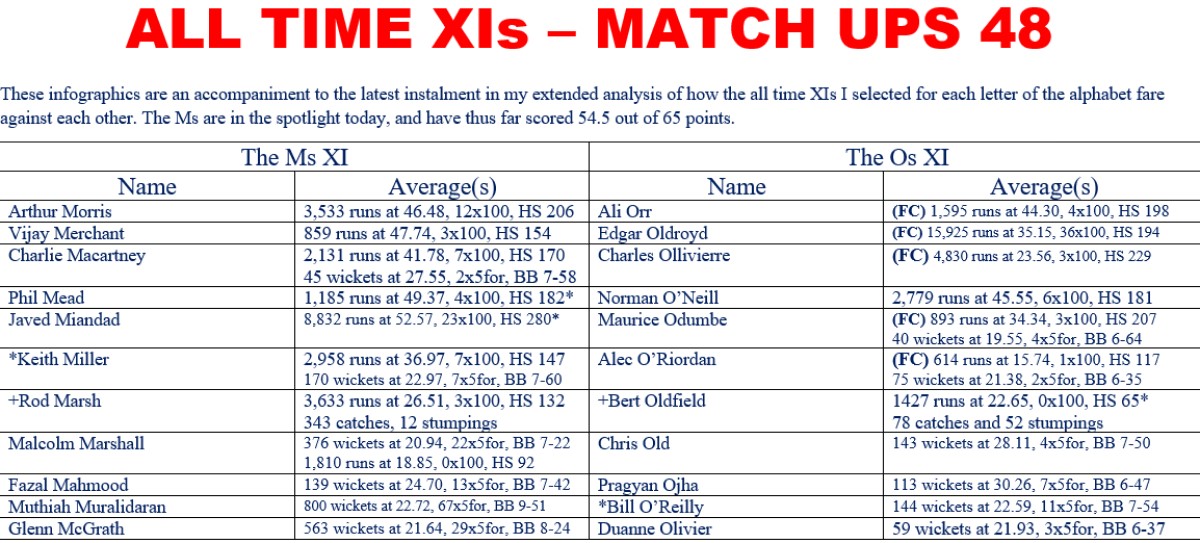
The Os are massively outclassed all across the board. The only crumbs of comfort for them are the presence of O’Riordan’s left arm and of leg spinner Bill O’Reilly. The Ms are simply too strong and there can be only one score: Ms 5, Os 0.

THE Ms V THE Ps
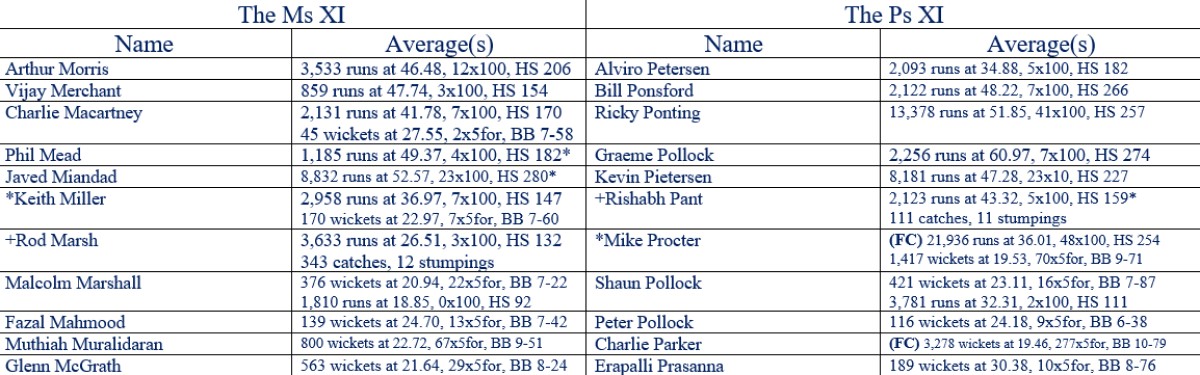
The Ms have the better opening pair, but Ponting and G Pollock win the number three and four slots batting wise, although Macartney offers a bowling option. Miandad beats Pietersen in the number five slot. Pant wins the batting element of his match up, but Marsh was the finer keeper. Procter may well have had a Milleresque record had he got the opportunity to enjoy a long test career, and these two legendary fast bowling all rounders are well nigh impossible to separate both as players and as captains. S Pollock outbats Marshall but is outbowled by the latter, P Pollock is outranked by McGrath. Murali comfortably wins the battle of the off spinners over Prasanna, but Charlie Parker, shockingly treated by the England selectors of his day, has to rated above Mahmood. These two sides are both very strong in batting, the Ms have the better keeper and the better pace bowling unit, while Parker, a left arm spinner, gives the Ps attack a better overall balance. I think the Ms advantage in pace bowling is just enough for them to win this one by the barest of margins: Ms 3, Ps 2.

THE Ms V THE Qs
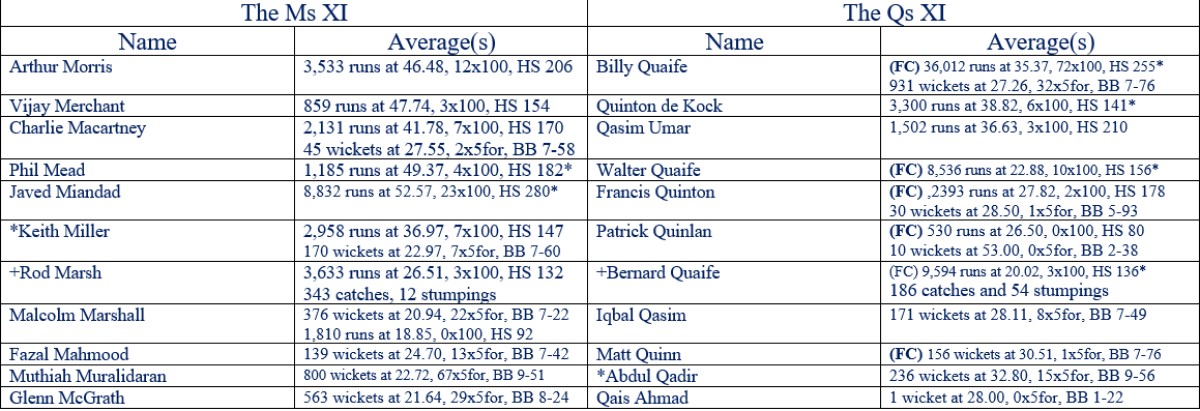
The Ms utterly dominate in batting and pace bowling, have the better keeper and the better skipper. Only in spin bowling do the Qs have anything to offer, but I think the gulf between the sides in other areas is so massive that even on a raging Bunsen they will be powerless: Ms 5, Qs 0.

THE Ms V THE Rs
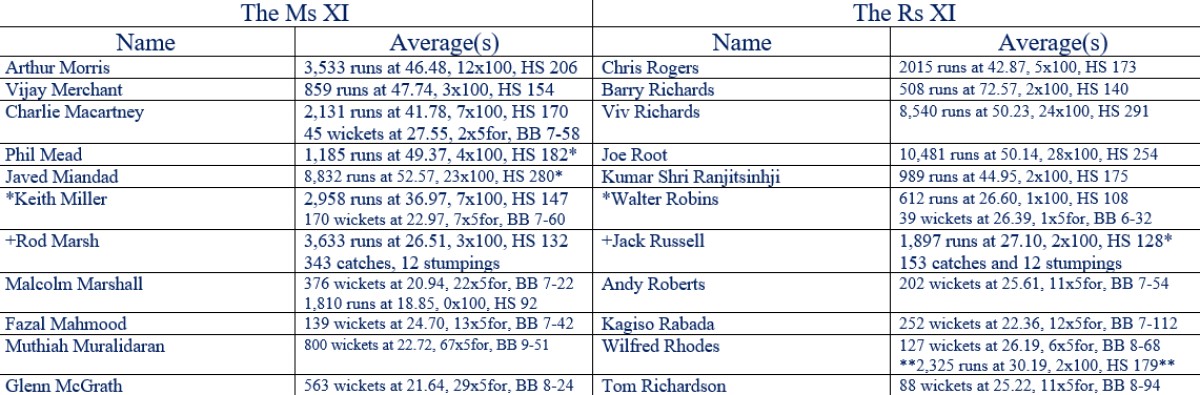
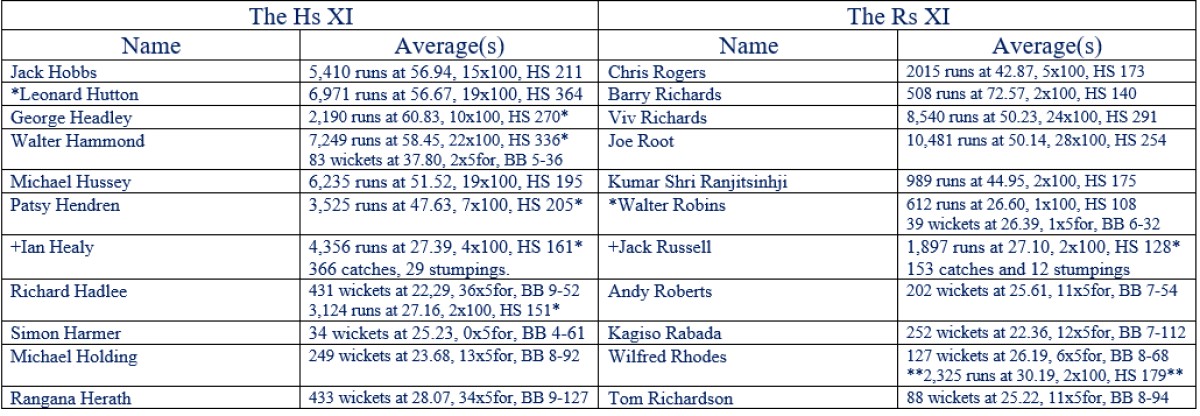
The opening pairs are fairly evenly matched – each features a high quality left handed opener and a brilliant right handed opener whose test opportunities were limited. Richards clearly ranks ahead of Macartney with the bat, but the Aussie offers his side an extra bowling option. The Rs win the number four slot on sample size and the relative lack of support Root has had for much of his career. As against that Miandad outranks Ranjitsinhji, and Miller wins the batting match up at six. We have a keeping clash of titans, in which for me Russell narrowly outpoints Marsh. Roberts, Rabada and Richardson are just outmatched by Marshall, McGrath and Miller, Murali outranks Rhodes, Mahmood outranks Robins, and the Ms have a sixth bowling option in Macartney. The Ms have a definite advantage: Ms 3.5, Rs 1.5.

THE Ms V THE Ss
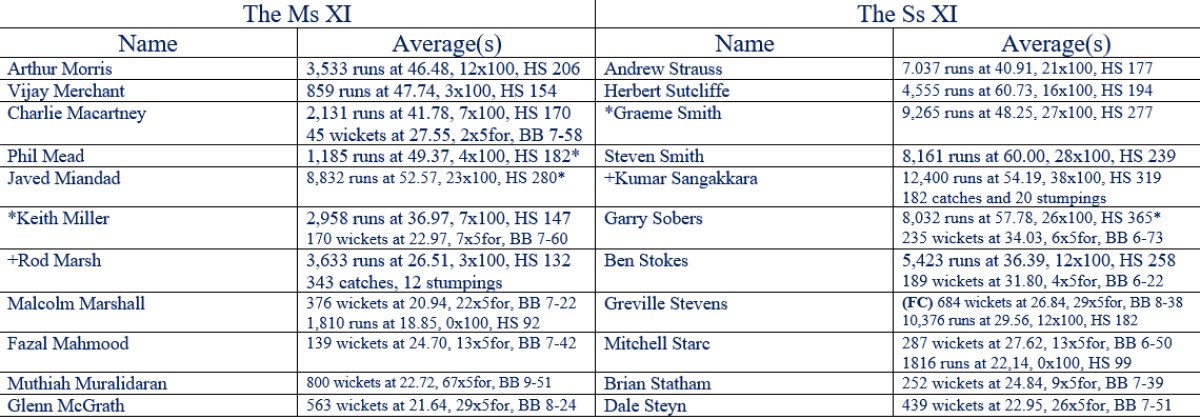
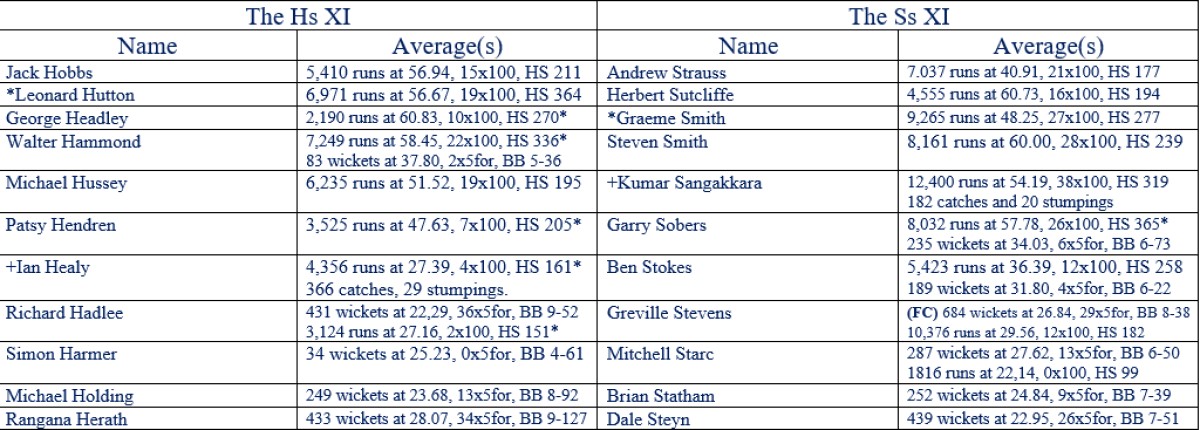
Morris rates ahead of Strauss, but Sutcliffe, provenly a big occasion player has to be rated ahead of Merchant, and therefore say that the Ss have the better opening pair. G Smith at three wins the batting match up against Macartney, with the usual caveat not applying, since the Ss have Sobers in their ranks. S Smith at four comfortably outranks Mead, Sangakkara at five wins the batting match up against Miandad, though Marsh wins the keeping match up comfortably. Sobers is well clear of Miller with the bat, but the Aussie’s fast bowling is ahead of any of the opposition save Steyn. The Ms have the best single spinner in this contest in the person of Murali. The Ms pace attack is superb, but all are right arm bowlers, whereas with Starc and the quicker version of Sobers the Ss have two left arm pacers. The quick version of Sobers is arguably the Ss fifth pace/seam option behind Stokes, so they have more depth in this department than the Ms. This is a mighty contest, but I think the Ss just have the edge: Ms 2, Ss 3

THE Ms PROGRESS REPORT

The Ms have scored 18.5 of a possible 25 points today, moving them up to 73 out 90 points, 81.11% so far.

PHOTOGRAPHS

My usual sign off…

All Time XIs – Match Ups 40

Continuing my extended analysis of how the all time XIs I selected for each letter of the alphabet fare against one another.

Welcome to the latest instalment in my extended analysis of how the all time XIs I selected for each letter of the alphabet fare against one another. Today the Js are in the spotlight, starting with 38 of a possible 75 points.

THE Js V THE Qs

The Js are massively stronger in batting and in pace bowling, and the only way the Qs are doing anything at all against them is if Qais Ahmad lives up to his potential and the Qs spinners have a field day. Even acknowledging this long shot as a possibility, I still score this one Js 5, Qs 0.

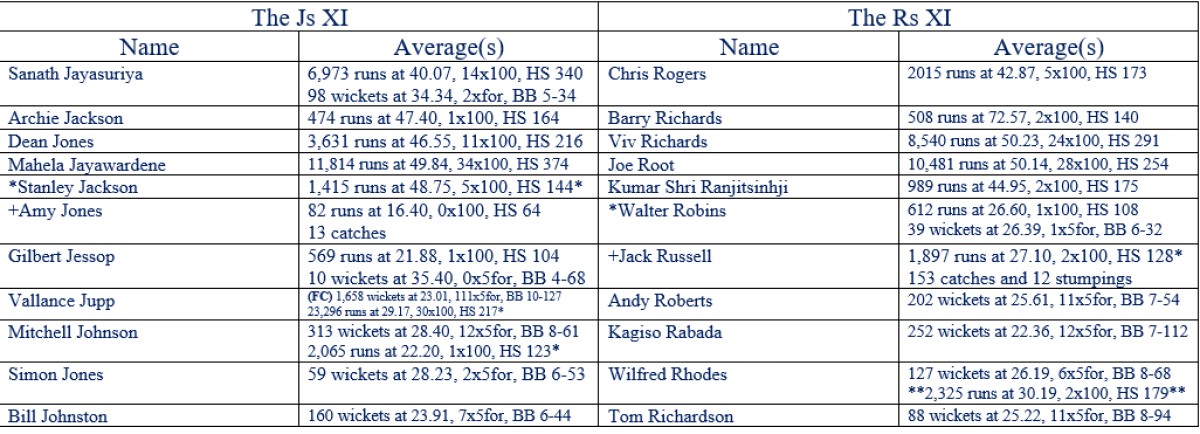
THE Js V THE Rs

The Rs have the stronger batting line up, both sides are ably captained, and the keeping match up is a clash of titans. Johnson and Johnston being left armers gives the Js pace attack more variation than the Rs, but the Rs are definitely ahead on spin bowling. Rs are well clear but not quite in whitewash territory: Js 1, Rs 4.

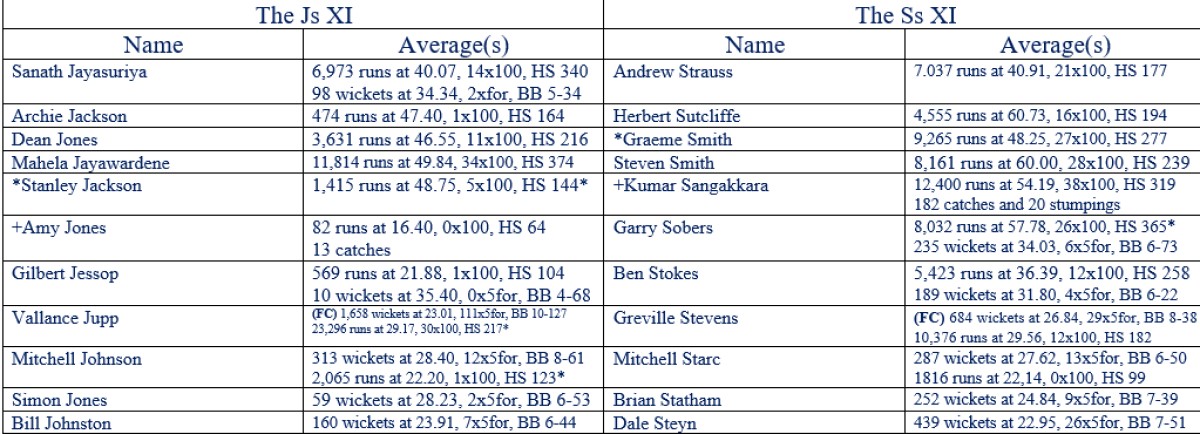
THE Js V THE Ss

The Ss have a super powerful batting line up, the better pace attack, and courtesy of Sobers cover virtually all angles known to spin bowlers (Sobers bowled wrist spin as well as orthodox, and left arm wrist spin is similar to orthodox off spin in angle of attack). Even with that ultimate x-factor guy, Gilbert Jessop, I cannot see the Js making a dent in this one: Js 0, Ss 5.

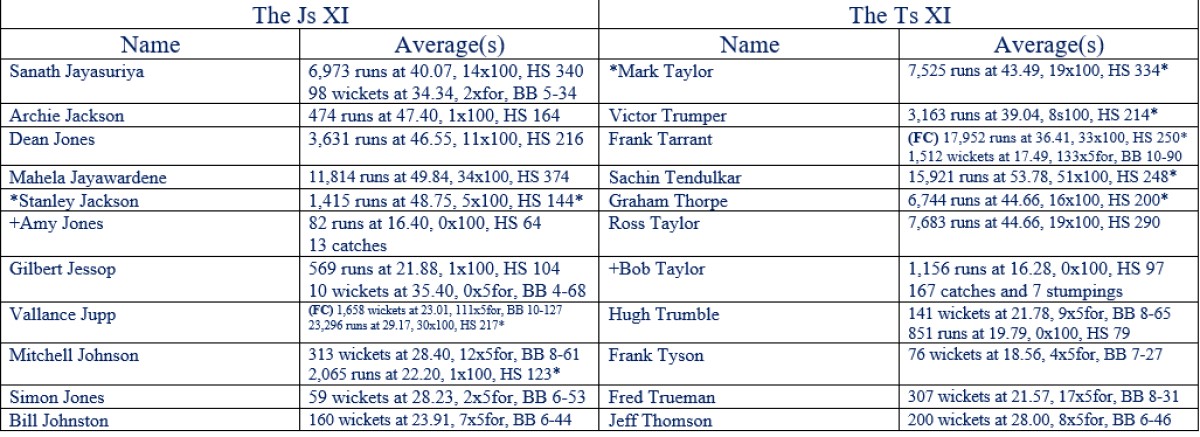
THE LETTER T

The Ts have the stronger batting line up, though Jupp and Johnson at eight and nine somewhat redress the imbalance there. Trumble outranks Jupp as an off spinner, and Tarrant outranks Jayasuriya and the slower version of Johnston as a bowler. The pace bowling is a tricky one: the Ts theoretically outrank the Js, but 1)the Js have extra variation through possessing left arm pace, 2)Johnson for all his middling overall record had a higher ceiling than any of the other pacers and 3)S Jones was also better than his average suggests. I think the Js actually therefore shade the fast bowling contest, but I don’t think that is enough to make up for losing in batting and spin bowling. Js 2, Ts 3.

THE Js V THE Us

The Js are ahead on batting, keeping, captaincy and pace bowling. The Us have an advantage in the slow bowling department. I see this is a clear win for the Js but will allow Underwood and Ur Rahman one field day: Js 4, Us 1.

THE Js PROGRESS

The Js have scored 12 out of 25 points today putting them on 50 out of 100, exactly 50%.

PHOTOGRAPHS

My usual sign off…

All Time XIs – Match Ups 36

Welcome to the latest instalment in my extended analysis of how the all time XIs I selected for each letter of the alphabet fare against one another. The Is occupy the spotlight, with 2.5 of a possible 55 points. Before getting to the main body of this post I pause to congratulate Ireland on a thumping nine-wicket win over the West Indies, a result which qualifies Ireland for the Super 12 stage of the T20 world cup and eliminates the West Indies.

THE Is V THE Ms

The Is have a small advantage in spin bowling, but the Ms are absolutely dominant everywhere else and there can be only one outcome: Is 0, Ms 5.

THE Is V THE Ns

The Is have a somewhat better batting line up than the Ns overall, the Ns have a much better pace attack, the Is have the better spinners. Nixon outranks Imtiaz in both departments, and I rate Noble a better captain than Illingworth. I think the Ns advantages in fast bowling and captaincy are the telling factors and score this Is 1.5, Ns 3.5.

THE Is V THE Os

Neither side is especially strong in batting, the Os have much the better pace bowling unit, a somewhat inferior spin attack, but much greater variation in their attack than the Is. The Os also have far the better keeper. I think the Os pace bowling settles the issue, but not by an emphatic margin: Is 2, Os 3.

THE Is V THE Ps

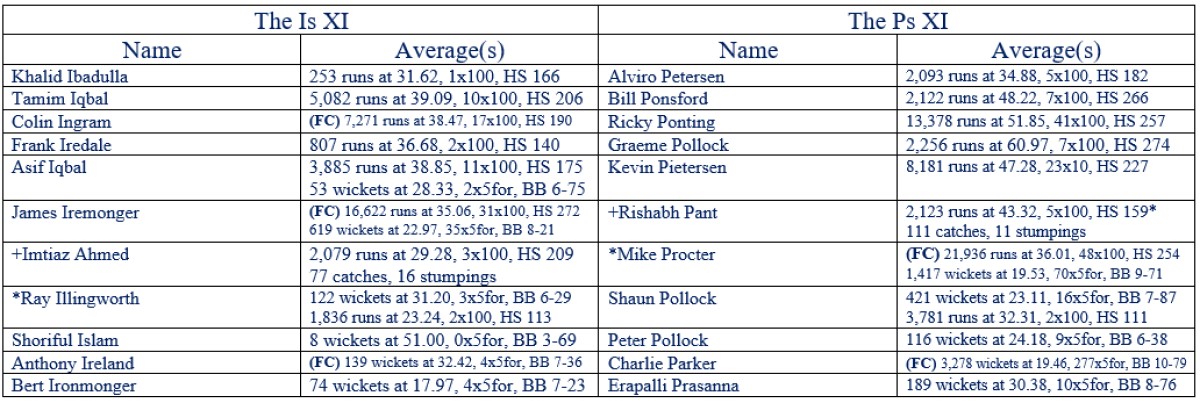
The Ps absolutely dominate in batting and pace bowling, have the better keeper and the better captain, and arguably win the spin bowling match ups as well – Prasanna definitely outranks Illingworth as an off spinner, while for all that the England selectors of the day treated him scurvily I would rate Parker ahead of Ironmonger as a left arm spinner. Thus I score this Is 0, Ps 5.

THE Is V THE Qs

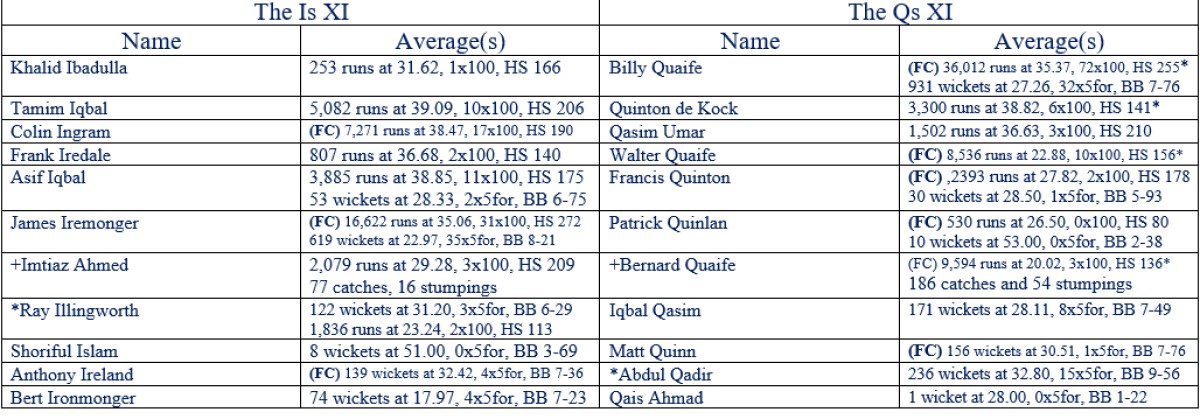
The Is a stronger in batting than the Qs, and they do actually have a seam attack, albeit a modest one, whereas the Qs have one accredited seamer. The Qs have the better spin attack, but I expect the Is to win this one comfortably: Is 4, Qs 1.

THE Is PROGRESS REPORT

The Is have scored 7.5 of a possible 25 points today, putting them on 10 out of 80 so far, 12.5%.

PHOTOGRAPHS

This is a somewhat different photo gallery. Yesterday I had to attend Sawston Health Centre in deepest Cambridgeshire for a CT scan. This entailed a 15-20 minute walk to King’s Lynn station, train to Ely, second train to Whittlesford Parkway, 25-30 mins walk from Whittlesford to Sawston, and similar in reverse save that I changed trains at Cambridge North on the homeward journey as the service I boarded at Whittlesford terminated there. Most of the photographs were taken at various stages of that journey…

All Time XIs – Match Ups 33

Continuing my extended analysis of how the all time XIs I selected for each letter of the alphabet fare against one another.

Welcome the the latest instalment in my extended analysis of how the all time XIs I selected for each letter of the alphabet fare against one another. This post sees us move past halfway in the match ups element of the series. The Hs are in the spotlight today and they so far have 36 out of 65 points.

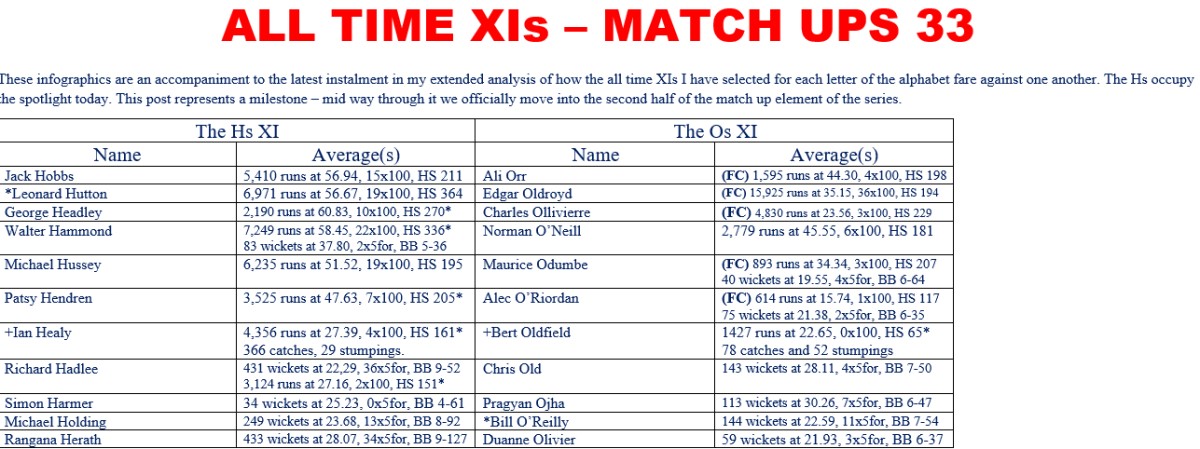
THE Hs V THE Os

The Hs have much the stronger batting, the better new ball pairing (although O’Riordan outranks Hammond as third seamer). The Os have the best individual spinner in this match up in the person of O’Reilly, and they also have a numerical superiority in that department, but Harmer and Herath both outrank Ojha. The Os have the better keeper, though Healy wins the batting element of that match up. The Os may have the better bowling attack and certainly have more options in both pace and spin departments, but the overwhelming superiority of the Hs batting renders that null: Hs 5, Os 0.

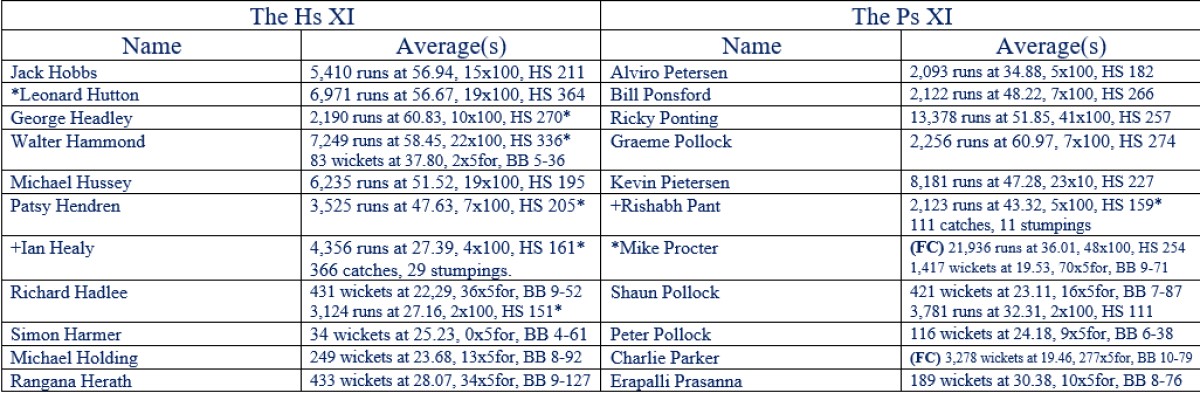
THE Hs V THE Ps

The Hs win five of the first six batting match ups, the Pant, Procter and S Pollock all their batting match ups. Healy outranks Pant as a keeper, Procter outranks Hutton as skipper. Hadlee and Holding v P and S Pollock is a close contest for which is the better new ball pairing, but Mike Procter massively outranks Hammond as a bowler. The Hs have the edge in spin bowling. I see this as about even in batting, the Ps ahead in pace bowling and the Hs a tiny bit better in the spin department, and I expect the Ps pace bowling to settle the issue: Hs 2, Ps 3.

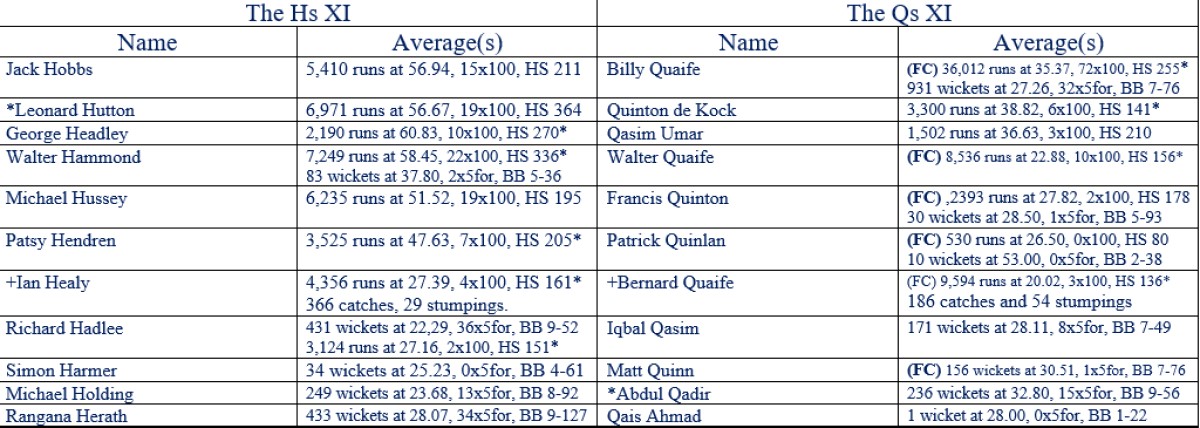
THE Hs V THE Qs

This one is clear cut, with the Hs ahead in all departments. Hs 5, Qs 0.

THE Hs V THE Rs

The Hs have the better batting line up, the Rs have the better keeper and also the better bowling – even if Hadlee and Holding are the best available new ball pair, which is open to debate, whoever out of Rabada, Roberts and Richardson ends as third seamer is way ahead of Hammond as a bowler. The spin department is closer, but Rhodes was certainly the finest of the four front line spinners featured in this match up. The Hs batting advantage is not enough to overcome their deficit on the bowling and keeping fronts: Hs 1.5, Rs 3.5.

THE Hs V THE Ss

This is very close on batting, with the Ss extra depth in that department possibly making the difference there. The Hs have the finer keeper, but the use of Sangakkara as keeper plus the presence of Sobers gives the Ss a range of bowling options far greater than that possessed by the Hs. Sobers in his quicker incarnation would be fifth choice seamer for the Ss, and he outranks Hammond, the Hs third seamer, as a bowler. Herath outranks the left arm orthodox version of Sobers, but does not also offer a wrist spin option. Harmer outranks Stevens. I think that with the batting fairly evenly match and the Hs having only a small advantage in spin bowling the Ss vast superiority in pace bowling gives them a huge win: Hs 0.5, Ss 4.5.

THE Hs PROGRESS REPORT

The Hs have scored 14 out of 25 points in this set of match ups, putting them on 50 points out of a possible 90, 55.56% so far.

PHOTOGRAPHS

My usual sign off…

All Time XIs – The Letter Q

Continuing my exploration of the ‘all time XIs’ theme with a look at the letter Q.

Welcome to the latest installment of my exploration of the theme of ‘all time XIs’. Today we look at players whose surnames begin with the letter Q. A certain amount of latitude has been exercised with the brief, though not quite as much as required by the letter X. Some of the players are comparatively obscure, hence both more quoting of exact career records and explanation than in some of these posts.

THE XI IN BATTING ORDER

  1. Billy Quaife (Warwickshire, England). The oldest ever scorer of a first class hundred at the grand old age of 56 years and four months. Only one player has scored more FC career runs for Warwickshire – Dennis Amiss. In addition to his batting he bowled serviceable leg spin, though given the make up of the side is unlikely to be required in that role.
  2. Quinton de Kock (South Africa). Using his forename to sneak him in. Although he is better known for his deeds in limited overs cricket the South African averages over 40 at FC level as well, and plays fast bowling well, hence, given the players available to me, using him as an ersatz opener and not as a wicket keeper.
  3. Qasim Omar (Pakistan). Not one of Pakistan’s better known top order players, but he played against England when they were there in 1984 and scored some valuable runs. Overall he averaged 39 at test level.
  4. Walter Quaife (Sussex, Warwickshire). Not the batter that Billy was, but by the standards of the 1880s and 1890s an average of 22.88 was modestly respectable, with pitches often difficult.
  5. Francis Quinton (Hampshire). 51 FC matches spread over 15 years in the late 19th century yielded him an average of 27.82, with two centuries and a top score of 178. He was also an occasional slow bowler, though not likely be needed in that capacity for this side.
  6. Patrick Quinlan (Ireland, Western Australia). 13 widely spaced FC matches yielded him 530 runs at 26.50, with four FC fifties. He was also an occasional right arm medium pacer, the relevance of which will be obvious by the end of the XI.
  7. +Bernard Quaife (Warwickshire). Although his father Billy liked the pair to open the batting together (they once did so against Derbyshire, whose new ball pair comprised Billy and Robert Bestwick, likewise related, to create a unique happening in FC cricket), he was never actually good enough as a batter to open, but he was a decent keeper, taking 186 catches and executing 54 stumpings at FC level in that role, and his 9,594 FC runs at 20.02 assume greater significance with batting being made his secondary role.
  8. Iqbal Qasim (Pakistan). Not one of the world’s best known left arm orthodox spinners, but 171 test wickets at 28.11 in 50 appearances at that level (999 FC wickets at 20.48 in 246 appearances) are a testament to his effectiveness in the role.
  9. Matt Quinn (New Zealand). A right arm medium fast bowler whose FC wickets cost 30.61 a piece, he is the only seamer for this letter who comes anywhere near making the grade.
  10. *Abdul Qadir (Pakistan). The 1980s was a difficult decade for spinners – and leg spin in particular almost fell into complete disuse at that time. With all due respect to Laxman Sivaramakrishnan (India) and Bob Holland (Australia) credit for this art form surviving long enough to be picked up by Shane Warne belongs chiefly to Abdul Qadir, whose 67 test appearances yielded 236 wickets at 32.80. That included a seismic performance at Faisalabad against the West Indies, then the dominant force in world cricket. WI needed 240 to win in the fourth innings, and Faisalabad is not exactly known for being bowler friendly. Pakistan won that match by 186 runs, and the chief architect of the West Indian collapse to 53 all out was Qadir, whose sorcery yielded 6-16. In recognition of his historical significance, and believing that he would have done the job well given the chance I have chosen him as captain of this XI.
  11. Qais Ahmad (Afghanistan). One of the best leg spinners currently playing the game, though rivalled in that department by his compatriot Rashid Khan. He will never have the historical significance of Qadir, but it would not surprise me if he finishes with a better overall record than the Lahori.

The XI is definitely short of batting, although deploying QDK as a specialist opener at least creates a chance of the top three delivering serious runs. There is only one recognized pace option, Matt Quinn. I see three ways round this: give Quinlan a few overs to get the shine of the new ball for the spinners, adopt a policy used with success by many English counties in the past, opening with right arm pace (Quinn) at one end and the left arm spin of Iqbal Qasim at the other (Kent won four titles between 1906 and 1913 with Fielder and Blythe, jusr such a combination, opening their bowling), or one or other of the leggies, Abdul Qadir or Qais Ahmad shares the new ball with Quinn.

ON THE FRINGES

I usually call this section ‘Honourable Mentions’ but there is nothing honourable about failing to claim a place in this XI, so I am using a title more reflective of the nature of this section of this post. I did locate one fast bowler other than Quinn to have a surname beginning with Q – James Quinton. However, even faced with a desperate shortage of options in his department I could not include someone who claimed one wicket in six FC matches. Hamidullah Qadri had a good time in the U19 World Cup, but at the moment his first class wickets cost 43 runs a piece and come at less than two per game, so although I had two leggies, a left armer and no specialist offie I could not include him. Imran Qayyum, a young left arm spinner, has a very similar FC bowling average to Qadri, and doesn’t seem likely to challenge Iqbal Qasim. Ian Quick, an Australian left arm spinner, paid just over 30 a piece for his FC wickets, not close to being as effective as Qasim, though he might be worth a place in an XI of players who don’t live up to their names! There was also one other challenger for the keeper’s slot, Trevor Quirk, a South African. His batting record was similar to that Bernard Quaife but over fewer matches, and he managed only 122 catches and eight stumpings (given the predominance of spin in the XI this last figure was a cause for concern as well).

PHOTOGRAPHS

Our cricketing exploration of the letter Q is at an end, and it remains only to provide the usual sign off…