Having selected all time XIs for each letter of the alphabet I am now beginning the task of looking at how they compare.
Having posted my all time Zs XI yesterday I am now attempting to analyse the merits of the respective XIs in competition. This is a major undertaking and will take a large number of posts. I start today with team A and cover its first five match ups.
THE As V THE Bs
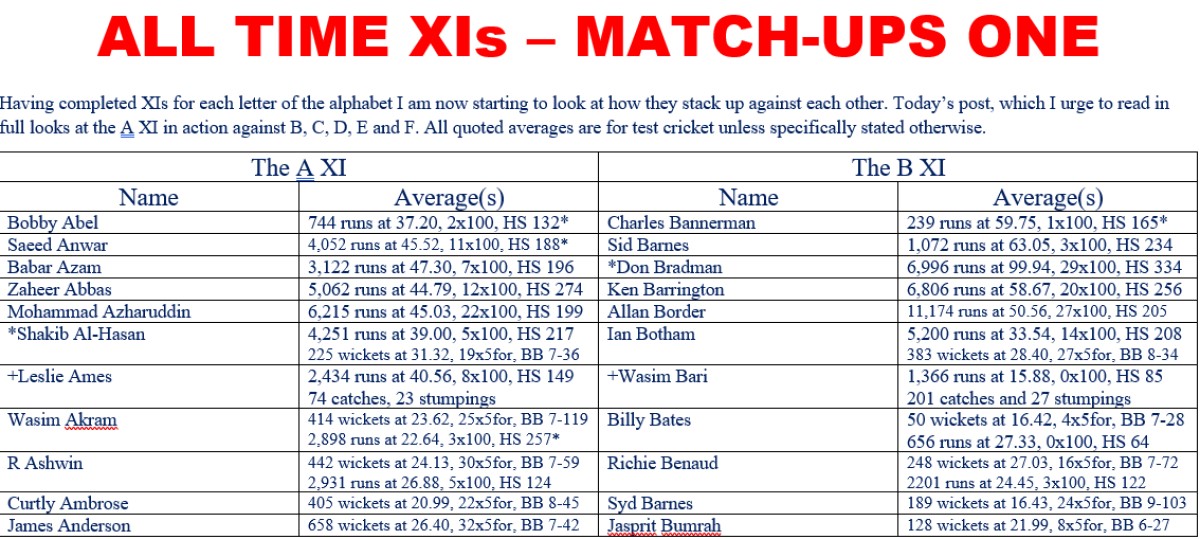
To set the scene, here a table showing two teams with the most important details about the players:
Both of these teams are deep in batting, with potential matchwinners in that department all the way down to number nine in each case, both teams have five high class bowling options. Team B’s top batting is much stronger than that of team A. It is very close between the two pace attacks, with Barnes’ utter brilliance compensating for Botham’s slightly expensive wicket taking rate. The spin bowling palm goes to the A XI, especially given that Al Hasan would probably fare considerably better as part of a strong attack than he actually does as part of a comparatively modest one. I would expect the Bs to win, probably 3-2 over a five match series, maybe even 4-1. Envisaging five match series, and thus using a five point scoring scale I score this as B 3.5, A 1.5
THE As V THE Cs
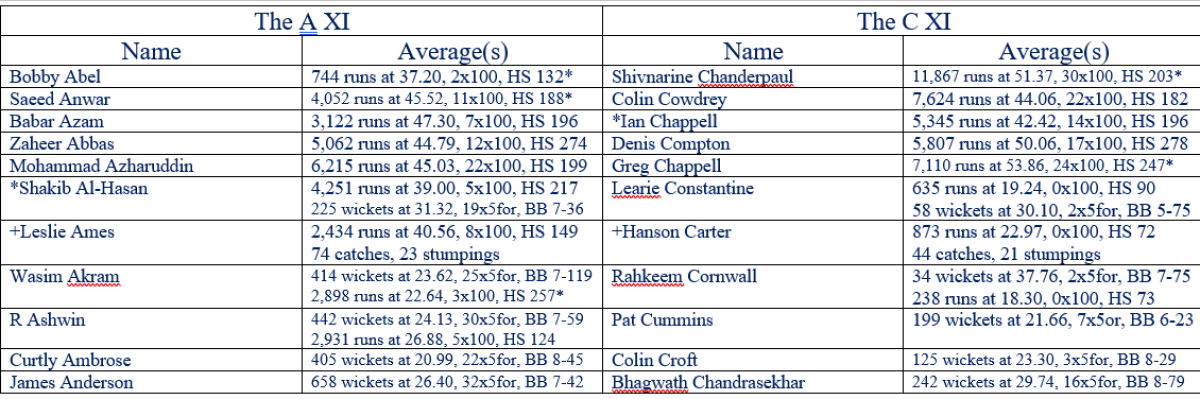
Here, the Cs have a stronger top five than the As, but 6,7 and 8 are weak slots, in all of which they are outpointed, while as good as Cummins and Croft are, they certainly do not do more than match up to Ambrose and Anderson, while Akram is clearly superior to Constantine. Ashwin is streets clear of Cornwall and from a bowling point of view Chandrasekhar has Al Hasan beaten. Ames v Carter is a mismatch in Ames’ favour. Overall, the power of the Cs top five batters notwithstanding I give team A a commanding advantage in this one, scoring at as As 4 Cs 1.
THE As V THE Ds
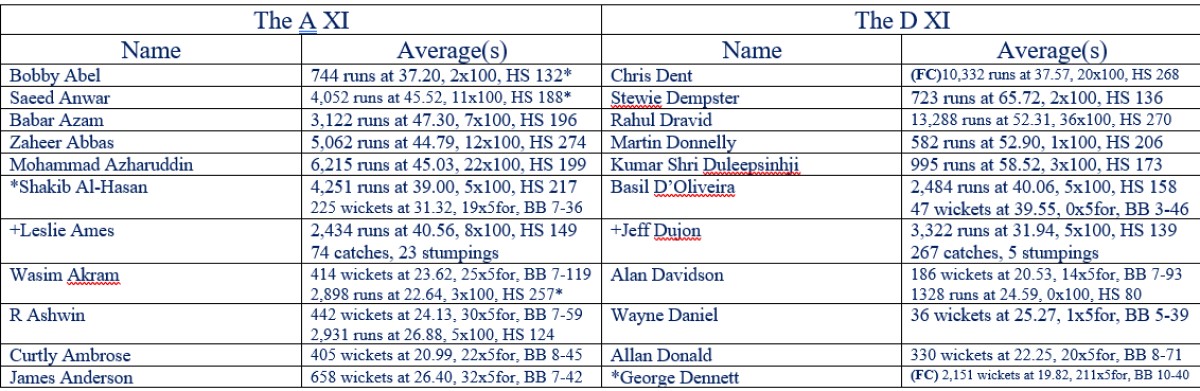
Dempster wins the battle of the right handed openers, Anwar that of the left handed openers. Dravid has a clear advantage over Azam. Donnelly and Duleep are at least a match for Abbas and Azharuddin. D’Oliveira, especially when his circumstances are taken into account is better with the bat than Al Hasan. Ames has to considered a better bat than Dujon, but the West Indian compensates for that by being the finer keeper. Akram v Davidson is a clash of the titans, but Davidson just edges it, having better averages in both departments. Daniel and Donald match evenly against Ambrose and Anderson. Dennett is a better SLA than Al Hasan, but he is the sides only front line spinner, whereas Al Hasan is second spinner behind Ashwin. Overall, I marginally favour the Ds in this contest, scoring it as Ds 3 As 2.
THE As V THE Es
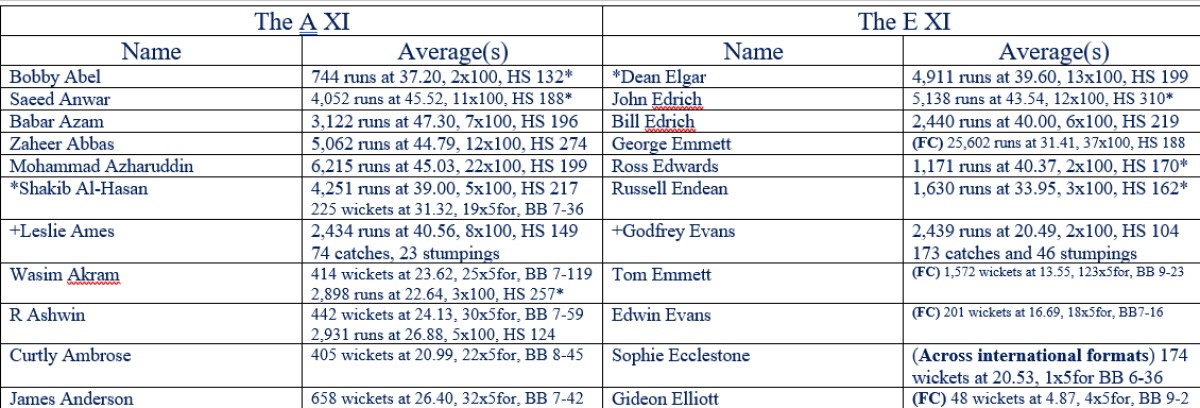
The As dominate on the batting front, with batters 2-7 inclusive outdoing their counterparts from the Es, while Abel’s performance on Victorian era wickets probably equates to rather better than Elgar’s on modern surfaces. Evans is a better keeper than Ames, but the Es have only four front line bowlers to the As five. The Es bowlers are very good, with Ecclestone the best spinner on either side. I think the As have a very clear advantage here, but not enough for a whitewash to be on, so my score is As 4, Es 1.
THE As V THE Fs
This is a hard one to call. The As are ahead on batting, but the Fs have stronger bowling. My own reckoning here is that Fs greater range of bowling options and the captaincy of Percy Fender, one of most astute ever in that role, give them an edge, and I score it as Fs 3, As 2.
THE As SCORE AT PRESENT
Tallying up the scores at this point, The As are on 13.5 of a possible 25, 54% of possible points. The only one of the five sides we have put them up against so far who have an absolutely indisputable advantage over them are the Bs.
Continuing my exploration of the all time XIs theme with a look at the letter Z.
I continue my exploration of the all time XIs theme with a team of players whose names begin with Z. I included Zaheer Abbas in the As, and in keeping with my policy that no one will feature is two XIs in this trip through the alphabet I therefore do not select him today. Other omissions can wait until the Honourable Mentions section.
THE XI IN BATTING ORDER
Fakhar Zaman (Pakistan). A left handed opening batter with a magnificent ODI record, a respectable test record and a good FC average.
Ibrahim Zadran (Afghanistan). A right handed opening batter, currently averaging 44 test cricket, and with a good FC record.
Zubayr Hamza (South Africa). A right handed top order batter who averages 48 in FC cricket, though he has not been successful at test level as yet.
Najibullah Zadran (Afghanistan). His opportunities at test level have been limited to date, but he has a fine record in limited overs cricket, and I am prepared to give him the benefit of the doubt.
Khaya Zondo (South Africa). Has an excellent FC batting record, though has not yet been given the opportunity to prove himself at the highest level.
Billy Zulch (South Africa). A right handed batter and occasional right arm medium pacer, he averaged 30 in test cricket when SA were a struggling outfit, had a good FC record.
+Zulqarnain Haider (Pakistan). An innings of 88 in what proved to be his only test (he fled Pakistan in fear of his own safety) underlined his skill with the bat and he was a fine keeper as well.
Monde Zondeki (South Africa). A right arm fast bowler who took his test wickets at 25 a piece.
Zia Ur Rehman (Afghanistan). A left arm orthodox spinner who takes his FC wickets at 19 a piece, but has yet to be given a chance at test level. Afghanistan have amazing strength in depth in the spin bowling department, and his test opportunity may never arrive.
Zaheer Khan (India). A left arm fast medium bowler, his test average of 32 looks on the high side, but he rarely had much in the way of pace support (India having strength in depth in the pace bowling department is a recent phenomenon).
Zahir Khan (Afghanistan). A left arm wrist spinner who claims his FC wickets at 21 a piece and bowled respectably in his three tests, though seven wickets at 34 a piece is a record that needs improvement.
This XI has a solid batting unit, a good keeper who can bat and four varied bowlers. It is a pity that the back up seam options are limited to Ibrahim Zadran and Billy Zulch, neither of whom could be classed as front line bowlers, but Zaheer Khan, Zondeki, Zia Ur Rehman and Zahir Khan should function fairly well as a main bowling attack.
HONOURABLE MENTIONS
The main rival to Fakhar Zaman as left handed opener was Hazratullah Zazai of Afghanistan, but though he has a respectable FC record he has yet to be picked for a test match. No right handed opener comes remotely close to challenging Ibrahim Zadran – while his test average of 44.50 comes from only eight innings at that level (no not outs to boost the average), his first class average of 41 comes from a much larger sample size and confirms his class. He averages about 18 runs an innings more than Zak Crawley at test level and 12 an innings more than the proven failure who happens to be a management favourite manages even at FC level.
Bas Zuiderent of the Netherlands played a fine innings against England in the 1996 World Cup, but overall his record is quite ordinary. Saif Zaib is an alleged batting all rounder, but his FC averages at the moment are the wrong way round – 22 with the bat and 31 with the ball. Tim Zoehrer was Zulqarnain’s rival for the gauntlets, but he had such a poor series in the 1986-7 Ashes that spectators at the MCG of all places were heard expressing the opinion that even the New South Welshman Greg Dyer would be in improvement on him (of course they really wanted their own Dimattina to get the job).
Mohammed Zanhar, a Sri Lankan leg spinner, took his FC wickets at 25 a piece, but only played 10 matches at that level. Adam Zampa has a great record in limited overs cricket, but his FC wickets come at massively pricey 48 runs a piece. Two fast bowlers, Dawlat Zadran of Afghanistan and Nuwan Zoysa of Sri Lanka (who once took a hat trick with his first three balls of a test match) entered my thoughts but neither had that great an overall record. Zak Chappell is expensive even at first class level, and is nearly as far short of meriting serious consideration as the other Zak I have mentioned in passing.
While I regret the absence of a genuine all rounder that omission could only be rectified by outright cheating, using a nickname to avail myself of ‘Zulu’ Klusener.
PHOTOGRAPHS
We have finished our cricketing journey through the letter Z and all that is left is my usual sign off…
Continuing my exploration of the all time XIs theme with a look at the letter Y.
I continue my exploration of the all time XIs theme with a look at players whose surnames begin with the letter Y (the kind of chicanery required for the letter X is not needed for this letter. A quick reference back to the Xs – Ted DeXter was an honourable mention for the Ds, so I felt able to include him in the Xs, and edited yesterday’s post to reflect this – please read the edited version. VVS Laxman was in the Ls XI, and I am not allowing myself to include someone in two different XIs in this trip through the alphabet.
THE XI IN BATTING ORDER
Michael Yardy (Sussex, England). A left handed opening batter who scored over 10,000 FC runs at 36, and also an occasional bowler of left arm orthodox spin, though his chief value in that department was in limited overs cricket.
Martin Young (Gloucestershire). A right handed opener who was a consistent score for his county for a number of years without ever attracting the attention of the England selectors.
Younis Khan (Pakistan). Over 10,000 test runs at 52, and number three is this right hander’s natural position in the order.
Mohammad Yousuf (Pakistan). He also averaged 52 in test cricket, though he did not score quite as many runs as Younis Khan. He holds the record for most test runs in a calendar year with 1,788.
Graham Yallop (Australia). A left handed batter with a fine test record in that department.
*Norman Yardley (Yorkshire, England). A right handed middle order batter, and a right arm medium pacer who revealed an aptitude for breaking partnerships on the 1946-7 tour of Australia. He was also a fine captain, a role I have given him in this side.
+Saleem Yousuf (Pakistan). A fine wicket keeper and useful right handed batter.
Umesh Yadav (India). A right arm fast bowler, his presence at no eight indicates this team’s biggest issue – lack of runs from the lower order.
Waqar Younis (Surrey, Glamorgan, Pakistan). One of the fastest bowlers in the world in his pomp, and one of the finest pacers his country ever produced.
Jack Young (Middlesex, England). A left arm orthodox spinner who took his FC wickets at less than 20 a piece, but got few opportunities at test level.
Poonam Yadav (India). The most controversial of all my selections, the diminutive leg spinner has a fine record in all formats, including 3-68 in her only test appearance to date. I have mentioned various skilled female cricketers in a lot of these posts, and a look at the E XI will confirm that I have named at least one female in a previous XI.
This XI has a solid opening pair who should be able to set a platform for the engine room of Younis Khan, Mohammad Yousuf and Graham Yallop. Yardley would captain the side well, which should make up for any shortfall in his own performance. Saleem Yousuf is a fine keeper, and there are four excellent bowlers. The pace department is a trifle thin, with Yardley officially third seamer, but Jack Young and Poonam Yadav look a fine spin combo. Overall I would expect this XI to give a decent account of itself.
HONOURABLE MENTIONS
Other than those I named there were three obvious candidates for opening batting slots: Bryan Young and Will Young, both of New Zealand have done the job at test level, but in both cases their record is no more than respectable. Rob Yates has had his moments for Warwickshire, but is too inconsistent to merit selection. Among middle order batters Suryakumar Yadav and Yashpal Sharma are unlucky that this team has such a strong middle order.
The only wicket keeping alternative to Saleem Yousuf was Hugo Yarnold of Worcestershire, but he was far inferior to Yousuf as a batter, and given the length of the tail as things were I felt the slot had to go to the Pakistani.
Three off spinners, Bruce Yardley, Shivlal Yadav and Jayant Yadav, were available, and any of them would have strengthened the batting, but all have moderate bowling records, and I am not prepared to boost the batting at the cost of reducing the team’s chances of taking 20 wickets. A left arm wrist spinner, Kuldeep Yadav, was available, and was the logical alternative to Poonam Yadav for the role of the second spinner. Radha Yadav, a left arm orthodox spinner, has had some successes for the Indian women’s team, but does not as yet compare to Jack Young, and like him is not to be relied on with the bat.
The only quick bowler other than two I selected that I could think off was Kuldip Yadav, a left arm fast medium bowler, but he has one first class scalp to his name, which makes picking him an unwarrantable gamble for me.
I end with one for the future: Yash Dhull, an off spinning all rounder, has had some captaincy experience with India Under 19s, and I will be surprised if in ten years time he does not dislodge Norman Yardley from the number six slot in this team. He has made a sensational start to his FC batting career, although he has yet to do much with the ball at that level. I would also sound a mild cautionary note: Tom Lammonby scored three centuries in his first six FC matches, but fell away badly in his first full length season to the extent that he was actually dropped five matches into it.
PHOTOGRAPHS
Our cricketing journey through the letter Y is at an end, and all that is left is my usual sign off…
Continuing my exploration of the All Time XIs theme with a look at the letter X.
I continue my exploration of the all time XIs theme with a look at the letter X. Filling the XI required a considerable amount of chicanery, so even though other players than the eleven I chose merited consideration I shall not be producing an ‘Honourable Mentions’ section today. Most of this XI have at least some international experience, and some are genuinely top class. Also, although we get into the all rounders a trifle too early for comfort, there are no absolute bunnies.
THE XI IN BATTING ORDER
MaX O’Dowd (Netherlands). His country’s most consistent current batter.
MaX Holden (Middlesex). A left handed opening batter. His FC record is modest, but he does average over 40 in list A cricket, and he is still young enough to do something about that FC average.
Ted DeXter (Sussex, England). A dashing right handed stroke maker, a useful medium-fast bowler and a fine fielder.
*Alan KippaX (Australia). His opportunities at international level were limited, not least because he did not get on well with Don Bradman, but an FC average of 57 tells you how good he was. He and Halford Hooker shared the all time record 10th wicket stand in FC history, turning 113-9 into 420 all out. He was a notably stylish batter to the extent that some even mentioned him in the same sentence as the immortal Victor Trumper.
Sam LoXton (Australia). An aggressive right handed batter (the five sixes he hit in his 93 at Headingley in 1948 remained an Ashes record for a single innings until Old Trafford 1981 when Ian Botham hit six in his 118) and a right arm fast medium bowler.
AXar Patel (India). A good enough left handed batter to average 33 in FC cricket and a very fine left arm orthodox spinner. His test opportunities have been limited by his being a contemporary of Ravindra Jadeja, but when England visited and Jadeja was injured he was the best bowler in the series.
Xenophon Balaskas (South Africa). A leg spinner and good lower middle order batter.
Ron OXenham (Australia). A right arm medium pacer, and a useful batter as well. He once shared a match winning last wicket stand of 76 while nursing an injury.
+Tom BoX (Hampshire, Surrey, Sussex). A wicket keeper and right handed batter. The earliest player to actually feature in an XI in this series, having played FC cricket between 1826 and 1856. His 247 FC appearances yielded 235 catches and 162 stumpings, and given the make up of this team that high number of stumpings counts in his favour. Between 1832 and 1856 inclusive he played in every single match involving Sussex. Given what my reading on the game;s history has told me about the state of pitches early in cricket’s history I have mentally upgraded his batting average of 11.95 and moved him a couple of places up the order in consequence.
MaX Walker (Australia). A right arm fast medium bowler, known as “Tangles” on account of somewhat unorthodox approach to the wicket. He was at his best as third seamer behind Lillee and Thomson. He took his test wickets at 27 a piece, a respectable figure.
MaX Waller (Somerset). A leg spinner, and like Walker above him, a reasonably competent lower order batter rather than an out and out tail ender.
THOUGHTS ABOUT THE XI
The opening pair of MaX O’Dowd and MaX Holden is definitely makeshift, but I would expect the latter to at least be able to bat for a bit of time even if he didn’t score many. Dexter at three and KippaX at four are the engine room of the side batting wise, with the latter the best batter in the side, and due being a contemporary of a number of superstackers is somewhat underrated. He is this XI’s answer to Joe Root, though a better captain than the Yorkshireman. LoXton is probably a place too high, but he did average closer to 40 than 30 with the bat. AXar Patel is probably the third most important player in the side behind DeXter and KippaX. Balaskas and Oxenham were both genuine all rounders as well, and Box, a superb keeper, never got to bat on properly prepared pitches – even Fuller Pilch, the best batter of his era, averaged under 20 at FC level, which lends some context to Box’s average of 11.95. MaX Walker was an authentically test class fast medium bowler, and Waller is not the worst of leg spinners, though his Fc record is modest. The XI is undoubtedly a touch light on batting, but the bowling is good to compensate. The big question is whether to open with OXenham and LoXton to enable MaX Walker to come on as third seamer, or use the one genuine test class seamer as a new ball bowler. DeXter is not the worst fourth seamer either.
PHOTOGRAPH
Our brief cricketing excursion through the letter X is at an end and it remains only to apply the usual sign off…
I continue my exploration of the all time XI theme with a look at surnames beginning with the letter W. Such is the immense strength of players who qualify for this team that a second XI of near equal strength could easily be selected and some fine players would still miss out.
THE XI IN BATTING ORDER
Frank Woolley (Kent, England). A left handed batter known for his excellence against fast bowling, a high class left arm orthodox spinner and a brilliant close catcher. He frequently opened for Kent, especially late in his career when he found the newer ball easier to see first up. This was the only way I could accommodate the only cricketer ever to achieve the triple career landmark of 10,000 runs (58,969), 1,000 wickets (2,066) and 1,000 catches (1,018).
*Frank Worrell (West Indies). A right handed batter of high class (averaged 49 in test cricket), opening was one of his positions, though he could bat anywhere. He was also a useful left arm seamer, and one of the greatest of all captains, a role I have given him in this side. West Indies has unique features in international cricket terms, being in truth a composite side, with players from a number of different countries who usually view each other as rivals making up the XI. The number of captains who have overcome these rivalries sufficiently to create a genuinely unified and harmonious team totals two, Worrell, also the first black captain WI ever had, and Clive Lloyd.
Everton Weekes (West Indies). Statistically the finest batter to have a surname beginning with W, having averaged 58.61 at test level. A powerful stroke maker, but one who believed firmly in keeping the ball on the ground. He was a dual international, having represented Barbados at contract bridge.
Clyde Walcott (West Indies). A powerful right handed batter, occasional wicket keeper and even more occasional seamer. He averaged 56.62 at test level.
Steve Waugh (Australia). Until 1989 his seam bowling was a makeweight which kept him in the team while his batting matured. The 1989 Ashes changed all that, as he began the series with two massive unbeaten centuries, setting a pattern that would endure from then until his retirement. He allowed his right arm medium-fast bowling to fall in virtual abeyance as his right handed batting flourished and he became one of the best in the world in that department. He made tough runs – his batting was crucial to the series win in the Caribbean in 1995 which set the seal on Australia’s ascent to the top of the cricket world, and on a pig of an Old Trafford wicket he chiselled out twin centuries to settle the match in favour of his side.
+BJ Watling (New Zealand). A superb keeper and a gritty right handed middle order batter.
Sammy Woods (Somerset, Australia, England). In his day one could only play county cricket by qualifying by residence for a county, which meant giving up playing for his home country. He turned for England against South Africa, but not, as Billy Midwinter had done against Australia. An attacking middle order batter, handicapped at Somerset by often having almost nothing to come after him and a right arm fast bowler of superb quality. He was also a fine captain, and with all respect to the guy one place below him in this order would be my choice as Worrell’s vice captain in this XI.
Shane Warne (Hampshire, Australia). Arguably the greatest of all leg spinners (although Bill O’Reilly and Clarrie Grimmett both took more wickets per game at better averages), a fine slip fielder and a useful lower order batter, holding the record for most test runs without a century (HS at that level 99).
Johnny Wardle (Yorkshire, England). A left arm orthodox spinner and a left arm wrist spinner (probably more needed in this latter category in this XI), and a hard hitting lower order batter. His career ended prematurely when he made the mistake of publicly criticising Yorkshire for their appointment of Ronnie Burnett as captain, but 102 wickets at 20.39 at test level is testament to his skill, and I don’t see Worrell having any problems handling him.
Bill Whitty (Australia). A left arm fast medium bowler whose 14 tests yielded 65 wickets at 21 a piece, an excellent prospective new ball partner for the man one place below him in the order…
Bob Willis (Surrey, Warwickshire, England). A right arm fast bowler. His ‘phoenix from the ashes’ turn around in 1981, when at Headingley he was called up for one final burst from the Kirkstall Lane end knowing that anything other than quick breakthroughs would spell the end of his test career and proceeded to blow Australia apart, claiming eight wickets in next to no time extended his test career by three years and meant that by the end he had claimed 325 wickets at the highest level, at the time an England record.
This is a superb XI, with a stellar top five, a keeper who can bat, an aggressive all rounder at seven and four wonderfully varied specialist bowlers. A bowling attack that features Willis, Whitty, Woods and Worrell to bowl seam, and Warne, Wardle and Woolley as spin options is top of the range by any standards.
HONOURABLE MENTIONS
This is its own way is the most difficult section of its type that I have yet had to write, and will feature many subsections. I am starting with three name checks because all with strong advocates for their inclusion.
DAVID WARNER
A fine attacking left handed opener, but could only be accommodated by dropping either Woolley with is vast range of skills or Worrell, my chosen captain. Although I could quote sandpapergate against him I settle for saying that I had strong positive reasons for selecting Woolley and Worrell rather than reasons for not selecting alternatives.
MARK WAUGH
‘Junior’ or ‘Afghan’ as he was referred to (the latter because of the delay compared to his twin brother in him getting international recognition – ‘the forgotten Waugh’) was a fine batter in the middle order in tests and opening in limited overs, as safe a slip fielder as I have ever seen in action and an occasional off spinner. However, the stellar records of my chosen specialist batters and my preference for five genuine bowlers left no space for him. If Aussies didn’t volubly disapprove of such things I would name him as designated substitute fielder.
KANE WILLIAMSON
One of the best batters in contemporary cricket, but just who out of Weekes, Walcott or S Waugh would I drop to make way for him? Sadly, as great as he is he has to miss out.
OPENING BATTERS
I have already dealt with Warner, but there are a stack of other openers who need to be mentioned. Bill Woodfull was a fine opener for Australia in his day, but a small mark against him as the considerable fall off from an FC average of 65 to a test average of 46, respectable rather than truly great. John Wright was a gritty and determined opener for New Zealand. ‘Plum’ Warner was the second England player ever to carry his bat through a test innings, and was also a notable captain. Siddath Wettimuny played a crucial role in the test match in which Sri Lanka first made the cricketing world treat them with respect, at Lord’s in 1984. His 190, which lasted until the third morning of the match was the underpinning of a Sri Lankan score of 491-7 declared. Shane Watson did well for Australia as a makeshift opener, but rarely produced really big scores. Albert Ward of England had a fine series in the 1894-5 Ashes but not the necessary consistent test success to merit any more than a mention. Finally, the silky skills of Laura Wolvaardt, for my money the best player of the cover drive of any contemporary cricketer deserve an honourable mention.
MIDDLE ORDER BATTERS
Doug Walters is probably the best middle order batter beginning with W that I have not yet mentioned. I considered acknowledging his partnership breaking skills as a medium pacer by giving him the number seven slot that I actually assigned to Woods, but preferred the genuine all rounder to the batter who bowled. Willie Watson was at the heart of one of cricket’s greatest rearguard actions at Lord’s in 1953, when England saved a match in which they looked beaten for all money, Watson holding out for approximately six hours. However his overall record falls short of greatness, so not even his left handedness could get him in. Another left hander who had to miss out was Vic Wilson, a gritty batter, Yorkshire’s first ever professional captain and a brilliant short leg fielder. Bob Woolmer had his moments for England, including three centuries, all against the oldest enemy, but he was a definite cut below top class. Imad Wasim of Pakistan is not quite good enough with the bat to qualify, and in a team already featuring Woolley and Wardle his left arm spin is a non-factor.
ALL ROUNDERS
David Wiese of Sussex and Namibia would have been one of the first names on the team sheet had I been picking with limited overs in mind, but his FC record while good is not on a par with his limited overs record. Rockley Wilson had a good record for Yorkshire and did well for England when getting a late call up, but is chiefly known for his work at Winchester College where one of his charges was a certain DR Jardine. Vyell Walker shares with WG Grace the distinction of scoring a century and taking all ten wickets in an innings of the same first class match, but I needed a fast bowling all rounder.
WICKET KEEPERS
Other than Watling I considered John Waite and Harry Wood of England for the gloves, but neither have the weight of achievement that Watling does.
FAST BOWLERS
The biggest miss here was Courtney Walsh, but I felt that he and Bob Willis were a trifle to similar, both being right armers of similar height, whereas Whitty’s left arm introduced an extra level of variation. Two injury blighted England quicks of different eras, Mark Wood and Alan Ward missed out. Willie Watson of New Zealand had a respectable test record, but like many others of his era his main job was to support Richard Hadlee. Arnold Warren of Derbyshire took five cheap wickets on his only test appearance. Daniel Worrall, an Aussie born seamer who has played a lot of county cricket was another to miss out. Probably the best quick bowler I overlook was Thomas William Wall of Australia, but his average ended up the wrong side of 30 due to the strength of the batting he came up against and the fact that he was often the only quick bowler in the side. Luke Wood, a left arm quick, is just beginning to make a name for himself, and may displace Bill Whitty in time. Mike Whitney of Australia was called up in an injury crisis after just six FC appearances, and established a respectable record. William Woof, the first player ever to sign a professional contract with Gloucestershire, was a left arm bowler who took 754 FC wickets at less than 18 a piece, but the fact that he was never chosen to play for England tells against him. Similarly, Tom Wass of Nottinghamshire, a right arm bowler of fast medium or leg spin who took 1,666 FC wickets at 20.43 just misses out, partly because the leg spin aspect of his bowling would not get much use in this XI.
SPINNERS
JC ‘Farmer’ White was a very fine left arm spinner, essential to England’s success in the 1928-9 Ashes, but lost out to Wardle due to the fact the Yorkie could bowl wrist spin as well as orthodox, whereas White could only bowl orthodox. Had the leg spinner’s slot not been an automatic selection I would have considered Amanda-Jade Wellington of Australia. Doug Wright, taker of seven first class hat tricks, was too inconsistent to qualify.
PLAYERS OF HISTORICAL SIGNIFICANCE
Tom Walker of Hambledon had to be overlooked due to lack of a verifiable career record, but as the first cricketer ever to have been styled ‘old everlasting’ he deserves a mention. John Willes and Edgar Willsher were key contributors to two major transitions in bowling history – the former the introduction of round arm, and the latter the move from round arm to over arm. Tom Wills was involved in the 1868 tour of England by a team of aboriginals and also created Aussie Rules football to give Aussie c.ricketers a way to keep fit during the close season.
OTHER LETTERS
Two players who would otherwise have merited considerable thought, Waqar Younis and MaX Walker were needed for other letters of the alphabet – X requiring a considerable degree of chicanery to fill.
ONE FOR THE FUTURE
Isabelle Eleanor Chih Ming Wong, generally known as Issy Wong, is a young quick bowler who has also had her moments with her aggressive batting, including a 94 (33) in domestic cricket. In ten years or so, if she keeps improving in both disciplines she may challenge Woods for the number seven slot.
PHOTOGRAPHS
Our cricketing journey through the letter W is at an end and it remains only to apply the usual sign off…
Continuing my exploration of the all time XIs theme with a look at players whose surnames begin with V.
I continue my exploration of the all time XIs theme with a look at players whose surnames begin with the letter V. There were many challenges with the selection of this side, which I will elucidate through the post.
THE XI IN BATTING ORDER
Michael Vandort (Sri Lanka). A left handed opening batter, his test record was respectable rather than outstanding.
Joe Vine (Sussex, England). A right handed opening batter and a leg spinner. His job for much of his career was to bat defensively for long periods – Sussex sides of his time were well equipped with stroke makers, but no so much with folk capable of playing the anchor role. An innings of 202 in five hours late his career showed that he could play more expansively when the situation allowed. His batting and bowling averages are the right way round.
*Michael Vaughan (Yorkshire, England). A right handed batter, occasional off spinner, and an excellent captain, a role I have given him in this side.
Gundappa Viswanath (India). A right handed batter possessed of consdierable grit and determination. He averaged over 40 in test cricket.
Dilip Vengsarkar (India). A right handed batter who averaged 42 in test cricket. He scored tough runs as well – he averaged a run more per innings against the West Indies, utterly dominant in his era, than he did in overall test cricket. At Headingley in 1986 when no one else on either side could score even one 50 he produced innings of 61 and 102.
+Kyle Verreynne (South Africa). A right handed batter and a fine wicket keeper. He is still establishing himself at test level, but he averages over 50 in FC cricket, and his keeping skills are abundantly clear.
Chaminda Vaas (Sri Lanka). A quality left arm fast medium bowler who never benefitted from having adequate seam support, and a useful left handed lower order batter. I freely admit that he is one place higher than would be ideal, but none of the bowlers I have named could accurately be described as mugs with the bat.
Bert Vogler (South Africa). A leg spinner, part of the great ‘googly quartet’ that South Africa fielded in the years 1907-10. His test wickets cost 22 a piece and came at well over four per match. In first class cricket his averages were the right way round – 20 per innings with the bat and 18 runs per wicket with the ball.
Hedley Verity (Yorkshire, England). One of the greatest of all left arm orthodox spinners. 144 test wickets at 24 a piece in a decade that featured doped pitches and Bradman’s batting is a fine record, and he also averaged 20 with the bat in test cricket. At first class level he was an absolute destroyer, claiming is wickets at 14.90 a piece, which enabled him to have batting and bowling averages the right way round.
Bill Voce (Nottinghamshire, England). A high quality left arm fast medium bowler, and a useful lower order batter. He was part of the 1932-3 England side that won 4-1 down under, and was the best bowler in the side four years later in a 2-3 defeat.
Vintcent Van Der Bijl (South Africa). The only member of this XI not to play test cricket, due to apartheid, but regarded as a great bowler by all who met him. The deeds at test level of the likes of Garner, Ambrose and McGrath are testament to how effective exceptionally tall bowlers can be at that level. He took his FC wickets at 16.57 a piece, though he doesn’t quite join the list of players in this side with their averages the right way round since he only averaged 16.20 with the bat.
This side contains an opening pair likely to build a good platform for the engine room of Vaughan, Viswanath and Vengsarkar to cash in on, a keeper who is also a genuinely high class batter, and a strong and varied bowling unit. Van der Bijl and Voce with the new ball will pose a challenge for anyone, and I suspect that Vaas as third seamer in a strong attack rather than opening bowler in an ordinary one would be even better than he actually was in the circumstances he faced, while Verity and Vogler are on reckoning a quality pair of contrasting spinners. My selection here absent a genuine all rounder (Vine, though a respectable bowler definitely does not merit the title all rounder) is an extreme example of my preference for strong bowling resources even if it means slightly limited batting. I refer sceptical readers to the deeds of Yorkshire in the 1930s and Surrey in the 1950s for examples of champion sides who were such precisely because of their bowling strength.
HONOURABLE MENTIONS
I start this section with a subsection devoted to a single player…
ADAM VOGES
Ignoring current players, a couple of whom are in the mix, this man has the highest batting average among those to have played 20 or more test matches, so why does he miss out? Quite simply because he cashed in on some pop-gun attacks, and in the only Ashes series he was part of, he like his team came a cropper. Thus, at the risk of enraging worshippers of the baggy green, I declined to select him.
OPENING BATTERS
Pieter Van Der Bijl (father of Vintcent) did well in his five test matches, including coming within a few runs of notching twin tons in the last ever timeless test match, at Durban in 1939. Murali Vijay had a respectable record for India. In short form cricket, especially T20, Elyse Villani of Australia’s women’s team would have a strong case, but there is a notable falling off in her record even between T20 and OD cricket.
MIDDLE ORDER BATTERS
Hanuma Vihari has a magnificent record in Indian domestic cricket, but has never delivered at international level, and his best position is number three, reserved in this XI for skipper Vaughan. Martin Van Jaarsveld had a solid record in domestic cricket but his test record was modest, whereas Vaughan,Viswanath and Vengsarkar were all proven at the highest level. Mike Veletta had a decent record in Australian domestic cricket, but a test batting average of less than 20 tells its own story about him at international level. Lou Vincent of New Zealand was no more than a goodish middle order batter, reflected by averaging in the mid thirties. Bryan Valentine of Kent had an excellent record in the few test matches he got to play, and I regretted not being able to include him. Dane Van Niekerk of South Africa Women is excellent at T20, good at OD cricket, but has hardly played any long form cricket.
WICKET KEEPERS
Other than Verreynne two candidates entered my thoughts. Sadanand Viswanath was one of the most talented keepers India ever produced, but that talent was largely unfulfilled, especially at international level. He has 25 years experience as an umpire however, so there is a role for him. Ricardo Vasconcelos started sensationally at Northamptonshire, but has fallen back in recent years, with his FC batting average standing at 34.
BOWLERS
The two bowlers I most regret not being able to accommodate were both left arm spinners, and unsurprisingly could not challenge the claims of Hedley Verity. Alf Valentine, the second of ‘those two little pals of mine’, took the first eight wickets to fall in the first test innings in which he ever bowled, but his overall record was not as good as Verity’s. Daniel Vettori of New Zealand may well be the second best spinner ever to have been born in the land of the long white cloud behind Clarrie Grimmett, who played his test cricket for Australia, but he comes some way short of challenging Verity.
PHOTOGRAPHS
Our cricketing journey through the letter V is at an end and all that remains is the usual sign off…
Continuing my exploration of the all-time XIs theme with a look at the best cricketers to have surnames beginning with the letter U.
I continue my exploration of the all time XIs theme with an XI of the best players to have surnames beginning with U. As I type this post I am listening to Trent Rockets vs London Spirit in The Hundred – today should be day four of England v South Africa, but even with over half of day one lost to rain England went down to an innings defeat before yesterday’s play was done.
THE XI IN BATTING ORDER
Taufeeq Umar (Pakistan). A left handed opening batter with a test double hundred to his credit, and an overall average of close to 40.
George Ulyett (Yorkshire, England). Right handed opening batter and right arm fast bowler. His batting record looks ordinary to our eyes, but in the period between 1877 and 1890, when he played, scoring was much lower than nowadays. His batting and bowling averages were the right way round, and he achieved notable feats in both departments, with a test best of 149 and best bowling figures of 7-36.
Imam Ul-Haq (Pakistan). A left handed top order batter with a respectable test record.
Inzamam Ul-Haq (Pakistan). A right handed middle order batter with a test average just short of 50 and an occasional left arm spinner.
*Misbah Ul Haq (Pakistan). My designated captain, a role he performed wirth distinction for his country. A right handed middle order batter, who briefly held the record for the fastest ever test century in terms of balls faced. He came very late to test cricket but still managed 75 appearances, and recorded a batting average of 46.
Polly Umrigar (India). Right handed batter, part time off spinner. Until Gavaskar came along he held Indian records for most test runs and most test hundreds
+Umar Akmal (Pakistan). An attacking right handed batter and this team’s wicket keeper. He really ought to have done better than just over 1,000 test runs at 34 given the talent he had.
Umar Gul (Pakistan). Right arm fast medium bowler, right handed batter. A fine bowler with a splendid yorker.
Umran Malik (India). One of the fastest bowlers around, and one who I am sure will fare well in test matches when the time comes. It is less than three years since he first bowled with a proper cricket ball, and he is already making waves in limited overs cricket.
Derek Underwood (Kent, England). A specialist left arm slow medium bowler, especially effective on rain affected surfaces and pitches that had broken up (he would have been a destroyer on the Ahmedabad surface that saw England beaten inside two days in 2021) and very economical on all surfaces.
Mujeeb Ur Rahman (Afghanistan). An off spinner with a magnificent record in limited overs cricket. I am prepared to credit him with being able to bowl well in any format, and have chosen him on that basis, this being one of the more difficult letters.
This team has seven quality batters, five genuine front line bowlers (Ulyett being an all rounder is the key). Umran Malik, Ulyett and Umar Gul is a strong pace attack, albeit not quite on a par with the Ts, while Underwood and Mujeeb Ur Rahman offer craft and guile, and should complement each other well.
HONOURABLE MENTIONS
This is a short section. Derek Ufton was at one time Knott’s understudy at Kent, but was not good enough to be selected for this side. Andrew Umeed, a Scot who bats right handed and bowls a bit of leg spin has just started playing for Somerset. His record at present is very moderate, but he may yet develop into a fine player.
Continuing my exploration of the all-time XIs theme with a look at cricketers whose surnames begin with the letter S. This piece spans two and a half centuries, five continents and even mentions one of the great fictional cricketers.
The exploration of the all-time XI theme continues with a look at players whose surnames begin with the letter S. This one was very tough, not because of any difficulty finding players of sufficient standard but because there was a lot overlap in terms of the expertise of the very best players, and balancing the side was a challenge that required compromise, of which more later.
THE XI IN BATTING ORDER
Andrew Strauss (Middlesex, England). A fine opening bat, and twice an Ashes winning skipper, though I have not given him that role in this side.
Herbert Sutcliffe (Yorkshire, England). 4,555 test runs at 60.73, 2,741 Ashes runs at 66.85.
*Graeme Smith (South Africa). One of the best captains of the modern era, and a top class left handed batter. He was a regular opener, but I believe he would handle first drop superbly as well.
Steven Smith (Australia). First called up on account of his leg spin bowling, he established himself as Australia’s best test batter since Bradman. After serving a ban for cheating (an incident that ruled him out of any leadership responsibilities) he returned to action with twin tons at Edgbaston in 2019.
+Kumar Sangakkara (Surrey, Sri Lanka). One of two serious candidates for the title of best batter his country has ever produced (Jayawardene being the other), and a good keeper as well. Usually I prefer to select a specialist keeper, rather than use a batter to perform this role, but circumstances dictate this selection.
Garry Sobers (Nottinghamshire, West Indies). The most complete cricketer ever to play the game. Devastating batter, left arm bowler of pace, swing, seam and both finger and wrist spin, gun fielder.
Ben Stokes (Durham, England). Attacking left handed batter, right arm fast medium bowler.
Greville Stevens (Middlesex, England). A leg spinning all rounder whose FC averages were the right way round (29 with the bat, 26 with the ball). This slot caused me more grief than any other – with three gun fast bowlers rounding out the order I wanted a spinner, and with Sobers present, neither a left armer of any description, nor a regular off spinner (similar line of attack to Sobers in his wrist spin guise) would be ideal. There were two candidates within these constraints – this chap, and Paul Strang of Zimbabwe, and the latter paid 36 per wicket at test level and over 30 at FC level.
Mitchell Starc (Australia). One of the fastest bowlers in the world at present, and while his highs are not quite up at Mitchell Johnson 2013-14 levels, his lows are nowhere near the depths of 2010-11 Johnson.
Brian Statham (Lancashire, England). One of Lancashire’s greatest ever fast bowlers, and one of the select few to have an end of his home ground named in his honour (James Anderson, also at Old Trafford, is in this club, as are Barbadians Joel Garner and Malcolm Marshall).
Dale Steyn (South Africa). The greatest fast bowler of the immediate post McGrath period, and surely a shoo-in for an all time South Africa XI even given their strength in the pace bowling department.
This XI features a super powerful top six, Stokes with full licence to attack and a powerful quartet of bowlers. The pace attack, with the quick version of Sobers arguably fifth choice in that department (behind Steyn, Starc, Statham and Stokes) is awesome, and Stevens plus Sobers in his slower guises should offer sufficient spin to augment that attack. Sangakkara as keeper violates my usual principal of going for the best keeper, but he was good enough to do the job for Sri Lanka on a regular basis.
HONOURABLE MENTIONS
A multi-faceted section starting with…
THE NUMBER EIGHT SLOT
There were two off spinners who would have their advocates for these position but missed out for reasons of balance: Harbhajan Singh of India and Graeme Swann of England, who each paid a little over 30 a piece for their test wickets and who were both useful lower order batters.
However, had I been willing to ignore considerations of balance I had a raft of top options to pack out the pace battery: Frederick Spofforth, a legend from the early days of test cricket was probably the pick of those I overlooked, but two present day Indians, Mohammad Shami and Mohammad Siraj would have their advocates as well, Peter Siddle of Australia is a quality practitioner if perhaps a notch below the very top bracket, Amar Singh, part of India;s first ever test side, was also indisputably a great fast bowler. John Snow of England was another great pacer who could have had this slot. Olly Stone, the Norfolk born Warwickshire and England pacer who has been plagued by injuries has the ability, but not the proven track record. Barbadian all rounder Franklyn Stephenson, one of only two cricketers to do the double of 1,000 runs and 100 wickets in first class matches in an English season since the reduction of the programme in 1969 (the other, Richard Hadlee, also played for Nottinghamshire) would appeal to some as a number eight.
I was conscious of the merits of all these players when making the call to select Greville Stevens, and my contention is not that he is a better cricketer than them, but that he is a better fit for the team, given the players who already had irrefutable claims for selection.
OPENING BATTERS
Bert Sutcliffe, the legendary New Zealand left hander, still holder of the record first class score by a native of that country (385 for Otago vs Canterbury, in a team score of 500 all out, with Canterbury contributing 382 off the bat in their two innings combined), and with a fine test record was a serious candidate for Strauss’ slot as left handed opener.
Among the right handed openers I could find no space for were Andrew Sandham, a member of the 100 first class hundreds club, Virender Sehwag, devastating unless the ball was swinging, when he could look very ordinary, Bobby Simpson of Australia, Michael Slater also of Australia and Alec Stewart of England all had impressive records as right handed opening batters. Arthur Shrewsbury of Nottinghamshire and England, second best 19th century batter behind WG Grace, was another who could have done a fine job in this role. Reg Simpson of Nottinghamshire and England had moments at the top level, including a 156* against Australia which set up a test victory for England, but he was not in the same bracket as the others.
MIDDLE ORDER BATTERS
I start this section by drawing your attention to my all time XI of Smiths, so that I do not have to repeat myself regarding players with that surname. Marlon Samuels and Ramnaresh Sarwan of the West Indies can both count themselves unlucky to have surnames beginning with S – under most other letters they would merit serious consideration. Mahadevan Sathasivam of Sri Lanka has legendary status in his own land, but for a series like this I have to deal in hard facts, so he misses out.
WICKET KEEPERS
Roy Swetman was a fine keeper in the 1950s, and Herbert Strudwick of Surrey and England made more dismissals in first class cricket than any keepers bar JT Murray of Middlesex and Bob Taylor of Derbyshire, though he often batted number 11, which with Statham and Steyn having ironclad claims for places was problematic.
ALL ROUNDERS
Darren Stevens’ performances since moving south from Leicestershire to Kent have been outstanding, but he has never played anything other than county cricket.
SPINNERS
Maninder Singh of India was a fine bowler, but as a left arm orthodox spinner he overlaps with Sobers, and he was a genuine bunny with the bat. Reggie Schwarz of Middlesex and South Africa missed out, because for all his importance as the guy who learned the googly from its creator Bosanquet and taught it to a number of his South African colleagues he actually used the googly not as part of his bowling armoury but as his stock ball, therefore becoming effectively an off spinner, a less good fit for the XI than a more standard leg spinner. Molly Strano, a consistently successful performer in Australian domestic cricket, and therefore by definition a superb bowler also misses out because she is also an off spinner.
BLASTS FROM THE PAST
Lack of sufficiently concrete records for two players prevented me from considering them: Edward ‘Lumpy’ Stevens, a great bowler of the late 18th century and Heathfield Harman Stephenson, whose performance for the All England XI at the Hyde Park Ground in Sheffield led to the coining of the phrase ‘hat trick’. He dismissed three of his opponents with successive deliveries, and the Sheffield crowd were so impressed by this display of bowling virtuosity that they used a hat to collect money for Stephenson and made him a presentation of both hat and money.
A FICTIONAL TALENT
Tom Spedegue, hero of a short story by Arthur Conan Doyle, in which he pioneers a new type of delivery which descends on the batter from the clouds “Spedegue’s Dropper” and shatters that season’s visiting Australians by taking 15 wickets in what turns out to be his first and only test would certainly have added variety to the attack had he been real.
WHITE BALL TALENTS
Had been selecting with limited overs cricket in mind Navjot Singh Sidhu and Sanju Samson would both have been close to inclusion.
FUTURE TALENTS
Will Smeed, scorer of the first individual century in The Hundred, is an obvious talent for the future. Glenton Stuurman (pronounced like ‘Steerman’), a young South African quick bowler is very promising, though he has a huge amount to do to come close to dislodging his compatriot Steyn. Sophia Smale, a 17 year old left arm orthodox spinner has announced herself with a couple of fine performances in the Hundred.
PHOTOGRAPHS
Our cricketing journey through the letter S, spanning two and a half centuries and many continents, is at an end, and it remains only to apply the usual sign off…
My exploration of the all time XIs theme continues with a team of players whose surnames begin with R, including a hugely detailed honourable mentions section, and a bumper photo gallery.
After yesterday’s struggles to produce an XI of players who could all be filed under the letter Q, today’s task of selecting an XI of players with surnames beginning with the letter R presents an altogether different challenge.
THE XI IN BATTING ORDER
Chris Rogers (Northamptonshire, Derbyshire, Middlesex, Australia). The immense strength of Australia’s batting when he was in his prime meant that he got the test call up very late in his career. Nevertheless, 25 matches at that level yielded him over 2,000 runs at 42.87, respectable by any standards. In FC cricket he scored over 25,000 runs at almost 50.
Barry Richards (Hampshire, South Africa). His test career was nipped in the bud by the expulsion of apartheid South Africa. Four matches at the highest level yielded him 508 runs at 72.57. He was also the leading run scorer in the first year of Packer’s World Series Cricket, when the bowling was seriously good. Don Bradman, certainly qualified to assess the merits of batters, rated him the best right handed opener he ever saw in action.
Viv Richards (Somerset, Glamorgan, West Indies). The ‘Master Blaster’ was the only cricketer from the Caribbean to achieve the career milestone of 100 first class hundreds. In England in 1976 he was untouchable, tallying 829 for the series even though he missed a match due to injury. He was also the first authentically great ODI batter. West Indies in his playing days were frequently accused of intimidatory bowling, but it was also noted that he was capable of intimidatory batting.
Joe Root (Yorkshire, England). Certainly the greatest batter England have produced in my lifetime, and a strong case could be made that he is England’s greatest ever (Grace, Hobbs, Sutcliffe, Hammond, Hutton and at a pinch May and Barrington would merit consideration in this discussion).
KS Ranjitsinhji (Sussex, England). He averaged 56.48 in first class cricket, though his appearances at test level were limited, he scored 989 runs at 45 at that level, including twice topping 150 against Australia. He was the first known to deliberately score behind the wicket on the leg side, pioneering the leg glance. He was born in a princedom in northern India, and India;s oremier domestic FC competition is still named in his honour.
*Walter Robins (Middlesex, England). A leg spinning all rounder, and a great captain who conjured a county championship in 1947 for a Middlesex side that was strong in batting but did not have a great bowling attack. Denis Compton, one of Middlesex’s all time greats, and a star of the team in Robins’ day rated him the best captain he ever played under.
+Jack Russell (Gloucestershire, England). One of the greatest keepers ever to play the game and a hugely underrated left handed batter. He scored a test century against the 1989 Australians when they were running rampant against a frankly shambolic England. He scored a defiant half century when Ambrose was ripping his way through England in Barbados in 1990. Another example of his unyielding determination came against South Africa at Centurion. He joined Atherton with England pretty much buried, and the pair proceeded to bat through two complete sessions to salvage a draw for their side.
Andy Roberts (Hampshire, Leicestershire, West Indies). The spearhead of the original West Indies pace quartet in 1976, he took 202 test wickets at 25 a piece, morphing as he matured from a fire and brimstone type bowler into an unhittably accurate one. He was also a useful lower order batter.
Kagiso Rabada (South Africa). At the age of 27 he is just about in the age range usually regarded as a cricketer’s prime years, and he already has 243 test wickets at 22 a piece, sufficient whatever happens in the rest of his career to underwrite his claim to the status of a great fast bowler.
Wilfred Rhodes (Yorkshire, England). One of the most extraordinary of all cricketers, he had a five-phase career: specialist left arm spin bowler, all rounder, specialist batter (in the 1911-12 Ashes he was England’s number two batter both in terms of his position in the order and in terms of his position in that series’ averages and didn’t bowl), all rounder (having hardly bowled in the years leading up to WWI, he picked up his bowling in 1919, and as though he had never abandoned it, he proceeded to top the national averages for that season), and finally, as his eyesight began to go, a few final years as a specialist bowler, before retiring to make way for the emerging Hedley Verity, who he summed up in typically laconic fashion “he’ll do”, which from Rhodes was a positively euphoric assessment. Given the cricketers available for the letter R I choose to use him in this XI as the specialist bowler he was both at the start and the end of his amazing career, one of the greatest ever. He was the only bowler ever to take over 4,000 first class wickets, and only three others even tallied 3,000, and none of those were ever of any great value with the bat. Of the top ten all time FC wicket takers only the mighty WG Grace outranks Rhodes as a batter. A final comment to end this section, from the legendary Victor Trumper, when Australia were piling up a massive total on a flat one, 185 of them from Trumper himself, and amidst the carnage Rhodes took 5-94 from 48 overs, at one point leading to Trumper saying “for goodness sake Wilfred, won’t you give me a moment’s peace?”.
Tom Richardson (Surrey, Somerset, England). Only 14 tests for the lion hearted fast bowler, but he took 88 wickets at 25 a piece in those matches. He took more FC wickets for Surrey than any other bowler, and reached the career landmarks of 1,000 FC wickets (134 matches) and 2,000 (327 matches) quicker than any other bowler.
This XI has one great (B Richards) and one very good opener, a power packed engine room of Viv Richards, Root and Ranjitsinhji, an all rounder who happens also to be great skipper, one of the greatest of all keepers, who was also a useful batter, and four great specialist bowlers. A fast attack of Roberts, Rabada and Richardson, backed by the spin of Rhodes and Robins, plus possible part time off spin support from Root and the Richardses is an any reckoning a stellar bowling unit. This is one of the strongest XIs to feature in this mini-series.
HONOURABLE MENTIONS
This is a multi-part section. The first subsection deals with probably the finest of the eligible cricketers not to make the XI…
CLIVE RICE
26,000 FC runs at 41, 900 FC wickets at 21, and no place for him? The problem is that this letter has immense strength available, and he never played test cricket due to circumstances. There is no way to know how he would have fared at test level – some (e.g Herbert Sutcliffe) do better against tougher opposition, some like Graeme Hick and someone we will be meeting later in this piece do very much worse. Also, fitting him in to the XI would be a major challenge – I would either have to drop one of my top five, all of whom have ironclad claims to their places, or change the balance of the side by dropping Robins and naming someone else as captain, or drop one of my three unarguably great fast bowlers to accommodate a batting all rounder, again changing the balance of the side.
OPENING BATTERS
CAG ‘Jack’ Russell averaged 59 in his brief test career, including becoming the first English batter to record twin tons in a test match, but the brevity of his career at the top tells against him. Jack Robertson, who contributed 12 tons to Middlesex’s 1947 championship winning season, played 11 test matches, averaging 46, and had he been left handed would have been a challenger to Rogers, but given that he played less than half as many tests as the Aussie and his average was not that much greater I felt that he had to be left out. Tim Robinson had an impressive start against India away in 1984-5 and Australia at home in 1985 but was unceremoniously found out by the West Indies mean machine in the Caribbean in 1986. Pankaj Roy shared an opening stand of 413 with Mulvantrai ‘Vinoo’ Mankad, but that was a rare major success at the top level for him – he averaged 32.56 at test level overall.
THE MIDDLE ORDER
Mark Ramprakash has the best FC batting record of anyone I omitted for this letter, but he failed miserably to transfer that form to the test arena, managing just two centuries in 52 test matches. Richie Richardson had a similar test average to Ranjitsinhji and played more matches at that level, but I felt that I could not overlook Ranji. Vic Richardson was one of the greatest all round athletes ever produced by the state of South Australia, but his record in the test arena was modest – he was comfortably outdone at that level by two of his three famous grandsons. Two J Ryders, Jack who played for Australia in the mid 1920s, and Jesse who played for New Zealand much more recently had good test records, but not quite good enough. Ajinkya Rahane has done some good things at test level for India, but for me he is just a fraction short of being genuinely top class and therefore misses out. Clive Radley did all that could be asked of him when called up for England in his mid-thirties. Also, a name check for one of the greatest batters the women’s game has seen, Mithali Raj.
ALL ROUNDERS
Other than Rice who I have already mentioned, and Robins who I selected there are two other all rounders who merit a mention: Wasim Raja, a batter and leg spin bowler for Pakistan, and Ravi Ratnayeke of Sri Lanka.
WICKET KEEPERS
Mushfiqur Rahim of Bangladesh was closest to challenging Russell for this slot. Jack Richards of Surrey and England had one great Ashes series in 1986-7, but left the game early after a dispute over terms with Surrey. Oliver George Robinson (Kent) is a fine keeper, and has recently scored 206* in a 50 overs a side game. Some Worcestershire fans would doubtless make a case on behalf of Steve ‘Bumpy’ Rhodes, but he was in truth not Russell’s equal in either department. Denesh Ramdin of the West Indies probably believes he should be in this XI but I don’t reckon anyone else does.
BOWLERS
Oliver Edward Robinson has done very well for England when he has been fit to bowl – and it is that caveat that prevents him from meriting serious consideration as yet. Wahab Riaz of Pakistan was a fine pacer in his day, but I cannot place him ahead of any of Roberts, Rabada or Richardson. Rumesh Ratnayake was often the only member of the Sri Lankan sides he was part of who could bowl at anything above medium pace, and I acknowledge his efforts with an honourable mention. One solitary spinner might have displaced Rhodes: Sonny Ramadhin. As good as the first half of ‘those two little pals of mine, Ramadhin and Valentine’ was he does not get in ahead of Rhodes.
WHITE BALL
I always select with long form cricket in mind unless I have specifically stated otherwise. The following names who could not be accommodated in a long form side would merit consideration in white ball: Rilee Rossouw (South Africa), KL Rahul (India), Luke Ronchi (Australia/ New Zealand), Jason Roy (England) and Mustafizur Rahman (Bangladesh, a left arm pacer with a great record in limited overs matches and a very moderate one in long form cricket).
WHAT MIGHT HAVE BEEN?
Rayford Robinson was an Australian batter and near contemporary of Don Bradman. The Don himself reckoned that in pure talent Robinson outranked him, but he managed one test appearance, in which he scored 2 and 3. He appears to have had an attitude problem.
Harold Rhodes was a fast bowler whose career was ruined by suspicions about his bowling action (he was actually perfectly legitimate, doing what is today described as ‘hyperextending’ his bowling arm).
ONES FOR THE FUTURE
Two last names to conjure with. Mohammad Rizwan of Pakistan has not yet done enough to claim a place for himself, and would probably have to force his way in as a specialist batter, given the keeping standards set by Russell. James Rew of Somerset is going places in a big way – at the age of 18 he already has centuries in both first class and list A cricket. I would be very surprised if a version of this XI in ten years from now did not feature him.
PHOTOGRAPHS
Our cricketing journey through the letter R is complete, and it remains only to apply the usual sign off…
Continuing my exploration of the ‘all time XIs’ theme with a look at the letter Q.
Welcome to the latest installment of my exploration of the theme of ‘all time XIs’. Today we look at players whose surnames begin with the letter Q. A certain amount of latitude has been exercised with the brief, though not quite as much as required by the letter X. Some of the players are comparatively obscure, hence both more quoting of exact career records and explanation than in some of these posts.
THE XI IN BATTING ORDER
Billy Quaife (Warwickshire, England). The oldest ever scorer of a first class hundred at the grand old age of 56 years and four months. Only one player has scored more FC career runs for Warwickshire – Dennis Amiss. In addition to his batting he bowled serviceable leg spin, though given the make up of the side is unlikely to be required in that role.
Quinton de Kock (South Africa). Using his forename to sneak him in. Although he is better known for his deeds in limited overs cricket the South African averages over 40 at FC level as well, and plays fast bowling well, hence, given the players available to me, using him as an ersatz opener and not as a wicket keeper.
Qasim Omar (Pakistan). Not one of Pakistan’s better known top order players, but he played against England when they were there in 1984 and scored some valuable runs. Overall he averaged 39 at test level.
Walter Quaife (Sussex, Warwickshire). Not the batter that Billy was, but by the standards of the 1880s and 1890s an average of 22.88 was modestly respectable, with pitches often difficult.
Francis Quinton (Hampshire). 51 FC matches spread over 15 years in the late 19th century yielded him an average of 27.82, with two centuries and a top score of 178. He was also an occasional slow bowler, though not likely be needed in that capacity for this side.
Patrick Quinlan (Ireland, Western Australia). 13 widely spaced FC matches yielded him 530 runs at 26.50, with four FC fifties. He was also an occasional right arm medium pacer, the relevance of which will be obvious by the end of the XI.
+Bernard Quaife (Warwickshire). Although his father Billy liked the pair to open the batting together (they once did so against Derbyshire, whose new ball pair comprised Billy and Robert Bestwick, likewise related, to create a unique happening in FC cricket), he was never actually good enough as a batter to open, but he was a decent keeper, taking 186 catches and executing 54 stumpings at FC level in that role, and his 9,594 FC runs at 20.02 assume greater significance with batting being made his secondary role.
Iqbal Qasim (Pakistan). Not one of the world’s best known left arm orthodox spinners, but 171 test wickets at 28.11 in 50 appearances at that level (999 FC wickets at 20.48 in 246 appearances) are a testament to his effectiveness in the role.
Matt Quinn (New Zealand). A right arm medium fast bowler whose FC wickets cost 30.61 a piece, he is the only seamer for this letter who comes anywhere near making the grade.
*Abdul Qadir (Pakistan). The 1980s was a difficult decade for spinners – and leg spin in particular almost fell into complete disuse at that time. With all due respect to Laxman Sivaramakrishnan (India) and Bob Holland (Australia) credit for this art form surviving long enough to be picked up by Shane Warne belongs chiefly to Abdul Qadir, whose 67 test appearances yielded 236 wickets at 32.80. That included a seismic performance at Faisalabad against the West Indies, then the dominant force in world cricket. WI needed 240 to win in the fourth innings, and Faisalabad is not exactly known for being bowler friendly. Pakistan won that match by 186 runs, and the chief architect of the West Indian collapse to 53 all out was Qadir, whose sorcery yielded 6-16. In recognition of his historical significance, and believing that he would have done the job well given the chance I have chosen him as captain of this XI.
Qais Ahmad (Afghanistan). One of the best leg spinners currently playing the game, though rivalled in that department by his compatriot Rashid Khan. He will never have the historical significance of Qadir, but it would not surprise me if he finishes with a better overall record than the Lahori.
The XI is definitely short of batting, although deploying QDK as a specialist opener at least creates a chance of the top three delivering serious runs. There is only one recognized pace option, Matt Quinn. I see three ways round this: give Quinlan a few overs to get the shine of the new ball for the spinners, adopt a policy used with success by many English counties in the past, opening with right arm pace (Quinn) at one end and the left arm spin of Iqbal Qasim at the other (Kent won four titles between 1906 and 1913 with Fielder and Blythe, jusr such a combination, opening their bowling), or one or other of the leggies, Abdul Qadir or Qais Ahmad shares the new ball with Quinn.
ON THE FRINGES
I usually call this section ‘Honourable Mentions’ but there is nothing honourable about failing to claim a place in this XI, so I am using a title more reflective of the nature of this section of this post. I did locate one fast bowler other than Quinn to have a surname beginning with Q – James Quinton. However, even faced with a desperate shortage of options in his department I could not include someone who claimed one wicket in six FC matches. Hamidullah Qadri had a good time in the U19 World Cup, but at the moment his first class wickets cost 43 runs a piece and come at less than two per game, so although I had two leggies, a left armer and no specialist offie I could not include him. Imran Qayyum, a young left arm spinner, has a very similar FC bowling average to Qadri, and doesn’t seem likely to challenge Iqbal Qasim. Ian Quick, an Australian left arm spinner, paid just over 30 a piece for his FC wickets, not close to being as effective as Qasim, though he might be worth a place in an XI of players who don’t live up to their names! There was also one other challenger for the keeper’s slot, Trevor Quirk, a South African. His batting record was similar to that Bernard Quaife but over fewer matches, and he managed only 122 catches and eight stumpings (given the predominance of spin in the XI this last figure was a cause for concern as well).
PHOTOGRAPHS
Our cricketing exploration of the letter Q is at an end, and it remains only to provide the usual sign off…































































































































































































































































 aspiblog