A look at Birmingham Phoenix v Southern Brave earlier today and a large photo gallery.
There are two Hundred double headers today – at 11AM this morning Birmingham Phoenix women took on Southern Braves women, with the equivalent men’s game currently in progress. Meanwhile the women’s game between Trent Rockets and Welsh Fire is approaching the halfway stage. This post looks back the early match.
THE PHOENIX INNINGS
Brave came into this match without a win so far this season. An up and down batting performance saw Phoenix reach 137-7 from their 100 balls. The highlight was a half century from Amy Jones. Emily Arlott with 22 off 12 balls near the end was the only other Phoenix player to top 20. Best bowler for the Brave was 16 year old left arm spinner Tilly Corteen-Coleman with 2-22 from her 20 balls.
THE BRAVE REPLY
Smriti Mandhana made a racing start with the bat, and at 18-0 after 11 balls Brave seemed to be going well. Then came a truly bizarre passage of play, as three times in the space of seven balls Ellyse Perry had appeals for caught behind turned down on the field but given on review. The first one, to dismiss Mandhana was a slightly tricky one as there were two different noises, Mandhana’s bat hitting the ground, and then a teeny but later the ball hitting Mandhana’s bat. However both Maia Bouchier (0 off 2 balls) and Georgia Adams (2 off three balls) got big nicks, and in both cases the ball also deflected significantly after passing the bat). At 21-3 things looked bad for the Brave but then Danni Wyatt and Freya Kemp had a fine partnership, and at 89-3 Brave were looking in control. Charis Pavely then found the edge of Pavely’s bat, and for the fourth time Amy Jones took the catch. Three runs later came what proved the killer blow, Danni Wyatt going to catch by Fran Wilson off Hannah Baker for 43 to make it 92-5. Chloe Tryon and Naomi Dattani put on 21 together, but then Pavely struck twice in three balls, first trapping Tryon LBW and then finding the edge Rhianna Southby’s bat for Jones’ fifth catch of the innings. That was 113-7, and any slender hopes Brave might have had of this being their day would have finally vanished three runs later when Dattani edged Arlott to give Jones a sixth catch, making it 116-8. The two Laurens, Bell and Cheatle, cobbled together five runs for the ninth wicket before Cheatle was run out desperate going for a second to keep Bell on strike, and leg spinner Katie Levick then bowled Bell and Brave were all out for 121, beaten by 16 runs. Player of the Match was an easy decision in view of Jones’ half century and stellar work behind the stumps. Full scorecard here.
A look at yesterday’s T20I between the England and Pakistan women’s teams, the curtain raiser for the home international summer. Also a vast photo gallery (I have two more ready to go, a third at the pre-editing stage and more pictures on my camera).
The international cricket summer got underway yesterday with a T20 international between the England and Pakistan Women’s teams. This post looks at what happened in that match.
ENGLAND FIGHT BACK FROM ABYSMAL START
I missed the early part of the match due to a West Norfolk Autism Group commitment, so I cannot comment on the nature of the dismissals suffered by England near the start. However, I do know that at low water mark they were 11-4, not a position from which many sides have recovered in a T20I. By the time I was able to tune in Heather Knight and Amy Jones were restoring the situation (Knight made 49, Jones 37), and their good work was continued by Danielle Gibson and Sophie Ecclestone, Gibson in particular playing a superb innings to score 41* off just 21 balls. Ecclestone finished on 18*, also scored very quickly, and in the end England has 163-6 from their 20 overs. Not a mammoth total in a T20I, but more than Pakistan Women had ever successfully chased, and quite remarkable after such a dreadful start.
GLENN THE BOWLING HERO
Pakistan started brightly, but wickets began to fall too early for comfort. The slow decline of the Pakistan innings became a crash when Sarah Glenn came into the attack. Glenn took 4-12 from her four overs, a new career best in the format for her, and Pakistan were almost out of it at 89-9. The crash of wickets included a horror spell of three balls for the Pakistan skipper, in the course of which she ran her batting partner out, and then lost her own wicket to a poor shot. The tenth wicket pair did their best, but with over 70 runs needed and them being already well behind the clock it was always a matter ‘when’ and not ‘if’. They cobbled together a stand of 21, before the last wicket went down, giving England a win by 53 runs. England won comfortably in the end, but Pakistan had given them a scare or two along the way – definitively winning the Power Play overs in the England innings and arguably winning that same period of their own innings. Ultimately Knight, Jones, Gibson and Ecclestone rescued England from an awful start with the bat, and Glenn’s outstanding spell with the ball was the clincher when Pakistan batted.
PHOTOGRAPHS
I have absolutely masses of photographs to share, having been posting about the trip to Pensthorpe for the last week, while gathering many more pictures in this splendid Norfolk spring weather (as I type this I am sat outside in shorts and t-shirt, with the temperature officially 24 degrees, and a light breeze blowing, and temperatures have been hitting the low 20s consistently for some days)…
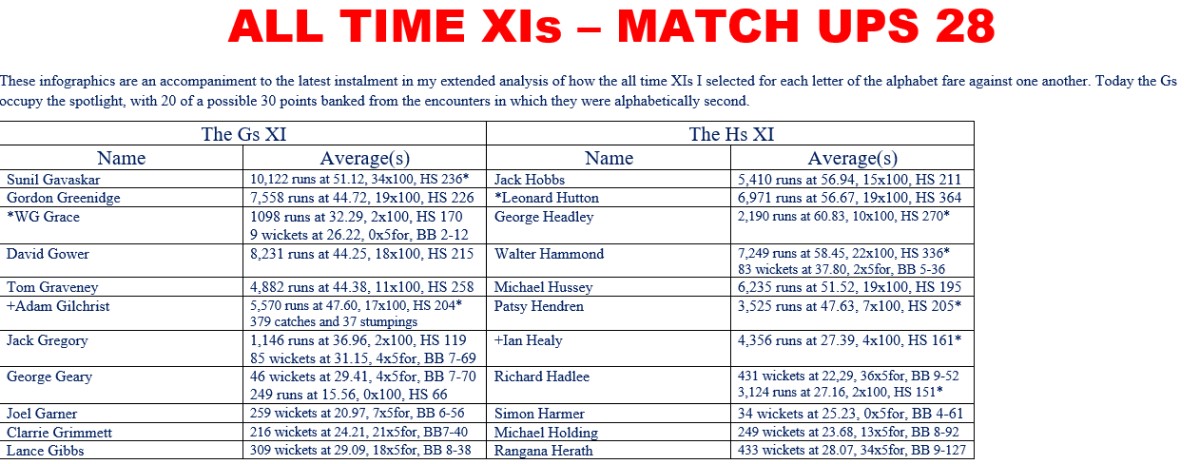
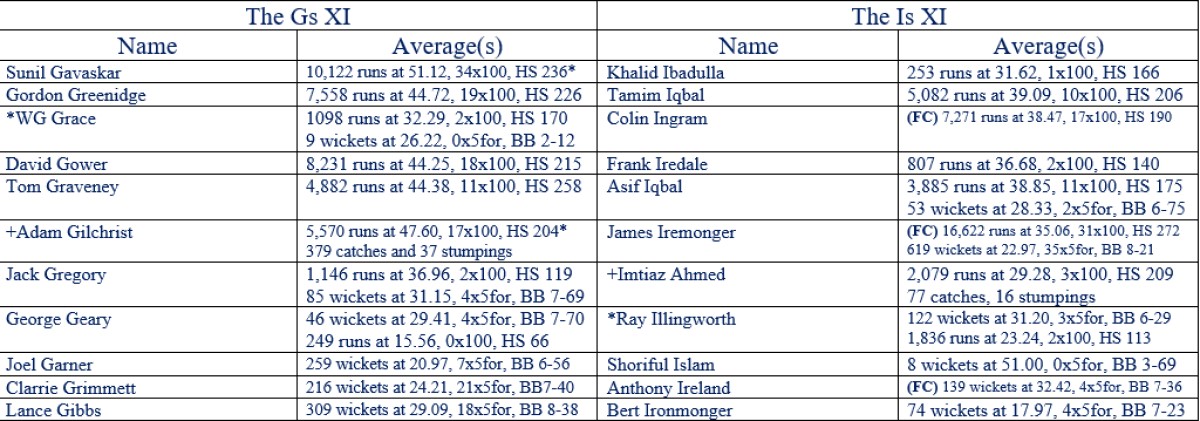
Continuing my extended analysis of how the all time XIs I picked for each letter of the alphabet fare against one another. The Gs are now in the spotlight.
Welcome to the latest instalment in my extended analysis of how the all time XIs I selected for each letter of the alphabet fare against another. Today the Gs take centre stage, with 20 of a possible 30 points banked against the teams who are alphabetically ahead of them.
THE Gs V THE Hs
The Hs are one of the few teams to have a better opening pair than the Gs. George Headley is also the better number three, though not by as much as raw figures suggest – Grace was already 32 when he made his test debut and almost 51 by the end of his test career, and an average of 32 in that era is worth about 48 in later times when surfaces were by and large better for batting than in the Victorian era. Grace also outranks Hutton as a skipper. Hammond and M Hussey clearly outpoint Gower and Graveney. Gilchrist and Hendren is a draw batting wise, but the presence of Gilchrist at six indicates where the Gs strengths lie – their range of bowling options. Healy loses his batting match up against Gregory but wins the keeping match up against Gilchrist. Hadlee and Holding are a better new ball combo than Garner and Geary, but Gregory is a much better third seamer than Hammond who would play that role for the Hs. The Gs are clear of the Hs in the spin department, having the two best spinners in these squads. The Hs are stronger in batting and keeping, about even in fast bowling, behind in captaincy and way adrift in spin bowling. I don’t think that the Hs one definite advantage, in batting, will make up for the greater depth and variety of the Gs bowling (any attack in which Grace ranks sixth is exceptionally strong) and I also expect Grace’s superior captaincy to make itself felt. This is a titanic contest which I have the Gs shading – Gs 3, Hs 2.
THE Gs V THE Is
The Gs boss the batting, winning every match up in that department down to number seven. Wicket keeping honours are shared, with Gilchrist much the better batter. While acknowledging that Illingworth was a fine skipper I rate Grace ahead of him in that capacity. The Gs utterly dominate in pace bowling, and have the better spin attack though by less of a margin. This can have only one outcome: Gs 5, Is 0.
THE Gs V THE Js
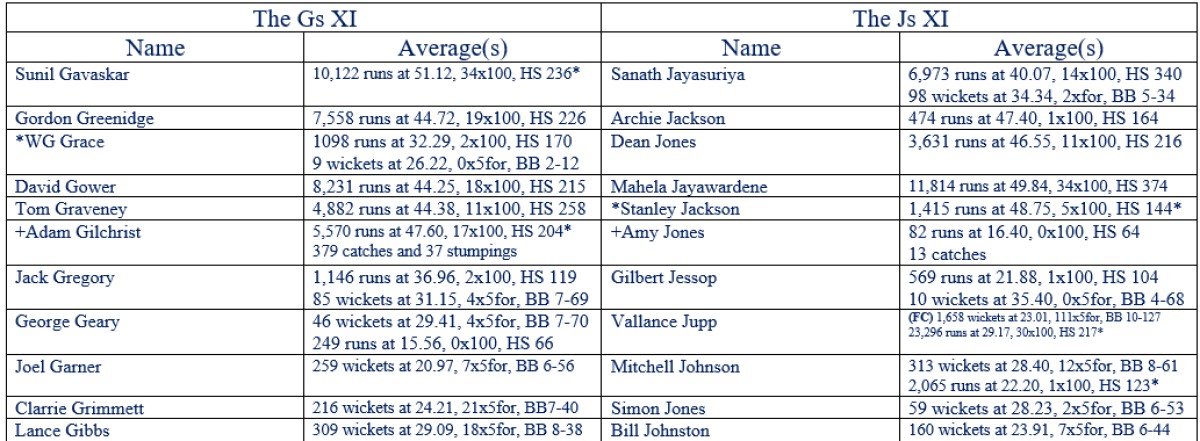
The Gs have the better opening pair without doubt. As I indicated in the match up with the Hs Grace’s average equates to about 48 in more recent times, including the era when D Jones batted, and he started his test career at an older age than would be ideal, so I give the Gs the number three slot as well. The Js win the number four and five slots, and FS Jackson and Grace is a clash of the titans captaincy wise. Gilchrist wins the batting element of the keepers match up though by less than the raw figures suggest, while A Jones is clear as keeper. Gregory outpoints Jessop. The Gs comfortably win the spin bowling – Gibbs rates above Jupp, and Grimmett is miles clear of Jayasuriya, and not even the spin element of Johnston’s bowling can close the gap. Pace bowling is close – the Js trio are 2nd, 3rd and 4th in the averages, with the Gs 1st, 5th and 6th. I think the Gs top order will make a better fist of handling the left arm rockets from Mitchell Johnson than the Js do of handling the awkward problem in £D geometry posed by Garner’s extreme height. If it reverse swings at any point S Jones would be particularly dangerous. I think the Gs are winning this with a degree of comfort and score it Gs 4, Js 1.
THE Gs V THE Ks
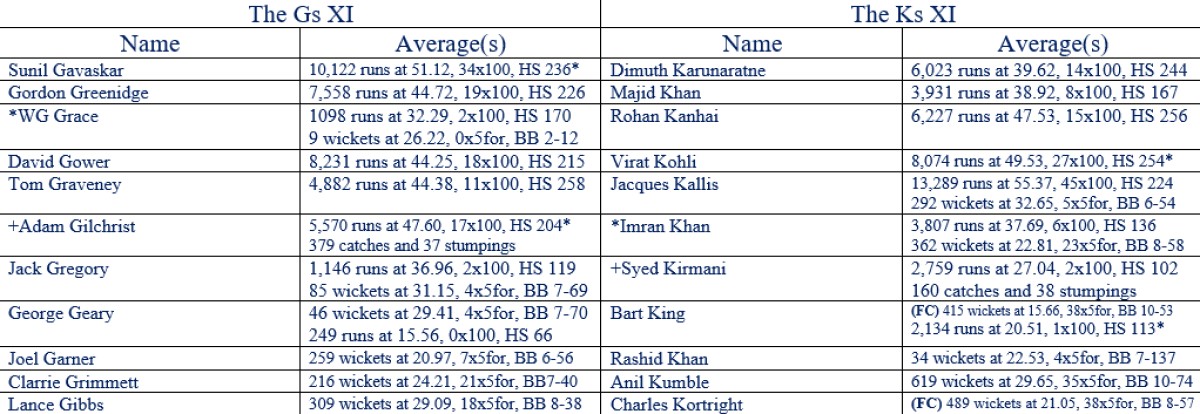
The Gs definitely have the better opening pair. I also give them the number three slot for reasons already explained, while Grace v I Khan is another clash of the titans captaincy wise. The Ks win the number four and five slots, though Gower’s left handedness (improving the balance of the batting order) and the more difficult conditions in which Graveney batted reduce the margins of superiority. Gilchrist is streets clear of Kirmani with the bat, but the Indian was the finer keeper. Imran Khan beats Gregory in both departments. Personally although neither got play test cricket (King was a USian – the best player that country has ever produced, while Kortright was in his prime during a very strong era for English cricket) I rate the Ks two specialist fast bowlers ahead of Garner and Geary, and also award King the number eight batting match up. The Gs spinners are better balance, being an off spinner and a leg spinner, which I think is enough to give them that department. I cannot pick a winner of this one: Gs 2.5, Ks 2.5.
THE Gs V THE Ls
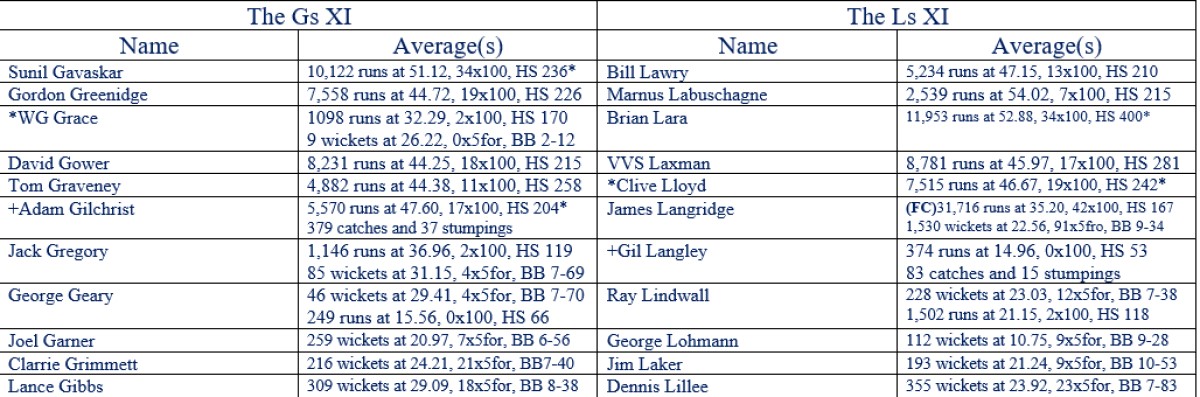
I think the Gs have the better opening combo (Labuschagne is playing out of position for the Ls), but the Ls win the number three slot (albeit by much less than the raw figures suggest). The Ls also win the number four and five slots. Gilchrist comfortably wins the keepers match up against Langley, the Ls have the better pace trio, but the Gs have the better spinners, Grimmett outperforming James Langridge more than Laker outperforms Gibbs. I just give this one to the Gs – Gs 3, Ls 2.
THE Gs SO FAR
The Gs have scored 17.5 out of 25 today, putting them on 37.5 out of 55 so far, 68.18% at the moment.
Continuing my all time XIs theme with a look at the letter J.
I continue the all-time XIs theme with a team comprising players whose surnames begin with J.
THE XI IN BATTING ORDER
Sanath Jayasuriya (Sri Lanka). Opening batter, left arm spinner and good fielder. His test match highlights include a high score of 340 and an innings of 213 against England at The Oval that combined with Muralidaran’s 16 wickets in the match to give SL their first victory in England. In ODI cricket (T20 only became a thing after his prime cricketing years) he completely redefined the role of an opener, his explosive performances in that role playing a large part in winning his country the 1996 World Cup.
Archie Jackson (Australia). He was a contemporary of Donald Bradman, and many who saw both rising through the ranks rated him the finer prospect. Ill health ruined his career – he died of tuberculosis at the tender age of 23, but an innings of 164 on test debut as a 19 year old provided some hard fact to reinforce the credentials he had established as a youngster.
Dean Jones (Derbyshire, Australia). A combative character, he came of age as a cricket during the first innings of what proved to be only the second tied test match in history (36 years on there have still only been two) at Chennai in 1986. Jones in that innings scored 210, batting almost eight hours, and at the end of it he had to be taken to hospital and put on a saline drip. Later, during the 1986-7 Ashes he played an innings of 184, albeit aided by being given not out when on just 5. He also produced several valuable knocks in the 1989 Ashes, though not coming close to the productivity in that series of Mark Taylor or Steve Waugh.
Mahela Jayawardene (Sri Lanka). Possessor of the highest test innings by a right hander (374 versus South Africa), and without question in the top two of all time Sri Lankan test batters (Sangakkara being the other).
*Stanley Jackson (Yorkshire, England). In 1905 he captained England to a decisive Ashes victory, topping both the batting and bowling averages, winning all five tosses and leading England to wins in both of the matches to reach definite conclusions. He scored five test centuries, all in home matches against the Aussies (he was an amateur, and business commitments always prevented him from touring). In 1902 he and George Hirst joined forces with the ball for Yorkshire to rout the touring Aussies for 23. His polished 49 at The Oval in the last test of that year’s Ashes enabled Jessop to begin England’s revival from 48-5 in pursuit of 263.
+Amy Jones (England). A stellar keeper batter, a worthy successor in the England women’s squad to the legendary Sarah Taylor (and being kept on her toes by the knowledge that Ellie Threlkeld, also a magnificent keeper batter, is waiting in the wings).
Gilbert Jessop (Gloucestershire, England). The most consistently rapid scoring batter the game has ever seen, a useful fast bowler and a brilliant fielder – in his great match at The Oval in 1902 his first significant contribution was not that innings, it was a brilliant bit of fielding that accounted for the key wicket of Victor Trumper, and he has been estimated to have been worth about 30 runs an innings in the field.
Vallance Jupp (Sussex, Northamptonshire, England). An off spinning all rounder, who after his move north and qualification by residence for his new county achieved the season’s double of 1,000 runs and 100 wickets in FC matches eight times in succession.
Mitchell Johnson (Australia). A mercurial left arm fast bowler who at his best was as good any such to have played to the game – in the 2013-14 Ashes he was nigh on unplayable. It is true that he was a cricketing version of the girl in the nursery rhyme – when he was good he was very good, when he was bad (as in the 2010-11 Ashes) he was horrid, but I choose to honour the Dr Jekyll side of his bowling rather than use the Mr Hyde element as an excuse to drop him. He was also a useful lower order batter, with a test century and a 99 in that department.
Simon Jones (Glamorgan, Hampshire, England). Plagued by injuries, but when fit he produced some outstanding performances – he was crucial to England’s triumph in the 2005 Ashes, reverse swinging the ball at high pace and causing every Aussie batter problems.
Bill Johnston (Australia). Australia’s leading wicket taker in three series immediately post-war. He bowled left arm fast medium and left arm orthodox spin – it was not unknown for him to go from spinning the old ball to swinging the new one.
This side possesses good batting depth (a superb top four, a batting all rounder, a keeper batter, two all rounders and a bowler who can bat, with only S Jones and Johnston describable as bunnies), and a fine variety of bowling options – Johnson, S Jones, Johnston, Jessop and Jackson providing five seam options all different from one another, while Jupp, Jayasuriya and Johnston in his slower style provide spin options.
HONOURABLE MENTIONS
Before going into the rest of this section there is one player I am going to give a subsection to himself…
RAVINDRASINH JADEJA(INDIA)
Averaging 35 with the bat and 24 with the ball in test cricket gives him a case to be regarded as the best contemporary all rounder of any kind in the game . The problem is that his bowling stock in trade, left arm orthodox spin overlaps with Jayasuriya and Johnston in his slower style. This is why I preferred Jupp’s off spin and the explosiveness of Jessop in the two slots he might have occupied – I was concerned with the balance of the attack, wanting my skipper to be able to change the bowling as well the bowler.
OTHER HONOURABLE MENTIONS
Steve James of Glamorgan and briefly England was a solid county opener, but I suspect that not even the staunchest of his county’s fans would expect him to be picked for this XI. Andrew Jones of New Zealand, a gritty and determinded number three for that country, might have had the slot I gave to Dean Jones, but while acknowledging his ability I felt that Dean, also a gritty competitor, had a sufficiently superior record to his trans-Tasman namesake to warrant getting the slot. Three fast bowlers who were close to being picked were in reverse chronological order Les Jackson of Derbyshire who took his FC scalps at 17 each but was only rewarded with two England caps, Ernie Jones of Australia, a seriously quick bowler in the 1890s, but also the first ever to be called for throwing in a test match, and John Jackson, a terror in the era immediately before WG Grace came to prominence. Prabath Jayasuriya has made a sensational start to his test career, but as a specialist left arm spinner it would hard for him to qualify for this XI even he maintains that start. Worcestershire leg spinner Roley Jenkins entered my thoughts, but I felt Jupp deserved the second spinner’s role. Digby Jephson, who was one of the last front line under arm bowlers at professional level and a good middle order batter is another I regret not being able to accommodate. Aqib Javed, a Pakistan fast bowler of the 1990s did not quite establish a good enough record to be a serious challenger. Among keepers only Eifion Jones, who was much less of a batter, comes close to namesake Amy behind the stumps – Geraint Jones was not up to standard in either department. Arthur Jepson does not qualify as a player but he can be one of the umpires, a role in which he excelled.
I end this section with two players who are very likely to be shoo-ins for this XI in 10 years time or thereabouts. Kyle Jamieson of New Zealand has made a magnificent start to his test career, and may well knock Mitchell Johnson out of the XI if he maintains his current progress. Will Jacks of Surrey is a hugely promising young batter and part time off spinner. In standard cricket formulation of initials and surname he is WG Jacks, and his recent 150 against Essex, most of it scored with tailenders for company, and giving his side an ultimately match settling first innings lead was worthy of the original WG.
PHOTOGRAPHS
Our cricketing adventure through the letter J is complete and all that remains is my usual sign off…
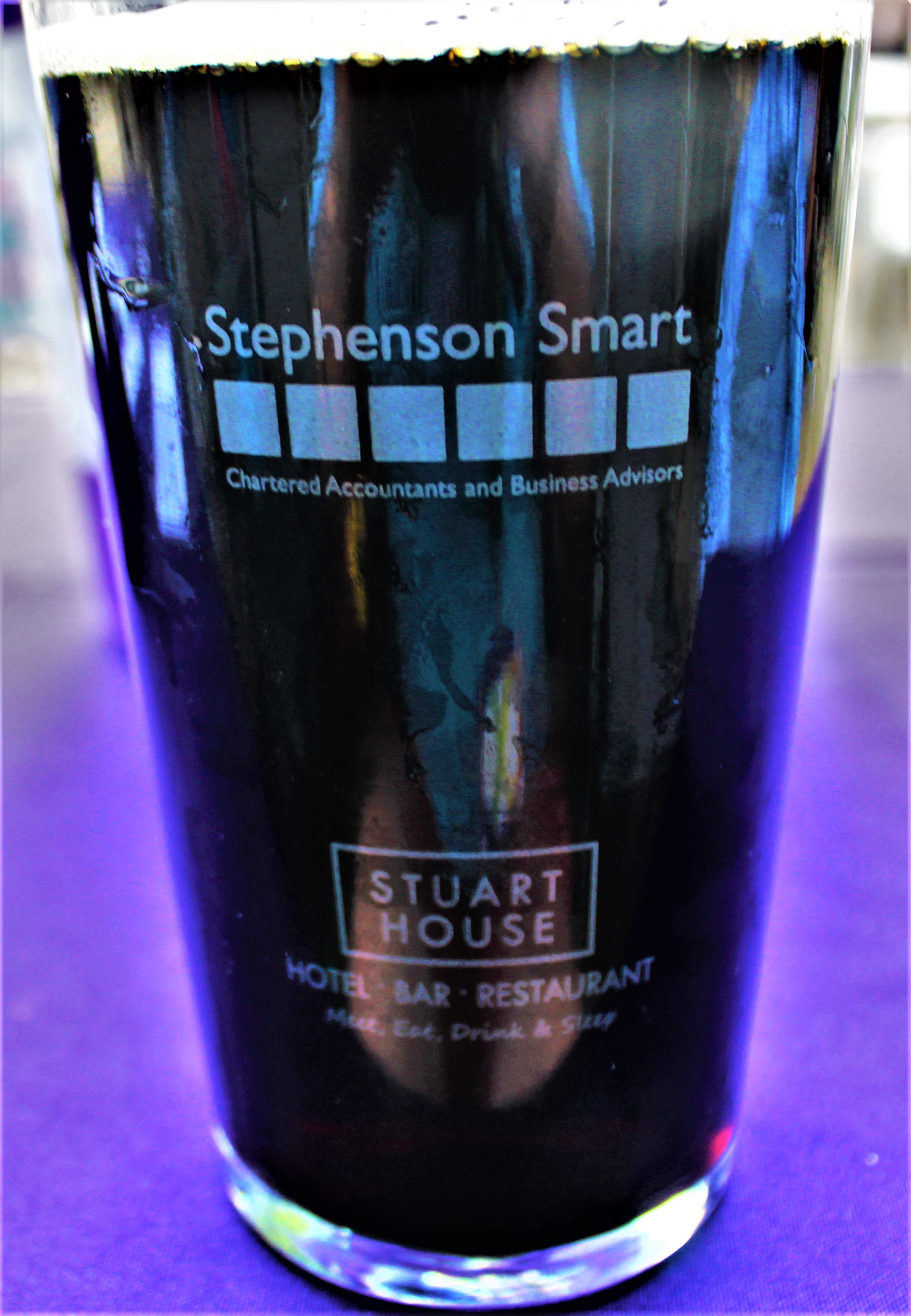
Many of these photographs were taken at the King’s Lynn Beer Festival at Stuart House Hotel, raising funds for the West Norfolk Autism Group. This one features the finest pint I encountered there, a chocolate stout brewed by Rudgate in the Vale of York.
A brief look at events in New Zealand where one England cricket team is doing well, and a revisit to my radical suggestion for sorting the men’s teams problems with finding good enough spinners.
This post looks briefly at goings on in New Zealand, and then explores a favourite theme of mine. First of all however, a brief…
NEWSFLASH
At 10:55 this morning I received my first Covid-19 jab. I barely felt the needle go into my arm and have as yet experienced no serious side effects. The second jab will be a minimum of four weeks from now and could be as much as 12 weeks. Contrary to what pro-government propaganda sources would have you believe my situation does not count in any sane view as ‘vaccinated’ – I have begun the process of getting vaccinated, but until I have had the second jab I am not actually vaccinated. Also, the government deserves very little credit for the vaccination program – the hard yards are being done by NHS workers, and the extent of government involvement for me was sending me a link I could not use, and a very inefficient helpline system which when I finally got through advised me to contact my surgery, who duly booked me a slot. The government have bungled all along the line, and their lockdown easing plans seem set to continue that trend, going too far too early.
ENGLAND WOMEN GO 2-0 UP WITH ONE TO PLAY IN NZ
A disciplined all round bowling performance, highlighted by Nat Sciver’s 3-26 from nine overs restricted NZ to 192 off 49.5 overs. Tammy Beaumont played the anchor role in the chase, finishing unbeaten on 72, while Sciver completed a fine day’s work by scoring a rapid 63, and keeper Amy Jones completed the job with an equally rapid unbeaten 46. England had seven wickets and 12.2 overs in the bank when they reached the target. Sophie Ecclestone failed to add to her haul of international wickets but did only go for 33 from her 10 overs, an economy rate bettered only by Sciver. Katherine Brunt and leg spinner Sarah Glenn each picked up two wickets and Kate Cross had one, while there were two run outs. Full scorecard here.
The men are struggling in India, but the women are going well, which leads me on to my theme…
ENGLAND MEN’S SPIN PROBLEMS
In yesterday’s post I argued for the promotion of Parkinson and Virdi from the reserves to the full squad for the final test match, advocating a spin trio of Leach, Virdi and Parkinson. England do not have many other male spinners whose records inspire much confidence. Thus, I suggest that England offer Ecclestone the opportunity to play alongside the men. For those wondering about the women, in addition to Glenn who I have already mentioned here is a sextet of decent spin options available to the women: Linsey Smith, Kirstie Gordon, Sophia Dunkley, Alex Hartley, Helen Fenby and Danielle Gregory. If she bowls well in a few men’s county games, then given her 100+ international wickets she could be fast tracked into the England men’s team and possibly be part of the Ashes campaign at the end of this year.
The latest in my “100 cricketers” series, rounding out the discussion of the sixth XI ancd introducing the seventh XI. As usual it also contains some of my photographs.
INTRODUCTION
Welcome to the latest installment in my “100 cricketers” series. This post concludes the look at my sixth XI with a look at the all-rounders and introduces the seventh XI in batting order. The introductory post to the whole series can be found here, the post in which I introduce the sixth XI here and the most recent post in the series here.
Her overall batting record looks modest (ODI average 27.33, T20I average 18.20, no tests played yet), but her last seven innings have been 56, 79, 54, 76, 18, 36 and 57, all of them in winning causes. At the age of 25 she should still be improving, and I firmly expect that international centuries will appear against her name sooner rather than later. Sarah Taylor’s absence has given her an opportunity for an extended run at international level and she has taken it splendidly.
Given that I do not set huge store by records in T20 and that she is yet another top woman cricketer who has had no opportunity to show what she can do in test cricket it is her ODI record that earns her a place in this squad, and her figures in that form of the game are: 48 matches, 1,330 runs at 41.81 with a highest score of 155 and 56 wickets at 27.39 (economy rate 3.87) with a best of 6-20. This means that she is worth a place purely with the bat, and is a genuine front-line spinner to support my West Indian pace quartet (better than anyone who actually provided spin back-up to a WI pace quartet, most often the part-time stuff of Viv Richards, and even Roger Harper, though officially a front-line bowler did not have that great a bowling record), which really strengthens the overall squad. To complete the record on the bowling front, Sanath Jayasuria’s slow left-arm would be the sixth bowling option and Chloe Tryon’s left-arm medium fast would be seventh in the pecking order. Deepti Sharma is a youngster, just 21 years old, which means that her finest years are still ahead of her – look for an already impressive record to get even better. This completes the look at the sixth XI, meaning that it is time to introduce…
Note that in this XI I have gone to to the extent of naming a vice-captain – I will explain this in more detail in later posts. For the moment, all I will say is that there are those who would advocate that the no3 in this XI get the captaincy and I wanted to emphasise just how far away he is from that in my thoughts.
PHOTOGRAPHS
The usual finish…
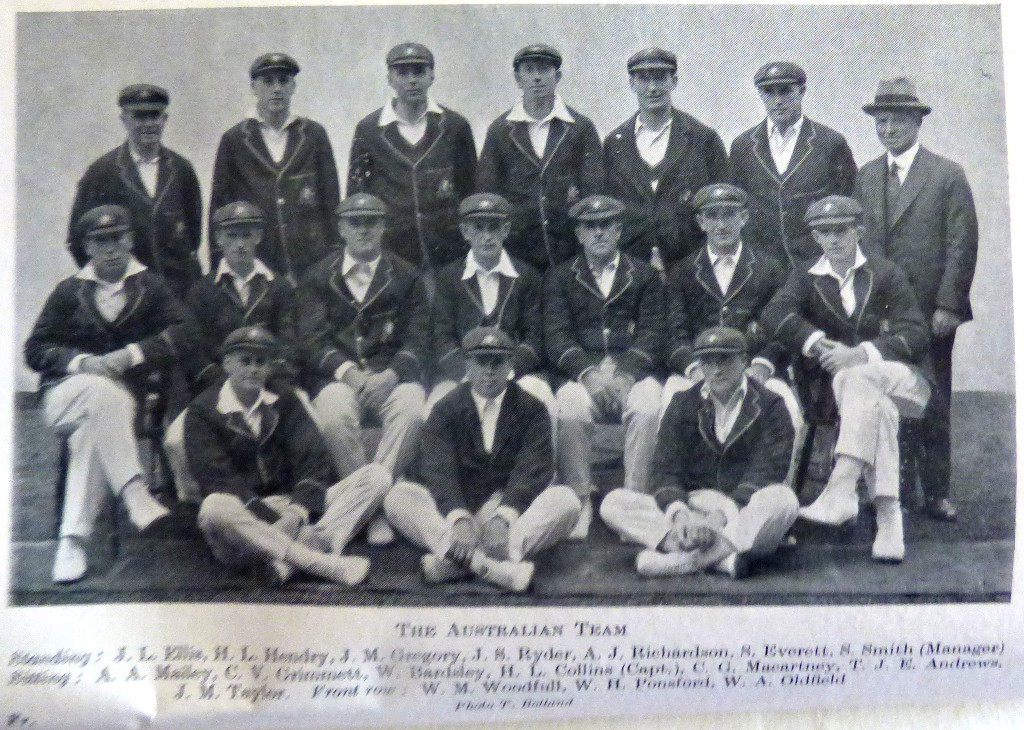
Plum Warner’s account of the 1926 Ashes (he was chairman of selectors that year)…
…featuring the famous urn embossed on the front cover
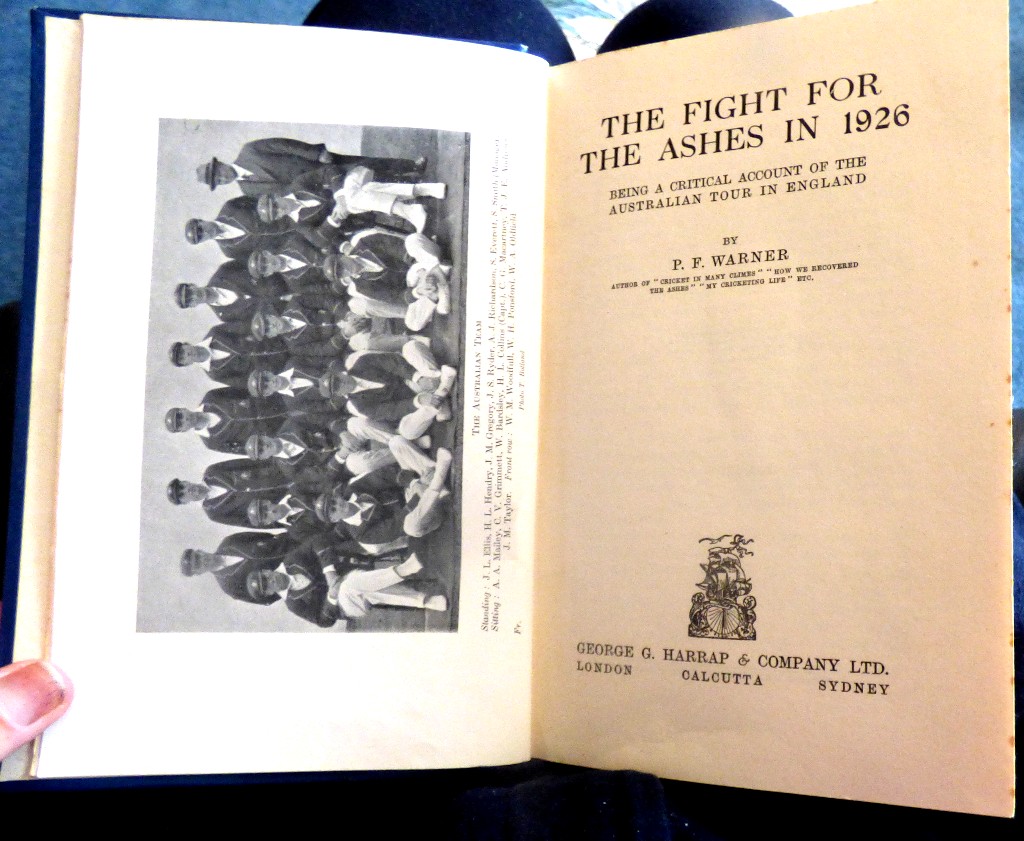
The title page.
Fred Root’s field – the four short-leg fielders were the key feature. In the famous bodyline series the much quicker Harold Larwood sometimes had six fielders close-in on the legside – with one deep for the hook and only two fielders in the whole of the offside.

























































































































































































































































 aspiblog