All Time XIs – Match Ups (11)

Welcome to the next post in my series analysing how the all time XIs I selected for each letter of the alphabet fare against each other. The Cs XI currently occupy the hot seat, and they enter this post on 3.5 out of 15 points.

THE Cs V THE Es

The Cs are ahead in each of the top five batting positions, though Elgar and J Edrich aren’t out of position whereas Cowdrey and Chanderpaul are. Also Bill Edrich lost six prime years to WWII, so Chappelli’s advantage over him the bat is slightly illusory. Endean outbats Constantine but doesn’t bowl. Evans is marginally behind Carter with the bat, but compensates by being the finer keeper. Tom Emmett and Gideon Elliott look capable of matching Cummins and Croft, and Emmett’s left arm is an extra point of variation. Edwin Evans beats Cornwall with the ball, while Ecclestone against Chandrasekhar is a close contest. The Cs have better back up bowling options, with Constantine, Compton, Chanderpaul and G Chappell all capable of offering something, whereas only Bill Edrich is remotely close to being a back up bowling option for the Es. This is a close contest, but I think the Es superiority in front line bowling is just enough: Cs 2, Es 3.

THE Cs V THE Fs

The Cs have the edge in batting, although the Fs extra depth in that department narrows the gap. The Fs are dominant in bowling – Ferris, Foster and Freeman are all arguably superior to any of the Cs pacers, and whoever out of Foster or Ferris ends up third seamer knocks Constantine out of the park in that department. Similarly, the Fs three front line spin options, Faulkner, Fender and Flowers are all better than Cornwall, with Faulkner and Flowers both clearly also ahead of Chandrasekhar. For all their marginal batting advantage there are no circumstances in which I can envisage the Cs having the advantage, and Fender is one of the few skippers not to lose that contest to Chappelli. I score this one Cs 1, Fs 4.

THE Cs V THE Gs

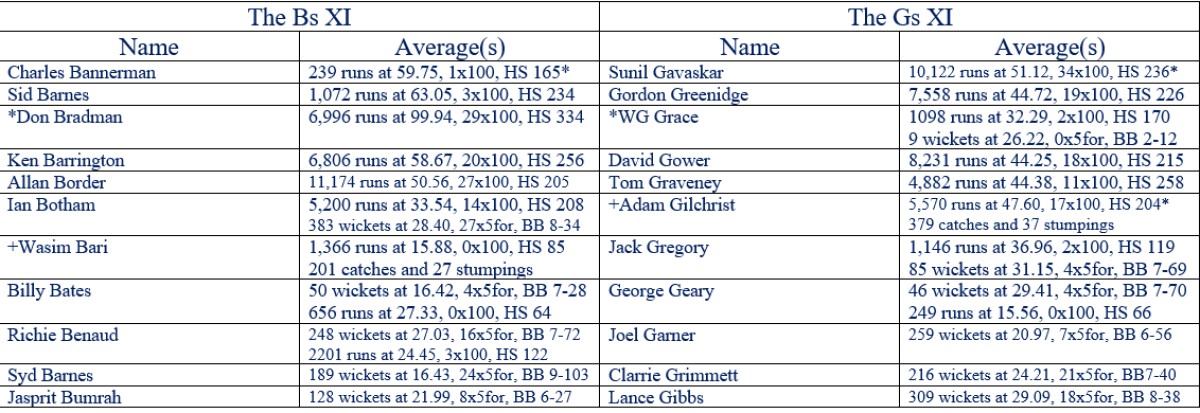
The opening pairs are apparently closely matched, but Gavaskar and Greenidge are in their natural positions, while Chanderpaul and Cowdrey are not. Similar Chappelli at three is not as well placed over Grace as the figures make it look – Grace came late to test cricket – 32 when he made his debut, almost 51 when he finally retired, and that batting average of 32 is worth at least half as much again in more modern times. Plus he provides a bowling option. The Cs win the number four and five slots. However Gilchrist knocks the spots off Carter with the bat, though the latter was probably the better keeper. Gregory outpoints Constantine in the battle of the fast bowling all rounders. Geary and Garner are a little behind Croft and Cummins as a pair, but not significantly so. Grimmett outpoints Chandrasekhar, and from a bowling point of view Gibbs is the proverbial country mile clear of fellow West Indian Cornwall. The Gs are definitely ahead in terms of the front five bowlers, and their sixth option, WG Grace, outpoints at least two of the Cs front five as well. The Gs have a significant advantage, and a skipper who will certainly stand up to opposite number Chappelli. Not even Chappelli can salvage anything for the Cs from this one: Cs 0, Gs 5.

THE Cs V THE Hs

The Hs win the first four batting positions, G Chappell just having the edge on compatriot Hussey at no 5. Hendren is far superior with the bat to Constantine, while Healy clearly beats Carter. Hadlee and Holding at least match Cummins and Croft, Harmer and Herath beat Cornwall and Chandrasekhar. The Cs have the better fifth bowler, Constantine outdoing Hammond in that department. The Cs extra bowling depth does not make up for their lack of front line strength or for the fact that they are badly outgunned with the bat: Cs 0, Hs 5.

THE Cs V THE Is

The Cs boss the first five batting positions, , though the Is win the next three. Bowling wise the Is win on spinners, but lose heavily in the pace department – Iremonger may rate as a better third seamer than Constantine, but the new ball pairing does not compare to Cummins and Croft. I score this as Cs 4, Is 1.

Cs PROGRESS REPORT

Even with four points in the final match up the Cs have scored just seven points out of 25 today, moving them on to 10.5 out of 40, 26.25% so far.

PHOTOGRAPHS

My usual sign off…

All Time XIs – Match Ups (10)

Continuing my analysis of how the all time XIs I selected for each letter of the alphabet fare against each other. Today’s match ups are the last four involving the Bs, and the first with the Cs in the hot seat.

Welcome to the latest in my series of posts analysing how the all time XIs I picked for each letter of the alphabet fare against each other. This post sees the completion of the Bs and the first match up with the C team in the hot seat. The Bs come into today with 69 of a possible 105 points. Before I get to the main meat of the post, Heritage Open Day 2022 which was to have been this Sunday has been postponed due to the death of a ludicrously over-privileged old woman. Apaarently the council cannot support the event on Sunday and without their support it cannot be run. Provisionally Sunday 2 October is being looked at the new date – I have already declared my availability for that date.

THE Bs V THE Ws

The Bs are ahead on batting, but the Ws are ahead on bowling. I personally think the Ws have the bowling guns to compensate for the Bs batting advantage and score this one Bs 2, Ws 3.

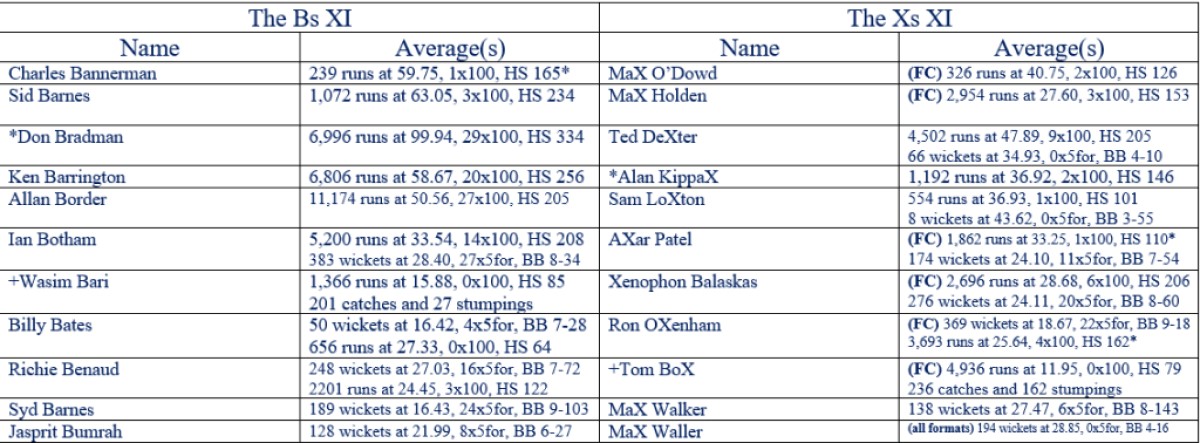
THE Bs V THE Xs

The Xs lose 10 match ups out of 11 fairly comprehensively. Box, allowing for how difficult batting was in his day, can be considered to win the battle of the keepers, but that will make little difference to the overall outcome – Bs 5, Xs 0.

THE Bs V THE Ys

The Bs are ahead in all areas – even if one accepts that Poonam Yadav is a better leg spinner than Richie Benaud was, the Aussie’s batting compensates for this. Bs 5, Ys 0.

THE Bs V THE Zs

The Bs once again dominate this one, with only Zulqarnain Haider definitely winning his match up. I score this as Bs 5, Zs 0.

THE Bs FINAL ANALYSIS

The Bs scored a further 17 points today, giving them 86 out of 125, or 68.80%. This puts them comfortably ahead of the As, who scored 69, and for the moment first in our ranking table.

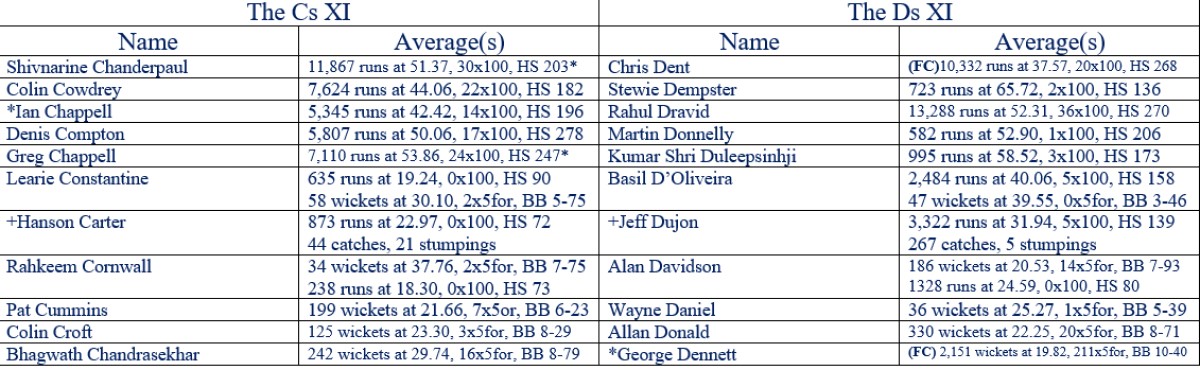
THE Cs V THE Ds

The Cs come into this match up with 1.5 points out of a possible 10 from their match ups against the As and the Bs. The Cs have a strong opening combo, albeit both batting out of their very best positions, a good number three who is also a shrewd and resourceful skipper, two unequivocal greats at four and five, a mercurial all rounder at six, a fine keeper, and a decent quartet of bowlers. The Ds lose out in the matter of opening pairs, win the number three slot hands down, but as against that lose on captaincy. Four and five are closely fought, but the greater experience of the C pair gives them the honours. Number six goes to the Ds. Dujon comfortably wins the battle of the keepers, while Davidson beats Cornwall in the number eight slot. Daniel and Donald are a good match for Cummins and Croft in the pace department, and Dennett, possibly the finest bowler never to have played test cricket (he overlapped with Rhodes and Blythe, both even greater left arm spinners), probably has the edge on Chandrasekhar. This is by far the closes contest the Cs have been in, and allowing for Chappelli’s captaincy and the possibility of a turner, where they would have the advantage, I score this one Cs 2, Ds 3. This means that after three match ups the Cs are on 3.5 of a possible 15 points, 23.33%.

PHOTOGRAPHS

Time for my usual sign off…

All Time XIs – Match Ups (6)

Welcome to the latest post in my series analysing how my all time XIs for each letter of the alphabet fare against each other. We reached the conclusion of the A XIs match ups yesterday, so now we start with the B XIs. They have 3.5 points in the bank from their encounter with the As (see here).

THE Bs V THE Cs

The Bs dominate the batting, with only G Chappell among the top six outpointing his opposite number, and that by a mere fraction. Added to this is the fact that for reasons explained in the original post about the Cs Chanderpaul and arguably Cowdrey are batting out of position. Carter out bats Bari, but Bari was the finer keeper. Bates and Benaud are unquestionably a finer pair of spinners than Cornwall and Chandrasekhar, and both also possessed batting pedigree, something to which Cornwall has limited claim and Chandrasekhar none. Barnes and Bumrah for my money have the edge on Cummins and Croft as a new ball combination, though the Cs are undoubtedly the faster pair. Botham and Constantine were two mercurial all rounders, capable of match winning performances. I will allow for the possibility of a Constantine special, while rating it odds against, so my final score for this is Bs 4.5, Cs 0.5.

THE Bs V THE Ds

The Bs have an advantage with the bat – only Duleepsinhji, D’Oliveira and Dujon of those whose batting is of major significance win their match ups in this department. Davidson, Daniel and Donald as a pace trio probably beat Barnes, Bumrah and Botham, but as against that the Ds have only one front line spin option, Dennett, to match up against Bates and Benaud. Finally, Bradman was acknowledged to be a superb skipper, whereas Dennett never got any captaincy experience because of the social mores of his time. Although the Ds are far from helpless in this contest, the Bs are obvious favourites and I score it Bs 3, Ds 2.

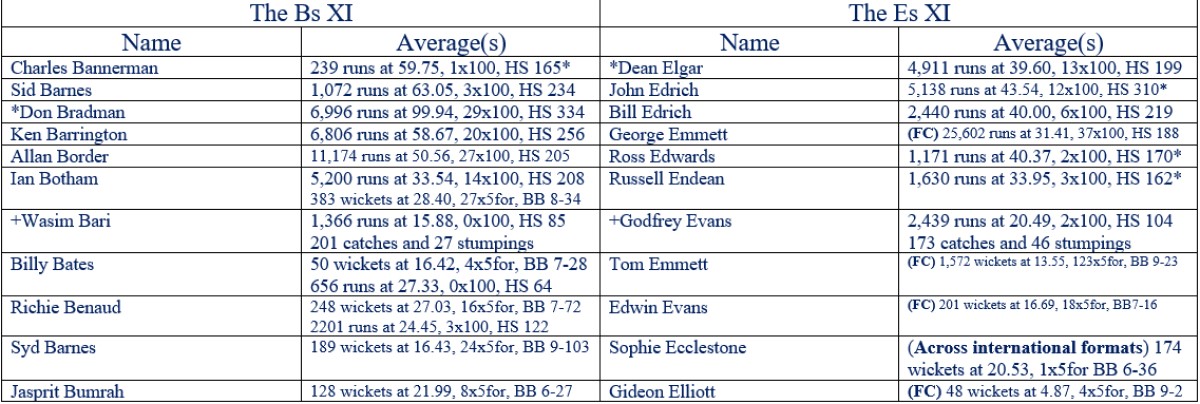
THE Bs V THE Es

The Bs have a huge advantage in batting, and Botham is definitely a better third pacer than Edrich, though Emmett and Elliott v Barnes and Bumrah is a fine contest, as is Ecclestone and Evans v Benaud and Bates in the spin bowling department. I make this one Bs 4, Es 1.

THE Bs V THE Fs

The Bs boss the batting as usual, though Foakes is the better keeper. The Fs have a greater range of bowling options, with six genuine front line bowlers. I accord them a definite win the pace department, with Ferris, Freeman and Foster clearly a stronger combo than Barnes, Bumrah and Botham. Flowers, Fender and Faulkner give the Fs three front line spin options. The question is whether the Fs extra bowling will compensate for the Bs huge superiority in batting. I don’t think it quite does, but I am not prepared to award the Bs victory here – Bs 2.5, Fs 2.5.

THE Bs V THE Gs

The Bs as usual are ahead on batting, but are clearly behind on bowling – WG is his side’s sixth best bowler. Grimmett and Gibbs are a good match for Bates and Benaud in the spin department, Gregory, Garner and Geary compare nicely with Barnes, Bumrah and Botham. I award this one to the Gs – Bs 2, Gs 3.

INTERIM REPORT ON THE Bs

The Bs are that this stage on 19.5 points out of 30, or 65%. The As were on a mere 14.5 points after their first six match ups, for comparison.

PHOTOGRAPHS

My usual sign off…

All Time XIs – The Letter C

Continuing my all-time XIs theme with a look at the letter C.

The temperature here is back to what would be expected of England in July after two days of serious heat. Peterborough, just over an hour to the west of me by bus was one of various UK places to top 40 degrees yesterday, while the Botanic Gardens in Cambridge, south of me, clocked 39.9. Holbeach and Marham, either side of King’s Lynn and closer still, both also had temperatures between 39 and 40. I am continuing my series of all-time XI posts with a look at the letter C.

THE XI IN BATTING ORDER

  1. Shivnarine Chanderpaul (Lancashire, West Indies). The Guyanese super stacker was not a regular opener, but with due respect to his achievements this season I could hardly pick Ben Compton, and nor did any other regular openers beginning with C jump out at me. I reckon he can handle the job, and as you will see going down the order I have a stack of quality players who belong in the middle order.
  2. Colin Cowdrey (Kent, England). Not a full time opener, but he did the job with success during the low scoring 1956 Ashes series. Also, when summoned out as an emergency replacement to the 1974-5 tour as a 42 year old who was short of practice, he stood up to the terrifying pace of Jeff Thomson and Dennis Lillee as well as any top order English batter (only middle order batters Greig and Knott could be said to fare well with the bat in this series).
  3. *Ian Chappell (Australia). Had an excellent record as a test match number three and was also a shrewd and ruthless skipper, a role I have no hesitation in assigning to him in this XI.
  4. Denis Compton (Middlesex, England). To maintain an average of 50 over a career of 78 test matches which was disrupted by six years of war and a knee injury one has to be class player. Denis Charles Scott Compton was also a prime entertainer. In addition to the batting he was a fine fielder and bowled presentable left arm wrist spin.
  5. Greg Chappell (Somerset, Australia). The first Australian to top 7,000 test runs, one of the safest slip catchers in the game’s history and an occasional bowler of both leg spin and medium pace.
  6. Learie Constantine (Nelson, West Indies). I mention his Lancashire League club, a club he served phenomenally when is his prime because his deeds as a league Pro are an essential part of the package that was Learie Constantine. An attacking batter, a fast bowler (before later turning to medium pace and spin with the odd quicker one interspersed) and one of the greatest of all fielders, he was a true all rounder.
  7. +Hanson Carter (Australia). The Yorkshire born keeper took over behind the stumps from the long serving Jim Kelly and yielded his spot to the legendary Bert Oldfield. He loses little even by comparison to these legends of the stumper’s art.
  8. Rakheem Cornwall (West Indies). Off spinner and useful lower order batter. He is on my own admission the most questionable pick in this side, but I have opted for him to give the bowling attack extra balance.
  9. Patrick Cummins (Australia). Currently the best test match fast bowler in the world, and a better batter than his test average suggests.
  10. Colin Croft (West Indies). Another fast bowler, similar in height and in bowling with his right arm to Cummins, also has a magnificent record, but the two are utterly dissimilar in other ways. He has the best innings figures in test cricket by a WI fast bowler, 8-29. He was also the second after Gary Gilmour to take a six-for in an ODI (6-15). I have positioned him one place above his usual spot in the batting order because there is an even more undisputed no11 to come…

  11. Bhagwath Chandrasekhar (India). One of a quartet of spinners to play for India in the 1970s (Bedi and Prasanna were both also indisputably world class, Venkataraghavan less so). He bowled leg spin at a fairly brisk pace, turning the withering of his right arm by childhood polio into a huge plus for himself. Only one bowler not have played county championship cricket took more FC wickets than Chandra, another leg spinner in Clarrie Grimmett.

This side contains a powerful top five (the only conceivable question mark there being whether Chanderpaul could handle the opening gig), a genuine all rounder, a keeper who can bat and varied quartet of bowlers. Cummins, Croft and Constantine are a fine trio of pacers, and leg spinner Chandrasekhar and off spinner Cornwall constitute a decent spin attack. In support if needed are Compton, G Chappell and Chanderpaul in that order of preference.

HONOURABLE MENTIONS

Sir Alastair Cook might have had the slot I gave to Chanderpaul, but my feeling having witnessed both is that the Guyanese was the better cricketer. Cook benefitted from being part of an exceedingly strong line up, something Chanderpaul rarely experienced. Another Cook, Jimmy of South Africa, is the ultimate ‘what might have been?’ – his domestic record was outstanding, but bearing in mind another southern African, Graeme Hick, I have to rule him out.

The best batter I was unable to accommodate was Martin Crowe (Somerset, New Zealand). I had positive reasons for including Compton and the Chappells (including the captaincy in the case of the most vulnerable of the trio to the Crowe challenge, Ian Chappell) rather than negative reasons for leaving Crowe out. Michael ‘Pup’ Clarke had a fine test record, but not quite the equal of anyone I selected. Another Aussie named Clarke, Belinda, might have got an opening slot. Medium pacer and useful lower order batter Tom Cartwright was the challenger to Cornwall for the number eight slot, and if you prefer relying on one front line spinner I accept that. Albert ‘Tibby’ Cotter, an Australian fast bowler who was killed during WWI was on the fringes, as was West Indian Sylvester Clarke. Neither Lance nor Chris Cairns quite merited a place. I end with the reverse of an honourable mention: Zak Crawley is a current England opener, but few have ever been less deserving of the position – his record is an opener puts him down in the ‘Brearley without the captaincy’ class, and even for Kent he barely averages 30 an innings.

PHOTOGRAPHS