All Time XIs – The Letter V

Continuing my exploration of the all time XIs theme with a look at players whose surnames begin with V.

I continue my exploration of the all time XIs theme with a look at players whose surnames begin with the letter V. There were many challenges with the selection of this side, which I will elucidate through the post.

THE XI IN BATTING ORDER

  1. Michael Vandort (Sri Lanka). A left handed opening batter, his test record was respectable rather than outstanding.
  2. Joe Vine (Sussex, England). A right handed opening batter and a leg spinner. His job for much of his career was to bat defensively for long periods – Sussex sides of his time were well equipped with stroke makers, but no so much with folk capable of playing the anchor role. An innings of 202 in five hours late his career showed that he could play more expansively when the situation allowed. His batting and bowling averages are the right way round.
  3. *Michael Vaughan (Yorkshire, England). A right handed batter, occasional off spinner, and an excellent captain, a role I have given him in this side.
  4. Gundappa Viswanath (India). A right handed batter possessed of consdierable grit and determination. He averaged over 40 in test cricket.
  5. Dilip Vengsarkar (India). A right handed batter who averaged 42 in test cricket. He scored tough runs as well – he averaged a run more per innings against the West Indies, utterly dominant in his era, than he did in overall test cricket. At Headingley in 1986 when no one else on either side could score even one 50 he produced innings of 61 and 102.
  6. +Kyle Verreynne (South Africa). A right handed batter and a fine wicket keeper. He is still establishing himself at test level, but he averages over 50 in FC cricket, and his keeping skills are abundantly clear.
  7. Chaminda Vaas (Sri Lanka). A quality left arm fast medium bowler who never benefitted from having adequate seam support, and a useful left handed lower order batter. I freely admit that he is one place higher than would be ideal, but none of the bowlers I have named could accurately be described as mugs with the bat.
  8. Bert Vogler (South Africa). A leg spinner, part of the great ‘googly quartet’ that South Africa fielded in the years 1907-10. His test wickets cost 22 a piece and came at well over four per match. In first class cricket his averages were the right way round – 20 per innings with the bat and 18 runs per wicket with the ball.
  9. Hedley Verity (Yorkshire, England). One of the greatest of all left arm orthodox spinners. 144 test wickets at 24 a piece in a decade that featured doped pitches and Bradman’s batting is a fine record, and he also averaged 20 with the bat in test cricket. At first class level he was an absolute destroyer, claiming is wickets at 14.90 a piece, which enabled him to have batting and bowling averages the right way round.
  10. Bill Voce (Nottinghamshire, England). A high quality left arm fast medium bowler, and a useful lower order batter. He was part of the 1932-3 England side that won 4-1 down under, and was the best bowler in the side four years later in a 2-3 defeat.
  11. Vintcent Van Der Bijl (South Africa). The only member of this XI not to play test cricket, due to apartheid, but regarded as a great bowler by all who met him. The deeds at test level of the likes of Garner, Ambrose and McGrath are testament to how effective exceptionally tall bowlers can be at that level. He took his FC wickets at 16.57 a piece, though he doesn’t quite join the list of players in this side with their averages the right way round since he only averaged 16.20 with the bat.

This side contains an opening pair likely to build a good platform for the engine room of Vaughan, Viswanath and Vengsarkar to cash in on, a keeper who is also a genuinely high class batter, and a strong and varied bowling unit. Van der Bijl and Voce with the new ball will pose a challenge for anyone, and I suspect that Vaas as third seamer in a strong attack rather than opening bowler in an ordinary one would be even better than he actually was in the circumstances he faced, while Verity and Vogler are on reckoning a quality pair of contrasting spinners. My selection here absent a genuine all rounder (Vine, though a respectable bowler definitely does not merit the title all rounder) is an extreme example of my preference for strong bowling resources even if it means slightly limited batting. I refer sceptical readers to the deeds of Yorkshire in the 1930s and Surrey in the 1950s for examples of champion sides who were such precisely because of their bowling strength.

HONOURABLE MENTIONS

I start this section with a subsection devoted to a single player…

ADAM VOGES

Ignoring current players, a couple of whom are in the mix, this man has the highest batting average among those to have played 20 or more test matches, so why does he miss out? Quite simply because he cashed in on some pop-gun attacks, and in the only Ashes series he was part of, he like his team came a cropper. Thus, at the risk of enraging worshippers of the baggy green, I declined to select him.

OPENING BATTERS

Pieter Van Der Bijl (father of Vintcent) did well in his five test matches, including coming within a few runs of notching twin tons in the last ever timeless test match, at Durban in 1939. Murali Vijay had a respectable record for India. In short form cricket, especially T20, Elyse Villani of Australia’s women’s team would have a strong case, but there is a notable falling off in her record even between T20 and OD cricket.

MIDDLE ORDER BATTERS

Hanuma Vihari has a magnificent record in Indian domestic cricket, but has never delivered at international level, and his best position is number three, reserved in this XI for skipper Vaughan. Martin Van Jaarsveld had a solid record in domestic cricket but his test record was modest, whereas Vaughan,Viswanath and Vengsarkar were all proven at the highest level. Mike Veletta had a decent record in Australian domestic cricket, but a test batting average of less than 20 tells its own story about him at international level. Lou Vincent of New Zealand was no more than a goodish middle order batter, reflected by averaging in the mid thirties. Bryan Valentine of Kent had an excellent record in the few test matches he got to play, and I regretted not being able to include him. Dane Van Niekerk of South Africa Women is excellent at T20, good at OD cricket, but has hardly played any long form cricket.

WICKET KEEPERS

Other than Verreynne two candidates entered my thoughts. Sadanand Viswanath was one of the most talented keepers India ever produced, but that talent was largely unfulfilled, especially at international level. He has 25 years experience as an umpire however, so there is a role for him. Ricardo Vasconcelos started sensationally at Northamptonshire, but has fallen back in recent years, with his FC batting average standing at 34.

BOWLERS

The two bowlers I most regret not being able to accommodate were both left arm spinners, and unsurprisingly could not challenge the claims of Hedley Verity. Alf Valentine, the second of ‘those two little pals of mine’, took the first eight wickets to fall in the first test innings in which he ever bowled, but his overall record was not as good as Verity’s. Daniel Vettori of New Zealand may well be the second best spinner ever to have been born in the land of the long white cloud behind Clarrie Grimmett, who played his test cricket for Australia, but he comes some way short of challenging Verity.

PHOTOGRAPHS

Our cricketing journey through the letter V is at an end and all that remains is the usual sign off…

All Time XIs – Arthurians vs Bills

Another twist on the ‘all time XI’ theme as the Arthurians (11 players with given name Arthur) take on the Bills (11 players with given name Bill) for a trophy I have playfully dubbed “The Grail Trophy”.

INTRODUCTION

Welcome to my latest take on the ‘All Time XI‘ theme that I am exploring while ‘Pandemic Stops Play’ remains the case. Today we look at two teams of players whose common factor is their given name.

THE BRIEF

The Arthurians, a team moniker plucked from the realms of mythology (knights of the round table etc), all have the given name Arthur. The Bills, a team moniker borrowed from an outfit based in Buffalo, NY each have the given name Bill. I stuck resolutely to the given name theme, ignoring players surnamed Arthur and Australian batter Wendell Bill. I also ignored nicknames, so no ‘Bill Fender’ or (Graeme Swann has the “credit” for this one) Tammy ‘BIll’ Beaumont. Also I stuck rigidly to Bills, no mere Billies allowed, sadly for  Barnes and Gunn of Nottinghamshire, Bates of Yorkshire, Murdoch of Australia and Sussex or Messrs. Godleman (Middlesex, Derbyshire) and Taylor (Hampshire) of more recent vintage. Similarly, for readers of my most recent post, ‘Silver Billy’ Beldham had to be disqualified. I also stuck resolutely to the ‘team’ principle – no crowbarring players in out of position here. Ground rules laid out it is time to meet the teams, starting with…

THE ARTHURIANS

  1. Arthur Morris – left handed opening bat, flourished immediately post World War II. He is one of relatively few players to have had a seriously big score overshadowed by someone else scoring a blob in the same innings. It occurred at The Oval in 1948, when Don Bradman was bowled second ball by Eric Hollies ot be left with a test average of 99.94. Morris batted through the Aussie innings on that occasion, leading to the following oft repeated snatch of conversation:
    questioner: did you see Bradman’s last test innings? Morris: “Yes, I was batting at the other end” questioner: “how many did you get” Morris, deadpan: “196”
  2. Arthur Shrewsbury – right handed opening bat, famously rated by WG Grace as second only tp himself.
  3. Arthur Jones – regular number three for Notts and England in his day. He lalso bowled leg spin.
  4. Arthur Mitchell – vital part of Yorkshire’s top or middle order in the 1930s, specialist gully fielder who turned himself into one of the best around in that position. When his playing days were done he became a hugely successful coach. Harold ‘Dickie’ Bird and Michael Parkinson (later famous as writer and broadcaster), then  opening partners for Barnsley in league cricket were summoned to the Yorkshire nets when he was coach, Parkinson got Maurice Leyland’s net, enjoyed himself but did not get invited back, while Bird got Mitchell’s net, was reduced by the stern “Ticker” to a quivering wreck, but did enough right to be asked back (the story appears in “Parkinson on Cricket”, by the aforementioned Michael Parkinson).
  5. Arthur Carr – Nottinghamshire middle order bat, inclined to attack (he hit 48 sixes in the 1925 season) and a shrewd tactician. He helped Jardine with his tactics for the 1932-3 Ashes Tour (he was county captain to two of the key bowlers). It was also Carr who confirmed to Jardine that Larwood and Voce were accurate enough to bowl to a 7-2 field. Incidentally, the two injuries sustained by Aussie batters in taht series both happened while Larwood was bowling to an offside field, and one of them, Oldfield’s, was admitted by the victim to be his own fault – he took on the hook shot and edged the ball into his own head.
  6. Arthur Chipperfield – right hand bat and leg spinner. He still has a place in the record books as the only amle to score 99 on test debut (it was a lunch interval that did for him – he was out second ball on the resumption, while Jess Jonassen an Aussie of more recent vintage hit 99 in her first test innings). Chipperfield did eventually manage a test century, a feat that Ms Jonassen has yet to accomplish, though she has time to do so.
  7. +Arthur Wood – wicket keeper and right handed lower middle order bat. In 1935 he became the first Yorkshire keeper to score over 1,000 runs in a season. In 1938 he made his test debut at the Oval, and walked out following Hutton’s dismissal for 364, with the score reading 770-6 and is alleged to have announced his presence in the middle by saying “Always wor a good man for a crisis, me”. No Aussie responses to this have been recorded. He rattled up 53 in that debut innings, being out with the score on 879. Another Yorkshireman, Verity, followed him to the crease and was with Joe Hardstaff, when the 900 came up, and Hammond having had confirmation that Bradman would not be batting finally declared, to the relief of all save Oval groundsman ‘Bosser’ Martin who had wanted to see a score of 1,000 achieved on his pitch.
  8. Arthur Wellard – right arm fast medium bowler, very attacking right handed lower order batter. In all he smote 500 first class sixes, 66 of them in 1935 alone, which stood as a season’s record for 50 years, before Ian Botham wellied 80 maximums in just 27 innings. Like Botham, Wellard played for Somerset, and he appears to have been every bit as inclined to deposit balls in the river Tone. In a match against Nottinhamshire he featured in a ‘gotcha’ sequence – when Notts batted a certain H Larwood was out B Wellard 0, while the corresponding line in the Somerset scoresheet read AW Wellard B Larwood 0.
  9. Arthur Fielder – right arm fast bowler, right handed lower order bat.
  10. Arthur Jepson – right arm fast medium, right handed lower order bat.After his playing days were done he became an umpire, and in that capacity was responsible for one of the great refusals of an appeal against the light. It was a limited overs match, and the time was closer to 9PM than 8, and when the issue of light was raised Jepson pointed to the sky and said “You can see the moon, how far do you need to be able to see?”
  11. *Arthur Mailey – leg spinner, no 11 batter. Until Rodney Hogg surpassed it in 1978-9 he held the record for wickets by an Aussie in an Ashes series, with 36 of them in 1920-1. In a tour match against Gloucestershire he dismissed the county by himself, recording innings figures of 10-66, which gave him the title for his autobiography “10 For 66 And All That” – and it is a splendid read. When Victoria put up their all time record first class team total of 1,107 (Ponsford 352, Ryder 295, Woodfull 133, Hendry 100, FL Morton run out for 0  amidst the carnage) Mailey took 4-362, still the most runs conceded by a bowler in a first class innings, although for me the 1-298 recorded by ‘Chuck’ Fleetwood-Smith in the Oval test match of 1938 is a worse shocker, because at least Mailey was getting wickets. Mailey himself claimed to have regretted that Jack Ellis, the last Victorian dismissed, had run himself out “just as I was striking a length” and also pointed out that “a chap in the shilling stand dropped an easy chance from Jack Ryder early in his innings”. In 1930 the manager of the Australian tour party upbraided him for passing on bowling tips to Scottish born leg spinner Ian Peebles and Mailey produced the classic response: “Spin bowling is an art and art is international.” Well spoken, Mr Mailey.

That is the Arthurian cast in all its glory, so now it is time to meet…

THE BILLS

  1. *Bill Woodfull – prolific opener for Victoria and Australia, twice regained the Ashes as Captain on his birthday (1930 and 1934). He was known in his day as ‘the unbowlable’, and did once go two entire seasons without being dismissed by that method.
  2. Bill Ponsford – regular opening partner of Woodfull for Victoria and Australia, scorer of two first class quadruple centuries.
  3. Bill Brown – right handed top order batter, usually an opener but could also go in at three, where I have put him in this team.
  4. Bill Bruce – attacking top order bat for Australia in the 1890s.
  5. Bill Alley – left handed bat, right arm medium fast. Became an umpire once his playing days were down.
  6. Bill Lockwood – right arm fast, right handed bat. Played for Nottinghamshire, Surrey and England. He was among the first fast bowlers to become noted for bowling a ‘slower ball’, and it would seem that not until Franklyn Stephenson, approximately 90 years later did anyone else wreak quite such havoc with that type of delivery. He achieved the double of 1,000 runs and 100 wickets in a seaosn twice
  7. +Bill Storer – wicketkeeper and combative right handed bat. The Derbyshire man toured Australia in 1897-8. In 1904 it was he who partnered Charles Ollivierre in the match winning second wicket stand at Chesterfield, when Derbyshire set 149 in 125 minutes knocked them off easily. Ollivierre and Storer were each also eyeing up personal landmarks – Ollivierre a century to go with his double in the first innings and Storer a fifty, and neither got there – Ollivierre 92 not out, Storer 48 not out. Storer was one of the players involved in the ‘netting boundary’ scheme trialled briefly in the late 1890s: netting 2-3 feet high was erected around the boundary, and batters got three for shots clearing the netting and two plus any they had managed to run if the ball rolled into the netting. This scheme, intended to discourage slogging and encourage gentle ground strokes made snicks through the slips very remunerative indeed. Storer did produce a score of 175 under this scheme, while in that same innings Wood was credited with 10 off a delivery from Cuthbert Burnup. The scheme was abandoned pretty swiftly however. Andrew Ward covers it in “Cricket’s Strangest Matches”.
  8. Bill Voce – left arm fast medium bowler, right handed batter. Toured Australia three times, successfully in 1932-3, as part of a narrowly beaten side in 1936-7 and in the ‘goodwill tour’ of 1946-7 where Bradman did not get the memo and an ill-equipped England were utterly routed. Cliff Cary, an Australian who commentated during that series, also wrote a book length account of it, “Cricket Controversy”.
  9. Bill O’Reilly – leg spinner, greatest bowler of the inter-war years and excellent writer (e.g “Cricket Taskforce”, his book about the 1950-1 Ashes).
  10. Bill Johnston – left arm fast medium, left arm orthodox spin, tail end batter. He was Australia’s leading wicket taker in the 1946-7, 1948 and 1950-1 Ashes series, and although hampered by an injury on the 1953 tour he became only the second after Bradman to average 100 for an English season (102 runs at 102.00, courtesy of 16 red inkers in 17 innings, some of them gained with the active connivance of team mates who saw the amusement value in him claiming a batting record). In the 1954-5 series, his last outing, he helped Neil Harvey to add 39 for the last wicket on the second test match, but too much damage had already been done, and England eventually got that last wicket to level the series at 1-1 (Harvey 92 not out), a position from which Hutton’s team never looked back.
  11. Bill Bowes – right arm fast medium, genuine no11 batter. His county, Yorkshire, were champions seven times in the 1930s, and in that decade he was only once outside the top 10 of the national bowling averages. His test opportunities were limited, but 68 wickets at 22 from 15 appearances does not exactly betoken failure at that level. In retirement he became an entertaining writer – he contributed the chapter on Jardine to “Cricket: The Great Captains”.

That is the Bills introduced, and we move on to:

AN EVALUATION

The Arthurians have a nicely contrasted opening pair, a useful look 3-5, an all rounder, a wicket keeper who can bat, three pace bowlers of varying types and a quality leg spinner. They are short in the finger spin department, but apart from that the look a pretty good unit.

The Bills have a solid opening partnership, nos 3,4 and 5 look pretty useful, they have a genuine all rounder at six, a good wicket keeper and combative bat at seven, and four widely varied bowlers to round out the XI. They are also a little short finger spin wise, but Johnston could bowl that, and Voce occasionally deployed it to.

I would expect a close and entertaining contest for the trophy (provisional name, given the presence of the Arthurians, The Grail!). One final section:

HONOURABLE MENTIONS

Arthur Morton of Derbyshire only just missed out for the Arthurians, while there were also two other possible wicket keepers for them, another Yorkshireman, Arthur Dolphin and Gloucestershire keeper and WG Grace’s best man, Arthur Bush. The Bills, even with my tight restrictions had a surplus of top order riches – Bill Lawry missed out on an opening slot, while Bill Hitch was unlucky among the bowlers, and Bill Edrich would also have his advocates. Bill Andrews of Somerset was another who merited consideration for his bowling. Bill Athey could not be accommodated in a side that had two renowned stickers opening the batting.

PHOTOGRAPHS

My chosen combatants for the ‘Grail Trophy’ have been introduced, along with a few potential replacements, and all that now remains to apply my usual sign off…
P1320169 (2)P1320172 (2)P1320173 (2)P1320174 (2)P1320175 (2)P1320177 (2)P1320178 (2)P1320179 (2)P1320182 (2)P1320186 (2)P1320187 (2)P1320188 (2)P1320189 (2)P1320192P1320219 (2)P1320220 (2)P1320221 (2)P1320223 (2)P1320224 (2)P1320227 (2)

P1320230 (2)
A small beetle making use of one og my clothes pegs, which is holding a t-shirt on the line (three pics).

P1320231 (2)P1320233 (2)

P1320234 (2)
A bug scuttling across the page of “Summer of Success”, the book about Essex’s first County Championship triumph in 1979, that I was reading.

P1320236 (2)

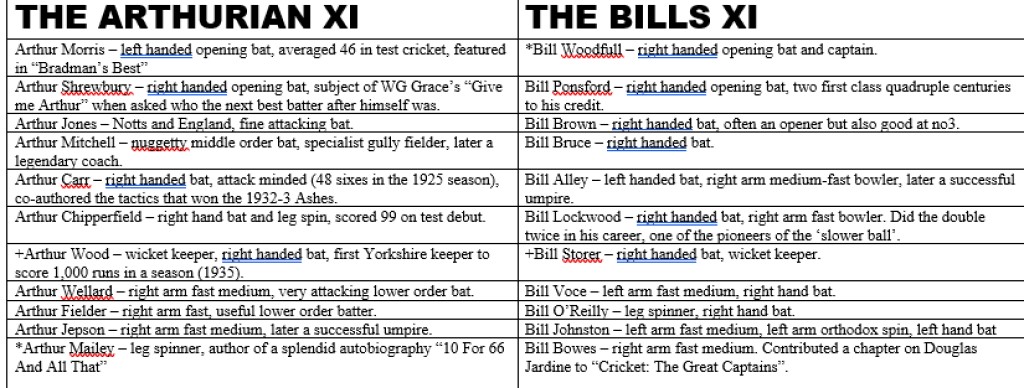
Arthurians v Bills
The teams in tabulated form, with abridged comments.