Continuing my analysis of how my all time XIs for each letter of the alphabet match up against one another.
This is the fifth post in my series analysing how the XIs I picked for each letter of the alphabet fare against each other. This will conclude the As involvement. At the start of this post the As have 51 out of a possible 100 points.
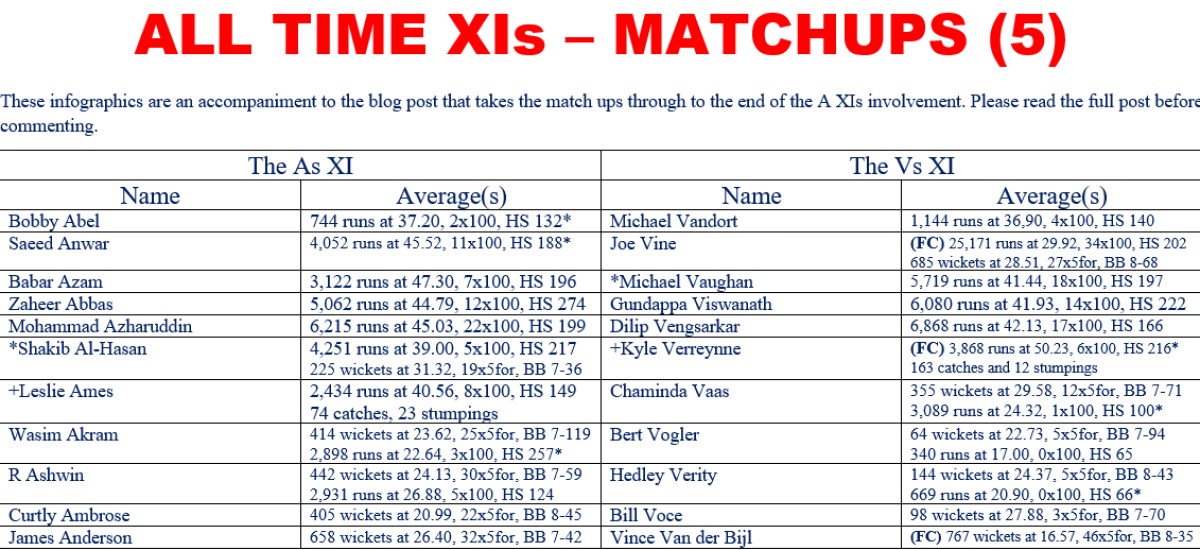
THE As V THE Vs
The As are stronger in batting and in seam bowling, though less though than the averages make the latter look – Vaas would fare better as third seamer in a strong attack than he did as opening bowler in a moderate one. The Vs are comfortably ahead in spin bowling. The As are definitely getting the better of this, but not by a huge margin. I score this one as As 3, Vs 2.
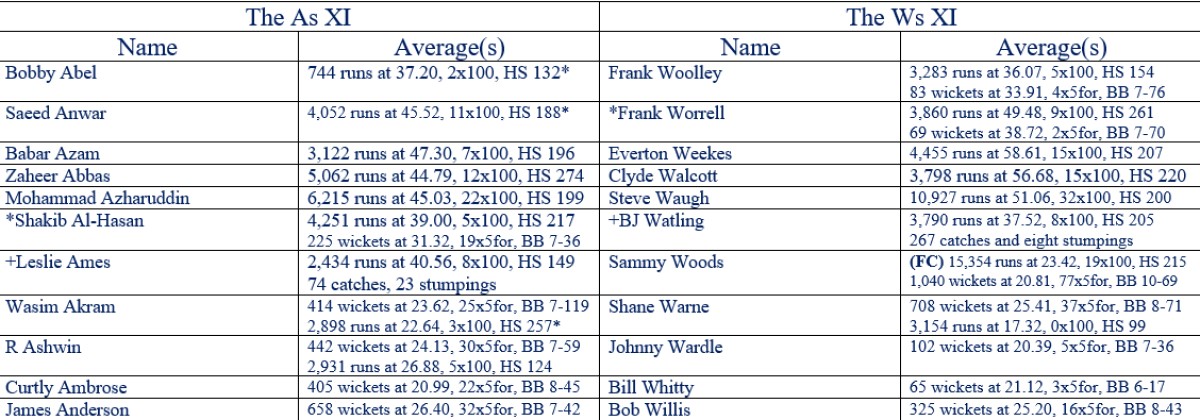
THE As V THE Ws
The Ws are comfortably ahead in batting, behind but not massively so in seam bowling and ahead in the spin bowling department. The extra bowling options provided by Woolley and Worrell count in their favour, and Worrell is clearly the better of the two skippers. I award the Ws a clear advantage here and score this one: As 1 Ws 4.
THE As V THE Xs
The As have a massive advantage in this one. For me this one is As 5 Xs 0.
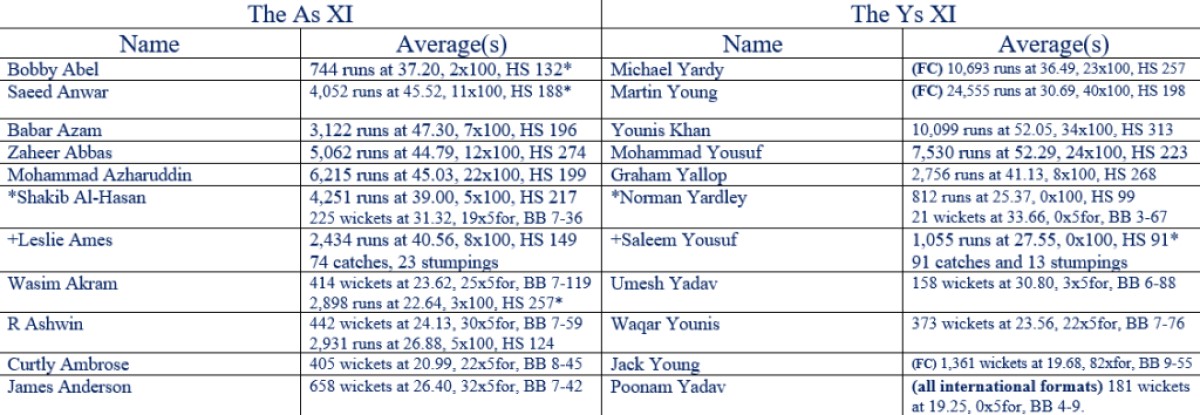
THE As V THE Ys
Even allowing for the presence of Younis Khan and Mohammad Yousuf the As have an advantage in batting. They also boss the seam bowling department. The Ys have the advantage in spin bowling, but not enough to compensate. As 4, Ys 1.
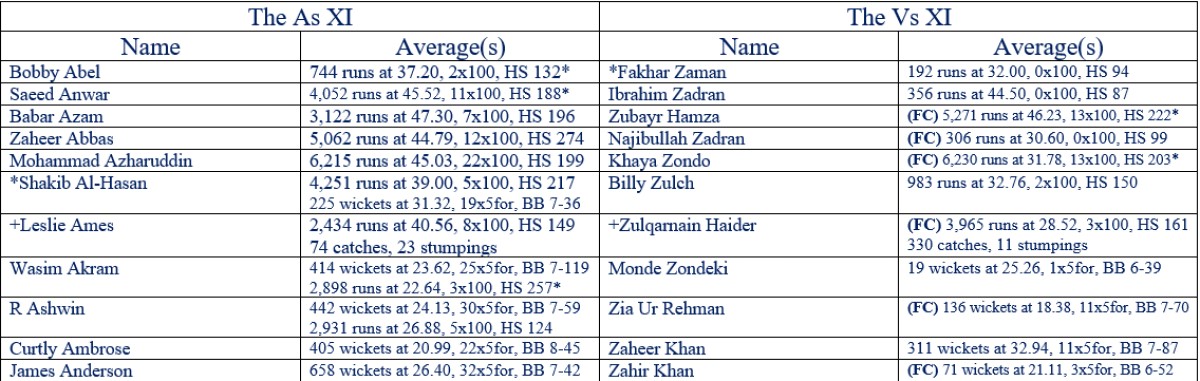
THE As V THE Zs
The As boss the batting and have a massive advantage in seam bowling. Spin bowling may be in favour of the Zs, but even if it is it cannot alter the outcome: As 5 Zs 0.
THE AS OVERALL
A strong final section for the As, seeing them take 18 of a possible 25 points to finish on 69 out of 125 points, 55.2%. The As fare respectably in the comparison and will be a lot closer to the top than the bottom.
Assembling an XI all of whose surnames begin with A. Also some photographs.
I am revisiting the theme of All Time XIs. This time I am focussing on teams that can be composed with players whose surnames all begin with the same letter. I begin at the beginning with the letter A.
THE XI IN BATTING ORDER
Bobby Abel – Surrey and England. The diminutive opener scored 74 first class centuries with a best of 357* v Somerset at Taunton. He was the first England batter to carry his bat through a completed test innings, scoring 132* on that occasion. He was also a fine fielder.
Saeed Anwar – Pakistan. A superb left handed stroke maker, an excellent counterpart to Abel at the top of the order.
Babar Azam – Pakistan. One of the best all format batters in the world at the moment.
Zaheer Abbas – Gloucestershire and Pakistan. The only Asian to have scored 100+ FC hundreds, a roll of honour that includes scores of 274 and 240 vs England in test matches and eight instances of a century in each innings of an FC match, including four where one of the centuries was a double.
Mohammad Azharruddin – India. A wristy middle order batter who did enough before his career ended in scandalous circumstances (match fixing and other dealings with dodgy bookies) to earn his place in this XI. He announced himself with centuries in each of his first three test matches, and at his peak dominated attacks all around the world.
*Shakib Al-Hasan – Bangladesh. Has an amazing all round record and has achieved it without ever having what could be described as a stellar supporting cast around him
+Leslie Ames – Kent and England. The only recognized keeper to have scored 100FC hundreds. Also holds the record for career stumpings in FC cricket (418). Won the Lawrence Trophy for the fastest hundred of the season twice in its first three seasons. Three of the four instances of the ‘wicket keepers double’ – 1,000 runs and 100 dismissals in FC cricket in a single season – were achieved by him.
Wasim Akram – Lancashire and Pakistan. Among left arm fast bowlers who bat only Alan Davidson of Australia, who played many fewer matches, boasts a test record to rival him.
R Ashwin – India. The best off spinner of the current era, and a handy lower order batter. It is a fair bet that England’s exhilarating run chase at Edgbaston would have been harder work had India picked him rather than Thakur for the number eight slot in their team.
Curtly Ambrose – Northamptonshire and West Indies. The list of bowlers with over 400 test wickets at under 21 a piece currently stands at one: Curtly Elconn Lynwall Ambrose. He rocked the WACA in Perth in 1998 by claiming seven Australian wickets for one run in a spell of 33 balls. Australia having reached 100 only one wicket down were all out for 118. At Trinidad in 1994 England need 194 in the last innings to win, with an awkward hour and a bit to survive in murky light on the penultimate day as their first task. By the end of that short session England were 40-8, and although bad batting played its part, so to did an immaculate spell of bowling by Ambrose.
James Anderson – Lancashire and England. More test wickets than any other pace bowler, and nor is there any obvious sign of his powers waning as his 40th birthday approaches.
This XI has a heavy scoring top five, a genuine all rounder at six, an all time great keeper batter at seven and a quite awesome quartet of bowlers, two of whom can certainly also bat. While the bowling attack is missing a leg spin option it is by any standards both powerful and varied, with left arm pace (Akram), two of the greatest right arm fast mediums of all time, who are different in methods to boot (Ambrose, relying on his immense height and unrelenting accuracy, and Anderson with his mastery of swing and seam). This trio is backed up by a pair of contrasting spinners (Ashwin, off spin, and Al-Hasan, left arm orthodox spin). The biggest decision is likely to which of Anderson or Ambrose gets to share the new ball with Akram.
HONOURABLE MENTIONS
Mike Atherton was close to claiming an opening slot and Dennis Amiss even closer, but I feel credit should be given to Abel for the fact that most of his runs were scored in the 19th century when pitches were often treacherous, and in the case of Amiss also feel that his decision to join a rebel tour of apartheid South Africa counts against him. Two top order batters who could bowl seam up both entered my thoughts: Mohinder Amarnath and Tom Abell. Russel Arnold of Sri Lanka came close. Among the quicks I could not accommodate were Kyle Abbott (Hampshire and South Africa) and Mohammad Abbas (Hampshire and Pakistan). Sri Lankan strokemaker Charith Asalanka may merit a place in few years time. Tommy Andrews, an Aussie middle order batter and ace close fielder of yesteryear was another who could not force his way into the middle order. West Indian left hander Keith Arthurton needed a bit more substance to go with his style to claim a place. Finally, although anyone capable of scoring 167 on the kind of pitches that existed in 1777 as James Aylward of Hambledon did must have been a very fine player, but I felt that there was just too little evidence to justify such a selection.
Today in a break from some of my more esoteric ‘all time’ XIs we take a look at the West Indies. Also features, politics, nature and a couple of family blogs, plus a mention for the fulltossblog.
INTRODUCTION
Welcome to the latest installment in my series of ‘All Time XI‘ themed posts. It being a Monday (yes, even in the somewhat strange circumstances in which I am currently living I am managing to keep track of what day of the week it is!) I am looking at an international outfit, in this case the West Indies, before reverting to more esoteric matters for the rest of the week. As usual with an international set up I will start with a team from my cricket lifetime and move on from that to an all-time version.
THE WEST INDIES WITHIN MY LIFE TIME
For this purpose I am considering only players I actually witnessed.
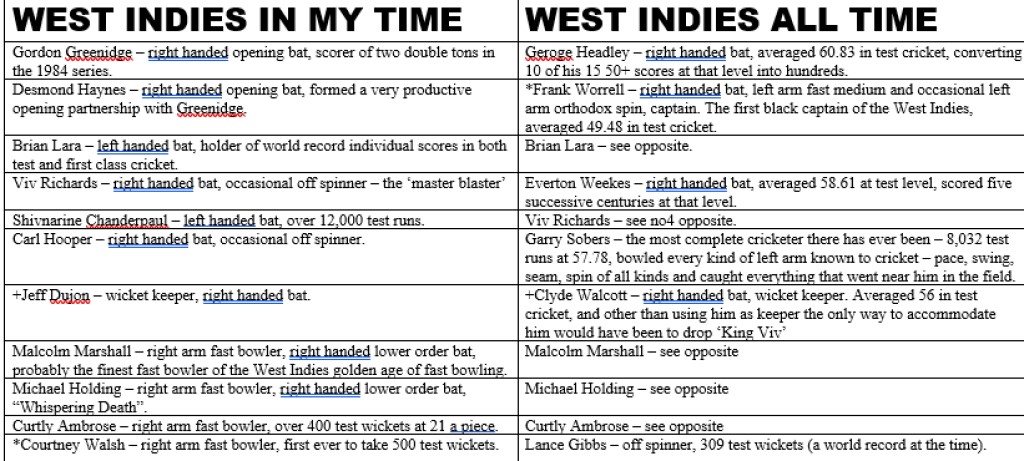
Gordon Greenidge – right handed opening batter, for Hampshire as well as his home island of Barbados and the West Indies. He scored two contrasting double centuries in the 1984 series, 223 not out in ten hours at Old Trafford, and 214 not out in about half of that time to win the Lord’s test for his side. I saw him score a ton in the MCC Bicentennial match, when he hit one square cut with such ferocity that the ball actually went through an advertising board. He was one half of a legendary opening partnership with…
Desmond Haynes – right handed opening batter, also Barbadian, and played county cricket for Middlesex for many years as well as international cricket for the West Indies. Where Greenidge was an attacker by instinct but capable at need of defending for long periods, Haynes was by inclination an anchor man, who could when circumstances demanded it absolutely annihilate bowling attacks, as shown by his magnificent ODI record.
Brian Lara – left handed batter. The Trinidadian holds the record test and first class scores, one of only two ever to have the double distinction (Bradman did so for a couple of years, between Headingley in 1930 where he made 334 to go with his 452 not out for NSW v Queensland and Christchurch 1933 where Hammond scored 336 not out) – 501 not out for Warwickshire against Durham in 1994 and 400 not out v England at Antigua in 2004. Ten years earlier he had hit 375 v England on the same ground, the only player to hold the world test record twice (Hayden intervening with 380 v Zimbabwe at Perth). A small caveat over these feats of tall scoring by Lara is that none came in winning cause – all three matches were drawn. Just for the record, the full progression of test record high scores is: Bannerman 165 in the first test innings of all in 1877, Murdoch 211 at The Oval in 1884, Foster 287 at Sydney in 1903, Sandham 325 at Kingston in 1930, Bradman 334 at Headingley in 1930, Hammond 336 not out at Christchurch in 1933, Hutton 364 at The Oval in 1938, Sobers 365 not out at Kingston in 1957, Lara 375 at Antigua in 1994, Hayden 380 at Perth, Lara 400 not out at Antigua in 2004.
Viv Richards – right handed bat, occasional off spinner. The ‘Master Blaster’. Among his many credits are a 56 ball hundred v England at Antigua in 1986, and an innings in 1990 against the same opposition when he twice mishit Devon Malcolm for sixes. He came into bat in a manner equivalent to a prima donna taking centre stage in an opera – all eyes immediately focussed on him, while everyone else, especially opposition bowlers, seemed simply to have the task of feeding him lines.
Shivnarine Chanderpaul – left handed bat, occasional leg spinner. He announced himself by scoring a double century in an under-19 match, and unlike his English equivalent who went straight back to his county second XI after doing so, he was fast tracked in the West Indies full team, and immediately began scoring runs (he would tally over 12,000 in test cricket).
Carl Hooper – right hand bat, semi-regular off spinner. This man simply exuded elegance and class – the main criticism that he attracted being that he did not often enough go on for the really big score.
+Jeff Dujon – Wicket keeper, right handed middle order bat – quite simply the best keeper the West Indies have had in my lifetime, and an average of over 30, including four test tons. He tended to get his runs when the team really needed them, not by thrashing already demoralized bowlers.
Malcolm Marshall – right arm fast bowler, useful lower right handed lower order bat. By my reckoning the greatest fast bowler of the West Indies’ golden age of fast bowling – and 376 test wickets at 20.94 is substantial backing for that claim. He was pretty much the ultimate pro, as he demonstrated during his years as Hampshire’s overseas star, and developed bucketloads of craft and guile to go with the pace he always possessed.
Michael Holding– right arm fast bowler, aggressive right handed lower order bat. ‘Whispering Death’ as he was known because of his silent run up was another magnificent fast bowler, one of the stars of the attack during both the ‘blackwashes’ the West Indies inflicted on England in the 1980s.
Curtly Ambrose – right arm fast bowler (later in his career slowed to fast medium, if not medium fast). Twice he won test matches by destroying the England batting, once with 8-45 in an innings at Bridgetown, and he was only prevented from the being the match winner at Headingley in 1991 by the batting of Graham Gooch (154 not out in a total of 252 all out on a pig of a pitch, second highest score 27 jointly by Ramprakash and Pringle) and a display of ineptitude by his own colleagues in the face of England’s much less threatening bowling ‘attack’. Against the Aussies in Perth he once produced a spell of 7-1 which unsurprisingly settled the outcome of that match. I saw him in action last year for Lashings World XI, when he bowled two overs off a reduced run up, and the opposition simply could not lay a bat on him.
*Courtney Walsh – right arm fast bowler (slowed late in his very long career to fast medium if not medium fast). The first bowler of any description to capture 500 test wickets. Although I do not usually think that fast bowlers make the best captains, he did the job well, suffering mainly from the fact that a once great side was becoming ordinary around him. His last bow, in England in the year 2000, showed up the problems in sharp relief (under the captaincy of Jimmy Adams), with the batting folding on a regular basis, and the bowling other than that of the then 38 year old Walsh being little to write home about – Trescothick made his test debut in that series, showed great character to survive the new ball but was still on 0 not out when Walsh was relieved, and got off the mark from the first ball bowled by Walsh’s replacement, going on to a fine 66.
This team has six quality batters, five of them definitely meriting the label ‘great’, a top drawer glove man who knew how to bat and four of the finest fast bowlers you would ever meet. There is little in way of spin for reasons I will go into in the next section of this post, with Hooper’s off breaks the nearest thing to a front line spin option.
EXPLANATIONS, HONOURABLE MENTIONS AND A SPECIAL FEATURE
I will start with a few honourable mentions: Chris Gayle, ‘Universe Boss’, scored two test triple centuries, and I saw him make a classic 167 not out at Adelaide in 2009, but I felt that the value of the Greenidge/Haynes combo was too great to include him. Richie Richardson was a fine batter, at one time rated no1 test batter in the world, but I could only have got him in by sacrificing Hooper at no 6. Clive Lloyd was a fine batter and captain, but I never actually witnessed him in action, so could not select him. Ramnaresh Sarwan was also a fine batter who I regretted not being able to fit in. Denesh Ramdin probably believes he was a candidate for the keeper’s slot, but in truth, a double ton against England on a feather bed of a pitch in Barbados notwithstanding, he was not in Dujon’s class in either department.
SPECIAL FEATURE: BALANCE, ALL ROUNDERS, BOWLERS AND THE WEST INDIES GOLDEN AGE
As mentioned in my overview of it the team lack either an all-rounder or a genuine spinner. The reason for this is that in my lifetime the West Indies men have only produced four cricketers who could be dubbed all rounders, Eldine Baptiste, Hamesh Anthony, Franklyn Stephenson and Ottis Gibson, and none were really good enough with the bat to drop a front liner for, nor with so many genuine fast bowlers to pick from could they force their way in that category. If I am mandated to select an all rounder then Stephenson comes in for Hooper, but under protest. Roger Harper, a middle order batter who bowled off spin and was a great fielder, was not quite good enough in either department to be considered. I only gave serious consideration to two specialist spinners, Suleiman Benn and Sunil Narine, but although Narine especially would have his advocates, neither have a test record that really commands respect, though Narine is an outstanding limited overs bowler.
Even had there been a spinner in the period concerned with a really fine test record, I had a particular reason for picking four specialist pace bowlers (albeit Marshall and Holding were both capable of scoring useful runs) – the four pronged pace battery propelled the West Indies to the top of the cricket world under Clive Lloyd and kept them there under Viv Richards. At Trinidad in the 1975-6 series against India Clive Lloyd, in anticipation of a turner was given a team containing three front line spinners, Inshan Ali, Albert Padmore and Raphick Jumadeen, to match the three India would play, Bedi, Chandrasekhar and Venkataraghavan. For three of the four innings, things went to plan, and India were set 406 to win. India knocked those runs off, a test record at the time, for the loss of just four wickets, the three West Indies spinners leaking 220 of the runs. Lloyd decided there and then that he wanted his best available bowling attack irrespective of conditions, and secured an all pace quartet (initially Andy Roberts, Wayne Daniel, Bernard Julien and Vanburn Holder) for the future. The West Indies did not look back from that point. One series was lost to New Zealand in 1980, but otherwise the West Indies ruled supreme until the rise of the Aussies in the 1990s. Other pace stars who featured for greater or lesser periods in this period were Colin Croft, Joel Garner, Sylvester Clarke, Milton Small and Tony Gray. Later, even after their domination had faded the West Indies produced a few other notably quick bowlers – Ian Bishop who was blighted by injuries, Kemar Roach (who I saw bowling at over 150kph at Adelaide, not a ground beloved of many bowlers) and most recently Shannon Gabriel. It is now time to move on to…
WEST INDIES ALL TIME
Of the players I named in the XI from my life, Lara, Richards, Marshall, Holding and Ambrose make the all-time XI. They are joined by the following:
George Headley – right handed bat, nicknamed ‘Atlas’ because he carried the team on his shoulders, like the titan of Greek mythology carried The Earth on his shoulders. He averaged 60.83 in test cricket, converting 10 of his 15 fifty plus scores into centuries. He usually batted three, but the West Indies in his day so often lost an early wicket that he was effectively opening anyhow, which is how I use him in this team.
*Frank Worrell – right handed bat, left arm fast medium and occasional left arm spin. He sometimes opened, which is the task I have given him in this team, and CLR James’ ghost would haunt me for eternity if I dared named anyone else as captain of an all-time West Indies XI. He was the first black player to be West Indies captain, breaking a particularly vile shibboleth that black fellows needed to be led by someone with white skin, and he led the West Indies to the top of the cricket world, becoming the first to succeed in banishing inter-island rivalries from the dressing room.
Everton Weekes – right handed bat, averaged 58 in test cricket, including a run of five successive centuries (ended by a run out 90). He also represented his home island of Barbados at Contract Bridge, a game that I enjoy playing.
Garry Sobers – left handed bat, left arm fast, left arm swing or seam and left arm finger and wrist spinner, brilliant fielder. Quite simply the most complete cricketer the world has ever seen, averaging 57.78 with the bat and taking 235 test wickets. If Ellyse Perry (still only 29 years old, though she has been around a long time) takes up spin bowling to add to her other cricketing accomplishments she may match him in that regard. Sobers was actually first selected as a left arm spinner, developed his batting after that, and then as a Lancashire League pro developed the ability to deploy pace, seam and swing because pros there are expected to be able to contribute heavily with both bat and ball no matter what, and the heavy skies and green surfaces that are both such regular features of north western England tend to lend themselves more to pace, swing and seam than to spin.
+Clyde Walcott – right hand bat, wicket keeper. He was a recognized wicket keeper, as well averaging 56 in test cricket, and the only way I could have got him in as other than a keeper would have been by dropping King Viv.
Lance Gibbs – off spinner, taker of 309 test wickets (world record at the time). While there was a reason why the West Indies team from my lifetime should feature an all-pace battery, for this combo I revert to a more balanced attack.
Thus my all-time XI in batting order reads: Headley, *Worrell, Lara, Weekes, Richards, Sobers, +Walcott, Marshall, Holding, Ambrose, Gibbs. This combination has a splendid looking opening pair, a stellar 3,4 and 5 with Lara a left hander for extra balance, the most complete cricketer of all time at six, a batter/keeper at 7, three fast bowlers and an off spinner. The bowling, with the three specialist quick bowlers backed up by Gibbs’ off spin, Sobers’ variety of left arm options, Worrell and possibly Richards as seventh bowler, looks awesome (the only base not covered is right arm leg spin).
HONOURABLE MENTIONS
George Challenor and Percy Tarilton, the pioneers of ‘Caribbean style batting’ never got to show what they could do at test level. Allan Rae and Jeff Stollmeyer were a highly successful opening combo, but had I opted to pick an opening partnership Greenidge and Haynes would have got the nod. Conrad Hunte was a great opener who never benefitted from having a truly established partner. I have the word of CLR James that Rohan Kanhai was an absolute genius with a bat in his hands, but just who could I drop to make way for him?
Among the great fast bowlers not getting the nod were: George John who flourished before his country played test cricket, Herman Griffith (also a tough captain – he was once captaining a youngster of whom big predictions were being made and when it came to time for the youngster to bowl he requested a suggestion of field placements beginning with the word ‘deep’, and when he prefaced his fourth successive position with that word Griffith snapped, and called up another bowler, saying “No, you obviously intend to bowl foolishness” – a refusal to accept low standards of which I wholeheartedly approve), Learie Constantine, Manny Martindale, Roy Gilchrist, Wes Hall and Charlie Griffith. Spinners to miss out included Ellis Achong (from whom the term ‘chinaman’ for the left arm wrist spinner’s equivalent of a googly derives – his parents came to Trinidad as indentured labourers, and were indeed Chinese, and the story is that when Walter Robins fell LBW to him, misreading the spin, he said en route back to the pavilion “fancy being done by a chinaman” and so the term was born), and my little pals Ram and Val (Sonny Ramadhin and Alf Valentine, who took the first eight wickets to fall in the first test innings in which he bowled). Had I been able to accommodate a specialist wicket keeper Deryck Murray would have got the nod, but with only 11 spaces to fill there was just no way to do so.
I am well aware that at least one of the regular readers of this series of posts knows a very great deal about West Indian cricket, and I hope that ‘africanherbsman’ as he identifies himself feels that I have done something approaching justice to the cricketers of his islands, for whose achievements I have great admiration.
LINKS AND PHOTOGRAPHS
Well, our virtual Caribbean cruise is at an end, but I have a few links to share before applying my usual sign off…
The fulltoss blog, which I highly recommend, have an excellent post up titled “The Joe Root Dilemma“. This refers to the fact that Root the captain averages whicless than Root the pure batter. My own view is that the best way to handle replacing Root as captain would be to appoint Burns as his successor, with Dominic Bess being made vice-captain and prepared for long-term succession to the role (I have stated before that other considerations being equal spinners, especially spinners who can bat a bit, should make the best captains, a view also expressed by Arthur Mailey, a test match spinner in his day, in his autobiography).




























































































































 aspiblog