England’s Undeserved Point

A look back at the England Women’s cricket team’s luckiest ever day, escaping with a point from a match in which they were utterly outplayed, and a lot of photographs.

Today’s match in the women’s cricket world cup saw England facing Pakistan in Colombo (this tournament is officially being held in India, but the Indian government refuse to allow Pakistanis, even Pakistani international cricketers, into their country, so Pakistan are based in Colombo). Such action as there was took place in three stanzas. The photos in this post will come in three parts, in natural breaks in the format of the post.

Pakistan won the toss and put England in to bat. England had two changes, both caused by illness. Em Arlott replaced Lauren Bell while leg spinner Sarah Glenn was in for the world’s number one ranked ODI bowler Sophie Ecclestone.

Pakistan bowled beautifully, albeit with quite a few bad balls thrown in. England scored rapidly, but lost wickets even more rapidly. Both openers went cheaply, and so too did Heather Knight and Natalie Sciver-Brunt. At 39-4 England were in deep trouble, and it would get deeper. Emma Lamb, an opener in domestic cricket, has barely been able to buy a run since England crowbarred her into their middle order, and she failed again today. Sophia Dunkley tried to play left arm spinner Sadia Iqbal off the back foot and was LBW for 11 to make it 57-6. Charlie Dean dug in with typical determination, but with the score having inched up to 78 Alice Capsey was LBW – she reviewed it in desperation, but it was pretty much plumb. One more run came before with the completion of the 25th over rain forced the players from the field. England at this juncture were 79-7, and unlike Australia who had had a similar score line against Pakistan but had escaped there was no frontline batter left to play the Mooney role in any turnaround.


When play was finally able to resume the match had been reduced to a 31 over per side match, meaning that England had six overs left to bat. Those six overs were England’s best period of play by far. They scored 54-2 from those six overs, giving them a final total of 133-9 from 31 overs. Quite rightly in view of the calamitous early part of their innings and the fact that only having six overs to bat had definitely worked in their favour this target was adjusted downwards. Pakistan would resume after a 10 minute innings break needing 113 to win. Charlie Dean with 33 from number eight in the order was the only English batter to even get as far as 20. Sarah Glenn with 18 from number nine was joint second top scorer alongside Knight.

Pakistan’s openers, Muneeba Ali and Omaima Sohail, started well. Not only were England not taking wickets as they needed to, they were not really threatening to do so. However with Pakistan 34-0 from 6.4 overs and in cruise control the rain returned and this time it did not let up, and the match was abandoned. That meant one of the most undeserved points you will ever see for England, official confirmation of Pakistan’s elimination, and a bad taste in the mouth of any genuine cricket fan who was following proceedings. I am English, but my sense of justice prevails here. The only emotions the England players should be feeling about today are shame and embarrassment – there have been few teams in any sport I would suggest who have been this humiliated and still emerged with a share of the spoils.


England do not stand quite alone in escaping with a share of the spoils after being thoroughly humiliated – few events in the history of a sport as old as cricket are truly unique. In the 1992 men’s world cup Pakistan were bowled out for 74 in a group match against England, and then it rained and the points were shared. Pakistan pulled their socks up after that shocking performance against England and went on to win the tournament.

In 1907 Northamptonshire probably suffered the worst humiliation of any side to escape with a share of the spoils in professional cricket. They were playing Gloucestershire in Gloucestershire in a heavily rain affected match. Gloucestershire totalled 60 and 88, with Gilbert Jessop managing 22 and 24, a performance at least as valuable as twin tons on a good batting pitch, while Northamptonshire were all out for 12 in their first innings (George Dennett 8-9, that man Jessop 2-3) and 40-7 in their second innings (Dennett 7-12 including a hat trick) when the rain made its final intervention.

England’s Victory

Looking at the turnaround in the test match at Old Trafford, plus a few other bits.
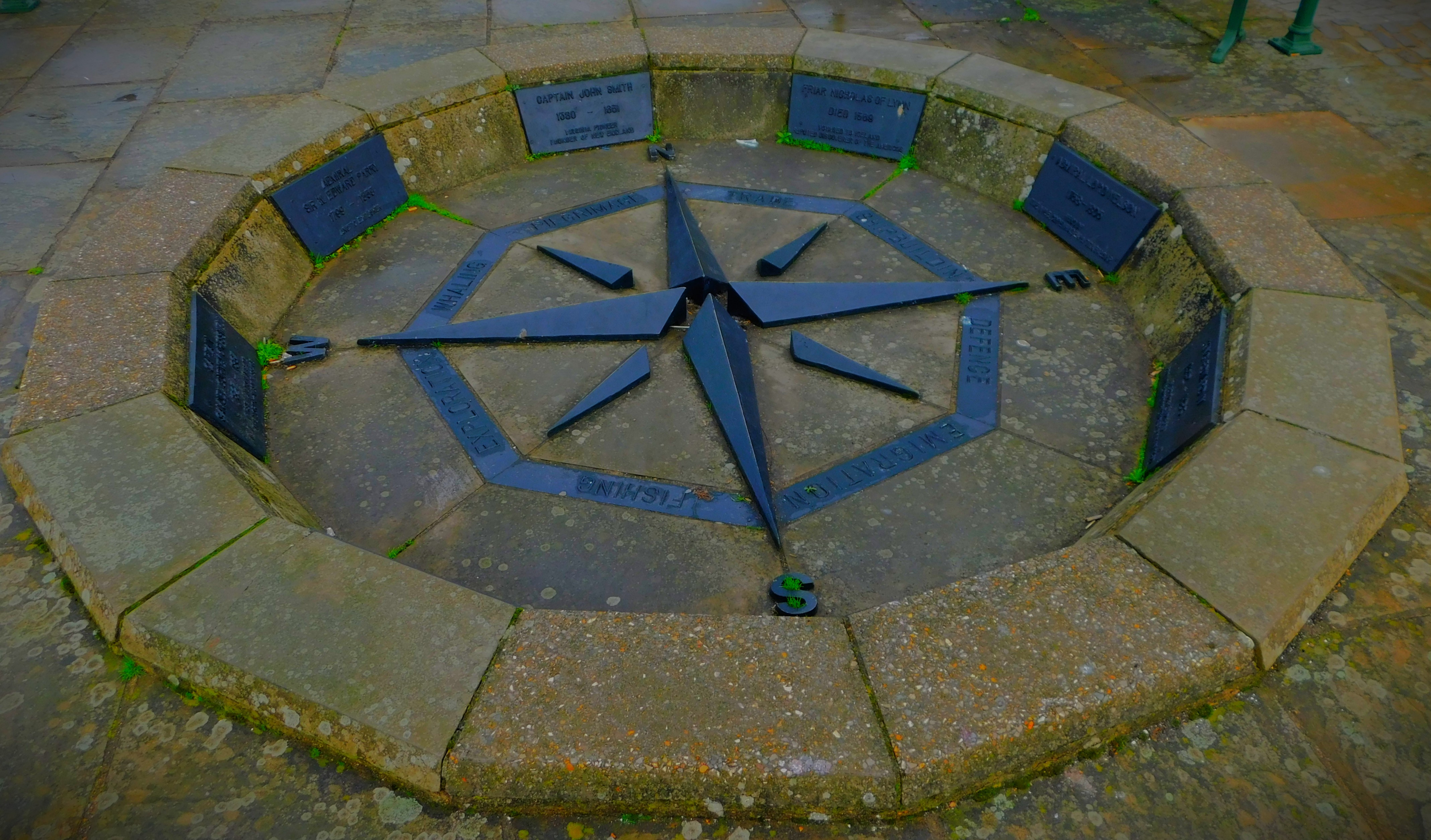
INTRODUCTION

The main focus of this post is the opening test match against Pakistan at Old Trafford, with a brief glimpse at the second round of fixtures in the Bob Willis Trophy as well.
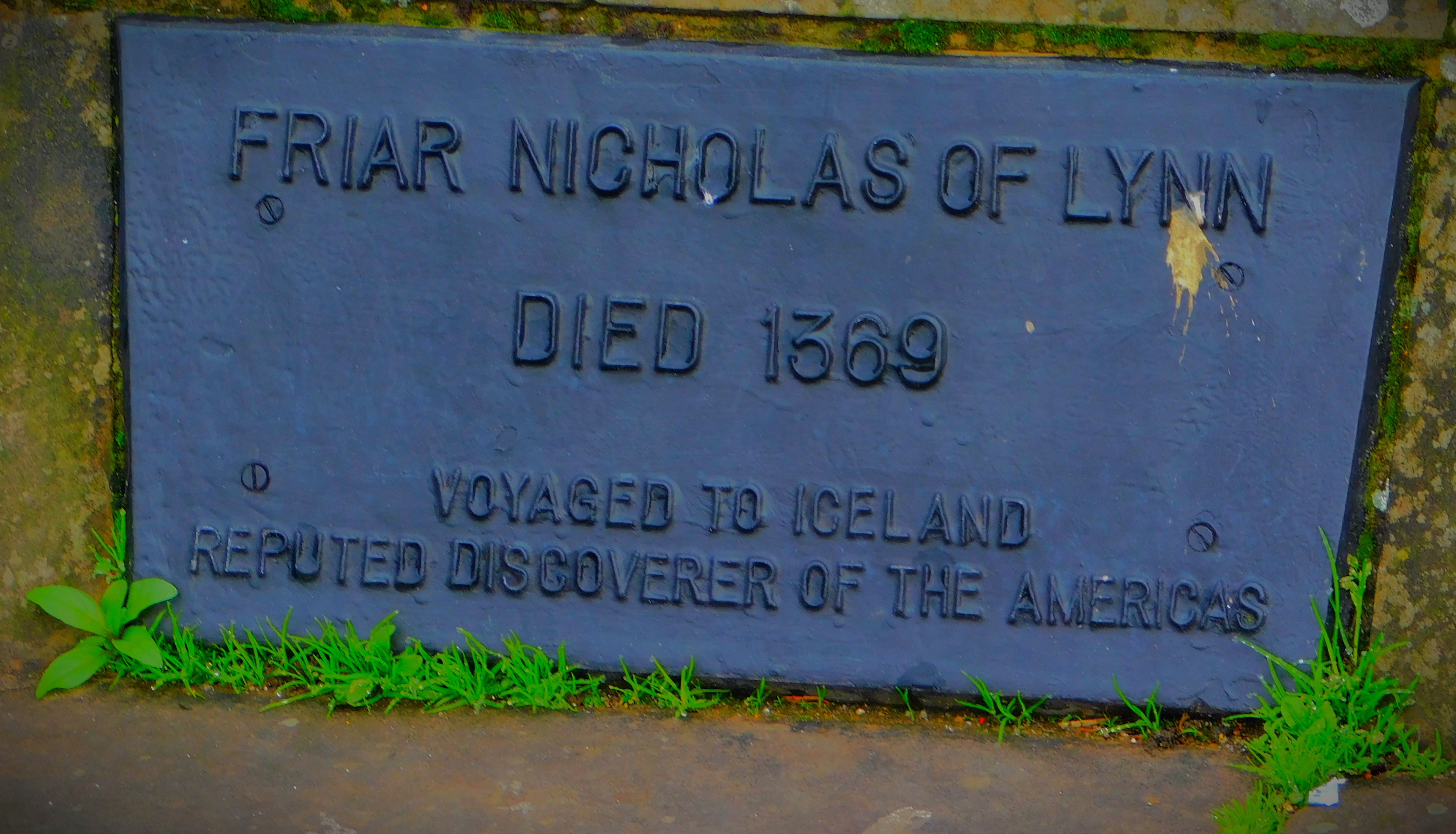
FROM THE JAWS OF DEFEAT

England’s fightback in this match began on Friday evening, when they reduced Pakistan’s second innings to 137-8. Although it did not take very long yesterday morning for the last two wickets to fall, 32 runs were accrued from the 3.2 overs for which Pakistan batted. This left England needing 277 to win, and at first, as wickets fell steadily it looked very unlikely. When Pope got out out to a brutal ball to make it 117-5 it seemed a matter of when, not if. At that point Chris Woakes with seven single figure scores in his last eight test knocks came in to join Jos Buttler who had had a stinker of a match up to that point. Both players played their shots, recognizing that taking the attack back to Pakistan was the only chance. As the partnership developed Pakistan became a little ragged, although nerves also kicked in for the England pair and progress slowed. Buttler fell for 75 with just over 30 still required, and England sent in Stuart Broad, known as a quick scorer, with the aim of making sure that the second new ball was not a serious factor. The ploy worked, and by the time the new ball became available the target had been reduced to 13. In desperation Pakistan put on a fast bowler at one end but kept Yasir Shah going at the other. Broad was out with England a boundary away from victory and Bess survived the remainder of the over. Woakes edged the first ball of the next over through the slip region for four and England were home by three wickets. Woakes had scored 84 not out, going with 19 in the first innings and total match figures of 4-54. In view of the result there was no other candidate for Man of the Match.

There has only been one occasion when an England no7 has scored more in a 4th innings run chase – at The Oval in 1902 when Gilbert Jessop came in with the team 48-5 in pursuit of a target of 263 and blasted 104 in 77 minutes. Woakes’ performance was more reminiscent of George Hirst’s effort in that match – five wickets with the ball and scores of 43 and 58 not out.

ENGLAND PLAYER RATINGS

  1. Rory Burns – 4 – the opener failed twice in this match.
  2. Dominic Sibley – 6 – one long innings and one failure with the bat, also a superb unassisted run out in the field,
  3. Joe Root – 6 – not many runs for the skipper, but he led the side well, and his promotion of Broad to cater for the specific circumstances of the second innings was an excellent decision.
  4. Ben Stokes – 6 – failed with the bat, but although not fully fit to bowl took a hand at the bowling crease in England’s hour of need and bagged a wicket.
  5. Ollie Pope – 7 – a magnificent knock in the first innings, when it looked like he was facing a different set of bowlers to everyone else, and the delivery that got him was all but unplayable. Also played a few decent shots in the second dig before fetching another ‘jaffa’.
  6. Jos Buttler – 4 – a horror show behind the stumps, including missing a chance to see the back of Shan Masood for 45 (he went on to 156) and several other howlers, a gritty first innings batting effort, and a fine effort in the second innings, but still even after that knock in overall deficit for the match.
  7. Chris Woakes – 9 – a magnificent match for the under-rated all rounder. He is now indispensable in England (in some other parts of the world where the combination of the Kookaburra ball and the different atmospheric conditions effectively eliminates swing he is a lot less of a player) and his Man of the Match award was thoroughly deserved.
  8. Dominic Bess – 5 – bad wicket keeping caused him to miss out on several wickets, but in the second innings with the ball definitely turning he should have done better than he did.
  9. Jofra Archer – 5 – an ordinary game for the express bowler.
  10. Stuart Broad – 7 – bowled reasonably, played two splendid cameo innings.
  11. James Anderson – 5 – the veteran was unimpressive by his own standards, though respectable by anyone else’s.

These ratings mostly look low for players in a winning side and that is for a good reason – Pakistan bossed this game through its first two innings, and England were fortunate to emerge victorious.

THE REST OF THE SERIES

News has just emerged that Stokes is heading to New Zealand for family reasons and will not play in the remaining matches of the series. Buttler cannot continue as keeper, the question being whether you think he can justify being picked purely as a batter. I personally do not and would leave him out. My chosen line-up from those available would be Burns, Sibley, Crawley, *Root, Pope, +Foakes, Woakes, Bess, Robinson, Archer, Broad. Anderson I think needs to be rested, and I opt for Robinson as his replacement. If Buttler’s selection is non-negotiable he gets the nod at six as a specialist batter, and Robinson misses out. Bess needs a good match sooner rather than later but I would not want to be without a front line spin option.

THE BOB WILLIS TROPHY

The second round of matches in this competition are well underway. Worcestershire scored 455-8 against Glamorgan, who are 27-0 in reply. Yorkshire managed 264 in their first innings and Notts are 140-4 in reply. Northants v Somerset has seen some extraordinary happenings – Somerset made 166 in the first innings, Northants were then bowled out for 67, and Somerset were at one point 54-6 in their second innings before recovering to reach 222, Northants are 5-0 in their second innings. Middlesex made 252 against Hampshire, who are 129-3 in reply. Leicestershire managed 199 against Derbyshire who are 235-3 in response. Sussex made 332 against Kent who are 131-1 in response. Gloucestershire scored 210 all out v Warwickshire who are 73-3 in reply. Durham were all out for 180 against Lancashire, who are 138-4 in response. Finally, Essex scored 262 in their first innings, and Surrey are 81-4 in response.

SOLUTION AND NEW TEASER

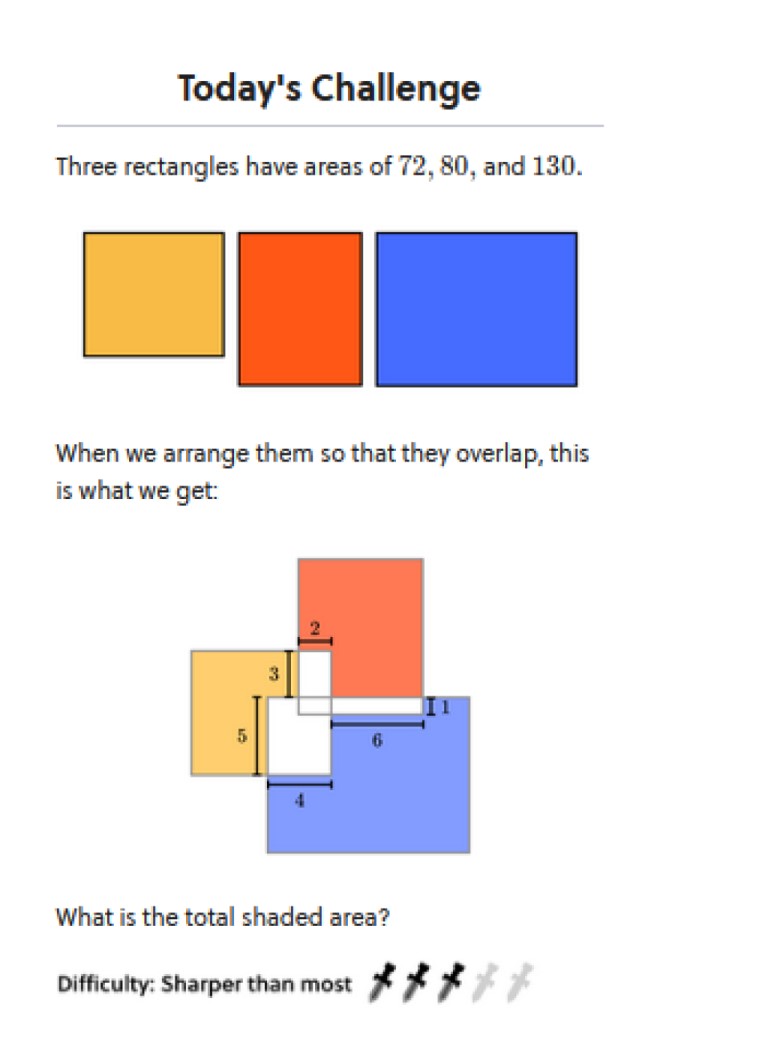
I posed this problem from brilliant in my last post:

Venn Rectangles

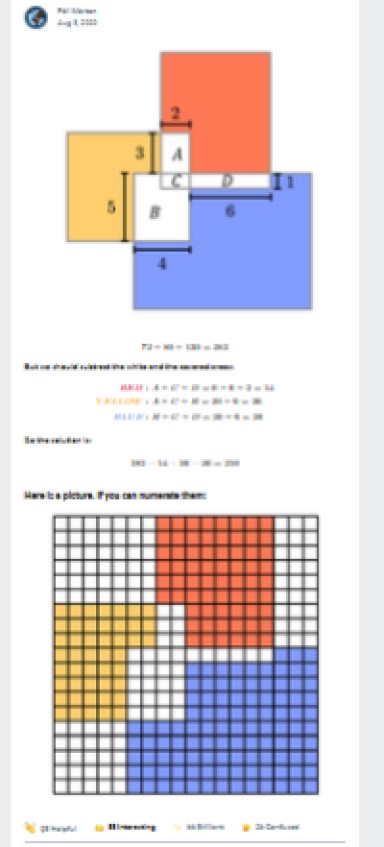
The answer is 216, as shown in this published solution by Pall Marton:

PM

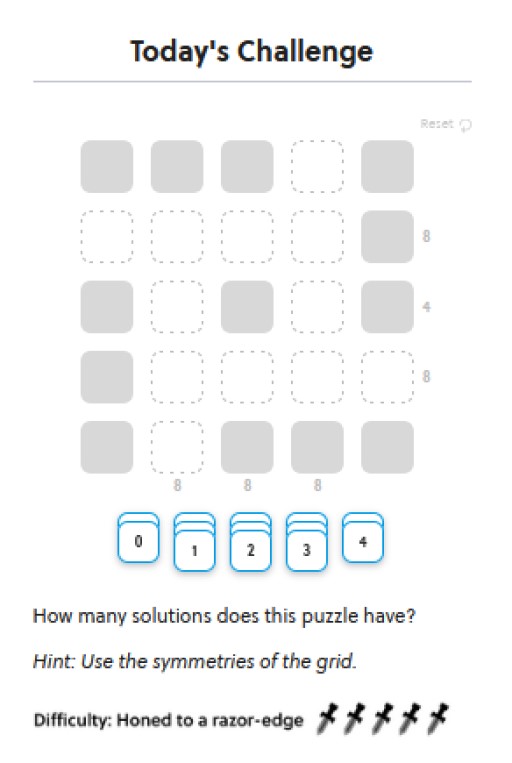
Here is another teaser, this one tangentially connected with sudoku:

Pinwheel

This one is not as hard as the five dagger rating suggests, but it is quite challenging. Solution in my next post.

PHOTOGRAPHS

My usual sign off…

IMG_2645 (2)IMG_2646 (2)IMG_2647 (2)IMG_2648 (2)IMG_2649 (2)IMG_2650 (2)IMG_2651 (2)IMG_2652 (2)IMG_2653 (2)IMG_2656 (2)IMG_2657 (2)IMG_2657 (3)IMG_2658 (2)IMG_2659 (2)IMG_2659 (3)

IMG_2662 (2)
Damselflies have been out in force, as these remaining pictures show. They are tricky in two ways – actually capturing them on camera, and editing the shots to best effect.

IMG_2662 (3)IMG_2663 (2)IMG_2663 (3)IMG_2664 (2)IMG_2664 (3)IMG_2664 (4)IMG_2665 (2)IMG_2665 (3)IMG_2665 (4)IMG_2667 (2)IMG_2667 (3)IMG_2668 (2)IMG_2668 (3)IMG_2669 (2)IMG_2669 (3)IMG_2670 (2)IMG_2670 (3)IMG_2670 (4)IMG_2671 (2)IMG_2671 (3)IMG_2671 (4)

Pakistan In Control In The Test Match

A look at developments in the test match, some mathematics and plenty of photographs

INTRODUCTION

The series opener between England and Pakistan is now into its third day of play. This post looks at developments in that match so far.

THE PAKISTAN INNINGS

A weather hit opening day ended with Pakistan two down, Babar Azam already past 50 and Shan Masood not far short. England bowled well on the second morning but did not get full benefit for their efforts in that department as they were badly let down by Jos Buttler who had an absolute nightmare behind the stumps. Post lunch England bowled poorly, and Masood cashed in, being well supported by Shadab Khan. Masood eventually reached 156 before his resistance was ended. Pakistan tallied 326 in total for their innings, a score that looks very good on this pitch.

ENGLAND’S RESPONSE

England were soon 12-3 in reply, with both openers and Stokes out cheaply. Root batted a long time but did not score many, and Buttler was just able to survive to the close after Root’s dismissal. At the end of day 2 England were 92-4, with Pope who had looked a class above anyone else in the order approaching a 50. This morning Pakistan bowled superbly and England did well to get through the opening session for the loss of only one wicket – Pope got an absolute beauty. Woakes was hit by a bouncer but resisted through to lunch in company with Buttler. Early in the afternoon session Buttler has been bowled by leg spinner Yasir Shah for 38 to make it 159-6. Bess will be next man in. Taking into account Buttler’s errors with the gauntlets a generously inclined assessor would now say that he is only in a double-figure rather than a triple-figure deficit for the match. Stokes’ unfitness for bowling means that England have little batting left – Woakes is more bowler than batter (though his record in England specifically is excellent), Bess can handle a bat, but against an attack equipped with serious pace and quality wrist spin (more difficult to handle than finger spin) little can be hoped for, much less expected, from Broad, Archer and Anderson. This Pakistan team look to be made of sterner stuff than the West Indies – Masood’s ton was his third in as many tests, while Azam’s innings was a magnificent performance, and his record suggests that he deserves to be bracketed with Kohli, Smith and Williamson and placed ahead of the current version of Root as a batter. The pace bowling, with a left arm quick in Shaheen Afridi, a right arm quick in the person of 17 year old Naseem Shah,  and an excellent exemplar of the steady medium-fast bowler in Mohammad Abbas looks superb. Yasir Shah with his leg spin and the second leg spinner Shadab Khan whose bowling has not yet been called on are likely to play an ever increasing role as the match goes on, and Yasir Shah has already accounted for a couple of wickets, Root yesterday as Pakistan’s keeper demonstrated that it is perfectly possible to make dismissals off a spin bowler on this pitch and Buttler today, bowled through the gate, once again failing to navigate his personal ‘Bermuda triangle’ which is located between 21 and 50. Ben Foakes has a first class batting average of 38 (having played just over 100 matches at that level – a very impressive record for someone for whom batting is the second string of the bow) and is also the best pure keeper in the country, and various young keepers are beginning to establish themselves at county level and would also be more deserving of the test gauntlets than Buttler, though my own feeling is that Foakes deserves an extended run as England’s acknowledged no1 test keeper before a youngster is blooded. Yasir Shah has nabbed a third wicket, that of Bess, while I was writing this. Archer has been sent in at no9, ahead of Broad and Anderson, and England need something major from Woakes backed by the tail – with the pitch already helping the bowlers quite a bit anything approaching a major deficit will be insuperable, and at the moment that is exactly what England will be facing.



A SOLUTION AND A NEW PROBLEM

I offered this problem from brilliant up in my previous post:

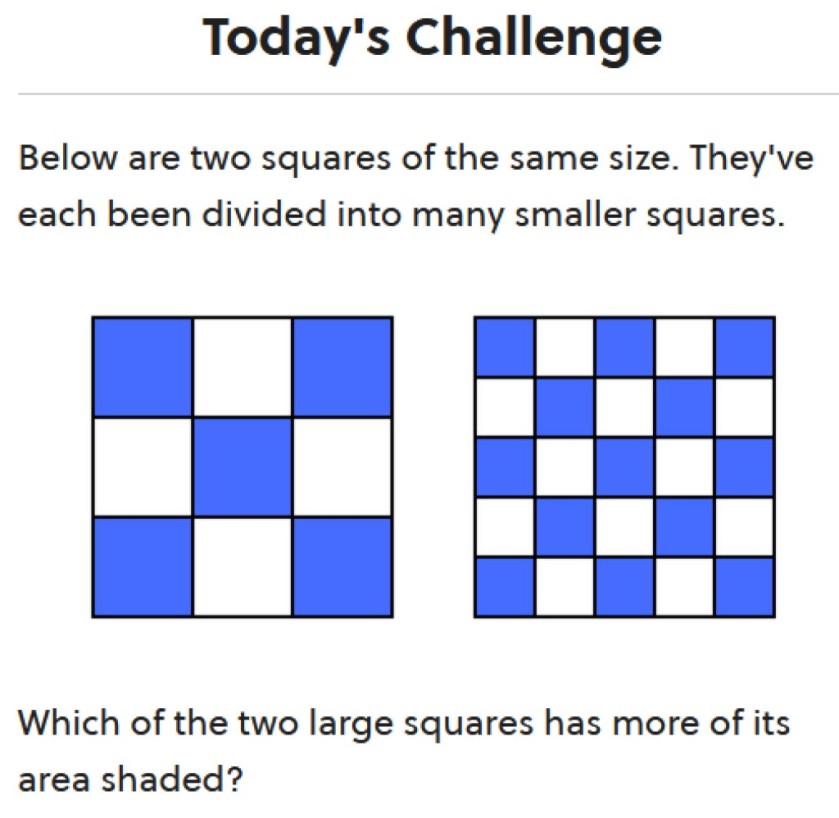
No multi-choice here (this is much too easy for that), but a bonus challenge: part 1) if there was a third square of the same size but divided into 49 smaller squares shaded in similar fashion which would have the largest shaded area, and part 2)what is the general rule relating the number of squares into which the big square is divided and the proportion of it that ends up shaded?

The first shape contains nine squares of which five are shaded, while the second contains 25 squares of which 13 are shaded. 5/9 = 0.55…, while 13/25 = 0.52, so the first shape has a greater shaded area. The 7X7 square would have an even smaller proportion of its area shaded – 25/49 = 0.51. The general rule is that the greater the number of squares the shape is divided into the closer the shaded area approaches to half the total area, while always remaining just above that limit.

Here is another problem from brilliant:

Venn Rectangles

Yasir Shah has just collected his fourth wicket, that of Woakes to make it 170-8, and England are definitely in the mire.

PHOTOGRAPHS

My usual sign off…

IMG_2564 (2)IMG_2564 (3)IMG_2564 (4)IMG_2565 (2)IMG_2567 (2)IMG_2568 (2)IMG_2569 (2)IMG_2569 (3)IMG_2570 (2)IMG_2572 (2)IMG_2574 (2)IMG_2575 (2)IMG_2576 (2)IMG_2577 (2)IMG_2578 (2)IMG_2579 (2)IMG_2580 (2)IMG_2581 (2)IMG_2582 (2)IMG_2594 (2)IMG_2596 (2)IMG_2597 (2)IMG_2598 (2)IMG_2599 (2)IMG_2600 (2)IMG_2601 (2)IMG_2602 (2)IMG_2603 (2)

IMG_2604 (2)
I gave these tomato plants a thorough watering this morning, mindful of the fact that extreme heat was forecast for later in the day (and has eventuated).

IMG_2605 (2)IMG_2606 (2)IMG_2607 (2)IMG_2608 (2)IMG_2609 (2)IMG_2610 (2)IMG_2610 (3)IMG_2611 (2)IMG_2613 (2)IMG_2614 (2)IMG_2615 (2)IMG_2618 (2)IMG_2619 (2)IMG_2620 (2)

IMG_2623 (2)
This is a comma butterfly with its wings closed – opened out is orange and black,

IMG_2624 (2)IMG_2625 (2)IMG_2628 (2)IMG_2629 (2)IMG_2630 (2)IMG_2632 (2)IMG_2632 (3)IMG_2632 (4)IMG_2632 (5)IMG_2632 (6)IMG_2633 (2)IMG_2634 (2)IMG_2636 (2)IMG_2637 (2)IMG_2639 (2)IMG_2639 (3)IMG_2640 (4)IMG_2640 (5)IMG_2640 (2)IMG_2640 (3)IMG_2640 (6)