All Time XIs – Given Names Beginning With E

An all time XI of cricketers whose given names begin with the letter E and a large photo gallery.

Today I pick an all time XI of players whose given names begin with the letter E. A couple of selections may well raise eyebrows but I reckon all are well justified. There will be an honourable mentions section.

  1. Eric Rowan (South Africa, right handed opening batter). At a time when South Africa weren’t the strongest he managed to record a test average of 43.66. His highest score was 236, which at the time was the highest individual score for South Africa, beaten by Graeme Pollock in the last series of South Africa’s first incarnation as a test nation. There was a famous occasion when notified while a match was in progress that he had been dropped for the next one he proceeded to show the selectors what they were missing by scoring a match saving 156* in the final innings, batting right through the final day.
  2. EM Grace (England, right handed opening batter, lob bowler). He was the first member of his family to be an acknowledged cricket marvel (his eldest brother Henry first developed the family’s ruling passion, and his love for the game led to their father and an uncle, Alfred Pocock, coaching the whole family). His bowling achieved some great successes as well – on one occasion he accounted for the famously hard to shift Harry ‘Not at Dorking’ Jupp with a steepling lob that landed exactly on top of the stumps, dislodging a bail.
  3. Everton Weekes (West Indies, right handed batter). One of the greatest batters ever to play the game.
  4. Eddie Paynter (England, left handed batter). The highest career average of any left hander to have played 20 or more tests, 59.23. That included double centuries against both Australia and South Africa. His most famous innings was an 83 in stifling heat at Brisbane, when he was suffering severe tonsilitis and rose from his hospital bed in England’s hour of need, which helped England secure the victory that confirmed them as winners of the 1932-3 Ashes.
  5. Elias ‘Patsy’ Hendren (England, right handed batter). Only Hobbs scored more than his 170 first class hundreds, and only Hobbs and Woolley exceeded his 57,610 first class runs. One record which remains his is most FC centuries at a single ground, 74 of his having come at Lord’s.
  6. *Eddie Barlow (South Africa, right handed batter, right arm medium pace bowler, captain). He averaged 45 with the bat at test level, and while his bowling was not much used at that level his FC bowling figures stack up well. He was an inspiring captain, in the 1970s he invigorated a Derbyshire side who had grown used to propping up the championship table and led them to some very respectable finishes.
  7. +Eleanor Threlkeld (England, wicket keeper, right handed batter). One of the best contemporary wicket keepers, and a fine batter as well, as evidenced by the match winning hundred she scored for Thunder against Storm in the Rachael Heyhoe-Flint Trophy (50 overs per side, the longest non-test match format played by women) on September 16 this year.
  8. Ernie Robson (Somerset, right arm medium fast bowler, right handed batter). An excellent bowling all rounder. His outswing was rated by Jack Hobbs, aka The Master, as the most difficult bowling he ever faced.
  9. Ernest Jones (Australia, right arm fast bowler, right handed batter). One of the fastest bowlers of the 1890s, he once famously sent a ball through WG’s beard.
  10. Erapalli Prasanna (India, off spinner, right handed batter). One of four spinners to regularly play for India in the 1970s (he, Bedi and Chandrasekhar were indisputably world class practitioners, the fourth member of the quartet, Srinisvaraghavan Venkataraghavan was a cut below the rest).
  11. Eric Hollies (England, leg spinner, right handed batter). Possessor of the all time worst wrong way round disparity between runs scored and wickets taken in FC cricket (1,673 FC runs at 5.00, boosted by 282 not outs in 616 innings, and 2,323 Fc wickets taken at 20.94 each). Also the man who stopped Bradman from recording a final test average in three figures, bowling him for a duck in his last test innings, which turned 6,996 runs at 101.39 into 6,996 at 99.94.

This side has a powerful top five, a quality all rounder, a quality keeper who can bat, a fine bowling all rounder and three splendid and contrasting specialist bowlers. A bowling attack that has Jones, Robson and Barlow to bowl pace/ seam, Hollies and Prasanna to bowl spin, and EM Grace as a wildcard has both depth and variety.

The opening batters had few challengers – Eve Jones’ left handedness bringing her into the picture, but not being sufficient to dislodge either of my choices. On a spinning pitch Eddie Barlow would give way to Enid Bakewell, an all rounder whose bowling stock in trade was left arm orthodox spin, with EM Grace taking the captaincy. Ernest Tyldesley was the best batter to miss out, a member of the 100 FC hundreds club and possessor of a very respectable test record. Two Eds, Joyce (Ireland/ England/ Ireland) and Smith (England) were respectable rather than outstanding. The main keeping rivals to Threlkeld were EFS Tylecote who as a schoolboy in 1868 took advantage of the batting friendly conditions of Clifton College to score the first recorded quadruple century in any form of cricket, 404* in a house match (31 years later another schoolboy, AEJ Collins, scored 628* in a house match at the same ground), and going on to keep wicket for England, Edward Pooley who should have been England’s first ever keeper but was cooling his heels in a New Zealand prison when the appointed time arrived and EJ ‘Tiger’ Smith of Warwickshire and England. Ernie McCormick was fast but erratic, and his 1938 tour of England was ruined by no-ball problems. Ernest Toshack had his moments as a left arm medium pacer, including taking 5-2 in an innings against England but did not have a weighty enough record to garner more than an honourable mention. Eiulf Peter ‘Buster’ Nupen, the only test cricketer to date to have been born in Norway, would be in the mix if the match was to be played on a matting wicket, but not otherwise. Edwin Tyler, a left arm orthodox spinner, once took an all-ten for Somerset, but falls short overall. Edward Wainwright of Yotrkshire and England had a good record as an off spinning all rounder in FC cricket, but failed to take a wicket in any of his five test appearances, finding the Australian pitches of 1897-8 unresponsive to his type of bowling, setting a trend that has continued to the present day when it comes to English off spinners in Australia. Ellyse Perry is a magnificent cricketer, but for this exercise she could only be picked if her batting was good enough on its own, and given the strength of the upper and middle order of this side I do not think it is. I end with a ‘what might have been’ – Edwin Boaler Alletson (Nottinghamshire). At Hove in 1911 he reached lunch on the final day on 47* from 50 minutes, which appeared to be merely delaying the inevitable. 40 minutes after the resumption he holed out in the deep – for 189! Those last 142 came out of a last wicket stand of 152 with Bill Riley, which left Sussex grateful to emerge with a draw after they lost a few early wickets in their second innings. This was Alletson’s maiden ton, and it ended up being a first and only for him. Had that innings given his career the boost it should he might well have had the slot I gave to Ernie Robson, but it proved a flash in the pan, and nor was his bowling that impressive overall.

My usual sign off…

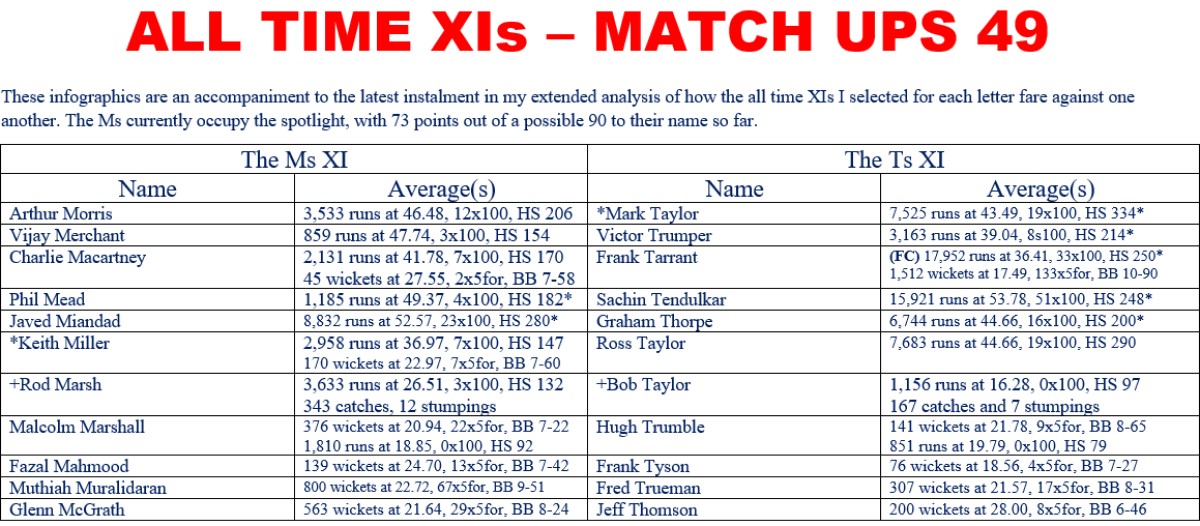
All Time XIs – Match Ups 49

Continuing my extended analysis of how the all time XIs I created for each letter of the alphabet fare against one another.

Welcome to the latest installment in my extended analysis of how the all time XIs I created for each letter fare against one another. The Ms continue to occupy the spotlight, starting today with 73 of a possible 90 points to their name.

THE Ms V THE Ts

Both these sides have strong opening pairs (Trumper played in the late Victorian and Edwardian eras, when pitches were often rough – that average of 39 is worth at least 50 in the modern era). Macartney wins the batting match up at number three, but Tarrant ranks as the greater bowler. The Ts comfortably win the number four slot, while the Ms win the number five slot. Ross Taylor outranks Miller as a batter, but unlike the Aussie he does not offer a bowling option). Marsh was a finer batter than Bob Taylor, but the Pom was the finer keeper. The Ts three specialist quicks are certainly faster than the Ms pace/ seam attack, though both sides are superbly equipped in this department. Murali outranks Trumble. The two sides are both strong in batting, strong in pace bowling, well captained and equipped with great keepers. I think Murali, Mahmood’s leg cutters and Macartney offer more variation between them than Trumble and Tarrant, though the latter two were both great bowlers, and this may be the factor that splits the sides, so I score this one: Ms 3, Ts 2.

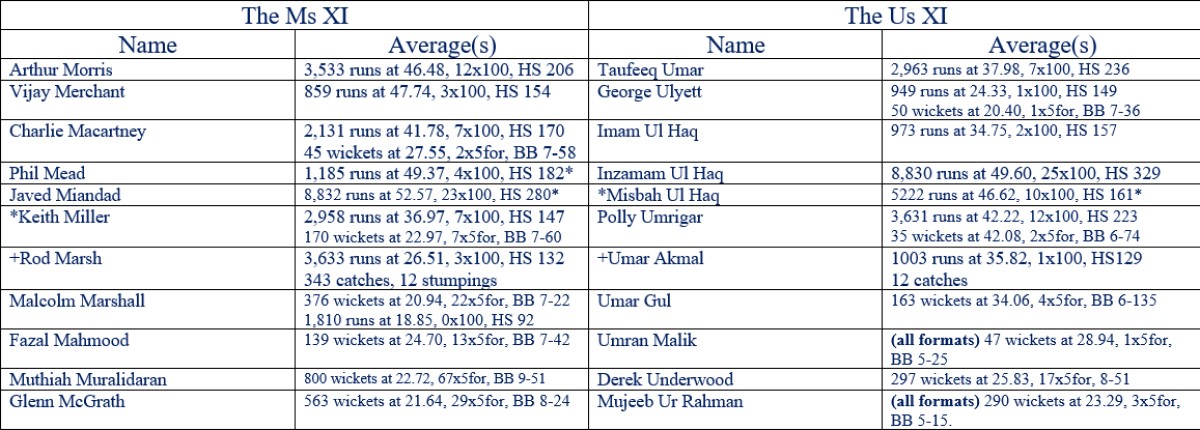
THE Ms V THE Us

The Ms are utterly dominant batting wise, with only Inzamam Ul Haq and Umar Akmal winning batting match ups for the Us, and Umar Akmal’s is negated by his being so inferior to Marsh as a keeper. Although Umran Malik is the quickest bowler in this match up he is as yet unproven, which means that all of Marshall, McGrath and Miller have to outrank him, as they equally clearly do Umar Gul and Ulyett. Murali likewise outranks Ur Rahman, though Underwood’s left arm slow medium may be considered more useful than Mahmood’s leg cutters. I cannot see the Us doing anything against the Ms and accordingly score this one Ms 5, Us 0.

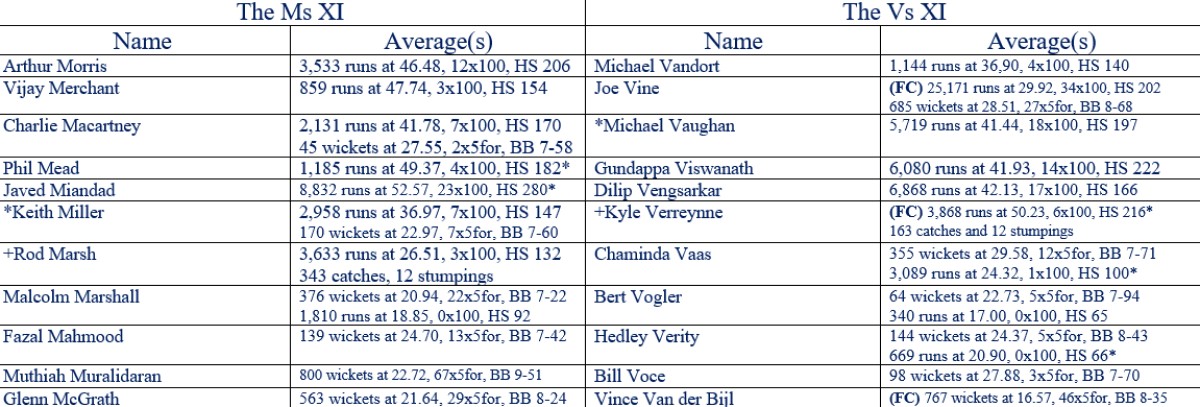
THE Ms V THE Vs

The Ms dominate the batting, with only Verreynne winning a batting match up for the Vs, and that is negated by Marsh being the superior keeper. The Vs have a pace bowling line up that is pretty much on a par with the Ms, given that a) Vaas would fare better as part of strong attack than he actually did as part of a moderate one, and b)Vaas and Voce were both left armers, whereas all three of the Ms outright fast bowlers were right armers. Verity outranks Murali as a finger spinner, while Vogler’s leg spin would probably be more dangerous than Mahmood’s leg cutters, while Macartney’s left arm spin and Vine’s leg spin are much of a muchness. On all except a spinning surface I would expect the Ms powerful batting to carry the day and accordingly score this one Ms 4, Vs 1.

THE Ms V THE Ws

The Ms have the better opening pair, though Woolley offers a bowling option comparable to Macartney and Worrell offers a bowling option not mirrored in the Ms ranks. Weekes and Walcott each comfortably win their batting match ups, and S Waugh v Miandad is a dead heat. Watling slightly outranks Miller with the bat, but Marsh outranks him as a keeper. Woods outranks Marsh with the bat (Woods played in the 1890s and 1900s, and mainly in England, where pitches were often hard to bat on) and is on a par with Miller as a bowler. Whitty, Willis and Woods are pretty close to Marshall, McGrath and Miller as a pace trio, Wardle is at least a match for Murali, Warne is clearly ahead of Mahmood. I think the Ws have this, though not by a vast amount: Ms 2, Ws 3.

THE Ms V THE Xs

The Xs arguably win two batting match ups (DeXter over Macartney, though the latter offered more with the ball, and Xenophon Balaskas over Marsh) and the wicket keeping match up. The bowling is even more strongly stacked in the Ms favour, leading to an inevitable scoreline of Ms 5, Xs 0.

THE Ms PROGRESS REPORT

The Ms have scored 19 of a possible 25 points today, moving them on to 92 out of 115, exactly 80% so far.

PHOTOGRAPHS

My usual sign off…

All Time XIs – The Letter W

I continue my exploration of the all time XI theme with a look at surnames beginning with the letter W. Such is the immense strength of players who qualify for this team that a second XI of near equal strength could easily be selected and some fine players would still miss out.

THE XI IN BATTING ORDER

  1. Frank Woolley (Kent, England). A left handed batter known for his excellence against fast bowling, a high class left arm orthodox spinner and a brilliant close catcher. He frequently opened for Kent, especially late in his career when he found the newer ball easier to see first up. This was the only way I could accommodate the only cricketer ever to achieve the triple career landmark of 10,000 runs (58,969), 1,000 wickets (2,066) and 1,000 catches (1,018).
  2. *Frank Worrell (West Indies). A right handed batter of high class (averaged 49 in test cricket), opening was one of his positions, though he could bat anywhere. He was also a useful left arm seamer, and one of the greatest of all captains, a role I have given him in this side. West Indies has unique features in international cricket terms, being in truth a composite side, with players from a number of different countries who usually view each other as rivals making up the XI. The number of captains who have overcome these rivalries sufficiently to create a genuinely unified and harmonious team totals two, Worrell, also the first black captain WI ever had, and Clive Lloyd.
  3. Everton Weekes (West Indies). Statistically the finest batter to have a surname beginning with W, having averaged 58.61 at test level. A powerful stroke maker, but one who believed firmly in keeping the ball on the ground. He was a dual international, having represented Barbados at contract bridge.
  4. Clyde Walcott (West Indies). A powerful right handed batter, occasional wicket keeper and even more occasional seamer. He averaged 56.62 at test level.
  5. Steve Waugh (Australia). Until 1989 his seam bowling was a makeweight which kept him in the team while his batting matured. The 1989 Ashes changed all that, as he began the series with two massive unbeaten centuries, setting a pattern that would endure from then until his retirement. He allowed his right arm medium-fast bowling to fall in virtual abeyance as his right handed batting flourished and he became one of the best in the world in that department. He made tough runs – his batting was crucial to the series win in the Caribbean in 1995 which set the seal on Australia’s ascent to the top of the cricket world, and on a pig of an Old Trafford wicket he chiselled out twin centuries to settle the match in favour of his side.
  6. +BJ Watling (New Zealand). A superb keeper and a gritty right handed middle order batter.
  7. Sammy Woods (Somerset, Australia, England). In his day one could only play county cricket by qualifying by residence for a county, which meant giving up playing for his home country. He turned for England against South Africa, but not, as Billy Midwinter had done against Australia. An attacking middle order batter, handicapped at Somerset by often having almost nothing to come after him and a right arm fast bowler of superb quality. He was also a fine captain, and with all respect to the guy one place below him in this order would be my choice as Worrell’s vice captain in this XI.
  8. Shane Warne (Hampshire, Australia). Arguably the greatest of all leg spinners (although Bill O’Reilly and Clarrie Grimmett both took more wickets per game at better averages), a fine slip fielder and a useful lower order batter, holding the record for most test runs without a century (HS at that level 99).
  9. Johnny Wardle (Yorkshire, England). A left arm orthodox spinner and a left arm wrist spinner (probably more needed in this latter category in this XI), and a hard hitting lower order batter. His career ended prematurely when he made the mistake of publicly criticising Yorkshire for their appointment of Ronnie Burnett as captain, but 102 wickets at 20.39 at test level is testament to his skill, and I don’t see Worrell having any problems handling him.
  10. Bill Whitty (Australia). A left arm fast medium bowler whose 14 tests yielded 65 wickets at 21 a piece, an excellent prospective new ball partner for the man one place below him in the order…
  11. Bob Willis (Surrey, Warwickshire, England). A right arm fast bowler. His ‘phoenix from the ashes’ turn around in 1981, when at Headingley he was called up for one final burst from the Kirkstall Lane end knowing that anything other than quick breakthroughs would spell the end of his test career and proceeded to blow Australia apart, claiming eight wickets in next to no time extended his test career by three years and meant that by the end he had claimed 325 wickets at the highest level, at the time an England record.

This is a superb XI, with a stellar top five, a keeper who can bat, an aggressive all rounder at seven and four wonderfully varied specialist bowlers. A bowling attack that features Willis, Whitty, Woods and Worrell to bowl seam, and Warne, Wardle and Woolley as spin options is top of the range by any standards.

HONOURABLE MENTIONS

This is its own way is the most difficult section of its type that I have yet had to write, and will feature many subsections. I am starting with three name checks because all with strong advocates for their inclusion.

DAVID WARNER

A fine attacking left handed opener, but could only be accommodated by dropping either Woolley with is vast range of skills or Worrell, my chosen captain. Although I could quote sandpapergate against him I settle for saying that I had strong positive reasons for selecting Woolley and Worrell rather than reasons for not selecting alternatives.

MARK WAUGH

‘Junior’ or ‘Afghan’ as he was referred to (the latter because of the delay compared to his twin brother in him getting international recognition – ‘the forgotten Waugh’) was a fine batter in the middle order in tests and opening in limited overs, as safe a slip fielder as I have ever seen in action and an occasional off spinner. However, the stellar records of my chosen specialist batters and my preference for five genuine bowlers left no space for him. If Aussies didn’t volubly disapprove of such things I would name him as designated substitute fielder.

KANE WILLIAMSON

One of the best batters in contemporary cricket, but just who out of Weekes, Walcott or S Waugh would I drop to make way for him? Sadly, as great as he is he has to miss out.

OPENING BATTERS

I have already dealt with Warner, but there are a stack of other openers who need to be mentioned. Bill Woodfull was a fine opener for Australia in his day, but a small mark against him as the considerable fall off from an FC average of 65 to a test average of 46, respectable rather than truly great. John Wright was a gritty and determined opener for New Zealand. ‘Plum’ Warner was the second England player ever to carry his bat through a test innings, and was also a notable captain. Siddath Wettimuny played a crucial role in the test match in which Sri Lanka first made the cricketing world treat them with respect, at Lord’s in 1984. His 190, which lasted until the third morning of the match was the underpinning of a Sri Lankan score of 491-7 declared. Shane Watson did well for Australia as a makeshift opener, but rarely produced really big scores. Albert Ward of England had a fine series in the 1894-5 Ashes but not the necessary consistent test success to merit any more than a mention. Finally, the silky skills of Laura Wolvaardt, for my money the best player of the cover drive of any contemporary cricketer deserve an honourable mention.

MIDDLE ORDER BATTERS

Doug Walters is probably the best middle order batter beginning with W that I have not yet mentioned. I considered acknowledging his partnership breaking skills as a medium pacer by giving him the number seven slot that I actually assigned to Woods, but preferred the genuine all rounder to the batter who bowled. Willie Watson was at the heart of one of cricket’s greatest rearguard actions at Lord’s in 1953, when England saved a match in which they looked beaten for all money, Watson holding out for approximately six hours. However his overall record falls short of greatness, so not even his left handedness could get him in. Another left hander who had to miss out was Vic Wilson, a gritty batter, Yorkshire’s first ever professional captain and a brilliant short leg fielder. Bob Woolmer had his moments for England, including three centuries, all against the oldest enemy, but he was a definite cut below top class. Imad Wasim of Pakistan is not quite good enough with the bat to qualify, and in a team already featuring Woolley and Wardle his left arm spin is a non-factor.

ALL ROUNDERS

David Wiese of Sussex and Namibia would have been one of the first names on the team sheet had I been picking with limited overs in mind, but his FC record while good is not on a par with his limited overs record. Rockley Wilson had a good record for Yorkshire and did well for England when getting a late call up, but is chiefly known for his work at Winchester College where one of his charges was a certain DR Jardine. Vyell Walker shares with WG Grace the distinction of scoring a century and taking all ten wickets in an innings of the same first class match, but I needed a fast bowling all rounder.

WICKET KEEPERS

Other than Watling I considered John Waite and Harry Wood of England for the gloves, but neither have the weight of achievement that Watling does.

FAST BOWLERS

The biggest miss here was Courtney Walsh, but I felt that he and Bob Willis were a trifle to similar, both being right armers of similar height, whereas Whitty’s left arm introduced an extra level of variation. Two injury blighted England quicks of different eras, Mark Wood and Alan Ward missed out. Willie Watson of New Zealand had a respectable test record, but like many others of his era his main job was to support Richard Hadlee. Arnold Warren of Derbyshire took five cheap wickets on his only test appearance. Daniel Worrall, an Aussie born seamer who has played a lot of county cricket was another to miss out. Probably the best quick bowler I overlook was Thomas William Wall of Australia, but his average ended up the wrong side of 30 due to the strength of the batting he came up against and the fact that he was often the only quick bowler in the side. Luke Wood, a left arm quick, is just beginning to make a name for himself, and may displace Bill Whitty in time. Mike Whitney of Australia was called up in an injury crisis after just six FC appearances, and established a respectable record. William Woof, the first player ever to sign a professional contract with Gloucestershire, was a left arm bowler who took 754 FC wickets at less than 18 a piece, but the fact that he was never chosen to play for England tells against him. Similarly, Tom Wass of Nottinghamshire, a right arm bowler of fast medium or leg spin who took 1,666 FC wickets at 20.43 just misses out, partly because the leg spin aspect of his bowling would not get much use in this XI.

SPINNERS

JC ‘Farmer’ White was a very fine left arm spinner, essential to England’s success in the 1928-9 Ashes, but lost out to Wardle due to the fact the Yorkie could bowl wrist spin as well as orthodox, whereas White could only bowl orthodox. Had the leg spinner’s slot not been an automatic selection I would have considered Amanda-Jade Wellington of Australia. Doug Wright, taker of seven first class hat tricks, was too inconsistent to qualify.

PLAYERS OF HISTORICAL SIGNIFICANCE

Tom Walker of Hambledon had to be overlooked due to lack of a verifiable career record, but as the first cricketer ever to have been styled ‘old everlasting’ he deserves a mention. John Willes and Edgar Willsher were key contributors to two major transitions in bowling history – the former the introduction of round arm, and the latter the move from round arm to over arm. Tom Wills was involved in the 1868 tour of England by a team of aboriginals and also created Aussie Rules football to give Aussie c.ricketers a way to keep fit during the close season.

OTHER LETTERS

Two players who would otherwise have merited considerable thought, Waqar Younis and MaX Walker were needed for other letters of the alphabet – X requiring a considerable degree of chicanery to fill.

ONE FOR THE FUTURE

Isabelle Eleanor Chih Ming Wong, generally known as Issy Wong, is a young quick bowler who has also had her moments with her aggressive batting, including a 94 (33) in domestic cricket. In ten years or so, if she keeps improving in both disciplines she may challenge Woods for the number seven slot.

PHOTOGRAPHS

Our cricketing journey through the letter W is at an end and it remains only to apply the usual sign off…

All Time XIs – Through The Alphabet XII

Another alphabetic progression for today’s all time XI cricket post, some thoughts on events at the Ageas bowl and England’s 1st test line up and some photographs.

INTRODUCTION

Welcome to today’s all time XIs cricket post, the 12th of our alphabetic progression posts, starting today at I. Tomorrow’s post will have a historical theme, the last of these alphabetic progression posts will appear on Sunday morning, and I have an international post lined up for Monday, which leaves me subject matter to find for Tuesday’s and Wednesday’s posts, and then on Thursday I will have an actual live test match to write about, and my gap-filling mission will have been accomplished. Before getting into the main body of today’s post it is time for an…

UPDATE FROM THE AGEAS BOWL

Yesterday Buttler’s team bowled out Stokes’ team for 233, taking a first innings lead of 54. Bess bowled well, taking two wickets. Oliver Edward Robinson also had two wickets, and was very economical, and there was a cameo appearance from Amar Virdi in which he looked impressive and picked up the wicket of Saqib Mahmood (admittedly one of the more genuine no11s playing today). The Buttler team are now 142-4 in their second innings, with Pope going well. Dan Lawrence has not batted this time round, so I presume that he has already been told he is in the test team (otherwise this is inexcusable since if he gets to the wicket it will be to have a slog before the declaration). Moeen Ali has had a turn at the bowling crease, and Rory Burns got out to him as Team Buttler started trying to force the pace, which they have done moderately effectively, but the evidence from his spell overall was clear – he is the third best off spinner on show at the Ageas bowl behind Bess and Virdi, and the fifth best spinner, with Leach and Parkinson also better practitioners. Curran has gone down ill, and will presumably miss the test match, and with Anderson failing to impress this morning, unless Broad turns on a spectacular new ball spell when the time comes I see Robinson as the one to get the nod, meaning that allowing for the loss of Curran my XI for the test match would be: Burns, Sibley, Crawley, Lawrence, *Stokes, Pope, +Foakes, Robinson, Bess, Wood, Archer.

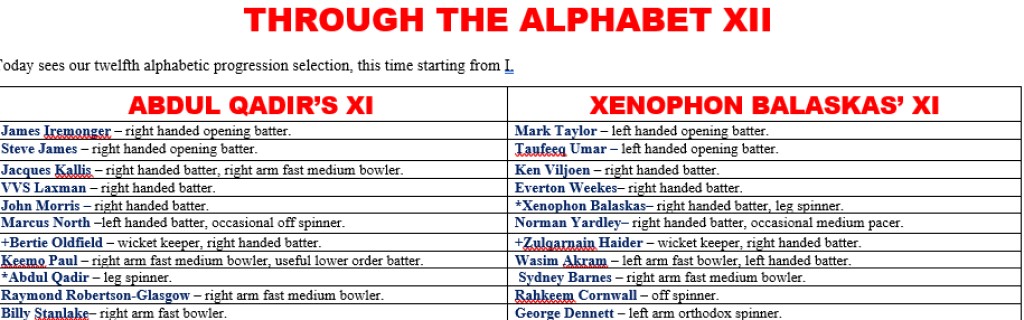
ABDUL QADIR’S XI

  1. James Iremonger – right handed opening batter. He played for Nottinghamshire, mostly in the years running up to World War 1, and had a first class batting average of 35. Subsequently he became a coach, and numbered Larwood and Voce among his charges.
  2. Steve James – right handed opening batter. He played for Glamorgan, and was the first batter ever to score a triple century for the county (albeit on a very flat pitch and at a very small ground – Glamorgan topped 700 for the loss of just three wickets). He played very briefly for England, discovering as others before him had that England selectors aren’t good at picking up what happens to their west. After his retirement he became a writer, his books including the excellent “The Plan” and the interesting “The Art of Centuries”.
  3. Jacques Kallis – right handed batter, right arm fast medium bowler. Only one other test cricketer to have been a regular bowler (Alastair Cook took one test wicket at a cost of 7 runs in his long test career)  has had as big a credit balance between their batting and bowling averages as Kallis: Garfield St Aubrun Sobers.
  4. VVS Laxman – right handed batter. In partnership with Rahul Dravid he turned the Kolkata 2001 test match on its head, so that India, following on 273 runs behind ended up winning by 171 runs, as Harbhajan Singh completed the turn around by spinning through a dispirited Australia in the 4th innings.
  5. John Morris – right handed batter. A heavy scoring stroke maker for Derbyshire, he never managed to establish himself for England, and his involvement in the ‘Tiger Moth’ incident with David Gower may well have ended his chances of so doing – certainly, even though he had scored 132 in the match in question, he was never heard from again at England level.
  6. Marcus North – left handed batter, occasional off spinner. He played for a number of counties, and made a good start to his international career before falling away at that level. The axe descended on his international career during the 2010-11 series when an ill-equpped and poorly led Australia were well beaten.
  7. +Bertie Oldfield – wicket keeper, right handed batter. One of the finest keepers ever to play the game, his 52 test stumpings remains an all-time record.
  8. Keemo Paul – right arm fast medium bowler, useful lower order batter. He is best known for his performances in limited overs cricket, but he also has a respectable record in long form cricket.
  9. *Abdul Qadir – leg spinner. In the 1980s the art of leg spin nearly died out, with all due respect to Australians Bob Holland, Trevor Hohns and Peter Sleep, the latter two of whom would never have been picked but for their skills with the bat. The man who kept the embers aglow, to fanned into glorious flame by Shane Warne in the 1990s was Abdul Qadir.
  10. Raymond Robertson-Glasgow – right arm fast medium bowler. A Scot who was able to short circuit the residential qualification rules of the day because he was related to someone who owned property in Bath, and also because Somerset were past masters at dodging those rules anyway. He regularly opened the Somerset bowling with James Bridges. Both believed they should bat higher than they did, and Bridges could be said to have had the better of that little dispute since it was usually him who got to bat at the lofty heights of no10. He went on to become one of the finest writers on the game.
  11. Billy Stanlake – right arm fast bowler. He plays mainly short form cricket, especially T20, but a first class bowling average of 31 is a respectable effort for someone who is not a regular at long form cricket (he has played eight first class matches in total as compared to 28 list A games and 64 T20 games). He is often referred to by commentators as ‘big Billy’ because of his great height (2.04 metres, approximatedly 6’8″ in imperial measurements).

This team has a good top six, a top of the range keeper and four varied bowlers. The spin department is a little understocked, with only North’s part time off spin as a back up for Qadir, but Stanlake, Robertson-Glasgow, Paul and 4th seamer Kallis is certainly a respectable pace attack.

XENOPHON BALASKAS’ XI

  1. Mark Taylor – left handed opening batter. He was one of the stars of the 1989 Ashes, with 839 runs in the series – more than any other Aussie save Bradman has ever tallied in a series. That series saw the end of Australia as whipping boys and the beginning of a rise that would see them reach the top of the cricket world by 1995, and then occupy that position for another decade. The combined impact of mismanagement, Kerry Packer and Ali Bacher had seen Australia flat lining since the mid 1970s, with England winning the Ashes at home in 1977, retaining in 1978-9, retaining again in 1981, surrendering them in 1982-3 when they were themselves weakened by the attentions of Mr Bacher, regaining them in 1985 and retaining them in 1987. Then, when Australia turned the tables in 1989 a combination of English mismanagement and refusal to face the obvious saw Australia retain the urn in 1990-1, 1993, 1994-5, 1997, 1998-9, 2001 and 2002-3, and all of those eight Ashes series from 1989 through to 2002-3 England only once one a game with the series still alive, at Edgbaston in 1997. Taylor, as well as his contributions at the top of the order took on the captaincy after Border retired, eventually handing over to Steve Waugh in turn.
  2. Taufeeq Umar – left handed opening batter. Played for Pakistan at the start of the 2000s, and averaged just below 39 as an opener in test matches.
  3. Ken Viljoen – right handed batter. He batted in this position in the infamous timeless test at Durban in 1939.
  4. Everton Weekes – right handed batter. Averaged 58.62 in test cricket, being the only player ever to score five centuries in successive test innings. He died recently at the age of 95, the last of the ‘three Ws’ (Walcott, Weekes and Worrell, born within a few miles of each other in the space of 18 months) to die.
  5. *Xenophon Balaskas – right handed batter, leg spinner. He is perhaps a little higher in the order than his batting record warrants, but he was a fine all rounder in his day.
  6. Norman Yardley – right handed batter, occasional right arm medium pace bowler. When he went on the 1946-7 tour of Australia, which was supposed to be a ‘goodwill tour’, except that Bradman did not get the memo it was as young batter whose bowling was rarely even used by his county, but a combination of injuries and a lack of resources in that department saw him pressed into service as a bowler for his country, and he responded well, bowling economically and picking up the odd useful wicket. He captained England in the 1948 Ashes, but was one of two candidates to refuse the captaincy of the 1950-1 tour (FG Mann of Middlesex being the other).
  7. +Zulqarnain Haider – wicket keeper, right handed batter. A brief but spectacular appearance in the limelight, during one of Pakistan’s many troubled periods.
  8. Wasim Akram – left arm fast bowler, left handed batter. He got his break when, at the age of 16, he bowled a spell in the nets that caught the eye of his country’s captain, Imran Khan. That was the launch of a career that saw him become one of the game’s all time greats, a fearsome fast bowler, a dangerous attacking bat in the lower middle order, and at one time captain. In 1992 he and Waqar Younis teamed up to render England’s batting feather legged. That winter in the world cup final he made the key intervention, ripping out two wickets at a crucial stage of the match and enabling his side to lift the trophy. England would spend most of the next 20 years or so after that loss producing one day cricket performances that were uninspired at best and downright incompetent at worst before a humiliating experience in the 2015 world cup would finally act as the kick up the backside they needed.
  9. Sydney Barnes – right arm fast medium bowler. That official description tells you about on tenth of the story of Barnes the bowler, discovered in the Lancashire nets by Archie MacLaren (England’s own nearest equivalent to the Wasim story), taken on a tour of Australia largely on the strength of that net session. A combination of him being constitutionally incapable of tugging his forelock, disapproval in official circles of his preference for Lancashire League cricket over the county ground and the fact that Lord Hawke, the Lincolnshire born author of the ‘Yorkshire born players only’ policy at that county did not see eye to eye with MacLaren and tended to disapprove of his hunches as a matter of principle led to Barnes playing less than half the number of tests he could, therefore should, have done. In 13 tests in Australia he captured 77 wickets, also taking 29 Aussie wickets in seven home tests against them, while against South Africa he captured 83 wickets in just seven test matches, and had he not quarrelled over terms and conditions with management and pulled out of what turned out to be the last test match before World War 1, he would almost certainly have had 60+ wickets for that series (he was on 49 from four matches) and been the first to 200 test wickets in what would have been his 28th game at that level.
  10. Rahkeem Cornwall – off spinner. 13 test wickets at 22 after two matches, 303 first class wickets at 25 each. We are likely to see something of the 27 year old off spinner in the upcoming ‘biosecure’ test series. This is a possible head to head contest between someone named Cornwall, and someone who was born in the neighboring county of Devon (there four Devonians in the current England camp, Bess the offspinner, Gregory the seam bowling all rounder and the Overton twins – one a genuinely fast bowler, one a fast medium, while England women’s captain Heather Knight was also born in Devon). I do not particularly expect to Gregory or either Overton in test action, but Bess must surely play.
  11. George Dennett – left arm orthodox spinner. 2,151 first class wickets at 19.82 each and never a single England cap. In the 1907 season, a very wet one in which in those days of “ooncoovered pitches” spinners flourished, he took over 200 first class wickets. The trouble was that Wilfred Rhodes and Colin Blythe were even greater masters of the art of left arm spin bowling than he was, and Frank Woolley always commanded a place as a batter.

This side has a decent top four, and the presence of Wasim Akram at no 8 means that all the next four are also capable of major innings. The bowling, with Akram and Barnes to take the new ball, Dennett, Cornwall and the skipper as spin options and Yardley’s medium paced nibblers as sixth option is very strong.

THE CONTEST

Abdul Qadir’s XI have the stronger batting line up, but Xenophon Balaskas’ XI have a quartet of front line bowlers that looks seriously formidable, plus the skipper. In keeping with my reckoning that it is the bowlers who win matches I make Xenophon Balaskas’ XI definite favourites. If the pitch turns than Qadir will struggle to match the combined efforts of Cornwall, Dennett and the opposition skipper. Over at the Ageas bowl Team Stokes have been set 255 for victory, and are 46-0 in the 13th, with Sibley and Bairstow opening.

PHOTOGRAPHS

While I have been typing this up Team Stokes have moved to 126-2, needing a further 129 with 19 and a half overs to be bowled. Zak Crawley, no 3 in the test for a certainty (Denly’s score of one for Team Buttler earlier today removed any tiny lingering doubt there) is going well. Now it is time for my usual sign off…

IMG_1348 (2)IMG_1350 (2)IMG_1352 (2)IMG_1354 (2)IMG_1355 (2)IMG_1356 (2)IMG_1356 (3)IMG_1359 (2)IMG_1361 (2)IMG_1361 (3)IMG_1361 (4)IMG_1362 (2)IMG_1365 (2)IMG_1365TTAXII

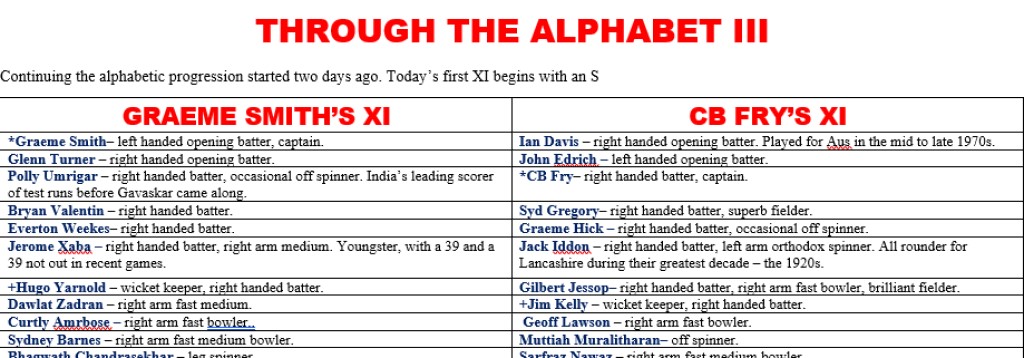
All Time XIs – Through The Alphabet III

Continuing the alphabetic progression of the last two days.

INTRODUCTION

Today’s all time XIs cricket post continues the alphabetic progression established over Friday and yesterday, so out first XI begins with an S.

GRAEME SMITH’S XI

  1. *Graeme Smith – left handed opening batter, captain. Scored large numbers of runs for South Africa. Appointed captain at a very young age he did that job very well as well.
  2. Glenn Turner – right handed opening batter. The only New Zealander to score 100 first class hundreds. In reversal of the more frequent pattern of development he started out as an absolute barnacle and developed an impressive range of strokes as he matured and grew in confidence – his 100th first class hundred as reached in the morning session of the first day of that game. This opening pair should blunt the opposing attack nicely for…
  3. Polly Umrigar – right handed batter, off spinner. India’s leading test run scorer prior to Gavaskar.
  4. Bryan Valentine – right handed batter. A great stylist for Kent and England.
  5. Everton Weekes – right handed batter. One of the greatest of all time to strengthen the middle order.
  6. Jerome Xaba – right handed batter, right arm medium pacer. X is a very difficult letter in this context, hence my inclusion of a player who has yet to feature in first class cricket.
  7. +Hugo Yarnold – wicket keeper, right handed batter. Holds the all-time record for stumpings in a first class innings, with six (six successive batters no less, only David East of Essex who caught eight in a row beats that sequence). In total he made almost 700 dismissals in his 287 first class matches. I accept that he is a trifle high in the order.
  8. Dawlat Zadran – right arm fast medium bowler.
  9. Curtly Ambrose – right arm fast bowler.
  10. Sydney Barnes – right arm fast medium bowler.
  11. Bhagwath Chandrasekhar – leg spinner. Our only front line spinner, and one member of this team whose position in the batting order will not cause any controversy.

This team is weaker in batting than is usual with my selections – Weekes is likely to need to remember how to count to six in the latter part of the innings.

CB FRY’S XI

  1. Ian Davis – right handed opening batter for Australia in the second half of the 1970s, known to his team mates as ‘wiz’ after a TV character of the time, ‘the wizard of ID’.
  2. John Edrich – left handed opening batter. A scorer of over 100 first class hundreds, and with a fine record at test level. He is one of five Surrey batters to have reached 100 first class hundreds (Hayward, Hobbs, Sandham and Ramprakash are the others).
  3. *CB Fry – right handed batter, captain. The English Leonardo, with an astonishing range of accomplishments to his credit. 
  4. Syd Gregory – right handed batter, brilliant fielder. A record eight tours of England, the first in 1890 and the last in 1912, the first test double century in Australia (Billy Murdoch scored 211 at The Oval in 1884), 201 at the SCG in 1894.
  5. Graeme Hick – right handed batter, occasional off spinner. His international record makes disappointing reading when compared to his stellar first class record, but there are two bog mitigating factors: his promotion to international cricket was rushed through, pitching him in to the fray against a very formidable West Indian fast bowling line up, and he was then dropped for the Sri Lanka game at tbe end of that season, and subsequently, when he was producing consistently at the top level for the first and only time of his career Ray Illingworth became supremo of English cricket (good idea, utterly wrong choice of person), and publicly described Hick as being ‘soft’, and Hick found himself back to being in and out of the side, as the Illingworth era was marked not so much by selectorial policy as a selectorial merry-go-round. Hick was merely the most prominent of a number of cricketers, along with Devon Malcolm, to be victims of the combination of crassness and insensitivity that marked the Illingworth era.
  6. Jack Iddon – right handed batter, left arm orthodox spinner. Just five England caps, because he was in prime during the tail end of Rhodes’ career and with Roy Kilner also well to the fore, but his first class record, coinciding with his county, Lancashire, enjoying their most successful ever period was 504 matches, 22,681 runs at 36.76 and 551 wickets at 26.90. He was also a decent fielder – once when Hammond commenced a day’s play by hitting the great Ted McDonald for five successive boundaries it was only a great stop by Iddon that prevented ball number six of that opening over going the same way.
  7. Gilbert Jessop – right handed batter, right arm fast bowler, brilliant fielder. The ultimate x-factor player to be coming at seven.
  8. +Jim Kelly – wicket keeper, right handed batter. He succeeded the great Jack Blackham as Australia’s wicket keeper and held the post for some 15 years.
  9. Geoff Lawson – right arm fast bowler. Had an excellent record in the 1980s, including being well capable of making irritating lower order runs, most notably his 74 at Lord’s in 1989 in support of Steve Waugh who was on his way to a second straight 150 (and was undefeated in both those innings).
  10. Muttiah Muralitharan – off spinner. 800 test wickets in 133 appearances at the highest level.
  11. Sarfraz Nawaz – right arm fast medium bowler. The highlight of his distinguished career was a spell of 7-1 in 33 deliveries that turned seeming defeat against Australia into victory – 305-3 became 310 all out.

This team has solid batting, and a bowling attack of Lawson, Nawaz, Muralitharan, Jessop and Iddon is hardly shabby, though not as stellar as some I have part together in this series.

THE CONTEST

CB Fry’s XI have greater depth in batting, while Graeme Smith’s XI are heavily reliant on their top five to score lots of runs. Graeme Smith’s XI has a stellar bowling unit, especially Ambrose, Barnes and Chandrasekhar. I see this as a close contest, with the odds possibly favouring CB Fry’s XI.

PHOTOGRAPHS

My usual sign off…

IMG_0908 (2)IMG_0910 (2)IMG_0911 (2)IMG_0912 (2)IMG_0912 (3)IMG_0913 (2)IMG_0913 (3)

TAII
The teams in tabulated form.