Team of the 1912 Triangular Tournament

The Team of the 1912 Triangular Tournament, plus a generous photograph gallery.

I am currently rereading Patrick Ferriday’s excellent book about the 1912 Triangular Tournament, “Before the Lights Went Out”. In this post I pick a team of that tournament.

The Triangular Tournament was an attempt to have the then three test playing nations in action in the same season. A combination of a wet summer, the fact that South Africa proved much weaker than expected and that Australia were missing six first team regulars due to a dispute between the players and the fairly newly formed board robbed the event of a lot of potential interest and it would 61 years before international cricket matches (in the form of the women’s ODI World Cup) took place at neutral venues again, and over 80 years before any further tests were held at neutral events. For all that the tournament was a flop there were some great players on show.

  1. Warren Bardsley (Australia, left handed opening batter). Even in conditions that would have been particularly alien to an Australian he had a very good tour, with the major highlight a knock of 164 against South Africa at Lord’s.
  2. Jack Hobbs (England, right handed opening batter). He came into the 1912 season already established as the best batter in the world and probably also the best cover point fielder in the game, and nothing happened to change that assessment of his position in the cricket world.
  3. Wilfred Rhodes (England, right handed batter). A decade earlier Rhodes, then a specialist left arm spinner who batted at number 11, scored 67 runs at 67.00 in the 1902 Ashes series. In the intervening years he had worked his way up the order, and towards the end of the period had pretty much let his bowling lapse, and on the 1911-12 Ashes tour he had been England’s number two batter in both averages and position in the order. After WWI, in response to Yorkshire’s needs he would once again become an all rounder, before eyesight problems forced him back down to the bottom of the order, though his bowling still kept him in the Yorkshire side until the emergence of Hedley Verity.
  4. Frank Woolley (England, left handed batter, left arm orthodox spin bowler). Woolley played some fine innings in the course of the tournament, and in the final match at The Oval, decreed by the powers that be to be a ‘winner takes all’ match that would be played until a result was achieved, he took five cheap wickets in each Australian innings, supported by Barnes in the first and Harry Dean, a left arm seamer, in the second.
  5. Charlie Macartney (Australia, right handed batter, left arm orthodox spinner). Featured prominently in both batting and bowling averages for the season, and if not quite the thing of beauty it became noted as being post WWI his batting was also apparently exceedingly watchable even then.
  6. Aubrey Faulkner (South Africa, right handed batter, leg spinner). South Africa overall had a tournament to forget, but Faulkner had moments with both bat and ball.
  7. *Frank Foster (England, right handed batter, left arm fast medium bowler). In 1911 he captained Warwickshire to their first ever County Championship, then in the 1911-2 Ashes he was one half of the most penetrative new ball pairing England had yet established alongside SF Barnes, and this duo carried on taking test wickets back home in England in 1912. He was good enough with the bat to have scored Warwickshire’s first ever first class triple century.
  8. Jimmy Matthews (Australia, leg spinner, right handed batter). He gets selected for an amazing bowling feat in the first test match of this tournament, when in the space of 90 minutes he took not one, but two test match hat tricks. Those were his only six wickets of the match, and none needed the assistance of a fielder. South Africa’s wicket keeper, Tommy Ward, was the hat trick victim both times, the second time somewhat bizarrely after being promoted ahead of Rolland Beaumont, who was allegedly a specialist batter, but spent most of this tour (when picked) batting low in the order.
  9. Syd Barnes (England, right arm fast medium bowler, right handed batter). He was firmly established as the best bowler of any type in the world by the time of this tournament, and even more firmly established as such by the time it ended.
  10. Bill Whitty (Australia, left arm fast medium bowler, right handed batter). He had an excellent season.
  11. +EJ ‘Tiger’ Smith (England, wicket keeper, right handed batter). Neither Australia nor South Africa had great keepers this series – South Africa had taken along two specialist keepers, but resorted to Louis Stricker, selected in the party for his batting, before the tour was done, because neither specialist keeper fared at all well, and Ward of course had the traumatic experience on test debut referred to above. Smith was an excellent keeper, though inclined to be cussed (he was apparently wont to say that he would bat at number one or number 11 but nowhere in between, so I have given him his second choice), and as a Warwickshire team mate of Frank Foster he was well used to keeping to the left armer, which some could find challenging.

This side has a powerful top six, a genuine all rounder at seven, three contrasting specialist bowlers and a quality keeper. Even with Rhodes not bowling at that stage of his career this side is well stocked with bowling options as well – Barnes, Foster, Whitty, Matthews, Faulkner, Woolley and Macartney are seven authentic options, and in one match of this tournament Hobbs’ occasional medium pace was pressed into service, and while unthreatening he managed to bowl 11 economical overs.

Gerry Hazlitt of Australia fared well with the ball, ‘young Jack’ Hearne was a candidate for the slot I awarded to Faulkner, while Sydney Pegler was the only South African bowler to really come to terms with English conditions. Arthur William ‘Dave’ Nourse, back in the land of his birth (as was South Africa captain Frank Mitchell) fared respectably enough to earn a mention.

My usual sign off…

All Time XIs – England Before WWI

A look at England’s resources in the early years of test cricket and a large photo gallery.

Today is the third anniversary of my first ever All Time XIs post, about Surrey and I am varying the theme today with a look not at an all-time XI but an XI for a particular period of cricket’s history – England before WWI, so picked from players who appeared in the first 37 years of test cricket.

THE XI IN BATTING ORDER

  1. *WG Grace (right handed opening batter, right arm bowler of various types and captain). WG’s test record looks fairly modest, but he was already 32 by the time he made his debut at that level and almost 51 by the time of his last appearance. He also did twice hold the England record individual score at that level, with 152 on his debut at The Oval in 1880, which lasted six years, and 170 at the same ground in 1886 to reclaim his record from Arthur Shrewsbury after one match. This latter stood until the 1894-5 Ashes series when Stoddart topped it with 173. Had test cricket been established a little earlier than it was Grace’s record would have been a lot better – in the 1870s he averaged 49 in FC cricket when no one else in England could do more than half as well.
  2. Jack Hobbs (right handed opening batter). Included in this XI as well as the one for the inter-war era out of deference to his own expressed wish to be remembered for how he batted before WWI – he was actually firmly established as the best in the world before the outbreak of WWI although his main record breaking years were after that conflict.
  3. Johnny Tyldesley (right handed batter). It was a choice between this man and David Denton of Yorkshire for the number three slot (both filled it with distinction) and I opted for the Lancastrian due to the fact that his brother misses out on a place in the inter-war XI because of England’s immense batting strength in that era.
  4. KS Ranjitsinhji (right handed batter). 989 test runs at 45 including two 150+ scores. One of the great geniuses of batting.
  5. FS Jackson (right handed batter,right arm medium fast bowler, vice captain). He never managed an overseas tour due to work commitments (he was a genuine amateur in terms of his cricket), but he still managed five test centuries against Australia in home matches. His peak came in the 1905 Ashes, when he won all five tosses, led England to victory in the only two matches to have definite results and topped both the batting and bowling averages for the series.
  6. Len Braund (right handed batter, leg spinner). The all rounder of the side, and an excellent slip fielder to boot.
  7. Frank Foster (left arm fast medium bowler, right handed batter). His career was cut short by a motorcycle accident, but in the few years he was around he did enough to claim his place, including playing a key role in a 4-1 win down under in 1911-2.
  8. +Augustus “Dick” Lilley (wicket keeper, useful lower order batter). The longest serving of England’s prewar keepers, and with an excellent record.
  9. George Simpson-Hayward (under arm off spin, right handed lower order batter). Selected for historical significance as the last specialist under arm bowler to feature at test level (and he did well in the five matches he got to play btw). He would need a law change (see here for a suggestion of how such a change could safely be made) to be able to play today.
  10. SF Barnes (right arm fast medium bowler, right handed lower order batter). That official ‘right arm fast medium’ is about as complete a description of Barnes the bowler as ‘artist’ is of Leonardo da Vinci – it tells a tiny fraction of the story of someone who could bowl every type of delivery known to right armers of his day and whose special weapon was effectively a leg break at fast medium.
  11. Wilfred Rhodes (left arm orthodox spinner, right handed lower order batter). Although Rhodes’ brief period as an England opening batter happened just before WWI I have selected him for his bowling – he started and ended his career as a specialist bowler with two spells as an all rounder and in the middle a spell as a specialist batter and I have put him in the slot from which he helped George Hirst to knock of the the 15 required when they came together at The Oval in 1902 and from where he helped RE Foster to add 130 for the last wicket at Sydney in 1903.

This XI has powerful top order, all rounders at six and seven, a fine keeper who could also bat at eight and three master bowlers to round out the order.

HONOURABLE MENTIONS

Other than my actual choices the main contenders for opening slots were Archie MacLaren and Arthur Shrewsbury. Reginald Foster has two places in the record books – his 287 at the SCG in 1903, at the time an all comers test record remains the record for someone playing their first test innings, and he is the only person to have captained England men at both cricket and football, but other than that amazing debut performance he only topped 50 once more in his career and that was an innings in which he benefitted from good fortune. Many would have expected CB Fry to be a shoo-in but his test record was not nearly as good as his FC record, and with WG inked in for the captaincy, and FS Jackson a more than able deputy his leadership skills were hardly required. Allan Steel might have had the all rounders slot I gave to Braund (like the latter he bowled leg spin). George Hirst may well have been as his Yorkshire skipper Lord Hawke was wont to claim the best ever county all rounder, but his performances for England were overall not that great, though he did have his moments.

George Lohmann was probably the biggest bowling omission but I felt he was too similar to Barnes to be able to pick both. The side also lacks a really fast bowler. The obvious candidate would be Tom Richardson, with 88 wickets in his 14 test matches, and if I were to be debarred from selecting Simpson-Hayward then Richardson would take his place, but I prefer the greater variety that Simpson-Hayward’s presence brings. Schofield Haigh’s England successes were limited for all that he was outstanding for Yorkshire. There were a stack of left arm spinners I could have picked: Johnny Briggs, Bobby Peel and Colin Blythe being the three most notable other than Rhodes in this period, while George Dennett never actually got an England cap, but 2,151 wickets at 19.82 in FC cricket provide proof of his greatness.

PHOTOGRAPHS

My usual sign off…

All Time XIs – Match Ups 26

Continuing my extended analysis of how the all time XIs I selected for each letter of the alphabet fare against one another, and of course a photo gallery.

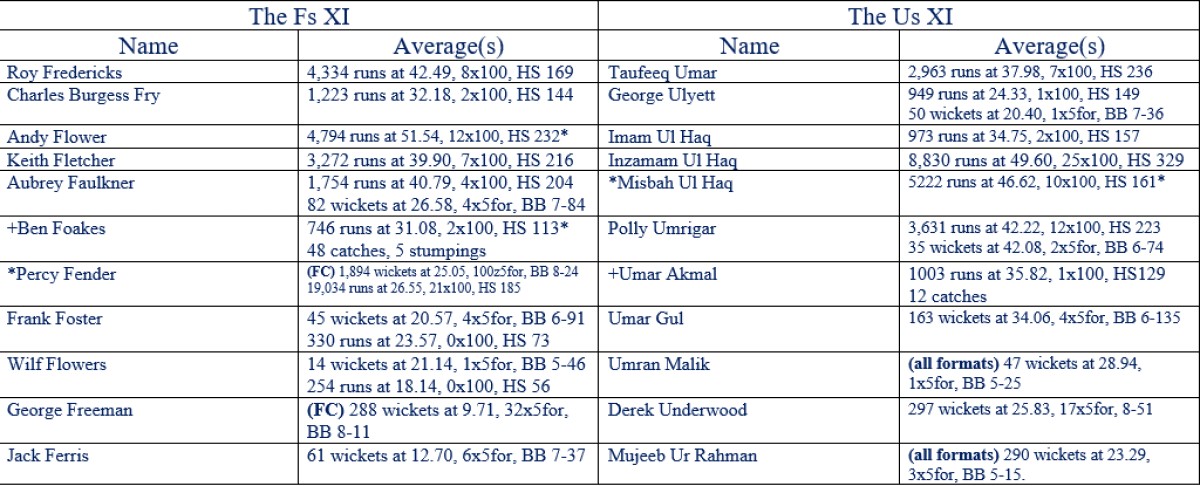
Welcome to the latest stage of my extended analysis of how the all time XIs I selected for each letter of the alphabet fare against one another. Today the Fs are in the spotlight, and they start with 51 of a possible 75 points.

THE Fs V THE Qs

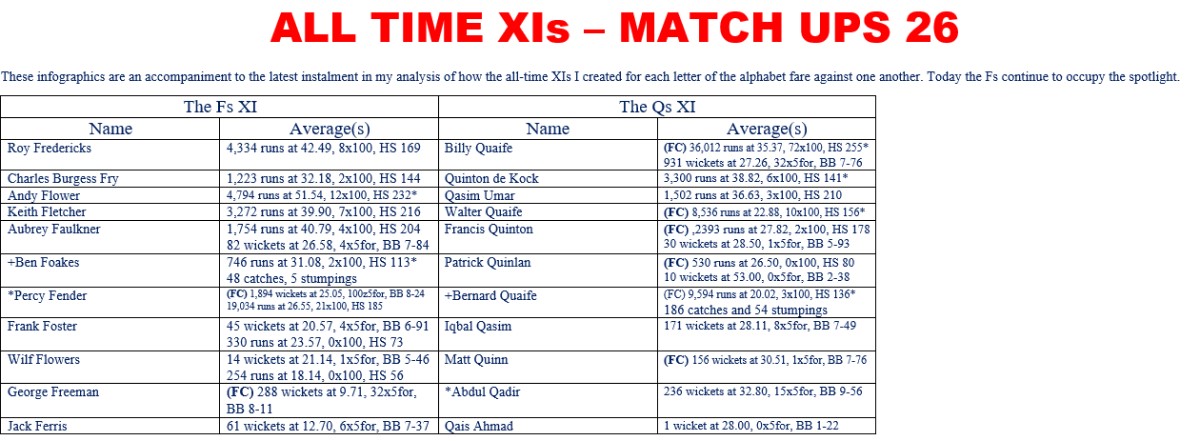
The Fs dominate in all departments, with only Quinton de Kock theoretically winning his match up against CB Fry, and that comes with the caveat that Fry played on uncovered pitches and was known for his skill on bad surfaces. This is an obvious Fs 5, Qs 0.

THE Fs v THE Rs

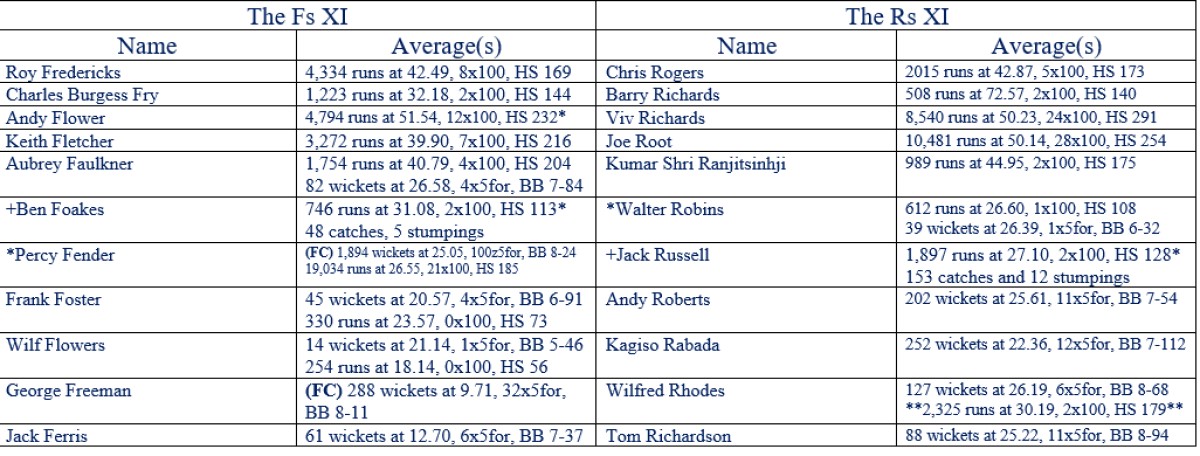
The Rs are better in the top five slots, though a larger sample size and the small difference between averages certainly squares the Fredericks/ Rogers match up. Additionally Faulkner offers a bowling option, which none of the Rs top five do to the same extent. Fender outranks Robins as a player while both were superb captains, Foakes is clear of Russell with the bat and of similarly stratospheric standards with the gloves. Freeman, Ferris and Foster have to be rated ahead of Roberts, Rabada and Richardson as a pace combo, though Rhodes far outranks Flowers as a finger spinner. As against that on a turning surface the Rs could only deploy front line spin from one end, their best back up spin options being Richards and Root, both part timers, whereas the Fs have the wrist spinning talents of Fender and Faulkner at their disposal. I give the Fs a comfortable margin of superiority here: Fs 4, Rs 1.

THE Fs V THE Ss

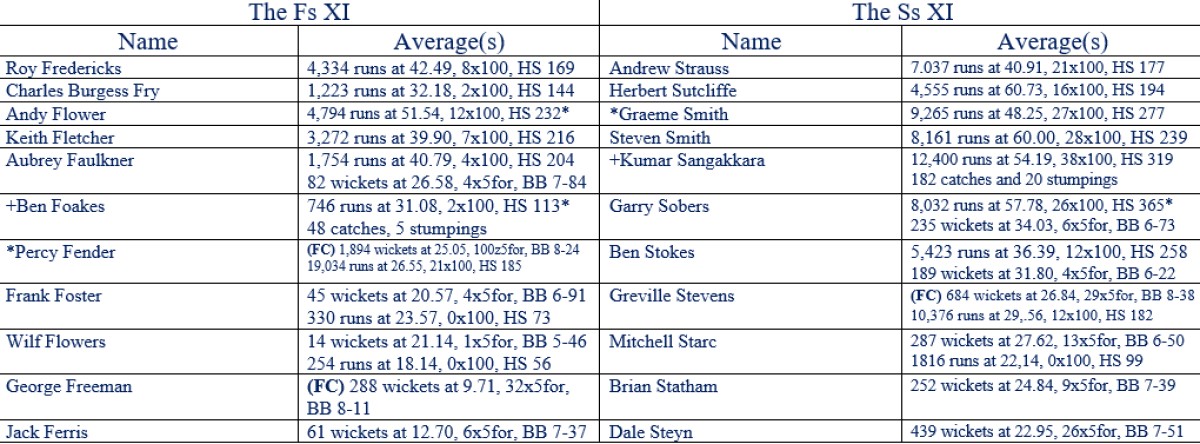
The Ss have a massive batting superiority, though the Fs are ahead in bowling, especially in the spin department, where Stevens and the slow bowling incarnation of Sobers are well behind the Flowers/ Fender/ Faulkner trio. Foakes is far the better keeper, and Fender outranks G Smith as a skipper. The Ss will give a good account of themselves, but the Fs have the better bowling guns and will win: Fs 3, Ss 2.

THE Fs V THE Ts

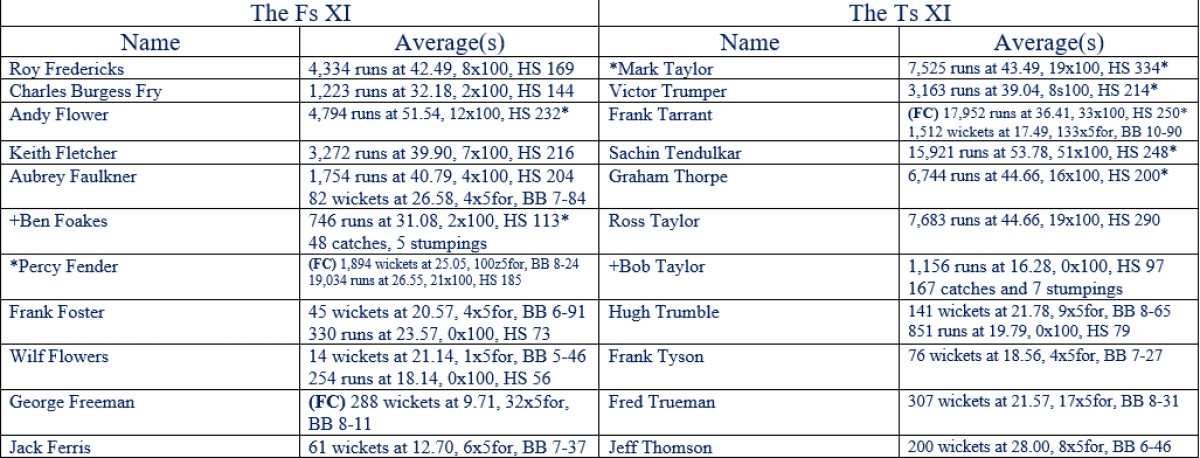
The Ts have the better opening pair, and also win the numbers 4,5 and 6 slots with the bat. Tarrant is ahead of Faulkner with the ball, and any advantage Bob Taylor has behind the stumps is accounted for by Foakes’ better batting. Also I rate Fender ahead of ‘Tubs’ as a skipper, though the Aussie was a worthy successor to Border in that role. Trumble comfortably outranks Flowers as an off spinner, but his position at number eight is telling as to which side had greater batting depth. The Ts pace trio are much quicker than the Fs, but the Fs are more varied, and overall a better combination. The Ts would win on turning surfaces but not elsewhere: Fs 3, Ts 2.

THE Fs V THE Us

The Fs are stronger in the top three batting slots, lose batting wise in positions 4 and 5, though Faulkner’s bowling mitigates that. Umrigar gives the Us extra batting strength, but he was a bit part bowler, ranking comfortably below either Faulkner or Fender. Fender outranks Misbah ul Haq as skipper. Umar Akmal outbats Foakes, but is simply not in his league as a keeper. The ordinary Umar Gul and unproven Umran Malik, plus Ulyett the bowler are way adrift of Ferris, Freeman and Foster as a pace trio. Underwood and Ur Rahman are probably better than any pairing from Flowers, Fender and Faulkner, but there are only two of them, with the expensive Umrigar third spin option. I think the Fs have a clear but not whitewash advantage here: Fs 4, Us 1.

THE Fs PROGRESS REPORT

The Fs have accrued 19 of a possible 25 points today and are now on 70 out of 100, 70% exactly.

PHOTOGRAPHS

My usual sign off…

All Time XIs – Match Ups (6)

Welcome to the latest post in my series analysing how my all time XIs for each letter of the alphabet fare against each other. We reached the conclusion of the A XIs match ups yesterday, so now we start with the B XIs. They have 3.5 points in the bank from their encounter with the As (see here).

THE Bs V THE Cs

The Bs dominate the batting, with only G Chappell among the top six outpointing his opposite number, and that by a mere fraction. Added to this is the fact that for reasons explained in the original post about the Cs Chanderpaul and arguably Cowdrey are batting out of position. Carter out bats Bari, but Bari was the finer keeper. Bates and Benaud are unquestionably a finer pair of spinners than Cornwall and Chandrasekhar, and both also possessed batting pedigree, something to which Cornwall has limited claim and Chandrasekhar none. Barnes and Bumrah for my money have the edge on Cummins and Croft as a new ball combination, though the Cs are undoubtedly the faster pair. Botham and Constantine were two mercurial all rounders, capable of match winning performances. I will allow for the possibility of a Constantine special, while rating it odds against, so my final score for this is Bs 4.5, Cs 0.5.

THE Bs V THE Ds

The Bs have an advantage with the bat – only Duleepsinhji, D’Oliveira and Dujon of those whose batting is of major significance win their match ups in this department. Davidson, Daniel and Donald as a pace trio probably beat Barnes, Bumrah and Botham, but as against that the Ds have only one front line spin option, Dennett, to match up against Bates and Benaud. Finally, Bradman was acknowledged to be a superb skipper, whereas Dennett never got any captaincy experience because of the social mores of his time. Although the Ds are far from helpless in this contest, the Bs are obvious favourites and I score it Bs 3, Ds 2.

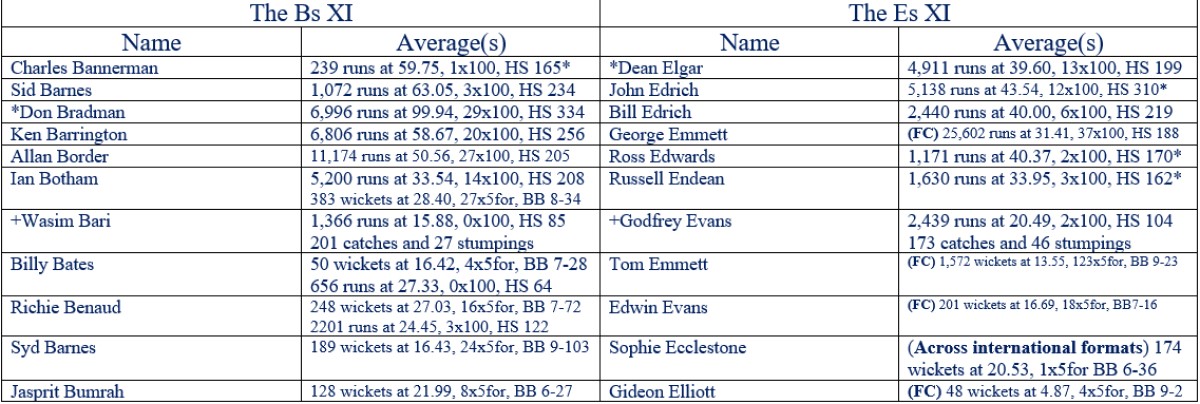
THE Bs V THE Es

The Bs have a huge advantage in batting, and Botham is definitely a better third pacer than Edrich, though Emmett and Elliott v Barnes and Bumrah is a fine contest, as is Ecclestone and Evans v Benaud and Bates in the spin bowling department. I make this one Bs 4, Es 1.

THE Bs V THE Fs

The Bs boss the batting as usual, though Foakes is the better keeper. The Fs have a greater range of bowling options, with six genuine front line bowlers. I accord them a definite win the pace department, with Ferris, Freeman and Foster clearly a stronger combo than Barnes, Bumrah and Botham. Flowers, Fender and Faulkner give the Fs three front line spin options. The question is whether the Fs extra bowling will compensate for the Bs huge superiority in batting. I don’t think it quite does, but I am not prepared to award the Bs victory here – Bs 2.5, Fs 2.5.

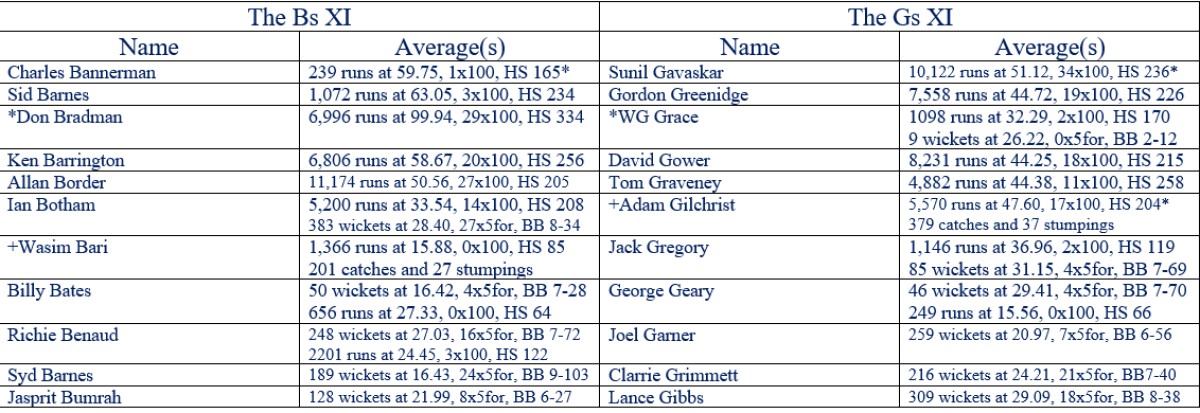
THE Bs V THE Gs

The Bs as usual are ahead on batting, but are clearly behind on bowling – WG is his side’s sixth best bowler. Grimmett and Gibbs are a good match for Bates and Benaud in the spin department, Gregory, Garner and Geary compare nicely with Barnes, Bumrah and Botham. I award this one to the Gs – Bs 2, Gs 3.

INTERIM REPORT ON THE Bs

The Bs are that this stage on 19.5 points out of 30, or 65%. The As were on a mere 14.5 points after their first six match ups, for comparison.

PHOTOGRAPHS

My usual sign off…