England XI 1963-83

A look at the best England players of 1963-83, including a mention of the rebel tour of Apartheid SA in 1982, since I refused to pick any of the players involved in that for my XI. A large photo gallery.

I continue my mini-series looking at England men’s players through the ages with a post covering 1963-83. This will end this series as I from that point on we are dealing with cricketers from my time following the game, and I covered that era here. Also, this post will be regarded as very controversial in some quarters – the first rebel tour to Apartheid South Africa happened in 1982, and I refuse to select any of the participants in that disgraceful venture.

THE XI IN BATTING ORDER

  1. John Edrich (left handed opening batter). Had a fine test record, with a best of 310* vs New Zealand and scores of 175 and 164 against the old enemy among his other successes.
  2. *Mike Brearley (right handed opening batter, captain). Has the least impressive playing record of anyone selected in one of these XIs, but he was a splendid captain, and three of the best England openers to play in this period were involved in the rebel tour mentioned in the introduction (Amiss, Boycott and Gooch) which means that this slot was going to go someone not quite in the top bracket as a batter, so I might as well secure an excellent captain.
  3. Ted Dexter (right handed batter, right arm medium fast bowler). A fine attacking batter and one at home in a slot that has often caused England problems over the years.
  4. Ken Barrington (right handed batter, occasional leg spinner). Statistically one of England’s best ever, with an average of almost 59 for 6,800 test runs. His highest test score was 256 at Old Trafford in 1964.
  5. David Gower – left handed batter. When he first started, before a long term shoulder problem made itself felt, he was one of England’s finest fielders as well. He scored 58 on test debut, racked up hist test century later that same summer, scored his maiden Ashes century at Perth on that winter’s tour, hit 200* v India at Edgbaston in 1979 and confirmed his arrival among the great with a match saving 154* at Jamaica in 1981 against the most powerful bowling unit in the world at that time, that of Clive Lloyd’s West Indies. He played on for another nine years after the end of the period under discussion and might well have gone on a good while longer had the England selectors of the early 1990s treated him decently.
  6. Tony Greig (right handed batter, right arm medium fast bowler and right arm off spinner). He averaged 40 with the bat and 32 with the ball in test cricket, and the fact that he could bowl spin as well as seam got him this slot over the alternative candidate.
  7. Ian Botham (right handed batter, right arm fast medium bowler). The period under discussion includes the earliest and best years of his international career, either side of an ill-starred spell as captain. The Ian Botham of 1977-83 was unequivocally one of the greatest cricketers ever to play the game. Thereafter he had occasional great moments but was largely a fading force.
  8. +Bob Taylor (wicket keeper, right handed batter). Made more dismissals than any other wicket keeper though his test appearances were limited by the presence of Alan Knott (who went on that rebel tour and who I therefore regarded as unavailable). He was also a much better batter than he was often credited with being, with his 97 at Adelaide in the 1978-9 Ashes a clearly defined match winning knock.
  9. Philippe-Henri Edmonds (left arm orthodox spinner, left handed lower order batter). With Greig able to bowl off spin (and England’s best specialist off spinner of the period ineligible as a rebel tourist) I wanted my specialist spinner to turn the ball the other way, and England had no class leg spinners in the period under discussion and the best left armer, Underwood, was another rebel tourist. Therefore Edmonds, whose test record places him next in line gets the slot.
  10. John Snow (right arm fast bowler, right handed lower order batter). A fine overall test record, highlighted by his stellar performance on the 1970-1 tour of Australia, when he joined Larwood (1932-3) and Tyson (1954-5) in the select club of England quicks to have blitzed Australia on their own pitches.
  11. Bob Willis (right arm fast bowler). A man whose career nearly ended in 1981 but who became England captain in 1982 such was the extent to which he revived his cricketing fortunes. The key moment came at Headingley in 1981, when with Australia seemingly cruising to a victory target of 130 Brearley brought him on at the Kirkstall Lane end, with an early breakthrough required to save his career. By lunch, courtesy of a sharp bouncer that accounted for Trevor Chappell (a misguided selection – he resembled a proper test match number three in name only), a slip catch by Botham that got skipper Hughes and a catch at short leg by Gatting to account for Yallop had turned 56-1 into 58-4 and suddenly the match was revitalized. Australia continued to implode after the interval, and one stage they were 75-8, before Lillee and Bright added 35 in four overs, but then Lillee miscued a drive and was well caught by Gatting and Willis found a yorker to polish off Bright. England had won by 18 runs and Willis had taken eight of the last nine wickets to fall giving him innings figures of 8-43.

This side features one great opener, one ordinary one who compensates by being an extraordinary captain, a powerful 3-5, a batting all rounder at six, a bowling all rounder at seven, a great keeper who was better with the bat than he was given credit for being, a left arm spinner who could bat a bit and two fine fast bowlers to round out the order. A bowling unit of Snow, Willis, Edmonds, Botham, Greig (either as fourth seamer or second spinner depending on conditions) plus Dexter and Barrington as back up options if needed should not struggle to take 20 wickets either.

HONOURABLE MENTIONS

Firstly there is a person who merits a paragraph to himself:

BASIL D’OLIVEIRA

Had he been able to play international cricket for his native land when in his mid 20s instead of finally getting the opportunity in his mid-thirties after moving halfway round the world to find cricketing fulfillment I have little doubt that he would have been one of the game’s all time greats. As it was he averaged 40 with the bat and had moments as a medium pacer without doing enough in that department to be classed as a test all rounder (which is why Greig got the number six slot).

OTHER HONOURABLE MENTIONS

Colin Cowdrey played a lot of his cricket in the period under discussion, but having included him in the XI for the earlier period I felt able to leave him out, and as you will have noted, even with the rebel tour creating problems there was no shortage of batting options available to me. Tom Cartwright and Geoff Arnold, two very fine seamers who played in this period would have their advocates. Had I need an off spinner the only option of sufficient class not rendered ineligible by rebel touring was Ray Illingworth (Geoff Miller’s record looks respectable at first glance, but he only took an average of two wickets per match, which counts against him). Derek Randall had his moments for England, especially against folks in baggy greens, but his overall test record falls short of the required standard. Allan Lamb who became eligible for England near the end of the period under discussion made a fine start to his test career, but he was never comfortable against spin, and for all his southern hemisphere birthplace he never delivered away from home. Mike Hendrick and Chris Old were stalwarts for England in the late 1970s and early 1980s but while acknowledging their qualities I preferred the extra pace of Snow and Willis for my specialists.

PHOTOGRAPHS

My usual sign off…

All Time XIs – The Letter E

A look at the letter E as I continue my all time XIs theme.

This blog post continues the All Time XIs theme with a look at the letter E.

THE XI IN BATTING ORDER

  1. Dean Elgar (South Africa). Among the best contemporary long form openers, a very tough competitor. He also bowls left arm orthodox spin, although he is not likely to be needed for that by this side.
  2. John Edrich (Surrey, England). One of two Norfolk born cricketers in this XI (out of five members of their family to play FC cricket). Like Elgar a very tough competitor who had to be got out. He had the useful knack of really making it count when he got himself in, illustrated by a HS of 310* v NZ and scores of 175 and 164 against Australia.
  3. Bill Edrich (Middlesex, England). Lost six years of his prime to WWII, also often missed due to differences of opinion between himself and those in authority, but still averaged 40 in test cricket. He could also bowl useful right arm fast medium, more than once taking the new ball in a test match. Possessed of almost limitless courage, exemplified by his efforts as a flying ace during the war, he was a fine player of fast bowling in particular.
  4. George Emmett (Gloucestershire, England). A fine batter for Gloucestershire.
  5. Ross Edwards (Australia). Once scored 170* against England in a test match. In the 1975 Ashes, at the end of which he retired from test cricket he showed his battling qualities with a 56 in just over four hours at Edgbaston and a 99 that saved Australia from the wreckage of 81-7 (with the assistance of a certain DK Lillee, who produced 73*)
  6. Russell Endean (South Africa). A hunch pick by his captain Jack Cheetham for a tour of Australia after SA had been hit with a huge number of retirements, leading some to argue for the abandonment of the tour. SA drew the series 2-2 with Endean justifying his skipper’s faith by producing a score of 162* in seven hours at a crucial juncture.
  7. +Godfrey Evans (Kent, England). One of the greatest keepers of all time (173 catches and 46 stumpings, the latter an England record, at test level). His batting highlights included two test centuries and an innings where with England battling for a draw he was on 0* for 97 minutes, supporting Denis Compton who was batting at the other end.
  8. Tom Emmett (Yorkshire, England). A great left arm fast bowler and a good enough lower order batter to have scored a first class ton at a time when those were not easy to come by.
  9. Edwin Evans (Australia). A right arm slow bowler and reasonably capable lower order batter, his domestic record was outstanding, and he played in the second test match ever.
  10. Sophie Ecclestone (Lancashire, Manchester Originals, England). A left arm orthodox spinner who takes her international wickets at 20 a piece overall and has had her moments batting down the order. Her stock bowling speed is in the low to mid 50s miles per hour, which is somewhat quicker than that of Matt Parkinson to give just one example. I would not pick a female seam/ pace bowler as they are a lot slower than their male equivalents, but spin is not principally about the speed at which one propels the ball, and I believe Ecclestone is up to the job.
  11. Gideon Elliott (Victoria). A right arm fast bowler who played less than anyone else to feature in any of these XIs – just nine FC matches between March 1856 and a similar time in 1862. In those nine matches he took 48 wickets at less than five runs a piece, including the performance in which wickets taken outstripped runs conceded by the greatest amount in FC history – 9-2 in a single innings.

This team has a solid top six, a great keeper and four splendid and varied bowlers. Given that Bill Edrich took the new ball on occasions at test level I am not that worried about him being the third bowler of above medium pace in this side, while the slower bowlers, Ecclestone and Edwin Evans provide a classic contrast in styles.

HONOURABLE MENTIONS

I will deal with the spin situation first: there were two obvious spinners whose surnames begin with E, John Emburey and Philippe-Henri Edmonds. As valuable as these two were to Middlesex’s cause over the years neither had a great test record, and Emburey blotted his copybook by going on both English rebel tours to South Africa, the only person to do so.

Fidel Edwards would have been a more conventional choice of a right arm fast bowler than Gideon Elliott, but my feeling is that Elliott’s absurdly cheap wicket taking average, even from so small a sample size justifies his inclusion.

The only challenger to Godfrey Evans for the gauntlets was Faroukh Engineer of India, but though he was a better bat than Evans he was not as good behind the stumps, and as usual I opted for the better keeper.

The only other test match opening batter whose surname begins with E that I could think of was Bruce Edgar, and his average was only just the right side of 30, considerably less than either Elgar or John Edrich.

Richard Ellison, a right arm fast medium bowler and useful lower order batter, had his moments for England, including the last two matches of the 1985 Ashes, but his record is not quite good enough overall.

PHOTOGRAPHS

My usual sign off…

An East Anglian XI In Honour of John Edrich

An XI with East Anglian connections in honour of John Edrich.

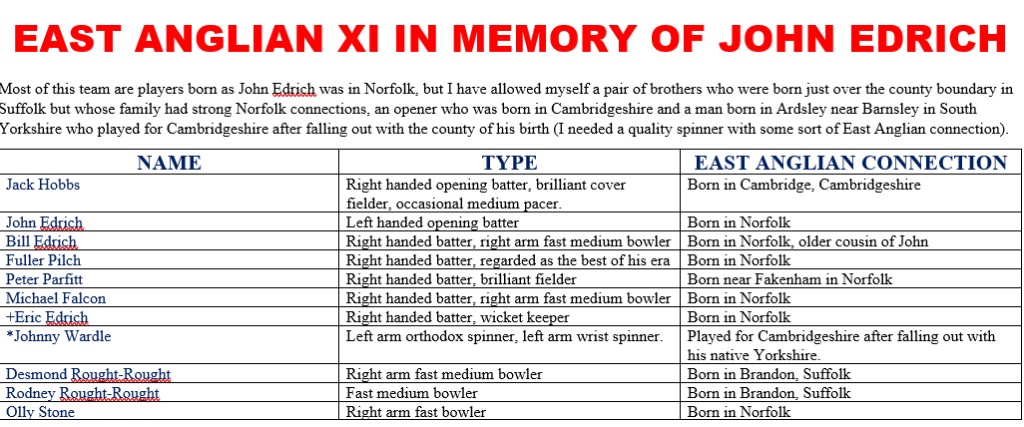
As I write this the Melbourne Stars are closing in on victory over the Sydney Sixers, while India enjoyed a good opening day at the MCG, dismissing Australia for 195 and reaching 36-1 in response, Shubman Gill impressing on debut with 28 not out overnight. Most of the players in the XI I present are Norfolk born, as John Edrich was, although there is one Cambridge born player and two brothers (out of three who had first class experience) who were born in Suffolk, while the captain was born in Yorkshire but played for Cambridgeshire after falling out with his native county.

EAST ANGLIAN XI

  1. John Edrich – left handed opening batter. Almost 40,000 first class runs at an average of 45, 103 first class hundreds, a test triple century (a knock that included 52 fours and five sixes) and the highest individual score in the first ever ODI back in 1971.
  2. Jack Hobbs – right handed opening batter, occasional medium pacer, brilliant cover fielder. The Master – 61,237 first class runs including 197 centuries. 3,636 runs including 12 centuries in Ashes matches. Born in Cambridge.
  3. Bill Edrich – right handed batter, right arm fast medium bowler. Older cousin of John Edrich and one of four brothers who all turned out at first class level. He lost six of his prime cricketing years to World War Two, in which he distinguished himself as a flying ace but still amassed 85 first class centuries.
  4. Fuller Pilch – right handed batter, rated by contemporary observers as the best of his era (the 1830s and 40s). Also sufferer of a bizarre dismissal for the Players against the Gentlemen in 1837 – the line in the scorebook reads “hat knocked on wicket”. The Players won a very low scoring match by an innings.
  5. Peter Parfitt – right handed batter, brilliant fielder, occasional off spinner. He once took four catches in a test innings, against Australia in 1972.
  6. Michael Falcon – right handed batter, right arm fast medium bowler. His averages are just the right way round.
  7. +Eric Edrich – right handed batter, wicket keeper. 53 dismissals in 38 first class appearances.
  8. *Johnny Wardle – left arm orthodox spinner, left arm wrist spinner, useful lower order batter. Born in Ardsley, just outside Barnsley in South Yorkshire. After a distinguished career for his native county and for England (102 test wickets at 20.39) he fell out with the Yorkshire authorities and ultimately played minor counties cricket for Cambridgeshire (Yorkshire in their vindictiveness ensured that no other first class county would touch him). His claim on a place is somewhat tenuous but I needed a quality spin bowler somewhere in the side, so I decided to stretch a point and include him.
  9. Desmond Rought-Rought – right arm fast medium bowler, took his first class wickets at 28 a piece. Born at Brandon in Suffolk.
  10. Rodney Rought-Rought – fast medium bowler, cannot ascertain which arm he used – am hoping it is left for the sake of variety. Brother of Desmond and also born at Brandon.
  11. Olly Stone – right arm fast bowler. In this side, with the two Rought-Roughts, Falcon and Edrich able to bowl seam there would no excuse for using him in other than short spells at top pace.

ANALYSING THE XI

This team has a solid batting line up, one bowler of genuine pace, various fast-medium bowlers and one of the finest spinners of them all. It would give a good account of itself in most conditions. The Sydney Sixers somehow turned their game against the Melbourne Stars around and won by one wicket with one ball to spare, taking all four points.

PHOTOGRAPHS

My usual sign off…

All Time XIs – Surrey

In view of the news of John Edrich’s death, and his role in this, the first of the All-Time XIs that I created a few months back, I am repubishing this…

Thomas's avataraspiblog

INTRODUCTION

Since there will be no cricket, or any other sport come to that, for a while I am going to fill the void by playing selector for a few all-time squads. Since I grew up in south London I will start with Surrey.

MY SURREY XI EXPLAINED

  1. Jack Hobbs – more first class runs and more first class hundreds than anyone else, also still has the England record for Ashes runs – 3,636 of them, including another record, 12 centuries in those matches. He was also a more than handy bowler of medium pace and a brilliant fielder at cover point. His claim to an opening slot is unanswerable.
  2. John Edrich – the left hander was one of three strong contenders for this slot, and both of the other two, Andrew Sandhamand Tom Hayward, actually did open the innings with Hobbs, but although I see the value of…

View original post 577 more words