M & Ms

An all time XI of players whose given names begin with the letter M, a more than usually important honourable mentions section, which deals with several areas of controversy and a two part photo gallery.

Today I present an all time XI of cricketers whose given names all begin with the letter M, and an honourable mentions section of more than usual importance. I also have plenty of photos to share.

  1. *Mark Taylor (Australia, left handed opening batter, captain). The second in a sequence of extraordinarily successful Aussie skippers, in that role he consolidated the achievements of Border who had taken over a team of also rans and passed his successor a team of champions and was succeeded by Steve Waugh. The wheels eventually came off the Aussie juggernaut under Waugh’s successor as skipper, Ricky Ponting, who suffered three Ashes series defeats, the last of which featured Australia on the wrong end of three innings defeats. His status as a batter was first shown in 1989 when he scored 839 runs in that year’s Ashes, a series tally beaten by only one Australian (Don Bradman, 974 in 1930), and bested by only Hammond among England players (905 in 1928-9). Probably his most famous moment came when he declared with himself on 334*, at the time a joint record individual score for an Australian with Don Bradman.
  2. Michael Slater (Australia, right handed opening batter). An attack minded opener who once scored 123* in a total of 184 all out, a performance that almost certainly won his side the match in question.
  3. Mahela Jayawardene (Sri Lanka, right handed batter). One of his country’s finest ever batters. He once scored 374 against South Africa, a test record for a right handed batter, in the course of which he shared a third wicket stand of 624, a first class record for any wicket, with Kumar Sangakkara. Almost 12,000 test runs at 49 show that he was far from being the Colombo specialist he was sometimes labelled.
  4. Martin Crowe (New Zealand, right handed batter). With the greatest of respect to Kane Williamson who has been part of a much stronger batting line up, he was probably the greatest batter his country has produced to date. His maiden test century, against England in the 1983-4 series between the two countries inspired his team mates to save a game in which they looked well beaten for most of the duration. This result in turn helped New Zealand to win a series against England for the first time ever, a feat they then repeated in England two and a half years later.
  5. Martin Donnelly (New Zealand, left handed batter). When he was in his prime cricket in New Zealand was almost entirely amateur, a fact that caused him to leave the game early, taking up a post as marketing manager at Courtauld’s of Sydney. In his brief career he became one of only two players to score Lord’s centuries in a Varsity match, a Gentlemen versus Players match and a test match. The last of this trio was an innings of 206. Also in a now legendary match between England and the Dominions, again at Lord’s, he was one of two Dominions players along with Keith Miller to score centuries, while a banquet of batting was completed by Hammond who scored twin tons for England.
  6. Mulvantrai Himmatlal ‘Vinoo’ Mankad (India, right handed batter, left arm orthodox spin bowler). This is probably the most controversial selection of my XI, but this guy was a lot more than the first to run out a non-striker for stealing ground in a test match – he completed the double of 1,000 runs and 100 wickets in his 23rd test match, a mark bettered only by Ian Botham (21 matches) ever since. His batting highlights included four double centuries, while his best test innings figures were an eight-for.
  7. +Mark Boucher (wicket keeper, right handed batter). Over 500 test match dismissals in the course of his very long career, and good enough with the bat to average 30 at test level.
  8. Malcolm Marshall (West Indies, right arm fast bowler, right handed batter). For my money the greatest fast bowler of the golden age of West Indies fast bowling, and therefore by definition among the greatest of all time. He was also a useful lower order batter.
  9. Mitchell Johnson (Australia, left arm fast bowler, left handed batter). This was another close call, the other candidate for the left arm fast bowler’s slot also being an Australian with the given name Mitchell, but my reckoning is that Johnson had a higher ceiling than Starc, and for that reason he gets the nod.
  10. Michael Holding (West Indies, right arm fast bowler, right handed batter). “Whispering Death” first gained legendary status at The Oval in 1976, when he conjured 14-149 (8-92 and 6-57) out of one of the flattest pitches imaginable, a surface on which every other bowler in the match took exactly as many wickets between them as he managed on his own, and he never lost the status he gained then for the rest of his playing career, also going on to a successful commentary career once his playing days were done.
  11. Muthiah Muralidaran (Sri Lanka, off spinner, right handed batter). More test wickets than any other bowler, 800 in 133 appearances at that level. In 1998 at The Oval, on a pitch that was flat to begin with and never turned truly spiteful he collected 16 English wickets across the two innings, a performance that separated the sides.

This side has a strong top five, a great and often underrated all rounder st six, one of the finest of all keeper/ batters and four mighty specialist bowlers, of whom three are definitely capable of chipping in with the bat as well. A bowling attack of Marshall, Holding, Johnson, Muralidaran and Mankad should never struggle unduly to take 20 opposition wickets.

I will deal with some obvious controversies first, starting with…

Two big names missed out here. Mike Procter, the South African genius whose international career was cut short by the enforced isolation of his country would be the choice of many, but I wanted a spin bowling all rounder, given the pace bowlers who were already inked in further down the order, and although Procter did have spin in his locker it was off spin, and I had an off spinner marked for inclusion as well. Mushtaq Mohammed, the Pakistan leg spinning all rounder who made his test debut at the age of 15 was another possibility, and I would not argue with anyone who picks him ahead of Mankad – my verdict went to the Indian who deserves better than to remembered for his association with one particular mode of dismissal.

Martin Donnelly’s left handedness secured him the number five slot for reasons of balance. This left a big call to made at number four between two antipodeans who both graced that slot at test level, and Mark ‘Afghan’ Waugh missed out in favour of Martin Crowe. Again, this was a very close and possibly controversial decision, and I accept that those who favour ‘Afghan’ have a valid point of view.

The fact that I wanted Mark Taylor to captain the side dictated the selection of the left handed opener, and I like a left/ right opening combo if possible, which led to the selection of Slater as Taylor’s opening partner, a role he actually played. Matthew Hayden had a serious claim on the left handed openers slot but for the need for a captain, and Marcus Trescothick was also in the frame.

Michael Vaughan was another candidate for captain, but his natural slot in the order would be number three and that would mean dropping Mahela Jayawardene. Misbah-ul-Haq would also have his advocates for the captaincy role, but the only player I could have dropped to make way for him would have been Martin Crowe. Mansoor Akhtar had a good record in domestic cricket in Pakistan, but never delivered in international cricket. Mitchell Marsh of Australia would be one of the first names on the team sheet for a limited overs XI, but his test record is nothing special. Madhusudan Rege had his moments in Indian domestic cricket, but played at a time when conditions in that country were preposterously favourable to batting, and was a one=cap wonder at test level. Marizanne Kapp came closest among female players to challenging for a place in this XI. Mushfiqur Rahim, who recently made history as the first Bangladeshi given out for handling the ball (a dismissal along with the former ‘hit ball twice’ now lumped in under Obstructing the Field) was a potential rival to Boucher for the gauntlets, but I rate the Saffa as the finer keeper and reckon that this side is strong enough batting wise that the extra five runs or so per innings that Rahim might be worth would be unlikely to make a lot of difference. Mushtaq Ahmed, the Pakistan leg spinner of the 1990s and early 2000s, came very close, and if the match were being played at the Narendra Modi stadium I might drop Holding and go in with just Marshall and Johnson to bowl pace and spin trio of Muralidaran, Ahmed and Mankad. Moeen Ali would merit consideration for a limited overs XI, but does not qualify for an XI picked with long form cricket in mind – the notion that the extra batting he offers might even come close to compensating for the gulf in class between him and Muralidaran as bowlers is frankly risible as far as I am concerned.

Today’s photo gallery comes in two parts. First we have some pictures from the place where the West Norfolk Autism Group committee had their Christmas meal earlier today…


…and we finish with some of my usual pictures.

All Time XIs – Bizarre Dismissals

My latest variation on the ‘all time XI’ theme looks at bizarre dismissals. There is also a correction in my usual ‘reverse tabloid’ fashion and some thoughts about laws of the game that are connected to my theme.

INTRODUCTION

It is time for another variation on the ‘All Time XI‘ theme. Today we have an XI who have all suffered bizarre dismissals. I will follow this up with a look at some of the more unusual ways of getting out and at a few other aspects of the laws. However, before I get into the body of the post I have one other duty to perform…

A CORRECTION

In my previous post when I introduced the ‘Signed Off In Style XI‘ I made an error with significant consequences. Alec Stewart did not score a century in his final test match – the innings I was thinking had been played earlier. He did finish in front of his own home crowd, and with a tally of runs to match the digital form of his birth date, but his score in that final innings was a mere 38. This being the case, especially bearing in mind the shortage of left handed batters in the XI, his slot should have gone to Alastair Cook, rather than the Essex man having to make do with a special honourable mention. My apologies to Sir Alastair as the one who suffered from a rare lapse of memory on my part. Note that I have followed my usual ‘reverse tabloid’ policy when it comes to making a correction!

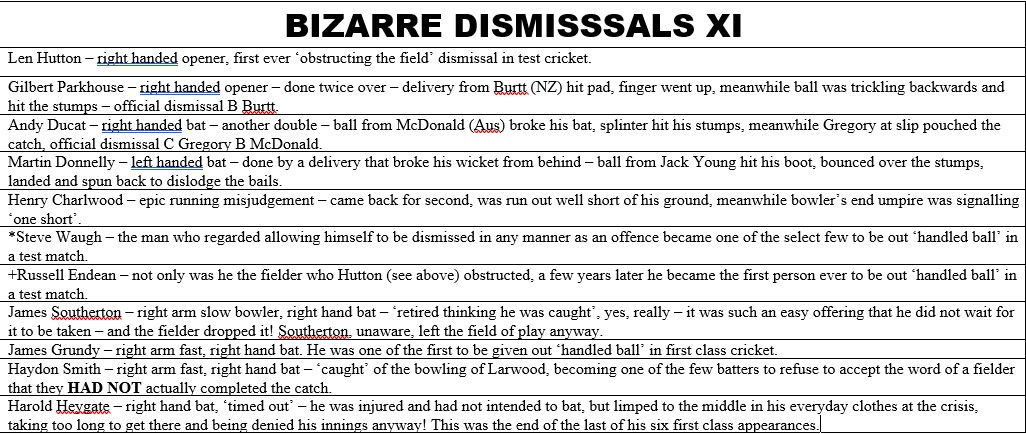
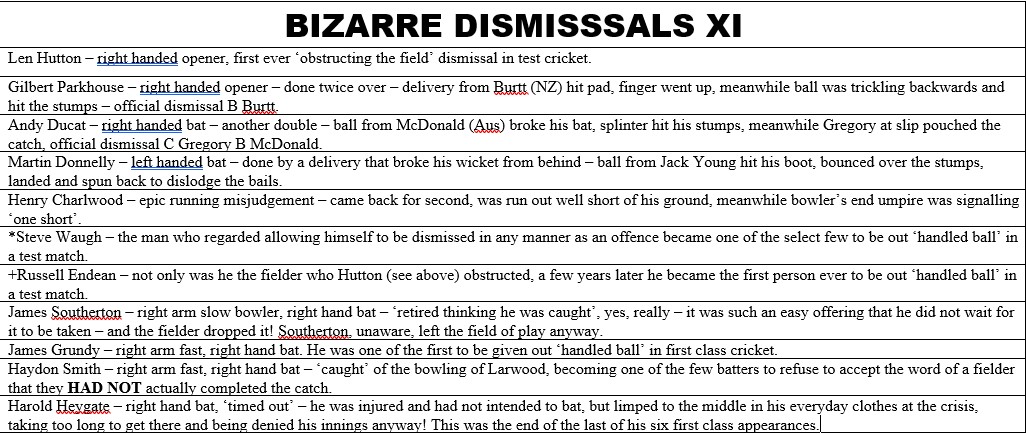
THE ‘BIZARRE DISMISSALS’ XI

  1. Sir Leonard Hutton – the Yorkshire opener, the first professional ever to captain his country in a home test, was also the first to be given out ‘obstructing the field’ in a test match. It happened against South Africa, and we shall be meeting the obstructed fielder a little later on.
  2. Gilbert Parkhouse – the Welshman was playing for England in New Zealand when he suffered the rare fate of being out twice to the same ball. The deliver, from a left arm spinner named Burtt hit his pad, and the umpire raised his finger instantly to give him out. However, the ball had been trickling backwards from the pad, and ultimately rolled into the stumps and dislodged a bail. The laws of cricket have this sort of thing covered, with an order of precedence for modes of dismissal, and Parkhouse was officially recorded as B Burtt, bowled outranking LBW in the pecking order. In the modern era this could actually have been made even worse, because the batter might have signalled for a review while that ball was trickling backwards! My own inclination in such a situation, for all that the review request would technically be null and void due to the subsequent dismissal would be to count it as a review burned off – no one who is that comprehensively out has any business reviewing, do they Mr Watson?
  3. Andrew Ducat – the Surrey stalwart, who was also an international footballer, was playing for England in the 1921 Ashes when a ball from Ted McDonald broke his bat, sending a splinter therefrom cannoning into his stumps, while at the same moment Jack Gregory at slip pouched the catch. In this case, ‘caught’ outranks ‘hit wicket’, so the entry on the scorecard was C Gregory B McDonald.
  4. Martin Donnelly – the elegant Kiwi left hander, who created a unique treble by scoring centuries at Lord’s in the Varsity Match, for the Gentlemen against the Players and in a test match, was once bowled by a delivery that broke his wicket from behind. The ball, from Jack Young, hit his boot, looped over the stumps and then spun back to hit them from behind!
  5. Henry Charlwood – running misjudgements don’t get much more horrendous than this one. He came back for a sharp second, and was comfortably run out – and what makes this a true classic, at the same time the bowler’s end umpire was signalling ‘one short’! Sometimes, especially if they were partnering Geoffrey Boycott and it was his call, run out victims deserve sympathy, but when you have failed to make your ground at either end of the pitch I feel that you can have little cause for complaint.
  6. *Steve Waugh – the tough Aussie who regarded allowing himself to be dismissed in any way as an offence nevertheless joined the select ranks of those to have been given out ‘handled ball’ in a test match.
  7. +Russell Endean – a few years after being the fielder obstructed by Hutton the South African entered the record books as the first person in test match history to be out ‘handled ball’. Endean also holds a rather more impressive record – most runs ever scored by one batter in a pre-lunch session of a first class match – 197, albeit in an extended session. His best test innings was 162 against Australia.
  8. James Southerton – the Surrey and Sussex slow bowler who was test cricket’s oldest ever debutant ended in an innings in a very curious way. He offered up a very straightforward catch, and headed for the pavilion without even waiting to see it taken. It was actually dropped, but the message did not reach Southerton, and he left the ground, to be recorded in the scorebook as ‘retired thinking he was caught’!
  9. James Grundy – best known as a right arm fast bowler, he only occasionally had his moments with the bat, but he featured in two of the ‘unusual dismissals’ list in the copy of the Wisden Book of Cricket Records that I used to own – from memory ‘handled ball’ and ‘hit ball twice’. As far I as am aware, his surname not withstanding, this particular Grundy did not have a side line producing home brewed cider!
  10. Haydon Smith – the Leicestershire right arm fast bowler and no11 batter’s unusual ‘dismissal’ was mentioned in my post about that county – he became one of a fairly select group of batters to have declined to accept a fielder’s word that they had NOT taken a catch!
  11. Harold Heygate – the 35 year old had not been planning to bat in Sussex’s second innings v Somerset due to back trouble, but when the ninth Sussex wicket fell with the scores dead level he rose from his sickbed and hobbled out in his everyday clothes. Unfortunately for him he took far too long to get to the middle, and a Somerset appeal for ‘Timed Out’ was duly upheld, ending the match in a tie, and no small quantity of confusion. This was Heygate’s sixth appearance for Sussex, and unsurprisingly his last.

The presence of Heygate at no11, mandatory given the nature of the XI, means that the side is light on bowling options, but I am hoping that Grundy, Smith and Southerton with a little help from skipper Waugh can carry the workload. The batting is definitely strong (when fully fit it was his batting that got Heygate selected).

THE REALLY UNUSUAL
MODES OF DISMISSAL

I believe that under the latest revisions of the laws of cricket ‘handled ball’, ‘hit ball twice’ and ‘obstructing the field’ now all come under the same heading of ‘obstructing the field’, while ‘timed out’ remains. However, I am go to look briefly at all of them individually:

HANDLED BALL

Batters are forbidden from handling the ball unless specifically and explicitly invited to do so by members of the fielding side. In addition to Waugh and Endean, Graham Gooch is another frontline batter to fall foul of this in a test match. The caveat over being invited to handle by the fielding side covers the situation where a fielder entices the batter to pick it up and then appeals (there is a Grace family story regarding the dismissal of Nottinghamshire’s Charles Wright which was apparently achieved in precisely such a manner). However, I think that in the last test match of the South Africa series (simultaneously only a few months and an epoch ago) England erred when Francois ‘Faf’ Du Plessis repeatedly and obviously deliberately handled the thing with sweaty batting gloves – rather than bother with official complaints about his conduct they should have simply appealed and sent him on his way – and ticked off anyone who dared to complain on South Africa’s behalf for being mischief makers. As it happened Du Plessis’ cheating (yes, that is what it was and I will not apologize for saying so) did not prevent his side from going down to a heavy defeat and the series going to England.

HIT BALL TWICE

This one specifically allows for a double hit if it is inadvertent or if it is purely to protect one’s wicket. What is being guarded against is the unscrupulous batter who uses one hit to ‘control’ or ‘tee the ball up’ and then smacks it out of the park with a second hit. Although I do not know of any stories of this happening I presume that it has done, since legislation, especially in the context of cricket, is rarely based on hypothetical happenings.

OBSTRUCTING THE FIELD

This is quite simple – if the batter deliberately prevents a wicket from being taken by getting in the fielder’s way it is out. Most often it is used in relation to catches, where fielder’s can easily be baulked by unscrupulous batters, but it could also apply to run outs if the batter had obviously altered their course to prevent a throw-in from running them out. There is no recourse if the batter is fairly diving for their ground with no obstructive intent and the ball hits them or their bat and races away to the boundary, although it would be considered out of order for the batter to attempt extra runs if the ball did not reach the boundary.

TIMED OUT

A simple, and to my mind, underused one. The batter is allowed a maximum amount of time (used to be two minutes, is now three) from the fall of a wicket to be at their place in the middle. I would say that the incoming batter should pass the outgoing batter on the field of play. Maybe in extreme circumstances, such as if the bowler has just taken four wickets with successive balls and that has caused the new batter to be caught unprepared, leeway should be given, but in general I would be harsh on this one, recommending fielding sides to appeal as soon as that three minutes is up.

HOW LEGISLATION DEVELOPS

Basically what happens with cricket laws is that something happens that makes people sit up, and legislation is passed to counteract it. Sometimes it is sensible, and sometimes very much not. I am now going to look at one specific topic:

DECLARATIONS

Originally no declarations were permitted – the batting side had to go on till they were all out. Then Surrey and Nottinghamshire, the two best county sides of the day, were playing a match the Surrey were ahead in, but unlikely to be able to bring to a conclusion. At this point John Shuter, the Surrey captain (yes, a Shuter on one side and a Gunn on the other!) had his ‘Baldrick’ moment, and instructed his team to get themselves out, so that they had time to dismiss the opposition and win the match. Surrey won that match, and the concept of the declaration was introduced. Subsequently there have been various scandals involving contrived declarations, at least one ‘bookmaker induced’ declaration and the declaration that led to the banning of declarations in limited overs matches. Declarations can be splendid when properly used, but also can be a huge blot on the game. Especially annoying is the giving away of runs to get your opponents to declare – no, back yourself and your team to win properly. I have mentioned (here) my distaste for the County Championship’s bonus point system. Justin Langer once declared an innings on 50-8 so that his opponents did not get full bowling points, which is obviously not to be approved of. The lawmakers have now said that declarations must be made with the intent to move the game forward, a woolly piece of phrasing practically designed to generate arguments. I have a hypothetical case: the batting side have scored rapidly, but have just had a mini clatter of wickets, and with an hour of day 1 remaining they are 375-8, with no 9 the not out batter and no 10 due to come in – now to me the declaration sticks out like a sore thumb, since 50 minutes bowling at a team who have spent most of the day chasing leather may well net two or three wickets, while it is unlikely the such extra runs as the tail produce will make a great difference. However, because of the bonus point system I would be prepared to bet money that in the event of such a declaration the opposition skipper would complain, although the batting side have given up a bonus point by declaring, they have also prevented the fielding side from getting full bowling points. Would the powers the be in such a circumstance have the guts to tell the complaining skipper that he needs to grow up or words to that effect? I now move to a really controversial subtopic:

DECLARATIONS IN LIMITED OVERS CRICKET

These have been outlawed since Brian Rose as captain of Somerset used a declaration to deliberately throw a game, because under the rules governing that competition doing so guaranteed that Somerset would progress. Rose declared at Worcester after one over, with the score 1-0, and Worcestershire of course won by ten wickets in a ‘match’ that contained ten minutes of actual playing time. While Rose’s declaration deserved the condemnation it got, and measures would be needed in some situations such as: last round of group fixtures, side A have already qualified, and side B who A are playing need a win to be sure of qualifying. Side C, who side A fear more are the other potential qualifiers, so side A use a declaration to give side B the game and eliminate side C. However, especially in this country, there should be some scope for declarations: Side A are 300-2 after 40 of their allocated 50 overs, and they know that the weather is likely to intervene, and to constitute a match each side must have faced at least 20 overs. If Side A are prepared to back their bowlers to defend 300 in the full 50 overs should it come to that then they should be allowed to declare their innings closed in the attempt to ensure that in the event of the predicted bad weather coming a match can be got in. Such a declaration should actually be considered praiseworthy in the circumstances, since Side A could probably be fairly confident of reaching 400 if they batted for the remaining 10 overs of their innings.

A LINK AND SOME PHOTOGRAPHS

The Fulltoss blog have a new post up speculating about the 2021-2 Ashes tour, and I heartily recommend it. Now, another XI has been put through its paces, I have raised some related issues, and it remains only to apply my usual sign off (nb for those who are squeamish about such things there is a picture featuring one of our eight legged friends)…

P1320040 (2)P1320041 (2)P1320043 (2)P1320044 (2)P1320046 (2)P1320048 (2)P1320049 (2)P1320053 (2)

P1320056 (2)
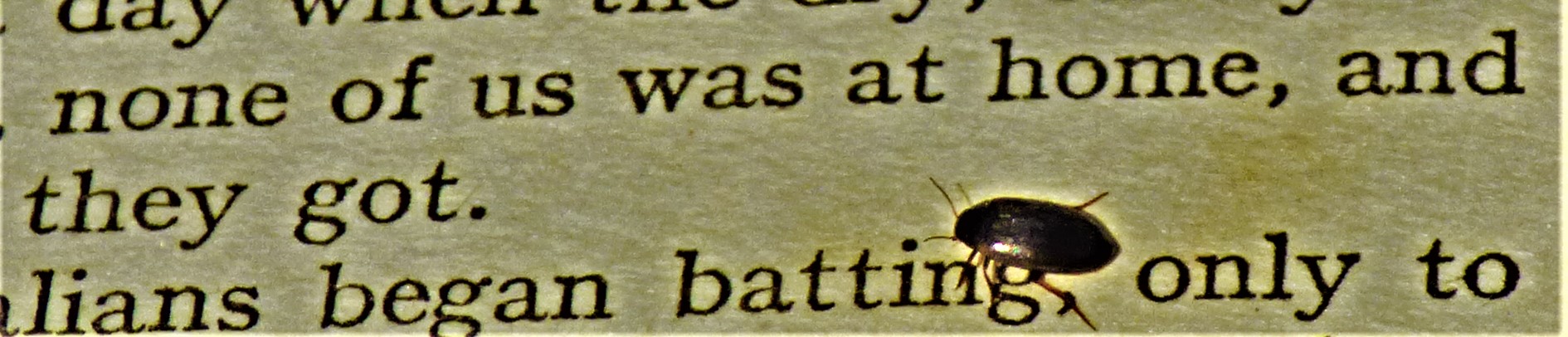
A bug carwling across my book (Hammond’s “Cricket: My World”)

P1320058 (2)

P1320062 (2)
A hovering insect, quite easy to see but very diifcult to capture – I hope the two shots I have managed to get of it are good.

P1320064 (2)P1320065 (2)P1320070 (2)

P1320071 (2)
An eight legged little friend crawling over the back of my hand.

Bizarre Dismissals