A look at the early stages of the Champions Trophy, currently taking place in Pakistan. Also a large and varied photo gallery.
The 2025 ICC Champions Trophy got underway on Wednesday. This tournament features the top eight sides in the ICC world rankings, which at present means there are several countries missing who might be expected to be there – none of Sri Lanka, West Indies or Zimbabwe made the cut for example. The format of the tournament (round one seeing the eight split into two groups of four, with the top two from each group moving into the semi-finals) means that even early on teams can find themselves in serious jeopardy.
THE MATCHES SO FAR
Today’s match, between Afghanistan and South Africa, was the third of the tournament, with the only two teams yet to see action being Australia and England who play each other tomorrow. The tournament is officially being staged in Pakistan, but India’s matches are taking place in the UAE as they refuse to travel to Pakistan, and their power in the cricket world is such that they get away with this sort of behaviour whenever they choose to indulge in it.
The tournament opened with Pakistan hosting New Zealand in Karachi. New Zealand batted first and compiled 320, which looked substantial, and was soon made to look even more so by a combination of good New Zealand bowling and some poor batting from Pakistan. Babar Azam scored 60, but took 93 balls to get there, which when your side has been set to score at 6.4 per over is simply not acceptable. Of the first 141 balls of the Pakistan innings exactly 100 were dot balls.
I did not catch any of the game between Bangladesh and India yesterday due to work. I gather that India won comfortably, though not as comfortably as they might – Rohit Sharma dropped an easy chance which would have given Axar Patel a hat trick, the first ever in the Champions Trophy, and the reprieved batter than took part in a huge partnership which gave Bangladesh something to attempt to defend.
Today’s match had strong echoes of Pakistan v New Zealand. South Africa won the toss and batted first, and with Ryan Rickelton scoring a fine century, Bavuma helping to set a platform for them with 58 and then van der Dussen and Markram scoring quicker 50s later on the in the innings (each made 52, off respectively 46 and 36 balls) South Africa emerged with 315-6 from their 50 overs, which looked more than enough. Probably the most disappointed of the Afghans would have been Rashid Khan whose figures of 10-0-59-0 continue a very poor showing in ODI tournament matches (he now has 17 wickets in 19 such matches at an average of over 50 a piece, though his economy rate is acceptable, largely because he is so good that opposition sides will happily settle for blanking his wickets column. Noor Ahmad, the young left arm wrist spinner, was frankly poor, recording 9-0-65-1. In reply Afghanistan never got into the hunt. Rahmat Shah played a fine knock but found no significant support. Other than his 90, the next highest scores were 18s from Azmatullah Omarzai and Rashid Khan. When Shah was last out, nicking one from Rabada through to Rickelton South Africa had won by 107 runs, a result which has probably already confirmed that Afghanistan will be making an early exit from the tournament. Rickelton’s century and solid keeping performance (two catches taken, only two byes let through) earned him the Player of the Match award, though Rabada’s 3-36, with Azmatullah Omarzai the least regarded batter of the trio, must have come into the reckoning.
LOOKING AHEAD
Australia are in a weakened state – tomorrow will be the first time in nine years that they take the field without any of Cummins, Hazlewood or Starc, and so makeshift is their squad that they are captained by the sandpaper tarnished Steve Smith. England have been in poor form, and much will come down to how they approach their batting. New Zealand and South Africa have played it right, building a base and then upping the tempo in the later stages. Pakistan were far too conservative in the first half of their chase against New Zealand, dropping irretrievably behind the required rate. England have a tendency to treat 50 over innings as extended versions of 20 over innings, which is how they might well come a cropper. The extra length of the innings means that there are times when consolidation is necessary – though not to the extreme of allowing 100 of the first 141 balls of your team’s innings to be dots!
PHOTOGRAPHS
My usual sign off…
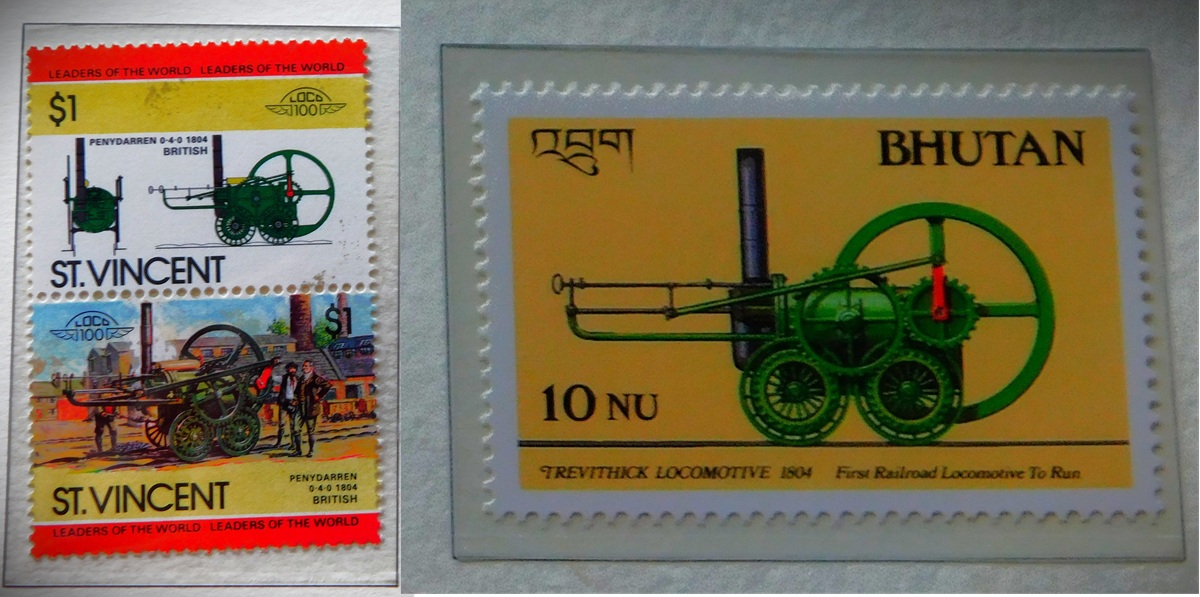
The first of the spring flowers are emerging, and it has been warm enough yesterday and today to venture out without a coat.A juxtaposition of two stamps each of which depict the world’s first Steam Lcomotive, Trevithick’s Pen-y-Darren, which first ran in 1804.
A look back at last night’s ODI series decider between West Indies and England, an all time XI with given names beginning with O as its theme and a photo gallery.
Last night saw the deciding ODI of the series between West Indies and England. That and an all time XI of players where the main focus is having a given name beginning with O form the bulk of today’s post.
WEST INDIES V ENGLAND DECIDER
As you will see it is more than usually appropriate that the heading of this section of the blog is in maroon, the colour of the West Indies.
Rain delayed the start significantly, and the by the time of the toss the match was reduced to 43 overs per side instead of 50. West Indies won the toss and put England into bat. Matthew Forde made an international debut in place of Oshane Thomas for West Indies and Matt Potts replaced Brydon Carse for England.
Ford bowled outstandingly with the new ball and was rewarded with three very quick wickets. Alzarri Joseph then struck twice, though he only got officially credited for one – a brilliant piece of fielding off his own bowling that in conjunction with a hesitation between the batters led to a run out was the one for which he got no credit, a terrible shot that led to a first ball duck for skipper Buttler was the one that he did get credit for. At that point England were reeling at 49-5. Liam Livingstone and Ben Duckett then shared a big partnership, and it looked like England’s early collapse might not be terminal.
England’s spinners bowled well, and the West Indies looked like failing in the chase on several occasions. Then, at the crucial moment, with the run rate definitely looking challenging for WI, and on a pitch on which extra pace had been at best a dubious asset (Forde, so successful for WI, is a medium pacer, and WI’s next best bowlers were their own spinners Motie and Cariah) Buttler entrusted Atkinson with an over. Atkinson immediately started trying for yorkers, and served up two delicious full tosses which both went for sixes. In total this over yielded 24 runs, and the result was no longer in doubt. WI duly won by four wickets and took the series.
There have been signs of promise from England this series, with Jacks and Salt looking like a decent opening pair, Jacks bowling well yesterday, Livingstone faring decently as an all rounder and Duckett’s innings yesterday, but there are also obvious problems, the biggest of them being Buttler’s inadequacy as skipper. West Indies bowl better than they bat (which as anyone familiar with my blog knows is the way round I would prefer things if I had to have a side that was stronger in one department than the other), with Forde a hugely promising new comer, Alzarri Joseph and Oshane Thomas both good pacers and Cariah and Motie good spinners. The batting is a trifle too dependent on Shai Hope for comfort, but they did the job yesterday without him making a huge score.
ORCHESTRATING AN ALL TIME XI
Today pick an all time XI with the theme being players whose given names begin with the letter O. I have had to resort to a couple of cheat picks to complete the XI, but nine of my players do indeed have given names beginning with O.
THE XI IN BATTING ORDER
Octavius Radcliffe (England, right handed opening batter, occasional off spinner). A west country based amateur of the late 19th century (born and died in Wiltshire, turned out for both Gloucestershire and Somerset, the former of which helped get him a place on the 1891-2 Ashes tour, skippered by WG Grace), and his record compares reasonably with those of a similar vintage.
Felix Organ (Hampshire, right handed opening batter, off spinner). One of my ‘cheat picks’, and picked more on potential than actual achievement. He does have a name beginning with O, but not his given name.
Ollie Pope (England, right handed batter, occasional wicket keeper). An excellent FC record and a respectable test record which he is well capable of improving. Number three has been his best position for England.
Owais Shah (England, right handed batter, occasional off spinner). In common with many an English player of vintage he has a good domestic record while having done little of note at international level.
O’Neill Gordon ‘Collie’ Smith (West Indies, right handed batter, occasional off spinner). He was killed in a car crash while in the process of establishing himself. He had done enough to earn his place in this XI.
Azmatullah Omarzai (Afghanistan, right handed batter, right arm medium fast bowler). My second ‘cheat pick’, he has shown himself to be a fine player, and I expect him to improve further.
+Oliver George Robinson (Kent, Durham, Wicket keeper, right handed batter). For me he should second choice for England men’s test wicket keeper right now behind Ben Stokes. He has recently moved from Kent to Durham, and the move north has not adversely affected his batting average, proof positive that he is genuinely skilled in that department, not merely a beneficiary of southern climes and pitches.
Omar Henry (South Africa, left arm orthodox spinner, left handed batter). The first non-white cricketer ever picked for an official South Africa XI, though that came too late in his career to for him to really benefit, 443 Fc wickets at 25.17 and 4,566 FC runs at 27.34 with five centuries and an HS of 125 show him to have been a fine cricketer when in his prime.
Oliver Edward Robinson (England, right arm fast medium bowler, right handed batter). When fully fit he is a formidable bowler. It is the necessity of that caveat that is problematic.
Odean Brown (West Indies, leg spinner, right handed batter). Yet to play international cricket, but 255 FC wickets at 23.00 is a respectable record.
Olly Stone (England, right arm fast bowler, right handed batter). Has been plagued by injuries, but when fit he is a devastating bowler.
I cannot pretend that this is a great XI, but it has a functional opening pair, a respectable 3,4,5, a hugely promising all rounder at six, a class keeper/ batter and four decent front line bowlers, though two of those would be injury worries.
HONOURABLE MENTIONS
Most of these are players who would merit consideration for a limited overs XI but not for a long form one. There are three exceptions: Ossie Wheatley and Oliver Hannon-Dalby established fine records bowling right arm fast medium at county level, and if worried about having both OE Robinson and Stone in the XI one of these two could replace OE Robinson, though it must be noted of Wheatley that he was a genuine liability except when actually bowling. Aussie Women’s leg spinner of the 1990s Olivia Magno was also a genuine candidate for the slot I gave to Odean Brown. Oliver Rayner, an off spin bowling all rounder, had to be overlooked due to the number of front line batters in this XI who could bowl off spin if needed. Four West Indians would in the mix if not on the team sheet if I were selecting with limited overs in mind: Obed McCoy (left arm seamer), Odean Smith (right arm seam bowling all rounder), Omari Banks (off spinner who could bat) and Oshane Thomas (right arm fast bowler, excellent in limited overs, but has an awful record in long form matches).
PHOTOGRAPHS
My usual sign off…
“Red sky in the morning, shepherd’s warning” – not really needed in an English December, but accurate.A pair of Canada Geese in the Great Ouse (six pictures total)Lapwings enjoying the exposed mudflat at a bend in the Great Ouse (several pictures)Four Lynx buses parked up at Lynn InterchangeAn Excel Bus awaiting passengers.
An acknowledgement of a major omission in yesterday’s post, a look back at yesterday’s west Indies v England ODI, an all time XI of players with given names beginning with K and a photo gallery.
This is a two-in-one post – yesterday saw the start of England’s new era in ODI cricket after the disaster of the world cup, and I look back at that match. I also parade an all time XI of players whose given names begin with K. Before getting into either of the main features I have on other thing to do…
ACKNOWLEDGE AN OMISSION
I noted yesterday when I covered cricketers whose given names began with J that I was dealing with an embarrassment riches. So much was the case that I entirely missed someone with a claim to place in the XI and to whom I should certainly have given at the least an honourable mention: Joel ‘Big Bird’ Garner the extra tall West Indies quick bowler of the 1970s and 80s. Note that I make no effort to perform the blogging equivalent of burying this rectification in 6 point type in the middle of page 27.
AN UNDERWHELMING RELAUNCH FOR ENGLAND
Yesterday saw the first match of a three match ODI series between the West Indies and England. The former had failed to even qualify for the recent ODI world cup, while the latter had an unmitigated disaster of a tournament.
THE PRELIMINARIES
After their world cup nightmare the England team showed a number of changes. Unfortunately Jos Buttler was allowed to retain the captaincy, a mistake which was to prove costly. Another poor call was the selection of left arm medium pacer Sam Curran who had proven valueless at the world cup. On the credit side a new look opening pair of Phil Salt and Will Jacks looked like a step in the right direction, as did the selection of young leg spinner Rehan Ahmed. Liam Livingstone was also in the XI, being treated as a bowling all rounder, scheduled to come in at seven and expected to bowl a full allocation of 10 overs. The West Indies had selected two frontline spinners as well, Gudakesh Motie (left arm orthodox) and Yannic Cariah (leg spin). Buttler won the toss and decided that England would bat, a correct call in my opinion.
THE ENGLAND INNINGS
Salt and Jacks made a blazing start, and were going at ten an over at one point, but both got out with the job half done, which was representative of the England innings as a whole. In the end, with the assistance of a late flurry from Sam Curran and Brydon Carse, England tallied 325 from their 50 overs. Gudakesh Motie had 2-49 from his ten overs, and Yannic Cariah 2-62 from his.
THE WEST INDIES RESPONSE
This was a tale of good spin bowling, good pace bowling from Gus Atkinson, dire pace/ seam bowling from Carse and Curran and terrible captaincy by Buttler, with Shai Hope playing a great innings, Romario Shepherd a spectacular one, and Sherfane Rutherford a brief but supremely eventful one.
Bizarrely, on a pitch that was helping spin, and with two of England’s designated pace options taking a hammering, Buttler chose not to deploy sixth bowler, off spinner Will Jacks. This piece of captaincy, curious at best, downright dreadful at worst, would cost England the match.
All seemed to be going pretty well for a time, and at one point the West Indies required run rate was close to 11 an over. However, once Rehan Ahmed (an exemplary display of leg spin bowling earning him 2-40 from his 10 overs) was finished, no one else was quite as good, though both Livingstone and Atkinson conceded runs at a respectable rate. The problem was the bowling of Curran and Carse, and the stubborn refusal of Buttler to deploy Jacks. Shepherd and Hope combined to take 23 off one Curran over, which made the ask manageable for the West Indies. After 48 of their 50 overs, with all of Ahmed, Livingstone and Atkinson bowled through and it having long since become too late to introduce Jacks the West Indies needed 19. Buttler opted to entrust the 49th over to Sam Curran, who had leaked 79 from eight overs up to that point. Five balls later, three of which had been dispatched into the stands Curran’s figures stood at 9.5-0-98-0 and West Indies had won the game with seven balls to spare. Shai Hope after a cautious start necessitated by circumstances had finished in glorious style, taking his score to 109* off 83 balls, his 16th ODI century, an innings in the course of which he passed 5,000 career ODI runs. Shepherd had hit 48 off 28 balls, Rutherford 6 off three, each ball being a genuine event – he hit his first ball in ODI cricket for six, was given out to his second but had the decision overturned, and then holed out off his third. Also worthy of mention was opener Alick Athenaze, whose 66 prevented his side from being sunk without trace. Hope was deservedly Player of the Match. Had England managed to win, Rehan Ahmed would have been an equally deserving recipient of the award for his bowling, but the incompetence of Curran and Carse and the poor captaincy of Buttler meant that Ahmed’s great effort was ultimately in vain and England’s brave new era of ODI cricket had started with a defeat. England need a new ODI skipper as a matter of urgency. Personally, with no absolute stand out candidate I would gamble on Jacks – slow bowling all rounders often make good skippers, and albeit on a small sample size, England historically fare well when captained by someone with first two initials WG – eight wins out of 14 matches under such a captain to date.
THE K XI IN BATTING ORDER
Kraigg Brathwaite (West Indies, right handed opening batter). Opening batters with given names beginning with K were hard to find, but the West Indian is noted for being able to bat time and has a respectable record in what has been a problematic area for his side ever since the Greenidge/ Haynes pairing broke up.
Krishnamachari Srikkanth (India, right handed opening batter). With a blocker in the number one slot I wanted my other opener to be more aggressively inclined. His career highlights include being the top individual scorer in a world cup final that his side won.
Ken Barrington (England, right handed batter, occasional leg spinner). One of the least appreciated of test cricket’s super stackers, his average of almost 59 an innings over the course of a long career puts him right up among the all time greats.
Kumar Sangakkara (Sri Lanka, left handed batter, wicket keeper). Few would seriously dispute his claim to be regarded as his country’s best ever test match batter.
Kane Williamson (New Zealand, right handed batter). Another modern great, the third element of an extremely powerful engine room for this XI.
*Keith Miller (Australia, right handed batter, right arm fast bowler, captain). One of the greatest all rounders ever to play the game, and reckoned by everyone who played under him to have been a superb captain as well.
+Kyle Verreynne (South Africa, wicket keeper, right handed batter). Yet to fully establish himself at international level, but his domestic record is excellent.
Kapil Dev (India, right arm fast medium bowler, right handed batter). An extraordinary record for his country, even more so given that he was often the only member of the attacks of which he was part who was actually capable of bowling a ball at above medium pace.
Kagiso Rabada (South Africa, right arm fast bowler, right handed batter). An indisputably great fast bowler.
Katie Levick (England, leg spinner, right handed batter). The only non-international I have picked, she has a splendid record in domestic cricket, and a little like George Dennett (see this post) she has been unlucky that her career has happened at a time when England women have been exceptionally well served by spinners. With Miller capable of turning his hand to off spin it seemed sensible to select a specialist spinner of a different type.
Ken Farnes (England, right arm fast bowler, right handed batter). A promising career was nipped in the bud by the outbreak of WWII, but by then he had done enough to earn his place in this XI.
This XI has an opening pair who should combine well, a very powerful 3,4,5 combination, an ATG all rounder, a quality keeper-batter, a great bowling all rounder and three high quality specialist bowlers. Farnes, Rabada, Miller, Kapil Dev and Levick is by an reckoning a powerful bowling unit.
HONOURABLE MENTIONS
Kevin Pietersen is probably the standout name among those I could not find space for in the XI. The only way to get him in would be to use him as an opener, presumably in place of Srikkanth, and that was never a role he relished. Two Indian princes, the uncle and nephew KS Ranjitsinhji and KS Duleepsinhji were also unlucky to miss out on middle order slots. Kim Hughes had talent to burn but ended with a record that was not weighty enough to merit inclusion. Ken Rutherford recovered from a dreadful start at test level to become a highly respected middle order batter, but someway short of qualifying for inclusion in this XIs middle order. Karen Rolton, who has a cricket ground named after her in her native Australia, was s superb batter who deserves at least this mention. Kusal Mendis of Sri Lanka is a fine player, but not quite fine enough in my view. Ken ‘Slasher’ Mackay, a left handed blocker and right arm medium pacer, was also on the fringes. KL Rahul would have been in as keeper had I been picking with ODIs in mind. Karun Nair did once score a test match triple century, but that innings accounted for four fifths of his career tally at that level. Ken Wadsworth and Kiran More were both challengers for the keepers slot, while Keith Andrew was a top quality keeper, but a bunny with the bat. Keith Piper, keeper-batter in Warwickshire’s mighty unit of the mid 1990s also deserves a mention. Keith Barker, a left arm pacer and a useful lower order batter, was a candidate for the number eight slot, but I felt that Kapil Dev’s international pedigree had to tell in that instance. Kyle Abbott was a candidate for a seam bowling slot, but with Kapil Dev already inked in I preferred the fire and brimstone of Farnes. Kuldeep Yadav was the other candidate for the specialist spinner’s slot. Krom Hendricks, the first non-white South African cricketer to have been a documented victim of discrimination based on the colour of his skin, does not have a detailed enough career record to be selected, but warrants an honourable mention.
In the absence of live cricket to write about I have created a clash between a team of players from before ODI cricket was a thing and a team of ODI players to do battle with one another. Also a photo gallery.
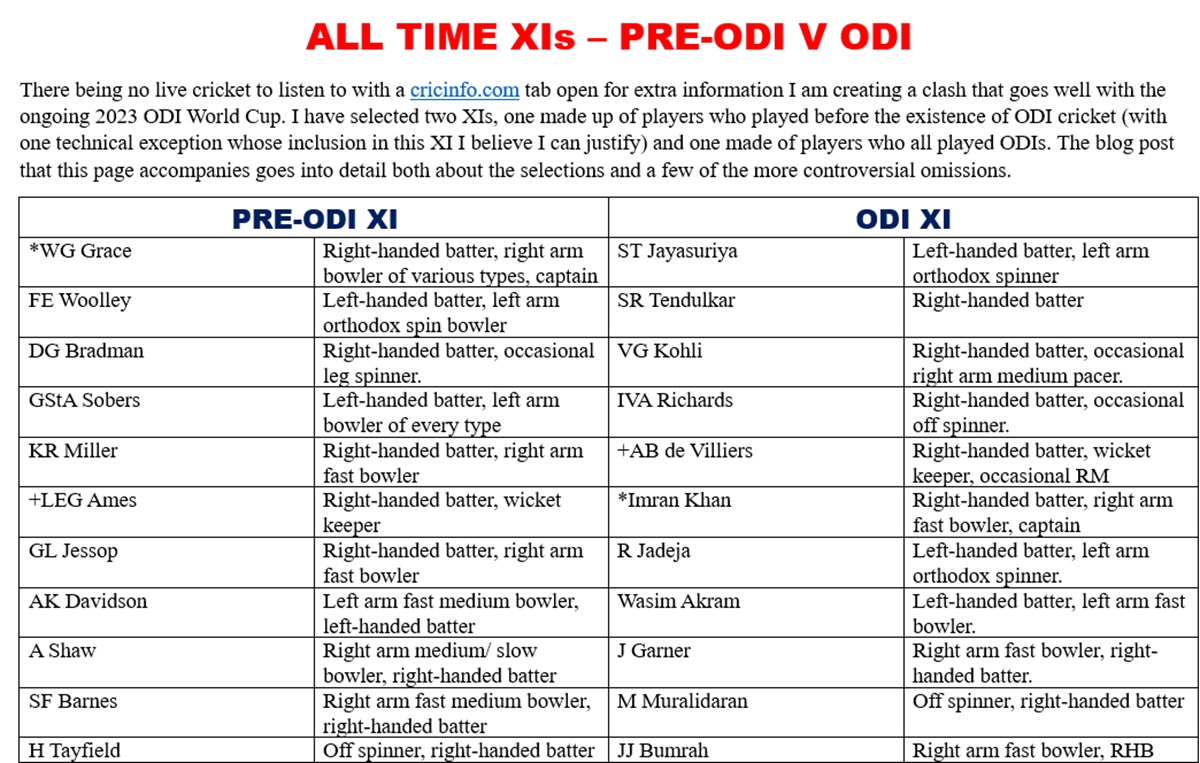
There is no live cricket today, so with the ODI World Cup 2023 approaching its final phase I have decided to produce a contest between two XIs – one of players whose careers took place before ODI cricket existed (with one very minor exception explained when we come to him) and one of ODI players. The following playing conditions would apply to what would be a five match ODI series: only one new ball per innings – using two as happens currently deprives us of old ball skills such as reverse swing because a ball that is only in use for 25 overs doesn’t get old, two minute time limit between a wicket falling and the new batter being ready to face (I am not expecting any ‘Timed Out’ dismissals but I am making sure that situation is covered anyway) and my own playing condition regarding overs not bowled within the time limit: The batting side to be awarded 10 runs or twice the current scoring rate, whichever is the greater, for each unbowled over, counting incomplete overs as ‘unbowled’ for this purpose.
THE PRE-ODI XI
*WG Grace (right handed batter, right arm bowler of various types through his career, good close catcher, captain). His commitment to attacking cricket is without question, his captaincy record is superb, and he was the dominant cricketer of his era.
Frank Woolley (left handed batter, left arm orthodox spin bowler, excellent close catcher). A fast scorer, a fine bowler and an excellent close fielder. Only one cricketer ever achieved the first class career treble of 10,000 runs, 1,000 wickets and 1,000 catches – Woolley.
Don Bradman (right handed batter, occasional leg spinner, excellent outfielder). The most prolific batter the game has ever known and capable of scoring seriously fast as well.
Garry Sobers (left handed batter, left arm bowler of every type known to cricket, excellent fielder). Before the pedants fly in, yes he did play a solitary ODI near the end of his career, in which he scored a duck. That is not enough to class him as an ODI player in my book, and I refuse to not pick the most complete player the game has ever known, so I include him in this XI.
Keith Miller (right handed batter, right arm fast bowler). One of the greatest all rounders ever to play the game, and both his attacking approach to batting and his willingness to experiment with the ball would be well suited to ODI cricket.
+Les Ames (right handed batter, wicket keeper). Twice winner of the Lawrence trophy for scoring the fastest first class hundred of the season, and maker of over 1,000 wicket keeping dismissals in his career.
Gilbert Jessop (right handed batter, right arm fast bowler, gun fielder). The most consistently fast scoring batter the game has ever known, a more than useful bowler and a brilliant fielder. I have listed him at seven in this order but I would expect Grace to display some flexibility in this matter – if wicket number 1,2,3 or 4 falls with say 10 overs to go I expect Jessop to come in.
Alan Davidson (left arm fast medium bowler, left handed batter, brilliant fielder). Among bowlers to play exclusively post WWII, to have ended their careers and to take 150 or more test wickets the one with the most economical bowling average is Davidson, with 186 test scalps at 20.53 each. He also had moments with the bat even at the highest level, averaging 24 in test cricket with an HS of 80 and his fielding earned him the nickname ‘the claw’.
Alfred Shaw (right arm medium/ slow bowler, right handed batter). The man who bowled more FC overs than he conceded runs at that level, and took just over 2,000 FC wickets at 12 a piece just has to be in this XI.
Sydney Francis Barnes (Right arm fast medium bowler, right handed batter). He would grumble about only being allowed 10 overs, but I would fully expect him to make superb use of those overs – he was probably the most skilful bowler ever to pick up a cricket ball.
Hugh Tayfield (off spinner, right handed batter). The leading test wicket taker for South Africa in their first period as a test nation, and by some way at that. He was also notoriously miserly with the ball, once sending down 137 successive dot balls including 16 successive eight ball maidens.
This side has seven top line batters and a capable number eight in Davidson. However the true jewel in this side’s crown is the bowling, with that front four of Davidson, Barnes, Shaw and Tayfield backed by all rounders Miller, Jessop, Sobers, Grace and Woolley. The only recognized bowling type not covered is leg spin, and Syd Barnes’ signature weapon largely fills that gap. Also there are few if any ‘passengers’ in the field in this XI, and a number of genuinely outstanding fielders. This is a side that would take a lot of beating.
HONOURABLE MENTIONS
New Zealander Bert Sutcliffe would be well suited to the left handed opener’s gig, but he does not have Woolley’s advantage of also offering a bowling option. Mulvantrai Himmatlal ‘Vinoo’ Mankad was another possibility, but I rated his batting not explosive enough. Mushtaq Mohammad could have been selected in place of Keith Miller had I been really desperate for leg spin representation. Among the bowlers I regretted not being able to include were Bill O’Reilly, Clarrie Grimmett, Hedley Verity, Johnny Wardle and Wilfred Rhodes (his approach to batting rules him out of an upper order slot in this format IMO). Billy Bates instead of Hugh Tayfield would strengthen the batting, but I think the South African was the finer bowler.
THE SOUTH AFRICAN ISSUE
Various white South Africans around the time ODIs were first getting going had limited opportunities to showcase their talents, and while several could make cases for inclusion I have opted not to pick any – I could not count them as ODI players since they never got to play those, and it would have been against the spirit of the exercise to pick them in the above line up. I will repeat something I have previously stated about this issue: these individuals deserve some sympathy, but not as much as the non-white South Africans who were entirely deprived of the chance to showcase their talents, going all the way back to Krom Hendricks in the 1890s.
THE ODI XI
Sanath Jayasuriya (left handed batter, left arm orthodox spinner). He gets this gig for his stellar role in Sri Lanka’s only World Cup win back in 1996.
Sachin Tendulkar (right handed batter). His record tally of ODI centuries has just been equalled, but his claim to this slot is in my view unarguable.
Virat Kohli (right handed batter, occasional right arm medium pacer). Currently the co-holder of the record for ODI centuries.
Viv Richards (right handed batter, occasional off spinner). The first truly great ODI batter.
+AB de Villiers (right handed batter, wicket keeper, occasional medium pacer). The man known to fans as ‘Mr 360’ because he could score literally anywhere in the whole 360 degree arc.
*Imran Khan (right handed batter, right arm fast bowler, captain). One of the greatest all rounders ever to play the game, and his leadership in the ‘cornered tigers’ world cup of 1992 removes any doubt about who has that role in this side.
Ravindra Jadeja (left handed batter, left arm orthodox spinner, gun fielder). One of the finest all rounders of the modern era.
Wasim Akram (left arm fast bowler, left handed batter). A great bowler and a handy lower order batter.
Joel Garner (right arm fast bowler, right handed batter). His immense height meant that he posed problems in 3D geometry for opposition batters, and very few could surmount them.
Muthiah Muralidaran (off spinner, right handed batter). One of the stars of that 1996 world cup win – the Sri Lankan seamers Vaas and Wickremasinghe often bowled only their opening spells, the remainder of the overs being bowled by spinners, and this man invariably bowled his full ten overs, generally with fine figures.
Jasprit Bumrah (right arm fast bowler, right handed batter). One of the reasons India have won all nine of their group games at the current tournament has been the excellence of their bowling, and this man is the spearhead of that attack.
This side is well equipped batting wise, and has a stellar bowling line up, with Jayasuriya likely to be seventh bowler. There is no leg spin – to accommodate either of the two best ODI leg spinners I have seen in action I would have to drop Jadeja and promote Akram to number seven.
HONOURABLE MENTIONS
Some would have ignored Jayasuriya’s bowling and selected Adam Gilchrist to open the batting and keep wicket. Some Indian fans would want Dhoni to be both keeper and captain, but I disagree, and they already have four players in my chosen XI. A live alternative for the number seven slot, though it would remove a spin option would be one of two South African bowling all rounders: right arm seamer Shaun Pollock or left arm seamer Marco Jansen. Some would pick McGrath ahead of Garner as the tall mean right arm pacer and in test cricket I would agree, but in ODIs I rate the West Indian just ahead of the Australian. Feel free to volunteer further suggestions in the comments, but remember to consider how your choices would affect the balance of the sides.
Some thoughts on the Bob Willis Trophy, a sensational ODI and the start of a test match. Some mathematics, an important petition and some photographs.
INTRODUCTION
This post looks back briefly at the first round of Bob Willis Trophy fixtures, for longer at yesterday’s incredible ODI and casts an eye over what is happening in Manchester.
BOB WILLIS TROPHY – EIGHT
DEFINITE RESULTS, ONE DRAW
In addition to the three teams who recorded wins before I reached the end of yesterday’s post, five other teams ultimately achieved victories in the first round of the Bob Willis Trophy. The odd game out was the game between Northamptonshire and Warwickshire, where Northamptonshire having escaped from a very difficult situation declined to make a game of it, and declared at 507-6 in their second innings after which the teams shook hands on a draw. Essex beat Kent by two wickets, Middlesex beat Surrey by 190 runs, bowling them out for 123 in the final innings. Worcestershire beat Gloucestershire by eight wickets. Leicestershire were set to score 150 off 17 overs by Lancashire and did it with eight balls to spare. Derbyshire were set 365 in the fourth innings by Nottinghamshire, and 299-7 it looked like they were either going to be bowled out or just hold out for a draw. However, the eighth wicket pair not only pulled off the great escape, they snatched the win off the last possible ball of the game. These outcomes bear all the hallmarks of a thoroughly absorbing set of county matches, but their conclusions were all overshadowed by…
AN ODI TO REMEMBER
It is often the case that limited overs games do not remain in the memory for any longer than they take to play, but often does not equal always, and most general rules have exceptions. Yesterday’s game between England and Ireland was precisely such a game. England batted first, Roy and Bairstow both failed, while Vince added to his considerable oeuvre of elegant miniatures, once more failing to produce a full scale masterwork. At 44-3 England looked to be in deep trouble, but Tom Banton produced his first ODI 50 at a vital time, skipper Morgan scored a majestic hundred and the lower order produced some useful runs. England eventually tallied 328, which looked enough for them to defend. An early wicket did not augur well for Ireland either, but then Paul Stirling and Andrew Balbirnie produced the best batting of the day to get Ireland within range. Both fell before it was quite a done deal, leaving the veteran Kevin O’Brien and the 20 year old Harry Tector together for the closing stages. It ultimately came down to eight needed off the final over, which Saqib Mahmood accepted responsibility for bowling. Tector hit a four, Mahmood bowled a no-ball and suddenly it was three needed off four balls. The first of those balls was a dot, but Tector then scored two off the third to last delivery to level the scores and took a single of the penultimate ball of the game to take the victory and ten points in the ODI Super League for Ireland. Although it went right down to the wire Ireland looked in control for most of their batting innings and any result other than the actual one would have been a travesty of cricketing justice. Well played Ireland – or if you prefer: D’imir go maith, Éire!
Plenty more will be seen of this Irish side, especially Harry Tector and Curtis Campher, the latter named of whom had a fine debut series. Most of the England side too will feature again, but Moeen Ali and James Vince are both in serious jeopardy – Moeen cannot buy a run at present and his bowling is not sufficient to command a place in its own right while Vince is a player of fine shots who never seems to play a major innings, and although he bowled three overs yesterday he is not a serious bowler, while Banton’s runs yesterday came although he was batting out of position – he normally bats at or very close to the top of the order.
THE TEST MATCH AT MANCHESTER
Another England team is in action between today and Sunday in Manchester, playing the first match of a three match test series against Pakistan. England are unchanged from the third test against the West Indies as Stokes is still not fully fit to bowl, England do not believe that three seamers plus Bess can take 20 wickets between them and the England management retains its absurd faith in Buttler as a test cricketer. Pakistan won the toss and have chosen to bat. They are 121-2 of 41.1 with the players currently off the field for bad light. Archer and Woakes have a wicket a piece, Broad and Anderson have none and Bess has bowled five overs to date. Babar Azam had reached a 50 and left handed opener Shan Masood is not far away from that mark, with Abid Ali and Azhar Ali the two to go, the latter for a duck. Pakistan have taken a minor gamble with their own batting, putting the young leg spinner Shadab Khan at no6, which most would reckon is a place or even two higher than his batting skills currently merit. If Pakistan can get to 300 in this innings that could well be enough for England to struggle – their recent history when faced with anything approaching a substantial total is not exactly encouraging.
SOLUTION AND NEW PROBLEM
Yesterday I posed this problem adapted from brilliant:
My change is that where they gave a list of options for what was closest the the probability that someone testing positive actually has the disease I simply ask: To the nearest whole number what is the percentage chance that someone who has tested positive for the disease actually has it? Answer in my next post (my own explanation, plus a particularly impressive published solution).
The way I worked this one out was: if we imagine a sample of 1,000 people, 50 will have the disease and 950 won’t. Of the 50 who do have the disease 47 will have tested positive while three test negative (94% accuracy on positives). Of the 950 who do not have the disease 96% will have tested negative and 4% won’t. That 4% of 950 is 38, so the probability of a someone who has tested positive actually having the disease is 47/ (47+38) = 47/85. This comes to 55.29% to two decimal places, or to the nearest whole percentage 55% and that is the answer. Below is a jpg of a brilliantly economical published solution from Inesh Chattopadhyay:
Today’s question is incredibly easy, and I also offer a bonus challenge:
No multi-choice here (this is much too easy for that), but a bonus challenge: part 1) if there was a third square of the same size but divided into 49 smaller squares shaded in similar fashion which would have the largest shaded area, and part 2)what is the general rule relating the number of squares into which the big square is divided and the proportion of it that ends up shaded?
A PETITION AND SOME PHOTOGRAPHS
Jo Corbyn, chair of NAS Norwich, has a petition on change.org calling on the government to stop cutting people’s life-saving social care. Below is a jpg of the petition, formatted as a link so that you can sign and share it – please do so:
A first post on the Bob Willis Trophy, a bit of mathematics and some photographs.
INTRODUCTION
This post looks at the start of the competition that has been devised to replace the county championship in this pandemic hit season, play in which got underway at 11AM this morning. The second ODI between England and Ireland gets underway at the Ageas Bowl shortly.
HONOURING A LEGEND
Bob Willis, the former fast bowler who was only the second England bowler to take as many as 300 test wickets, following in the footsteps of Fred Trueman, died on December 4th 2019. When it became apparent a normal county championship would be impossible to stage it was only natural that his name should be attached to the replacement competition. Willis’ finest hour came at Headingley in 1981. He he taken no wickets in either innings, when with Australia 56-1 in their second innings needing only a further 74 for victory he was given one last chance to save his test career. Just under an hour later Australia were 75-8 and Willis had taken six wickets in as many overs (the other, the adhesive Border, had fallen to Chris Old). Dennis Lillee and Ray Bright launched a counter attack that yielded 35 runs in four overs before Lillee mistimed a drive and Gatting ran in, dived and held the catch. Alderman was dropped twice of Botham, but the first ball of Willis’ 16th over of the innings and tenth off the reel uprooted Bright’s middle stump to give England victory by 18 runs, with Willis having figures of 8-43. Willis would play on another three years, captaining the side for a period.
AN EXPERIMENT BORN OF NECESSITY
The 18 First Class counties have been split into three regions, South, Central and North. Each region will be play five rounds of matches, so that each side plays each other side in their region twice. At the end of this the two teams with the most points will play a final at Lord’s, which will be contested over five days instead of the regular four for a county fixture. Certain other changes have been made to the normal format of county games: the number of points for a draw has been increased from five to eight so that teams who suffer a lot of adverse weather will not too badly affected, a new ball will only be available at 90 overs rather than 80, the first innings for each county cannot last beyond 120 overs, and the minimum lead to be able to enforce the follow-on will be 200 rather than 150 runs. One beneficial side effect of these arrangements should be that spinners come into the game more than at present (Surrey and Middlesex, whose game I have listened to some of, are each playing two spinners, in Surrey’s case first class debutant Daniel Moriarty and England hopeful Amar Virdi, who would be the most obvious replacement for Dom Bess in the off spinner;s role). England is somewhat overburdened with bowlers who move the ball around a bit at medium pace or fractionally above and short of both genuine pace and spin. Surrey and Warwickshire were going to be experimenting with letting in spectators, but that has been prevented by the fact that Covid-19 cases are spiking upward making caution once more the order of the day.
A MEASURE OF MATHEMATICS
I have solutions to provide to the two problems I posed in my previous post, and I also have a new problem to set. My first was this one:
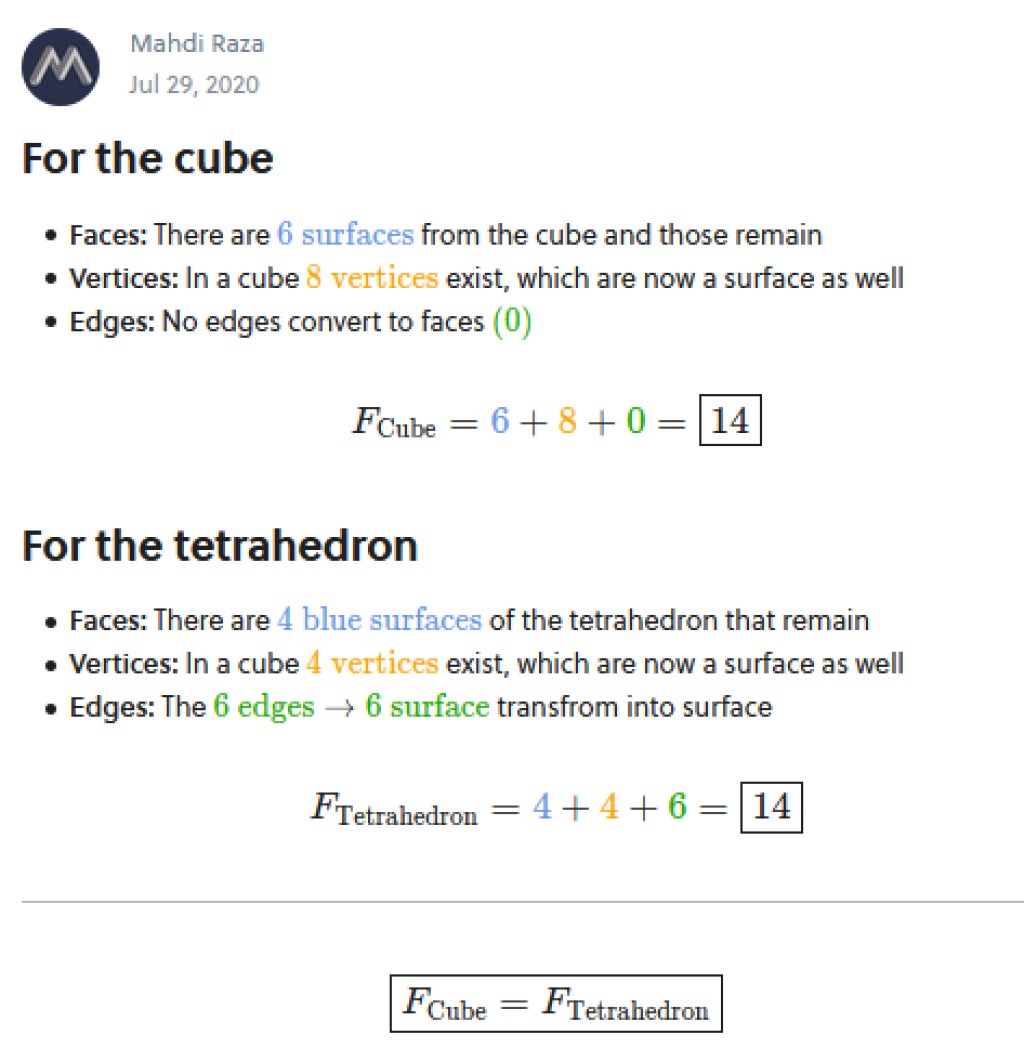
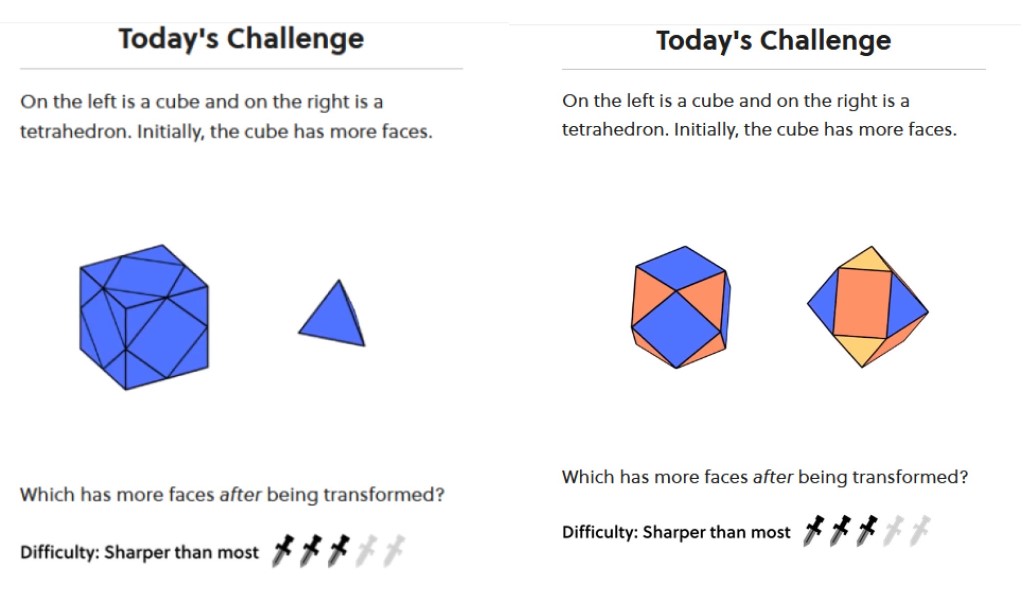
This was a bit of trick question. The answer is the both final shapes have the same number of faces (14 as it happens). Here is a published solution from Mahdi Raza:
The second problem I posed was this one:
The fact that the result is not allowed to be negative at any stage means that only five square numbers need be considered as possible plays for Mei – 1, 4, 9, 16 and 25. 25 + 9 = 34, which means that if either of these numbers is chosen Yuri is left with a square number and reaches 0 at the first attempt, which leaves 1, 4 and 16 as options.
Case 1: Mei plays 16. This reduces the number to 18. Yuri’s choices are now 1, 4, 9 or 16, of which 9 is instantly ruled out since it gives the game to Mei. However a choice of 16 by Yuri reduces the number to 2. Mei’s next move is forced 0 she subtracts 1, leaving 1 remaining and a win for Yuri as he also subtracts 1.
Case 2: Mei plays 4. This reduces the number to 30. All Yuri now has to do is play 25, reducing the number to 5, and whether Mei subtracts 1 or 4 she leaves a square number which Yuri thus reduces to 0 winning the game.
Case 3: Mei plays 1 which reduces the number to 33. If Yuri plays 25 that reduces the number to 8. Mei has a choice between 1 and 4, and 4 reduces the total to 4 an a win for Yuri, so she has to play 1. If Yuri now plays 4 then Mei plays 1 and Yuri has to do likewise, giving the game to Mei. Thus Yuri plays 1 reducing the number to 6, and Mei can then win the game by playing 4 and making the number 2 with Yuri to play. Thus Yuri cannot play 25 as his first response. If he plays 16 that reduces the number to 17, from which Mei cannot play 1 as that gives Yuri the game. If she plays four that reduces the number to 13, and Yuri’s forced moved of 1 reduces the number to 12, from which Mei cannot play one or nine as they immediately allow winning moves for Yuri. So she plays four, making the number now eight, and Yuri counters with a one which makes the number seven, and whether Mei plays one or four Yuri is in control because his own next move makes the number two. If she plays a nine instantly from 17 that reduces the number to eight and again Yuri is in control. Similarly 16 hands the game straight to Yuri. Thus whatever number Mei starts with Yuri has a winning response. THus, if both players play optimally Mei cannot win.
A little look at the ODI between England and Ireland, and upcoming cricket development. Two mathematical challenges and some photographs, including some butterflies.
INTRODUCTION
England are playing Ireland today in the first One Day International anywhere for 139 days. It is England’s first home ODI since the 2019 World Cup final.
BIO-SECURE BUBBLES AND SELECTION
A combination of the rules surrounding bio-secure bubbles and the need to make up for time lost to the pandemic means that England are without their multi-format players (yet another reason why Buttler should have been dropped from the test squad – he is much more valuable as a limited overs player than as a long format player), which means that six of the World Cup Final eleven are missing. Ireland are in transition, and two youngsters, Curtis Campher and Harry Tector (the middle of three brothers, in between Jack and Tim, the last named of whom is according to some the best cricketer) are making their international debuts.
ENGLAND OFF TO A FLYER
Ireland are batting, though whether they still will be by the time I have finished this post is open to question, since they have already lost five wickets, including one of the debutants, Tector. Campher is still batting, and is in partnership with the veteran Kevin O’Brien. This is also the first ODI to contribute to the new ODI League which will decide who qualifies for the next world cup. David Willey, left arm medium fast, and Saqib Mahmood, right arm fast, have done the damage with the ball so far, while Adil Rashid (leg spin) and Tom Curran (right arm fast medium) are currently in action, with vice-captain Moeen Ali presumably fifth bowler should such be required. Tom Banton of Somerset may get an opportunity to demonstrate his batting skills later in the game.
UPCOMING FOR ENGLAND
The ODI squad have another two matches in this series against Ireland, while the first test match of the second series of the summer, against Pakistan, gets underway on Thursday. Pakistan look a stronger combination than the West Indies, making a strong start very important. Australia are due to visit for an ODI series in September. Some steps have already been taken towards spectators returning to the grounds, and more trials will be conducted during the Bob Willis Trophy, the county tournament that is taking the place of the County Championship for what remains of this season. It is not just about making sure that numbers in the ground are safe, but also of ensuring that travel to and from the grounds can be conducted safely. O’Brien has just holed out off the bowling of Rashid to make it 79-6. Simi Singh and Andrew McBrine both have some sort of batting skill, McCarthy is definitely a tail ender and Craig Young is a genuine no11. Simi Singh has just been run out for 0 to make it 79-7. McBrine is next man in. Save for a memorable occasion in New Zealand 42 years ago when Boycott was the victim, courtesy of Botham who had been instructed to up the run rate by any means necessary, there has never been a good time to suffer a run out, but this was a more than usually bad time from an Irish perspective for such a thing to happen.
TWO MATHEMATICAL TEASERS
I have two problems from brilliant to share with you. I start with one officially rated at three daggers (I am showing you two stills from what is actually an animation), but which I consider very much easier than that:
My second offering is more difficult, but not nearly as difficult is the five dagger rating suggests:
This had multiple choice answers originally, but I am not offering them. It is considerably less difficult than the rating suggests, though I admit to spending a measurable length of time thinking about it before coming up with the answer (solving these problems is a ‘before breakfast’ activity for me, and I never spend hugely long on any of them). Solutions tomorrow.
PHOTOGRAPHS
My usual sign off:
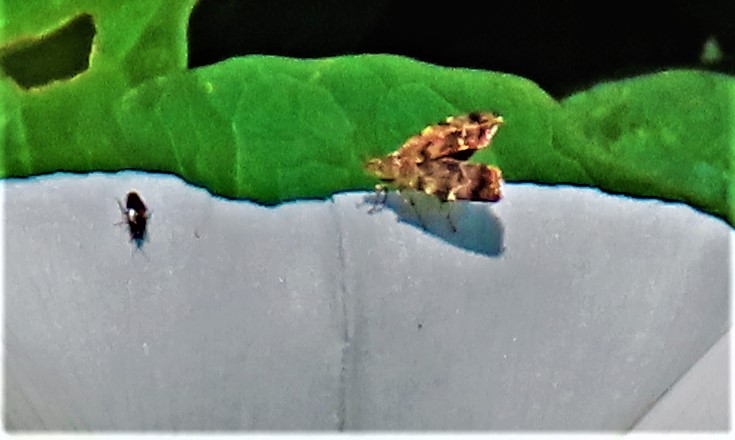
Butterflies seen yesterday and today while out walking.
There is a very large clump of Buddleia growing adjacent to the bridge that carries Littleport Street across the Gaywood river, which is often a good place to observe butterflies, and it was there that I spotted this peacock this morning (six shots in the attempt to do full justice to so splendid a specimen).
PS Well done to Ireland – after that awful start they are still batting, now on 124-7, Campher now on 46, and McBrine 23.
















































































































































































































































































































































































 aspiblog