P is for Power, Panache, Presence etc

An all time XI of players whose given names begin with P, an important honourable mentions section which starts with two ‘what might have beens’ and a photo gallery.

In this post I select an all time XI of players whose given names begin with the letter P. There is an extensive and important honourable mentions section as well, and some photographs to end.

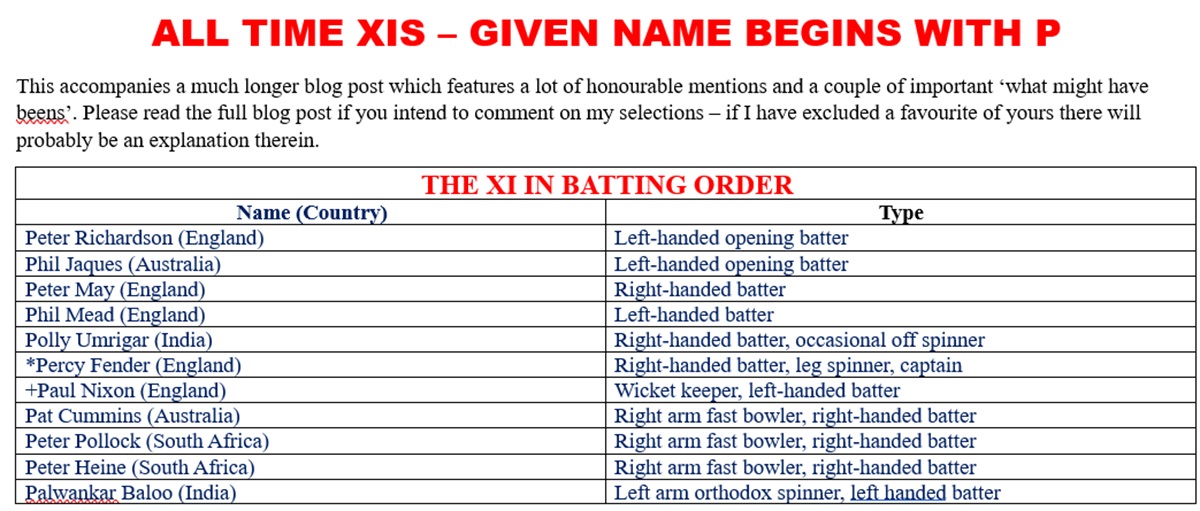
  1. Peter Richardson (England, left handed opening batter). Had a fine test record in a generally low scoring decade, the 1950s. He also lacked a regular opening partner at England level, which makes his achievements in the role even more creditable.
  2. Phil Jaques (Australia, left handed opening batter). One of the many fine players to miss out on opportunities because Australia had a dominant and settled line up at the time. His performances in the nine test matches he got to play were excellent, and his first class record over a long career speaks for itself.
  3. Peter May (England, right handed batter). An outstanding career record, averaging 46 in test cricket’s lowest, slowest scoring decade.
  4. Phil Mead (England, left handed batter). A fine test record, and an outstanding first class one. His Hampshire tallies of 48,809 runs and 138 centuries are both records for a single first class team, while his overall career tallies place him fourth all time in both runs scored and centuries made.
  5. Polly Umrigar (India, right handed batter, occasional off spinner). He overcame a traumatic start to his test career, mainly at the hands of Fred Trueman, to end it as the holder of India career records for most runs and most centuries at test level, and with an average of 42 at that level. His India career records all stood as such until Sunil Gavaskar came along and didn’t so much raise the bar as blast it into the stratosphere.
  6. *Percy Fender (England, right handed batter, leg spinner, captain). Perhaps one place higher than would be absolutely ideal, but this side has a strong top five, and there is a very handy keeper/ batter to come. A fine all rounder, and an even finer captain, a role that Peter May’s presence not withstanding I have no hesitation in awarding him in this side.
  7. +Paul Nixon (England, wicket keeper, left handed batter). He was never picked by England for a test match, though he did play some limited overs internationals, but he was very fine wicket keeper, and good enough with the bat to average 35 in first class cricket.
  8. Pat Cummins (Australia, right arm fast bowler, right handed batter). One of the best contemporary fast bowlers.
  9. Peter Pollock (South Africa, right arm fast bowler, right handed batter). The spearhead of the South African bowling attack in the last years of their first incarnation as a test nation, he first developed his bowling in the backyard of the family home, where if he wanted a bat he had first to dismiss his younger brother, and since said younger brother was Graeme Pollock that, as many another bowler learned over the years, took quite a lot of doing.
  10. Peter Heine (South Africa, right arm fast bowler, right handed batter). Formed an excellent and nasty new ball pairing with Neil Adcock, who should probably have been in the Ns XI in the years immediately before Pollock.
  11. Palwankar Baloo (India, left arm orthodox spin bowler, left handed batter). India were not a test nation in his playing days, and since rather than being a Jam Saheb or a Nawab he was a humble member of a low caste he did not have the opportunity of going to England to play. 33 first class matches yielded him 179 wickets at 15.09 a piece, an astounding record, especially given the caste prejudice he faced while assembling it.

This side has a powerful top five, a fine all rounder who was also a very astute captain, an excellent keeper/ batter and four high quality specialist bowlers. Cummins, Pollock, Heine, Baloo and Fender, with Umrigar available as sixth bowler are unlikely to struggle to take 20 opposition wickets.

I begin this section, for reasons that I hope will become apparent, with…

My first what might have been, and the one that some would be gunning for me over my failure to include him is Phillip Hughes, a left handed opening batter who died after being hit on the back of the head by a bouncer in 2014, at the age of just 26. Hughes’ tragic demise does not change basic facts: in this case he had not done enough to earn his place in this XI, with a test average of under 33, including the 2010-11 Ashes when he looked decidedly ordinary. There is no way of knowing how his career would have developed, and I can only go on actual facts, therefore he misses out.

The second person to feature in this section is another Aussie. Some 40 years before Glenn McGrath was born there Dubbo, New South Wales had come very close to producing a champion fast bowler: Pat Crawford. His career came to a premature end after a horrible injury. In four test matches he took seven wickets at 15.28, while 37 first class matches yielded him 110 scalps at 21.02. In view of the achievements of Cummins, Pollock and Heine, plus one or two others who had to miss out I felt that while his figures did suggest a truly great performer I could not include him.

Two other openers whose test records definitely make them worthy of consideration were Paul Gibb and Peter Parfitt, the former of whom could also have been named as keeper. Pravin Amre of India started his first class career looking like he was going to shred the record books, but ultimately did not do so, though his records at both first class and test level were excellent by mosr reckonings. Pathum Nissanka of Sri Lanka has an outstanding first class batting record and a very respectable test one, and may ultimately claim a place in this XI, but at the moment he is not quite there. Peter Burge of Australia was also in the mix for a middle order batting slot, but although he definitively won one test match for his country (an innings of 160 that was largely responsible for what looked a substantial first innings deficit becoming a substantial first innings lead) his overall record was respectable rather than great. Paul Collingwood was a candidate for the place I gave to Umrigar, and would also be a candidate for being the designated substitute fielder, though he has a rival for that slot in Paul Parker. Phil Sharpe was a gritty batter who averaged 40 at test level and an outstanding slip fielder. Parthiv Patel, Paul Downton and Peter Nevill were the three wicket keepers closest to challenging Nixon. The fastest bowler to miss out was unquestionably Patrick Patterson, but he was nearly as erratic as he was quick, which is why his record falls short of greatness. Peter Siddle and Pat Trimborn were both quality practitioners of right arm fast medium bowling. Pedro Collins was another test match pacer not quite good enough for this XI. The spin options were thinner on the ground, though Pat Pocock, who once took seven wickets in 11 balls for Surrey against Sussex deserves a mention, and two contrasting left armers, Philippe-Henri Edmonds and Paul Adams of the ‘frog in a blender’ action would both have their advocates. Pat Symcox, a fine off spinner for South Africa, would also have his advocates. Peter Hatzoglou (leg spin) and Patrick Dooley (left arm wrist spin) would be candidates for a limited overs side. Australian left hander Phoebe Litchfield would also be a candidate for a batting slot in a limited overs XI.

My usual sign off…

All Time XIs – the Letter P and Left Handers

An all time XI of players whose surnames begin with P, and because it is International Left Handers Day an all time XI of left handers.

Today is International Left Handers day, so this post includes a bonus feature – I lead off with an all time XI of left handers. A list of honourable mentions for such an XI would be incredibly long, so I shall not include it. After parading my chosen left handers the focus of the bulk of the blog post is on cricketers whose surnames begin with the letter B.

LEFT HANDERS XI IN BATTING ORDER

  1. *Graeme Smith (South Africa). A steely left handed opening batter, and the obvious choice to captain this XI – a role he performed superbly for South Africa.
  2. Alastair Cook (Essex, England). The opener is England’s all time leading scorer of test runs (though likely to be overhauled by Joe Root in the not too distant future).
  3. Brian Lara (Warwickshire, West Indies). The holder of world record individual scores at both test and first class level, a joint feat achieved only once before in cricket history, by Don Bradman for the two and a half years that his 334 was the world test record score. Also the only player to have twice held the world test record score, and one of only two along with Bill Ponsford to have two first class quadruple centuries.
  4. Graeme Pollock (South Africa). Possibly the greatest batter ever produced by his country. When the curtain came down on the first period of SA being a test nation he was left with an average of 60.97.
  5. Frank Woolley (Kent, England). The only player to achieve the first class career treble of 10,000+ runs (58,969 in his case), 1,000+ FC wickets (2,066) and 1,000+ FC catches (1,018). Capable of match winning performances with both bat and ball (as a left arm orthodox spinner), and one the finest fielders ever to play the game.
  6. Garry Sobers (Nottinghamshire, West Indies). The most complete player to have played the game. One of the greatest batters of all time, a bowler of fast, medium or slow pace (both orthodox and wrist spin) and a brilliant fielder.
  7. +Adam Gilchrist (Australia). A top quality keeper, and a destructive middle order batter.
  8. Wasim Akram (Lancashire, Pakistan). Fast bowler, attacking batter.
  9. Alan Davidson (Australia). Fast medium bowler, occasional spinner, useful lower order batter and fielder of such brilliance that he earned the nickname ‘the claw’.
  10. Mitchell Johnson (Australia). One of the fastest bowlers ever to play the game and a useful lower order batter. On his day he was simply unplayable.
  11. Hedley Verity (Yorkshire, England). A left arm spinner and a useful lower order batter (indeed he was once pressed into service as an emergency opener in a test match and did well). On surfaces that didn’t help him he was very economical and never allowed batters to feel at ease. On surfaces that did help him he was a destroyer. Yorkshire’s match against Nottinghamshire in 1932 illustrated both sides of Verity the bowler – in Nottinghamshire first innings he took 2-64 from 41 overs, in their second, when he had a rain=affected pitch to exploit he recorded figures of 19.4-16-10-10 – the cheapest all ten in FC history.

This XI has an awesomely strong batting line up, and a bowling attack of Akram, Johnson, Davidson, Verity, Sobers and Woolley is both strong and varied.

SURNAMES BEGINNING WITH P IN BATTING ORDER

We move on to the main meat of the post, an all time XI of players whose surnames begin with P.

  1. Alviro Petersen (Glamorgan, South Africa). A solid right handed opener.
  2. Bill Ponsford (Australia). One of only two players to twice top 400 in FC matches. He scored centuries in his first two test matches and in his last two.
  3. Ricky Ponting (Australia). One of the two best number three batters of the modern era alongside Rahul Dravid. He was also an excellent slip fielder, and a long serving captain, though his record in that department was tarnished by the fact that oversaw three failed Ashes campaigns – the only other three time Ashes losing skipper in 140 years being Archie MacLaren of England (1901-2 in Australia, 1902 in England, 1909 in England), hence my not giving him the role in this side.
  4. Graeme Pollock (South Africa). One of the greatest of all left handed batters (see the left handers XI earlier in this post).
  5. Kevin Pietersen (Nottinghamshire, Hampshire, Surrey, England). A batter of undoubted greatness, though problematic in the dressing room to the extent that his first two counties were both glad to see the back of him. He top scored in both innings of his test debut, ended that series with the second most important innings of 158 to be played by a South African born batter at The Oval. His test best was 227 at the Adelaide Oval in the 2010-11 Ashes.
  6. +Rishabh Pant (India). Attacking left handed batter, quality keeper. Probably his greatest moment came at the Gabba when he played a match and series winning innings for an injury-hit India.
  7. *Mike Procter (Gloucestershire, South Africa). One of the finest all rounders ever – a genuinely fast bowler, an attacking middle order batter and a shrewd captain to boot – I have given him that role in this side.
  8. Shaun Pollock (Warwickshire, South Africa). An exceptionally accurate right arm fast medium bowler and a useful lower order batter. He is also my chosen vice captain for this side in preference to either Ponting or Pietersen.
  9. Peter Pollock (South Africa). A right arm fast bowler, spearhead of the South African attack during the last few years of their first period as a test nation.
  10. Charlie Parker (Gloucestershire, England). The third leading wicket taker in FC history with 3,278 scalps at that level, but only one England cap.
  11. Erapalli Prasanna (India). An off sinner who took 189 test wicketsin the 1970s.

This side has one good and one great opener, a superb engine room at 3-5, a keeper batter, a genuine all rounder, and four great bowlers. In Procter and Peter Pollock the side has two genuinely fast bowlers, with Shaun Pollock’s fast medium to back them up. Parker and Prasanna are an excellent pair of contrasting spinners.

HONOURABLE MENTIONS

Eddie Paynter has a higher test average than anyone I have overlooked at 59.23, but his test career was quite brief, and his average is over a run an innings less than that of Graeme Pollock. Cheteshwar Pujara is the next most notable omission, but no way can he be selected ahead of Ponting at number three, and his efforts when India recently used him as an ersatz opener were not very impressive.

The two Nawabs of Pataudi to play test cricket (the last two to have that title) were both fine batters, but not quite good enough to break into this powerful XI.

Roy Park of Australia never got the opportunity to prove himself at test level – his batting career for his country lasted exactly one ball. Ashwell Prince of South Africa might have his advocates as well.

Ellyse Perry is unlucky to have a surname beginning with P – there are many other letters where I would be delighted to be able to choose a player of her class, but she just misses out.

JH Parks of Sussex was a fine county all rounder, but hardly a challenger to Procter. JM Parks was a batter/ keeper for both Sussex and England, but for my money Pant is better in both departments than Parks was, and even if Parks’ batting shades it I would go for the better keeper (a walkover win for Pant).

Dattu Phadkar of India was good middle order batter an enough of a bowler to take the new ball for his country (although this is partly a reflection of India’s shortage of quick bowlers in his playing days), but could hardly displace Procter.

Liam Patterson-White, an all rounder who bowls left arm spin, may be challenging for inclusion in a few years time, as might leg spinner Matt Parkinson, but as yet they are potentials rather than actuals.

Three seriously quick bowlers who missed out were Patrick Patterson (WI) whose time at the top was short, Len Pascoe (Australia), who also didn’t have great depth of achievement and Pushpakumara of Sri Lanka, whose record was very modest for all his pace.

PHOTOGRAPHS

Time for my usual sign-off…