Team of the 1912 Triangular Tournament

The Team of the 1912 Triangular Tournament, plus a generous photograph gallery.

I am currently rereading Patrick Ferriday’s excellent book about the 1912 Triangular Tournament, “Before the Lights Went Out”. In this post I pick a team of that tournament.

The Triangular Tournament was an attempt to have the then three test playing nations in action in the same season. A combination of a wet summer, the fact that South Africa proved much weaker than expected and that Australia were missing six first team regulars due to a dispute between the players and the fairly newly formed board robbed the event of a lot of potential interest and it would 61 years before international cricket matches (in the form of the women’s ODI World Cup) took place at neutral venues again, and over 80 years before any further tests were held at neutral events. For all that the tournament was a flop there were some great players on show.

  1. Warren Bardsley (Australia, left handed opening batter). Even in conditions that would have been particularly alien to an Australian he had a very good tour, with the major highlight a knock of 164 against South Africa at Lord’s.
  2. Jack Hobbs (England, right handed opening batter). He came into the 1912 season already established as the best batter in the world and probably also the best cover point fielder in the game, and nothing happened to change that assessment of his position in the cricket world.
  3. Wilfred Rhodes (England, right handed batter). A decade earlier Rhodes, then a specialist left arm spinner who batted at number 11, scored 67 runs at 67.00 in the 1902 Ashes series. In the intervening years he had worked his way up the order, and towards the end of the period had pretty much let his bowling lapse, and on the 1911-12 Ashes tour he had been England’s number two batter in both averages and position in the order. After WWI, in response to Yorkshire’s needs he would once again become an all rounder, before eyesight problems forced him back down to the bottom of the order, though his bowling still kept him in the Yorkshire side until the emergence of Hedley Verity.
  4. Frank Woolley (England, left handed batter, left arm orthodox spin bowler). Woolley played some fine innings in the course of the tournament, and in the final match at The Oval, decreed by the powers that be to be a ‘winner takes all’ match that would be played until a result was achieved, he took five cheap wickets in each Australian innings, supported by Barnes in the first and Harry Dean, a left arm seamer, in the second.
  5. Charlie Macartney (Australia, right handed batter, left arm orthodox spinner). Featured prominently in both batting and bowling averages for the season, and if not quite the thing of beauty it became noted as being post WWI his batting was also apparently exceedingly watchable even then.
  6. Aubrey Faulkner (South Africa, right handed batter, leg spinner). South Africa overall had a tournament to forget, but Faulkner had moments with both bat and ball.
  7. *Frank Foster (England, right handed batter, left arm fast medium bowler). In 1911 he captained Warwickshire to their first ever County Championship, then in the 1911-2 Ashes he was one half of the most penetrative new ball pairing England had yet established alongside SF Barnes, and this duo carried on taking test wickets back home in England in 1912. He was good enough with the bat to have scored Warwickshire’s first ever first class triple century.
  8. Jimmy Matthews (Australia, leg spinner, right handed batter). He gets selected for an amazing bowling feat in the first test match of this tournament, when in the space of 90 minutes he took not one, but two test match hat tricks. Those were his only six wickets of the match, and none needed the assistance of a fielder. South Africa’s wicket keeper, Tommy Ward, was the hat trick victim both times, the second time somewhat bizarrely after being promoted ahead of Rolland Beaumont, who was allegedly a specialist batter, but spent most of this tour (when picked) batting low in the order.
  9. Syd Barnes (England, right arm fast medium bowler, right handed batter). He was firmly established as the best bowler of any type in the world by the time of this tournament, and even more firmly established as such by the time it ended.
  10. Bill Whitty (Australia, left arm fast medium bowler, right handed batter). He had an excellent season.
  11. +EJ ‘Tiger’ Smith (England, wicket keeper, right handed batter). Neither Australia nor South Africa had great keepers this series – South Africa had taken along two specialist keepers, but resorted to Louis Stricker, selected in the party for his batting, before the tour was done, because neither specialist keeper fared at all well, and Ward of course had the traumatic experience on test debut referred to above. Smith was an excellent keeper, though inclined to be cussed (he was apparently wont to say that he would bat at number one or number 11 but nowhere in between, so I have given him his second choice), and as a Warwickshire team mate of Frank Foster he was well used to keeping to the left armer, which some could find challenging.

This side has a powerful top six, a genuine all rounder at seven, three contrasting specialist bowlers and a quality keeper. Even with Rhodes not bowling at that stage of his career this side is well stocked with bowling options as well – Barnes, Foster, Whitty, Matthews, Faulkner, Woolley and Macartney are seven authentic options, and in one match of this tournament Hobbs’ occasional medium pace was pressed into service, and while unthreatening he managed to bowl 11 economical overs.

Gerry Hazlitt of Australia fared well with the ball, ‘young Jack’ Hearne was a candidate for the slot I awarded to Faulkner, while Sydney Pegler was the only South African bowler to really come to terms with English conditions. Arthur William ‘Dave’ Nourse, back in the land of his birth (as was South Africa captain Frank Mitchell) fared respectably enough to earn a mention.

My usual sign off…

Steel, Swashbuckling, Stumpings, Speed, Swing, Spin

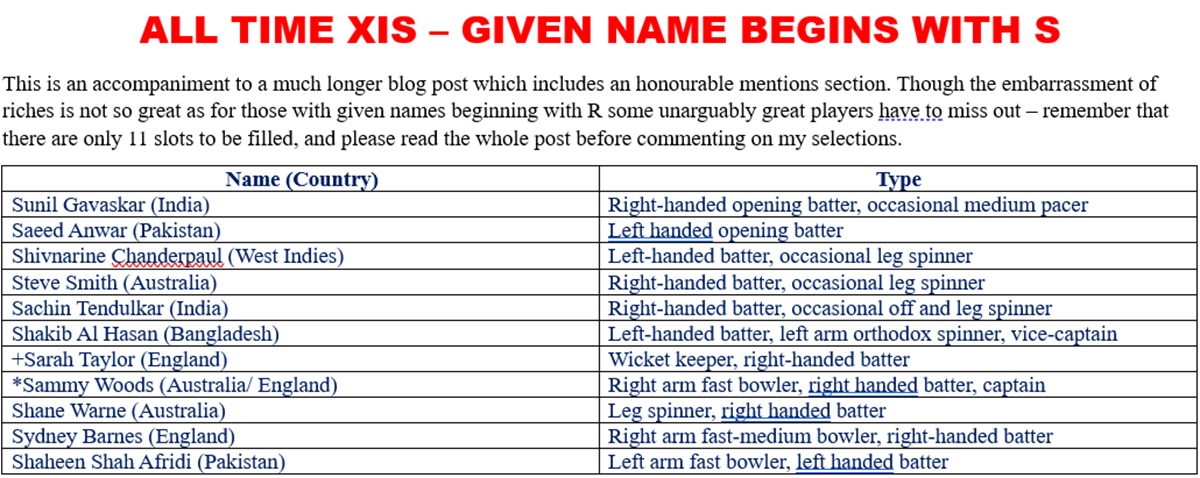
An all time XI of players whose given names begin with the letter S, including a detailed honourable mentions section which features some serious players. Also a photo gallery.

Today I run the rule over players whose given names begin with the letter S. My chosen XI contains players who match all the words in my title and more besides. Also, while the embarrassment of riches is not on the same scale as two days ago when I looked at given names beginning with R, there are some indubitable greats who have received no more than an honourable mention.

  1. Sunil Gavaskar (India, right handed opening batter, occasional medium pacer). He was the first to reach the career milestone of 10,000 test runs. At the time of his retirement his career tally of 34 test centuries was also an all comers record.
  2. Saeed Anwar (Pakistan, left handed opening batter). With a defensively minded right hander locking down one of the opening berths the ideal would be to fill the remaining place with an attack minded left handed, and fortunately I have available someone who was just that and was also good enough to have a test average of 45.
  3. Shivnarine Chanderpaul (West Indies, left handed batter, occasional leg spinner). He first came to general attention when he scored a double century for West Indies U19s against England U19s, and was promptly fast tracked into the test side (unlike England’s own double centurion in that U19s series, whose achievement was ignored by England management). He went on to establish a magnificent test record in a side that was went into freefall around him.
  4. Steve Smith (Australia, right handed batter, occasional leg spinner). Probably the second best batter ever to come out of Australia behind the mighty Don Bradman.
  5. Sachin Tendulkar (India, right handed batter, occasional off/ leg spinner). Most test runs, most test hundreds, most test appearances, only player to have scored 100 or more centuries across international formats. Probably the biggest compliment ever paid him was by Don Bradman, who was watching television coverage of one of his innings when he thought he spotted something familiar about Tendulkar and called his wife to check, and she confirmed that there were indeed similarities in batting style between the two of them.+
  6. Shakib Al Hasan (Bangladesh, left handed batter, left arm orthodox spinner, vice-captain). A genuine all rounder. Sometimes controversial, many were critical of his role when Angelo Mathews made history as the first person ever to be given Timed Out in an international match, though in truth the Bangladeshi was in the right, and Mathews’ reaction to falling victim to such an unusual dismissal was what really deserved censure.
  7. +Sarah Taylor (England, wicket keeper, right handed batter). A superb keeper and a fine batter as well.
  8. *Sammy Woods (Australia, England, right arm fast bowler, right handed batter, captain). Born in Sydney, but spent most of his career playing for and captaining Somerset. Somerset rarely if ever had the luxury of a settled side in his day, but his achievements as a captain were still impressive, including leading his county to victories over Yorkshire in three successive seasons when the northern county were generally ruling the roost.
  9. Shane Warne (Australia, leg spinner, right handed batter). One of the all time greats of the game, his case for inclusion needs no further amplification.
  10. Syd Barnes (England, right arm fast medium bowler, right handed batter). That official ‘right arm fast medium’ tells a tiny fraction of the story of Barnes’ methods. His signature weapon was a leg break delivered at fast medium pace, and 189 wickets at 16.43 each in just 27 tests (yes, an average of seven wickets per match at test level) is testament to just how good he was.
  11. Shaheen Shah Afridi (Pakistan, left arm fast bowler, left handed batter). He is still in the fairly early stages of his career, but 105 wickets at 25.58 in 27 test matches is a very fine start at the highest level.

This side has an excellent and contrasting opening pair, a mighty engine room of Chanderpaul, S Smith and Tendulkar, a genuine all rounder, a great keeper/ batter, a bowling all rounder and three superb specialist bowlers. The bowling, with Afridi, Barnes and Woods to attend to the pace and Warne and Al Hasan to bowl spin is also superb, and it is hard to see any conditions in which this attack would struggle.

The opening pair both had ironclad cases for inclusion. If I were picking for limited overs then I would settle for two left handed openers, with Sanath Jayasuriya replacing Gavaskar whose record in limited overs was not great, but in long form there is no contest. The trouble comes in the number four and five slots, where in addition to the two I opted for, there were two other outstanding candidates, who are very unlucky that their given names begin with this letter, which keeps them out: Steve Waugh and Stan McCabe both of Australia. Also, Saud Shakeel has had an amazing start to his test career, and may yet force his way in, but with the top five I have plus the two reserves I have already mentioned selecting someone on the basis of seven test matches, however outstandingly he has done in them would be unwarrantable. Finally for this area of the order, Stephen Fleming had a respectable rather than truly outstanding record for New Zealand, and could only have commanded a place had I been dire need of a captain, which I was not.

Shakib Al Hasan had no challengers at six, not least because with Warne inked into the side Shahid Afridi’s leg spin was unlikely to add much to the bowling attack. In a limited overs side, Sikandar Raza of Zimbabwe, an off spinning all rounder, would come into the mix – with Jayasuriya opening he increases the bowling variation available. However, his long form record is not special.

There were at a push four serious challengers to my actual choice for the wicket keeping role: Steve Marsh, who was fine keeper/ batter for Kent without ever getting the England job, Steve Rhodes who did do the England job, but was not IMO in Taylor’s bracket in either department, Sadanand Viswanath, a talented Indian keeper who didn’t fully deliver on his talents and Steve Rixon, understudy to Rod Marsh on at least one Ashes tour for Australia.

In the fast bowling department two England bowlers missed out for differing reasons: Steve Harmison was devastating when it was his day, but it was rather too frequently not his day for him to be classed as a genuine great. Had Simon Jones been able to keep himself in one piece he would have been a shoo-in, but injuries ruined his career. Schofield Haigh had a magnificent record for Yorkshire for many years, but never accomplished much for England. Sarfraz Nawaz, right arm fast medium for Pakistan, merits a mention, but no way could he dislodge either Barnes or his countryman Afridi. There is an extra reason for backing Shaheen Afridi in this area, which is that Barnes’ finest Ashes series, in 1911-2, came when he shared the new ball with a left arm pacer, Frank Foster.

Three off spinners have to be mentioned, though I had no way of accommodation them in the XI: Simon Harmer, unlucky to have played as little international cricket as he has, Saqlain Mushtaq, a genuine great, but not good enough to displace Warne, and Srinivas Venkataraghavan, one of the Indian spin quartet of the 1970s. The truth is that the other three spinners in question, Bedi, Chandrasekhar and Prasanna were all a distinct cut above Venkataraghavan, who sometimes got the nod because he offered extra batting compared to the other three. The quartet only once played in the same XI, on which occasion Prasanna, the other off spinner, was the most successful of the four. However, Venkataraghavan definitely qualifies for an umpiring gig, and his on-field colleague can be Sadanand Viswanath.

I start this section with a single picture and a reminder that you can view those in the gallery the follows at a larger size by clicking on any picture that attracts your attention.

Now for the rest of the gallery…

All Time XIs – England Every Decade

A quirky all time XI and some photographs.

Welcome to another quirky take on the all time XIs theme. This time I pick an England XI (plus twelfthy) in which every decade of test history is represented at least once.

  1. Jack Hobbs (right handed opening batter, 1900s-1930s). At the time of his retirement he was the leading run scorer in test history, and he still holds the England records for Ashes runs (3,636) and centuries (12).
  2. Herbert Sutcliffe (right handed opening batter, 1920s-30s). The only England batter to finish a career that spanned at least 20 test matches with an average above 60 (60.73).
  3. *WG Grace (right handed batter, right arm bowler of various types through bhis career, captain, 1880s-1890s). Made his debut for England in the first ever test match on English soil in 1880, and although he was already 32 by then he remained a formidable opponent for the next 19 years.
  4. Ken Barrington (right handed batter, occasional leg spinner, 1950s-60s). Averaged just short of 59 with the bat, including a career best of 256 against Australia.
  5. Wally Hammond (right handed batter, right arm medium fast bowler, ace slip fielder, 1920s-1940s). The first ever to score as many as 7,000 test runs. In the 1928-9 Ashes he scored 905 runs at 113.125, four years later he was joint leading run scorer for the series with 440 at 55.00, a performance followed up by scoring 227 and then 336* in two tests in New Zealand.
  6. +Les Ames (wicket keeper, right handed batter, 1930s). He averaged over 40 with the bat in test cricket and was also a top notch wicket keeper. Late in his career lumbago prevented him from keeping wicket, but he played on for Kent as a specialist batter, with Godfrey Evans maintaining the succession of great Kent keepers, going back to Tylecote in the 1880s.
  7. Ian Botham (right handed batter, right arm fast medium bowler, ace slip fielder, 1970s-1990s). I have placed him in the position from which he scored both of his legendary centuries in the 1981 Ashes. His last bow at international level was the 1992 World Cup – he retired from all competitive cricket part way through the 1993 home season when he realized that England would not be picking him again.
  8. Jim Laker (off spinner, right handed lower order batter, 1940s-50s). Perhaps the greatest of all orthodox off spinners, most famous for his destruction of the 1956 Australians. It is also noteworthy, especially in view of the generally awful record of English off spinners down under, that he took 15 economical wickets for a thoroughly beaten England in 1958-9.
  9. Syd Barnes (right arm fast-medium bowler , right handed lower order batter, 1900s-1910s). 189 wickets at 16.43 in just 27 test matches makes its own case for his inclusion.
  10. Hedley Verity (left arm orthodox spinner, right handed lower order batter, 1930s). Even in a decade of doped pitches and Bradman’s batting he claimed 144 test wickets at 24 each, while in FC cricket he was an absolute destroyer, paying less than 15 a piece for his wickets.
  11. James Anderson (right arm fast medium bowler, left handed lower order batter, 2000s-2020s). England’s all time leading test wicket taker.
  12. George Ulyett (right handed batter, right arm fast bowler, 1870s-1880s). The fast bowling all rounder was part of the earliest period of England’s international cricket history and could replace anyone save Ames without massively weakening the side – he once scored 149 in a test match, opening the batting, while his best bowling figures at that level were 7-36.

This side has a powerful batting line up, and a strong and well varied bowling attack. There is no front line leg spinner, and no left arm quick bowler, and no genuinely fast bowler, but nonetheless it is a pretty good side.

A two part photo gallery today…

All Time XIs: England Record Setters

Today I pick an England XI each of whom have their place or places in the record books. Several excellent candidates missed out because I could only accommodate 11 players, but I think my XI has a good mix of quirkiness and class.

THE XI IN BATTING ORDER

  1. Herbert Sutcliffe (right handed opening batter). Not just an England record, an all comers record: the only player to have played 20 or more test matches and never had a batting average below 60 at that level. I have previously mentioned how the progression of his averages shows him to have been the ultimate big game player.
  2. Alastair Cook (left handed opening batter). His feat of scoring a 50 and a century on test debut and finishing his career in the same way 12 years later is one of multiple ways in which he qualifies: England’s leading run scorer, England’s leading century maker, scorer of more runs from number two than any other England player.
  3. Walter Hammond (right handed batter, ace slip fielder, right arm medium fast bowler). More runs from number three than any other England batter, most runs in a series for England (905 at 113.125 in the 1928-9 Ashes), unique sequence of over 700 runs in the space of four test innings (101 and 75* in the last test of the 1932-3 Ashes, 227 and 336* in the two innings he played in New Zealand on the way home from that tour), twice scorer of back to back test double centuries (251 and 200 in the 1928-9 Ashes as well as the NZ runfest already detailed).
  4. Joe Root (right handed batter, occasional off spinner). Leading run scorer among current England batters, by a long way, leading career aggregate for any England right hander.
  5. Eddie Paynter (left handed batter). Has the best average of any left hander to have played 20 or more test matches for England – 59.23. His record includes double centuries against Australia and South Africa, but his most famous innings was 83 at Brisbane in the 1932-3 Ashes when he defied nurses advice and rose from his sick bed to bail England out of a crisis.
  6. +Les Ames (right handed batter, wicket keeper). Uniquely in this line up, because I required a keeper who was also a top class batter, I have used first class records to get him – more career stumpings than anyone else in history, three of the four “keeper’s doubles” (1,000 runs and 100 dismissals in first clas matches in the same season) stand to his credit.
  7. *Aubrey Smith (right arm fast medium bowler, right handed batter, captain). The only player to captain England in his only test, and since England won the match comfortably a rare England skipper with a 100% winning record in the job.
  8. Jim Laker (off spinner, right handed lower order batter). Most wickets in an Ashes series (46 in 1956, a haul that included a first class record 19 in the match at Old Trafford).
  9. Syd Barnes (right arm fast medium, right handed lower order batter). 189 wickets in just 27 tests for an average of seven per match. Two thirds of those wickets came overseas – 77 in 13 matches in Australia and 49 in just four matches in South Africa (in the last series before WWI).
  10. James Anderson (right arm fast medium, left handed lower order batter). England’s all time leading wicket taker, closing on 700 test scalps.
  11. Charles ‘Father’ Marriott (leg spinner, right handed tail end batter). 11 wickets in his only test appearance, the most by any one cap wonder. One of the select club of players to have taken more first class wickets than he scored runs.

This XI contains a very powerful top six, and although Smith and Laker are both probably a place too high in the order both could handle a bat – the latter had a test best of 63. Also a bowling attack that has Anderson, Barnes and Smith as front line seam/swing/pace options plus Hammond as fourth seamer if needed and Marriott and Laker as a contrasting spin pairing is not going to need as many runs behind it as some attacks would.

HONOURABLE MENTIONS

There are quite a few of these, so I am going to divide them up into categories.

Opening batters: Len Hutton (test record score for England, 364 at The Oval in 1938), Jack Hobbs (a record 12 centuries for England against Australia), John Edrich (highest score by an England left hander, 310* v NZ) and Graham Gooch (most runs by an batter in a single test match – 456 (333 and 123 v India at Lord’s in 1990) are all definite candidates, and some would also include WG Grace, the only player to twice hold the England record score (152 and 170, both v Australia, at The Oval in 1880 and 1886).

Middle order batters: RE Foster (highest ever score by a debutant and still the highest for England in Australia, 287 at Sydney in 1903), and the only player to captain England men’s teams at cricket and football and KS Ranjitsinhji (150+ scores on debut in two countries – 154* at Old Trafford in 1896 and 175 at Sydney in 1897) are the most obvious.

All rounders: Ian Botham reached the double of 1,000 runs and 100 wickets in an all comers record 21 matches, and 2,000 and 200 in 42 matches before falling away later in his career. Billy Bates took England’s first hat trick, part of a performance that saw him become the first ever to score a 50 and take 10 wickets in the same test match.

Pace bowlers: George Lohmann has the cheapest career average of any bowler to have taken 100 or more test wickets – 10.75. Frank Tyson is the only post WWII England bowler to finish a test career of more than 10 matches with a bowling average below 20 – 18.56. Kent left arm quick Fred ‘Nutty’ Martin still has the record for most wickets by an England debutant – 12.

Other bowlers: Derek Underwood took the most test wickets of any England bowler of below medium pace – 297 with his left arm slow medium. Graham Swann was the leading career wicket taker among England off spinners.

PHOTOGRAPHS

My usual sign off…

All Time XIs – England Before WWI

A look at England’s resources in the early years of test cricket and a large photo gallery.

Today is the third anniversary of my first ever All Time XIs post, about Surrey and I am varying the theme today with a look not at an all-time XI but an XI for a particular period of cricket’s history – England before WWI, so picked from players who appeared in the first 37 years of test cricket.

THE XI IN BATTING ORDER

  1. *WG Grace (right handed opening batter, right arm bowler of various types and captain). WG’s test record looks fairly modest, but he was already 32 by the time he made his debut at that level and almost 51 by the time of his last appearance. He also did twice hold the England record individual score at that level, with 152 on his debut at The Oval in 1880, which lasted six years, and 170 at the same ground in 1886 to reclaim his record from Arthur Shrewsbury after one match. This latter stood until the 1894-5 Ashes series when Stoddart topped it with 173. Had test cricket been established a little earlier than it was Grace’s record would have been a lot better – in the 1870s he averaged 49 in FC cricket when no one else in England could do more than half as well.
  2. Jack Hobbs (right handed opening batter). Included in this XI as well as the one for the inter-war era out of deference to his own expressed wish to be remembered for how he batted before WWI – he was actually firmly established as the best in the world before the outbreak of WWI although his main record breaking years were after that conflict.
  3. Johnny Tyldesley (right handed batter). It was a choice between this man and David Denton of Yorkshire for the number three slot (both filled it with distinction) and I opted for the Lancastrian due to the fact that his brother misses out on a place in the inter-war XI because of England’s immense batting strength in that era.
  4. KS Ranjitsinhji (right handed batter). 989 test runs at 45 including two 150+ scores. One of the great geniuses of batting.
  5. FS Jackson (right handed batter,right arm medium fast bowler, vice captain). He never managed an overseas tour due to work commitments (he was a genuine amateur in terms of his cricket), but he still managed five test centuries against Australia in home matches. His peak came in the 1905 Ashes, when he won all five tosses, led England to victory in the only two matches to have definite results and topped both the batting and bowling averages for the series.
  6. Len Braund (right handed batter, leg spinner). The all rounder of the side, and an excellent slip fielder to boot.
  7. Frank Foster (left arm fast medium bowler, right handed batter). His career was cut short by a motorcycle accident, but in the few years he was around he did enough to claim his place, including playing a key role in a 4-1 win down under in 1911-2.
  8. +Augustus “Dick” Lilley (wicket keeper, useful lower order batter). The longest serving of England’s prewar keepers, and with an excellent record.
  9. George Simpson-Hayward (under arm off spin, right handed lower order batter). Selected for historical significance as the last specialist under arm bowler to feature at test level (and he did well in the five matches he got to play btw). He would need a law change (see here for a suggestion of how such a change could safely be made) to be able to play today.
  10. SF Barnes (right arm fast medium bowler, right handed lower order batter). That official ‘right arm fast medium’ is about as complete a description of Barnes the bowler as ‘artist’ is of Leonardo da Vinci – it tells a tiny fraction of the story of someone who could bowl every type of delivery known to right armers of his day and whose special weapon was effectively a leg break at fast medium.
  11. Wilfred Rhodes (left arm orthodox spinner, right handed lower order batter). Although Rhodes’ brief period as an England opening batter happened just before WWI I have selected him for his bowling – he started and ended his career as a specialist bowler with two spells as an all rounder and in the middle a spell as a specialist batter and I have put him in the slot from which he helped George Hirst to knock of the the 15 required when they came together at The Oval in 1902 and from where he helped RE Foster to add 130 for the last wicket at Sydney in 1903.

This XI has powerful top order, all rounders at six and seven, a fine keeper who could also bat at eight and three master bowlers to round out the order.

HONOURABLE MENTIONS

Other than my actual choices the main contenders for opening slots were Archie MacLaren and Arthur Shrewsbury. Reginald Foster has two places in the record books – his 287 at the SCG in 1903, at the time an all comers test record remains the record for someone playing their first test innings, and he is the only person to have captained England men at both cricket and football, but other than that amazing debut performance he only topped 50 once more in his career and that was an innings in which he benefitted from good fortune. Many would have expected CB Fry to be a shoo-in but his test record was not nearly as good as his FC record, and with WG inked in for the captaincy, and FS Jackson a more than able deputy his leadership skills were hardly required. Allan Steel might have had the all rounders slot I gave to Braund (like the latter he bowled leg spin). George Hirst may well have been as his Yorkshire skipper Lord Hawke was wont to claim the best ever county all rounder, but his performances for England were overall not that great, though he did have his moments.

George Lohmann was probably the biggest bowling omission but I felt he was too similar to Barnes to be able to pick both. The side also lacks a really fast bowler. The obvious candidate would be Tom Richardson, with 88 wickets in his 14 test matches, and if I were to be debarred from selecting Simpson-Hayward then Richardson would take his place, but I prefer the greater variety that Simpson-Hayward’s presence brings. Schofield Haigh’s England successes were limited for all that he was outstanding for Yorkshire. There were a stack of left arm spinners I could have picked: Johnny Briggs, Bobby Peel and Colin Blythe being the three most notable other than Rhodes in this period, while George Dennett never actually got an England cap, but 2,151 wickets at 19.82 in FC cricket provide proof of his greatness.

PHOTOGRAPHS

My usual sign off…

All Time XIs – Match Ups (7)

Continuing my analysis of how my all-time XIs for each letter of the alphabet stack up against each other.

I am continuing my analysis of how my all-time XIs for each letter of the alphabet fare against each other. The Bs XI are currently in the hot seat, and come into today on 19.5 points out of a possible 30.

THE Bs V THE Hs

The Bs are ahead on batting, with only Hussey of the top five out batting his counterpart from the the Bs XI, but Hendren and Healy are both better with the bat than their opposite numbers. Healy wins the clash of the keepers. While Hadlee and Holding are close to Barnes and Bumrah as a prospective new ball pairing, Botham has to be preferred as third seamer to Hammond. Bates and Benaud are at least the equal as spinners of Harmer and Herath. I score this one Bs 3.5, Hs 1.5.

THE Bs V THE Is

This is a monster mismatch – only Imtiaz Ahmed with the bat beats his opposite number. Shoriful Islam and Anthony Ireland are hopelessly outclassed as a new ball pairing by Barnes and Bumrah, while Illingworth loses to fellow Yorkie Bates in the off spinning all rounders clash – adjusting their figures for improved pitches by the time Illingworth was playing, Bates is equivalent to an Illingworth era or later player averaging 40 with the bat and 25 with the ball, so he comfortably beats Illingworth in both departments. Ironmonger beats Benaud as a bowler, though he was of zero value with the bat. Quite simply there are no circumstances in which the Is can be envisaged troubling the Bs and I score this Bs 5, Is 0.

THE Bs V THE Js

This looks like a mismatch but 1) The Js have an extra front line bowling option compared to the Bs, 2)A Jones is a much better bat than the figures from her few test appearances suggest and is a superb keeper, 3) Jessop was the ultimayte x-factor player. Johnston, S Jones, Johnson and Jessop give the Js a clear edge in the seam bowling department, Jupp is good match for Bates, and though Benaud beats Jayasuriya with the ball, the Sri Lankan is well clear with the bat. The Bs advantage with the bat will probably tell in their favour, but this is much closer than it appears it first sight and I score it Bs 3, Js 2.

THE Bs V THE Ks

The Bs have their usual advantage in the top batting slots, with only Kallis beating his opposite number in that department. However, Khan wins the battle of the all rounders, Kirmani rates above Bari with both bat and gloves. King, Kortright and Khan represent a fearsome pace trio, with Kallis a decidedly useful fourth seamer. Although them both being leg spinners is less than ideal there is enough of a contrast in bowling styles between R Khan and Kumble to mitigate that, and they are a good match for Bates and Benaud. Here I think the Ks bowling depth will swing it for them: Bs 2, Ks 3.

THE Bs V THE Ls

Once again the Bs dominate the top batting positions, but Langridge wins the battle of the allrounders, Langley and Bari are level pegging. In bowling Lindwall, Lillee and Lohmann outpoint Barnes, Bumrah and Botham – even if you rate Barnes and Bumrah one and two in the pacers department, Lillee, the third best of the Ls on statistics is far clear of Botham as a bowler. Laker and Langridge are about level with Bates and Benaud. I do not see the Bs batting advantage saving them here, and I score a close contest as Bs 2, Ls 3.

THE Bs PROGRESS UPDATE

The Bs have scored 15.5 out of 25 in these five match ups and are therefore up to 35 points out of 55, a score of 63.63%. The As were on 28 at this same stage of their progress.

PHOTOGRAPHS

My usual sign off…

All Time XIs – Match Ups (6)

Welcome to the latest post in my series analysing how my all time XIs for each letter of the alphabet fare against each other. We reached the conclusion of the A XIs match ups yesterday, so now we start with the B XIs. They have 3.5 points in the bank from their encounter with the As (see here).

THE Bs V THE Cs

The Bs dominate the batting, with only G Chappell among the top six outpointing his opposite number, and that by a mere fraction. Added to this is the fact that for reasons explained in the original post about the Cs Chanderpaul and arguably Cowdrey are batting out of position. Carter out bats Bari, but Bari was the finer keeper. Bates and Benaud are unquestionably a finer pair of spinners than Cornwall and Chandrasekhar, and both also possessed batting pedigree, something to which Cornwall has limited claim and Chandrasekhar none. Barnes and Bumrah for my money have the edge on Cummins and Croft as a new ball combination, though the Cs are undoubtedly the faster pair. Botham and Constantine were two mercurial all rounders, capable of match winning performances. I will allow for the possibility of a Constantine special, while rating it odds against, so my final score for this is Bs 4.5, Cs 0.5.

THE Bs V THE Ds

The Bs have an advantage with the bat – only Duleepsinhji, D’Oliveira and Dujon of those whose batting is of major significance win their match ups in this department. Davidson, Daniel and Donald as a pace trio probably beat Barnes, Bumrah and Botham, but as against that the Ds have only one front line spin option, Dennett, to match up against Bates and Benaud. Finally, Bradman was acknowledged to be a superb skipper, whereas Dennett never got any captaincy experience because of the social mores of his time. Although the Ds are far from helpless in this contest, the Bs are obvious favourites and I score it Bs 3, Ds 2.

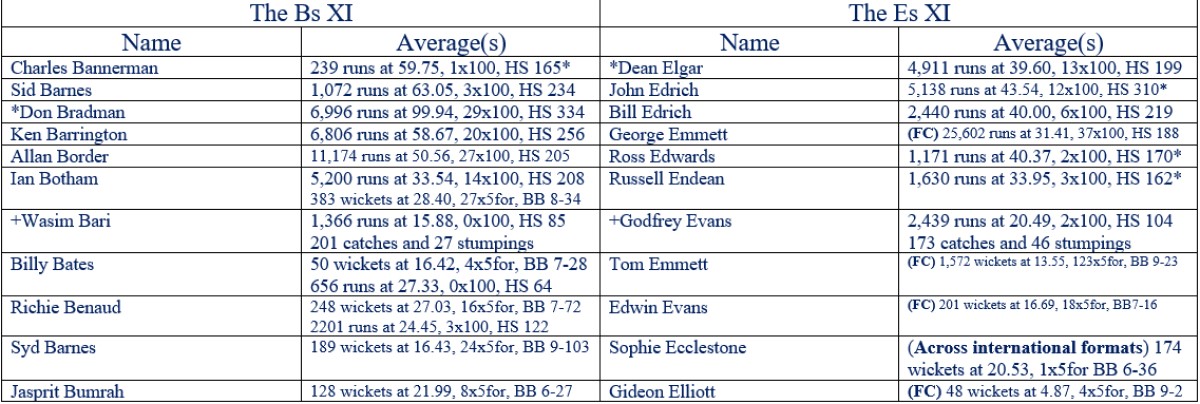
THE Bs V THE Es

The Bs have a huge advantage in batting, and Botham is definitely a better third pacer than Edrich, though Emmett and Elliott v Barnes and Bumrah is a fine contest, as is Ecclestone and Evans v Benaud and Bates in the spin bowling department. I make this one Bs 4, Es 1.

THE Bs V THE Fs

The Bs boss the batting as usual, though Foakes is the better keeper. The Fs have a greater range of bowling options, with six genuine front line bowlers. I accord them a definite win the pace department, with Ferris, Freeman and Foster clearly a stronger combo than Barnes, Bumrah and Botham. Flowers, Fender and Faulkner give the Fs three front line spin options. The question is whether the Fs extra bowling will compensate for the Bs huge superiority in batting. I don’t think it quite does, but I am not prepared to award the Bs victory here – Bs 2.5, Fs 2.5.

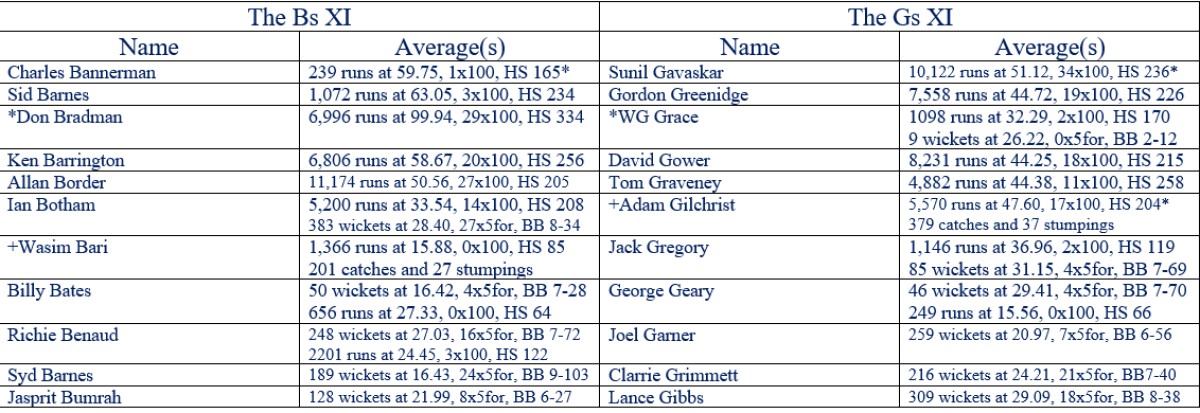
THE Bs V THE Gs

The Bs as usual are ahead on batting, but are clearly behind on bowling – WG is his side’s sixth best bowler. Grimmett and Gibbs are a good match for Bates and Benaud in the spin department, Gregory, Garner and Geary compare nicely with Barnes, Bumrah and Botham. I award this one to the Gs – Bs 2, Gs 3.

INTERIM REPORT ON THE Bs

The Bs are that this stage on 19.5 points out of 30, or 65%. The As were on a mere 14.5 points after their first six match ups, for comparison.

PHOTOGRAPHS

My usual sign off…

All Time XIs – The Letter B

The deciding ODI between England and India is intriguingly poised as I start this post picking the greatest XI of cricketers with surnames beginning with B (see the As). Elsewhere, Rory McIlroy is within sight of The Open Championship and five of the most unpleasant human beings anyone could conjure up are engaged in a battle to make Sauron look like one of the good guys as a way of securing the Conservative party leadership and with it the post of Prime Minister.

THE XI IN BATTING ORDER

  1. Charles Bannerman – Australia. The Kent born opener scored 165 in the first ever test match innings, and even with him scoring that many his team could only tally 245 all out. He also impressed in his native land during the heavily rain affected summer of 1878, though that tour did not feature a test match.
  2. Sidney George Barnes – Australia. A combination of WWII and continual skirmishes with the authorities limited his test career to 13 matches, but a batting average of 63 speaks for itself.
  3. *Donald Bradman – Australia. The most prolific batter the game has ever seen, his test average of 99.94 leaves a respectable career average (around 40) between him and the best of the rest at that level.
  4. Ken Barrington – Surrey and England. The Berkshire born right hander averaged 58 at test level, with a best of 256 at Old Trafford in 1964.
  5. Allan Border – Essex and Australia. The nuggety left hander pretty much was Australia’s resistance batting wise for about the first 10 years of his illustrious career. In the last few years of that great career, with Australia a good side, he played some excellent attacking innings. He would be the vice-captain of this side, as an acknowledgement of his status as the best skipper Australia have had in my lifetime.
  6. Ian Botham – Somerset, Worcesstershire, Durham and England. For a few years he was a genuinely great all rounder, for a few more after that he was a producer of occasionally devastating performances. England selectors of the period during and after his final decline spoiled many a promising career by trying to get decent young cricketers to fit into the Botham shaped hole opening in England’s ranks.
  7. +Wasim Bari – Pakistan. Pakistan’s best ever wicket keeper, and unlike some of his successors in that post there were never any questions asked about where his real loyalties were.
  8. Billy Bates – Yorkshire and England. His brief test career was ended by a freak eye injury sustained during net practice, but 656 runs at 27 and 50 wickets at 16 at that level are some testament to the off spinning all rounders capabilities. He took England’s first ever test hat trick, part of a match performance that yielded 55 in the only innings he had to play and seven wickets in each Australian innings.
  9. Richie Benaud – Australia. Before becoming ‘the Bradman of TV commentators’ (yes I believe he was that far clear of the best of the rest in that role) the Aussie leg spinning all rounder became the first to achieve the test career double of 2,000 runs and 200 wickets.
  10. Sydney Francis Barnes – England. Probably the most skilled bowler of any type ever to have played the game. Like his near namesake who is opening the batting for this XI he had a less than harmonious relationship with the authorities. He played little county cricket because he was paid better for being a professional for various clubs in the northern leagues. This meant that he played less than half of the test matches that England played between the start and end of his test career. Nonetheless, 189 wickets in 27 matches at 16.43 a piece is sufficient evidence of the trouble he caused even the best opponents.
  11. Jasprit Bumrah – India. He burst on the scene at the end of 2018, taking a cheap six-for in that year’s Boxing Day test in Melbourne. He is now established as one the finest contemporary pace bowlers, and is still young enough that he should still be improving. He would form a seriously potent new ball combination with Barnes (sorry Beefy, in this line up you don’t get the new ball).

This team has a heavy scoring top five, a colossus of an all rounder at six, a top drawer keeper, two bowlers who can bat and two of the greatest specialist bowlers. The bowling, with Barnes and Bumrah sharing the new ball, Botham as back up pacer and two contrasting spinners in Benaud and Bates is both strong and well balanced.

HONOURABLE MENTIONS

The team has no left arm orthodox spinner, and two who came very close were the Indians Bishan Singh Bedi and Palwankar Baloo. However, the only people I could have dropped to make way for one of them were Bates or Benaud, and that would have weakened the batting. Warren Bardsley (Australia), Bill Brown (Australia) and Jack Brown (Yorkshire, England) were three fine opening batters, any of whom might have been selected instead of Bannerman. Davud Boon suffered due being a regular number three – a position which for this particular letter is not open to debate! Jonny Bairstow missed out due to the extreme strength of batting available here and the fact that he has blown hot and cold (currently blazing hot) through his career. Two South Africans, Eddie Barlow and Colin Bland were very close to selection – the former missing out to Ian Botham and the latter to the general batting strength available, though he is of course designated fielding sub in the event of anyone having to leave the field. Bill Bowes was the best pace bowler to miss out and would certainly be in the tour party for this letter. West Indian speedsters Winston and Kenny Benjamin were also fine players, but no one is persuading me that they get in ahead of Barnes and Bumrah (or indeed Bowes). I also regretted not being able to accommodate Somerset and England’s Len Braund, resourceful batter, good leg spinner and brilliant slip fielder. West Indies batter Carlisle Best was ruled out for the same reason I had to rule out Keith Arthurton in the previous post – not enough substance to go with the style.

PHOTOGRAPHS

My usual sign off…

All Time XIs: Ultimate Talents

A look at a selection of record breaking and utterly unique cricketers by way of explaining the unanswerability of the question “who was the greatest ever cricketer”.

This post was provoked by a question I saw posted on twitter yesterday: who was the greatest cricketer of all time. This question is of course unanswerable and to explain why this is so I have assembled a touring party of 17 all of whom were about as good as players of their type can be. All of these players have attributes that mean that the claim that they stand alone in cricket history is unassailable, and I explain why in the course of my look at that them.

FIRST XI IN BATTING ORDER

  1. JB Hobbs – right handed opening batter, occasional right arm medium pacer. ‘The Master’, scorer of more FC runs and more FC centuries than anyone else in the history of the game.
  2. *WG Grace – right handed opening batter, right arm bowler of various types through his career. The most dominant player of any era, towering over his contemporaries both literally and metaphorically.
  3. DG Bradman – right handed batter, occasional leg spinner. A test batting average of 99.94, maintained over 52 matches at level needs no further comment.
  4. SR Tendulkar – right handed batter, occasional bowler. The only player to have scored 100 centuries across formats in international cricket.
  5. FE Woolley – left handed batter, left arm orthodox spinner. The only cricketer to tally over 10,000 FC runs, take over 1,000 wickets and hold over 1,000 catches in the course of a first class career.
  6. GS Sobers – left handed batter, left arm bowler of every type known to cricket. The most complete cricketer the game has ever seen.
  7. GH Hirst – right handed batter, left arm fast medium bowler. Achieved the feat of 1,000 runs and 100 wickets in first class matches in each of 10 successive seasons, including the only ever instance of 2,000 runs and 200 wickets in the same FC season.
  8. +RW Taylor – wicket keeper, right handed batter. The most wicket keeping dismissals (1,649 of them – 1,473 catches and 176 stumpings) of anyone in first class cricket history.
  9. W Rhodes – left arm orthodox spinner, right handed batter. More first class wickets than anyone else in the game’s history, even though there was a phase in his career when he hardly bowled. He also scored almost 40,000 runs in FC cricket.
  10. SF Barnes – right arm fast medium bowler, right handed batter. The best wickets per game ratio of anyone to play 20 or more tests – 189 in 27 matches, at 16.43 each = seven wickets per match. Generally regarded as the greatest of all bowlers.
  11. T Richardson – right arm fast bowler, right handed batter. The fastest to the career landmarks of 1,000 FC wickets (134 matches) and 2,000 (327 matches). From the start of the 1894 season to the end of the 1897 season he took just over 1,000 wickets, a period of wicket taking unique in cricket history.

This is a well balanced XI of awesome power. Now onto…

THE RESERVES

These are my six designated reserves:

  1. H Sutcliffe, right handed opening batter. My reserve opener was the ultimate big game player. His overall FC average was 52.02, his overall test average 60.73 and his overall Ashes average 66.85. As he himself once said to Pelham Warner “ah Mr Warner, I love a dogfight”.
  2. JH Kallis, right handed batter, right arm fast medium bowler. Has a fair claim to be regarded as the best batting all rounder ever to play the game. He didn’t master the full range of skills that Sobers did, hence his place as a reserve rather than in the starting XI.
  3. GA Faulkner, right handed batter, leg spinner. The only cricketer to have finished a career of over 20 test matches with a batting average of over 40 and a bowling average of less than 30.
  4. GL Jessop, right handed batter, right arm fast bowler. The most consistently fast scorer ever to play the game.
  5. +LEG Ames, right handed batter, wicket keeper. The only recognized keeper to have scored 100FC hundreds, also holds the record for most career stumpings in first class cricket – 418.
  6. GA Lohmann, right arm medium fast bowler, right handed batter. The man with the lowest career bowling average of anyone take 100 test wickets – 10.75.

CONCLUSIONS

This little collection of players fully illustrates why there is no definitive answer to the question I saw on twitter yesterday. I also missed the taker of 800 test wickets (Muralidaran), the only player to score 5,000 test runs and take 400 test wickets (Kapil Dev), the holder of the record test and first class individual scores (Lara), and quite a few others who have and deserve to have legions of fans. If forced to provide a single player as answer to this question I would consider WG Grace to be less far wrong than any other single answer.

PHOTOGRAPHS

My usual sign off…

XIs I Would Want To Watch

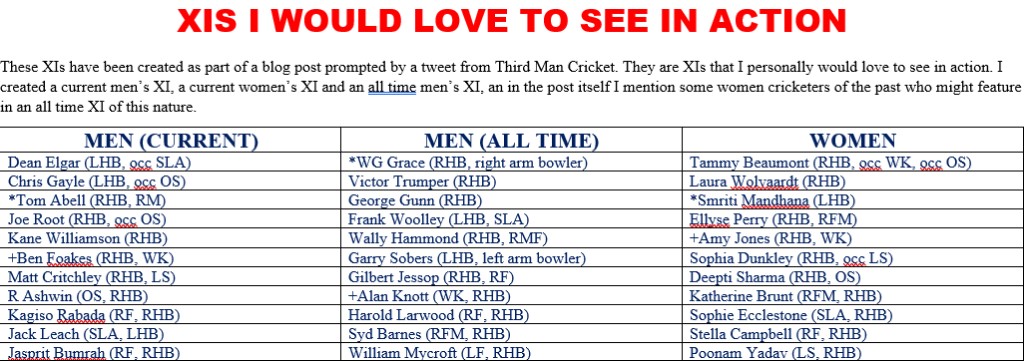
This post was inspired by a tweet from Third Man Cricket, which I reproduce below to set the scene:

https://platform.twitter.com/widgets.js

I shall be producing three XIs – a current men’s XI, an all time men’s XI and a current women’s XI. In the latter I will mention several names who would feature in an all time version.

MEN’S CURRENT XI

  1. Dean Elgar (left handed opening batter, occasional left arm orthodox spinner). The South African has established himself as one of the best long form openers around, and he is a natural counterpoint to the other opening batter.
  2. Chris Gayle (left handed opening batter, occasional off spinner). The greatest T20 batter the world has yet seen, he can also handle long form cricket, as evidenced by two test triple centuries.
  3. *Tom Abell (right handed batter, right arm medium pacer, captain). With Elgar and Gayle opening he would likely get to the middle somewhat later than he usually does for Somerset, for whom he plays. Until September when things went pear shaped both for him and for Somerset he was having a fantastic season, and I for one look forward to seeing him playing test cricket.
  4. Joe Root (right handed batter, occasional off spinner). Since the start of 2021 seven test centuries have been scored by England batters, and six of those stand to the credit of Joe Root.
  5. Kane Williamson (right handed batter). The Kiwi recently led his side to victory in the first ever World Test Championship final.
  6. +Ben Foakes (right handed batter, wicket keeper). The best keeper currently playing the game, and at no6, with a bit of ballast between him and the genuine tail enders he should fare well.
  7. Matt Critchley (right handed batter, leg spinner). His bowling is not necessarily going to feature (as you will see I have gone spin heavy). He has had an excellent season for Derbyshire and would certainly be in my Ashes tour party.
  8. R Ashwin (off spinner, right handed batter). The best off spinner currently playing the game, and as England learned in India recently a more than useful lower order batter.
  9. Kagiso Rabada (right arm fast bowler, right handed batter). One half of an explosive new ball pairing I have selected.
  10. Jack Leach (left arm orthodox spinner, left handed batter). England’s best current spinner, with 340 FC wickets at 26 a piece. His test record from 16 games reads 62 wickets at 29.98, very respectable. His next outing unless that tour gets cancelled will be in The Ashes later this year.
  11. Jasprit Bumrah (right arm fast, right handed batter). His spell on the final afternoon at The Oval broke England’s resistance in that match. He is also one of the select few visiting fast bowlers to have rattled the Australians in their own backyard.

This side has a strong batting line up, with everyone down to Ashwin at eight capable of major contributions, and has a splendid range of bowling options, though some my consider it light on seam/pace options, with Tom Abell the only bowler of that type other than the new ball pair. Ashwin and Leach should function well together as a spin duo, and although this is mainly about players I would want to see in action I would expect this combination to fare well against any opposition.

MEN’S ALL TIME

  1. *WG Grace (right handed opening batter, right arm bowler of various types through his career, captain). The founding father of cricket as we know it, his career figures are staggering – 54,896 first class runs, beaten only by Hobbs, Woolley, Hendren and Mead, and 2,876 wickets, beaten only by Rhodes, Freeman, Parker, Hearne and Tom Goddard. From hitting a then ground record 224 v Surrey at The Oval (maiden FC ton) to saving a Gentlemen vs Players match by scoring 74 on his 58th birthday, his great moments in FC cricket spanned 40 years.
  2. Victor Trumper (right handed opening batter). In the wet season of 1902 he had what was virtually a royal progress around England, amassing 2,570 runs in first class matches for the Australians, including 11 centuries. The highlight both of that season and of his career came in the fourth test match at Manchester, when reached his century before lunch on the first day. England hit back strongly, and at one stage in the final innings were 92-3, needing only a further 32 to complete victory, but a batting collapse saw them all out for 120 giving Austalia victory by three runs and with it The Ashes.
  3. George Gunn (right handed batter). One of cricket’s great eccentrics, he could do almost anything depending on his mood. He once gave his wicket away because he did not want to bat in the hot weather, and on another occasion he responded to being told that lunch was being taken later than usual by getting himself out so that he could eat at his regular time. He was would dance down the pitch against fast bowlers. Neville Cardus described him as “o rare George Gunn”. His brother William was an England regular and also the original Gunn of Gunn & Moore batmakers. Although she is also a native of Nottinghamshire as far as I am aware Jenny Gunn who has recently finished a long career for the England women’s team is unrelated to him.
  4. Frank Woolley (left handed batter, left arm orthodox spinner). The only player ever achieve the first class career treble of 10,000 runs, 1,000 wickets and 1,000 catches. He scored his runs at a tremendous rate, and must have been incredible to watch in action.
  5. Wally Hammond (right handed batter, right arm medium fast bowler). His chief glory was his cover drive, rated by Don Bradman as the greatest example of that shot the he ever saw (and Bradman as well as being the best batter ever to play the game saw almost every great player of the 20th century).
  6. Garry Sobers (left handed batter, left arm bowler of every type known to cricket). The most complete player the game has ever known, and surely one of the most watchable as well.
  7. Gilbert Jessop (right handed batter, right arm fast bowler). The fastest scorer the game has ever seen, a fine bowler (it was actually in this capacity that he was first selected for England) and a gun fielder.
  8. +Alan Knott (wicket keeper, right handed batter). One of the greatest ever exponents of the keepers art and a more than useful lower middle order batter, noted for his ability to improvise long before that was a major thing in cricket.
  9. Harold Larwood (right arm fast bowler, right handed batter). One of three English fast bowlers to have blitzed the Aussies on their own pitches, along with Tyson in 1954-5 and Snow in 1970-1. In the final match of the 1932-3 Ashes, what turned out to be his last ever test appearance, he scored 98 as nightwatch. On his previous tour of Australia in 1928-9 he had scored 70 from no9 in the first test match.
  10. Syd Barnes (right arm fast medium bowler, right handed batter). 189 wickets from just 27 matches, an average of seven wickets per game, and they cost him only 16.43 a piece. His great weapon was a leg break, delivered at fast medium pace. The only bowler other than him to master a delivery of this type was Alec Bedser.
  11. William Mycroft (left arm fast bowler, right handed batter). The only non-test player in the XI, but over 800 FC wickets at 12 a piece. In 1876 he became the first player ever to take 17 wickets in a first class match, for Derbyshire against Hampshire, but Hampshire sneaked home by one wicket.

This side is fantastically equipped in all departments, and would fare well against most combinations.

WOMEN’S CURRENT XI

  1. Tammy Beaumont (right handed batter, occasional wicket keeper, occasional off spinner). The diminutive opener demonstrated her enduring class with a superb century against New Zealand at her home ground of Canterbury in the last international fixture of the 2021 season. Her innings laid the foundation for a late onslaught from Danni Wyatt and Sophia Dunkley that propelled England to 347-5 from 50 overs, a total that NZ never looked like chasing.
  2. Laura Wolvaardt (right handed batter). The South African has not yet played test cricket (the women don’t get to play nearly enough of that format) but all indications, including the fact the she is much better in ODIs than in T20Is are that she would be at home in that format.
  3. *Smriti Mandhana (left handed batter, captain). The stylish Indian has just burnished an already hugely impressive record by scoring a test century against Australia in Australia, at Carrara.
  4. Ellyse Perry (right handed batter, right arm fast medium bowler). The best all rounder of either sex currently playing the game. If she learns to bowl spin (both off and leg spin would be required) she would rival Sobers for the title of the most complete cricketer of them all.
  5. +Amy Jones (right handed batter, wicket keeper). A brilliant wicket keeper and a fine attacking batter.
  6. Sophia Dunkley (right handed batter, occasional leg spinner). She has rapidly established herself as an England regular.
  7. Deepti Sharma (left handed batter, off spinner). The Indian all rounder helped to build on the platform that Mandhana’s innings referred to above gave India in Carrara, scoring 59 of her own.
  8. Katherine Brunt (right arm fast medium, right handed batter). The veteran from Barnsley remains a formidable bowler, has developed her batting to the point of being not far short of a genuine all rounder, and is always hugely entertaining.
  9. Sophie Ecclestone (left arm orthodox spinner, right handed batter). She takes her international wickets at 20 each and at the age of 22 is the best finger spinner currently playing women’s cricket.
  10. Stella Campbell (right arm fast, right handed batter). The tall (1.86 metres = 6′ 1″ in old money) Aussie teenager is a perfect contrast to the much shorter Brunt. She is also significantly quicker than the Yorkshirewoman, as the tweet below from Hypocaust shows:

https://platform.twitter.com/widgets.js

11. Poonam Yadav (leg spinner, right handed batter). From the tallest member of the side, and its fastest bowler, to the shortest and its slowest bowler. She tosses the ball so high that one sometimes wonders whether air traffic control towers pick up tiny white dots on their radar screens when she is bowling. The method is undoubtedly effective for her – she has a magnificent record.

This side features a strong batting line up and a beautifully balance bowling unit, with Campbell, Brunt and Perry to bowl pace and the trio of Yadav, Ecclestone and Sharma providing three very different spin options.

I have chosen not to an all-time women’s XI, but the following players not named above would all be ones I would want to accommodate somehow: Charlotte Edwards (right handed opening batter), Enid Bakewell (right handed batter, left arm orthodox spinner), Carole Hodges (right handed batter, off spinner), Karen Rolton (right handed batter), Sarah Taylor (right handed batter, wicket keeper) and Cathryn Fitzpatrick (right arm fast bowler, right handed batter)

PHOTOGRAPHS

My usual sign off…