The Rachael Heyhoe-Flint Trophy Final

An account of the Rachael Heyhoe-Flint Trophy final which took place yesterday between Blaze and Vipers. Also a large photo gallery.

Yesterday saw the final of the Rachael Heyhoe-Flint Trophy, between Vipers, in their fourth final out of four (2 won, one lost going into yesterday) and the newly formed Blaze (a move from Loughborough to Nottingham and a name change). Vipers won the toss, and with cloud cover around which was expected to dissipate later in the day they decided to out Blaze into bat. Blaze skipper Kirstie Gordon claimed in response that she would have chosen to bat first anyway but my own suspicion is that not even she actually believed that, never mind anyone else.

Batting was as difficult in the early stages as had been expected, and only the efforts of veteran opener Tammy Beaumont who fought her way to 76 before getting out trying to up the scoring rate at the death prevented Blaze fron sinking without trace. As it was only two other batters, both lower order players, topped 20 for the Blaze (extras, assisted by some indiscipline on the part of the Vipers bowlers, also did so). A late flurry took Blaze to exactly 200 from their rain-reduced 48 overs. Left arm spinner Linsey Smith was the pcik of the bowlers with 3-30 from her 10 overs.

The Vipers lost two very early wickets, before two Georgias, Adams and Elwiss, put on 96 together for the third wicket. Then young leg spinner Josie Groves claimed both set batters and Charlie Dean to reduce Vipers to 109-5. That brought Freya Kemp in to join Emily Windsor with 92 still required. Windsor and Kemp batted superbly, first averting the danger of a collapse, and then as the got settled in mounting an assault on a target that had never got remotely challenging in terms of required run rate. Windsor completed a fine half century, and then, living up to her billing

as ‘the finisher’ she made the winning hit, her ninth boundary in a final score of 57*. Kemp, busy but never flustered at the crease, had scored 32* (35) at the other end. Vipers were home by five wickets with 7.4 overs to spare, a comfortable victory, and yet another trophy as coach for Charlotte Edwards, whose second cricketing career is showing signs of outshining even her amazing playing career. This was Edwards’ third domestic trophy of 2023 alone, since she had coached Vipers to success and in the competition that bears her own name and had also been coach of the team that won The Hundred. The “keepers must be top line batters” brigade would do well to note that this trophy was lifted a team whose keeper, Rhianna Southby, was not required to bat, and who was officially scheduled to come in at number nine (she was impeccable behind the stumps for the record).

My usual sign off…

Beaumont Batting Beautifully

A look at developments in the Women’s Ashes test match and a large photo gallery.

Battle continues to rage in the Women’s Ashes test at Trent Bridge. This time yesterday I wrote about had happened up to that time (here), and now I continue the story.

THE REST OF YESTERDAY

England reached the close of yesterday on 218-2, Beaumont completing her century just before the close of play. It was a wonderful innings, and it was also historic: she became only the fourth English batter ever to score centuries in all three international formats, joining Heather Knight, Jos Buttler and Dawid Malan in this club.

TODAY SO FAR

Natalie Sciver-Brunt was England’s only casualty of the morning session, falling for 78. By lunch England were 308-3 with Beaumont 144 not out. Dunkley fell not long after the resumption, which brought Danni Wyatt to the crease for her test debut, 13 years after her white ball debut. On 152 Beaumont was given LBW, but a review showed the ball pitching outside leg stump. She is now on 164, with England 344-4. The next landmark is 168, her highest score in any form of international cricket, then Betty Snowball’s 189, the all time England record individual score, then the 201 she scored in the warm up match, then Perry’s 213* and finally if she can get there Amelia Kerr’s 232* for New Zealand v Ireland, the highest score in any form of women’s international cricket (and I think even Ms Kerr might concede that the Aussie bowling attack is a trifle more formidable than that of the emerald isle).

PHOTOGRAPHS

I have a splendid gallery for you…

While I have been preparing this post for publication England have moved past 350, and Beaumont on to 169.

Channel Islands 5: A Cricketing Journey to Alderney

Journeying through cricket history and from King’s Lynn to Alderney in honour of John Arlott.

Having reached Alderney in my account of my recent holiday it is now time for a special post in honour of John Arlott, the legendary cricket commentator, who lived his last years on the island. We will travel through considerable space and time in the course this journey.

STOP ONE: CAMBRIDGE

Cambridge, which my route from King’s Lynn to Portsmouth passed through, was the birthplace of Jack Hobbs, ‘The Master’. It also provides a specialist spinner for the XI since after his falling out with Yorkshire, which ended his first class career, Johnny Wardle played minor counties cricket for Cambrigeshire.

STOP TWO: VAUXHALL

The train from Waterloo to Portsmouth passes through but does not stop at Vauxhall, which overlooks The Oval, home of Surrey County Cricket Club. It is not my purpose to pick an time Surrey XI here (I did that a while back) so I am not actually using this location to pick any players – I am merely noting it.

STOPS 3,4 AND 5: SURBITON, WOKING, GUILDFORD

As with Vauxhall the train passes through Surbiton. Surbiton is not in itself of major relevance, but a line branches off here to Thames Ditton and Hampton Court, and at one time of his life the legendary fast bowler Tom Richardson had a home in Thames Ditton.

Woking, the first stop on the London-Portsmouth route, was home for many years to the Bedser twins, Alec (right arm fast medium, useful lower order batter) and Eric (right handed batter, off spinner).

Guildford, also a scheduled stop on the route, is home to the earliest verifiable reference to the great game of cricket. Testimony regarding the usage of a piece of land, made in 1598 and referring to the childhood of the man testifying, tells us that some form of cricket was being played in Guildford by the 1550s. Surrey still play the odd match at Guildford and one of the more recent of those games featured Kevin Pietersen scoring a double century in the course of which he hit a number of balls into the river Wey which flows past the ground.

STOPS 6-7: GODALMING AND PETERSFIELD

Godalming is home to Charterhouse School, where George Geary (Leics and England) was cricket coach for a time and one of his charges was Peter May. More recently Martin Bicknell (Surrey and England) has been director of cricket there.

Petersfield has a connection that dates to much earlier in cricket’s history: John Small, one of Hambledon’s finest batters in that clubs glory days of the late 18th century, lived there. According to John Nyren in “Cricketers of My Time” Small was a keen skater and enjoyed skating on the surface of Petersfield Pond when that body of water froze over in the winter.

STOP 8: PORTSMOUTH

Portsmouth was one of Hampshire’s out grounds when such were regularly used. In 1899 Major Robert Poore smashed Somerset for twin tons there, and then confirmed his liking for west country bowling by scoring a career best 304 in the return match at Taunton (when another army officer, Captain Teddy Wynyard, scored 225, in a sixth wicket stand of 411).

STOP 9: GUERNSEY

Guernsey has not to my knowledge produced any significant cricketers, though it has produced a couple of well known sportspeople: tennis player Heather Watson, at one time British number one, and footballer Matt Le Tissier who played for Southampton for many years. However it did indirectly give me a squad member, because it was there that I consumed bottle of ginger beer whose place of origin was significant:

Bundaberg, where this variety of ginger beer comes from, was the birthplace of Don Tallon, Australian keeper batter named by Bradman as keeper in his all time XI and considered by many of his contemporaries to have been the best ever in that role.

THE TERMINUS: BRAYE ROAD, ALDERNEY

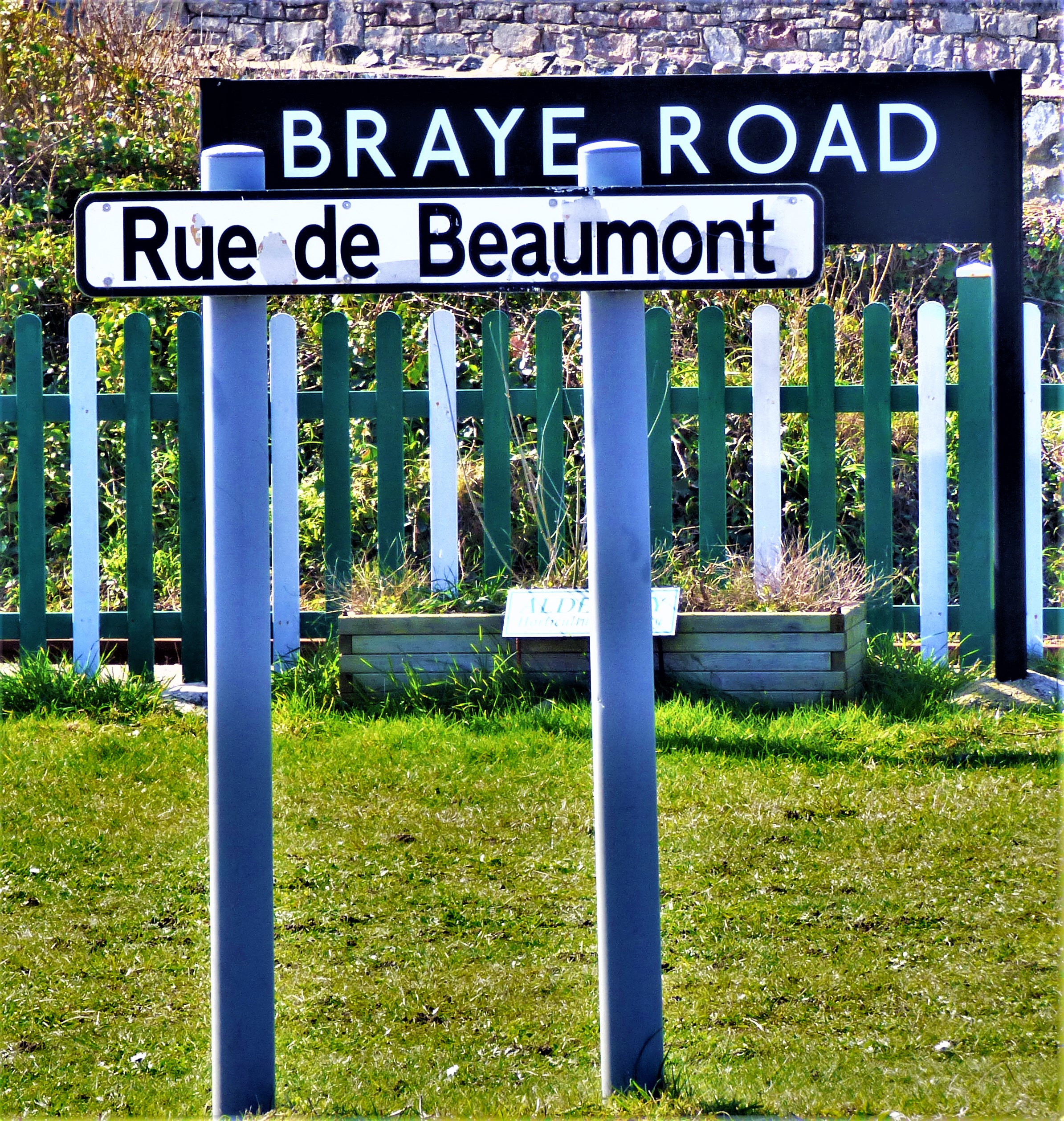
Braye Road is one terminus of the Alderney Railway, once a genuine commercial railway transporting stone from a quarry, now a heritage railway using carriages of 1938 tube stock (I was not able to travel it being there too early in the year for it to be open). It also gave me, by way of a piece of lateral thinking, a final player for my cricket journey:

The cricket significance of this picture lies in the name of the road rather than that of the station: it provides a tenuous link to opening batter Tammy Beaumont.

SELECTING OUR XI

In terms of the players I have linked to specific locations we have:

Jack Hobbs, Johnny Wardle (Cambridge), Tom Richardson (Surbiton/ Thames Ditton), Alec and Eric Bedser (Woking), Kevin Pietersen (Guildford), Peter May, George Geary, Martin Bicknell (Godalming), John Small (Petersfield), Major Robert Poore (Portsmouth), Don Tallon (Guernsey, by subterfuge), Tammy Beaumont (Alderney, by cunning use of a street sign). These are 13 players, from whom 11 must be selected. My XI in batting order is:

  1. Jack Hobbs
  2. Tammy Beaumont
  3. John Small
  4. Peter May
  5. Kevin Pietersen
  6. Eric Bedser
  7. +Don Tallon
  8. George Geary
  9. Alec Bedser
  10. *Johnny Wardle
  11. Tom Richardson

This XI is well balanced, with good batting depth. The bowling has a genuine speedster in Richardson, two high quality fast medium/ medium fast bowlers in Geary and A Bedser, a great left arm spinner in Wardle and off spin back up from E Bedser, with Hobbs’ medium pace as sixth bowling option. I end this post with a view of Fort Clonque:

XIs I Would Want To Watch

This post was inspired by a tweet from Third Man Cricket, which I reproduce below to set the scene:

https://platform.twitter.com/widgets.js

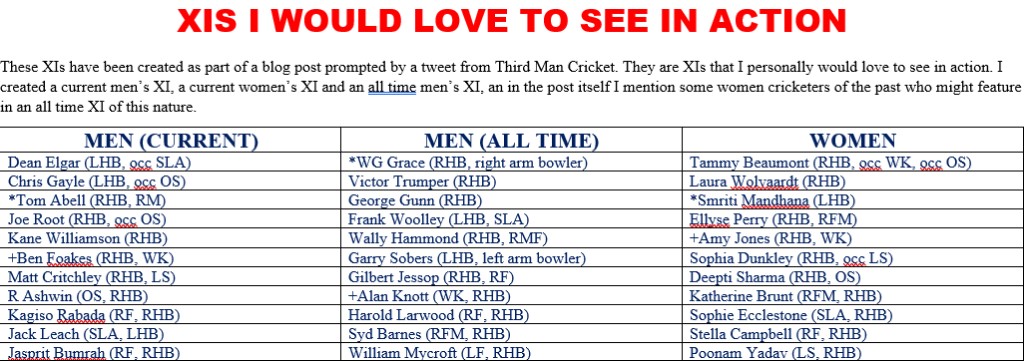
I shall be producing three XIs – a current men’s XI, an all time men’s XI and a current women’s XI. In the latter I will mention several names who would feature in an all time version.

MEN’S CURRENT XI

  1. Dean Elgar (left handed opening batter, occasional left arm orthodox spinner). The South African has established himself as one of the best long form openers around, and he is a natural counterpoint to the other opening batter.
  2. Chris Gayle (left handed opening batter, occasional off spinner). The greatest T20 batter the world has yet seen, he can also handle long form cricket, as evidenced by two test triple centuries.
  3. *Tom Abell (right handed batter, right arm medium pacer, captain). With Elgar and Gayle opening he would likely get to the middle somewhat later than he usually does for Somerset, for whom he plays. Until September when things went pear shaped both for him and for Somerset he was having a fantastic season, and I for one look forward to seeing him playing test cricket.
  4. Joe Root (right handed batter, occasional off spinner). Since the start of 2021 seven test centuries have been scored by England batters, and six of those stand to the credit of Joe Root.
  5. Kane Williamson (right handed batter). The Kiwi recently led his side to victory in the first ever World Test Championship final.
  6. +Ben Foakes (right handed batter, wicket keeper). The best keeper currently playing the game, and at no6, with a bit of ballast between him and the genuine tail enders he should fare well.
  7. Matt Critchley (right handed batter, leg spinner). His bowling is not necessarily going to feature (as you will see I have gone spin heavy). He has had an excellent season for Derbyshire and would certainly be in my Ashes tour party.
  8. R Ashwin (off spinner, right handed batter). The best off spinner currently playing the game, and as England learned in India recently a more than useful lower order batter.
  9. Kagiso Rabada (right arm fast bowler, right handed batter). One half of an explosive new ball pairing I have selected.
  10. Jack Leach (left arm orthodox spinner, left handed batter). England’s best current spinner, with 340 FC wickets at 26 a piece. His test record from 16 games reads 62 wickets at 29.98, very respectable. His next outing unless that tour gets cancelled will be in The Ashes later this year.
  11. Jasprit Bumrah (right arm fast, right handed batter). His spell on the final afternoon at The Oval broke England’s resistance in that match. He is also one of the select few visiting fast bowlers to have rattled the Australians in their own backyard.

This side has a strong batting line up, with everyone down to Ashwin at eight capable of major contributions, and has a splendid range of bowling options, though some my consider it light on seam/pace options, with Tom Abell the only bowler of that type other than the new ball pair. Ashwin and Leach should function well together as a spin duo, and although this is mainly about players I would want to see in action I would expect this combination to fare well against any opposition.

MEN’S ALL TIME

  1. *WG Grace (right handed opening batter, right arm bowler of various types through his career, captain). The founding father of cricket as we know it, his career figures are staggering – 54,896 first class runs, beaten only by Hobbs, Woolley, Hendren and Mead, and 2,876 wickets, beaten only by Rhodes, Freeman, Parker, Hearne and Tom Goddard. From hitting a then ground record 224 v Surrey at The Oval (maiden FC ton) to saving a Gentlemen vs Players match by scoring 74 on his 58th birthday, his great moments in FC cricket spanned 40 years.
  2. Victor Trumper (right handed opening batter). In the wet season of 1902 he had what was virtually a royal progress around England, amassing 2,570 runs in first class matches for the Australians, including 11 centuries. The highlight both of that season and of his career came in the fourth test match at Manchester, when reached his century before lunch on the first day. England hit back strongly, and at one stage in the final innings were 92-3, needing only a further 32 to complete victory, but a batting collapse saw them all out for 120 giving Austalia victory by three runs and with it The Ashes.
  3. George Gunn (right handed batter). One of cricket’s great eccentrics, he could do almost anything depending on his mood. He once gave his wicket away because he did not want to bat in the hot weather, and on another occasion he responded to being told that lunch was being taken later than usual by getting himself out so that he could eat at his regular time. He was would dance down the pitch against fast bowlers. Neville Cardus described him as “o rare George Gunn”. His brother William was an England regular and also the original Gunn of Gunn & Moore batmakers. Although she is also a native of Nottinghamshire as far as I am aware Jenny Gunn who has recently finished a long career for the England women’s team is unrelated to him.
  4. Frank Woolley (left handed batter, left arm orthodox spinner). The only player ever achieve the first class career treble of 10,000 runs, 1,000 wickets and 1,000 catches. He scored his runs at a tremendous rate, and must have been incredible to watch in action.
  5. Wally Hammond (right handed batter, right arm medium fast bowler). His chief glory was his cover drive, rated by Don Bradman as the greatest example of that shot the he ever saw (and Bradman as well as being the best batter ever to play the game saw almost every great player of the 20th century).
  6. Garry Sobers (left handed batter, left arm bowler of every type known to cricket). The most complete player the game has ever known, and surely one of the most watchable as well.
  7. Gilbert Jessop (right handed batter, right arm fast bowler). The fastest scorer the game has ever seen, a fine bowler (it was actually in this capacity that he was first selected for England) and a gun fielder.
  8. +Alan Knott (wicket keeper, right handed batter). One of the greatest ever exponents of the keepers art and a more than useful lower middle order batter, noted for his ability to improvise long before that was a major thing in cricket.
  9. Harold Larwood (right arm fast bowler, right handed batter). One of three English fast bowlers to have blitzed the Aussies on their own pitches, along with Tyson in 1954-5 and Snow in 1970-1. In the final match of the 1932-3 Ashes, what turned out to be his last ever test appearance, he scored 98 as nightwatch. On his previous tour of Australia in 1928-9 he had scored 70 from no9 in the first test match.
  10. Syd Barnes (right arm fast medium bowler, right handed batter). 189 wickets from just 27 matches, an average of seven wickets per game, and they cost him only 16.43 a piece. His great weapon was a leg break, delivered at fast medium pace. The only bowler other than him to master a delivery of this type was Alec Bedser.
  11. William Mycroft (left arm fast bowler, right handed batter). The only non-test player in the XI, but over 800 FC wickets at 12 a piece. In 1876 he became the first player ever to take 17 wickets in a first class match, for Derbyshire against Hampshire, but Hampshire sneaked home by one wicket.

This side is fantastically equipped in all departments, and would fare well against most combinations.

WOMEN’S CURRENT XI

  1. Tammy Beaumont (right handed batter, occasional wicket keeper, occasional off spinner). The diminutive opener demonstrated her enduring class with a superb century against New Zealand at her home ground of Canterbury in the last international fixture of the 2021 season. Her innings laid the foundation for a late onslaught from Danni Wyatt and Sophia Dunkley that propelled England to 347-5 from 50 overs, a total that NZ never looked like chasing.
  2. Laura Wolvaardt (right handed batter). The South African has not yet played test cricket (the women don’t get to play nearly enough of that format) but all indications, including the fact the she is much better in ODIs than in T20Is are that she would be at home in that format.
  3. *Smriti Mandhana (left handed batter, captain). The stylish Indian has just burnished an already hugely impressive record by scoring a test century against Australia in Australia, at Carrara.
  4. Ellyse Perry (right handed batter, right arm fast medium bowler). The best all rounder of either sex currently playing the game. If she learns to bowl spin (both off and leg spin would be required) she would rival Sobers for the title of the most complete cricketer of them all.
  5. +Amy Jones (right handed batter, wicket keeper). A brilliant wicket keeper and a fine attacking batter.
  6. Sophia Dunkley (right handed batter, occasional leg spinner). She has rapidly established herself as an England regular.
  7. Deepti Sharma (left handed batter, off spinner). The Indian all rounder helped to build on the platform that Mandhana’s innings referred to above gave India in Carrara, scoring 59 of her own.
  8. Katherine Brunt (right arm fast medium, right handed batter). The veteran from Barnsley remains a formidable bowler, has developed her batting to the point of being not far short of a genuine all rounder, and is always hugely entertaining.
  9. Sophie Ecclestone (left arm orthodox spinner, right handed batter). She takes her international wickets at 20 each and at the age of 22 is the best finger spinner currently playing women’s cricket.
  10. Stella Campbell (right arm fast, right handed batter). The tall (1.86 metres = 6′ 1″ in old money) Aussie teenager is a perfect contrast to the much shorter Brunt. She is also significantly quicker than the Yorkshirewoman, as the tweet below from Hypocaust shows:

https://platform.twitter.com/widgets.js

11. Poonam Yadav (leg spinner, right handed batter). From the tallest member of the side, and its fastest bowler, to the shortest and its slowest bowler. She tosses the ball so high that one sometimes wonders whether air traffic control towers pick up tiny white dots on their radar screens when she is bowling. The method is undoubtedly effective for her – she has a magnificent record.

This side features a strong batting line up and a beautifully balance bowling unit, with Campbell, Brunt and Perry to bowl pace and the trio of Yadav, Ecclestone and Sharma providing three very different spin options.

I have chosen not to an all-time women’s XI, but the following players not named above would all be ones I would want to accommodate somehow: Charlotte Edwards (right handed opening batter), Enid Bakewell (right handed batter, left arm orthodox spinner), Carole Hodges (right handed batter, off spinner), Karen Rolton (right handed batter), Sarah Taylor (right handed batter, wicket keeper) and Cathryn Fitzpatrick (right arm fast bowler, right handed batter)

PHOTOGRAPHS

My usual sign off…

Tammy Beaumont Turns 30

A post put together for England ace Tammy Beaumont’s 30th birthday.

Today is England Women’s cricketer Tammy Beaumont’s 30th birthday. I celebrate the day by drawing your attention to some of my previous writings about one of my favourite current cricketers.

A RADICAL SOLUTION TO ENGLAND’S OPENING WOES

This blog’s first mention of Tammy Beaumont was in August 2018 when Cook was nearing retirement and Keaton Jennings was proving not to be up to the task. I had noted that Beaumont had been scoring well for some time in international cricket, and that other than Rory Burns no one was making a really convincing case for themselves. I still think England would have been well advised to try out my suggestion. The post can be viewed here, with the featured image from it reproduced below:

Beaumont on the attack

THE OPENING POST OF THE 100 CRICKETERS SERIES

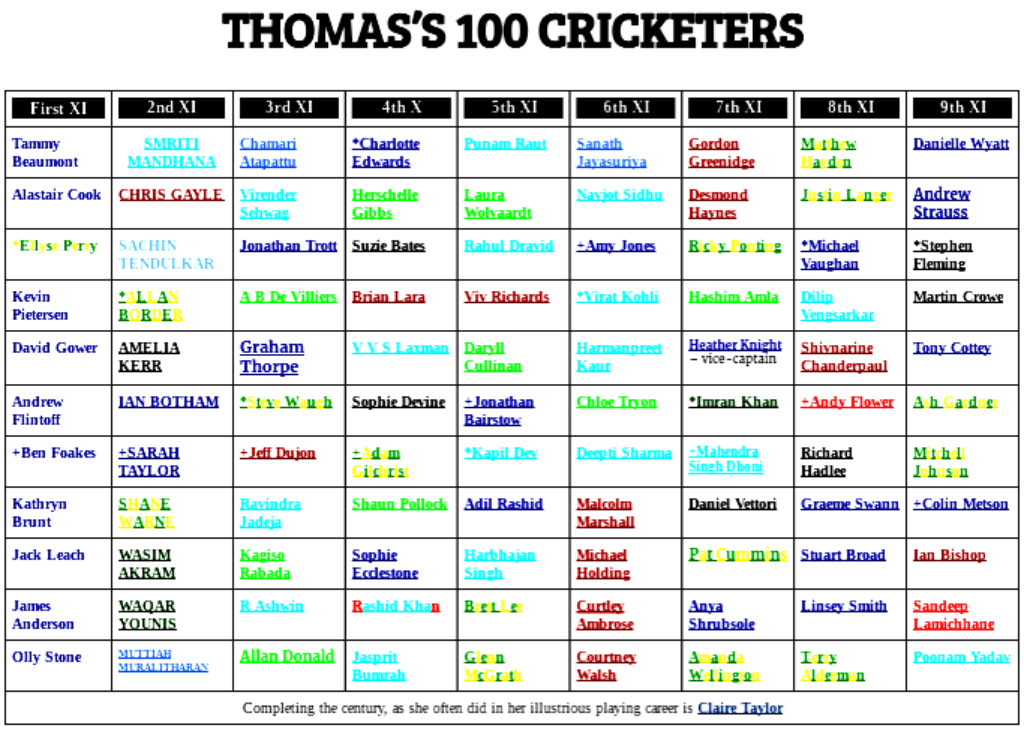
When I produced my ‘100 Cricketers’ series in 2019, I started with a post dedicated to Tammy Beaumont (the series also concluded with a standalone post dedicated to a female cricketer, Claire Taylor). This post can be viewed here. An overview of the entire series with links to all posts can be seen by visiting this page. I reproduce the complete list of those involved below.

TAMMY BEAUMONT
IN ALL TIME XIS

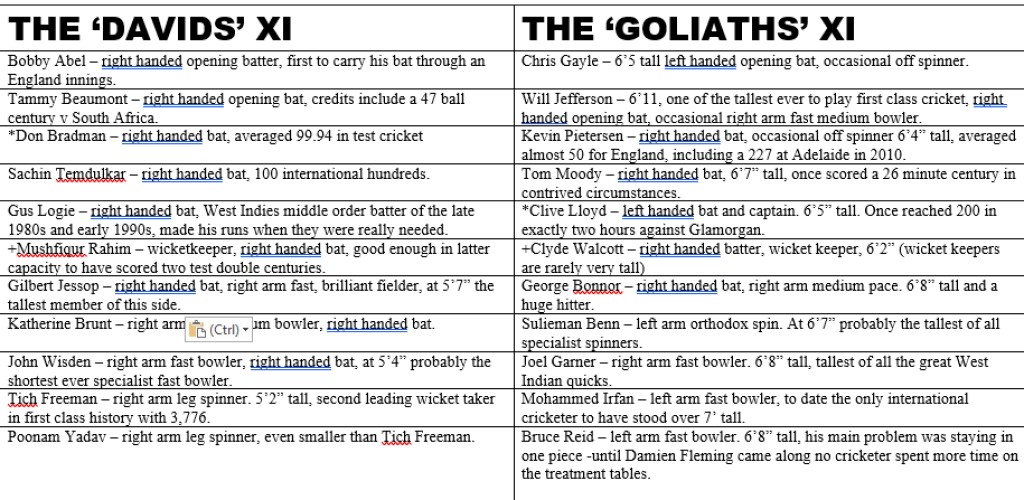
During the first lockdown I produced a series of All Time XI themed posts which you can view by clicking here. The first of these to feature Tammy Beaumont was a contest in which an XI of Goliaths took on an XI of Davids. It can be seen here, with the feature image reproduced below.

A 47 BALL CENTURY

I first included this in a post last year “The Cognominal Clash” after it was drawn to my attention by the Pinch Hitter:

TAMMY BEAUMONT
ON CRICINFO

Full details of Tammy Beaumont’s career can be found on cricinfo. Her profile can be viewed by clicking here. I have reproduced part of it below.

PHOTOGRAPHS

Time for my usual sign off…

All Time XIs: A Women’s XI For International Women’s Day

An international women’s day special, selecting an XI of the finest contemporary female cricketers, with a couple of extra features.

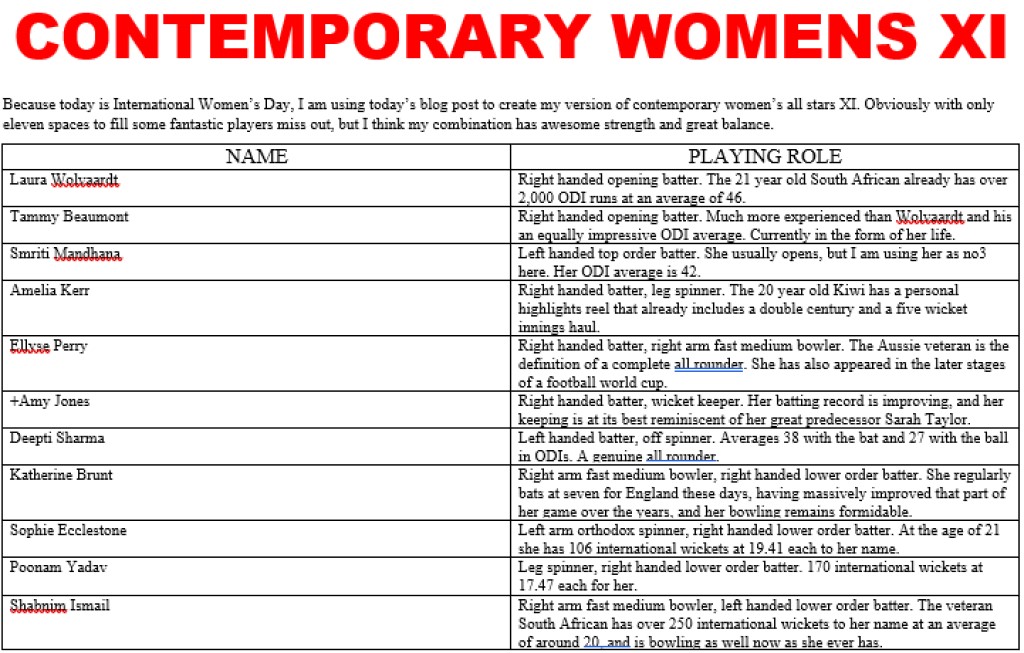
Today is International Women’s Day, and as a cricket fanatic I am commemorating it by selecting an XI comprising the finest talents from contemporary women’s cricket.

THE XI IN BATTING ORDER

  1. Laura Wolvaardt – right handed opening batter. The 21 year old South African already has over 2,000 ODI runs at an average of 46. She forms one half of an opening partnership that blends youth and experience and could confidently be expected to function superbly. A career best 149 and one other hundred indicate that she can go big.
  2. Tammy Beaumont – right handed opening batter. Just a few days short of her 30th birthday, the experienced England opener is in the form of her life at the moment, reflected by her status as the no1 ODI batter in women’s cricket. She averages a run per innings less than Wolvaardt, but has played rather more. Seven centuries in ODIs confirm her ability to go on and get big runs.
  3. Smriti Mandhana – left handed top order batter. She normally opens for India, but should also go well at number three. An ODI average of 42, including four centuries at that level indicates a player of high class, and she is also one of the most aesthetically pleasing of all international batters, especially when driving through the covers.
  4. Amelia Kerr – right handed batter, leg spinner. At the age of 20 she has a personal highlights reel at international level that includes a double century and a five wicket haul. In the one victory New Zealand recorded over England in their recent series she starred with 72 and four wickets.
  5. Ellyse Perry – right handed batter, right arm fast medium bowler. The 30 year old Aussie is the most complete all rounder in the game. Her eight test appearances have yielded her a batting average of 78 and a bowling average of 18, in 112 ODIs she averages 52 with the bat and 24 with the ball, while in 120 T20Is she averages 28 with the bat and 19 with the ball. She has also found time to feature in the later stages of a football world cup along the way – she is an all rounder in more than one sense!
  6. +Amy Jones – right handed batter, keeper. Her batting is improving, and her keeping at its best can be reminiscent of great predecessor in the role, Sarah Taylor.
  7. Deepti Sharma – left handed batter, off spinner. She averages 38 with the bat and 27 with the ball in ODIs.
  8. Katherine Brunt – right arm fast medium bowler, right handed lower order batter. She regularly bats seven for England, having massively improved that area of her game over the years, but it is her bowling that makes her worth her place.
  9. Sophie Ecclestone – left arm orthodox spinner, right handed lower order batter. 106 international wickets at less than 20 each and she is still only 21. For more detail on her please visit Inside Edge Cricket’s post on her produced specially for today as this post is, by clicking here.
  10. Poonam Yadav – leg spinner, right handed lower order batter. A complete contrast to her predecessor in the order, who is very tall, the leggie is the smallest member of the XI, and bowls very slow, high tossed spinners. She has many remarkable spells to her credit, perhaps the most outstanding being against Australia in a world T20 cup match, when the latter were seemingly cruising to victory when she was brought on and nailed on for defeat by the time she had bowled her four overs.
  11. Shabnim Ismail – right arm fast medium, left handed lower order batter. The veteran South African is bowling as well now as she ever as and will be an excellent new ball partner for Brunt. She had a superb tournament in the most recent running of the Women’s Big Bash League.

This team comprises a stellar top five, two of whom are genuine all rounders, a splendid keeper/batter at six, a genuine all rounder at seven, a top quality bowling all rounder at eight and three superb specialist bowlers. Brunt and Ismail with the new ball, Perry as third seamer if needed and spin quartet of Ecclestone, Yadav, Sharma and Kerr provides a bowling attack that should be comfortably able to meet all eventualities. Below is the team in infographic form:

LINK AND PHOTOGRAPHS

Just the one link before my usual sign off, a tweet which fits the international women’s day theme – it is a list of rape prevention tips, which rather than being the usual victim-blaming c**p such things usually are actually addresses those who need to be told – the men. It was posted by Theresa Drennan, and can be viewed it’s original niche by clicking here.

Now it is time for my latest photographs…

England Women Dominate T20 Opener in New Zealand

England came into the T20 series having won the ODI series very impressively, and further boosted by the news that Tammy Beaumont’s magnificent series had seen her rise to the top of the Women’s ODI batting rankings.

A MAGNIFICENT TEAM BOWLING PERFORMANCE

England bowled first, and a magnificent bowling performance it was too. Brunt, Sciver, Ecclestone and Glenn each took two wickets, Mady Villiers 1. Glenn went for just 11 from her full four overs, Ecclestone 18 from the same, and Brunt who got the final scalp with the fourth ball of her final over had gone for just 13 as. Freya Davies bowled one over for three runs. Villiers had 1-16 from three overs. Only Sciver who conceded 28 was somewhat expensive. The fielding was of a standard to match the bowling. New Zealand were all out for 96, with only wicket keeper Katey Martin (36) having any real success with the bat.

AN EFFICIENT CHASE

Danni Wyatt who had had a thin time in the ODI series, Tammy Beaumont, Natalie Sciver and Amy Jones all made positive contributions, with only skipper Knight failing, as England made light work of the chase, winning by seven wickets with four overs to spare. Jones had earlier shown that she had learned a good deal from her time as Sarah Taylor’s understudy by pulling off a super smart stumping in the Kiwi innings. A full scorecard of the match can be viewed here, while a highlights package is available on the following link: https://www.ecb.co.uk/video/2051616/highlights-england-cruise-to-victory-in-series-opener-new-zealand-v-england-first-it20?tagNames=England-highlights&utm_source=TWITTER&utm_medium=englandcricket&utm_content=100001880092520%2B&utm_campaign=England+women+in+NZ

Tomorrow is an early start for serious cricket fans living in the UK as live coverage of the final test of the India v England series commences at 3:45AM, with an early opening of a cricinfo tab to check for advance news highly recommended. The below image shows my preparation:

With the additional precaution of moving my computer into the bedroom when I go to bed tonight so that I can follow the first session from in bed before properly getting up during the lunch break the alarm setting above gives me time to open up cricinfo, open up the talksport2 coverage and log on to twitter to check in with other die-hard fans and be ready for the day’s action.

PHOTOGRAPHS

My usual sign off…

Consolation Victory for NZ Women

A brief look back at last night’s ODI between NZ Women and England Women, plus a look at my chosen England XI for the first IND v ENG T20I and some photographs.

This post is a two parter, first looking back at last night’s game and then looking at selections for the T20 leg of England’s tour of India.

NZW V ENGW

With the series safely won (note to the England Men’s team – this is how you do it) England rested veteran pace bowler Katherine Brunt ahead of the upcoming T20 series. Heather Knight won the toss and chose to bat. Tammy Beaumont came up trumps (88 not out) and so did Knight herself (60), but no one else was able to anything significant, and England were held to 220, with every New Zealand bowler doing well. Amelia Kerr with 4-42 had the best figures.

New Zealand lost two early wickets, and were still 170 short win Sophie Devine was third out, but Amy Satterthwaite was already playing brilliantly and Amelia Kerr now joined her, and try as they might England could do nothing as New Zealand reached the target with this pair still together, Satterthwaite 119 not out and Kerr 72 not out.

ENGLAND XI FOR THE 1ST 20

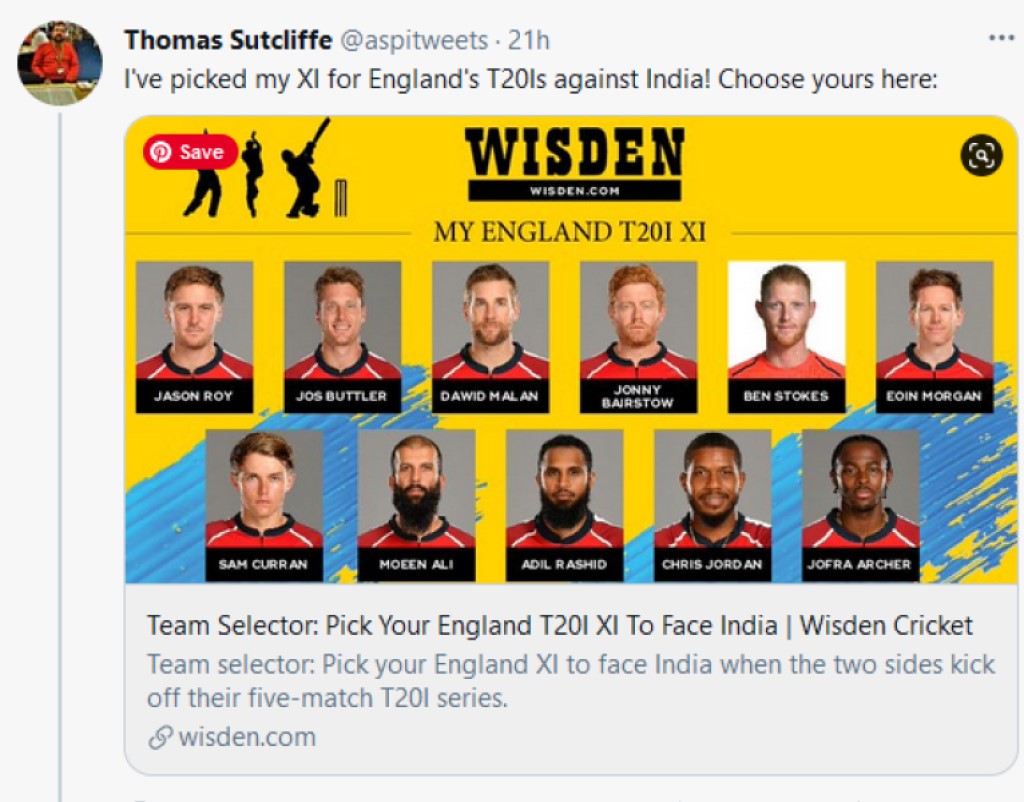
There is a ‘choose your England XI for the first T20’ up on wisden.com, which is fun to play. The XI I chose attracted some comment on twitter, mainly positive, and I am now going to go into more detail here. Below is my XI:

https://wisden.com/mysquad/team-selector-pick-your-england-t20i-xi-to-face-india/c92da4c_202102271627

There were five players available to be picked who I did not select: Liam Livingstone, Sam Billings, Tom Curran, Reece Topley and Mark Wood. I regarded the top four as must picks, given their records, considered Stokes as a necessity since very few good T20 sides don’t have a front line bowler who bats in the top half of the order, and Morgan is the current captain and it would be huge shout to replace him and name a new captain. Sam Curran has genuine all round skills, as does Moeen Ali with the only member of this XI to have no sort of batting pedigree at international level being Jofra Archer at no11. The five players picked mainly on account of their bowling skills re respectively left arm fast medium, off spin, leg spin, right arm fast medium with lots of variation and right arm fast, an excellent range of bowling, with Stokes, right arm fast medium, there as a sixth genuine option. This latter is an insurance policy against someone having a horror day with the ball. My second choice line up from the players available would be to have the two Bs, Bairstow and Buttler open the batting, Malan at three, Livingstone (who can also bowl spin, though he is not a front line option in this department) at four, and nos 5-11 unchanged.

PHOTOGRAPHS

My usual sign off, bolstered by some full moon shots from Friday evening…

England Women Secure Series Victory With A Game To Spare In New Zealand

A brief look at events in New Zealand where one England cricket team is doing well, and a revisit to my radical suggestion for sorting the men’s teams problems with finding good enough spinners.

This post looks briefly at goings on in New Zealand, and then explores a favourite theme of mine. First of all however, a brief…

NEWSFLASH

At 10:55 this morning I received my first Covid-19 jab. I barely felt the needle go into my arm and have as yet experienced no serious side effects. The second jab will be a minimum of four weeks from now and could be as much as 12 weeks. Contrary to what pro-government propaganda sources would have you believe my situation does not count in any sane view as ‘vaccinated’ – I have begun the process of getting vaccinated, but until I have had the second jab I am not actually vaccinated. Also, the government deserves very little credit for the vaccination program – the hard yards are being done by NHS workers, and the extent of government involvement for me was sending me a link I could not use, and a very inefficient helpline system which when I finally got through advised me to contact my surgery, who duly booked me a slot. The government have bungled all along the line, and their lockdown easing plans seem set to continue that trend, going too far too early.

ENGLAND WOMEN GO 2-0 UP WITH ONE TO PLAY IN NZ

A disciplined all round bowling performance, highlighted by Nat Sciver’s 3-26 from nine overs restricted NZ to 192 off 49.5 overs. Tammy Beaumont played the anchor role in the chase, finishing unbeaten on 72, while Sciver completed a fine day’s work by scoring a rapid 63, and keeper Amy Jones completed the job with an equally rapid unbeaten 46. England had seven wickets and 12.2 overs in the bank when they reached the target. Sophie Ecclestone failed to add to her haul of international wickets but did only go for 33 from her 10 overs, an economy rate bettered only by Sciver. Katherine Brunt and leg spinner Sarah Glenn each picked up two wickets and Kate Cross had one, while there were two run outs. Full scorecard here.

The men are struggling in India, but the women are going well, which leads me on to my theme…

ENGLAND MEN’S
SPIN PROBLEMS

In yesterday’s post I argued for the promotion of Parkinson and Virdi from the reserves to the full squad for the final test match, advocating a spin trio of Leach, Virdi and Parkinson. England do not have many other male spinners whose records inspire much confidence. Thus, I suggest that England offer Ecclestone the opportunity to play alongside the men. For those wondering about the women, in addition to Glenn who I have already mentioned here is a sextet of decent spin options available to the women: Linsey Smith, Kirstie Gordon, Sophia Dunkley, Alex Hartley, Helen Fenby and Danielle Gregory. If she bowls well in a few men’s county games, then given her 100+ international wickets she could be fast tracked into the England men’s team and possibly be part of the Ashes campaign at the end of this year.

PHOTOGRAPHS

My usual sign off…

All Time XIs – Through The Alphabet

Today’s all time XI cricket post follows a strict alphabetical progression.

INTRODUCTION

Welcome to another variation on the all-time XI cricket theme. Today each featured player has a surname beginning with a different letter of the alphabet, and each letter is used strictly in sequence, meaning that the second XI ends with a player whose surname begins with V.

RAY ILLINGWORTH’S XI

  1. Bobby Abel – right handed opening batter. 744 test runs at 37.20, an excellent record for his period, over 30,000 first class runs.
  2. Tammy Beaumont – right handed opening batter. Has fared magnificently as an opener since being given the role for England in 2015.
  3. Belinda Clark – right handed batter. In the 1990s she had the same kind of reputation as a batter that her compatriot Meg Lanning does today. She averaged 45 in test cricket and 47 in ODIs, the latter figure including the first ODI double ton by anyone.
  4. Emrys Davies – left handed batter, left arm orthodox spinner. He was usually to be found in this sort of place in the batting order, and played some fine innings from no4.
  5. Ross Edwards – right handed batter. One of the better Aussie batters of the first half of the 1970s (he retired somewhat prematurely at the end of the 1975 series played after the inaugural men’s world cup). In the first match of that series at Edgbaston he was horrifically out of form but ground out a half century in four hours and ten minutes, while others scored quicker (notably Rod Marsh with the top score of 61) at the other end. Rick McCosker and Ian Chappell had also scored 50s, and Thommo down near the extras scored a test best 49 to boost the score to 359. England were then bowled out twice, with skipper Denness, who had won the toss an put Australia in, managing three and eight in his last two test innings. In the second test of that series Australia slumped to 81-7 in response to England’s first innings 315 (Greig 96, Knott 69, Steele 50) and it was that man Edwards, helped by DK Lillee, who dug Australia out of this king sized hole. Edwards made 99, Lillee a test best 73 not out, and in the end England led by just 47, and were unable to force victory.
  6. Andrew Flintoff – right handed batter, right arm fast bowler. He took a while to establish himself at the top level before enjoying a couple of magnificent years, and occasionally reviving old memories thereafter.
  7. Jack Gregory – left handed batter, right arm fast bowler. Injuries took their toll late in his career, but his record confirms his status as a genuine all rounder.
  8. George Hirstright handed batter, left arm fast medium bowler. His England record does not look that great, but his play for Yorkshire, over the course of three decades, places him firmly among the greatest of all time.
  9. *Raymond Illingworth – off spinner, right handed batter. In 1970-1, with Australia holding the Ashes, and having done so since winning them in 1958-9, Illingworth captained England to a 2-0 series victory to regain the urn, the first to do so in Australia since Jardine 38 years previously, and only the sixth in all after Bligh in 1882-3, Stoddart in 1894-5, Warner in 1903-4 and Douglas in 1911-2 as well as Jardine. Subsequent to that tour England’s only successes down under have been when Brearley defended the urn in 1978-9, Gatting in 1986-7 defending the urn won back by Gower in 1985 and Strauss in 2010-11, defending the 2009 spoils. He was a quality player in his day as well.
  10. +Eifion Jones – wicket keeper, right handed batter. He made more dismissals than any other Glamorgan keeper, 933 of them (840 caught, 93 stumped) in 405 matches.
  11. Rashid Khan – leg spinner, right handed lower order batter. Although it is his bowling that has got him in (after four tests he has 23 wickets at 21.08 at that level – a more than promising start – while eight first class matches in total have yielded him 58 wickets at 17.44, and he is not quite 22 years old.

This team has a solid top five, three fine all rounders, a keeper, and two spinners who can both bat. It has no tail to speak of (even Rashid Khan averages 23 in FC cricket), and Gregory and Hirst will make a fine new ball pairing, with Flintoff as back up, while Khan, Illingworth and Davies provide fine spinning options (especially the first two). This team will take a lot of beating.

HONOURABLE MENTIONS

First of all, bear in mind my decision to pick players in positions they actually occupied. That means that Abel is virtually indisputable, although Mayank Agarwal will change that if he continues as he has started. Jack Brown of England, Bill Brown of Australia and Sidney George Barnes of Australia were all good options for the letter B, and I could accept any of them. Ian Chappell might have had the no 3 slot. I felt no 4 was a position too high for Basil D’Oliveira, and felt that Davies’ bowling gave him an edge of Joe Darling. No 5 was too low in the order for Bill Edrich (he either opened or batted no 3) or his cousin John (a specialist opener), while none of the other cricketing Edriches had a good enough record. George Emmett of Gloucestershire might have his advocates, although five was lower than he usually batted. Freddie Flintoff had no rivals. Jack Gregory’s slot might have gone to Tony Greig, but I felt that that the Aussie gave me three genuine pace bowlers. Hirst’s place might have gone to Schofield Haigh but I felt that his left arm bowling and superior batting clinched it in his favour. Illingworth’s two main rivals were Jack Iverson and Bert Ironmonger, but both were genuine no11s, so would have been two places too high, and in Ironmonger’s case I already had a left arm spinner in Davies. Some might think that Geraint Jones should have had the keeper’s slot, but his allegedly superior batting (I am not wholly convinced it actually was) does not make up for the fact that he was definitely a tad clumsy behind the stumps. Rashid Khan’s place could have gone to his compatriot the left arm wrist spinner Zahir Khan, while if I had wanted an extra pace bowling option Indian left armer Zaheer Khan could have been selected.

WALTER ROBINS’ XI

  1. Justin Langer – left handed opening batter, averaged 45 in test cricket, with a best of 250 against England at the MCG.
  2. Colin McDonald – right handed opening batter. The 1950s was a slow and low scoring decade, which makes McDonald’s test average of 39, batting at the top of the order particularly impressive. His best series was the 1958-9 Ashes when the he was the most successful batter on either side.
  3. Scott Newman – left handed batter. When he first started it seemed that an England career beckoned, but he never quite kicked on, finishing with a first class average of 38.
  4. Norman O’Neill – right handed batter. A fine stroke making batter for Australia. He averaged 45.55 in test cricket, making his debut in  the 1958-9 Ashes series.
  5. Kevin Pietersen – right handed batter, occasional off spinner.
  6. +Quinton De Kock – left handed batter, wicket keeper. I could not come up with a cricketer whose surname began with Q who could play as high as no six, so I allowed myself to pick someone whose first name began with Q.
  7. *Walter Robins – leg spinner, right handed batter, captain. A highly successful captain of Middlesex, well regarded by most of those who played under him. He averaged 26.39 with the bat and 23.30 with the ball, scoring 13,884 first class runs and capturing 969 wickets in his 379 games at that level.
  8. George Simpson-Hayward – off spinner (under arm). 23 wickets at 18 in his five test matches, 503 first class wickets at 21.
  9. Charles Turner – right arm medium fast bowler. One of the great bowlers of the early period of test history – took his 100th wicket in his 17th test match. Link two in an Australian chain through test history – Jack Blackham who kept wicket in the first 17 test matches ever played was a team mate of his, he gave Bill O’Reilly (3) some useful advice, who in turn gave Richie Benaud (4) some useful advice, and in his turn he passed on some advice to Shane Warne (5) – it only remains to provide a verifiable link from Warne to a current Aussie player to complete the chain.
  10. Derek Underwood – left arm slow medium bowler. 297 test wickets for the Kent maestro. Economical on pitches that did not help him and a destroyer on any surface that did help him.
  11. Vince Van Der Bijl – right arm fast medium bowler. The big South African took 767 wickets at 16.54 in first class cricket (his country were isolated due to apartheid, and he chose not to go down the route of qualifying to play for another country, so he played no official international cricket). Philippe-Henri Ednonds who played alongside Van Der Bijl for Middlesex said in “100 Greatest Bowlers” that Van Der Bijl would likely have had a test record in similar lines to Brian Statham’s had he played at that level.

This side has a powerful top five, an explosive batter/ keeper at six and a well balanced bowling attack. Turner and Van Der Bijl look every inch a quality new ball pair, while Underwood, Simpson-Hayward and Robins offer a fine variety of slower options.

HONOURABLE MENTIONS

No other L challenges Langer for the no1 slot. N was also a fairly barren letter, as was O. I did consider selecting Ellyse Perry in place of Kevin Pietersen, while no5 is too low for Graeme Pollock, who batted either at no3 or no4. I covered Q in that entry. I think Robins’ all round skills and captaincy make him a must pick – no 7 is definitely at least a position too high for Andy Roberts the . great fast bowler. Similarly, I felt no 8 was too high in the order for Fred Spofforth, so went for the highly individual skills of Simpson-Hayward. Jeff Thomson’s hell fire pace was an alternative to Turner. Underwood had no rival for the letter U. I could have gone for Chaminda Vaas in place of Van Der Bijl, but considered that the South African’s amazing first class record had to be acknowledged. Including Hedley Verity would have left me with only Turner as a recognized new ball bowler.

THE CONTEST

Robins’ XI has the stronger top batting, but more of a tail. Illingworth’s XI are better equipped in bowling, and they bat deeper, although their top batting is the weaker of the two sides. It is a tough call, but I think that Illingworth’s XI just about has the edge.

SOLUTION TO YESTERDAY’S TEASER

Marathon

We are told that the runners in first and fourth told the truth and those in second and third lied. C’s statement has to be true, because it being a lie would put C in fourth and that is disallowed by the conditions. Since it is a true statement and C did not finish fourth there is only one place for C to finish, which is first, the other place who told the truth. A’s statement is thus proven true, so A came fourth. B thus lied and therefore finished second, making D the other liar and the third place finisher. Thus C was first and A was fourth, making them three places apart. The cause of the aggro when this problem appeared on brilliant is that two runners finished in between A and C and some therefore believed the answer to be two, but the number of places separating A and C is 4-1 = 3. Brilliant caved to the moaners, giving those who had selected two but explained their reasoning for doing so in the comments credit, and they added an explanatory note to the problem itself. However, having reasoned the problem out as I have explained above and then selected two is actually equivalent to arguing that 4-1 = 2, so I think they should have held firm on that one.

LINK AND PHOTOGRAPHS

Holly Gillibrand, a young Scottish environmental activist has an article titled “Cry for the Wild” in the Oban Times. Below is a screenshot of the first few paragraphs:

HG

Time for my usual sign off:

IMG_0880 (2)IMG_0881 (2)IMG_0881 (3)IMG_0882 (2)IMG_0882 (3)IMG_0885 (2)IMG_0885 (3)IMG_0888 (2)IMG_0888 (3)IMG_0889 (2)IMG_0889 (3)IMG_0890 (2)IMG_0890 (3)IMG_0891 (2)IMG_0891 (3)IMG_0892 (2)IMG_0892 (3)IMG_0894 (2)IMG_0894 (3)IMG_0895 (2)IMG_0896 (2)IMG_0897 (2)IMG_0898 (2)IMG_0898 (3)IMG_0899 (2)IMG_0899 (3)IMG_0899 (4)

Through the Alphabet
The teams in tabulated form.