A look at day three in Galle and a couple of issues raised therein.
This post looks at day three of Sri Lanka v England and at a couple of issues the arise from today’s play.
ROOT VS EMBULDENIYA
Although others contributed a fascinating third day in Galle was dominated by two players. Joe Root of England confirmed that he has rediscovered the art of going seriously big, as it took a run out in the day;s last over to dislodge him, by which time he had moved to 186. The other overarching performer was Sri Lanka’s left arm spinning find Lasith Embuldeniya who took his haul for the innings to seven wickets, Other than the impertubable England skipper the only person to play Embuldeniya with any great comfort was Jos Buttler who made a decent half century. The other significant batting effort on the day came from Dominic Bess, who came in with England staring down the barrel of a three-figure deficit on first innings with Sri Lanka to bat last. By the time he was dismissed the difference between the sides was under 50, and England were looking in the hunt. Unfortunately the odd looking decision to send the flamboyant Wood in ahead of the adhesive Leach with the close of play approaching did not work out well, and then there was the freakish run out of Root which ended the day, leaving England 339-9 in reply to Sri Lanka’s 381, with Leach and Broad to resume batting tomorrow.
ENGLAND’S BALANCING PROBLEMS ABSENT STOKES
Sam Curran looks a place too high in the order as a test match number seven, and the reason he is there is because on flat wickets England need to equip themselves with plenty of bowling options, and with Ben Stokes not available for this series they did not have their great x-factor player to turn to, which left them to choose between lengthening the batting or the bowling. Rightly in view of the conditions in which this series is happening they opted for the latter. There is strong evidence to support the view that if having to choose between batting and bowling strength the bowling strength is more important: Surrey won seven county championships in the 1950s with an average batting side that possessed a stellar bowling attack, Yorkshire won seven championships in the 1930s, and again the key ingredient of their success was a devastating bowling unit, spearheaded by Bill Bowes and Hedley Verity. Finally, in the first decade of the 1900s Yorkshire won five titles, although only one of their batters, David Denton, was good enough to be chosen for England purely on batting skill in that decade, with the key again being an awesome line up of bowlers, headed by the Huddersfield area trio of Hirst, Rhodes and Haigh. Sussex in that same decade had a very deep batting line up, but limited bowling resources, and never came seriously close to winning the title. However, a batting line up with Curran at seven does necessitate those at the top coming to the party and so far this series only the skipper has done so – without him England would undoubtedly be staring a 0-2 defeat in the face rather than being favourites to win the series.
THE ROLE OF DOMINIC BESS
England are desperate for Dominic Bess to establish himself as a test class spinner, because he is a splendid fielder and a capable bat as well. Currently in first class cricket he averages 23.77 with the bat and 29.41 with the ball (137 wickets in 48 matches at that level). In test cricket he averages 24.77 with the bat and 33.37 with the ball (27 wickets in 11 matches). The bowling average and the low wickets/matches ratio – just below 2.5 – both point to the issue: as much he offers outside his main role, barring one good series against South Africa he has yet to deliver in his main role, with the ball.
Today he contributed 32, and looked like he was handling the bowling as well as any of his team mates save Root. It may be that ultimately the way forward for Bess as an international cricketer is to concentrate more on his batting, and aim to be picked as batter who bowls, rather than a bowler who bats. Garry Sobers and Steven Smith were both originally selected at test level as spinners (Sobers was at no9 on test debut, Smith at no8) and ended up making their biggest marks with the bat, although Sobers continued to bowl, whereas Smith has all but given up that aspect of the game. Going back further, Wilfred Rhodes was the best spinner in the world early in his career, and batted no11 for England, and went on to tour Australia in 1911-12 as one of the designated opening batters, hardly bowling at all (he would pick up his bowling after World War 1, and return to the top in that department, finishing his career as once more a specialist bowler, as his sight declined – he would go blind during his retirement – and he could no longer bat). At the moment Bess is always likely to get the nod if England want two front line spinners, and the main in more danger of losing out is Leach, who bowled 36 overs in the first innings here without causing any great problems for the batters, but do not be surprised to see Bess moving up the order in the not distant future, as he seeks to find a more secure niche than ‘bits and pieces guy who gets selected when two spinners are needed’.
PHOTOGRAPHS
Today’s gallery starts with seven pictures on the theme of ‘red sky in the morning, shepherd’s warning’, although today’s weather in King’s Lynn, while far from pleasant has not really borne out that saying:
Responding to an entertaining challenge thrown down by cric blog to name a test XI and 12th man featuring one current player from each of the 12 test playing nations. Also features some photographs.
This post was inspired by a challenge tweeted by @cric_blog:
🇦🇫 🇦🇺 🇧🇩 🏴 🇮🇳 🇮🇪 🇳🇿 🇵🇰 🇿🇦 🇱🇰 🇧🇧 🇿🇼
Make a Test XI (and 12th man) picking one current player from each of the 12 Test nations. Go!#Cricket
I responded on twitter, but there is a limit to how much detail one can go into there, so I am now putting up a blog post to provide a fuller explanation of my thoughts (I thank CricBlog for setting a tough but fun challenge and inspiring me to create a blog post – a combination of an English late autumn/ winter and lock down is not exactly ideal for providing inspiration!).
SELECTION ISSUES
The 12 test playing nations are: Australia, Afghanistan, Bangladesh, England, India, Ireland, New Zealand, Pakistan, South Africa, Sri Lanka, West Indies and Zimbabwe. Some of these nations have many current greats to choose from, others have very few players to merit consideration. I also wished as far as possible to pick players in appropriate places in the batting order and to have a properly balanced side.
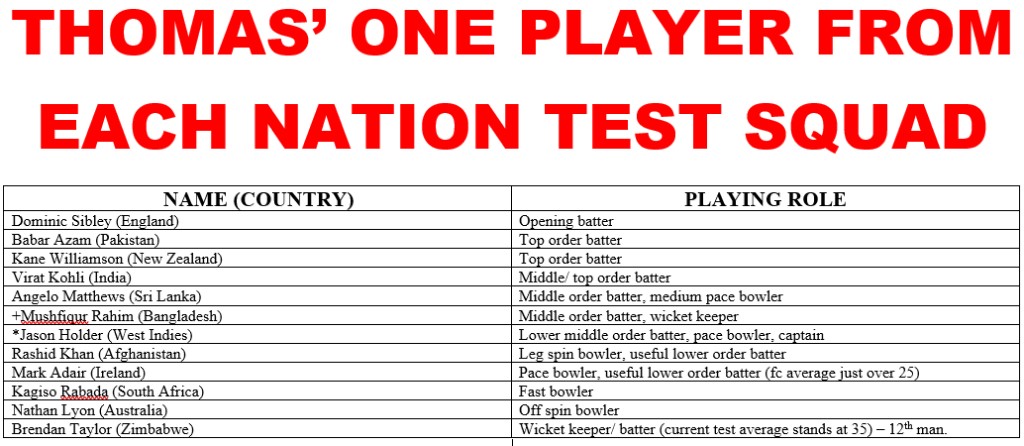
THE SQUAD FROM 1-12
Dominic Sibley (England) – an opening batter who knows how to bat for a long time. He has impressed considerably since his selection for England, which was earned the old fashioned way by scoring shedloads for his county.
Babar Azam (Pakistan) – he often bats no3 in long form cricket, but he can also open, his class is unquestionable, and his attacking inclinations make him a suitable partner for the solid Sibley.
Kane Williamson (New Zealand) – one of the finest long form batters the game has ever seen, and certainly in the top handful of contemporary batters whatever the format.
Virat Kohli (India) – Another all time great.
Angelo Matthews (Sri Lanka) – Averages 45 with the bat and is also a potential sixth bowler with his medium pace. Sri Lanka are not especially strong at the moment, limiting one’s options in terms of selecting a team of this nature.
+Mushfiqur Rahim (Bangladesh) – A fine wicket keeper and worth his place as a middle order batter as well, the little Bangladeshi can be counted as one of two genuine all rounders in the XI.
*Jason Holder (West Indies) – lower middle order batter, quick bowler and captain. He has a test double century to his name and has also taken some major wicket hauls, including a six-for to start the first test series of the 2020 English season. Although the West Indies ended up losing that series I was overall impressed by Holder’s captaincy and had little hesitation over giving him that role in this team. As an aside, England owe the Windies big time for this summer and should have reciprocal tours of that part of the world high on their priority list.
Rashid Khan (Afghanistan) – an outstanding leg spinner and a useful lower order batter, he was the easiest selection of all for this squad, so far above his compatriots does he stand.
Mark Adair (Ireland) – pace bowler, useful lower order batter (he averages over 25 in first class cricket). He was impressive with the ball at Lord’s in 2019, his only test to date.
Kagiso Rabada (South Africa) – pace bowler. The quickest bowler in the squad, and the best of the three pace bowlers I have named.
Nathan Lyon (Australia) – the best current off spinner (only Murali among off spinners I have seen in action ranks as an unquestionably better bowler – sorry Swanny), and a suitable ‘spin twin’ for Rashid Khan.
Brendon Taylor (Zimbabwe) – Zimbabwe has few stand out names at present, but as a 12th man a wicket keeper who is also a good enough willow wielder to average 35 in test cricket is a pretty decent option.
THE TEAM ANALYSED
This team has a well matched opening pair, an outstanding no 3 and 4, a no 5 who has a very respectable record, an excellent keeper/batter, and Holder filling the all rounders slot at seven. The bowling line up, with Rabada taking the new ball alongside Holder or Adair, a third high class pacer and two outstanding and contrasting spinners in Rashid Khan and Nathan Lyon is also formidable. I would fully expect this team to give a good account of itself in any conditions. For more about my ideas on selection policies and team balance you can look at my ‘All Time XIs‘ series and/or at my ‘100 cricketers‘ series.
EXTENDING THE CHALLENGE
Please feel free to use the comments to indicate your own selections, sticking to the brief of one player per test playing nation. Those who fancy a really serious challenge are invited to pick a XII on similar lines to go up against mine (without thinking too hard I can identify nos 4, 5, 6 (or 4, 5, 7 or 4,6, 7) and 11 of such a combination and would be interested to see if these names feature).
PHOTOGRAPHS
I finish this post with some photographs (to view an image at full size please click on it):
Continuing the all-time XIs theme with a look at Australia, I use this post to make more explicit some of my thinking about team balance.
INTRODUCTION
After completing my look at the English first class counties yesterday (click here to visit a page from which you can access all 18 of those posts) I am now moving on to the next stage of this series. In this post I am going to attempt to explain more of my thinking about selection. I will begin by presenting an Australian XI of players from my time following cricket, which I am taking as starting from the 1989 Ashes (I saw odd bits from the 1985 series and heard about the 1986-7 series but 1989 was the first I can claim really direct memories of. Before moving on to the team that many of my fellow Poms would be watching from behind the sofa there is one other thing to do…
THE RECEPTION OF MY FIRST 18 POSTS (WITH A NOD TO THE PINCHHITTER)
Yesterday I shared my All Time XIs for the counties on twitter. The feedback was very interesting, and mainly tendered in the right spirit. The PinchHitter, who sends out a daily email to those who sign up for it was today kind enough to include a reference to this endeavour in today’s email, which you can view here. Everyone’s opinions differ, and so long as suggestions are made with constructive intent I will not complain, though I would ask that you suggest who should be left out to accommodate your favoured choices. I am bound in an endeavour of this nature to fail to flag up people who merit attention – tthere are vast numbers of players to be considered when doing something like this.
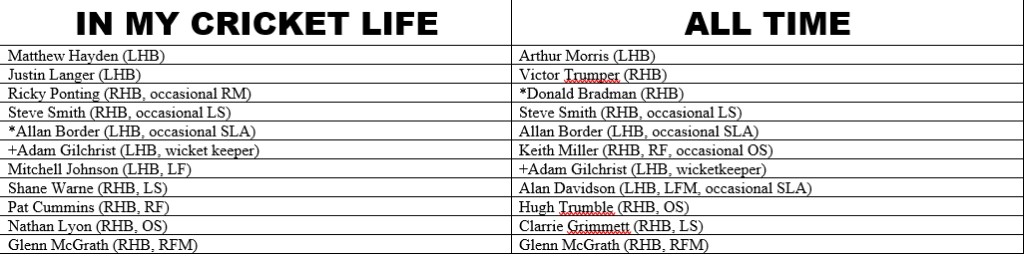
AUSTRALIA IN MY CRICKET LIFE XI
Matthew Hayden – an attack minded left handed opener who was very successful over a number of years. He had a horrible time in the first four matches of the 2005 Ashes, but bounced back with 138 in the fifth match at The Oval. In Brisbane in 2002 he cashed in on Nasser Hussain’s decision to field first by scoring 197, and then adding another ton in the second innings.
Justin Langer– a different style of left handed opener to Hayden, his most regular partner, Langer was no less effective at the top of the order. His greatest performance was a score of 250 at the MCG. He played in the county championship for Middlesex and Somerset.
Ricky Ponting – a right hander whose natural inclination was to attack but who could also produce a defensive knock at need. Although he had one very poor Ashes series, in 2010-11 his overall record demanded inclusion.
Steve Smith – a right hander, with an even better average (to date), than Ponting. He was tarnished by his involvement in sandpapergate, but his comeback in the 2019 Ashes showed that while he cannot be trusted with a leadership position his skill with the bat remains undminished.
*Allan Border – a left handed middle order bat who was the first to 11,000 test runs, also an occasional left arm spinner who did once win his country a match with his bowling (match figures of 11-96 against the West Indies in 1988). For the first 10 years of his long career he was a mediocre side’s only serious bulwark against defeat, but in the last years of his career he was part of the first of a succession of great Australian teams. The role he played as captain in Australia’s transformation from moderate to world beaters was an essential part of the story of the ‘Green and Golden Age’ and I recognize it as such by naming him captain of this side.
+Adam Gilchrist– attacking left handed middle order bat (opener in limited overs cricket) and high quality wicket keeper. One of the reasons that England won the 2005 Ashes was that they were able to keep him quiet (highest score of the series 49 not out), the only time in his career any side managed that. At Perth in the 2006-7 series, immediately following a victory at Adelaide after England had made 550 in the first innings and then did a collective impression of rabbits in headlights against Warne in the second, he smashed a century off 57 balls, then the second fastest ever test century in terms of balls faced.
Mitchell Johnson – left arm fast bowler and attacking left handed lower middle order bat, also the ‘Jekyll and Hyde’ of 21st century test cricket. In the 2010-11 Ashes the ‘Hyde” version predominated, save for one great match at Perth, struggling to such an extent in his other games in that series that he probably scared his own fielders more than the England batters! The ‘Jekyll’ version was on display in the 2013-14 Ashes, when he bowled as quick as anyone in my cricket following lifetime, was also accurate, and scared the daylights out of the England batters, taking 37 wickets in the series and being the single most important reason for the 5-0 scoreline that eventuated.
Shane Warne – leg spinner and attacking right handed lower order bat – one of the two greatest spinners I have seen in action (Muttiah Muralitharan being the other). From the moment that his first ball floated in the air to a position outside leg stump and then spun back to brush Mike Gatting’s off stump at Old Trafford in 1993 he had a hex on England, becoming the first bowler ever to take 100 test wickets in a country other than his own. In the 2005 Ashes, when England regained the urn after 16 years, he took 40 wickets and scored 250 runs in the series. His only blot in the series came at The Oval when he dropped an easy chance offered by Kevin Pietersen, which allowed that worthy to play his greatest ever innings and secure the series. He took over 700 test wickets (the exact figure is open to argument, since some of his credited wickets were taken in an Australia v Rest of The World game, and earlier ROW games organized when South Africa were banished from the test scene are not counted in the records). He also scored more test runs than anyone else who never managed a century, 3,154 of them.
PatCummins– right arm fast bowler, right handed lower order bat. Injuries hampered his progress (he first appeared on the scene as a 17 year old, but he has still done enough to warrant his inclusion. At the MCG in 2018, when Jasprit Bumrah rendered the Aussies feather-legged with a great display of fast bowling, Cummins took six cheap wickets of his own in India’s second innings, not enough to save his side, who lost both match and series, but enough to demonstrate just how good he was, a fact that he underlined in the 2019 Ashes.
Nathan Lyon – off spinner and right handed tail end bat. One of only three spinners of proven international class that Australia have produced in my time following cricket (Stuart MacGill, a leg spinner, is the third). In the first match of the 2019 Ashes he cashed on Steve Smith’s twin tons by taking 6-49 in the final innings of the game.
Glenn McGrath – right arm fast medium bowler and right handed tail end bat. Australia lost only one Ashes series with McGrath in the ranks, and he was crocked for both of the matches they ,lost in that series. I tend to be a bit wary of right arm fast mediums having seen far too many ineffective members of the species toiling for England over the years but this man’s record demands inclusion. In that 2005 Ashes series he was the player of the match that his side did win – his five cheap wickets after Australia had been dismissed for 190 in the first innings wrenched the initiative back for the Aussies and they never relinquished it. He is at no11 on merit, but even in that department he is a record breaker – more test career runs from no 11 than anyone else.
This combination comprises a stellar top five, a wicket keeper capable of delivering a match winning innings and a strong and varied bowling attack – left arm pace (Johnson), right arm pace (Cummins), right arm fast medium (McGrath), leg spin (Warne) and off spin (Lyon) with Border’s left arm spin a sixth option if needed. It also has a tough and resourceful skipper in Border.
BUILDING THIS COMBINATION
Australia in the period concerned have not had a world class all rounder – the nearest approach, Shane Watson, was ravaged by injuries and although he delivered respectable results with the bat his bowling was not good enough to warrant him being classed as an all rounder. I could deal with this problem by selecting Gilchrist as a wicket keeper and assigning him the traditional all rounders slot (one above his preferred place admittedly), which is what got him the nod over Ian Healy, undoubtedly the best pure wicket keeper Australia have had in my time following the game. A more controversial option would have been to borrowEllyse Perry from the Australian Women’s team and put her at no six. Having opted for Gilchrist the question was then whether I wanted extra batting strength or extra bowling strength, and in view of the batters I could pick from and the need to take 20 wickets to win the match I opted for an extra bowling option – those who have studied my county “All Time XIs” will have noted that I always made sure they had plenty of depth and variety in the bowling department – I want my captains to be able to change the bowling, not just the bowlers. Warne and Lyon picked themselves for the spinners berths, with the coda that if the match was taking place in India Warne would have to be dropped and someone else found as he was expensive in that country (43 per wicket). Australia in this period has had two left arm quick bowlers who merited consideration, Johnson and Mitchell Starc. I opted for Johnson, as Johnson at his best, as seen in the 2013-14 Ashes was simply devastating. McGrath picked himself. For the final bowling slot I had an embarrassment of riches to choose from. I narrowed the field by deciding that I was going to pick a bowler of out and out pace. Brett Lee’s wickets came too expensively, Shaun Taitdoes not have the weight of achievement. I regard Cummins at his best as a finer bowler than either Josh Hazlewood or James Pattinson, so opted for him.
Turning attention to the batting, Langer and Hayden were a regular opening pair, and I did not consider either Mark Taylor or David Warner who both have great records to have done enough to warrant breaking an established pairing. Border got the no 5 slot and the captaincy because of his great record as both batter and captain and the fact that Ponting and Smith whose claims were irrefutable are both right handers. If I revisit this post in a few years I fully expect Marnus Labuschagne to be in the mix – he has made an incredible start to his test career. Adam Vogesaveraged 61.87 in his 20 test matches, but his career only spanned a year and a half, and a lot of the opposition he faced was weak – and in the heat of Ashes battle he failed to deliver, scoring only two fifties and no century in the series, which is in itself sufficient reason not to deem him worthy of a place. He never played in an Ashes match, the ultimate cauldron for English and Australian test cricketers, and so that average not withstanding cannot truly be considered a great of the game. The Waugh twins both had amazing test records, especiallySteve, but such has been Australia’s strength in the period concerned that they cannot be accommodated.
TURNING THIS INTO AN ALL TIME XI
For me Smith and Border of the front five hold their places. Ponting would be a shoo-in for the no3 slot in almost any other team one could imagine, but for true if cruel reason that he is only the second best Australia have had in that position he loses out, with Donald Bradman(6,996 test runs at 99.94) getting the no 3 slot. At no six we now have a genuine all rounder, Keith Miller (George Giffen, once dubbed “the WG Grace of Australia”, Monty Noble and Warwick Armstrong also had superb records), with Gilchrist retaining the gloves and now dropping to no 7. There is a colossal range of bowling options, out of which I go for Alan Davidson (186 test wickets at 20.53 and a handy man to have coming in at no 8), Hugh Trumble, an off spinner whose tally of 141 Ashes wickets was a record over 70 years, and who twice performed the hat trick in test matches at the MCG, in “Jessop’s Match” at The Oval in 1902 he scored 71 runs without being dismissed and bowled unchanged through both England innings, collecting 12 wickets, comes in at no 9, Clarrie Grimmett the New Zealand born leg spinner who captured 216 wickets in just 37 test matches gets the no 10 slot and Glenn McGrath retains his no 11 slot. This team has a stellar top five, an all-rounder at six, a fine wicket keeper and explosive batter at no 7 and a very varied and potent line up of bowlers. Why Grimmett ahead of Warne? Grimmett in both test and first class cricket (he took more wickets in the latter form than anyone else who never played county championship cricket) averaged a wicket per match more than Warne.
At the top of the batting order I have replaced Hayden and Langer with Arthur Morris, a left handed opener who Bradman rated the best such that he ever saw and Victor Trumper, right handed batting hero of the early 20th century. In 1902 at Old Trafford, when England needed to keep things tight on the first morning until the run ups dried sufficiently for Bill Lockwood to be able to bowl Trumper reached his century before lunch, and since Australia won that game by just three runs this was a clearly defined match winner.
Australia has had a string of top class glove men down the years – Blackham who played in each of the first 17 test matches, Bert Oldfield,Don Tallon, Wally Grout, Rodney Marsh and Ian Healy are some of the best who appeared at test level, but none of them offer as much as Gilchrist does with the bat.
There are an absolute stack of legendary bowlers who have missed out, likewise batters – I will not attempt a listing these, but everyone who wants to is welcome to mention their own favourites.
FINAL THOUGHTS
This has been a very challenging exercise, but also a very enjoyable one. As for my All Time Aussie XI, not only would I not expect anyone else to agree with all my picks, I might well pick different players next time – there are a stack of players one could pick and be sure of. The one from my cricket following life (remember that start point of the 1989 Ashes) has fewer options, but again, it is probable that with the options available even in that period, no one else would pick the same XI that I have. If you plan to suggest changes please indicate who your choices should replace, and please consider the balance of the side when making your choices.
PHOTOGRAPHS
Our little look at the oldest enemy is over, and it remains only for my usual sign off…
My all-time Surrey XI, as I find ways to make up for the absence of live cricket.
INTRODUCTION
Since there will be no cricket, or any other sport come to that, for a while I am going to fill the void by playing selector for a few all-time squads. Since I grew up in south London I will start with Surrey.
MY SURREY XI EXPLAINED
Jack Hobbs – more first class runs and more first class hundreds than anyone else, also still has the England record for Ashes runs – 3,636 of them, including another record, 12 centuries in those matches. He was also a more than handy bowler of medium pace and a brilliant fielder at cover point. His claim to an opening slot is unanswerable.
John Edrich – the left hander was one of three strong contenders for this slot, and both of the other two, Andrew Sandhamand Tom Hayward, actually did open the innings with Hobbs, but although I see the value of picking an existing partnership, Edrich’s left handedness creates an extra problem for the fielding side to contend with, and for me that is the crucial factor.
Ken Barrington – finding big run scorers associated with Surrey is not difficult, but what sets Barrington apart (and no 3 is has natural position) is that he was even more of a heavy scorer at test level (average 58.67).
Graham Thorpe – that rara avis an English middle order batter from the 1990s with a record to boast about. A century on debut against Australia and an average in the mid 40s maintained through precisely 100 test caps tells its own story about his consistency.
Peter May – In what was an overall low scoring decade (the 1950s) he maintained a test average of 46.77, and was also highly prolific for his county.
+Alec Stewart – in spite of the fact that doing so loses some of the brilliance of Stewart the batter I name him as keeper for the sake of the balance of the side. The leading scorer of test runs in the 1990s, and a very able keeper. Given the top five he would very likely be coming in with free rein to play his strokes.
*Percy Fender – a fine all-rounder, a highly respected captain who many felt should have had the England job and precisely the right kind of person to be batting no 7 in a strong team – he holds the record (35 minutes) for the fastest century against genuinely first class bowling.#
Alec Bedser– a man who in the period immediately after World War two was not just the spearhead, but pretty much the entire spear of England’s bowling attack, and the first to take 200 wickets for England.
Jim Laker – probably the finest of all orthodox offspinners, and for Surrey he was frequently more successful away than at home (in each of seasons 1955, 1956 and 1957 this applied to name but three).
Tony Lock – the other half of the great spin pairing of the 1950s, a slow left-armer.
Tom Richardson – a fast bowler who took more wickets for Surrey than any other bowler in their history. His 1,000th first class wicket came in his 134th first class match, and his 2,000th in his 327th.
This team consists of an awesome top five, a batter-keeper at six, an all-rounder and four frontline bowlers. There are two left handers among the top batters, and the bowling contains the new ball pair of Richardson and Bedser, an offspinner, a slow left armer and a leg spinner (Fender), plus Hobbs’ medium pace if required. I have not included an overseas player, but if mandated to do so I would bring in Waqar Younis in place of Richardson.
George Lohmann (definitely in an all-time Surrey tour party as cover for Bedser), Martin Bicknell, Bill Lockwood and Alf Gover all merit consideration as bowlers, while other than the openers I could not accommodate Douglas Jardine andEric Bedser were two of the better batters to miss out. Mark Ramprakash did not come into my calculations because his record at the highest level was ordinary, and the bulk of his runs for Surrey came while they were in division 2 and not up against the strongest bowling attacks.
PHOTOGRAPHS
I am rationoing my photographs at the moment because I cannot be sure of getting opportunities to take more in the immediate future.











































































 aspiblog