Day 3 in Chennai and Great Escapes

A look at Chennai, where England are very well placed, and also at the astonishing events that unfolded in Chittagong today, with a section on other notable ‘steals’.

A two part post here, both parts inspired by goings on in places that begin with a ‘ch’.

ENGLAND CONSOLIDATE

England had already had two good days in Chennai, and resumed on the third morning on 555-8. It took 10.1 overs for the last two wickets to fall, in which time the score advanced to 578 all out. Then Jofra Archer removed both openers with the ball still new, Bess claimed the prize scalp of Kohli and was gifted the wicket of Rahane. India at that point were 73-4, but Rishabh Pant then joined Cheteshwar Pujara in a fine stand. Bess picked them both up eventually, but Sundar and Ashwin held out until the close with the score 257-6. With the pitch beginning to wear England’s likeliest path to victory is to wrap up the Indian innings fairly quickly tomorrow morning, aim for quick runs in their own second innings and give themselves a day and half to bowl India out again. If India bat long but slowly tomorrow it may be necessary to enforce the follow on because there is not time to win it by batting a second time, but going in again for short burst of rapid scoring and having India bat last when the pitch is at its most difficult would be preferable. There would be a case for Burns and especially Sibley being held back in this second innings, to be used only if wickets are tumbling.

BETTER TO BE A LUCKY
GENERAL THAN A GOOD ONE

The nature of the dismissals that gave Bess his four wickets prompted some comments about him being lucky. However, apart from the Napoleon Bonaparte quote that heads this subsection, which is valid in any case, Bess has now had respectable hauls too often for the accusation of being lucky to hold much water. David Denton, the Yorkshire batter of the early 20th century was known as ‘Lucky’ Denton, but the reason people noticed him benefitting from good fortune was because of the use he made of his lucky breaks – 38,000 first class runs cannot be scored by luck alone. Similarly, another Yorkshireman, Herbert Sutcliffe was also renowned as a favourite of fortune, but again the good luck he enjoyed was noticed because he cashed in on it.

THE CHITTAGONG COUP

Yesterday Bangladesh declared their second innings closed at 223-8, an advantage of 394. When the West Indies were 59-3, with Kyle Mayers, a 28 year old test debutant whose first class batting average stood at a modest 28, walking out to bat it was looking a shrewd judgement. He and Nkrumah Bonner, also a debutant, put on 216 for the fourth wicket, reducing the ask to 120, before Bonner fell for 86. Jermaine Blackwood could only muster nine runs, and that was 292-5, still 103 to get. Wicket keeper Joshua Da Silva proved an excellent partner, scoring 20 himself, but playing an excellent support role to Mayers, already by then holder of the record for the highest ever fourth innings score by a test debutant. By the time Da Silva was out Mayers had gone past 200 and only three further runs were needed for victory. One more wicket fell before the target was reached, Mayers 210 not out at the end, and appropriately scoring the winning run. This the third recent match to have been won in the face of seemingly impossible odds, following the Headingley Heist (2019, see here) and what I will now dub the Brisbane Burgle (here). This one tops the lot – Stokes, the hero of Headingley, was on home turf and was already an experienced test cricketer, while of the three key figures on the final day in Brisbane only Sundar had not previously played test cricket. There have been other notable steals in test history, including but not limited to:

  1. The Oval, 1882 – England needed just 82 to win in the fourth innings but FR Spofforth, provoked to fury by WG Grace’s sharp run out of Sammy Jones in Australia’s second dig, took seven wickets as England crashed to defeat by seven runs.
  2. The Oval, 1902 – England were set 263 to win on a pig of a pitch, and at 48-5, with Jack Saunders having taken four cheap wickets it must have looked all over. Gilbert Jessop blasted 104 in 77 minutes, but even at his dismissal England were 187-7. George Hirst rallied the tail, and was on 58 not out, to go with 43 in the first innings and five wickets in Australia’s first innings when the winning single was taken by Wilfred Rhodes, the no11.
  3. Melbourne 1907 – When Syd Barnes, renowned as possibly the greatest of all bowlers, walked in to bat in the final innings England needed 73 from their last two wickets. When the wicket keeper Humphries was adjudged LBW, Arthur Fielder had to join Barnes, and nos 10 and 11 needed to conjure 39 runs to pull off the win. Little by little they inched their way closer, and eventually Barnes took on a sharp run with the scores level. A calm return to the keeper from Hazlitt would have led to test cricket’s first tie, but he panicked and shied wildly at the stumps, and England were home by one wicket.
  4. Lord’s 1984 – England, for about the only time in the 1980s, had the upper hand on the West Indies to the extent that some were criticising skipper Gower for not declaring overnight. Gower’s eventual declaration on the fifth morning left the Windies needing 342 to win. Gordon Greenidge played one of the most brilliant innings ever, scoring 214 not out, well supported by Larry Gomes, a reliable left hander, who was on 92 not out when the Windies sealed victory by nine wickets.

PHOTOGRAPHS

My usual sign off…

Quintuple Nelson, No Balls and Dropped Dollies

This is my account of the second day of the test match in Chennai, though I start by congratulation Sixers on their triumph in the Big Bash League – they won very comfortably over Scorchers in the final, with Vince scoring 95. About the only thing they could have done better was to have given the final over to Vince with occasional medium pace, in view of the fact that they had 30 to defend and AJ Tye was one of the batters in for the Scorchers.

ENGLAND IN CONTROL

England started the day on 263-3, Root 128 not out and Stokes coming in as the new batter after the loss of Sibley. Stokes and Root were still in occupation at lunch and the score had moved past 350, with Stokes starting to score rapidly. Stokes fell for 82 to make it 387-4, Pope was in next and contributed 34, his dismissal making it 473-5. Four runs after that Root finally fell for a magnificent 218, the highest score ever by a visiting batter at this venue, beating the 210 Dean Jones made in the first innings of the second ever tied test in 1986. Two of the other three doubles by overseas batters at this ground came in a single innings during the 1984-5 tour when Gatting and Fowler scored 207 and 201. Buttler was never at his most convincing, and he and Archer fell in successive balls to Ishant Sharma making it 525-8, with Leach walking out to join his Somerset colleague Bess. A ninth wicket should have fallen when Bess hit one straight to Rohit Sharma, but India’s opener was obviously already thinking about batting and dropped an absolute dolly of a catch. By the close England had reached 555-8, with Bess unbeaten on 28, and Leach on 6, which included a straight driven four. Ominously for India after almost two whole days of looking like an absolute road the pitch started offering turn and bounce just before the end of day two, something that Bess and Leach will have noted.

For India Jasprit Bumrah looked formidable at all times, Ishant Sharma bowled economically and his two wickets were just reward for his efforts, Ashwin commanded respect most of the time, but the two younger spinners, Washington Sundar and Shahbaz Nadeem, both looked inadequate. Also in picking Sundar and Nadeem alongside Ashwin and overlooking Kuldeep Yadav India had left themselves with three very orthodox finger spinners. Yadav would have posed more of a challenge to England.

India were guilty of frequent no-balling, erring 19 times in total in this regard. In this match the the third umpire has been given sole responsibility for calling no-balls, and each such call was indicated by the sounding of a klaxon. Kohli was also at fault for his use of DRS – India lost all three of their of reviews in a fairly short period of time, and two were burned up in a manner that would have had Tim Paine blushing. The third (actually chronologically the second) was less outrageous, but DRS is supposed to be for the obvious mistake, not for use in an attempt to swing a close one your way, and the ball was clearly going over the top of the stumps. Having followed the series in Australia closely and heard almost every ball of this England innings thus far I am going to risk bringing down a tide of wrath on my head by saying that Rahane is a far superior skipper to Kohli, and that he should have that job, while Kohli plays purely as a batter. After these reviews had been burned a few close calls went against India, but they had only themselves to blame for the fact that they could not send them upstairs.

England will bat on tomorrow – their approach has made it clear that they are hoping to bat just the once in this game, unless the face either a) a tiny chase in the fourth innings or b)circumstances indicate they would be best served by having a lash for 20 to 30 overs before putting India back in for the fourth innings. An example of situation b could arise if England make say 580 in total, India are all out for a total in the upper 300s, either just avoiding the follow on or being close enough to doing so that it makes sense to rest the bowlers, somewhere around halfway through day four, and England look to score as many as they can be midway through the evening session and then get India back in. It would therefore make little sense to declare at this point – when Buttler and Archer fell in successive balls there would have been a case for a declaration to give a tired Indian side a brief mini-session to negotiate today. Ishant Sharma is on 299 test wickets, while Root moved past Alec Stewart to third on the all time list of England test run scorers, and you have to go down the list to Hanmond, 7,249 at 58.45 to find someone with a higher average. Hammond also features in another context here – the last England batter to score 150+ in an innings of each of three straight test matches was Hammond in 1928, when he scored 251 in the first innings at Sydney, 200 in the first innings of the next match at Melbourne and 119 not out and 177 in the fourth match at Adelaide. Gooch on 8,900 is next in Root’s sights and he may well get there this series the way he is going. Cook, on 12,472 is further in the distance, but I am now firmly expecting Root to get there before he is done. England need to win this series by two clear matches to make the final of the World Test Championship, while a series win of any sort will put India into the final, and the results not covered in the foregoing will see Australia face New Zealand in that final (the black caps are already booked in thanks to Australia’s very late cancellation of their trip to South Africa).

For the moment, England have done a fine job over these two days, but even with the pitch apparently starting to offer more to the bowlers taking 20 wickets will not be an easy task.

PHOTOGRAPHS

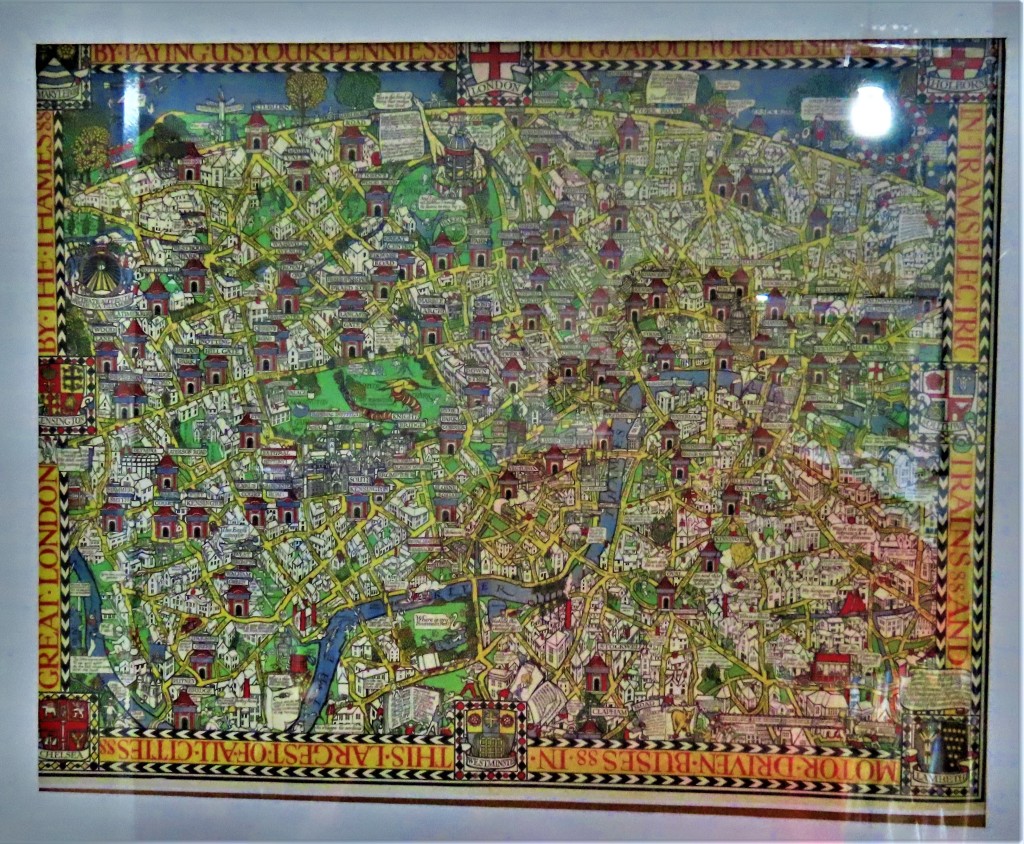
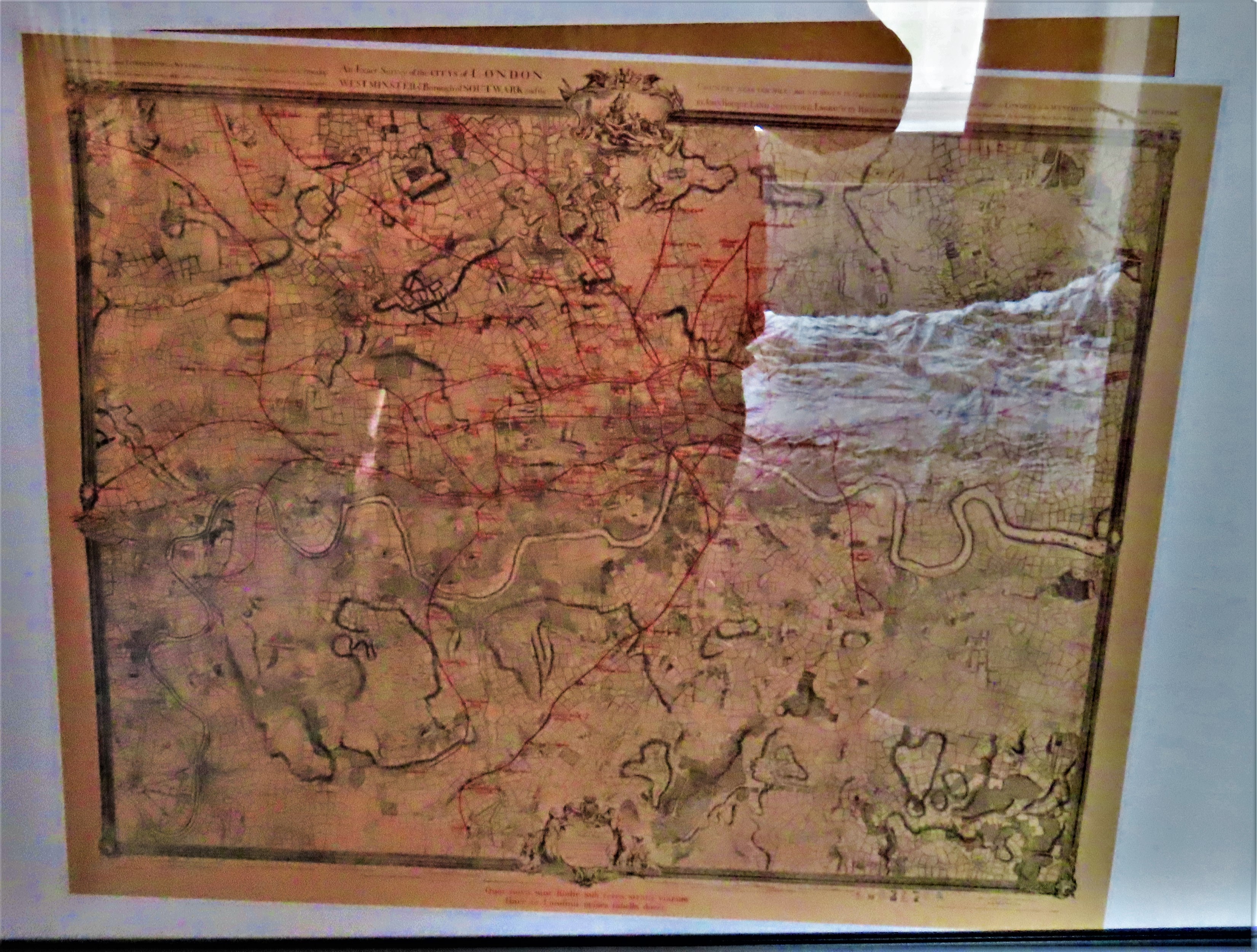
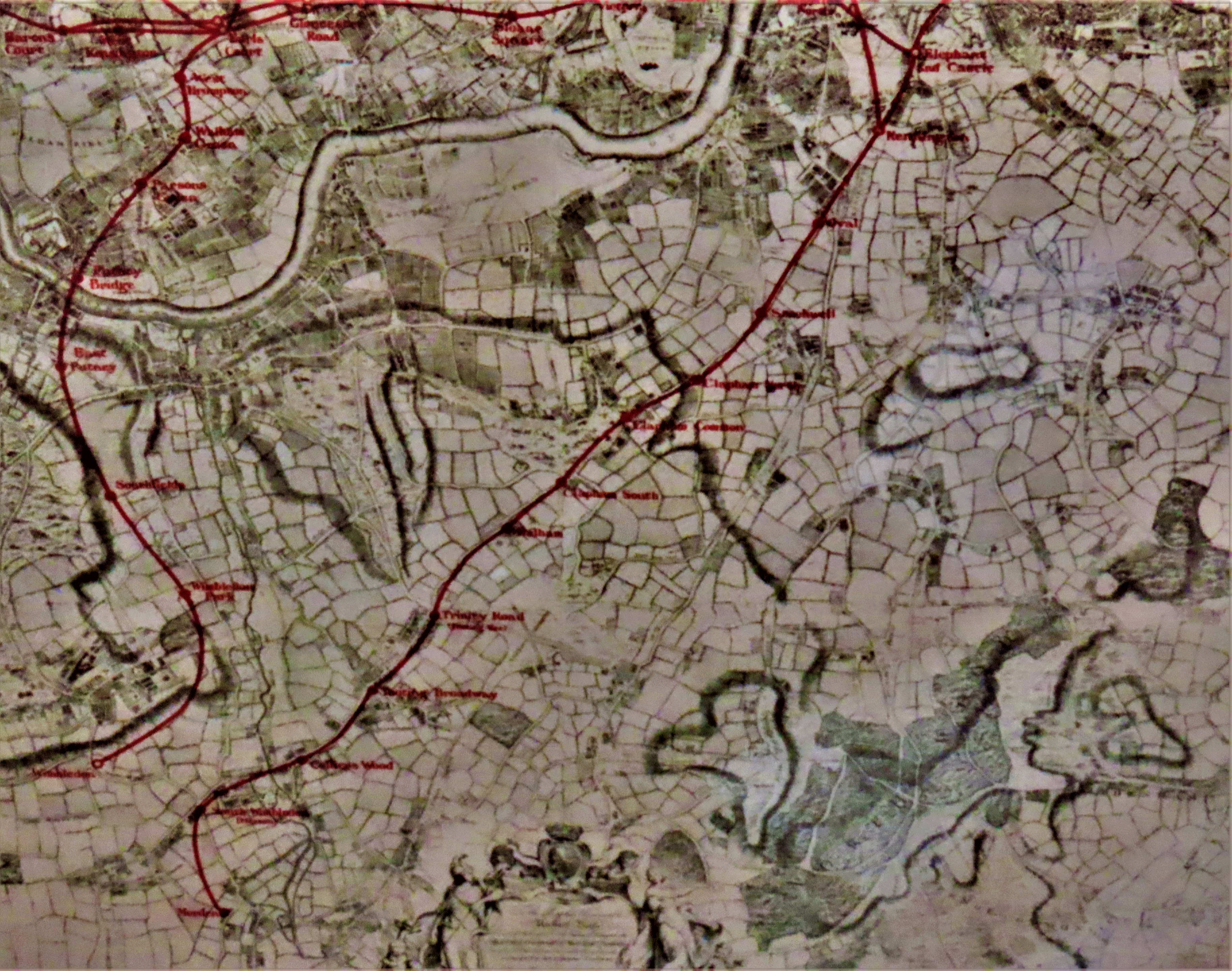
A combination of the cricket and solidly grey skies mean that I have few new bird pics, so I got one of my favourite old railway maps out to augment the gallery…

England’s Ascendancy

My account of the first day of India v England in Chennai, plus some photographs.

This post deals with day 1 in Chennai, where India and England have been doing battle. For those of us here in the UK coverage has been available on Channel Four for TV fans (which I am not – don’t look here for any comments about TV coverage) and on Talksport 2 for radio fans who want live commentary (TMS have been running a ‘cricket social’ on n 5 live sports extra). The time difference between the UK and India, and my preferred methods of following the game meant that at 3:45AM local time I was tuned into talksport2 and had a cricinfo window open on my computer for extra detail.

PRELIMINARIES

England were without Zak Crawley due to injury but did have Stokes, Pope and Archer all available and all were duly selected. England also departed from their stated rotation policy with the veterans and gave Anderson a second successive match. Fortunately, for all that some who should have known better were spruiking such a move England did not pick Moeen Ali. The selected lineup was thus: Sibley, Burns, Lawrence, *Root, Stokes, Pope, Buttler, Bess, Archer, Leach, Anderson. India meanwhile had lost left arm spinner Axar Patel to injury. Somewhat surprisingly they opted not pick wrist spinner Kuldeep Yadav, going instead for deepening their batting by picking both offspinners, Sundar and Ashwin, both of whom are handy with the bat alongside a debutant left arm spinner, Shahbaz Nadeem. Joe Root won the toss and chose to bat. Indian skipper Kohli, being a sensible chap, did not resort to the ‘psychological ploy’ of saying that he would have bowled anyway (note to captains who still do this, no one is buying it, OK?) opting instead for honesty.

THE PLAY

The morning started quietly, but with no great trouble for England. With 15 minutes to go until lunch the score was 63-0, but then Burns essayed a reverse sweep, not wise on day one of a test match and especially not so close to lunch, and edged the ball to Pant who took the catch. In the next over the unfortunate Lawrence got an absolute beauty from Bumrah and was pinned LBW and it was 63-2. The third umpire then spent ages agonizing over a decision on a potential run out after Root was a bit dozy, but fortunately he had made his ground. England took lunch at 67-2, and Root and Sibley were able to regroup. Post lunch scoring was slow initially but neither batter looked in any real trouble. Things picked up somewhat in the second half of the afternoon session and England reached tea at 140-2, with Root playing superbly and Sibley doing precisely what he was in the side to do: bat time and get some miles into the bowlers legs.

After tea Root hit the accelerator, while Sibley continued to be an excellent foil at the other end. Sundar was bowled comparatively sparingly, and was expensive and sadly posed little threat. Nadeem’s debut was marred by the bowling of several no-balls (pretty much inexcusable for a spinner), leaving only Ashwin as genuinely threatening spinner. The faster bowlers were better, Ishant being accurate enough to command respect at all times, and Bumrah bowling splendidly and deserving rather more reward than he actually got.

There were three scheduled balls of the day remaining and we were deep into the half hour over spill in which overs can be bowled when another corker of a ball from Bumrah pinned Sibley LBW. Because we were already over time, the dismissal ended play for the day, which means that England will resume on 263-3, Root 128 not out and Stokes the new batter. Root’s innings was a gem, his handling of the spinners especially brilliant. Sibley was rocklike until that fourth last ball of the day beat him, and his determined effort should not be overlooked. Root’s first innings scores in his last three tests have been 228, 186 and now 128 not out with power to add. In terms of an English batter going big successively in two different away countries I can think only of Hammond in 1933 who scored 101 and 75 not out in the fifth and final Ashes test and then produced scores of 227 and 336 not out in New Zealand in the next two games as a performance to rival Root’s.

Sundar’s figures of 12-0-55-0 indicate the problem with picking someone in a bowling role based on their batting ability, and underline the rightness of England not selecting Moeen Ali who is undoubtedly a less skilled practitioner with the ball than Sundar.

Root and Stokes need to get England through the first hour of tomorrow, and then England should have India where they want them. Root after the close made it quite clear that England are aiming to go big, and on this surface which appears to be very unresponsive that is necessary – I reckon that at minimum England need to double their current score before they can feel in control of things. However, I would much rather be in their shoes than India’s at the moment, hence the title of this piece.

PHOTOGRAPHS

There has been some sun today, and the finches are out in force here in North Lynn…

Scorchers Through to #BBL10 Final and England’s No3

An account of the ‘Challenger’ match between Scorchers and Heat, a note on the England no three situation, a link to an important petition and some photographs.

While the main part of this post deals with today’s ‘Challenger’ match, the penultimate game of BBL10, I will also be touching on the question on England’s no 3 with Crawley injured.

SCORCHERS OUTCLASS HEAT

A quiet opening over from which four runs accrued gave no hint of the fireworks that were to follow. The second over bowled by Mark Steketee went for 13 and Scorchers were properly off and running. Bartlett bowled the third, and his second, saving him from what have been a sixth ‘supersubbing’ of the tournament and at the end of it Scorchers were 23-0. 10 came off the fourth over and Scorchers at 33-0 were going reasonably. They moved into higher gear immediately thereafter, cashing in on Bartlett being given a third successive over by taking 14 from it, and then adding another 14 of the leg spin of Swepson in the next over. Heat’s second leg spinner, Labuschagne, was lucky to escape with his first over going for only nine. By the halfway point Scorchers were 108-0 and looking at a monster total. They did not claim the Power Surge immediately, while the expected ‘supersub’ by the Heat bringing Morkel on for Steketee did happen. With Livingstone falling in the 12th for a magnificent 77 off 39 balls Scorchers endured their only quiet spell, overs 11-14 yielding them 19 for the loss of that wicket. At that point, with Bancroft set and Mitch Marsh starting to go well they took the Power Surge, and they took 22 off the first over thereof, and then 11 more off the second to be 160-1 after 16. They maintained the momentum thereafter and were 189-1 off 18.1 overs when the rain came down.

The interruption lasted long enough to terminate the Scorchers innings and eat into the number of overs available for the Heat to chase in. The resumption came with Heat facing a DLS adjusted target of 200 off 18 overs, four overs of Power Play at the start, but controversially only one over of Power Surge later on. Scorchers used both their Power Surge overs, and did so with devastating effect as shown above, and if after 18.1 overs they had failed to do so there would be no real cause for compensating them for their own stupidity in delaying the surge so long. 200 off 18 overs was a fair enough target given that Scorchers had they had their full 20 would have been somewhere in the region of 215-220 or approximately 11 an over, precisely the task facing Heat, but I do feel that Heat should have had two overs of Surge and not one. I do not for one instant believe that this slightly harsh treatment of Heat affected the result in any way.

Heat made a bright start, scoring 32 off the first three overs, to be not a million miles behind the rate. Disaster struck in the next over however, when openers Denly and Lynn fell in successive balls – Denly caught off a skyer during which the batters crossed and Lynn bowled by the next ball, to end the Power Play at 37-2, with Labuschagne and Heazlett together. Heazlett was unable to even threaten to repeat his ‘Sambulance rescue’ act from Heat’s previous match, and at the halfway point Heat were 66-4, needing 134 off nine at 14.89 per over to win. In a last desperate gamble they claimed the Power Surge hoping to revive their innings, but they could only take nine off their single over of Surge and at 75-4 after ten needed 125 off eight overs to win. By the end of the 12th over they were six wickets down and all but out. A flourish in the next period saw them boost the score to 121-7 after 15, but 79 off three overs is not something that one can expect be achieved, especially by lower order batters. In the end Heat just brought up the 150 with a boundary off the last ball of the match, finishing on 150-9, fully 50 short of the target. Scorchers will thus face Sixers in Saturday’s final, and one hopes there will not be another AJ Tye deliberate wide to end that one.

My only mild criticism of Scorchers today is that they should have taken the Power Surge immediately at 108-0 after ten, rather than enduring that brief quiet patch in overs 11-14, but their timing of the taking of the Surge was by no means foolish, and they did make brilliant use of those two overs of fielding restrictions. Heat did well to get as far as they did after a very poor start in the tournament, and Scorchers also made a slow start, although not as much as Heat, and are in their best form at the right time. Sixers have been superb throughout the tournament and will start the final, at the iconic SCG on Saturday, as favourites. In the end, the bizarre and byzantine qualification system and knock out stage has seen justice done with the two best sides locking horns in the final.

ENGLAND’S NUMBER THREE

England’s intention to revert to their preferred top three of Sibley, Burns and Crawley has been thwarted by an injury to Crawley. My understanding is that Crawley will definitely miss the first two tests, and that his place at no3 will be taken by Dan Lawrence. I approve of this – the other options available to England have even less appeal: Have Pope, returning from injury and with no experience of batting near the top of an order, bat at three, move the skipper up one slot from no4 when he has historically never performed at his best in the no3 slot and is enjoying a bonanza at no4, Stokes at no3, which would be a huge ask for an all rounder, or play Buttler as a specialist batter at no3, which is perhaps the least bad of the alternatives. England are definitely underdogs in this series and will need plenty to go right to have any chance, but if Sibley and Burns can see off the new ball, Lawrence manages something at no3 and at least one of the engine room pair of Root and Stokes can go seriously big they could have a chance.

LINK AND PHOTOGRAPHS

Just before my photographs, I have a petition to share with you calling for key workers to be given a pay rise. There is a screenshot below and I urge you to sign and share it by clicking here.

Now it is time for my usual sign off…

A Late Injury for England

An injury to Zak Crawley forces a rejig of England’s batting line up, and in the face of continuing hype for a Moeen Ali recall I once again point out the flaws with that idea.

With the first India v England test match due to get underway in Chennai in 33 hours time news has come through of an injury to Zak Crawley. Better news is that Ollie Pope is definitely fit, while the ridiculous news is that Moeen Ali is till being hyped for a test comeback.

REJIGGING THE ENGLAND BATTING ORDER

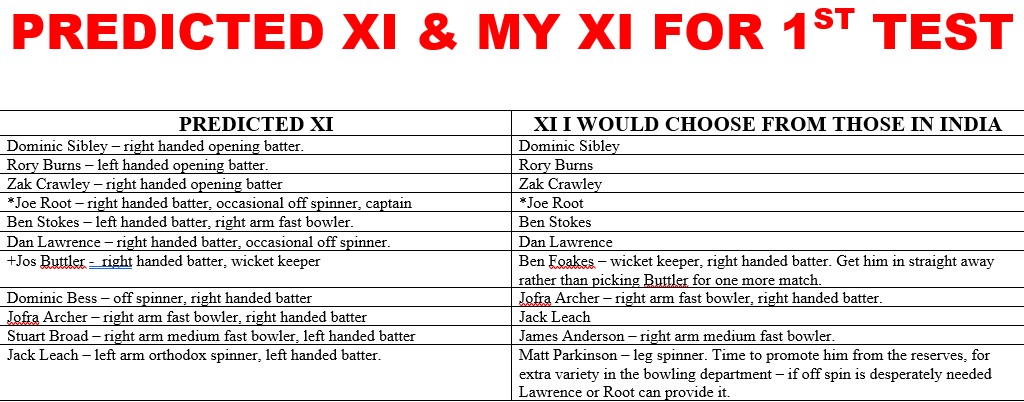
With Pope returning and Crawley injured, Dan Lawrence who made a decent start to his international career in Sri Lanka will come into the side. For me he goes in at number three, while Pope makes his return at no6. Thus, the team I expect to see is now: Sibley, Burns, Lawrence, *Root, Stokes, Pope, +Buttler, Bess, Archer, Broad, Leach and the team I would personally pick from those in India is: the same top six, and then +Foakes, Archer, Leach, Anderson, Parkinson. I explained in yesterday’s post why I favour the elevation of Parkinson, but I will not be especially annoyed if Bess retains his place, and I would accept a dogged insistence on strict rotation policy for the veterans. I will be furious if Moeen gets selected. Such a move would be doubly flawed: his record shows him to not be worth a place with either bat or ball, and it is a retrograde step bringing back an oldster.

TWO SPINNERS NEEDED

There is more than a possibility that India will have three front line spinners in their ranks, with the most likely trio being R Ashwin (off spin), Kuldeep Yadav (left arm wrist spin) and Axar Patel (left arm orthodox spin), although Washington Sundar (off spin) is also in the reckoning. Thus, for England to go with only one front line spinner plus Moeen as back up would be foolish, especially given that Root or Lawrence could bowl off spin if such was definitely warranted. The presence of two part time off spinners among the batters is a further reason for favouring the Parkinson/ Leach combo, maximizing the variation available to England. Without Parkinson playing the nearest England have to a leg spin option is Sibley, with a princely tally of four first class wickets to his name.

If England are up for a real gamble, and want to suggest a potential career development path to Bess, they could select all three spinners (Bess alongside Leach and Parkinson) and have Bess come in at number seven – he has shown some skill with the bat and I suspect a move up the order, maybe not so dramatically as the legendary Wilfred Rhodes, is in his future. Moeen Ali does not have enough to offer as a bowler, and very much belongs to the past. At no seven, as third spinner, where I am suggesting Bess he would be less of a disaster, but if he is at no8 in a team aiming for a more conventional balance England will be in trouble – you can only win a test match if you can take 20 wickets. It is time for my ‘spinners’ infographic to get yet another run out:

PHOTOGRAPHS

My usual sign off…

Looking Ahead to India v England

I look at England’s options ahead of the series in India which gets underway on Friday, with a particular focus on spin.

Before I get into the main meat of this post, a note on the coverage of this series: radio commentary is in the hands of talksport2, which means a less good commentary team than if TMS had the rights, while TMS will be running what they call a ‘cricket social’, which does not work anything like as well as commentary, and for TV fans the big news is that UK broadcasting rights have gone to Channel Four, the first time since 2005 that a terrestrial broadcaster has had such rights in this country. Radio coverage (the way I will be following the action) begins at 3:45AM on Friday our time, with the first ball scheduled to bowled at 4:00AM.

INS AND OUTS

Rory Burns is back from paternity leave, Ben Stokes and Jofra Archer are both available after missing the Sri Lanka tour, and the spin situation remains in flux. Burns will open with Sibley, with Crawley reverting to the number three slot from which he hit 267 against Pakistan not so long ago. Root will be at four. England seem to be being absolutely rigid in their rotation policy re Anderson and Broad, so his heroics in the second match in Galle notwithstanding Anderson is likely to be on the sidelines for this match. The most likely top six given continuing uncertainty over Pope’s shoulder, although he is with the tour party, would seem to be: Sibley, Burns, Crawley, Root, Stokes, Lawrence. Foakes is finally going to get another chance with the gloves, although probably not until match 2, with Buttler available this time, and that leaves the bowling to sort out. England will probably select two spinners given that the pitch at Chepauk Stadium, Chennai will take spin late in the game, which almost certainly means that Archer will be paired with Broad to take the new ball, though I would personally retain Anderson rather than be quite so dogmatic about the rotation policy with the veterans. This leaves the spinners to sort out.

ENGLAND’S SPINNING WOES

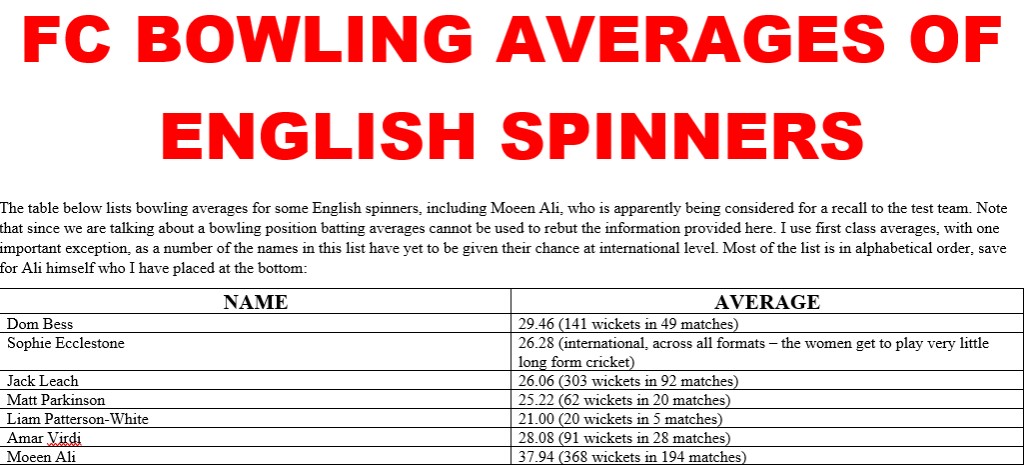
Current incumbents Jack Leach and Dominic Bess each had their good moments in Sri Lanka but each also looked innocuous at times, and Bess in particular struggled to keep things tight enough when nothing was happening as he bowled too many loose balls. Amar Virdi and Matt Parkinson are in India, officially as reserves, and also in India is Moeen Ali, a man in his middle thirties whose record (60 test matches, batting average 29, bowling average 37) is that of someone who is not up to the task in either department. There have been rumblings about a test recall for him, including an article published on the usually sensible Full Toss blog making what was supposed to be the case for his recall. Whatever the right answer to England’s spinning woes is it is not selecting an ageing mediocrity such as Moeen Ali. I expect that the selectors will persevere with Leach and Bess, but myself, for all that it makes the England lower order look a bit shaky I would be inclined to promote Parkinson (leg spin, FC average 25.22) from the reserves to partner Leach, with off spin if it is deemed necessary being bowled by either Lawrence or Root (skipper, please not the order in which I have listed these two options!). In the longer haul, rather than looking backwards to Moeen Ali, England need to look forwards, and in addition to Parkinson I suggest that Virdi, Liam Patterson-White and Daniel Moriarty as being worthy of attention, with Simon Harmer, now eligible for England, being considered as a stop gap solution so long as he accepts coaching younger spinners as part of his England duties. I might also consider whether Sophie Ecclestone’s left arm spin could prove as effective among the men as it has in the women’s game. Looking to the future, left arm spinning all rounder Lewis Goldsworthy will be worth keeping an eye on. Finally, England might not struggle so much to find spinners if counties who produced turning pitches did not find themselves the subject of sanctions from the ECB.

TWO ENGLAND XIS

I offer in infographic form two XIs for the match starting on Friday, the one I think we will actually see, and the one I would pick from those available:

PHOTOGRAPHS

Just a few pics today:

A Game That Neither Side Deserved to Win

An account of today’s BBL10 ‘Eliminator Round’ between Strikers and Heat, some suggested changes to the format of the tournament, and an acknowledgement of Pakistan’s victory over South Africa.

Before getting into the meat of today’s post, which deals with the ‘Eliminator’ round of BBL10, between Strikers and Heat, a word of congratulation to Pakistan, who completed a convincing win over South Africa by seven wickets. South Africa lost three wickets just before the close yesterday, as 175-1 became 185-4, and today they continued in that vein, being all out for 245, a lead of 87. Although Nortje bagged a couple of early wickets Pakistan were never in serious trouble, and fell appropriately to Fawad Alam to make the winning hit. His form since his recall to the colours makes one wonder how his team overlooked him for 11 whole years (not a record – George Gunn was called up by England after a lapse of 17 years between games, while in first class cricket there is the bizarre case of William Caesar who played two games in 1920 and four more in 1946, with nothing in between).

OVERKIND QUALIFICATION
SYSTEM EXPOSED

It is rare the a pom gets an opportunity to call Aussies soft with any hint of justification, but BBL10 has provided it. A qualification system that allowed five teams out of a total of eight to make it to the knock out phase (in the Vitality Blast eight teams out of 18 do so, while in the 50 over contest it has been six teams out of 18) look questionable from the get go, and today’s match was powerful evidence for the prosecution, as Strikers took on Heat in the ‘Eliminator’.

Heat have been at their most vulnerable this season when faced with a run chase, so the Strikers were correct to choose to bat first. However, even if you make the correct call, you do then have to play decent cricket, and this was where Strikers slipped up. All seemed good when they were 18-0 after two overs, but overs three and four went for only six runs between them, giving a Power Play score of 24-0. In Overs 5-10 Strikers failed to gain any momentum, as first Carey and then Head pottered about, barely managing to achieve a scoring rate of one run per two balls (Carey 13 off 22, Head 12 off 21). At the half way stage Strikers were 53-1, way below par, and they immediately claimed the Power Surge, also using the ‘x-factor sub’ rule to bring Wells in for Worrall in an effort to jazz up their batting. One wicket fell in the Surge, but Strikers also scored 16 off those two overs, and they seemed to be maintaining the momentum, although bizarrely Renshaw came in ahead of ‘x-factor’ man Wells, when they were 94-3 after 15, having scored 41 in the third quarter of their innings. A big finish was needed, and did not materialize. In the end Strikers finished with 130-7 from their 20 overs, with only Weatherald, Salt, and at the death Wes Agar having shown anything like sufficient intent.

Heat made an even worse start than Strikers had, not scoring especially quickly and losing the big wickets of Lynn and Labuschagne early. A third wicket went down in the fourth over, and Heat’s Power Play had yielded 24-3. In overs 5-10 Heat scored 44 without losing a wicket, being 68-3 at halfway, 15 runs ahead but two wickets behind Strikers at the same point. They declined to take the Power Surge, holding back, and in the 14th over Denly was out for 41 to make it 92-4. At the end of the 15th Heat were 98-4, needing 33 of five overs, and the 16th was economical as well. Then however Travis Head blundered, giving himself a second over when he could have had Siddle and Agar bowl through. It revived the Heat, as they were 110-4 at the end of it, and that point they finally did claim the Power Surge. They got eight off the first over with it, reducing the ask to 13 runs off two overs, and then Agar, who had had a fine tournament with the ball, cracked under pressure, the winning runs being accrued off five balls of his over. Jimmy Peirson finished unbeaten on 47, a fine knock, which earned him the Player of the Match award.

Strikers made a huge mess of their own innings, with as I have said, Carey and Head especially culpable. Heat were barely any more impressive, getting their tactics badly wrong and being saved by Head’s inexplicable decision to give himself a second over. Heat should have claimed the surge when Denly and Peirson were together and they could have had two set batters use it. Also, their selection of Heazlett backfired – the left hander was picked to counter Strikers’ spinners Briggs and O’Connor both of whom turn the ball away from the right hander’s bat and was out before he got to face either.

Tomorrow sees Scorchers and Sixers do battle, with the winner going straight into the final, while the loser whill face the winner of Sunday’s game between Heat (their reward for winning this one) and Thunder. I would guess that if they followed today’s action Thunder will be licking their lips at the prospect of Sunday’s game.

This was a game that neither side deserved to win, and that had the qualification system been sensible would not have been taking place – 4th and 5th out of eight have no business making it to the knock out stages of a tournament, and it looked every inch a contest between two moderate sides neither of whom really know how to win.

ORGANIZATIONAL CHANGES

I have already indicated what I think the qualification system should be: three teams qualify, group winners into the final, second vs third for the right to join them, with 2nd having home advantage.

I also feel the tournament would benefit from being more compact. A lot of the time there is only one game per day, with a few days featuring two games. With 14 rounds of group games I would play four fixtures per day, thereby having all eight sides in action, with a day off between rounds, meaning that the group phase would last 27 days in total, and then the two knockout matches would take place on successive days after two days off, making the whole length of the tournament 31 days – and it being an Aussie tournament I would make game day 1 Boxing Day, and the final to take place on Australia Day.

PHOTOGRAPHS

My usual sign off…

Test Cricket Returns to Pakistan and England Spinners

Looking at the resumption of test cricket in Pakistan and at the question of England spinners, as news arrives of a potential test recall for Moeen Ali.

This post contains two parts, a look at current goings on in Pakistan and a look at England spinners ahead of the upcoming tour of India. The feature infographic provides a brief version of why I less than impressed by news of a possible test recall for Moeen Ali, and I will cover it more fully in the second part of this post. All player details come from cricinfo.com.

SOUTH AFRICA IN TROUBLE

The first test match to be played in Pakistan for some considerable time is under way. South Africa, the visitors, batted first, and did not make a particularly good fist of it. No one in their top six scored less than 13, but only Dean Elgar with 58 managed to get beyond 23. It took a late 35 from George Linde to get South Africa to 220. Five of the top six (where most of the runs should come from) getting into double figures but not even reaching 25 suggests carelessness, and reports I have read of the wickets confirm that more of them were given than were taken.

Pakistan looked to faring even worse when South Africa reduced them to 33-4 by the close of the first day. However, Fawad Alam dug in, and found some good support from the middle and lower order. Alam ground out a determined century, with no8 Faheem Ashraf (fairly new to test cricket, but averaging 31 with the bat and 27 with the ball in first cricket) scoring 64. By the time stumps were drawn at the end of day two, Pakistan were 308-8, a lead of 88. I don’t think it will happen, but personally just for the psychological impact of telling the opposition “you had us 33-4 and now we reckon we have enough of an advantage to win” I would recommend an overnight declaration. It was not all bad for South Africa today however – their women recorded an impressive win in an ODI against Pakistan, Laura Wolvaardt scoring 58 – perhaps the men should give her a bell, as their top order could do with a bit of stiffening.

ENGLAND SPINNERS

Leaving aside Simon Harmer, now technically eligible for England but apparently not in the selector’s minds, England have a number of spinning options they could look at, and Moeen Ali, touted for a test recall in some quarters, is not in my opinion one of them. He pays 36.59 per wicket in test cricket, a marginal improvement on his first class bowling average of 37.94. His batting, which his supporters turn to next demands two retorts: firstly picking people for bowling slots based on what they can do with the bat is flawed, unless they have very similar bowling stats to someone with much less batting skill, and secondly at test level it does not pass muster anyway – while his first class batting average is a respectable 36.72, his test batting average is 28.97, at the good end of ‘bowler who bats’ territory but definitely nowhere close to all-rounder status. In other words England are thinking of recalling someone whose bowling is in the ordinary range of ‘batters who bowl’ (Hammond, who averaged 58.45 with the bat at test level took his wickets at 37.80 for example) and whose batting is at the good end of the range for ‘bowlers who bat’.

Dom Bess, one of the current incumbents, pays 29.46 for his first class wickets, and just over 30 each for his test victims. Sophie Ecclestone, a very successful bowler for England Women, averages 26.28 across the three international formats (the women play so little long form cricket that one has to look across the spectrum) – and yes, I would certainly rate her a better option for a spinner’s berth than Ali. Jack Leach pays 26.06 a time for his first class victims, and averages just over 30 per victim in test cricket. Matt Parkinson, yet to be given his chance at test level pays 25.22 per victim at first class level. Liam Patterson-White has played just five first class matches to date, but has 20 wickets in them at 21.00 a piece. Amar Virdi has paid 28.08 each for his 91 first class wickets. Finally, if you absolutely insist on someone with all round qualities, Lewis Goldsworthy had an excellent under 19 world cup, though he has yet to play first class cricket (it would not be entirely unprecedented for someone to make their first class debut in a test match). Moeen Ali sits firmly in the category of proven failures at the highest level, and any of the players I have listed would be better selections than him – all are young enough to improve, whereas he is not. My personal vote would go to Parkinson, the leg spinner, to support Jack Leach, with Bess coming in if the pitch looks it warrants three spinners (Bess takes wickets when the ball turns, but when there is no assistance for him he leaks too many runs for comfort due to his tendency to bowl the odd loose ball). Whatever the right answer is, it is most definitely not an ageing player who cannot be deemed worthy of a place with either bat or ball.

PHOTOGRAPHS

My usual sign off…

A Great Turnaround

My account of an astonishing final day of the Sri Lanka v England test series in Galle, complete with England player ratings and an acknowledgement of Lasith Embuldeniya.

This post deals with the events that unfolded in Galle today, which started with England very much second favourites.

ENGLAND FIRST INNINGS

England resumed 42 runs adrift with one wicket left in their first innings. Five runs were accumulated, four of them by way of a reverse sweep from James Anderson before the end came. Embuldeniya did not add to his seven wickets, but his day was far from done…

SRI LANKA SECOND INNINGS

Sri Lanka started their second innings with an advantage of 37, and plenty of time to build a daunting lead. Unfortunately they lost their heads rather dramatically. Jack Leach and Dominic Bess, bowling much better than they had in the first innings and assisted by some kamikaze batting from the Sri Lankans picked up wickets quickly. By lunch Sri Lanka were six down, and two more wickets fell soon after. There were two splendid catches, Crawley doing well to hang on to one that was hit out of the middle of the bat but straight at him, and Anderson getting underneath a swirling mishit. Embuldeniya, barely rested from his bowling stint, proceeded to play an innings that shamed most of his supposed betters with the bat, producing a first class career best 40 chock full of common sense. He succeeded in having Bess removed from the attack, but then he and no11 Asitha Fernando fell to successive Joe Root deliveries, leaving Sri Lanka all out for 126, and England facing a target of 164 to win.

ENGLAND 2ND INNINGS

Crawley did reach double figures for the first time in the series, but then honoured protocol by falling to Embuldeniya for the fourth successive time. Bairstow made a small contribution, Root failed, and Lawrence played a poor shot before he had given himself time to get a proper sight of the ball. At that point the score was 89-4, and England were by no means safe. Embuldeniya had three of the wickets, giving him ten for the match. Sibley was grinding away at one end, and was now joined by Buttler. Buttler batted sensibly, keeping the scoreboard ticking, although Sri Lanka were not doing nearly enough to make things difficult – singles were regularly there for the taking. As England closed in, Sibley completed a 50 which was worth more than a century on a flat track would have been. He had his good fortune, with a couple of close LBW appeals being turned down and being labelled “umpire’s call” by the DRS. However, the second of the two had hit him above the knee roll, and he is quite tall, so one can understand why it was considered too high by the umpire. Also, all fortune, good or ill, to one side, he showed an immense amount of character after a very poor series up to that point. Buttler just missed out on what would have been his second fifty of the match, but he was there at the end as England won by six wickets, to take the series 2-0.

THE PLAYER OF THE MATCH AWARD AND EMBULDENIYA

England’s win by six wickets effectively ensured that Joe Root, who had a second successive great game, would be player of the match. Had Sri Lanka bowled England out a second time and emerged victorious Embuldeniya would have been a deserving recipient, and even had the margin been three wickets rather than six he would have merited consideration. As it was a margin as comfortable as six wickets really did mean that someone from the winning team had to be chosen, and with all respect to Anderson and to Sibley for his gritty second innings effort Root was the only serious candidate. Root was also the Player of the Series, which was an absolute shoo-in. Embuldeniya’s combination of 40 and a 10 wicket haul got some of us thinking about other notable combinations of runs with big wicket hauls, and here are six of the best from test history:

  1. Melbourne 1883 – Billy Bates took seven wickets in each innings, including England’s first ever test hat trick, and scored 55 in England’s only innings
  2. The Oval 1902 – Hugh Trumble scored 64 not out and 7 not out and took eight first innings and four second innings wickets, but as with Embuldeniya could not win it for his side, England sneaking home by one wicket. Trumble had the best match aggregate for Australia with 71 runs, and bowled unchanged through both England innings for his 12 wicket haul.
  3. Alan Davidson 1960 – He took 5-135 in the West Indies first innings of 453, 6-87 in their second innings 284 and contributed 44 to Australia’s first innings 505 and 80 to their second innings 232, having to settle for a place in history as part of test cricket’s first ever tie, rather than a win.
  4. Ian Botham, Bombay 1980 (it was not called Mumbai in those days) – 6-58, 114 not out when no one else even topped 50, 7-48 in an innings victory.
  5. Imran Khan, Faisalabad 1982 – 6-98, 117, 5-82 in an innings win over India
  6. Richard Hadlee, Brisbane 1985 – 9-52 in the first innings, an all time test record for an out and out fast bowler, a blistering 54 (four of each kind of boundary) which enabled skipper Coney to declare with two full days in hand for Australia to be dismissed a second time, and six more wickets to finish the job.

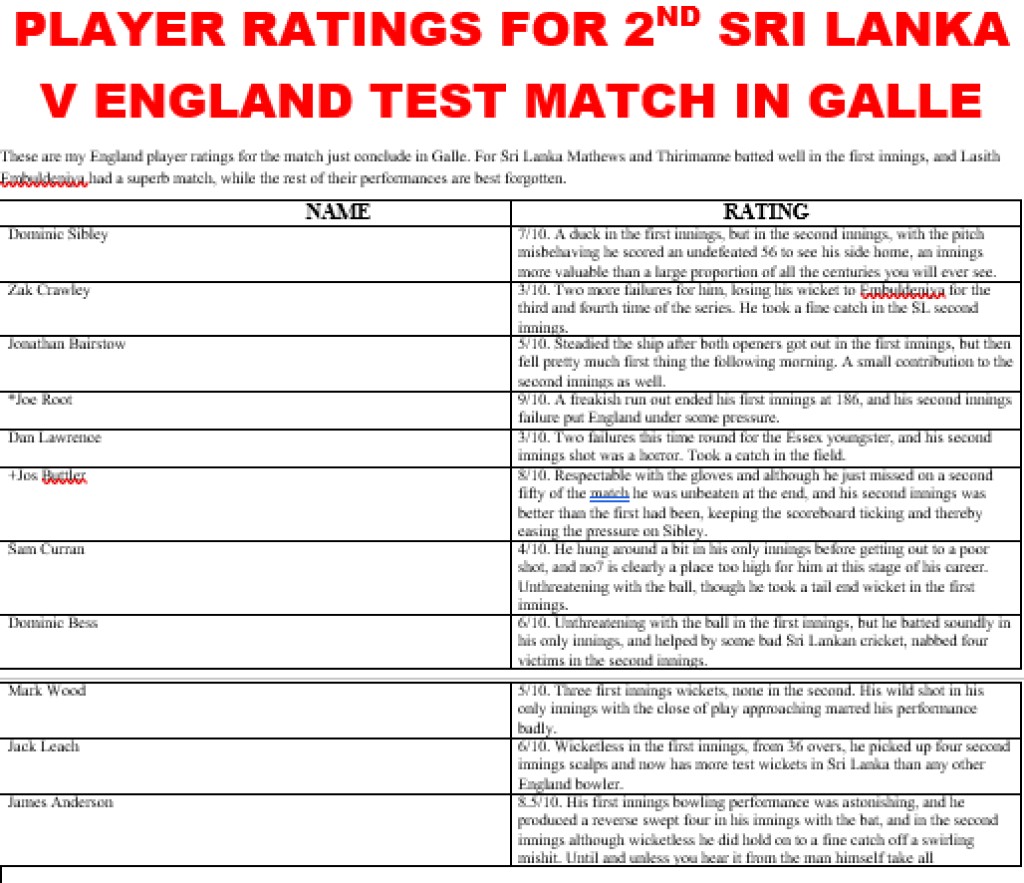
ENGLAND PLAYER RATINGS

Dominic Sibley – 7/10. His gritty second innings saved a dire series for him, and spared England some potentially major blushes, sending him and them on to India in good heart.

Zak Crawley – 3/10. Two horrific failures with the bat, but he did hold one fine catch during the Sri Lankan second innings.

Jonathan Bairstow – 5/10. stabilised the ship in the England first innings after both openers had gone cheaply, but did then get out first thing on the following morning. A modest contribution to the second innings. Although he batted well at times he never did so for long enough in this series, as evidenced by a highest score of 47.

Joe Root – 9/10. 186 in the first innings, a couple of wickets to end the Sri Lankan second innings, but a failure at a crucial moment in the England second innings blotted his otherwise stellar copybook, costing him one mark.

Dan Lawrence – 3/10. A double failure with the bat this time, and his second innings shot was quite awful. He did take a catch in the field along the way.

Jos Buttler – 7/10. A fifty in the first innings, just missed out on that mark in the second, but played a crucial role in seeing England home. A competent effort with the gloves.

Sam Curran – 4/10. Largely unthreatening with the ball, though he did bag a wicket in the first innings, he hung around briefly with the bat, but did nothing to alter the impression that no7 is a place too high for him in a test batting order.

Dominic Bess – 7-10. His first innings bowling was largely unthreatening, he played a fine support knock in England’s first innings, and bagged four wickets in the second innings.

Mark Wood – 5/10. Three first innings wickets, none in the second. His shot near the end of day three was a poor one, and an absolute shocker in the circumstances.

Jack Leach – 7/10. Toiled through 36 overs in the first innings, getting no wickets. Bowled well in the second and was rewarded with four wickets. He now has more wickets in Sri Lanka than any other England bowler.

James Anderson – 8.5/10. Without his bowling in the first innings England would have been buried – SL would have had over 500 on the board. In the second innings he did not get among the wickets but did take a fine catch, doing well to get under a swirling mishit.

This is England’s fifth successive away test victory, their best run on foreign soil since they followed victories in the last four matches of the 1911-2 Ashes with another three to start the 1913-4 tour of South Africa. The bowling spearhead then was another right arm fast medium with Lancashire connections, albeit more to league cricket than to the county, Sydney Francis Barnes, and he was just a shade older than Anderson is now, being past 40 by the end of the South African series. India will be a much tougher tour – this Sri Lankan team are not used to winning, and that manifests itself in an obvious lack of killer instinct at key moments, whereas India surmounted huge difficulties to best the Aussies in their own backyard.

PHOTOGRAPHS

I end as usual with some photographs…

Sri Lanka In Control In Galle

A look at day two of the second Sri Lanka v England test and some of the issues raised by it.

This post deals with day 2 of the second Sri Lanka v England test match in Galle, and tackles a couple of related issues.

ANDERSON AND THE REST

England achieved their first goal of removing Mathews early on day 2, for 110, but Dickwella who just missed out on a maiden test hundred and Dilruwan Perera with a fine half century took Sri Lanka to 381. James Michael Anderson finished this innings with the following figures: 29-13-40-6. Mark Wood, bowling consistently fast, took three wickets, and the other fell to Sam Curran’s left arm. Both front line spinners, Bess and Leach, were therefore wicketless, and neither posed much of a threat.

EMBULDENIYA’S BUNNIES

The England innings started almost on repeat from the first match, left arm spinner Lasith Embuldeniya being entrusted with the new ball, in company with veteran seamer Lakmal on this occasion. Sibley was first to go, pinned LBW (he reviewed, an effort bad enough to be almost worthy of the adjective ‘Watsonian’ in “honour” of the legendary Shane Watson, but the decision was correctly upheld), and then Crawley snicked one into the slips and England were 5-2, and in three innings to date Embuldeniya has now dismissed both openers all three times, without a double figure score from either. Root and Bairstow steadied the ship, and reached the close at 98-2, Root 67 not out. I was actually involved in a video conference at this time, so did not catch this passage of play. To give themselves a chance, given that the ball is already starting to turn, England will need to bat all day tomorrow as a first requirement. To do this they could do with someone other than Root producing a major performance with the bat. Looking ahead, England go to India next, and although Ravi Jadeja is injured, the Indian squad named for this series features Axar Patel, like Embuldeniya, a left arm spinner, and there is a strong case for India giving him the new ball alongside Bumrah, now recovered from his own injury. This strategy of pairing a left arm slow bowler with a right arm fast one at the start of an innings is nothing new. It used to be considered standard just over a century ago. Kent had their greatest period, four county championships in seven seasons, with Arthur Fielder and Colin Blythe, just such a combo, as their new ball pairing. Lancashire had a decade earlier used Mold and Briggs to similar effect. In the 1912 Triangular tournament England more than once used Syd Barnes and Harry Dean as an opening pair, and on one occasion Barnes and Frank Woolley did the honours. Australia’s lowest ever test innings score of 36 all out was made in the face of Rhodes (SLA, 7-17) and Hirst (LFM, 3-15) at Edgbaston in 1902. Sri Lanka’s reinvention of the cricketing wheel is working well for them.

ENGLAND OPENERS

The disastrous time Sibley and Crawley are having at the hands of Embuldeniya has naturally raised the question of whether to continue playing them or not. Whatever the correct answer is, I know what is not correct, though it is being advocated by various people: a recall for Keaton Jennings, a man with a Brearleyesque batting average and without the captaincy skills. For the India series Burns will be available, and he will fill one of the openers slots. I would revert to the Sibley, Burns, Crawley top three and hope it works. For the second innings of this match there is a potentially bigger problem, but it is hard to see a tactical adjustment of the batting order working, as Embuldeniya will surely be called up for a bowl as soon as either Sibley or Crawley appear.

There are some good young top order batters in county cricket, and I would rather look to them than to a never-really-was like Jennings.

THE ‘BRANDERSON’ ISSUE

England’s stated policy is rotate the two veterans, James Anderson and Stuart Broad, but they may well have to rethink – to leave Anderson out after his performance here would look odd to put it mildly. At home against New Zealand and India both should play, while for the Asheis it will depend on form and fitness, but I would be looking as follows: Brisbane – Broad, Adelaide – Anderson, Perth – neither, if all are fit I would go with the outright pace of Archer, Wood and Stone, Melbourne – both, Sydney – Anderson.

PHOTOGRAPHS

My usual sign off: