
The Group Stage of #BBL10: A Retrospective

A look at the 56th and last group game of #BBL10, an analysis of the qualification system, a look at the innovations in this year’s BBL and some photographs.

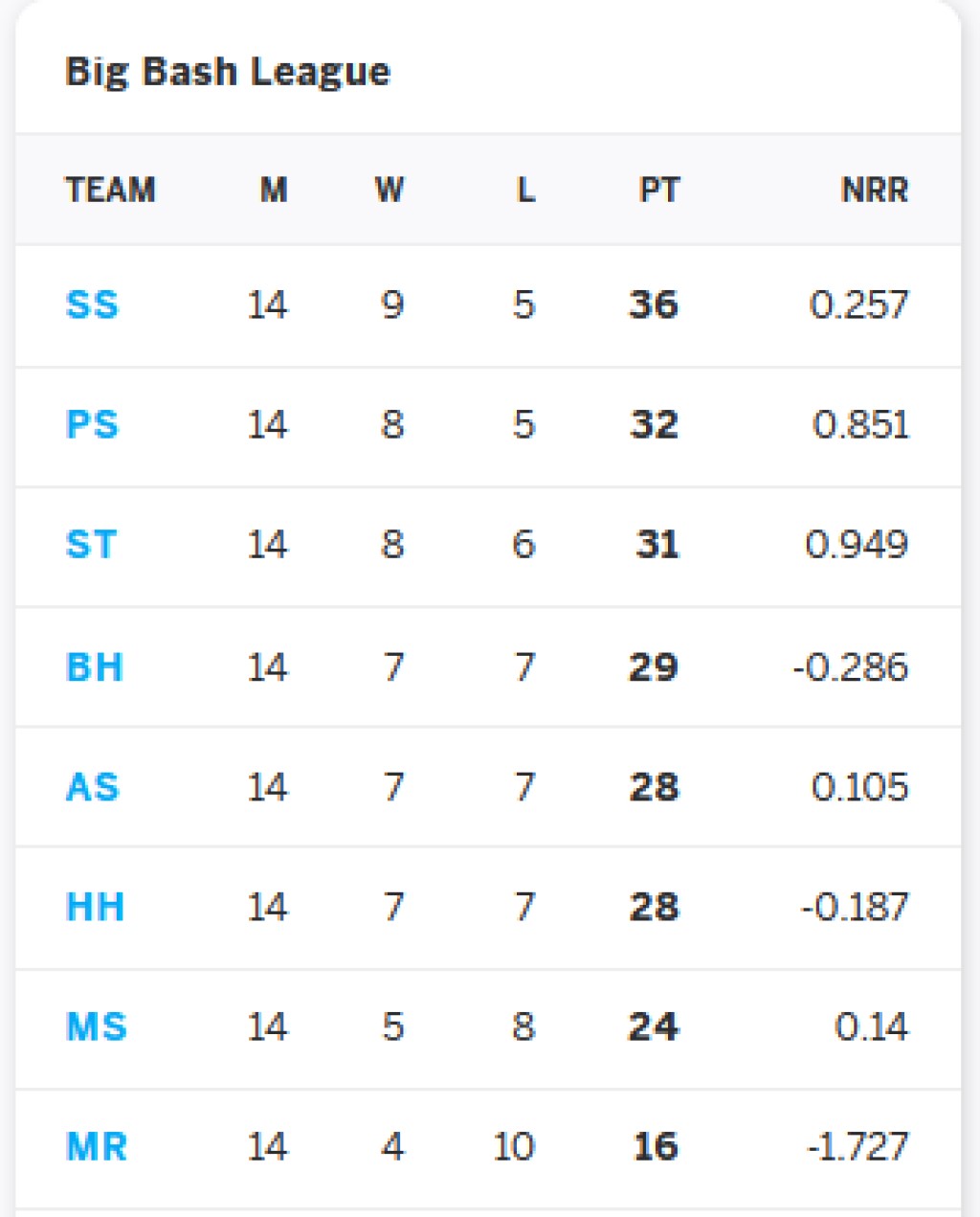
The graphic which heads this post is the final group table of BBL10, screenshotted from cricinfo.com. In this post I look back at the 56th and final group game, analyse the qualifying system in place for this tournament and offer final views on the three innovations. I would like to say at this point, in case the rest of this post gives a wrong impression, that I have enjoyed the tournament, and my criticisms are offered in a constructive spirit.

STARS STUFF UP SEES THEM CRASH OUT OF BBL10

With Heat beating Scorchers to secure a qualifying place and Renegades final act of the tournament being to eliminate the Hurricanes the 56th and last group game, commentary of which was broadcast on five live sports extra presented a stark situation to the two combatants: Stars needed the full four points (three for the win and one for the Bash Boost) to qualify (with a sensible qualifying system they would already have been gone – more on this later). Sixers meanwhile needed the Bash Boost point at minimum to win the group, and a victory of any sort to do so outright rather than on net run rate.

With Stars needing all the points they had to get big runs in the first ten overs of their innings, but they failed to pick up this message. Nick Larkin, a known slow starter, was sent in at number three, and in this case provided the expected slow start and then failed to go on (11 off 16 balls). Then, at the end of the tenth, setting the Bash Boost target, Nic Maddinson came back for a second on the penultimate ball rather than leaving the big hitting Maxwell on strike. Two more accrued of the last ball of the tenth, leaving Stars on 72-3, and a modest target for the Sixers to claim the all-important first point of the game, which would ensure no Melbourne participation in the final stages (Renegades’ win had not altered their final position – last).

Overs 11-15, which included the Power Surge being taken for overs 14 and 15 were the best part of Stars’ day, as they scored 52-1 in that period to reach 125-4 at the three-quarter mark. They lost a little momentum in the closing stages, but three sixes in the final over boosted them to 177-6, a respectable total, though not very relevant as their poor handling of the first ten had likely cost them any chance of qualifying.

Faced with the situation they were in Stars should have front loaded their batting with all their biggest hitters, realising that their 20 over score would only be truly relevant if they went big in the first ten. Nick Larkin as a known slow starter should probably not have been picked for this match at all.

Sixers lost a couple of early wickets, but by the end of their four over power play were 43-2, 11 runs ahead of Stars at the same stage. They also outscored Stars in the second phase of the innings, albeit only by two runs, being 85-3 at the halfway point, and having already won the war, securing their own status as group winners and the elimination of the Stars, although a Pyrrhic victory in the final battle remained on for the Stars.

Overs 10-15 did not go especially well for the Sixers, who reached the three-quarter way stage at 126-5, 1 run ahead, but one wicket behind the Stars. They picked things up in the final quarter however, and in the end a boundary struck by Dan Christian of the penultimate ball of the match ensured that Stars would not even have a Pyrrhic victory to finish. Sixers deservedly topped the group, and I for one have no sympathy for the Stars, who made a complete mull of their approach to this game, and who in the words of Anne Robinson “Leave with NOTHING.”

A FLAWED
QUALIFICATION SYSTEM

Although it lent a few of the final group games an interest they might not otherwise have had, a qualification system that allows five teams out of eight to progress to the knockout stages has to be considered flawed. Firstly, in order to reward each qualifying team according to their placement the knockout phase is byzantine in the extreme. Secondly, it means that average teams are being rewarded – the teams in the 4th and 5th qualifying spots each recorded seven wins and seven losses, which does not deserve to be enough to progress. Tournaments that are organized on part league part cup lines should reward only teams who are exceptionally successful in the league phase – and losing as many games as you win is not exceptionally successful on any definition. My own preferred method for an eight team tournament would be as follows: three teams qualify for the final stages, the group winners going straight through to the final, while the second and third place teams play off for the right to join them, with the second placed team having home advantage by way of reward for doing better than the third placed team. This would make the tournament more compact by reducing the number of knockout matches, although they also need to have more days on which multiple matches are played in the group stages, and would ensure that only teams who are clearly better than the rest get to play in the knockout matches.

THE THREE INNOVATIONS

BBL10 featured three innovations this year: the Power Surge, reducing the opening Power Play from six overs to four, with a two over Power Surge to be claimed by the batting team at any point after 10 overs, the Bash Boost point, awarded to the team with the better score at the halfway stage, and the ‘x-factor’ sub where specifically at the halfway stage of the first innings each team may swap out one player for one of their designated ‘x-factor’ subs. I am a huge fan of the Power Surge, though a number of teams have misused it, being wary of going early and ending up without front line batters to cash in on it, and would like to see it adopted in other T20 competitions. The Bash Boost point has overall been a success, although a combination of the importance it assumed today, and Stars’ flawed approach caused it to spoil this particular game somewhat, and again albeit under a different name, it might well be worth other T20 competitions adopting it. The ‘x-factor’ sub rule belongs in the circular file, and has in my view contributed nothing to the tournament. If you need to alter the balance of your side after the start of the game, the one valid reason for using such a sub, you should have got it right first time.

PHOTOGRAPHS

My usual sign off:
Some BBL Thoughts and All Time XIs Revisited

A look at the innovations featured in the tenth edition of the Big Bash League and a visit to all-time XI territory, with place names the link on this occasion.

A two-parter today, first looking at the innovations featured in this year’s Big Bash League and then, inspired by something I noticed during commentary on today’s weather hit game a revisit to all-time XI territory.

BBL INNOVATIONS

The current version of the Big Bash League, the tenth running of said tournament, features three innovations, and I shall touch on each in turn:

  1. Power Surge: instead of a straight six overs of power play and then 14 of standard fielding restrictions there are now four overs of power play, and then a Power Surge of two overs, to be claimed at any time after 10 overs at the behest of the batting side. This has been a really successful innovation, with a lot of thought going into to when to take it. Ideally you would want two set batters at the crease to maximize the potential gain, and also to be quite close to the end of the innings to use it as a kind of springboard into a big finish. I can see the possibility of claiming it for overs 11 and 12 if the openers are still together, on the understanding that a big hitter will be promoted to cash in on it if one of the openers falls. If that is not an option then if two batters are going well at the end of the 15th over, claiming it for overs 16 and 17 with a view to really making the final quarter of the innings pay would appeal. I do not share TMS Commentator Simon Mann’s view about taking it for the last two overs of the innings being a good notion.
  2. Bash Bonus Point – a bonus point is awarded to the team who score more from their first 10 overs, while three are awarded for the outright win. This has led to some interesting situations where teams knowing that overall victory is effectively out of the question go all out for being ahead after 10 overs in an effort to salvage something, as opposed to concentrating on surviving the full 20 overs so that their net run rate does not take a hammering. I consider this to be a success, although I could see a situation where a team gets knocked out due to this innovation, and fans would not be happy with that.
  3. The ‘x-factor’ sub: players designated for this role before the game may be brought in (no more than one per side) after a maximum of ten overs of the first innings of the match. The substituted player must not have batted and may not have bowled more than one over (sensible caveats which prevent a specialist batter being used and then replaced by a specialist bowler, and vice versa). I have witnessed only two matches (via TMS commentaries) in which these players have been used, one of them today’s no-result. I have waited until I had actually seen the usage of such players before commenting on the innovation, but I have seen nothing to alter my initial thinking that if you actually pick your best XI at the start you should not need to make use of this option, and the fact that uptake of it has been very limited is itself a comment on the innovation. Thus I score these innovations at two out of three.

A PLACE NAMES XI

One of the players who featured in today’s match was Joel Paris, a left arm pace bowler, which started me thinking about players who have places in their names. I set myself rules that the place name must be the whole of on the player’s names, not part thereof, and that it must be spelt the same way (as you will see later this latter was germane). After I have been through the batting order I will explain some of those who missed out for one reason or another.

  1. Sir Leonard Hutton – right handed opening batter, occasional leg spinner. Hutton is a place in Essex, on the edge of Shenfield.
  2. Sidney George Barnes – right handed opening batter, occasional leg spinner. A combination of World War Two and the fact that he and the authorities did not always get on limited his test career to 13 matches, in which he recorded an average of 63. Barnes is near Putney, either southwest London or Surrey depending on who you consult.
  3. Frank Woolley – left handed batter, left arm orthodox spinner, excellent close fielder. Woolley is a small village, almost precisely equidistant between Barnsley and Wakefield in Yorkshire.
  4. Ken Barrington – right handed batter, occasional leg spinner. Upper and Lower Barrington are a matched pair of villages in Gloucestershire (Marcus Berkmann mentions them in one of his books about life in cricket’s lower reaches).
  5. Victor York Richardson – right handed batter, fine fielder, occasional wicket keeper. A fine test batter in the 1920s and 30s, and grandfather of two others, Ian and Greg Chappell, his middle name gets him into this team.
  6. *Warwick Armstrong – right handed batter, leg spinner, captain. I rated him the finer of the two regular test captains in this line up, and anyway I wanted Hutton free to concentrate on his batting. In the 1905 tour of England he scored over 2,000 runs and took over 100 wickets in first class matches.
  7. +Jack Blackham – right handed batter, wicket keeper. He played in each of the first 17 test matches ever contested and is regarded as one of the greatest of all keepers. Blackham is a small village almost exactly equidistant between East Grinstead in Sussex and Tunbridge Wells in Kent.
  8. Washington Sundar – off spinner, left handed lower order batter. The 21 year old Indian has been making a name for himself in T20, but he also has a more than adequate FC record, averaging 31.29 with the bat and 26.93 with the ball in that format.
  9. Joel Paris – left arm fast medium bowler, left handed lower order batter. His first class averages are just the right way around – 23.38 with the bat and 23.25 with the ball.
  10. Sydney Francis Barnes – right arm fast medium bowler, right handed lower order batter. In the case of Sidney Barnes the batter I had to use his surname as the place name, but this greatest of all bowlers qualifies twice over, since his first name Sydney is spelt the same way as Australia’s largest city.
  11. Ian Peebles – leg spinner, right handed lower order batter. Peebles is due south of Edinburgh.

This team has a deep batting order, a very varied and strong bowling attack, and would definitely give a good account of itself. Now for some honourable mentions:

William Maldon Woodfull, a fine opening bat and captain for Victoria and Australia would qualify by virtue of his middle name, which is a place in Essex and also the place in Victoria where he was born. Anthony William Greig, an attacking middle order bat good enough to average 40 in test cricket and a decent bowler of both medium pace and off spin missed out by a single letter – the Cornish seaside village of Antony not having an H in its name. Rahkeem Cornwall might have replaced Washington Sundar without unduly weakening the team (he is also an off spinner and more than useful lower order batter). Had I allowed myself to reach back a few hundred years to a long antiquated spelling of a place near York, which is now always spelt Bootham, as it is pronounced, I could have accommodated Ian Terrence Botham – the single o spelling was once a thing. Arran Brindle, a batter for England women who has at least one century in men’s club cricket to her name, could have got in via her first name. Ian Peebles’ place in the XI could have gone to either of two other leg spinners, Richie Benaud, whose name derives from a village in France, but who I would have heading the commentary team, and Amanda-Jade Wellington. Finally, I was tempted to find a place for Mike Gatting who shares a surname with a legendary former UK constituency. The old Gatting constituency, disenfranchised in 1831, contained one grand house, and it happened on one occasion that the butler had a quarrel with the master of the house and stood against the master’s son (the master by this time considering himself to old to be a candidate). The master voted for his son over the butler and that was that.

PHOTOGRAPHS

Now it is time for my usual sign off: