Day 1 of the 2nd SLvE Test at Galle, the Future of Test Cricket and The Draw

An account of day 1 in Galle and mentions of a couple of related topics.

This post is a three parter, beginning with the action from Galle, and then touching on a couple of other topics drawn to my attention while I was following the action in the final two sessions of the day by way of radio commentary and a cricinfo tab open for extra detail (I listened to the first session in bed, as the coverage began at 4:15AM UK time).

ANDERSON SHINES BUT SRI LANKA SHADE THE DAY

England’s only change to their XI from the first match was to follow their planned rotation policy with regard to the veterans, bringing Anderson in for Broad. Sri Lanka had Oshada Fernando come in for Kusal Mendis, and Lakmal for Hasaranga. Sri Lanka won the toss and chose to bat, and were very quickly two down, both wickets to Anderson on his return. Thirimanne and Mathews then saw Sri Lanka through to lunch at 76-2. That became 76-3 as Anderson struck instantly on the resumption, removing Thirimanne. Mathews went on, finding another staunch ally in Dinesh Chandimal. Chandimal fell to Wood, the fast bowler’s first wicket of the series, for 52. Mark Wood has been consistently in excess of 90mph this series, and the wicket was long overdue reward for toiling through over 230 balls in the heat of Sri Lanka. It was England’s last success of the day, as Mathews completed a fine hundred, and Niroshan Dickwella reined in his natural aggression to survive to the close. At the end of day one Sri Lanka were 229-4 from 87 overs (yet again, with England in the field the over rate was abysmal and even with the half hour overrun period and no weather interruptions three overs have vanished from the game), Mathews 107 not out, Dickwella 19 not out, James Anderson 19 overs, 10 maidens, 24 runs, three wickets, an outstanding display of bowling from the oldest player on either side. Overall the pitch was flat, and no bowler really got anything out of it. With the pitch likely to break up and/or crumble later in the game Sri Lanka definitely took the honours of day 1, and England will need to strike quickly tomorrow morning to avoid finding themselves in trouble.

TEST CRICKET’S FUTURE

Some people seem to be oblivious of the amazing series that has just concluded between India and Australia, and to be persisting in their belief that test cricket is in trouble. A link to a Telegraph piece arguing that players who play white ball matches should be banned from red ball cricket did the rounds on twitter today. The Telegraph articles are paywalled, and since I consider it a vile rag and absolutely will not countenance contributing to its coffers I have not read it in full, but the headline is enough to enrage me.

Most cricket playing countries have much smaller pools of players to draw on than England, but if this idea was to be adopted then England would immediately be deprived of Root, Stokes, Woakes, Sam Curran, Buttler, Wood, Bairstow and others from their test ranks. England could still put out a functional side without these players, but it would be a lot less good. Yes, players being rotated in and out of squads can be irritating, and yes the cricket schedule is absurdly cluttered, but test cricket is in fine health overall. India were able to chase that total down at the Gabba because they had players who have learned how to chase through playing in white ball cricket.

THE DRAW

Other sports have results that they call draws, but the draw in cricket has a uniquely wide range of possibilities: neither side within the proverbial country mile of winning, one side hanging on by its fingernails having been utterly outplayed, both sides trading blows right down to the wire but neither able to land the knock out punch. I understand but don’t necessarily agree with the use of tie-splitting procedures in limited overs matches, but in long form matches the draw is a vital part of the equation. In that match at the Gabba one of the things that made the closing stages so sensation was that it was a three-way contest: India vs Australia vs the clock. Timeless test were once a thing – Australia made all its home tests timeless for over 50 years, and some of the games must have been absolute crackers, but there would also have been some horrendous bores on shirt front pitches. Some of cricket’s greatest moments have been in drawn contests: McGrath surviving the final over at Manchester in 2005 to save Australia when it looked like Ponting’s great rearguard was going to be in vain, Pietersen and Giles saving England at the Oval in the final match of that series, England digging themselves out of a huge hole at the Gabba in 2010, and two injured Indians gritting out the final session at the SCG just recently. The draw has its place in cricket, and although there have been some incredibly dull draws (1990 at the Oval, Surrey 707, Lancashire 863, no time for the second innings) there have also been some utterly compelling draws which would have been much less so without the possibility of that result eventuating.

PHOTOGRAPHS

My usual sign off…

Hopeless Heat Hammered

A mention of Afghanistan v Ireland to highlight the emergence at international level of Rahmanullah Gurbaz, and account of Strikers v Heat, some links and some photographs.

Although the main focus of this post is today’s game in the Big Bash League, a passing mention of Afghanistan’s victory over Ireland in Abu Dhabi is in order. Rahmanullah Gurbaz, a 19 year old keeper/batter made his ODI debut for them, and produced the goods in some style, scoring 127 off 127 balls in their innings. Off spinner Andy McBrine took five cheap wickets for Ireland, but a late flourish from Rashid Khan, 55 off 30 balls, got Afghanistan up to 287 from their 50 overs. Although Curtis Campher and Lorcan Tucker both batted well for Ireland, Tucker’s dismissal for 83 finally ended their hopes, and in the end Afghanistan won by 16 runs. Rashid Khan in his main role had a respectable 2-56 from his 10 overs. Gurbaz added two stumpings to his century and gave away only two byes in the entire 50 overs of Ireland’s innings. A keeper who can score big runs is a huge asset to any side (as opposed to a batter who has been given the gloves but is not actually a proper keeper).

STRIKERS DOUSE THE HEAT

This match involved two teams who both needed a win to keep their qualification hopes alive. Strikers won the toss and decided to bat first. By the end of their Power Play overs they had reached 43-0, bringing up the 50 in the fifth over. Marnus Labuschagne, fresh from test duty, bowled the sixth over, and the first five balls went for 15, before the sixth got him a wicket, Weatherald for 36 off 18 balls. Strikers reached the halfway point on 104-1, with Alex Carey and Travis Head going well. This was the time to boldly claim the Power Surge at the first opportunity as a possible launching pad to a total in excess of 200, but Strikers declined to do so, and their innings entered a quiet period, the next four overs advancing the score by 27 before they finally, belatedly, claimed their Power Surge. They did not make the greatest use of those two overs, only adding 17 to their score, to be 148-2 after 16, but a huge finish saw them almost reach 200, and Carey complete a fine century. In the end they had 197-5, and it seemed that they had left a few runs out there by mistiming the taking of the Power Surge.

Heat began the chase decently, but Chris Lynn fell for 17 in the third over to make it 23-1, and then Heat unthinkingly favoured seniority, sending the two Joes, Denly and Burns, and Labuschagne, all solid test type players in at 3,4 and 5. At the half way stage Heat were 68-3, needing 130 off 10 overs to win. They had little choice but to take the Power Surge hoping it would revitalize their innings. Unfortunately, wickets fell to the first two balls thereof, putting Siddle on a hat trick, and pretty much killing Heat’s hopes. Heat then proceeded to do the one thing I find unforgivable, quit on the job. They settled down to attempt to survive their 20 overs, with no attention paid to the victory target. They failed even to achieve this miserable, losers target, being all out for 115 after 17.5 overs, beaten by a monster 82 runs.

Strikers moved into fourth, level with Stars and Scorchers on 24 points, but behind on net run rate, and having played a game more than those two. Heat dropped into seventh, on 21 points, and having played a game more than the sides immediately above them, Hurricanes and Thunder. On today’s showing the Heat have zero chance of turning things around to achieve a qualifying place, and quite frankly it will be better for the tournament if they do not qualify. Strikers were far from perfect, messing up the timing of the Power Surge in their innings, surrendering two wickets to poor balls from Labuschagne, and in consequence of their reluctance to go early with the surge, having a quiet third quarter to their innings, but they thrashed Heat out of sight, winning every phase of the game, some of them by huge margins.

Strikers progress was as follows: 43-0 off four (Power Play), 61-1 off overs 5-10 inclusive, 37-1 off overs 11-15 inclusive, 56-3 off overs 16-20, while their Power Surge overs yielded a not terribly impressive 17-0. Heat’s progress was as follows: 33-1 off four (Power Play), 35-2 off overs 5-10, 31-4 off overs 11-15 and 16-3 in the final quarter of their innings, which of course they failed to bat through. This included 12-2 off their Power Surge overs. The comparative stats for each phase of the innings were thus: 1st four, Strikers win by 10 runs and one wicket, 5-10 Strikers win by 26 runs and one wicket, 11-15 Strikers win by six runs and three wickets, final quarter Strikers win by 40 runs, same no of wickets lost, Power Surge Strikers win by five runs and two wickets. However, even more damning than these figures is the fact that after the two wickets went down at the start of their Power Surge Heat quite blatantly gave up on the game, which may be understandable, but is absolutely never acceptable.

LINKS AND PHOTOGRAPHS

Before getting to my usual sign off I have a petition and two autism related pieces to share with you. The petition, by way of change.org, is calling for a pedestrian crossing to put in on the south side of Battersea Bridge. There is a screenshot below, and I urge you to sign and share by clicking here.

My second link is to one of Pete Wharmby’s epic twitter threads about autism, the first three points of which you can read below:

Finally, Cambria Jenkins his produced a post on the question of ‘Autistic Person’ vs ‘Person with Autism’. Like the vast majority of autistic people I describe myself as an autistic person, and I take a very dim view of neurotypicals seeking to tell me why I am wrong to do so. Read Cambria’s post here.

Now it is time for my usual sign off…

BBL10 Logjam

Looking at the Big Bash League in the light of today’s game and providing some thoughts about the Power Surge.

The group stage of this tenth edition of the Big Bash League is entering its closing stages, with Sixers clear at the top, Renegades adrift at the bottom (certain not to qualify for the knockouts – 10 points adrift of the last qualifying spot with only eight left to play for) and six teams battling for four spots. From Scorchers in second down to Strikers in seventh the teams are separated by just four points,although third placed Stars have played a game more than the others in this sextet.

The Thunder, who had looked comfortable were dragged into the maelstrom when the Hurricanes beat them in a rain affected game, successfully chasing a DLS adjusted target. Yesterday Scorchers absolutely thrashed Heat to claim second spot in the group. This sets the stage for…

THE MELBOURNE DERBY

Stars had a chance of going second as they took on rock bottom Renegades today. The Stars batted first, and bizarrely the first over of the match was a maiden. Andre Fletcher failed to get going properly, taking eight balls to get off the mark, and getting out after hitting two fours, which gave him 11 off 14 balls. Nick Larkin came in at three, and he too struggled for a large part of his innings. The Power Play overs ended with Stars 27-1. In the ninth over Stoinis, who had been doing most of the scoring, fell for 37 to make it 58-2, Coulter-Nile, a fast bowler who has had some success with his big hitting batting was promoted with a view to increasing the Bash Boost target. Unfortunately the gamble back fired as he was out first ball to make it 58-3. That brought Maxwell in, and at the end of the tenth it was 63-3, a modest halfway score. Maxwell fell early in the second half of the innings, and by the end of the 15th, with a Power Surge to come, Stars had put up the 100, Larkin still there, but as yet having done little to impress.

Finally, with the score 111-4 after 16, Stars took the Power Surge. They fared reasonably well, scoring 21 runs and losing two wickets in those two overs, which left them on 132-6 after 18. They then did produce a big finish, 26 off the last two overs to total 158-6 from their 20. Larkin after taking 28 balls to reach 20 finished 61 not out off 47, 41 off his last 19 balls, but his dilatoriness in those first 28 would come back to haunt his team.

Renegades began dreadully in reply, limping to 17-2 in their Power Play overs. They improved in overs 5-10 but were still 10 runs adrift at the half way point, 53-3 as opposed to 63-3. They too were slow in claiming their Power Surge, waiting to the end of the 15th, at which point they were 96-4. They made decent use of the two over Surge, but still required 41 off three overs to win. Over number 18 was a big one for them, reducing the ask to 25 off 12 balls, and then the 19th settled it, 19 runs in total coming from it, leaving Renegades six to get in the final over. A boundary for Webster, taking him to 22 off nine balls, finished things, but the real key was Harvey, 47 not out off 22 balls, an innings that deservedly earned him the Player of the Match award. It was perhaps fitting that an attack minded left hander named Harvey should play the key role in settling a match between two Melbourne based sides.

POWER SURGE THOUGHTS

Of the three innovations in this years Big Bash League the Power Surge is the one that intrigues me the most. The ‘x-factor sub’ belongs in the circular file, the Bash Boost point is proving to be a huge success, and I also like the concept of the Power Surge, but feel that its application has been lacking, with sides too inclined to leave it late and therefore ending up not really benefitting from it (nb Brian Charles Lara who knows a bit about batting is on my side on this one).

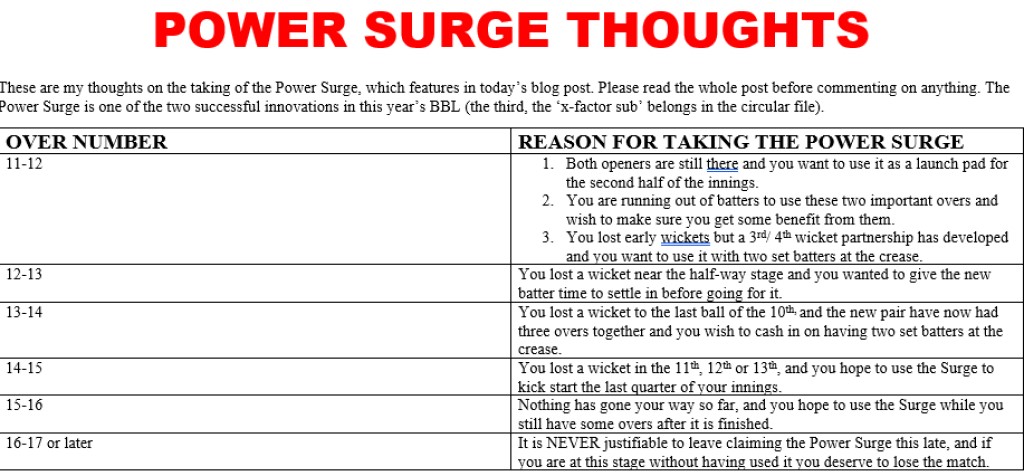
The infographic I created for this post, which you will have seen at the head of it, and which reappears to end this section, outlines my thoughts on this issue, and I will add to it just this: sides going into the second half of their innings should be inclined to go early rather than late with the Power Surge and should delay it only if there are strong reasons, such as a wicket falling in the tenth over, for doing so. I can see no merit at all in using it any later than overs 15 and 16, as you should be getting big runs off the closing overs anyway even without the extra fielding restrictions.

PHOTOGRAPHS

I have two galleries to share with you today, the first featuring my newest acquisitions, and the second my regular fare:

India Zindabad!

An account of the spectacular denouement to the Border-Gavaskar trophy series at the Gabba, a look at cricket formats and to upcoming test series, and some photographs.

This post is mainly about the amazing conclusion to the battle for the Border-Gavaskar trophy, the last day of which ended early this morning UK time. I will also be comparing the various formats that cricket now has and looking ahead to upcoming test series.

THE INJURY STREWN ROAD BACK FROM 36 ALL OUT

India took a first innings lead in the first test of the series, before that game underwent a shocking turnaround, as an hour of Cummins and Hazlewood at their best routed India for its lowest ever test score of 36, and Australia knocked of the target of 90 for the loss of two (see here for more details) wickets. At that point, with Kohli departing on paternity leave and injuries already making themselves felt an Indian series victory looked a long way away.

In the second match at the MCG India, captained by Rahane in the absence of Kohli hit back hard to level the series, but their injury list continued to lengthen.

In the third match of the series at Sydney, India continued to suffer injuries, with their two best spinners, Ashwin and Jadeja joining the crocked list. Also injured was Hanuma Vihari. However, in a display of determination that was a foretaste of what was to come at the Gabba, Vihari and Ashwin carried India to a hard fought draw in this match.

The final stop for India, with a bowling attack so depleted that those selected in bowling spots had one test cap between them, was the Gabba, where Australia were unbeaten since 1988, when a full strength West Indies, featuring one of the most awesome collections of fast bowlers ever seen, did the job.

Australia won the toss and chose to bat first (a number of sides of been lured in by the prospect of early life in the pitch and chosen to bowl, normally with terrible consequences – Hutton’s England leaked 601-8 in 1954-5 and lost by an innings and 160, Border’s Aussies conceded over 450 in 1986, were made to follow on and ended up beaten by seven wickets, Hussain’s England allowed Australia to reach 367-2 by the close of the opening day, and thereafter there was only going to be one result), and they tallied 369, a very respectable effort. Shardul Thakur and Washington Sundar each featured prominently in the bowling figures, as did Siraj. At 186-6 India looked in colossal trouble, but Thakur and Sundar followed their bowling exploits with some excellent batting, making 67 and 62 respectively, and in the end the deficit was just 33.

India did well to restrict Australia’s 2nd innings to 294, which left them 329 to get and just over a day to do so. The weather which had intervened several times, did so once again, ending day 4 early with India 4-0, needing 324 off 98 overs on the final day to win, with a draw also sufficing to retain the Border-Gavaskar trophy.

By lunch on day five India had lost only one wicket, and Gill and Pujara were going well. The afternoon session was better for Australia, but they still did not capture many wickets, and Pant was batting well by the tea break.

When Mayank Agarwal fell for a skittish nine it still seemed that only two results were possible. Sundar joined Pant, and they were still together going into the mandatory last 15 overs, with 69 needed. By the ten over to go mark this was up around a run a ball, but they were still together. Briefly the ask went above one run per ball, but then Sundar hit a six and a four in quick succession, which in turn encouraged Pant, and suddenly the target was approaching at a rapid rate. Cummins, who had toiled heroically and picked up four wickets on the day gave way to Hazlewood, while Lyon was wheeling away at the other end. There was a brief wobble when Sundar fell essaying a reverse sweep and then Thakur got himself out cheaply, but the target was close to being achieved by then, and not long later a straight driven four for Rishabh Pant ended the chase, India winning by three wickets to take the series 2-1 and retain the Border-Gavaskar trophy in style. Pant had scored 89 not out, backing up Gill’s earlier 91 and a determined 56 from Pujara.

Pant was named Player of the Match, while his 20 wickets earned Cummins the Player of the Series award. Personally I would have given the match award to Thakur who made significant contributions to all of the first three innings, without which India would never have been in the contest, but I can understand why it went to Pant.

Of all the test series I have followed closely enough to comment on from personal experience (dating back to the 1989 Ashes debacle) this one between Australia and India has only one remotely serious rival, the 2005 Ashes series, which featured three of the greatest matches I have ever been witness to plus Pietersen and Giles’ heroics at The Oval.

ON CRICKET FORMATS

Top level cricket these days has four principal formats with a fifth in the pipeline, and this match just concluded at the Gabba, plus events at Galle prompted to me to write a little about each:

  • Test Cricket – these two matches in their differing ways provided excellent case studies as to why the five day format is the best of the lot for cricket. Both matches featured fight backs which could not have been mounted in a shorter version of the game.
  • First class cricket – played over either three or four days (one of the definitions of a first class cricket match is that it must last at least three days), and like test cricket the longer time frame enables things to happen that could not in a short match.
  • One day cricket – played over the one day, usually one innings per side, although various split innings formats have been tried, and each side is limited to a certain number of overs, and at least five bowlers must be used. It has its great moments, notably the 2019 World Cup final, but the great majority of games in this format do not stick in the memory any longer than it takes to play them.
  • T20 – One innings of 20 overs per side, various fielding restrictions and other gimmicks according to the exact competition. These can be cracking entertainment while they last, especially if they get close, but again few stick in the memory.
  • The Hundred – 100 balls per innings for each side, to be bowled in some combination or other of blocks of five and ten balls. Nobody really knows why this joke of a format was invented, though after being delayed for a year by the pandemic it is expected to make’s it appearance in the 2021 English season. I feel that tampering to the extent that is involved in the design of this new format is unacceptable. The number of balls in an over has changed through cricket’s long history – it was four in the early days, five in the 1880s and 1890s, then six, then eight for a time (briefly in this country, for about 50 years in Australia) and then back to six, but it has always been fixed and constant within each match. Just as I refused to pay any attention to the Stanford extravaganza, rightly seeing it as fundamentally bad for cricket, so I plan to ignore the Hundred.

FUTURE TESTS

England have two series coming up against India, first in India, then in England, and an Ashes series down under at the end of the year. I now feel having seen an injury ravaged India fight like tigers and beat the Aussies in their own back yard that England will be lucky to win either series against India, but for all that no England team not holding the Ashes have won in Australia since 1970-1 they have a decent chance of winning that series. I noticed that Axar Patel, a left arm spinner, is in India’s squad for the upcoming series in India, and given the ‘rabbits in headlights’ responses of Messrs Crawley and Sibley to Lasith Embuldeniya taking the new ball for Sri Lanka I can see exactly how India might use him to their advantage! Overall, test cricket is in fine health, and has once again dealt very effectively with premature rumours of its sad demise, by producing a couple of amazing games that overlapped with one another.

PHOTOGRAPHS

Time for my usual sign off…

The First Sri Lanka v England Test Match in Retrospect

A look back at the test match in Galle that finished early this morning. Includes player ratings and selection thoughts for the second match, a look ahead and some photographs.

This post looks back at the test match just concluded in Galle. Another such game reaches its denouement in Brisbane tonight, and if weather permits it should be a cracking finish.

ENGLAND GO 1-0
UP IN THE SERIES

Both teams arrived for this match not so much ‘underdone’ as ‘completely raw’, due to scheduling issues. Sri Lanka slumped to 135 on the first day, with Bess emerging with five wickets for a rather patchy bowling performance. Both England openers then fell cheaply, Sri Lanka’s decision to give the new ball to Embuldeniya with his left arm spin paying off in spades, but Root and Bairstow took England to the close, within sight of a first innings lead. Bairstow was out first thing on day 2, but Dan Lawrence on debut batted like a veteran, making 73, and providing Root with superb support. By the close England were 320-4 and seemingly headed for a monster lead. Buttler fell early on the third morning, triggering a collapse that saw England all out for 421, Root 228, a lead of 286 when at one stage 400+ seemed likely. Sri Lanka dug in and fought hard in their second innings, with both spinners, Bess and Leach, bowling better than they had first time around, Wood bowling quick when he was used, Curran sometimes making things happen and Broad bowling almost as economically as his Notts and England predecessor Alfred Shaw did in the early days of test cricket. Just before the end of the fourth day Sri Lanka were all out for 359 leaving England 74 to get.

The start of the England innings resembled a flashback sequence as the openers Sibley and Crawley both fell cheaply to Embuldeniya, who looks a real find for Sri Lanka. Then Bairstow made a greedy call for a run and succeeded in stitching up his skipper, and that was 14-3, and the possibility of a history making collapse loomed. In 1882, in the match that spawned The Ashes, England were set 85 in the fourth innings and ended up all out for 77, losing by seven runs. It seemed that present day England might be about to choke on an even smaller target. Dan Lawrence joined Bairstow, and they saw England through to the close at 38-3. The fifth day started on time, and with the same two spinners, Embuldeniya and Perera taking up where they had left off. In the event, 35 minutes play was sufficient for England to get home without further loss. The only alarm was a close LBW shout, turned down, and had Sri Lanka sent it upstairs they would have had a wicket. In the event it was Bairstow who made the winning hit, when it would have been more fitting for it to have been Lawrence.

Had Sri Lanka been able to completely dry up England’s scoring (in the great 1882 match Spofforth and Boyle at one point bowled 17 overs for one run) they may have induced serious panic, but England were always able to keep the scoreboard ticking, and in the end the margin was very comfortable.

Sri Lanka can take great credit for fighting back hard enough to take the game into its fifth and final day after they performed so awfully on the first two days. For England the big pluses were Joe Root rediscovering how to go seriously big and Dan Lawrence playing so well on debut, while young Embuldeniya may yet develop into a worthy successor to Muralitharan and Herath. Sibley and Crawley need to improve their approach to spinners, otherwise every test skipper will be tossing the new ball straight to a spinner to get a couple of early scalps. If England’s spinners produce some of the stuff they did in this game when they come up against India they will get absolutely destroyed, but it was good to see both improve considerably as the match went on.

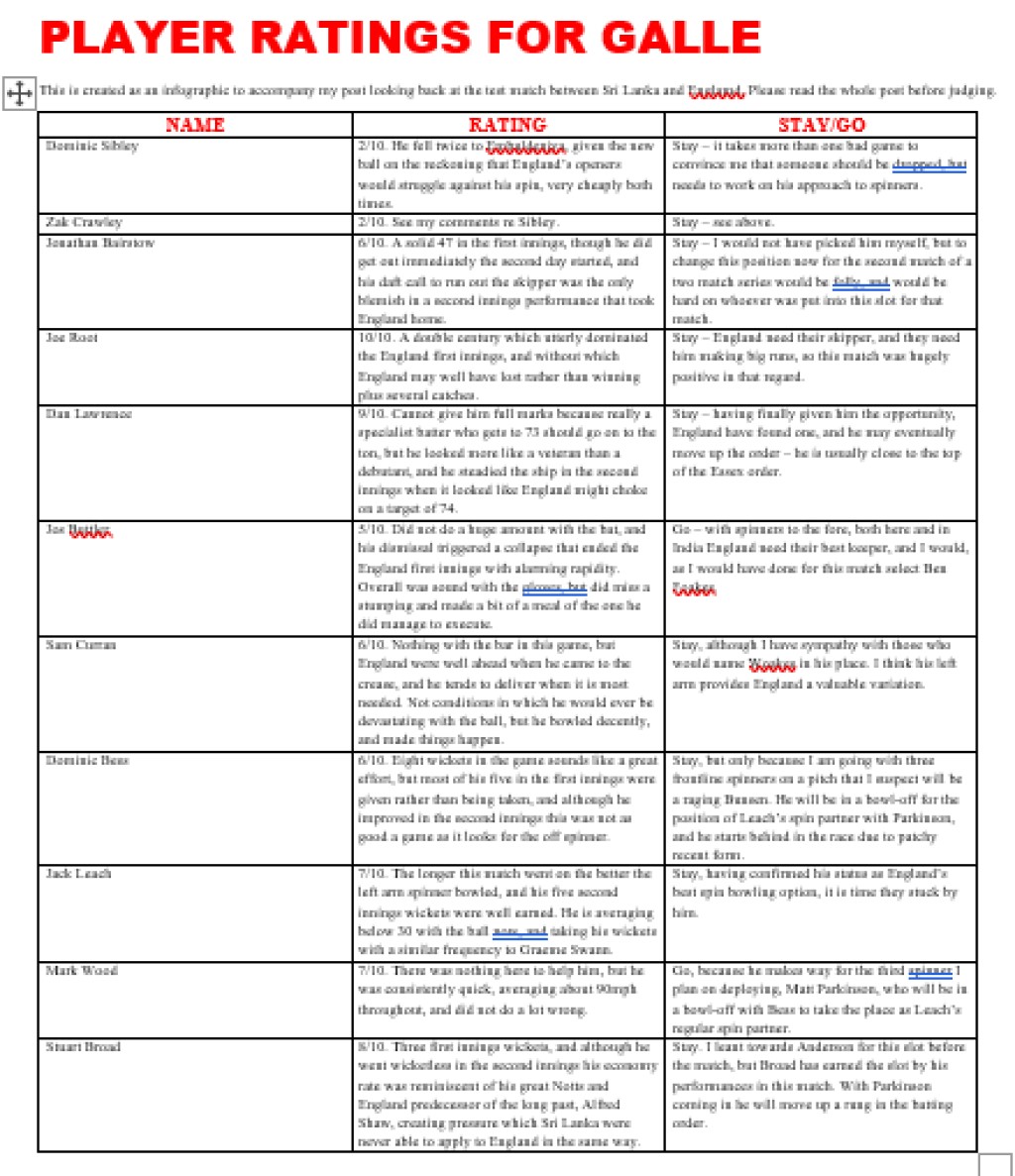
PLAYER RATINGS & STAY/GO

In this section I rate the performances of the England players and offer my opinions about who should stay and who should go.

  1. Dom Sibley – 2/10. Twice fell very cheaply to Embuldeniya and never looked comfortable in either innings. He stays – one bad match should not get someone the chop, but he does need to work on his handling of spin.
  2. Zak Crawley – 2/10. My comments about Sibley apply equally to him, although he has demonstrated that he can play spin well later in an innings, if he manages to get in against pace.
  3. Jonathan Bairstow – 6/10. A solid 47 in the first innings and after running the skipper out in the second he did well to see England home. I would not personally have recalled him to the test squad, but I see little point in dropping him at this juncture and having a newcomer at no3 for the second game of a two game series.
  4. Joe Root – 10/10. His mammoth 228 utterly dominated the England first innings, he also took several catches in the field, and handled his bowlers well as captain. He will need to demonstrate that his rediscovered ability to go seriously big works against the likes of India and Australia as well as against a very weak Sri Lanka, but he could not have done much more here.
  5. Dan Lawrence – 9/10. When a batter reaches 73 they should be able to complete the ton, and that is the sole reason the debutant does not get full marks. He played a fine first test innings, and showed great composure when England were rocking in the final innings. He definitely stays, and it looks like England have found a good one.
  6. Jos Buttler – 5/10. his first innings dismissal marked the start of a collapse, and he was not needed in the second innings. He kept competently other than missing a stumping in the second Sri Lankan innings. However, with spinners so much to the fore, both in Sri Lanka, and later on in India, as far as I am concerned he goes, as England need their best keeper, Foakes.
  7. Sam Curran -6/10. He made things happen with his bowling on a couple of occasions. For me he stays, but I have sympathy for those who would replace him with Woakes. I regard his left arm as a potentially valuable variation.
  8. Dom Bess – 6/10. Eight wickets in a match sounds like a great performance, but the truth is that most of his five first innings wickets were given rather than being taken, and that even in the second innings when he bowled better there were two many loose deliveries from him. He stays, but only because, on what I am expecting to be the ultimate in turners I go with three spinners, with him being in a bowl-off for the role of Leach’s spin partner with the third spinner – and starting that race from behind due to his patchy recent form.
  9. Jack Leach – 7/10. The left arm spinner was understandably rusty at first, but by the end he was bowling very well, and his five second innings wickets were just reward for a fine effort. He stays, his position as England’s #1 spinner confirmed by his performance here.
  10. Mark Wood – 7/10. Sensibly used by his skipper only in short bursts he was always quick, averaging around the 90mph mark, and in conditions that offered him nothing he did very little wrong. Nevertheless, I would leave him out to accommodate Parkinson who will be in a bowl-off with Bess for the second spinner’s slot.
  11. Stuart Broad – 8/10. The veteran took three wickets in the first innings, and although he went wicketless in the second, his extreme economy, reminiscent as I have said of Alfred Shaw, helped to create pressure, which created wickets for other bowlers. He stays, moving a rung up the batting order given the inclusion of Parkinson.

LOOKING AHEAD

England should make it 2-0 on Sri Lanka (the second game gets under way on Friday), but will need to improve to compete effectively with India, who have shown immense determination to take their series in Australia right down to the wire, and then at the back end of this year comes the toughest assignment of all for an England team – Australia in Australia. Lawrence looks a huge find, and with Pope due to return for the India series, Burns back in the reckoning before too long and Bracey waiting in the wings, concerns about Sibley and Crawley against spin notwithstanding the batting looks good. In conditions where out and out speed is of the essence Archer will soon be available as well as Wood, with Stone waiting in the wings. Seam and Swing are always England’s strongest suits, and with no sign of Anderson or Broad leaving, Woakes and Curran about, and Ollie Robinson in the wings that area remains strong. Spin remains a concern, although Leach is looking good, while in Australia I would expect Parkinson, the leg spinner, to fare better than Bess, for another reason I want him to get some test experience in before that tour starts. It is also possible that younger spinners such as Virdi, Moriarty and Patterson-White could be contenders. Finally, there remains the gamble which some would consider heretical of giving Sophie Ecclestone a bell and asking if she fancies having a go alongside the men.

PHOTOGRAPHS

My usual sign off, with the addition of an infographic about the ratings and stay/go section:

Galle and Brisbane

A look at the two test matches currently in progress, and at Joe Root’s status as an England batter.

There are two test matches in progress at the moment, with overlapping playing hours. This post looks at both.

GALLE: ENGLAND ON TOP

When bad light brought a slightly early end to day three in Galle (due to the old fort that adjoins the ground Galle stadium cannot have floodlights – the fort is a World Heritage Site, so my usual gripe re bad light and test matches does not apply here) Sri Lanka were beginning to offer resistance, but were coming from a very long way behind.

Day Two, also truncated by the weather, saw England establish complete control. Bairstow failed to add to his overnight 47, but debutant Dan Lawrence made a fine 73, Buttler was looking comfortable by the close, and Root had a blemish free 168 not out to his credit. England were 320-4 and looking at all sorts of history if things continued the same way.

Day Three saw the remaining England wickets add just a further 101, Root being last out for a splendid 228. The only chance he offered in this innings was the one that was taken at deep midwicket to end it. Embuldeniya had every right to feel more than a little frustrated, a fine effort with the ball leaving him with figures of 3-176 while the much less impressive Perera had four wickets in the end. Root’s innings took his test aggregate past 8,000, in fewer innings than any England batter save Pietersen (KP 176, Root 178). It now stands at 8,059, meaning that he needs a further 56 to become the all-time leading test run scorer among Yorkshiremen. Inspired by the rapid fall of England’s last six wickets Sri Lanka then showed some fight with the bat, helped it must be said by an unimpressive bowling display from England. Bess could not get his length right, Leach was unlucky, there was little for the quicker bowlers, though Curran picked up a wicket when a rank long hop sailed straight to deep third man. Root tried a few overs but unaccountably Lawrence was not given a go. Mendis finally got off the mark after four successive ducks, a sequence known in the trade as an ‘Audi’, thereby avoiding the ‘Olympic’, but fell just before the close. Sri Lanka sent Embuldeniya in as nightwatchman, and the light closed in quick enough that he was still there at stumps. Scores so far: Sri Lanka 135 and 156-2, England 421, SL need 130 more to avoid the innings defeat.

England are of course heavy favourites, but that should not conceal the problems – Bess has been far too erratic, and if he bowls this kind of stuff in India he will be destroyed, other than Root and Lawrence there were no major batting contributions.

IS ROOT ENGLAND’S GREATEST EVER BATTER?

This question was raised on twitter today, in view of the milestone Root has just reached in test cricket and his great records in the other two formats. My own answer was that this question cannot be resolved because it is impossible to compare different eras, but Root is a magnificent all-format player who would have been a great in any era. I am now going to look, in chronological order, at some of those who might have been just as good had there been multiple formats in their day. I have restricted myself to players who experienced international cricket…

  • WG Grace – the man who virtually created modern batting. He successfully countered every type of bowling that existed in his day, could score rapidly when the occasion warrants (in 1895, less than two months shy of his 47th birthday, he scored 257 and 73 not out v Kent, the latter played against the clock to chase down a target, which was achieved successfully.
  • Jack Hobbs – The Master, capable of very attacking performances, especially in his younger days.
  • Herbert Sutcliffe – as he once famously told Plum Warner “ah luv a dogfight”, a claim borne out by his averages: 52.02 in first class cricket, 60.73 in test cricket, 66.85 in Ashes cricket. Although he is best known for long determined innings, like his seven-hour 161 which began on difficult pitch at The Oval in 1926, and his 135 at Melbourne two and a half years later, he could and did attack when the occasion demanded it. His 100th first class hundred was made with Yorkshire needing quick runs, and he hit eight sixes along the way.
  • Walter Hammond – averaged 58.45 at test level. His highest score was 336 not out against New Zealand, accrued in just 318 minutes. When he scored 1,000 first class runs in May 1927 the innings that completed the achievement came at the expense of Hampshire, and saw him score 192 out of 227 made while he was at the crease. He once started a day’s play v Lancashire by hitting Ted McDonald, then the best fast bowler in the world, for five successive boundaries, and according to Neville Cardus, a Lancastrian, it was only a fine bit of fielding by Jack Iddon that stopped it being six boundaries out of six for the over.
  • Denis Compton – averaged over 50 for England, reached 100 first class hundreds in 552 innings, a tally beaten only by Bradman (295), scored the quickest ever first class triple hundred, reaching the mark in 181 minutes at Benoni in 1948.
  • Peter May – the 1950s were a low and slow scoring decade, and yet Peter May averaged 46 in test cricket through that decade, and was noted for his stroke making.

INDIA FIGHTING HARD AT THE GABBA

India have had terrible problems with injuries during their tour of Australia. Among those on the sidelines for this match were both halves of India’s best new ball pairing, Bumrah and Shami, both of India’s two best test spinners, Ashwin and Jadeja, and others. Nevertheless, they are very far from being down and out at the Gabba. Australia won the toss and batted, scoring 359, with three wickets a piece for Natarajan, Thakur and Sundar, of whom only Thakur had previously played test cricket. India had reached 62-2 in reply before a storm hit Brisbane, bringing an end to play for day two. Rahane and Pujara are together at the crease, with Agarwal and Pant still to come, Sundar at seven capable of making a useful contribution and then the specialist bowlers. If India win it will be an incredible achievement, if they manage the draw and thereby retain the Border-Gavaskar trophy that will still be a mighty effort, and even if Australia ultimately prevail I for one will salute India for making such a fight of this series in the face of so many misfortunes.

PHOTOGRAPHS

I end with my usual sign off…

England in Command in Galle

A look at day 1 of Sri Lanka v England in Galle, and a glimpse at the state of play in BBL10. Also some photographs.

Early this morning UK time the test series between Sri Lanka and England got underway. This post looks back at the first day.

ENGLAND DOMINATE DAY 1

Unsurprisingly given the current situation, with a global pandemic happening, neither side had had anything approaching proper preparation for a test match. Sri Lanka had had no cricket at all since taking a hammering in South Africa. England managed one day of an intra-squad fixture, which with both “sides” containing more than 11 players and arrangements being made that each would bat for at least 50 overs in the first innings had precious little resemblance to a real match – it was more in the nature of an extended net with umpires in position. This lack of preparation was shown in some less than stellar cricket.

Sri Lanka batted first, and mustered 135 all out, a poor score, especially given that almost all of their wickets were lost through bad batting rather than good bowling. There were a couple of freakish dismissals – Bess got one when a shot hit Jonathan Bairstow and Buttler caught the rebound, while Leach got a finger tip to a drive, deflecting it into the bowlers end stumps with Embuldeniya way out of his crease. Bess was also the beneficiary when a really succulent long hop was bashed straight into the hands of backward point. Stuart Broad was in the wickets early on, Jack Leach bowled nicely, and, by hook or by crook, Bess emerged from the fray with 5-30.

After that shocking display with the bat Sri Lanka needed things to happen for them with the ball. To that end they gave the new ball to left arm orthodox spinner Embuldeniya, a clever decision given that Sibley and Crawley would both prefer to begin against seam. It paid early dividends, as both openers perished with only 17 on the board. At that point skipper Root joined Bairstow, a choice at no3 which did not meet universal approval. They played beautifully, although Root was given out LBW fairly early on – he reviewed it, and the technology showed that the ball was going over the top of the stumps. By the close Root had reached 66 not out, Bairstow was on 47 not out, and England at 127-2 were in total control of the match.

Root has recently had problems turning starts into major innings, and he needs to dig in again early on tomorrow and make sure this effort does not go to waste. As for England as whole this is the most dominant opening day they have had since Trent Bridge 2015 when they rolled Australia for 60 and were comfortably into a first innings lead by the end of the day.

Those of us following proceedings by way of Test Match Special were treated during the lunch break to an interview with Justin Langer, coach of Australia. His attitude to the controversy over Steve Smith allegedly scuffing up a batter’s guard at the SCG showed a failure of understanding, and also a huge degree of petulance – it was basically an on-air tantrum. Smith’s actions may well have been as innocent as Langer insists, but what both Smith and Langer need to understand and are apparently unable or unwilling to is that a proven cheat will not be given the benefit of the doubt when such incidents occur.

RECENT BBL ACTION

The tenth running of the Big Bash League is still in full swing. Yesterday the two Sydney franchises locked horns in a top of the table clash. Thunder, batting first, began brilliantly, scoring 47-1 from their four overs of Power Play, but then had a disastrous second period of their innings, being 86-4 after 10 overs. They then slowed up in overs 11-15, declining to take the Power Surge in a bid to revitalize their innings, and found themselves 112-5 after 15. They left the Power Surge right to the end, finally taking it at the last moment they could, for the 19th and 20th overs. They did score 24 off this two overs, but they would probably have done that at the tail end of a T20 innings even without it being a Power Surge, so they effectively did not benefit from those two overs. They ended on 166-6 from 20, at a high scoring ground (the average innings score for a T20 at Manuka is 175). Ir rained during the interval, and a delayed start to the second innings led to a DLS recalculation. Sixers resumed needing 129 from 14 overs to win, and 67 off seven to claim the Bash Boost point, while they would have three overs of Power Play and one of Power Surge. They got off to a flier, secured the Bash Boost point with an over to spare, and maintained the momentum, winning in the end by five wickets, with eight balls to spare. That put them six points clear at the top of the group, and left Thunder just about catchable by the chasing pack.

Today, while I was focussed on the test match the Heat took on bottom of the table Renegades. Renegades mustered 149, which rarely wins a T20 these days. Heat made life a little more difficult for themselves than it should have been by surrendering three quick wickets as they entered the closing stages of the chase, but they won by five wickets in the 19th over. This moves Heat, who also took the Bash Boost point, into the fifth and last qualifying slot on 20 points. Renegades remain on nine points, 11 points short of the qualifying zone with only four games to play, and it is now only a matter of when, rather than if, their early exit from the tournament is officially sealed.

PHOTOGRAPHS

My usual sign off…

BBL10 And A Great Test Match

A great test match, some fine BBL10 action, a very important petition and some photographs.

Overnight UK time Australia and India were fighting out a test match in Sydney, while this edition of the BBL continues to impress. I am going to start with…

TEST CRICKET IS THE BEST CRICKET – A FIVE DAY DEMO

Australia took a first innings lead of 94 over India – 338 vs 244. Ravi Jadeja suffered an injury which ended his participation in the series, although he said that if necessary he would bat in India’s second innings. Jadeja is almost criminally underrated by the cricketing world at large, being on recent figures the best all rounder in test cricket (although New Zealand youngster Kyle Jamieson is bidding fair to change that if he continues as he has started). This was therefore a massive loss – he had already contributed four first innings wickets, some useful unbeaten runs and a superb run out to this match.

Australia made decent runs for the second time of the match, although they were once again heavily dependent on Smith and Labuschagne to do so. They declared at 312-6, setting India 407 in four sessions to win, or else bat out for a draw. By the close of day four India were 98-2, with Pujara and Rahane together.

Rahane was out almost before the final day had begun, which brought Rishabh Pant to the crease. I regard Pant as a proven liability with the keeper’s gloves, but have never questioned his batting talents, and he played a magnificent innings, which briefly ignited hopes of an incredible victory for the visitors. Once he was dismissed for 97 victory was pretty much off the menu, but Pujara was still there, playing very well. Vihari strained a hamstring taking a run, but battled on gamely. Pujara’s dismissal seemed to have once again swung things decisively Australia’s way, bringing R Ashwin to the crease, since Jadeja was being held back due to his injury. Ashwin to a blow to the ribs, but like Vihari, he refused to allow the pain of his injury to deter him. Some hostile bowling, led as usual by Cummins, and alas some vicious sledging, failed to dislodge either of the pair. Eventually, the close of play arrived, with India 334-5, 73 short of victory, and possibly by then favourites had the match been extended to give a definite result.

This was a match which commanded attention throughout five absorbing days of play, and while the heist did not eventuate, the way Ashwin and Vihari, both incommoded by injuries, battled it out at the death and saw their side to a draw will live long in the memory. The final match takes place at the Gabba, a ground where Australia have not lost since 1988. If India win or draw they retain the Border-Gavaskar trophy, while only a win will do for Australia. In 2010-11 England staged a great escape at the Gabba in the series opener, after trailing by over 200 on first innings, and then obliterated the Aussies in the second match at Adelaide, and just maybe saving this game in such a fashion as they did will be the fillip India need to produce something very special to finish this series.

THE BBL

There have been three BBL games since my last blog post. In the first Scorchers sprang a surprise by beating Thunder who had been topping the group. Scorchers batted first, and after 14 overs were 101-4, at which point they claimed the Power Surge. They made brilliant use of those two overs with fielding restrictions in place, accruing no fewer than 40 runs from them. This was followed by a strong finish and a final score of 185-6. Thunder were behind over the Power Play, ahead in runs at the 10 over mark, giving them the Bash Boost point, but also a wicket behind on the comparison. They had a good start to the second half of their innings, reaching 119-4 after 14, at which point they claimed their own Power Surge. This was where they lost their way, and with it, the match. The two overs of Power Surge yielded them just 18 runs and saw the fall of two wickets – suddenly they were four runs and two wickets worse off than the Scorchers had been at the same stage. Overs 17 and 18 were good for them, and with two overs to go they were 161-7 and still just about in the hunt. The 19th over settled the issue, just two runs coming from it and a wicket falling. 23 off the final over was never going to happen, and in the event Thunder were all out for 168, beaten by 17 runs.

Yesterday morning UK time the Heat were in action against the Sixers. Heat were put in after the Sixers won the bat flip, and after four overs were 29-2. After 10 overs this had become 59-3. After 13 overs, when they claimed the Power Surge for overs 13 and 14 they were 77-3. By the end of the 15th, the second Power Surge over they were 109-4, 32-1 from the Surge. The last five overs of the Heat innings were disastrous, yielding 39-6 for a final score of 148 all out. Sixers were behind most of the way through the chase, though they got the Bash Boost point, being 60-4 after their first 10 overs. They were 104-4 after 15, and in the hunt, but not comfortably placed. In the 18th they looked in real trouble, seven down, and still noticeably adrift, but the veteran Dan Christian was batting very well at one end, and he pulled the game out of the fire for the Sixers, just getting them home off the penultimate possible ball. Heat were unfortunate to come away from this match with nothing, while the Sixers moved to the top of the group.

This morning’s game featured the Stars against the Strikers. The Stars were second bottom and in need of a win, while the Strikers were more comfortably placed but were about to lose the services of Rashid Khan, departing from the tournament to play for his country, Afghanistan, and could do with a cushion between them and those just outside the qualifying zone.

The Stars chose to bat first, and were in trouble for almost the entirety of their innings. They were 17-1 after four overs of what was supposed to be POWER PLAY, picked things up somewhat to be 67-3 after ten, then delayed the Power Surge far too long (my own opinion that the Surge is best taken somewhere between over 11, the earliest point at which it becomes available and over 15 depending on circumstances being strengthened by having heard during today’s commentary that Brian Charles Lara, who certainly knows a bit about batting, is also a fan of using the Surge early rather than leaving it late), eventually taking it at 105-5 after 16 overs. They managed 16 runs and lost two further wickets in those two overs. 121-7 after 18. A flourish at the end got them to 149-7, a total that looked decidedly modest. Strikers missed out on the Bash Boost point, Carey holing out in attempting to get it off the final ball of the 10th. After 14 overs Strikers were 96-3 and they claimed the Power Surge at that point, a sensible move. The Power Surge overs saw Strikers score 20 and lose one wicket. A quiet 17th over seemed to have brought Stars back into things, but the 18th over settled the issue, 18 coming from it, and even with a wicket falling along the way, 12 runs off 12 balls was never likely to test Strikers. In the event the 20th over was not needed, as the winning runs came off the final ball of the 19th, when a difficult catch went down and the batters got through for the two they needed. Save for overs 5-10 inclusive the Strikers had won every phase of the game. Where they were decisively clear was in the Power Play and Power Surge overs – Stars managing a combined 33-3 from those overs of their innings, while Strikers scored 47-2 from the equivalent overs of their innings, 14 runs and one wicket better. As this tournament develops it is becoming clear that the Power Surge needs to be claimed fairly early, firstly so it can act as a springboard to a big finish, and secondly to ensure that you actually have proper batters to cash in on it. Stars should probably have used in overs 11-12 of their innings, when Stoinis, well set, could have used it as a major launching pad. As it was, their last pair of recognized batters were together when they finally took it, with Adam Zampa next man in.

All of this means that Stars, Heat and Scorchers are now all on 16 points, separated only by net run rate, although Scorchers, leading the trio and in the final qualifying place, also have a game in hand. Strikers have temporarily gone third, displacing Hurricanes, who in action tomorrow, and have a four point cushion, equivalent to a win plus a Bash Boost point, on the teams just outside the qualifying zone. The two Sydney based teams, Sixers and Thunder, top the group and are pretty much sure to qualify, Strikers and Hurricanes are also well placed to do so, while Scorchers, Heat and Stars are battling for the remaining place, with Renegades effectively gone.

A PETITION AND PHOTOGRAPHS

Just before my usual sign off, a petition, calling on the government to give key workers a pay rise. Please click here to sign and share the petition, a screenshot of which is below:

The petition I want you all to sign and share.

A Concatenation of Cricket

A look at each of BBL10, AusvInd and SLvENG (preview), including a mention of Claire Polosak’s history making involvement at the SCG, plus a link to a superb thread about Kohli, Smith and Williamson and my usual sign off.

There is a massive amount of cricket going on the moment, with the Big Bash League in full swing, Australia locked in battle with India in the test arena and England engaged in an intra-squad tussle as a warm-up match before their test series in Sri Lanka gets underway. This post will therefore be a long one.

AUSTRALIA V INDIA

Australia managed for the first time in the series to get a respectable first innings score on the board. However, they have plenty of cause for concern nevertheless. 338 is not commanding on a decent batting pitch, and 284 of those runs came from just three players: Smith 131, Labuschagne 91 and debutant Pucovski with 62. India were 96-2 by the end of the second day, and it should develop into a fine game. Ravi Jadeja, whose selection some were questioning, bagged four wickets with his left arm spin and also made an extraordinary run out when he had one stump to aim at from 45 metres, and hit it. Inexcusably, no Indian fielder had got into a position to back the throw up, so it was hit or bust for Jadeja, and he hit. Much of day 1 was lost to rain, which is why the run aggregate looks small for two days play. This match is also significant for the fact that the 4th umpire is Claire Polosak, the first female to officiate in a men’s test match. At the age of 32, she has many years left in which to rise further up the officiating pecking order.

THE BIG BASH LEAGUE

There has been some excellent action in the Big Bash League lately. Today’s game between the Strikers and the Renegades was one of the best games of the tournament, the Renegades getting home with one ball to spare. Renegades also won the Bash Boost point, gaining the full four points. However, even with the rather generous qualifying arrangements in this tournament (the top five go through to the knockout stage, and only eight teams are involved), Renegades remain seven points adrift of a qualifying slot with only five games to play. All of the other seven teams have realistic chances of continuing their involvement. Personally, for an eight team, single group, tournament I would allow just three teams to advance, and incentivize top finishers by arranging the mini-knockout as follows: the group winners go straight into the final, while second place take on third place in an eliminator, with second place rewarded for their own greater success in the group by being given home advantage for that match. With five teams qualifying you do not have to do that well to get through (even Renegades, though rank outsiders, are not completely out of contention yet, and the best they can finish with from their 14 games is won seven, lost seven, an exactly even record, and not one that IMO should have a chance of being rewarded with qualification).

There have been some very individualistic talents on display in the BBL, which set me thinking about a team of players who were uncompromising in doing things their own way. This was my chosen selection:

  1. *WG Grace – right handed opening batter, right arm bowler of varying types, captain. Before his emergence batting was very specialized, batters concentrating on either playing off the back or front foot, and in some cases specializing in one particular stroke. He demonstrated that it was possible for a batter to play a complete game, scoring off both front and back foot, and making use of a wide range of stroked to do so. He was so successful in doing things his way that he single-handedly altered the course of cricket history, setting the game on a course it would follow pretty much unaltered for a century.
  2. George Gunn – right handed opening batter. No one ever knew quite what he would do – he might come down the pitch in a fast bowler’s first over, or he might eschew stroke making altogether.
  3. Ted Dexter – right handed batter, right arm medium fast bowler. He was often accused of losing concentration because he often got out between 70 and 100. CLR James however was of the opinion that what happened was that when a hundred appeared on the horizon Dexter started concentrating, rather than just playing his natural game.
  4. Denis Compton – right handed batter, left arm wrist spinner. It is in keeping with Compton’s general approach that when he decided to develop his bowling he opted for the least frequently used of all bowling styles, left arm wrist spin. On one famous occasion he overbalanced while playing his stroke, brought has bat round in a sweep as he was falling and still collected four runs.
  5. Viv Richards – right handed batter, occasional off spinner. At Old Trafford in 1984 Derek Pringle, following the received wisdom of the day, attempted to tie Richards, going well, but with only lower order batters for support, down with a low full toss. Most batters of the time would have been happy with a single, and delighted had they got the ball away for four. Richards whipped it over mid wicket for six. Richards at the end of that innings had 189 not out in a score of 272-9, an ODI individual scoring record that remained his until Saeed Anwar topped it with 194, some years later. A demoralised England never looked like getting close to chasing those runs down.
  6. Garry Sobers – left handed batter, left arm bowler of every type known to cricket. The most outrageously gifted cricketer of them all, he started as a left arm spinner batting low in the order, became one of the greatest of all batters. He also taught himself to bowl fast, and while playing Lancashire League cricket he learned to swing the ball under the leaden skies that are a feature of that part of the world.
  7. Gilbert Jessop – right handed batter, right arm fast bowler, ‘gun’ fielder. The fastest scoring batter in the game’s history, a useful bowler and a brilliant fielder.
  8. +Alan Knott – wicket keeper, right handed batter. As a batter he was highly effective in a very unorthodox way. Similarly, his keeping, among the best the game has ever seen, was marked by an absolute unconcern for appearance, so long as it worked. He would tape the top of his keeping pads to his trousers to make sure that they could not flap and thereby possibly incommode him.
  9. Cecil Parkin – right arm ‘all sorts’ bowler. He had a penchant for bowling six different types of ball per over. When it wasn’t his day this made setting a field for him difficult, but when it was his day he was well nigh unplayable.
  10. Sydney Barnes – right arm fast medium bowler. That designation tells about 1% of the story. His signature weapon was a leg break delivered at fast medium pace. The nearest any other bowler came to rediscovering this delivery was Alec Bedser immediately after World War II. When Barnes was bowling, it did not much matter who the captain was – Barnes was in control, and everyone, fielders and batters alike knew it.
  11. Jack Iverson – right arm wrist spinner. An unusual designation to use, appropriately since he was a mighty unusual bowler. He bowled with a leg spinner’s action, but sent down off breaks. His extraordinary life and career are covered splendidly in Gideon Haigh’s “Mystery Spinner”.

Two honourable mentions: Johnny Wardle, a master of all forms of left arm spin, but lack of space combined with the presence of Sobers and Compton induced me to not pick him. Derek Underwood’s unique left arm slow/medium bowling was something I would have liked to feature, but not at the expense of Parkin or Iverson who were the only two I could have dropped for him.

ENGLAND IN SRI LANKA

Today England started an intra-squad warm up match, over two days, with each side to bat for fifty overs in the 1st innings and then events to take their course. We have learned little new from today: Ollie Pope, who will not be playing in the test as he is not fully recovered from an injury, bats better with one good shoulder than most of his colleagues with two, which is no great surprise, and the ultimate ‘dog bites man’ story, James Anderson can take wickets anywhere. There was one genuine positive though, Jack Leach relocating form and confidence. The delivery with which he accounted for Ben Foakes was a beauty. This is the XI I would be picking for the first test, limiting my supplementary notes to the controversial selections:

  1. Dominic Sibley
  2. Zak Crawley
  3. James Bracey (with India and Australia being England’s next confirmed opponents and the only others on the menu for this year, New Zealand, now at no1 in the test rankings after thrashing the daylights out of Pakistan, it makes sense to use absences among the seniors to get some new players in against these relatively easy opponents, and I hate the notion of going full-on retrograde by picking Bairstow). He is better suited to no3 than my other envisaged batting newcomer.
  4. *Joe Root
  5. Dan Lawrence – my other envisaged batting debutant.
  6. +Ben Foakes – a recall for England’s best keeper, against opponents he has played well against before, resting Buttler for the big challenges ahead (I want five bowling options in Sri Lanka, which means I cannot accommodate both Buttler and Foakes, and especially after what has happened with Rishabh Pant in Sydney I am not prepared to do without the best available keeper).
  7. Chris Woakes – my chosen all-rounder.
  8. Sam Curran – a three-way battle for this slot, but in view of the risk I have taken with my selections at 9,10 and 11, and the fact that there is little likelihood of a Sri Lankan pitch inspiring an out and out speedster I have opted for Curran’s left arm to add variety, and for his batting skills, rather than go for Wood or Stone for speed.
  9. Jack Leach – the left arm spinner is in form, and it is about time that England started giving genuine spinners some encouragement.
  10. James Anderson – the evergreen Lancastrian looks sharp and ready, and the other veteran, Stuart Broad, has a very poor record in Sri Lanka, so with space IMO for only one of the two I have gone for the man with 600 test wickets.
  11. Matt Parkinson – today after I had advocated for him on twitter I was told by someone that “he is a white ball bowler”. While it is true that he is principally known for his limited overs bowling, a first class bowling average of 25.22, three five wicket innings hauls and one ten wicket match does not bear out the flat statement above – he can certainly handle a red ball.

This team is a little light on batting, with Foakes at six and Woakes at seven, but Sri Lanka do not have a great bowling unit – they have just been harshly dealt with by South Africa. The bowling offers great variety, with Curran and Anderson to share the new ball, Woakes as a third pace bowling option and two contrasting front line spinners, with Root’s occasional tweakers as a sixth option if needed.

A SPLENDID THREAD

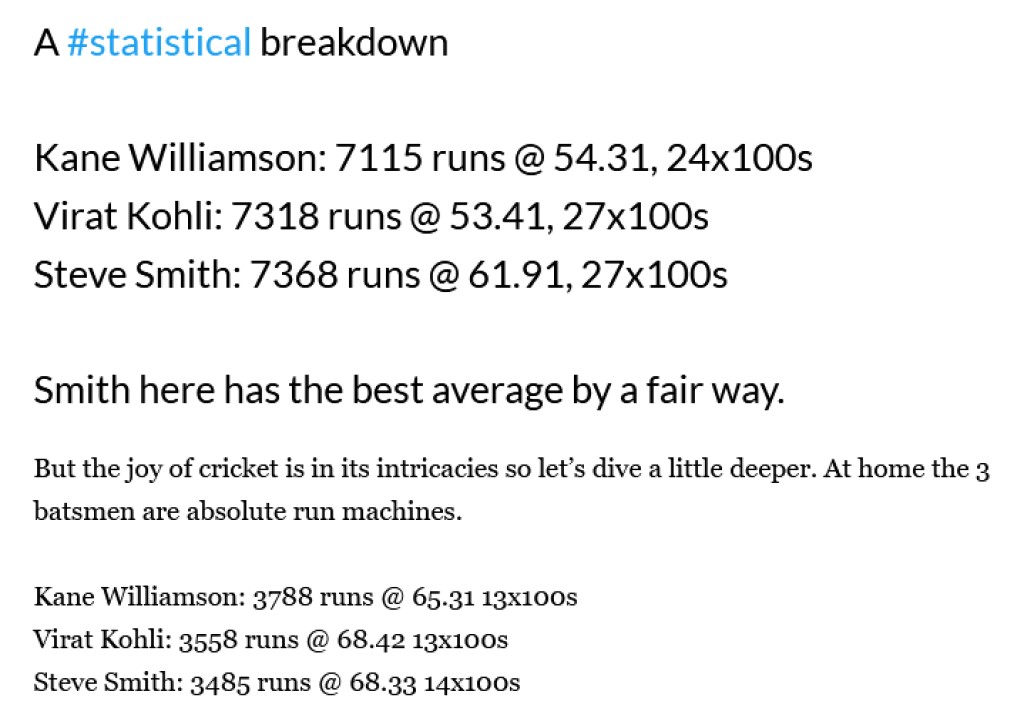
This twitter thread about the batting of that great trio Kohli, Smith and Williamson was created by allthingscricket, and I recommend you read it in full by clicking here. Screenshot below:

The start of allthingscricket’s thread about the great trio.

A PETITON & PHOTOGRAPHS

Before my usual sign off, I have a petition to share. This one is open only to UK residents, as it is on the official UK government petition site. It calls for students to be excused some of this year’s tuition fees, as they are not getting what they pay for, since they are quite correctly not able to be at University at present. Click here to sign and share. Screenshot below:

Now it is time for my usual sign off…

BBL10 UPDATE

A look at recent BBL developments, a nickname suggestion and some photographs.

This post looks back at the three BBL games on which the TMS team have provided live commentaries since my last blog post, and also attempts to give impetus to a nickname I have coined.

RENEGADES V THUNDER

The Renegades went into this match in bad position in the tournament and were unlucky to finish it in an even worse one. They batted first, and there was a rain interruption 12 overs into their innings which lasted long enough to reduce the game to 17 overs per side. They took the two over Power Surge immediately on the resumption, to relaunch their innings, an excellent decision IMO, and one that worked well for them. They finished with 167 from their 17 overs, which the Duckworth-Lewis-Stern system (DLS) turned into a target for the Thunder of 173, with the readjusted Bash Boost point target 65 off eight overs. The Thunder had reached 117-2 from 12 overs, helped by a fine knock from Alex Hales, when the rain returned, terminally this time. Thunder were ahead of the official DLS par score and took the points. My own reckoning is that 56 off five overs, even with eight wickets still standing, would have been tough for the Thunder to pull off. Renegades played again today (no commentary), and were soundly thrashed by the Scorchers as the latter continue their attempt at a Lazarus act.

SIXERS V HEAT

The Sixers were going well in the tournament, while the Heat were struggling somewhat. The Sixers had a good first ten overs, scoring 85 from them. It was in overs 11-15 that they let thing slip, being 123-6 after 15. A mini-revival got them to 165 from their 20. The Heat fared well in response, but lost wickets at awkward times. However, a respectable and well timed Power Surge got them back into the contest. At the start of the 17th over of the chase, bowled by Carlos Brathwaite the contest looked even, with maybe the Heat slight favourites, although they did not have a lot of batting in reserve should wickets fall. By the end of that over, which included three wides, and went for a lot of runs the Heat were cruising, and they took a mere four further deliveries to finish the job, Lewis Gregory finishing with 31 not out from 16 balls. The Heat were good value for the win. How would the Sixers respond to such lese majeste?…

SIXERS V STRIKERS

This was today’s commentary game on TMS. The Strikers started slowly and were 58-2 at the end of the tenth. The Power Surge did little to improve their situation, and it was only a late flourish in the last couple of overs of their innings that got them to the respectability of 150. They would have to bowl well to defend such a total. Jonathan Wells made 66 for the Strikers.

Unfortunately, with one exception, they did not bowl well. Rashid Khan bagged three wickets with his leg spin, but at that point Vince, already showing signs of going well, was joined by Jordan Silk.

One of the many subjects I read about is astronomy/cosmology, and anyone who has read remotely seriously about this kind of stuff would have come across Joseph Silk, a top astrophysicist. In quest of bringing some more imaginative nicknames back into the game, I link two J Silks together by dubbing Jordan Silk “Astrophysicist”, which could be shortened to “Astro”, linking to the the novels of Aussie writer Matthew Reilly.

Rashid Khan was given his fourth over early, the 14th of the innings to be precise, but by then the Sixers could afford to play him out without trying anything risky, and he finished with 3-18 from his allocation, a good deed in the naughty world of Strikers’ bowling figures.

Sixers then took the Power Surge, and those two overs plus another two were sufficient to see the Sixers to a seven wicket win, Vince 45 not out, “Astrophysicist”/ “Astro” 38 not out (he is also a fine boundary fielder, and has saved Sixers plenty of runs in that capacity during the tournament).

The Sixers, after their hiccup against the Heat, seem back on track and destined to be involved in the final stages of the tournament. The Strikers meanwhile look like a team in a lot of trouble. With the possible exception of the last two overs of the Strikers innings the Sixers won every phase of today’s game, and were far more dominant in it than the Heat had been against the Sixers, for all that Heat actually had a couple more balls in hand when they completed victory in that game.

PHOTOGRAPHS

My usual sign off…