Test Cricket Returns to Pakistan and England Spinners

Looking at the resumption of test cricket in Pakistan and at the question of England spinners, as news arrives of a potential test recall for Moeen Ali.

This post contains two parts, a look at current goings on in Pakistan and a look at England spinners ahead of the upcoming tour of India. The feature infographic provides a brief version of why I less than impressed by news of a possible test recall for Moeen Ali, and I will cover it more fully in the second part of this post. All player details come from cricinfo.com.

SOUTH AFRICA IN TROUBLE

The first test match to be played in Pakistan for some considerable time is under way. South Africa, the visitors, batted first, and did not make a particularly good fist of it. No one in their top six scored less than 13, but only Dean Elgar with 58 managed to get beyond 23. It took a late 35 from George Linde to get South Africa to 220. Five of the top six (where most of the runs should come from) getting into double figures but not even reaching 25 suggests carelessness, and reports I have read of the wickets confirm that more of them were given than were taken.

Pakistan looked to faring even worse when South Africa reduced them to 33-4 by the close of the first day. However, Fawad Alam dug in, and found some good support from the middle and lower order. Alam ground out a determined century, with no8 Faheem Ashraf (fairly new to test cricket, but averaging 31 with the bat and 27 with the ball in first cricket) scoring 64. By the time stumps were drawn at the end of day two, Pakistan were 308-8, a lead of 88. I don’t think it will happen, but personally just for the psychological impact of telling the opposition “you had us 33-4 and now we reckon we have enough of an advantage to win” I would recommend an overnight declaration. It was not all bad for South Africa today however – their women recorded an impressive win in an ODI against Pakistan, Laura Wolvaardt scoring 58 – perhaps the men should give her a bell, as their top order could do with a bit of stiffening.

ENGLAND SPINNERS

Leaving aside Simon Harmer, now technically eligible for England but apparently not in the selector’s minds, England have a number of spinning options they could look at, and Moeen Ali, touted for a test recall in some quarters, is not in my opinion one of them. He pays 36.59 per wicket in test cricket, a marginal improvement on his first class bowling average of 37.94. His batting, which his supporters turn to next demands two retorts: firstly picking people for bowling slots based on what they can do with the bat is flawed, unless they have very similar bowling stats to someone with much less batting skill, and secondly at test level it does not pass muster anyway – while his first class batting average is a respectable 36.72, his test batting average is 28.97, at the good end of ‘bowler who bats’ territory but definitely nowhere close to all-rounder status. In other words England are thinking of recalling someone whose bowling is in the ordinary range of ‘batters who bowl’ (Hammond, who averaged 58.45 with the bat at test level took his wickets at 37.80 for example) and whose batting is at the good end of the range for ‘bowlers who bat’.

Dom Bess, one of the current incumbents, pays 29.46 for his first class wickets, and just over 30 each for his test victims. Sophie Ecclestone, a very successful bowler for England Women, averages 26.28 across the three international formats (the women play so little long form cricket that one has to look across the spectrum) – and yes, I would certainly rate her a better option for a spinner’s berth than Ali. Jack Leach pays 26.06 a time for his first class victims, and averages just over 30 per victim in test cricket. Matt Parkinson, yet to be given his chance at test level pays 25.22 per victim at first class level. Liam Patterson-White has played just five first class matches to date, but has 20 wickets in them at 21.00 a piece. Amar Virdi has paid 28.08 each for his 91 first class wickets. Finally, if you absolutely insist on someone with all round qualities, Lewis Goldsworthy had an excellent under 19 world cup, though he has yet to play first class cricket (it would not be entirely unprecedented for someone to make their first class debut in a test match). Moeen Ali sits firmly in the category of proven failures at the highest level, and any of the players I have listed would be better selections than him – all are young enough to improve, whereas he is not. My personal vote would go to Parkinson, the leg spinner, to support Jack Leach, with Bess coming in if the pitch looks it warrants three spinners (Bess takes wickets when the ball turns, but when there is no assistance for him he leaks too many runs for comfort due to his tendency to bowl the odd loose ball). Whatever the right answer is, it is most definitely not an ageing player who cannot be deemed worthy of a place with either bat or ball.

PHOTOGRAPHS

My usual sign off…
All Time XIs – Double Letters

An addition to my ‘All Time XIs’ series, this time taking double letters as its theme.

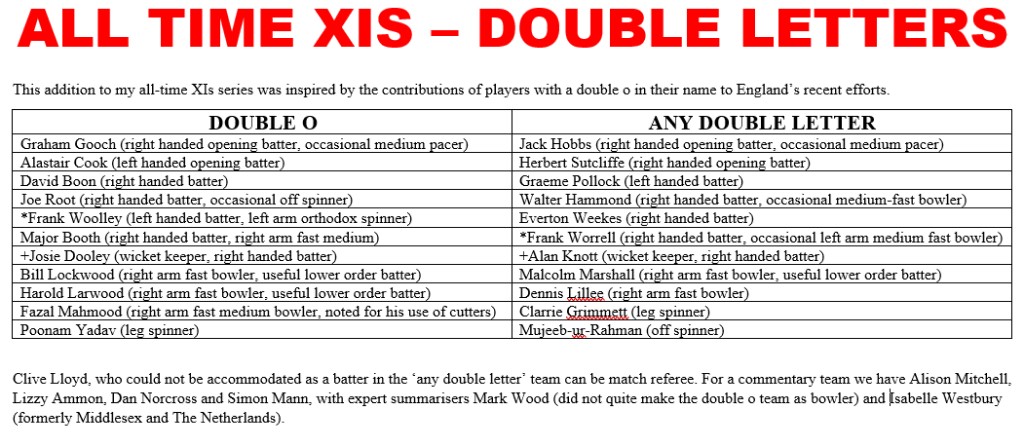
The role of players with a double o in their names for England in recent times got me thinking about a team of players who all featured that combo, and I then started thinking about other names with double letters in, resulting in a new post for my All Time XIs series.

THE DOUBLE O XI

  1. Graham Gooch – right handed opening batter, occasional medium pacer. Scorer of 8,900 test runs, and player of the best test innings I have ever personally witnessed – 154 not out in an innings tally of 252 vs West Indies at Headingley in 1991, with Ambrose running riot on a pig of a pitch.
  2. Alastair Cook – left handed opening batter, scorer of more test runs than any other left hander – 12,475 of them in all.
  3. David Boon – right handed batter, started as an opener, but moved down to no3 to enable the formation of the right-left Marsh-Taylor combination and enjoyed tremendous success in that latter position.
  4. Joe Root – right handed batter, occasional off spinner. Arguably England’s finest batter of the 21st century, Cook’s achievements notwithstanding.
  5. *Frank Woolley – left handed batter, left arm orthodox spinner. The only player to have the treble of 10,000 first class runs, 1,000 first class wickets and 1,000 first class catches, and indeed the only person to have taken 1,000 catches as other than a wicket keeper. In first class cricket he averaged 40 with the bat and 19 with the ball, and his bowling won at least one test match for England. I am sufficiently impressed by his tactical thoughts, as expressed in “King of Games” to name him as captain even though as a professional of that era he never had the job.
  6. Major Booth – right handed batter, right arm fast medium bowler. Major was his given name (he was named in honour of a respected Salvation Army figure), not a rank. He would certainly have played many times for England but for the first World War (he lost his life during the battle of the Somme). In the late stages of the 1914 season he and Alonzo Drake, another cut off in his prime by the outbreak of war, bowled unchanged together through four successive first class innings.
  7. +Josephine Dooley – wicket keeper, right handed batter. One of the successes of the most recent edition of the Women’s Big Bash League.
  8. Bill Lockwood – right arm fast bowler, useful lower order batter. He was one of the first fast bowlers to develop a really effective slower ball.
  9. Harold Larwood – right arm fast bowler, useful lower order batter. The list of visiting fast bowlers to have blitzed the Aussies in their own backyard is a short one, and the Notts express features prominently on it.
  10. Fazal Mahmood – right arm fast medium bowler. Pakistan’s first authentically great bowler, he took 12 wickets in their first ever test victory at The Oval in 1954. He was known as a master of bowling cutters, often wreaking havoc on the matting pitches which were standard in his homeland at the time.
  11. Poonam Yadav – leg spinner. The tiny Indian causes huge problems with her craftily flighted slow leg breaks. The greatest demonstration of her ability to change the course of a match came in the most recent World T20 when Australia seemed to be coasting as she began her spell and were obviously beaten by the time she had finished.

This team contains a strong top five, an all rounder at six in Booth, a keeper who can bat at seven and four great bowlers with plenty of variation. Woolley is an excellent second spin option with his left armers, and Gooch and Root might also contribute with the ball.

THE ANY DOUBLE LETTER XI

  1. Jack Hobbs – Right handed opening batter, occasional medium pacer. The Master, scorer of 197 first class centuries in total, 12 of them in Ashes tests. He achieved all that in spite of losing four years of his cricketing prime to World War 1.
  2. Herbert Sutcliffe – right handed opening batter. First class average 52.02, test average 60.73, Ashes average 66.85. When the going got tough, he got going. He formed the most successful opening pairing in test history with Hobbs, their average opening stand being 87.81.
  3. Graeme Pollock – left handed batter. The South African averaged 60.97 before his country’s international isolation ended his test career. I opted for his left handed stroke play in preference to having a third right handed opener in Hutton occupy this slot.
  4. Walter Hammond – right handed batter, occasional medium-fast bowler. 7,249 runs in 85 test matches at 58.45, and that average only ended up below 60 because he returned to test action after World War Two, when into his forties.
  5. Everton Weekes – right handed batter. He had a similar average to Hammond in test cricket.
  6. *Frank Worrell – right handed batter, occasional left arm medium-fast bowler, captain. He averaged 49.48 in test cricket, and was one the most successful captains ever, taking the West Indies from also rans which they had been for their entire history to that point to being champions by the time he finished.
  7. +Alan Knott – wicket keeper, right handed batter. One of the game of cricket’s most noted eccentrics, and also one of the greatest keepers ever to don the gauntlets. He also averaged 32.75 with the bat, and tended to score big runs when the team most needed them.
  8. Malcolm Marshall – right arm fast bowler, useful lower order batter. Arguably the greatest fast bowler of the golden age of West Indies fast bowling.
  9. Dennis Lillee – right arm fast bowler. The Aussie was for some years test cricket’s all time leading wicket taker, and his 164 Ashes wickets is a tally surpassed in the history of those contests only by Shane Warne who finished just short of 200.
  10. Clarrie Grimmett – leg spinner. The New Zealand born Aussie who having moved country to better his cricketing prospects had to then cross two state boundaries before establishing himself in first class cricket at the third time, and did not make his test debut until the age of 33 still became the first bowler ever to take 200 test wickets, capturing 216 from 37 test appearances – nearly six per game at the highest level. His Aussie team mate Bill O’Reilly, who was second choice for this spot, was adamant that Grimmett, then 46, should have been selected for the 1938 tour of England.
  11. Mujeeb-ur-Rahman – off spinner. A bit of a gamble on this one – left armer George Dennett with 2,151 first class wickets at less than 20 a piece could easily have been named for this spot, but the young Afghan off spinner has impressed most times he has had the ball in his hand of late.

This team features a very strong top six, one of the all time great keepers, and four great bowlers. I consider that Hammond and Worrell between them make up for the lack of a genuine all rounder. There are too many honourable mentions to name, but before moving on to the next section I would just like to say that if you have someone who you think I have missed please indicate which of my selections should be dropped to make way for them.

OFF THE FIELD

Clive Lloyd, a near miss for a batting place in the ‘any double letter’ team can be match referee, a role he also filled with distinction. In the commentary box we can have Alison Mitchell, Lizzy Ammon, Dan Norcross and Simon Mann, with expert summarisers Mark Wood (not too far off a bowling spot in the double o XI) and Isabelle Westbury (Middlesex and Holland).

PHOTOGRAPHS

My usual sign off:

The Group Stage of #BBL10: A Retrospective

A look at the 56th and last group game of #BBL10, an analysis of the qualification system, a look at the innovations in this year’s BBL and some photographs.

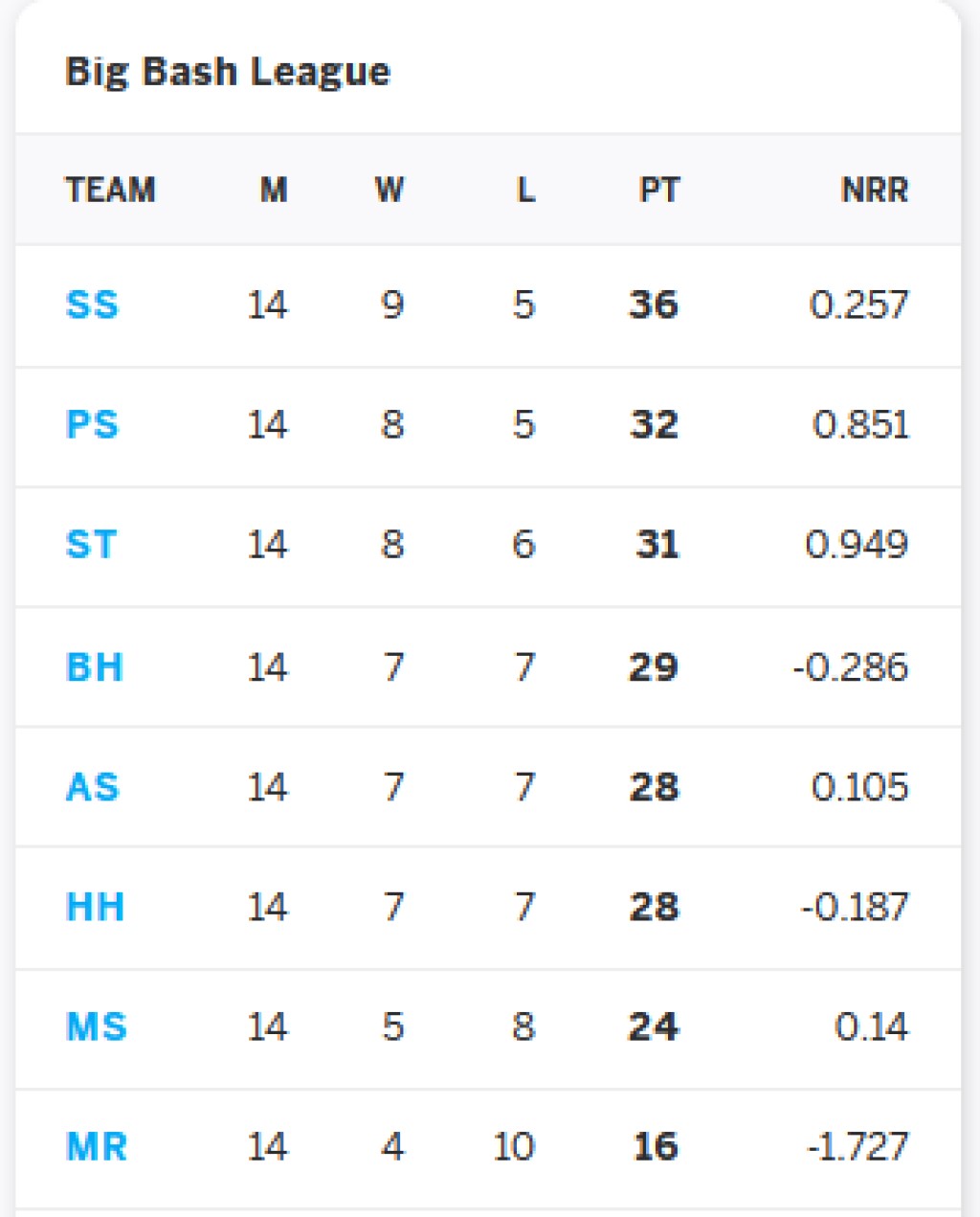
The graphic which heads this post is the final group table of BBL10, screenshotted from cricinfo.com. In this post I look back at the 56th and final group game, analyse the qualifying system in place for this tournament and offer final views on the three innovations. I would like to say at this point, in case the rest of this post gives a wrong impression, that I have enjoyed the tournament, and my criticisms are offered in a constructive spirit.

STARS STUFF UP SEES THEM CRASH OUT OF BBL10

With Heat beating Scorchers to secure a qualifying place and Renegades final act of the tournament being to eliminate the Hurricanes the 56th and last group game, commentary of which was broadcast on five live sports extra presented a stark situation to the two combatants: Stars needed the full four points (three for the win and one for the Bash Boost) to qualify (with a sensible qualifying system they would already have been gone – more on this later). Sixers meanwhile needed the Bash Boost point at minimum to win the group, and a victory of any sort to do so outright rather than on net run rate.

With Stars needing all the points they had to get big runs in the first ten overs of their innings, but they failed to pick up this message. Nick Larkin, a known slow starter, was sent in at number three, and in this case provided the expected slow start and then failed to go on (11 off 16 balls). Then, at the end of the tenth, setting the Bash Boost target, Nic Maddinson came back for a second on the penultimate ball rather than leaving the big hitting Maxwell on strike. Two more accrued of the last ball of the tenth, leaving Stars on 72-3, and a modest target for the Sixers to claim the all-important first point of the game, which would ensure no Melbourne participation in the final stages (Renegades’ win had not altered their final position – last).

Overs 11-15, which included the Power Surge being taken for overs 14 and 15 were the best part of Stars’ day, as they scored 52-1 in that period to reach 125-4 at the three-quarter mark. They lost a little momentum in the closing stages, but three sixes in the final over boosted them to 177-6, a respectable total, though not very relevant as their poor handling of the first ten had likely cost them any chance of qualifying.

Faced with the situation they were in Stars should have front loaded their batting with all their biggest hitters, realising that their 20 over score would only be truly relevant if they went big in the first ten. Nick Larkin as a known slow starter should probably not have been picked for this match at all.

Sixers lost a couple of early wickets, but by the end of their four over power play were 43-2, 11 runs ahead of Stars at the same stage. They also outscored Stars in the second phase of the innings, albeit only by two runs, being 85-3 at the halfway point, and having already won the war, securing their own status as group winners and the elimination of the Stars, although a Pyrrhic victory in the final battle remained on for the Stars.

Overs 10-15 did not go especially well for the Sixers, who reached the three-quarter way stage at 126-5, 1 run ahead, but one wicket behind the Stars. They picked things up in the final quarter however, and in the end a boundary struck by Dan Christian of the penultimate ball of the match ensured that Stars would not even have a Pyrrhic victory to finish. Sixers deservedly topped the group, and I for one have no sympathy for the Stars, who made a complete mull of their approach to this game, and who in the words of Anne Robinson “Leave with NOTHING.”

A FLAWED
QUALIFICATION SYSTEM

Although it lent a few of the final group games an interest they might not otherwise have had, a qualification system that allows five teams out of eight to progress to the knockout stages has to be considered flawed. Firstly, in order to reward each qualifying team according to their placement the knockout phase is byzantine in the extreme. Secondly, it means that average teams are being rewarded – the teams in the 4th and 5th qualifying spots each recorded seven wins and seven losses, which does not deserve to be enough to progress. Tournaments that are organized on part league part cup lines should reward only teams who are exceptionally successful in the league phase – and losing as many games as you win is not exceptionally successful on any definition. My own preferred method for an eight team tournament would be as follows: three teams qualify for the final stages, the group winners going straight through to the final, while the second and third place teams play off for the right to join them, with the second placed team having home advantage by way of reward for doing better than the third placed team. This would make the tournament more compact by reducing the number of knockout matches, although they also need to have more days on which multiple matches are played in the group stages, and would ensure that only teams who are clearly better than the rest get to play in the knockout matches.

THE THREE INNOVATIONS

BBL10 featured three innovations this year: the Power Surge, reducing the opening Power Play from six overs to four, with a two over Power Surge to be claimed by the batting team at any point after 10 overs, the Bash Boost point, awarded to the team with the better score at the halfway stage, and the ‘x-factor’ sub where specifically at the halfway stage of the first innings each team may swap out one player for one of their designated ‘x-factor’ subs. I am a huge fan of the Power Surge, though a number of teams have misused it, being wary of going early and ending up without front line batters to cash in on it, and would like to see it adopted in other T20 competitions. The Bash Boost point has overall been a success, although a combination of the importance it assumed today, and Stars’ flawed approach caused it to spoil this particular game somewhat, and again albeit under a different name, it might well be worth other T20 competitions adopting it. The ‘x-factor’ sub rule belongs in the circular file, and has in my view contributed nothing to the tournament. If you need to alter the balance of your side after the start of the game, the one valid reason for using such a sub, you should have got it right first time.

PHOTOGRAPHS

My usual sign off:

A Great Turnaround

My account of an astonishing final day of the Sri Lanka v England test series in Galle, complete with England player ratings and an acknowledgement of Lasith Embuldeniya.

This post deals with the events that unfolded in Galle today, which started with England very much second favourites.

ENGLAND FIRST INNINGS

England resumed 42 runs adrift with one wicket left in their first innings. Five runs were accumulated, four of them by way of a reverse sweep from James Anderson before the end came. Embuldeniya did not add to his seven wickets, but his day was far from done…

SRI LANKA SECOND INNINGS

Sri Lanka started their second innings with an advantage of 37, and plenty of time to build a daunting lead. Unfortunately they lost their heads rather dramatically. Jack Leach and Dominic Bess, bowling much better than they had in the first innings and assisted by some kamikaze batting from the Sri Lankans picked up wickets quickly. By lunch Sri Lanka were six down, and two more wickets fell soon after. There were two splendid catches, Crawley doing well to hang on to one that was hit out of the middle of the bat but straight at him, and Anderson getting underneath a swirling mishit. Embuldeniya, barely rested from his bowling stint, proceeded to play an innings that shamed most of his supposed betters with the bat, producing a first class career best 40 chock full of common sense. He succeeded in having Bess removed from the attack, but then he and no11 Asitha Fernando fell to successive Joe Root deliveries, leaving Sri Lanka all out for 126, and England facing a target of 164 to win.

ENGLAND 2ND INNINGS

Crawley did reach double figures for the first time in the series, but then honoured protocol by falling to Embuldeniya for the fourth successive time. Bairstow made a small contribution, Root failed, and Lawrence played a poor shot before he had given himself time to get a proper sight of the ball. At that point the score was 89-4, and England were by no means safe. Embuldeniya had three of the wickets, giving him ten for the match. Sibley was grinding away at one end, and was now joined by Buttler. Buttler batted sensibly, keeping the scoreboard ticking, although Sri Lanka were not doing nearly enough to make things difficult – singles were regularly there for the taking. As England closed in, Sibley completed a 50 which was worth more than a century on a flat track would have been. He had his good fortune, with a couple of close LBW appeals being turned down and being labelled “umpire’s call” by the DRS. However, the second of the two had hit him above the knee roll, and he is quite tall, so one can understand why it was considered too high by the umpire. Also, all fortune, good or ill, to one side, he showed an immense amount of character after a very poor series up to that point. Buttler just missed out on what would have been his second fifty of the match, but he was there at the end as England won by six wickets, to take the series 2-0.

THE PLAYER OF THE MATCH AWARD AND EMBULDENIYA

England’s win by six wickets effectively ensured that Joe Root, who had a second successive great game, would be player of the match. Had Sri Lanka bowled England out a second time and emerged victorious Embuldeniya would have been a deserving recipient, and even had the margin been three wickets rather than six he would have merited consideration. As it was a margin as comfortable as six wickets really did mean that someone from the winning team had to be chosen, and with all respect to Anderson and to Sibley for his gritty second innings effort Root was the only serious candidate. Root was also the Player of the Series, which was an absolute shoo-in. Embuldeniya’s combination of 40 and a 10 wicket haul got some of us thinking about other notable combinations of runs with big wicket hauls, and here are six of the best from test history:

  1. Melbourne 1883 – Billy Bates took seven wickets in each innings, including England’s first ever test hat trick, and scored 55 in England’s only innings
  2. The Oval 1902 – Hugh Trumble scored 64 not out and 7 not out and took eight first innings and four second innings wickets, but as with Embuldeniya could not win it for his side, England sneaking home by one wicket. Trumble had the best match aggregate for Australia with 71 runs, and bowled unchanged through both England innings for his 12 wicket haul.
  3. Alan Davidson 1960 – He took 5-135 in the West Indies first innings of 453, 6-87 in their second innings 284 and contributed 44 to Australia’s first innings 505 and 80 to their second innings 232, having to settle for a place in history as part of test cricket’s first ever tie, rather than a win.
  4. Ian Botham, Bombay 1980 (it was not called Mumbai in those days) – 6-58, 114 not out when no one else even topped 50, 7-48 in an innings victory.
  5. Imran Khan, Faisalabad 1982 – 6-98, 117, 5-82 in an innings win over India
  6. Richard Hadlee, Brisbane 1985 – 9-52 in the first innings, an all time test record for an out and out fast bowler, a blistering 54 (four of each kind of boundary) which enabled skipper Coney to declare with two full days in hand for Australia to be dismissed a second time, and six more wickets to finish the job.

ENGLAND PLAYER RATINGS

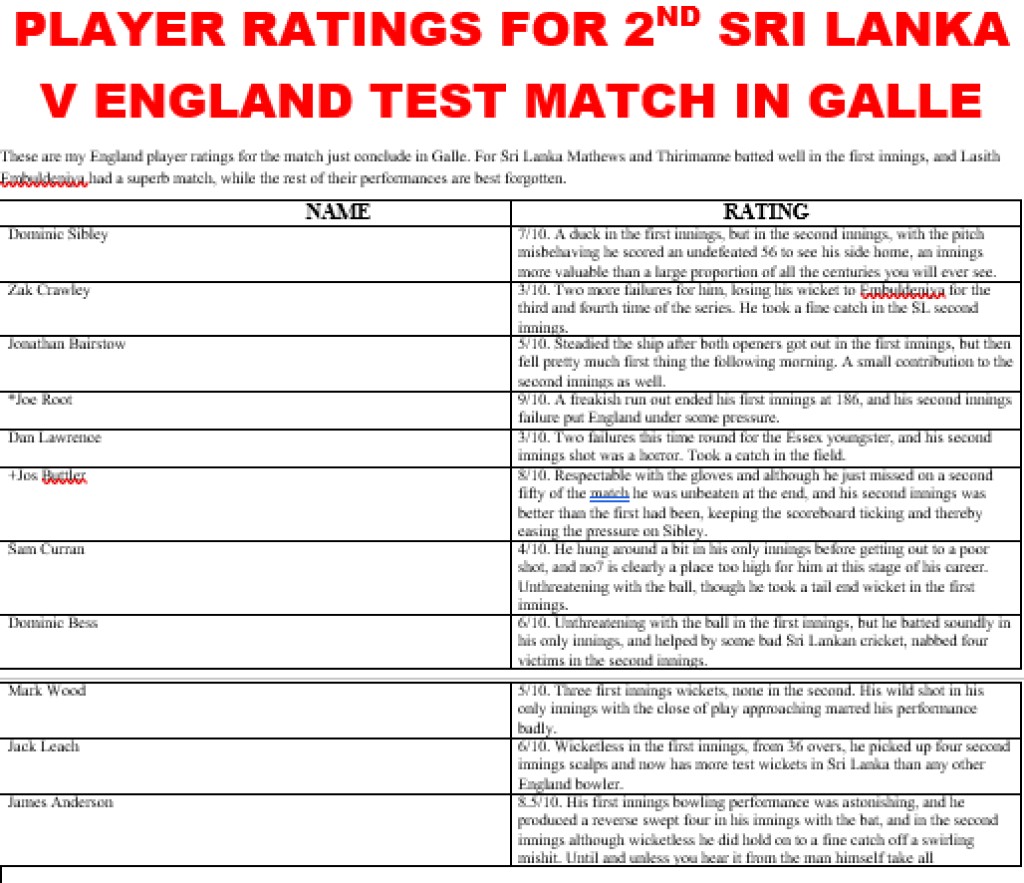
Dominic Sibley – 7/10. His gritty second innings saved a dire series for him, and spared England some potentially major blushes, sending him and them on to India in good heart.

Zak Crawley – 3/10. Two horrific failures with the bat, but he did hold one fine catch during the Sri Lankan second innings.

Jonathan Bairstow – 5/10. stabilised the ship in the England first innings after both openers had gone cheaply, but did then get out first thing on the following morning. A modest contribution to the second innings. Although he batted well at times he never did so for long enough in this series, as evidenced by a highest score of 47.

Joe Root – 9/10. 186 in the first innings, a couple of wickets to end the Sri Lankan second innings, but a failure at a crucial moment in the England second innings blotted his otherwise stellar copybook, costing him one mark.

Dan Lawrence – 3/10. A double failure with the bat this time, and his second innings shot was quite awful. He did take a catch in the field along the way.

Jos Buttler – 7/10. A fifty in the first innings, just missed out on that mark in the second, but played a crucial role in seeing England home. A competent effort with the gloves.

Sam Curran – 4/10. Largely unthreatening with the ball, though he did bag a wicket in the first innings, he hung around briefly with the bat, but did nothing to alter the impression that no7 is a place too high for him in a test batting order.

Dominic Bess – 7-10. His first innings bowling was largely unthreatening, he played a fine support knock in England’s first innings, and bagged four wickets in the second innings.

Mark Wood – 5/10. Three first innings wickets, none in the second. His shot near the end of day three was a poor one, and an absolute shocker in the circumstances.

Jack Leach – 7/10. Toiled through 36 overs in the first innings, getting no wickets. Bowled well in the second and was rewarded with four wickets. He now has more wickets in Sri Lanka than any other England bowler.

James Anderson – 8.5/10. Without his bowling in the first innings England would have been buried – SL would have had over 500 on the board. In the second innings he did not get among the wickets but did take a fine catch, doing well to get under a swirling mishit.

This is England’s fifth successive away test victory, their best run on foreign soil since they followed victories in the last four matches of the 1911-2 Ashes with another three to start the 1913-4 tour of South Africa. The bowling spearhead then was another right arm fast medium with Lancashire connections, albeit more to league cricket than to the county, Sydney Francis Barnes, and he was just a shade older than Anderson is now, being past 40 by the end of the South African series. India will be a much tougher tour – this Sri Lankan team are not used to winning, and that manifests itself in an obvious lack of killer instinct at key moments, whereas India surmounted huge difficulties to best the Aussies in their own backyard.

PHOTOGRAPHS

I end as usual with some photographs…

Hotting Up In Galle

A look at day three in Galle and a couple of issues raised therein.

This post looks at day three of Sri Lanka v England and at a couple of issues the arise from today’s play.

ROOT VS EMBULDENIYA

Although others contributed a fascinating third day in Galle was dominated by two players. Joe Root of England confirmed that he has rediscovered the art of going seriously big, as it took a run out in the day;s last over to dislodge him, by which time he had moved to 186. The other overarching performer was Sri Lanka’s left arm spinning find Lasith Embuldeniya who took his haul for the innings to seven wickets, Other than the impertubable England skipper the only person to play Embuldeniya with any great comfort was Jos Buttler who made a decent half century. The other significant batting effort on the day came from Dominic Bess, who came in with England staring down the barrel of a three-figure deficit on first innings with Sri Lanka to bat last. By the time he was dismissed the difference between the sides was under 50, and England were looking in the hunt. Unfortunately the odd looking decision to send the flamboyant Wood in ahead of the adhesive Leach with the close of play approaching did not work out well, and then there was the freakish run out of Root which ended the day, leaving England 339-9 in reply to Sri Lanka’s 381, with Leach and Broad to resume batting tomorrow.

ENGLAND’S BALANCING PROBLEMS ABSENT STOKES

Sam Curran looks a place too high in the order as a test match number seven, and the reason he is there is because on flat wickets England need to equip themselves with plenty of bowling options, and with Ben Stokes not available for this series they did not have their great x-factor player to turn to, which left them to choose between lengthening the batting or the bowling. Rightly in view of the conditions in which this series is happening they opted for the latter. There is strong evidence to support the view that if having to choose between batting and bowling strength the bowling strength is more important:
Surrey won seven county championships in the 1950s with an average batting side that possessed a stellar bowling attack, Yorkshire won seven championships in the 1930s, and again the key ingredient of their success was a devastating bowling unit, spearheaded by Bill Bowes and Hedley Verity. Finally, in the first decade of the 1900s Yorkshire won five titles, although only one of their batters, David Denton, was good enough to be chosen for England purely on batting skill in that decade, with the key again being an awesome line up of bowlers, headed by the Huddersfield area trio of Hirst, Rhodes and Haigh. Sussex in that same decade had a very deep batting line up, but limited bowling resources, and never came seriously close to winning the title. However, a batting line up with Curran at seven does necessitate those at the top coming to the party and so far this series only the skipper has done so – without him England would undoubtedly be staring a 0-2 defeat in the face rather than being favourites to win the series.

THE ROLE OF DOMINIC BESS

England are desperate for Dominic Bess to establish himself as a test class spinner, because he is a splendid fielder and a capable bat as well. Currently in first class cricket he averages 23.77 with the bat and 29.41 with the ball (137 wickets in 48 matches at that level). In test cricket he averages 24.77 with the bat and 33.37 with the ball (27 wickets in 11 matches). The bowling average and the low wickets/matches ratio – just below 2.5 – both point to the issue: as much he offers outside his main role, barring one good series against South Africa he has yet to deliver in his main role, with the ball.

Today he contributed 32, and looked like he was handling the bowling as well as any of his team mates save Root. It may be that ultimately the way forward for Bess as an international cricketer is to concentrate more on his batting, and aim to be picked as batter who bowls, rather than a bowler who bats. Garry Sobers and Steven Smith were both originally selected at test level as spinners (Sobers was at no9 on test debut, Smith at no8) and ended up making their biggest marks with the bat, although Sobers continued to bowl, whereas Smith has all but given up that aspect of the game. Going back further, Wilfred Rhodes was the best spinner in the world early in his career, and batted no11 for England, and went on to tour Australia in 1911-12 as one of the designated opening batters, hardly bowling at all (he would pick up his bowling after World War 1, and return to the top in that department, finishing his career as once more a specialist bowler, as his sight declined – he would go blind during his retirement – and he could no longer bat). At the moment Bess is always likely to get the nod if England want two front line spinners, and the main in more danger of losing out is Leach, who bowled 36 overs in the first innings here without causing any great problems for the batters, but do not be surprised to see Bess moving up the order in the not distant future, as he seeks to find a more secure niche than ‘bits and pieces guy who gets selected when two spinners are needed’.

PHOTOGRAPHS

Today’s gallery starts with seven pictures on the theme of ‘red sky in the morning, shepherd’s warning’, although today’s weather in King’s Lynn, while far from pleasant has not really borne out that saying:

Sri Lanka In Control In Galle

A look at day two of the second Sri Lanka v England test and some of the issues raised by it.

This post deals with day 2 of the second Sri Lanka v England test match in Galle, and tackles a couple of related issues.

ANDERSON AND THE REST

England achieved their first goal of removing Mathews early on day 2, for 110, but Dickwella who just missed out on a maiden test hundred and Dilruwan Perera with a fine half century took Sri Lanka to 381. James Michael Anderson finished this innings with the following figures: 29-13-40-6. Mark Wood, bowling consistently fast, took three wickets, and the other fell to Sam Curran’s left arm. Both front line spinners, Bess and Leach, were therefore wicketless, and neither posed much of a threat.

EMBULDENIYA’S BUNNIES

The England innings started almost on repeat from the first match, left arm spinner Lasith Embuldeniya being entrusted with the new ball, in company with veteran seamer Lakmal on this occasion. Sibley was first to go, pinned LBW (he reviewed, an effort bad enough to be almost worthy of the adjective ‘Watsonian’ in “honour” of the legendary Shane Watson, but the decision was correctly upheld), and then Crawley snicked one into the slips and England were 5-2, and in three innings to date Embuldeniya has now dismissed both openers all three times, without a double figure score from either. Root and Bairstow steadied the ship, and reached the close at 98-2, Root 67 not out. I was actually involved in a video conference at this time, so did not catch this passage of play. To give themselves a chance, given that the ball is already starting to turn, England will need to bat all day tomorrow as a first requirement. To do this they could do with someone other than Root producing a major performance with the bat. Looking ahead, England go to India next, and although Ravi Jadeja is injured, the Indian squad named for this series features Axar Patel, like Embuldeniya, a left arm spinner, and there is a strong case for India giving him the new ball alongside Bumrah, now recovered from his own injury. This strategy of pairing a left arm slow bowler with a right arm fast one at the start of an innings is nothing new. It used to be considered standard just over a century ago. Kent had their greatest period, four county championships in seven seasons, with Arthur Fielder and Colin Blythe, just such a combo, as their new ball pairing. Lancashire had a decade earlier used Mold and Briggs to similar effect. In the 1912 Triangular tournament England more than once used Syd Barnes and Harry Dean as an opening pair, and on one occasion Barnes and Frank Woolley did the honours. Australia’s lowest ever test innings score of 36 all out was made in the face of Rhodes (SLA, 7-17) and Hirst (LFM, 3-15) at Edgbaston in 1902. Sri Lanka’s reinvention of the cricketing wheel is working well for them.

ENGLAND OPENERS

The disastrous time Sibley and Crawley are having at the hands of Embuldeniya has naturally raised the question of whether to continue playing them or not. Whatever the correct answer is, I know what is not correct, though it is being advocated by various people: a recall for Keaton Jennings, a man with a Brearleyesque batting average and without the captaincy skills. For the India series Burns will be available, and he will fill one of the openers slots. I would revert to the Sibley, Burns, Crawley top three and hope it works. For the second innings of this match there is a potentially bigger problem, but it is hard to see a tactical adjustment of the batting order working, as Embuldeniya will surely be called up for a bowl as soon as either Sibley or Crawley appear.

There are some good young top order batters in county cricket, and I would rather look to them than to a never-really-was like Jennings.

THE ‘BRANDERSON’ ISSUE

England’s stated policy is rotate the two veterans, James Anderson and Stuart Broad, but they may well have to rethink – to leave Anderson out after his performance here would look odd to put it mildly. At home against New Zealand and India both should play, while for the Asheis it will depend on form and fitness, but I would be looking as follows: Brisbane – Broad, Adelaide – Anderson, Perth – neither, if all are fit I would go with the outright pace of Archer, Wood and Stone, Melbourne – both, Sydney – Anderson.

PHOTOGRAPHS

My usual sign off:

Day 1 of the 2nd SLvE Test at Galle, the Future of Test Cricket and The Draw

An account of day 1 in Galle and mentions of a couple of related topics.

This post is a three parter, beginning with the action from Galle, and then touching on a couple of other topics drawn to my attention while I was following the action in the final two sessions of the day by way of radio commentary and a cricinfo tab open for extra detail (I listened to the first session in bed, as the coverage began at 4:15AM UK time).

ANDERSON SHINES BUT SRI LANKA SHADE THE DAY

England’s only change to their XI from the first match was to follow their planned rotation policy with regard to the veterans, bringing Anderson in for Broad. Sri Lanka had Oshada Fernando come in for Kusal Mendis, and Lakmal for Hasaranga. Sri Lanka won the toss and chose to bat, and were very quickly two down, both wickets to Anderson on his return. Thirimanne and Mathews then saw Sri Lanka through to lunch at 76-2. That became 76-3 as Anderson struck instantly on the resumption, removing Thirimanne. Mathews went on, finding another staunch ally in Dinesh Chandimal. Chandimal fell to Wood, the fast bowler’s first wicket of the series, for 52. Mark Wood has been consistently in excess of 90mph this series, and the wicket was long overdue reward for toiling through over 230 balls in the heat of Sri Lanka. It was England’s last success of the day, as Mathews completed a fine hundred, and Niroshan Dickwella reined in his natural aggression to survive to the close. At the end of day one Sri Lanka were 229-4 from 87 overs (yet again, with England in the field the over rate was abysmal and even with the half hour overrun period and no weather interruptions three overs have vanished from the game), Mathews 107 not out, Dickwella 19 not out, James Anderson 19 overs, 10 maidens, 24 runs, three wickets, an outstanding display of bowling from the oldest player on either side. Overall the pitch was flat, and no bowler really got anything out of it. With the pitch likely to break up and/or crumble later in the game Sri Lanka definitely took the honours of day 1, and England will need to strike quickly tomorrow morning to avoid finding themselves in trouble.

TEST CRICKET’S FUTURE

Some people seem to be oblivious of the amazing series that has just concluded between India and Australia, and to be persisting in their belief that test cricket is in trouble. A link to a Telegraph piece arguing that players who play white ball matches should be banned from red ball cricket did the rounds on twitter today. The Telegraph articles are paywalled, and since I consider it a vile rag and absolutely will not countenance contributing to its coffers I have not read it in full, but the headline is enough to enrage me.

Most cricket playing countries have much smaller pools of players to draw on than England, but if this idea was to be adopted then England would immediately be deprived of Root, Stokes, Woakes, Sam Curran, Buttler, Wood, Bairstow and others from their test ranks. England could still put out a functional side without these players, but it would be a lot less good. Yes, players being rotated in and out of squads can be irritating, and yes the cricket schedule is absurdly cluttered, but test cricket is in fine health overall. India were able to chase that total down at the Gabba because they had players who have learned how to chase through playing in white ball cricket.

THE DRAW

Other sports have results that they call draws, but the draw in cricket has a uniquely wide range of possibilities: neither side within the proverbial country mile of winning, one side hanging on by its fingernails having been utterly outplayed, both sides trading blows right down to the wire but neither able to land the knock out punch. I understand but don’t necessarily agree with the use of tie-splitting procedures in limited overs matches, but in long form matches the draw is a vital part of the equation. In that match at the Gabba one of the things that made the closing stages so sensation was that it was a three-way contest: India vs Australia vs the clock. Timeless test were once a thing – Australia made all its home tests timeless for over 50 years, and some of the games must have been absolute crackers, but there would also have been some horrendous bores on shirt front pitches. Some of cricket’s greatest moments have been in drawn contests: McGrath surviving the final over at Manchester in 2005 to save Australia when it looked like Ponting’s great rearguard was going to be in vain, Pietersen and Giles saving England at the Oval in the final match of that series, England digging themselves out of a huge hole at the Gabba in 2010, and two injured Indians gritting out the final session at the SCG just recently. The draw has its place in cricket, and although there have been some incredibly dull draws (1990 at the Oval, Surrey 707, Lancashire 863, no time for the second innings) there have also been some utterly compelling draws which would have been much less so without the possibility of that result eventuating.

PHOTOGRAPHS

My usual sign off…

Hopeless Heat Hammered

A mention of Afghanistan v Ireland to highlight the emergence at international level of Rahmanullah Gurbaz, and account of Strikers v Heat, some links and some photographs.

Although the main focus of this post is today’s game in the Big Bash League, a passing mention of Afghanistan’s victory over Ireland in Abu Dhabi is in order. Rahmanullah Gurbaz, a 19 year old keeper/batter made his ODI debut for them, and produced the goods in some style, scoring 127 off 127 balls in their innings. Off spinner Andy McBrine took five cheap wickets for Ireland, but a late flourish from Rashid Khan, 55 off 30 balls, got Afghanistan up to 287 from their 50 overs. Although Curtis Campher and Lorcan Tucker both batted well for Ireland, Tucker’s dismissal for 83 finally ended their hopes, and in the end Afghanistan won by 16 runs. Rashid Khan in his main role had a respectable 2-56 from his 10 overs. Gurbaz added two stumpings to his century and gave away only two byes in the entire 50 overs of Ireland’s innings. A keeper who can score big runs is a huge asset to any side (as opposed to a batter who has been given the gloves but is not actually a proper keeper).

STRIKERS DOUSE THE HEAT

This match involved two teams who both needed a win to keep their qualification hopes alive. Strikers won the toss and decided to bat first. By the end of their Power Play overs they had reached 43-0, bringing up the 50 in the fifth over. Marnus Labuschagne, fresh from test duty, bowled the sixth over, and the first five balls went for 15, before the sixth got him a wicket, Weatherald for 36 off 18 balls. Strikers reached the halfway point on 104-1, with Alex Carey and Travis Head going well. This was the time to boldly claim the Power Surge at the first opportunity as a possible launching pad to a total in excess of 200, but Strikers declined to do so, and their innings entered a quiet period, the next four overs advancing the score by 27 before they finally, belatedly, claimed their Power Surge. They did not make the greatest use of those two overs, only adding 17 to their score, to be 148-2 after 16, but a huge finish saw them almost reach 200, and Carey complete a fine century. In the end they had 197-5, and it seemed that they had left a few runs out there by mistiming the taking of the Power Surge.

Heat began the chase decently, but Chris Lynn fell for 17 in the third over to make it 23-1, and then Heat unthinkingly favoured seniority, sending the two Joes, Denly and Burns, and Labuschagne, all solid test type players in at 3,4 and 5. At the half way stage Heat were 68-3, needing 130 off 10 overs to win. They had little choice but to take the Power Surge hoping it would revitalize their innings. Unfortunately, wickets fell to the first two balls thereof, putting Siddle on a hat trick, and pretty much killing Heat’s hopes. Heat then proceeded to do the one thing I find unforgivable, quit on the job. They settled down to attempt to survive their 20 overs, with no attention paid to the victory target. They failed even to achieve this miserable, losers target, being all out for 115 after 17.5 overs, beaten by a monster 82 runs.

Strikers moved into fourth, level with Stars and Scorchers on 24 points, but behind on net run rate, and having played a game more than those two. Heat dropped into seventh, on 21 points, and having played a game more than the sides immediately above them, Hurricanes and Thunder. On today’s showing the Heat have zero chance of turning things around to achieve a qualifying place, and quite frankly it will be better for the tournament if they do not qualify. Strikers were far from perfect, messing up the timing of the Power Surge in their innings, surrendering two wickets to poor balls from Labuschagne, and in consequence of their reluctance to go early with the surge, having a quiet third quarter to their innings, but they thrashed Heat out of sight, winning every phase of the game, some of them by huge margins.

Strikers progress was as follows: 43-0 off four (Power Play), 61-1 off overs 5-10 inclusive, 37-1 off overs 11-15 inclusive, 56-3 off overs 16-20, while their Power Surge overs yielded a not terribly impressive 17-0. Heat’s progress was as follows: 33-1 off four (Power Play), 35-2 off overs 5-10, 31-4 off overs 11-15 and 16-3 in the final quarter of their innings, which of course they failed to bat through. This included 12-2 off their Power Surge overs. The comparative stats for each phase of the innings were thus: 1st four, Strikers win by 10 runs and one wicket, 5-10 Strikers win by 26 runs and one wicket, 11-15 Strikers win by six runs and three wickets, final quarter Strikers win by 40 runs, same no of wickets lost, Power Surge Strikers win by five runs and two wickets. However, even more damning than these figures is the fact that after the two wickets went down at the start of their Power Surge Heat quite blatantly gave up on the game, which may be understandable, but is absolutely never acceptable.

LINKS AND PHOTOGRAPHS

Before getting to my usual sign off I have a petition and two autism related pieces to share with you. The petition, by way of change.org, is calling for a pedestrian crossing to put in on the south side of Battersea Bridge. There is a screenshot below, and I urge you to sign and share by clicking here.

My second link is to one of Pete Wharmby’s epic twitter threads about autism, the first three points of which you can read below:

Finally, Cambria Jenkins his produced a post on the question of ‘Autistic Person’ vs ‘Person with Autism’. Like the vast majority of autistic people I describe myself as an autistic person, and I take a very dim view of neurotypicals seeking to tell me why I am wrong to do so. Read Cambria’s post here.

Now it is time for my usual sign off…
BBL10 Logjam

Looking at the Big Bash League in the light of today’s game and providing some thoughts about the Power Surge.

The group stage of this tenth edition of the Big Bash League is entering its closing stages, with Sixers clear at the top, Renegades adrift at the bottom (certain not to qualify for the knockouts – 10 points adrift of the last qualifying spot with only eight left to play for) and six teams battling for four spots. From Scorchers in second down to Strikers in seventh the teams are separated by just four points,although third placed Stars have played a game more than the others in this sextet.

The Thunder, who had looked comfortable were dragged into the maelstrom when the Hurricanes beat them in a rain affected game, successfully chasing a DLS adjusted target. Yesterday Scorchers absolutely thrashed Heat to claim second spot in the group. This sets the stage for…

THE MELBOURNE DERBY

Stars had a chance of going second as they took on rock bottom Renegades today. The Stars batted first, and bizarrely the first over of the match was a maiden. Andre Fletcher failed to get going properly, taking eight balls to get off the mark, and getting out after hitting two fours, which gave him 11 off 14 balls. Nick Larkin came in at three, and he too struggled for a large part of his innings. The Power Play overs ended with Stars 27-1. In the ninth over Stoinis, who had been doing most of the scoring, fell for 37 to make it 58-2, Coulter-Nile, a fast bowler who has had some success with his big hitting batting was promoted with a view to increasing the Bash Boost target. Unfortunately the gamble back fired as he was out first ball to make it 58-3. That brought Maxwell in, and at the end of the tenth it was 63-3, a modest halfway score. Maxwell fell early in the second half of the innings, and by the end of the 15th, with a Power Surge to come, Stars had put up the 100, Larkin still there, but as yet having done little to impress.

Finally, with the score 111-4 after 16, Stars took the Power Surge. They fared reasonably well, scoring 21 runs and losing two wickets in those two overs, which left them on 132-6 after 18. They then did produce a big finish, 26 off the last two overs to total 158-6 from their 20. Larkin after taking 28 balls to reach 20 finished 61 not out off 47, 41 off his last 19 balls, but his dilatoriness in those first 28 would come back to haunt his team.

Renegades began dreadully in reply, limping to 17-2 in their Power Play overs. They improved in overs 5-10 but were still 10 runs adrift at the half way point, 53-3 as opposed to 63-3. They too were slow in claiming their Power Surge, waiting to the end of the 15th, at which point they were 96-4. They made decent use of the two over Surge, but still required 41 off three overs to win. Over number 18 was a big one for them, reducing the ask to 25 off 12 balls, and then the 19th settled it, 19 runs in total coming from it, leaving Renegades six to get in the final over. A boundary for Webster, taking him to 22 off nine balls, finished things, but the real key was Harvey, 47 not out off 22 balls, an innings that deservedly earned him the Player of the Match award. It was perhaps fitting that an attack minded left hander named Harvey should play the key role in settling a match between two Melbourne based sides.

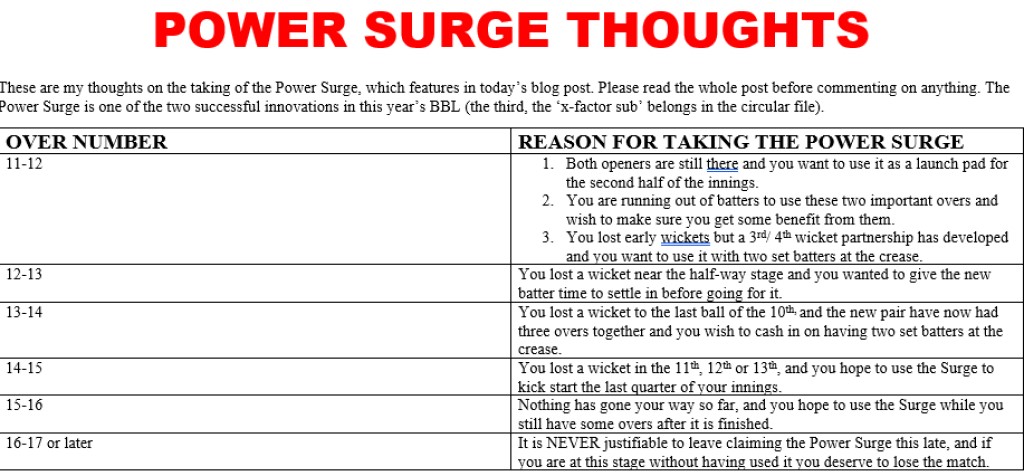
POWER SURGE THOUGHTS

Of the three innovations in this years Big Bash League the Power Surge is the one that intrigues me the most. The ‘x-factor sub’ belongs in the circular file, the Bash Boost point is proving to be a huge success, and I also like the concept of the Power Surge, but feel that its application has been lacking, with sides too inclined to leave it late and therefore ending up not really benefitting from it (nb Brian Charles Lara who knows a bit about batting is on my side on this one).

The infographic I created for this post, which you will have seen at the head of it, and which reappears to end this section, outlines my thoughts on this issue, and I will add to it just this: sides going into the second half of their innings should be inclined to go early rather than late with the Power Surge and should delay it only if there are strong reasons, such as a wicket falling in the tenth over, for doing so. I can see no merit at all in using it any later than overs 15 and 16, as you should be getting big runs off the closing overs anyway even without the extra fielding restrictions.

PHOTOGRAPHS

I have two galleries to share with you today, the first featuring my newest acquisitions, and the second my regular fare:

India Zindabad!

An account of the spectacular denouement to the Border-Gavaskar trophy series at the Gabba, a look at cricket formats and to upcoming test series, and some photographs.

This post is mainly about the amazing conclusion to the battle for the Border-Gavaskar trophy, the last day of which ended early this morning UK time. I will also be comparing the various formats that cricket now has and looking ahead to upcoming test series.

THE INJURY STREWN ROAD BACK FROM 36 ALL OUT

India took a first innings lead in the first test of the series, before that game underwent a shocking turnaround, as an hour of Cummins and Hazlewood at their best routed India for its lowest ever test score of 36, and Australia knocked of the target of 90 for the loss of two (see here for more details) wickets. At that point, with Kohli departing on paternity leave and injuries already making themselves felt an Indian series victory looked a long way away.

In the second match at the MCG India, captained by Rahane in the absence of Kohli hit back hard to level the series, but their injury list continued to lengthen.

In the third match of the series at Sydney, India continued to suffer injuries, with their two best spinners, Ashwin and Jadeja joining the crocked list. Also injured was Hanuma Vihari. However, in a display of determination that was a foretaste of what was to come at the Gabba, Vihari and Ashwin carried India to a hard fought draw in this match.

The final stop for India, with a bowling attack so depleted that those selected in bowling spots had one test cap between them, was the Gabba, where Australia were unbeaten since 1988, when a full strength West Indies, featuring one of the most awesome collections of fast bowlers ever seen, did the job.

Australia won the toss and chose to bat first (a number of sides of been lured in by the prospect of early life in the pitch and chosen to bowl, normally with terrible consequences – Hutton’s England leaked 601-8 in 1954-5 and lost by an innings and 160, Border’s Aussies conceded over 450 in 1986, were made to follow on and ended up beaten by seven wickets, Hussain’s England allowed Australia to reach 367-2 by the close of the opening day, and thereafter there was only going to be one result), and they tallied 369, a very respectable effort. Shardul Thakur and Washington Sundar each featured prominently in the bowling figures, as did Siraj. At 186-6 India looked in colossal trouble, but Thakur and Sundar followed their bowling exploits with some excellent batting, making 67 and 62 respectively, and in the end the deficit was just 33.

India did well to restrict Australia’s 2nd innings to 294, which left them 329 to get and just over a day to do so. The weather which had intervened several times, did so once again, ending day 4 early with India 4-0, needing 324 off 98 overs on the final day to win, with a draw also sufficing to retain the Border-Gavaskar trophy.

By lunch on day five India had lost only one wicket, and Gill and Pujara were going well. The afternoon session was better for Australia, but they still did not capture many wickets, and Pant was batting well by the tea break.

When Mayank Agarwal fell for a skittish nine it still seemed that only two results were possible. Sundar joined Pant, and they were still together going into the mandatory last 15 overs, with 69 needed. By the ten over to go mark this was up around a run a ball, but they were still together. Briefly the ask went above one run per ball, but then Sundar hit a six and a four in quick succession, which in turn encouraged Pant, and suddenly the target was approaching at a rapid rate. Cummins, who had toiled heroically and picked up four wickets on the day gave way to Hazlewood, while Lyon was wheeling away at the other end. There was a brief wobble when Sundar fell essaying a reverse sweep and then Thakur got himself out cheaply, but the target was close to being achieved by then, and not long later a straight driven four for Rishabh Pant ended the chase, India winning by three wickets to take the series 2-1 and retain the Border-Gavaskar trophy in style. Pant had scored 89 not out, backing up Gill’s earlier 91 and a determined 56 from Pujara.

Pant was named Player of the Match, while his 20 wickets earned Cummins the Player of the Series award. Personally I would have given the match award to Thakur who made significant contributions to all of the first three innings, without which India would never have been in the contest, but I can understand why it went to Pant.

Of all the test series I have followed closely enough to comment on from personal experience (dating back to the 1989 Ashes debacle) this one between Australia and India has only one remotely serious rival, the 2005 Ashes series, which featured three of the greatest matches I have ever been witness to plus Pietersen and Giles’ heroics at The Oval.

ON CRICKET FORMATS

Top level cricket these days has four principal formats with a fifth in the pipeline, and this match just concluded at the Gabba, plus events at Galle prompted to me to write a little about each:

  • Test Cricket – these two matches in their differing ways provided excellent case studies as to why the five day format is the best of the lot for cricket. Both matches featured fight backs which could not have been mounted in a shorter version of the game.
  • First class cricket – played over either three or four days (one of the definitions of a first class cricket match is that it must last at least three days), and like test cricket the longer time frame enables things to happen that could not in a short match.
  • One day cricket – played over the one day, usually one innings per side, although various split innings formats have been tried, and each side is limited to a certain number of overs, and at least five bowlers must be used. It has its great moments, notably the 2019 World Cup final, but the great majority of games in this format do not stick in the memory any longer than it takes to play them.
  • T20 – One innings of 20 overs per side, various fielding restrictions and other gimmicks according to the exact competition. These can be cracking entertainment while they last, especially if they get close, but again few stick in the memory.
  • The Hundred – 100 balls per innings for each side, to be bowled in some combination or other of blocks of five and ten balls. Nobody really knows why this joke of a format was invented, though after being delayed for a year by the pandemic it is expected to make’s it appearance in the 2021 English season. I feel that tampering to the extent that is involved in the design of this new format is unacceptable. The number of balls in an over has changed through cricket’s long history – it was four in the early days, five in the 1880s and 1890s, then six, then eight for a time (briefly in this country, for about 50 years in Australia) and then back to six, but it has always been fixed and constant within each match. Just as I refused to pay any attention to the Stanford extravaganza, rightly seeing it as fundamentally bad for cricket, so I plan to ignore the Hundred.

FUTURE TESTS

England have two series coming up against India, first in India, then in England, and an Ashes series down under at the end of the year. I now feel having seen an injury ravaged India fight like tigers and beat the Aussies in their own back yard that England will be lucky to win either series against India, but for all that no England team not holding the Ashes have won in Australia since 1970-1 they have a decent chance of winning that series. I noticed that Axar Patel, a left arm spinner, is in India’s squad for the upcoming series in India, and given the ‘rabbits in headlights’ responses of Messrs Crawley and Sibley to Lasith Embuldeniya taking the new ball for Sri Lanka I can see exactly how India might use him to their advantage! Overall, test cricket is in fine health, and has once again dealt very effectively with premature rumours of its sad demise, by producing a couple of amazing games that overlapped with one another.

PHOTOGRAPHS

Time for my usual sign off…