The Knockout Stages of the Womens World T20 Cup

A look back at the closing stages of the women’s T20 world cup and a photo gallery.

In this post I look at the semi-finals and final of the Women’s World T20 Cup in South Africa.

AUSTRALIA V INDIA

I was at work when this match was played, so my knowledge of it is entirely second/ third hand. Australia won by five runs, and there appear to have been two key moments in the chase – Harmanpreet Kaur being run out due to a failure to ground her bat properly when coming back for a second and a brilliant piece of fielding by Ellyse Perry which saved a seemingly certain boundary.

SOUTH AFRICA V ENGLAND

No South African side, male or female, had ever reached a world cup final in either T20 or ODI cricket. England were unbeaten in the tournament and have plentiful experience of finals. SA posted a very respectable score. Katherine Sciver-Brunt playing her last ICC tournament had a terrible time in the field. After viciously upbraiding several of her team mates for perceived lapses she had a horror time bowling the 20th over, conceding 18 from it, which lifted SA into the 160s. This did not seem to matter when Dunkley and Wyatt made a blazing start to the chase, putting England ahead of the required rate, but the fall of wickets and a quiet spell spanning overs 9-15 inclusive turned the game South Africa’s way, and although England fought back hard in the closing stages South Africa won by six runs and thus claimed a place in the final.

SOUTH AFRICA V AUSTRALIA

With the hosts in the final Newlands was absolutely jam packed. Unsurprisingly both teams picked the same XIs that had won their respective semi-finals. Australia won the toss and batted. SA bowled well, but not quite well enough, and aided by a big final over Australia posted 156 from their 20 overs. SA started slowly and although Laura Wolvaardt (who overtook Natalie Sciver-Brunt to become the tournament’s leading run scorer in the course of her 61 off 48 balls) and Chloe Tryon staged a mid-innings revival that briefly hinted at making a serious challenge for the runs, Australia were just too good. In the end the margin was 19 runs. This was a sixth T20 World Cup for the Australian women, a 13th global trophy in all for them, and the fifth time that Meg Lanning had captained a side to a world cup victory (no one else of either sex has achieved this feat more than twice). South Africa had fought hard, and to the credit of the fans Newlands remained full right to the end even though the result was obvious some way before it was officially confirmed. Much more will be heard of this South African squad in the future, and it took the most dominant cricket team on the planet (either sex) to stop them in their tracks this time round.

PHOTOGRAPHS

My usual sign off…

The Womens’ T20 World Cup Semi Finalists

A brief look at the four teams in the semi-finals of the Womens Under 19 World Cup, and a substantial photo gallery.

The semi-finalists of the Womens T20 World Cup are now established, as are the timings of their matches. Tomorrow when I shall be at work Australia face India, while on Friday England take on the hosts South Africa. This post looks at the four sides and their passage to the semi-finals.

AUSTRALIA

They came into this tournament as heavy favourites and there is no great reason to alter that assessment. They have disposed of everyone in their path to date. They still have two tough contests ahead of them, but all available evidence suggests that they are thoroughly capable of adding yet more silverware to the best stocked trophy cabinet in international cricket.

ENGLAND

England are also unbeaten, and finished their group stage with a flourish (a game I know about only at second hand due to work commitments), beating Pakistan by 114 runs (213-5 plays 99). They should have what it takes to get past South Africa in the semi-final, but unless India produce something beyond anything they have shown thus far in the tournament the women in green and gold will be waiting in the final, and England will need to be at their absolute best and probably have a bit of luck in addition to win that contest. England have been strong in all areas, with their least effective player of the tournament so far being the veteran Katherine Sciver-Brunt whose last ICC tournament this is.

INDIA

Other than suffering a narrow defeat at England’s hands India did everything right in their group. They should also be buoyed by the recent success of their juniors in the Womens U19 T20 World Cup, the first world cup win by any Indian women’s team, and the upcoming Womens Premier League (female equivalent of the IPL) will act as a spur to ensure that they produce their best on the biggest stage, but they face a mighty obstacle in the semi-finals in the form of the Aussies.

SOUTH AFRICA

The hosts left ir right to the last gasp to ensure their own qualification. They entered the last match of the group stage, against Bangladesh, needing a win (nothing else – net RR was not an issue) to qualify. South African teams have been known to fail to close out such deals, notably the South African men, who in the last men’s T20 World Cup were in the identical position against even less significant opposition, The Netherlands, and suffered a humiliating defeat and consequent early exit. SA were less impressive than their final winning margin of 10 wickets with 2.1 overs to spare suggests – Bangladesh batted poorly, and failed to capitalize on a number of opportunities they were given in the field. Although sometimes teams who only just sneak in at the last moment end up winning because they are the ones in form I don’t think even the most one-eyed of South Africa fans would dispute that they rank as fourth out of the teams to qualify for the semi-finals.

PHOTOGRAPHS

My usual sign off…

England Men in New Zealand

A look back at the first New Zealand v England test match, a couple of 15-minute city related links and lots of photographs.

The first test of mini-series of two matches between New Zealand and England men’s teams has ended early on the fourth of five scheduled days in a crushing victory for England. This post looks back at the match.

ENGLAND BAT FIRST

England batted first and scored at a very quick rate, so that the regular loss of wickets was not as much of an issue as it might have been. When the ninth England wicket fell at 325, with a bit of time left in the day, Ben Stokes declared in order to get New Zealand in under the lights. Harry Brook had made 89 and Ben Duckett 84.

EARLY WICKETS AND A FIGHTBACK

Anderson, Broad and Robinson proved highly effective in the situation that the England batters and their skipper Stokes had created for them and by the end of day one New Zealand were 37-3. On the second day, largely through Tom Blundell (138), the Kiwis mounted a spirited fightback and ended up only 19 runs in deficit on first innings. Stuart Broad and James Anderson stood on the cusp of yet another piece of history, needing one more to wicket between them to have taken more wickets in test matches in which they played together than any other pair of bowlers.

ENGLAND’S SECOND INNINGS

England scored briskly once again, and avoided losing excessive numbers of wickets to the new ball. On day three Neil Wagner put in a spirited bowling effort for the Kiwis, but half centuries for Root, Brook and Foakes plus aggressive contributions from Stokes and Robinson got England to 374 in their second innings, and at pace that meant that for the second time in the match they got to attack the Kiwis under the lights with the new ball (I reckon even if they hadn’t been all out Stokes would have declared to make sure of this, just as he did in the first innings).

NEW ZEALAND SECOND INNINGS

England were even more devastating under the lights second time round, and the Kiwis ended day three on 63-5 and surely knowing that the writing was on the wall.

In the event, in the very small hours of this morning UK time, while I was asleep, the Kiwis managed to exactly double this score, going down by 267 runs. Anderson finished with 4-18, Broad 4-45. Harry Brook was named Player of the Match for his 143 runs across the two England innings. A full scorecard can be viewed here. The biggest difference between the sides was in how they used the new ball – England, helped by Stokes’ game management that saw them twice get to use it under floodlights, kept things tight and took plenty of wickets, while New Zealand took few wickets with the new ball and got smacked around when trying to use it.

SIDELIGHT: INDIA MEN RETAIN BGT

Meanwhile India men were in action against Australia men in the second match of the Border-Gavaskar trophy series, India having won the first by a huge margin. Going into today Australia looked like they had a real chance to level the series, but a brainless display of batting against Jadeja (7-42) and Ashwin saw them crash from 60-1 to 115 all out, and India were never seriously in danger of failing to chase their target of 114 (yes, the teams were separated by a single run on first innings), getting there with six wickets in hand.

PHOTOGRAPHS

I have lots of photographs to share with you. Most of my photographs are taken within walking distance of my home in King’s Lynn, which links to the subject of 15-minute cities – a vision of providing people with amenities close enough to home not to require a car to visit them, and I have two good links to share on this topic:

  1. This Guardian article by Oliver Wainwright.
  2. A twitter thread by Haringey based active travel enthusiast Carla Francome based on a recent radio interview.

Now for my usual sign off…

England and Australia off to Winning Starts at the Womens T20 World Cup

A look back at yesterday’s two matches in the Women’s T20 World Cup and some photographs.

The Womens World T20 Cup is underway in South Africa. This post looks back at the two matches that took place yesterday.

ENGLAND V WEST INDIES

West Indies batted first. There were no huge selection surprises. Katherine Sciver-Brunt entered the record books just by taking the field – at 37 years 224 days she became the oldest person ever to turn out for England in a Women’s T20 World Cup match. She also then became England’s oldest ever wicket taker in a match of this nature. England were not quite at their best with the ball and in the field, though Sophie Ecclestone emerged with 3-23 from her four overs. West Indies probably scored about 15 runs more than they should have done due to English lapses, eventually finishing on 136.

Sophia Dunkley served notice of her and England’s intentions by scoring 34 off 18 balls. However, she, Danni Wyatt and Alice Capsey all fell before England were halfway to the target. At that point Heather Knight joined Natalie Sciver-Brunt, and there were no further alarms as England cruised home with over five overs to spare.

AUSTRALIA V NEW ZEALAND

Australia are the current holders, and arrived at the tournament with an awesome looking squad. A blistering batting performance, with Alyssa Healy scoring a record equalling sixth World T20 cup 50 and Ellyse Perry scoring 40 off just 22 balls saw Australia total 173-9, a total that would require excellent batting and a fair amount of luck to overhaul.

The Kiwis, whose batting line up is not the deepest, started disastrously with both openers out for ducks in the first over of the reply. The third wicket pair hinted briefly at a revival, but when that stand was ended by a controversial decision. Thereafter no one really threatened to anything with the bat. Ashleigh Gardner took her first ever international five-for, 5-12, half of those runs coming from one defiant blow from Jess Kerr with the writing already on the wall. To sum up NZ’s fortunes, she was out to the very next delivery, and thje tenth and final wicket fell four balls later. NZ had scraped up a measly total of 76, going down by 97 runs.

PHOTOGRAPHS

Today’s usual sign off comes in two parts, first a general gallery and then a specific focus on the Egret that seems to have taken up residence in the environs of the Gaywood River.

Now for the Egret pics…

Miscellany

London Underground at 160 years old and a couple of cricket bits, plus some photographs.

I have a number of things to post about, and will cover them in order.

LONDON UNDERGROUND 160

On January the 10th 2023 London Underground, the oldest underground railway system in the world, turned 160. From a modest seven stations when what was then called the Metropolitan Railway opened (this section of track is now part of the Hammersmith & City and Circle lines, but only Great Portland Street to Farringdon feature today’s Metropolitan line (the Metropolitan line platforms at Baker Street, two terminal platforms and two through platforms are later additions after the network began to expand, while platforms 5-6 have been restored to look as close to the 1863 originals as feasible) the system has grown to almost 300 stations and over 250 miles of track. After the initial opening, the biggest development was the development of electric locomotives, which enabled the opening of lines running further below ground and built with less surface level disruption, making use of the blue clay on which London sits and the Greathead Shield. The first deep level tube line, the City & South London Railway, now part of the Northern line, opened in 1890.

Big Bash League

Yesterday (I missed today’s game because of an important meeting) Brisbane Heat took on Perth Scorchers. Heat looked set for a formidable total when they reached the halfway stage of their innings at 80-2, but a disastrous third quarter of the innings, including a Power Surge that they took at a sensible time but failed miserably to cash in on yielded 25-2, and even with a decent final quarter of their innings they mustered 155 from their 20 overs, respectable but not the truly formidable score that looked on at halfway. Scorchers began poorly in response, managing only 25-2 in the opening four overs, but Heat then blundered, entrusting the fifth over to part time leggie Marnus Labuschagne. No fewer than 20 runs were plundered from that over. Even so, at the halfway stage of the chase Scorchers were still fractionally behind the rate, being 75-2, needing 81 off the last ten. It was the third quarter of the Scorcher’s allocation that killed the game – where Heat had scored 25-2 from overs 11-15, Scorchers, who also took their Power Surge in this period, and in their case made excellent use of it, scored 60-0 from overs 11-15. The winning hit was a six, off the second ball of the 17th over, with the third wicket pair still together. Scorchers top the table, with a game in hand on their closest challengers as well, while Heat are currently stone last, though they have a game in hand on the team immediately above them.

AUSTRALIA CANCEL TOUR OF AFGHANISTAN

Australia were due to tour Afghanistan but have cancelled that tour in protest at the activities of the Taliban. This has caused considerable controversy, but I, old enough to remember South Africa’s isolation (caused by racial rather than sexual discrimination, though I suspect the likes of Balthazar Johannes Vorster were as misogynist as they were racist) am entirely in favour of the move (please note that individual South Africans were allowed to play in domestic competitions around the world, they were just not allowed to compete under the banner of South Africa) and hope that other countries will stand up to be counted.

PHOTOGRAPHS

My usual sign off…

Two Great Performances in Losing Causes

A look at two remarkable performances that came in losing causes, a brief mention of an innings victory for Sri Lanka and some photographs.

Yesterday saw two remarkable games of cricket, each featuring a notable performance for a member of a badly beaten team.

INTERNATIONAL: SURYAKUMAR YADAV

In the final match of the T20I series England batted first against India. With Dawid Malan leading the way (77 off 39), England posted a massive total. For a time it looked like India might chase them down, and had Suryakumar Yadav had proper support they probably would have done. As it was, the only person to stay with him for any length of time, Shreyas Iyer, did not score quick enough on his own account. Yadav scored 117 off 55 balls, and India went down by 17 runs. Although I understand why Reece Topley got Player of the Match for his three crucial wickets I personally would have given it to Yadav.

DOMESTIC: GEORGE SCRIMSHAW

In the evening the last of the four Vitality Blast quarter finals took place. Somerset were at home to Derbyshire. Somerset were scoring at ten an over at the end of the 11th over, but then went on a spectacular charge which saw the last nine overs yield over 150 runs. This meant a final total of 265-5, an all time tournament record, for Somerset. Leg spinner Matthew McKiernan earned a place in the record books for the wrong reason – his 4-0-82-0 was the most expensive four overs in T20 history. Yet in amongst the dung heap that was the Derbyshire bowling figures one jewel shone out: George Scrimshaw 4-0-16-2. Given that his team mates collectively had 3-249 from 16 overs, for an ER of 15.56 per over his performance prevented a Somerset tally of over 300. The runs his bowling saved unsurprisingly counted for little in the end – a dispirited Derbyshire sank to 74 all out and defeat by 191 runs, yet another record.

SOME NEWS FROM ABROAD

Sri Lanka is a country in turmoil at the moment. Their male cricketers gave them something to enjoy though – around noon UK time they completed a victory over Australia by an innings and 39 runs. Australia managed 364 batting first, Sri Lanka took 190 run lead, piling up 554 with Dinesh Chandimal scoring an unbeaten double hundred. Australia then mustered a meagre 151 all out in their second innings. Chandimal’s innings notwithstanding, the star of this victory was debutant Prabath Jayasuriya, a left arm orthodox spinner who had taken 6-118 in the first dig when conditions were all in the batters favour. Second time around on a surface now offering assistance to spinners he claimed 6-59. Only three players have ever had better match figures on debut than his – Narendra Hirwani took 16-136 for India v West Indies, Bob Massie took 16-137 for Australia v England, and Fred ‘Nutty’ Martin took 12-102 for England against Australia in 1890. None of those three went on to have long or illustrious careers, but Jayasuriya can look at two who took 11 on debut: Clarrie Grimmett went on to claim 216 test wickets, an all comers record at the time, and Alec Bedser took 236 in his career. At 30 years of age Jayasuriya is three years older than Bedser was and three years younger than Grimmett was when he made his debut.

PHOTOGRAPHS

My usual sign off…

Ashes Ahoy

A preview of Ashes 2021-22, with official coverage starting at 11PM UK time.

Official coverage of the 2021-22 Ashes series gets underway at 11PM tonight UK time, on five live sports extra for radio fans like me and on BT Sports for TV fans. The preliminaries have been turbulent for both sides, though at least England’s woes have largely been weather related (no on-field preparation time due to ridiculous amounts of rain), whereas for the second time in a few years an Australian test skipper has stepped down mired in scandal.

ENGLAND

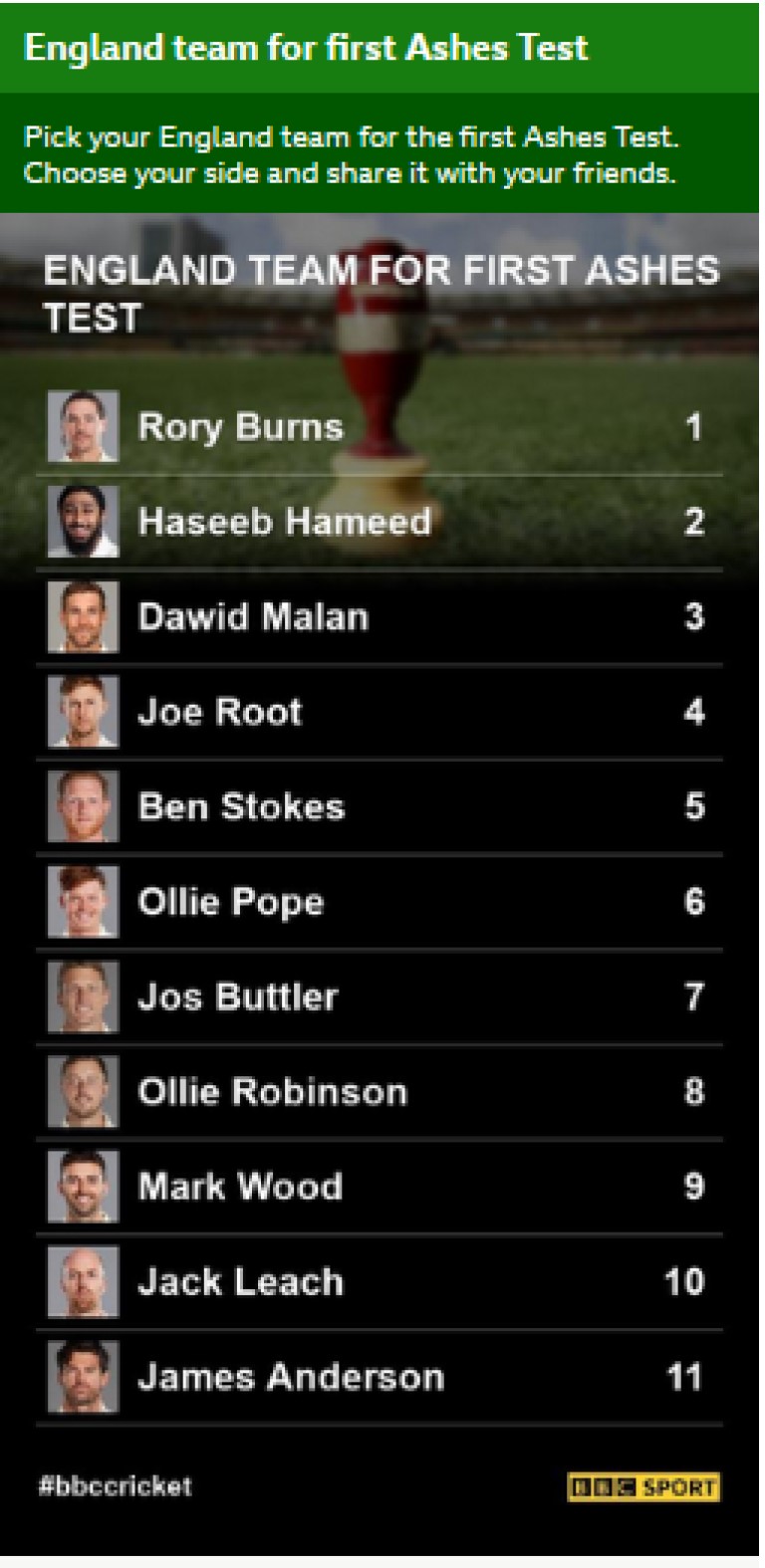
England welcome Ben Stokes back into the fold after a layoff for mental health reasons. Sensibly Pope, a massive talent and one seemingly well suited to Aussie pitches has been preferred for the number six slot to the perennially underachieving at test level Jonathan Bairstow (a magnificent ODI opener and a fine T20I number four, the two international roles he should now make his sole focus). The basic question left is between Woakes (for extra batting depth and arguably bowling variety), Broad (for maximum bowling firepower) and Leach (there is some talk of going without the spinner, but with Stokes back there is no excuse – three front line pacers plus Stokes as back up is plenty in that department). My own final 11 would be: Burns, Hameed, Malan, *Root, Stokes, Pope, +Buttler, Robinson, Wood, Broad, Leach but I would not unduly quarrel with Woakes being picked ahead of Broad.

AUSTRALIA

Cynics would say that the loss of Tim Paine probably leaves Australia better equipped both batting and keeping wise than they were with him in post (Alex Carey makes his test debut as keeper-batter). Pat Cummins, who was Paine’s vice captain takes over the captaincy for this series (it is not common for a specialist fast bowler to be given this role – the last for England was Bob Willis who held the reins from 1982 to early 1984, and the only one ever to perform the role for Australia was Ray Lindwall in the 1950s – he stepped in on the field due to an injury). Mysteriously, Steve Smith, who could surely never be trusted with the captaincy again, has been appointed vice captain. Australia have a tried and not very trusted at no5 in Travis Head, a newbie at no six in Cameron Green and a debutant keeper in Carey. They have an experienced pace trio of Cummins, Hazlewood and the express paced but sometimes erratic Starc, and the second best test off spinner currently playing the game (sorry Nathan Lyon, Ashwin is definitely ahead of you). Their batting has three proven stars in Warner, Labuschagne and Smith.

PROSPECTS

While neither could be described as top class both of England’s openers, Burns and Hameed, have demonstrated an ability to bat time in test matches, and they provably gel well as a pair – three test century opening stands together already. Malan at number three is frankly a backward looking selection, but he may perform well. Obviously the skipper, batting in his regular number four slot, will be crucial to England’s chances, and at least the Burns/Hameed combo should insure that he is not too often coming in with the ball still new and shiny. It is a huge relief to have Stokes back in action, and a good series for him could well swing things England’s way. This is the series for Pope, who enjoys the type of pitches that Australia usually provides, to establish himself beyond question in England’s middle order, and I am expecting big things from him. Buttler has a respectable test batting record, and though he is not the equal of Foakes as a keeper I can understand why England have opted for him. The bowling, even with Anderson rested due to a minor calf issue, looks impressive. Robinson has been a revelation since his elevation to the test match ranks, Wood is quick and performs well away from home, Leach pays less than 30 per wicket and takes only just short of four wickets per game in his career to date and could well be crucial in this series, Broad has previously had success at the Gabba, and Woakes if picked will probably perform well.

Australia are in some turmoil, with four of their top seven genuinely questionable, though their bowling unit is its usual formidable self. Also Cummins is new to captaincy and there are at least two major ways a bowling captain can err – they can bowl themselves into the ground in an effort to lead by example, and they can go the other way and not give themselves enough overs. Also captaincy can have an adverse effect on form – Ian Botham took 7-48 in his last bowling innings before becoming England captain and 6-95 in his first after resigning the role, but never managed a five-for as captain.

A further factor in the equation is that due to their quarantine policy Perth (where England have only ever won one match, under Brearley in 1978) is off the roster, and if the weather forecasts are correct the opener at the Gabba is highly likely to be drawn.

Thus, even though it is half a century since an England team regained The Ashes down under (three retentions in that period, in 1978-9, 1986-7 and 2010-11), I really believe that England have a genuine chance. Australia will start as favourites and rightly so, but if England get everything right the upset is a definite possibility.

PHOTOGRAPHS

My usual sign off…

World T20 Semi-Final Line Ups Complete

A look at the semi-finalists at the T20 World Cup, my team of the tournament and some photographs.

We now know who will be contesting the semi-finals of the T20 World Cup in the UAE. This post looks at the routes the four teams took to reach the SF stage and names an XI of the tournament.

ENGLAND DOMINANT UNTIL THEIR FINAL GAME

England won their first four games, and did so comfortably, accruing a massive net RR of +3.183 in the process. Their last game was against South Africa, third in the group, yesterday. In yesterday’s first game Australia had comfortably beaten West Indies, which meant they were well placed to qualify. South Africa needed a big win to qualify. South Africa batted first and did the first bit very well indeed, scoring 189-2 from their 20 overs. That left England needing 87 to qualify, 106 to top the group, 131 to eliminate South Africa and 190 to make it five wins from five. England went for the win, and went into the 20th over of their innings with a chance of pulling it off. Liam Livingstone hit the longest six of the tournament along the way, a 112 metre monstrosity of a hit. The first three balls of the 20th killed England’s hopes stone dead, as three successive batters holed out to boundary fielders, giving Rabada one of the more bizarre hat tricks ever seen in top level cricket (Charles Townsend’s 1899 effort for Gloucestershire v Somerset, when all three victims were stumped by keeper WH Brain is also noteworthy in this department). SA emerged victorious by 10 runs, but had not quite done enough, and found themselves knocked out in spite of winning four of their five group games, including beating the group winners (England). Australia went through in second place.

THE OTHER GROUP

The second group comprised India, Pakistan, New Zealand, Sri Lanka, Scotland and Namibia. This morning and very early afternoon UK time New Zealand took on Afghanistan, with India also having a mathematical chance of qualifying, should Afghanistan win by a small margin and then India beat Namibia tomorrow. In the event, with the exception of Najibullah Zadran (73 off 48 balls), no Afghan batter could get going and they posted a modest 124-8. NZ were never in serious trouble against so modest a target, and got home off the first ball of the 18th, confirming their SF place and India’s elimination. This is a case of cricketing justice being done and seen to be done – NZ had won four of their five matches, and had they lost someone would have been qualifying with three wins out of five when a team in the other group went home with four out of five. Pakistan are just starting their last group match against Scotland, in a bid to be the only team to record a 100% win record at the Super 12 stage. India have been the biggest disappointment of this tournament, succumbing tamely to massive defeats at the hands of Pakistan (ten wickets) and New Zealand (a mere eight wickets, but more time in hand than Pakistan had had). It is possibly also significant that their most commanding batting performance saw skipper Kohli, one the 21st century’s greatest batters, not bat at all. Kohli’s last international century in any format was scored almost exactly two years, and it maybe that an outstanding career is approaching its close.

THOMAS’S TOURNAMENT XI

Before giving more details, my team in batting order:

+Jos Buttler (Eng, RHB, WK)
*Babar Azam (Pak, RHB, captain)
Charith Asalanka (SL, LHB, occ OS)
Aiden Markram (SA, RHB, occ OS)
Asif Ali (Pak, RHB, RMF)
Wanindu Hasaranga de Silva (SL,LS, RHB)
Chris Woakes (Eng, RHB, RFM)
Mark Watt (Sco, SLA, LHB)
Anrich Nortje (SA, RF, RHB)
Shaheen Shah Afridi (Pak, LF, LHB)
Tabraiz Shamsi (SA, LWS, RHB)

12th: Liam Livingstone (Eng, RHB, LS/OS)

There were three players contending for two opening slots, and I would not argue with those who went for the proven combination of Babar Azam and Mohammad Rizwan, but on any honest reckoning Buttler has been the best opener on show in this tournament, scoring both heavily and very fast.

My choice for number three has really announced himself during this tournament, showing serious talent (anyone who can whip an Anrich Nortje delivery over midwicket for six as he did against SA is a heck of a player).

Aiden Markram has had a superb tournament, and like the rest of his team is entitled to consider himself unlucky to not be still involved. As well as his batting he has been useful with the ball for SA.

Asif Ali is there just in case the team finds itself in a tight finish, in which situation he is a virtual cheat code.

Wanindu Hasaranga de Silva has been one of the stars of the tournament, batting well in the middle order and being devastating with his leg spin.

Chris Woakes has been very important to England’s success in this tournament to date, and it is noteworthy that England’s sole loss saw him have a poor game.

Mark Watt has been for me the Associate Nations Player of the Tournament, taking wickets in every match to date, and generally being very economical. He has also played one crucial innings, when he helped to rescue his side from 56-6 against Bangladesh.

Anrich Nortje has been consistently excellent with the ball, testing all his opponents to the fullest.

Shaheen Shah Afridi has been outstanding with his left arm pace. This place was a toss up between him and Trent Boult, who plays the same role for NZ (Mitchell Starc of Australia has not had his finest tournament) but I have gone for Afridi for his extra pace.

Tabraiz Shamsi is the best bowler of his type in the world, and has managed to enhance an already considerable reputation in the course of this tournament.

Liam Livingstone gets the 12th man slot because he covers lots of bases – he can spin the ball either way and is a ferocious batter.

This team has a stellar top four, a cheat code finisher, two magnificent all rounders of very different types and four wonderfully contrasting specialist bowlers. There are runs aplenty in this line up, and a mouthwatering array of bowling options. I regret not being able to find a place for any of the Aussies, but none has been definitively the best in the tournament in their role.

PHOTOGRAPHS

My usual sign off…

The Long and Short of Cricket

A look back at the recent Australia v India test match, and at today’s amazing BBL game between Hobart Hurricanes and Brisbane Heat, plus some thoughts on the BBL’s innovations for this year.

No, on this occasion my title does not refer to Mohammad Irfan and Poonam Yadav, though in another context it could! Instead I refer to the longest and shortest formats of top level cricket – 5-day test cricket and T20.

INDIA MAKE IT 1-1 WITH VICTORY AT MELBOURNE

India had lost the first match of the series at Adelaide after being bowled out for 36 in their second innings (see this post for more on that game), and Kohli had departed from the squad to be present at the birth of his child. Australia batted first, and with Bumrah and Ashwin featuring prominently, were dismissed for 195, no one managing to reach 50. India responded with a determined batting effort led by stand-in skipper Rahane who redeemed himself for running out Kohli in Adelaide by reaching a gritty century, while Ravindra Jadeja, one of the finest of contemporary all-rounders and a brilliant fielder to boot, contributed 62 to the cause, and India built a first innings lead of 131. At one point it looked like they might not have to bat again, but young Cameron Green and Pat Cummins resisted stoutly to take Australia into credit and the game into a fourth day. Green and Cummins continued their partnership on the fourth morning, but once they were separated resistance was limited. For the second time in the match no Aussie managed a fifty, but they did just reach 200 before Hazlewood shouldered arms to a straight one and was bowled to end the innings. Low totals have sometimes been defended, but very rarely as low as 70, and India lost only two wickets in reaching their goal.

Steve Smith failed twice, Labuschagne managed some resistance in the first innings but not a substantial score, and Cameron Green’s promise aside there do not appear to many sources of runs for Australia at the moment, and bowlers, even such fine ones as Australia possess, cannot win matches if they don’t have anything to defend. David Warner returns for the next match at the SCG, with presumably the shockingly out of form and lacking in confidence Joe Burns dropping out. Also waiting in the wings, though currently not fully fit for action, is Will Pucovski who has produced some Ponsfordesque scores for Victoria. Travis Head in the Aussie middle order has what appears to be a respectable batting average, but what his average does not show is the fact that he has a severe case of ‘Watsonitis’ – he scores runs, but never seems able to turn a good start into a really major innings.

India meanwhile are strengthened by the return from injury of Rohit Sharma, who will presumably resume his opening berth alongside Agarwal.

BBL THOUGHTS

This section is provoked by today’s astonishing game between Hobart Hurricanes and Brisbane Heat (the Hurricanes were nominally the home team, even though the match was taking place at the Gabba!)

Hurricanes batted first, and after 10 overs were 65-3 with Malan going well and Ingram newly arrived at the other end. Malan fell not long after, bringing Colin Ingram and Tim David together. They shared a good partnership, but Hurricanes failed to take advantage of the opportunity to claim the Power Surge with two destructive hitters together at the crease. After 18 overs they were 140-6, and had to take the Power Surge. Mujeeb Ur Rahman, on of three Afghan spinners (Rashid Khan, leg spin, and Zahir Khan, left arm wrist spin, being the others) to have BBL contracts bowled the 19th, and it was a quite superb over, not only going for only one run, but also yielding three wickets, giving Mujeeb 5-15 from his four overs. The 20th over was better for the Hurricanes, although they only lasted four balls of it, that was enough to boost their total by nine. That gave them precisely 150 to defend, a fairly modest total by BBL standards.

However, the Hurricanes were as brilliant at the start of their bowling innings as they had been poor in the second half of their batting innings, and the Heat were 8-3 early on and looking in some trouble. Then Max Bryant and Lewis Gregory shared an excellent partnership and seemed to have at least secured their side the Bash Boost bonus point for being ahead after 10 overs. Bryant was out to the penultimate ball of the ninth, making it 60-4, six need for the Bash Boost point. However, a combination of good bowling and tentative batting saw them just miss out. Gregory’s dismissal in the 11th over made it 66-5, and brought Bazley into join Peirson. They were still together at the end of the 14th, at which point Heat took the Power Surge. Overall these two overs were good for the Heat, the loss of Peirson not withstanding, and Heat needed 31 from 24 balls for the win. With Bazley going well and Steketee connecting with a couple of decent blows that came down to 15 off 12 balls. The 19th started with two dots, but then Bazley hit a six to reduce the task to nine off nine balls. The over ended with Heat needing seven to win. That came down to four off two balls with Steketee on strike. Steketee got two off the penultimate ball, and that meant two needed off one ball, or one to take it to a Super Over. Steketee went for the tying run off that final ball, but it was judged that although his bat was over the line before the bails were dislodged it was also in the air, and he was given run out, to make it 149-8 and victory for the Hurricanes by one run.

It was a magnificent game, but I would have preferred the Heat to win so that the Hurricanes got properly punished for mishandling the second half of their batting innings.

ON #BBL10’S INNOVATIONS

There have been three innovations to this year’s BBL, two which had their own impact on today’s game. They are: the Bash Boost point for the team who are ahead at the ten over mark, the Power Surge (instead of six overs of power play restrictions at the start of the innings there are four, with two more to be claimed at any time after the tenth over by the batting side) and the ‘x-factor sub’, whereby after 10 overs of the first innings a player who has a) not batted and b) bowled no more than one over can be replaced by a designated ‘x-factor’ sub.

I am a huge fan of the Bash Boost point, it has created points of interest in games which would otherwise have been dead, and today it was very closely fought.

I like the concept of the Power Surge, but it requires flexibility of thought, and not many sides have thus far shown that. I would say that all things being equal the ideal time to take it would be at the end of the 15th, using it as a launch pad for the final quarter of the innings. One might go earlier in two situations: the openers are still together after 10 overs and you want to use the Power Surge to launch you towards a really huge total, and also if you have lost a few wickets, your innings needs a shot in the arm and/or you want to ensure that you have two decent batters to use the Power Surge. I can see no case for delaying it right to the end, and I think the Hurricanes stuffed up big time, for all that it did not end up costing them, in their own innings – they should have taken the Power Surge while Ingram, who could really have cashed in on it was still there.

As for the ‘x-factor sub’, that belongs in the circular file. I fully understand the need for ‘concussion protocol subs’, but basically I remain convinced that teams should finish the match containing the same players who started it.

A final recommendation for the BBL: for goodness sake use the DRS – unlike football with the disastrous VAR we actually have a method of using technology to help with decisions that usually works, and it should be automatic to use it.

PHOTOGRAPHS

My usual sign off…

All Time XIs -The Underappreciated Ashes

My latest variation on the ‘all time XIs’ theme – enjoy!

INTRODUCTION

Welcome to another variation on the ‘All Time XIs’ theme. Today I create two teams to do battle for the little urn, but with a twist. The players featured today are players of whom more should have been seen. There is one player of the 22 who did not get to play test cricket, but I believe I can justify his inclusion. At the other end of the scale is a player who eventually played 79 times at the highest level, but who had to wait a long time for the call to come. We start with…

ENGLAND’S UNDERAPPRECIATED XI

  1. Jack Robertson – the stylish Middlesex opener was selected for 11 test matches, all between 1947 and 1952, and he scored 881 runs in those games, at and average of 46.36, with a highest score of 133. He missed the 1950-1 Ashes, when until Reg Simpson scored 156 not out in the final match only Hutton had contributed serious runs from the top of the order.
  2. Cyril Walters – another stylist, the Glamorgan and Worcestershire opener was selected for 11 test matches between 1933 and 1939, in which he scored 784 runs at 52.26, including one century and seven fifties.
  3. David Steele – ‘The Bank Clerk Who Went to War’ – the gritty Northamptonshire, Leicestershire and Derbyshire man played eight tests in 1975 and 1976, against Australia and the West Indies, averaging 42.06 (672 runs in 16 innings, no not outs).
  4. Clive Radley – the Hertford born Middlesex middle order man of the 1970s who like Steele only got to play eight times at the highest level. He scored 481 runs at 48.10 with a highest of 158, and another century versus Pakistan.
  5. Eddie Paynter – the Lancashire left hander’s record reads: 20 test matches, 31 innings, 1,540 runs at 59.23, 591 of them at 84.43 in Ashes matches. Among those who have played 20 or more games for England only Yorkshire’s Herbert Sutcliffe (60.73) has recorded a higher test average.
  6. +Ben Foakes – the Surrey man is the best current English wicket keeper, any doubt about that status being removed by the retirement of the marvellous Sarah Taylor. The measly five test matches he has thus far been given have yielded him 332 runs at 41.50 including a century and also 10 catches and two stumpings. I hope that the selectors will see sense and render him ineligible for selection in future sides of this nature. For the moment, he holds this position as he keeps wicket – summa cum laudae.
  7. Harold Larwood – The Notts express who was the star of the 1932-3 Ashes, and never picked again after that series through a combination of Aussie whinging and appalling behaviour by the English powers that be. Number 7 may look high in the order for him, but he did score 98 in his last test innings and made many useful contributions for Nottinghamshire with the bat.
  8. Frank Tyson – The Northanptonshire super fast man 76 wickets at 18.56 in his 18 test matches. He like Larwood was the hero of an Ashes triumph down under – in 1954-5. Many years after his prime he played in a charity game in which he bowled at Keith Fletcher (Essex), then an England regular, and he produced a delivery that Fletcher reckoned to be the quickest he faced that season.
  9. *Johnny Wardle – 28 test matches, 102 wickets at 20.39 with his left arm spin (he could bowl both orthodox and wrist spin). The Yorkshireman was often passed over in favour of Tony Lock, which rankled in “God’s own county”, especially since Lock’s action in the period in question was rarely as far above suspicion as Caesar’s wife. He fell out with Yorkshire over their appointment of 40 year old amateur Ronnie Burnet as skipper in 1958, and Yorkshire vindictively warned other counties against signing him, which effectively terminated his chances of further international recognition as well. I have done what Yorkshire would not in 1958 and named as captain of this team.
  10. Sydney Barnes – 27 tests, 189 wickets at 16.43, 77 of them in 13 matches down under. He played in under half of the matches contested by England between his first and last appearances, which irrespective of the fact that he was an awkward blighter (if he were to dispute this assessment it would only be as a matter of principle) and chose to play most of his cricket in the leagues rather than in the county championship is simply absurd. Also, there were various times when people considered him a possible post World War 1, including as late as 1930 when some people believed he was the man to take on Bradman who was running riot (2,960 runs at 98,66 for the tour, 974 of them at 139.14 in the test matches). West Indian legend Learie Constantine who faced Barnes for Nelson vs Rawtenstall in the Lancashire League when Barnes was 59 years old said after that match (in which he made 90) “if you wanted to score off Barnes you had to score off good bowling”.
  11. Charles ‘Father’ Marriott – (Lancs and Kent) A ‘one cap wonder’. He was selected in the final match of the 1933 series against the West Indies, took 11-96 in the match and that was his international career. He was known to be a liability except when actually bowling (his 711 first class wickets comfortably beating the 574 runs he scored at that level).

This team has a splendid looking top five, a superb glove man well capable of batting at six, and five excellent and well varied bowlers, all of whom save Marriott are capable of making useful contributions with the bat (Barnes was a regular run scorer in the leagues where he generally plied his trade and played one clearly defined match winning innings in a test match, at Melbourne in 1907 when he came in with 73 needed and two wickets standing and was there on 38 not out when the winning run was scored. Now it is time to look at…

AUSTRALIA UNDERUSED XI

  1. Sidney George Barnes – 13 test matches, in which he averaged 63 with a highest score of 234 (at Sydney in the second match of the 1946-7 Ashes). A combination of World War II (six years of his prime gone), and run-ins with the authorities meant that he played ridiculously little for such a fine batter. I would want ‘Blowers‘ at the mic when Sydney Francis Barnes bowled to Sidney George Barnes – there would surely be some priceless commentary moments!
  2. Chris Rogers – averaged 42.87 in the 25 matches he played, having amassed over 15,000 first class runs before the call came. He hit his peak at just the wrong time, when Australia had a dominant side that they were understandably reluctant to change.
  3. Mike Hussey – what is a man who played 79 tests doing here? He had been playing first class cricket and amassing mountains of runs in that form of the game for over a decade before getting to don the baggy green (‘Mr Cricket’ eschewed the other classic Aussie insignia, the chip on the shoulder). Yes, 79 tests is a fine achievement, as his average in that form of the game, but it could so easily have been 159 test matches, and it is for that reason that I include him.
  4. Martin Love – his peak coincided with Australia’s most dominant period, with the result that his test record amounts to 233 runs at 46.60 with one century. At almost any other time, or in almost any other country he would be an automatic selection for most of his career.
  5. Adam Voges – although the one trough of his brief test career (he was in his mid 30s when it began) coincided with the 2015 Ashes he averaged 61.87 in his 20 matches, an output that cannot be ignored.
  6. *Albert Trott – all rounder and captain (also captain of the ‘what might have been XI’ when I come to present that). His test career was in two parts – for Australia in the 1894-5 Ashes, and then for England against South Africa in 1899. Between them they amounted to five matches in which he scored 228 runs at 38.00 and took 26 wickets at 15.00. It was also in 1899 that he achieved a thus far unrepeated feat – he struck a ball from fellow Aussie Monty Noble that cleared the Lord’s pavilion, hitting a chimney pot and dropping down the back of the building. He was a right arm spin bowler. His test debut in 1895 was remarkable – 38 and 72 not out with the bat and 8-43 in the second England innings.
  7. +Graham Manou – the most skilled glove man in Australia during his career, but Brad Haddin was generally preferred on ground of his belligerent batting. Manou played in only one test match, unusual for an Australian (there are about 70 English members of this club).
  8. Eddie Gilbert – right arm fast bowler and the most controversial of my 22 picks today. He never played test cricket, but in his brief domestic career he sometimes caused carnage, including inflicting on Don Bradman “the luckiest duck of my career”. He might have been selected during the 1932-3 Ashes had Australia adopted a ‘fight fire with fire’ approach. He was an aboriginal, which might explain his scurvy treatment by the Australian cricket powers that be – it would be until Jason Gillespie that a player of proven aboriginal ancestry would don the baggy green.
  9. Laurie Nash – another fast bowler who could have been used as part of the ‘fight fire with fire’ option in 1932-3. He claimed that he could have stopped ‘Bodyline’ in two overs given the chance. His two test caps yielded 10 wickets at 12.60. What might have happened at Australia taken the ‘fight fire with fire’ approach? My reckoning is that there would probably have been one absolute war zone of a test when both teams gave it both barrels, and then the method would have been abandoned, because the English professionals who could not afford to risk their livelihoods would have insisted on it.
  10. Stuart Clark – a tall fast-medium who took 94 wickets at 23.86 in his 24 test matches. Injury problems and a chap by the name of McGrath kept him from featuring more often than he did.
  11. Jack Iverson – mystery spinner (subject of Gideon Haigh’s book “Mystery Spinner”) whose test career amounted to the five matches of the 1950-1 Ashes series, in which he took 21 wickets at 15.23. Many reckoned that he would have been even deadlier in England (although he bowled wrist spin he was effectively a very accurate off spinner) – which creates an interesting counter-historical speculation. Had he gone to England in 1953 Australia may well have retained The Ashes, which would almost certainly have meant that the grumblers who had never liked the notion of a professional captaining England would have got their way and Hutton would have been replaced by an amateur, which would almost certainly have also meant no 1954-5 triumph with ‘Typhoon’ Tyson.

This team has a strong looking top five, a potentially match winning all rounder at six, a magnificent keeper at seven and four top quality bowlers.

THOUGHTS ON HOW THIS ASHES CONTEST MIGHT GO

Barring an emerald coloured pitch and/or heavy cloud cover that you are prepared to bet on remaining in place for long enough to cash in on the toss winner would be heavily advised to bat first and get their runs on the board (trying to score runs against Trott and Iverson in the fourth innings does not look like fun, and this is even more the case vis a vis Wardle, Barnes and Marriott). I reckon that Larwood and Tyson are a quicker pair (thought not by much) than Gilbert and Nash. Where England definitely shade it is that irrespective of conditions Barnes is likely to more dangerous than Clark. I would expect it to be close – in a five match, play to a finish series I would back England to win 3-2, while I would expect England’s margin to look a little more comfortable with draws in the equation because I reckon Steele and Radley could each be counted on for at least one match saving rearguard action,  while ‘Mr Cricket’ would probably probably save one game for the Aussies, so factoring in draws I make it 2-0 to England. Glenn McGrath would probably utter his reflex “5-0 to Australia’ line!

Given the characters on show we need some good officials in charge. I am going for Bucknor and Dar as on field umpires, Venkataraghavan as TV Replay umpire and Clive Lloyd as match referee. For commentators I have already indicated that ‘Blowers’ has a role to play, and as his colleagues I choose Jim Maxwell (Australia) and Alison Mitchell (who has a foot in both camps) – sorry ‘Aggers‘, no gig for you this series. For expert summarisers I have no strong preferences other than that Boycott is absolutely banned.

A TWITTER THREAD AND PHOTOS

I have set the stage for my Ashes series between two teams of often overlooked players, but there remains one more thing to do before my usual sign off – I have an important twitter thread about Coronavirus to share with you, from Lainey Doyle, please click on screenshot to view the whole thread:

Lainey TT

We end with the usual photographic flourish:

Neglected Ashes
The contending XIs in tabulated form.

P1310744 (2)P1310745 (2)P1310748 (2)P1310758 (2)P1310762 (2)P1310763 (2)P1310764 (2)P1310766 (2)P1310767 (2)P1310769 (2)

P1310771 (2)
Sitting out in my bit of garden is providing plenty of opportunities for camera work (all bar two of the remaining pics in this post were taken while sitting outside, which I was also doing for most of the time spent typing this post).

P1310772 (2)P1310773 (2)P1310774 (2)P1310775 (2)P1310776 (2)P1310777 (2)P1310778 (2)P1310779 (2)P1310780 (2)P1310781 (2)P1310782 (2)P1310783 (2)P1310785 (2)P1310787 (2)P1310788 (2)P1310789 (2)P1310791 (2)P1310793 (2)P1310794 (2)