W is for Winners

An all time XI of players whose given names begin with W, a very detailed honourable mentions section and a photo gallery.

Today I present an all time XI of players whose given names begin with W and a detailed honourable mentions section, as well as my usual photo gallery.

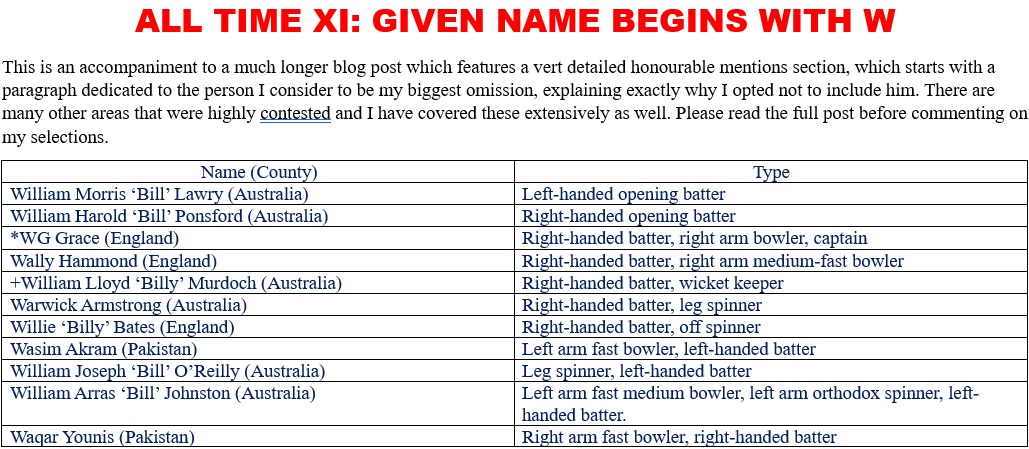
  1. William Morris ‘Bill’ Lawry (Australia, left handed opening batter). He averaged 47 with the bat in test cricket.
  2. William Harold ‘Bill’ Ponsford (Australia, right handed opening batter). Until Brian Lara came along only one player had achieved two first class scores in excess of 400, Ponsford, with 429 against Tasmania in 1922 and 437 against Queensland in 1927. In December of 1927 he became the only player ever to score 1,000 first class runs in a calendar month outside of England, with a sequence of 1,146 runs in five innings. His test record was not quite so outstanding, but even at that level he averaged 48, which included centuries in each of his first two test matches and centuries in each of his last two.
  3. *WG Grace (England, right handed batter, right arm bowler of various styles, captain). Cricket’s first superstar, and in his best decade, the 1870s, he averaged 49 with the bat at a time when the best of the rest were just about managing 25. Only one other person in cricket history ever sustained being twice as prolific as the best of the rest over a long period – Bradman.
  4. Wally Hammond (England, right handed batter, right arm medium-fast bowler). He scored 7,249 runs at 58.45, including 905 at 113.125 in the 1928-9 Ashes.
  5. +William Lloyd ‘Billy’ Murdoch (Australia, right handed batter, wicket keeper). Australia’s best batter in the earliest years of test cricket, and a fine enough keeper that FR Spofforth missed the first ever test match because he initially didn’t believe that any keeper other than Murdoch could handle his bowling.
  6. Warwick Armstrong (Australia, right handed batter, leg spinner). A fine all round cricketer whose feats included scoring over 2,000 runs and taking over 100 wickets in first class matches on the 1905 tour of England. 16 years later he almost captained an undefeated side, the only loss they sustained on the tour coming at the hands of ‘an England XI’ assembled by AC MacLaren.
  7. Willie ‘Billy’ Bates (England, right handed batter, off spinner). The first England bowler ever to take a test hat trick, part of a match performance in which he scored a 50 and took seven wickets in each Australian innings.
  8. Wasim Akram (Pakistan, left arm fast bowler, left handed batter). One of the greatest ever.
  9. William Joseph ‘Bill’ O’Reilly (Australia, leg spinner, left handed batter). Only one batter among those he came up against in the course of his career could truly claim to have his measure: Don Bradman.
  10. William Arras ‘Bill’ Johnston (Australia, left arm fast medium bowler, left arm orthodox spinner, left handed batter). The third essential member of Australia’s immediate post WWII bowling attack after Lindwall and Miller, as well as being two types of bowler in one he was possessed of great stamina – it was not unknown for him to go straight from spinning the old ball to swinging the new one. Three times he was Australia’s leading wicket taker in Ashes series. In England in 1953, with the active connivance of some his team mates, who got themselves out in some of the later matches to help engineer the outcome, he became only the second player to average 100+ for an English first class season (17 innings, 16 not outs, 102 runs, average 102.00) after Bradman in 1938 (the Don achieved his average of 115.66 for that season without any such shenanigans going on).
  11. Waqar Younis (Pakistan, right arm fast bowler, right handed batter). A superb practitioner, and one who regularly shared the new ball with Wasim Akram.

This side has a powerful batting line up, and a wealth of bowling options. The only regular type of bowling that is not featured is left arm wrist spin. The front five of Younis, Akram, Johnston, O’Reilly and Bates are formidable in their own right, and in the unlikely event that they prove insufficient there are Armstrong, Grace and Hammond as back up options.

I start this section with a paragraph devoted to my most notable omission…

One of the most extraordinary performers in the history of cricket, with a remarkable five-phase playing career – specialist left arm spinner, all rounder, specialist batter, all rounder, specialist left arm spinner. The trouble is that brilliant as he was as an all rounder at county level his England career was almost exclusively spent either as specialist bowler (early and late periods) or as a specialist batter (in the run up to WWI). His batting would not warrant selection as a specialist and if I pick him as a specialist bowler I would have to leave out Johnston, who offers me two bowling options in one and had an outstanding test record.

The opening slots were rich in potential candidates. Lawry’s only rival for the left handed openers slot was Warren Bardsley, the first batter ever to score twin centuries in a test match and possessor of a fine overall test record, as well as being Australia’s leading scorer of first class centuries until Bradman came along, more than half of those tons having come in England.

Ponsford was rivalled for the right handers opening slot by two other Williams who were generally known as Bill, WA Brown and WM Woodfull. Woodfull in particular is unlucky to miss out, while Brown also had a fine record.

I regard WG Grace as an essential pick and my reckoning is that he could handle first drop, though he did prefer to open. Two regular number threes who thus miss out are William Gunn, the Gunn of Gunn & Moore, whose test record did not live up to his superb first class record and William Scotton, also of Nottinghamshire, whose ability to bat for long periods of time came at the expense of run scoring. William John ‘Bill’ Edrich was another who might have had this slot, averaging 40 in test cricket in spite of losing six prime years to WWII. WG ‘Billy’ Quaife had a splendid record for Warwickshire but his seven tests were disappointing. Wajahatullah Wasti of Pakistan once scored twin tons in a test match but did little else at that level. William Yardley has a place in the record books – in 1870 he became the first player ever to score a century in the Varsity Match.

Among the all rounders I could not accommodate were Wasim Raja, WE ‘Bill’ Alley, Wanindu Hasaranga de Silva, Wilf Flowers and William ‘Billy’ Barnes.

My decision to entrust the gloves to Murdoch meant that three very accomplished keepers, Wriddhiman Saha of India, Wasim Bari of Pakistan, and Arthur Theodore Wallace ‘Wally’ Grout of Australia missed out.

WH ‘Bill’ Lockwood was a fine bowling all rounder, and possibly the pioneer of the slower ball, but not a serious rival to Akram for the number eight slot. A number of Williams, all known as Bill, were fine quick bowlers: Whitty, Voce, Bowes, Copson, Andrews and Bestwick among them. Two Williams known by their full first names, Lillywhite and Mycroft, were both great bowlers kept out by the immense strength in depth available for this squad. Wes Hall and Wayne Daniel were two of the many superb quicks to come from the coral island of Barbados, and both can be considered unlucky to miss out. Walter Mead, a bowler of mixed spin for Essex who claimed a 17 wicket match haul against the 1893 Australians and had a magnificent first class record was the biggest miss in the spin bowling department.

In a few years time there may be a second WG in the line up – WG Jacks of England, an attacking batter and a capable off spinner who is in the process of establishing himself in international cricket.

My usual sign off…

All Time XIs – Match Ups 41

Continuing my in depth analysis of how my all time XIs fare against one another, with some comments about Ireland’s great win over England in the T20 World Cup and a photo gallery.

Welcome to the latest installment in my extended analysis of how my all time XIs fare against one another. Today sees the Js occupy the spotlight for the final time, with 50 points out of 100 currently on the board. Before getting into the main meat meat of this post I congratulate Ireland wholeheartedly on their defeat of England. The rain, which washed the second match (Afghanistan vs New Zealand) out completely did play a walk on role – officially Ireland won by 5 runs on the DLS method. However, England deserve no sympathy and will receive none from me – they were behind the asking rate the entire way through the chase, even after Ireland failed to capitalize on being 92-1 after 10 overs, slipping to 157 all out in 19.4. Dawid Malan (35 off 37) and Harry Brook (17 off 18) were chiefly responsible for putting England in a hole they couldn’t dig their way out of – their scoring, with rain an obvious threat, was absurdly slow. England had a very deep batting order, but the approach of Malan and Brook meant that by the time the rain came the biggest hitter in the side, Livingstone, who would have been on a high having taking 3-17 with the ball, faced only two balls. Ireland skipper Balbirnie was named player of the match for his 62, but crucial early momentum was also provided by Ireland number three and keeper Lorcan Tucker.

THE Js V THE Vs

The Js are stronger in batting and have the better keeper, both sides have similar strength in front line pace bowling, though the Js have Jessop as an extra option. The Vs are stronger in spin bowling, with Verity, Vogler and Vine all front line options, while the Js have Jupp, Johnston in his slower style and the part timer Jayasuriya. I think the Js have got this one, but not by a huge margin: Js 3, Vs 2.

THE Js V THE Ws

The Js have the better opening pair though not by much, the Ws dominate in positions 3-6 batting wise, though the Js have the better keeper. Warne, Wardle and Woolley are a better spin combo than the Js have (Wardle’s ability to bowl wrist spin means that the Ws effectively have off spin covered even without having a designated off spinner). There is little to choose between the front line pace trios, though Jessop outranks Worrell as a support seamer. The Ws have a clear advantage but not enough to put them in whitewash territory: Js 1, Ws 4

THE Js V THE Xs

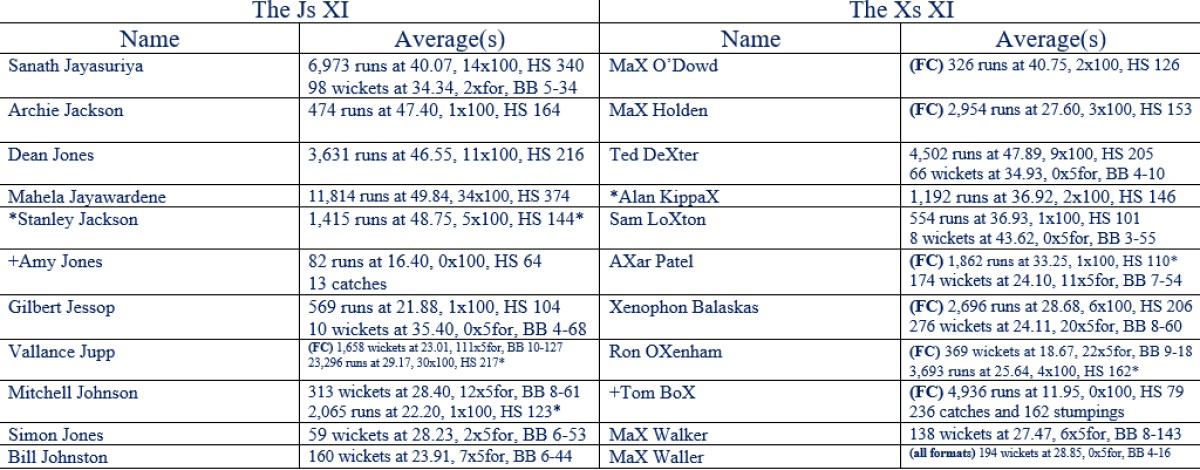
The Js are ahead on batting (only DeXter wins his match up among the Xs top eight), massively ahead in pace bowling, a little behind in spin bowling and BoX is one of the few keepers in this series to definitely at least match A Jones in that department. I don’t think the Xs spinners will help them enough to make any difference to the result: Js 5, Xs 0.

THE Js V THE Ys

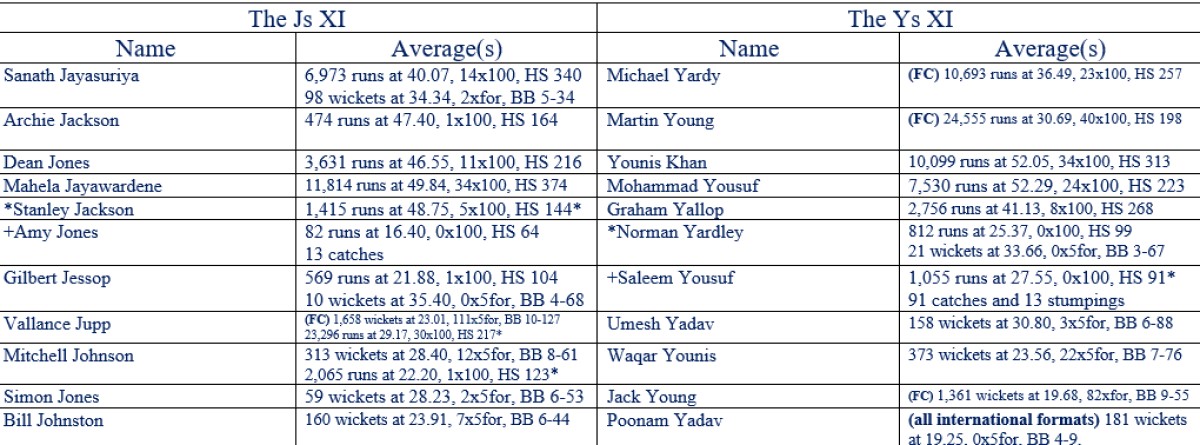
The Js have the better opening pair by some way, the Ys the better nos 3 and 4. Jackson outranks Yallop at five and probably outranks fellow Yorkie Yardley as a skipper. The Js are way ahead in pace bowling and about even in spin bowling. This is a comfortable but not whitewash win for the Js: Js 4, Ys 1.

THE Js V THE Zs

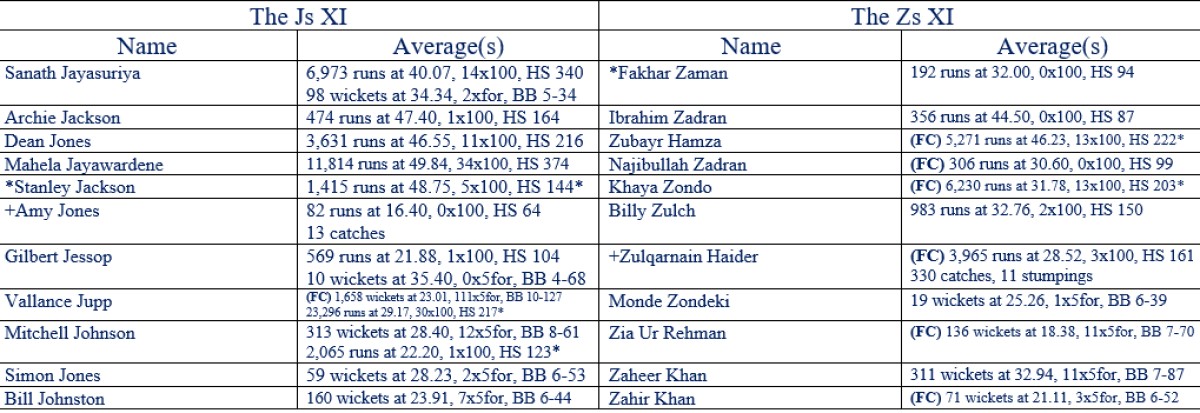
The Js have the better batting by some way, the better skipper, the better keeper, a far stronger pace attack and a spin attack that probably matches that of the Zs if it doesn’t better it. There can be only one scoreline: Js 5, Zs 0.

THE Js FINAL SCORE

The Js have scored 18 out of 25 today, giving them a final tally of 68 out of 125, 54.4%.

PHOTOGRAPHS

My usual sign off…

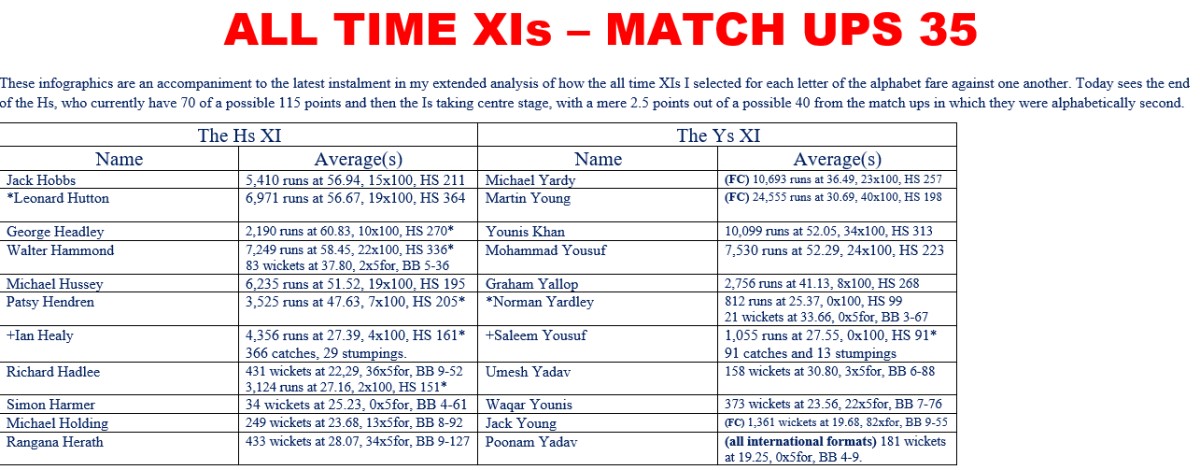
All Time XIs – Match Ups 35

Continuing my extended analysis of how the all time XIs I picked for each letter of the alphabet fare against one another.

Welcome to the latest instalment in my extended analysis of how the all time XIs I selected for each letter of the alphabet fare against one another. Today sees the last two match ups involving the Hs, who come into today with 70 of a possible 115 points, and also the first three match ups of the Is period in the spotlight, which they come into with 2.5 of a possible 40 points banked.

THE Hs V THE Ys

The Hs dominate the batting, have the better new ball pairing, the better keeper and the better spin combination. Norman Yardley perhaps rates as a somewhat better third seamer than Hammond but even that is debatable. The Ys have no chance here: Hs 5 Ys 0.

THE Hs V THE Zs

The Hs have the Zs beaten in all departments. Hs 5, Zs 0.

THE Hs FINAL SCORE

The Hs finish with 80 of a possible 125 points, a score of 64%.

THE Is V THE Js

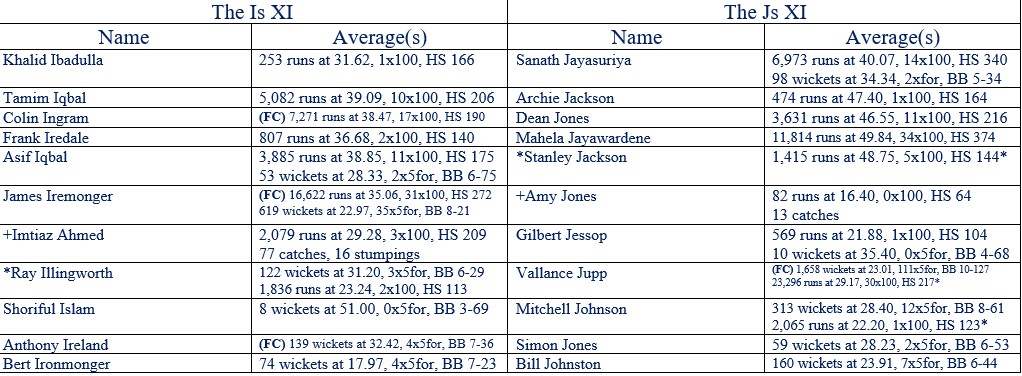
The Js have a strong superiority in batting, an overwhelming advantage in pace bowling, and they lose only tiny amount of ground in spin bowling, and also have the better keeper. The Is are miles adrift and I score this Is 0, Js 5.

THE Is V THE Ks

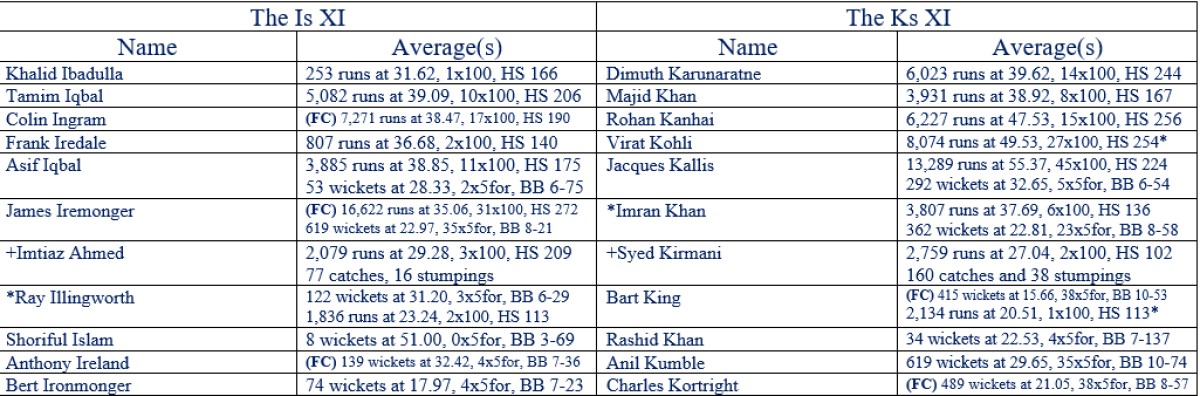
This is even more conclusive in the Ks favour. My scoring system limits margins of victory to 5-0, so I score this Is 0, Ks 5 and note that the Is are lucky to get 0.

THE Is V THE Ls

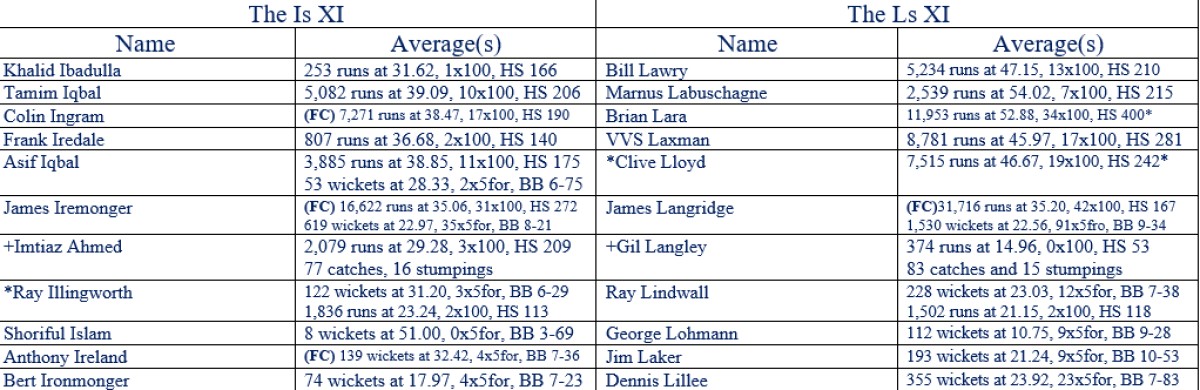
The Ls have an overwhelming advantage in both batting and pace/ seam bowling, the better keeper, the better captain, and while James Langridge rates below Ironmonger as a left arm spinner, Jim Laker comfortably outranks Illingworth as an off spinner. Only one scoreline is possible: Is 0, Ls 5.

THE Is PROGRESS REPORT

The Is have not added a single point to their tally and are now on 2.5 points out of a possible 55, 4.55%.

PHOTOGRAPHS

My usual sign off…

All Time XIs – The Letter J

Continuing my all time XIs theme with a look at the letter J.

I continue the all-time XIs theme with a team comprising players whose surnames begin with J.

THE XI IN BATTING ORDER

  1. Sanath Jayasuriya (Sri Lanka). Opening batter, left arm spinner and good fielder. His test match highlights include a high score of 340 and an innings of 213 against England at The Oval that combined with Muralidaran’s 16 wickets in the match to give SL their first victory in England. In ODI cricket (T20 only became a thing after his prime cricketing years) he completely redefined the role of an opener, his explosive performances in that role playing a large part in winning his country the 1996 World Cup.
  2. Archie Jackson (Australia). He was a contemporary of Donald Bradman, and many who saw both rising through the ranks rated him the finer prospect. Ill health ruined his career – he died of tuberculosis at the tender age of 23, but an innings of 164 on test debut as a 19 year old provided some hard fact to reinforce the credentials he had established as a youngster.
  3. Dean Jones (Derbyshire, Australia). A combative character, he came of age as a cricket during the first innings of what proved to be only the second tied test match in history (36 years on there have still only been two) at Chennai in 1986. Jones in that innings scored 210, batting almost eight hours, and at the end of it he had to be taken to hospital and put on a saline drip. Later, during the 1986-7 Ashes he played an innings of 184, albeit aided by being given not out when on just 5. He also produced several valuable knocks in the 1989 Ashes, though not coming close to the productivity in that series of Mark Taylor or Steve Waugh.
  4. Mahela Jayawardene (Sri Lanka). Possessor of the highest test innings by a right hander (374 versus South Africa), and without question in the top two of all time Sri Lankan test batters (Sangakkara being the other).
  5. *Stanley Jackson (Yorkshire, England). In 1905 he captained England to a decisive Ashes victory, topping both the batting and bowling averages, winning all five tosses and leading England to wins in both of the matches to reach definite conclusions. He scored five test centuries, all in home matches against the Aussies (he was an amateur, and business commitments always prevented him from touring). In 1902 he and George Hirst joined forces with the ball for Yorkshire to rout the touring Aussies for 23. His polished 49 at The Oval in the last test of that year’s Ashes enabled Jessop to begin England’s revival from 48-5 in pursuit of 263.
  6. +Amy Jones (England). A stellar keeper batter, a worthy successor in the England women’s squad to the legendary Sarah Taylor (and being kept on her toes by the knowledge that Ellie Threlkeld, also a magnificent keeper batter, is waiting in the wings).
  7. Gilbert Jessop (Gloucestershire, England). The most consistently rapid scoring batter the game has ever seen, a useful fast bowler and a brilliant fielder – in his great match at The Oval in 1902 his first significant contribution was not that innings, it was a brilliant bit of fielding that accounted for the key wicket of Victor Trumper, and he has been estimated to have been worth about 30 runs an innings in the field.
  8. Vallance Jupp (Sussex, Northamptonshire, England). An off spinning all rounder, who after his move north and qualification by residence for his new county achieved the season’s double of 1,000 runs and 100 wickets in FC matches eight times in succession.
  9. Mitchell Johnson (Australia). A mercurial left arm fast bowler who at his best was as good any such to have played to the game – in the 2013-14 Ashes he was nigh on unplayable. It is true that he was a cricketing version of the girl in the nursery rhyme – when he was good he was very good, when he was bad (as in the 2010-11 Ashes) he was horrid, but I choose to honour the Dr Jekyll side of his bowling rather than use the Mr Hyde element as an excuse to drop him. He was also a useful lower order batter, with a test century and a 99 in that department.
  10. Simon Jones (Glamorgan, Hampshire, England). Plagued by injuries, but when fit he produced some outstanding performances – he was crucial to England’s triumph in the 2005 Ashes, reverse swinging the ball at high pace and causing every Aussie batter problems.
  11. Bill Johnston (Australia). Australia’s leading wicket taker in three series immediately post-war. He bowled left arm fast medium and left arm orthodox spin – it was not unknown for him to go from spinning the old ball to swinging the new one.

This side possesses good batting depth (a superb top four, a batting all rounder, a keeper batter, two all rounders and a bowler who can bat, with only S Jones and Johnston describable as bunnies), and a fine variety of bowling options – Johnson, S Jones, Johnston, Jessop and Jackson providing five seam options all different from one another, while Jupp, Jayasuriya and Johnston in his slower style provide spin options.

HONOURABLE MENTIONS

Before going into the rest of this section there is one player I am going to give a subsection to himself…

RAVINDRASINH JADEJA (INDIA)

Averaging 35 with the bat and 24 with the ball in test cricket gives him a case to be regarded as the best contemporary all rounder of any kind in the game . The problem is that his bowling stock in trade, left arm orthodox spin overlaps with Jayasuriya and Johnston in his slower style. This is why I preferred Jupp’s off spin and the explosiveness of Jessop in the two slots he might have occupied – I was concerned with the balance of the attack, wanting my skipper to be able to change the bowling as well the bowler.

OTHER HONOURABLE MENTIONS

Steve James of Glamorgan and briefly England was a solid county opener, but I suspect that not even the staunchest of his county’s fans would expect him to be picked for this XI. Andrew Jones of New Zealand, a gritty and determinded number three for that country, might have had the slot I gave to Dean Jones, but while acknowledging his ability I felt that Dean, also a gritty competitor, had a sufficiently superior record to his trans-Tasman namesake to warrant getting the slot. Three fast bowlers who were close to being picked were in reverse chronological order Les Jackson of Derbyshire who took his FC scalps at 17 each but was only rewarded with two England caps, Ernie Jones of Australia, a seriously quick bowler in the 1890s, but also the first ever to be called for throwing in a test match, and John Jackson, a terror in the era immediately before WG Grace came to prominence. Prabath Jayasuriya has made a sensational start to his test career, but as a specialist left arm spinner it would hard for him to qualify for this XI even he maintains that start. Worcestershire leg spinner Roley Jenkins entered my thoughts, but I felt Jupp deserved the second spinner’s role. Digby Jephson, who was one of the last front line under arm bowlers at professional level and a good middle order batter is another I regret not being able to accommodate. Aqib Javed, a Pakistan fast bowler of the 1990s did not quite establish a good enough record to be a serious challenger. Among keepers only Eifion Jones, who was much less of a batter, comes close to namesake Amy behind the stumps – Geraint Jones was not up to standard in either department. Arthur Jepson does not qualify as a player but he can be one of the umpires, a role in which he excelled.

I end this section with two players who are very likely to be shoo-ins for this XI in 10 years time or thereabouts. Kyle Jamieson of New Zealand has made a magnificent start to his test career, and may well knock Mitchell Johnson out of the XI if he maintains his current progress. Will Jacks of Surrey is a hugely promising young batter and part time off spinner. In standard cricket formulation of initials and surname he is WG Jacks, and his recent 150 against Essex, most of it scored with tailenders for company, and giving his side an ultimately match settling first innings lead was worthy of the original WG.

PHOTOGRAPHS

Our cricketing adventure through the letter J is complete and all that remains is my usual sign off…