Blasts From The Past v #BBL10 Composite

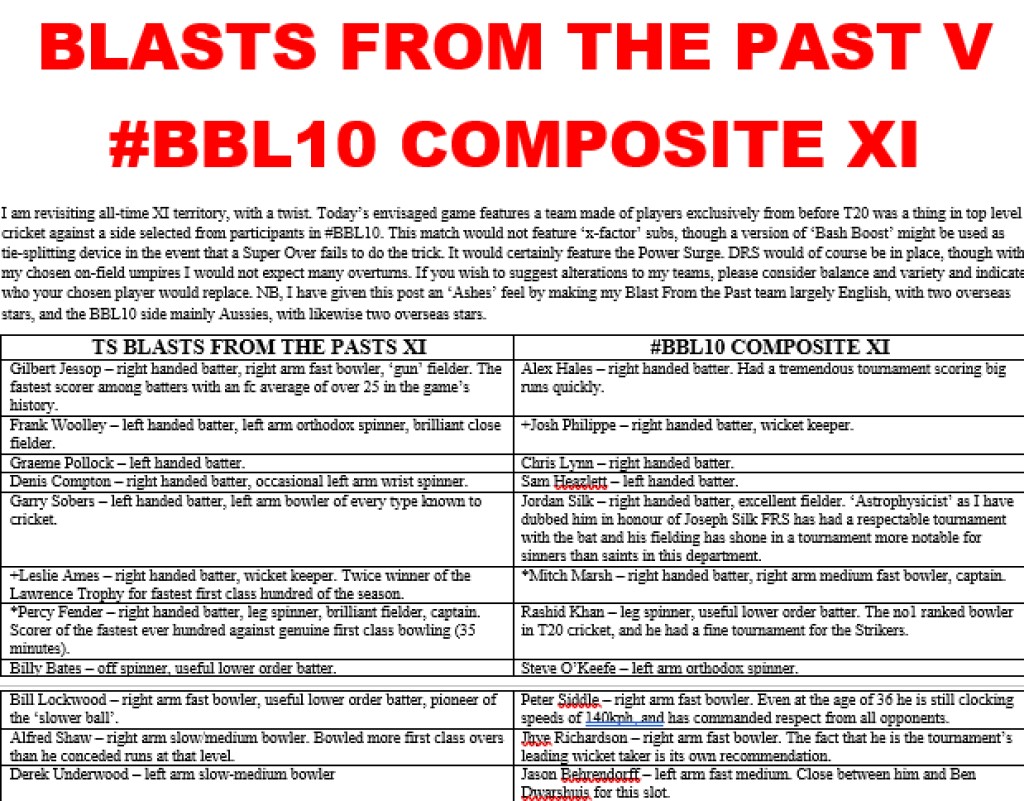
A variation on my All Time XI theme pits a ‘Blast from the Past’ XI against a #BBL10 Composite XI. Also, on the 40th anniversary of the Chappell incident I look at under arm bowling.

Today we revisit all-time XI territory with a bit of a twist, and then I have a bonus section prompted by today being the 40th anniversary of Trevor Chappell’s most (in)famous moment on the cricket field.

THE GROUND RULES

I have given this post a hint of an ‘Ashes’ flavour – my Blast From The Past XI is mainly English, though this being put in a T20 setting I have allowed myself two overseas players, while similarly my BBL10 Composite XI is mainly Australian with two overseas players permitted. It is two XIs, with the ‘x-factor sub’ idea given the treatment it deserves – in the bin. A variant on the ‘Bash Boost’ could be used as a tie-splitting procedure if a Super Over doesn’t do the job, while the Power Surge would remain. Naturally, DRS would be in use for this contest, though with my chosen on-field umpires, of whom more later, Claire Polosak as TV Replay umpire probably wouldn’t be overturning many deicisons. If you think I have had mistakes with either XI please feel free to make alternative suggestions, but remember that balance and variety are important, and tell me who should be dropped to make way for the people you want.

THOMAS SUTCLIFFE’S BLASTS FROM THE PAST XI

All members of this team played before T20 was a thing in top level cricket, and only three even played what is now called List A cricket.

  1. Gilbert Jessop – right handed batter, right arm fast bowler, ‘gun’ fielder. The fastest scoring batter with a first class average of over 25 that the game has ever seen, a useful fast bowler and an electrifying fielder, the ‘Croucher’ is a must for this side.
  2. Frank Woolley – left handed batter, left arm orthodox spinner, excellent close catcher. All-out attack was his natural tendency with the bat anyway, his all round record was astonishing – 58,969 runs at 40 an innings, over 2,000 wickets at 19 a piece and 1,018 catches in first class cricket, the latter a record for any outfielder.
  3. Graeme Pollock – left handed batter. One of my overseas players, and one of the three members of this side to have played List A cricket – he actually held the record in that format with an innings of 222, which stood until Ally Brown hit 268 for Surrey v Glamorgan at The Oval, with the pitch for that game being way off centre, giving a very short boundary on one side.
  4. Denis Compton – right handed batter, occasional left arm wrist spinner.
  5. Garry Sobers – left handed batter, left arm bowler of pretty much every type known to cricket. The first person ever to hit six sixes in an over in first class cricket, and without a doubt the most complete player the game has yet seen. My second overseas player, and one of the three members of this side to have played List A. He averaged 38 with the bat and 21 with the ball in list A, though his only ODI innings was a duck (he did bowl respectably in that game).
  6. +Leslie Ames – right handed batter, wicket keeper. Twice a winner of the Lawrence Trophy for the fastest first class hundred of the season, the only keeper ever to score 100 first class hundreds, all-time record holder for first class stumpings – 418 in total in his career.
  7. *Percy Fender – right handed batter, leg spinner, brilliant fielder, captain. He scored the fastest century ever scored off authentic first class bowling, in 35 minutes versus Northamptonshire.
  8. Billy Bates – off spinner, useful lower order batter. Took England’s first ever hat trick, part of a performance in which took seven wickets in each innings and scored 55 with the bat.
  9. Bill Lockwood – right arm fast bowler, useful lower order batter. One of the first fast bowlers to develop a slower ball as part of his armoury, and he caused as many problems with it as any player prior to Franklyn Stephenson.
  10. Alfred Shaw – right arm slow to medium bowler. Bowled more overs in his first class career than he conceded runs, took his wickets at 12 a piece, and once said “length and successful variation of pace are the secrets of good bowling”, a philosophy which would stand him in good stead for T20s.
  11. Derek Underwood – left arm slow-medium bowler. The third member of this side to have played List A cricket. His economy rate in ODIs was 3.44.

This team has massive batting depth, with only Shaw and Underwood unlikely to contribute in that department. Only Pollock and Ames of the XI are completely unrecognized as bowlers, with Sobers’ three styles meaning that there are in total 10 front line options plus Compton’s left arm wrist spin.

#BBL10 COMPOSITE XI

This XI have been selected on their performances during the tournament and with an eye to balance and variety. Note also that I have only allowed myself two non-Aussies.

  1. Alex Hales – right handed opening batter. He has had a quite magnificent tournament, and in many people’s eyes should be back in the mix for England’s T20 team.
  2. +Josh Philippe – right handed batter, wicket keeper. Excellent with both bat and gloves this tournament.
  3. Chris Lynn – right handed batter. Usually an opener, I put him at three here, with his four fifty plus scores in the tournament indicating that he is far from finished just yet.
  4. Sam Heazlett – left handed batter. His ‘Sambulance rescue‘ innings of 74 not out off 49 when his team were in big trouble against Thunder yesterday sealed his place in this XI.
  5. Jordan Silk – right handed batter, excellent fielder. There were many possibilities for this slot, but ‘Astrophysicist’ (in honour of Joseph Silk FRS) gets the nod because in a tournament where there have been rather more sinners than saints in the field he has shone in that department.
  6. *Mitch Marsh – right handed batter, right arm medium fast bowler, captain. A T20 side really needs six front line bowling options at minimum so that you have cover if one misfires, and Marsh’s batting is unequivocally good enough to be no six, usually considered mainly a batter’s position.
  7. Rashid Khan – leg spinner, useful lower order batter. The Afghan, rated the no1 T20 bowler in the world, did superbly for the Strikers before his country’s needs took over and he left the tournament.
  8. Steve O’Keefe – left arm orthodox spinner. He has bowled very economically this tournament.
  9. Peter Siddle – right arm fast bowler. The veteran impressed for the Strikers, still being able to hit the 140kph mark, and generally being very accurate.
  10. Jhye Richardson – right arm fast bowler. The leading wicket taker in this tournament.
  11. Jason Behrendorff – left arm fast medium. Close between him and Ben Dwarshuis for this slot.

This side has good batting strength, and a strong and varied bowling attack, and should be able to give a good account of itself.

MY ON-FIELD UMPIRES

In keeping with this post I choose one umpire who is in the ‘blast from the past’ category and one from the modern era to officiate on the field. I am opting for Frank Chester, who stood in 48 test matches, a record at the time and for many years afterwards as my ‘blast from the past umpire’. One story about Chester to sum up his skill in this role: there was an occasion when he was officiating and a ball went through to the keeper with an audible click en route, the fielding side went up in a huge appeal for caught behind and were shocked when Chester gave it not out, while the umpire, unflustered, walked up to the stumps at the batter’s end, looked at the off stump and nodded to himself – he had identified the faint red mark that confirmed that he was right, and that the click has been the ball brushing the stump not quite hard enough to dislodge a bail. The other on-field umpire for this contest, from the modern era, is Aleem Dar.

THE CHAPPELL INCIDENT AND UNDER ARM BOWLING

It was 40 years ago today that with New Zealand needing six off the last ball to tie the match and no11 Brian McKechnie on strike Greg Chappell ordered his brother Trevor to roll that last ball along the ground. This disgraceful incident led to under arm bowling being ruled illegal, an overreaction in my opinion. Since that time a law change has seen balls that bounce multiple times called no balls, so the Chappell situation can be handled simply by adding a note that a ball that rolls along the deck is considered to have bounced an infinite number of times and is therefore a no-ball. This would keep the way open for a latter-day Jephson or Simpson-Hayward, or indeed a would-be reviver of the art of David Harris to emerge, while preventing dishonourable tactics such as those used by the Chappell brothers 40 years ago (if you would have it so Greg can be considered the chief culprit, but Trevor cannot be held blameless, since he could have challenged his brother and said that he would not adopt those tactics but would bowl the best yorker he could summon up).

PHOTOGRAPHS
A Concatenation of Cricket

A look at each of BBL10, AusvInd and SLvENG (preview), including a mention of Claire Polosak’s history making involvement at the SCG, plus a link to a superb thread about Kohli, Smith and Williamson and my usual sign off.

There is a massive amount of cricket going on the moment, with the Big Bash League in full swing, Australia locked in battle with India in the test arena and England engaged in an intra-squad tussle as a warm-up match before their test series in Sri Lanka gets underway. This post will therefore be a long one.

AUSTRALIA V INDIA

Australia managed for the first time in the series to get a respectable first innings score on the board. However, they have plenty of cause for concern nevertheless. 338 is not commanding on a decent batting pitch, and 284 of those runs came from just three players: Smith 131, Labuschagne 91 and debutant Pucovski with 62. India were 96-2 by the end of the second day, and it should develop into a fine game. Ravi Jadeja, whose selection some were questioning, bagged four wickets with his left arm spin and also made an extraordinary run out when he had one stump to aim at from 45 metres, and hit it. Inexcusably, no Indian fielder had got into a position to back the throw up, so it was hit or bust for Jadeja, and he hit. Much of day 1 was lost to rain, which is why the run aggregate looks small for two days play. This match is also significant for the fact that the 4th umpire is Claire Polosak, the first female to officiate in a men’s test match. At the age of 32, she has many years left in which to rise further up the officiating pecking order.

THE BIG BASH LEAGUE

There has been some excellent action in the Big Bash League lately. Today’s game between the Strikers and the Renegades was one of the best games of the tournament, the Renegades getting home with one ball to spare. Renegades also won the Bash Boost point, gaining the full four points. However, even with the rather generous qualifying arrangements in this tournament (the top five go through to the knockout stage, and only eight teams are involved), Renegades remain seven points adrift of a qualifying slot with only five games to play. All of the other seven teams have realistic chances of continuing their involvement. Personally, for an eight team, single group, tournament I would allow just three teams to advance, and incentivize top finishers by arranging the mini-knockout as follows: the group winners go straight into the final, while second place take on third place in an eliminator, with second place rewarded for their own greater success in the group by being given home advantage for that match. With five teams qualifying you do not have to do that well to get through (even Renegades, though rank outsiders, are not completely out of contention yet, and the best they can finish with from their 14 games is won seven, lost seven, an exactly even record, and not one that IMO should have a chance of being rewarded with qualification).

There have been some very individualistic talents on display in the BBL, which set me thinking about a team of players who were uncompromising in doing things their own way. This was my chosen selection:

  1. *WG Grace – right handed opening batter, right arm bowler of varying types, captain. Before his emergence batting was very specialized, batters concentrating on either playing off the back or front foot, and in some cases specializing in one particular stroke. He demonstrated that it was possible for a batter to play a complete game, scoring off both front and back foot, and making use of a wide range of stroked to do so. He was so successful in doing things his way that he single-handedly altered the course of cricket history, setting the game on a course it would follow pretty much unaltered for a century.
  2. George Gunn – right handed opening batter. No one ever knew quite what he would do – he might come down the pitch in a fast bowler’s first over, or he might eschew stroke making altogether.
  3. Ted Dexter – right handed batter, right arm medium fast bowler. He was often accused of losing concentration because he often got out between 70 and 100. CLR James however was of the opinion that what happened was that when a hundred appeared on the horizon Dexter started concentrating, rather than just playing his natural game.
  4. Denis Compton – right handed batter, left arm wrist spinner. It is in keeping with Compton’s general approach that when he decided to develop his bowling he opted for the least frequently used of all bowling styles, left arm wrist spin. On one famous occasion he overbalanced while playing his stroke, brought has bat round in a sweep as he was falling and still collected four runs.
  5. Viv Richards – right handed batter, occasional off spinner. At Old Trafford in 1984 Derek Pringle, following the received wisdom of the day, attempted to tie Richards, going well, but with only lower order batters for support, down with a low full toss. Most batters of the time would have been happy with a single, and delighted had they got the ball away for four. Richards whipped it over mid wicket for six. Richards at the end of that innings had 189 not out in a score of 272-9, an ODI individual scoring record that remained his until Saeed Anwar topped it with 194, some years later. A demoralised England never looked like getting close to chasing those runs down.
  6. Garry Sobers – left handed batter, left arm bowler of every type known to cricket. The most outrageously gifted cricketer of them all, he started as a left arm spinner batting low in the order, became one of the greatest of all batters. He also taught himself to bowl fast, and while playing Lancashire League cricket he learned to swing the ball under the leaden skies that are a feature of that part of the world.
  7. Gilbert Jessop – right handed batter, right arm fast bowler, ‘gun’ fielder. The fastest scoring batter in the game’s history, a useful bowler and a brilliant fielder.
  8. +Alan Knott – wicket keeper, right handed batter. As a batter he was highly effective in a very unorthodox way. Similarly, his keeping, among the best the game has ever seen, was marked by an absolute unconcern for appearance, so long as it worked. He would tape the top of his keeping pads to his trousers to make sure that they could not flap and thereby possibly incommode him.
  9. Cecil Parkin – right arm ‘all sorts’ bowler. He had a penchant for bowling six different types of ball per over. When it wasn’t his day this made setting a field for him difficult, but when it was his day he was well nigh unplayable.
  10. Sydney Barnes – right arm fast medium bowler. That designation tells about 1% of the story. His signature weapon was a leg break delivered at fast medium pace. The nearest any other bowler came to rediscovering this delivery was Alec Bedser immediately after World War II. When Barnes was bowling, it did not much matter who the captain was – Barnes was in control, and everyone, fielders and batters alike knew it.
  11. Jack Iverson – right arm wrist spinner. An unusual designation to use, appropriately since he was a mighty unusual bowler. He bowled with a leg spinner’s action, but sent down off breaks. His extraordinary life and career are covered splendidly in Gideon Haigh’s “Mystery Spinner”.

Two honourable mentions: Johnny Wardle, a master of all forms of left arm spin, but lack of space combined with the presence of Sobers and Compton induced me to not pick him. Derek Underwood’s unique left arm slow/medium bowling was something I would have liked to feature, but not at the expense of Parkin or Iverson who were the only two I could have dropped for him.

ENGLAND IN SRI LANKA

Today England started an intra-squad warm up match, over two days, with each side to bat for fifty overs in the 1st innings and then events to take their course. We have learned little new from today: Ollie Pope, who will not be playing in the test as he is not fully recovered from an injury, bats better with one good shoulder than most of his colleagues with two, which is no great surprise, and the ultimate ‘dog bites man’ story, James Anderson can take wickets anywhere. There was one genuine positive though, Jack Leach relocating form and confidence. The delivery with which he accounted for Ben Foakes was a beauty. This is the XI I would be picking for the first test, limiting my supplementary notes to the controversial selections:

  1. Dominic Sibley
  2. Zak Crawley
  3. James Bracey (with India and Australia being England’s next confirmed opponents and the only others on the menu for this year, New Zealand, now at no1 in the test rankings after thrashing the daylights out of Pakistan, it makes sense to use absences among the seniors to get some new players in against these relatively easy opponents, and I hate the notion of going full-on retrograde by picking Bairstow). He is better suited to no3 than my other envisaged batting newcomer.
  4. *Joe Root
  5. Dan Lawrence – my other envisaged batting debutant.
  6. +Ben Foakes – a recall for England’s best keeper, against opponents he has played well against before, resting Buttler for the big challenges ahead (I want five bowling options in Sri Lanka, which means I cannot accommodate both Buttler and Foakes, and especially after what has happened with Rishabh Pant in Sydney I am not prepared to do without the best available keeper).
  7. Chris Woakes – my chosen all-rounder.
  8. Sam Curran – a three-way battle for this slot, but in view of the risk I have taken with my selections at 9,10 and 11, and the fact that there is little likelihood of a Sri Lankan pitch inspiring an out and out speedster I have opted for Curran’s left arm to add variety, and for his batting skills, rather than go for Wood or Stone for speed.
  9. Jack Leach – the left arm spinner is in form, and it is about time that England started giving genuine spinners some encouragement.
  10. James Anderson – the evergreen Lancastrian looks sharp and ready, and the other veteran, Stuart Broad, has a very poor record in Sri Lanka, so with space IMO for only one of the two I have gone for the man with 600 test wickets.
  11. Matt Parkinson – today after I had advocated for him on twitter I was told by someone that “he is a white ball bowler”. While it is true that he is principally known for his limited overs bowling, a first class bowling average of 25.22, three five wicket innings hauls and one ten wicket match does not bear out the flat statement above – he can certainly handle a red ball.

This team is a little light on batting, with Foakes at six and Woakes at seven, but Sri Lanka do not have a great bowling unit – they have just been harshly dealt with by South Africa. The bowling offers great variety, with Curran and Anderson to share the new ball, Woakes as a third pace bowling option and two contrasting front line spinners, with Root’s occasional tweakers as a sixth option if needed.

A SPLENDID THREAD

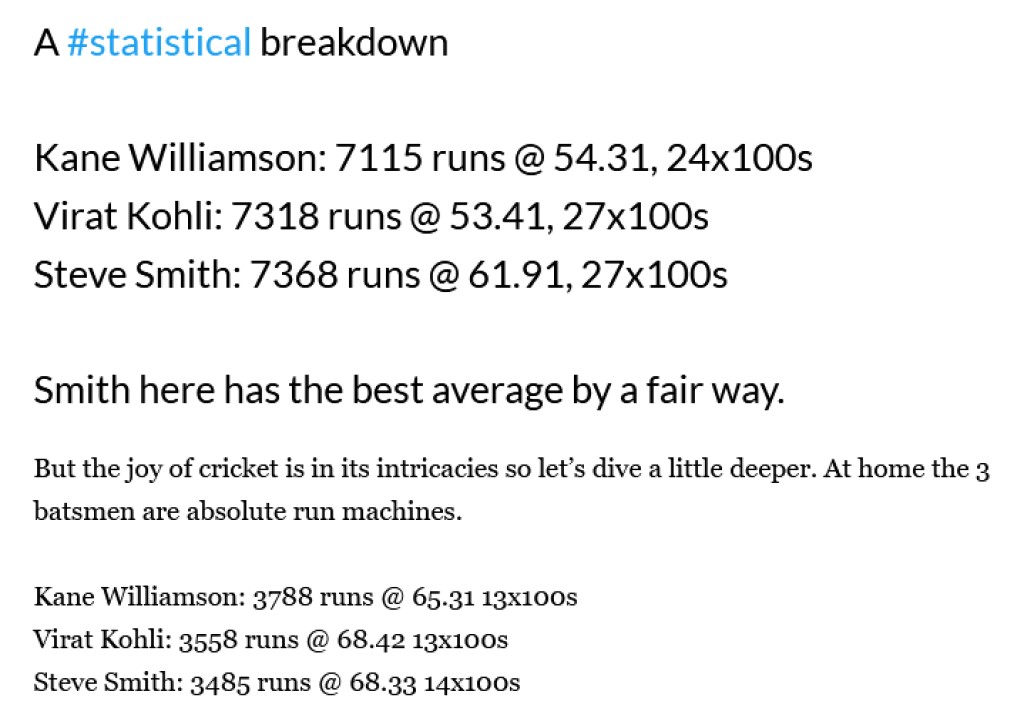
This twitter thread about the batting of that great trio Kohli, Smith and Williamson was created by allthingscricket, and I recommend you read it in full by clicking here. Screenshot below:

The start of allthingscricket’s thread about the great trio.

A PETITON & PHOTOGRAPHS

Before my usual sign off, I have a petition to share. This one is open only to UK residents, as it is on the official UK government petition site. It calls for students to be excused some of this year’s tuition fees, as they are not getting what they pay for, since they are quite correctly not able to be at University at present. Click here to sign and share. Screenshot below:

Now it is time for my usual sign off…