All Time XIs – The Game’s Old Testament

An XI picked from cricket’s early history and a huge photo gallery.

This exercise looks as the title suggests at cricket’s early history. I have allowed myself one cricketer who played test cricket but otherwise these players are all of pre-test vintage.

  1. *WG Grace (right handed batter, right arm bowler of various types, excellent close catcher, captain). The sole test cricketer in the XI, but although he played test cricket over a period spanning almost 19 years he was past his absolute prime by the time he debuted in that format in the first test on English soil in 1880.
  2. John Small (right handed batter). John Nyren in his book about Hambledon (his father Richard was closely involved with the club) waxes lyrical about Small. Small’s most remarkable effort was a 138* that was spread over three days play.
  3. James Aylward (left handed batter). Only eight years after John Minshull scored the first recorded century in any cricket match this man set the Hambledon all time record with an innings of 167.
  4. Nicholas Wanostrocht aka Felix (right handed batter). He played his cricket (for Kent among others) under the assumed name ‘Felix’ because he worked as a schoolmaster and felt it would damage his professional reputation to play under his own name. He was also author of ‘Felix on the Bat’.
  5. Fuller Pilch (right handed batter). Recognized as the best batter of the 1830s and 1840s. He used a bat with a long blade and a comparatively short handle.
  6. Vyell Walker (right handed batter, slow bowler). One of seven brothers from Southgate – the cricket ground there is still known as Walker’s Ground. A Middlesex regular, and along with Grace one of only two players to have scored a century and taken all ten wickets in an innings in the same first class match.
  7. +Tom Box (wicket keeper, right handed batter). He played every Sussex game from 1832 to 1856 inclusive, a remarkable achievement. He often batted in the top half of the order for them, and was clearly an excellent keeper.
  8. William Clarke (right arm leg spin bowler, right handed batter). An extraordinary wicket taker, and not the worst batter. He also created the All England XI, a professional touring XI who played all round the country. Over the next 30 years a number of other such teams were created, but in the end a potential schism was averted when WG Grace threw his lot in with the MCC. ‘Old Clarke’ has left the modern game one great legacy – it was he who bought the Trent Bridge Inn, enclosed some adjoining fields and turned them into a cricket ground.
  9. James Broadbridge (right arm fast bowler, right handed batter). One half of cricket’s first acknowledged great bowling partnership, along with…
  10. William Lillywhite (right arm fast bowler, right handed batter). ‘The Nonpareil’, regular bowling partner of Broadbridge.
  11. David Harris (right arm fast bowler, right handed batter). The first authentically great bowler, his method is splendidly described by Nyren in his book.

This XI has a good batting line up and a strong, varied bowling attack – three great pacers, two great and contrasting spinners and Grace as sixth bowling option. It also has an excellent captain and a great keeper.

The nearest overseas player to making the cut was Gideon Elliott, the Victoria fast bowler whose handful of first class matches yielded 48 wickets at less than five a piece. I picked Walker for the all rounders slot over Alfred Mynn, ‘the Lion of Kent’ for reasons of balance, which also ruled out either Osbaldeston or Lambert. I regretted not being able to find a place for John Wisden, the diminutive fast bowler who created Wisden’s Almanac. Julius Caesar, the remarkably named Surrey batter who toured Australia in 1863-4 deserves a mention, and also Heathfield Harman Stephenson, performer of the original hat trick, in a match at Hyde Park, Sheffield – the name coming about because someone in the crowd passed their hat around to collect money which was presented to Stephenson in honour of his feat. Two early Yorkshire greats, Ephraim Lockwood and Louis Hall might have their advocates. Three fast bowlers who I have not yet mentioned who had fine achievements to their credit were Sam Redgate, John Jackson and George Tarrant. George Freeman of Yorkshire was also close to selection.

My usual sign off…

The County Championship: Cricket’s Great Survivor

A look t the many challenges and changes the County Championship has faced and survived in its long history. Also a large photo gallery.

Today would be the second day of the second round of county championship matches of the 2023 season, except that there is so much rain around the country that no matches are currently playing as I type this, hence I am listening to commentary on today’s IPL game. In this post I look back at the many challenges that the county championship has overcome.

A TURBULENT PRE-BIRTH

Although matches between teams bearing the names of counties have been happening for over three centuries (teams dubbed ‘Kent’ and ‘Surrey’ did battle in 1708), it wasn’t until the mid 1860s that anyone had the idea of ranking county sides, and not until 1891 that a properly organized county championship took place (so many sometimes conflicting authorities assessed counties between 1864 and 1890 that there are no fewer than seven different listings of ‘Champion Counties’ from that period. In 1845 The All England XI played it’s first match, and was to continue to exist as a travelling XI playhing matches against the odds (opposition sides of more than 11 players – 15, 18 and 22 were common numbers) for some 30 years. A split led to the formation of the United All England XI, and subsequent to that the United North of England and United South of England XIs were established. At one point it seemed that English cricket might suffer a rugby type split, with the professionals playing games against the odds in their travelling XIs and the amateurs playing 11 v 11 matches, but such was averted – the key figure of WG Grace threw his lot in the with the MCC, though he also continued to turn out for the United South of England XI – his price for supporting the establishment and thereby ensuring that English cricket would continue to be run from Lord’s and would not split was that he be allowed to make a mockery of the principles of amateurism. In the end the travelling XIs withered on the vine, and by the early 1880s the last of them had ceased to exist. Matches against odds lasted longer – England tours of Australia featured such matches for many years to come.

PROFESSIONAL LIMITED OVERS CRICKET

From 1891-1962, although the there were many changes in how the championship was calculated and who played in it (just eight counties played the first few, six more were promoted to first class status in 1895, Worcestershire in 1899, Northamptonshire in 1905 and Glamorgan in 1921), the championship stood alone. Between the 1962 and 1963 seasons two major decisions were made: the distinction between amateur and professional was abolished (there were precious few amateurs left, and even fewer whose amateur credentials would have stood up to any sort of scrutiny) and henceforth all first class cricketers would be professionals, and the first professional limited overs competition, the Gillette Cup was launched, starting in 1963. In 1969 the John Player League, matches of 40 overs per side, to be played on Sundays (the shorter allocation of overs meant the games could start in the afternoon) was introduced, and the county championship programme was reduced to 20 matches per season (28 had been standard). It was increased back to 22 and then 24. Then, four day championship cricket was introduced, Durham were given first class status, and a for a few years 17 four day matches (each of the 18 counties playing the other 17 once) became the standard. England continued to struggle, and after much controversy and debate, two more big changes happened in the year 2000, in the wake of England sinking to the bottom of the world test rankings: The County Championship was split into two divisions with promotion and relegation, and ECB central contracts were introduced, giving England control over the top players. England’s fortunes rose rapidly. Overall, although Duncan Fletcher’s policy of effectively using a central contract to bar holders of such from playing county cricket took things too far both these moves have been successful.

EVEN SHORTER FORM CRICKET

In 2003 the ECB introduced yet another competition, with innings of just 20 overs per side. Players took a while to get to grips with the approach required by this format, but it proved extremely popular.

15 years later, the ECB decided that yet another competition was needed, and opted for a quirky new format of innings comprising 100 balls each bowled in sets of five, with players allowed to bowl two sets back to back, but no more. This competition was called The Hundred, and one of its effects was to push the County Championship, now a mere 14 matches per season, further towards the margins of the season as it now ‘owns’ August, with a One Day Cup of much reduced stature taking place alongside it. The Hundred has brought much greater prominence to women’s cricket, but I do regret the ever increasing concentration of County Championship matches at the beginning and end of each season, with few games happening in high summer. However I have no worries about the future of the County Championship – it was born facing challenges, and has faced challenges at many points of its life so far, and it is still here.

PHOTOGRAPHS

I have a bumper gallery for you today:

Blasts From The Past v #BBL10 Composite

A variation on my All Time XI theme pits a ‘Blast from the Past’ XI against a #BBL10 Composite XI. Also, on the 40th anniversary of the Chappell incident I look at under arm bowling.

Today we revisit all-time XI territory with a bit of a twist, and then I have a bonus section prompted by today being the 40th anniversary of Trevor Chappell’s most (in)famous moment on the cricket field.

THE GROUND RULES

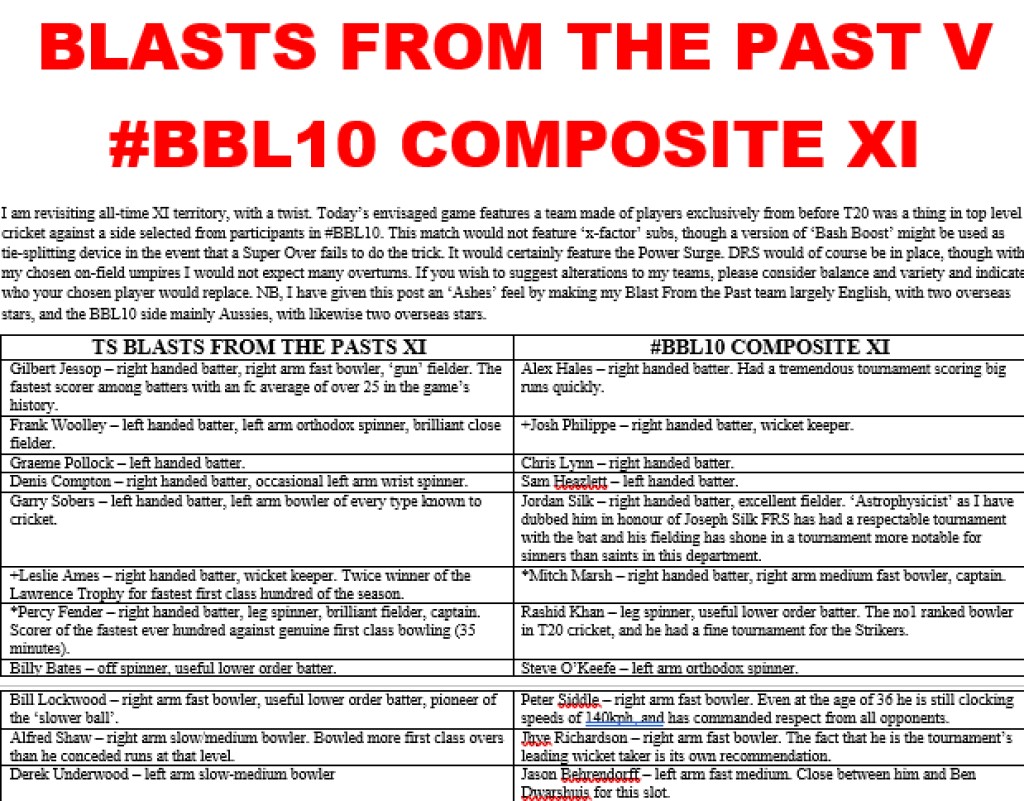
I have given this post a hint of an ‘Ashes’ flavour – my Blast From The Past XI is mainly English, though this being put in a T20 setting I have allowed myself two overseas players, while similarly my BBL10 Composite XI is mainly Australian with two overseas players permitted. It is two XIs, with the ‘x-factor sub’ idea given the treatment it deserves – in the bin. A variant on the ‘Bash Boost’ could be used as a tie-splitting procedure if a Super Over doesn’t do the job, while the Power Surge would remain. Naturally, DRS would be in use for this contest, though with my chosen on-field umpires, of whom more later, Claire Polosak as TV Replay umpire probably wouldn’t be overturning many deicisons. If you think I have had mistakes with either XI please feel free to make alternative suggestions, but remember that balance and variety are important, and tell me who should be dropped to make way for the people you want.

THOMAS SUTCLIFFE’S BLASTS FROM THE PAST XI

All members of this team played before T20 was a thing in top level cricket, and only three even played what is now called List A cricket.

  1. Gilbert Jessop – right handed batter, right arm fast bowler, ‘gun’ fielder. The fastest scoring batter with a first class average of over 25 that the game has ever seen, a useful fast bowler and an electrifying fielder, the ‘Croucher’ is a must for this side.
  2. Frank Woolley – left handed batter, left arm orthodox spinner, excellent close catcher. All-out attack was his natural tendency with the bat anyway, his all round record was astonishing – 58,969 runs at 40 an innings, over 2,000 wickets at 19 a piece and 1,018 catches in first class cricket, the latter a record for any outfielder.
  3. Graeme Pollock – left handed batter. One of my overseas players, and one of the three members of this side to have played List A cricket – he actually held the record in that format with an innings of 222, which stood until Ally Brown hit 268 for Surrey v Glamorgan at The Oval, with the pitch for that game being way off centre, giving a very short boundary on one side.
  4. Denis Compton – right handed batter, occasional left arm wrist spinner.
  5. Garry Sobers – left handed batter, left arm bowler of pretty much every type known to cricket. The first person ever to hit six sixes in an over in first class cricket, and without a doubt the most complete player the game has yet seen. My second overseas player, and one of the three members of this side to have played List A. He averaged 38 with the bat and 21 with the ball in list A, though his only ODI innings was a duck (he did bowl respectably in that game).
  6. +Leslie Ames – right handed batter, wicket keeper. Twice a winner of the Lawrence Trophy for the fastest first class hundred of the season, the only keeper ever to score 100 first class hundreds, all-time record holder for first class stumpings – 418 in total in his career.
  7. *Percy Fender – right handed batter, leg spinner, brilliant fielder, captain. He scored the fastest century ever scored off authentic first class bowling, in 35 minutes versus Northamptonshire.
  8. Billy Bates – off spinner, useful lower order batter. Took England’s first ever hat trick, part of a performance in which took seven wickets in each innings and scored 55 with the bat.
  9. Bill Lockwood – right arm fast bowler, useful lower order batter. One of the first fast bowlers to develop a slower ball as part of his armoury, and he caused as many problems with it as any player prior to Franklyn Stephenson.
  10. Alfred Shaw – right arm slow to medium bowler. Bowled more overs in his first class career than he conceded runs, took his wickets at 12 a piece, and once said “length and successful variation of pace are the secrets of good bowling”, a philosophy which would stand him in good stead for T20s.
  11. Derek Underwood – left arm slow-medium bowler. The third member of this side to have played List A cricket. His economy rate in ODIs was 3.44.

This team has massive batting depth, with only Shaw and Underwood unlikely to contribute in that department. Only Pollock and Ames of the XI are completely unrecognized as bowlers, with Sobers’ three styles meaning that there are in total 10 front line options plus Compton’s left arm wrist spin.

#BBL10 COMPOSITE XI

This XI have been selected on their performances during the tournament and with an eye to balance and variety. Note also that I have only allowed myself two non-Aussies.

  1. Alex Hales – right handed opening batter. He has had a quite magnificent tournament, and in many people’s eyes should be back in the mix for England’s T20 team.
  2. +Josh Philippe – right handed batter, wicket keeper. Excellent with both bat and gloves this tournament.
  3. Chris Lynn – right handed batter. Usually an opener, I put him at three here, with his four fifty plus scores in the tournament indicating that he is far from finished just yet.
  4. Sam Heazlett – left handed batter. His ‘Sambulance rescue‘ innings of 74 not out off 49 when his team were in big trouble against Thunder yesterday sealed his place in this XI.
  5. Jordan Silk – right handed batter, excellent fielder. There were many possibilities for this slot, but ‘Astrophysicist’ (in honour of Joseph Silk FRS) gets the nod because in a tournament where there have been rather more sinners than saints in the field he has shone in that department.
  6. *Mitch Marsh – right handed batter, right arm medium fast bowler, captain. A T20 side really needs six front line bowling options at minimum so that you have cover if one misfires, and Marsh’s batting is unequivocally good enough to be no six, usually considered mainly a batter’s position.
  7. Rashid Khan – leg spinner, useful lower order batter. The Afghan, rated the no1 T20 bowler in the world, did superbly for the Strikers before his country’s needs took over and he left the tournament.
  8. Steve O’Keefe – left arm orthodox spinner. He has bowled very economically this tournament.
  9. Peter Siddle – right arm fast bowler. The veteran impressed for the Strikers, still being able to hit the 140kph mark, and generally being very accurate.
  10. Jhye Richardson – right arm fast bowler. The leading wicket taker in this tournament.
  11. Jason Behrendorff – left arm fast medium. Close between him and Ben Dwarshuis for this slot.

This side has good batting strength, and a strong and varied bowling attack, and should be able to give a good account of itself.

MY ON-FIELD UMPIRES

In keeping with this post I choose one umpire who is in the ‘blast from the past’ category and one from the modern era to officiate on the field. I am opting for Frank Chester, who stood in 48 test matches, a record at the time and for many years afterwards as my ‘blast from the past umpire’. One story about Chester to sum up his skill in this role: there was an occasion when he was officiating and a ball went through to the keeper with an audible click en route, the fielding side went up in a huge appeal for caught behind and were shocked when Chester gave it not out, while the umpire, unflustered, walked up to the stumps at the batter’s end, looked at the off stump and nodded to himself – he had identified the faint red mark that confirmed that he was right, and that the click has been the ball brushing the stump not quite hard enough to dislodge a bail. The other on-field umpire for this contest, from the modern era, is Aleem Dar.

THE CHAPPELL INCIDENT AND UNDER ARM BOWLING

It was 40 years ago today that with New Zealand needing six off the last ball to tie the match and no11 Brian McKechnie on strike Greg Chappell ordered his brother Trevor to roll that last ball along the ground. This disgraceful incident led to under arm bowling being ruled illegal, an overreaction in my opinion. Since that time a law change has seen balls that bounce multiple times called no balls, so the Chappell situation can be handled simply by adding a note that a ball that rolls along the deck is considered to have bounced an infinite number of times and is therefore a no-ball. This would keep the way open for a latter-day Jephson or Simpson-Hayward, or indeed a would-be reviver of the art of David Harris to emerge, while preventing dishonourable tactics such as those used by the Chappell brothers 40 years ago (if you would have it so Greg can be considered the chief culprit, but Trevor cannot be held blameless, since he could have challenged his brother and said that he would not adopt those tactics but would bowl the best yorker he could summon up).

PHOTOGRAPHS

Franchise Squad From The Before The White Ball Era

I name a franchise squad comprising entirely players from before white ball cricket was played – and challenge cricket fans among my readers to do likewise.

INTRODUCTION

I am deviating briefly from my coverage of my stay in Cornwall because mention was made of players from the past who would have been useful in franchise cricket during this morning’s BBL commentary on Test Match Special, and I got thinking about a franchise squad comprised of players who flourished before white ball cricket was played.

RULES

To be eligible for consideration under my rules players must have retired before the inaugural T20 cup took place in 2003. Also, unless a very good reason can be found players considered for this must have had some international experience. At least one recognized wicketkeeper must be in the squad.

THOMAS’S SQUAD

I have named 15 for my squad, an envisaged first XI and four reserves.

GILBERT LAIRD JESSOP

The most consistently fast scoring batter in the game’s history (he reached 100 in less than an hour at the crease 11 times in first class cricket, and in a career that included 53 centuries he only once batted as long as three hours in), a gun fielder (his credits include a direct hit run out of Victor Trumper in a test match) and a crafty pace bowler. If one had a time machine to fetch him in his prime into the present day he would send an IPL auction into meltdown.

GARFIELD ST AUBRUN SOBERS

Quite simply the most complete cricketer who ever played the game – a batter capable of hitting six sixes in an over and who averaged 57.78 in test cricket, three bowlers in one (left arm seam and swing, slow left arm orthodox and slow left arm wrist spin, the latter of which would be especially useful in T20) and a brilliant fielder.

ISAAC VIVIAN ALEXANDER RICHARDS

The best batter in the early days of ODI cricket and a brilliant fielder. In view of who else is available to bowl in this squad his off spin would be unlikely to be called on.

ROBERT GRAEME POLLOCK

He averaged over 60 in test cricket, and although he never played ODIs due to South Africa being in isolation by the time that form of cricket took off he averaged over 50 in List A cricket with a best of 222 not out.

FRANK EDWARD WOOLLEY

The only cricketer to have achieved the career triple of 10,000 runs (58,969 no less), 1,000 wickets (2,066 of those) and 1,000 catches (1,018) in first class cricket, and the only non-wicketkeeper to have pouched 1,000 catches.

BASIL LEWIS D’OLIVEIRA

An attacking middle order batter and the sort of medium pace nibbler who would be very useful in T20.

LESLIE ETHELBERT GEORGE AMES

The only recognized wicketkeeper ever to score 100 first class hundreds, and he won the Lawrence trophy for the fastest hundred of the season twice in the first three years of its existence.

GEORGE HERBERT HIRST

He achieved the double of 1,000 runs and 100 wickets in a first class season 14 times in his career, including the only occasion on which anyone managed the ‘double double’ (1906, 2,385 runs and 208 wickets). An aggressive right handed bat and left arm pace bowler, he was also like Jessop what is now termed a gun fielder.

JAMES CHARLES LAKER

Probably (sorry Nathan Lyon fans, I do not buy your claims on his behalf) the best ever at what he did, namely bowling off spin. In 1956 he took 46 wickets in the Ashes series, including 19-90 in the 4th match at Old Trafford), and also helped his county to beat the Aussies by taking 10-88 (off 46 overs on a good wicket in the first innings of the match) and 2-42 in the second Aussie innings.

ALFRED SHAW

He bowled more overs in first class cricket (no List A in his day) than he conceded runs (25,699 overs bowled, 24,873 runs conceded), and captured just over 2,000 first class wickets. His impeccable length and canny variations of pace would make him an excellent option in T20. I also choose him as captain – he proved himself good at the job at a time when few professional cricketers got the chance (most captains in his era were, nominally at least, amateurs who did not get paid to play cricket).

CLARENCE VICTOR GRIMMETT

Clarrie Grimmett (aka Scarl, Old Grum or Fox) the New Zealand born Aussie leg spinner took 216 wickets in only 37 test matches (he had to wait until he was 33 to get the call), and a record first-class tally for someone who never played County Championship cricket (1,424, again at just about six wickets per game). He was exceedingly economical, commanded a range of variations (and was forever experimenting with new types of delivery), and as such would seem made for T20 bowling (although like Shaw above he would probably not have been best pleased at being restricted to four overs per innings).

WALTER REGINALD HAMMOND

A stroke playing batter with a formidable record (over 50,000 first class runs including 167 centuries), a superb slip fielder and a very capable bowler (and in T20, knowing that he would not be bowling more than four overs at any one time he may have been a little less unenthusiastic about this aspect of his game than he was in first class and test cricket). He once hit the first five balls of a days play, bowled by no less a personage than Ted Macdonald, for fours, and according to reports it was only a good bit of fielding that stopped being six fours out of six for the over.

MULVANTRAI HIMMATLAL “VINOO” MANKAD

A slow left-arm bowler, a fine batter (he regularly opened for his country in test cricket) and a capable fielder. He was the first bowler in test cricket to run out an opposition batter for backing up too far, causing a controversy that continues to flare up every time something similar happens (my sympathies are exclusively with the bowler – the batter who gets run out is trying to gain an unfair advantage). If he were to be in the team it would be fun to have Ashwin in the ranks of the opposition!

MICHAEL JOHN PROCTER

An aggressive middle order batter, a fine fielder and a fast bowler who could also bowl off breaks, Procter could come in for anyone save Ames without the side as a whole suffering.

WILLIAM JOSEPH OREILLY

A very different type of legspinner to Grimmett, bowling at around medium pace and generating extra bounce (he was tall, unlike Grimmett), O’Reilly (though he would be voluble in expressing his dislike of the format, and I am quite certain that what he would have to say about The Hundred/ Harrison’s Harebrained Have a Hit would be unprintable) would be excellent at this form of the game.

This squad gives me a plentiful supply of attacking batters, a huge range of bowling options including every style of bowling and plenty of excellent fielders.

CONCLUSION, CHALLENGE AND PHOTOGRAPHS

For ease of references here is my squad listed without comments: 1)Gilbert Jessop, 2) Garry Sobers, 3)Viv Richards, 4)Graeme Pollock, 5)Frank Woolley, 6)Basil D’Oliveira
7) +Les Ames, 8)George Hirst, 9)Jim Laker 10)*Alfred Shaw 11)Clarrie Grimmett, Reserves: Wally Hammond, Vinoo Mankad, Mike Procter, Bill O’Reilly.

For the cricket fans among my readers here is a challenge: name your own franchise squad comprising players from before T20 cricket started, either directly in the comments, or in a post of your own which you link to in the comments below.

Here are a few Cornish photos to finish…

P1290156 (2)
Two shots showing waves crashing over the breakwater that is visible from my parents living room.

P1290157 (2)

P1290158 (2)
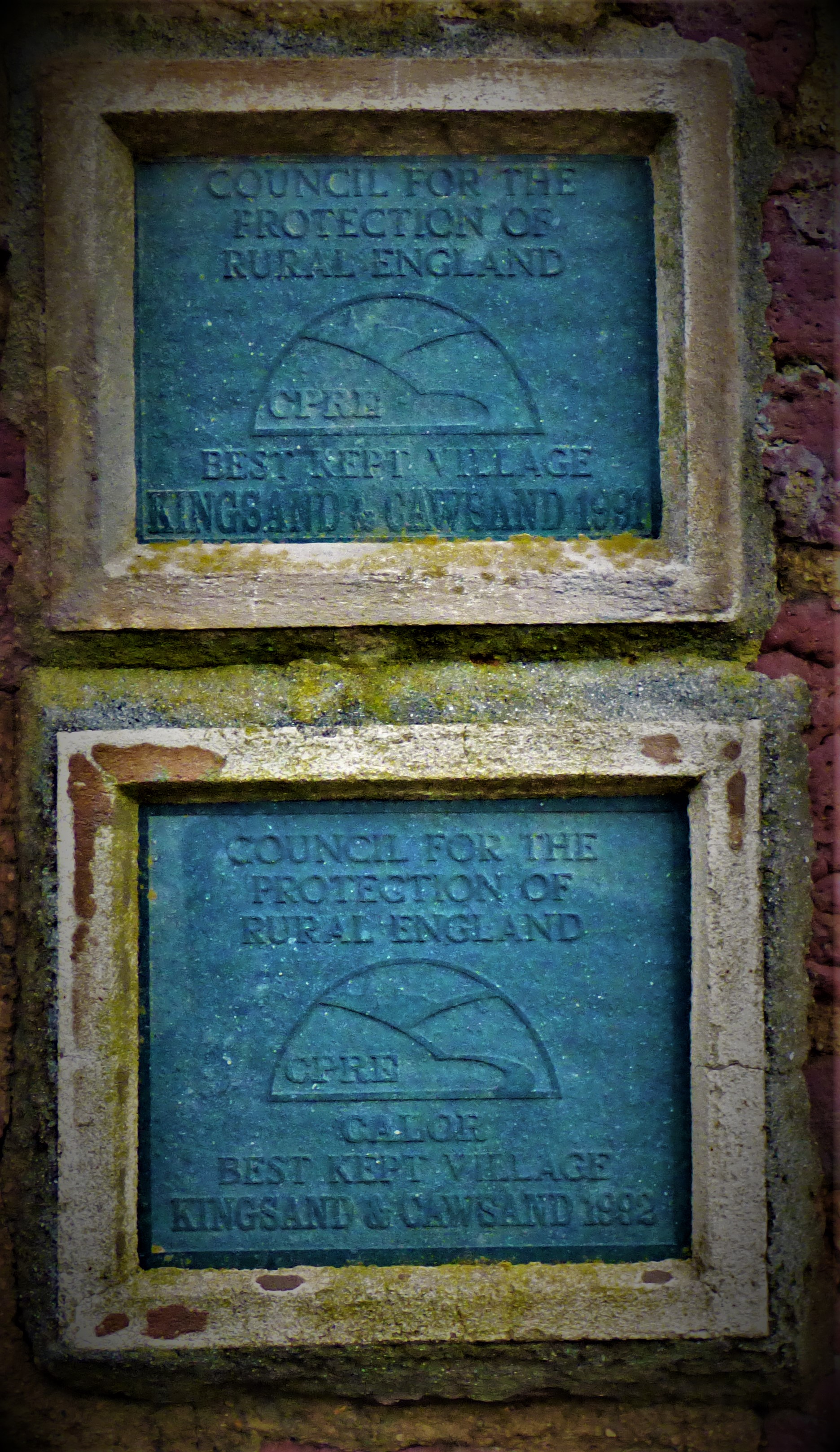
A few shots from Cawsand, the closest village to my parents home.

P1290159 (2)P1290160 (2)P1290161 (2)P1290162 (2)P1290163 (2)P1290164 (2)P1290165 (2)P1290166 (2)

P1290167 (2)
Three views of Fort Picklecombe from Cawsand.

P1290168 (2)P1290169 (2)P1290170 (2)

P1290177 (2)
A heron standing on the breakwater (two shots)

P1290179 (2)P1290182 (2)P1290183 (2)

P1290186 (2)
The officers mess at Fort Picklecombe (permission for the building was given on condition that this part be modelled on Warwick Castle).