In this post I select an all time England XI who were not the best players in their own families. Some of my choices are undoubtedly controversial but I believe I can defend them all.
THE XI IN BATTING ORDER
EM Grace (Gloucestershire, England, right handed opening batter, lob bowler). In the early 1860s, before WG, seven years his junior, overtook him he was the acknowledged cricketing marvel of the age. His sole England appearance came in the first test on English soil in 1880, and even then, at the age of 39 and long past his best he was able to contribute to an opening stand of 91 with WG in the first innings. The test that led to the creation of The Ashes may well have gone the other way had he been in the team instead of AN ‘Monkey’ Hornby – WG would have undoubtedly captained the side better than did Hornby, whose tinkering with the batting order in the final innings contributed to England’s defeat, and EM, even at 41, would probably have been better value with the bat than Hornby, who was never comfortable against Spofforth. I have explained in previous posts how under arm could be relegalized without danger of a repeat of the Trevor Chappell incident – simply rule that a ball that rolls (or is rolled) along the deck has bounced an infinite number of times and call it ‘no ball’.
Chris Broad (Gloucestershire, Nottinghamshire, England). His England career ended when he decamped on the last ever rebel tour of apartheid South Africa in 1989, but while nowhere near on a par with son Stuart he had a very respectable England career, including an away Ashes series in which he scored 487 runs at 69 including three successive centuries.
Michael Vaughan (Yorkshire, England, right handed batter). Although at a casual glimpse his test record reads the best of the three members of his family to have played at that level (he is related to Johnny and Ernest Tyldesley of Lancashire and England many years ago), I have noted that Johnny Tyldesley’s record was better than it looked due to him playing the vast majority of his cricket before WWI, generally on wickets that favoured bowlers, while Ernest got surprisingly few England caps for so prolific a county scorer, so I have (with Neville Cardus doubtless backing me from beyond the grave) opted to rate Johnny the best of the three and therefore select Michael Vaughan and Ernest Tyldesley in this XI.
Ernest Tyldesley (Lancashire, England, right handed batter). The only Lancastrian ever to score 100 FC hundreds. See my comments re Vaughan for the justification of his inclusion.
KS Ranjitsinhji (Sussex, England, right handed batter). One of two members of the ruling family of Nawanagar to play for Sussex and England, and I have decided that the other, his nephew KS Duleepsinhji, outranks him and so included him in this XI.
Richard Hutton (Yorkshire, England, right handed batter, right arm fast medium bowler). Good enough to be selected for England as an all rounder, but unquestionably outranked by his father Leonard.
*David Bairstow (Yorkshire, England, wicket keeper, right handed batter). The best wicket keeper in the Bairstow family, but outranked overall by his son due to the latter’s batting.
Maurice Tremlett (Somerset, England, right arm fast medium bowler, right handed batter). The most talented of his family, but was sadly messed up by well meaning coaches, meaning that he was outachieved by his grandson Chris.
Tim Tremlett (Hampshire, right arm medium pace bowler, right handed batter). Never selected for England, but 450 FC wickets at 23.99 each shows that he was a good county bowler, and he also managed a first class hundred.
*James Lillywhite junior (Sussex, England, left arm orthodox spinner, left handed lower order batter, captain). The fact that his uncle William Lillywhite, “The Nonpareil” was regarded as the greatest bowler of his era, a distinction never conferred on the nephew, enables to me to include England’s first ever captain in this XI. His two tests, the first two such games ever played, yielded him 8 wickets at 15.75. In first class cricket, where the sample size is much larger, he took 1,210 wickets at 15.23, including 96 five wicket innings hauls and 22 ten wicket match hauls. His best innings figures were 10-129. He also scored 5,530 runs at 14.30 with a best of 126*.
Dean Headley (Kent, Middlesex, England, right arm fast medium bowler, right handed batter). His grandfather George was one the game’s all time greats, which enables me to select him in this team (his father Ron also played test cricket). In 15 test matches he managed a very respectable 60 wickets at 27.85, while in all first class cricket he took 466 wickets at 28.52.
This team has a powerful top five, a genuine all rounder at six, a keeper who can bat, and four high quality front line bowlers. The spin bowling is a bit light, with only Lillywhite a front liner in that department. For all that none of these players were on my reckoning the best in their own families I would expect this combination to give a good account of itself.
HONOURABLE MENTIONS
GF Grace might have had to slot I gave to Richard Hutton, but I preferred to accommodate an extra family. The Cowdrey and D’Oliveira families missed out because in each case the principal cricketer in that family was the only one worthy of inclusion (picking Brett D’Oliveira as an opening batter would also have given me a leg spin option, but in truth he is not good enough in either department). John Langridge was a contender for the right handed openers slot I gave to Chris Broad, being definitely outranked as a player by James Langridge, but still very fine. While there is reasonable evidence to support the view that Gubby Allen was actually the son of Plum Warner and not of Walter Allen I could not accommodate Plum in this XI, and while Gubby Allen’s extra pace would have been welcome he has to outrank his alleged father as a cricketer and was thus ineligible. A possible leg spin option was Archie Lenham of Sussex, currently definitely outranked by father Neil and possibly by grandfather Les, but more than likely to eclipse both before he is done. Claude Woolley (Northamptonshire) was undoubtedly outranked by brother Frank, but was IMO not good enough to warrant selection in this XI. Second choice keeper for this XI would be Leslie Compton (Middlesex), outranked in cricketing terms by brother Denis, and possibly by two of Denis’ grandsons, Nick and Ben. In football, Denis and Leslie both played for Arsenal, and it would be Denis in that sport who would rate as not the best in his own family.
The definitive XI of England men one cap wonders, a petition and a large photo gallery.
Of the 700 or so players to have turned out for the England men’s test side approximately 100 have done so exactly once. This XI is picked from these players. Sidestream Bob commented on yesterday’s post indicating that he wanted to see such an XI, so here it is.
THE XI IN BATTING ORDER
*Edward Mills Grace (right handed opening batter, right arm lob bowler, daring close fielder). Eclipsed by his brother WG and already 39 by the time he made his sole test appearance he still scored 36 in the first innings, sharing an opening stand of 91 with WG. He was towering prodigy in the late 1850s and early 1860s, and it was only near the end of the 1860s that WG, seven years his junior (the same age gap coincidentally as that between Mycroft Holmes and his more gifted younger brother Sherlock – and Conan Doyle was a cricket fanatic and a fine player in his own right) definitely overhauled EM. Test cricket came too late for EM, though he should probably have been picked for the Oval test of 1882 – AN Hornby never delivered against Australia with the bat and his captaincy helped cost England that match, when he held CT Studd, scorer of two centuries against the Aussies that season, back until number 10, and Studd ended up not facing a ball in the innings.
Alan Butcher (left handed opening batter). One solitary test cap was scant reward for a long and productive county career first with Surrey and then with Glamorgan.
Mark Benson (right handed top order batter). He was a regular opener, and scored large numbers of runs for Kent in the course of long career. His one and only test appearance, against India in 1986 yielded scores of 21 and 30.
Alan Wells (right handed batter). His paucity of test caps was partly self inflicted since he signed up for the last rebel tour of South Africa, but he was very successful at county level, and his call up for the last test of the 1995 series against the West Indies was scant reward for so good a career, especially when an Ambrose snorter ensured that his test career would yield no runs.
Paul Parker (right handed batter, excellent fielder). Mike Brearley was told that if he wanted to captain England in the final test of 1981 at The Oval he had to accept an experimental line up. Picking folk for the last test of a series seems silly to me because unless the do something remarkable they are likely to end as one cap wonders. Paul Parker was one of those capped at The Oval in 1981, he did little in the match and was promptly forgotten about by the selectors, though he continued to perform well for Sussex.
Fred Grace (right handed batter, right arm medium pacer, excellent outfielder). In the 1870s only big brother WG did significantly better with the bat than Fred, and he took his FC wickets at 20.06 a piece. His sole test call up, at The Oval in 1880, saw him collect a pair and not do much with the ball, though had the ‘Champagne Moment’ been a thing in 1880 his catch to dismiss the big hitting George Bonnor, held as the batters were crossing for their THIRD run (Frederick Gale chain measured the distance and worked out that Fred Grace was 115 yards – approximately 105 metres – from the bat when he took the catch) would have won it. Fred Grace was not a victim of selectorial caprice – two weeks after this match he caught a chill, which turned into a fatal chest infection.
*Aubrey Smith (right arm fast medium bowler, right handed lower middle order batter, captain). The only person to captain an England men’s test team on his only appearance at that level, there could be no other captain of this XI. He took seven wickets in that one match, the first of two on an early tour of South Africa which were granted test status retrospectively. He was unavailable for the second match, and Monty Bowden took the captaincy. Smith took to acting first on stage and then on screen once his playing days were done, and he founded Hollywood Cricket Club, for whom he turned out even into his eighties.
Arnold Warren (right arm fast bowler, right handed lower order batter). He did once share a ninth wicket stand of 283* with one J Chapman. His sole test cap came in 1909, and he took 6-113 in the match including an innings haul of 5-57. For Derbyshire he was one half of an excellent though hard to handle new ball duo alongside Billy Bestwick.
+Leslie Gay (wicket keeper, right handed batter). Finding a keeper who was one cap wonder was a challenge, but this guy, who also kept goal for the England men’s football team played the first match of the 1894-5 Ashes and was dropped for Hylton ‘Punch’ Philippson after a poor game, and never got another England cap.
Charlie Parker (left arm orthodox spinner, right handed lower order batter). The third leading wicket taker in first class history, with 3,278 scalps, but just one appearance for England, in which he took 2-32.
Charles ‘Father’ Marriott (leg spinner, right handed lower order batter). A natural number 11 if ever there was one, and an excellent fit for this side. His career as a teacher limited his cricket playing but in the course of an FC career that spanned 17 years he claimed 724 wickets nevertheless, and his sole test appearance, against the West Indies in 1933, yielded match figures of 11-96, the best ever achieved by a one-cap wonder.
This side has decent top six, a bowling all rounder at seven, a bowler who could bat at eight, a keeper who was not a total incompetent with the bat and two genuine tail enders. The bowling, with Smith and Warren to share the new ball, Fred Grace as a back up seam option and C Parker, Marriott and EM Grace as three different slow options is both strong and varied.
EXTRAS
Stuart Law, a one cap wonder for Australia, qualified by residence (he played county cricket for many years, first for Lancashire and then for Essex) for England in 2006, but I felt that given that his sole appearance was for another country it would be a stretch to include him in this XI.
Mike Smith of Gloucestershire and Simon Brown of Durham each got picked on a ‘horses for courses’ basis for test matches at Headingley in the 1990s, and in each case did little and were never picked again. Their overall records are not good enough for them to displace any of my chosen specialist bowlers.
PHOTOGRAPHS
Before my usual sign off I have a petition to share with you. It calls for ‘Swift bricks’ to be a requirement for all new build houses to combat the decline in numbers in the swift population, and is on the cusp of the 100,000 signatures needed for a debate in parliament – if you are a UK citizen you could be the one to send it over the line: https://petition.parliament.uk/petitions/626737
Another variation on the ‘all time XI’ theme, this time ‘one cap wonders’ against ‘nontest stars’, with a bonus feature on women’s cricket and some photographs.
INTRODUCTION
It is time for another variation on the “All Time XI” theme. This one features an XI made up of one-cap wonders and and XI designated Nontest.
THE BRIEF
The ‘one cap wonders’ XI is fairly self explanatory – these people made precisely one appearance at the highest level for various reasons. The Nontest XI comprises players who either flourished before their country gained test status or belong to a country that has never enjoyed test status. Many of these players are making their debuts in this series of posts, but in some cases they have featured elsewhere. First be introduced, in most cases representing decisions that appear to make as much sense as cluttering up an already overloaded cricket calendar with a new competition featuring innings of 100 balls per team and a raft of rule changes are…
THE ONE CAP WONDERS XI
Ken Eastwood – brought in for the final test of the 1970-1 Ashes series when the Australian selectors decided to replace Bill Lawry as skipper and without consulting their new skipper to be Ian Chappell decided that the old skipper could not play under the new. Eastwood, already 35 years of age, was like Bill Lawry a blocker by instinct, but he was nowhere near as good a batter, hence why he had not previously caught the selectors eyes. He is an example of what I consider the worst kind of ‘one cap wonder’ story – someone brought in at the end of a series who unless they do something very special is practically guaranteed never to get picked again. England in the 1980s and 1990s were continuously guilty of doing this, indeed Mike Brearley was only confirmed as skipper for the sixth test of the 1981 Ashes on the understanding that he would accept an ‘experimental selection’ for that game, with the series already decided, and I personally think that Mr Brearley should have said “If you are going to be experimental bring in your envisaged new skipper as well.”
EM Grace – played in the first test on English soil in 1880, by when he was 40 years of age. He contributed 39 to opening stand of 91 with his brother WG in the first innings. He had toured Australia with an amateur party in 1863-4. He should have played in the 1882 test that inaugurated The Ashes, rather than AN ‘Monkey’ Hornby (the Hornby of “my Hornby and my Barlow, long ago”), who was as much Spofforth’s bunny as another Lancashire opener, Atherton, would be McGrath’s bunny in the later 1990s. Hornby’s bizarre tampering with the England batting order in the final innings contributed to the defeat – CT Studd, with two centuries against the Aussies to his name already that season was held back, getting progressively more nervous, until no10, and ended up 0 not out having not faced a ball! In addition to his aggressive top order batting EM Grace was a fearless close fielder (he once caught AE Stoddart, a renowned hitter, while standing so close in at point that he was able to pass the ball to the wicket keeper without moving his feet) and had moments with his bowling, which included lobs (he once dislodged renowned stonewaller Harry Jupp by landing a steepler directly onto that worthy’s bails).
Jack MacBryan– the only capped test cricketer who never batted, bowled or fielded at that level – the match was ruined by rain, he was waiting for a bat when the weather made its final intervention and he was never called up again.
Andy Ganteaume – the West Indian right handed batter suffered from a doctrinaire interpretation of the situation – he was selected in place of an injured player, scored 112 in his only innings, and then the injured player returned. Ganteaume thus had a test average of 112.
Rodney Redmond – the Kiwi left hander is his country’s equivalent of Ganteaume – one test match in which he made 107 and 56, a record match aggregate for a one cap wonder.
GF Grace – in his case the selectors cannot be blamed, since by the time of England’s next game after his solitary cap he was in his grave. However, he rated second only to his brother WG as an attacking batter at the time, had his moments with the ball and was a brilliant fielder.
Arnold Warren – the Derbyshire fast bowler who was also a good enough bat to have a first class hundred was called up for one match in the 1909 Ashes, collecting 6-113 overall, including 5-57 in one innings.
+Leslie Gay – when he was called up to keep wicket for England at the SCG in 1894 Gay completed a curious double – he had also kept goal for England at football. His performance with the wicket keeper’s gloves was not a distinguished one, and in England’s second innings 437 he was the only person not to reach double figures (bowled off his pads by a full toss with his score on 4). Nonetheless, England won the game (it was the ‘follow on’ match at the start of that series).
Jack Durston – the giant Middlesex fast bowler was among the many called up by England during the 1921 Ashes (30 players appeared in home colours that series), and match figures of 5-136 suggest he was unlucky to be dropped, even if you do not subscribe to my opinion that ‘one cap wonders’ in general; say more about the inadequacies of the selectors than they do about the players.
Charlie Parker – the Gloucestershire left arm spinner took more first class wickets than anyone else bar Rhodes (Yorkhsire, SLA) and Freeman (Kent, LS) and yet had to make do with one test cap. He was named in the XII for Leeds in 1926 but was the player left out, and skipper Carr then put Australia in, saw Bardsley out to the first ball of the game and then dropped a sitter from Macartney in the same over, and watched Macartney reach 100 by lunch time and ultimately 151 at a run a minute.
Charles ‘Father’ Marriott – the Lancashire and Kent leg spinner and genuine no11 was called up against the West Indies in 1933, took 11-96 in the match and was never picked again.
Our assemblage of ‘one cap wonders’ has a strong looking top five, an all rounder at six, some good bowlers and a wicket keeper. It is now time to meet the opposition…
NONTEST STARS XI
Percy Tarilton – one of the pair considered by many, including CLR James, to be the forefathers of West Indian batting (the other, George Challenor, did get to play test cricket, but only when well past his best).
Mahadevan Sathasivam – reckoned the first great batter to be produced by the island then known as Ceylon, now Sri Lanka. He only played 11 first class matches, recording an average of 41 in those games with a best score of 215. Mike Marqusee in “War Minus The Shooting”, his account of the 1996 World Cup, tells some good stories about ‘Satha’ as he was known.
William ‘Silver Billy’ Beldham – two centuries before Graham Thorpe this Farnham native was rated the best batter around. At a time when centuries at any level were rare (the first ever documented individual century was scored by John Minshull in 1769) Beldham amassed no fewer than three in matches considered to have been first class. He lived, as befits a character from the game;s old testament, to a great age, 96 to be precise, and in equally classic old testament fashion became the father of sons and daughters (no fewer than 39 of them, 11 with his first wife and 28 with his second!) According to one witness, James Pycroft, his speciality shot was the cut, which if Pycroft is even close to accurate must have rivalled the Robin Smith version for ferocity.
Charles Ollivierre – the right handed batter came to England with the 1900 West Indians and stayed to play for Derbyshire.
Clive Inman – among the first Ceylonese to be a regular in the County Championship, for Leicestershire and Derbyshire (Laddie Outschoorn of Worcestershire, a near contemporary, was also from that island).
Duncan Fletcher – A fine all rounder for Zimbabwe, batting left handed and bowling right arm fast medium. He was just too old to get to play test cricket, his playing highlight being 69 and 4-42 v Australia at the 1983 World Cup. After his playing days he coached, first at Glamorgan and then with England. He was in charge for the 2005 Ashes triumph, and although he overused the provisions of central contracts, effectively using them as a blanket ban on their holders playing county cricket overall he did a splendid job for England, the first of two Zimbabweans who did not say much to do so, the other being Andrew Flower who guided England to the top of the test match rankings, a mere 12 years after they had been bottom thereof. The story of England’s renaissance in the early 2000s spearheaded as it was by these two Zimbabweans is well told in Steve James’ (who experience Fletcher the coach in his Glamorgan playing days) “The Plan”.
+Lebrun Constantine – West Indian middle order batter and wicket keeper. He made the 1906 tour party to England only after fans raised a subscription to pay for his passage. His son Learie did get to play test cricket as a brilliant and dashing all rounder and went on to achieve considerable success in the field of human rights, ultimately becoming Baron Constantine of Nelson and Maraval (Nelson was the Lnacashire town for whom he played league cricket, and where he settled, Maraval the place in Trinidad from which he hailed).
Bart King – the USian (acknowledgement to Kiwi blogger Heather Hastie for this handy term) fast bowler was the original ‘King of Swing’ as I mentioned in my ‘non-cricketing birthplaces XI’, and took his wickets at a mere 15 a piece. He made four tours of England with The Philadelphians, on the last of which he took 87 wickets in 10 first class appearances.
*Palwankar Baloo – those who saw my India post will already know that I was impressed enough by this mans achievements in the matches he did get to play to name him in my all-time India XI. It will come as no surprise that I chosen to name a spin bowler (left arm orthodox in this case) as captain, a distinction he was denied in life due to caste prejudice.
George John – CLR James for one insisted that this man was one of the all time great fast bowlers. The West Indies gained test status too late for him to benefit (although his slightly younger regular bowling partner George Francis did play test cricket near the end of his career).
Sandeep Lamichhane – the Nepalese leg spinner (see my ‘100 cricketers series‘, especiallythis post) has a magnificent record in limited overs cricket. Any county signing him as an overseas player would get a round of applause from me (he is still not yet 20), although I would not recommend an effort to fast track his country to the top table – Bangladesh were promoted at the wrong time and have suffered in consequence, Ireland’s promotion came just as a gifted generation were fading from the scene and has not worked out that well for them, though Afghanistan have benefitted from their promotion. Lamichhane the county overseas star could be one of the great stories of post Covid-19 cricket – I truly believe that if a county could secure his services it would be a case of ‘who dares wins’.
This team has a fine looking top five, an all rounder at six, a keeper who can bat and spectacular quartet of bowlers.
THE CONTEST
While according full respect to the ‘one cap wonders’ I would confidently expect the ‘Nontest Stars’ to dominate proceedings – the lower half of the ‘one cap wonders’ order is unlikely to score many runs, and King and John would seem to have the edge on Warren and Durston as new ball bowlers, while I would also expect Lamichhane and Baloo to compare decently with Marriott and Parker. Allowing for the uncertainties of cricket I will settle for predicting a series score of 4-1 to the Nontest Stars (no McGrath style 5-0 predictions for me!). The acknowledgement of the Nontest Stars in this post sets up a nice bonus feature.
FOR MORE WOMEN’S TEST MATCHES
It is time to attend to half of the potential pool of cricketers (see this post for nore on my opinions on women playing alongside the men), the women. At the moment, the women’s game is thriving, but save for one match every two years between the two oldest foes it is exclusively played over limited overs. I would like to see much more women’s test cricket played, involving many more countries. Here are just a few who will almost certainly miss out on what cna confidently predicted to be successful test careers:
Smriti Mandhana – the attack minded Indian opener fares better in ODIs than in T20s and it is my reckoning that she would be better still in tests.
Laura Wolvaardt – the 20 year old South African is a superb technician with the bat, fares considerably better in ODIs than T20s, and given the chance to open in test matches (her natural position in any batting order) she could well establish an Agarwal-like record.
Deepti Sharma – the Indian off spinning all rounder is another whose ODI record far outweighs her T20 record, and whose fundamentally correct batting approach seems to have all the right ingredients for long form cricket, while spinners usually benefit from being able to bowl more overs.
Shabnim Ismail – the South African quick bowler is impressive in limited overs cricket, and given the opportunity in test cricket she could be devastating.
Poonam Yadav – the diminutive Indian leg spinner is fabulous in limited overs cricket, and is a huge wicket taker, which latter suggests that she would make excellent use of the opportunity to bowl for long spells.
Also of course, if long form cricket were a regular feature of the women’s game there would be more who would be well suited to it.
PHOTOGRAPHS
Our two teams for today’s contest have strutted their stuff, and it remains only for me to apply my usual sign off…
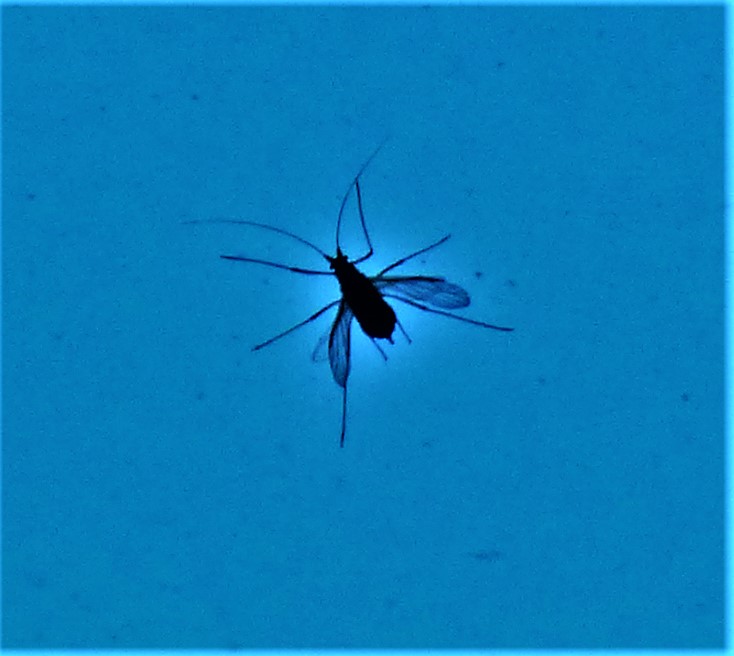
A fly resting on top of my back gate.
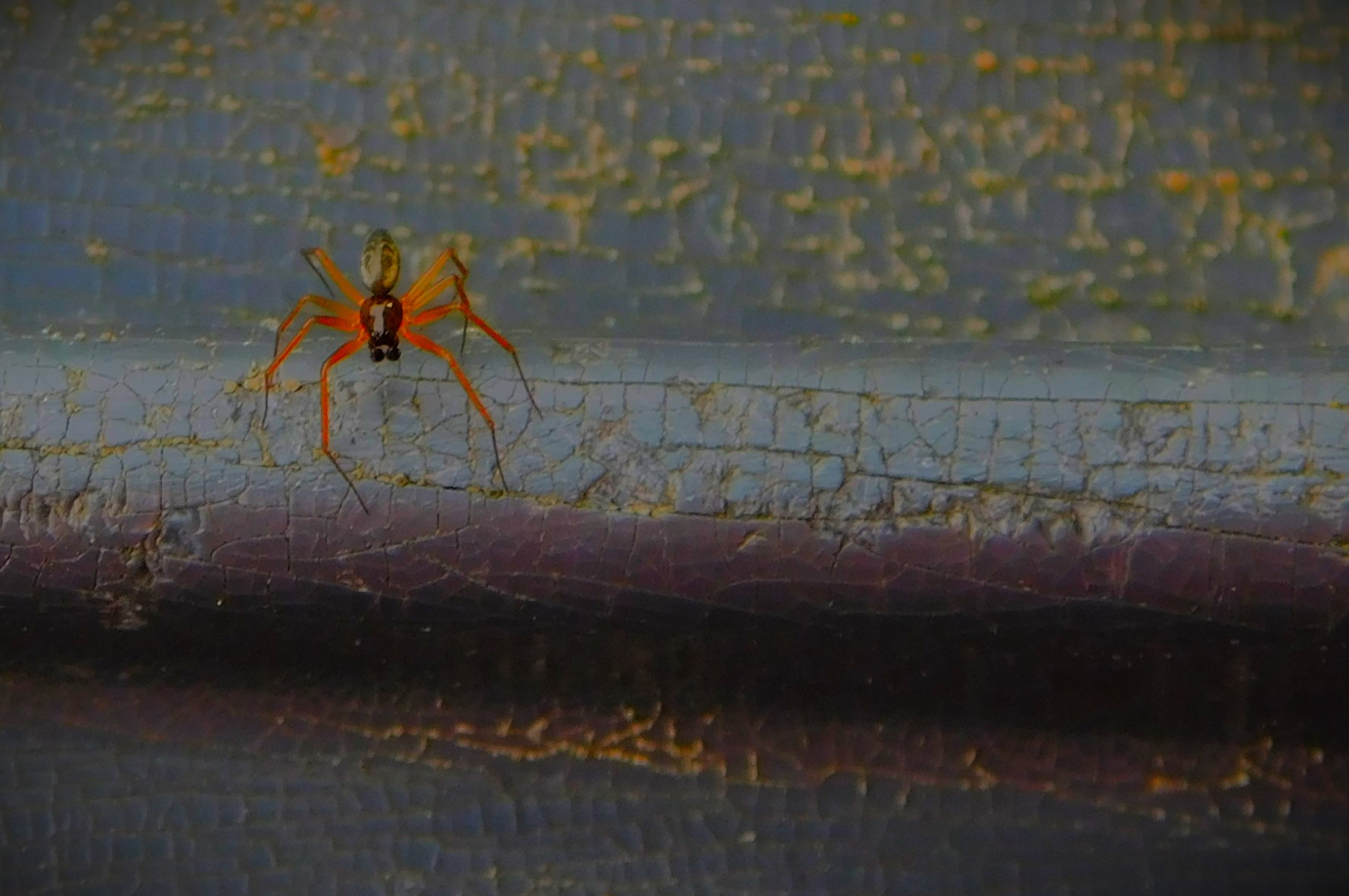
My back gate has also been alimed as a hime by one of our eight legged friends (two pics).
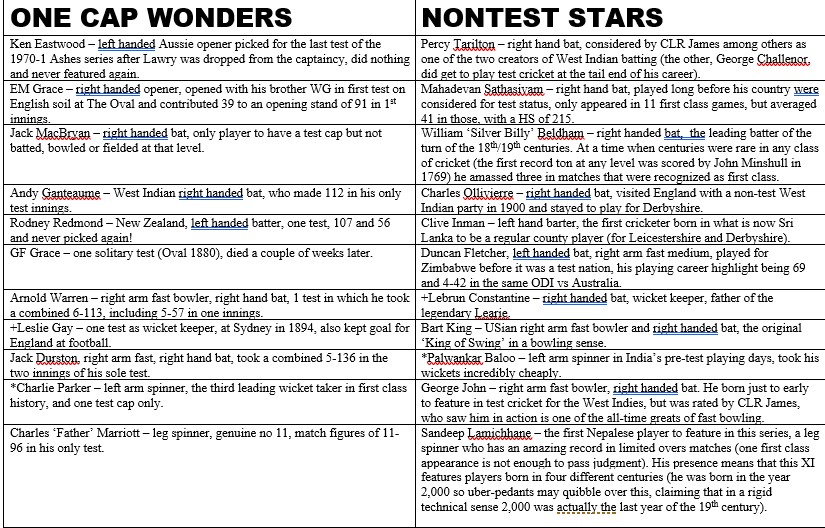
The two teams in tabulated form with abbreviated comments.




































































































































































 aspiblog