All Time XIs – The Letter S

Continuing my exploration of the all-time XIs theme with a look at cricketers whose surnames begin with the letter S. This piece spans two and a half centuries, five continents and even mentions one of the great fictional cricketers.

The exploration of the all-time XI theme continues with a look at players whose surnames begin with the letter S. This one was very tough, not because of any difficulty finding players of sufficient standard but because there was a lot overlap in terms of the expertise of the very best players, and balancing the side was a challenge that required compromise, of which more later.

THE XI IN BATTING ORDER

  1. Andrew Strauss (Middlesex, England). A fine opening bat, and twice an Ashes winning skipper, though I have not given him that role in this side.
  2. Herbert Sutcliffe (Yorkshire, England). 4,555 test runs at 60.73, 2,741 Ashes runs at 66.85.
  3. *Graeme Smith (South Africa). One of the best captains of the modern era, and a top class left handed batter. He was a regular opener, but I believe he would handle first drop superbly as well.
  4. Steven Smith (Australia). First called up on account of his leg spin bowling, he established himself as Australia’s best test batter since Bradman. After serving a ban for cheating (an incident that ruled him out of any leadership responsibilities) he returned to action with twin tons at Edgbaston in 2019.
  5. +Kumar Sangakkara (Surrey, Sri Lanka). One of two serious candidates for the title of best batter his country has ever produced (Jayawardene being the other), and a good keeper as well. Usually I prefer to select a specialist keeper, rather than use a batter to perform this role, but circumstances dictate this selection.
  6. Garry Sobers (Nottinghamshire, West Indies). The most complete cricketer ever to play the game. Devastating batter, left arm bowler of pace, swing, seam and both finger and wrist spin, gun fielder.
  7. Ben Stokes (Durham, England). Attacking left handed batter, right arm fast medium bowler.
  8. Greville Stevens (Middlesex, England). A leg spinning all rounder whose FC averages were the right way round (29 with the bat, 26 with the ball). This slot caused me more grief than any other – with three gun fast bowlers rounding out the order I wanted a spinner, and with Sobers present, neither a left armer of any description, nor a regular off spinner (similar line of attack to Sobers in his wrist spin guise) would be ideal. There were two candidates within these constraints – this chap, and Paul Strang of Zimbabwe, and the latter paid 36 per wicket at test level and over 30 at FC level.
  9. Mitchell Starc (Australia). One of the fastest bowlers in the world at present, and while his highs are not quite up at Mitchell Johnson 2013-14 levels, his lows are nowhere near the depths of 2010-11 Johnson.
  10. Brian Statham (Lancashire, England). One of Lancashire’s greatest ever fast bowlers, and one of the select few to have an end of his home ground named in his honour (James Anderson, also at Old Trafford, is in this club, as are Barbadians Joel Garner and Malcolm Marshall).
  11. Dale Steyn (South Africa). The greatest fast bowler of the immediate post McGrath period, and surely a shoo-in for an all time South Africa XI even given their strength in the pace bowling department.

This XI features a super powerful top six, Stokes with full licence to attack and a powerful quartet of bowlers. The pace attack, with the quick version of Sobers arguably fifth choice in that department (behind Steyn, Starc, Statham and Stokes) is awesome, and Stevens plus Sobers in his slower guises should offer sufficient spin to augment that attack. Sangakkara as keeper violates my usual principal of going for the best keeper, but he was good enough to do the job for Sri Lanka on a regular basis.

HONOURABLE MENTIONS

A multi-faceted section starting with…

THE NUMBER EIGHT SLOT

There were two off spinners who would have their advocates for these position but missed out for reasons of balance: Harbhajan Singh of India and Graeme Swann of England, who each paid a little over 30 a piece for their test wickets and who were both useful lower order batters.

However, had I been willing to ignore considerations of balance I had a raft of top options to pack out the pace battery: Frederick Spofforth, a legend from the early days of test cricket was probably the pick of those I overlooked, but two present day Indians, Mohammad Shami and Mohammad Siraj would have their advocates as well, Peter Siddle of Australia is a quality practitioner if perhaps a notch below the very top bracket, Amar Singh, part of India;s first ever test side, was also indisputably a great fast bowler. John Snow of England was another great pacer who could have had this slot. Olly Stone, the Norfolk born Warwickshire and England pacer who has been plagued by injuries has the ability, but not the proven track record. Barbadian all rounder Franklyn Stephenson, one of only two cricketers to do the double of 1,000 runs and 100 wickets in first class matches in an English season since the reduction of the programme in 1969 (the other, Richard Hadlee, also played for Nottinghamshire) would appeal to some as a number eight.

I was conscious of the merits of all these players when making the call to select Greville Stevens, and my contention is not that he is a better cricketer than them, but that he is a better fit for the team, given the players who already had irrefutable claims for selection.

OPENING BATTERS

Bert Sutcliffe, the legendary New Zealand left hander, still holder of the record first class score by a native of that country (385 for Otago vs Canterbury, in a team score of 500 all out, with Canterbury contributing 382 off the bat in their two innings combined), and with a fine test record was a serious candidate for Strauss’ slot as left handed opener.

Among the right handed openers I could find no space for were Andrew Sandham, a member of the 100 first class hundreds club, Virender Sehwag, devastating unless the ball was swinging, when he could look very ordinary, Bobby Simpson of Australia, Michael Slater also of Australia and Alec Stewart of England all had impressive records as right handed opening batters. Arthur Shrewsbury of Nottinghamshire and England, second best 19th century batter behind WG Grace, was another who could have done a fine job in this role. Reg Simpson of Nottinghamshire and England had moments at the top level, including a 156* against Australia which set up a test victory for England, but he was not in the same bracket as the others.

MIDDLE ORDER BATTERS

I start this section by drawing your attention to my all time XI of Smiths, so that I do not have to repeat myself regarding players with that surname. Marlon Samuels and Ramnaresh Sarwan of the West Indies can both count themselves unlucky to have surnames beginning with S – under most other letters they would merit serious consideration. Mahadevan Sathasivam of Sri Lanka has legendary status in his own land, but for a series like this I have to deal in hard facts, so he misses out.

WICKET KEEPERS

Roy Swetman was a fine keeper in the 1950s, and Herbert Strudwick of Surrey and England made more dismissals in first class cricket than any keepers bar JT Murray of Middlesex and Bob Taylor of Derbyshire, though he often batted number 11, which with Statham and Steyn having ironclad claims for places was problematic.

ALL ROUNDERS

Darren Stevens’ performances since moving south from Leicestershire to Kent have been outstanding, but he has never played anything other than county cricket.

SPINNERS

Maninder Singh of India was a fine bowler, but as a left arm orthodox spinner he overlaps with Sobers, and he was a genuine bunny with the bat. Reggie Schwarz of Middlesex and South Africa missed out, because for all his importance as the guy who learned the googly from its creator Bosanquet and taught it to a number of his South African colleagues he actually used the googly not as part of his bowling armoury but as his stock ball, therefore becoming effectively an off spinner, a less good fit for the XI than a more standard leg spinner. Molly Strano, a consistently successful performer in Australian domestic cricket, and therefore by definition a superb bowler also misses out because she is also an off spinner.

BLASTS FROM THE PAST

Lack of sufficiently concrete records for two players prevented me from considering them: Edward ‘Lumpy’ Stevens, a great bowler of the late 18th century and Heathfield Harman Stephenson, whose performance for the All England XI at the Hyde Park Ground in Sheffield led to the coining of the phrase ‘hat trick’. He dismissed three of his opponents with successive deliveries, and the Sheffield crowd were so impressed by this display of bowling virtuosity that they used a hat to collect money for Stephenson and made him a presentation of both hat and money.

A FICTIONAL TALENT

Tom Spedegue, hero of a short story by Arthur Conan Doyle, in which he pioneers a new type of delivery which descends on the batter from the clouds “Spedegue’s Dropper” and shatters that season’s visiting Australians by taking 15 wickets in what turns out to be his first and only test would certainly have added variety to the attack had he been real.

WHITE BALL TALENTS

Had been selecting with limited overs cricket in mind Navjot Singh Sidhu and Sanju Samson would both have been close to inclusion.

FUTURE TALENTS

Will Smeed, scorer of the first individual century in The Hundred, is an obvious talent for the future. Glenton Stuurman (pronounced like ‘Steerman’), a young South African quick bowler is very promising, though he has a huge amount to do to come close to dislodging his compatriot Steyn. Sophia Smale, a 17 year old left arm orthodox spinner has announced herself with a couple of fine performances in the Hundred.

PHOTOGRAPHS

Our cricketing journey through the letter S, spanning two and a half centuries and many continents, is at an end, and it remains only to apply the usual sign off…


All Time XIs: Ultimate Talents

A look at a selection of record breaking and utterly unique cricketers by way of explaining the unanswerability of the question “who was the greatest ever cricketer”.

This post was provoked by a question I saw posted on twitter yesterday: who was the greatest cricketer of all time. This question is of course unanswerable and to explain why this is so I have assembled a touring party of 17 all of whom were about as good as players of their type can be. All of these players have attributes that mean that the claim that they stand alone in cricket history is unassailable, and I explain why in the course of my look at that them.

FIRST XI IN BATTING ORDER

  1. JB Hobbs – right handed opening batter, occasional right arm medium pacer. ‘The Master’, scorer of more FC runs and more FC centuries than anyone else in the history of the game.
  2. *WG Grace – right handed opening batter, right arm bowler of various types through his career. The most dominant player of any era, towering over his contemporaries both literally and metaphorically.
  3. DG Bradman – right handed batter, occasional leg spinner. A test batting average of 99.94, maintained over 52 matches at level needs no further comment.
  4. SR Tendulkar – right handed batter, occasional bowler. The only player to have scored 100 centuries across formats in international cricket.
  5. FE Woolley – left handed batter, left arm orthodox spinner. The only cricketer to tally over 10,000 FC runs, take over 1,000 wickets and hold over 1,000 catches in the course of a first class career.
  6. GS Sobers – left handed batter, left arm bowler of every type known to cricket. The most complete cricketer the game has ever seen.
  7. GH Hirst – right handed batter, left arm fast medium bowler. Achieved the feat of 1,000 runs and 100 wickets in first class matches in each of 10 successive seasons, including the only ever instance of 2,000 runs and 200 wickets in the same FC season.
  8. +RW Taylor – wicket keeper, right handed batter. The most wicket keeping dismissals (1,649 of them – 1,473 catches and 176 stumpings) of anyone in first class cricket history.
  9. W Rhodes – left arm orthodox spinner, right handed batter. More first class wickets than anyone else in the game’s history, even though there was a phase in his career when he hardly bowled. He also scored almost 40,000 runs in FC cricket.
  10. SF Barnes – right arm fast medium bowler, right handed batter. The best wickets per game ratio of anyone to play 20 or more tests – 189 in 27 matches, at 16.43 each = seven wickets per match. Generally regarded as the greatest of all bowlers.
  11. T Richardson – right arm fast bowler, right handed batter. The fastest to the career landmarks of 1,000 FC wickets (134 matches) and 2,000 (327 matches). From the start of the 1894 season to the end of the 1897 season he took just over 1,000 wickets, a period of wicket taking unique in cricket history.

This is a well balanced XI of awesome power. Now onto…

THE RESERVES

These are my six designated reserves:

  1. H Sutcliffe, right handed opening batter. My reserve opener was the ultimate big game player. His overall FC average was 52.02, his overall test average 60.73 and his overall Ashes average 66.85. As he himself once said to Pelham Warner “ah Mr Warner, I love a dogfight”.
  2. JH Kallis, right handed batter, right arm fast medium bowler. Has a fair claim to be regarded as the best batting all rounder ever to play the game. He didn’t master the full range of skills that Sobers did, hence his place as a reserve rather than in the starting XI.
  3. GA Faulkner, right handed batter, leg spinner. The only cricketer to have finished a career of over 20 test matches with a batting average of over 40 and a bowling average of less than 30.
  4. GL Jessop, right handed batter, right arm fast bowler. The most consistently fast scorer ever to play the game.
  5. +LEG Ames, right handed batter, wicket keeper. The only recognized keeper to have scored 100FC hundreds, also holds the record for most career stumpings in first class cricket – 418.
  6. GA Lohmann, right arm medium fast bowler, right handed batter. The man with the lowest career bowling average of anyone take 100 test wickets – 10.75.

CONCLUSIONS

This little collection of players fully illustrates why there is no definitive answer to the question I saw on twitter yesterday. I also missed the taker of 800 test wickets (Muralidaran), the only player to score 5,000 test runs and take 400 test wickets (Kapil Dev), the holder of the record test and first class individual scores (Lara), and quite a few others who have and deserve to have legions of fans. If forced to provide a single player as answer to this question I would consider WG Grace to be less far wrong than any other single answer.

PHOTOGRAPHS

My usual sign off…

An All Time XI All From Different Countries

A variation on the all-time XI, this time requiring every player to come from a different country. Also some photographs.

I have one other thing to mention besides my main topic, which is a revisit to the All Time XI theme which I have explored here many times, especially during the period immediately after Covid-19 was officially declared a pandemic.

THE BRIEF

This is to be an All Time XI with every selected player coming from different countries. It is to be a team that will pose a formidable threat in any and all conditions, so variety is essential. There are some players (Bradman and Sobers e.g) whose preeminence is such that they have to be their country’s representative, and in the case of some of the minor nations who are represented they had only one player wh0 could even be considered. This in turn limited who could be picked from other countries where the field was theoretically wider.

THE TEAM INCLUDING 12TH

  1. Jack Hobbs (England, right handed opening batter and occasional medium pacer). “The Master”, scorer of 61,237 FC runs including 197 centuries, scorer of 12 Ashes centuries. The oldest ever test centurion, the last of his centuries at that level coming at Melbourne in 1929 by when he was 46 years old. My English representative is highly likely to be one half of a pair that gets the innings off to a strong start.
  2. Sunil Gavaskar (India, right handed opening batter, occasional medium pacer). He was the first to reach the milestone of 10,000 test runs. He had an excellent technique and seemingly limitless patience. One would absolutely ideally prefer one of the openers to be left handed but I can’t see many new ball bowlers queuing up for a crack at this opening pair!
  3. Don Bradman (Australia, right handed batter, occasional leg spinner). The greatest batter ever to have played the game (his test average of 99.94 puts him almost 40 runs an innings ahead of the next best, his FC average of 95.14 puts him 24 an innings ahead of the next best at that level). He is also vice captain of the team.
  4. Graeme Pollock (South Africa, left handed batter, occasional leg spinner). The best test average of any left hander to have played 20 or more test matches, 60.97 per innings.
  5. Garry Sobers (West Indies, left handed batter, left arm bowler of every type known to cricket). Quite simply the most complete player the game has yet seen and one whose absence from this XI I could never countenance.
  6. +Mushfiqur Rahim (Bangladesh, right handed batter, wicket keeper). One of the great stalwarts of Bangladesh cricket, an excellent keeper and a gritty middle order batter whose test record would almost certainly be even more impressive than it actually is had he been part of a stronger side.
  7. *Imran Khan (Pakistan, right handed batter, right arm fast bowler). Has a strong case to be regarded as the greatest genuine all rounder in test history (batting average 37, bowling average 22), and a great captain as well (he is designated skipper of this side, and one of very few who could possibly see Bradman named vice captain rather than captain).
  8. Rashid Khan (Afghanistan, leg spinner and useful right handed lower order batter). This one was fairly inevitable – I need a wide range of top class bowling options, and a leg spinner of undisputed world class who hails from a minor nation is pretty much indispensable in that regard.
  9. ‘Bart’ King (USA, right arm fast bowler, useful right handed lower order batter). The original ‘King of Swing’, taker of over 400 FC wickets at 15 a piece, and good enough with the bat to average 20.
  10. Richard Hadlee (New Zealand, right arm fast bowler, useful left handed lower order batter). With genuine respect to today’s Kiwi side, comfortably the strongest they have ever been able to field, he remains his country’s greatest ever cricketer.
  11. Muttiah Muralitharan (Sri Lanka, off spinner, right handed tail end batter). 800 test wickets, taken at a rate of six per game. At The Oval in 1998, on a pitch that was quite hard and quite dry but basically blameless he claimed 16 English wickets in the match (7-155 in the first innings, and then after SL had taken a lead of 150, spearheaded by Jayasuriya scoring a double hundred, 9-65 in the second English innings).
  12. Andy Flower (Zimbabwe, left handed batter, wicket keeper, occasional off spinner). This man covers as many bases as possible as 12th – while I would not relish him coming in for any of the front line bowlers given that he is very much a part timer, and Sobers and Bradman can both be considered impossible to cover for anyway he won’t massively weaken the side even in a worst-case scenario.

RESULTS AND PROSPECTS

I start this little section by looking at the bowling, as it is that department that separates winners and also-rans. A pace bowling unit of Richard Hadlee, ‘Bart’ King and Imran Khan is awesome by any reckoning, and if there is definitely nothing for spinners, there is Sobers in his faster incarnations as fourth seamer. If spinners are called for, Rashid Khan and Muttiah Muralitharan are two of the all time greats, and offer a contrast, being leg spinner and off spinner respectively, and Sobers can bowl left arm orthodox and left arm wrist spin support. Thus there are bowling options available to meet every eventuality, and this side can be very confidently expected to take 20 wickets in any conditions.

The batting features a pair of openers who are highly likely to give the innings a strong start, a trio of fast and heavy scoring batters at 3, 4 and 5, a keeper who scores lots of runs at six, a genuine all rounder at seven, and three bowlers who can genuinely bat as well. Murali is the only bunny in a very deep batting order.

A number of the players in this XI, most notably Hobbs, Bradman and Sobers are rated among the the finest fielders ever to have played the game, and there are no carthorses anywhere, so they will give a good account of themselves in this department as well.

Finally, with Imran Khan as captain and Don Bradman as vice captain and Hobbs also there to be consulted this team has tactical acumen to burn and is highly unlikely to be outmatched in that area.

Thus this team seems to tick every box, and I would confidently expect it to dispose of any opposition put in front of it.

THE STEAM HOUSE CAFE

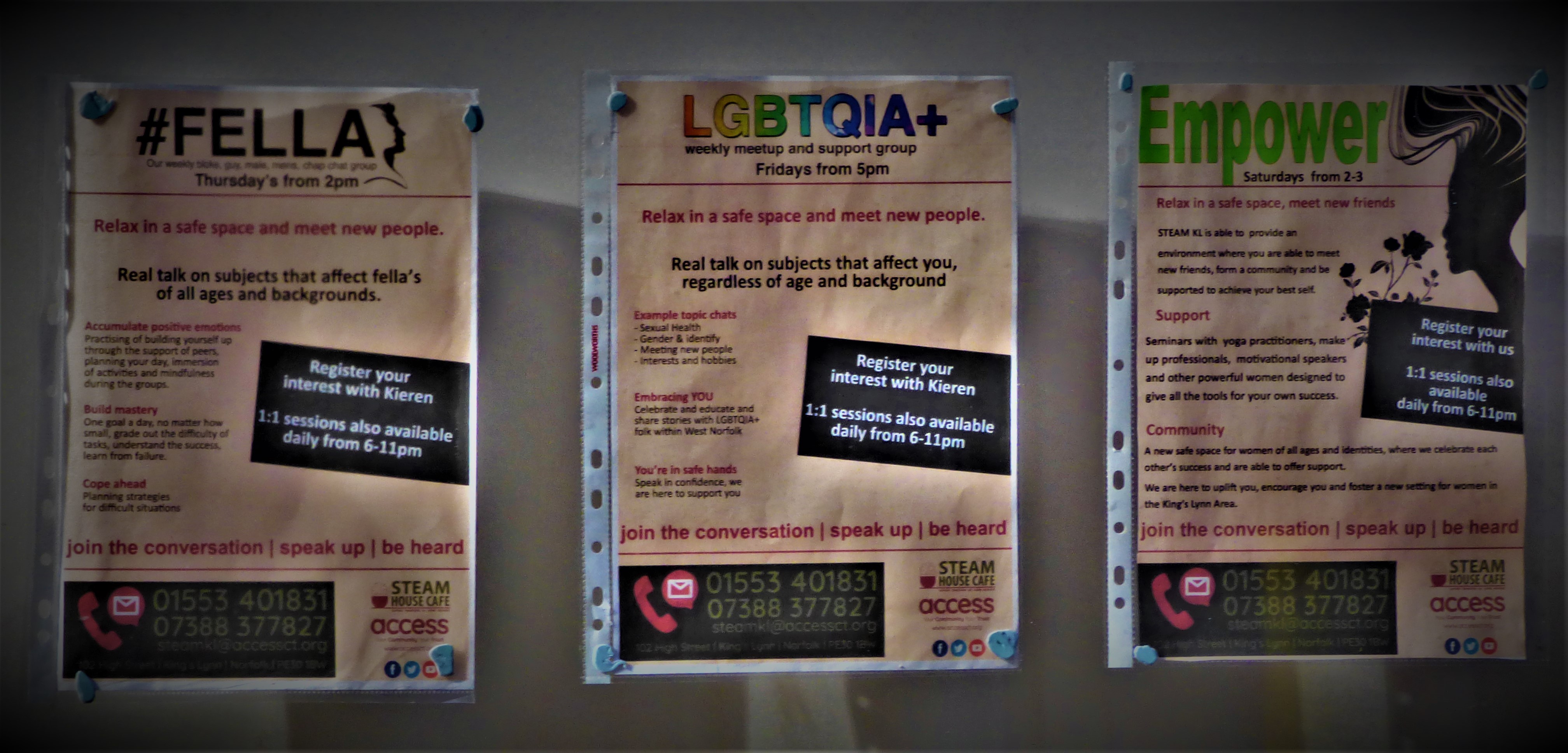
The STEAM House Cafe on King’s Lynn High Street is a cafe-style safe space for people with mental health issues, and I was there yesterday as part of a group from NAS West Norfolk. We and they are hoping to be able to organize something there specifically for autistic people.

PHOTOGRAPHS

Time for my usual sign off…

A brief summary of the XI.

AN ALL LEFT HANDED XI

An XI of southpaws for World Left Handers Day. Plus of course some photographs.

Today is World Left Handers Day, so I put together an XI of players who did everything cricket wise left handed. This means a lot of famous names are missing because they performed one discipline right handed. My chosen wicket keeper bowled six deliveries in a professional career that spans 470 matches across formats to date, and I have been unable to establish for sure which hand he bowled them with.

THE XI IN BATTING ORDER

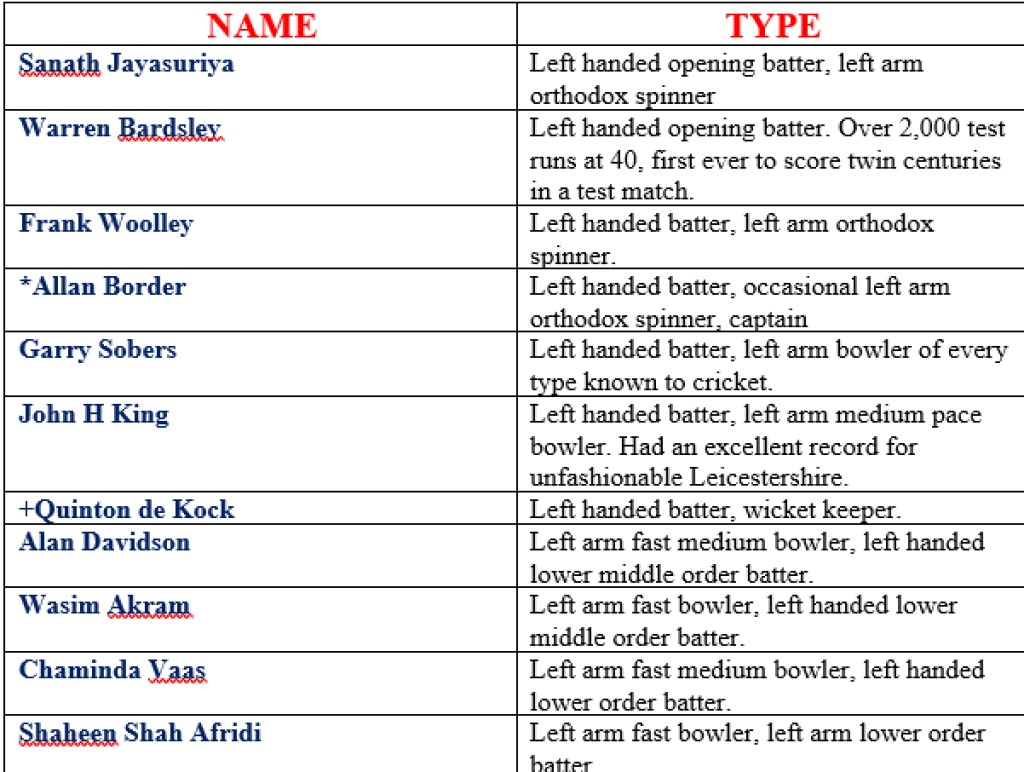
  1. Sanath Jayasuriya: left handed opening batter, left arm orthodox spinner. In 1996 he was the MVP at the World Cup. Two years later at The Oval he scored 213 in Sri Lanka’s first innings, the highest individual score of the match.
  2. Warren Bardsley: left handed opening batter. The gritty Aussie scored over 2,000 test runs at an average above 40. He was the first to score twin centuries in a test match, at The Oval in 1909. In first class cricket he tallied 17,000 runs at 49 including 53 centuries. He scored 29 of those 53 centuries in England, proving that he was definitely not a ‘home track bully’.
  3. Frank Woolley: left handed batting, left arm orthodox spinner. The only person to have achieved the career treble of 10,000 runs, 1,000 wickets and 1,000 catches in first class cricket.
  4. *Allan Border: left handed batter, occasional left arm orthodox spinner, captain. Another gritty Aussie, he was the first to the milestone of 11,000 test runs, having been the second after SM Gavaskar to reach 10,000. The first and greatest of four long serving Aussie captains with magnificent winning records to appear in my lifetime – he passed the baton to Mark Taylor, who was succeeded by Steve Waugh and then Ricky Ponting, who oversaw a regression back towards the mean in his last years in the job.
  5. Garry Sobers: left handed batter, left arm bowler of every type known to cricket. Fortunately the most complete cricketer ever to have played the game did everything cricket wise left handed, and is therefore a shoo-in for this team.
  6. John H King: left handed batter, left arm medium pace bowler. A stalwart all rounder for Leicestershire he suffered from ‘unfashionable county syndrome’ to the extent that in spite of a highly impressive record at FC level he was a one cap wonder for England.
  7. +Quinton de Kock: left handed batter, wicket keeper. He has a magnificent record in all formats of the game.
  8. Alan Davidson: left arm fast medium bowler (also occasional orthodox spin), left handed lower middle order batter. 186 test wickets at 20.53 secure his place in this side.
  9. Wasim Akram: left arm fast bowler, left handed lower middle order batter. Fast tracked into his national side when then captain Imran Khan saw him bowling in the nets and liked what he saw he established himself as one of the greatest of left arm pace bowlers and a more than useful batter.
  10. Chaminda Vaas: left arm fast medium bowler, left handed lower order batter. The Sri Lankan never had pace bowling support of the same class at the other end (indeed for most of his career the only other bowler of unquestioned top class in the side was the off spinner, Muralitharan) but still established a fine test record.
  11. Shaheen Shah Afridi: left arm fast bowler, left arm lower order batter. The young Pakistani has already established a remarkable record in his brief career to date, and I expect many more highlights before his time at the top is done.

Below is a condensed version of the above in graphic form:

EVALUATION OF RESOURCES

The side has a strong and deep batting order – Wasim Akram at nine would satisfy even England’s selectors as to depth, while Jayasuriya, Bardsley, Woolley, Border, Sobers and de Kock are all bona fide greats, and King, the all rounder, would probably have averaged 40 had he played on today’s pitches, though he would also have paid more for his wickets. The bowling resources are awesome, with Afridi, Akram, Davidson, Sobers and King to provide pace/ swing/ seam bowling, and Woolley, Jayasuriya and Sobers able to provide top quality spin. Sobers is the only wrist spin option, but there are very few left arm wrist spinners with commanding records. The depth of spin available means that Border, with a 10 wicket haul in a test match to his credit, would almost certainly never get a bowl. This southpaw squad would take a lot of beating.

PHOTOGRAPHS

My usual sign off…

Selecting An All Time Test XI

I take on the near impossible task of selecting an all time test XI. Also some more photographs for you.

Let me start by saying that this task, suggested on twitter by Adam Sutherland, is the sort of thing Alexa might come up with if asked for an example of an insoluble problem. The embarrassment of riches at one’s disposal is such that I would expect no two people to arrive at the same answer. Nevertheless it is fun to do, and I am going to offer my answer. Feel free to list your alternatives, or if you dare, a completely different XI of your own to take on mine in a five match series in the comments.

THE TEAM

There are lots of candidates for an opening pair. In my case I resolve the issue by selecting an opening pair who were the best in test history and who I therefore pick as a package: Jack Hobbs and Herbert Sutcliffe, with their average partnership of 87.81 at that level.

Number three, with all due respect to such masterly practitioners as Rahul Dravid and Ricky Ponting is one of the two nailed on certainties for a place in this XI: the one and only Donald Bradman, who I also name as captain of the side. An average of over 30 runs an innings more than any of the competition does not allow for argument.

Number four has many contenders, but having named three right handers I wanted a left hander, and the best record among such batters is held by Graeme Pollock, with an average of 60.97 (Brian Charles Lara is the other contender, but too many of his really big scores came in either defeats or draws).

Number five goes to Sachin Tendulkar. Again there were many possibilities, but I accept the word of Don Bradman, who recognized something of himself in the way Tendulkar batted (a resemblance also acknowledged by Lady Bradman when consulted), and there can be no higher praise.

Now we need an all-rounder, and this is the other utterly undisputable slot other than no3: the most complete cricketer there has ever been, Garfield St Aubrun Sobers. He scored 8,032 test runs at 57.78, took 235 wickets, bowling virtually every type of delivery known to left arm bowlers (he was originally selected as a left arm orthodox spinner, batting no9) and he was also one of the greatest fielders the game ever saw.

For the wicket keeper, although I do not normally approve of compromising at all on keeping skills I rate Adam Gilchrist’s batting at no seven so highly that I am selecting him for the role.

For my remaining bowlers I go for Wasim Akram at no8, left arm fast and capable of generating prodigious swing. No9 is Malcolm Marshall, for me the greatest fast bowler of the golden age of West Indies fast bowling. No10 is Sydney Barnes, 189 wickets in just 27 tests (seven per game) at 16.43 a piece. I round out the order with the off spinner Muttiah Muralitharan.

Thus in batting order we have:

JB Hobbs
H Sutcliffe
*DG Bradman
RG Pollock
SR Tendulkar
G St A Sobers
+AC Gilchrist
Wasim Akram
MD Marshall
SF Barnes
M Muralitharan

Barnes’ principle weapon was a leg break at fast medium pace, so I felt that the off spinner Muralitharan as opposed to a leg spinner (Warne, O’Reilly, Grimmett and Kumble being the principle contenders) gave the attack more variation. Wasim Akram’s place as left arm paceman could have gone to Alan Davidson or Mitchell Johnson without appreciably weakening the side, and there are a plethora of right arm quicks for whom cogent cases could be made. Barnes’ extraordinary record made him the third clearest selection in the entire XI.

PHOTOGRAPHS

Just before my usual sign off, a link to the piece I produced OTD last year as part of my ‘all time XIs’ series: Leicestershire. Now for those photos…

All Time XIs – Rest Of The World v Asia

An international clash of the titans today, as the Rest of the World take on Asia in our ‘all time XIs’ cricket post.

INTRODUCTION

Today’s all time XIs cricket post follows the usual Monday theme of going international. Today we pit the Rest of the World against Asia. I am, as usual in this series, thinking principally in terms of long form cricket, although of course this contest could not (or at least should not) officially be given test status.

REST OF THE WORLD

  1. Jack Hobbs – right handed opening batter, scorer of 12 centuries in Ashes cricket,a tally only beaten by Don Bradman with 19. He was one half of no less than four of the greatest opening partnerships in the history of cricket, at county level with Hayward and then Sandham, and at test level with Rhodes and then Sutcliffe.
  2. Herbert Sutcliffe – right handed opener. His case for selection for a contest of this nature is even more watertight than was his actual case for England selection. He got better the tougher the competition – averaging 52 in all first class cricket, 60.73 in test cricket and 66.85 in Ashes cricket. He and Hobbs had an average opening stand of 87, 15 times topping the hundred. At The Oval in 1926 they put on 172 in England’s second innings, beginning on a very spiteful pitch, with Hobbs falling for exactly 100 to end the partnership (the first time he had made a test century on his home ground), while Sutcliffe went on to 161 and to put England in an invincible position. At Melbourne in the third match of the 1928-9 series he and Hobbs started the final innings with England set to make 332, and many people reckoning that on the rain damaged pitch they had to contend with that the innings would not even last a full session. Actually, the pair were still in residence by the tea interval, and part way through the evening session Hobbs sent a message to the pavilion that if a wicket fell that night Jardine rather than Hammond should come in at no3. Hobbs finally fell for 49 to make to 105-1, and Jardine duly came in, and he and Sutcliffe were still together at close of play. The following day the surface was easier, and although England suffered a mini clatter of wickets, including Sutcliffe for 135, with victory in sight, George Geary ultimately settled the issue by hitting a ball through mid on for four with three wickets still standing.  Sutcliffe’s 100th first class hundred was scored when Yorkshire were after quick runs for a declaration, and he duly attacked from the get go, clobbering eight sixes on his way to the landmark.
  3. *Don Bradman – right handed batter, captain. To follow the greatest opening pair the game has ever seen we have the greatest batter of them all, the man who averaged 99.94 in test cricket. He scored 974 runs (a record for any test series) in the 1930 Ashes, at 139.14, but perhaps his most remarkable display of high scoring given the circumstances came in the last three matches of the 1936-7 series. England won both of the opening games, and the weather played havoc with the third, England declaring their first innings at 76-9 to get Australia back in while the pitch was still vicious. Bradman countered by sending in tailenders O’Reilly and Fleetwood-Smith, and then when O’Reilly was out before the close, another specialist bowler, Frank Ward. As a result of this the score when Bradman emerged to join regular opener Fingleton was 97-5, and the pitch had largely eased. Bradmand and Fingleton put on 346 together, and then McCabe joined Bradman. Bradman in that innings made 270, the most ever by someone coming in at no7 in a test innings, and England, set 689 to win, were duly beaten by a huge margin. Bradman then made another double ton in the fourth match, which Australia won to make it 2-2. In the final game Bradman was dropped early in his innings, scored 169, and Australia duly won again, becoming the first and to date only side to win a five match series after losing the first two matches thereof.
  4. Graeme Pollock – left handed batter. He averaged 60.97, a figure exceeded among those to have finished careers that included 20 or more test matches only by Bradman and Adam Voges, the latter named benefitting from playing most of his test cricket against weak opposition, and coming a cropper in his only Ashes series.
  5. Wally Hammond – right handed batter, right arm medium fast bowler, occasional off spinner, ace slip fielder. When he led England out at Trent Bridge at the start of the 1938 Ashes he made history – he was the first person to have been a professional and also to be appointed an official England captain. A directorship at the Marsham Tyre Company had enabled him to turn amateur, which also saw him become the first and only player to captain the Players against the Gentlemen and the Gentlemen against the Players. In that team that he led out at Trent Bridge was the man who would get to lead his team out without turning amateur, Leonard Hutton. By the time of the outbreak of World War II he had scored 6,883 test runs at 61.75, but a comeback post war which never really worked out for him, and ended with a disastrous 1946-7 Ashes (168 runs in the series at 21.00).
  6. Garry Sobers – left handed batter, left arm bowler of every type known to cricket. The most complete player ever to have played the game.
  7. +Adam Gilchrist – left handed batter, wicket keeper. The most destructive keeper/ batter there has ever been, he completely rewrote the requirements for keeper/ batters. The search for the keeper who is also a destructive batter has led to some bizarre decisions – the current England camp’s obsession with Buttler, barely even a competent keeper and someone who has failed to transfer his white ball form to the red ball game is an example of people being led up a blind alley by this thinking (though arguably it is only England’s second worst selection blooper for the upcoming resumption of test cricket behind the selection of Denly at four, which amounts to a v-sign being flashed at Lawrence and Bracey, compilers of the only two major scores of the warm up match). It is nowadays unthinkable that a Bert Strudwick, who habitually batted no11, would be selected as a test wicket keeper, and even Bob Taylor, another brilliant wicket keeper who was not a proper front line batter would have a hard time convincing national selectors to pick him – just look at the treatment Ben Foakes has had from the England selectors.
  8. Malcolm Marshall – right arm fast bowler, useful lower order batter. For my money the greatest fast bowler of the West Indies’ golden age.
  9. Michael Holding – right arm fast bowler. His 14-149 in the match on flat Oval wicket in 1976 is probably enough on its own to justify his inclusion, but he produced many other stellar performances. At Bridgetown, Barbados in 1981 he made use of a super-fast pitch to bowl probably the most intimidating opening over any test match has ever seen – the England opener, by then a veteran of over 100 test appearances, was beaten all ends up by four deliveries, got bat on one and had his off stump uprooted by the final ball of the over.
  10. Sydney Barnes – right arm fast medium bowler. His wicket taking rate of seven per match is out on its own among bowlers who played 20 or more test matches. At Melbourne in 1911-2 Johnny Douglas won the toss for England and put Australia in, a decision that needed early wickets to justify it. Barnes soon had the Aussie top four back in the hutch, for a single between them, and with a couple more wickets also falling early in the game Australia were at one point 38-6 in their first innings. They recovered to reach the semi-respectability of 184, but England remained in total control and ran out winners by eight wickets. Wilfred Rhodes, who went on that tour as a specialist batter, having started his career as a specialist bowler, was asked many years later about Barnes and just how good he was and said simply “the best of them today are half as good as Barnie wor.”
  11. Clarrie Grimmett – leg spinner. The Dunedin born leggie first crossed the Tasman in search of cricketing fulfilment, and then crossed two state boundaries in his new country, before eventually breaking into the South Australia side, and then, at the age of 33 into the test side. He took 11 wickets on test debut, and went on to finish with 216 wickets in 37 matches, a wicket taking rate of just short of six per match, putting him ahead of his mate Bill O’Reilly and significantly ahead of Shane Warne.

This team features a stellar batting line up, two out and out quicks, probably the greatest bowler of them all, the craft and guile of Grimmett, and of course the most complete player ever to play the game in Sobers. Barnes, Holding, Marshall, Grimmett and Sobers, with Hammond as sixth bowler represents a mighty fine range of bowling options.

SOME OF THOSE WHO MISSED OUT

Everyone will have their own ideas about possible selections, but here are some of my own additional thoughts:

  • Opening batters – I went for the greatest opening partnership of all time. Thinking in partnership terms their only serious rivals are Greenidge/ Haynes and Hayden/ Langer. WG Grace, especially given his all round skills, Victor Trumper, Len Hutton, Arthur Morris, Barry Richards and Chris Gayle might all have been considered on their individual methods.
  • No3 – this position was non-negotiable, ‘the Don’ standing high above all other contenders.
  • Nos 4 and 5 – Steve Smith was ruled out on grounds other than technical ones. Brian Lara and Allan Border had fine records as left handed batters, but I considered Pollock to have an even stronger case – all available evidence suggests that when the curtain came down on that incarnation of his country as a test playing nation he was still getting better. Among right handers Viv Richards, Kane Williamson and Steve Waugh all have serious cases for consideration, but Hammond has his slip fielding and his potential value as a support bowler on his side as well as his phenomenal batting record.
  • No6 – non-negotiable. Sobers’ range of cricketing talents make him not so much a star as a galaxy – or at the very least a constellation.
  • The keeper – Gilchrist gets it because of his batting, but many from Jack Blackham, the so-called ‘prince of wicket keepers’ who kept for Australia in the inaugural test match through to Ben Foakes of today would be worth a place as glovemen.
  • The fast bowlers – too many potential candidates to list. I regret that left arm fast bowler William Mycroft was in his pomp before test cricket was a thing, and similarly the brilliant USian Bart King was not quite brilliant enough to propel hbis country to test status. Two other 19th century legends, Charlie Turner and George Lohmann could have had the spot I gave to Barnes.
  • The spinners – I ruled out selecting a specialist left arm spinner, because I already had Sobers to attend to that department, I considered off spinners Billy Bates and Jim Laker, while O’Reilly and Warne were obvious rivals to Grimmett, but I think the obstacles Grimmett had to clear before even having a chance to prove himself get him the nod.

ASIA

  1. Sunil Gavaskar – right handed opening batter. The first ever to score 10,000 test runs, and the first to score as many as 30 test centuries. He made 13 of those centuries against the West Indies, a dominant cricketing force for much of his career.
  2. Hanif Mohammad – right handed opening batter. He played the longest ever test innings, 337 against the West Indies in 970 minutes at the crease. His side had folded for 106 in their first dig, and made to follow on, saved the game by posting 657-8 second time around. That 551 runs difference between 1st and second innings scores is an all time test record, and is equalled at first class level by Middlesex (83 and 634 in a match in the 1980s) and Barbados (175 and 726-7 declared). The other side of his game was seen for Karachi against Bahawalpur when he scored 499 in just over ten hours at the crease, then a world first class record (ended by a run out, depending on which you believe either going for the 500th, or, believing himself to be on 498, seeking to farm the bowling for the following morning.
  3. Rahul Dravid – right handed batter. More test runs than any other number three. When he really got settled in one got the impression that nothing short of an earthquake would dislodge him.
  4. Virat Kohli – right handed batter. A man who averages over 50 in all three international formats and has scored big runs against all opponents.
  5. Sachin Tendulkar – right handed batter. The only player ever to have scored 100 centuries in international matches (Kohli is currently on 70, and may conceivably match Tendulkar’s achievement).
  6. +Kumar Sangakkara – left handed batter, wicket keeper. Until Alastair Cook went past him he had more test runs to his credit than any other left hander. I have chosen him as wicket keeper to be able to pick a full range of bowlers.
  7. *Imran Khan – right handed batter, right arm fast bowler, captain. Statistically, with credit balance of 14 between his batting and bowling averages he ended as the most successful of the four great test all rounders of the 1980s. He was also one of the very few captains able to unify a Pakistan dressing room.
  8. Wasim Akram – left arm fast bowler, left handed batter. Has a fair claim to be regarded as the best left arm quick bowler ever to play test cricket, and a mighty useful player to have coming at no8.
  9. Anil Kumble – leg spinner, useful lower order batter. The third leading wicket taker in test history, although Jimmy Anderson is officially still in the hunt to get past him. One of only two bowlers to have taken all ten in a test innings.
  10. Muttiah Muralitharan – off spinner. 800 test wickets from 133 appearances at that level, an all time record tally.
  11. Jasprit Bumrah – right arm fast bowler. He is in the early stages of what should be an illustrious career. He already has on his CV an achievement few fast bowlers can point to – shaking the Aussie up in their own backyard, which he did in the 2018-9 series for the Border-Gavaskar trophy.

This side has a stellar top five, a keeper who is also a world class batter at six, a genuine all rounder at seven and four excellent varied bowlers. A pace attack of Imran Khan, Wasim Akram and Jasprit Bumrah looks decidedly fruity, and spin twins Muralitharan and Kumble will be formidable on any surface.

SO.ME OF THOSE WHO MISSED OUT

  • Opening batters – the current Indian opening pair of Rohit Sharma and Mayank Agarwal might well have warranted selection as a partnership, while Saeed Anwar, Sanath Jayasuriya (who would also have offered an extra bowling option) and Vijay Merchant all had cases for individual inclusion.
  • No3 – I considered that Dravid had no serious rivals for this slot, but I acknowledge the successes of Zaheer Abbas in the role.
  • Nos 4-5 – Javed Miandad, Younis Khan, Inzamam-ul-Haq, Mohammad Yousuf, Misbah-ul-Haq, Mahela Jayawardene, Aravinda De Silva and Mushtaq Mohammad could all have a case made for them.
  • The keeper – among keepers who also count as front line batters, and therefore do not significantly alter the balance of the side Mushfiqur Rahim and Rishabh Pant had cases, while Syed Kirmani, Wriddhiman Saha and Wasim Bari all had cases for being picked as specialist glove men.
  • The All rounder – non-negotiable, especially given his claims on the captaincy (sorry, Kapil).
  • Spinners – If I revisit this post in a few years Rashid Khan, the Afghan leg spinner, may well have displaced Anil Kumble (like Kumble he is also a handy lower order batter), while Sandeep Lamichhane of Nepal may also be making a strong case, especially if he can get a contract to play county cricket and build up his long form record, and Zahir Khan, another Afghan who bowls left arm wrist spin (not to be confused, as Gulu Ezekiel did on twitter yesterday, with Zaheer Khan the left arm pace bowler for India) may also be making a case for himself. Had Palwankar Baloo had the opportunity at test level he may well have had an excellent record with his left arm orthodox spin, but just as I felt unable to pick William Mycroft for the ROW because he never played test cricket, so I cannot pick Baloo here. The great Indian spin quartet of the 1970s, Bedi, Chandrasekhar, Prasanna and Venkataraghavan, all have cases for selection, especially the highly individual Chandrasekhar. Ravindra Jadeja’s all round skills fell only just short of making a case for him, and R Ashwin would also have his advocates. Saqlain Mushtaq, off spin, Abdul Qadir and Mushtaq Ahmed (both leg spin) all warrant consideration.
  • The pace bowlers. I picked Bumrah on a hunch, although he is in the early stages of his career, and of course technically his place should have gone to Waqar Younis. Shoaib Akhtar would also have his advocates, but he was very inconsistent, and that ‘100mph delivery’ did not actually cause the batter a great deal of trouble. Two early Indians, Amar Singh and Mahomed Nissar both had fine records at a time when bowling quick on the subcontinent was a cause of heartbreak. Fazal Mahmood who bowled Pakistan to their first ever test victory at The Oval in 1954 might have been selected as an analogue for Barnes in the ROW side, and there may be those who would want to see Sarfraz Nawaz selected. Finally, about ten years ago I would have been betting that Mohammad Amir, then an 18 year old left arm fast bowler, would be among the game’s all time greats before long. Sadly he was drawn into a web of corruption, served a five year suspension from the game, and although still a fine bowler has now decided to concentrate purely on limited overs cricket, so has to be filed under ‘what might have been’. The other two players involved in that scandal, Mohammad Asif, a fast medium bowler, and Salman Butt, opening batter and captain, were both in the respectable rather than outstanding class and would never been eligible even had they not got themselves banned.

THE CONTEST

The contest, for what I shall call the ‘Hutton-Baloo’ trophy, acknowledging two of those who missed out on selection, would be a splendid one. The ROW probably just about start as favourites, but Asia do have an amazing bowling attack, and with Akram at eight and Kumble at nine their batting is deeper than that of the ROW, though lacks the eye-watering strength of the ROW’s top batting.

PHOTOGRAPHS

My usual sign off…

IMG_1402 (2)IMG_1403 (2)IMG_1404 (2)IMG_1405 (2)IMG_1406 (2)IMG_1407 (2)IMG_1408 (2)IMG_1409 (2)IMG_1410 (2)IMG_1411 (2)IMG_1412 (2)IMG_1413 (2)IMG_1415 (2)IMG_1416 (2)IMG_1417 (2)IMG_1418 (2)IMG_1419 (2)IMG_1420 (2)IMG_1421 (2)IMG_1422 (2)IMG_1423 (2)

IMG_1424 (2)
The Bankhouse, venue for my first meal out in four months.

IMG_1425 (2)IMG_1426 (2)IMG_1427 (2)IMG_1428 (2)IMG_1429 (2)IMG_1430 (2)IMG_1431 (2)IMG_1432 (2)IMG_1433 (2)IMG_1434 (2)IMG_1435 (2)IMG_1436 (2)IMG_1437 (2)

IMG_1438 (2)
An excellent use of a Beck style diagram.

IMG_1439 (2)IMG_1440 (2)IMG_1441 (2)IMG_1442 (2)IMG_1443 (2)IMG_1444 (2)IMG_1446 (2)IMG_1447 (2)IMG_1448 (2)IMG_1449 (2)IMG_1450 (2)

IMG_1451 (2)
A red admiral.

IMG_1451 (3)IMG_1452 (2)

IMG_1453 (2)
Socially responsible signage.

IMG_1454 (2)ROW v Asia

All Time XIs – Left Hand v Right Hand

Today’s ‘all time XI’ cricket post sees a team of left handers take on a team of right handers.

INTRODUCTION

Welcome to today’s ‘all time XI‘ cricket themed post. Today we have a team who did everything right handed against a team who did everything left handed, and a guessing game – based on some of my explanations can you work out what tomorrow’s post will be?*

THE LEFT HANDED XI

  1. Arthur Morris – left handed opening batter, very occasional left arm wrist spin. Rated by Bradman as the best left handed opener he ever saw. Morris the bowler was in action when Compton hit the four that won the 1953 Ashes.
  2. Sanath Jayasuriya – left handed opening batter, left arm orthodox spinner.
  3. Frank Woolley – left handed batter, left arm orthodox spinner.
  4. Martin Donnelly – left handed batter, very occasional left arm orthodox spinner. He averaged 52.90 in his very brief test career, including 206 v England at Lord’s in 1949.
  5. *Allan Border – left handed batter, occasional left arm orthodox spinner, captain. The guy who if the first three wickets fall quickly will dig the team out of the hole, while also being capable of playing very aggressively if circumstances warrant. 
  6. Garry Sobers – left handed batter, left arm bowler of every type known to cricket. The most complete all rounder ever to play the game. His 254 for Rest of the World v Australia in the series that replaced the 1971-2 Australia v South Africa series was rated by Bradman as the best innings he ever saw played in Australia.
  7. +Steven Davies – wicket keeper, left handed batter. Once seen as England material he did not quite kick on. He has never bowled a ball of any kind in senior first team cricket.
  8. Wasim Akram – left arm fast bowler, left handed lower middle order batter. An ideal number eight, who meets all the qualification criteria for this XI.
  9. Mitchell Johnson – left arm fast bowler, useful left handed lower order batter. A cricketing version of the ‘little girl with the curl’ – when he was good he was very good indeed, when he was bad (e.g Brisbane, Melbourne and Sydney in the 2010-11 Ashes) he was awful. Having listened to a number of them I consider his good times to be good enough to warrant his inclusion.
  10. Johnny Wardle – left arm orthodox spinner, left arm wrist spinner, left handed lower order batter. 102 test wickets at 20.39, in spite of often missing out to make way for Tony Lock, and his career ending early due to a fall out with authority.
  11. Fred Morley – left arm fast bowler, left handed genuine number 11 batter. Took his first class wickets at 13 a piece, and his four test appearances netted him 16 wickets at 18.50 (he died at the age of 33, in 1884, hence the brevity of his test career).

This team has an excellent batting line up, and with Wasim Akram, Mitchell Johnson and Fred Morley to bowl fast and Sobers as fourth seamer, plus Wardle, Woolley, Sobers and Jayasuriya as front line spin options the bowling is none too shabby either.

NOT QUALIFIED

Among the specialist batters who did not qualify were Graeme Pollock, Brian Lara, Shivnarine Chanderpaul and Alastair Cook who all bowled their few deliveries with their right hands. Adam Gilchrist, keeper and left handed batter, bowled only a few balls in his career, but he did so with his right hand, officially described as ‘off spin’. Two of the greatest of left arm orthodox spinners batted right handed, Wilfred Rhodes and Hedley Verity, while the crafty left arm slow medium of Derek Underwood was paired with rather less crafty right handed batting. Left arm fast bowler William Mycroft, who took his first class wickets even more cheaply than Morley, and was a similarly genuine no11, did his batting right handed, and so did not qualify. This little list contains a clue to tomorrow’s post.

RIGHT HANDED XI

  1. Jack Hobbs – right handed opening batter, occasional right arm medium pace bowler.
  2. Herbert Sutcliffe – right handed opening batter, very occasional right arm medium pacer.
  3. *Donald Bradman – right handed batter, occasional leg spinner, captain. The greatest batter of them all, to build on the foundation laid by the greatest of all opening pairs.
  4. George Headley – right handed batter, occasional leg spinner. Averaged 60.83 in test cricket, converting 10 of his 15 50+ scores at that level into hundreds.
  5. Walter Hammond – right handed batter, right arm medium fast bowler, ace fielder. Averaged 58.45 in test cricket, topping 200 seven times at that level, including twice hitting two in succession – 251 at Sydney and then 200 not out at Melbourne in 1928-9 and 227 and 336 not out in New Zealand on the way home from the 1932-3 Ashes.
  6. WG Grace – right handed batter, right arm bowler of varying styles through his career.
  7. +Les Ames – right handed batter, wicket keeper, very occasional leg spinner. Statistically the greatest of all wicket keeping all rounders, and ticks all the qualifying boxes for this team.
  8. Malcolm Marshall – right arm fast bowler, useful right handed lower order batter.
  9. Shane Warne – leg spinner, useful right handed lower batter.
  10. Sydney Barnes – right arm fast medium bowler, right handed lower order batter. 189 wickets in just 27 test matches, 77 of them in 13 games down under.
  11. Muttiah Muralitharan – off spinner, right handed tail end batter. 800 wickets in 133 test matches – an average of six per game.

This team contains a super strong top six, a great wicket keeping all rounder and four all time great bowlers. Hammond is not the worst as a fifth bowler, particularly behind that foursome, while Grace is also a genuine all rounder, and even Hobbs might take wickets with his medium pace. Because there have historically been many more pure right handers than pure left handers, people turning out not to be qualified is less of an issue for this team.

THE CONTEST

The Right Handed XI is stronger in batting, but not quite so formidably armed in the bowling department, although still mighty strong. Overall I would expect the right handers to win, but certainly would not entirely rule out the left handers.

LINKS AND PHOTOGRAPHS

I have introduced my two teams for today’s contest, set you a guessing game re tomorrow, and now just before signing off I have a couple of superb twitter threads to share:

My usual sign off…

IMG_0662 (2)IMG_0664 (2)IMG_0665 (2)IMG_0666 (2)IMG_0667 (2)IMG_0668 (2)IMG_0669 (2)IMG_0670 (2)IMG_0671 (2)IMG_0672 (2)

LH v RH
The teams in tabulated form.

All Time XIs – All Rounders v Specialists

Today’s ‘all time XI’ cricket post pits all rounders against specialists.

INTRODUCTION

Welcome to another variation on an ‘all time XI‘ cricket theme. Today an XI noted for all round talents take on an XI largely made up of specialists (although I have allowed them one all rounder).

THE ALL ROUNDERS

  1. *WG Grace – right handed opening batter, right arm bowler of varying types through his career. He tallied 54,896 runs at 39.55 in first class cricket and took 2,876 first class wickets at 17.92 each. I note two things in defence of his batting average: he played on poor wickets for much of his career, and that career was very long, and went on well past his cricketing prime. In the decade of the 1870s, when he was at his zenith he averaged 49 with the bat, while no one else who played consistently over the course of that decade averaged over 25. If we accept that he would have paid for his wickets and averaged more with the bat playing on good pitches and allow 50% inflation for the effects of the change in pitches then his career figures become a batting average of 59.42 and a bowling average of 26.88.
  2. Wilfred Rhodes – right handed batter, left arm orthodox spinner. His career figures were 39.807 runs and 4,187 wickets, at averages of 30 and 16 respectively, but his career had several distinct periods: he started as pure bowler, batting no 10 or 11, then he moved up into the middle order for a few seasons, batting habitually at 6 or 7, and doing the double regularly (seven successive seasons), then he moved up to the top of the batting order, and on the 1911-2 Ashes tour he was England’s number two in every way – number two in the order, and second to Hobbs in the batting averages. Then, after World War 1, with Yorkshire needing more bowling he picked up his bowling arts, dropped into the middle order (no 5 initially, and moved down as years passed), and he again did the double in the first seven post war seasons. In 1926, now batting at no 8, he returned to the England team at the age of 49 for the Ashes decider at The Oval, and took 4-44 in the second innings. Then came the final stage of his career, when eyesight problems, which eventually became complete blindness late in his life, caused his batting to decline and he played as an out and out rabbit with the bat who was still worth his place as a batter. He went on the 1929-30 tour of the West Indies, playing for his country for the last time at the age of 52 years 165 days, the oldest ever to play test cricket for any country. In 1930 Hedley Verity began his Yorkshire career, and at the end of that season, at the age of 53, Rhodes retired from first class cricket to leave the stage clear for the younger man. A A Thomson wrote a two part book about the ‘Kirkheaton twins’, titled simply “Hirst and Rhodes”.
  3. Frank Woolley – left handed batter, left arm orthodox spinner, close fielder. 58,969 first class runs at 40.75, 2,068 wickets at 19.85 and 1,018 catches (the only player ever to achieve this treble, and indeed the only outfielder ever to take 1,000 first class catches. The 1906 Wisden said of Woolley after his debut season that “it is doubtful whether he is robust enough to enjoy a really long career.” He only lasted 32 years, up to the end of the 1937 season!
  4. Wally Hammond – right handed batter, right arm medium fast bowler, ace slip fielder. 50,551 first class runs at 56.10, 732 wickets at 30.58, 820 catches. He lost two seasons of his early career, one to bureaucratic malice (Lord Harris, a stickler on matters of qualification, and dedicated to Kent, noted Hammond’s Dover birthplace, and that school – Cirencester Grammar – did not technically count as residence, and caused this hiatus), and one to a mysterious illness picked up in the Caribbean, and six seasons of his later career to World War II, so his figures might have been ever more remarkable.
  5. Garry Sobers – left handed batter, left arm bowler of every type known to cricket, fine fielder. 28,314 first class runs at 54.87, 1,043 wickets at 27.74, 407 catches. The most complete all rounder the game has ever seen. Like Rhodes he started his career as a left arm spinner who did not really bat. Unlike Rhodes having climbed up the order he never went right back down, although he was moved down from three to six when his captain Frank Worrell noted that he and Rohan Kanhai were not combining very well and split them up.
  6. +Les Ames – wicket keeper, right handed batter. 37,248 runs in first class cricket at 43.51, 703 catches and 418 stumpings. The only wicket keeper ever to score 100 first class hundreds.
  7. Gilbert Jessop – right handed batter, right arm fast bowler, ace fielder. 26,698 first class runs at 32.63, 873 wickets at 22.79, 407 catches. A contemporary assessment of his fielding had it worth 20-30 runs per innings. He scored 53 first class innings, five of them doubles, with a best of 286, and only once in his career did he spend over three hours at the crease. For most of his career a ball had to go right out of the ground to score six, otherwise his record would have been even more extraordinary. He was once involved in a partnership of 66 to which he contributed…66 – the highest such partnership in first class cricket history. 
  8. George Hirst – right handed batter, left arm fast medium bowler. 36,356 first class runs at 34.13, 2,742 wickets at 18.73. In each of 1904 and 1905 he achieved the 2,000 runs, 100 wickets double, only previously achieved by WG Grace, Charles Townsend and Gilbert Jessop, though matched in 1905 by the Aussie Warwick Armstrong, and then in 1906 he became the only player ever to the ‘double double’, scoring 2,385 runs and taking 208 wickets in first class matches. Every season from 1903-13 inclusive he scored at least 1,000 runs and took at least 100 wickets in first class matches. He went on to be a successful coach, first at Harrow, then for Yorkshire. He was at the Yorkshire nets when Trueman had his first bowl there, and when others were fretting over the youngster’s wildness Hirst said coolly “just imagine what he will do when he teach him to bowl straight”, correctly realizing that pace cannot be taught but accuracy can.
  9. Maurice Tate – right arm fast medium, right handed batter. 2,784 first class wickets at 18.16, 21,616 first class runs at 25.04. Other than Hirst’s 1906 ‘double double’ only two cricketers have ever combined a season tally of 1,000 first class runs with 200 wickets, and he is one of them. He relied on swing and cut, being the first bowler to make really devastating use of the sea fret at Hove – usually the flatness of the pitches there emasculated bowlers.
  10. Albert Trott – right arm slow bowler, right handed batter. 1,674 first class wickets at 21.09, 10,696 runs at 19.48. The first of only two members of this team to have averages the wrong way round. In 1899 and 1901 he combined over 200 wickets with over 1,000 runs in first class matches. However, his decline was rapid thereafter as an obsession with repeating his 1899 feat of hitting a ball over the Lord’s pavilion negatively affected his batting and his bowling lost its fizz, and somewhere along the line he completely lost the fast yorker that was such a devastating weapon in his armoury. His first misfortune occurred when after making a sensational start to his test career he was not picked for the 1896 tour of England, and made his own way to that country, ultimately signing for Middlesex. He seemed to have put the disappointment behind him by the time another Aussie side visited in 1899, but then came that shot of Monty Noble, and its subsequent effect on his batting.
  11. Peter Smith – leg spinner, right handed batter. 1,697 wickets at 26.55 , 10,142 runs at 17.95 in first class cricket. He achieved the season’s double for the first time in 1947, and it was in that season that he had his greatest batting moment. In the game before his big day out he had batted at no 10 and bagged a pair, so he had seemingly little cause for complaint at being made no 11 for the game against Derbyshire. The ninth Essex wicket fell at 199 and he walked out to join Frank Vigar. By the time he was out the score had risen to 417, and his share of that stand of 218 was 163, with five sixes and 23 fours, the highest first class score ever made by a no 11.

This team has an excellent top five, statistically the best batter keeper there has ever been, the ultimate x-factor player in Jessop and a fine foursome who are there principally as bowlers. Counting Sobers as three options because of his multiplicity of styles there are 12 front line bowling options in this team.

THE SPECIALISTS

  1. Jack Hobbs – right handed opening batter. 61,237 first class runs at 50.65. Both this tally of first class runs and his 197 centuries are first class records, and he lost four years of his cricketing prime to World War 1. His entry into first class cricket was also slightly delayed because he was a native of Cambridge and had to qualify by residence for Surrey (after someone at Chelmsford apparently binned his letter asking for a trial without having read it).
  2. Herbert Sutcliffe – right handed opening batter. 50,670 first class runs at 52.02. The only player to score at least 2,000 first class runs in every inter-war season. He and Jack Hobbs were statistically the most productive of all test opening partnerships, the average opening stand between them being 87.81 per wicket, including 15 century opening stands.
  3. *Don Bradman – right handed batter. 28,067 runs at 95.14 in first class cricket. In his 338 innings he reached 50 186 times and went on to the century on 117 of those occasions, an average of a century per 2.78 innings, a figure not remotely approached by anyone else who played enough innings to qualify for assessment. 37 times he topped 200, an all time first class record, and on six of those occasions he scored over 300, the only player have more than four such first class scores (Hammond and Ponsford joint 2nd).
  4. Phil Mead – left handed batter. 55,061 runs at 47.67. His Hampshire tallies of 48,809 runs and 138 centuries are both records for any single first class team. He was originally associated with Surrey, and considered to be mainly a bowler, but moved to Hampshire and ended up as one of the heaviest scoring batters of all time.
  5. Patsy Hendren – right handed batter. 57,611 runs at 50.80. The third leading first class run scorer of all time, and second leading centurion with 170. He did all of this while having a reputation for being a great joker and prankster, just to show that one can be a highly successful player while remembering that it should be fun.
  6. Keith Miller – right handed batter, right arm fast bowler. 14,183 first class runs at 48.90, 497 wickets at 22.30. Another who always realized that it should be fun. He served as an RAAF pilot in World War Two which led to his famous response to a question about pressure “There is no pressure in cricket – pressure is being in a Mosquito with two Messerschmidts up your arse.”
  7. +Bob Taylor – wicket keeper. He took 1,473 first class catches and executed 176 stumpings, totalling the most dismissals ever achieved by any keeper in first class cricket (two London based cricketers, John Murray and Herbert Strudwick are 2 and 3 on the list). Until he finally scored his maiden first class hundred near the end of his career he was in a club of two with Tony Lock – players who had over 10,000 first class runs, but no first class hundred (Lock’s highest score was 89 not out).
  8. Alec Kennedy – right arm medium fast bowler. 2,874 first class wickets at 21.23. He was seventh in the all-time list of first class wicket takers, and the only one of those seven not to be in Philippe-Henri Edmonds’ “100 Greatest Bowlers”. For many years he and Jack Newman (see yesterday’s post) carried the Hampshire bowling, until left arm spinner Stuart Boyes came along to lighten their workload a bit.
  9. Jack Hearne – right arm medium fast bowler. 3,061 first class wickets at 17.75 each. Number four in the list of all time wicket takers, a haul that included nine in an innings no fewer than eight separate times.
  10. Tich Freeman – leg spinner. 3,776 first class wickets at 18.42, taken in 550 first class games. Second on the all-time list of wicket takers behind Rhodes. Remarkably a combination of World War 1 and the strength of Kent’s bowling in his youth meant that by the time he turned 30 he had captured precisely 29 first class wickets. He took 200 or more wickets in each of eight successive seasons, including the only ever instance of 300 (304 in 1928).
  11. Charlie Parker – left arm orthodox spinner. 3,278 first class wickets at 19.46. The third leading wicket taker in first class cricket. Six times in first class cricket he achieved the hat trick, most remarkably in his benefit match when he hit the stumps five times in succession but the second was called no-ball.

This team has a stellar top five, a great all rounder, a great wicket keeper and four excellent and varied bowlers. The bowling with Kennedy, Hearne, Freeman and Parker with Miller as fifth option also looks highly impressive.

HONOURABLE MENTION

Every single batter to have scored over 50,000 first class runs is present in one or other of my teams, and numbers 1,2,3,4,6 and 7 of the all time leading wicket takers are also represented. No 5 in that list is Tom Goddard, the Gloucestershire off spinner who took 2,979 first class wickets at 19.84. For reasons of balance I had to select Kennedy, otherwise my only recognized pace options would have been Hearne and Miller, which is a bit too rich even for my blood.

THE CONTEST

This would be an absolute cracker of a contest. From no 3-11 inclusive the all-rounders team has a combined batting average of 280.95, while for different reasons it is hard to quantify Grace and Rhodes as openers. It would seem likely given their records when they were at their best as openers that these two would contribute sufficiently to make a team total of 400 more likely than not. The top six of the specialists team have a combined average of 344 in first class cricket, so nos 6-11 would have to come up with 50-60 between them to equalize things on this assessment. Without Bradman the specialists would have no chance whatsoever, with him it looks very even. I will call the trophy for this contest the ‘Martin – Stokes Trophy’, honouring two New Zealand born cricketers, one of the great specialists, that purest of pure bowlers Chris Martin, and a great all rounder in Ben Stokes.

AFTERWORD

For all that I would expect my side of all rounders to give a good account of themselves I most emphatically do not recommend selecting a fistful of all rounders in general. Especially I would warn of the curse of the ‘bits and pieces’ cricketer – the player who can bat a bit and bowl a bit but is not good enough at either to warrant selection. In general someone should only be picked if they merit selection as a specialist – and if they have a second string to their bow so much the better. The other problem that I did not highlight in connection with the all rounders side is that teams that bat literally all the way down often end up struggling because folk in such teams tend to develop the feeling that it is not likely to matter much if they do get out. I have memories seared in to me of England teams in the 1980s and 1990s picking bowlers who could bat a bit, and ending up neither able to score commanding totals nor to bowl the opposition out.

PHOTOGRAPHS

My usual sign off…

IMG_0510 (2)IMG_0511 (2)IMG_0512 (2)IMG_0513 (2)IMG_0515 (2)IMG_0516 (2)IMG_0517 (2)IMG_0518 (2)IMG_0519 (2)IMG_0520 (2)IMG_0521 (2)IMG_0522 (2)IMG_0523 (2)IMG_0524 (2)IMG_0526 (2)IMG_0527 (2)IMG_0528 (2)IMG_0530 (2)IMG_0536 (2)IMG_0537 (2)IMG_0538 (2)IMG_0539 (2)IMG_0540 (2)IMG_0541 (2)IMG_0542 (2)IMG_0543 (2)IMG_0544 (2)IMG_0545 (2)IMG_0546 (2)

All Rounders v Specialists
The teams in tabulated form.


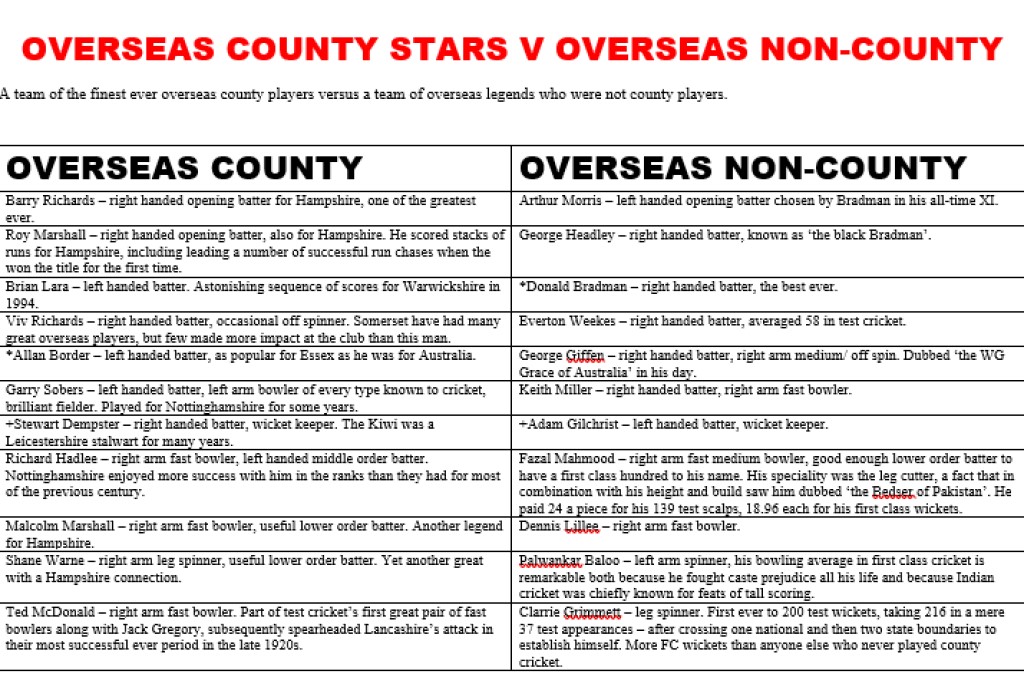
All Time XIs – Overseas Stars

Today is overseas players day as an XI of the best county overseas players to on an XI of the best overseas players not to play for counties. Also features a very important petition, a measure of mathematics and some very interesting links, as well as my usual photographs.

INTRODUCTION

Welcome to my latest variation on the All Time XI cricket theme. Today overseas players have the floor, as I pit a team of the best county overseas players against a team of overseas stars who were not county players.

THE COUNTY OVERSEAS PLAYERS

  1. Barry Richards – right handed opening batter. Played for Hampshire for many years, producing a number of extraordinary performances. See my recent South Africa post for more about him.
  2. Roy Marshall – right handed opening batter, occasional off spinner. The Barbadian scored a huge number of runs for Hampshire, and the speed with which he scored them was a crucial factor in Hampshire’s first ever County Championship, when he several times led successful run chases.
  3. Brian Lara – left handed batter. The holder of the highest individual scores in both test and first class cricket, the latter made for Warwickshire against Durham in his and their record breaking 1994 season.
  4. Viv Richards – right handed batter, occasional off spinner. An all-time great who featured in my West Indies team but had to make do with an honourable mention in the Somerset post due to my selection policies regarding overseas players.
  5. *Allan Border – left handed batter, occasional left arm orthodox spinner. The Aussie was as respected for Essex as he was in native land.
  6. Garry Sobers – left handed batter, left arm bowler of every kind known to cricket, brilliant fielder. The most complete all rounder ever to play the game, he played for Nottinghamshire for a number of years.
  7. +Stewart Dempster – right handed batter, wicket keeper. One of the most talented cricketers ever to come from New Zealand, he averaged 65.72 in his brief test career before signing up to play for Leicestershire, whom he served well for a number of years.
  8. Richard Hadlee – right arm fast bowler, left handed attacking middle order bat. The Kiwi legend was also outstanding for Nottinghamshire over a number of years. In 1984 he achieved the double of 1,000 runs and 100 wickets in the first class season, the first time it had been done since the reduction of first class fixtures to make space for the John Player League in 1969. Could such a ‘double’ be achieved in a 14 game first class season such as has been the case in England in recent years? Yes – WG Grace once had a run of 11 matches in 1874 in which he achieved the feat, but anyone who does manage it will achieve a feat comparable to the great George Hirst’s 1906 season when he scored 2,385 first class runs and took 208 wickets, the only ever season’s ‘double double’.
  9. Malcolm Marshall – right arm fast bowler, right handed lower order batter. The biggest haul of wickets in a first class season since the reduction of fixtures referred to above is 134, taken by Marshall for Hampshire, for whom he played over the course of a number of years.
  10. Shane Warne – leg spinner, right handed lower order batter. Our fourth player with a Hampshire connection and the greatest leg spinner of the modern era.
  11. Ted McDonald – right arm fast bowler. One half of the first great pair of fast bowlers in test history along with Jack Gregory, and the first truly great player to come from Tasmania (with due respect to Charles Eady who once took a seven-for and then scored 566 in a club final, and to Kenny Burn, selected for an England tour as reserve keeper after a misunderstanding – he was a specialist batter, and his brother was a keeper), he then signed up to play as a Lancashire League pro and ultimately signed for the county, and was fast bowling spearhead for them during their greatest ever period, the second half of the 1920s. In 1930 when Bradman was taking all the headlines McDonald greeted the boy wonder by rolling back the years, posting five slips, making the ball fly and dismissing him for nine.

This XI features a stellar top five, the greatest of all all rounders, a keeper-batter and four fabulous and varied bowlers. The batting is very deep with Shane Warne due to come in at no 10, and the three fast bowlers, Hadlee, Marshall and McDonald backed by Warne and Sobers with Roy Marshall, Richards and Border in reserve looks like a superb bowling attack as well.

THE NON-COUNTY XI

  1. Arthur Morris – left handed opening batter, named by Bradman as the best he ever saw.
  2. George Headley – right handed batter. He was known as ‘the black Bradman’, and his average at test level was 60.83. He usually batted three, but the West Indies so often lost an early wicket that he was effectively opening anyway,  so I have promoted him to do that job, making way for…
  3. *Donald Bradman – right handed batter, the best ever.
  4. Everton Weekes – right handed batter. He averaged 58 in test cricket, including five successive centuries. He also played Bridge for his native Barbados.
  5. George Giffen – right handed batter, right arm medium/ off spin. An all-rounder whose deeds saw him dubbed ‘the WG Grace of Australia’, his most astounding match performance came at the expense of Victoria when he hit 271 and then took 7-70 and 9-96. In the 1894-5 Ashes he scored 475 runs and took 34 wickets, still finishing on the losing side. I decided that my top four here were so strong that I could afford to start the all rounders at no 5, naming two as compensation for the presence of Sobers in the ranks of the opposition.
  6. Keith Miller – right handed batter, right arm fast bowler. Australia’s greatest ever all rounder. 2,958 test runs at 36.97 and 170 wickets at 22.97 at that level.
  7. +Adam Gilchrist – left handed batter, wicket keeper. Statistically the best keeper batter in test history.
  8. Fazal Mahmood – right arm fast medium bowler. His size and build combined with his mastery of the leg cutter led to him being labelled ‘the Bedser of Pakistan’. He took 12 wickets in the match when Pakistan achieved their first test victory. His test average per wicket was 24 for 139 wickets, while his fast class wickets came at 18.96 each.
  9. Dennis Lillee – right arm fast bowler. He did play a few games for Northamptonshire, but he was not a regular county cricketer. He took a then record 355 test wickets from 71 appearances at that level, 167 of them against England.
  10. Palwankar Baloo – left arm orthodox spinner. I wrote about him in my piece on India. I consider his 179 wickets in 33 first class games at a mere 15.21 each doubly outstanding because he contended against caste prejudice all his life (he was one of three ‘untouchables’ who negotiated the pact that ended Gandhi’s fast against separate electorates for depressed castes) and because Indian cricket was chiefly known for tall scoring rather than for any sort of bowling success.
  11. Clarrie Grimmett – leg spinner. He crossed the Tasman from his native New Zealand, and then twice moved states in his new adopted home before establishing himself as a first class cricketer. In consequence of this circuitous route to the top he was 33 years old when he finally got to don the baggy green. He took 11-82 on test debut v England and never looked back. In all he played 37 test matches and took 216 wickets, his career at that level ending when he was passed over for the 1938 tour of England, but he was still taking big first class wicket hauls two seasons later than that. In all first class cricket he captured 1,424 wickets, a record for anyone who never played county cricket (we met no2 on this list yesterday), from 248 appearances, averaging over 5.7 wickets per match.

This team has a top four with a combined average of approximately 267 at test level, two quality all rounders at five and six, a great keeper batter at seven and four excellent and varied bowlers. The bowling, with Lillee and Miller as outright fast bowlers, Fazal Mahmood’s cutters, Baloo and Grimmett as specialist spinners plus Giffen also looks highly impressive.

THE CONTEST

These are two awesomely strong and well balanced sides, and the only thing I can say for sure about the contest is that it would be an absolute humdinger.

A SOLUTION AND A NEW PROBLEM

Yesterday I offered you a little teaser from brilliant.org

This is how I resolved this:

  • The bottom shape is a right angled triangle and we are told that all angles of the same colour are identical. This means that 180-90 = 3x yellow angle, so yellow angle = 90/3 = 30 degrees.
  • The four top left triangles together form an angle of 180 degrees, and three of the four contain the blue angle, while the other contains the yellow angle, established at 30 degrees, so (180-30)/3 = blue angle, this simplifies to 150/3 = blue angle = 50 degrees.
  • The big central triangle is a right angled triangle with a blue angle and the green angle. Since the internal angles of a triangle sum up to 180, 90 + 50 + green =180, which means that the green angle that we are looking for is 180 – (90 + 50) which equals 40 degrees.

From the same source comes another teaser, this time on the theme of pattern recognition:

Square spiral

As with the previous one this was originally multiple choice but I am just leaving you to work out the answer.

AN IMPORTANT PETITION

A petition seeking justice for Belly Mujinga, a transport worker who died after being spat at by someone who knew they had covid-19, is running on change.org. There was a second victim of this despicable assault who did not die, so when the perpetrator is found they should face a charge of attempted murder as well as one of murder. Please sign and share the petition by clicking on the screenshot below.

Mujinga

LINKS AND PHOTOGRAPHS

Just a few links before it is time for my usual sign off:

  • Marina Hyde hits top form on the subject of Johnson apparently needing a baying mob behind him to be able to handle Prime Ministers Questions, with this splendid piece in The Guardian.
  • Elizabeth Dale who runs a blog called Cornish Bird which is devoted to revealing some of the less well known parts of her home county has a splendid post up at the moment about St Loy Cove, Penwith.
  • National Geographic have a post up at the moment introducing the guina, a tiny South American wild cat weighing just six pounds and in danger of extinction.
  • Finishing these links where we started, with The Guardian, Lucy Jones has a piece titled “Noticing nature is the greatest gift you can get from lockdown“, which is both an excellent read, and an appropriate place from which to provide my usual sign off..

P1320698 (2)P1320700 (2)P1320701 (2)P1320702 (2)P1320704 (2)P1320705 (2)P1320706 (2)P1320707 (2)P1320708 (2)P1320709 (2)P1320710 (2)P1320711 (2)P1320712 (2)P1320714 (2)P1320715 (2)P1320716 (2)P1320717 (2)P1320718 (2)

Overseas
The teams in tabulated form.


All Time XIs – Teams of the Talents

My latest variation on the all-time XI theme.

INTRODUCTION

Welcome to today’s piece of whimsy on the theme of ‘all time XIs‘. I will set out the brief in full detail before launching into the main body of the post.

TEAMS OF THE TALENTS EXPLAINED

The two teams consist of one chosen from players who I have witnessed in action, and one chosen from players I have only read about but would dearly love to see in action. While class has most emphatically not been ignored my two principal criteria for creating these teams was to encompass the maximum breadth of skills within 11 players and that the teams should be jam packed with entertainment value. Of course no two cricket fans would arrive at similar conclusions following this brief – indeed I would probably not come up with the same set of teams twice. Please feel free to comment with your own views on my creations!

TEAM OF THE TALENTS – HISTORIC XI

  1. Victor Trumper – right handed opening bat. This is the man who at Old Trafford in 1902, with England’s primary aim as stated by skipper MacLaren being to ‘keep Victor quiet before lunch’ was 103 not out by lunch on that first morning, having absolutely splattered MacLaren’s carefully set fields. On another occasion against South Africa he taunted the Saffer skipper Percy Sherwell as follows: every time Sherwell rearranged his field Trumper would hit the next ball somewhere a fielder had just been moved away from! Later, when commiserated on over being made to look foolish while Trumper hit 214 not out Sherwell responded “don’t worry, we have seen batting today”.
  2. *WG Grace – right handed opening batter, right arm bowler of varying type. I could name no one else as captain of this team. He once said of his own approach to batting “I never liked defensive shots – you can only get three for them.”
  3. Frank Woolley – left handed batter, left arm orthodox spinner, brilliant close catcher. The “Pride of Kent” as Peebles subtitled his biography of Woolley. ‘Crusoe’ Robertson-Glasgow once wrote of Woolley that he was “Easy to watch, difficult to bowl to and impossible to write about” before going on to make a noble effort at doing the latter.
  4. Denis Compton – right handed batter, left arm wrist spinner. A running theme through his book “Playing for England” and demonstrated in practice by the way he played cricket is that cricket is a game and should be fun.
  5. Charles Townsend – right handed bat, right arm leg spinner. My choice from various options for the leg spinning all rounder – he was the second after WG to achieve the season double of 2,000 runs and 100 wickets in first class matches.
  6. Garry Sobers – left handed batter, left arm bowler of every type known to cricket, brilliant fielder. The most complete cricketer there has ever been and incapable of being other than highly entertaining.
  7. Gilbert Jessop – right handed batter, right arm fast bowler, brilliant fielder. The sort of cricketer for whom the phrase ‘worth the admission money on his own’ was invented, and a shoo-in for a team of this nature.
  8. +Jack Blackham – wicket keeper, right handed lower order bat. The game;s first great keeper.
  9. George Simpson-Hayward – right arm off spinner (under arm). 23 wickets at 18 in five test matches. The notion of him foxing international batters with his methods is irresistible to me.
  10. FR Spofforth – right arm fast bowler (later added considerable variations). The ‘Demon’ must have been seriously compelling to watch.
  11. Sydney Barnes – right arm fast medium bowler. My pick for the greatest bowler ever. A new ball pairing of him and Spofforth would test anyone.

This team features a splenid opening pair, a wonderfully entertaining and contrasting pair at 3 and 4, three genuine all rounders at 5,6 and 7, with Townsend and Jessop flanking the incomparable Sobers, a great wicket keeper who could bat, and a splendidly varied trio of specialist bowlers. The bowling also looks rich in depth and variety, with nine of XI recognized bowlers, commanding between them a minimum of 11 styles (eight plus Sobers’ three).

TEAM OF THE TALENTS MODERN XI

  1. Sanath Jayasuriya – left handed opening batter, left arm orthodox spinner. The Sri Lankan was the star of the 1996 ODI World Cup, but also did the business plenty of times at test level.
  2. Virender Sehwag – right handed opening batter, occasional off spinner. The only cricketer ever to have scored over 100 runs in each session of a day’s test cricket (nb Don Bradman at Headingley was 220 not out at tea, but only added 89 in the final session of that day).
  3. Brian Lara – left handed batter.
  4. Sachin Tendulkar – right handed batter, holder of a raft of records at test and ODI level.
  5. Viv Richards – right handed batter, occasional off spinner.
  6. Ben Stokes – left handed batter, right arm fast bowler.
  7. +Adam Gilchrist – left handed batter, wicket keeper.
  8. Wasim Akram – left arm fast bowler, left handed lower middler order batter.
  9. *Shane Warne – leg spinner, right handed lower order bat. I have chosen him as captain of this side. His arrival in the scene, commencing with the ‘Gatting ball’ at Old Trafford in 1993 was the trigger for an international revival of spin bowling.
  10. Malcolm Marshall – right arm fast bowler, right handed lower order batter.
  11. Muttiah Muralitharan – right arm off spinner. I watched transfixed as he destroyed England at The Oval in 1998, taking 16 wickets in the match either side of a huge Sri Lankan total. 

This team has an excellent top five, x factor players at six and seven and a suoerb quartet of front line bowlers. With Stokes and Jayasuriya also significant as bowlers this team has most bases covered bowling wise, although there is no left arm wrist spinner, and of course no under arm option.

THE CONTEST

The XI from my lifetime have a stronger batting line up, with Marshall listed at no10, but the historic XI have greater depth and variety in bowling. This contest would be a spectacular one, and I cannot call a winner.

PHOTOGRAPHS

This post was interrupted by illness, and I am still by no means well – we shall see whether I can manage another tomorrow or whether it has to be wait until Sunday, when I will come up with something. Now for my usual sign off…

P1320534 (2)P1320535 (2)P1320536 (2)P1320540 (2)P1320541 (2)P1320543 (2)P1320546 (2)P1320546 (3)P1320547 (2)P1320549 (2)P1320550 (2)P1320551 (2)P1320552 (2)P1320553 (2)P1320554 (2)P1320555 (2)P1320557 (2)P1320559 (2)P1320560 (2)P1320561 (2)P1320564 (2)P1320566 (2)P1320567 (2)P1320568 (2)P1320569 (2)P1320569 (3)P1320570 (2)P1320571 (2)P1320572 (2)P1320573 (2)

Teams of the talents
The teams in tabulated form.