All Time XIs – South Africa 1889-1970

An XI from South Africa’s first period as a test playing nation and a huge photo gallery.

This is the first of what will be three posts about South African cricket – I will also cover the period of isolation and their second incarnation as a test nation. I have previously done an all time SA post (click here, although a current version would show some changes).

  1. Herby Taylor (right handed opening batter). The number of test match batters who could claim with any conviction to have mastered the great Syd Barnes totals one – this man, who in a series when Barnes took 49 wickets in four matches at less than 10 a piece before missing the fifth due to a dispute over terms and conditions scored 509 runs at 50.90.
  2. Trevor Goddard (left handed batter, left arm medium paced bowler). He was a regular opener, averaging 35 with the bat at test level and taking his test wickets (123 in 41 matches) at 26 a piece.
  3. Bruce Mitchell (right handed opening batter, occasional leg spinner). His bowling is not likely to be needed here as will be seen later. He 42 played matches over a 20 year span (split into two by WWII), scoring 3,471 runs at 48.88. He usually opened but I have put him one place lower in this XI to mix up the left and right handers.
  4. Graeme Pollock (left handed batter). He played enough test matches before isolation for his greatness to be confirmed, and because he never played county cricket he was barred from playing in Packer’s World Series Cricket, so his deeds post 1970 were largely confined to those performed in his native land, hence my decision to pick him in this XI rather than the next.
  5. *Dudley Nourse (right handed batter, captain). One of the legendary figures of South African cricket, averaging 53 at test level.
  6. Aubrey Faulkner (right handed batter, leg spinner). The most genuine of genuine all rounders, and as such one of the first names on the team sheet.
  7. +John Waite (wicket keeper, right handed batter). 141 dismissals in his 50 test appearances, and a good enough batter to average 30 at the highest level, with four centuries along the way, and that when he was often used as an opener, a tough ask for a keeper.
  8. Bert Vogler (leg spinner, right handed batter). 64 wickets at 22.73 in his 15 test appearances, and good enough with the bat to average 17 at test level with two half centuries.
  9. Hugh Tayfield (off spinner, right handed batter). One of the most economical of all test bowlers, once sending down 137 successive dot balls against England. He was also South Africa’s leading wicket taker of their first incarnation as a test nation with 170 scalps in 37 test matches at 25.91 a piece, and like Vogler he sometimes had his moments as a lower order batter.
  10. Peter Pollock (right arm fast bowler, right handed batter). As the elder of two brothers he had to get his younger brother out if he wanted a bat on their backyard games as a child, and since that younger brother was Graeme Pollock this took a fair bit of doing. 116 wickets in 28 test matches at 24.18 confirms that he developed into a decidedly good bowler. He was also far from being a rabbit with the bat.
  11. Neil Adcock (right arm fast bowler, right handed batter). A genuine number 11 with the bat, but 104 wickets at 21.10 each in 26 test matches confirms his greatness in his chosen department.

This side has great batting depth, with only Adcock absolutely incapable of assisting in that department and a well varied bowling attack. The seam department is a little light, with Goddard third in line in that department, but I would not anticipate this side struggling to take 20 opposition wickets.

I ruled out Barry Richards, reserving him for the 1970-91 side, as four test matches is an insufficient sample, and unlike RG Pollock he was seen all around the world after the enforced ending of his international career. That meant that other than my choices there were two serious candidates for the opening berths – Alan Melville and Eric Rowan. Melville, because of WWII, only got to play 11 test matches, though his record was outstanding in those matches. Rowan was nearly as awkward a customer for his team mates and the SA cricketing authorities as he was for opposition bowlers.

Two great figures from the early days of SA cricket, Jimmy Sinclair (their first ever test centurion) and Arthur William ‘Dave’ Nourse missed out because their records lacked sufficient substance to back up their legendary status.

The only rival for Faulkner’s slot was Eddie Barlow, but his test record was that of a batter who bowled, not an all rounder, so I opted for Faulkner as offering a more complete package. Some would have opted for Denis Lindsay as keeper, but he only had one really good series, whereas Waite was a consistent performer over a long period of time.

I regarded all my four specialist bowlers as having ironclad cases for inclusion. Of the quicker bowlers Peter Heine was the unluckiest to miss out based on concrete achievements. We have no way of knowing how great Krom Hendricks might have been if given the chance, and ‘Buster’ Nupen was superb on matting pitches but ineffective on turf, a disparity that is reflected in his modest test record. Athol Rowan was possibly an even more talented off spinner than Hugh Tayfield, but a knee injury sustained during WWII ruined his career.

My usual sign off…

All Time XIs: 11 Countries, no England or Australia

Today I select an all time XI where every player comes from a different country and the first two test match protagonists, England and Australia, are excluded. Also features an extensive photo gallery.

I set myself a tough challenge today: could I name an international XI where each player came from a different nation and neither of the two original test protagonists, England and Australia were included. This meant a degree of compromise, and some huge names missing out because accommodating them would have left me insoluble problems elsewhere. I think the end result is a fairly impressive looking side.

THE XI IN BATTING ORDER

  1. Sunil Gavaskar (India, right handed opening batter). His credentials are unarguable, but of course selecting him meant no place for Tendulkar, Kohli or any of the great spinners India have had down the years.
  2. George Headley (West Indies, right handed opening batter). A magnificent test record, and has a genuine claim to have been WI’s best ever. Filling the opening slots was the single toughest job involved in selecting this side.
  3. Graeme Pollock (South Africa, left handed batter). Another all time great, at least ensuring that the batting well get off to a decent start.
  4. Steve Tikolo (Kenya, right handed batter). His country’s best ever, and an FC average of 48 underlines his credentials
  5. Sikandar Raza (Zimbabwe, right handed batter, off spinner). Number five was too low in the order for Andrew Flower, and the latter was not good enough to dislodge any of top three, so I made the compromise selection of a batting all rounder for this slot.
  6. *Imran Khan (right handed batter, right arm fast bowler, captain). An excellent captain and among the greatest of all all rounders, ideal for this side.
  7. +Mushfiqur Rahim (Bangladesh, right handed batter, wicket keeper). A top quality keeper, and a fine batter as well.
  8. Richard Hadlee (New Zealand, right arm fast bowler, left handed lower middle order batter). Other than perhaps Clarrie Grimmett, who had to cross one national and two state boundaries to find cricketing fulfillment, disqualifying himself for this XI in the process, there is no case for anyone else being regarded as New Zealand’s finest ever bowler.
  9. Bart King (United States of America, right arm fast bowler, right handed lower middle order batter). Just over 400 FC wickets at 15 a piece, mainly for the Philadelphians in the course of four tours of England and good enough with the willow to average 20 in that department. As a ‘minor nation’ representative of indisputable top class he helped make the task of this post possible.
  10. Rashid Khan (Afghanistan, leg spinner, right handed lower order batter). A superb leg spinner, and his position at number ten in this order notwithstanding far from a mug with the bat as well.
  11. Muthiah Muralidaran (Sri Lanka, off spinner, right handed lower order batter). More test wickets than any other bowler in history – 800 of them. Some have suggested that his record is unduly boosted by cheap Bangladeshi and Zimbabwean scalps, but even against the more highly regarded nations he took 624 wickets at 24 – a cheaper average than Shane Warne’s against all comers (176 wickets at 15 against the two ‘minnows’).

This XI has a very powerful top four, a batting all rounder at five, one of the all time great genuine all rounders at six, a keeper who is also a top drawer batter and four of the greatest bowlers in history, three of whom can bat to varying degrees – Hadlee and King being close to all rounders and Rashid Khan definitely a ‘bowler who bats’. I do not see a bowling unit that has Hadlee, King and I Khan to bowl pace, Murali and R Khan to bowl spin and Raza as sixth option struggling to claim 20 wickets on any surface.

ALTERNATIVES

Obviously many great names missed out, but if you want to press the case for your favourites consider a) who misses out to get them in, b) how does that affect the balance of the side. Remember for example that if you want Tendulkar or Kohli to bat at four, Gavaskar has to be replaced as opener by a non-Indian, and unless you can find an opener from Kenya (Tikolo’s country) or a country not covered in my original selections that will in turn mean that someone else from down the order having to be replaced. One possibility that I could see for changing my XI would be to replace Rahim as keeper with Titendu Taibu (Zimbabwe), and then bring left arm spin bowling all rounder Shakib Al Hasan (Bangladesh) in in place of Raza, leaving the other nine positions unaffected and slightly improving the depth and variety of the bowling by increasing the range of spin coverage. However my view is that Rahim outranks Taibu in both departments, and that Al Hasan is not enough of an improvement on Raza to justify the swap.

PHOTOGRAPHS

The weather is very changeable here in Norfolk at the moment, but there has been enough of the good, or at least decent, variety that I have a large photo gallery to share…

All Time XIs – Match Ups 55

Continuing my extended analysis of how the all time XIs I created for each letter of the alphabet. Also a couple og bonus features in addition to the regular photo gallery.

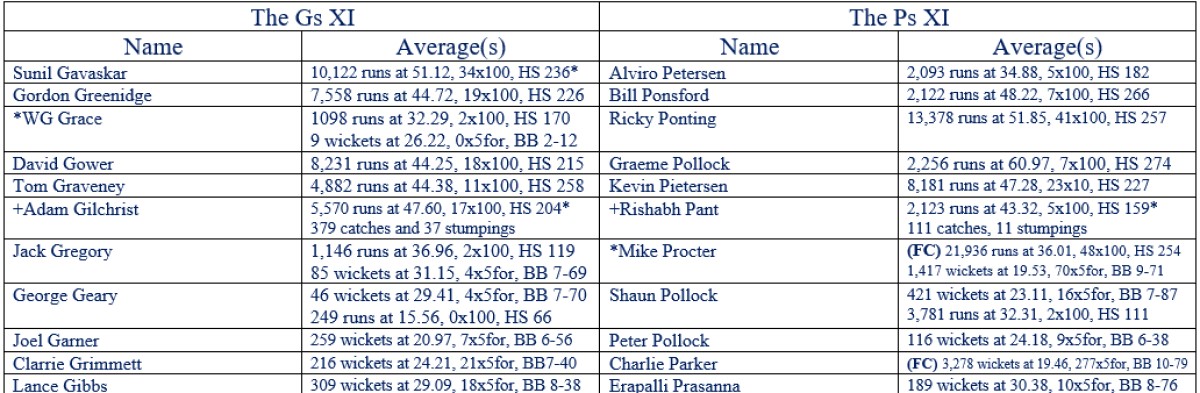
Welcome to the latest instalment in my extended analysis of how my all time XIs fare against one another. This is the first of two posts which between them will cover every match up in which the Ps come alphabetically first. They have 49 out of 75 points coming into the spotlight. There are also a couple of bonus features, after the main body of the post and before the final photograph gallery.

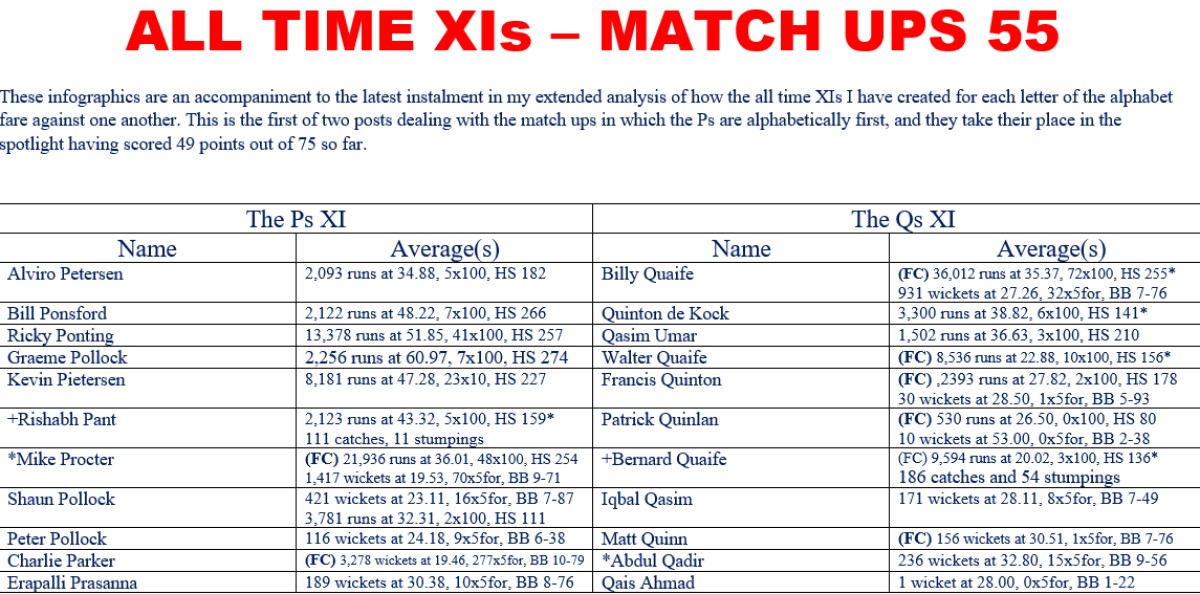
THE Ps V THE Qs

Close contests involving the Qs have been rare in this series, and this one does not buck that trend in any way. The Ps absolutely boss the batting, have the better captain, the better keeper and a far better pace attack. Only in spin bowling are the Qs possibly ahead, and if they do have an advantage there it is not enough to alter the scoreline: Ps 5, Qs 0.

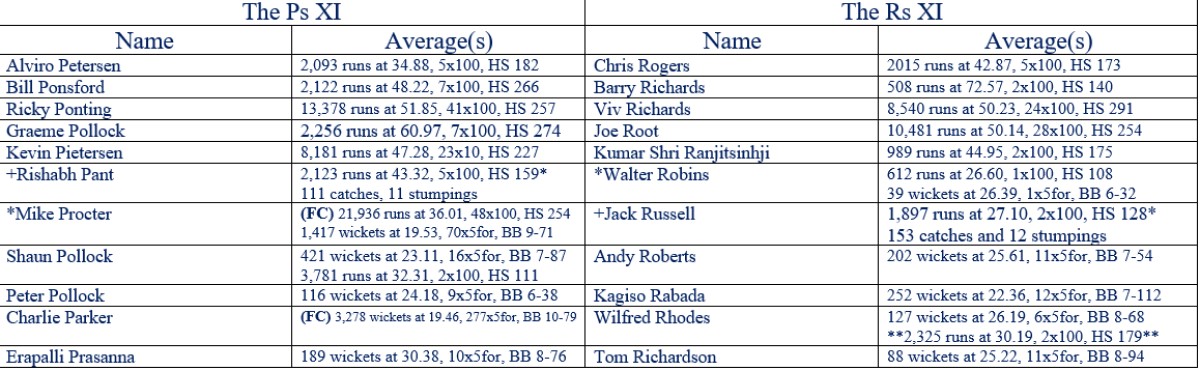
THE Ps V THE Rs

The Rs have the better opening partnership – Rogers clearly outranks Petersen, while no lesser person than Sir Donald Bradman, an Aussie team mat of Ponsford to boot, rated Barry Richards ahead of Ponsford. Ponting outranks Viv Richards, though not by much, while Root’s larger sample size does not wipe out a 10.83 run per innings gap in batting averages between him and G Pollock. Pietersen would seem to outrank Ranjitsinhji, but the latter played in an era when batting was more difficult, with pitches often treacherous, and Ranji got no easy opponents to cash in on (all his tests were played against Australia). Pant outranks Robins with the bat, while the latter is on a par with Procter as a skipper and outranks Prasanna as a bowler. Procter outbats Russell, while the latter was a finer keeper than Pant, and Procter is up there with any of the Rs fast bowlers, as great as they are. S Pollock outranks Roberts in both departments, while Rabada marginally outranks P Pollock as a bowler. Rhodes undoubtedly outranks Parker as a left arm spinner. The Rs are ahead in batting and keeping and about even in fast bowling, the Ps have an advantage in spin bowling. This is close, but I think that the the Rs are just winning it: Ps 2, Rs 3.

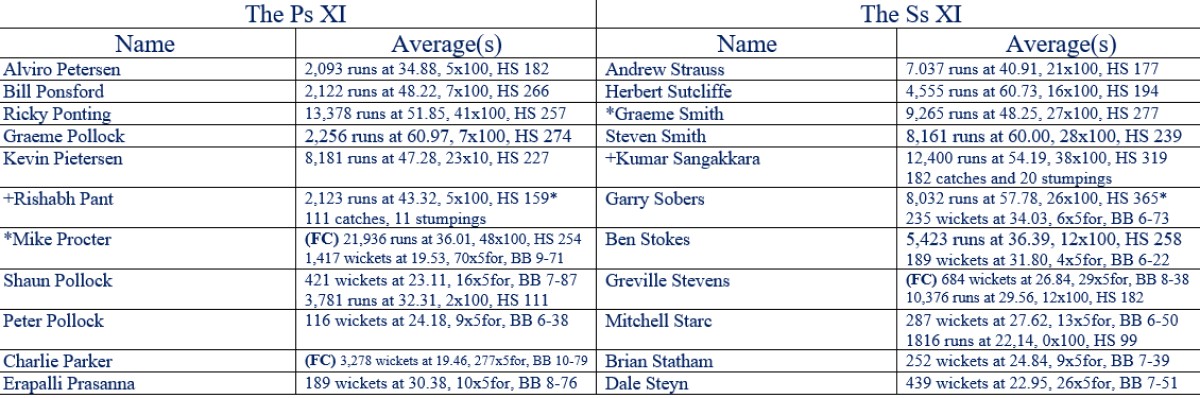
THE Ps V THE Ss

The Ss have the better opening pair – Sutcliffe was a near contemporary of Ponsford and outdid him at the highest level, while Strauss definitely outranks Petersen. Ponting wins the number three slot, bu G Pollock outranks S Smith – all evidence points to Pollock being on an upward trajectory when the curtain came down on SA’s first period as a test playing nation. Sangakkara outranks Pietersen with the bat, but Pant rates higher than him with the gloves. Sobers wins his batting match up with Pant, and has no bowling equivalent in the Ps ranks, though Parker was a finer exponent of left arm orthodox spin. Stokes wins the batting match up with Procter, but the Saffa was a much greater bowler than Stokes. Stevens outranks S Pollock as a batter, and marginally loses the nearest bowling match up for him, against Prasanna. The pace bowling is quite close in terms of the front liners – the Rs are a little better on averages, but the Ss have Starc’s left arm to add variety. Also, the Ss have back up in that department in the form of Stokes and the quicker versions of Sobers the bowler, which tips the scales in their favour in that department. The Ss thus win on batting and pace/ seam bowling, tie on captaincy, lose narrowly on spin bowling and heavily on keeping. I think the Ss are winning, and score this Ps 2, Ss 3.

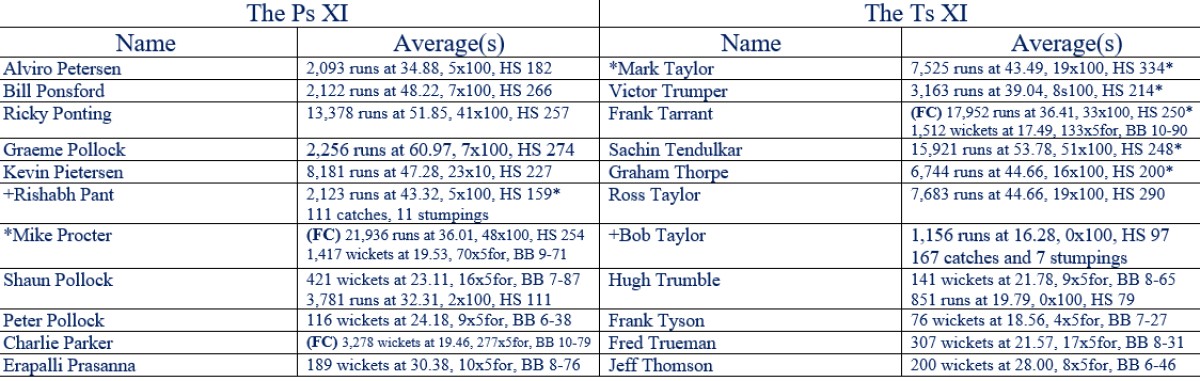
THE Ps V THE Ts

The Ts have the better opening pair – Trumper’s average of 39.04 on Victorian and Edwardian pitches is a more impressive achievement than Ponsford’s 48.22 on the shirtfronts of the interwar era, and ‘tubs’ Taylor clearly outranks Petersen. Ponting wins the batting match up at three, but Tarrant offers a bowling option comparable to Parker in quality. The number four batting match up is a draw, featuring two all time greats of the game. Superficially Pietersen seems to have Thorpe beaten in the number five slot, but Pietersen had a lot more support from the rest of the order than Thorpe, so I am giving Thorpe the verdict. Ross Taylor outranks Pant with the bat, while Bob Taylor was much better keeper. Procter outranks Bob Taylor with the bat, and also wins the bowling match up against Thomson. S Pollock outranks Trumble with the bat, but is outranked by Trueman with the ball, Peter Pollock just loses his match up against the even quicker Frank Tyson, and Trumble comfortably outpoints Prasanna in the battle of the off spinners. It is close with the bat, and in the fast bowling department, both sides are well captained, but the Ts have clear advantages in keeping and spin bowling, so I give them a narrow win in the contest: Ps 2, Ts 3.

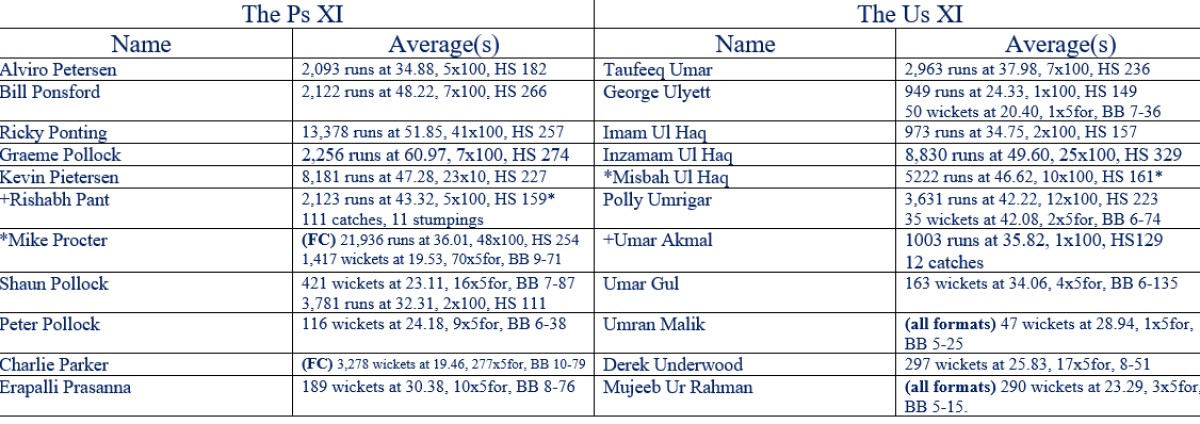
THE Ps V THE Us

The Ps have an overwhelming superiority in batting and fast bowling, the better keeper and a captain at least the equal of his opposite number in that role. Underwood outranks Parker with the ball and it maybe that in time Ur Rahman will end up outranking Prasanna, but at the moment he is unproven. Nevertheless, I will concede that the Us win the spin bowling department, and allow them one big day out: Ps 4, Us 1.

THE Ps PROGRESS REPORT

The Ps have scored 15 points out of 25 today and move up to 64 points out of 100, 64%.

A BOOK REVIEW

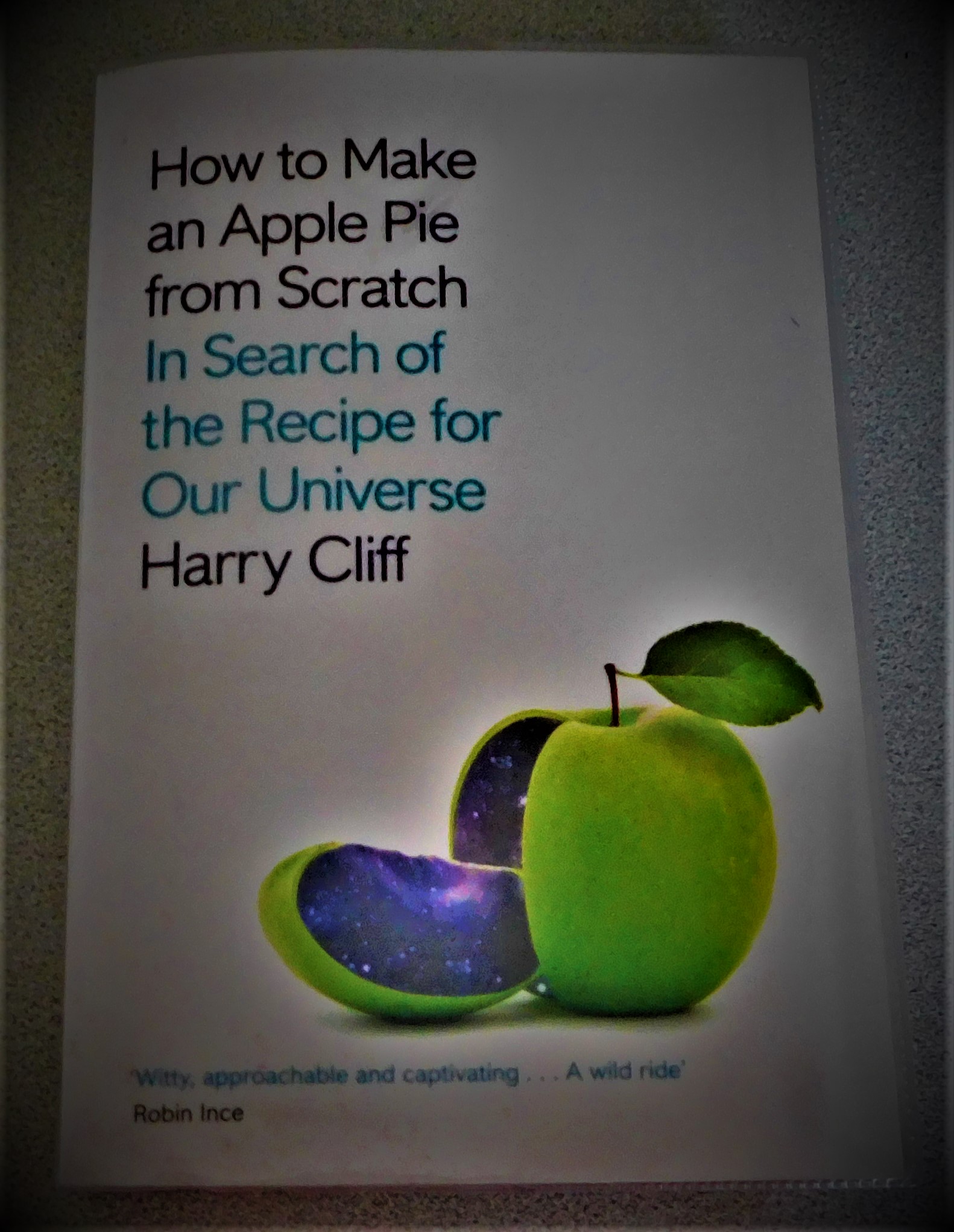
I have just finished reading “How to Make an Apple Pie from Scratch: In Search of the Recipe for Our Universe” by Harry Cliff, a quirky account of the current state of play in Particle Physics and Cosmology. I thoroughly enjoyed reading it and heartily recommend it.

CLIMATE CHANGE AT WORK

Bear in mind as you read this section that we are in the middle of November, and my home is roughly 100 miles north of London. This morning I walked into town by way of Bawsey Drain, and back by the route I use most frequently for this trip. On the outbound trip I saw a red admiral butterfly in a patch of nettles – a creature I have never previously seen in Norfolk any later than September. Then, on the homeward journey I saw a ruddy darter, a species of damselfly and hence even more out of place in Norfolk at this time of year, sunning itself (yes, a damselfly sunning itself in an English November, you read that right) on a brick wall.

PHOTOGRAPHS

Time for my usual sign off…

All Time XIs – Match Ups 45

Continuing my extended analysis of how the all time XIs I selected for each letter of the alphabet fare against one another.

Welcome to the latest instalment in my extended analysis of how the all time XIs I selected for each letter of the alphabet fare against each other. Today the Ls enter the spotlight, with 40.5 of a possible 55 points banked from the teams who are alphabetically ahead of them.

THE Ls V THE Ms

Considered purely an averages the Ls have the better opening pair, but 1) Labuschagne is batting out of position, 2)Morris and Merchant both played on uncovered pitches, Labuschagne didn’t, 3)Merchant’s test average is reduced by the fact that his career at that level was so very spread out – he played 10 test matches, spread over 18 years, with a world war in the middle, and in FC cricket where he played on a much more regular basis he averaged 71, second only to Bradman. In view of all of these considerations I give the Ms the better opening pair. The Ls have much the better number three, but Macartney compensates by offering a bowling option. Number four goes to the Ms, as does number five, though Lloyd rates above Miller as a captain. Miller wins the number six slot batting wise, and is of similar standard with the ball to Lindwall. Marsh comfortably wins the battle of the keepers. Both sides have superb new ball pairs, Laker and Murali are two titans of off spin bowling, while I think Langridge offers the Ls more variation than Mahmood does the Ms. I think the key here is Macartney, and for that reason I score this Ls 1.5, Ms 3.5

THE Ls V THE Ns

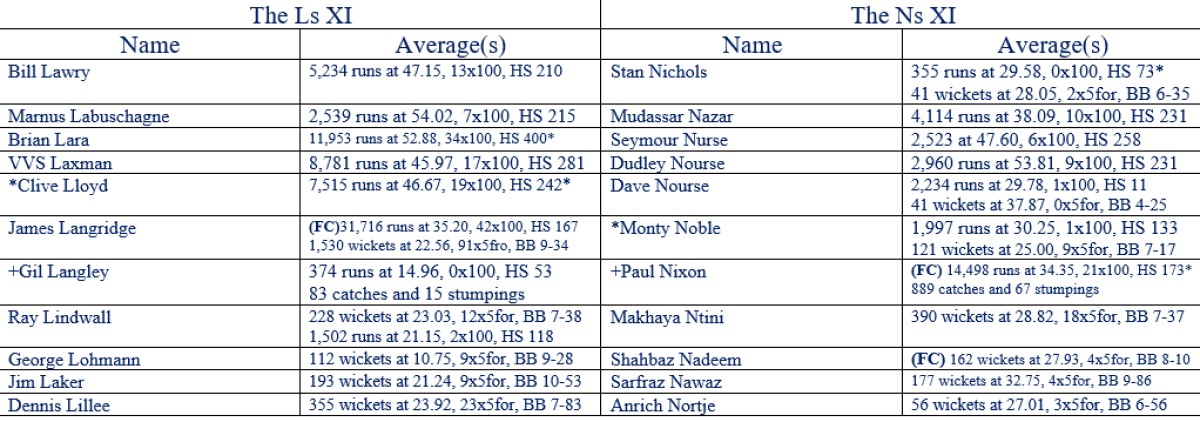
The Ls dominate everywhere except at number four batting wise. They also have the better keeper, a better pace attack and a better spin combination, while it is about even on captaincy. I see no way for the Ns to offer any sort of a challenge and score this one Ls 5, Ns 0.

THE Ls V THE Os

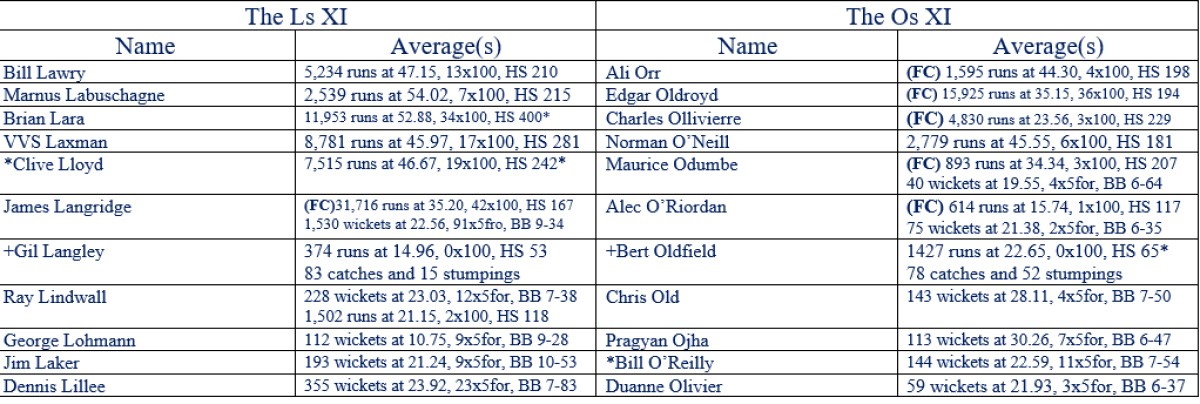
The Ls dominate, though the Os do boast the better keeper, and they have a more varied bowling unit. Still, this cannot be seen as other than exceedingly one sided: Ls 5, Os 0.

THE Ls V THE Ps

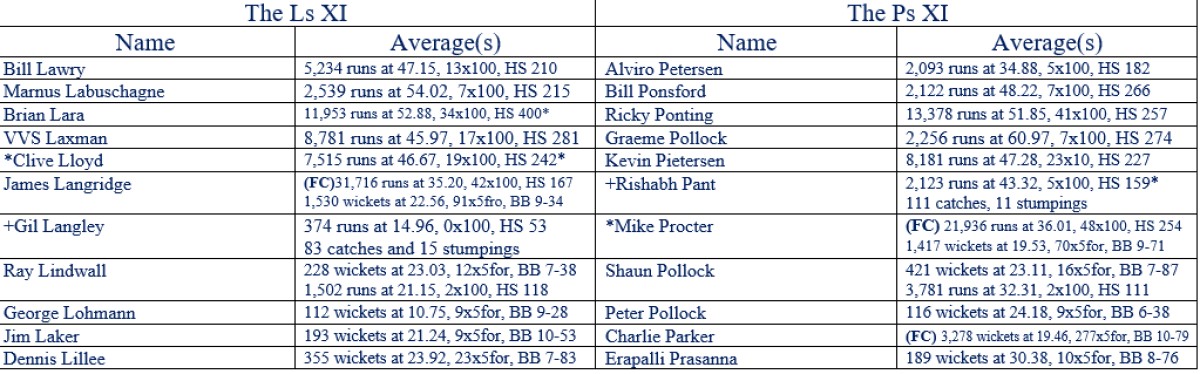
The Ls, the caveat about Labuschagne’s position notwithstanding, have the better opening pair, number three is a clash of cricketing titans, the Ps win the number four slot hands down and are marginally ahead at number five. Pant wins the batting element of his match up, though Langley was the finer keeper. Procter wins his batting match up, and probably rates close to Lindwall as a bowler. Lillee and Lohmann outrank S and P Pollock, and while Parker was a finer spinner than Langridge, Laker outranks Prasanna. I make the Ps a little stronger in batting, and the Ls stronger in bowling, and thus give the Ls the verdict: Ls 3, Ps 2.

THE Ls V THE Qs

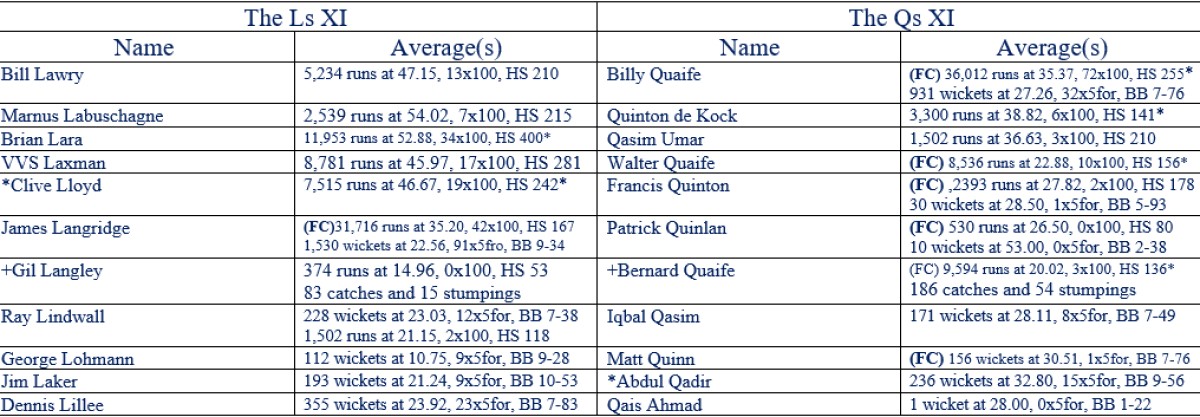
Here the Ls absolutely dominate. The have the better batting by far, the better captain by far, the better keeper, they are utterly dominant in the pace bowling department, and though they have only two spin options to the Qs three those are the two best spinners on either side, thus there can be only one result: Ls 5, Qs 0.

THE Ls PROGRESS

The Ls have scored 19.5 out of 25 today, which moves them on to 60 out of 80, 75% so far.

PHOTOGRAPHS

This photo gallery comprises pictures taken between Queen Elizabeth Hospital, where I attended this morning for glaucoma tests. I compromised on the journey, using the bus on the way in but walking all the way home, hence the fact that the first pic is in hospital grounds.

All Time XIs – Match Ups 42

Continuing my extended analysis of how the all time XIs I selected for each letter of the alphabet fare against one another, ushering the Ks into the spotlight.

Welcome to the latest instalment in my extended analysis of how my teams fare against one another. Today the Ks enter the spotlight, with 37 of a possible 50 points banked from the matches against teams who precede them alphabetically.

THE Ks V THE Ls

The Ls have the better opening pair, though their advantage there is lessened by the fact that one of their openers is batting out of position. The Ls also have the better number three. However, Kallis outranks Lloyd with the bat, and offers an extra bowling option not available to the Ls. Both sides have excellent captains. The Ks win the wicket keeping battle. Lindwall, Lillee and Lohmann are a match for I Khan, King and Kortright, while Laker and Langridge are a better balanced spin combo than R Khan and Kumble. This is a proper battle, but I think Kallis just tips the scales the Ks way: Ks 3, Ls 2.

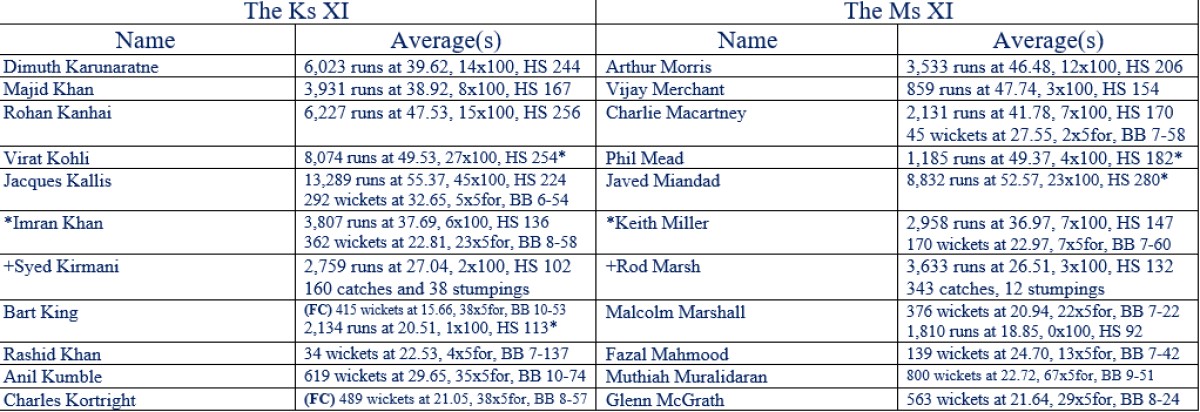
THE Ks V THE Ms

The Ms have much the stronger opening pair. The Ks win the number 3-5 slots, though number four only on sample size. Each side has one recognized bowler in their top five, and for my money Macartney outranks Kallis in that department. Miller against I Khan is just about the ultimate in match ups between fast bowling all rounders. The Keepers battle is also a clash of titans. Marshall outranks King as a bowler, but King is clear with the bat (King’s record in his era translates to averaging 30 with the bat and 23 with the ball on covered pitches). At the moment, though this is subject to change as the Afghan develops Mahmood outranks R Khan as a bowler. Murali outranks Kumble as a bowler. McGrath comfortably wins his match up against Kortright. The Ks, with their super powerful engine room at nos 3-5, and King at eight outranking Marshall in that department may just win the batting, but the Ms comfortably win the bowling. I make this a slightly more comfortable than regulation win for the Ms: Ks 1.5, Ms 3.5.

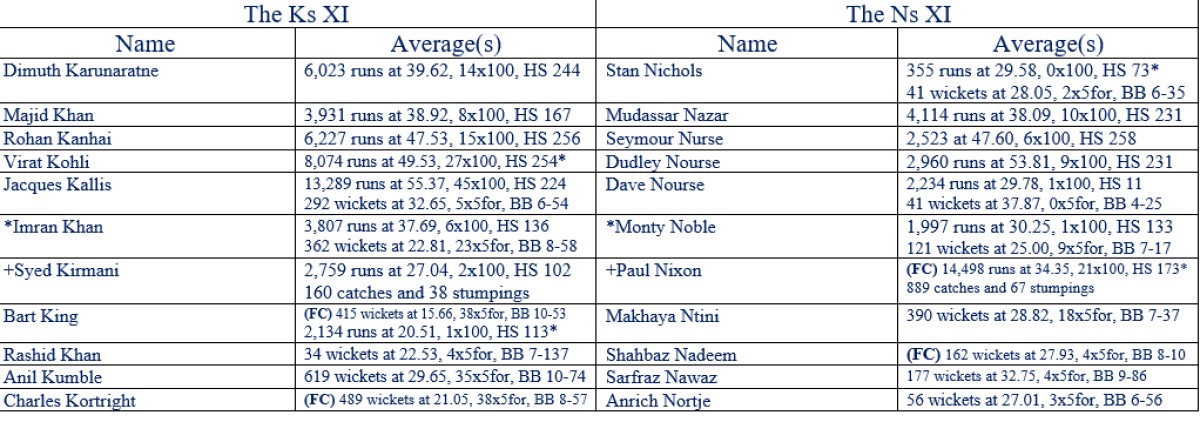
THE Ks V THE Ns

The Ks boss the top batting, with only Dudley Nourse close to his opposite number in that department among their top five. The Ks also have the better keeper, far the better pace bowling unit and the better spinners. Only in captaincy, where Noble is a worthy rival to I Khan to the Ns even come close, and that will not save them: K5 , Ns 0.

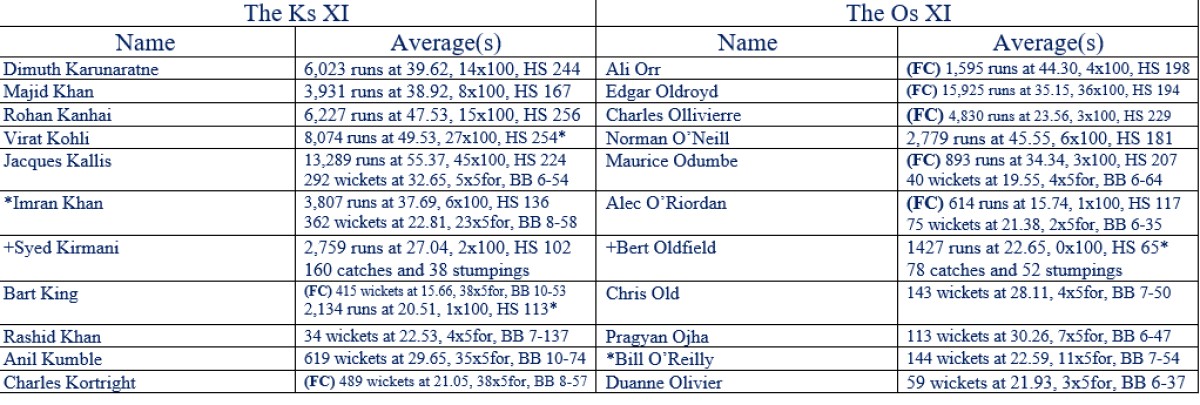
THE Ks V THE Os

The KO clash is indeed a KO – in the Ks favour. Oldfield, O’Reilly and Olivier win their match ups for the Os, but the other eight all go very comfortably in favour of the Ks. This has to be scored as Ks 5, Os 0.

THE Ks V THE Ps

The Ps have the better opening pair, although not by much, especially given that the one person who could claim to have sorted Ponsford out was an express paced bowler, Larwood. The Ks have two such, Kortright and I Khan, plus King who was also pretty sharp. Ponting and G Pollock win the number three and four slots more conclusively, Kallis winning the number five slot, and offering an extra bowling option into the bargain. Pant outbats Kirmani, but the older Indian was probably the better keeper of the two. Procter against I Khan is another titanic clash of fast bowling all rounders on the same lines as Miller against I Khan. King and S Pollock are hard to pick apart, as are P Pollock and Kortright. Parker and Prasanna are a better balanced spin pairing than R Khan and Kumble, and probably just about outrank them anyway. I just give this to the Ps: Ks 2, Ps 3.

THE Ks PROGRESS REPORT

The Ks have scored 16.5 out of 25 today, moving them up to 53.5 out of 75, 71.33% so far.

PHOTOGRAPHS

My usual sign off…

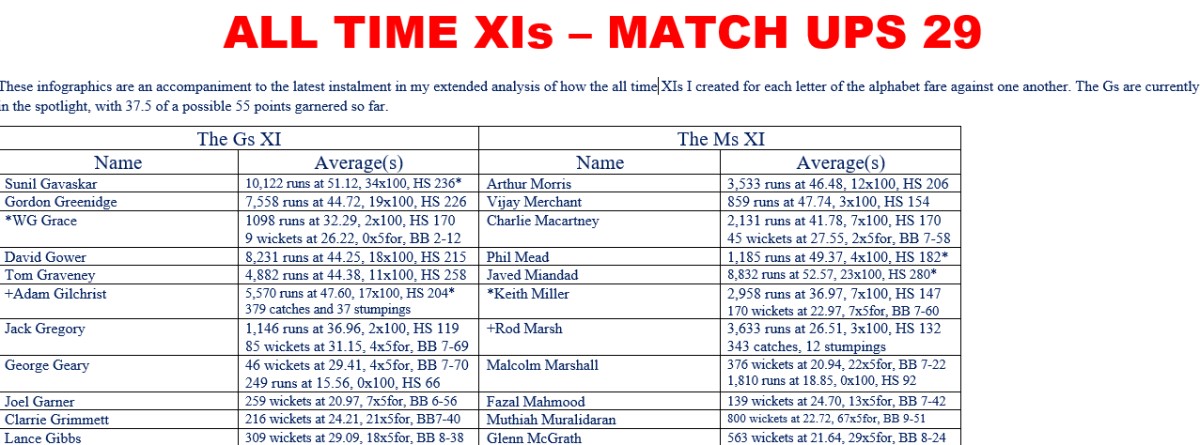
All Time XIs – Match Ups 29

Welcome to the latest instalment in my extended analysis of how the teams I selected for each letter of the alphabet. The Gs are currently in the spotlight and start today with 37.5 of a possible 55 points. There are links (light blue text) back to the posts I created for today’s featured sides in the selection stage of this series.

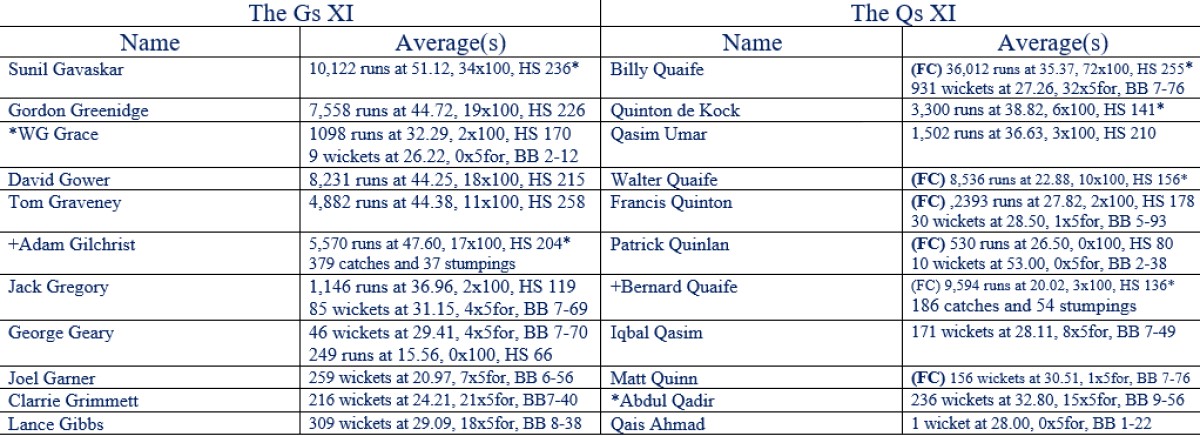
THE Gs V THE Ms

The opening pairs are both stellar. I rate WG as the better number three – Macartney benefitted from some very flat pitches – 16 of the 25 all time leading run scorers in FC history played some part of their careers in the inter-war years (Macartney finished his test career in 1926) and there is a reason why that era was known for tall scoring, especially in Australia. Grace is the only super stacker to have played all his FC cricket before WWI (an appearance for The Gentlemen of England v Surrey early in the 1908 season was his last FC match). Second and third among all time pre-WWI scorers in FC cricket are Fry and Ranji, both over 20,000 runs behind Grace. I give the number four slot to Gower – his test average is a few runs per innings lower than Mead’s, but the sample size is much larger for him. Miandad definitely gets the verdict over Graveney. Gilchrist wins the batting element of the keepers match up by a greater margin than he loses the keeping element. Miller outpoints Gregory in both departments. The Ms have a significant advantage in pace bowling – only Garner among the Gs specialist pacers would find a place in the Ms XI did one change the opening letter of his name. As against that, while Murali clearly outpoints Gibbs, Grimmett outranks Mahmood and gives the Gs a better balanced attack than the Ms. Both Grace and Miller were fine skippers, though I think Grace has to be awarded the palm in this department. I cannot pick a winner of this epic contest: Gs 2.5, Ms 2.5.

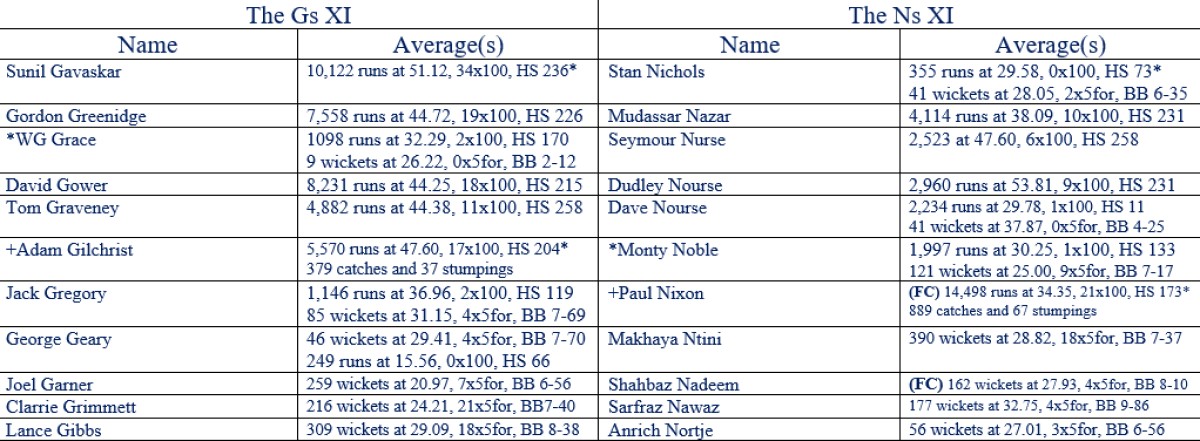
THE Gs V THE Ns

The Gs have far the better opening pair, Grace is about even on batting with Nurse given the different eras in which they played, Dudley Nourse outpoints Gower, but Dave Nourse is outpointed by Graveney. Noble is outbatted by Gilchrist and outbowled by Gibbs, Nixon is outbatted by Gregory but outkeeps Gilchrist. The Gs win the pace bowling match up due to having Garner in their ranks, and they are miles clear in spin bowling, with Grimmett outbowling Nadeem by an even bigger margin than Gibbs outbowls Noble. Only in middle order batting, and that not by much, can the Ns claim an advantage: Gs 5, Ns 0.

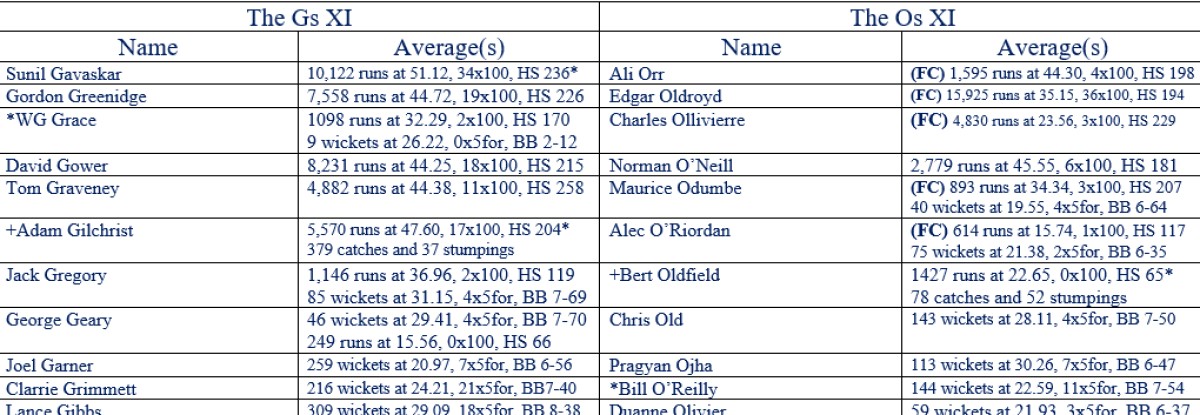
THE Gs V THE Os

The Gs absolutely boss the batting, with every match up in that department going their way bar Gower v O’Neill, which goes to the Aussie by a fraction. The seam bowling is also overwhelmingly in the Gs favour. Grace massively outranks O’Reilly (who never actually had the job IRL) as a skipper, and Oldfield wins the keeping side of his match up against Gilchrist. The Gs win the spin bowling – Gibbs outranking Ojha, while O’Reilly and Grimmett were both absolute titans of leg spin. There is simply no way the Os can offer any serious resistance: Gs 5, Os 0.

THE Gs V THE Ps

With all due respect to Ponsford, the Gs have the better opening pair. The Ps win the batting element of the number three slot, but by much less than raw figures suggest – Grace’s average, recorded between the ages of 32 and almost 51, equates to about 48 on 21st century pitches. G Pollock clearly wins the battle of the left handed stroke players at number four. Pietersen and Graveney is a closer battle – Graveney, a stroke maker by instinct, played in an era when scoring rates were generally slow and would probably have fared better in Pietersen’s era than he did in his own. I make this one level pegging. Gilchrist outpoints Pant, although Pant is young enough that he may yet change that. Circumstances restricted Procter to a handful of tests, in which he fared very well. Myself I think Gregory probably wins the batting element of their match up, while Procter very comfortably wins the bowling element. S Pollock outpoints Geary in both departments. P Pollock loses his match up to Garner. Grimmett outranks Parker for my money, though the scandalous way in which the England selectors of that era treated Parker makes it hard to be sure. Gibbs v Prasanna is more clear cut – their test careers had an overlap, Gibbs took more wickets at a better average, and Prasanna’s home pitches favoured spin more than Gibbs’ did, giving Gibbs a comfortable win. I make the Gs slightly the better batting side, and I just rank Grace ahead of Procter as a skipper, and I think they have a bigger advantage in spin bowling than the Ps do in pace bowling. This is a superb contest and I score it Gs 3, Ps 2.

THE Gs V THE Qs

This is a total non-contest. The Gs win every match up batting wise, have the better keeper, far the better captain, are the only side who can actually be said to have a pace attack, and barring something extraordinary from the largely untried Qais Ahmad they also boss the spin bowling department. Fs 5. Qs 0.

THE Gs PROGRESS UPDATE

The Gs have scored 20.5 of a possible 25 points today, moving them up to 58 of a possible 80 points, 72.5% so far.

PHOTOGRAPHS

My usual sign off…

All Time XIs – the Letter P and Left Handers

An all time XI of players whose surnames begin with P, and because it is International Left Handers Day an all time XI of left handers.

Today is International Left Handers day, so this post includes a bonus feature – I lead off with an all time XI of left handers. A list of honourable mentions for such an XI would be incredibly long, so I shall not include it. After parading my chosen left handers the focus of the bulk of the blog post is on cricketers whose surnames begin with the letter B.

LEFT HANDERS XI IN BATTING ORDER

  1. *Graeme Smith (South Africa). A steely left handed opening batter, and the obvious choice to captain this XI – a role he performed superbly for South Africa.
  2. Alastair Cook (Essex, England). The opener is England’s all time leading scorer of test runs (though likely to be overhauled by Joe Root in the not too distant future).
  3. Brian Lara (Warwickshire, West Indies). The holder of world record individual scores at both test and first class level, a joint feat achieved only once before in cricket history, by Don Bradman for the two and a half years that his 334 was the world test record score. Also the only player to have twice held the world test record score, and one of only two along with Bill Ponsford to have two first class quadruple centuries.
  4. Graeme Pollock (South Africa). Possibly the greatest batter ever produced by his country. When the curtain came down on the first period of SA being a test nation he was left with an average of 60.97.
  5. Frank Woolley (Kent, England). The only player to achieve the first class career treble of 10,000+ runs (58,969 in his case), 1,000+ FC wickets (2,066) and 1,000+ FC catches (1,018). Capable of match winning performances with both bat and ball (as a left arm orthodox spinner), and one the finest fielders ever to play the game.
  6. Garry Sobers (Nottinghamshire, West Indies). The most complete player to have played the game. One of the greatest batters of all time, a bowler of fast, medium or slow pace (both orthodox and wrist spin) and a brilliant fielder.
  7. +Adam Gilchrist (Australia). A top quality keeper, and a destructive middle order batter.
  8. Wasim Akram (Lancashire, Pakistan). Fast bowler, attacking batter.
  9. Alan Davidson (Australia). Fast medium bowler, occasional spinner, useful lower order batter and fielder of such brilliance that he earned the nickname ‘the claw’.
  10. Mitchell Johnson (Australia). One of the fastest bowlers ever to play the game and a useful lower order batter. On his day he was simply unplayable.
  11. Hedley Verity (Yorkshire, England). A left arm spinner and a useful lower order batter (indeed he was once pressed into service as an emergency opener in a test match and did well). On surfaces that didn’t help him he was very economical and never allowed batters to feel at ease. On surfaces that did help him he was a destroyer. Yorkshire’s match against Nottinghamshire in 1932 illustrated both sides of Verity the bowler – in Nottinghamshire first innings he took 2-64 from 41 overs, in their second, when he had a rain=affected pitch to exploit he recorded figures of 19.4-16-10-10 – the cheapest all ten in FC history.

This XI has an awesomely strong batting line up, and a bowling attack of Akram, Johnson, Davidson, Verity, Sobers and Woolley is both strong and varied.

SURNAMES BEGINNING WITH P IN BATTING ORDER

We move on to the main meat of the post, an all time XI of players whose surnames begin with P.

  1. Alviro Petersen (Glamorgan, South Africa). A solid right handed opener.
  2. Bill Ponsford (Australia). One of only two players to twice top 400 in FC matches. He scored centuries in his first two test matches and in his last two.
  3. Ricky Ponting (Australia). One of the two best number three batters of the modern era alongside Rahul Dravid. He was also an excellent slip fielder, and a long serving captain, though his record in that department was tarnished by the fact that oversaw three failed Ashes campaigns – the only other three time Ashes losing skipper in 140 years being Archie MacLaren of England (1901-2 in Australia, 1902 in England, 1909 in England), hence my not giving him the role in this side.
  4. Graeme Pollock (South Africa). One of the greatest of all left handed batters (see the left handers XI earlier in this post).
  5. Kevin Pietersen (Nottinghamshire, Hampshire, Surrey, England). A batter of undoubted greatness, though problematic in the dressing room to the extent that his first two counties were both glad to see the back of him. He top scored in both innings of his test debut, ended that series with the second most important innings of 158 to be played by a South African born batter at The Oval. His test best was 227 at the Adelaide Oval in the 2010-11 Ashes.
  6. +Rishabh Pant (India). Attacking left handed batter, quality keeper. Probably his greatest moment came at the Gabba when he played a match and series winning innings for an injury-hit India.
  7. *Mike Procter (Gloucestershire, South Africa). One of the finest all rounders ever – a genuinely fast bowler, an attacking middle order batter and a shrewd captain to boot – I have given him that role in this side.
  8. Shaun Pollock (Warwickshire, South Africa). An exceptionally accurate right arm fast medium bowler and a useful lower order batter. He is also my chosen vice captain for this side in preference to either Ponting or Pietersen.
  9. Peter Pollock (South Africa). A right arm fast bowler, spearhead of the South African attack during the last few years of their first period as a test nation.
  10. Charlie Parker (Gloucestershire, England). The third leading wicket taker in FC history with 3,278 scalps at that level, but only one England cap.
  11. Erapalli Prasanna (India). An off sinner who took 189 test wicketsin the 1970s.

This side has one good and one great opener, a superb engine room at 3-5, a keeper batter, a genuine all rounder, and four great bowlers. In Procter and Peter Pollock the side has two genuinely fast bowlers, with Shaun Pollock’s fast medium to back them up. Parker and Prasanna are an excellent pair of contrasting spinners.

HONOURABLE MENTIONS

Eddie Paynter has a higher test average than anyone I have overlooked at 59.23, but his test career was quite brief, and his average is over a run an innings less than that of Graeme Pollock. Cheteshwar Pujara is the next most notable omission, but no way can he be selected ahead of Ponting at number three, and his efforts when India recently used him as an ersatz opener were not very impressive.

The two Nawabs of Pataudi to play test cricket (the last two to have that title) were both fine batters, but not quite good enough to break into this powerful XI.

Roy Park of Australia never got the opportunity to prove himself at test level – his batting career for his country lasted exactly one ball. Ashwell Prince of South Africa might have his advocates as well.

Ellyse Perry is unlucky to have a surname beginning with P – there are many other letters where I would be delighted to be able to choose a player of her class, but she just misses out.

JH Parks of Sussex was a fine county all rounder, but hardly a challenger to Procter. JM Parks was a batter/ keeper for both Sussex and England, but for my money Pant is better in both departments than Parks was, and even if Parks’ batting shades it I would go for the better keeper (a walkover win for Pant).

Dattu Phadkar of India was good middle order batter an enough of a bowler to take the new ball for his country (although this is partly a reflection of India’s shortage of quick bowlers in his playing days), but could hardly displace Procter.

Liam Patterson-White, an all rounder who bowls left arm spin, may be challenging for inclusion in a few years time, as might leg spinner Matt Parkinson, but as yet they are potentials rather than actuals.

Three seriously quick bowlers who missed out were Patrick Patterson (WI) whose time at the top was short, Len Pascoe (Australia), who also didn’t have great depth of achievement and Pushpakumara of Sri Lanka, whose record was very modest for all his pace.

PHOTOGRAPHS

Time for my usual sign-off…

All Time XIs – Through The Alphabet VII

Today’s all time XI cricket post continues the alphabetic progression theme. Lots of Photographs as well.

INTRODUCTION

Today’s all time XIs cricket post is our seventh alphabetic progression. We finished yesterday with a B, so today we start with a C.

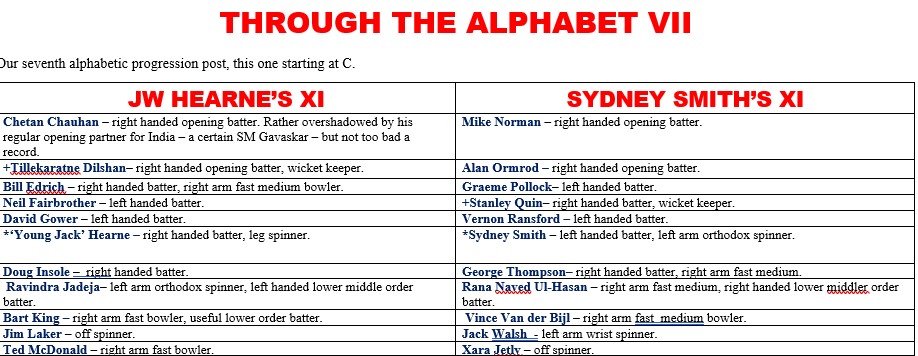
JW HEARNE’S XI

  1. Chetan Chauhan – right handed opening batter. He was overshadowed by his regular opening partner for India, Sunil Gavaskar, but his record was not a bad one.
  2. +Tillekaratne Dilshan – right handed opening batter, wicket keeper. One of the most innovative of all iternational batters. I admit that he was not a regular wicket keeper, and that the combination of keeping and opening the batting is a tough one, but he did keep on occasion, and I think he could do both jobs.
  3. Bill Edrich – right handed batter, right arm fast medium bowler. A regular number three and occasional opener. In the last ever ‘timeless’ test match (the 99th such ever played, and it was the events of that game that pretty much killed the notion of timeless tests stone dead – after ten days play it ended in a draw because England had to get back to Cape Town to catch their boat home) Edrich who had endured a nightmare start to his test career produced 219 in the second England innings, as they got to 654-5 chasing 696 to win.
  4. Neil Fairbrother – left handed batter. He holds the record for the highest first class score at a London ground – 366 for Lancashire v Surrey at The Oval, in a monstrosity of a match in which Surrey made 707 and Lancashire 863. He failed to establish himself at test level, partly because the powers that be typecast him as a one-day specialist, where he did have an excellent record.
  5. David Gower – left handed batter. 8,231 runs at 44.25 in test cricket, and it would have been more but for the narrow-minded, intolerant attitude of then captain Graham Gooch, which brought the curtain down on his career when he still had plenty to offer. Gower, unlike Gooch, resisted the bait dangled by apartheid South Africa, and did not sign up for either of the two England rebel tours of the 1980s. He scored 58 in his first test innings, making his maiden century against New Zealand later that summer, and scoring a crucial maiden Ashes hundred at Perth on the 1978-9 tour. His 123 at Adelaide on the 1990-1 tour, one of two centuries he made in that series (the only England player to do so), was rated by Don Bradman as among the top five innings he ever saw played in Australia. That tour also saw an epic sense of humour failure by Gooch and manager Mickie Stewart over an incident in which Gower and John Morris of Derbyshire buzzed the upcountry ground at which England were playing in tiger moth planes.
  6. *Jack Hearne – right handed batter, leg spinner. In first class cricket over the course of a long career he averaged 40 with the bat and 24 with the ball, although he did most of his bowling before World War 1, playing largely as a batter thereafter. He was not actually related to the original Jack Hearne, a medium pacer who claimed 3,061 first class wickets (the fourth most ever), but they did both play for Middlesex, and their careers overlapped. I have named as captain, following my belief that all other factors being equal a slow bowling all rounder should be best equipped for the job (exhibit A among actual captains in favour of this theory the late legendary Richie Benaud, exhibit B Ray Illingworth – and as an effective captain who because of the mores of his time never officially had the job I give you exhibit C, Wilfred Rhodes – as witness his comment about Percy Chapman’s England captaincy “Aye ‘ee wor a good ‘un – he allus did what me and Jack telt him”).
  7. Doug Insole – right handed batter. He normally batted a little higher than this, but his attacking approach, often further highlighted by the fact that he was batting in partnership with one TE Bailey, makes him well suited to batting in this position, and I is not the easiest of letters to deal with. After his playing days were done he became a selector, and as chairman of selectors once dropped a well known Yorkshire opener on disciplinary grounds immediately after said worthy had scored 246 not out – an incident with which TMS listeners no longer have to fear being regaled while listening to commentaries.
  8. Ravindra Jadeja – left arm orthodox spinner, left handed lower middle order batter. Test averages of 35 with the bat and 24 with the ball make for a mighty useful no8, and he is also one of the best fielders currently playing the game. For those who produce ‘ah, but he is not so good away from home’ I suggest you check out the away records of James Anderson and Stuart Broad and then come back to me.
  9. Bart King – right arm fast bowler, useful lower order batter. In 65 first class matches he took 415 wickets at 15.66 each while also averaging 20 with the bat. In the last of his four visits to England with the Philadelphians he claimed 87 wickets in 11 first class appearances to top that season’s bowling averages. He was the pioneer of swing bowling – it was a commonplace in that era before World War 1 for bowlers to rub the new ball in the dirt to remove the shine, and many sides reckoned that to give the opponents a varied challenge it was best to open the bowling with a fast and a slow bowler. Kent, champions four times in the last eight pre world war one seasons, regularly gace the new ball to left arm spinner Blythe alongside right arm fast bowler Arthur Fielder, while Lancashire a decade earlier had used a similar pairing of Briggs and Mold. It was King who taught the cricket world how to use the shine of a new ball as an extra weapon in the bowler’s armoury, and it is now very rare for a slow bowler of any type to get the new ball, although Muralitharan sometimes took it for Sri Lanka.
  10. Jim Laker – off spinner. Probably the best of all classical off spinners, most famous for his destruction of the 1956 Australians (58 of the first 100 wickets he took that season in first class matches wore baggy greens, 46 of them being claimed in the five test matches). On the 1958-9 tour of Australia, although the hosts regained the urn, they were, much to their chagrin, obliged to treat Laker with a degree of respect, and in the four test matches for which he was fit and available he claimed 15 wickets at an economical average. Among English off spinners only Fred Titmus four years later, John Emburey and Geoff Miller against an ill-equipped and badly captained rabble in 1978-9 and John Emburey again in 1986-7 also against a less than full strength side have fared better down under.
  11. Ted McDonald – right arm fast bowler. One half of the first great fast bowling duo seen at test level, along with Jack Gregory (Tom Richardson and Bill Lockwood, pioneer of the slower ball, had opened together for Surrey). After the Ashes series of 1920-1 and 1921, in which Australia won eight straight tests before England drew the last two of the home series he accepted a Lancashire league contract, and went on to playfor the county for some years, combining with Cecil Parkin and Richard Tyldesley to form a bowling unit that saw Lancashire dominate the second half of the 1920s.

This team has a solid batting line up, a competent keeper and a fine array of bowlers. McDonald and King look a splendid new ball pair, Edrich is available if a third pace option is needed, and in Laker, Jadeja and Hearne there is a wonderfully varied trio of spinners.

SYDNEY SMITH’S XI

  1. Mike Norman – right handed opening batter. A consistent county pro rather than a real star.
  2. Alan Ormrod – right handed opening batter. Played for Worcestershire for many years, before finishing his career at Lancashire. He was part of the Worcestershire side involved in the ‘ten minute game’, when Somerset skipper Brian Rose declared after one over, deliberately losing the limited overs match in order to protect his side’s wicket taking rate. The powers that be took a dim view of this, and Somerset were booted out of the competition anyway. Declarations were late banned from limited overs cricket, a move I consider unduly hamfisted, especially now that net run rate is used to split ties. Why shouldn’t a side who are 300-2 after 40 overs and facing possible weather interruptions say to their opponents “OK, we reckon we can defend in this over the full fifty if we have to do, over to you to have a bat”?
  3. Graeme Pollock – left handed batter. He averaged 60.97 in test cricket before his country were forced into international isolation by the fallout from the D’Oliveira case (in fact South Africa were lucky to have lasted as longs as they did in that first incarnation as a test playing nation – various moments could have seen them given the boot well before they were.
  4. +Stanley Quin – right handed batter/ wicket keeper. He played for Victoria in the 1930s, averaging 33 in first class cricket, including a double century, and given how difficult a letter Q is I think this is a pretty good solution. His 24 first class appearances brought him 35 catches and 24 stumpings.
  5. Vernon Ransford – left handed batter. He averaged 37.84 in test cricket – at a time when Victor Trumper, universally regarded as an all-time great, averaged 39.04 at that level, sufficient indication of his class as a performer.
  6. *Sydney Smith – left handed batter, left arm orthodox spinner. He was Northamptonshire’s first ever overseas signing, coming over from the West Indies in 1909, twenty years before they took their test bow, and doing the double in his first season of county cricket. He finished his career averaging 31 with the bat and 18 with the ball. Making a standard ‘covered pitches inflation’ adjustment of 50% up for each average that equates to averaging 46 with the bat and 27 with the ball today.
  7. George Thompson – right handed batter, right arm fast medium bowler. The man, along with Bill East, who was most responsible for Northants’ elevation to first class rank in 1905, and the first Northamptonshire cricketer to play for his country – and he did not fare badly at that level either, more especially given that by the time the chance arrived he was already past 30.
  8. Rana Naved Ul-Hasan – right arm fast medium bowler, right handed lower middle order batter. He first appeared on scoresheets as Naved Ul-Hasan, before indicating a preference for Rana Naved, and U is not an easy letter to fill. He played for Sussex for some years, and had a lot in common with an earlier Sussex stalwart, Maurice Tate, both being fast medium bowlers who loved to give the ball a good clout with the bat.
  9. Vince Van der Bijl right arm fast medium. Took his first class wickets at 16.54 each. A combination of the political situation in South Africa and his unwillingness to completely cast adrift from his native land cost him a test career. He was a popular overseas star for Middlesex. On one occasion when the county lost a Sunday League (an aeon or so ago counties played 40 overs per side matches on Sundays, accumulating points towards a league title) match by eight runs and when they got back to the dressing room Van der Bijl opened the post -mortem by saying “sorry folks, those two half volleys I bowled early in my spell cost us”, thereby preventing any recriminations from developing.
  10. Jack Walsh – left arm wrist spinner. Australian born, but moved to England and enjoyed a long career with Leicestershire – one of a number of Aussie spinners of that era to decide that the grass was greener elsewhere.
  11. Xara Jetly – off spinner. The trickiest letter of the lot, but the teenage Kiwi may yet go on to establish herself as a top player – it is certainly a name I will have half an eye one for the future. The women play almost exclusively limited overs cricket, which reduces the potential for really big wicket hauls, but there is a 3-35 among her recent sets of figures.

This team may be a little short of really top drawer batters (only Pollock and Ransford qualify for that description), but it does have great depth – everyone down to no8 has the capacity to play a match winning innings. The bowling, with a pace trio of Rana Naved Ul-Hasan, Vince Van der Bijl and George Thompson backed by tweakers Xara Jetly, Jack Walsh and Sydney Smith looks really good.

THE CONTEST

This should be a cracker. JW Hearne’s XI are stronger in batting, but not quite as strong in bowling. I suspect that Sydney Smith’s XI would need Graeme Pollock to ‘come to the party’ to win, but he usually managed that, so I cannot predict a winner.

PHOTOGRAPHY

Finally, it is time for my usual sign off…

IMG_1148 (2)IMG_1149 (2)IMG_1151 (2)IMG_1152 (2)IMG_1154 (2)IMG_1155 (2)IMG_1159 (2)IMG_1160 (2)IMG_1161 (2)IMG_1162 (2)IMG_1166 (2)IMG_1167 (2)IMG_1168 (2)IMG_1171 (2)IMG_1171 (3)IMG_1172 (2)IMG_1172 (3)IMG_1173 (2)IMG_1176 (2)IMG_1178 (2)IMG_1179 (2)IMG_1183 (2)IMG_1184 (2)IMG_1185 (2)IMG_1186 (2)IMG_1188 (2)IMG_1189 (2)IMG_1190 (2)IMG_1192 (2)IMG_1192 (3)IMG_1193 (2)IMG_1194 (2)IMG_1195 (2)IMG_1195 (3)IMG_1198 (2)IMG_1199 (2)IMG_1201 (2)IMG_1202 (2)IMG_1203 (2)IMG_1205 (2)

TTA VII
The teams in tabulated form.