
There is no I in Team

A mention of Adelaide Strikers WBBL triumph, an XI of players whose given names begin with I, and a photo gallery.

Today I select an all-time XI all of whose given names begin with I. Before getting to the main meat of the post I also acknowledge Adelaide Strikers winning a second consecutive Women’s Big Bash League title, which they did earlier today, beating Brisbane Heat by three runs in a superb final that illustrated yet again how utterly compelling low scoring matches can be – Strikers managed 125-5 from their 20 overs, and then bowled like demons to restrict Heat to 122-8 in their innings. A full scorecard can be viewed here.

  1. Ibrahim Zadran (Afghanistan, right handed opening batter). Has a respectable record in his fledgling test career and an outstanding one in ODI cricket.
  2. Ian Redpath (Australia, right handed opening batter). Averaged 43 in test cricket.
  3. Ian Chappell (Australia, right handed batter, vice captain). I only occasionally name vice captains of these XIs and have done so on this occasion because this team has two outstanding leaders among its number, and one of those could not be named as captain. He had a very good test record.
  4. Inzamam-ul-Haq (Pakistan, right handed batter). One of his country’s all time great batters, though somewhat marred by not being the best runner between the wickets.
  5. Ian Bell (England, right handed batter). It took him a few years to overcome an early reputation for softness, but by the time his career ended he was one of the most respected of all middle order batters, with a record whose weight of achievement matched the stylishness of its accomplishment.
  6. *Imran Khan (right handed batter, right arm fast bowler, captain). One of the greatest all rounders ever to play the game and an outstanding captain to boot.
  7. +Ian Healy (Australia, wicket keeper, right handed batter). An outstanding keeper, and a very tough competitor – all four of his first class centuries came in the test arena.
  8. Irfan Pathan (India, left arm medium fast bowler, left handed batter). At test level, the ultimate benchmark, his averages were just the right way round, with the bowling average just on the right side of 30 per wicket.
  9. Ian Bishop (West Indies, right arm fast bowler, right handed batter). Injuries spoiled his career, which at one stage seemed certain to see him claim a place among the all time greats of the game. As it was, 161 test wickets at 24.27 each from 43 matches still amounted to a very fine record. He has recently established himself as an excellent commentator, always being well prepared for any match he is covering.
  10. Ian Peebles (England, leg spinner, right handed batter). Only 13 test appearances for the Scottish born spinner, which yielded him 45 wickets at 30.91 each. In first class cricket he managed 951 wickets at 21.38 each.
  11. Ishant Sharma (India, right arm fast medium, right handed batter). His average of 32.40 per wicket looks expensive, but he was a bowler who improved massively later on in his career, and in many ways the current era of India being well equipped in the seam/ pace department began with him.

This side has a solid looking opening pair, a powerful engine room of Chapelli, Inzamam-ul-Haq and Bell, an ATG all rounder, an ATG keeper and a bowling attack that is probably better than their respective career averages suggest. Bishop, Sharma, Pathan, Peebles and Imran Khan an attack that should claim 20 opposition wickets without undue difficulty on most surfaces.

The biggest miss by far is Ian Terrence Botham. There were two candidates for the all rounders slot, and my feeling is that outstanding is Botham was between 1977 and 1982, his subsequent protracted decline gives the verdict to Imran. Also, Botham and Chappelli in the same dressing room might be problematic.

There is no left handed front line batter, but the nearest claimant, Ian Blackwell, never established himself as an international player, and averaged less than 40 in FC cricket. Imam-ul-Haq likewise falls short, though he merits a mention.

Ian Healy has three challengers for the gloves: Imtiaz Ahmed (Pakistan), Ian Smith (New Zealand) and Ikram Alikhil (Afghanistan), the last named of whom may eventually depose him from this XI.

I considered Issy Wong for the number eight slot, but felt that Irfan Pathan’s left arm offered more than the youngster’s right.

There were three spinners challenging for inclusion: Imran Tahir (South Africa), Ish Sodhi (New Zealand) and Intikhab Alam (Pakistan).

Iain O’Brien (New Zealand) was closest among the quicks I did not select to displacing any of my choices.

Subzero temperatures and mist, both currently afflicting west Norfolk, do not provide the best of opportunities for photographers, but I do have a gallery to share with you…


All Time XIs – A Family Affair Part Two

The second part of a two part exercise that started yesterday, featuring the second XII, honourable mentions and a comparison, as well as a large photo gallery.

Welcome to the second part of a two part all time XIs piece that I started yesterday. Today we see our second XI, honourable mentions and a comparison.

  1. Graeme Pollock (left handed batter). Not a regular opener, but he did once score 274 in a test match from number three, and my reckoning is that he could cope with the task of opening. He averaged over 60 in test cricket before the curtain came down on South Africa due to the foul apartheid system of government in that country.
  2. Majid Khan (right handed opening batter). One of three cousins to have captained Pakistan (only one of the other two features in this post), he was a stylish and attack minded opening batter, generally rated by those who saw him as a better player than an average just the wrong side of 40 suggests.
  3. Garry Sobers (left handed batter, left arm bowler of every type known to cricket, brilliant fielder). The most multi-skilled player in cricket’s long history, and a regular in this batting position – his then test record 365* came batting here.
  4. Mark Waugh (right handed batter, occasional off spinner, ace slip fielder). Once dubbed ‘Afghan’ because how much longer it took the Aussie selectors to noticer him than it taken them to notice his twin brother, he was a stylish batter and the safest slip fielder I ever saw in action.
  5. Steve Waugh (right handed batter, occasional medium pace bowler, vice captain). A gritty and determined batter who tended to score runs when they were most needed, and I have acknowledged his leadership qualities by naming him as vice-captain of this XI.
  6. Jonathan Bairstow (right handed batter, occasional wicket keeper). He is picked in this side as a specialist batter, a role that in my view he is best suited to.
  7. *Imran Khan (right handed batter, right arm fast bowler, captain). One of the greatest of all allrounders, cousin of Majid Khan and designated captain of the XI. Some might make him vice-captain and S Waugh captain rather than vice-versa, but I believe he was the finer skipper, and also the Pakistan Cricket Board recently disgraced themselves by putting up a montage about Pakistan cricket history that did not even mention him.
  8. David Holford (right handed batter, leg spinner). A cousin of Garry Sobers, which is why I am prepared to pick him although his record is fairly moderate – a compromise to get Sobers in being worthwhile IMO. The two cousins once saved a test match against England by putting on 274 together.
  9. +David Bairstow (wicket keeper, right handed batter). This is why I selected Jonathan Bairstow – there are limited ways of getting a top drawer keeper into a side of this nature and this is one of them.
  10. Shaun Pollock (right arm fast medium bowler, right handed batter). Almost absurdly low in the order for him (nos 8,9 and 10 in this side are virtually interchangeable in terms of batting skill, and all rather better than a standard number eight).
  11. Peter Pollock (right arm fast bowler, right handed lower order batter). One of the most ferocious fast bowlers of South Africa’s first period as a test nation (JJ Kotze, Neil Adcock and Peter Heine are other contenders), a fine player to round out the XI.

This side is awesomely strong in batting, superbly equipped in seam/ pace bowling (P Pollock, S Pollock, I Khan, Sobers), has a great skipper and a great keeper, but is under par in the spin department, with the moderate Holford and Sobers in his slower guises the best available to them.

Two fast bowlers I could not accommodate in either XI were West Indian half brothers Fidel Edwards and Pedro Collins. The Mohammad brethren of Karachi, five of whom played FC cricket and four of whom gained test selection were perhaps the most notable family to be omitted, although the multi-generational Cowdreys (four generations), D’Oliveiras and Headleys (three generations each) all produced many first class cricketers and two of the five Edriches of Norfolk to play first class cricket would have been worthy selections. The two George Baileys of Tasmania, Great-great grandfather and Great-great grandson, are to date the furthest apart by generation of related first class cricketers, but the elder just missed out on international honours and the younger was never a regular in the Aussie team. The Gunns of Notttinghamshire produced four first class cricketers, two of whom, William (also the original Gunn of Gunn&Moore) and George did well for England. Sussex have a long history of cricketing families (see my post about that county), but the only family of theirs that had two players of sufficient class to potentially claim places were the ruling family of Nawanagar with ‘Ranji’ and ‘Duleep’.

The XI I presented today is stronger in batting (although G Pollock is out of position), and its pace/ seam attack is quicker though not necessarily better. Neither side is that strong in spin bowling. Both will be well led, and both have high class keepers, though Tallon would outrank D Bairstow in that department. No side with WG Grace in their ranks can be entirely discounted but I think todays XI have a clear advantage and would expect a five match series between these sides to end 4-1 in their favour.

My usual sign off…

Picking an all time Asian Test XI

Constructing an all time Asian XI, also sharing a petition and as usual including a photo gallery.

This post is my extended response to a tweet from Tanmay:

What would be your All Time Asian Test XI?

🇮🇳 • 🇵🇰 • 🇱🇰 • 🇧🇩

— TANMAY 🤡 (@spear_93) April 13, 2023

https://platform.twitter.com/widgets.js

I gave a brief twitter friendly answer yesterday, and I am now using this post to expand my thoughts and look at the architecture of an all time XI.

THE BRIEF

I have taken Tanmay’s question as referring specifically to players who played for Asian nations as opposed to players of Asian heritage who played for other nations. I also decided that for the purposes of this post only players with genuinely weighty test records should be considered – there have been players who have been brilliant at lower levels and struggled at the summit, and there have been players who have made incredible starts at test level and then fizzled out (look up Narendra Hirwani in the context of this specific post). I also require that any XI I name be well balanced and obviously capable of functioning as a unit, so I try to select varied players.

BUILDING OUR XI

We start with the openers. Here there is one candidate who overshadows all others, Sunil Gavaskar with over 10,000 test runs at an average above 50. Gavaskar’s partner should ideally pose a contrast, so I want a more attacking player, and preferably a left handed one. For me the person who fits the bill best in terms of Asian test players is Saeed Anwar of Pakistan.

The number three slot is non-negotiable in my opinion – Rahul Sharad Dravid with 13,288 test runs at an average of 53 is a lock for this slot

There would be more candidates for the number four slot but for the presence of Sachin Ramesh Tendulkar who preferred this slot in test matches.

At number five I want a left hander given that numbers three and four are right handers, and again there is one commanding candidate: Kumar Sangakkara, the second most prolific of all test match left handers behind Alastair Cook, and with a better batting average than the former England opener.

At number six I want an all rounder, and there is once again a clear cut candidate, who also happens to have been an outstanding captain, Imran Khan.

A wicket keeper who can make major contributions with the bat is a major asset to any side, and Mushfiqur Rahim, a fine keeper and one of the most consistent test batters Bangladesh has yet produced fits the bill nicely.

A number eight should be primarily a bowler, but ideally you want them to be reasonably capable with the bat as well, and Wasim Akram, one of the greatest of all left arm fast bowlers and possessor of a test match double century to boot would seem the ideal candidate.

Numbers 9, 10 and 11 are bowling slots, and we want at least one more fast bowler and at least one spinner. Waqar Younis of Pakistan and Muthiah Muralidaran of Sri Lanka answer these descriptions – the former a genuinely great right arm fast bowler and regular bowling partner of Wasim Akram as well and the latter an off spinner and holder of the record for career test scalps – 800 in 133 matches. For the number nine slot my preference is for a second spinner and one who does something different to Murali, and I opt for leg spinner Anil Kumble, fourth in the list of all time test wicket takers and a big contrast to Murali.

Thus we have constructed our XI and in batting order it reads:

Sunil Gavaskar
Saeed Anwar
Rahul Dravid
Sachin Tendulkar
Kumar Sangakkara
*Imran Khan
+Mushfiqur Rahim
Wasim Akram
Anil Kumble
Waqar Younis
Muthiah Muralidaran

This gives us a very powerful top five, one of the greatest of all all rounders, a quality keeper who is also a very good bat and four top line bowlers of great quality and variety. The bowling with three fast bowlers, one of whom bowls left arm for extra variation and two of the greatest spinners ever to play has both depth and variety as well. I hesitate to say that this side could beat an ROW all time XI because the latter, something like: JB Hobbs, H Sutcliffe (the best ever test match opening pair), *DG Bradman, SPD Smith, G St A Sobers, AW Greig, +AC Gilchrist, AK Davidson, MD Marshall, SK Warne, GD McGrath has arguably even stronger batting and definitely greater depth and variety in the bowling – between Sobers and Davidson any type of delivery that a left arm bowler can produce is covered, while Marshall, McGrath, Warne and Greig do likewise for right arm bowlers, but this Asian XI would be able to give even such formidable opposition as this a genuine contest.

THE MISSING

In an exercise of this nature many legendary cricketers are bound to miss out and probably no two people would pick the same XI. I would not argue against the likes of Virat Kohli, Javed Miandad or any of a fistful of left arm spinners: three all rounders, ‘Vinoo’ Mankad, Ravindra Jadeja and Shakib al Hasan and at least two specialists in the craft, Bishan Singh Bedi and Rangana Herath would all have their advocates, merely in favour of my own choices. Two contemporary greats who I decided did not yet have the weight of achievement at test level to merit selection but who I may well include should I revisit this in a few years were Rishabh Pant (who may very well displace Mushfiqur Rahim) and Rashid Khan (who faces an even more formidable obstacle in the form of Kumble).

PHOTOGRAPHS

Just before my usual sign off I have a petition to share: The Academy in Brixton is in danger and there is a petition on change.org to save it. I grew up in southwest London, close enough to Brixton that when I temped there for a period in 1997 I walked to and from work. Finally we come to the photographs…

All Time XIs: 11 Countries, no England or Australia

Today I select an all time XI where every player comes from a different country and the first two test match protagonists, England and Australia, are excluded. Also features an extensive photo gallery.

I set myself a tough challenge today: could I name an international XI where each player came from a different nation and neither of the two original test protagonists, England and Australia were included. This meant a degree of compromise, and some huge names missing out because accommodating them would have left me insoluble problems elsewhere. I think the end result is a fairly impressive looking side.

THE XI IN BATTING ORDER

  1. Sunil Gavaskar (India, right handed opening batter). His credentials are unarguable, but of course selecting him meant no place for Tendulkar, Kohli or any of the great spinners India have had down the years.
  2. George Headley (West Indies, right handed opening batter). A magnificent test record, and has a genuine claim to have been WI’s best ever. Filling the opening slots was the single toughest job involved in selecting this side.
  3. Graeme Pollock (South Africa, left handed batter). Another all time great, at least ensuring that the batting well get off to a decent start.
  4. Steve Tikolo (Kenya, right handed batter). His country’s best ever, and an FC average of 48 underlines his credentials
  5. Sikandar Raza (Zimbabwe, right handed batter, off spinner). Number five was too low in the order for Andrew Flower, and the latter was not good enough to dislodge any of top three, so I made the compromise selection of a batting all rounder for this slot.
  6. *Imran Khan (right handed batter, right arm fast bowler, captain). An excellent captain and among the greatest of all all rounders, ideal for this side.
  7. +Mushfiqur Rahim (Bangladesh, right handed batter, wicket keeper). A top quality keeper, and a fine batter as well.
  8. Richard Hadlee (New Zealand, right arm fast bowler, left handed lower middle order batter). Other than perhaps Clarrie Grimmett, who had to cross one national and two state boundaries to find cricketing fulfillment, disqualifying himself for this XI in the process, there is no case for anyone else being regarded as New Zealand’s finest ever bowler.
  9. Bart King (United States of America, right arm fast bowler, right handed lower middle order batter). Just over 400 FC wickets at 15 a piece, mainly for the Philadelphians in the course of four tours of England and good enough with the willow to average 20 in that department. As a ‘minor nation’ representative of indisputable top class he helped make the task of this post possible.
  10. Rashid Khan (Afghanistan, leg spinner, right handed lower order batter). A superb leg spinner, and his position at number ten in this order notwithstanding far from a mug with the bat as well.
  11. Muthiah Muralidaran (Sri Lanka, off spinner, right handed lower order batter). More test wickets than any other bowler in history – 800 of them. Some have suggested that his record is unduly boosted by cheap Bangladeshi and Zimbabwean scalps, but even against the more highly regarded nations he took 624 wickets at 24 – a cheaper average than Shane Warne’s against all comers (176 wickets at 15 against the two ‘minnows’).

This XI has a very powerful top four, a batting all rounder at five, one of the all time great genuine all rounders at six, a keeper who is also a top drawer batter and four of the greatest bowlers in history, three of whom can bat to varying degrees – Hadlee and King being close to all rounders and Rashid Khan definitely a ‘bowler who bats’. I do not see a bowling unit that has Hadlee, King and I Khan to bowl pace, Murali and R Khan to bowl spin and Raza as sixth option struggling to claim 20 wickets on any surface.

ALTERNATIVES

Obviously many great names missed out, but if you want to press the case for your favourites consider a) who misses out to get them in, b) how does that affect the balance of the side. Remember for example that if you want Tendulkar or Kohli to bat at four, Gavaskar has to be replaced as opener by a non-Indian, and unless you can find an opener from Kenya (Tikolo’s country) or a country not covered in my original selections that will in turn mean that someone else from down the order having to be replaced. One possibility that I could see for changing my XI would be to replace Rahim as keeper with Titendu Taibu (Zimbabwe), and then bring left arm spin bowling all rounder Shakib Al Hasan (Bangladesh) in in place of Raza, leaving the other nine positions unaffected and slightly improving the depth and variety of the bowling by increasing the range of spin coverage. However my view is that Rahim outranks Taibu in both departments, and that Al Hasan is not enough of an improvement on Raza to justify the swap.

PHOTOGRAPHS

The weather is very changeable here in Norfolk at the moment, but there has been enough of the good, or at least decent, variety that I have a large photo gallery to share…

All Time XIs: All Captains

An all time XI of great former test skippers and a huge photo gallery.

For today’s blog post I have selected an XI made up entirely of players who captained their country in test cricket. I required players with excellent playing records – no passengers for me, and also who had been successful as captains.

THE XI IN BATTING ORDER

  1. Mark Taylor (Australia, left handed opening batter, ace slip fielder). Second link in a chain of four successive very successful Aussie skippers. He succeeded Allan Border who had inherited a rabble and passed on the best side in the world. Taylor kept Australia at the top of the world pecking order, in its own way as impressive an achievement as his predecessor’s feat of dragging them to the top in the first place.
  2. *Frank Worrell (West Indies, right handed opening batter, left arm fast medium bowler, occasional left arm spinner). He averaged 49 with the bat, which confirms that he was worth his place as a player. I have named him as captain of this side of captains because as well as being a superbly successful skipper he was one of genuinely historic importance – his appointment represented the end of a particularly unpleasant captaincy fetish, since he was the first black man to be appointed West Indies captain.
  3. Don Bradman (Australia, right handed batter, outstanding outfielder). The most prolific batter there has ever been, with a test average of 99.94, and a superb captain. In the 1936-7 Ashes he turned a 0-2 deficit after two matches into a 3-2 series win. In 1948 he led the Australians through an unbeaten tour of England.
  4. Clive Lloyd (left handed batter, outstanding cover fielder and later a fine slip). The pioneer of the ‘four fast bowlers’ strategy that propelled West Indies back to the top of the world game after a difficult period in the late 1960s and early 1970s.
  5. Steve Waugh (Australia, right handed batter, occasional right arm medium fast bowler). The third link in the chain of Aussie skippers I referred to earlier, and he built on the earlier achievements of Border and Taylor give an acknowledged best side in the world an aura of total invincibility.
  6. Imran Khan (Pakistan, right handed batter, right arm fast bowler). A great all rounder and a great skipper. Maybe in a few years time Stokes will challenge him for this slot – he has made an outstanding start as skipper, and an Ashes triumph this summer would help to cement his reputation in that role, but as things stands he has no challenger.
  7. +Rodney Marsh (Australia, wicket keeper, left handed batter). A bit of a cheat as he never actually captained his country, but keeper-captains in test cricket are few and far between, and successful keeper-captains at test level are in the ‘hens teeth’ category of rarity, and he would have been a better choice than Kim Hughes to skipper the 1981 Ashes touring party.
  8. Wasim Akram (Pakistan, left arm fast bowler, left handed batter). His greatness as a player is unquestioned and he was a fine skipper as well. Not too much should be read into the acrimonious end to his tenure in the top job – Pakistan skippers rarely go gently into the night.
  9. Richie Benaud (Australia, leg spinner, right handed batter). The first cricketer to achieve the test career double of 2,000 runs and 200 wickets. His captaincy highlights include regaining the Ashes in 1958-9, defending them in 1961 and again in 1962-3, and captaining Australia in the classic 1960-1 tied test series against the West Indies when his opposite number was Frank Worrell.
  10. Bishan Singh Bedi (India, left arm orthodox spinner, left handed tail end batter). One of the greatest ever masters of his craft and a successful skipper in somewhat difficult circumstances.
  11. Courtney Walsh (right arm fast bowler, right handed tail end batter). The first bowler ever to take 500 test wickets, and a respectable captaincy record in spite of the fact that the job is generally reckoned tough for specialist fast bowlers and the West Indies were on the way to crashing down from the heights of the Lloyd/ Richards eras by the time he got the job.

This side has a powerful batting line up, a great keeper, and Walsh, Wasim Akram and Imran Khan as front line bowlers, Benaud and Bedi as front line spinners and support bowling available from Worrell and Waugh. It is a side to be reckoned with in every department.

HONOURABLE MENTIONS

I regarded Frank Worrell as having the right handed openers slot under wraps, and I preferred my other opener to be left handed. Taylor’s chief rival for this slot was Andrew Strauss (England), who led his side to the top of the world rankings. Worrell’s presence also meant that I had to leave out WG Grace, a superb skipper as well as the best cricketer of the 19th century. I could not accommodate Border alongside Lloyd without having a huge surfeit of left handers, and I regarded the West Indian’s achievements as captain as being the greater. The fourth in that chain of successful Aussie skippers, Ricky Ponting, cannot be said to be unlucky – a) he was up against Bradman for the number three slot and b) when the greats he had inherited from his predecessors departed the scene he was shown up as a fairly ordinary skipper and one given to inappropriate outbursts – his rant on being run out by Gary Pratt and his infamous stand off with umpire Dar six years later being two examples. Another Aussie, Steve Smith, rendered himself ineligible by being caught up in a cheating scandal while captain. If you feel I have been unfair to your favourite feel free to comment. None of the England skippers I have witnessed in action have massively impressed me save Stokes, who I have mentioned as a potential future captain. Alec Stewart, who could have been used as a solution to the keeper-captain problem failed two grounds in my book: keeping was not his best role and he was a very poor skipper to boot.

PHOTOGRAPHS

I have a bumper photo gallery for you…

All Time XIs – Match Ups 44

Continuing my extended analysis of how the all time XIs I selected for each letter of the alphabet fare against one another, with the Ks last day in the spotlight.

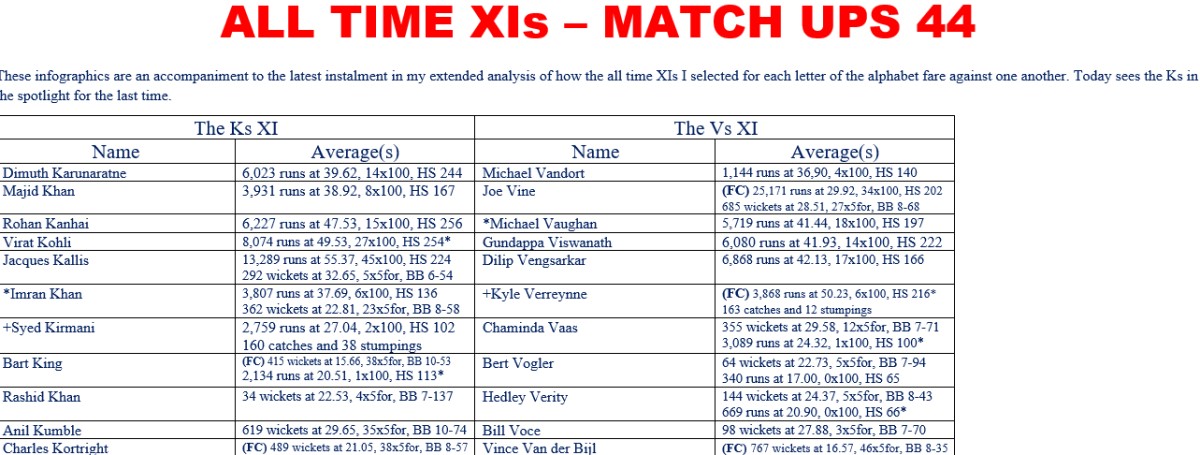
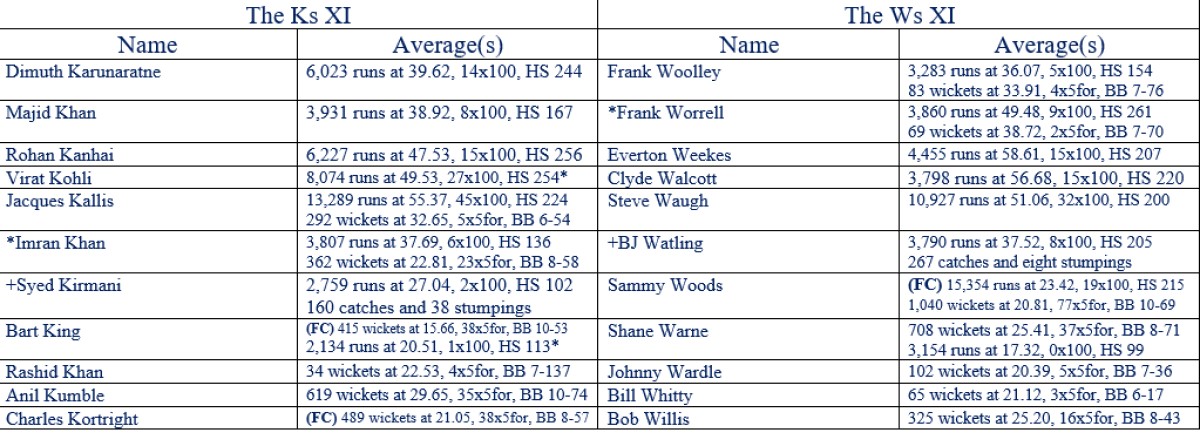
Welcome to the latest instalment in my extended analysis of how the all time XIs I picked for each letter of the alphabet fare against one another. Today is the Ks last day in the spotlight, and they have 68 of a possible 100 points so far.

THE Ks V THE Vs

The Ks boss the batting, they have the better keeper, the better captain and the better pace bowling unit. Only Hedley Verity saves the Vs from a complete wipeout in all departments, but not even his presence alters the scoreline: Ks 5, Vs 0.

THE Ks V THE Ws

The Ws have the better the opening pair and also comfortably win the number three and four slots. Kallis beats S Waugh at number five. I Khan and Watling are equals with the bat, Worrell and I Khan is a clash of captaincy titans, Woods ranks higher with the bat than Kirmani and is on similar plane to I Khan with the ball. The Ws have the better spin combination, and Whitty’s left arm gives them the edge in new ball bowling as well. I would say Woolley is a better sixth bowler than Kallis as well. I think the Ws winning this, though it would be a hell of a contest: Ks 2, Ws 3.

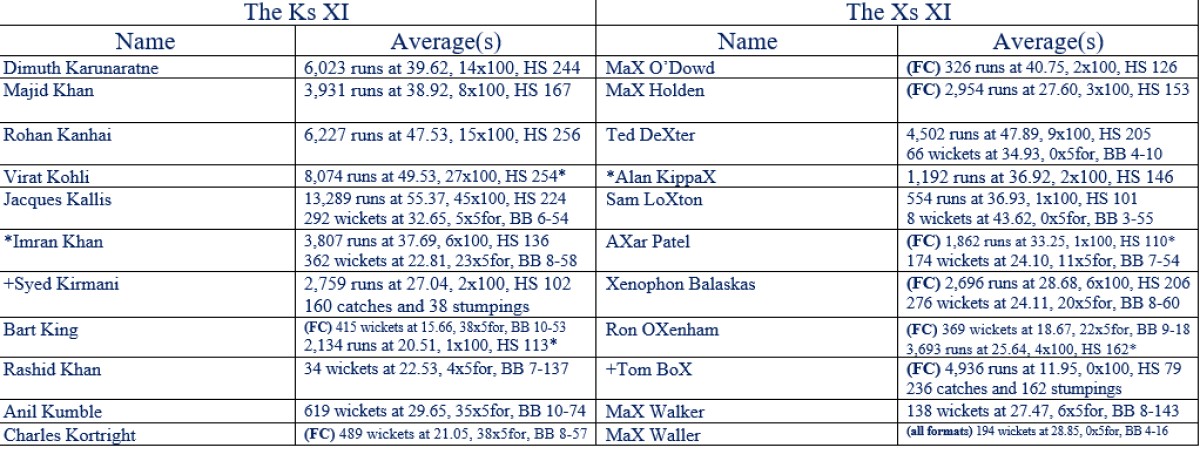
THE Ks V THE Xs

Apart from DeXter having a small advantage over Kanhai in the number three slot and BoX being the better keeper, and probably pretty close with the bat (Pilch, the best bat of BoX’s era averaged under 20) the Xs are thoroughly outclassed in all departments: Ks 5, Xs 0.

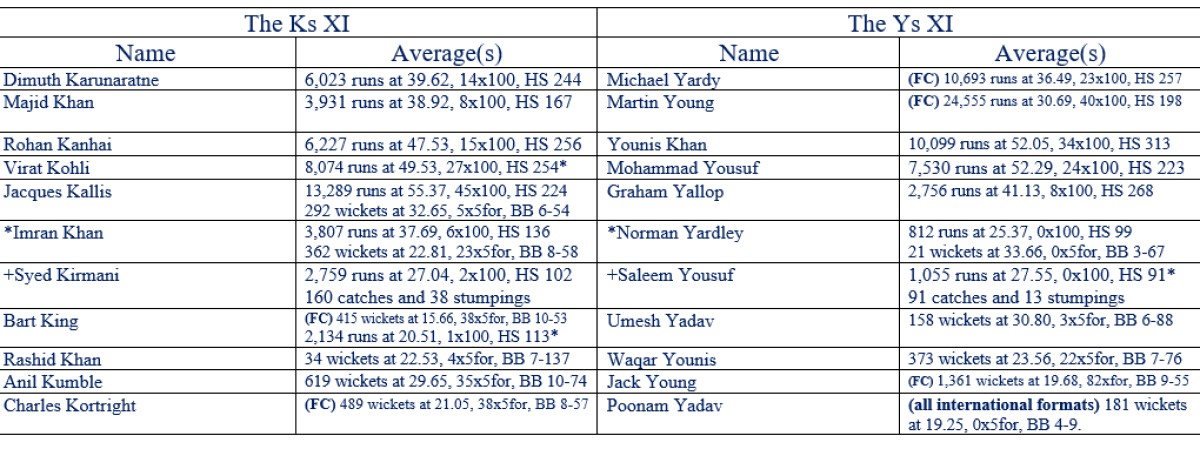
THE Ks V THE Ys

Only in the number three and four slots do the Ys have a definitive advantage over the Ks. The Ks have an overwhelming superiority in pace bowling, though the better balance of the Ys spin pairing just gives them that department their inferiority everywhere else means that the scoreline in unaffected: Ks 5, Ys 0.

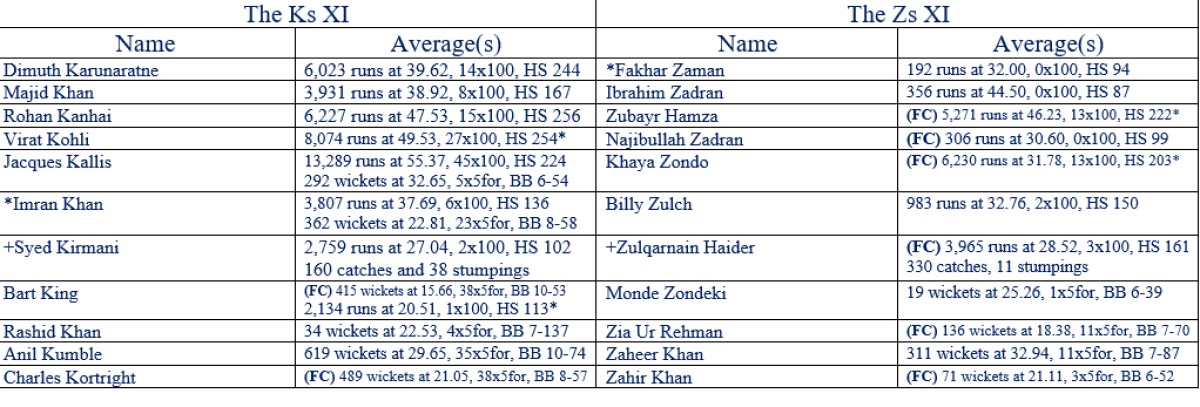
THE Ks V THE Zs

The Ks dominate this outright, with the Zs not even matching them anywhere: Ks 5, Zs 0.

THE Ks FINAL SCORE

The Ks have scored 22 of a possible 25 points today, meaning that they finish with 90 out of 125 points, 72% overall.

PHOTOGRAPHS

All Time XIs – Match Ups 43

Continuing my extended analysis of how the all time XIs I selected for each letter of the alphabet fare against one another.

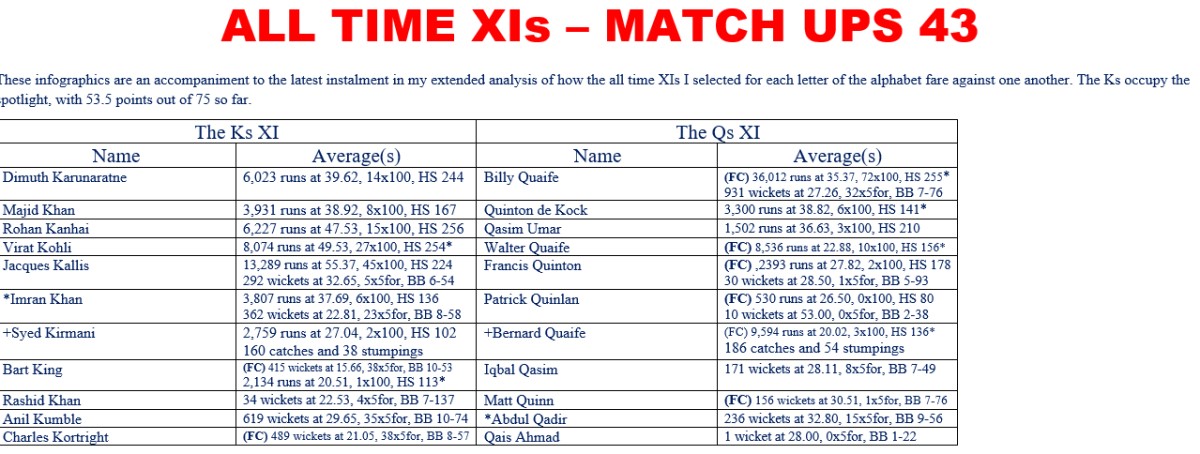
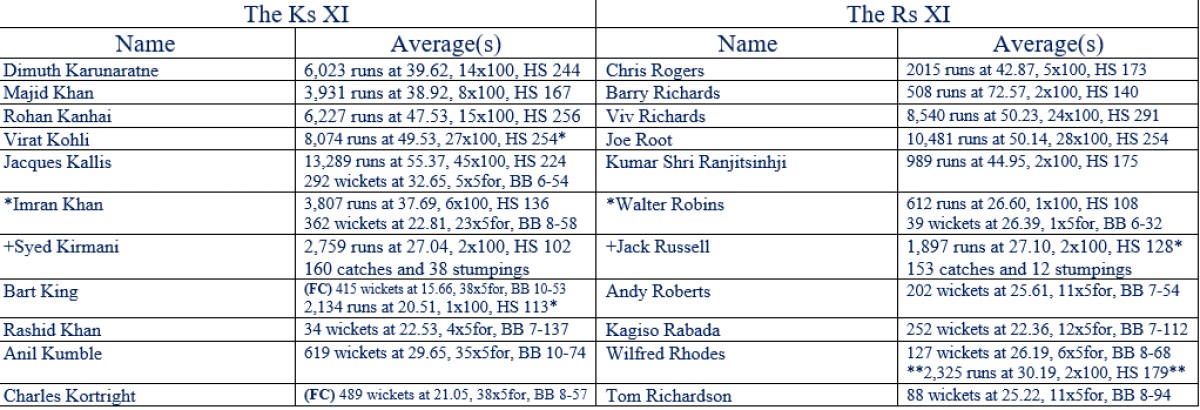
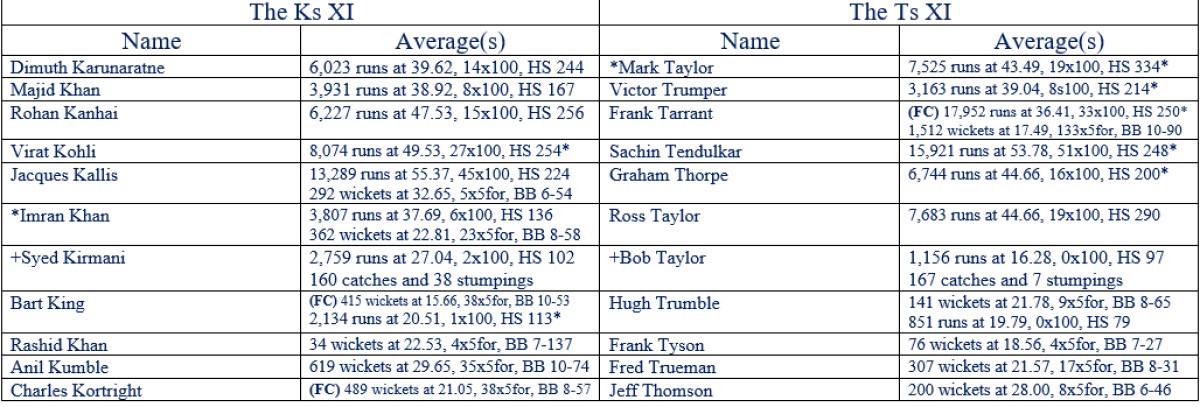
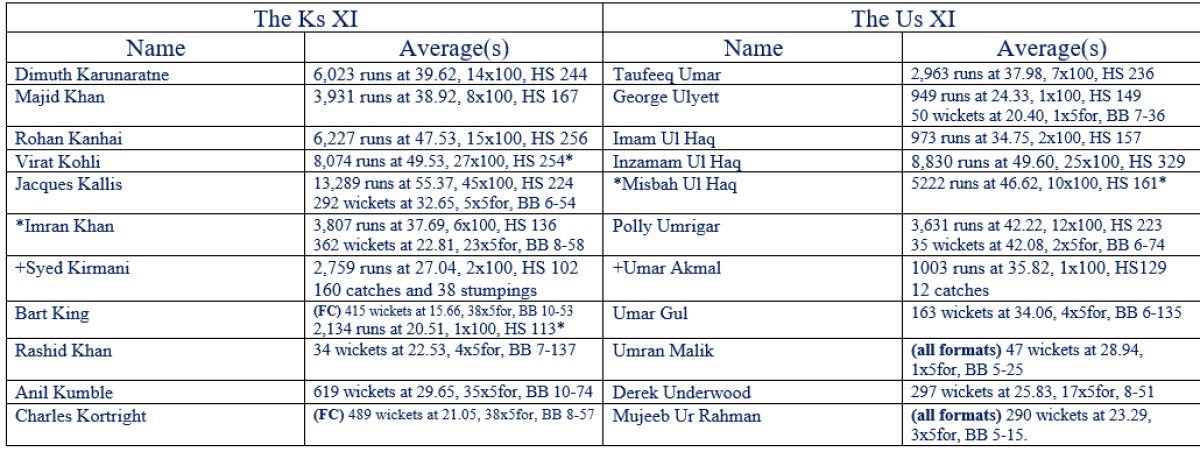
Welcome to the latest instalment in my extended analysis of how the all time XIs I selected for each letter of the alphabet fare against one another. The Ks continue to occupy the spotlight, and they come into today on 53.5 of a possible 75 points.

THE Ks V THE Qs

An easy one to start – the Ks boss all departments completely, and the Qs can do nothing to prevent the inevitable: Ks 5, Qs 0.

THE Ks V THE Rs

The Rs win the first four batting match ups (sorry India fans, Root has more runs, more centuries and a higher average than Kohli), though Kallis outranks Ranji and offers a bowling option. The Ks have the better all rounder, while both sides are excellently captained. The Rs have the finer keeper. Both sides have superb pace trios, the Rs possibly just the better. The Rs also have a small edge in spin bowling, with Rhodes and Robins being better balanced than the Ks two leg spinners. The Ks have a fourth seam option in Kallis, as against which the Rs have part time off spin available from Root or either Richards. In the end the sheer power of the Rs top batting, and their more varied bowling unit leads me to give them the verdict, just: Ks 2, Rs 3.

THE Ks V THE Ss

The Ss win the first four batting slots, narrowly lose the batting match up at five. Sobers beats I Khan with the bat, though the latter outranks G Smith as a captain. Kirmani wins the keeping match up, but Sangakkara as keeper gives the Ss a bonus pick – Stokes has no match up in the Ks ranks. Both sides have ace fast bowling trios, though the Ss have a small edge there in the form of Starc’s left arm. The Ss not only have Stokes as fourth seamer (he outranks Kallis the bowler), they also have the quicker version of Sobers as a fifth seam option, and a second left armed one. The Ks do have better spinners, but the Ss with Stevens leg spin, and Sobers in his slower guises cover every spin angle (left arm wrist spin is quite similar in angle to off spin). I think the Ss have this one quite comfortably, but the Ks would avoid a whitewash: Ks 1 Ss 4.

THE Ks V THE Ts

The Ts have the better opening pair, and by more than the figures suggest – Trumper played on some rough pitches and would undoubtedly average a lot more on 21st century surfaces. The Ks win the number three slot batting wise. Tendulkar wins the number four slot, Kallis the number five. Ross Taylor outbats I Khan but does not offer a bowling option. I Khan outranks Mark Taylor as a skipper. Bob Taylor wins the keeping match up. Trumble was a better spinner than either of the Ks two, and Frank Tarrant also ranks very high. The Ts pace trio is the fastest in this series, and they outrank the Ks for quality as well. The Ks of course have the Kallis factor on their side, but I do not think that is enough for them to win outright: Ks 2.5, Ts 2.5.

THE Ks V THE Us

The Ks win in all departments. It is just conceivable that Underwood and Ur Rahman would prove better than Kumble and R Khan on a turner, so I will score this as Ks 4, Us 1.

THE Ks PROGRESS

The Ks have scored 14.5 out of 25 today, putting them on 68 out of 100, 68% overall.

PHOTOGRAPHS

My usual sign off…

All Time XIs – Match Ups 38

Continuing my extended analysis of how the all time XIs I selected for each letter of the alphabet fare against one another.

Welcome to the latest installment in my extended analysis of how the all time XIs I selected for each letter of the alphabet fare against one another. Today sees the Is last four match ups, with that team currently on 11 out of 105 and then the Js take to the spotlight, of which more later. The T20 World Cup saw two cracking matches today – Sri Lanka won convincingly in the first match, and the India-Pakistan match was one of the most extraordinary matches ever seen. Pakistan scored 159-8 batting first, and India lost four early wickets in the reply before Virat Kohli and Hardik Pandya shared an excellent partnership. In the closing stages Pakistan had a problem – they had one of their minor bowlers, Mohammad Nawaz with one over still to bowl, and gambled on bowling the fast bowlers through first and leaving him with the 20th over. When India needed 28 with eight balls remaining it looked to have worked, but Kohli hit sixes off the last two balls of the 19th and Nawaz had ‘only’ 16 to defend rather than 20+. Things went well for Nawaz initially and India needed 13 off the last three balls, and then calamity struck for Nawaz – he bowled a no-ball which was clouted for six, and then his next delivery was called wide and suddenly it was five needed off three balls. By the time the last ball was due to be bowled scores were level, and Ashwin, on strike, kept a cool head and took India across the line. Kohli, who had recovered from an awful start (12* off 21 balls) to finish on 82* was the only candidate for Player of the Match.

THE Is V THE Ws

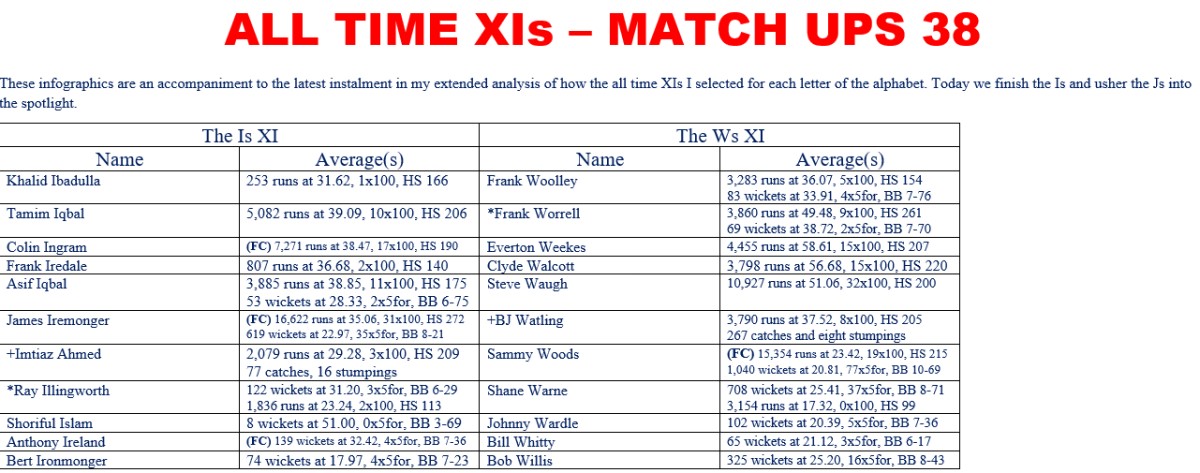
The Ws win the batting match ups all the way down to number six, have the better skipper, absolutely dominate on the fast bowling front, and even outdo the Is in spin bowling, the latter’s strongest suit. There can be only one score: Is 0, Ws 5.

THE Is V THE Xs

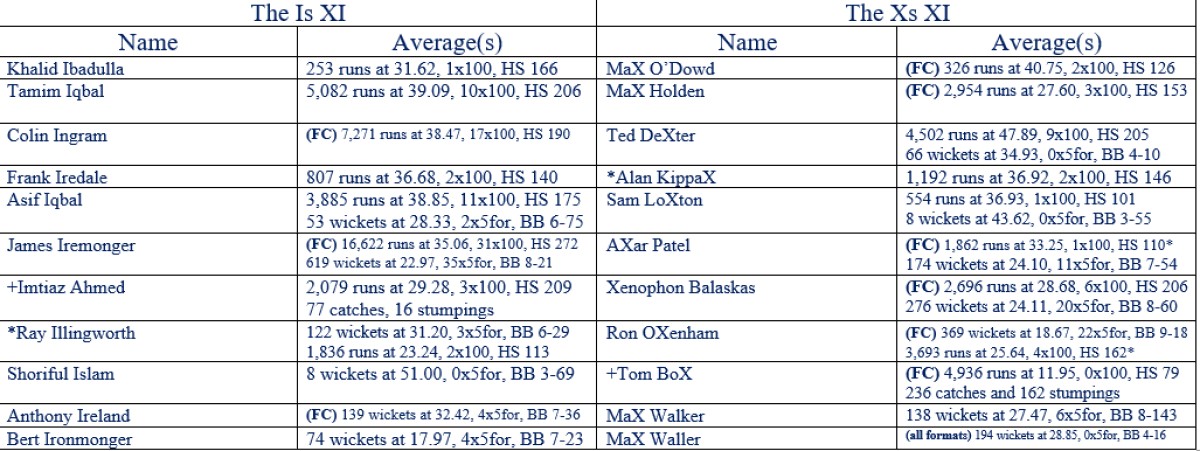
The Is are for once ahead on batting, neither side has much pace bowling, though MaX Walker is the best single practitioner on either side, and the Is are a bit ahead on spin bowling. As against that BoX claims the keeping honours and less far below Imtiaz Ahmed in batting than the figures suggest – the best batter of BoX’s era, Fuller Pilch, averaged less than 20 in FC cricket. This is a tough one to call, but I think the presence of MaX Walker just swings it the way of the Xs – Is 2, Xs 3.

THE Is V THE Ys

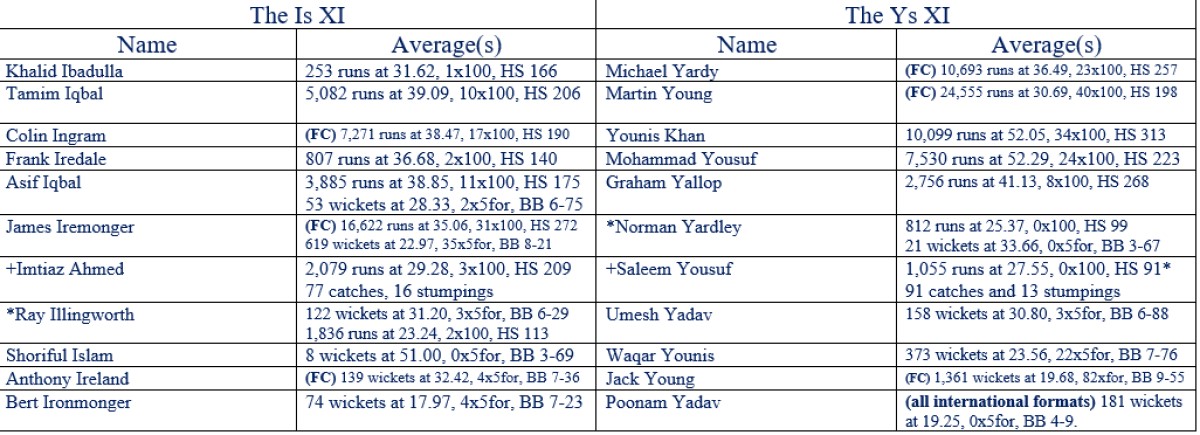
The Is have the better opening pair, with T Iqbal the class act of the four players concerned. The Ys win the 3,4 and 5 slots. Iremonger at six outranks Yardley in both departments, S Yousuf wins the keeping honours by more than Imtiaz Ahmed wins the batting order. The Ys dominate the bowling, with even their pace attack outranking that of the Is and the spin attack being of similar standards. I think the Ys are winning this quite comfortably: Is 1, Ys 4.

THE Is V THE Zs

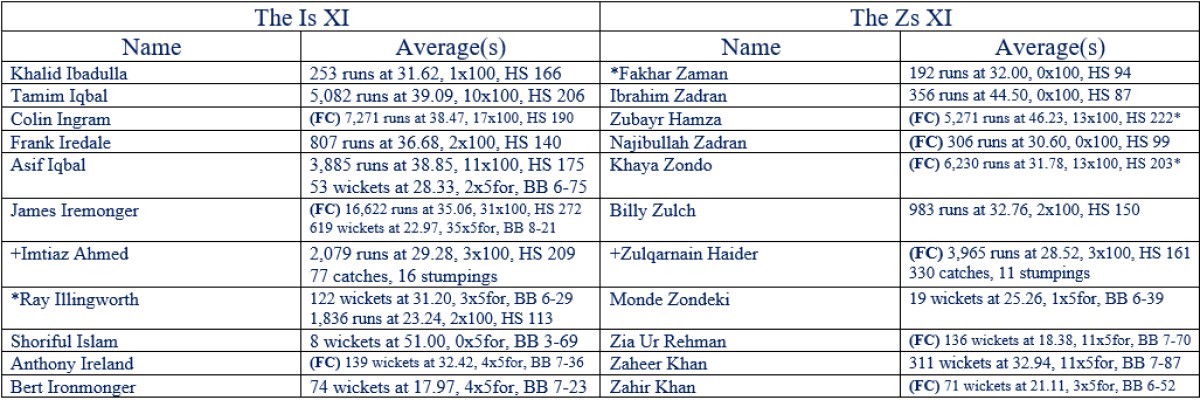
The Zs have marginally the stronger top six, but none of their front line bowlers can do anything significant with the bat. The Zs have the better new ball bowlers, the Is the better spinners. Illingworth rates higher as a skipper than Zaman. I think the all round skills of Iremonger and the higher standard of the Is spinners plus Illingworth’s captaincy swing it their way: Is 3, Zs 2.

THE Is FINAL RESULTS

The Is have scored 6 points out of 20 today and finish with 17 out of 125, 13.6% overall.

THE Js V THE Ks

The Js have 24.5 of a possible 45 points in the bank as they take the spotlight.

The Js have the better top three, the Ks are stronger batting wise in positions three through seven, but Jupp and Johnson partly compensate for that. The Ks have the better fast bowling, although the left arms of Johnson and Johnston give the Js extra variation. The Js with Jupp’s off spin, Jayasuriya and Johnston in his slower style have a better balance spin combo than the Ks. I think the Ks have this, but the Js are far from negligible: Js 2, Ks 3.

THE Js PROGRESS REPORT

The Js have 26.5 of a possible 55 points, 48.18%.

PHOTOGRAPHS

My usual sign off…

All Time XIs – Match Ups 28

Continuing my extended analysis of how the all time XIs I picked for each letter of the alphabet fare against one another. The Gs are now in the spotlight.

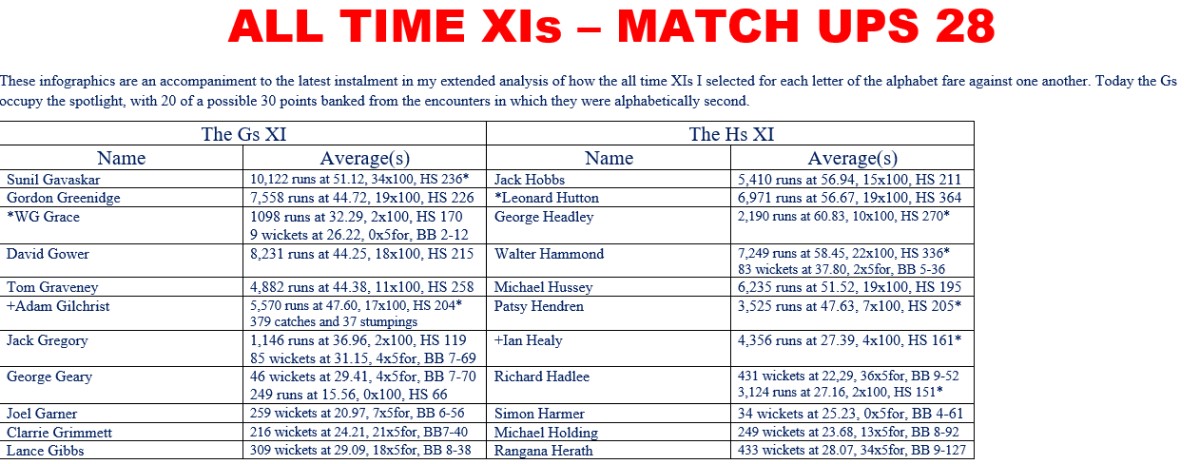
Welcome to the latest instalment in my extended analysis of how the all time XIs I selected for each letter of the alphabet fare against another. Today the Gs take centre stage, with 20 of a possible 30 points banked against the teams who are alphabetically ahead of them.

THE Gs V THE Hs

The Hs are one of the few teams to have a better opening pair than the Gs. George Headley is also the better number three, though not by as much as raw figures suggest – Grace was already 32 when he made his test debut and almost 51 by the end of his test career, and an average of 32 in that era is worth about 48 in later times when surfaces were by and large better for batting than in the Victorian era. Grace also outranks Hutton as a skipper. Hammond and M Hussey clearly outpoint Gower and Graveney. Gilchrist and Hendren is a draw batting wise, but the presence of Gilchrist at six indicates where the Gs strengths lie – their range of bowling options. Healy loses his batting match up against Gregory but wins the keeping match up against Gilchrist. Hadlee and Holding are a better new ball combo than Garner and Geary, but Gregory is a much better third seamer than Hammond who would play that role for the Hs. The Gs are clear of the Hs in the spin department, having the two best spinners in these squads. The Hs are stronger in batting and keeping, about even in fast bowling, behind in captaincy and way adrift in spin bowling. I don’t think that the Hs one definite advantage, in batting, will make up for the greater depth and variety of the Gs bowling (any attack in which Grace ranks sixth is exceptionally strong) and I also expect Grace’s superior captaincy to make itself felt. This is a titanic contest which I have the Gs shading – Gs 3, Hs 2.

THE Gs V THE Is

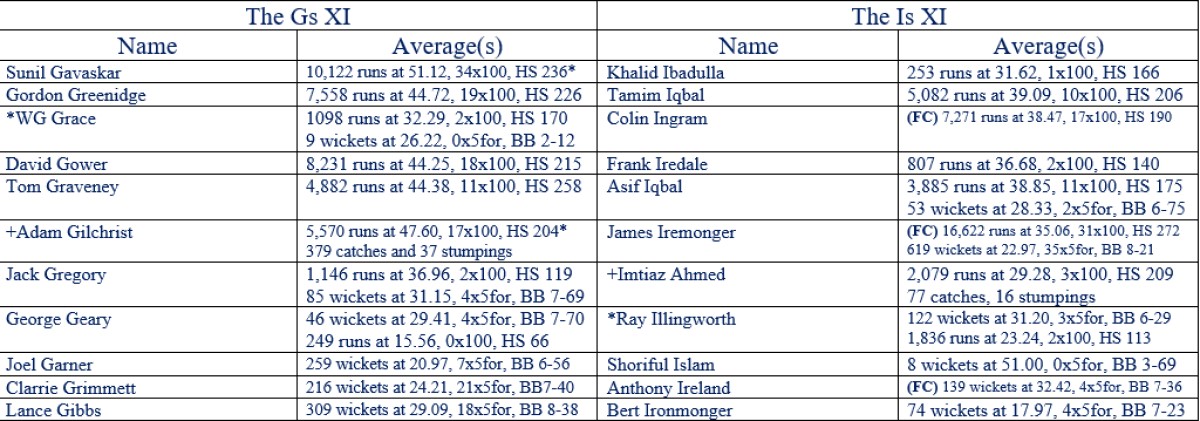
The Gs boss the batting, winning every match up in that department down to number seven. Wicket keeping honours are shared, with Gilchrist much the better batter. While acknowledging that Illingworth was a fine skipper I rate Grace ahead of him in that capacity. The Gs utterly dominate in pace bowling, and have the better spin attack though by less of a margin. This can have only one outcome: Gs 5, Is 0.

THE Gs V THE Js

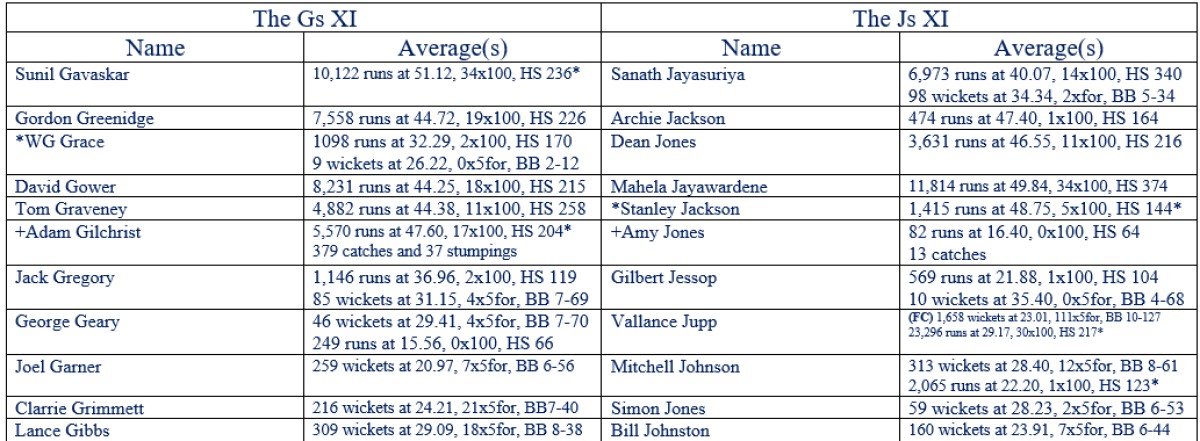
The Gs have the better opening pair without doubt. As I indicated in the match up with the Hs Grace’s average equates to about 48 in more recent times, including the era when D Jones batted, and he started his test career at an older age than would be ideal, so I give the Gs the number three slot as well. The Js win the number four and five slots, and FS Jackson and Grace is a clash of the titans captaincy wise. Gilchrist wins the batting element of the keepers match up though by less than the raw figures suggest, while A Jones is clear as keeper. Gregory outpoints Jessop. The Gs comfortably win the spin bowling – Gibbs rates above Jupp, and Grimmett is miles clear of Jayasuriya, and not even the spin element of Johnston’s bowling can close the gap. Pace bowling is close – the Js trio are 2nd, 3rd and 4th in the averages, with the Gs 1st, 5th and 6th. I think the Gs top order will make a better fist of handling the left arm rockets from Mitchell Johnson than the Js do of handling the awkward problem in £D geometry posed by Garner’s extreme height. If it reverse swings at any point S Jones would be particularly dangerous. I think the Gs are winning this with a degree of comfort and score it Gs 4, Js 1.

THE Gs V THE Ks

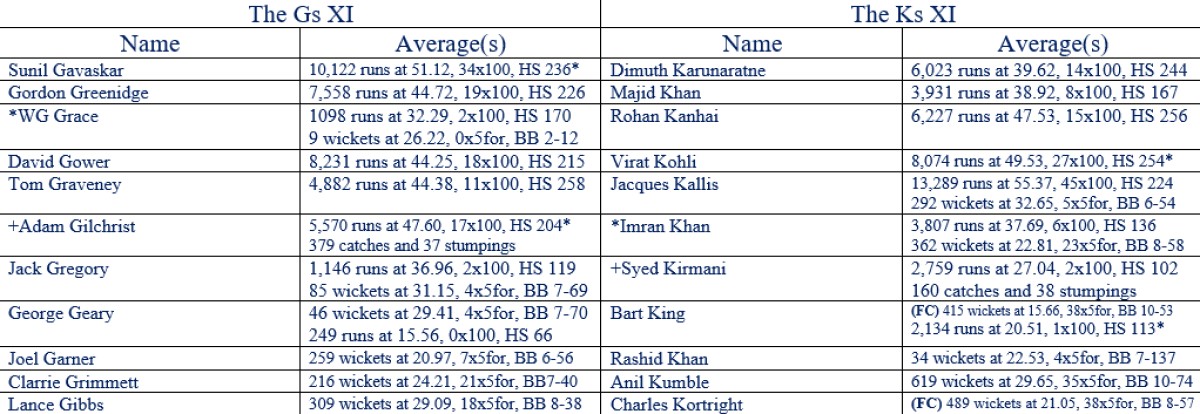
The Gs definitely have the better opening pair. I also give them the number three slot for reasons already explained, while Grace v I Khan is another clash of the titans captaincy wise. The Ks win the number four and five slots, though Gower’s left handedness (improving the balance of the batting order) and the more difficult conditions in which Graveney batted reduce the margins of superiority. Gilchrist is streets clear of Kirmani with the bat, but the Indian was the finer keeper. Imran Khan beats Gregory in both departments. Personally although neither got play test cricket (King was a USian – the best player that country has ever produced, while Kortright was in his prime during a very strong era for English cricket) I rate the Ks two specialist fast bowlers ahead of Garner and Geary, and also award King the number eight batting match up. The Gs spinners are better balance, being an off spinner and a leg spinner, which I think is enough to give them that department. I cannot pick a winner of this one: Gs 2.5, Ks 2.5.

THE Gs V THE Ls

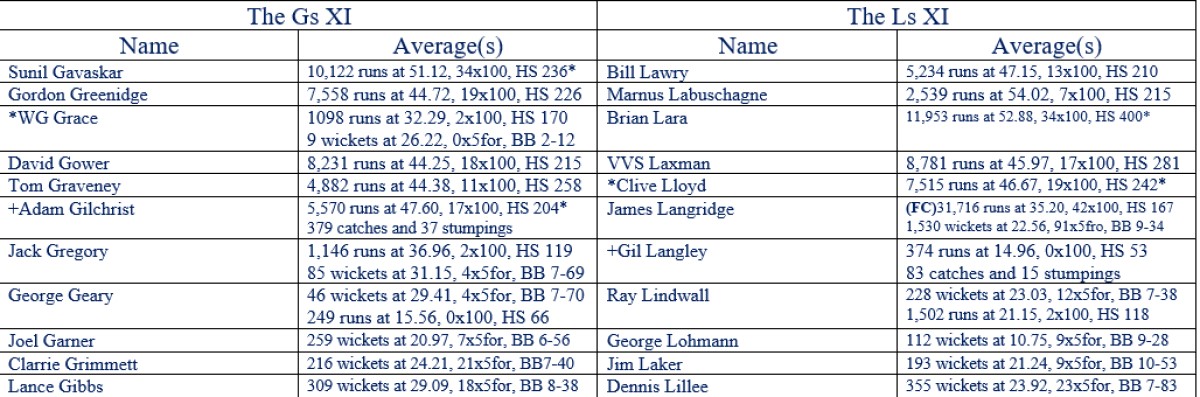
I think the Gs have the better opening combo (Labuschagne is playing out of position for the Ls), but the Ls win the number three slot (albeit by much less than the raw figures suggest). The Ls also win the number four and five slots. Gilchrist comfortably wins the keepers match up against Langley, the Ls have the better pace trio, but the Gs have the better spinners, Grimmett outperforming James Langridge more than Laker outperforms Gibbs. I just give this one to the Gs – Gs 3, Ls 2.

THE Gs SO FAR

The Gs have scored 17.5 out of 25 today, putting them on 37.5 out of 55 so far, 68.18% at the moment.

PHOTOGRAPHS

My usual sign off…

All Time XIs – Match Ups 24

Continuing my extended analysis of how the all time XIs I selected for each letter of the alphabet fare against one another. Pictures from Heritage Open Day.

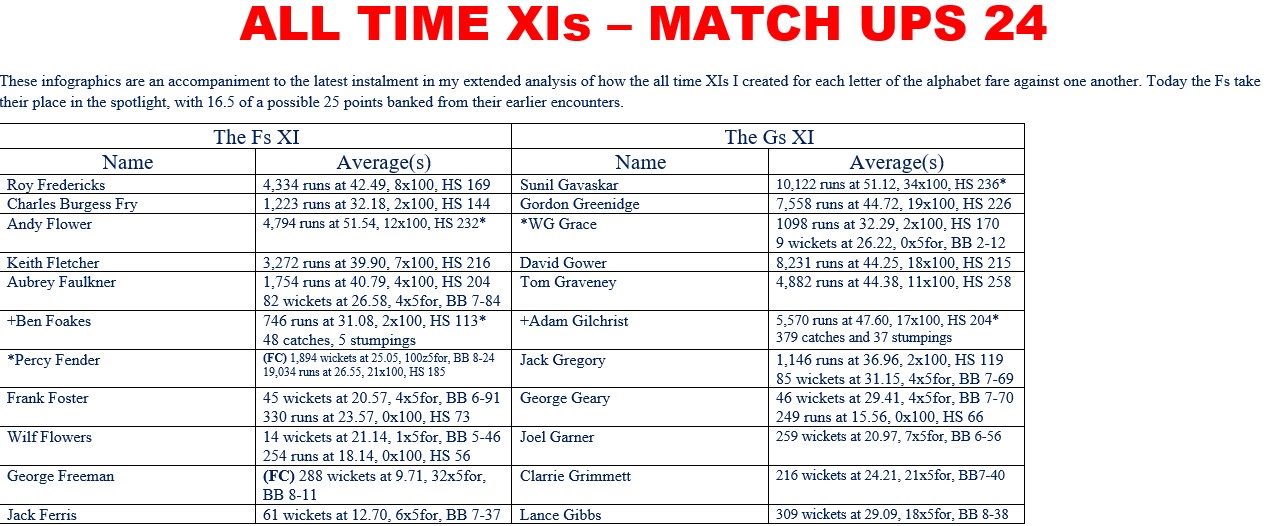
Welcome to the latest instalment in my extended analysis of how the all time XIs I selected for each letter of the alphabet fare against one another. The Fs take their place in the spotlight today, with 16.5 of a possible 25 points already banked. This post also comes with a two part picture gallery.

THE Fs V THE Gs

The Gs have the better opening pair, but not by as =much as raw figures make it look: Fredericks was left handed whereas both Gs openers are right handed, and also Fry’s average of 32 on early 20th century pitches is would equate to considerably more on modern pitches. Conversely Flower at number three outranks Grace the batter by a lot less than the figures suggest, and Grace also offers a genuine bowling option. Gower outranks Fletcher, but the difference in batting averages between Faulkner and Graveney is more than made up for by the different pitches they played on and the fact that Faulkner provides a bowling option. Gilchrist hugely outbats Foakes, though Foakes wins the keeping side of their match up. Fender and Grace were two of the greatest captains to feature in this series, and I just award Fender the laurels in this epic match up. The Fs have the better pace attack – of the Gs three pacers only Garner would merit a place in the Fs XI. George Freeman retired in 1875, to concentrate on his auctioneering business, and although he would undoubtedly have paid more per wicket on modern surfaces he would still have been utterly outstanding. Ferris’ test bowling average of 12.70 converts on my rough and ready scheme for Victorian to modern to someone averaging 19.05 today, while Foster the third seamer clearly outranks Gregory as a bowler. While Grimmett and Gibbs rank as the two best spinners in this contest, Flowers, Fender and Faulkner are a trio of genuinely front line options. The Gs do of course have Grace as their own extra bowling option. This is an epic contest, but I think the pace bowling resources of the Fs plus Fender’s captaincy tip the scales their way: Fs 3, Gs 2.

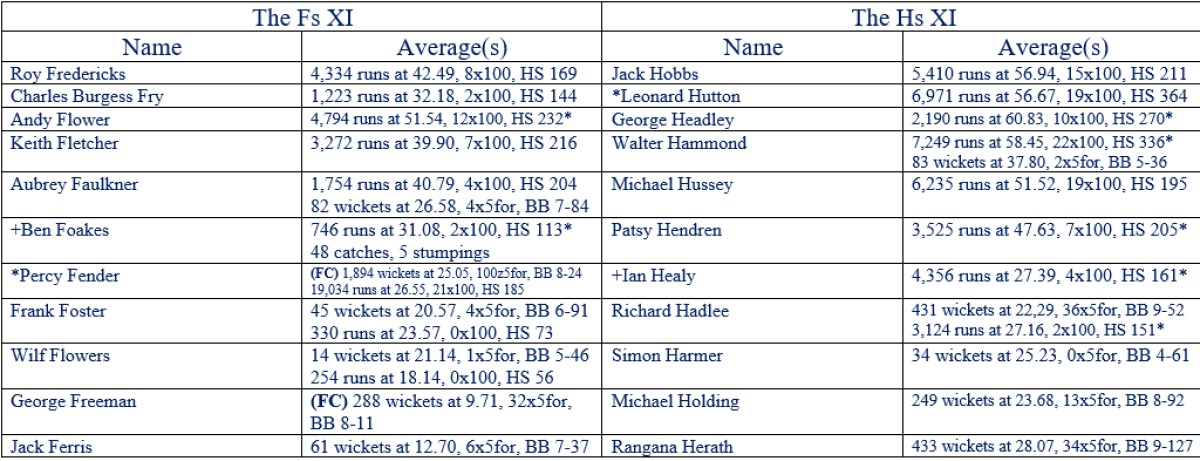
THE Fs V THE Hs

The Hs dominate the batting, winning every match up down to number eight in the order. However, the Fs have a massive advantage in the bowling department, with Hammond the H’s only back up bowler behind the front four. Holding and Hadlee might be a fair match for Freeman and Ferris, although Ferris’ left arm gives the Fs an extra point of difference, but Hammond the bowler is miles behind Foster. While I would give Harmer the verdict over Flowers, Fender and Faulkner both probably outrank Herath. Bowlers win more than batters, so I score this one Fs 3.5, Hs 1.5.

THE Fs V THE Is

This is a non-contest with the Fs dominating the batting, having the better skipper, the better keeper, far the better pace attack, being outpointed only in the spin department, and that not by nearly enough to affect the outcome: Fs 5, Is 0.

THE Fs V THE Js

The Fs have a clear advantage in this one as well, but less so than in the previous case. No team with the mercurial talents of Jayasuriya, Jessop and Mitchell Johnson available can be completely dismissed, so I score this Fs 4, Js 1.

THE Fs V THE Ks

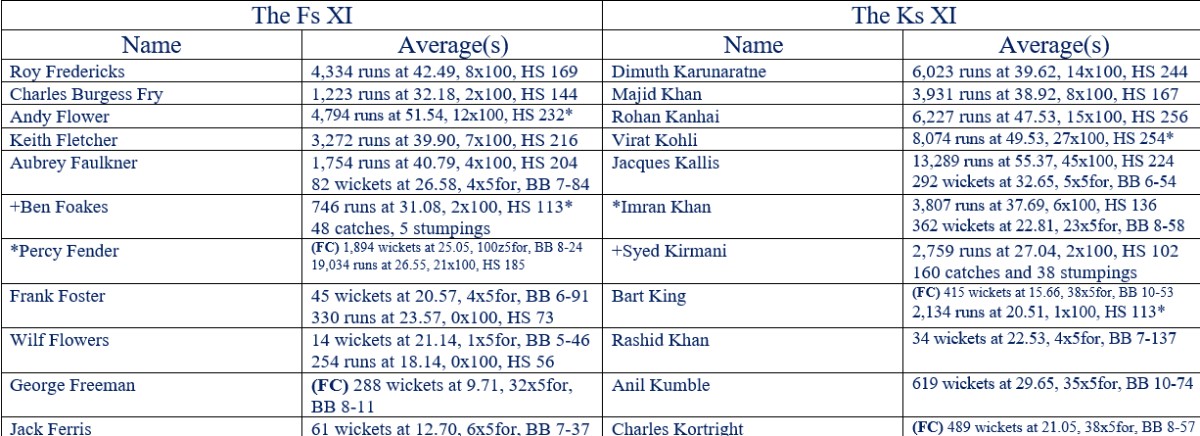
The Ks have the edge in batting, and they like the Fs have six authentic bowling options. The Fs are ahead in spin bowling with R Khan and Kumble both being leg spinners, whereas the Fs have an off spinner as well as their two leggies. The front line pace trios are very hard to separate, although all three of the Ks speedsters bowl right handed, so they lose on lack of variation. Kallis is his side’s sixth bowler, and I rate him less valuable to the cause in that department than Faulkner, his equivalent. There is very little between the captains, two of the best ever in that role. I think the slightly more varied bowling attack will just be enough for the Fs – Fs 3, Ks 2.

THE Fs PROGRESS REPORT

The Fs scored 18.5 of a possible 25 points today, putting them on 35 out of 50 so far, 70%.

PHOTOGRAPHS

Part one of today’s photographic selection features pictures taken while stewarding at Greenland Fishery during yesterday’s rescheduled Heritage Open Day (should have been the 11th, but the death of a ludicrously over privileged old lady necessitated a postponement and yesterday was the new day chosen. A number of stewards were not available for the new date, hence some of us being relocated (I was originally due to be at the Red Mount Chapel).

Part two of the photo gallery is some of my more typical photography….