Welcome to the latest instalment in my extended analysis of how the all time XIs I selected for each letter of the alphabet fare against one another. The Is occupy the spotlight, with 2.5 of a possible 55 points. Before getting to the main body of this post I pause to congratulate Ireland on a thumping nine-wicket win over the West Indies, a result which qualifies Ireland for the Super 12 stage of the T20 world cup and eliminates the West Indies.
THE Is V THE Ms
The Is have a small advantage in spin bowling, but the Ms are absolutely dominant everywhere else and there can be only one outcome: Is 0, Ms 5.
THE Is V THE Ns
The Is have a somewhat better batting line up than the Ns overall, the Ns have a much better pace attack, the Is have the better spinners. Nixon outranks Imtiaz in both departments, and I rate Noble a better captain than Illingworth. I think the Ns advantages in fast bowling and captaincy are the telling factors and score this Is 1.5, Ns 3.5.
THE Is V THE Os
Neither side is especially strong in batting, the Os have much the better pace bowling unit, a somewhat inferior spin attack, but much greater variation in their attack than the Is. The Os also have far the better keeper. I think the Os pace bowling settles the issue, but not by an emphatic margin: Is 2, Os 3.
THE Is V THE Ps
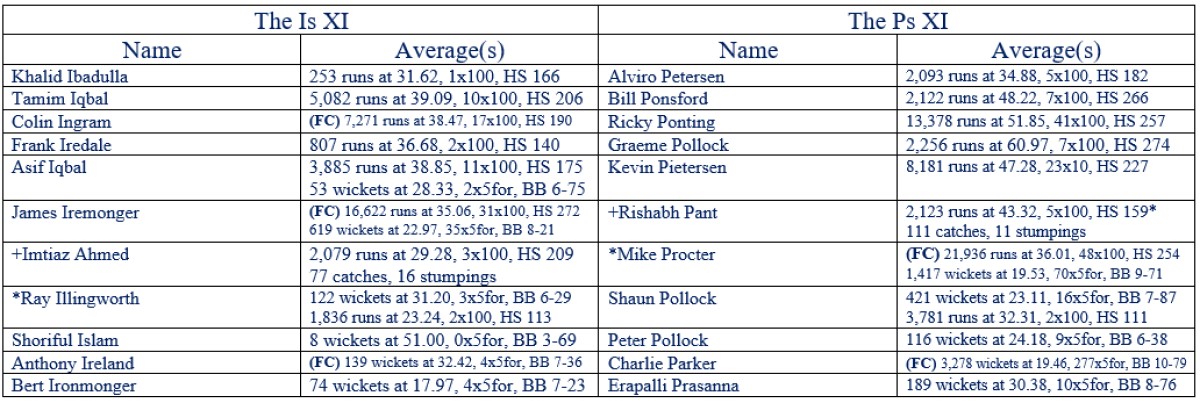
The Ps absolutely dominate in batting and pace bowling, have the better keeper and the better captain, and arguably win the spin bowling match ups as well – Prasanna definitely outranks Illingworth as an off spinner, while for all that the England selectors of the day treated him scurvily I would rate Parker ahead of Ironmonger as a left arm spinner. Thus I score this Is 0, Ps 5.
THE Is V THE Qs
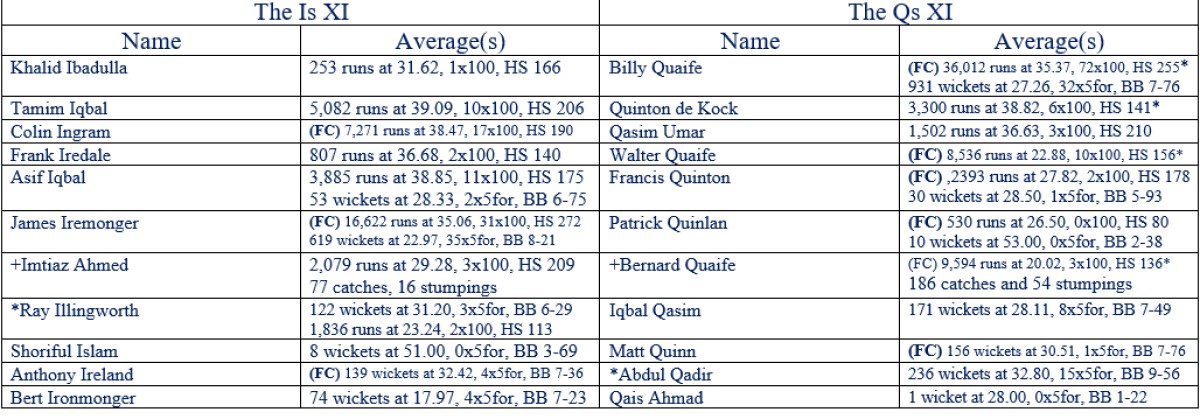
The Is a stronger in batting than the Qs, and they do actually have a seam attack, albeit a modest one, whereas the Qs have one accredited seamer. The Qs have the better spin attack, but I expect the Is to win this one comfortably: Is 4, Qs 1.
THE Is PROGRESS REPORT
The Is have scored 7.5 of a possible 25 points today, putting them on 10 out of 80 so far, 12.5%.
PHOTOGRAPHS
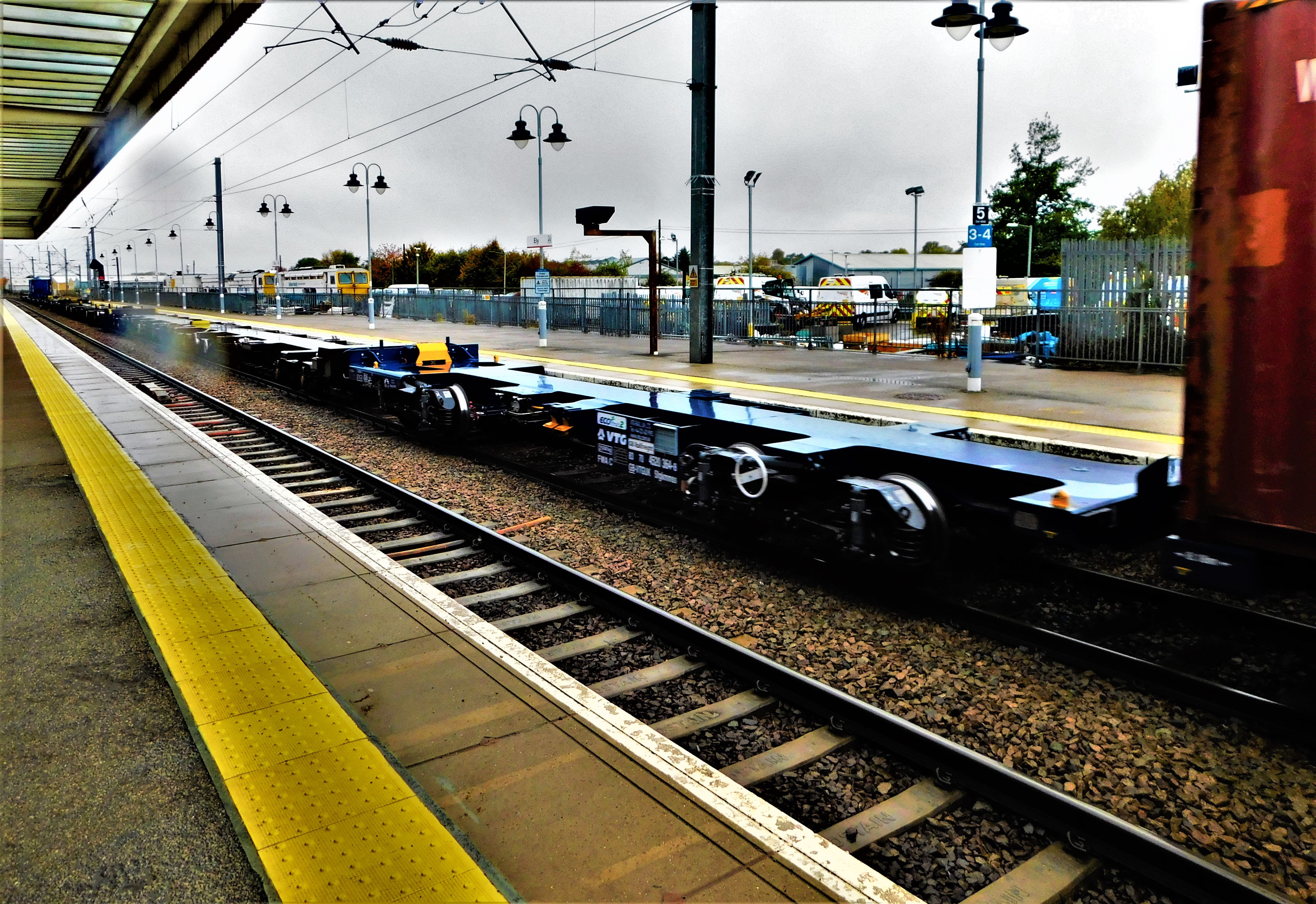
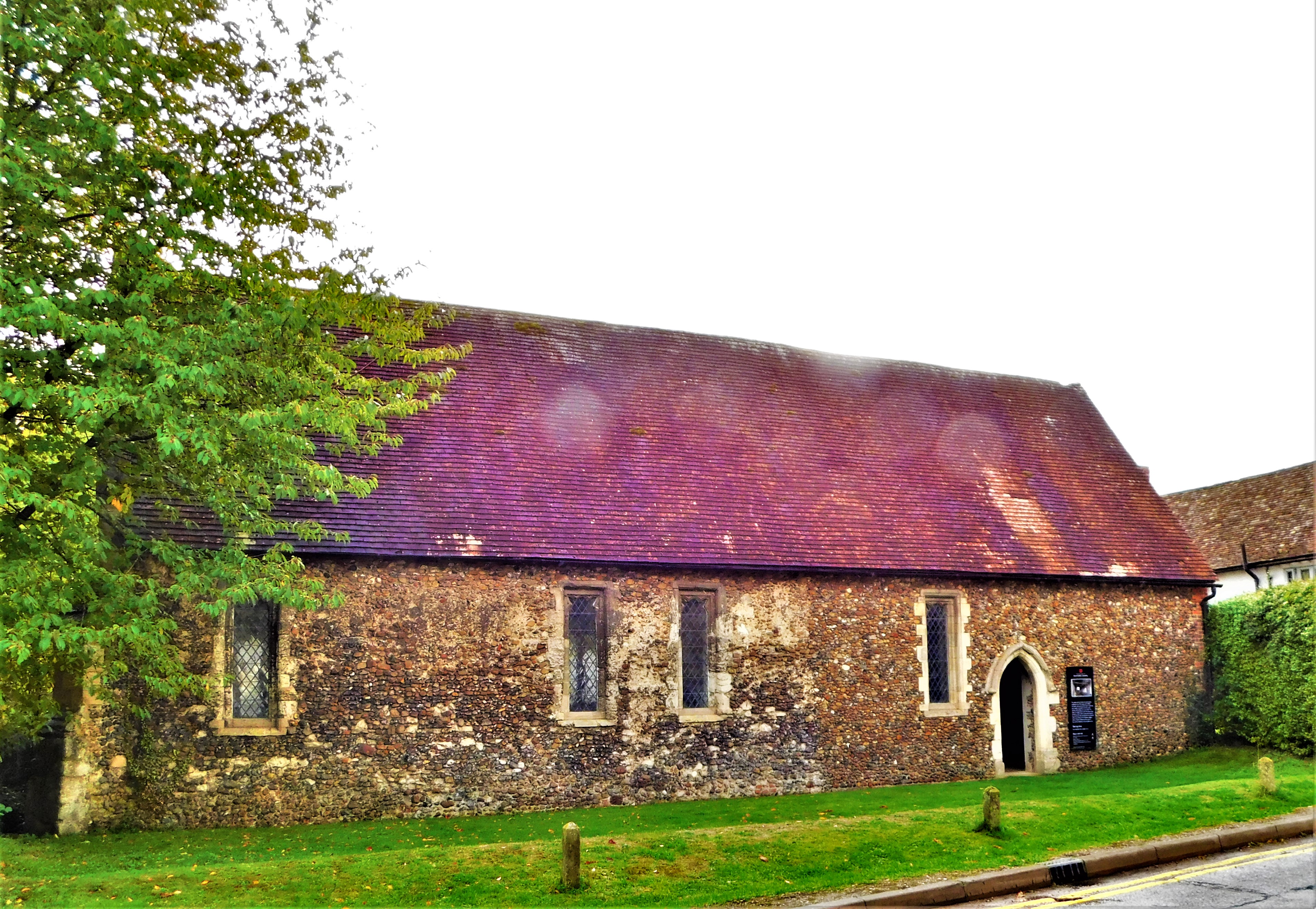
This is a somewhat different photo gallery. Yesterday I had to attend Sawston Health Centre in deepest Cambridgeshire for a CT scan. This entailed a 15-20 minute walk to King’s Lynn station, train to Ely, second train to Whittlesford Parkway, 25-30 mins walk from Whittlesford to Sawston, and similar in reverse save that I changed trains at Cambridge North on the homeward journey as the service I boarded at Whittlesford terminated there. Most of the photographs were taken at various stages of that journey…
Continuing my extended analysis of how the all time XIs I selected for each letter of the alphabet fare against each other.
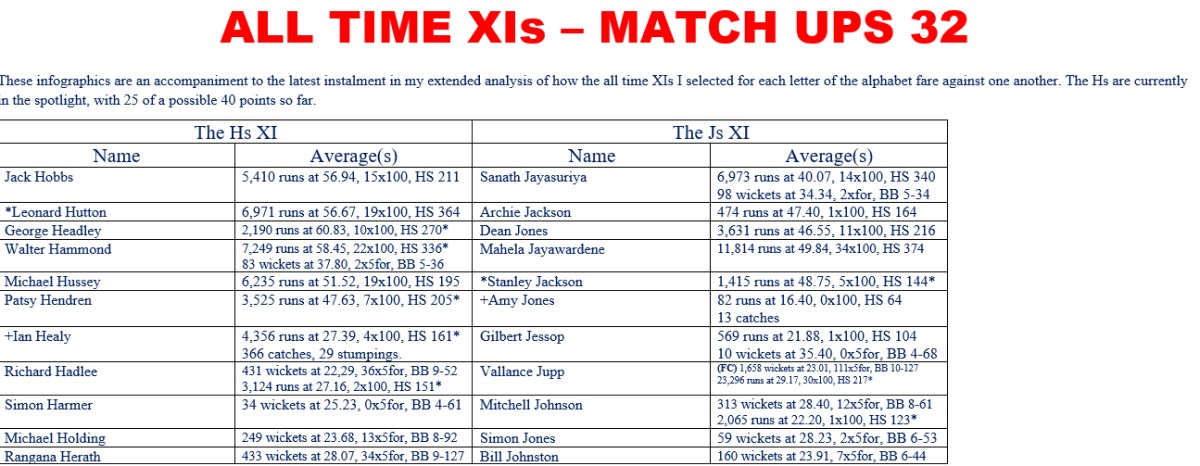
Welcome to the latest instalment in my extended analysis of how the all time XIs I selected for each letter of the alphabet fare against one another. Today the Hs occupy the spotlight and they have 25 of a possible 40 points so far.
THE Hs V THE Js
The Hs as usual boss the batting. Jackson outranks fellow Yorkie Hutton as a skipper. The keeping match up is a close one, the Js have the better seam/ pace attack, but the Hs have the better spin attack. I think the Hs have enough to win this one, but it is by no means conclusive: Hs 3, Js 2.
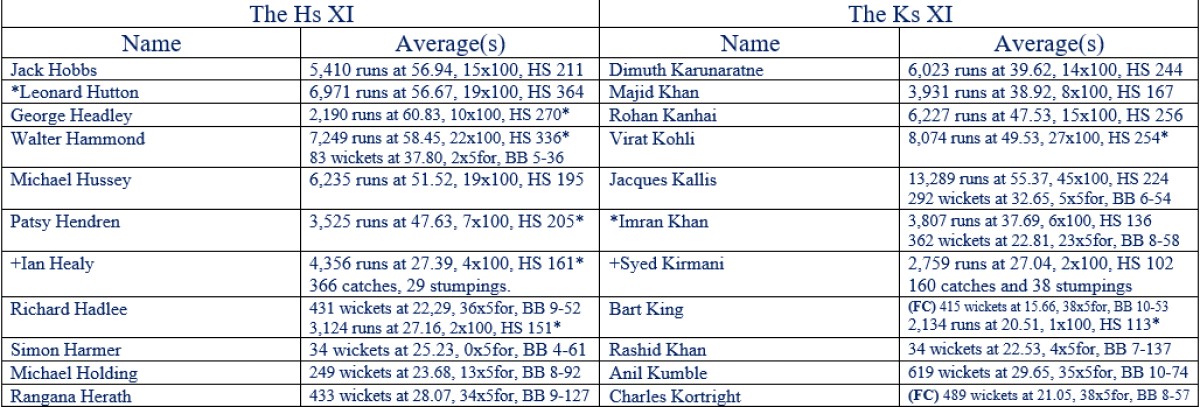
THE Hs V THE Ks
The Hs are well ahead in batting – only Kallis in the top six wins a batting match up for the Ks. The battle of the keepers is close, I Khan outranks Hutton as a skipper. The Ks have much the better pace attack, with their fourth seamer, Kallis, outranking Hammond as a bowler. As against that the Hs spin attack is better balanced. I think the Ks have this and score it: Hs 2, Ks 3.
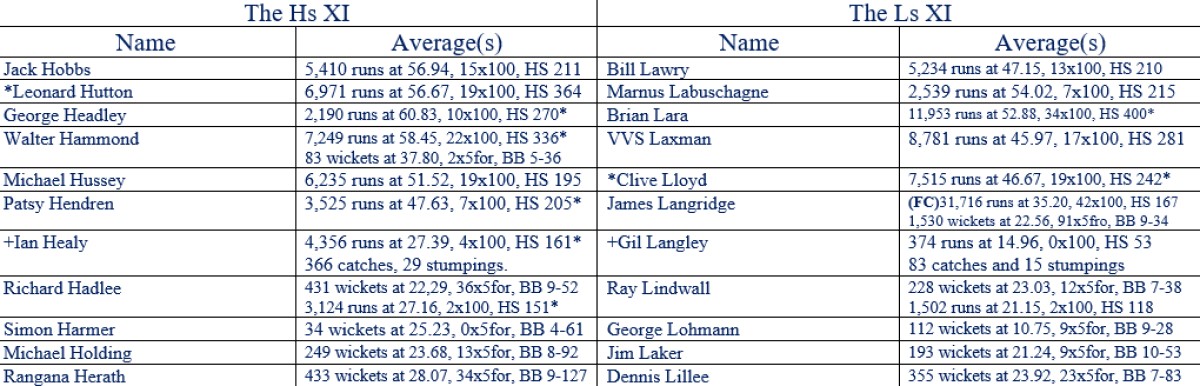
THE Hs V THE Ls
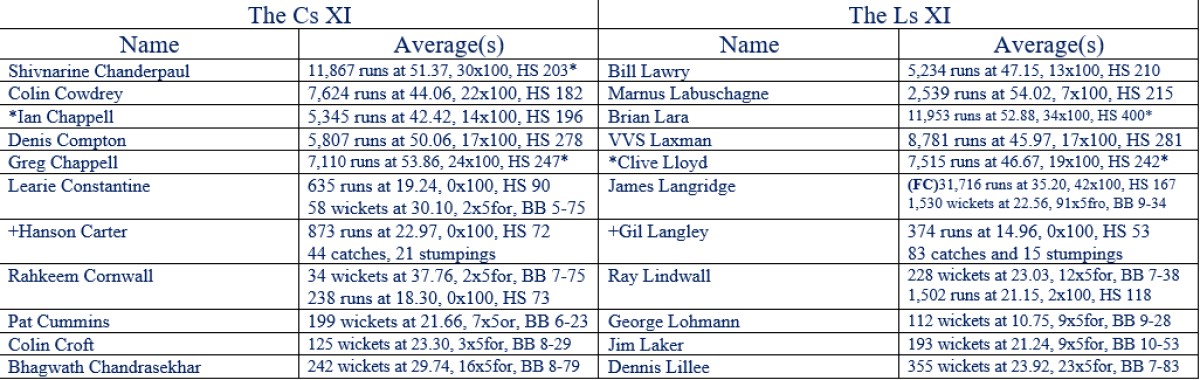
The Hs win the batting and keeping elements of this match up, but lose on captaincy, pace bowling and off spin (sorry, Harmer fans, I cannot rank him as even Laker’s equal in that department). Langridge is outranked as a left arm spinner by Herath. I think the Ls bowling is settling this one and I see them winning comfortably: Hs 1, Ls 4
THE Hs V THE Ms
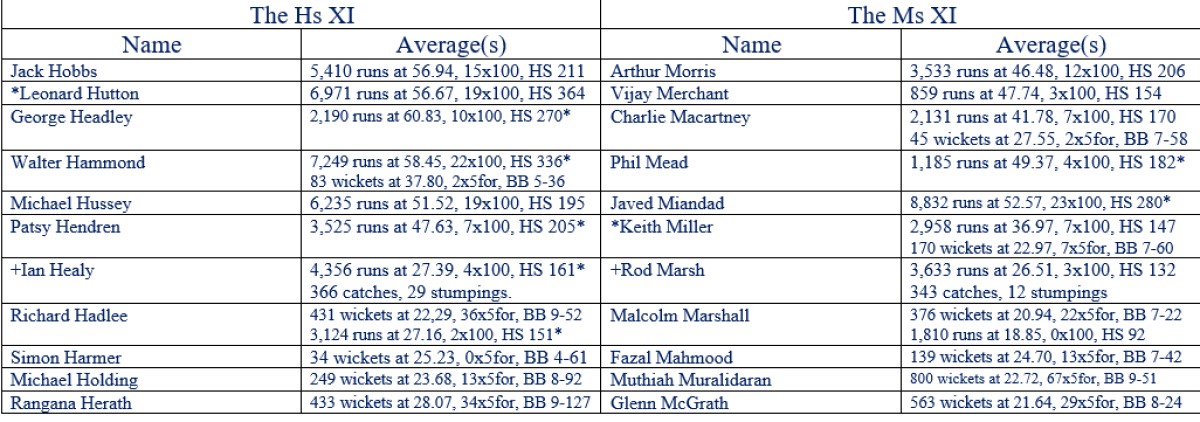
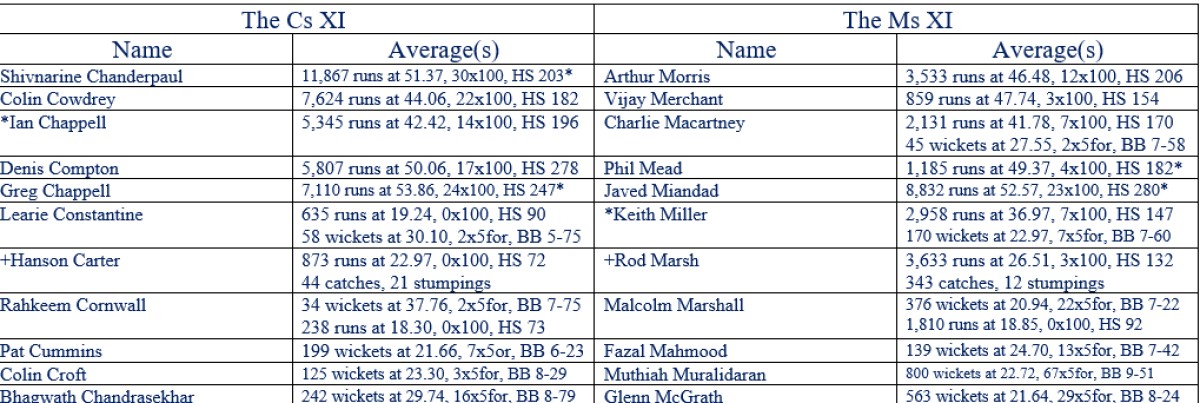
The Hs have the better batting, the keeping situation is a clash of titans, the Ms absolutely boss the pace bowling, and Murali is the best individual spinner in the contest. While Macartney, the Ms sixth bowler, is not on a par with Herath, Mahmood’s facility with the leg cutter somewhat closes that gulf. Ms are winning this comfortably: Hs 1, Ms 4.
THE Hs V THE Ns
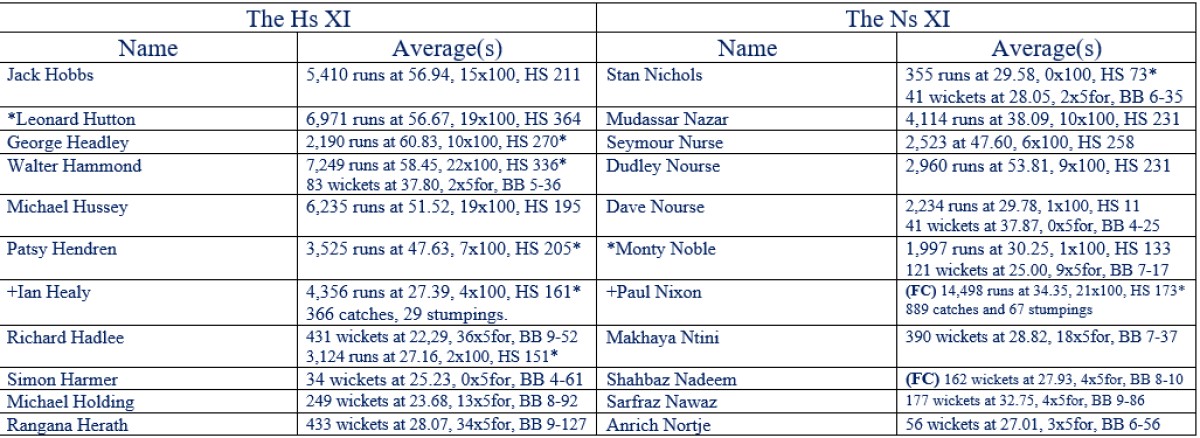
The Hs as usual dominate the batting, though Noble outranks Hutton as a skipper. The Ns have a numerical superiority in the seam department, but none of their seamers are a match for either Holding or Hadlee. Harmer clearly outranks Noble as a bowler, and Herath is even further clear of Nadeem, giving the Hs a huge advantage in spin bowling. The Hs are winning this one comfortably – Hs 4, Ns 1.
THE Hs PROGRESS UPDATE
The Hs have scored 11 of a possible 25 points today, moving on to 36 out of a possible 65, 55.38% at the moment.
Continuing my extended analysis of how the all time XIs I created for each letter of the alphabet fare against one another.
Welcome to the continuation of my extended analysis of how the all time XIs I picked for each letter of the alphabet fare against one another. The Ds continue to occupy the hot seat, and come into today with 24 of a possible 55 points.
THE Ds V THE Ms
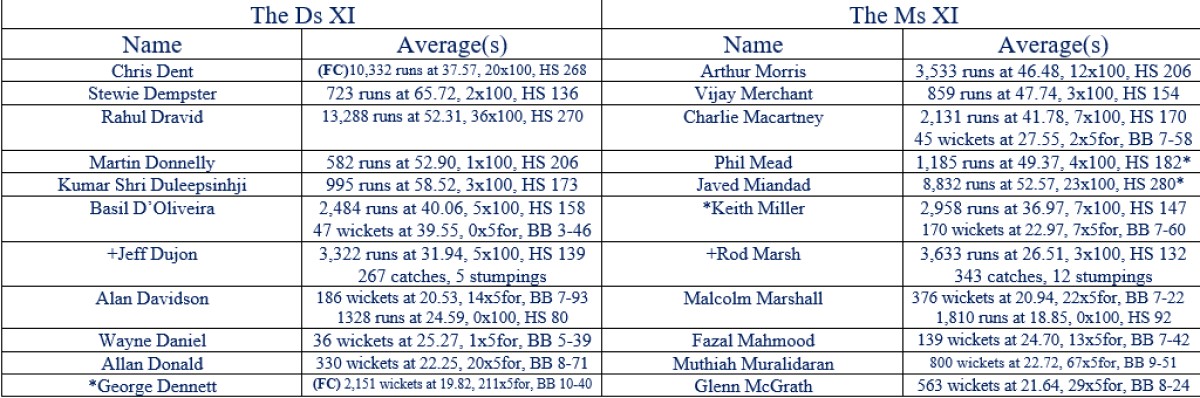
Morris beats Dent, Dempster beats Merchant, Dravid is massively ahead of Macartney on batting but Macartney offers an extra bowling option for the Ms, Mead and Donnelly is a close contest between two very different left handers, Duleepsinhji’s average is six an innings better than Miandad’s, but Miandad’s came over many more innings. D’Oliveira outbats Miller, but the Aussie was far the better bowler. Dujon outbats Marsh, while both were superb keepers. Marshall, McGrath and Mahmood are at least the equals of Davidson, Donald and Daniel, and Muralidaran beats Dennett. The Ds are somewhat ahead on batting but the Ms are miles ahead in bowling and it is this latter I expect to settle the issue, to the extent that I cannot see any circumstances in which the Ds get the better of the Ms: Ds 0, Ms 5.
THE Ds V THE Ns
The Ds are far clear in batting, with only Dudley Nourse of the Ns top eight winning their match up in this regard. The Ds also win the front line bowlingm with Ntini, Nawaz and Nortje clearly outgunned by Davidson, Donald and Daniel in the seam/pace department and Nadeem probably outpointed by Dennett. Dujon has Nixon covered in both departments. The Ns have one advantage – their back up bowling is much better, with Noble having no match among the Ds, and Nichols clearly superior to D’Oliveira as fourth seamer. However, the back up bowlers would only come in to play on a very flat wicket, so I give the Ds a conclusive advantage: Ds 4, Ns 1.
THE Ds V THE Os
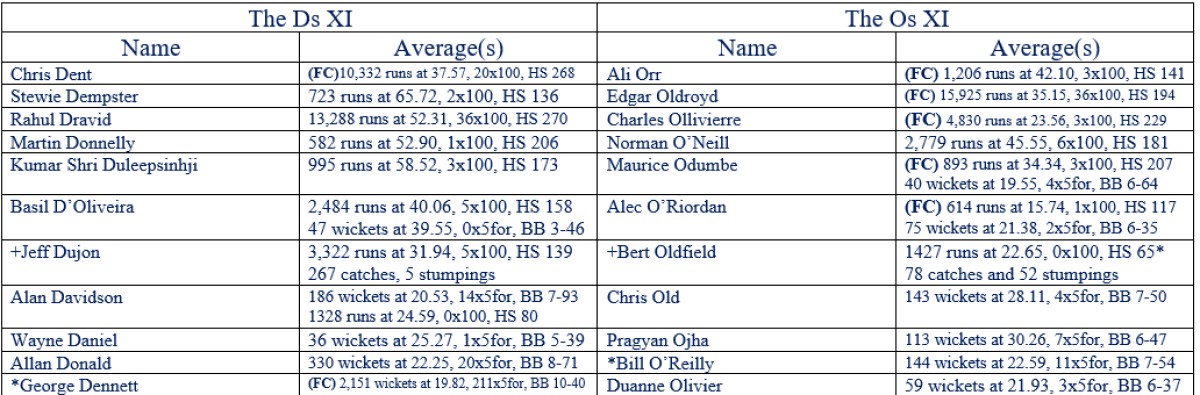
The Ds dominate this one, but the Os are saved from a wipe out by the fact that they are ahead in the spin bowling department and would win on a turner. Ds 4, Os 1.
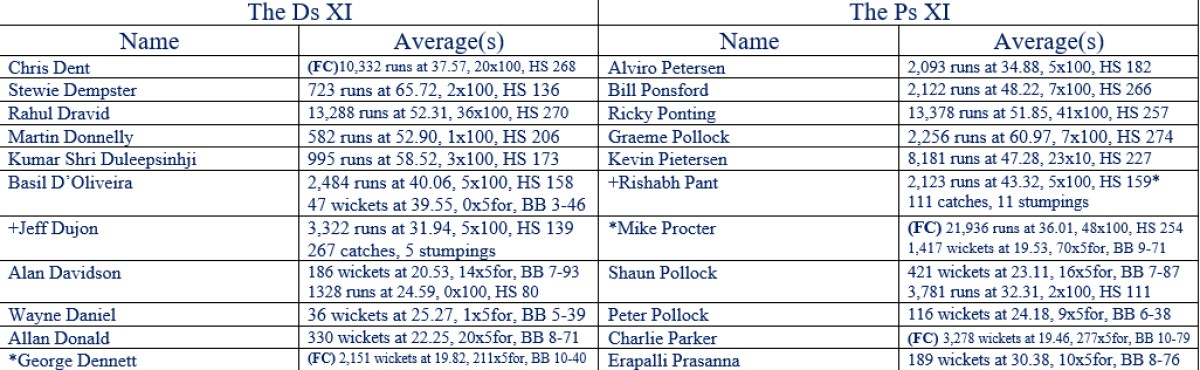
THE Ds V THE Ps
The Ds have the better opening pair, the number three slot is a titanic clash. G Pollock wins the number four slot comfortably, while Pietersen’s disadvantage vs Duleepsinhji is somewhat offset by the much larger sample size on which his test record is based. While D’Oliveira outbats Procter, Procter outbowls his opposite number. Pant comfortably outbats Dujon, but the West Indian was probably the better keeper. S and P Pollock keep the pace clash close, Parker marginally beats Dennett, and Prasanna gives the Ps an extra spinner. I think the Ps are better balanced, and better skippered with Procter in charge and I expect that to make the difference: Ds 2, Ps 3.
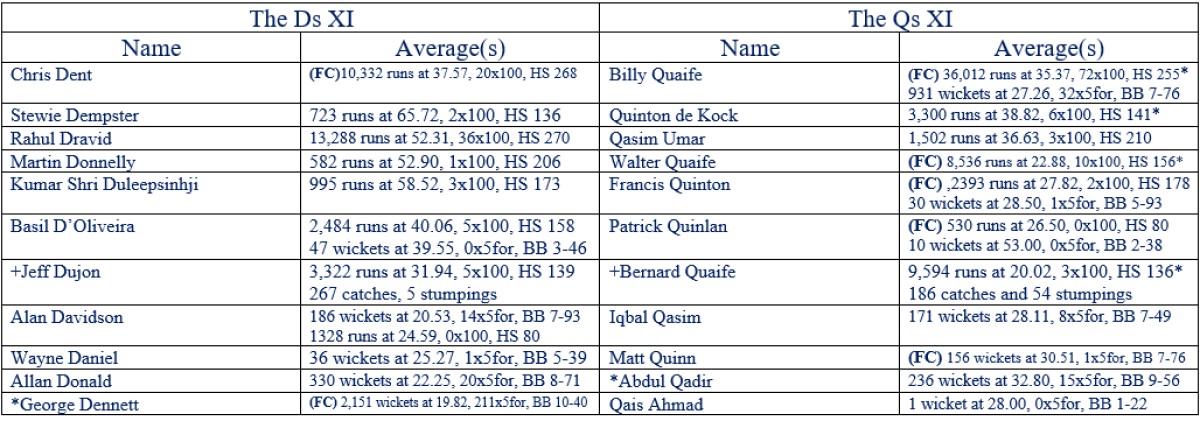
THE Ds V THE Qs
The Ds dominate the batting and the pace/seam bowling, but the Qs would be able to bowl spin from both ends should the pitch offer turn, and this is just enough to save them from a whitewash: Ds 4, Qs 1.
THE Ds PROGRESS UPDATE
The Ds have scored 14 of a possible 25 today, putting them on 38 out of 80 so far, 47.5%. They are behind the As and the Bs but ahead of the Cs.
Continuing my analysis of how the all time XIs I have created for each legtter of the alphabet fare against each other. Also a two part photo gallery.
Welcome to the latest post in my series analysing how the all time XIs I created for each letter of the alphabet fare against one another. The Cs are in the hot seat today, starting with 10.5 of a possible 40 points.
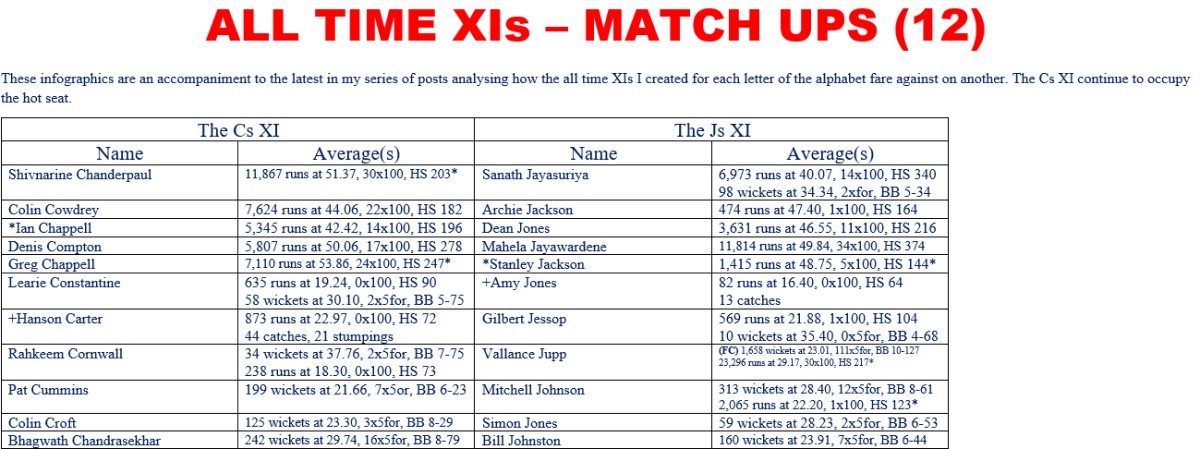
THE Cs V THE Js
The Cs have a theoretical advantage when it comes to the opening pair, but the Js openers were both regular openers, the Cs not so. The Js win the number three slot, narrowly lose the number four slot and lose the number five slot, though Stanley Jackson holds his own as skipper with Chappelli. Jones wins the battle of the keepers against Carter. The battle of the explosive all rounders between Constantine and Jessop is great clash, though based on their FC records, and Jessop’s famous innings at The Oval in 1902 I would say Jessop has the higher ceiling. Vallance Jupp outperforms Cornwall in both departments. While Cummins and Croft beat Johnston and S Jones as a new ball combo, Johnson is miles better as third seamer than Constantine, and the Js have back ups in the form of Jessop and FS Jackson better than any available to the Cs. Jayasuriya was not nearly as good a bowler as Chandrasekhar but Jupp’s superiority over Cornwall and Johnston’s ability to bowl spin at need more than counterbalance that issue. I score this as Cs 1, Js 4.
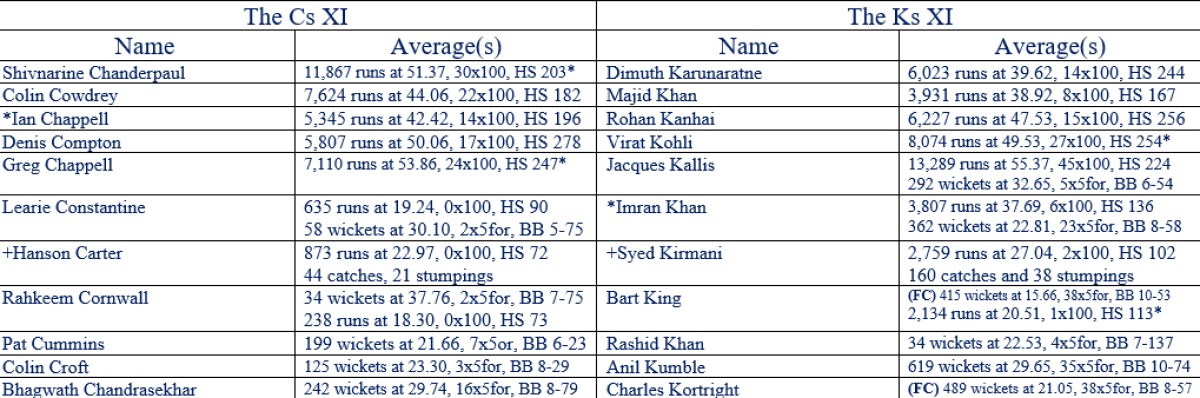
THE Cs V THE Ks
The Cs outpoint the Ks in the 1,2 and 4 batting slots, while the Ks win numbers 3 and 5. Imran Khan comfortably outpoints Constantine at six. Kirmani wins the clash of the keepers. King and Kortright are certainly a match for Cummins and Croft, with Imran a far better third seamer than Constantine, and Kallis available as further back up in that department for the Ks. Rashid Khan and Anil Kumble are sufficiently different in method to make up for the fact that both bowl leg spin. Kumble outranks Chandrasekhar if only because he achieved his figures over many more matches, and Rashid Khan is well ahead of Rahkeem Cornwall as a bowler. The Cs have a marginal advantage in front line batting, but that is well and truly obliterated by the all round skills of Imran Khan, Syed Kirmani, Bart King and Rashid Khan. In bowling the Ks win comprehensively and that leads to my score: Cs 0, Ks 5.
THE Cs V THE Ls
The Ls are ahead with the opening pair, especially since Lawry was the only regular opener among the four players involved. Lara comfortably beats Chappelli in the number three slot, Compton beats Laxman, G Chappell beats Lloyd, while Lloyd matches Chappelli on captaincy. Langridge wins the number six slot comfortably, Carter wins the battle of the keepers. Lindwall and Lillee are a good match for Cummins and Croft as a new ball pairing, Lohmann is a country mile clear of Constantine as third seamer, Laker as a bowler is way ahead of Cornwall, and Langridge is not far behind Chandrasekhar in that department. The Cs have an advantage in the top line batting slots, but the Ls win the bowling comfortably: Cs 1, Ls 4.
THE Cs V THE Ms
In theory the opening pairs are about equal, but in practice Morris and Merchant were both regular openers, whereas Chanderpaul and Cowdrey weren’t, and also Merchant achieved his test figures in a career that was dispersed over a long period of time, and his FC average of 71 suggests he was a better batter than his test record suggests. Chappelli is ahead of Macartney in the number three slot but only just. Compton outpoints Mead, but again not by much. G Chappell is similarly a fraction ahead of Miandad. Miller is far ahead of Constantine in the battle of the all rounders, though Chappelli outpoints him as skipper, Marsh comfortably outpoints Carter in the battle of the keepers. Marshall and McGrath are clear of Cummins and Croft as a new ball pairing, Fazal Mahmood is far clear of Constantine as third seamer, and with Miller also available in that department. Murali is far clear of Cornwall as an off spinner and while Macartney’s left arm spin is not the equal of Chandrasekhar’s leg spin he was once a match winner for his country with it. Add to that the fact that Fazal Mahmood was a master of the leg cutter and that Miller could switch to off breaks at need, and the Ms dominate the spin department as much as they dominate the pace department: Cs 0, Ms 5.
THE Cs V THE Ns
The Cs unequivocally win on opening pairs. Nurse beats Chappelli in the number three slot. Dudley Nourse beats Compton in the number four slot, but Dave Nourse comes a very distant second with the bat to G Chappell. Monty Noble wins the battle of the all rounders against Constantine, and matches Chappelli on captaincy. Nixon was better with the bat than Carter, but the Yorkshire born Aussie was probably the finer keeper. Cummins and Croft beat Ntini and Nortje as a new ball pair, but the back up options the Ns have in this department, Sarfraz Nawaz and Stan Nichols outweigh Constantine. While Noble outdoes Cornwall as an off spinner, Chandrasekhar comfortably outpoints Nadeem. The Cs are ahead on batting, behind on pace bowling and about even on spin bowling. I think the Ns bowling guns settle this in their favour but not by much: Cs 2, Ns 3.
Cs PROGRESS UPDATE
The Cs have accrued just 4 points today, from a possible 25, and are now on 14.5 out of 65 points, 22.31% so far.
PHOTOGRAPHS
My usual sign off has a variation today – it comes in two parts. Part one is pictures of last night’s full moon…
The second part of this sign off comprises some of my more regular photographs…
Continuing my extended analysis of how my all time XIs for each letter fare against each other. Also some of my own photographs.
We continue our extended look at how the all time XIs I picked for each letter of the alphabet fare against each other. The Bs are still in the hot seat, and go into today with 35 points out of a possible 55.
THE Bs V THE Ms
The top batting is the usual story of dominance by the Bs, although Macartney’s skill as a bowler should be born in mind when looking at his position. Miandad outdoes Border in the number five slot, Miller is clear of Botham with the bat and miles clear of him with the ball. Marsh is better in both departments than Bari. Marshall and McGrath at least match Barnes and Bumrah as a new ball pairing. Fazal is ahead of Benaud, his nearest bowling match in opposition ranks, although the Aussie was a much better batter. Muralidaran just beats Bates – in the modern era, with pitches being less treacherous than they were in Bates’ day he would probably have paid about 24 per wicket to Murali’s 22, in addition to which Murali’s performance would probably be better as part of this attack than it was IRL, when he was largely carrying an indifferent bowling unit. Also, as touched on earlier, the Ms have a sixth bowling option (and Macartney did win Australia a test match as a bowler). I think the Ms stellar bowling resources are enough for them to overcome the advantage that the Bs have in the batting department, but this would be a heck of a contest – I score it Bs 2, Ms 3.
THE Bs V THE Ns
The Bs totally dominate in batting, and while Bari would rate the better of the two keepers Nixon has his batting to compensate. The Bs, with due respect to Ntini and Nortje have the better new ball pairing, and Botham rates ahead of Nawaz as third seamer. Bates was a finer bowler than Noble, though the latter was better with the bat. Benaud is streets ahead of Nadeem in both departments. I find it very hard to see any situation in which the Ns can make a contest of this: Bs 5, Ns 0.
THE Bs V THE Os
Oldfield wins the clash of the keepers, and O’Reilly outpoints Benaud as a leg spinner, though the latter was a much better bat. O’Riordan outpoints Botham with the ball, though Botham wins with the bat, the Irishman’s left arm is an extra point of variation for the Os. The Os have an extra bowling resource – while Ojha is outdone by Bates as second spinner, the Os also have a third spinner in Odumbe. However on a raging bunsen Border could bowl his left arm spin, so even on that surface I do not see the Bs being unduly challenged: Bs 5, Os 0.
THE Bs V THE Ps
The Bs have the advantage in batting, also less so than usual – G Pollock at no 4 outpoints Barrington, Pant has a clear advantage over Botham in that department, Procter is even more dominant over Bari. S Pollock is on figures ahead of Bates with the bat, but Bates’ average is worth about 40 in 21st century conditions. The Ps are slightly behind on new ball pairings, but that is compensated for by the extent to which Procter outclasses Botham as third seamer. Bates has to be rated ahead of Prasanna with the ball, but Parker is at least a match for Benaud in that department. This is a very close contest, but I think the Bs just about have enough: Bs 3 Ps 2.
THE Bs V THE Qs
The Bs dominate this one in all areas, and there is simply no way for the Qs to make a contest out of this: Bs 5, Qs 0.
Bs PROGRESS UPDATE
The Bs have scored 20 out of 25 in this set of match ups, which puts them on 55 points out of 80, 68.75%. The As for comparison were on 43.5 out of 80 points.
Continuing my analysis of my all-time XIs match up against each other. Today we look at the As against the Ls, Ms, Ns, Os and Ps.
Welcome to the continuation of my look at how my all time XIs for each letter of the alphabet match up against each other. Going into this post we have been through ten of the A XI’s match ups, and they are so far on 27 of a possible 50 points.
THE As V THE Ls
Among the top five batters the Ls have a clear advantage, even allowing for the fact that Labuschagne is out of position – only Laxman and Lloyd are not significantly clear of their opposite numbers. At number six we have a clash of left arm spinning all rounders. Shakib Al Hasan is ahead on the batting front, but there is very little doubt that Langridge was the finer bowler. While Langley was a better keeper than Ames he was a fraction of the batter that Ames was. Lindwall is outpointed by Akram, but Lohmann and Lillee are worthy adversaries for Ambrose and Anderson. Laker wins the battle of the off spinners on the bowling front, though he was a lot less of a batter than Ashwin.
Boiling it all down, The Ls have an advantage of the batting front, although their batting power is very top heavy, have the better keeper and are at least the equal of the As on the bowling front, and for my money definitely superior. There would probably be one occasion in a series when the As batting depth would count in their favour over the Ls top heavy power in that department, so I score it As 1 Ls 4.
THE As V THE Ms
Among the top five only Babar Azam for the As has a better batting average than his opposite number. Miller comes out slightly below Al Hasan on the batting front, way ahead on the bowling front. I suspect he was also the finer captain. Ames has an advantage on the batting front among the keepers, but Marsh was one of the greatest keepers ever to play the game. Marshall, McGrath and Mahmood a certainly a capable match for Akram, Ambrose and Anderson. Murali comfortably wins the battle of the off spinners on the bowling front, though Ashwin’s batting partly compensates for this. Additionally the Ms have a sixth bowling option, Charlie Macartney, who did win his country a match with the ball in hand. Miller once switched to off breaks on a Brisbane ‘sticky dog’, and took seven wickets, so even producing a raging bunsen for the benefit of Ashwin and Al Hasan might not be enough for the As. I find it hard to see any situation in which the As come out on top in this clash and accordingly score it As 0 Ms 5.
THE As V THE Ns
The As boss the opening combo. Nurse and Dudley Nourse outpoint Azam and Abbas, in one case by a minor margin in the other substantially. Azharuddin has a significant advantage over Dave Nourse. Al Hasan beats Noble with the bat, but the Aussie wins hands down with the ball and as a captain. Ames wins the battle of the keepers with the bat, and there is no huge difference in gkovework. Ntini, Nawaz and Nortje are comfortably outpointed by Akram, Ambrose and Anderson, and Nadeem is nowhere close to Ashwin in either department. The Ns do have an extra pace option in Nichols, but even that is not enough – The As have an overwhelming advantage in bowling and I expect that to tell in their favour: As 4, Ns 1.
THE As V THE Os
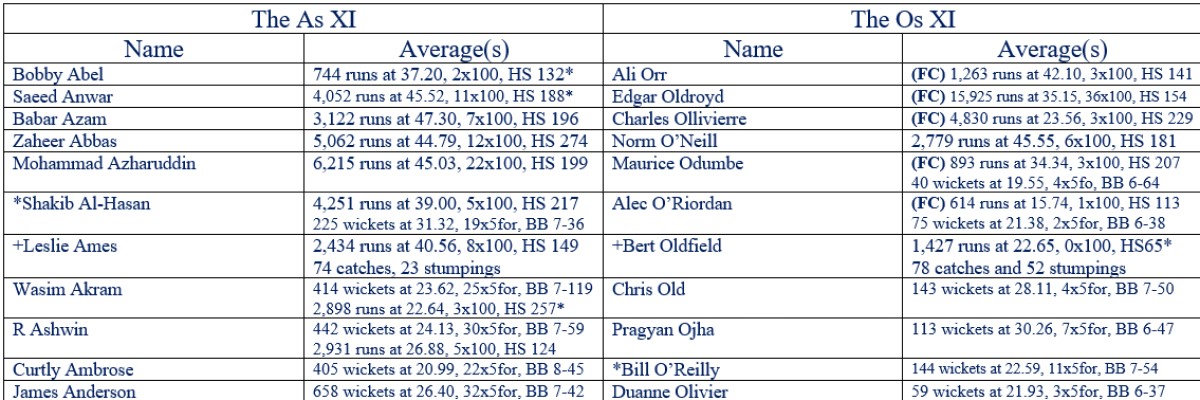
The As dominate this in all departments. The only member of the Os team the As would want in their own ranks is Bill O’Reilly. There can only be one scoreline here: As 5, Os 0
THE As V THE Ps
The opening pairs are closely matched here, the Ps dominate slots 3-5. Procter is massively ahead of Al Hasan as an all rounder – while the Bangladeshi has a better batting record, the Saffa is far ahead with the ball. Pant has a better batting average than Ames and is at least his equal with the gloves. Shaun Pollock is almost an exact match to Akram in terms of bowling figures and almost ten runs an innings better with the bat. Peter Pollock is beaten only by Ambrose among the As quick bowlers. Parker, a victim of selectorial malice in his playing days (a one cap wonder at test level in spite of that huge tally of FC wickets), is the best spinner on either side in this match, though Prasanna is outmatched by Ashwin. The Ps are stronger in batting, and Procter, S Pollock, P Pollock, Parker and Prasanna is not a definitely inferior bowling unit to Ambrose, Anderson, Akram, Ashwin and Al Hasan. I expect the Ps to win, and slightly more comfortably than a bare 3-2. Final score As 1.5, Ps 3.5.
As PROGRESS SO FAR
This has been a tough set of match ups for the As XI, and even with one 5-0 in their favour they score just 11.5 of a possible 25 points in this segment of the alphabet, putting them on 38.5 out of 75, a score of 51.33%, down from the 54% they were on going into this post.
PHOTOGRAPHS
My usual sign off…
Pics 1 and 2 convey important information about my local river.
Continuing my exploration of the all-time XIs theme with a look at the veritable dragon’s hoard of talent available in the form of cricketers with surnames beginning with M.
I continue my exploration of the all-time XIs theme with a look at players whose surnames begin with the letter M. This was difficult, because as Sherlock Holmes said about this letter in reference to his own files, the collection of Ms is a fine one – so fine that as you will see in the honourable mentions a number of extraordinary players miss out.
THE XI IN BATTING ORDER
Arthur Morris (Australia). The man rated by Donald Bradman as the best left handed opener he ever saw in action. His absolute peak came in the 1948 Ashes when he scored 696 in the series at 87.00, a series that Bradman, captain of that side, described him as having dominated.
Vijay Merchant (India). There were a number of candidates for this slot, all with respectable test averages, but Merchant got the nod for two reasons: his test career was more spread out than that of other contenders, and in first class cricket where the sample size is much larger has average of 71.20 puts him second only to Bradman among qualifiers.
Charles Macartney (Australia). The ‘Governor General’ as he was nicknamed is probably the most controversial pick in my XI given the other contenders for his slot in the XI, but what swung it for him was that he offered a genuine extra bowling option with his left arm orthodox spin (he won a test match for Australia in this capacity).
Phil Mead (Hampshire, England). A dour left hander, Mead holds the records for most FC centuries (138) and runs (48,809) for a single team, Hampshire. Only three batters scored more FC runs in their careers than him: Hobbs, Woolley and Hendren, and only three scored more FC centuries than his 153: Hobbs, Hendren and Hammond
Javed Miandad (Glamorgan, Pakistan). Rated by many as Pakistan’s all time number one batter, he went through an entire very long test career without his average ever dipping below 50 at that level, which amounts to an absolutely ironclad claim to greatness.
*Keith Miller (Australia). One of the greatest all rounders ever to play the game, and a supreme entertainer. A wartime flying ace with the RAAF he was always aware that he had been lucky to emerge from the horrors of WWII still alive, which informed his attitudes thereafter. Once when asked about the pressures of international cricket he made the immortal reply “There is no pressure in cricket – pressure is flying a Mosquito with two Messerschmidts up your arse”.
+Rodney Marsh (Australia). A superb wicket keeper and a more than capable middle order batter.
Malcolm Marshall (Hampshire, West Indies). Probably the greatest fast bowler of the golden age of West Indies fast bowling, and therefore without any question among the greatest of all time, he was also a capable lower order batter – indeed Hampshire, whom he served loyally as overseas player for a number of years, regarded him as an all rounder. The record for most wickets in an English FC season in the period since the championship programme was drastically pruned to make space for the John Player League in 1969 is held by Marshall with 134.
Fazal Mahmood (Pakistan). A right arm fast medium bowler whose speciality was the leg cutter, he was the first bowler of any type from his country to claim greatness. Pakistan’s first win on English soil, at The Oval in 1954 owed much to him – he claimed 12 wickets in the match.
Muttiah Muralitharan (Lancashire, Sri Lanka). His 800 test wickets is comfortably an all comers record in that format, with only Warne among other bowlers having gone past 700. It seems unlikely the even the apparently ageless James Anderson can keep going long enough to overhaul his tally. His finest match came at The Oval in 1998. Sri Lankan skipper Ranatunga won the toss and put England in. On a flat pitch Murali took 7-155 in that first innings as England scored 445. Sri Lanka replied by claiming a lead of 150, with Jayasuriya hitting a double century, and then on a pitch just beginning to wear Murali ran through England’s second innings with 9-65, leaving Sri Lanka with a mere formality of a target to knock off.
Glenn McGrath (Worcestershire, Australia). The spearhead of the Australian pace attack in the most dominant period their men’s side ever had, in the late 1990s and early 2000s. It is significant that in the only Ashes series of his career that Australia did not win he was absent injured for both defeats. He signed off an illustrious career at his home ground in Sydney by contributing to a victory that gave Australia only the second 5-0 sweep of a series in Ashes history after Warwick Armstrong’s 1920-21 side.
This side contains a superb top six, including two all rounders of different type, a keeper who could bat and a quartet of superb and well varied bowlers. A bowling attack that has Marshall, McGrath, Fazal Mahmood and Miller to bowl pace and Muralitharan and Macartney to bowl spin is both deep and balanced. Mahmood’s skill with the leg cutter at least partly compensates for the absence of a genuine leg spinner.
HONOURABLE MENTIONS
This section is the most difficult of its kind that I have yet had to create. It begins with individual highlights of a great batter and two great all rounders who I think deserve special coverage…
PETER MAY
Peter Barker Howard May was undeniably a very great batter. For someone who was by instinct an attacking stroke maker to have a test average of 46 in test cricket’s lowest, slowest scoring decade, the 1950s, was an extraordinary achievement. I simply felt that Macartney, bringing with him a bowling option has he did was an even better choice for the number three slot, while Mead’s left handedness gave him an edge (Macartney batted right handed).
MULVANTRAI ‘VINOO’ MANKAD
One of the greatest all rounders India ever produced, but I preferred Macartney as the finer batter. If you want to slot him in somewhere I won’t argue – but consider the effect on team balance.
MUSHTAQ MOHAMMAD
Another great all rounder, and one who would have given me a leg spin option. I felt that Fazal Mahmood’s leg cutters more or less covered that element of bowling, and that as great a cricketer as ‘Mushy’ undoubtedly was, Miller was even greater.
OTHER HONOURABLE MENTIONS
Other than the pair I named a number of openers commanded attention. Hanif Mohammad was probably the greatest of those I overlooked, but Roy Marshall, Colin McDonald and Archie MacLaren were all fine openers in their different ways. Arthur Milton, though not really good enough to be seriously entertained has a place in sporting history as the last to play the England men’s teams in both cricket and football. The elegant Indian left hander Smriti Mandhana was the closest female cricketer to earning consideration, and would have been very close indeed had I been selecting with limited overs cricket in mind.
Other than May to whom I gave a whole paragraph of his own, Billy Murdoch and was also in the mix for the number three slot.
Stan McCabe was another of the unlucky ones, his right handedness costing him the slot I gave to Phil Mead. Daryl Mitchell of New Zealand, the best current cricketer to have a surname beginning with M could not quite command a spot in that powerful middle order.
Mushfiqur Rahim with initials MR is deeply unfortunate – both letters I might sneak him in under have all time great keepers already available. Arthur McIntyre of Surrey and England was a good keeper batter in the 1950s, but hardly a challenger to Marsh.
It is particularly in the bowling department that there is a huge overflow of talent for this letter. Leg spinner Arthur Mailey was a trifle too expensive to command a place, paying 34 a piece for his wickets. Ted McDonald, Devon Malcolm, Danny Morrison, Manny Martindale, Alan Mullally, David Millns, Martin McIntyre and Kyle Mills are among the fast bowlers who might have been considered.
For limited overs matches Eoin Morgan, Mitchell Marsh, Tom Moody, Tymal Mills and Adam Milne would all be in the mix as well.
If he can stay fit for a decent length of time Lancastrian quick Saqib Mahmood may be knocking on the doors in a few years time.
PHOTOGRAPHS
Our cricketing journey through the letter M is at an end, and it remains only to apply the usual sign off…
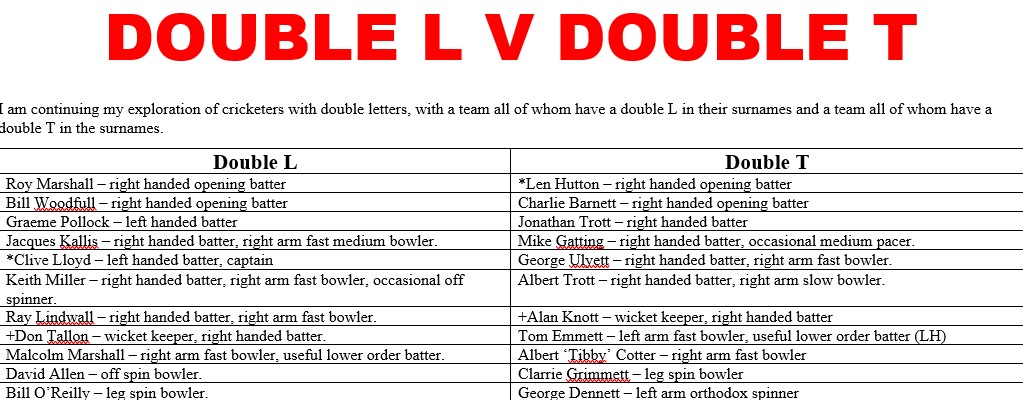
An ‘all time XI’ post that continues the double letter theme from a couple of days ago. A team of players whose surnames contain a double L are pitted against a team of players whose name contains a double T.
After my recent post about cricketers with double letters in their names I am exploring the theme further with a team of players all of whom have a double L in their surnames taking on a team of players all of whom have a double T in their surnames.
TEAM DOUBLE L
Roy Marshall – right handed opening batter. He was part of the 1950 West Indies team that toured England, and there were those who reckoned that in terms of pure talent he was the equal of any of the three Ws. However, his main distinction was a brilliant overseas player for Hampshire, including playing a key role in their first ever County Championship.
Bill Woodfull – right handed opening batter. He averaged 65 in first class cricket, 46 in test cricket. He once went two whole years without being out ‘bowled’ at all. Although both were right handers he represents a good contrast to Marshall as he was a blocker, while Marshall preferred a more flamboyant approach.
Graeme Pollock – left handed batter. A test average of 60.97, including a highest score of 274.
Jacques Kallis – right handed batter, right arm fast medium bowler. A man who averaged over 50 with the bat and in the low 30s with the ball. Just as Woodfull was a blocker to accompany Marshall the hitter, so Kallis’ approach is much more staid than was that of Pollock.
*Clive Lloyd – left hander batter, captain. 7,515 test runs for the Guyanese giant. He scored the joint second fastest first class double hundred ever, reaching that mark in precisely 120 minutes v Glamorgan, thereby equalling Gilbert Jessop who reached 200 in the same length of time for Gloucestershire v Sussex. He made a century in the final of the first ever men’s cricket world cup (the women had taken their bow in this format two years previously).
Keith Miller – right handed batter, right arm fast bowler, occasional off spinner. Australia’s greatest ever all rounder, and one the two individuals in whose honour the Compton-Miller medal was named. He once took a seven-for in his secondary bowling style, on a Brisbane pitch (uncovered in those days) that had been turned into a mud heap by heavy overnight rain.
Ray Lindwall – right arm fast bowler, right handed batter. He scored two test centuries with his batting, while has bowling record was outstanding.
+Don Tallon – wicket keeper, right handed batter. Rated by many of those who saw him (including Bradman) as the greatest of all keepers, and a capable batter.
Malcolm Marshall – right arm fast bowler, useful lower order batter. An all-time great of fast bowling.
David Allen – off spinner. The Gloucestershire bowler took his first class wickets (over 1,200 of them) at 23.64, and was unlucky that his prime years coincided with those of Titmus and Illingworth, which limited his test exposure. I opted for him over Illingworth because he was a slower bowler than Illingworth, contrasting nicely with my other front line spinner who was notably quick for a bowler of his type…
Bill O’Reilly – leg spinner. He bowled his leg breaks at a briskish medium pace and had a well concealed googly in his armoury. Although the pair famously did not get on Bradman rated O’Reilly high enough to include him in his all time World XI, covered in detail by Roland Perry in “Bradman’s Best”.
This team has a stellar top five, a legendary all rounder at six, a great bowling all rounder at seven, an all-time great keeper who could also bat at eight and three quality bowlers to round out the order. Only David Allen, included for reasons of balance (apologies Mr D K Lillee, four fast bowlers plus Kallis with only O’Reilly as a spin option just doesn’t look right). could be considered other than great. Another fast bowler who could not be accommodated on similar grounds was big Bob Willis. Phil Tufnell might have had the second spinner’s berth, but his successes were too sporadic to make him eligible as far as I am concerned.
TEAM DOUBLE T
*Len Hutton – right handed opening batter, captain. Take a look at his outstanding record and then consider that he missed six years of his prime due to World War II, from which he also emerged with one arm shorter than the other following an accident.
Charlie Barnett – right handed opening batter. Again combining a blocker and a hitter for our opening pair. In the Trent Bridge test of 1938 he was 98 not out by lunch on the first day, opening with Hutton. There is a story that a spectator once arrived a few minutes late a Bristol and saw that one over had gone and the score was 20-1 – Barnett had hit five fours and then been dismissed by the sixth ball!
Jonathan Trott – right handed batter. From 2010 to 2012 he was a superb no3, including scoring two centuries in an Ashes series in Australia, the first to help save the first match at the Gabba and the second to bury Australia at the MCG after the hosts were dismissed for 98 on the opening day.
Mike Gatting – right handed batter, occasional medium pacer. A combination of a very slow start at international level and the fact that he played on for too long at the end makes his test record look ordinary, but for the second half of the 1980s he was superb at that level.
George Ulyett – right handed batter, right arm fast bowler. A test best score of 149, and he also had a seven-for at that level.
Albert Trott – right handed batter, right arm slow bowler. He made a sensational start to his test career, taking 8-43 in one innings of his debut match and also scoring 110 undefeated runs in his own two batting innings (38* and 72*). He also featured prominently in his second test match, but was surprisingly overlooked for the 1896 tour of England captained by his brother Harry. He travelled over anyway, signed for Middlesex, and was a few years the best all rounder in the game. Even after his star had faded he had occasional spectacular moments, such as the devastating spell in his benefit match where in a short space of time he took four wickets in four balls and followed up with another hat trick to finish things, unfortunately to the detriment of his financial well being. He played three times for England against South Africa, and his test record from five matches played shows a batting average of 38 and a bowling average of 15 (26 wickets, including two five fors, but no ten wicket match).
+Alan Knott – wicket keeper, right handed batter. One of the greatest of all glovemen and he tended to score his runs when they were most needed.
Tom Emmett – left arm fast bowler, left handed batter. At a time when such were much scarcer than today he was good enough with the bat to score a first class hundred, and his averages at that level are the right way round – 14.84 with the bat and 13.55 with the ball. Test cricket came too late for him (he was already 35 when he played in the first ever test match, the first of seven such appearances).
Albert ‘Tibby’ Cotter – right arm fast bowler. Had a fine record for Australia in the first decade of the 20th century.
Clarrie Grimmett – leg spinner. 216 test wickets in 37 matches at that level, and more first class wickets (1,424) than anyone else who never played in the County Championship.
George Dennett – left arm orthodox spinner. 2,151 first class wickets at 19.82 and never played for his country. Against Northamptonshire in 1907 he had match figures of 15-21, only to see rain save his opponents in the end. Gloucesterhsire scored 60 all out in the first innings, Northants then crumbled for just 12, Dennett 8-9, Jessop 2-3, Gloucestershire then made 88 at the second attempt, and set 137 to win Northants were 40-7, Dennett 7-12, when the rain made its final decisive intervention.
This side has depth in batting, with everyone down to Emmett at eight capable of making a significant contribution, a superb bowling attack with Emmett, Cotter and Ulyett to bowl fast, and Grimmett and Dennett two great spinners.
PHOTOGRAPHS
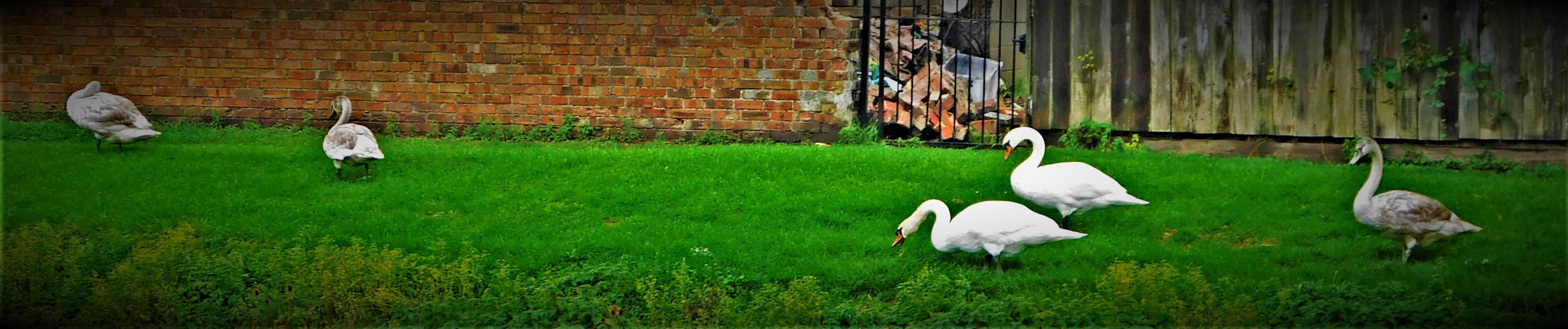
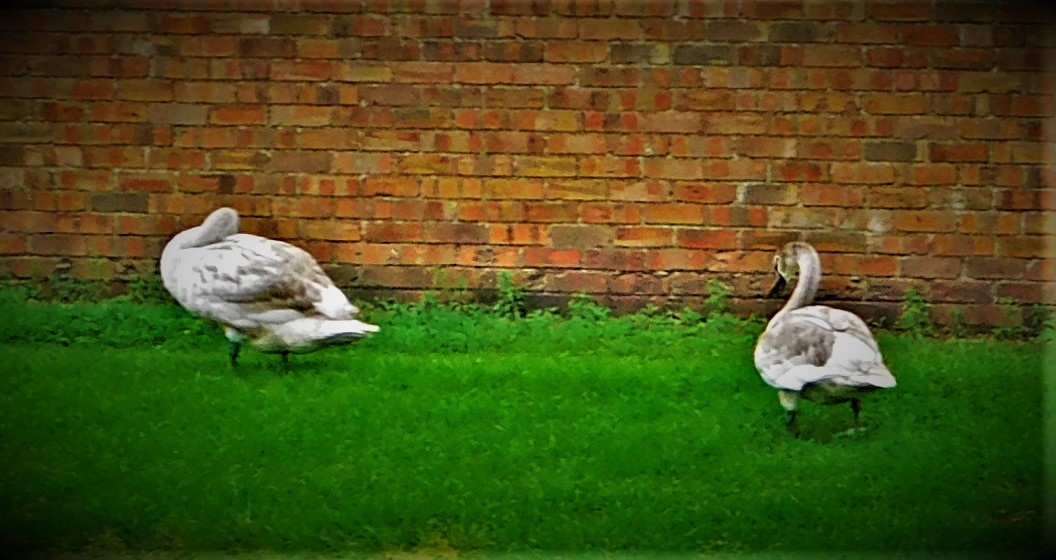
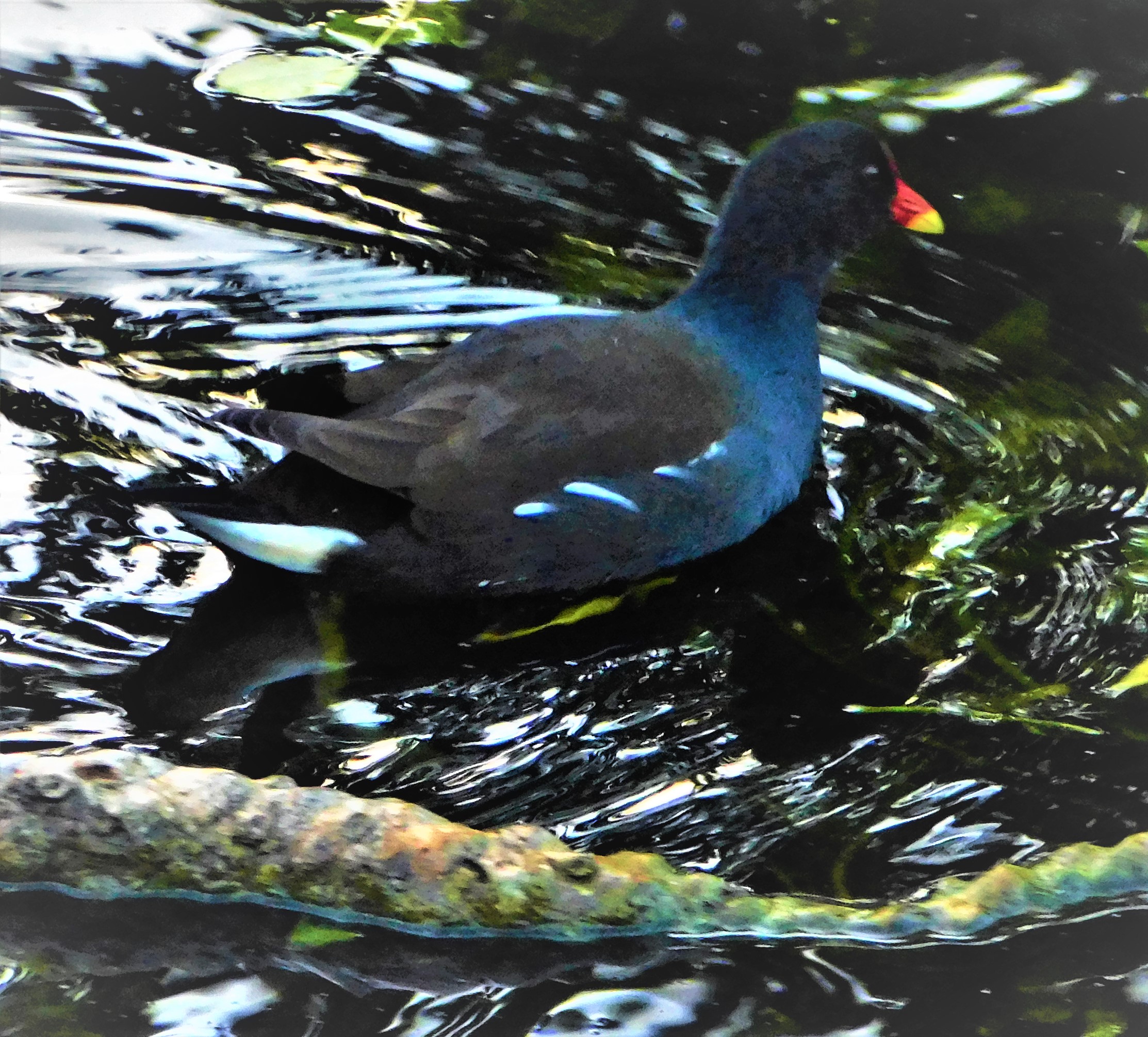
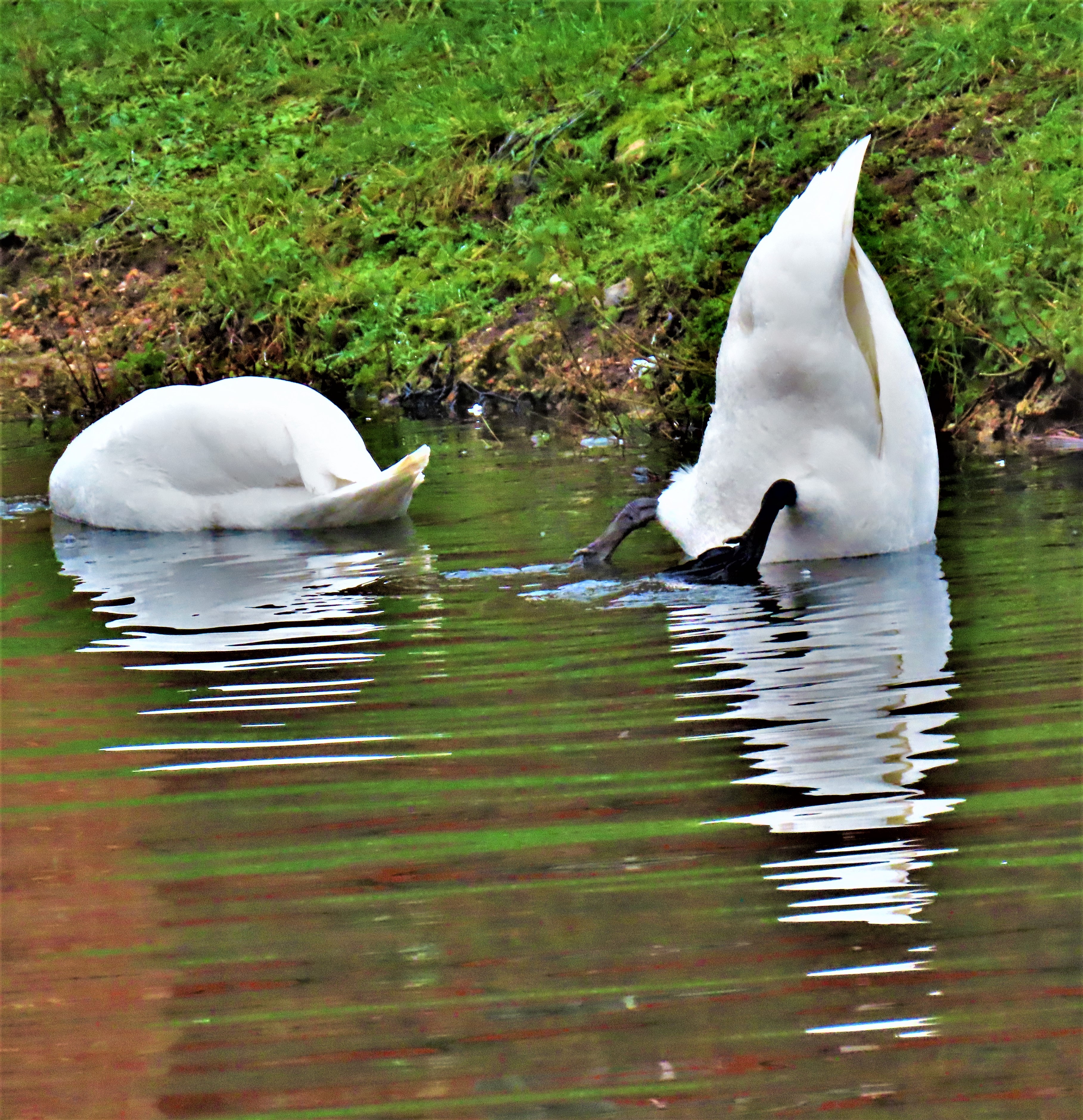
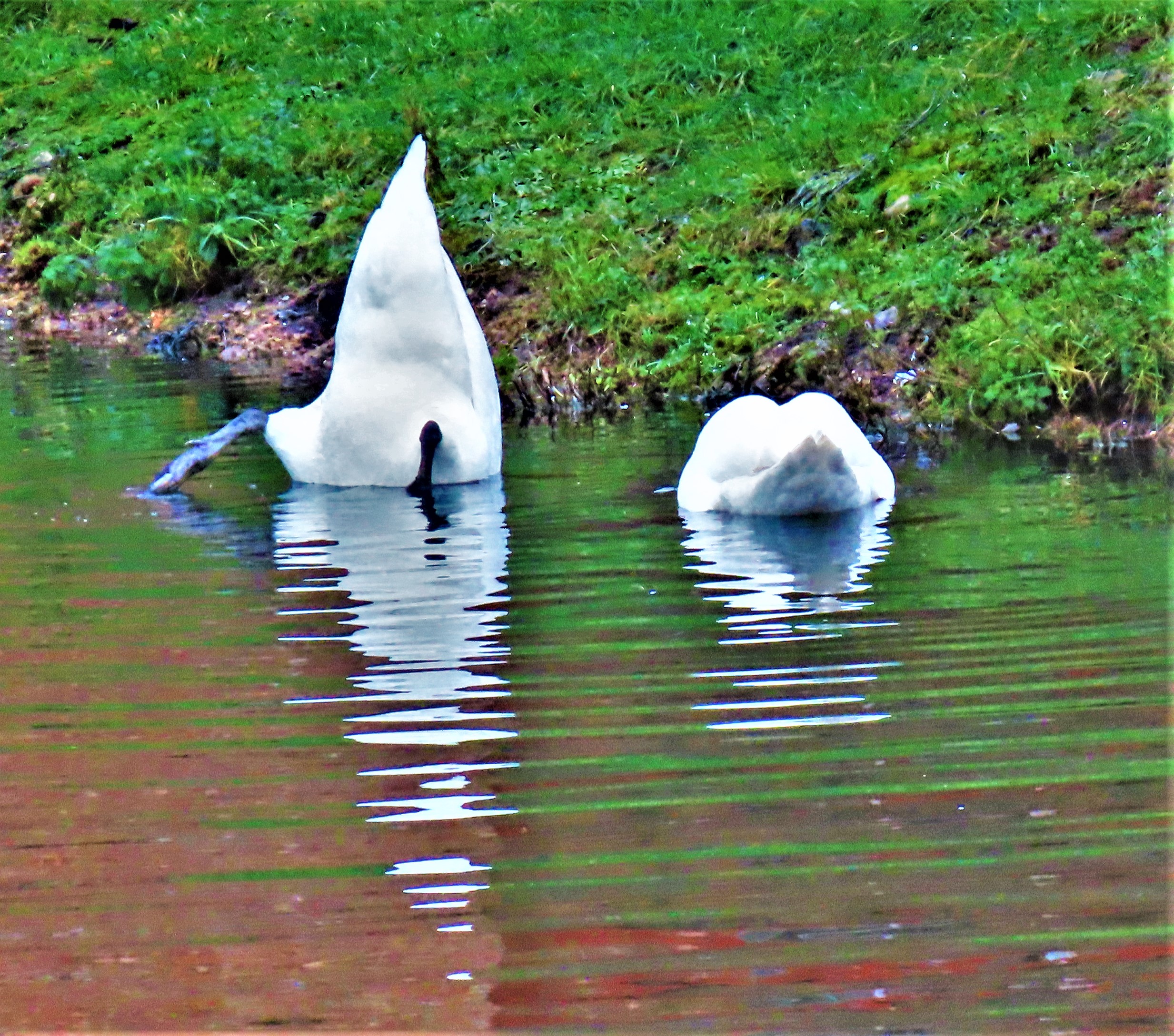
I have a fine collection of photos for you, including swans demonstrating synchronized diving:
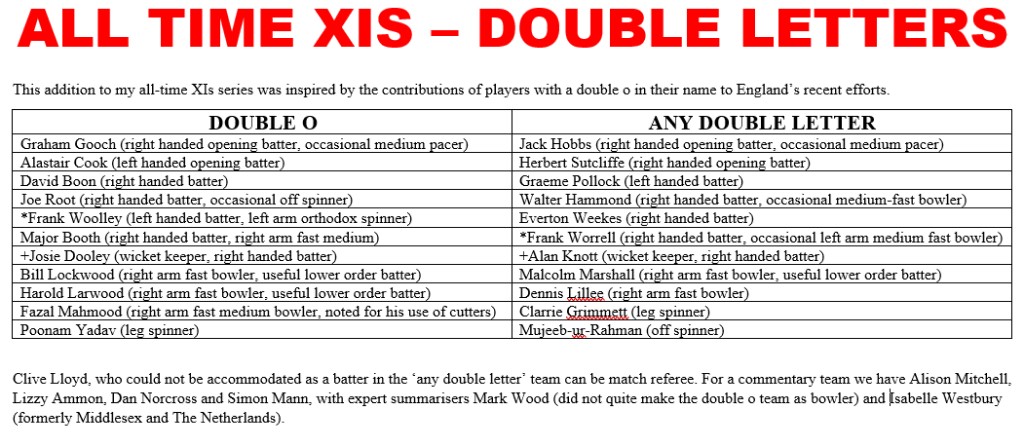
An addition to my ‘All Time XIs’ series, this time taking double letters as its theme.
The role of players with a double o in their names for England in recent times got me thinking about a team of players who all featured that combo, and I then started thinking about other names with double letters in, resulting in a new post for my All Time XIs series.
THE DOUBLE O XI
Graham Gooch – right handed opening batter, occasional medium pacer. Scorer of 8,900 test runs, and player of the best test innings I have ever personally witnessed – 154 not out in an innings tally of 252 vs West Indies at Headingley in 1991, with Ambrose running riot on a pig of a pitch.
Alastair Cook – left handed opening batter, scorer of more test runs than any other left hander – 12,475 of them in all.
David Boon – right handed batter, started as an opener, but moved down to no3 to enable the formation of the right-left Marsh-Taylor combination and enjoyed tremendous success in that latter position.
Joe Root – right handed batter, occasional off spinner. Arguably England’s finest batter of the 21st century, Cook’s achievements notwithstanding.
*Frank Woolley – left handed batter, left arm orthodox spinner. The only player to have the treble of 10,000 first class runs, 1,000 first class wickets and 1,000 first class catches, and indeed the only person to have taken 1,000 catches as other than a wicket keeper. In first class cricket he averaged 40 with the bat and 19 with the ball, and his bowling won at least one test match for England. I am sufficiently impressed by his tactical thoughts, as expressed in “King of Games” to name him as captain even though as a professional of that era he never had the job.
Major Booth – right handed batter, right arm fast medium bowler. Major was his given name (he was named in honour of a respected Salvation Army figure), not a rank. He would certainly have played many times for England but for the first World War (he lost his life during the battle of the Somme). In the late stages of the 1914 season he and Alonzo Drake, another cut off in his prime by the outbreak of war, bowled unchanged together through four successive first class innings.
+Josephine Dooley – wicket keeper, right handed batter. One of the successes of the most recent edition of the Women’s Big Bash League.
Bill Lockwood – right arm fast bowler, useful lower order batter. He was one of the first fast bowlers to develop a really effective slower ball.
Harold Larwood – right arm fast bowler, useful lower order batter. The list of visiting fast bowlers to have blitzed the Aussies in their own backyard is a short one, and the Notts express features prominently on it.
Fazal Mahmood – right arm fast medium bowler. Pakistan’s first authentically great bowler, he took 12 wickets in their first ever test victory at The Oval in 1954. He was known as a master of bowling cutters, often wreaking havoc on the matting pitches which were standard in his homeland at the time.
Poonam Yadav – leg spinner. The tiny Indian causes huge problems with her craftily flighted slow leg breaks. The greatest demonstration of her ability to change the course of a match came in the most recent World T20 when Australia seemed to be coasting as she began her spell and were obviously beaten by the time she had finished.
This team contains a strong top five, an all rounder at six in Booth, a keeper who can bat at seven and four great bowlers with plenty of variation. Woolley is an excellent second spin option with his left armers, and Gooch and Root might also contribute with the ball.
THE ANY DOUBLE LETTER XI
Jack Hobbs – Right handed opening batter, occasional medium pacer. The Master, scorer of 197 first class centuries in total, 12 of them in Ashes tests. He achieved all that in spite of losing four years of his cricketing prime to World War 1.
Herbert Sutcliffe – right handed opening batter. First class average 52.02, test average 60.73, Ashes average 66.85. When the going got tough, he got going. He formed the most successful opening pairing in test history with Hobbs, their average opening stand being 87.81.
Graeme Pollock – left handed batter. The South African averaged 60.97 before his country’s international isolation ended his test career. I opted for his left handed stroke play in preference to having a third right handed opener in Hutton occupy this slot.
Walter Hammond – right handed batter, occasional medium-fast bowler. 7,249 runs in 85 test matches at 58.45, and that average only ended up below 60 because he returned to test action after World War Two, when into his forties.
Everton Weekes – right handed batter. He had a similar average to Hammond in test cricket.
*Frank Worrell – right handed batter, occasional left arm medium-fast bowler, captain. He averaged 49.48 in test cricket, and was one the most successful captains ever, taking the West Indies from also rans which they had been for their entire history to that point to being champions by the time he finished.
+Alan Knott – wicket keeper, right handed batter. One of the game of cricket’s most noted eccentrics, and also one of the greatest keepers ever to don the gauntlets. He also averaged 32.75 with the bat, and tended to score big runs when the team most needed them.
Malcolm Marshall – right arm fast bowler, useful lower order batter. Arguably the greatest fast bowler of the golden age of West Indies fast bowling.
Dennis Lillee – right arm fast bowler. The Aussie was for some years test cricket’s all time leading wicket taker, and his 164 Ashes wickets is a tally surpassed in the history of those contests only by Shane Warne who finished just short of 200.
Clarrie Grimmett – leg spinner. The New Zealand born Aussie who having moved country to better his cricketing prospects had to then cross two state boundaries before establishing himself in first class cricket at the third time, and did not make his test debut until the age of 33 still became the first bowler ever to take 200 test wickets, capturing 216 from 37 test appearances – nearly six per game at the highest level. His Aussie team mate Bill O’Reilly, who was second choice for this spot, was adamant that Grimmett, then 46, should have been selected for the 1938 tour of England.
Mujeeb-ur-Rahman – off spinner. A bit of a gamble on this one – left armer George Dennett with 2,151 first class wickets at less than 20 a piece could easily have been named for this spot, but the young Afghan off spinner has impressed most times he has had the ball in his hand of late.
This team features a very strong top six, one of the all time great keepers, and four great bowlers. I consider that Hammond and Worrell between them make up for the lack of a genuine all rounder. There are too many honourable mentions to name, but before moving on to the next section I would just like to say that if you have someone who you think I have missed please indicate which of my selections should be dropped to make way for them.
OFF THE FIELD
Clive Lloyd, a near miss for a batting place in the ‘any double letter’ team can be match referee, a role he also filled with distinction. In the commentary box we can have Alison Mitchell, Lizzy Ammon, Dan Norcross and Simon Mann, with expert summarisers Mark Wood (not too far off a bowling spot in the double o XI) and Isabelle Westbury (Middlesex and Holland).
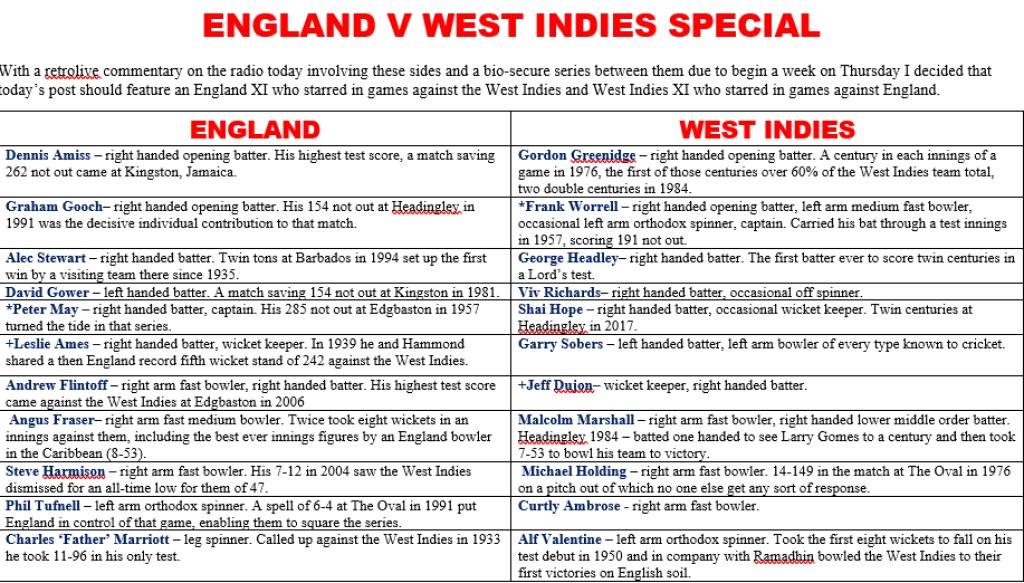
A Saturday Spectacular in the all-time XI cricket series, inspired by a combination of today’s retrolive commentary and the upcoming ‘bio-secure’ test series.
INTRODUCTION
Todau a ‘retrolive’ commentary on the Headingley Test of 2017 between England and the West Indies began, and a week on Thursday the first ‘bio-secure’ test of the post Covid-19 era gets underway between the same two sides. Today’s all time XIs post therefore interrupts our sequence of ‘through the alphabet‘ posts to pit an England XI all of whom had great moments against the West Indies against a West Indies XI all of whom had great moments against England.
ENGLAND
Dennis Amiss – right handed opening batter. In the Kingston test of 1973 England were staring down both barrels as they went into their second innings. They escaped with a draw, and when stumps were drawn at the end of the match Amiss was on career best 262 not out. In 1974 and 1975 a ferocious working over by Dennis Lillee and Jeff Thomson adversely affected Amiss but he bravely remodelled his stance to better enable him to stand up to the very fast bowlers, and at The Oval in 1976 England were facing a total of 687-8 declared. Amiss produced another double century, but this time the West Indies won the match.
Graham Gooch – right handed opening batter, occasional medium pace bowler. In the first test of the 1991 series between England and the West Indies, at Headingley, England took a small first innings lead. Curtly Ambrose then served up a storm at the start of the England second innings, taking the first six wickets to fall, with only Ramprakash who exactly matched his first innings 27 having provided Gooch any support. Derek Pringle bravely held out for two hours making 27 of his own, and Gooch shepherded the nine, ten, jack as best he could. England were all out for 252, and Gooch had an unbeaten 154 to his name. The West Indies collapsed in their own second innings and England were victorious. This was by no means Gooch’s highest test score – he made 333 against India in 1990, 210 against New Zealand in 1994, 196 against Australia in 1985 and 183 against New Zealand in 1986 to give a few examples. However, these scores came on flat wickets and against largely modest bowling attacks – of the bowlers involved in those innings only Hadlee (for New Zealand in 1986) and Kapil Dev (for India in 1990) were performers of unquestionably top rank. The Headingley 1991 pitch was a difficult one, and the West Indies bowlers were Marshall, Patterson, Ambrose and Walsh, three of whom were unquestionably great bowlers and the fourth, Patterson, was seriously, blisteringly quick, although a trifle inconsistent.
Alec Stewart – right handed batter, occasional wicket keeper. In the third test of the 1994 series England needed 194 to win and had an hour to survive in murky light on the penultimate day. By the end of that hour they were 40-8, courtesy of the old firm of Ambrose and Walsh, and the game ended early the following morning with England out for 46, only one run more than their lowest ever total. The next match was at Bridgetown, Barbados (see yesterday’s post for more about that island’s cricketing pedigree) where no visiting side had triumphed since 1935. Stewart, opening with Atherton in that series, proceeded to notch up twin centuries and England rebounded from their humiliation in the third test with victory in the fourth. Given the make up of the West Indies bowling attack picking three recognized openers is a tactic with plenty going for it anyway.
David Gower – left handed batter. When England began their second innings in the final test of the 1981 tour of the West Indies defeat seemed certain. By the end of day four the odds were still in favour of a West Indies victory, but Gower was on 70, and had some good support from Peter Willey. On the final morning Willey fell, and Ian Botham, captaining the side and struggling for form also fell cheaply. Paul Downton joined Gower in the last chance saloon. The resistance held out, and the match was safe by the time Gower took one last single deep into the last hour to move to 154 not out, the highest individual score for England in the series. This innings, occupying eight hours and scored in the teeth of the most lethal fast bowling unit ever assembled (Andy Roberts had just been dropped after going wicketless in the previous match, leaving a foursome of Holding, Garner, Croft and Marshall, the new kid on the block) confirmed Gower’s place among the world’s top batters – his first century had been made against an ordinary New Zealand, his first Ashes century against an under-strength and badly captained Australian side and his 200 not out against India at Edgbaston was scored against a less than stellar attack on a very flat pitch. The next two series between England and the West Indies were both 5-0 to the West Indies, and it was at Headingley in 1988 that England next drew a match against them.
*Peter May – right handed batter, captain. In the Edgbaston test of 1957 England collapsed badly in their first innings against ‘those two little pals of mine, Ram and Val’ – Sonny Ramadhin and Alf Valentine and were made to follow on. Both openers fell cheaply, and May walked out to play an innings in which England needed him to go big. The third England wicket fell with England still adrift, bringing Colin Cowdrey to the crease. May and Cowdrey who came together near the end of day 3 were still in occupation when then fifth and final day got underway. Cowdrey fell for 154 to end a stand of 411, still an England record for any wicket. By the time May declared to give the West Indies an awkward little session of batting he had been at the crease for ten hours and scored 285 not out, at the time a record for an England captain, beating the 240 scored by Hammond at Lord’s in 1938. Ramadhin had wheeled down 98 overs that second England innings and had just two wickets to show for it – and was never to same force again. The West Indies, having for a long time looked like winning were in the end relieved to come away with a draw, having lost seven wickets in the closing stages of the game. England went on to win the series.
+Leslie Ames – right handed batter, wicket keeper. In the last series before World War II, in 1939, Ames and Hammond shared a fifth wicket stand of 242, then an England record against all comers, to set up a victory.
Andrew Flintoff – right handed batter, right arm fast bowler. He had a couple of magnificent years from 2004 through the summer of 2006, and one of the seemingly endless succession of highlights for him in that period was his highest test score, 167 against the West Indies at Edgbaston in 2006, in an England win.
Angus Fraser – right arm fast medium bowler. He twice took eight wickets in an innings in the Caribbean, including the best ever by an England bowler in that part of the world, 8-53. In 1990 England set off for the Caribbean in what seemed to be a very poor state. The last three series between the two had been 5-0, 5-0 and 4-0 to the Windies, and England had just been thrashed by Australia in the 1989 Ashes. In 1988, which included that 4-0 drubbing by the Windies, 28 players had been called up for England test teams. Then in 1989 against Australia 31 players were named in England test squads and 29 actually took the field for England. The only player to have played every game in both years was David Gower, and he was not picked for the tour of the Caribbean. Greenidge and Haynes started smoothly for the West Indies at Sabina Park, Jamaica, before their partnership was ended by misadventure – a ball was played to Devon Malcolm who fumbled it, which encouraged Greenidge to turn for a second, Malcolm unleashed a bullet throw and there was a run out. Then in a spectacular role reversal the West Indies middle order folded, and having reached 60 before losing a wicket they were all out for 164 and Fraser had 5-28. A big partnership between Allan Lamb and Robin Smith rammed home England’s advantage, and they won the match. Fraser subsequently had injury problems and also suffered like many others from the attitude of Ray ‘In My Day’ Illingworth when he was England supremo.
Steve Harmison – right arm fast bowler. When England under the captaincy of Michael Vaughan headed to the Caribbean in 2004 Harmison was just beginning to establish himself as a genuinely top class, genuinely fast bowler. That series underlined his improvement, with his personal highlight being a spell of 7-12 as the West Indies were hustled out for a record low of 47. Nb – when talking about bowling figures number of wickets take precedence, and it is only identical wicket hauls that are split by economy, a reflection of the fact that in non-limited overs cricket you need to take 20 wickets to win the match and that in limited overs cricket getting someone out is still the most definitive way to prevent them from scoring, so although on the basis of runs per wicket (1.71 against 6.63) 7-12 is better than 8-53 the fact that Fraser’s haul was eight wickets rather than seven trumps the difference in economy.
Phil Tufnell– left arm orthodox spinner. England came to The Oval in 1991 2-1 down in the series, needing to win the square it which after the disasters of the 1980s would be a very fine result. A century for Robin Smith and few other useful innings got England to 400 in their first innings. Phil Tufnell then got to work with the ball, beginning his spell of destruction with the psychologically crucial wicket of Viv Richards. That huge breakthrough achieved Tufnell took a further five wickets in his spell, at a cost of a mere four runs. His overall innings figures were 6-25, the West Indies were made to follow on, and England won and squared the series. Before this series, series scores between the two teams since 1980, with England first, had been 0-1, 0-2, 0-5, 0-5, 0-4 and 1-2 – a net 1-18 against England.
Charles ‘Father’ Marriott – leg spinner. The Lancashire and Kent leg spinner, who had been playing county cricket since 1920 was called up for the last test of the 1933 series. England batted first and scored 312. The West Indies were all out for 100 in their first innings, Marriott 5-37 (and Nobby Clark the left arm fast bowler 3-16). England enforced the follow on, the West Indies batted better second time round, but not well enough, being all out for 195, Clifford Roach making 56 opening the batting, Marriott taking 6-59, while the fast bowlers Clark, and Stan Nichols of Essex took two each, left arm spinner Langridge bowling seven wicketless overs. Marriott had 11-96 in the match, and was known to be a pure bowler (711 first class wickets at 20.11, 574 first class runs at 4.41), England had won by an innings and 17 runs, but that was the sum total of Marriott’s test career.
This side has a strong top six, a player who at his best was an x-factor all rounder, and four well varied bowlers. Harmison, Fraser, Flintoff, Marriott and Tufnell is an attack should be useful in all conditions.
THE WEST INDIES
Gordon Greenidge – right handed opening batter. On the most difficult pitch of the 1976 ‘grovel’ series he made twin centuries, the first of them being 61% of his team’s innings total. His two double centuries in 1984 are also worthy of mention.
*Frank Worrell – right handed batter, left arm medium fast bowler, occasional left arm orthodox spinner, captain. In 1957 he carried his bat through an innings, finishing with 191 not out. In 1963 he was captain, and the series was regarded as one of the greatest ever played.
George Headley – right handed batter. A man who averaged 60.83 in test cricket clearly had highlights against every opponent. However, the particular performance that gets him in here came in the 1939 series, when he became the first batter ever to score twin centuries in a Lord’s test.
Viv Richards – right handed batter, occasional off spinner. Was his 232 in the opening match of the 1976 series better than his 291 at The Oval in the final match thereof, were they both trumped by the first test century to be recorded at St John’s Antigua in 1981 or were all other efforts trumped by his 56-ball century at Antigua five years later? That is even before we consider ODIs (138 not out in the 1979 World Cup Final, 189 not – then an ODI record individual score – in an innings total of 272-9 at Old Trafford in 1984). These details provide some indication of why even in 1991 when he was well past his prime his wicket which started Phil Tufnell on his merry way was so psychologically important.
Shai Hope– right handed batter, occasional wicket keeper. When England and the West Indies convened at Headingley in 2017 533 first class matches had been played at the ground and nobody had ever scored twin tons there, even though some mighty fine batters called the place home, e.g. Herbert Sutcliffe and Len Hutton. The person who finally entered the record books by achieving that feat, and did it in a test match to boot, was Shai Hope. Three years on those remain his only two test centuries at test level, a remarkable quirk.
Garry Sobers – left handed batter, left arm bowler of every type known to cricket. He had a stack of extraordinary performances against all opposition, as befits the most complete player the game has yet seen. The particular match I have picked on to include him here featured the West Indies deep in trouble when their fifth second innings wicket went down and Sobers being joined at the crease by David Holford, primarily a leg spinner. The pair put on an undefeated 274 together for the sixth wickets, Sobers 163 not out, Holford 105 not out, and England ended up being glad to escape with a draw after losing a few second innings wickets.
+Jeff Dujon – wicket keeper, right handed batter. Although the West Indies largely dominated the 1988 series (4-0, and the drawn first match owed more to the weather than to the stoutness of England’s resistance), but there was one occasion therein when they hit trouble – 53-5 in their first innings, and Dujon, with support from Logie rescued them – the sixth wicket stand was worth 130, and got the West Indies back into the match.
Malcolm Marshall– right arm fast bowler. At Headingley in 1984 he sustained a broken arm, a rare case in that era of a West Indian being on the receiving end of an injury. When the ninth West Indian wicket fell Gomes was on 96, and so Marshall went in to bat one-handed to see his team mate to a century. Then, to English consternation, he proceeded to take the new ball. He proceeded to rip through the second England innings with career best figures of 7-53, displacing the 63 and 36 scored by Tennyson batting one-handed against Australia with Gregory and McDonald as the greatest test performance by a cricketer playing with one usable hand.
Michael Holding – right arm fast bowler. In August 1976 England was baking in a heatwave, the pitch at The Oval was absolutely flat and lifeless and the outfield was almost grassless due to the drought. The West Indies piled up 687-8 declared, but even their bowlers could get little out of the pitch, with one exception. Michael Anthony Holding took 8-92 in England’s first innings, the best innings figures at that time by a West Indian fast bowler (a spinner, Jack Noriega, had taken nine wickets in a test innings for them). The West Indies declined enforce the follow-on, giving their bowlers a breather. A declaration at 182-0 left England needing to match their first innings 435 to win. This time round Holding took 6-57 to give him 14-149 in the match and his side victory and a 3-0 series scoreline.
Curtly Ambrose – right arm fast bowler. I have already mentioned his bowling at Headingley in 1991 and at Trinidad in 1994 (the 46 all out game), but before that he had settled the 1990 series in the West Indies by destroying England in the last two test matches thereof. England had won the opener (see under Fraser), the second, scheduled for Guyana, had been washed out without a ball being bowled, and a combination of more bad weather and some scandalous (and unchecked, never mind punished) time wasting by Desmond Haynes as stand-in captain had condemned the third match at Trinidad to another draw, in spite of Malcolm picking up ten wickets in a test match (6-77 in one innings) for the first time in his career. However, in the final two tests, Ambrose was simply unstoppable, his figures including an 8-45 in one innings. England’s best resistance in those matches came from pugnacious wicket keeper Jack Russell who produced a day-long rearguard in one of them.
Alf Valentine – left arm orthodox spinner. He made his test debut in the 1950 series and proceeded to capture the first eight England wickets to fall, only to be denied absolute immortality to Berry and Hollies, two of the game’s greatest ‘ferrets’. The feat still remains a record, and helped the West Indies to their first win on English soil, as he and as spin twin Sonny Ramadhin weaved their webs around England’s batters. England did not properly counter this duo until the 1957 series and the May-Cowdrey partnerhsip at Edgbaston.
This team has a stellar top four, a record breaker at five, the most complete player in the game’s history at six, an excellent keeper who can bat and fine quartet of bowlers. The choice of Valentine as specialist spinner means there is a little overlap in skills with Sobers, who numbered left arm orthodox spin among his bowling styles. Marshall, Holding and Ambrose, with Sobers left arm as fourth pace option and Worrell also available looks a superb pace attack, while Valentine’s finger spin and Sobers’ wrist spin should be sufficient in that department.
OTHER CONTENDERS
There are of course many, but I will mention just some of the more obvious. Andy Sandham scored the first ever test match triple century at Sabina Park in 1930, but that match, supposedly ‘timeless’ ended in a draw because England had to go home, taking some of the gloss off the innings. Fred Trueman had a fabulous series against the West Indies in 1963, including a career best test match haul of 12-119 at Edgbaston. Among the all rounders I felt that Greig’s presence would fire the West Indies up too much, so his 13 wicket match haul at Trinidad did not get him in, Ian Botham’s record against the West Indies was very ordinary (one innings haul of 8-103 at Lord’s in 1984, but even that came in a losing cause, and a highest score against them of 81) and Stokes has not had one of his greatest performances against them as yet (the ‘bio-secure’ series may well change that). Brian Lara twice made world test record scores against England (375 in 1994, 400 not out in 2004, both at St Johns, Antigua), but both were accumulated on flat wickets in high scoring, stale, draws, and the latter, as was that case with his 501 not out for Warwickshire v Durham, was definitely an example of the individual counting for more than the team. Courtney Walsh had a magnificent series in England in 2000, at the age of 38, but lack of support from the rest of his team caused it to be in a losing cause, so, with regret, I was not able to pick him. Sonny Ramadhin, Valentine’s spin twin, missed out because of the history making nature of Valentine’s debut. Finally, Ellis ‘Puss’ Achong caused cricket’s terminology to expand when he dismissed Walter Robins, and the chagrined all rounder said as he headed back to the pavilion “fancy being bowled by a chinaman”, which is why that type of delivery is now called a chinaman.
THE CONTEST
This has all the makings of an absolute cracker. The odds definitely favour the West Indies, especially as Worrell has to be considered a better captain than May, but it should be a good contest.
PHOTOGRAPHS AND TEASER
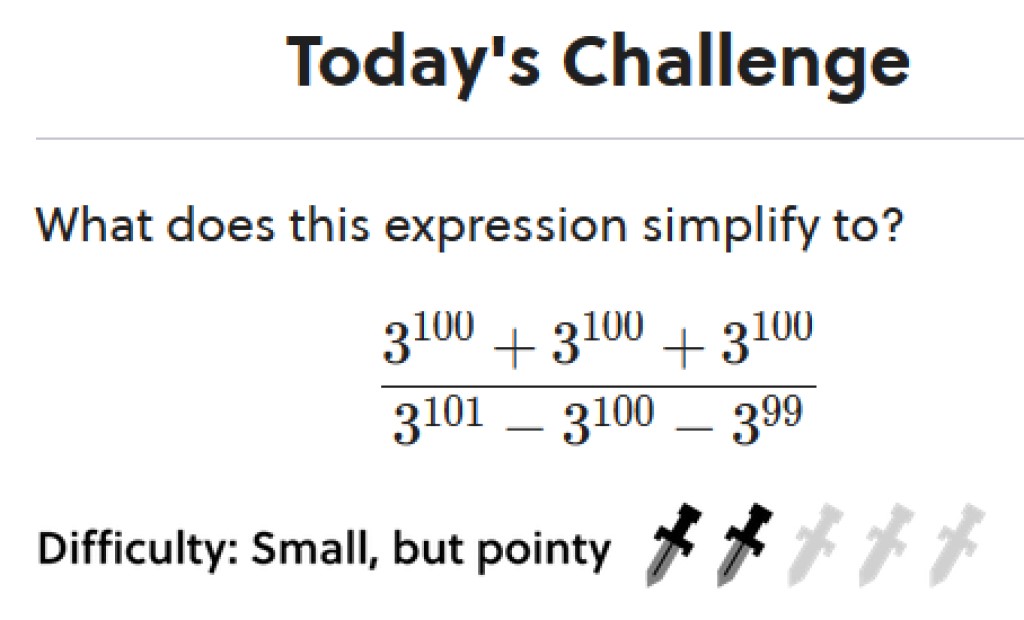
As a lead in to my regular sign off, here is a teaser from brilliant.org:










































































































































































































































































 aspiblog