The London Cup and England’s 3rd Test Squad

The London Cup, England’s 3rd test squad, links, a teaser and some photographs.

INTRODUCTION

Just before starting work on this post I spotted that the England squad for the third test match has been selected. Therefore I will start with a look at that, before moving on to main subject.

A DISAPPOINTING SELECTION

The squad for tomorrow’s 3rd test match against the West Indies contains 14 names, as follows (see here for full details):

Joe Root (Yorkshire) Captain, James Anderson (Lancashire), Jofra Archer (Sussex), Dominic Bess (Somerset), Stuart Broad (Nottinghamshire), Rory Burns (Surrey), Jos Buttler (Lancashire), Zak Crawley (Kent), Sam Curran (Surrey), Ollie Pope (Surrey), Dom Sibley (Warwickshire), Ben Stokes (Durham), Chris Woakes (Warwickshire), Mark Wood (Durham).

Ben Foakes, James Bracey and Dan Lawrence have all been overlooked. My choice of 11 from this 14 (like the Irishman who was asked for directions ‘Oi wouldn’t start from here’) would be in batting order: Burns, Sibley, Crawley, *Root, Stokes, +Pope, Curran, Bess, Archer, Broad, Anderson. I refuse ever to name Buttler in a suggested test XI, which from this 14 means I have to give the gloves to Pope. I think England need both their veterans Broad and Anderson, and I also want the spinner, the out and out speedster and with due respect to Woakes I opt for the extra variation provided by Curran’s left arm, gambling on him at number seven. Although I would like to accommodate both speedsters, it would mean either one of the veterans missing out or Bess coming in at number seven which is a trifle too much of a gamble on the batting even for me. 

THE LONDON CUP

Surrey and Middlesex women’s sides convened at The Oval to play a T20 match for The London Cup yesterday evening, starting at 6PM. The game was available on livestream courtesy of http://www.kiaoval.com. Surrey had lost all of the previous five runnings of this event, and were without Nat Sciver, Sophia Dunkley and Bryony Smith, all up at Derby with the national squad.

Surrey bowled first, and opened with medium pace from Amy Gordon and spin purveyed by Claudie Cooper. Middlesex were saved from complete disaster by a robust innings from Cordelia Griffith who made 30, the highest individual score the game. Gayatri Gole came in at 60-5 and reached 28 not out, as Middlesex ended up recovering somewhat to 108-7 from their 20 overs.

Beth Kerins had a spell which started dreadfully – four of the six balls of her first over were rank full tosses but recovered well.

Dani Gregory, a young leg spinner with a very rapid arm action, bowled a spell in which she sent down a number of wides, but also some very good stuff, including this beauty (click link below to view), probably the best single delivery of the match.

Surrey themselves struggled with the bat, especially against Katie Wolfe, the quickest bowler on either side, and Emily Thorpe, another young spinner who looks a real prospect (she got two wickets, both clear cut LBWs, one of them Aylish Cranstone just as she was beginning to like dangerous). They too were 60-5 at low water mark, and their number 7, wicket keeper Kira Chathli, played a fine innings to rescue them. In the 18th over Chathli twice flipped deliveries over the keeper’s head for fours to get Surrey back almost up with the rate. The 19th over was bowled by Katie Wolfe, and until near the end looked like settling it for Middlesex, but then the irrepressible Chathli hit another four and six were needed off the final over. The number nine for Surrey got Chathli back on strike early in the over, and with two balls left three were required for victory. Chathli, cool as a cucumber, slotted one final boundary to take her own score to 28 not out and her side to victory with one ball remaining. Bhavika Gajipra also bowled well for Middlesex.

TEASER, LINKS AND PHOTOGRAPHS

A couple of pieces from Richard Murphy of Tax Research UK:

  1. The right response to the question ‘What taxes should be raised to pay for coronavirus?’ is ‘None’
  2. The UK government’s own accounts show that QE cancels government debt

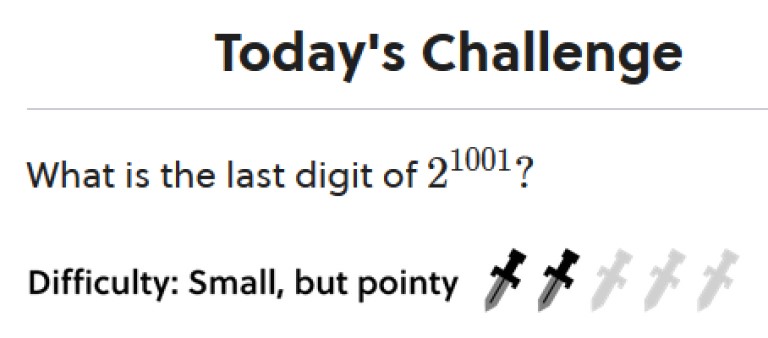
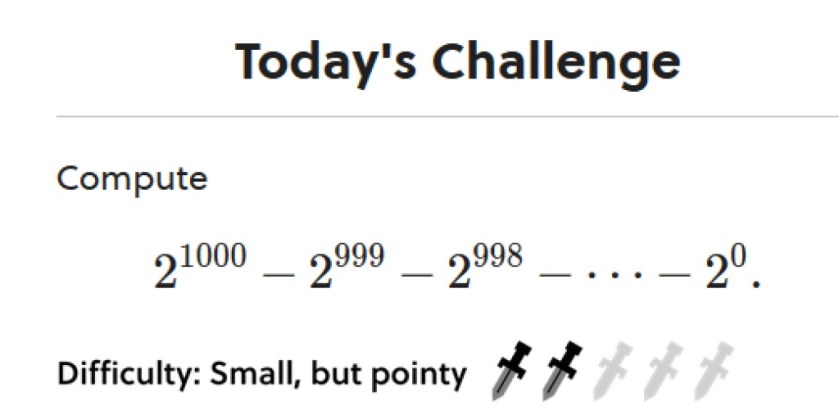
A very easy teaser from brilliant.org:

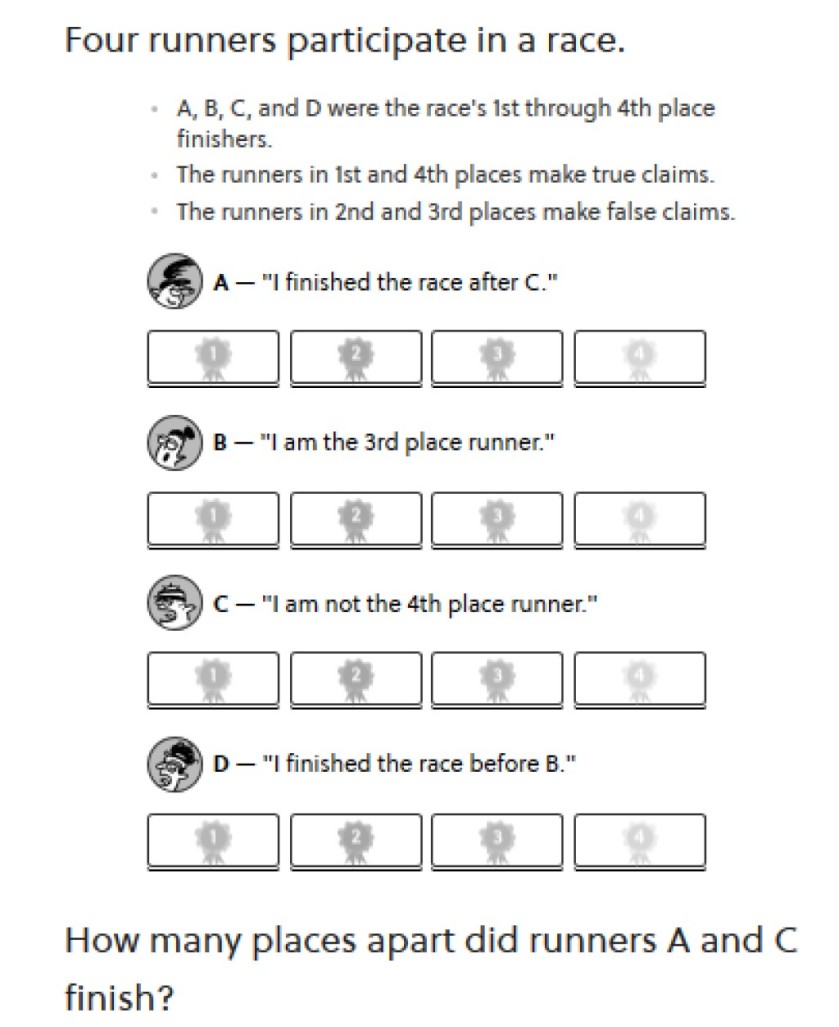
Teaser

This was offered with multiple choice answers, but I am not going to be that generous. I will however give one hint: this is a problem about pattern recognition, not calculation.

Now it is time for my usual sign off…

IMG_2170 (2)IMG_2171 (2)IMG_2172 (2)IMG_2173 (2)IMG_2173 (3)

IMG_2175 (2)
This panel is on Railway Road.

IMG_2176 (2)IMG_2177 (2)IMG_2178 (2)IMG_2179 (2)IMG_2180 (2)IMG_2181 (2)IMG_2182 (2)IMG_2183 (2)IMG_2184 (2)IMG_2185 (2)IMG_2186 (2)IMG_2187 (2)IMG_2188 (2)IMG_2189 (2)IMG_2190 (2)IMG_2191 (2)IMG_2192 (2)IMG_2193 (2)IMG_2193 (3)IMG_2194 (2)IMG_2195 (2)IMG_2196 (2)IMG_2197 (2)IMG_2198 (2)IMG_2199 (2)IMG_2200 (2)IMG_2200 (3)IMG_2201 (3)IMG_2202 (2)IMG_2206 (2)IMG_2208 (2)IMG_2208 (3)IMG_2209 (2)IMG_2210 (2)IMG_2211 (2)IMG_2212 (2)IMG_2213 (2)IMG_2214 (2)IMG_2215 (2)IMG_2215 (3)

IMG_2215 (4)
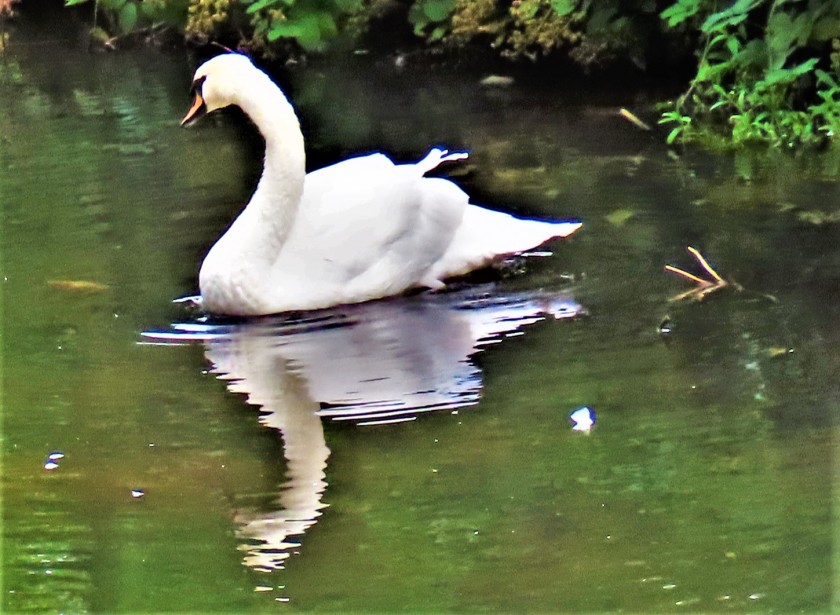
A swan reflected in the water…
IMG_2215 (5)
…and reversing it, Escher style, so that the reflected swan looks like it is the original.

IMG_2216 (2)IMG_2217 (2)IMG_2218 (2)IMG_2219 (2)IMG_2220 (2)IMG_2221 (2)IMG_2222 (2)IMG_2223 (2)


Looking Ahead To Friday

Some speculations about possible inclusions for the third test, an all-time XI created around one of the possibles for the West Indies, the solution to yesterday’s teaser and a bumper collection of photographs.

INTRODUCTION

This post looks at the options for each time ahead of the deciding test match between England and the West Indies on Friday. There is a match taking place at The Oval tonight which may be interesting, and will be viewable courtesy of Surrey County Cricket Club’s livestream.

ENGLAND

I think the current top six can and should be retained, so I shall nothing further about them. Buttler has to go, and the question of his replacement is tied up with the question of how England should line up bowler wise. Here the problem is condensing the choices into at most five, and possibly only four. It would be rough on Jimmy Anderson not to play at his home ground, but equally Stuart Broad bowled two magnificent spells in the game just concluded and would not react well to being rested for the decider. Curran’s left arm and Archer’s extreme pace now that he can be selected again give them edges, as does the former’s batting. Woakes had a solid game with the ball in the match just concluded, and he also has batting skill on his side. Bess remains first choice spinner and the question is whether Jack Leach should also be selected. Going the two spinners route would require the selection of five players who are predominantly bowlers, and I feel that at least one of Curran or Woakes would have to be picked in this circumstance, as Bess at 7, Archer at 8, Leach at 9, Broad at 10 and Anderson at 11 leaves the lower order looking very fragile. A bowling foursome, if Leach is not to be picked should be Bess, Archer, Broad, Anderson, with Ben Foakes getting the gloves and batting at seven. For the two spinner route Pope gets the gloves, and the remainder of the order goes either Woakes, Curran, Bess, Archer, Leach or if you are prepared to gamble a bit more Curran, Bess, Archer, Leach, Broad I am going to plump for two spinners and a bit of a gamble on the batting and suggest as the final XI: Sibley, Burns, Crawley, *Root, Stokes, +Pope, Curran, Bess, Archer, Leach, Broad.

WEST INDIES

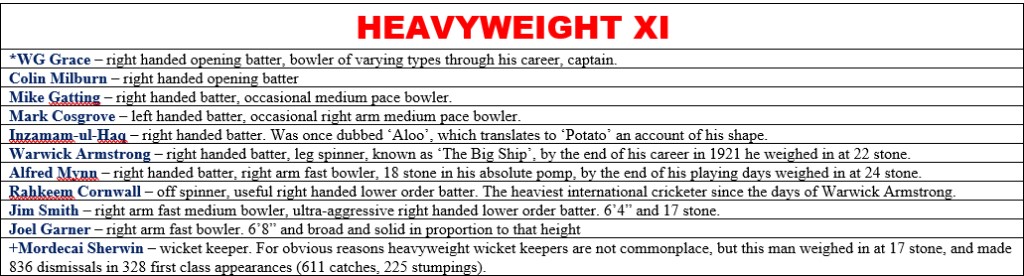
The West Indies’ big question is whether to pick Rahkeem Cornwall, and if so how they will fit him in. This depends on whether they are want extra batting strength to maximize their chances of retaining the Wisden Trophy, which they do by avoiding defeat, or whether they are determined to go all out to attempt to become the first West Indies side to win a series in England since 1988. The cautious approach entails bring Cornwall in for Shannon Gabriel, have him bat at nine below Holder, so that West Indies have only two outright tailenders, Joseph and Roach. The more aggressive approach is to drop a batter, presumably Shai Hope who has done precious little since scoring those twin tons at Headingley in 2017, and have a 7,8,9,10,11 of Holder, Cornwall, Joseph, Roach, Gabriel. To me the latter approach has far more appeal, and a side of Campbell, Brathwaite, Brooks, Blackwood, Chase, +Dowrich, Holder, Cornwall, Joseph, Roach, Gabriel thus eventuates. Cornwall is best known for being the heaviest international cricketer since Warwick Armstrong in 1921, so, in the spirit of my lockdown series of All Time XIs, we move on to…

THE PLUS SIZED XI

  1. *WG Grace – right handed opening batter, right arm bowler of varying types through his career, captain. As a youngster he was a champion sprinter and hurdler as well as a quality cricketer but in later years his weight mushroomed, reaching somewhere in the region of 20 stone near the end of his career. In 1895, less than two months short of his 47th birthday, he scored 1,000 first class runs in the first three weeks of his season (May 9th – 30th), including his 100th first class hundred (no 2 on the list of century makers at the time being Arthur Shrewsbury on 41).
  2. Colin Milburn – right handed opening batter. His career was ended prematurely by the car accident that cost him his left eye, but his record up to that point was very impressive.
  3. Mike Gatting – right handed batter, occasional right arm medium pace bowler.
  4. Mark Cosgrove – left handed batter, occasional right arm medium pace bowler. Australia were never keen on selecting him because of his bulk, but he scored plenty of runs in first class cricket.
  5. Inzamam-ul-Haq – right handed batter. He was once dubbed ‘Aloo’, which translates as ‘Potato’ on account of his shape. He had a long test career in which he averaged 49 with the bat.
  6. Warwick Armstrong – right handed batter, leg spinner. At the end of his test career he weighed in at 22 stone, and yet in those last two years he did as much batting as Steve Waugh in a comparable period and bowled as many overs of leg spin as Shane Warne in a comparable period. He was nicknamed ‘Big Ship’, and there is a book about him by Gideon Haigh titled “Big Ship”.
  7. Alfred Mynn – right handed batter, right arm fast bowler. ‘The Lion of Kent’ weighed in at 18 stone in his pomp, and later grew even heavier, allegedly weighing in at 24 stone by the end of his career.
  8. Rahkeem Cornwall – off spinner, useful right handed lower order batter. His averages are just the right way round at first class level – 23.75 with the bat and 23.57 with the ball. He is taller than Armstrong was by a couple of inches and weighs about the same.
  9. Jim Smith – right arm fast medium bowler, ultra-aggressive right handed lower order batter. 6’4″ tall and weighing in at 17 stone. He once clubbed a 50 in just 11 minutes off genuine bowling – not declaration stuff. He was born in Wiltshire, and under the rules of the day had to qualify by residence for a first class county, in his case Middlesex. He took 172 first class wickets in his first full season, finishing sixth in the national bowling averages, and helped by the fact that with Lord’s as his home ground he was enjoying success in front of the right people he was selected for that winter’s tour. Unfortunately for fans of big hitting he and Arthur Wellard of Somerset were only once selected in the same England team.
  10. Joel Garner – right arm fast bowler. 6’8″ tall and broad and solid in proportion to that great height. He is perhaps here under slightly false pretenses since he did not noticeably carry extra weight, but he was certainly a big unit.
  11. +Mordecai Sherwin – wicket keeper. Given the nature of the job it is no great surprise that plus sized wicket keepers are something of a rarity. However, this guy weighed 17 stone and was still able to pull off 836 dismissals in 328 first class appearances (611 catches and 225 stumpings).

This side has a strong top five (Gatting, with a test average of 35.55, is probably the least impressive of the quintet as a batter), two genuine all rounders in Armstrong and Mynn, a trio of fine bowlers, two of whom can bat a bit and an excellent keeper. The bowling attack, with Garner, Smith and Mynn to bowl pace, Armstrong, Cornwall and Grace purveying slower stuff and Gatting and Cosgrove available as seventh and eighth bowlers is strong and varied, although there is no left armer. Thus, even given the selection criteria, this is a team that would take some beating.

HXI

SOLUTION TO YESTERDAY’S TEASER

I offered up this from brilliant yesterday:

Here is Liam Robertson’s solution:

Sol

PHOTOGRAPHS

My usual sign off…

IMG_2078 (2)IMG_2079 (2)IMG_2080 (2)IMG_2081 (2)IMG_2083 (2)IMG_2084 (2)IMG_2085 (2)IMG_2086 (2)IMG_2087 (2)IMG_2088 (2)IMG_2089 (2)IMG_2090 (2)IMG_2091 (2)IMG_2092 (2)IMG_2092 (3)IMG_2093 (2)IMG_2094 (2)IMG_2094 (3)IMG_2094 (4)IMG_2095 (2)IMG_2096 (2)IMG_2096 (3)IMG_2097 (2)IMG_2098 (2)IMG_2101 (2)IMG_2101 (3)IMG_2102 (2)IMG_2102 (3)IMG_2102 (4)IMG_2103 (2)IMG_2103 (3)IMG_2104 (2)IMG_2107 (2)IMG_2108 (2)IMG_2109 (2)IMG_2109 (3)IMG_2111 (2)IMG_2114 (2)IMG_2115 (2)IMG_2116 (2)IMG_2117 (2)IMG_2118 (2)IMG_2119 (2)IMG_2120 (2)IMG_2121 (2)IMG_2121 (3)IMG_2122 (2)IMG_2122 (3)IMG_2123 (2)IMG_2123 (3)IMG_2124 (2)IMG_2125 (2)IMG_2125 (3)IMG_2126 (2)IMG_2126 (3)IMG_2127 (2)IMG_2127 (3)IMG_2127 (4)IMG_2128 (2)IMG_2128 (3)IMG_2129 (2)IMG_2130 (2)IMG_2130 (3)IMG_2131 (2)IMG_2132 (2)IMG_2133 (2)IMG_2133 (3)IMG_2134 (2)IMG_2134 (3)IMG_2135 (2)IMG_2135 (3)IMG_2136 (2)IMG_2137 (2)IMG_2138 (2)IMG_2138 (3)IMG_2139 (2)IMG_2141 (2)IMG_2144 (2)IMG_2145 (2)IMG_2148 (2)IMG_2149 (2)IMG_2152 (2)IMG_2153 (2)IMG_2153 (3)IMG_2154 (2)IMG_2155 (2)IMG_2156 (2)IMG_2157 (2)IMG_2158 (2)IMG_2159 (2)IMG_2159 (3)IMG_2161 (2)IMG_2161 (3)IMG_2162 (2)IMG_2162 (3)IMG_2163 (2)IMG_2163 (3)IMG_2164 (2)IMG_2165 (2)IMG_2166 (2)IMG_2166 (3)IMG_2167 (2)IMG_2167 (3)IMG_2168 (2)IMG_2168 (3)

England’s Triumph At Old Trafford

An account of the test match that finished yesterday evening with a victory for England, a look forward to the decider which starts on Friday, some links and some photographs.

INTRODUCTION

This post looks back at the test match that concluded yesterday evening in Manchester and forward to the one that starts at the same ground on Friday morning.

THE TALE OF THE TAPE

Thursday morning at Old Trafford was grey and rainy, and so play got underway late. England were deprived of Archer due to that player’s misconduct in between the Ageas Bowl and Old Trafford, had already decided to rest Wood and Anderson, while Crawley was correctly retained with Joe Denly losing his place, presumably permanently. Thus England’s line up read: Sibley, Burns, Crawley, *Root, Stokes, Pope, +Buttler, Woakes, Curran, Bess, Broad. This was a very strong batting line up, but there was no genuine pace in the bowling attack, with the possible exception of Stokes. The West Indies were unchanged.

Jason Holder won the toss for the West Indies and immediately made the first mistake of the match when he allowed himself to be influenced by the overhead conditions and chose to bowl first on a very flat looking pitch. At first things did not look too bad for the West Indies as Burns and Crawley fell cheaply, and even when Root was third out the score had only reached 81. At this point Ben Stokes got into the action, and was scarcely to be out of ti again for the rest of the match. Sibley was looking secure at one end, and now Stokes displayed considerable resolve and patience to stay with him. By the end of the first day the fourth wicket pair were still in occupation and the score was 207-3, and the decision to bowl first stood revealed as a ghastly howler on Holder’s part. On the second day Stokes and Sibley consolidated their position, with Sibley reaching his second test century just before lunch, and Stokes completing his tenth such score just afterwards. Finally, with the score at 341 Sibley fell for 120, having also completed a century of a much rarer kind – 100 balls left alone in the course of a single innings. GThe stand of 260 was the second highest ever for any wicket at Old Trafford, though some way short of England’s all time fourth wicket record stand, the 411 put on by Peter May and Colin Cowdrey versus the West Indies at Edgbaston in 1957. Pope fell cheaply, bringing Buttler to the crease at 352-5, and with an opportunity, undeserved in many opnions including mine, to cash in on tired bowlers. Ben Stokes was finally dislodged for 176, his second highest test score, with the score at 395, Woakes fell first ball which brought Curran to the crease. At 426 Buttler who had made a less than impressive (given the ultra favourable circumstances) 40 was caught off the bowling of Holder. One run later Curran was out. Dom Bess, in company with Stuart Broad, played a useful cameo reaching 31 not out before Root declared with the score at 469-9. John Campbell was out in the mini-session of batting the West Indies had before day 2 closed, Alzarri Joseph was sent in as nightwatchman and took them through to the close, at which point they were 32-1. Day three was washed out, a big dent to England’s hopes. In the middle of the fourth afternoon the West Indies were 235-4 and the draw was a strong favourite. Then that man Stokes intervened again, bowling a hostile spell in which he accounted for the obdurate Kraigg Brathwaite and destabilized the West Indies innings. Stuart Broad then bowled a magnificent spell with the second new ball before Woakes took a couple of late wickets, and the West Indies were all out for 287, giving England a lead of 182. With quick runs needed England sent in Buttler and Stokes. Buttler proceeded to be bowled for a third-ball duck, a dismissal which really should end his test career (he is a magnificent limited overs player but has never been anything special in long form cricket), which brought Zak Crawley to the wicket. Crawley made 11 before he too fell, and England closed the 4th day on 37-2, with Stokes and Root in occupation. England, as they had to in the circumstances, needing a win to keep both the Wisden trophy and their slender hopes of the World Test Championship alive, went on the all out attack on the final morning, blazing 91 off 11 overs before declaring at 129-3, with Stokes 78 not out and Pope 12 not out off seven balls. This left the West Indies needing 312 to win and with 85 overs to get them.

Broad bowled superbly with the new ball, and the West Indies rapidly plunged to 37-4. Blackwood and Brooks then put on exactly 100 together before that man Stokes broke the partnership, dismissing Blackwood for 55. Woakes then cleaned up Dowrich for a duck, bringing skipper Holder in to join Brooks. Holder and Brooks took the score to 161 before Curran pinned Brooks LBW, which went to review where it came up as umpires call, the third time a West Indian had suffered that fate in the innings. Holder and Roach offered some resistance before Bess made the crucial breakthrough, bowling Holder for 35, to make at 183-8, and leave three tailenders tasked with holding out for more than 20 overs to save the game. Alzarri Joseph scored nine, was then caught by Bess of the bowling of Stokes to make it 192-9. I had an evening engagement and was not able to catch the fall of the final wicket, that of Kemar Roach, caught by Pope off the bowling of Bess. England took that wicket just after umpire Richard Illingworth had signalled the start of the last 15 overs of the game and had won by 113 runs, meaning that the third match of this series will be a ‘winner takes all’ battle.

STOKES THE COLOSSUS

Stokes’ performance in this match saw him displace Jason Holder at the top of the test match all rounders rankings, and it also saw him rise to no3 in the world batting rankings behind Virat Kohli and ‘sandpaper’ Steve Smith. Stokes’ participation in this match was as follows: 176 off 356 balls spread over 487 minutes at the crease in the first innings, 1-29 off 13 overs in the second, with that wicket coming in the spell that destabilized the West Indies innings, 78 not out off 57 balls to set up the declaration in the third innings and 14.4 overs for figures of 2-30 (he was unable to complete his final over, the last two balls of it being bowled by Joe Root). At Lord’s in 1952 Mulvantrai Himmatlal ‘Vinoo’ Mankad scored 72 in the first innings, bowled a marathon stint of 73 overs in the England reply, scored 184 in the third innings and bowled a further 24 overs in the second England innings, this all round effort all coming to nought as his side were beaten anyway. In first class cricket there are George Hirst’s spectacular dominance over Somerset in 1906 – 111, 117 not out, six first innings wicket and five second innings wickets, George Giffen’s 271 not out, 7-70 and 9-98 for South Australia versus Victoria, while in 1874 WG Grace had a spell of sustained brilliance in which he combined centuries with ten wicket match hauls five times in the space of six matches. At club level there is the feat of Dr M E Pavri, an Indian all rounder who apparently bowled at a lively pace (he toured England in the 1880s, long before his country were promoted to test status, and there is a story of him sending a stump nine yards backwards in a match at Norwich), and who decided on one occasion that teammates were unnecessary, taking on an XI all on his own. In that game he batted first, scored 52 not out before deciding that he had enough runs to serve his purposes, and then without fielders to aid him dismissed the opposing XI for 38 to win the match.

ENGLAND PLAYER RATINGS

  1. Dom Sibley – 9 – a magnificent display of concentration in his only innings, though he was reprieved when Jason Holder dropped a fairly regulation chance, so it was not an absolutely blemish free effort.
  2. Rory Burns – 3 – a failure with the bat, nothing notably good or bad in the field.
  3. Zak Crawley 4a first baller in the first innings, and also failed in the second innings thrash for runs, managing 11 off 15 balls, which does at least represent a half decent scoring rate.
  4. *Joe Root – 6 – two scores in the twenties, though in the second innings he was good foil to Stokes while the latter was lashing out. He was possibly a little conservative in the matter of the second innings declaration, but overall he captained well.
  5. Ben Stokes – 10 – he batted England into a commanding position with his first innings effort, his bowling intervention in the first West Indies innings was crucial in reopening the possibility of an England win, his second innings batting effort in altogether different circumstances was precisely what the team needed, and he again made the crucial breakthrough in the final innings when he broke the Brooks/Blackwood partnership. I reckon even Craig Revel-Horwood would have rated this performance a 10.
  6. Ollie Pope – 5 – failed in the first innings, 12 not out off 7 balls in the second to help England to the declaration and he performed the last action of the game, taking the catch that dismissed Kemar Roach.
  7. +Jos Buttler3 – his first innings 40 was unimpressive given the circumstances, he responded to being given the opportunity to open the innings and bat in his best T20 fashion with a third ball duck, and although he held on to three catches in the match this must be the end of the road for Buttler the test cricketer.
  8. Chris Woakes6.5 – failed with the bat in his only innings, but bowled well in both innings, reminding everyone that he is always difficult to play in English conditions.
  9. Sam Curran – 6 – only 17 with the bat, but bowled quite well. It was with his dismissal of Brooks in the second innings to make it 161-7 that moved victory from possible to probable.
  10. Dom Bess – 6.5 – his 31 not out in the first innings was a useful knock, he was economical though not penetrative in the first West Indies innings, and it was his delivery to bowl Jason Holder that effectively sealed the destiny of this match, while he completed a trio of late interventions by then catching Alzarri Joseph and finally picking up the wicket of Roach to complete the victory.
  11. Stuart Broad – 8.5 – he bowled a magnificent spell with the second new ball in the West Indies first innings to ensure that England would have a substantial advantage and bowled another fine spell with the new ball in the West Indies second innings which left them in tatters at 37-4.

LOOKING FORWARD TO FRIDAY

It is possible that England will want to play two spinners in the decider, and they could also maintain their rotation policy with Broad and Anderson, although I suspect that even in King’s Lynn I will not need the assistance of a radio to hear Mr Broad’s response should be told that he is being rested for the decider, and there is also the question of whether to play Archer in the decider. Of the three specialist batters who failed in this match two, Burns and Pope already have test hundreds, and it seems likely that the third, Crawley, will be joining them sooner rather than later, so I am not unduly worried about them. Buttler, just to re-emphasize the point has to go. Thus I offer up three potential line ups, two of which have permutations:

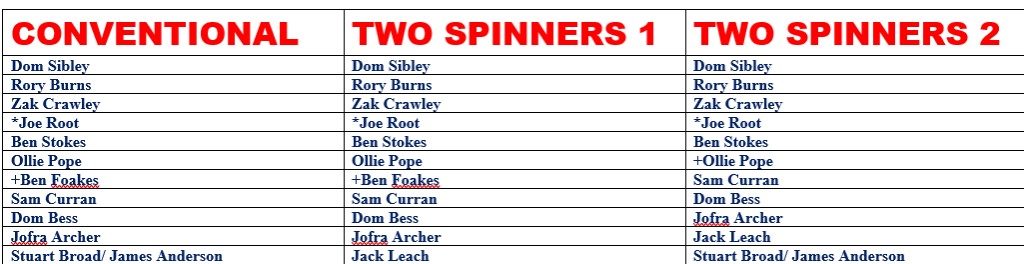
Potential Line ups

The first line up brings in Archer for his extra pace but sticks to one spinner and a choice between Broad and Anderson. The second line up accommodates two spinners but runs the risk of having Stokes as third seamer. The third line up is gamblers line up, entails Pope as keeper, a job he has done in test cricket, and five regular bowlers, with Stokes as back up. If England do decide to go with two spinners that would be my preferred option, although the second line up does at least have variety going for it – right arm fast (Archer), left arm medium fast (Curran), off spin and left arm orthodox spin plus x-factor Stokes. England need a win to regain the Wisden trophy and retain an interest in the World Test Championship, while the West Indies have not won a series in England since 1988, and so although a draw would see them retain the Wisden trophy it would not be a great result for them. So far this has been a splendid series, with England bouncing back well after the loss in Southampton.

TYING THINGS TOGETHER

The full scorecard for this fine match can be viewed here, courtesy of cricinfo. My other posts about this match are:

For a different view, here is the fulltoss blog’s account.

LINKS AND PHOTOGRAPHS

I have a varied trio of links to share today:

And now it is time for my usual sign off…
IMG_2038 (2)IMG_2039 (2)IMG_2040 (2)IMG_2041 (2)IMG_2042 (2)IMG_2043 (2)IMG_2044 (2)IMG_2045 (2)IMG_2046 (2)IMG_2046 (3)IMG_2046 (4)IMG_2047 (2)IMG_2048 (2)IMG_2048 (3)IMG_2048 (4)IMG_2049 (2)IMG_2049 (3)IMG_2050 (2)IMG_2051 (2)IMG_2051 (3)IMG_2053 (2)IMG_2053 (3)IMG_2054 (2)IMG_2055 (2)IMG_2058 (2)IMG_2058 (3)IMG_2058 (4)IMG_2059 (2)IMG_2059 (3)IMG_2062 (2)IMG_2066 (2)IMG_2068 (2)IMG_2068 (3)IMG_2069 (2)IMG_2069 (3)IMG_2071 (2)IMG_2071 (3)IMG_2072 (2)IMG_2072 (3)IMG_2073 (2)IMG_2073 (3)IMG_2074 (2)IMG_2074 (3)IMG_2074 (4)IMG_2074 (5)IMG_2074 (6)IMG_2077 (2)IMG_2077 (3)

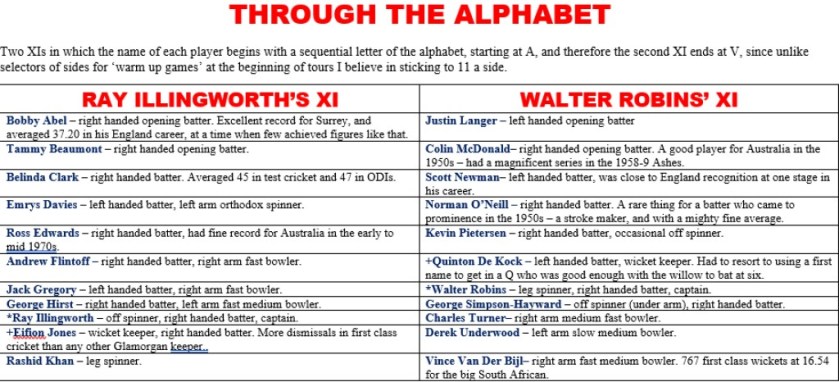
All Time XIs – Through The Alphabet XIII

Today’s all time XIs cricket post is our 13th alphabetic progression, also features mathematics and photographs.

INTRODUCTION

My apologies for the fact that you will be seeing today’s all time XIs cricket post a little late – I have been to a restaurant for a family Sunday lunch, the first time I have been out to do something in four months. This is the 13th and final alphabetic progression post in this series (I have three more days to fill before I will have some actual test cricket to write about), starting from the letter E.

CHARLOTTE EDWARDS’ XI

  1. *Charlotte Edwards – right handed opening batter, occasional spin bowler, captain. An epoch or two ago I was watching a game between the England and Australia women’s teams, and England by and large were surrendering with precious little fight. The glorious exception was a girl in her mid teens who fought her way to a magnificent 74. Her name was Charlotte Marie Edwards, and she went on from that impressive beginning to become one of the all time greats of women’s cricket. She was also a fine captain, leading her side to world cup glory and an Ashes triumph in 2009.
  2. Graeme Fowler – left handed opening batter, occasional wicket keeper. He could never quite convince the England selectors of his merits, although his last two test match appearances featured scores of 201 and 69. He scored twin centuries, aided by a runner in each innings (David Lloyd in the first and Ian Folley in the second) in one of the most extraordinary of all cricket matches, when Warwickshire posted 523-4 declared on the opening day and ended up losing by ten wickets!
  3. Harold Gimblett – right handed batter. He scored 123 in 79 minutes on his first class debut, winning the Lawrence Trophy for the fastest first class hundred of the season in the process, and went on to score more runs for Somerset than any other batter (Marcus Trescothick falling just short of matching him in the end). His 310 not out remains the highest first class score by a Somerset native, although Viv Richards and Justin Langer both produced bigger innings for the county. Like Marcus Tresocthick he suffered from mental health issues, and unlike Trescothick he was unable to come through them, and ended up becoming one of the depressingly long list of cricket suicides.
  4. Joe Hardstaff Jr – right handed batter. A man who averaged 44 in first class cricket, scored 169 not v Australia at The Oval in 1938 and 205 v India in 1946 at test level. His father played for Nottinghamshire and England as well, and like many other cricketers in that area and that era had worked down a mine before turning professional (Harold Larwood was another who worked in the mines before getting a professional cricket contract).
  5. Frank Iredale – right handed batter. He played 14 test matches for Australia, averaging 36, and that in the 1890s and early 1900s. He played a key role in the 1894 match at the SCG which England won after following on – on the first morning Tom Richardson reduced Australia to 21-3, before Iredale joined Giffen in the first of two big partnerships that dug Australia out of the hole.
  6. Roly Jenkins – right handed batter, leg spinner. A fine all rounder for Worcestershire, scoring over 10,000 first class runs and taking over 1,000 first class wickets in his career.
  7. +Kycia Knight – wicket keeper, left handed batter. One of a pair of twin sisters who are both regulars for the West Indies women (the other, Kyshona, bowls medium pace and bats in the lower order). She has never had the opportunity to play long form cricket, but she has a respectable record in limited overs cricket, and her batting would certainly be better suited to long form than it is to  limited overs.
  8. Brett Lee – right arm fast bowler, useful lower order batter. One of the quickest bowlers ever to play the game, though inconsistent and prone to injury. The 2005 Ashes saw him at his best, but his efforts were not enough to prevent England regaining the Ashes after Australia had won eight successive series (1989, 1990-1, 1993, 1994-5, 1997, 1998-9, 2001 and 2002-3) in cricket’s greatest rivalry.
  9. Muttiah Muralitharan – off spinner. 800 wickets in 133 test appearances. His 16 wickets at The Oval in 1998 were all the more remarkable because they were taken on a very flat pitch, and in a match that England had been less than enthusiastic about arranging, believing in spite of the 1996 World Cup that Sri Lanka were not good enough to oppose them.
  10. Sarfraz Nawaz – right arm fast medium bowler. He had his finest hour in Australia, when the home side had reached 305-3 in pursuit of a target of 388, and thanks to him were all out for 310. He took 7-1 in the space of 33 deliveries in that spell, finishing with 9-86 for the whole innings.
  11. Bill O’Reilly – leg spinner. Almost universally rated as the best bowler of the interwar years, and unhesitatingly named by Bradman (with whom he did not get on) as the best bowler he ever saw or faced. He took at least 25 wickets in each of four successive test series, a record for consistency that still stands.

This side has a strong top five, a genuine all rounder, a keeper and four quality bowlers. They will take a lot of beating.

LIONEL TENNYSON’S XI

  1. Alviro Petersen – right handed opening batter. Averages 40 in first class cricket, though he has never been good enough to be an absolute regular for South Africa.
  2. Willie Quaife – right handed opening batter, occasional leg spinner. One of the most stubborn end enduring of all cricketers, playing on for Warwickshire until he was 56 years old.
  3. Richie Richardson – right handed batter. The second greatest batter ever to come from the island of Antigua behind Viv Richards. He was the last international batter to face up to opposition quick bowlers in a hat rather than a helmet (he favoured a maroon sun hat, rather than a cap). Perhaps his greatest test performance came at Perth, when 6’7″ Jo Angel decided that banging the ball in short was the way to go, and the stands in the region of midwicket took an absolute pounding, Richardson being far from averse to taking on the short stuff and also having faced quicker bowlers than Angel over the years.
  4. Ben Stokes – right handed batter, right arm fast bowler.
  5. *Lionel Tennyson – right handed batter, occasional fast bowler. He scored 63 and 36 batting virtually one handed in a test match (he had a broken left arm) in 1921. A year later he helped to engineer one of the greatest turnarounds in cricket history, when Hampshire came back from being rolled for 15 in their first innings to beat Warwickshire by 155 runs.
  6. George Ulyett – right handed batter, right arm fast bowler. It was his bowling that first got him noticed, but he would also open the batting for his country.
  7. +Ricardo Vasconcelos – left handed batter, wicket keeper. Born in South Africa, of Portuguese ancestry, and now essential to Northamptonshire, for whom at the age of 22 he has already been keeper, opening batter and captain. He averages 36 with the bat, and has made 48 dismissals in 33 first class matches.
  8. Arnold Warren – right arm fast bowler. He took five cheap wickets on his only test match appearance. For those wondering about him being as high as no 8, he did once share a partnership of 283 with a certain J Chapman, so he clearly could bat.
  9. Xara Jetly – off spinner.
  10. Waqar Younis – right arm fast bowler. One of the all time great fast bowlers, both for Pakistan and for first Surrey and then Glamorgan, who he bowled to a county championship, in county cricket.
  11. Zahir Khan – left arm wrist spinner. Z is a difficult letter to fill, and in view of the pace bowling resources I already had Dawlat Zadran was not going to add much. Therefore I slightly cheated by selecting another Afghan who has one name beginning with Z, Zahir Khan. He is only just starting his career at present but I expect big things from him before too long.

This team has some decent batting and lots of depth and variety in bowling. Younis, Warren, Ulyett, Stokes and the occasional stuff of Tennyson is a superb range of pace options, and Xara Jetly and Zahir Khan should be able to enough in the spin department.

THE CONTEST

This should be a good contest. Lionel Tennyson’s XI have a greater range of bowling options, but as against that Charlotte Edwards’ XI are probably a stronger batting side. I just about make Lionel Tennyson’s XI favourites.

SOLUTION TO YESTERDAY’S TEASER

I presented this problem from brilliant yesterday:

Triangles

This problem was set on brilliant as a multi-choice question, and it was a matter of seconds work to look at the available answers and conclude that 125 was right (the other three answers for the missing length all gave triangles with a shortest side of non-integer length, the sort of thing I notice pretty much without thinking). This was unfortunate because without the multi-choice answers it would have been a genuinely tough problem. Here is a published solution from someone who unlike me did not take advantage of the availability of a hack:

PHOTOGRAPHS

My usual sign off…

IMG_1379 (2)IMG_1380 (2)IMG_1381 (2)IMG_1382 (2)IMG_1383 (2)IMG_1384 (2)IMG_1385 (2)IMG_1386 (2)IMG_1386 (3)IMG_1387 (2)IMG_1387 (3)IMG_1388 (2)IMG_1389 (2)IMG_1390 (2)IMG_1390 (3)IMG_1391 (2)IMG_1391 (3)IMG_1392 (2)IMG_1393 (2)IMG_1396 (2)IMG_1397 (2)IMG_1399 (2)IMG_1400 (2)IMG_1401 (2)TTA XIII

All Time XIs – Eras Clash

A post that looks at cricket history, a view on England’s first test selections, a mathematical teaser and some photographs.

INTRODUCTION

Welcome to today’s All Time XIs cricket post, in which we look at the history of English cricket. A team of cricketers who were all born before 1850 are pitted against an XI who were all born after 1850. Before getting into the main body of the post I start with:

THOUGHTS ON THE SELECTIONS FOR THE FIRST TEST MATCH

22 players have been retained by England at the ground, with 13 officially in the test squad and nine as back ups. Here courtesy of the pinchhitter is the full list:

Eng Squad

My thoughts on the above are: arguably neither Broad nor Anderson should be in the 13, and certainly Broad should not be there. Ollie Robinson should be in the 13 and if he is definitely fit so should Curran. Bracey and Lawrence should both be in the 13, as should Foakes, with Buttler not even meriting a place in the 22. I am relieved the Bess is confirmed as first choice spinner and that Moeen Ali has not even made the 22. I would have liked to see Parkinson in the 22 at least. I am personally not entirely convinced about Woakes. Buttler’s continuing presence in the test squad is a disgrace – he can barely even be described as a competent keeper and his red ball batting record is ordinary. Denly’s selection is a very poor call as well – he averages dead on 30 in test cricket, and Bracey and Lawrence provided the only two major innings of the warm up game and should both be ahead of him.

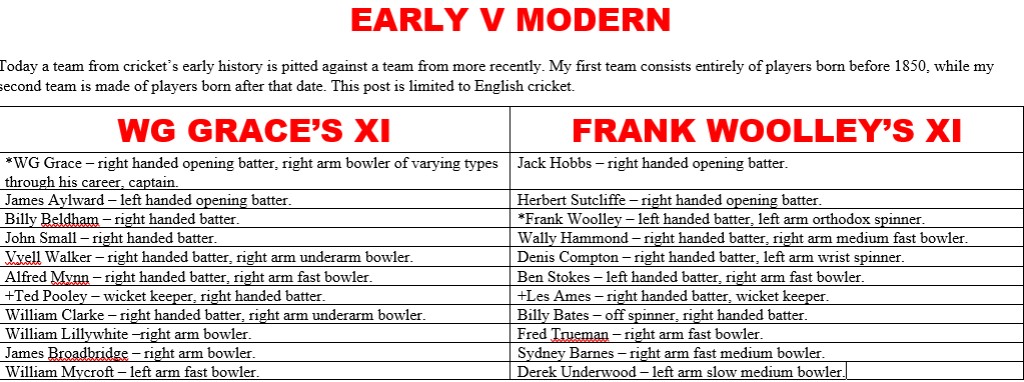
WG GRACE’S XI

  1. *WG Grace – right handed opening batter, right arm bowler of varying styles through his career, captain. He was born in 1848, the latest birth year of any member of this XI. He scored 54,896 first class runs and took 2,876 first class wickets. Over the course of his best decade, the 1870s, he averaged 49 with the bat, while the next best among regular players was 25, achieved by Richard Daft and his younger brother Fred.
  2. James Aylward – left handed opening batter. His 167 against All England in 1777, a mere eight years after the first record hundred of any type was scored is enough on its own to warrant his selection. He batted through two full days of play on that occasion, and his left handedness also helps make him a good complement for Grace.
  3. Billy Beldham – right handed batter. At a time when 20 was considered a decent score, and seriously big scores were a huge rarity he amassed three centuries in matches still recognized today as being first class.
  4. John Small – right handed batter. One of the greats of his day. He is credited with pioneering the policy of playing with a straight bat – before he showed what could be done with this method cross batted swiping was the order of the day.
  5. Vyell Walker – right handed batter, right arm underarm bowler. One of only two players (the other, WG Grace, is also in this XI) to have scored a century and taken all ten wickets in an innings of the same first class match. He was one of seven brothers who hailed from Southgate, and the ground there, which still occasioanlly hosts Middlesex games, is called the Walker Ground in their honour.
  6. Alfred Mynn – right handed batter, right arm fast bowler. The greatest all rounder the game saw prior to the emergence of WG Grace.
  7. +Ted Pooley – wicket keeper, right handed batter. A great keeper for Surrey, and would have kept for England in the inaugural test match but for an incident that saw him briefly confined in a New Zealand prison cell.
  8. William Clarke – right arm underarm bowler. He was rated as the best bowler of this type ever to play the game, averaging 300 wickets a season in all forms of cricket at his peak, including 476 in his most productive season. He was captain of the All England XI, a touring outfit that played matches against odds (opposition having more than 11 in their team) all round the country. His most significant contribution to cricket history came as a result of his marriage to the landlady of the Trent Bridge Inn. He enclosed some land behind the inn, turning it into a proper cricket ground, and 180 years on Trent Bridge is officially still a test venue, although it will not be hosting any games this season – internationals will be happening at the Ageas Bowl and Old Trafford only.
  9. William Lillywhite – right arm bowler. The greatest bowler of his era, and one of the pioneers of ’round arm’ bowling, the development between under arm and over arm in the game’s history. He was one half of the game’s first great bowling partnership, along with…
  10. James Broadbridge – right arm bowler. Like Lillywhite, who he regularly bowled in tandem with he was among the pioneers of ’round arm’, and with these two spearheading their bowling Sussex were able to take on the Rest of England on equal terms.
  11. William Mycroft – left arm fast bowler. 863 wickets in 138 first class games at 12.09 each. His best match performance came in 1876 by when he was 35 years of age, when he took 17-103 v Hampshire, only to see them sneak home by one wicket.

This side has a powerful top six, three of whom can be described as all rounders (Grace, Walker, Mynn), a great keeper and a magnificent and varied foursome of bowlers.

FRANK WOOLLEY’S XI

  1. Jack Hobbs – right handed batter, occasional medium paced bowler. 61,237 first class runs, including 197 centuries, both all time records. Scored his last test century at the age of 46, still the oldest ever to do so.
  2. Herbert Sutcliffe – right handed batter. Hobbs’ opening partner for England, an alliance that had the best average of any opening pair in test history, 87.
  3. *Frank Woolley – left handed batter, left arm orthodox spinner. The only player ever to achieve the career treble of 10,000 runs, 1,000 wickets and 1,000 catches in first class cricket, and indeed the only non-keeper to take 1,000 first class catches.
  4. Wally Hammond – right handed batter, right arm medium fast bowler. He lost eight seasons of his career, one to bureaucratic malice on the part of Lord Harris, one to a mystery illness picked up in the Caribbean and six to World War II and still scored over 50,000 first class runs with 167 centuries, including 7,249 runs and 22 centuries for England. Only two players have ever scored as many as 900 runs in a test series, Hammond with 905 at 113.125 being the first in the 1928-9 Ashes, a record that was overhauled 18 months later by Don Bradman. He is joint record holder for reaching 1,000 first class runs in a season in the shortest time period, doing it in 1927 between May 7 when he started and May 28, where WG Grace in 1895 had done it between May 9 and May 30.
  5. Denis Compton – right handed batter, left arm wrist spinner. He averaged 50 in test cricket, set a record first class season’s aggregate in 1947. In 1956 he was recalled for England at The Oval, having had a knee operation earlier in the season, and scored 94. He still holds the record score for England against Pakistan, with 278. He also holds the record for the quickest ever first class triple century, racking it up in 181 minutes v Benoni during the 1948-9 tour of South Africa. At Adelaide in the 1946-7 Ashes he and Arthur Morris entered the record books when each of them scored twin tons in a drawn match.
  6. Ben Stokes – left handed batter, right arm fast bowler. The man who will captain England when test cricket resumes in a few days time. Instrumental in England’s 2019 World Cup win, and also largely responsible for the win at Headingley later that season, plus having an outstanding series in South Africa. When the recent intra-squad warm up match at the Ageas Bowl was accepted as a draw he had been smashing the ball all over the place, but the dismissal of Moeen Ali, LBW to Bess, ended his team’s hopes of triumph, and Team Buttler apparently decided not to press for the wickets they needed to win.
  7. +Les Ames – right handed batter, wicket keeper. Over 100 first class hundreds with the bat, and over 1,000 first class dismissals with the gloves. Eight of his centuries came at test level, including 120 v Australia at Lord’s in 1934, which helped put England in position to win that match, their only victory over the old enemy at that venue in the entire 20th century.
  8. Billy Bates – off spinner, right handed batter. In his 15 match test career, ended prematurely by an eye injury, he averaged 27 with the bat and took 50 wickets at 16 each. His best match came at the MCG in the 1882-3 series, when he took seven wickets in each innings and contributed 55 to the only innings England had to play.
  9. Fred Trueman – right arm fast bowler. His record speaks for itself.
  10. Sydney Barnes – right arm fast medium bowler. 189 wickets in 27 test matches at 16.43 each.
  11. Derek Underwood – left arm slow medium bowler. 297 test wickets for the crafty Kent bowler.

This team has a strong batting line up, six front line bowling options (the four specialists plus Stokes and Woolley) and Hammond and Compton as back up bowlers. There is no right arm leg spin option, but Underwood, Woolley and Compton could all move the ball away from the right hander.

THE CONTEST

This has all the makings of a classic, and I will not even attempt to predict the outcome.

A MATHEMATICAL TEASER

This problem appeared on brilliant.org today, and should have been even better than it actually was (it was a fine one anyway):

Triangles

This was presented as multi-choice, with four possible answers, and as I will explain tomorrow that opened up an unorthodox route to a solution, so I am not making it multi-choice.

PHOTOGRAPHS

My usual sign off…

IMG_1366 (2)IMG_1367 (2)IMG_1368 (2)IMG_1369 (2)IMG_1370 (2)IMG_1372 (2)IMG_1373 (2)IMG_1374 (2)IMG_1375 (2)IMG_1376 (2)IMG_1377 (2)IMG_1377 (3)IMG_1377 (4)IMG_1377 (5)IMG_1378 (2)IMG_1378 (3)

Old v New
The teams in tabulated form.

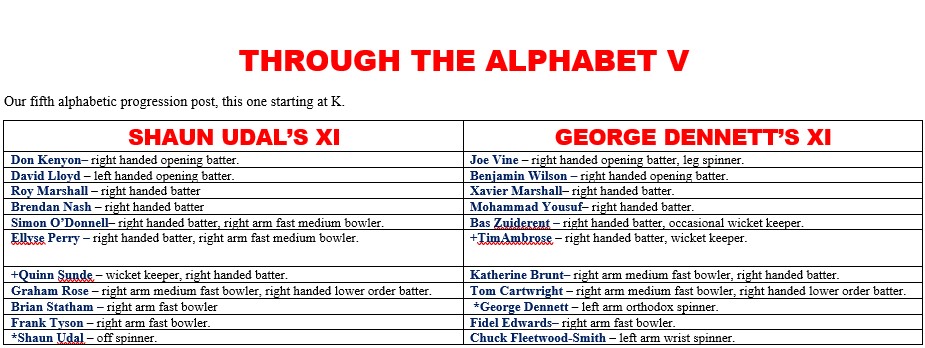
All Time XIs – Through the Alphabet VIII

Today’s all time XI continues the alphabetic progression, starting with a Y.

INTRODUCTION

Welcome to today’s ‘all time XI‘ cricket post. After yesterday’s England v West Indies special we resume our alphabetic progression sequence of squads, starting with a Y.

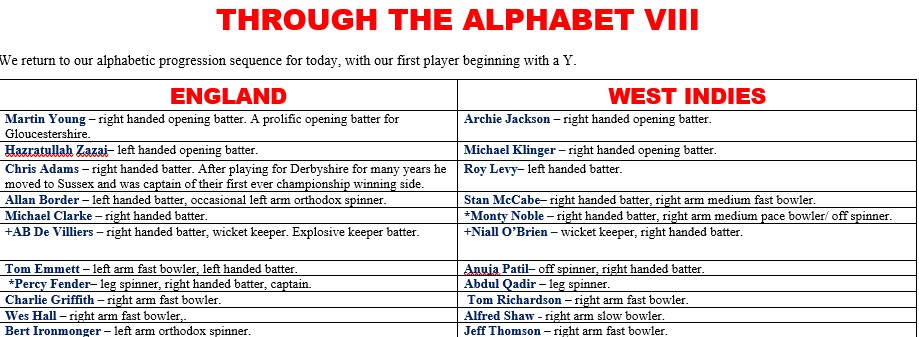
PERCY FENDER’S XI

  1. Martin Young – right handed opening batter. A consisten run scorer for Gloucestershire for many years.
  2. Hazratullah Zazai – left handed opening batter. The attacking Afghan opener shuuld complement the more restrained Young very nicely.
  3. Chris Adams – right handed batter. He played for Derbyshire for many years before moving south to Sussex, who he captained to their first ever county championship title. Although prolific at county level he never quite delivered for England (though it must be acknowledged that he was given few opportunities to do so). He has gone on to a coaching career in which he has also enjoyed some success, being involved with the Surrey set up for one of their championship wins.
  4. Allan Border – left handed batter, left arm orthodox spinner, vice captain. The first person to reach the career milestone of 11,000 test runs, and until another resolute left handed, Alastair Cook, went past it he held the record for consecutive test appearances, having played the last 153 of his 156 tests in succession. His career had two distinct components – part 1, when he was desperately attempting to hold together a struggling outfit, and was very often the only serious stumbling block faced by opposition bowlers, and part 2, when Australian efforts to rebuild began to bear fruit, and they went from chumps to champs in the space of a few years, a position they would occupy undisputed for another decade after Border’s retirement. I don’t often name vice captains in this series, but his status as the captain who turned Australia’s fortunes round in the late 1980s has to be acknowledged, and I had another player in the team I wanted to name captain.
  5. Michael Clarke – right handed batter, occasional left arm orthodox spinner. To put it mildly he was not universally popular with Australian fans during his playing career, but the excellence of his record at the highest level cannot be denied. He had, in common with many of his team mates, a very poor series in the 2010-11 Ashes, and some of his efforts to avoid being seen to covet his skipper’s job were overdone to say the very least – such as suggesting that he at 29 might be retiring before the 36 year old Ponting. It may also have not have helped when in the final match of that series, with Ponting injured, the debutant Khawaja was given the job of filling the no3 slot while the veteran Clarke stayed down the order.
  6. +AB De Villiers – right handed batter, wicket keeper. An explosive middle order batter and a fine keeper. Although he was best known for his performances in limited overs cricket his test record was also splendid.
  7. Tom Emmett – left arm fast bowler, left handed batter. Although it was his bowling for which he was chiefly noted he could definitely bat as well – at one time Yorkshire pressed him into service as an opening batter when they were short. 
  8. *Percy Fender – leg spinner, right handed batter. An all rounder who once scored a first class century in 35 minutes against proper bowling (various quicker efforts appear in footnotes in the record books as they were scored against bowlers who were trying to concede quick runs to bring about a declaration, a ‘tactic’ that was once common in county cricket. He never got to captain England, but was universally acknowledged to be superb at the job, which is why I have named as captain of this side.
  9. Charlie Griffith – right arm fast bowler. One half of a great fast bowling pair. There is an amusing story from their schooldays featuring Griffith bowling off spin interspersed with the odd quicker one while the other member of the duo was keeping wicket.
  10. Wes Hall – right arm fast bowler. He bowled the final over of the first ever tied test, at Brisbane in 1960, spilling a catch that he would have been well advised to leave to Rohan Kanhai along the way. At Lord’s in 1963, when the match ended in a draw with England six runs and the West Indies one wicket short of the line, he bowled an epic unchanged spell on the final day.
  11. Bert Ironmonger – left arm orthodox spinner. Australia’s oldest ever test cricketer – he was 46 when he made his debut and 51 when he played his last test match. He and Bill O’Reilly were the bowling stars of Australia’s only victory in the 1932-3 Ashes series, at Melbourne, and the same duo shot South Africa out for 36 and 45 in a test match in which Bradman crocked himself and was unable to bat and Australia still won by an innings and 72 runs.

This team has a fine top six, including a keeper batter, and a bowling attack that is beautifully balanced, with left arm pace, right arm pace, leg spin and left arm orthodox spin. There is no off spin and no purveyor of ‘chinamen’, It is a side that I would expect to give a good account of itself.

MONTY NOBLE’S XI

  1. Sanath Jayasuriya – left handed opening batter, left arm orthodox spinner. The MVP of the 1996 cricket world cup, and he had a fine test record as well.
  2. Michael Klinger – right handed opening batter. One of the better batters never to play test cricket, he enjoyed a long and distinguished career for South Australia, and was often mentioned as a possible for the test side. He did get to play a few T20Is.
  3. Roy Levy – left handed batter. He played 25 matches for Queensland in the late 1920s and early 1930s, and his record does not look stellar. He qualifies by virtue of an innings played at the age of 22 against South Australia with 37 year old leg spinner Clarrie Grimmett in their ranks. The match was desperately close in the final stages, as Levy shepherded the Queensland tail towards the target. Eventually Levy chanced his arm against the bowler at the other end to Grimmett, sent the ball into the air towards Grimmett who missed the catch, and then compounded the felony by shying wildly at the stumps and missing, which enabled Levy to complete the winning run. Levy in that innings finished with 85 not out, and Queensland won by one wicket. There is a detailed account of the match in Patrick Murphy’s “Fifty Incredible Cricket Matches”.
  4. Stan McCabe – right handed batter, right arm medium fast bowler.
  5. *Monty Noble – right handed batter, right arm medium pace bowler/ off spinner. A genuine all rounder and a fine captain as well. He and Warwick Armstrong once put on 428 together for Australia against Sussex for the sixth wicket.
  6. Niall O’Brien – wicket keeper, right handed batter. The Kent, Northamptonshire and Ireland keeper established a fine record over a long period of time.
  7. Anuja Patil – off spinner, right handed batter. Her international experience has been limited to T20s thus far, but her record makes impressive reading.
  8. Abdul Qadir – leg spinner. 67 test matches, 236 wickets at 32.80 at a time when spinners were in eclipse due to the success of Clive Lloyd’s battery of four fast bowlers for the West Indies, and a tendency developed therefrom by other countries to treat spinners as ‘fill-in’ bowlers. Leg spin in particular was all but extinct – the only specialist leg spinner who played international cricket at the same time as Qadir that I can think of was the older Australian Bob Holland, and save for once against the West Indies dear old ‘Dutchy’ was never a match winner. In 1986 at Faisalabad Qadir took 6-16 in the second West Indies innings as they slumped to a then all-time low for them of 53 all out, and defeat by 186 runs.
  9. Tom Richardson – right arm fast bowler. His thousandth first class wicket came in 134th match and his 2,000th in his 327th match at that level, both of which figures remain all time record. From the start of 1894 to the end of 1897 – four seasons and one tour of Australia – he captured over 1,000 wickets, a period of sustained destructiveness matched only by Kent leg spinner Tich Freeman. Neville Cardus selected Richardson as one of his “Six Giants of the Wisden Century” in 1963 because he was a real life version of a storybook fast bowler. He learned his craft on Mitcham Common, and as Surrey’s star fast bowler thought nothing of walking from his home in Mitcham to The Oval (a substantial walk, I can tell you, as someone who grew up in southwest London myself) with his kit bag, doing a day’s bowling and walking home again at the end.
  10. Alfred Shaw – right arm slow bowler. His dictum was “length and successful variations of pace are the key to successful bowling.” He bowled more overs in his career than he conceded runs (admittedly for most of his career an over consisted of four balls). He took over 2,000 wickets at 12 runs a piece, with his best season seeing him claim 186 at 8.54 each in first class matches. He also dismissed WG Grace more often than any other bowler – 49 times in all (they met in many types of fixture, including Gentlemen vs Players, North v South, Under 30 v Over 30, etc.). He bowled the first delivery ever in a test match. In the 1881 Gentlemen vs Players match (he was a professional, so played for the Players) he made what turned out to be a crucial 8 not out in the Players second innings, and then took 6-19 in the Gentlemen’s second innings, ending the match by taking a blinder off his own bowling to give the Players victory by two runs. After retiring from Nottinghamshire who he served for many years he became coach at Sussex, and in a crisis came out of retirement for them and proceeded to show a new generation what all the fuss had been about 20 years earlier.
  11. Jeff Thomson – right arm fast bowler. When there was all the hoop-la about Shoaib Akhtar’s first record 100mph delivery (which the batter played calmly to square leg with no apparent difficulty) one person who was resolutely unimpressed was Jeffrey Robert Thomson, who believed, not entirely unjustifiably that he had regularly propelled the ball at that speed 25 years earlier. He in tandem with Dennis Lillee and backed up the fast medium of Max Walker destroyed England in 1974 and 1975, and it was a 5-1 series defeat in that part of the world, again mainly caused by Lillee and Thomson that planted the germ of the four fast bowler idea in Clive Lloyd’s mind, and idea that crystallized when India scored 406-4 to win at Trinidad a few months later with the West Indies fielding three spinners because the pitch was expected to turn.

This side has some decent batting, a quality wicket keeper, and lots of bowling. Thomson, Richardson and Shaw, with Noble as fourth option in that department provide  ‘seam’ options, while Qadir and Patil offer two contrasting spin options, with Noble as back up in that department as well.

SOLUTION TO YESTERDAY’S TEASER

I offered the following problem from brilliant to readers yesterday:

Exponent

Here is Pall Marton’s published solution, a genuinely brilliant effort:

Pall Marton

A LINK AND PHOTOGRAPHS

Alison, who some of readers will know as ‘the unabashed autist‘ now has a new site, alisonrising, which I recommend to all of you – please visit and subscribe. Now it is time for my usual sign off…

IMG_1268 (2)IMG_1269 (2)IMG_1270 (2)IMG_1271 (2)IMG_1273 (2)IMG_1274 (2)IMG_1275 (2)IMG_1275 (3)IMG_1276 (2)IMG_1277 (2)IMG_1278 (2)IMG_1279 (2)IMG_1280 (2)IMG_1282 (2)IMG_1282 (3)IMG_1283 (2)IMG_1283 (3)IMG_1283 (4)IMG_1285 (2)IMG_1286 (2)IMG_1287 (2)IMG_1287 (3)IMG_1288 (2)IMG_1289 (2)IMG_1289 (3)IMG_1290 (2)IMG_1290 (3)IMG_1290 (4)IMG_1291 (2)IMG_1295 (2)IMG_1296 (2)IMG_1298 (2)IMG_1299 (2)IMG_1300 (2)IMG_1301 (2)IMG_1302 (2)IMG_1303 (2)IMG_1304 (2)IMG_1305 (2)IMG_1306 (2)IMG_1307 (2)IMG_1308 (2)

TTA VIII
The teams in tabulated form.

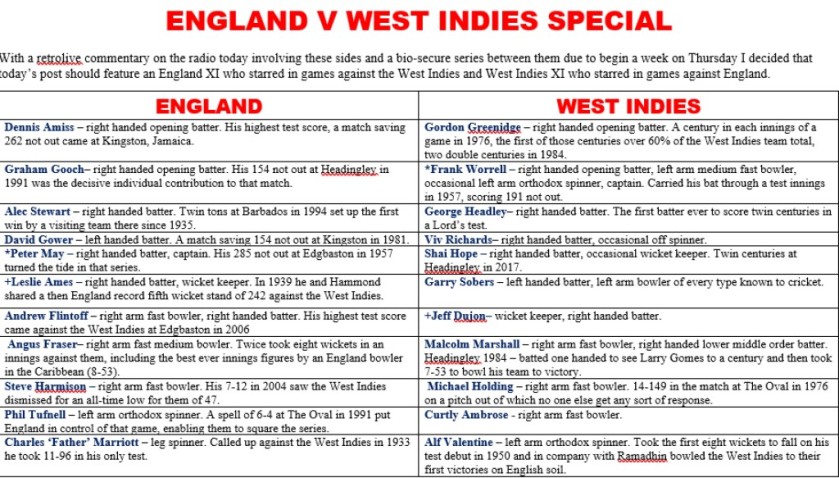
All Time XIs – England v West Indies Special

A Saturday Spectacular in the all-time XI cricket series, inspired by a combination of today’s retrolive commentary and the upcoming ‘bio-secure’ test series.

INTRODUCTION

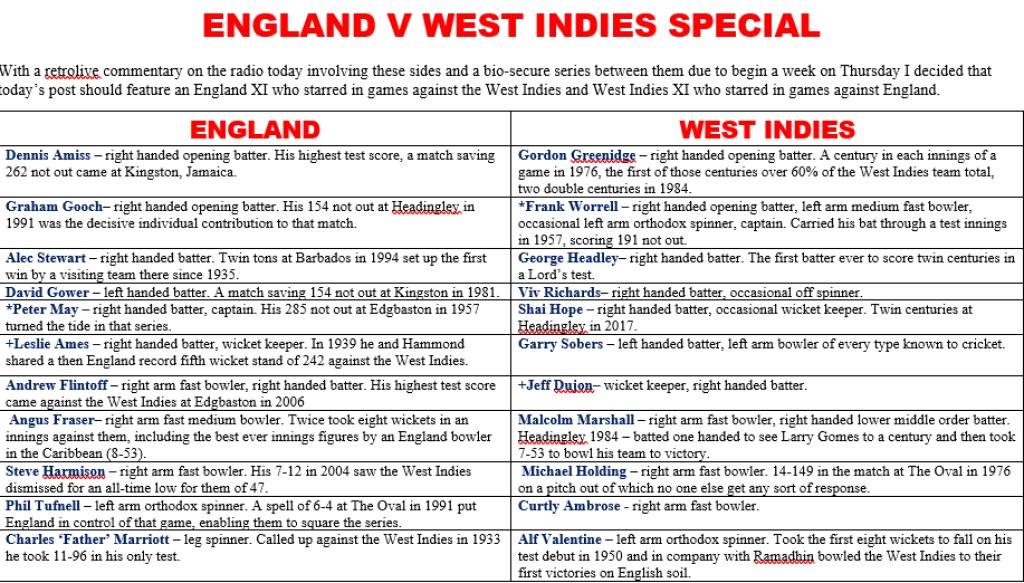
Todau a ‘retrolive’ commentary on the Headingley Test of 2017 between England and the West Indies began, and a week on Thursday the first ‘bio-secure’ test of the post Covid-19 era gets underway between the same two sides. Today’s all time XIs post therefore interrupts our sequence of ‘through the alphabet‘ posts to pit an England XI all of whom had great moments against the West Indies against a West Indies XI all of whom had great moments against England.

ENGLAND

  1. Dennis Amiss – right handed opening batter. In the Kingston test of 1973 England were staring down both barrels as they went into their second innings. They escaped with a draw, and when stumps were drawn at the end of the match Amiss was on career best 262 not out. In 1974 and 1975 a ferocious working over by Dennis Lillee and Jeff Thomson adversely affected Amiss but he bravely remodelled his stance to better enable him to stand up to the very fast bowlers, and at The Oval in 1976 England were facing a total of 687-8 declared. Amiss produced another double century, but this time the West Indies won the match.
  2. Graham Gooch – right handed opening batter, occasional medium pace bowler. In the first test of the 1991 series between England and the West Indies, at Headingley, England took a small first innings lead. Curtly Ambrose then served up a storm at the start of the England second innings, taking the first six wickets to fall, with only Ramprakash who exactly matched his first innings 27 having provided Gooch any support. Derek Pringle bravely held out for two hours making 27 of his own, and Gooch shepherded the nine, ten, jack as best he could. England were all out for 252, and Gooch had an unbeaten 154 to his name. The West Indies collapsed in their own second innings and England were victorious. This was by no means Gooch’s highest test score – he made 333 against India in 1990, 210 against New Zealand in 1994, 196 against Australia in 1985 and 183 against New Zealand in 1986 to give a few examples. However, these scores came on flat wickets and against largely modest bowling attacks – of the bowlers involved in those innings only Hadlee (for New Zealand in 1986) and Kapil Dev (for India in 1990) were performers of unquestionably top rank. The Headingley 1991 pitch was a difficult one, and the West Indies bowlers were Marshall, Patterson, Ambrose and Walsh, three of whom were unquestionably great bowlers and the fourth, Patterson, was seriously, blisteringly quick, although a trifle inconsistent.
  3. Alec Stewart – right handed batter, occasional wicket keeper. In the third test of the 1994 series England needed 194 to win and had an hour to survive in murky light on the penultimate day. By the end of that hour they were 40-8, courtesy of the old firm of Ambrose and Walsh, and the game ended early the following morning with England out for 46, only one run more than their lowest ever total. The next match was at Bridgetown, Barbados (see yesterday’s post for more about that island’s cricketing pedigree) where no visiting side had triumphed since 1935. Stewart, opening with Atherton in that series, proceeded to notch up twin centuries and England rebounded from their humiliation in the third test with victory in the fourth. Given the make up of the West Indies bowling attack picking three recognized openers is a tactic with plenty going for it anyway.
  4. David Gower – left handed batter. When England began their second innings in the final test of the 1981 tour of the West Indies defeat seemed certain. By the end of day four the odds were still in favour of a West Indies victory, but Gower was on 70, and had some good support from Peter Willey. On the final morning Willey fell, and Ian Botham, captaining the side and struggling for form also fell cheaply. Paul Downton joined Gower in the last chance saloon. The resistance held out, and the match was safe by the time Gower took one last single deep into the last hour to move to 154 not out, the highest individual score for England in the series. This innings, occupying eight hours and scored in the teeth of the most lethal fast bowling unit ever assembled (Andy Roberts had just been dropped after going wicketless in the previous match, leaving a foursome of Holding, Garner, Croft and Marshall, the new kid on the block) confirmed Gower’s place among the world’s top batters – his first century had been made against an ordinary New Zealand, his first Ashes century against an under-strength and badly captained Australian side and his 200 not out against India at Edgbaston was scored against a less than stellar attack on a very flat pitch. The next two series between England and the West Indies were both 5-0 to the West Indies, and it was at Headingley in 1988 that England next drew a match against them.
  5. *Peter May – right handed batter, captain. In the Edgbaston test of 1957 England collapsed badly in their first innings against ‘those two little pals of mine, Ram and Val’ – Sonny Ramadhin and Alf Valentine and were made to follow on. Both openers fell cheaply, and May walked out to play an innings in which England needed him to go big. The third England wicket fell with England still adrift, bringing Colin Cowdrey to the crease. May and Cowdrey who came together near the end of day 3 were still in occupation when then fifth and final day got underway. Cowdrey fell for 154 to end a stand of 411, still an England record for any wicket. By the time May declared to give the West Indies an awkward little session of batting he had been at the crease for ten hours and scored 285 not out, at the time a record for an England captain, beating the 240 scored by Hammond at Lord’s in 1938. Ramadhin had wheeled down 98 overs that second England innings and had just two wickets to show for it – and was never to same force again. The West Indies, having for a long time looked like winning were in the end relieved to come away with a draw, having lost seven wickets in the closing stages of the game. England went on to win the series.
  6. +Leslie Ames – right handed batter, wicket keeper. In the last series before World War II, in 1939, Ames and Hammond shared a fifth wicket stand of 242, then an England record against all comers, to set up a victory.
  7. Andrew Flintoff – right handed batter, right arm fast bowler. He had a couple of magnificent years from 2004 through the summer of 2006, and one of the seemingly endless succession of highlights for him in that period was his highest test score, 167 against the West Indies at Edgbaston in 2006, in an England win.
  8. Angus Fraser – right arm fast medium bowler. He twice took eight wickets in an innings in the Caribbean, including the best ever by an England bowler in that part of the world, 8-53. In 1990 England set off for the Caribbean in what seemed to be a very poor state. The last three series between the two had been 5-0, 5-0 and 4-0 to the Windies, and England had just been thrashed by Australia in the 1989 Ashes. In 1988, which included that 4-0 drubbing by the Windies, 28 players had been called up for England test teams. Then in 1989 against Australia 31 players were named in England test squads and 29 actually took the field for England. The only player to have played every game in both years was David Gower, and he was not picked for the tour of the Caribbean. Greenidge and Haynes started smoothly for the West Indies at Sabina Park, Jamaica, before their partnership was ended by misadventure – a ball was played to Devon Malcolm who fumbled it, which encouraged Greenidge to turn for a second, Malcolm unleashed a bullet throw and there was a run out. Then in a spectacular role reversal the West Indies middle order folded, and having reached 60 before losing a wicket they were all out for 164 and Fraser had 5-28. A big partnership between Allan Lamb and Robin Smith rammed home England’s advantage, and they won the match. Fraser subsequently had injury problems and also suffered like many others from the attitude of Ray ‘In My Day’ Illingworth when he was England supremo.
  9. Steve Harmison – right arm fast bowler. When England under the captaincy of Michael Vaughan headed to the Caribbean in 2004 Harmison was just beginning to establish himself as a genuinely top class, genuinely fast bowler. That series underlined his improvement, with his personal highlight being a spell of 7-12 as the West Indies were hustled out for a record low of 47. Nb – when talking about bowling figures number of wickets take precedence, and it is only identical wicket hauls that are split by economy, a reflection of the fact that in non-limited overs cricket you need to take 20 wickets to win the match and that in limited overs cricket getting someone out is still the most definitive way to prevent them from scoring, so although on the basis of runs per wicket (1.71 against 6.63) 7-12 is better than 8-53 the fact that Fraser’s haul was eight wickets rather than seven trumps the difference in economy.
  10. Phil Tufnell – left arm orthodox spinner. England came to The Oval in 1991 2-1 down in the series, needing to win the square it which after the disasters of the 1980s would be a very fine result. A century for Robin Smith and few other useful innings got England to 400 in their first innings. Phil Tufnell then got to work with the ball, beginning his spell of destruction with the psychologically crucial wicket of Viv Richards. That huge breakthrough achieved Tufnell took a further five wickets in his spell, at a cost of a mere four runs. His overall innings figures were 6-25, the West Indies were made to follow on, and England won and squared the series. Before this series, series scores between the two teams since 1980, with England first, had been 0-1, 0-2, 0-5, 0-5, 0-4 and 1-2 – a net 1-18 against England.
  11. Charles ‘Father’ Marriott – leg spinner. The Lancashire and Kent leg spinner, who had been playing county cricket since 1920 was called up for the last test of the 1933 series. England batted first and scored 312. The West Indies were all out for 100 in their first innings, Marriott 5-37 (and Nobby Clark the left arm fast bowler 3-16). England enforced the follow on, the West Indies batted better second time round, but not well enough, being all out for 195, Clifford Roach making 56 opening the batting, Marriott taking 6-59, while the fast bowlers Clark, and Stan Nichols of Essex took two each, left arm spinner Langridge bowling seven wicketless overs. Marriott had 11-96 in the match, and was known to be a pure bowler (711 first class wickets at 20.11, 574 first class runs at 4.41), England had won by an innings and 17 runs, but that was the sum total of Marriott’s test career.

This side has a strong top six, a player who at his best was an x-factor all rounder, and four well varied bowlers. Harmison, Fraser, Flintoff, Marriott and Tufnell is an attack should be useful in all conditions.

THE WEST INDIES

  1. Gordon Greenidge – right handed opening batter. On the most difficult pitch of the 1976 ‘grovel’ series he made twin centuries, the first of them being 61% of his team’s innings total. His two double centuries in 1984 are also worthy of mention.
  2. *Frank Worrell – right handed batter, left arm medium fast bowler, occasional left arm orthodox spinner, captain. In 1957 he carried his bat through an innings, finishing with 191 not out. In 1963 he was captain, and the series was regarded as one of the greatest ever played.
  3. George Headley – right handed batter. A man who averaged 60.83 in test cricket clearly had highlights against every opponent. However, the particular performance that gets him in here came in the 1939 series, when he became the first batter ever to score twin centuries in a Lord’s test.
  4. Viv Richards – right handed batter, occasional off spinner. Was his 232 in the opening match of the 1976 series better than his 291 at The Oval in the final match thereof, were they both trumped by the first test century to be recorded at St John’s Antigua in 1981 or were all other efforts trumped by his 56-ball century at Antigua five years later? That is even before we consider ODIs (138 not out in the 1979 World Cup Final, 189 not – then an ODI record individual score – in an innings total of 272-9 at Old Trafford in 1984). These details provide some indication of why even in 1991 when he was well past his prime his wicket which started Phil Tufnell on his merry way was so psychologically important.
  5. Shai Hope – right handed batter, occasional wicket keeper. When England and the West Indies convened at Headingley in 2017 533 first class matches had been played at the ground and nobody had ever scored twin tons there, even though some mighty fine batters called the place home, e.g. Herbert Sutcliffe and Len Hutton. The person who finally entered the record books by achieving that feat, and did it in a test match to boot, was Shai Hope. Three years on those remain his only two test centuries at test level, a remarkable quirk.
  6. Garry Sobers – left handed batter, left arm bowler of every type known to cricket. He had a stack of extraordinary performances against all opposition, as befits the most complete player the game has yet seen. The particular match I have picked on to include him here featured the West Indies deep in trouble when their fifth second innings wicket went down and Sobers being joined at the crease by David Holford, primarily a leg spinner. The pair put on an undefeated 274 together for the sixth wickets, Sobers 163 not out, Holford 105 not out, and England ended up being glad to escape with a draw after losing a few second innings wickets.
  7. +Jeff Dujon – wicket keeper, right handed batter. Although the West Indies largely dominated the 1988 series (4-0, and the drawn first match owed more to the weather than to the stoutness of England’s resistance), but there was one occasion therein when they hit trouble – 53-5 in their first innings, and Dujon, with support from Logie rescued them – the sixth wicket stand was worth 130, and got the West Indies back into the match.
  8. Malcolm Marshall – right arm fast bowler. At Headingley in 1984 he sustained a broken arm, a rare case in that era of a West Indian being on the receiving end of an injury. When the ninth West Indian wicket fell Gomes was on 96, and so Marshall went in to bat one-handed to see his team mate to a century. Then, to English consternation, he proceeded to take the new ball. He proceeded to rip through the second England innings with career best figures of 7-53, displacing the 63 and 36 scored by Tennyson batting one-handed against Australia with Gregory and McDonald as the greatest test performance by a cricketer playing with one usable hand.
  9. Michael Holding – right arm fast bowler. In August 1976 England was baking in a heatwave, the pitch at The Oval was absolutely flat and lifeless and the outfield was almost grassless due to the drought. The West Indies piled up 687-8 declared, but even their bowlers could get little out of the pitch, with one exception. Michael Anthony Holding took 8-92 in England’s first innings, the best innings figures at that time by a West Indian fast bowler (a spinner, Jack Noriega, had taken nine wickets in a test innings for them). The West Indies declined enforce the follow-on, giving their bowlers a breather. A declaration  at 182-0 left England needing to match their first innings 435 to win. This time round Holding took 6-57 to give him 14-149 in the match and his side victory and a 3-0 series scoreline.
  10. Curtly Ambrose – right arm fast bowler. I have already mentioned his bowling at Headingley in 1991 and at Trinidad in 1994 (the 46 all out game), but before that he had settled the 1990 series in the West Indies by destroying England in the last two test matches thereof. England had won the opener (see under Fraser), the second, scheduled for Guyana, had been washed out without a ball being bowled, and a combination of more bad weather and some scandalous (and unchecked, never mind punished) time wasting by Desmond Haynes as stand-in captain had condemned the third match at Trinidad to another draw, in spite of Malcolm picking up ten wickets in a test match (6-77 in one innings) for the first time in his career. However, in the final two tests, Ambrose was simply unstoppable, his figures including an 8-45 in one innings. England’s best resistance in those  matches came from pugnacious wicket keeper Jack Russell who produced a day-long rearguard in one of them.
  11. Alf Valentine – left arm orthodox spinner. He made his test debut in the 1950 series and proceeded to capture the first eight England wickets to fall, only to be denied absolute immortality to Berry and Hollies, two of the game’s greatest ‘ferrets’. The feat still remains a record, and helped the West Indies to their first win on English soil, as he and as spin twin Sonny Ramadhin weaved their webs around England’s batters. England did not properly counter this duo until the 1957 series and the May-Cowdrey partnerhsip at Edgbaston.

This team has a stellar top four, a record breaker at five, the most complete player in the game’s history at six, an excellent keeper who can bat and fine quartet of bowlers. The choice of Valentine as specialist spinner means there is a little overlap in skills with Sobers, who numbered left arm orthodox spin among his bowling styles. Marshall, Holding and Ambrose, with Sobers left arm as fourth pace option and Worrell also available looks a superb pace attack, while Valentine’s finger spin and Sobers’ wrist spin should be sufficient in that department.

OTHER CONTENDERS

There are of course many, but I will mention just some of the more obvious. Andy Sandham scored the first ever test match triple century at Sabina Park in 1930, but that match, supposedly ‘timeless’ ended in a draw because England had to go home, taking some of the gloss off the innings. Fred Trueman had a fabulous series against the West Indies in 1963, including a career best test match haul of 12-119 at Edgbaston. Among the all rounders I felt that Greig’s presence would fire the West Indies up too much, so his 13 wicket match haul at Trinidad did not get him in, Ian Botham’s record against the West Indies was very ordinary (one innings haul of 8-103 at Lord’s in 1984, but even that came in a losing cause, and a highest score against them of 81) and Stokes has not had one of his greatest performances against them as yet (the ‘bio-secure’ series may well change that). Brian Lara twice made world test record scores against England (375 in 1994, 400 not out in 2004, both at St Johns, Antigua), but both were accumulated on flat wickets in high scoring, stale, draws, and the latter, as was that case with his 501 not out for Warwickshire v Durham, was definitely an example of the individual counting for more than the team. Courtney Walsh had a magnificent series in England in 2000, at the age of 38, but lack of support from the rest of his team caused it to be in a losing cause, so, with regret, I was not able to pick him. Sonny Ramadhin, Valentine’s spin twin, missed out because of the history making nature of Valentine’s debut. Finally, Ellis ‘Puss’ Achong caused cricket’s terminology to expand when he dismissed Walter Robins, and the chagrined all rounder said as he headed back to the pavilion “fancy being bowled by a chinaman”, which is why that type of delivery is now called a chinaman.

THE CONTEST

This has all the makings of an absolute cracker. The odds definitely favour the West Indies, especially as Worrell has to be considered a better captain than May, but it should be a good contest.

PHOTOGRAPHS AND TEASER

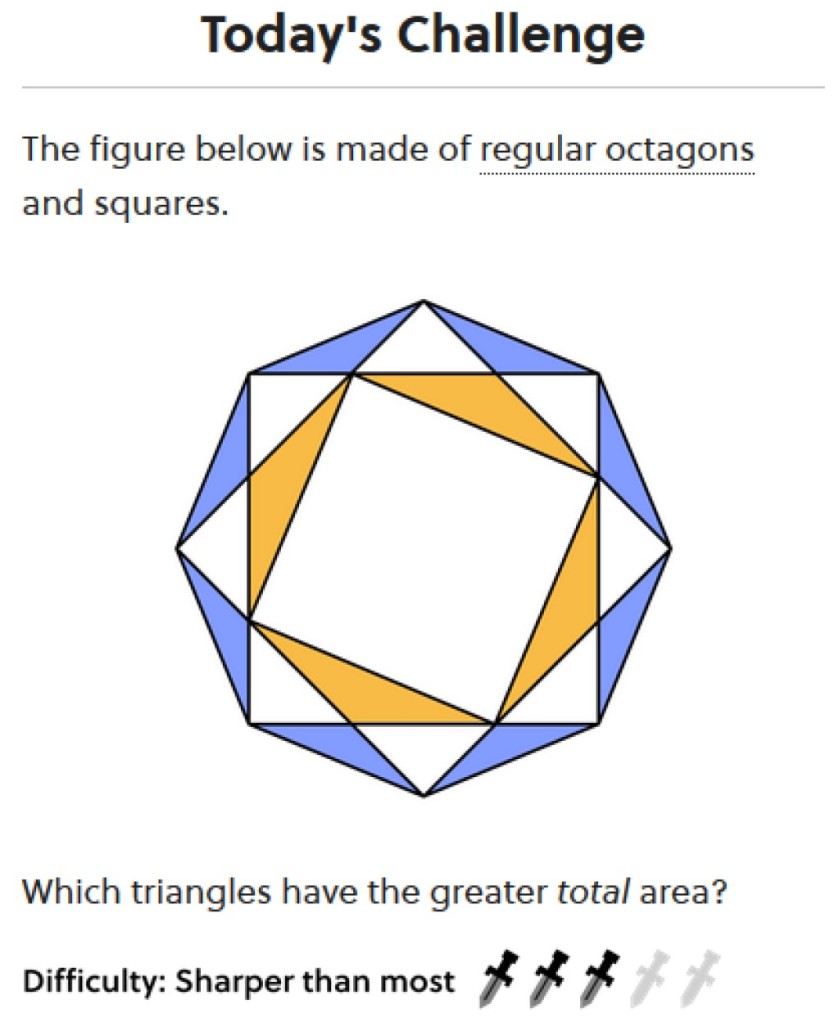
As a lead in to my regular sign off, here is a teaser from brilliant.org:

Exponent

Solution in tomorrow’s post.

IMG_1206 (2)IMG_1207 (2)IMG_1213 (2)IMG_1214 (2)IMG_1216 (2)IMG_1217 (2)IMG_1218 (2)IMG_1219 (2)IMG_1220 (2)IMG_1221 (2)IMG_1223 (2)IMG_1226 (2)IMG_1227 (2)IMG_1228 (2)IMG_1229 (2)IMG_1230 (2)IMG_1231 (2)IMG_1232 (2)IMG_1232 (3)IMG_1233 (2)IMG_1235 (2)IMG_1236 (2)IMG_1237 (2)IMG_1238 (2)IMG_1239 (2)IMG_1239 (3)IMG_1240 (2)IMG_1241 (2)IMG_1241 (3)IMG_1242 (2)IMG_1242 (3)IMG_1244 (2)IMG_1245 (2)IMG_1247 (2)IMG_1249 (2)IMG_1250 (2)IMG_1251 (2)IMG_1253 (2)IMG_1255 (2)IMG_1256 (2)IMG_1258 (2)IMG_1259 (2)IMG_1261 (2)IMG_1264 (2)IMG_1265 (2)IMG_1266 (2)IMG_1267 (2)IMG_1267 (3)IMG_1267 (4)

Eng v WI special
The teams in tabulated form.


All Time XIs – Through the Alphabet VI

Our sixth ‘alphabetic progression’ post in this ‘all time XI’ cricket series, a solution to yesterday’s teaser and plenty of photographs.

INTRODUCTION

In today’s all time XIs cricket post we continue with our alphabetic progression. Yesterday we ended on an F, so today we start from G.

BILL O’REILLY XI

  1. Gordon Greenidge – right handed opening batter. He was a crucial part of the West Indies success in the 1980s. In the 1984 series in England the West Indies were twice in deep trouble, and both times were hauled out of it by Greenidge. At Old Trafford he saved the day with an innings of 223 in 10 hours at the crease, and the Windies emerged victorious. At Lord’s the Windies were set 342 to win in just under a full day (and Gower, the England captain, was criticized for not declaring earlier, and for allowing his batters to accept on offer of the light when they should, four fast bowlers notwithstanding, have stayed out there. The West Indies won by nine wickets, with Greenidge blazing his way to 214 not out, while Larry Gomes (92 not out) played the supporting role to perfection. In the MCC Bicentennary match he made a century, notable for the setting of a fielder specifically to cut down the number of runs the reverse sweep was bringing him. A long county career with Hampshire helped him to score more first class hundreds (90) than any other West Indian bar Viv Richards.
  2. Desmond Haynes – right handed opening batter. He was Greenidge;s regular opening partner for Barbados and the West Indies. Barbados, a coral island similar in size to the Isle of Wight has produced over 70 test match cricketers – an all time batting order with these two opening, the three Ws at 3,4 and 5, Sobers at six, a keeper and four bowlers, two of them Marshall and Garner is shaping up mightily impressively. The Isle of Wight for comparison has produced a few cricketers who reached the dizzy heights of the Hampshire 2nd XI. Haynes and Greenidge put on over 6,000 runs together in first wicket stands at test level, although their average opening stand is not quite as eye-popping as the 87 of Jack Hobbs and Herbert Sutcliffe.
  3. Shreyas Iyer – right handed batter. The young Indian, noted for his aggressive approach, has yet to play test cricket, but hes an averages 52 in first class cricket and has made a remarkable start to his ODI career. I can envisage him being devastating after Greenidge and Haynes have given the innings their usual strong start (and similarly when the time comes coming in after the Sharma/ Agarwal opening partnership has been broken).
  4. Mahela Jayawardene – right handed batter. He holds the record for the highest test score by a right handed batter, 374 vs South Africa, when he and gthe left handed Kumar Sangakkara put on 624 together for the third wicket, starting from 14-2. Three higher individual test scores have been recorded, Lara’s 400 not out and 375, which both came in high scoring draws, whereas Jayawardene’s set his side up for an innings victory, and Matthew Hayden’s 380, scored against a hapless Zimbabwe team at Perth. Following the list on down, Sobers’ 365 not out was made against a Pakistan side who fielded only two front line bowlers, Hutton’s 364 at The Oval set his side up for a crushing victory, Jayasuriya’s 340 came in a monstrosity of a game at Colombo (over 100 runs per wicket through the five days), Hanif Mohammad’s 337 secured a draw for his side, Hammond’s 336 not out and Bradman’s 334 both came in drawn games- not that many of the super-huge scores have actually helped their team to win.
  5. Rohan Kanhai – right handed batter. His record at first class and test level is highly impressive, and I have the word of CLR James, that he was an absolute genius with a bat in his hand.
  6. Geoffrey Legge – right handed batter. He played for Kent and England. He managed only one century for his country, but it was a big one – 196.
  7. +Billy Murdoch – right handed batter, wicket keeper. Fred ‘the demon’ Spofforth missed the first ever test match because he believed that only Billy Murdoch could keep to his bowling (he came in to the side when the second match was arranged, apparently convinced that the chosen keeper, Blackham, was good enough after all), so although it was not where he usually played in test cricket he did have pedigree as a wicket keeper. His batting deeds included 153 not out in the first test on English soil at The Oval, the first ever test double century at the same ground four years later, 286 for Australia in a tour match and a first class triple century, at a time when only WG Grace (twice) and Walter Read of Surrey had previously achieved the feat.He played county cricket for Sussex and was part of WG Grace’s ultimately ill-fated London County venture.
  8. Dion Nash – right arm fast medium bowler. An effective swing bowler for New Zealand in the 1990s, and by no means valueless as a lower order batter.
  9. Bill O’Reilly – leg spinner. Nicknamed ‘tiger’ for his on field ferocity (he was later to be fairly ferocious with a pen in his hand as well), he bowled faster than most of his type (one action shot of him was erroneously labelled ‘Bill O’Reilly, Australia fast bowler, and seeing it one can understand how the mistake happened).Donald Bradman rated him the best bowler he ever saw or faced, although as O’Reilly himself acknowledged Bradman was the one opposition batter who generally had his measure. World War II basically ended his career at the top level, although he played a one-off test against New Zealand, taking a hatful of cheap wickets but also learning the hard way that his knees were finally knackered.
  10. Jamie Porter – right arm fast bowler. Has done good things for his county Essex, but has not yet been given the opportunity to perform at a higher level. I hope he does get the chance to prove himself at the highest level. He has 329 first class wickets at 24.31.
  11. Hamidullah Qadri – off spinner. He currently pays 35 per wicket in his fledgling first class career, and needs to reduce that figure, but he is still very young, and he did enjoy some success in the last U19 world cup. Given that I already had a legspinner (more on this later), the alternative was Imran Qayyum, a left arm orthodox spinner, but he pays 43 per wicket, which is simply too expensive to hold out serious hopes of him making the grade.

This side has a stellar batting line up but is a trifle light on bowling options. Nonetheless I would expect it to give a good account of itself.

HONOURABLE MENTIONS

Strong cases could be made for the selection of Gavaskar or Gooch as my opening batter whose name begins with G, and a respectable one for Chris Gayle, while Jack Hobbs and Matthew Hayden could both have been picked as the opener whose name begins with H, with Tom Hayward also a possibility. However, Greenidge and Haynes functioned superbly well as a pair, and I have opted for them because of that detail. Abdul Qadir deserves credit for keeping the embers of the torch of leg spin bowling aglow in the 1980s, to be fanned in full blazing flame by Shane Warne in the 1990s, but with Bill O’Reilly in the side I did not especially want a second leg spinner, so I went with the unknown quantity of Hamidullah Qadri.

ANDREW STRAUSS’ XI

  1. Jack Robertson – right handed opening batter. A test average of 46 is testament to his class. In the great 1947 season when Denis Compton and Bill Edrich rewrote the record books Robertson hit 12 first class centuries, very often teeing the innings up for the other two.
  2. *Andrew Strauss – left handed opening batter, captain. The man who captained England to no one in the world at test cricket, and who averaged over 40 with the bat, both as captain and in the ranks gets the nod here.
  3. Johnny Tyldesley – right handed batter. In the first decade of the twentieth century only two professionals were selected in England teams purely for their batting, this man and David Denton of Yorkshire.
  4. Inzamam Ul-Haq – right handed batter. He announced his arrival at the top level with an innings of 60 off 37 balls in the 1992 World Cup (back then, performances like that were not commonplace).
  5. James Vince – right handed batter. Has a good record for Hampshire, and has done fairly well in limited overs matches for England. His test career has featured far too many well compiled 20s and 30s and no really major innings (83 at Brisbane is his highest).
  6. +Clyde Walcott – right handed batter, wicket keeper. Selecting him as wicket keeper, enables me to pick a strong bowling line up.
  7. Xenophon Balaskas – leg spinner, right handed batter. This is about the right position for him, and X is a difficult letter.
  8. Bruce Yardley – off spinner. He was effective for Australia in the late 1970s and early 1980s, once being te match winner against the West Indies at a time when defeats for them were a great rarity.
  9. Dawlat Zadran – right arm fast medium bowler. Has done some good things for Afghanistan and may yet get better still. Certainly worth his place.
  10. James Anderson – right arm fast medium bowler. Zadran could only benefit from sharing the new ball with an experienced partner, and they don’t come much more experienced in that regard than the man who has taken more test wickets than any other pace bowler, and the most by any Eng;land bowler (and officially he is still counting).
  11. Jasprit Bumrah – right arm fast bowler. The list of visiting quick bowlers to really rattle the Aussies in their own backyard is not a long one, although the West Indies in the great years under Lloyd and Richards had a few. The list of Indian bowlers of serious pace is also not a long one – Amar Singh in the 1930s, and Javagal Srinath in the 1990s are the only two before the present era who I can think of. If one were to use the two lists to create a Venn diagram, there would be one name in the overlap between the two circles: Jasprit Bumrah, whose sheer speed in the 2018-9 series for the Border-Gavaskar trophy was more responsible than anything else for India’s triumph.

This team has an excellent top six, Xenophon Balaskas at seven can be considered an all-rounder, Yardley may provide some assistance to the top order, and then there are three pace bowlers. With Anderson to guide and encourage them the two younger bowlers, Bumrah and Zadran should fare well. If there is real turn Xenophon Balaskas and Yardley should be capable of exploiting it. This looks a fine side.

HONOURABLE MENTIONS

Bobby Simpson would have his advocates for the opening slot I gave to Strauss. I thought about picking Radha Yadav, the left arm spinner, for the no eight slot but decided that gave me too long a tail (Anderson at 10 is definitely in the ‘rabbit’ category with the bat, while Bumrah is a ‘ferret’ – someone who comes after the raqbbits).

THE CONTEST

Bill O’Reilly XI have a very deep batting line up packed with class, but they are short of bowling guns. Andrew Strauss’ XI have less in the way of batting riches, although their top order is strong on any reckoning, but they do have what looks a strong and balanced bowling unit. My reckoning, based on the evidence from cricket’s history is that it is the bowlers who settle matches, and so my reckoning is that Andrew Strauss’ XI start as firm favourites.

SOLUTION TO YESTERDAY’S TEASER

Yesterday I set this teaser, from brilliant.org:

Octagons

Here is Chew-Seong Cheong’s excellent published solution:

Oct Sol

As an habitue of brilliant.org I recognized a trick when I saw it and realized that the trick answer given the wording of the question was that the areas were equal and therefore went for that as my answer.

PHOTOGRAPHS

I have introduced today’s teams, assessed the contest and presented the solution to yesterday’s teaser. The only thing left to for this post to be complete is my usual sign off…

IMG_1114 (2)IMG_1115 (2)IMG_1116 (2)IMG_1117 (2)IMG_1118 (2)IMG_1118 (3)IMG_1119 (2)IMG_1119 (3)IMG_1120 (2)IMG_1120 (3)IMG_1121 (2)IMG_1121 (3)IMG_1122 (2)IMG_1123 (2)IMG_1124 (2)IMG_1124 (3)IMG_1125 (2)IMG_1126 (2)IMG_1126 (3)IMG_1127 (2)IMG_1127 (3)IMG_1128 (2)IMG_1129 (2)IMG_1129 (3)IMG_1130 (2)IMG_1133 (2)IMG_1133 (3)IMG_1139 (2)IMG_1140 (2)IMG_1141 (2)IMG_1142 (2)IMG_1143 (2)IMG_1144 (2)IMG_1145 (2)IMG_1146 (2)IMG_1146 (3)IMG_1147 (2)

TTA VI
The teams in tabulated form.

All Time XIs – Through The Alphabet V

Today’s ‘all time XI’ cricket post continues the alphabetic progression theme. Also features a mathematical teaser and lots of photographs.

INTRODUCTION

Welcome to today’s all time XI cricket post. We continue the alphabetic progression theme. Yesterday’s second XI ended with a J, so we start with an opening batter whose name begins with K.

SHAUN UDAL’S XI

  1. Don Kenyon – right handed opening batter. A consistent and reliable opener for Worcestershire over a number of years.
  2. David Lloyd – left handed opening batter, occasional left arm orthodox spinner. After a distinguished career for Lancashire and nine appearances in test matches he went to become a highly entertaining commentator and writer, and a good coach.
  3. Roy Marshall – right handed batter. He usually opened, mainly for Hampshire. Regular openers often fare well at number three – Mark Butcher and Michael Vaughan are two who did so for England.
  4. Brendan Nash – right handed batter. Australian born, but played for the West Indies.
  5. Simon O’Donnell – right handed batter, right arm fast medium bowler. Toured England in 1985 as a promising young all rounder, but did not quite make the grade at test level (he was a casualty of a rebuilding effort that paid dramatic fruit starting in 1989 with an Ashes win in England and going on to become a dominant international force). He finished his first class career with a first class batting average of 39 and a bowling average of 37.
  6. Ellyse Perry – right handed batter, right arm fast medium.
  7. +Quinn Sunde – wicket keeper, right handed batter. Finding Qs to fit the bill calls for some flexibility. He is only just 19 and has not yet played first class cricket, but has played for NZ U-19.
  8. Graham Rose – right arm medium fast bowler, useful lower order batter. A Somerset stalwart, who did not do quite enough to attract the attention of the England selectors. I saw him in  action in 1996 at Swansea, and he took four cheap wickets in a Glamorgan total of 310 in the first innings. Somerset took a small lead, with Lathwell playing fluently early in their innings and Hayhurst and Bowler providing grittier efforts, while Steve Watkin had a very similar analysis to Rose’s. Somerset’s advantage was insufficient – Robert Croft spun them to defeat on the final day. His averages are just the right way round, and hos bowling average is just less than 30.
  9. Brian Statham – right arm fast bowler. 252 test wickets at 24 each, mainly from the wrong end – for Lancashire when he had the choice of ends he took his wickets at just 16 a piece. Like his successor as Lancashire and England new ball bowler, James Anderson, he batted left handed, occasionally playing very useful innings – in one of the 1954-5 Ashes matches he was involved in a crucial partnership in England’s first innings – the last wicket stand between him and Johnny Wardle account for 43 of a total of 154, and England won that game by 38 runs. Also, at a time when quite a few of his colleagues had to be ‘hidden’ in the field he was excellent in that department as well.
  10. Frank Tyson – right arm fast bowler. The other half of that 1954-5 Ashes winning new ball pairing. His was a brief but spectacular career – he had other strings to his bow, which meant that he did not have worry about prolonging his career, and by the end of the 1950s he was finished as a professional.
  11. *Shaun Udal – off spinner, captain. A long career, mainly for Hampshire, before moving to Middlesex for his last few years. He did get to play for England but did not fare very well at the highest level.

This team has a decent top four, one good and one great all rounder, a wicket keeper and a bowling foursome that looks pretty good. It is deficient in the spin department – the only back up available for Udal’s off spin is Lloyd’s part time left arm spin.

GEORGE DENNETT’S XI

  1. Joe Vine – right handed batter, leg spinner. The role he played for Sussex for many years, and briefly for England. Sussex in that period were a magnificent batting side, but somewhat light on bowlers, so they never seriously threatened in the county championship – there is a vast mass of evidence to support the contention that if you are going to a little short in either of these departments it is better to be light in batting – good bowlers do not need absolutely huge totals to defend, whereas unless you get lucky with opposition declarations you cannot win games without taking 20 wickets. This is why, when I started this series with a look at the 18 first class counties and restricted myself to one overseas player per county that overseas choice was nearly always a bowler, occasionally an all rounder and almost never a pure batter.
  2. Benjamin Wilson – right handed opening batter. He was Wilfred Rhodes’ most regular Yorkshire opening partner in the years immediately before World War 1. He was sometimes criticized for taking an overly defensive approach to his innings (I have an idea that there was a more recent Yorkshire opener who also got that kind of criticism!).
  3. Xavier Marshall – right handed batter. A man who has played for two international sides – the West Indies where he was born and the USA. X, like Q, calls for a wee bit of flexibility.
  4. Mohammad Yousuf – right handed batter. After a slightly suspect top three we come to someone who averaged over 50 in his test career. He finished under something of a cloud (and I saw every ball of that shocking match in Sydney which he basically handed to Australia after Pakistan had taken a first innings lead of 200). First, with Hussey and tail ender Siddle resuming overnight and Australia only 74 to the good he failed to set attacking fields, and his tactics allowed Australia to reach lunch with no further loss. Then, with Pakistan needing 176, when it should have been under 100, he surrendered his own wicket to an appalling stroke, leaving his side 54-4 and with no experienced front line batters left.
  5. Bas Zuiderent – right handed batter. England’s performance in the 1996 World Cup was one of their most disgraceful ever in any tournament, on-field incompetence being matched by bad behaviour off it (skipper Atherton, who should have been nowhere near a limited overs side in any case,  called one reporter who was having difficulty phrasing a question in what was after all not his first language a buffoon, and there were other cringeworthy stories as well). England reached the quarter finals only because they had been put in a group with two non-test playing nations, Holland and the United Arab Emirates, the only two teams they beat in that competition (justice was done in the quarter-final when they were marmalised by Sri Lanka). The Holland win was decidedly unconving, with Zuiderent, then only 18, and Van Noortwijk plundering a century stand together – it was only Van Noortwijk’s dismissal to a boundary catch that finally put England in control. Zuiderent’s share of the spoils was a merry 54. He did not go on to great things after that start, but his innings that day, which garnered more plaudits than Hick’s century for England had, gets him his place as a middle order batter beginning with Z.
  6. +Tim Ambrose – right handed batter, wicket keeper. He made a century on test debut, but never fully established himself. For Sussex and then Warwickshire he was a consistent run getter in the middle of the order and a superb wicket keeper.
  7. Katherine Brunt – right arm medium fast bowler, right handed batter. She began as a pure bowler, but although not doing so as effectively as Ellyse Perry who also began down the order she has developed her batting to a level that allows her to be described as an all rounder.
  8. Tom Cartwright – right arm medium fast bowler, useful lower order batter. The obverse of Brunt in terms of career development – he started as mainly a batter, and actually scored a first class double century playing as such, before dropping down the order because his bowling was more valuable to the side than his batting. He started with Warwickshire and moved to Somerset. He became so metronomically accurate that it is claimed that at the end of a season at Taunton there would be a worn patch two feet long and six inches wide at one end, where he had been lading the ball time after time through the season. He played a walk-on role (more accurately walk-off) in the D’Oliveira affair – he was initially selected in the 1968-9 tour party to South Africa, while D’Oliveira to general consternation was left out. Cartwright then withdrew citing injury, but as he later admitted, actually because he did not wish to go to South Africa. His replacement was D’Oliveira, mainly a batter, and Balthazar Johannes Vorster, then South African president, proceeded to state that D’Oliveira would not be accepted (attempts had earlier been made to bribe D’Oliveira, as documented by Peter Oborne in his book “Basil D’Oliveira”), and the tour was promptly cancelled. England and South Africa next went head to head in 1994, and a visit by Bradman to South Africa in which he had a face to face meeting with Vorster, and the latter, erroneously feeling safe, gave vent to some unvarnished racism led to the final isolation of apartheid South Africa.
  9. *George Dennett – left arm orthodox spinner. When cricinfo tweeted yesterday asking for people’s suggestions for the best player never to have played test cricket this man was mine. 2,151 wickets at 19.82 each in first class cricket, mainly for Gloucestershire, and never an England call up. This is because when he was in his pomp first Wilfred Rhodes and then Colin Blythe (2,503 first class wickets at 16) were ahead of him in the pecking order of left arm spinners, and Frank Woolley, worth his place as a batter anyway, also bowled left arm orthodox spin. Similarly, when I named my Gloucestershire all-time XI (second post in this series), Charlie Parker, third leading wicket taker in first class history got the left arm spinner’s position, with the off-spin of Tom Goddard (no 5 on the all time first class wicket taking list with 2,979) in support. The mores of his time prevented it from even being a consideration then, but I have named him as captain of this team, a job I think he would have done well.
  10. Fidel Edwards – right arm fast bowler. A genuinely fast bowler for the West Indies, at a time when they as a side were struggling. His tendency to waywardness is partially addressed by the fact that the support pace bowlers, Cartwright and Brunt are both noted for accuracy.
  11. Chuck Fleetwood-Smith – left arm wrist spinner. He was the reason for Denis Compton choosing this most difficult type of bowling when he decided to add a second string to his bow. He was often expensive, but always capable of bowling the wicket taking ball.

This team has a respectable top order, a quality keeper who can bat well in the middle od the order, and five players selected principally for their bowling, although two of them could definitely make significant contributions with the bat. There is not a front line off spinner, but Dennett, Fleetwood-Smith and Vine are a fine and varied trio of spinners, while the presence of Brunt and Cartwright should enable Edwards ton be used in short bursts.

THE CONTEST

Shaun Udal’s XI are somewhat stronger in batting (if only because they bat deeper)  than George Dennett’s XI, but their bowling attack is not as well balanced. I would expect George Dennett’s XI to prevail, and would be absolutely certain that they would do so on a turner, as Udal backed by Lloyd’s part time stuff hardly compares with Dennettt, Fleetwood-Smith and Vine.

A MATHEMATICAL TEASER

This problem came up on brilliant.org today:

Octagons

The original question has multiple choice answers, but I am not offering that. I will offer you a gentle hint – there are three possible answers to this question. In tomorrow’s post I will include an official solution and an explanation of my own ‘method’.

PHOTOGRAPHS

My usual sign off…

IMG_1039 (2)IMG_1040 (2)IMG_1042 (2)IMG_1048 (2)IMG_1050 (2)IMG_1051 (2)IMG_1052 (2)IMG_1053 (2)IMG_1055 (2)IMG_1059 (2)IMG_1061 (2)IMG_1062 (2)IMG_1062 (3)IMG_1065 (2)IMG_1066 (2)IMG_1067 (2)IMG_1068 (2)IMG_1069 (2)IMG_1072 (2)IMG_1073 (2)IMG_1074 (2)IMG_1077 (2)IMG_1078 (2)IMG_1080 (2)IMG_1081 (2)IMG_1082 (2)IMG_1083 (2)IMG_1087 (2)IMG_1088 (2)IMG_1090 (2)IMG_1091 (2)IMG_1093 (2)IMG_1094 (2)IMG_1096 (2)IMG_1097 (2)IMG_1098 (2)IMG_1100 (2)IMG_1101 (2)IMG_1103 (2)IMG_1104 (2)IMG_1105 (2)IMG_1106 (2)IMG_1107 (2)IMG_1109 (2)IMG_1111 (2)IMG_1113 (2)

TTA V
The teams in tabulated form

All Time XIs – Through The Alphabet

Today’s all time XI cricket post follows a strict alphabetical progression.

INTRODUCTION

Welcome to another variation on the all-time XI cricket theme. Today each featured player has a surname beginning with a different letter of the alphabet, and each letter is used strictly in sequence, meaning that the second XI ends with a player whose surname begins with V.

RAY ILLINGWORTH’S XI

  1. Bobby Abel – right handed opening batter. 744 test runs at 37.20, an excellent record for his period, over 30,000 first class runs.
  2. Tammy Beaumont – right handed opening batter. Has fared magnificently as an opener since being given the role for England in 2015.
  3. Belinda Clark – right handed batter. In the 1990s she had the same kind of reputation as a batter that her compatriot Meg Lanning does today. She averaged 45 in test cricket and 47 in ODIs, the latter figure including the first ODI double ton by anyone.
  4. Emrys Davies – left handed batter, left arm orthodox spinner. He was usually to be found in this sort of place in the batting order, and played some fine innings from no4.
  5. Ross Edwards – right handed batter. One of the better Aussie batters of the first half of the 1970s (he retired somewhat prematurely at the end of the 1975 series played after the inaugural men’s world cup). In the first match of that series at Edgbaston he was horrifically out of form but ground out a half century in four hours and ten minutes, while others scored quicker (notably Rod Marsh with the top score of 61) at the other end. Rick McCosker and Ian Chappell had also scored 50s, and Thommo down near the extras scored a test best 49 to boost the score to 359. England were then bowled out twice, with skipper Denness, who had won the toss an put Australia in, managing three and eight in his last two test innings. In the second test of that series Australia slumped to 81-7 in response to England’s first innings 315 (Greig 96, Knott 69, Steele 50) and it was that man Edwards, helped by DK Lillee, who dug Australia out of this king sized hole. Edwards made 99, Lillee a test best 73 not out, and in the end England led by just 47, and were unable to force victory.
  6. Andrew Flintoff – right handed batter, right arm fast bowler. He took a while to establish himself at the top level before enjoying a couple of magnificent years, and occasionally reviving old memories thereafter.
  7. Jack Gregory – left handed batter, right arm fast bowler. Injuries took their toll late in his career, but his record confirms his status as a genuine all rounder.
  8. George Hirstright handed batter, left arm fast medium bowler. His England record does not look that great, but his play for Yorkshire, over the course of three decades, places him firmly among the greatest of all time.
  9. *Raymond Illingworth – off spinner, right handed batter. In 1970-1, with Australia holding the Ashes, and having done so since winning them in 1958-9, Illingworth captained England to a 2-0 series victory to regain the urn, the first to do so in Australia since Jardine 38 years previously, and only the sixth in all after Bligh in 1882-3, Stoddart in 1894-5, Warner in 1903-4 and Douglas in 1911-2 as well as Jardine. Subsequent to that tour England’s only successes down under have been when Brearley defended the urn in 1978-9, Gatting in 1986-7 defending the urn won back by Gower in 1985 and Strauss in 2010-11, defending the 2009 spoils. He was a quality player in his day as well.
  10. +Eifion Jones – wicket keeper, right handed batter. He made more dismissals than any other Glamorgan keeper, 933 of them (840 caught, 93 stumped) in 405 matches.
  11. Rashid Khan – leg spinner, right handed lower order batter. Although it is his bowling that has got him in (after four tests he has 23 wickets at 21.08 at that level – a more than promising start – while eight first class matches in total have yielded him 58 wickets at 17.44, and he is not quite 22 years old.

This team has a solid top five, three fine all rounders, a keeper, and two spinners who can both bat. It has no tail to speak of (even Rashid Khan averages 23 in FC cricket), and Gregory and Hirst will make a fine new ball pairing, with Flintoff as back up, while Khan, Illingworth and Davies provide fine spinning options (especially the first two). This team will take a lot of beating.

HONOURABLE MENTIONS

First of all, bear in mind my decision to pick players in positions they actually occupied. That means that Abel is virtually indisputable, although Mayank Agarwal will change that if he continues as he has started. Jack Brown of England, Bill Brown of Australia and Sidney George Barnes of Australia were all good options for the letter B, and I could accept any of them. Ian Chappell might have had the no 3 slot. I felt no 4 was a position too high for Basil D’Oliveira, and felt that Davies’ bowling gave him an edge of Joe Darling. No 5 was too low in the order for Bill Edrich (he either opened or batted no 3) or his cousin John (a specialist opener), while none of the other cricketing Edriches had a good enough record. George Emmett of Gloucestershire might have his advocates, although five was lower than he usually batted. Freddie Flintoff had no rivals. Jack Gregory’s slot might have gone to Tony Greig, but I felt that that the Aussie gave me three genuine pace bowlers. Hirst’s place might have gone to Schofield Haigh but I felt that his left arm bowling and superior batting clinched it in his favour. Illingworth’s two main rivals were Jack Iverson and Bert Ironmonger, but both were genuine no11s, so would have been two places too high, and in Ironmonger’s case I already had a left arm spinner in Davies. Some might think that Geraint Jones should have had the keeper’s slot, but his allegedly superior batting (I am not wholly convinced it actually was) does not make up for the fact that he was definitely a tad clumsy behind the stumps. Rashid Khan’s place could have gone to his compatriot the left arm wrist spinner Zahir Khan, while if I had wanted an extra pace bowling option Indian left armer Zaheer Khan could have been selected.

WALTER ROBINS’ XI

  1. Justin Langer – left handed opening batter, averaged 45 in test cricket, with a best of 250 against England at the MCG.
  2. Colin McDonald – right handed opening batter. The 1950s was a slow and low scoring decade, which makes McDonald’s test average of 39, batting at the top of the order particularly impressive. His best series was the 1958-9 Ashes when the he was the most successful batter on either side.
  3. Scott Newman – left handed batter. When he first started it seemed that an England career beckoned, but he never quite kicked on, finishing with a first class average of 38.
  4. Norman O’Neill – right handed batter. A fine stroke making batter for Australia. He averaged 45.55 in test cricket, making his debut in  the 1958-9 Ashes series.
  5. Kevin Pietersen – right handed batter, occasional off spinner.
  6. +Quinton De Kock – left handed batter, wicket keeper. I could not come up with a cricketer whose surname began with Q who could play as high as no six, so I allowed myself to pick someone whose first name began with Q.
  7. *Walter Robins – leg spinner, right handed batter, captain. A highly successful captain of Middlesex, well regarded by most of those who played under him. He averaged 26.39 with the bat and 23.30 with the ball, scoring 13,884 first class runs and capturing 969 wickets in his 379 games at that level.
  8. George Simpson-Hayward – off spinner (under arm). 23 wickets at 18 in his five test matches, 503 first class wickets at 21.
  9. Charles Turner – right arm medium fast bowler. One of the great bowlers of the early period of test history – took his 100th wicket in his 17th test match. Link two in an Australian chain through test history – Jack Blackham who kept wicket in the first 17 test matches ever played was a team mate of his, he gave Bill O’Reilly (3) some useful advice, who in turn gave Richie Benaud (4) some useful advice, and in his turn he passed on some advice to Shane Warne (5) – it only remains to provide a verifiable link from Warne to a current Aussie player to complete the chain.
  10. Derek Underwood – left arm slow medium bowler. 297 test wickets for the Kent maestro. Economical on pitches that did not help him and a destroyer on any surface that did help him.
  11. Vince Van Der Bijl – right arm fast medium bowler. The big South African took 767 wickets at 16.54 in first class cricket (his country were isolated due to apartheid, and he chose not to go down the route of qualifying to play for another country, so he played no official international cricket). Philippe-Henri Ednonds who played alongside Van Der Bijl for Middlesex said in “100 Greatest Bowlers” that Van Der Bijl would likely have had a test record in similar lines to Brian Statham’s had he played at that level.

This side has a powerful top five, an explosive batter/ keeper at six and a well balanced bowling attack. Turner and Van Der Bijl look every inch a quality new ball pair, while Underwood, Simpson-Hayward and Robins offer a fine variety of slower options.

HONOURABLE MENTIONS

No other L challenges Langer for the no1 slot. N was also a fairly barren letter, as was O. I did consider selecting Ellyse Perry in place of Kevin Pietersen, while no5 is too low for Graeme Pollock, who batted either at no3 or no4. I covered Q in that entry. I think Robins’ all round skills and captaincy make him a must pick – no 7 is definitely at least a position too high for Andy Roberts the . great fast bowler. Similarly, I felt no 8 was too high in the order for Fred Spofforth, so went for the highly individual skills of Simpson-Hayward. Jeff Thomson’s hell fire pace was an alternative to Turner. Underwood had no rival for the letter U. I could have gone for Chaminda Vaas in place of Van Der Bijl, but considered that the South African’s amazing first class record had to be acknowledged. Including Hedley Verity would have left me with only Turner as a recognized new ball bowler.

THE CONTEST

Robins’ XI has the stronger top batting, but more of a tail. Illingworth’s XI are better equipped in bowling, and they bat deeper, although their top batting is the weaker of the two sides. It is a tough call, but I think that Illingworth’s XI just about has the edge.

SOLUTION TO YESTERDAY’S TEASER

Marathon

We are told that the runners in first and fourth told the truth and those in second and third lied. C’s statement has to be true, because it being a lie would put C in fourth and that is disallowed by the conditions. Since it is a true statement and C did not finish fourth there is only one place for C to finish, which is first, the other place who told the truth. A’s statement is thus proven true, so A came fourth. B thus lied and therefore finished second, making D the other liar and the third place finisher. Thus C was first and A was fourth, making them three places apart. The cause of the aggro when this problem appeared on brilliant is that two runners finished in between A and C and some therefore believed the answer to be two, but the number of places separating A and C is 4-1 = 3. Brilliant caved to the moaners, giving those who had selected two but explained their reasoning for doing so in the comments credit, and they added an explanatory note to the problem itself. However, having reasoned the problem out as I have explained above and then selected two is actually equivalent to arguing that 4-1 = 2, so I think they should have held firm on that one.

LINK AND PHOTOGRAPHS

Holly Gillibrand, a young Scottish environmental activist has an article titled “Cry for the Wild” in the Oban Times. Below is a screenshot of the first few paragraphs:

HG

Time for my usual sign off:

IMG_0880 (2)IMG_0881 (2)IMG_0881 (3)IMG_0882 (2)IMG_0882 (3)IMG_0885 (2)IMG_0885 (3)IMG_0888 (2)IMG_0888 (3)IMG_0889 (2)IMG_0889 (3)IMG_0890 (2)IMG_0890 (3)IMG_0891 (2)IMG_0891 (3)IMG_0892 (2)IMG_0892 (3)IMG_0894 (2)IMG_0894 (3)IMG_0895 (2)IMG_0896 (2)IMG_0897 (2)IMG_0898 (2)IMG_0898 (3)IMG_0899 (2)IMG_0899 (3)IMG_0899 (4)

Through the Alphabet
The teams in tabulated form.