A One Woman Show at Indore

A look back at today’s Women’s World Cup Match between Australia and South Africa, and in particular its defining performance, an incredible display of leg spin bowling by Alana King. Also a photo gallery.

This post is devoted to today’s match at the Women’s Cricket World Cup, between Australia and South Africa to decide who would finish top of the league stage, setting up a semi-final against fourth placed India, while the losers would face England in the other semi-final. Yesterday, which should have been Sri Lanka versus Pakistan, saw only 4.2 overs of play before the rain finally and decisively settled things, underlining yet again the folly of using Colombo as a venue in that city’s wettest month and the further folly of making all matches there day-nighters when the rain is generally at its worst in late afternoon/ early evening.

The heading for this section is simply the figures in standard Overs-Maidens-Runs-Wickets form recorded by Alana King for the nearest thing to an absolutely perfect display of leg spin bowling that you could ever hope to see.

King came on to bowl with South Africa looking a bit rocky at 43-2 after 11 overs, and by the time she rattled Nadine de Klerk’s stumps with the last ball of 24th over (her seven overs being numbers 12, 14, 16, 18, 20, 22 and 24 of the innings) the Proteas had subsided to a miserable 97 all out. The one wicket not to go to King in this period, that of Ayabonga Khaka was arguably the leggie’s by proxy as well – in the previous over bowled by King there had been five dots and then a single off the sixth ball as de Klerk, who was batting competently, demonstrated her opinion of Khaka’s chances against King. Khaka was on strike to the fourth ball of the following over, bowled by Ash Gardner, and was comprehensively bowled by the off spinner. King took four of her wickets before conceding a run, and her final figures of 7-18 were an all time record for a World Cup match and an all time ODI record for an Australian woman, relegating Ellyse Perry’s 7-22 to second place and current bowling coach Shelley Nitshke’s 7-24 to third.

After what had happened in South Africa’s innings there was very little chance of an upset. South Africa did take two early wickets, but a 75 run stand between Georgia Voll and Beth Mooney did most of the work for them, and some good blows by Annabel Sutherland after the stand was broken did the rest. Sutherland hit each of her first two balls to the boundary, and after one dot ball she then got her fourth ball away for the two runs Australia still needed. The margin was seven wickets, and Australia had taken only 16.5 overs to knock off the runs. There was of course only one candidate for Player of the Match.

South Africa have overall been very convincing in this phase of the tournament, but in both their first and last matches they came a cropper against quality spin – in their first match England’s spinners shared the wickets as the Proteas slumped to 69 all out, while in this one Alana King almost single-handedly destroyed them. They now have to face England in the semi-final. In view of what has happened today England must be looking at ways to include leg spinner Sarah Glenn. One possibility if they feel like going all in on ‘spin to win’ would be to rest Lauren Bell for the semi-final and rely purely on Natalie Sciver-Brunt’s medium pace for any seam they might need.

My usual sign off…

England Women Book Semi-Final Slot

A look back at yesterday’s thriller at the women’s cricket world cup between India and England, with links to the scorecard and to a post by Hypocaust about the the numbers, plus a photo gallery.

Yesterday’s match at the women’s cricket world cup saw England facing hosts India at Indore. This post looks back at a remarkable match.

Lauren Bell and Sophie Ecclestone were recovered from the sickness that kept them out of England’s previous match, so England were back at full strength. India had opted to bolster their bowling. Natalie Sciver-Brunt won the toss and decided, to some surprise, that England would bat first.

Amy Jones and Tammy Beaumont gave England a solid start, and then the rest of the England innings was dominated by a command performance from former skipper Heather Knight. Knight, well supported by current skipper Sciver-Brunt who helped the third wicket to put on 115 at better than a run a ball, took a mere 86 balls to reach her third career ODI hundred and first against India. After Sciver-Brunt was out we saw a familiar scene as Sophia Dunkley, Emma Lamb and Alice Capsey all fell cheaply – the England numbers 5,6 and 7 have a combined aggregate of 111 runs between them for the tournament so far, and then a second familiar scene as Charlie Dean ensured that the good early phase of the innings was entirely wasted by scoring a rapid undefeated 19 to boost the final total to 288, not massive on a good pitch but surely defensible.

For much this innings it looked like the hosts were heading to a comfortable win. In particular when the two left handers, Smriti Mandhana and all rounder Deepti Sharma were both going well England looked beaten for all money. Then Mandhana had a rush of blood to the head against Linsey Smith and holed out to Alice Capsey for 88 off 94 balls to make it 234-4 in the 42nd over and open up a possible way back in to things for England. Richa Ghosh never got going and managed a mere 8, caught by former skipper Knight off the bowling of current incumbent Sciver-Brunt to make it 256-5 in the 46th over. It was in the following over that England got the breakthrough that put them ahead on points for the first time in a long while, when Deepti Sharma, who had batted very well for her 50, got over aggressive against Ecclestone, who by her own lofty standards had had a poor time with the ball, and was caught by Dunkley to make it 265-6. With two overs to go India needed 23, and England were definitely favourites. The first ball of the 49th over, bowled by Lauren Bell, went for four, but the tall seamer came back well in the rest of the over, and India needed 14 off the final over, with Linsey Smith, England’s most economical bowler on the day, to bowl it. Smith bowled a superb over, and by the time the fifth ball had gone for a mere two runs India needed eight to tie off the last ball of the match, meaning that in effect Smith only had to bowl a legal delivery for England to get the win that would secure their semi-final berth. She did so, and it was hit for four irrelevant runs, meaning that England had won by four runs and became the third side to book a semi-final slot. India meanwhile are now in serious jeopardy of suffering the fate of the England men in 1999 – being ejected early from their own party. Even with that final irrelevant four Linsey Smith’s figures were 10-0-40-1, absolutely crucial to England’s success, though unsurprisingly Knight was named Player of the Match for her century. Scorecard here, and a for the numbers people here is Hypocaust’s post.

My usual sign off…

Deepti Sharma Guides India to ODI Win Over England

An account if the first ODI in a three match series between the England and India women’s teams and a large photo gallery.

The ODI series between the England and India women’s teams started today at 1PM, at the Utilita Bowl near (not in) Southampton. This series has a little extra importance as there is an ODI world cup coming up later this year, so both sides were looking to put down a marker.

Nat Sciver-Brunt was fit to play, though not to bowl, which left England with a dilemma in terms of the balance of side. In the event they solved the problem by playing a batting all rounder, Alice Davidson-Richards at number six, and five bowlers, of whom two, Charlie Dean and Sophie Ecclestone are useful batters as well. Sciver-Brunt won the toss and chose to bat.

England started badly with both openers, Tammy Beaumont and wicket keeper Amy Jones going cheaply. Sciver-Brunt and Lamb mounted a fightback, but then both were out in quick succession to make it 97-4, with Sophia Dunkley, on her 27th birthday, being joined by Davidson-Richards. The pair batted superbly, putting on 106 for the fifth wicket. At 203-5 England needed someone to inject some extra speed into the scoring late on, so Ecclestone was promoted ahead of Dean to number seven. Ecclestone scored 23 not out off 19 balls, and Dunkley reached 83 (92). The final ball of the innings, from Amanjot Kaur, bowled Dunkley, in keeping with my belief that there are only three acceptable outcomes to the final ball of a limited overs innings: a boundary, a wicket or at the least a run out attempt.

Kate Cross opened the bowling for England, and unfortunately she was definitely off the boil. At no stage of the innings did she ever look threatening. Lauren Bell had moments with the ball, but only one wicket fell remotely early, Mandhana edging Bell through to Jones for 28 to make it 48-1. The second wicket fell at 94 when Ecclestone got one through the previously very impressive Pratika Rawal for 36. Rawal averages in the60s in this format in her brief career so far. Eight runs later Harleen Deol suffered a dismissal that was probably in all honesty somewhat worse than ‘village’, being run out because although her bat was beyond the crease line she had failed to ground it, a truly amateurish way for a top order batter in an international line up to go. The fourth wicket, that of skipper Harmanpreet Kaur was a credit to England however. Kaur was given not out by umpire Redfern, who does not get much wrong, but even though the bowler, Dean, herself wasn’t 100% confident Sciver-Brunt sent it upstairs, and the ball tracking showed that it pitched just outside off, hit Kaur below knee level (and the Indian skipper is not a particularly tall woman) and in line with off stump, and was doing just enough to thump into middle had it not been obstructed. That was 124-4, and brought Deepti Sharma into join Jemimah Rodrigues. From here on to the end Deepti Sharma was in complete control of proceedings, never fussing or panicking. Two further wickets did fall, Rodrigues to a catch by Jones off Filer for 48 and Ghosh stumped by the proverbial country mile after charging at Dean and missing her shot, but as the end of the innings approached the required run rate tumbled. In the end number eight and medium paced bowler Amanjot Kaur, like a ham actor stealing the Oscar winner’s scene, ended proceedings by hitting the first two balls of the 49th over, bowled by Cross, for fours to win the match for India. India had won by four wickets with ten balls to spare, and Deepti Sharma’s 62 not out from 64 balls to mastermind the key stage of the chase quite rightly earned her the Player of the Match award.

My usual sign off…

India Win Champions Trophy

A look back at the Champions trophy final, an account of a pizza making session, a new bird sighting and a regular photo gallery.

The final of the Champions Trophy took place yesterday in Dubai, between India and New Zealand. This post briefly looks back at what happened in that match.

New Zealand won the toss and batted first. They started well, with Rachin Ravindra looking in prime form but then lost three wickets in quick succession including Kane Williamson cheaply. I was out for most of the rest of the New Zealand innings after the derailment, arriving back from my morning commitment with the Indian reply under way. New Zealand had finished with a score of 251, respectable, but even on a Dubai surface that is not easy to score quickly on probably 20 runs less than they had needed to make it a really competitive game. Rohit Sharma gave the Indian innings a blazing start, putting them well ahead of the rate. The New Zealand spinners, Santner, Michael Bracewell (at least the fourth of his family after John, Brendan and Doug to play for New Zealand), Phillips and Ravindra all acquitted themselves nobly, Bracewell’s figures in particular being outstanding. The problem was, with Matt Henry out injured the pace element of the attack, O’Rourke, Nathan Smith and the giant Jamieson looked below par, and none distinguished themselves, all proving relatively easy to play on a surface that offered zero encouragement to pacers. Jamieson for all his legendary high release point does not have all that much pace anyway, not even always hitting 80mph. The run chase was tantalizing – every time India seemed away and clear a wicket fell, to just open up the hint of a possibility for New Zealand. In the end the cool head of KL Rahul, assisted in muscular fashion by Hardik Pandya, who fell just before the end, proved decisive. It was another veteran, Ravindra Jadeja who got to hit the winning runs, a four off the final ball of the 49th over, bowled by O’Rourke. India had four wickets in hand, although the fact that Shami was scheduled to come in next suggests that last three of those wickets weren’t worth very much. Rachin Ravindra with 263 runs and 3 wickets across the tournament was Player of the Series, while Rohit Sharma’s 76 (83) won him Player of the Match. Had New Zealand won Michael Bracewell, with 53 not out off 40 balls and 10-1-28-2 would have been Player of the Match for sure. Scorecard here.

Yesterday morning was an autistic adults Pizza Making event at Pizza Express in King’s Lynn town centre. I was one of the participants…

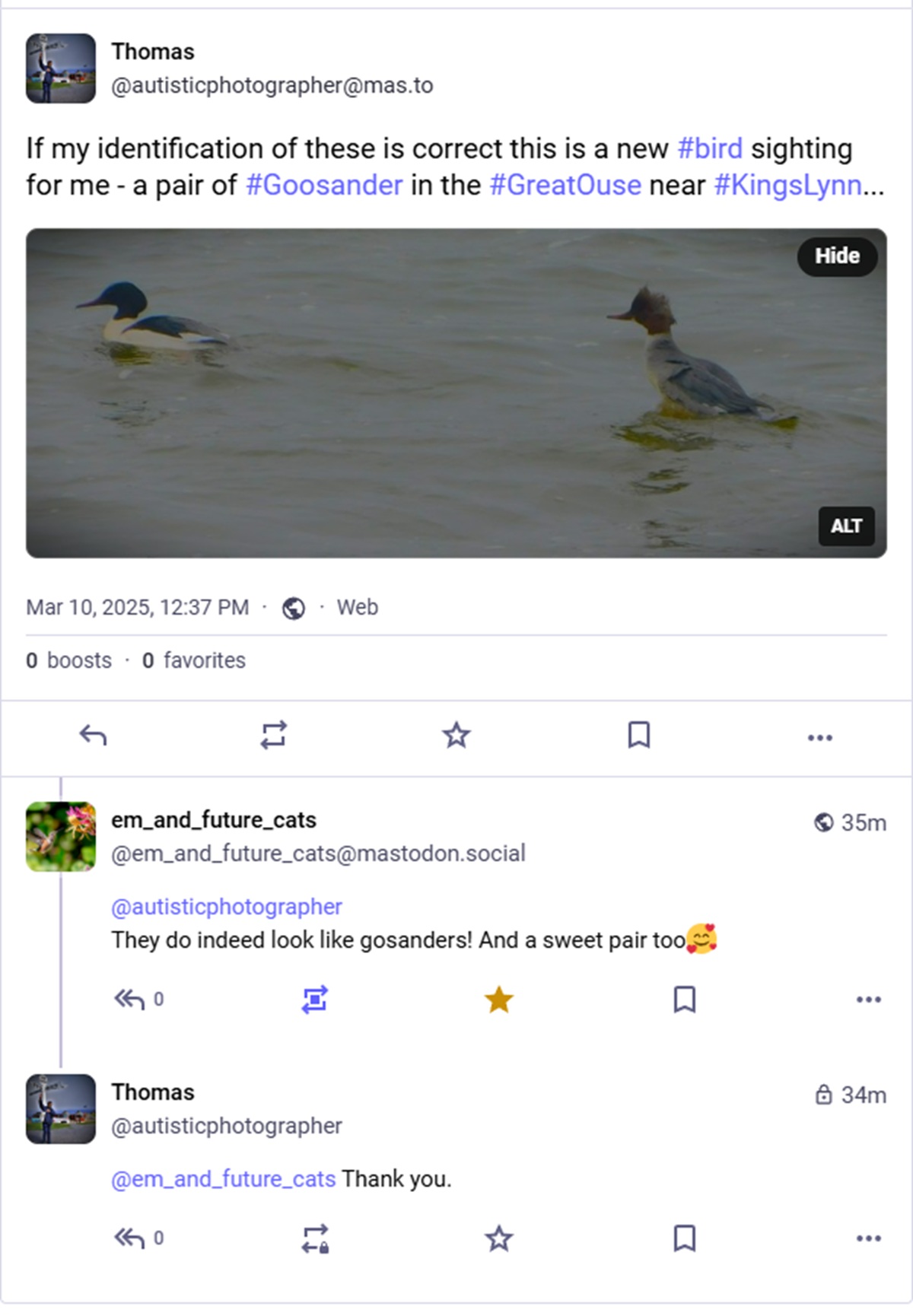
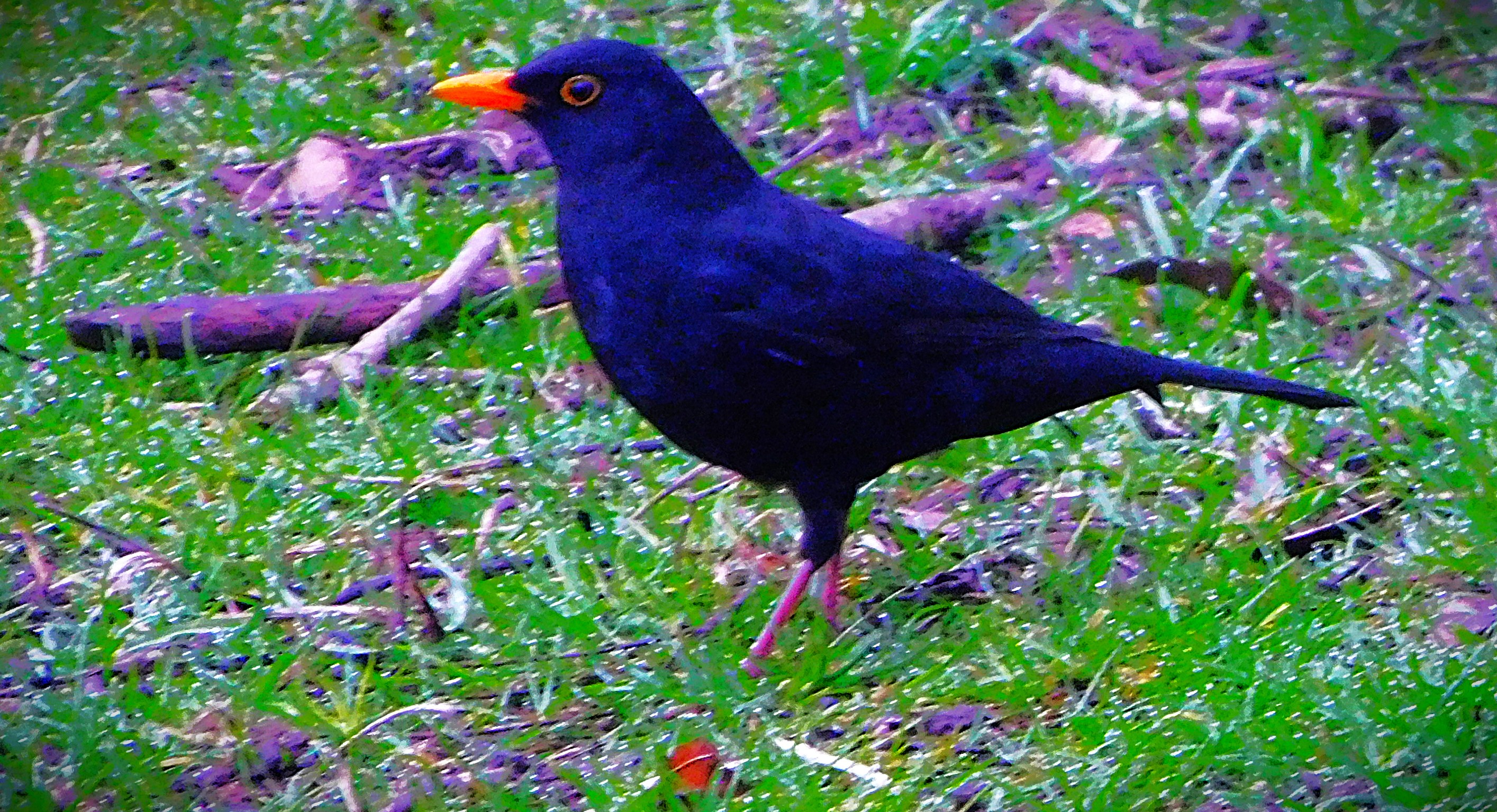
I have a new bird sighting to report. This morning, between the Nar Outfall and the path through Hardings Pits I spotted what a combination of my bird book and mastodon (where I posted a photograph with my identification and got a positive response). Here is a screenshot of the mastodon exchange…

Here are all my photos of the pair of Goosanders (and a reminder – to view a photo at larger size just click on it(…

To end this post here is the rest of my photo gallery…

New Zealand off to a Strong Start

A look at early developments in the second semi-final of the Champions trophy, a link (teslatakedown.co.uk). and a large photo gallery.

The second semi-final of the Champions Trophy is underway. Work commitments meant that I did not catch a single ball of yesterday’s match between Australia and India. India won, which means that the final of the tournament will take place outside the official host nation, and on the worst pitch on show at this tournament, the paceless strip of rubbish that Dubai has served up. This post looks at the early stages of the match between New Zealand and South Africa.

New Zealand won the toss and chose to bat. The pitch at Lahore looks very flat, with even the towering Marco Jansen struggling to generate bounce. Will Young has been the only casualty so far, for a 23 ball 21. Rachin Ravindra has reached an excellent 50, taking 47 balls to get there. He has added ten further runs of another eight deliveries since reaching the landmark. Kane Williamson is currently on 27 from 36 balls, and New Zealand are 111-1 from 19 overs.

Bin-gland

A look at the state of the England Men’s ODI team. Also a large photo gallery.

England’s participation in the Champions Trophy is at an end, and they have been the worst team at the tournament, being the only side in either group not to record a single point. This post looks briefly at yesterday’s match and then at the problems with this England Men’s ODI side.

England’s elimination was already confirmed before yesterday’s match began, but the question was whether they would depart with a bang or a whimper. Afghanistan were hoping for it to be an almighty bang, since a victory by 207 or more runs would push South Africa’s net run rate below Afghanistan and mean that the latter made the semi-finals. In the event England exited with the tamest of whimpers. The match started in familiar fashion, with Phil Salt (no 1 in the England batting order) and Jamie Smith (no 3) both departing cheaply, both to terrible shots. That once again brought Duckett and Root together with a rebuilding operation to perform. This time round we got an illustration of the fact that if you keep on needing rescue operations you don’t always get them – Duckett made 24 and Root 37, which would remain England’s top score. Brook, officially next in line for the captaincy vacated by Buttler, managed 19. Buttler, attempting to provide some stability, a role for which he is not well suited, managed 21 off 43 balls, while Jofra Archer ended up second top scorer with 25 off 31 balls, and the comparative ease with which he was able to bat was a damning indictment of his alleged betters in that department. All of this added up to 179 all out from 38.2 overs – a scoring rate of below five an over and 11.4 overs left unused. Marco Jansen took 3-39, and was outdone figures wise by Wiaan Mulder who had 3-25. No South African bowled badly, with Kagiso Rabada’s 1-42 from seven overs being the worst figures of any of their five bowlers. Rassie van der Dussen, 72 not out off 87 balls, and Henrich Klaasen, 64 off 56 balls before perishing in the moment of victory were the chief performers responsible for making England’s total look as pathetic as it was, South Africa winning by seven wickets with 20.5 overs to spare – in other words they had more than the length of a T20 innings to spare.

England personnel wise (for the moment we will ignore questions of the domestic schedule) have four main issues, of which only the first is definitely being dealt with:

  1. They have the wrong captain. Buttler has stepped down, which starts to address this, but my own feeling is that they need to do something more radical than merely turn to ‘next cab in the rank’ Brook. Perhaps Liam Dawson, who playing skills would help to address other problems could be brought straight in as captain.
  2. Numbers one and three in the order need replacing. You cannot expect to win matches when losing two early wickets on an absolutely regular basis, and the dismissals of Salt and Smith against South Africa suggest that neither learned anything from their failures in the first two matches.
  3. Lack of all rounders. This, with five bowlers required to be used in every innings, creates issues of balance – you either pick five proper bowlers, relying on the top six to do the bulk of the scoring, or you pick four front line bowlers only and rely on part timers to bowl the fifth allocation of ten overs. England have opted for the latter approach, and their lack of either depth or variety in the bowling department has cost them at this tournament, which leads to…
  4. Too much similarity in bowling. England have not a left armer of any type at this tournament (look up the bowling half of the package offered by Dawson the player), the fast bowlers used have all been very similar, making it easy for opposing batters to take them on. The one trustworthy component of the England bowling attack at this tournament, Adil Rashid, is now 37 years old, and the endurance of James Anderson notwithstanding probably has a fairly limited remaining shelf life at the top level.

England have not been struggling in ODIs for nearly as long as they had been when they crashed out of the 2015 World Cup, but a reset of a similar type to the one that took place then is required.

My usual sign off (with a reminder as we start a new month that images can be viewed at a larger size by clicking on them)…

England’s Champions Trophy Hopes Hang by a Thread

England are currently playing Afghanistan in a match in which the defeated side definitely goes out of the tournament. Each side will have one match left. If England win they will then need to beat South Africa to qualify, while if Afghanistan emerge victorious they will need to beat Australia to qualify. In the event of the winner of today’s match losing their final game Australia and South Africa (whose match yesterday was rained out without a ball being bowled) would both qualify. This post looks at developments in today’s match so far.

Afghanistan won the toss and chose to bat first. The injured Brydon Carse was replaced in the England line up by Jamie Overton. The match started well for England, with Afghanistan being 39-3 at one point. However, a combination of an injury to Mark Wood, Jos Buttler’s stubborn refusal to recognize until far too late that Wood couldn’t bowl his full allocation, the questionable balance of the England line up, reliant as it is on Livingstone and Root to bowl the fifth allocation of ten overs, and a magnificent innings by Ibrahim Zadran created a dramatic turnaround in events. Zadran had three principal assistants from his own side in addition to Wood’s injury and Buttler’s bad captaincy. The revival began with Zadran and Hashmatullah Shahidi putting on 103 for the fourth wicket in 19.4 overs, the latter contributing a solid 40. Revival began to become genuine counter attack with the next partnership, with Azmatullah Omarzai which yielded 72 in 10.3 overs, Omarzai scoring 41 off 31 balls. Then came the truly explosive partnership, 40 year old Mohammad Nabi exactly matching his age years in runs off his own bat, from just 24 balls, while Zadran now utterly dominant turned what was already a very high class innings into one of unquestioned greatness. His previous best ODI score was 162, and he passed both that and Ben Duckett’s Champions Trophy record set just a few days ago of 165 with a single blow that took him from 160 to 166. By the time he fell, in the final over of the innings, bowled due to a combination of the injury and Buttler’s mismanagement of his bowlers by Liam Livingstone, he had scored 177 off 146 balls with 12 fours and six sixes the score had reached 323, the sixth wicket stand worth 111 in 9.1 overs, which included 20 off one Archer over and 23 in the 47th over of the innings, bowled by Root, who when Wood’s departure from the field finally forced Buttler to extend the allocation he gave his fifth bowler duo. During the middle overs Livingstone and Root had bowled a combined 10-0-50-0, but neither are remotely suited to bowling at the death, and the danger of Wood not being able to bowl his full ten overs was blatantly apparent from quite early in the innings. A couple of balls after Zadran’s dismissal Nabi was also out to make to 324-7. A further single accrued to end the innings at 325-7. Livingstone, given the 50th over of the innings in desperation had final figures of 5-0-28-2, the sole England bowled to go at under a run a ball.

Salt went for 12 early on in the reply, bowled by Omarzai’s medium pace. Jamie Smith charged at Nabi’s first ball of the innings and was caught by Omarzai for 9 to make it 30-2. Duckett and Root put on 68 together before Rashid Khan trapped Duckett LBW for 38 to make it 98-3. Brook looked reasonable impressive, but got himself out with the job barely started, hitting one straight back to Omarzai for 25 off 21 balls. That was 133-4 (these last two wickets have fallen while I have been working on this post, making the thread of the title more than a little frayed) with Buttler coming in to join Root. The advocates of immense batting firepower will point out that England still have Livingstone to come, and that Jamie Overton is not the worst number eight. To this I respond that if England had a better bowling line up Afghanistan may well not have been able to fight back from the depths of 37-3. For my money this match is as good as over already. If this proves correct I hope that the first decision England make in the aftermath of this tournament is to axe Buttler as captain. They also need to realize sharpish that four proper bowlers backed up by Livingstone and Root is not good enough. England with the Livingstone/ Root combination have statistically the worst fifth bowling option of any of the eight sides at this tournament.

There is a Tesla dealership practically next door to Park Royal station (Piccadilly line), and on March the 8th at 11AM there will a protest there directed at Elon Musk. Click here to sign up.

My usual sign off…

Picking an All Time ODI XI

An attempt at selecting an all-time ODI XI, with mentions of a few players from before the ODI era who I might have considered had I not decided to stick to actual ODI players. Also a photo gallery.

I am writing this from King’s Lynn library (it has limited opening on Sundays, to those wh0 are ‘Open Library’ members). This topic was raised by the talksport2 commentary team in an ODI between India and England, and between the distractions of having my entire heating system replaced and my home broadband malfunctioning I have not previously got round to posting my own version.

I will be picking only people who have ODI experience, though I will then append a short subsection on who might have been considered had I opted not to thus restrict myself. The number six slot will feature two possibilities, as explained more fully when I get there. I will not include an honourable mentions section as to do justice to those it would have to be far too long. If you fancy suggesting alternatives you are most welcome, though I urge you to consider the effect of your choices on the overall balance of the side.

  1. +Adam Gilchrist (Australia, left handed opening batter, wicket keeper). This man changed ideas as to what could be expected of the wicket keeper with the bat. Some subsequent attempts to find a version of him have neglected to pay sufficient attention to the keeping skills of the player concerned, but he was top notch in that department as well as with the bat.
  2. Rohit Sharma (India, right handed opening batter). He holds the highest ever ODI score, 264, and has also scored two other ODI double centuries, the only player to have as many as three to his name. Overall he has some 11,000 ODI runs to his name, and his century tally is third on the all-time list.
  3. Viv Richards (West Indies, right handed batter, occasional off spinner). The first player to really master the art of ODI batting. The 189* he scored in a total of 272-9 at Old Trafford in 1984 was for a long time the highest ever ODI score.
  4. Virat Kohli (India, right handed batter). Has to rank as the all time number one ODI batter. I could not accommodate both him and Sachin Tendulkar in this XI, and in ODI terms Kohli is ahead of his predecessor. Kohli’s century making rate of better than one every six ODI innings puts him way ahead of the competition.
  5. AB de Villers (South Africa, right handed batter, occasional wicket keeper, occasional right arm medium pacer). Known as ‘Mr 36o’ for his ability to score runs to literally any part of the field he was epoch making batter, a competent keeper and had occasional successes bowling medium pace.
  6. *Imran Khan (Pakistan, right handed batter, right arm fast bowler, captain). One of the greatest of all all rounders. He came out of retirement to lead Pakistan to victory in the 1992 world cup. In the event of the pitch warranting a spin bowling all rounder rather than a pace bowling one Shakib Al-Hasan of Bangladesh would take his slot and the captaincy.
  7. Wasim Akram (Pakistan, left arm fast bowler, left handed batter). A record that speaks for itself.
  8. Joel Garner (West Indies, right arm fast bowler, right handed batter). The most economical bowler in ODI history, and achiever of the highest ever ODI ranking points total.
  9. Muthiah Muralidaran (Sri Lanka, off spinner, right handed batter). When Sri Lanka won the 1996 world cup their bowling was so dominated by spin that the new ball pair of Vaas and Wickramasinghe often bowled only their opening spells, not being recalled later in the innings. The leader of the Sri Lankan spin unit that won them the world cup that year was Muralidaran.
  10. Adam Zampa (Australia, leg spinner, right handed batter). Shane Warne was not quite the force with a white ball that he was with a red one, though of course he was capable being the matchwinner with a white one, but for my money with the white ball and only with the white ball Zampa outranks his fellow Aussie, which is why I pick him here.
  11. Glenn McGrath (Australia, right arm fast bowler, right handed batter). The key bowler in Australia’s most dominant period in men’s white ball cricket, during which they won three straight world cups (1999, 2003 and 2007).

This side features a very powerful top five, all rounders at six and seven and four great bowlers. Yes, with Garner as high as eight the tail starts quite early, but I am not expecting them to be called on to bat with massive frequency. I also reckon that the bowling unit, with two tall, lethally accurate, right arm pacers, an all time great left arm pacer, two great specialist spinners and either a fourth fast bowler or a third, different (SLA, as opposed to OS and LS already there) spin option will be quite capable of defending even an under par total. With regards to the balance of the side I have followed my usual principle of giving the bowling unit primary importance – history is well stocked with winning sides who had great bowling but comparatively modest batting, while there have been very few whose balance has been the other way round.

I consider three players from before ODI cricket was a thing to have strong cases for consideration:

Garry Sobers (West Indies, left handed batter, left arm bowler of every type known to cricket). Accommodating him in place of any of that top five would be extremely hard, but the most complete player the game has ever known, and one whose approach to batting was very attack minded would have to at least be considered.

Frank Woolley (England, left handed batter, left arm orthodox spin bowler). Given his outstanding FC record and his attacking approach he would replace Shakib Al-Hasan as my alternative selection to Imran Khan on spinning surfaces, and may even straight out replace Imran on any surface. The prejudices of his era stopped from getting regular captaincy experience, but I think he would have done the job well given proper opportunities.

Gilbert Jessop (England, right handed batter, right arm fast bowler). He is also a potential replacement for Imran. His feats of rapid scoring are legendary, he once bowled unchanged through an FC innings while conceding only three (Northamptonshire 12 all out, Dennett 8-9 with his left arm spin, Jessop 2-3 at the other end) runs and his fielding was the stuff of legend.

My usual sign off…

England Women Reassume Control in South Africa

An account of yesterday’s ODi between the South Africa and England women’s teams and a photo gallery.

At 8AM UK time yesterday morning the second One Day International in the current multi-format series between the South Africa and England women’s teams took place at Durban. This post looks back at that match.

England won the toss and put South Africa in to bat. Protea skipper Laura Wolvaardt confirmed that she would have put England had she won the toss.

Kate Cross replaced Lauren Bell for England, and her metronomic accuracy proved an excellent counterpoint to the pace and fire of Lauren Filer with whom she shared the new ball. England soon had two early wickets, Tazmin Brits and Sune Luus each having their stumps rearranged by Filer. From 14-2 the proteas appeared to have launched a very effective recovery when Wolvaardt and the up-and-coming Annerie Dercksen took the total into the 70s without further loss. However now came the period that effectively settled the match. Spinners Charlie Dean and Sophie Ecclestone tore out the middle order in an extraordinary period in which 72-2 and on the road to recovery became 76-7 and definitively doomed. Dean took four of the wickets with her off spin, including performing the hat trick (her victims for this achievement were Marizanne Kapp, Nadine de Klerk and Sinalo Jafta, none of whom would be considered not to be a front line batter), while Ecclestone, for once subordinate in destruction, nevertheless claimed the prize scalp of Wolvaardt, clean bowled for 35. Chloe Tryon did her best to save something from the wreckage, scoring an impressive 45 before Ecclestone had her caught by Tammy Beaumont. That was 127-9, and the last pair of Khaka and Hlubi boosted the total by a further eight before Hlubi was bowled by Ecclestone to end the innings. Dean had 4-45 from her full 10 overs, Ecclestone 3-27 from 7.3 overs and Filer who had added Nonkuloleko Mlaba, clean bowled, to her two opening scalps had 3-32 from six overs, all three bowled.

To have any chance of defending such a small total South Africa needed early wickets, and the England opening pair of Tammy Beaumont, playing her 100th successive ODI, and Maia Bouchier ensured that no early wickets fell. By the end of the 10 over opening power play England were 57-0. 12 more runs came before Bouchier was dismissed, and although Beaumont and Knight followed quickly at 80 and 82, Nat Sciver-Brunt and Danni Wyatt-Hodge took England to the brink of victory. Just seven further runs were needed when Sciver-Brunt was LBW to de Klerk. New batter Amy Jones struck her first and third balls for fours to give England victory by six wickets with 26 OVERS to spare. The ODI segment of the series is thus level at 1-1 with one more match to come. Charlie Dean was named player of the match.

My usual sign off…

Livingstone, I Presume

An account of the second ODI between West Indies and England, which took place yesterday. Also a large photo gallery.

This post will tell the story of the second ODI between West Indies and England which took place yesterday afternoon and evening UK time (morning and afternoon Antigua time) at North Sound. Before I get to the main body of the post I have small chore to perform:

In my previous post I named Jacob Bethell among England’s debutants in that match. This was not so – he had played five previous matches. The actual debutant I should have named among the four but did not was Jordan Cox, a top order batter and occasional keeper who started his career with Kent and now plays for Essex. In keeping with my policy on such matters I have ensured that this correction cannot be missed.

John Turner came in for his international debut, having been in a number of England squads, without quite getting a cap. This meant that England had in effect seven multi-dimensional cricketers (although Cox played purely as a batter he is an occasional keeper) and four bowlers. As any reader of my all time XIs will be aware I am an ardent advocate of sides having a wide range of bowling options if such is possible. However, nine bowling options of varying degrees of seriousness does seem to be overdoing it a touch, especially given that it left the side with a fragile batting order.

In the course of the 50 overs of the West Indies innings England skipper Livingstone used all nine of his genuine bowling options. There was no obvious sign of a plan in his usage of his bowlers, and he certainly overused his own mixed spin – 7-0-56-1 is testament to that. West Indies tallied 328 from their 50 overs, a record score for North Sound.

Phil Salt started well for England. Unfortunately Will Jacks and Jordan Cox both went cheaply. Bethell and Salt had a good partnership, before Salt was dismissed for 59 to make it 107-3. Livingstone now joined Bethell. Bethell joined Salt in reaching 50, but shortly thereafter was fourth out at 160. That brought Sam Curran to the crease, being treated by England as a genuine all rounder, but under suspicion in some quarters of actually not being up to the job in either department. With only Mousley of significance as batter among those still to come the onus was on Livingstone and Curran to do most of the heavy lifting. Livingstone and Curran batted sensibly together, and were still in residence at the end of the 40th over. The target at that point was precisely 100, a rate normally considered achievable in modern limited overs cricket. It was now that Livingstone changed gears. The first bowlers to feel the effects of this were spinners Chase and Motie, but the most dramatic sufferers were two of the quicks, Shamar Joseph and Jayden Seales, who each visibly wilted under the Livingstone onslaught. Both bowled wides as well as full tosses (each were trying and failing to nail a yorker), and Livingstone sent two balls clean out of the ground and another into a concrete fixture in one of the stands. Curran, playing a valuable supporting role, brought up a 50 that though in the shadow of Livingstone’s pyrotechnics still came at a run a ball. He was fifth out at exactly 300, ending a match turning stand of 140 with Livingstone. There were 4.3 overs remaining as Mousley joined Livingstone, with the latter on the verge of an extraordinary century. Livingstone reached the landmark, his maiden ODI century, off just 77 balls, and continued on his merry way. He was now in absolutely rampant mood, and precisely two overs after the dismissal of Curran, so with England still having 2.3 overs to spare, he scored the winning run, taking his own score to 124 not out off 85 balls. In total he hit nine sixes and five fours in this spectacular take down of the West Indies.

This result means that the sides will head to Barbados with the series locked at 1-1. The West Indies players would of course have preferred to settle the series in this match, but I suspect their board will not be entirely unhappy that the series is level heading to Bridgetown. Livingstone’s amazing innings and the various supporting roles played by Salt, Bethell and Curran should not be allowed to paper over some rather obvious cracks. The England squad is fundamentally unbalanced, and for most of yesterday’s match they looked second best, as they did for the entirety of the first match. I congratulate England on the win, but they do need to look at the balance of future squads, and deepen that batting order. If Livingstone had got out at any stage of overs 41-44 inclusive, as anyone batting like that easily could, it would have been pretty much settled in West Indies favour – it was a much closer thing than the ultimate 2.3 overs to spare suggests.

My usual sign off…