A mention of Afghanistan v Ireland to highlight the emergence at international level of Rahmanullah Gurbaz, and account of Strikers v Heat, some links and some photographs.
Although the main focus of this post is today’s game in the Big Bash League, a passing mention of Afghanistan’s victory over Ireland in Abu Dhabi is in order. Rahmanullah Gurbaz, a 19 year old keeper/batter made his ODI debut for them, and produced the goods in some style, scoring 127 off 127 balls in their innings. Off spinner Andy McBrine took five cheap wickets for Ireland, but a late flourish from Rashid Khan, 55 off 30 balls, got Afghanistan up to 287 from their 50 overs. Although Curtis Campher and Lorcan Tucker both batted well for Ireland, Tucker’s dismissal for 83 finally ended their hopes, and in the end Afghanistan won by 16 runs. Rashid Khan in his main role had a respectable 2-56 from his 10 overs. Gurbaz added two stumpings to his century and gave away only two byes in the entire 50 overs of Ireland’s innings. A keeper who can score big runs is a huge asset to any side (as opposed to a batter who has been given the gloves but is not actually a proper keeper).
STRIKERS DOUSE THE HEAT
This match involved two teams who both needed a win to keep their qualification hopes alive. Strikers won the toss and decided to bat first. By the end of their Power Play overs they had reached 43-0, bringing up the 50 in the fifth over. Marnus Labuschagne, fresh from test duty, bowled the sixth over, and the first five balls went for 15, before the sixth got him a wicket, Weatherald for 36 off 18 balls. Strikers reached the halfway point on 104-1, with Alex Carey and Travis Head going well. This was the time to boldly claim the Power Surge at the first opportunity as a possible launching pad to a total in excess of 200, but Strikers declined to do so, and their innings entered a quiet period, the next four overs advancing the score by 27 before they finally, belatedly, claimed their Power Surge. They did not make the greatest use of those two overs, only adding 17 to their score, to be 148-2 after 16, but a huge finish saw them almost reach 200, and Carey complete a fine century. In the end they had 197-5, and it seemed that they had left a few runs out there by mistiming the taking of the Power Surge.
Heat began the chase decently, but Chris Lynn fell for 17 in the third over to make it 23-1, and then Heat unthinkingly favoured seniority, sending the two Joes, Denly and Burns, and Labuschagne, all solid test type players in at 3,4 and 5. At the half way stage Heat were 68-3, needing 130 off 10 overs to win. They had little choice but to take the Power Surge hoping it would revitalize their innings. Unfortunately, wickets fell to the first two balls thereof, putting Siddle on a hat trick, and pretty much killing Heat’s hopes. Heat then proceeded to do the one thing I find unforgivable, quit on the job. They settled down to attempt to survive their 20 overs, with no attention paid to the victory target. They failed even to achieve this miserable, losers target, being all out for 115 after 17.5 overs, beaten by a monster 82 runs.
Strikers moved into fourth, level with Stars and Scorchers on 24 points, but behind on net run rate, and having played a game more than those two. Heat dropped into seventh, on 21 points, and having played a game more than the sides immediately above them, Hurricanes and Thunder. On today’s showing the Heat have zero chance of turning things around to achieve a qualifying place, and quite frankly it will be better for the tournament if they do not qualify. Strikers were far from perfect, messing up the timing of the Power Surge in their innings, surrendering two wickets to poor balls from Labuschagne, and in consequence of their reluctance to go early with the surge, having a quiet third quarter to their innings, but they thrashed Heat out of sight, winning every phase of the game, some of them by huge margins.
Strikers progress was as follows: 43-0 off four (Power Play), 61-1 off overs 5-10 inclusive, 37-1 off overs 11-15 inclusive, 56-3 off overs 16-20, while their Power Surge overs yielded a not terribly impressive 17-0. Heat’s progress was as follows: 33-1 off four (Power Play), 35-2 off overs 5-10, 31-4 off overs 11-15 and 16-3 in the final quarter of their innings, which of course they failed to bat through. This included 12-2 off their Power Surge overs. The comparative stats for each phase of the innings were thus: 1st four, Strikers win by 10 runs and one wicket, 5-10 Strikers win by 26 runs and one wicket, 11-15 Strikers win by six runs and three wickets, final quarter Strikers win by 40 runs, same no of wickets lost, Power Surge Strikers win by five runs and two wickets. However, even more damning than these figures is the fact that after the two wickets went down at the start of their Power Surge Heat quite blatantly gave up on the game, which may be understandable, but is absolutely never acceptable.
LINKS AND PHOTOGRAPHS
Before getting to my usual sign off I have a petition and two autism related pieces to share with you. The petition, by way of change.org, is calling for a pedestrian crossing to put in on the south side of Battersea Bridge. There is a screenshot below, and I urge you to sign and share by clicking here.
My second link is to one of Pete Wharmby’s epic twitter threads about autism, the first three points of which you can read below:
Finally, Cambria Jenkins his produced a post on the question of ‘Autistic Person’ vs ‘Person with Autism’. Like the vast majority of autistic people I describe myself as an autistic person, and I take a very dim view of neurotypicals seeking to tell me why I am wrong to do so. Read Cambria’s post here.
Looking at the Big Bash League in the light of today’s game and providing some thoughts about the Power Surge.
The group stage of this tenth edition of the Big Bash League is entering its closing stages, with Sixers clear at the top, Renegades adrift at the bottom (certain not to qualify for the knockouts – 10 points adrift of the last qualifying spot with only eight left to play for) and six teams battling for four spots. From Scorchers in second down to Strikers in seventh the teams are separated by just four points,although third placed Stars have played a game more than the others in this sextet.
The Thunder, who had looked comfortable were dragged into the maelstrom when the Hurricanes beat them in a rain affected game, successfully chasing a DLS adjusted target. Yesterday Scorchers absolutely thrashed Heat to claim second spot in the group. This sets the stage for…
THE MELBOURNE DERBY
Stars had a chance of going second as they took on rock bottom Renegades today. The Stars batted first, and bizarrely the first over of the match was a maiden. Andre Fletcher failed to get going properly, taking eight balls to get off the mark, and getting out after hitting two fours, which gave him 11 off 14 balls. Nick Larkin came in at three, and he too struggled for a large part of his innings. The Power Play overs ended with Stars 27-1. In the ninth over Stoinis, who had been doing most of the scoring, fell for 37 to make it 58-2, Coulter-Nile, a fast bowler who has had some success with his big hitting batting was promoted with a view to increasing the Bash Boost target. Unfortunately the gamble back fired as he was out first ball to make it 58-3. That brought Maxwell in, and at the end of the tenth it was 63-3, a modest halfway score. Maxwell fell early in the second half of the innings, and by the end of the 15th, with a Power Surge to come, Stars had put up the 100, Larkin still there, but as yet having done little to impress.
Finally, with the score 111-4 after 16, Stars took the Power Surge. They fared reasonably well, scoring 21 runs and losing two wickets in those two overs, which left them on 132-6 after 18. They then did produce a big finish, 26 off the last two overs to total 158-6 from their 20. Larkin after taking 28 balls to reach 20 finished 61 not out off 47, 41 off his last 19 balls, but his dilatoriness in those first 28 would come back to haunt his team.
Renegades began dreadully in reply, limping to 17-2 in their Power Play overs. They improved in overs 5-10 but were still 10 runs adrift at the half way point, 53-3 as opposed to 63-3. They too were slow in claiming their Power Surge, waiting to the end of the 15th, at which point they were 96-4. They made decent use of the two over Surge, but still required 41 off three overs to win. Over number 18 was a big one for them, reducing the ask to 25 off 12 balls, and then the 19th settled it, 19 runs in total coming from it, leaving Renegades six to get in the final over. A boundary for Webster, taking him to 22 off nine balls, finished things, but the real key was Harvey, 47 not out off 22 balls, an innings that deservedly earned him the Player of the Match award. It was perhaps fitting that an attack minded left hander named Harvey should play the key role in settling a match between two Melbourne based sides.
POWER SURGE THOUGHTS
Of the three innovations in this years Big Bash League the Power Surge is the one that intrigues me the most. The ‘x-factor sub’ belongs in the circular file, the Bash Boost point is proving to be a huge success, and I also like the concept of the Power Surge, but feel that its application has been lacking, with sides too inclined to leave it late and therefore ending up not really benefitting from it (nb Brian Charles Lara who knows a bit about batting is on my side on this one).
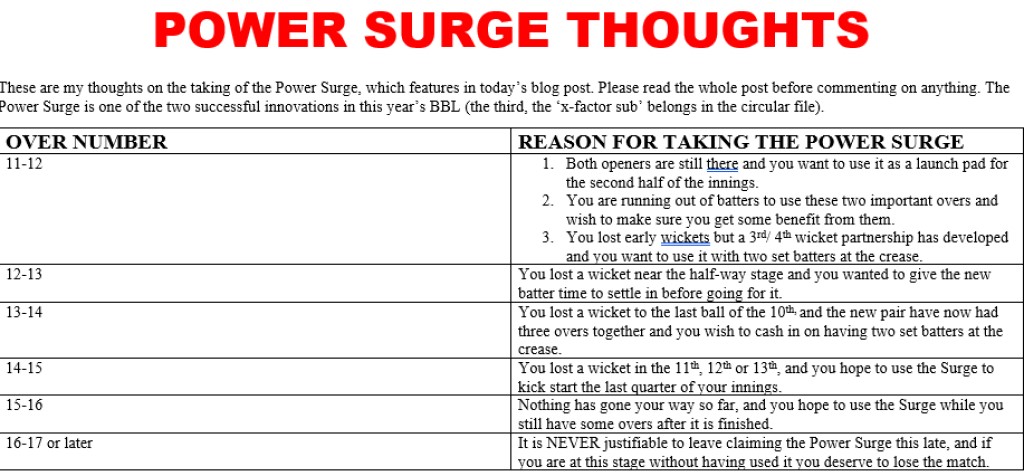
The infographic I created for this post, which you will have seen at the head of it, and which reappears to end this section, outlines my thoughts on this issue, and I will add to it just this: sides going into the second half of their innings should be inclined to go early rather than late with the Power Surge and should delay it only if there are strong reasons, such as a wicket falling in the tenth over, for doing so. I can see no merit at all in using it any later than overs 15 and 16, as you should be getting big runs off the closing overs anyway even without the extra fielding restrictions.
PHOTOGRAPHS
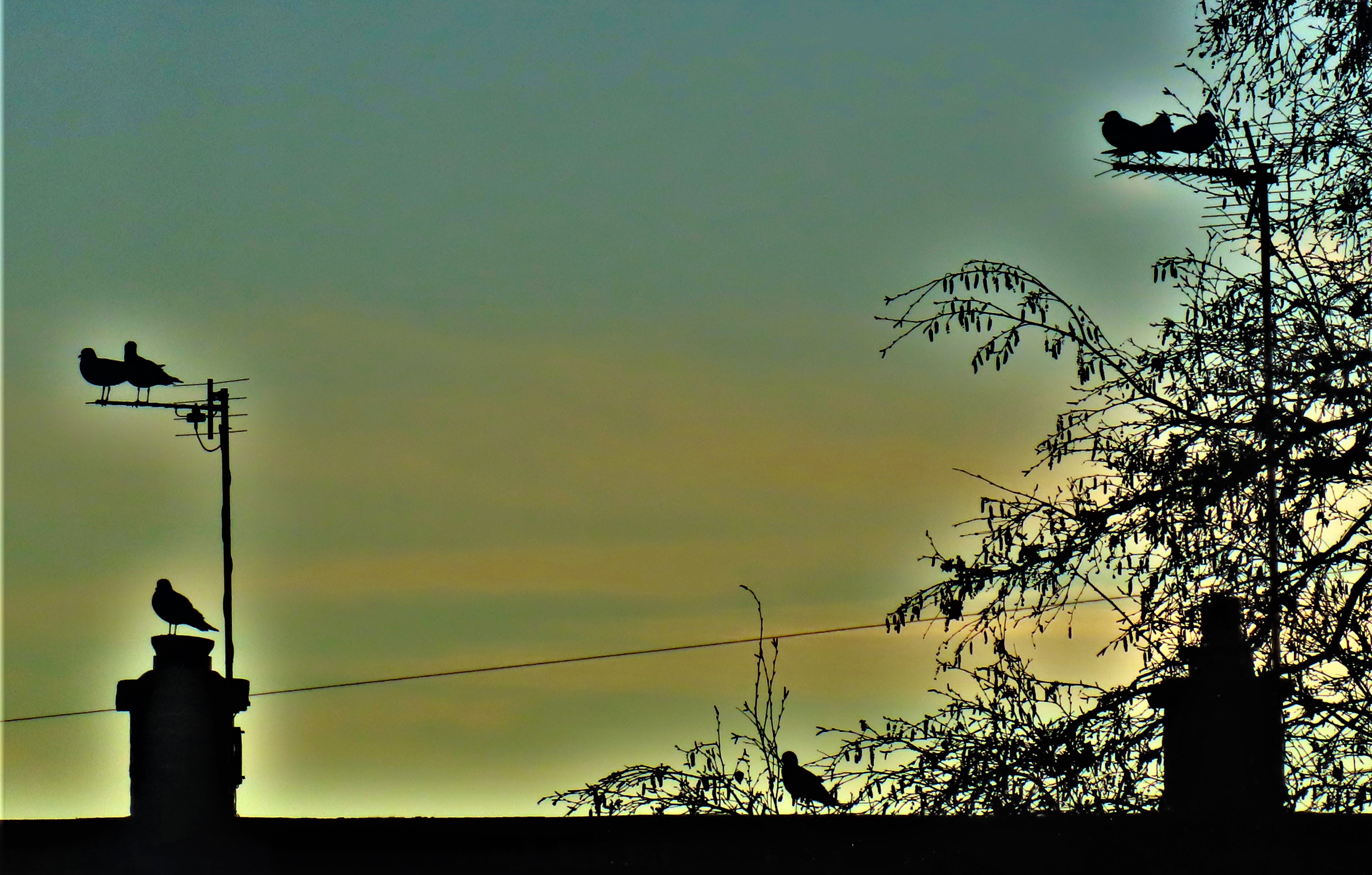
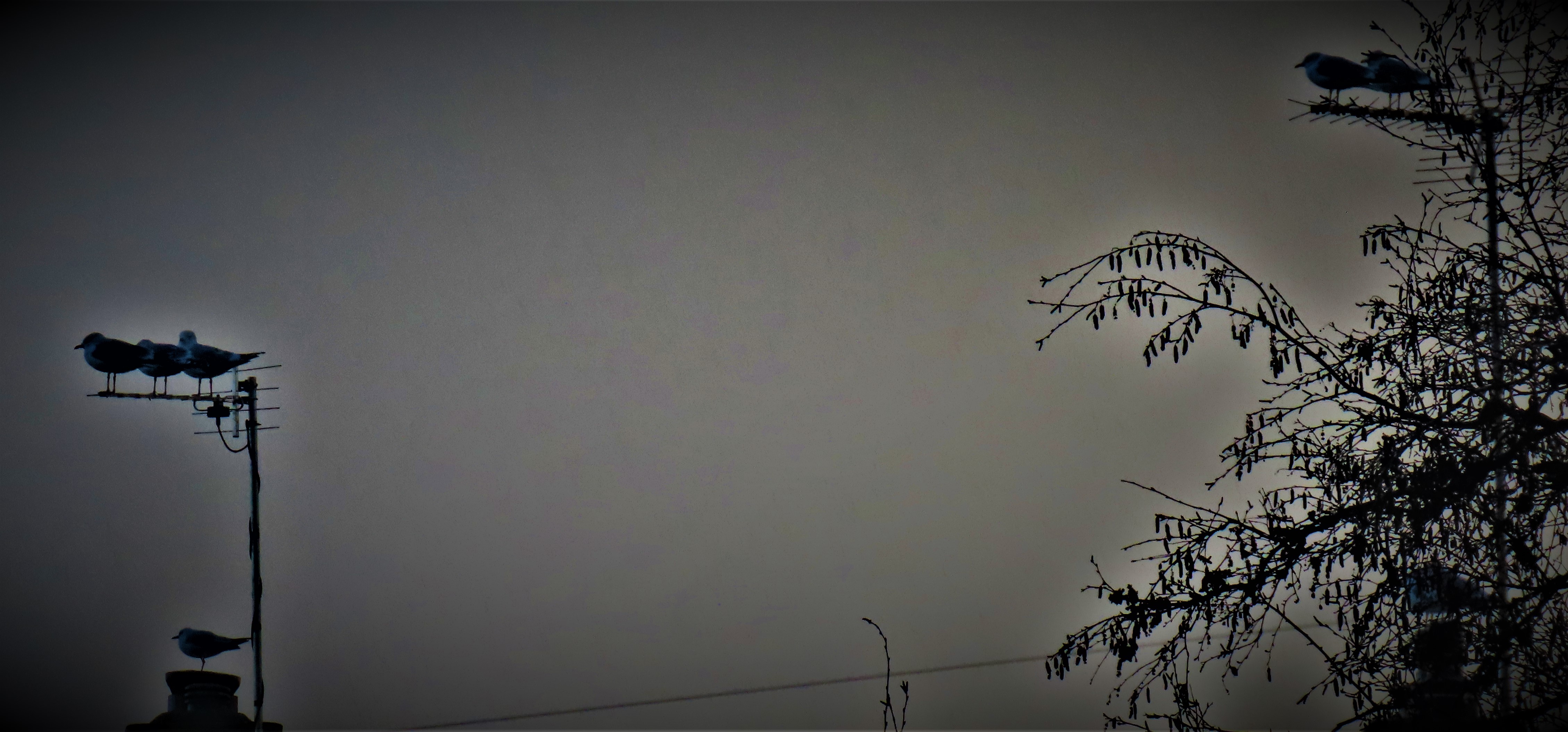
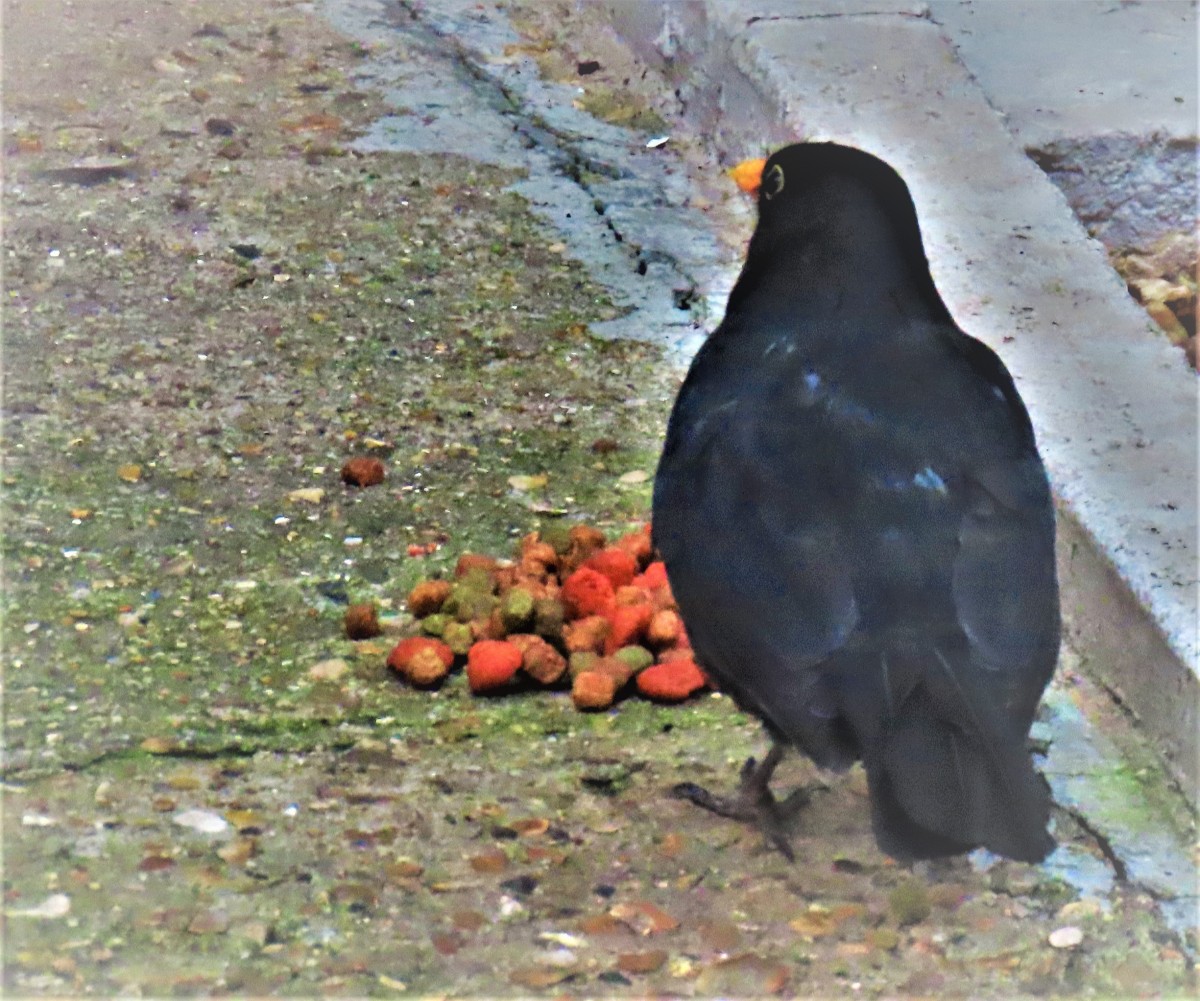
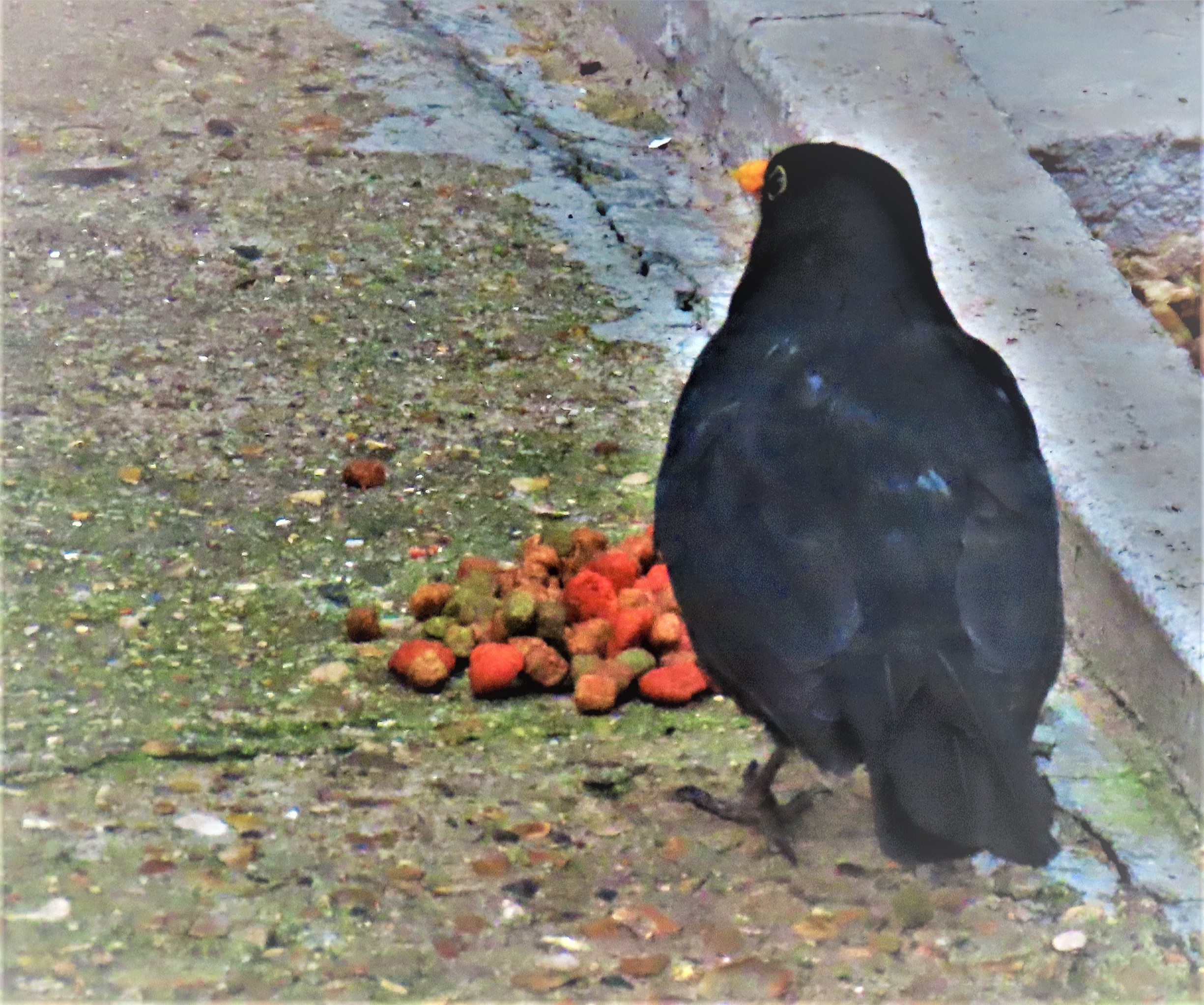
I have two galleries to share with you today, the first featuring my newest acquisitions, and the second my regular fare:
An account of the spectacular denouement to the Border-Gavaskar trophy series at the Gabba, a look at cricket formats and to upcoming test series, and some photographs.
This post is mainly about the amazing conclusion to the battle for the Border-Gavaskar trophy, the last day of which ended early this morning UK time. I will also be comparing the various formats that cricket now has and looking ahead to upcoming test series.
THE INJURY STREWN ROAD BACK FROM 36 ALL OUT
India took a first innings lead in the first test of the series, before that game underwent a shocking turnaround, as an hour of Cummins and Hazlewood at their best routed India for its lowest ever test score of 36, and Australia knocked of the target of 90 for the loss of two (see here for more details) wickets. At that point, with Kohli departing on paternity leave and injuries already making themselves felt an Indian series victory looked a long way away.
In the second match at the MCG India, captained by Rahane in the absence of Kohli hit back hard to level the series, but their injury list continued to lengthen.
In the third match of the series at Sydney, India continued to suffer injuries, with their two best spinners, Ashwin and Jadeja joining the crocked list. Also injured was Hanuma Vihari. However, in a display of determination that was a foretaste of what was to come at the Gabba, Vihari and Ashwin carried India to a hard fought draw in this match.
The final stop for India, with a bowling attack so depleted that those selected in bowling spots had one test cap between them, was the Gabba, where Australia were unbeaten since 1988, when a full strength West Indies, featuring one of the most awesome collections of fast bowlers ever seen, did the job.
Australia won the toss and chose to bat first (a number of sides of been lured in by the prospect of early life in the pitch and chosen to bowl, normally with terrible consequences – Hutton’s England leaked 601-8 in 1954-5 and lost by an innings and 160, Border’s Aussies conceded over 450 in 1986, were made to follow on and ended up beaten by seven wickets, Hussain’s England allowed Australia to reach 367-2 by the close of the opening day, and thereafter there was only going to be one result), and they tallied 369, a very respectable effort. Shardul Thakur and Washington Sundar each featured prominently in the bowling figures, as did Siraj. At 186-6 India looked in colossal trouble, but Thakur and Sundar followed their bowling exploits with some excellent batting, making 67 and 62 respectively, and in the end the deficit was just 33.
India did well to restrict Australia’s 2nd innings to 294, which left them 329 to get and just over a day to do so. The weather which had intervened several times, did so once again, ending day 4 early with India 4-0, needing 324 off 98 overs on the final day to win, with a draw also sufficing to retain the Border-Gavaskar trophy.
By lunch on day five India had lost only one wicket, and Gill and Pujara were going well. The afternoon session was better for Australia, but they still did not capture many wickets, and Pant was batting well by the tea break.
When Mayank Agarwal fell for a skittish nine it still seemed that only two results were possible. Sundar joined Pant, and they were still together going into the mandatory last 15 overs, with 69 needed. By the ten over to go mark this was up around a run a ball, but they were still together. Briefly the ask went above one run per ball, but then Sundar hit a six and a four in quick succession, which in turn encouraged Pant, and suddenly the target was approaching at a rapid rate. Cummins, who had toiled heroically and picked up four wickets on the day gave way to Hazlewood, while Lyon was wheeling away at the other end. There was a brief wobble when Sundar fell essaying a reverse sweep and then Thakur got himself out cheaply, but the target was close to being achieved by then, and not long later a straight driven four for Rishabh Pant ended the chase, India winning by three wickets to take the series 2-1 and retain the Border-Gavaskar trophy in style. Pant had scored 89 not out, backing up Gill’s earlier 91 and a determined 56 from Pujara.
Pant was named Player of the Match, while his 20 wickets earned Cummins the Player of the Series award. Personally I would have given the match award to Thakur who made significant contributions to all of the first three innings, without which India would never have been in the contest, but I can understand why it went to Pant.
Of all the test series I have followed closely enough to comment on from personal experience (dating back to the 1989 Ashes debacle) this one between Australia and India has only one remotely serious rival, the 2005 Ashes series, which featured three of the greatest matches I have ever been witness to plus Pietersen and Giles’ heroics at The Oval.
ON CRICKET FORMATS
Top level cricket these days has four principal formats with a fifth in the pipeline, and this match just concluded at the Gabba, plus events at Galle prompted to me to write a little about each:
Test Cricket – these two matches in their differing ways provided excellent case studies as to why the five day format is the best of the lot for cricket. Both matches featured fight backs which could not have been mounted in a shorter version of the game.
First class cricket – played over either three or four days (one of the definitions of a first class cricket match is that it must last at least three days), and like test cricket the longer time frame enables things to happen that could not in a short match.
One day cricket – played over the one day, usually one innings per side, although various split innings formats have been tried, and each side is limited to a certain number of overs, and at least five bowlers must be used. It has its great moments, notably the 2019 World Cup final, but the great majority of games in this format do not stick in the memory any longer than it takes to play them.
T20 – One innings of 20 overs per side, various fielding restrictions and other gimmicks according to the exact competition. These can be cracking entertainment while they last, especially if they get close, but again few stick in the memory.
The Hundred – 100 balls per innings for each side, to be bowled in some combination or other of blocks of five and ten balls. Nobody really knows why this joke of a format was invented, though after being delayed for a year by the pandemic it is expected to make’s it appearance in the 2021 English season. I feel that tampering to the extent that is involved in the design of this new format is unacceptable. The number of balls in an over has changed through cricket’s long history – it was four in the early days, five in the 1880s and 1890s, then six, then eight for a time (briefly in this country, for about 50 years in Australia) and then back to six, but it has always been fixed and constant within each match. Just as I refused to pay any attention to the Stanford extravaganza, rightly seeing it as fundamentally bad for cricket, so I plan to ignore the Hundred.
FUTURE TESTS
England have two series coming up against India, first in India, then in England, and an Ashes series down under at the end of the year. I now feel having seen an injury ravaged India fight like tigers and beat the Aussies in their own back yard that England will be lucky to win either series against India, but for all that no England team not holding the Ashes have won in Australia since 1970-1 they have a decent chance of winning that series. I noticed that Axar Patel, a left arm spinner, is in India’s squad for the upcoming series in India, and given the ‘rabbits in headlights’ responses of Messrs Crawley and Sibley to Lasith Embuldeniya taking the new ball for Sri Lanka I can see exactly how India might use him to their advantage! Overall, test cricket is in fine health, and has once again dealt very effectively with premature rumours of its sad demise, by producing a couple of amazing games that overlapped with one another.
A look back at the test match in Galle that finished early this morning. Includes player ratings and selection thoughts for the second match, a look ahead and some photographs.
This post looks back at the test match just concluded in Galle. Another such game reaches its denouement in Brisbane tonight, and if weather permits it should be a cracking finish.
ENGLAND GO 1-0 UP IN THE SERIES
Both teams arrived for this match not so much ‘underdone’ as ‘completely raw’, due to scheduling issues. Sri Lanka slumped to 135 on the first day, with Bess emerging with five wickets for a rather patchy bowling performance. Both England openers then fell cheaply, Sri Lanka’s decision to give the new ball to Embuldeniya with his left arm spin paying off in spades, but Root and Bairstow took England to the close, within sight of a first innings lead. Bairstow was out first thing on day 2, but Dan Lawrence on debut batted like a veteran, making 73, and providing Root with superb support. By the close England were 320-4 and seemingly headed for a monster lead. Buttler fell early on the third morning, triggering a collapse that saw England all out for 421, Root 228, a lead of 286 when at one stage 400+ seemed likely. Sri Lanka dug in and fought hard in their second innings, with both spinners, Bess and Leach, bowling better than they had first time around, Wood bowling quick when he was used, Curran sometimes making things happen and Broad bowling almost as economically as his Notts and England predecessor Alfred Shaw did in the early days of test cricket. Just before the end of the fourth day Sri Lanka were all out for 359 leaving England 74 to get.
The start of the England innings resembled a flashback sequence as the openers Sibley and Crawley both fell cheaply to Embuldeniya, who looks a real find for Sri Lanka. Then Bairstow made a greedy call for a run and succeeded in stitching up his skipper, and that was 14-3, and the possibility of a history making collapse loomed. In 1882, in the match that spawned The Ashes, England were set 85 in the fourth innings and ended up all out for 77, losing by seven runs. It seemed that present day England might be about to choke on an even smaller target. Dan Lawrence joined Bairstow, and they saw England through to the close at 38-3. The fifth day started on time, and with the same two spinners, Embuldeniya and Perera taking up where they had left off. In the event, 35 minutes play was sufficient for England to get home without further loss. The only alarm was a close LBW shout, turned down, and had Sri Lanka sent it upstairs they would have had a wicket. In the event it was Bairstow who made the winning hit, when it would have been more fitting for it to have been Lawrence.
Had Sri Lanka been able to completely dry up England’s scoring (in the great 1882 match Spofforth and Boyle at one point bowled 17 overs for one run) they may have induced serious panic, but England were always able to keep the scoreboard ticking, and in the end the margin was very comfortable.
Sri Lanka can take great credit for fighting back hard enough to take the game into its fifth and final day after they performed so awfully on the first two days. For England the big pluses were Joe Root rediscovering how to go seriously big and Dan Lawrence playing so well on debut, while young Embuldeniya may yet develop into a worthy successor to Muralitharan and Herath. Sibley and Crawley need to improve their approach to spinners, otherwise every test skipper will be tossing the new ball straight to a spinner to get a couple of early scalps. If England’s spinners produce some of the stuff they did in this game when they come up against India they will get absolutely destroyed, but it was good to see both improve considerably as the match went on.
PLAYER RATINGS & STAY/GO
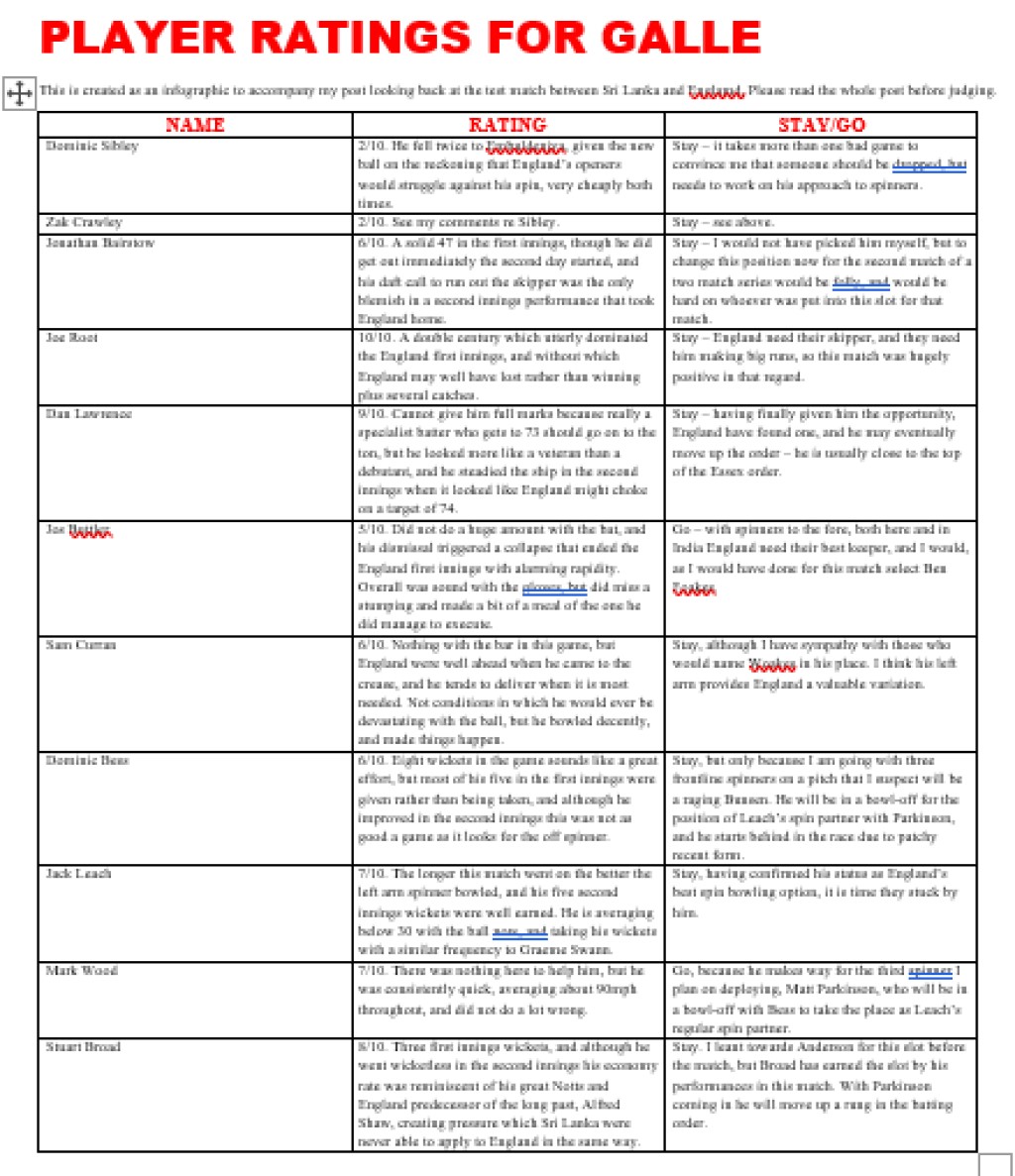
In this section I rate the performances of the England players and offer my opinions about who should stay and who should go.
Dom Sibley – 2/10. Twice fell very cheaply to Embuldeniya and never looked comfortable in either innings. He stays – one bad match should not get someone the chop, but he does need to work on his handling of spin.
Zak Crawley – 2/10. My comments about Sibley apply equally to him, although he has demonstrated that he can play spin well later in an innings, if he manages to get in against pace.
Jonathan Bairstow – 6/10. A solid 47 in the first innings and after running the skipper out in the second he did well to see England home. I would not personally have recalled him to the test squad, but I see little point in dropping him at this juncture and having a newcomer at no3 for the second game of a two game series.
Joe Root – 10/10. His mammoth 228 utterly dominated the England first innings, he also took several catches in the field, and handled his bowlers well as captain. He will need to demonstrate that his rediscovered ability to go seriously big works against the likes of India and Australia as well as against a very weak Sri Lanka, but he could not have done much more here.
Dan Lawrence – 9/10. When a batter reaches 73 they should be able to complete the ton, and that is the sole reason the debutant does not get full marks. He played a fine first test innings, and showed great composure when England were rocking in the final innings. He definitely stays, and it looks like England have found a good one.
Jos Buttler – 5/10. his first innings dismissal marked the start of a collapse, and he was not needed in the second innings. He kept competently other than missing a stumping in the second Sri Lankan innings. However, with spinners so much to the fore, both in Sri Lanka, and later on in India, as far as I am concerned he goes, as England need their best keeper, Foakes.
Sam Curran -6/10. He made things happen with his bowling on a couple of occasions. For me he stays, but I have sympathy for those who would replace him with Woakes. I regard his left arm as a potentially valuable variation.
Dom Bess – 6/10. Eight wickets in a match sounds like a great performance, but the truth is that most of his five first innings wickets were given rather than being taken, and that even in the second innings when he bowled better there were two many loose deliveries from him. He stays, but only because, on what I am expecting to be the ultimate in turners I go with three spinners, with him being in a bowl-off for the role of Leach’s spin partner with the third spinner – and starting that race from behind due to his patchy recent form.
Jack Leach – 7/10. The left arm spinner was understandably rusty at first, but by the end he was bowling very well, and his five second innings wickets were just reward for a fine effort. He stays, his position as England’s #1 spinner confirmed by his performance here.
Mark Wood – 7/10. Sensibly used by his skipper only in short bursts he was always quick, averaging around the 90mph mark, and in conditions that offered him nothing he did very little wrong. Nevertheless, I would leave him out to accommodate Parkinson who will be in a bowl-off with Bess for the second spinner’s slot.
Stuart Broad – 8/10. The veteran took three wickets in the first innings, and although he went wicketless in the second, his extreme economy, reminiscent as I have said of Alfred Shaw, helped to create pressure, which created wickets for other bowlers. He stays, moving a rung up the batting order given the inclusion of Parkinson.
LOOKING AHEAD
England should make it 2-0 on Sri Lanka (the second game gets under way on Friday), but will need to improve to compete effectively with India, who have shown immense determination to take their series in Australia right down to the wire, and then at the back end of this year comes the toughest assignment of all for an England team – Australia in Australia. Lawrence looks a huge find, and with Pope due to return for the India series, Burns back in the reckoning before too long and Bracey waiting in the wings, concerns about Sibley and Crawley against spin notwithstanding the batting looks good. In conditions where out and out speed is of the essence Archer will soon be available as well as Wood, with Stone waiting in the wings. Seam and Swing are always England’s strongest suits, and with no sign of Anderson or Broad leaving, Woakes and Curran about, and Ollie Robinson in the wings that area remains strong. Spin remains a concern, although Leach is looking good, while in Australia I would expect Parkinson, the leg spinner, to fare better than Bess, for another reason I want him to get some test experience in before that tour starts. It is also possible that younger spinners such as Virdi, Moriarty and Patterson-White could be contenders. Finally, there remains the gamble which some would consider heretical of giving Sophie Ecclestone a bell and asking if she fancies having a go alongside the men.
PHOTOGRAPHS
My usual sign off, with the addition of an infographic about the ratings and stay/go section:
A look at the two test matches currently in progress, and at Joe Root’s status as an England batter.
There are two test matches in progress at the moment, with overlapping playing hours. This post looks at both.
GALLE: ENGLAND ON TOP
When bad light brought a slightly early end to day three in Galle (due to the old fort that adjoins the ground Galle stadium cannot have floodlights – the fort is a World Heritage Site, so my usual gripe re bad light and test matches does not apply here) Sri Lanka were beginning to offer resistance, but were coming from a very long way behind.
Day Two, also truncated by the weather, saw England establish complete control. Bairstow failed to add to his overnight 47, but debutant Dan Lawrence made a fine 73, Buttler was looking comfortable by the close, and Root had a blemish free 168 not out to his credit. England were 320-4 and looking at all sorts of history if things continued the same way.
Day Three saw the remaining England wickets add just a further 101, Root being last out for a splendid 228. The only chance he offered in this innings was the one that was taken at deep midwicket to end it. Embuldeniya had every right to feel more than a little frustrated, a fine effort with the ball leaving him with figures of 3-176 while the much less impressive Perera had four wickets in the end. Root’s innings took his test aggregate past 8,000, in fewer innings than any England batter save Pietersen (KP 176, Root 178). It now stands at 8,059, meaning that he needs a further 56 to become the all-time leading test run scorer among Yorkshiremen. Inspired by the rapid fall of England’s last six wickets Sri Lanka then showed some fight with the bat, helped it must be said by an unimpressive bowling display from England. Bess could not get his length right, Leach was unlucky, there was little for the quicker bowlers, though Curran picked up a wicket when a rank long hop sailed straight to deep third man. Root tried a few overs but unaccountably Lawrence was not given a go. Mendis finally got off the mark after four successive ducks, a sequence known in the trade as an ‘Audi’, thereby avoiding the ‘Olympic’, but fell just before the close. Sri Lanka sent Embuldeniya in as nightwatchman, and the light closed in quick enough that he was still there at stumps. Scores so far: Sri Lanka 135 and 156-2, England 421, SL need 130 more to avoid the innings defeat.
England are of course heavy favourites, but that should not conceal the problems – Bess has been far too erratic, and if he bowls this kind of stuff in India he will be destroyed, other than Root and Lawrence there were no major batting contributions.
IS ROOT ENGLAND’S GREATEST EVER BATTER?
This question was raised on twitter today, in view of the milestone Root has just reached in test cricket and his great records in the other two formats. My own answer was that this question cannot be resolved because it is impossible to compare different eras, but Root is a magnificent all-format player who would have been a great in any era. I am now going to look, in chronological order, at some of those who might have been just as good had there been multiple formats in their day. I have restricted myself to players who experienced international cricket…
WG Grace – the man who virtually created modern batting. He successfully countered every type of bowling that existed in his day, could score rapidly when the occasion warrants (in 1895, less than two months shy of his 47th birthday, he scored 257 and 73 not out v Kent, the latter played against the clock to chase down a target, which was achieved successfully.
Jack Hobbs – The Master, capable of very attacking performances, especially in his younger days.
Herbert Sutcliffe – as he once famously told Plum Warner “ah luv a dogfight”, a claim borne out by his averages: 52.02 in first class cricket, 60.73 in test cricket, 66.85 in Ashes cricket. Although he is best known for long determined innings, like his seven-hour 161 which began on difficult pitch at The Oval in 1926, and his 135 at Melbourne two and a half years later, he could and did attack when the occasion demanded it. His 100th first class hundred was made with Yorkshire needing quick runs, and he hit eight sixes along the way.
Walter Hammond – averaged 58.45 at test level. His highest score was 336 not out against New Zealand, accrued in just 318 minutes. When he scored 1,000 first class runs in May 1927 the innings that completed the achievement came at the expense of Hampshire, and saw him score 192 out of 227 made while he was at the crease. He once started a day’s play v Lancashire by hitting Ted McDonald, then the best fast bowler in the world, for five successive boundaries, and according to Neville Cardus, a Lancastrian, it was only a fine bit of fielding by Jack Iddon that stopped it being six boundaries out of six for the over.
Denis Compton – averaged over 50 for England, reached 100 first class hundreds in 552 innings, a tally beaten only by Bradman (295), scored the quickest ever first class triple hundred, reaching the mark in 181 minutes at Benoni in 1948.
Peter May – the 1950s were a low and slow scoring decade, and yet Peter May averaged 46 in test cricket through that decade, and was noted for his stroke making.
INDIA FIGHTING HARD AT THE GABBA
India have had terrible problems with injuries during their tour of Australia. Among those on the sidelines for this match were both halves of India’s best new ball pairing, Bumrah and Shami, both of India’s two best test spinners, Ashwin and Jadeja, and others. Nevertheless, they are very far from being down and out at the Gabba. Australia won the toss and batted, scoring 359, with three wickets a piece for Natarajan, Thakur and Sundar, of whom only Thakur had previously played test cricket. India had reached 62-2 in reply before a storm hit Brisbane, bringing an end to play for day two. Rahane and Pujara are together at the crease, with Agarwal and Pant still to come, Sundar at seven capable of making a useful contribution and then the specialist bowlers. If India win it will be an incredible achievement, if they manage the draw and thereby retain the Border-Gavaskar trophy that will still be a mighty effort, and even if Australia ultimately prevail I for one will salute India for making such a fight of this series in the face of so many misfortunes.
A look at day 1 of Sri Lanka v England in Galle, and a glimpse at the state of play in BBL10. Also some photographs.
Early this morning UK time the test series between Sri Lanka and England got underway. This post looks back at the first day.
ENGLAND DOMINATE DAY 1
Unsurprisingly given the current situation, with a global pandemic happening, neither side had had anything approaching proper preparation for a test match. Sri Lanka had had no cricket at all since taking a hammering in South Africa. England managed one day of an intra-squad fixture, which with both “sides” containing more than 11 players and arrangements being made that each would bat for at least 50 overs in the first innings had precious little resemblance to a real match – it was more in the nature of an extended net with umpires in position. This lack of preparation was shown in some less than stellar cricket.
Sri Lanka batted first, and mustered 135 all out, a poor score, especially given that almost all of their wickets were lost through bad batting rather than good bowling. There were a couple of freakish dismissals – Bess got one when a shot hit Jonathan Bairstow and Buttler caught the rebound, while Leach got a finger tip to a drive, deflecting it into the bowlers end stumps with Embuldeniya way out of his crease. Bess was also the beneficiary when a really succulent long hop was bashed straight into the hands of backward point. Stuart Broad was in the wickets early on, Jack Leach bowled nicely, and, by hook or by crook, Bess emerged from the fray with 5-30.
After that shocking display with the bat Sri Lanka needed things to happen for them with the ball. To that end they gave the new ball to left arm orthodox spinner Embuldeniya, a clever decision given that Sibley and Crawley would both prefer to begin against seam. It paid early dividends, as both openers perished with only 17 on the board. At that point skipper Root joined Bairstow, a choice at no3 which did not meet universal approval. They played beautifully, although Root was given out LBW fairly early on – he reviewed it, and the technology showed that the ball was going over the top of the stumps. By the close Root had reached 66 not out, Bairstow was on 47 not out, and England at 127-2 were in total control of the match.
Root has recently had problems turning starts into major innings, and he needs to dig in again early on tomorrow and make sure this effort does not go to waste. As for England as whole this is the most dominant opening day they have had since Trent Bridge 2015 when they rolled Australia for 60 and were comfortably into a first innings lead by the end of the day.
Those of us following proceedings by way of Test Match Special were treated during the lunch break to an interview with Justin Langer, coach of Australia. His attitude to the controversy over Steve Smith allegedly scuffing up a batter’s guard at the SCG showed a failure of understanding, and also a huge degree of petulance – it was basically an on-air tantrum. Smith’s actions may well have been as innocent as Langer insists, but what both Smith and Langer need to understand and are apparently unable or unwilling to is that a proven cheat will not be given the benefit of the doubt when such incidents occur.
RECENT BBL ACTION
The tenth running of the Big Bash League is still in full swing. Yesterday the two Sydney franchises locked horns in a top of the table clash. Thunder, batting first, began brilliantly, scoring 47-1 from their four overs of Power Play, but then had a disastrous second period of their innings, being 86-4 after 10 overs. They then slowed up in overs 11-15, declining to take the Power Surge in a bid to revitalize their innings, and found themselves 112-5 after 15. They left the Power Surge right to the end, finally taking it at the last moment they could, for the 19th and 20th overs. They did score 24 off this two overs, but they would probably have done that at the tail end of a T20 innings even without it being a Power Surge, so they effectively did not benefit from those two overs. They ended on 166-6 from 20, at a high scoring ground (the average innings score for a T20 at Manuka is 175). Ir rained during the interval, and a delayed start to the second innings led to a DLS recalculation. Sixers resumed needing 129 from 14 overs to win, and 67 off seven to claim the Bash Boost point, while they would have three overs of Power Play and one of Power Surge. They got off to a flier, secured the Bash Boost point with an over to spare, and maintained the momentum, winning in the end by five wickets, with eight balls to spare. That put them six points clear at the top of the group, and left Thunder just about catchable by the chasing pack.
Today, while I was focussed on the test match the Heat took on bottom of the table Renegades. Renegades mustered 149, which rarely wins a T20 these days. Heat made life a little more difficult for themselves than it should have been by surrendering three quick wickets as they entered the closing stages of the chase, but they won by five wickets in the 19th over. This moves Heat, who also took the Bash Boost point, into the fifth and last qualifying slot on 20 points. Renegades remain on nine points, 11 points short of the qualifying zone with only four games to play, and it is now only a matter of when, rather than if, their early exit from the tournament is officially sealed.
A look at recent BBL developments, a nickname suggestion and some photographs.
This post looks back at the three BBL games on which the TMS team have provided live commentaries since my last blog post, and also attempts to give impetus to a nickname I have coined.
RENEGADES V THUNDER
The Renegades went into this match in bad position in the tournament and were unlucky to finish it in an even worse one. They batted first, and there was a rain interruption 12 overs into their innings which lasted long enough to reduce the game to 17 overs per side. They took the two over Power Surge immediately on the resumption, to relaunch their innings, an excellent decision IMO, and one that worked well for them. They finished with 167 from their 17 overs, which the Duckworth-Lewis-Stern system (DLS) turned into a target for the Thunder of 173, with the readjusted Bash Boost point target 65 off eight overs. The Thunder had reached 117-2 from 12 overs, helped by a fine knock from Alex Hales, when the rain returned, terminally this time. Thunder were ahead of the official DLS par score and took the points. My own reckoning is that 56 off five overs, even with eight wickets still standing, would have been tough for the Thunder to pull off. Renegades played again today (no commentary), and were soundly thrashed by the Scorchers as the latter continue their attempt at a Lazarus act.
SIXERS V HEAT
The Sixers were going well in the tournament, while the Heat were struggling somewhat. The Sixers had a good first ten overs, scoring 85 from them. It was in overs 11-15 that they let thing slip, being 123-6 after 15. A mini-revival got them to 165 from their 20. The Heat fared well in response, but lost wickets at awkward times. However, a respectable and well timed Power Surge got them back into the contest. At the start of the 17th over of the chase, bowled by Carlos Brathwaite the contest looked even, with maybe the Heat slight favourites, although they did not have a lot of batting in reserve should wickets fall. By the end of that over, which included three wides, and went for a lot of runs the Heat were cruising, and they took a mere four further deliveries to finish the job, Lewis Gregory finishing with 31 not out from 16 balls. The Heat were good value for the win. How would the Sixers respond to such lese majeste?…
SIXERS V STRIKERS
This was today’s commentary game on TMS. The Strikers started slowly and were 58-2 at the end of the tenth. The Power Surge did little to improve their situation, and it was only a late flourish in the last couple of overs of their innings that got them to the respectability of 150. They would have to bowl well to defend such a total. Jonathan Wells made 66 for the Strikers.
Unfortunately, with one exception, they did not bowl well. Rashid Khan bagged three wickets with his leg spin, but at that point Vince, already showing signs of going well, was joined by Jordan Silk.
One of the many subjects I read about is astronomy/cosmology, and anyone who has read remotely seriously about this kind of stuff would have come across Joseph Silk, a top astrophysicist. In quest of bringing some more imaginative nicknames back into the game, I link two J Silks together by dubbing Jordan Silk “Astrophysicist”, which could be shortened to “Astro”, linking to the the novels of Aussie writer Matthew Reilly.
Rashid Khan was given his fourth over early, the 14th of the innings to be precise, but by then the Sixers could afford to play him out without trying anything risky, and he finished with 3-18 from his allocation, a good deed in the naughty world of Strikers’ bowling figures.
Sixers then took the Power Surge, and those two overs plus another two were sufficient to see the Sixers to a seven wicket win, Vince 45 not out, “Astrophysicist”/ “Astro” 38 not out (he is also a fine boundary fielder, and has saved Sixers plenty of runs in that capacity during the tournament).
The Sixers, after their hiccup against the Heat, seem back on track and destined to be involved in the final stages of the tournament. The Strikers meanwhile look like a team in a lot of trouble. With the possible exception of the last two overs of the Strikers innings the Sixers won every phase of today’s game, and were far more dominant in it than the Heat had been against the Sixers, for all that Heat actually had a couple more balls in hand when they completed victory in that game.
A farewell to 2020 (don’t let the door hit your bum on the way out), an account of the last cricket match of 2020 and a new year’s message to my readers.
The end of 2020 is now less than ten hours distant (in UK, some of you are already into 2021, and have been able to celebrate New Year’s Eve – well done NZ), and it will be a great relief to see it out, though 2021 offers little sign of immediate improvement for us Brits (although those north of Hadrian’s Wall might do themselves a favour by going for a UDI). A stark indication of quite how badly Johnson and his cronies are letting the country down: yesterday 981 people in Britain died due to Covid-19, while across the Irish sea just nine suffered the same fate.
As a cricket fan, 2020 has been a fine year since the resumption of cricket in the summer (my congratulations to the West Indies, both men’s and women’s teams for making the journey and ensuring the home summer saw some international cricket – as soon as a visit from this island becomes an asset rather than a liability those tours should be reciprocated. I am going to devote most of the rest of this post to covering the last top level cricket match of 2020.
ADELAIDE STRIKERS V PERTH SCORCHERS
This BBL match featured one team doing less well than expected or hoped (Strikers) and a team doing appallingly (Scorchers). Strikers batted first, and every time they seemed be getting going a wicket fell. Finch batted well but could find no serious support. Then, down to him and Rashid Khan (best known for being the no1 rated T20 bowler on the planet but also a more than useful lower order batter whose approach is ideally suited to short form cricket), he was overly timid about claiming the Power Surge, and Rashid fell with it still unclaimed. At the end of their innings the Strikers had 146-9, a total that should not pose the chasing side much of a problem, but Scorchers as mentioned earlier were winless.
Scorchers started the chase well, with Jason Roy doing most of the scoring. However when both openers, Roy for 49 and Livingstone for an unconvincing 8, fell in the same over one had to wonder if the Scorchers were about to suffer another case of the collywobbles. Although a third wicket fell just before halfway, a boundary of the final ball of the tenth over secured Scorchers the Bash Boost point. Some would say that they also delayed claiming the Power Surge longer than they ought, but at least they managed to take it with two set batters at the crease, and by the time it ended the chase had been reduced to 14 off four overs, which would take a lot of messing up.
The 17th over of the innings was Peter Siddle’s third and he made a good fist of it, meaning that the target was still 10 going into the 18th. Successive fours off the third and fourth balls of that over completed the job, giving Scorchers a win by seven wickets and all four points. It was a satisfying end for me on two counts: 1) I had predicted at the start of the 17th that Siddle would not get to bowl his 4th because the game would end before he could and 2) much more importantly it meant that the Strikers were properly punished for mucking up over the Power Surge.
The more I follow of this year’s Big Bash the more I think that it must be better to go for the Power Surge too early rather than too late, which is why I cannot wholly endorse Scorchers waiting until the end of the 15th to go for it, but unquestionably they approached it miles better than the Strikers.
If the Scorchers could contrive to use this hugely impressive victory as a springboard back into the tournament it would represent a comeback to send Lazarus green with envy on their part.
PHOTOGRAPHS
Just before my usual sign off, which on this occasion includes a video, I have a few final words of 2020 for my readers: thank you all, and here’s to a better 2021
An account of two and a half extraordinary days of cricket at Adelaide.
The first test between Australia and India in the latest series for the Border-Gavaskar Trophy has ended after only half the allotted time, with Australia winning by eight wickets. Two and a half days proved ample time for some extraordinary happenings as we shall see…
THE MATCH
This match was a day-nighter which made it slightly easier to follow from the UK (the BBC have rights to Australian radio broadcasts for three years, so there was live commentary on 5 Live Sports Extra) – just a very early morning start as opposed an all-nighter. Both sides had questions over their opening pairs due to injuries. For India Prithvi Shaw got the nod to open with Mayank Agarwal, while with both Warner and heir apparent Pucovski hors de combat for Australia they opted for Matthew Wade, who had never previously opened a first class innings, never mind a test one to partner Joe Burns. The other question was over India’s choice of keeper, and they opted for the superior keeper, Wriddhiman Saha rather than deepening their batting by selecting Rishabh Pant.
India won the toss and chose to bat. The second ball of the game exposed a gap between Shaw’s bat and pad through which an HGV could have been driven, leading to the ‘death rattle’ and India were 0-1. Agarwal also fell cheaply, before Chesteshwar Pujara and Virat Kohli stabilized things. Pujara batted well up to a point, but did not do quite enough to keep the scoreboard ticking. Ajinkya Rahane now joined Kohli and for a time all was rosy for India, as the pairing prospered. The falling sweep twitter account piped up to mention that Rahane had never been run out in a test innings, to which I could not resist responding with a question as to whether that related to good running or an ability to ensure that his partners lost their wickets when mix-ups occurred. A few moments after this exchange Rahane proceeded to stitch his skipper up, and India were four down. Rahane himself followed not long after, and Hanuma Vihari also fell cheaply, bringing R Ashwin into join the keeper Saha. None of the remaining members of the batting order, Umesh Yadav, Jasprit Bumrah and Mohammad Shami could lay claim to any real batting skill, although Bumrah had just notched his maiden first class 50 in a warm-up game against Australia A. Saha and Ashwin made it to the close with the score at 233-6.
The second day began with a flurry of wickets, as India were quickly rounded up for a total of 244. Australia made this total look quite respectable, and it was only a fighting 73 not out from captain/ wicket keeper Tim Paine that kept their deficit to 53. India missed a cartload of chances as well – officially five catches went down, and there was more than one incident of an edge falling short of a fielder who had positioned themselves too deep to make the catch. Among thos reprieved was Paine himself on 25.
India began their second innings 25 minutes before the cut-off time at which stumps had to be drawn, which I thought represented a case for promoting Pujara to open in place of the clearly vulnerable Shaw (check my twitter account and you will see that I posted to this effect at the time). India felt otherwise and in to bat trooped Shaw and Agarwal. This time Shaw did get off the mark, but with four to his name he was bowled in pretty much identical fashion to the first innings, the ball going through a veritable chasm between bat and pad to hit the stumps. Bumrah was then sent in as nightwatchman, and managed to see things through to the close at 9-1.
For some reason known only to themselves the BBC were not joining the broadcast of the third day’s play until 40 minutes after the start, so I missed the beginning of the end, the commentary being joined just as Kohli was dismissed to make it 19-6. I heard commentary on the dismissals that I had missed, as playbacks were presented during the coverage of what remained, and I heard the end of the Indian innings and the entire Australia chase. Agarwal and Bumrah took the score to 15 before Bumrah was out, the first of four successive wickets, the others being Agarwal, Pujara and Rahane to fall with the score at 15. Saha and Ashwin fell in successive balls as well, and that was 26-8. At 31 Vihari, the last recognized batter was ninth out, and five runs later Shami was struck on the arm and retired hurt, leaving the Indian 2nd innings all over for just 36, their lowest ever test score (previously 42 versus England). Australia thus required 90 to win. Burns and Wade batted well, before Wade was run out with Australia 20 short of the target. Labuschage holed out with eight still needed. The end came with Joe Burns hitting a six that also took him to a half century.
His 73 not out, captaincy and excellent wicket keeping, including a fistful of catches in that second Indian innings earned Paine the man of the match award.
THE INDIAN 2ND INNINGS
Normally when a team is out very cheaply there is at least some culpability on the part of the batters. When England sank for 46 to lose a match they had been ahead in at Trinidad in 1994 the rout began with Atherton padding up to the first ball and being plumb LBW, Ramprakash falling in the same over, also to a dismissal that suggested a player and a team in a funk. Here, apart from Shaw at the end of day two, the wickets all seem to have fallen to magnificent bowling, Cummins (four wickets, including his 150th in test cricket) and Hazlewood (five, at one stage 5-3, 5-8 by the end of the innings, including his 200th test wicket) bowling a perfect line and length and benefitting from some good fortune which both thoroughly deserved, as they found numerous edges and each edge was pouched, mostly by the keeper, some by other fielders. 36 all out in a test is a shocker, but here any honest observer has to credit the bowling, not blame the batting.
One crumb of comfort for India: immediately after the 46 all out I referred to earlier, and which I regard as a worse collapse, for all that England then scraped up 10 more runs than India managed this time, England travelled to Barbados where the West Indies had not been beaten in 59 years, and proceeded to win comfortably, Alec Stewart notching a century in each innings.
LOOKING TO THE FUTURE
Obviously India have a mountain climb, and the fact that Kohli is leaving to be with his wife as she gives birth and Shami is in jeopardy due to his injury today makes it even steeper, but they must not give up. The next game is at the MCG, where they won comfortably last time they were in Australia, and Bumrah in particular will have fond memories of that match. At the start of the 1902 Ashes Australia were bowled out for 36 in a single innings, albeit then being saved by the weather, and rebounded to win the series 2-1, with England’s lone victory coming in the final match at The Oval. I await the match in Melbourne with great interest, having enjoyed this one very much.
PLAYER RATINGS
I will start with the winning team:
Matthew Wade – given a job to do that he had never previously done he can be proud of his contribution to a low scoring match. 6/10 Joe Burns – many were questioning his presence in this team, and his first innings effort was far from encouraging. He also struggled in the first part of his second innings, but in the end emerged with flying colours. 7/10 Marnus Labuschagne – a gritty effort in the first innings when the rest of the Aussie front line batters all fell cheaply, and he fell in the second innings when trying to speed Australia over the winning line. 7/10 Steve Smith – R Ashwin demonstrated in the first innings that the least elegant but most effective batter in the game can be dismissed cheaply, and he did not the opportunity to make a noteworthy contribution to the 2nd innings. 3/10 Travis Head – an anonymous match for him. He failed in his only batting innings. 2/10 Cameron Green – a hugely exciting young all rounder of whom I expect to be hearing much more. He did enough in this game to demonstrate that he belongs at the highest level. 5/10 Tim Paine – a gritty innings, some fine keeping and good captaincy (although his use of the DRS still needs plenty of work). His player of the match award was well merited. 9/10 Pat Cummins – the right arm quick demonstrated why he is currently ranked the no1 test bowler in the world, bowling very well in the first Indian innings and magnificently in the second. 9/10 Mitchell Starc – good with the ball in the first innings, not much needed in the second. 7/10 Josh Hazlewood – a superb bowling effort in the second innings in tandem with Pat Cummins, and adequate in the first innings. 8/10 Nathan Lyon – the off spinner was out bowled by his rival Ashwin, but in a match where the quicks were more prominent he was far from failing. 7/10
Now we turn the Indians:
Mayant Agarwal: not a match the established opener will look back on with any pride. 4/10 Prithvi Shaw: a nightmare for the youngster who has a magnificent record in Indian domestic cricket but is not yet established as a test player. I cannot see him continuing as an opener – it is an early wicket every time for the Aussies if he does, but he may have a role in this series nonetheless as there will be a vacancy at no4, where he will be less exposed. 1/10 Cheteshwar Pujara: he did a solid job in the first innings, although he should have done more to keep the scoreboard ticking. Failed in the second innings. 4/10 Virat Kohli: before being stitched up by Rahane in the first innings he looked nailed on for a century. 7/10 Ajinkya Rahane: played well in the first innings, but a lot of the good he did for his side with his personal score was negated by his role in Kohli’s dismissal and his own subsequent dismissal shortly afterwards. Including the run out of Kohli the last 16 Indian wickets plus Shami retired hurt raised just 89 between them. 3/10 Hanuma Vihari: two failures for the youngster. 2/10 Wriddhiman Saha: kept superbly as usual, and looked to have done a valuable job with the bat in the closing stages of the opening day. 4/10 R Ashwin: good work with the bat near the end of the first day, but dismissed right at the start of the second when a decent morning’s batting could have put India out of reach in the match. Bowled beautifully in the Australian first innings and was rewarded with four wickets. 7/10 Umesh Yadav: bowled respectably in the first Australian innings. 5/10 Jasprit Bumrah: bowled impressively and commanded respect from all the Aussies. It must be said that there was little evidence of his much vaunted improvement with the bat and using him as nightwatchman was probably a mistake (if India were going to protect any of their major batters it should have been Shaw, which they could have done by promoting Pujara one place). Still, he did little noticeably wrong, and did manage the nightwatchman’s first task of surviving to the close of play. 6/10
Looking at the players India have available for the second match I would suggest that they select Shubman Gill to open with Agarwal and fill the temporarily vacant no4 slot by moving Shaw down from his current opening berth.
If you wish to see a scorecard and some more recognized views about this match, click here.
A look at the innovations featured in the tenth edition of the Big Bash League and a visit to all-time XI territory, with place names the link on this occasion.
A two-parter today, first looking at the innovations featured in this year’s Big Bash League and then, inspired by something I noticed during commentary on today’s weather hit game a revisit to all-time XI territory.
BBL INNOVATIONS
The current version of the Big Bash League, the tenth running of said tournament, features three innovations, and I shall touch on each in turn:
Power Surge: instead of a straight six overs of power play and then 14 of standard fielding restrictions there are now four overs of power play, and then a Power Surge of two overs, to be claimed at any time after 10 overs at the behest of the batting side. This has been a really successful innovation, with a lot of thought going into to when to take it. Ideally you would want two set batters at the crease to maximize the potential gain, and also to be quite close to the end of the innings to use it as a kind of springboard into a big finish. I can see the possibility of claiming it for overs 11 and 12 if the openers are still together, on the understanding that a big hitter will be promoted to cash in on it if one of the openers falls. If that is not an option then if two batters are going well at the end of the 15th over, claiming it for overs 16 and 17 with a view to really making the final quarter of the innings pay would appeal. I do not share TMS Commentator Simon Mann’s view about taking it for the last two overs of the innings being a good notion.
Bash Bonus Point – a bonus point is awarded to the team who score more from their first 10 overs, while three are awarded for the outright win. This has led to some interesting situations where teams knowing that overall victory is effectively out of the question go all out for being ahead after 10 overs in an effort to salvage something, as opposed to concentrating on surviving the full 20 overs so that their net run rate does not take a hammering. I consider this to be a success, although I could see a situation where a team gets knocked out due to this innovation, and fans would not be happy with that.
The ‘x-factor’ sub: players designated for this role before the game may be brought in (no more than one per side) after a maximum of ten overs of the first innings of the match. The substituted player must not have batted and may not have bowled more than one over (sensible caveats which prevent a specialist batter being used and then replaced by a specialist bowler, and vice versa). I have witnessed only two matches (via TMS commentaries) in which these players have been used, one of them today’s no-result. I have waited until I had actually seen the usage of such players before commenting on the innovation, but I have seen nothing to alter my initial thinking that if you actually pick your best XI at the start you should not need to make use of this option, and the fact that uptake of it has been very limited is itself a comment on the innovation. Thus I score these innovations at two out of three.
A PLACE NAMES XI
One of the players who featured in today’s match was Joel Paris, a left arm pace bowler, which started me thinking about players who have places in their names. I set myself rules that the place name must be the whole of on the player’s names, not part thereof, and that it must be spelt the same way (as you will see later this latter was germane). After I have been through the batting order I will explain some of those who missed out for one reason or another.
Sir Leonard Hutton – right handed opening batter, occasional leg spinner. Hutton is a place in Essex, on the edge of Shenfield.
Sidney George Barnes – right handed opening batter, occasional leg spinner. A combination of World War Two and the fact that he and the authorities did not always get on limited his test career to 13 matches, in which he recorded an average of 63. Barnes is near Putney, either southwest London or Surrey depending on who you consult.
Frank Woolley – left handed batter, left arm orthodox spinner, excellent close fielder. Woolley is a small village, almost precisely equidistant between Barnsley and Wakefield in Yorkshire.
Ken Barrington – right handed batter, occasional leg spinner. Upper and Lower Barrington are a matched pair of villages in Gloucestershire (Marcus Berkmann mentions them in one of his books about life in cricket’s lower reaches).
Victor York Richardson – right handed batter, fine fielder, occasional wicket keeper. A fine test batter in the 1920s and 30s, and grandfather of two others, Ian and Greg Chappell, his middle name gets him into this team.
*Warwick Armstrong – right handed batter, leg spinner, captain. I rated him the finer of the two regular test captains in this line up, and anyway I wanted Hutton free to concentrate on his batting. In the 1905 tour of England he scored over 2,000 runs and took over 100 wickets in first class matches.
+Jack Blackham – right handed batter, wicket keeper. He played in each of the first 17 test matches ever contested and is regarded as one of the greatest of all keepers. Blackham is a small village almost exactly equidistant between East Grinstead in Sussex and Tunbridge Wells in Kent.
Washington Sundar – off spinner, left handed lower order batter. The 21 year old Indian has been making a name for himself in T20, but he also has a more than adequate FC record, averaging 31.29 with the bat and 26.93 with the ball in that format.
Joel Paris – left arm fast medium bowler, left handed lower order batter. His first class averages are just the right way around – 23.38 with the bat and 23.25 with the ball.
Sydney Francis Barnes – right arm fast medium bowler, right handed lower order batter. In the case of Sidney Barnes the batter I had to use his surname as the place name, but this greatest of all bowlers qualifies twice over, since his first name Sydney is spelt the same way as Australia’s largest city.
Ian Peebles – leg spinner, right handed lower order batter. Peebles is due south of Edinburgh.
This team has a deep batting order, a very varied and strong bowling attack, and would definitely give a good account of itself. Now for some honourable mentions:
William Maldon Woodfull, a fine opening bat and captain for Victoria and Australia would qualify by virtue of his middle name, which is a place in Essex and also the place in Victoria where he was born. Anthony William Greig, an attacking middle order bat good enough to average 40 in test cricket and a decent bowler of both medium pace and off spin missed out by a single letter – the Cornish seaside village of Antony not having an H in its name. Rahkeem Cornwall might have replaced Washington Sundar without unduly weakening the team (he is also an off spinner and more than useful lower order batter). Had I allowed myself to reach back a few hundred years to a long antiquated spelling of a place near York, which is now always spelt Bootham, as it is pronounced, I could have accommodated Ian Terrence Botham – the single o spelling was once a thing. Arran Brindle, a batter for England women who has at least one century in men’s club cricket to her name, could have got in via her first name. Ian Peebles’ place in the XI could have gone to either of two other leg spinners, Richie Benaud, whose name derives from a village in France, but who I would have heading the commentary team, and Amanda-Jade Wellington. Finally, I was tempted to find a place for Mike Gatting who shares a surname with a legendary former UK constituency. The old Gatting constituency, disenfranchised in 1831, contained one grand house, and it happened on one occasion that the butler had a quarrel with the master of the house and stood against the master’s son (the master by this time considering himself to old to be a candidate). The master voted for his son over the butler and that was that.


































































































































































 aspiblog