How WBBL11 Was Won

A look back at today’s WBBL11 final, between Perth Scorchers and Hobart Hurricanes, and a photo gallery.

This morning (UK time) saw the final of the Women’s Big Bash League 11th edition. The contending sides were Hobart Hurricanes, who had won the league stage and thus gone straight into the final and Perth Scorchers who had had to win two extra matches in order to get there. The other benefit besides going straight through to the final that the Hurricanes got was that the match was played in Hobart.

The bat flip was won by Perth Scorchers. Sophie Devine chose to bat first, believing that runs on the board would give her side the opportunity to impose scoreboard pressure on the opposition. Both sides were unchanged from their previous matches (in Hurricanes’ case quite a while back, and it was one that was only half finished in bizarre circumstances – in the break between innings a ball got rolled into the pitch surface creating a dangerously large hole therein and resulting in an abandonment).

Katie Mack and Beth Mooney have been a formidable opening pair for the Scorchers this season, but neither were at their best today. Mack in particular struggled to get going, and Mooney did so only because she was reprieved multiple times. Finally in the sixth a cover a catch did go to hand, Linsey Smith pouching one off Lauren Smith to send Mack back for 17 and make it 36-1. Maddy Darke, in at number three for the Scorchers never got going at all, and it was Linsey Smith as bowler who got her, with the aid of a catch by Natalie Sciver-Brunt, to make it 48-2 in the eighth over. The innings was just into its second half when Heather Graham rattled Mooney’s stumps, getting the left hander for 33 and making it 64-3. Freya Kemp hit a six, but then gave Sciver-Brunt a catch off Linsey Smith to go for 10 and make it 79-4 in the 13th over. Paige Scholfield batted well, but the last serious hope of a big Scorchers total disappeared when Lizelle Lee stumped Devine off Graham to make it 112-5 in the 17th over. Scholfield and Alana King stayed together for the rest of the innings. The most remarkable happening was Nicola Carey contriving to concede just three runs in the final over of the innings, two of them off the final ball. Carey had figures overall of 4-0-23-0, and two of those overs were in the opening Power Play, and another was that 20th over. The final score was 137-5, which did not look like enough, although if Hurricanes had taken all the chances they were offered Scorchers would probably have been all out for about 90.

Lizelle Lee struck form from the outset. The four over opening Power Play yielded 39-0. In the sixth over Amy Edgar clean bowled Danni Wyatt-Hodge for 16 to make it 49-1. That brought Sciver-Brunt in to join Lee, and the pair made hay. At the halfway stage the score was 81-1. Hurricanes activated the Power Surge at the first permitted opportunity, namely for overs 11 and 12, quite rightly going for the quick kill (and even without that motivation, would they ever have a better time to take it than with Lizelle Lee and Natalie Sciver-Brunt both well set?) rather than waiting on further developments. Lee hit the fourth ball of the 11th over for a six, the third such blow of her innings, to pass 50 off 32 balls, and followed up by hitting four more off the fifth and another half dozen off the sixth. Sciver-Brunt joined the party by putting the first ball of the 12th over into the stands. In total the two overs of Power Surge produced 31-0, , and Hurricanes were 112-1 after 12 overs, needing a mere 26 off the last eight. Sciver-Brunt fell with victory in sight, but Lee went to a new record score for a WBBL final of 77 not out (44 balls, 10 fours, four sixes), while Nicola Carey made the winning hit, a four off the final ball of the 15th over. The margin was eight wickets, with five overs to spare. Lizelle Lee after that stunning blitz with the bat was named Player of the Match. This means that the Hurricanes currently hold both the men’s and women’s BBL titles, and that the only franchise never to have won a WBBL title is now the Melbourne Stars.

The Power Surge can be activated at any stage in the last ten overs of an innings. In this match it was one of many areas in which Hurricanes were superb. Scorchers by contrast took their surge for overs 15 and 16, and amassed 15-0 from those two overs, little if any better than they would have done in regular play. It is that last point, that the key is not just how many runs those overs yield, but how many more they yield than would have been scored anyway that informs my thinking on this subject. Taking it for overs 15 and 16 as Scorchers did today makes some sort of sense, effectively extending ‘the death’ from four overs to six. Leaving it any later would to me rank as folly. The Hurricanes had an easy choice today, as they had two well set batters both ideally suited to making use of a Power Surge when they took it. In general I think sides, influenced by the worry that taking it can lead to the loss of wickets are overcautious about doing so and tend it leave it later than they should.

My usual sign off…

The Sandpaper Derby

An account of today’s clash between the Sydney Sixers and the Sydney Thunder, “The Sandpaper Derby” ads I have dubbed it because of some of the personnel involved. Also a photo gallery.

Today’s Big Bash League match was between the two Sydney sides, the Sixers and the Thunder. I have dubbed it the sandpaper derby because Steve Smith was playing for the Sixers and David Warner and Cameron Bancroft were both in the Stars XI. A win would ensure Sixers a place in the knockout stages and definitively end the Stars hopes, while a win for the Stars would have created a logjam in the middle of the table.

It was recently confirmed that Steve Smith would be moving up to open the batting for Australia in test matches following the retirement of David Warner. Unfortunately for those looking for omens, Smith was out to the very first ball of this match and Sixers were 0-1 after one ball. They fought back from that early blow, and at 88-3 after 12 overs were looking reasonably placed. However they not only failed to take the Power Surge at that point, they also failed to do so an over later when they were still only three down. Then in the next over Josh Philippe was out, and the opportunity to take the Power Surge with two set batters together had been squandered. Sixers then completed a display of poor decision making by taking the Power Surge at an obviously bad time. It was only a late flourish that got them to the semi-respectability of 151-7 from their 20 overs.

Thunder set off like a train in pursuit of this seemingly moderate total, and were 44-0 at the end of their four over initial Power Play, 17 runs and one wicket better than Sixers at the same stage. However, veteran left arm spinner Steve O’Keefe bowled the fifth over, and he produced one that scooted through low to bowl Alex Hales for a fluent 28. Four balls later Bancroft, the Thunder number three, was on his way back, and five overs into the reply Thunder were 46-2. Warner and Kohler-Cadmore stopped the haemorrhage of wickets, but neither batted with any fluency, and in the tenth over Kohler-Cadmore holed out to Moises Henriques off the bowling of Hayden Kerr to make it 63-3, Kohler-Cadmore’s share 6 off 12 balls. The new batter was Oliver Davies, and he also failed even to strike at a run a ball, making 15 (18) before he was caught by Jack Edwards of Sean Abbott to make it 87-4. Daniel Sams, in at number six, proceeded to edge one from Ben Dwarshuis and it was 88-5 in the 15th. Two runs later Chris Green fell to a catch by Vince off Edwards to make it 90-6. With one ball of the 17th over remaining Warner became O’Keefe’s third victim, ending one of the worst T20 innings ever played, considering the circumstances and Warner’s vast experience (this was his 357th T20 match as a professional), 37 off 39 balls, with two sixes and a four early on, so that ex-boundaries he managed a measly 21 off 36. That was 101-7, and Thunder were pretty much done for. A late flurry from number 10 Liam Hatcher (20 off 10 with the game well and truly lost, a knock which should have had some of his supposed betters squirming with embarrassment) got Thunder to 132 when they were all out with one ball left of their allocation, defeat by 19 runs. O’Keefe, whose wickets of Hales and Bancroft started the turning of the tide, and who also accounted for Warner, and finished with 4-0-13-3, was deservedly named Player of the Match. Full scorecard here.

My usual sign off…

Stars v Sixers

An account of today’s BBL match between Melbourne Stars and Sydney Sixers. Also a photo gallery.

This morning UK time Melbourne Stars hosted Sydney Sixers in the Big Bash League. This post looks back at the match.

Glenn Maxwell scored 31 off 14 balls, but no one else in the Stars line up came close to firing on all cylinders. Off spinner Todd Murphy bowled superbly and was rewarded with 2-15 from his four overs. Sean Abbott, the leading wicket taker in BBL history, would have been extremely disappointed to record 4-0-36-0 in a moderate opposition total. Stars finished with 156-4, the kind of total no team should ever record in a T20 innings – to bat through the whole 20 overs losing only four wickets and finish with a run rate of under eight an over is unacceptable, and I fully expected this total not to pose any great threat. Cricinfo’s ‘Win Predictor’ tool was slightly less scathing in its assessment than me, giving Sixers an initial 61% chance of a successful chase to Stars 39% chance of a successful defence.

Sixers started fairly slowly, but safely. The loss of Philippe to the penultimate ball of the opening Power Play made it 29-1, at which point Daniel Hughes joined James Vince. By the halfway point this pair were still together, though the required run rate had climbed to 8.90 per over. The 11th and 12th overs started to swing things firmly in Sixers favour, and then, with Vince and Hughes still together they took their Power Surge, very well timed in my estimation. Of course taking those two overs of Power Surge at a sensible time is only half the equation – you then still have to make full use of them. Sixers did exactly that, scoring 29-0 from the two overs in question, to be 122-1 after 14 overs. This meant that the RRR was below six an over, with the CRR up at 8.71, and barring a spectacular crash of wickets the game was as good as done – Sixers might conceivably have lost it from there, but Stars could not win it without the assistance of their opponents. In the event Sixers were icy cool, and by the time Vince was out for a superb 79 the target was down to 18 off 3.4 overs with seven wickets left. There were still seven wickets standing when Jordan Silk calmly turned the first ball of the 19th over into the leg side for the winning runs. A single would have been enough as scores were level by then, but the ball actually ran away for four. The only stage at which Sixers looked like they were other than in total control of the situation was when Maxwell was going well early in the Stars innings – even when they were significantly behind the required rate at the halfway stage of their innings they had nine wickets standing. The timing and use of the Power Surge were exemplary, realizing that they were superbly placed to take it at the end of the 12th over and not delaying in the hope of being even better placed later. Wickets can be lost in the Power Surge, but I have also seen wickets fall when a team delays the Power Surge and I would always prefer a team to be overbold about taking it than overcautious. Sixers are now very well placed to qualify for the KO stages, while Stars are very unlikely to do so – they would need to win all their remaining games and have a few other results go their way into the bargain. One other small point: in spite of the fact that most of the problems in both innings were caused by slower bowlers Stars opted to give Jonathan Merlo (right arm medium fast) his first over in this season’s competition, which worked out horrendously, costing 13 runs. Since Merlo was officially scheduled to bat at number nine, the fact that he hardly bowls, which today’s effort made only too easy to understand, this raised the question of just what he was doing in the XI.

My usual sign off…

The BBL So Far

A look at how the Big Bash League is panning out and a photo gallery.

The Big Bash League is well underway. This edition of the tournament features only 10 group matches per side rather than 14 and also sensibly only allows the top four sides to qualify for the knockout stages as opposed to the ludicrously overgenerous situation previously whereby fifth was good enough.

There was radio commentary on this match today for UK listeners. Renegades batted first and helped by a rare example of a reasonably well timed Power Surge (overs 16 and 17, making it a kick starter into the death overs rather than actually being part of the death overs, still an over or so later than I would like but the best timed one in any of the radio commentaries I have listened to so far) which they capitalized on, taking the two overs for a total of 34 runs, tallied an eminently respectable looking 185-5 from their 20 overs.

Unfortunately for them they bowled like drains, which in combination with some excellent Hurricanes batting, especially from Matthew Wade and Macallister Wright, saw the hosts home by six wickets with an over to spare.

Three sides, Brisbane Heat, Sydney Sixers and Perth Scorchers, are looking very likely to progress. Another three, Adelaide Strikers, Sydney Thunder and Hobart Hurricanes would appear to be fighting for the fourth qualification slot, while the two Melbourne sides, as happened in the women’s version of this tournament, look like propping up the table.

In the BBL the initial Power Play lasts for four overs rather than the usual six and the batting side then has a two over Power Surge which they have to take in the second half of their innings (this is to stop sides lazily using it for overs 5 and 6 and thereby having a standard Power Play). My feeling based on the games I have listened to so far this season is that most sides are very overcautious about taking the Power Surge which means it often happens later than it should. Personally the latest I would countenance those overs being taken is for overs 16 and 17 as happened today, but I would want to go earlier if possible. In one of the other games I listened to the side batting first had two well set batters together at the end of 12th over and still together at the end of the 13th, but they refused to take these golden opportunities to use the Power Surge, and lost a wicket in the 14th. They ended up using the Power Surge in the 18th and 19th overs of their innings, which I regard as plumb crazy. It depends on exact situations but I would always want to go fairly early. If the openers happened still to be together at the end of the 10th over I would seriously consider taking the Power Surge for overs 11 and 12 as a launch pad for the second half of the innings. The other time I might go that early as if a number of wickets have fallen and I want to use the surge while I still have two front line batters to capitalize on it. I would say that in intermediate situations between the two I have outlined above I would look at overs 13-14, overs 14-15, overs 15-16 and at the very outside overs 16-17 and would never allow the surge to unused going into the death overs.

My usual sign off…

Heat’s Horror Day

A look at today#s BBL game, and how Brisbane Heat got absolutely blown apart by the team who came into today bottom of the table.

Today in the Big Bash League Brisbane Heat took on Sydney Thunder, with both sides desperate for a win.

THE HEAT INNINGS

Jimmy Peirson won the toss for Brisbane Heat and decided that they would bat first. This was the first and only thing that went right for them all match.

After six overs they were limping at 26-3. Peirson joined Munro for a rebuilding act at that point, and the pair were still together at the end of the 14th over, and the scoring rate was still below six an over. Time for the Power Surge you would think, but Peirson bottled taking it. A few balls into the 15th over Peirson was out and the chance of taking the Surge with two well set batters together had gone. In the end Peirson’s cowardice resulted in Heat’s Power Surge being the last two overs of their innings, with six wickets down. Unsurprisingly in those circumstances they did little with it, and ended with a final total of 121-6. In a T20, even on a pitch that is not particularly batter friendly that kind of score should never be enough…

THE THUNDER INNINGS

…Sydney Thunder’s openers, Gilkes and Hales, immediately put Heat’s pathetic effort in to proper context. By the halfway stage of the innings they were 87-0, needing just 35 more to win. A brutal onslaught against Swepson in the 11th over reduced that target to 10 off nine overs, and three fours in four balls by Hales off Steketee in the next over completed a ten wicket win for Thunder with 50 balls to spare. Gilkes, Sydney Thunder’s keeper as well as one of their opening batters, was named Player of the Match, having scored 56* (34) to Hales’ 59* (36). Sydney Thunder won so comprehensively that Peirson bungling the timing of Brisbane Heat’s Power Surge probably did no more than increase the severity of the beating that Heat took, but nevertheless it was terrible captaincy by him. I personally thought he should have called it at the end of the 12th by when he and Munro had been together six overs, and not calling it at the end of the 13th or the end of the 14th, when the pair were still together was beyond stupid. It is hard to see how Heat pick themselves up from this blasting at the hands of the team who came into today bottom of the table, and it is hard to see how Peirson can be allowed to remain captain. Scorecard here.

PHOTOGRAPHS

My usual sign off…
Strikers and Renegades lose unbeaten records in successive days

A look at developments in the Big Bash League, including yet another example of a Power Surge blunder.

Today Hobart Hurricanes beat Melbourne Renegades by eight runs, a result that means every team in the Big Bash League has won at least one match and suffered at least one defeat. However as I was only able to follow that game by way of cricinfo and therefore have only a fragmentary picture of it I shall say nothing further about it. Yesterday’s match, between Adelaide Strikers and Brisbane Heat, in which the former lost their own unbeaten record is a different matter, as there was radio commentary on that one.

THE BRISBANE HEAT INNINGS

Having won the toss and decided to bat Heat did not start well, but Sam Billings played a superb knock. They also took their two over Power Surge (see here for my thoughts on this) at a sensible time. They reached 166-7 in the end, with Billings scoring 79.

ANOTHER POWER SURGE MESS UP

Strikers were behind the rate right through the chase, but would probably have won had they taken any of three opportunities to claim the Power Surge with Colin de Grandhomme and Thomas Kelly at the crease. These opportunities would have been claiming the Surge for overs 13-14, 14-15 or 15-16. Failure to take it for the first was semi-defensible, the second failure was crazy and the third downright criminal. Strikers’ exceedingly experienced skipper Peter Siddle should have got a message out to the two batters instructing them to take the Power Surge once they had twice failed to do so. In the event Kelly fell in the 15th over, De Grandhomme in the 16th, with the Surge still unused, which left only lower order batters for the Strikers. Strikers never did get on terms with the required run rate, and it was only Siddle hitting the last ball of the match for six, with the result already settled, that kept the margin to six runs. Michael Neser bowled an excellent 19th over for the Heat, basically closing out the match for them, and finishing with 2-23 from his four overs. Mark Steketee took four wickets but was also expensive. However, batters usually get favoured when there is competition for the Player of the Match award, and so unsurprisingly it went to Billings for his knock. This was the third time in as many days that a team being over cautious about going for the Power Surge were punished by losing the match. In the situation the Strikers were in it was essential to take the Surge when De Grandhomme and Kelly were together. I would have preferred an out and out throw down of the gauntlet, taking it for overs 11 and 12 to the actual over-caution shown by the players. Only Peter Siddle, as experienced as he is, will know why when they weren’t claiming it for themselves he did not attempt to get a message out to the two batters telling them that they needed to do so.

PHOTOGRAPHS

My usual sign off…

Power Surges

A look at the Big Bash League’s great innovation, the Power Surge and how best to use it, with a couple of classic examples of it being misused on successive days.

With the Big Bash League now in full swing this post is dedicated to that competition’s great innovation, the Power Surge (they had two others but have binned both the ‘supersub’ and the ‘Bash Boost Point’). I am writing it because yesterday and today I saw two classic examples of mistiming the Power Surge, whereas in the WBBL earlier this year the sides were nearly all excellent at judging when to go for it.

WHAT IS A POWER SURGE?

Most T20 innings around the world begin with six overs of ‘Power Play’, when only two fielders are allowed to be posted more than 30 yards from the bat and then have 14 overs of regular play when up to five fielders can be outside that 30 yard radius. The Power Surge variation, which I am a huge supporter of, has the innings start with four overs of Power Play, with the remaining two to be taken at the batting side’s discretion at any point after the end of the 10th over.

WHEN SHOULD THE POWER SURGE BE TAKEN?

There are a range of good answers depending on exact circumstances but the key thing to remember is that a successful Power Surge is not just about how many runs you score from those overs, it is about how many more runs you score from those overs than you would have done in regular play. Therefore using it in the ‘death overs’, when you would be scoring very fast anyway is not making full use of it. Ideally you would want both batters to have faced at least a few balls by calling for the Power Surge but if by the end of the 15th over you have not found a really suitable time to take it then take it for overs 16-17 irrespective of anything else, as a launchpad into the death overs.

POWER SURGE FAIL 1: JIMMY PEIRSON (BRISBANE HEAT)

Brisbane Heat made an awful start to yesterday’s match against Melbourne Renegades, losing three early wickets. However at the end of the 10th over, the fourth wicket partnership was still going, and this represented the golden opportunity to take the Power Surge with two set batters there to make use of it. Both batters fell in the 11th over, meaning a spot of retrenchment was needed. At the end of the 14th over the sixth wicket stand was still going, both batters had faced a reasonable number of balls, and this represented what will call the silver opportunity to take the Power Surge – both batters in to an extent, and enough overs left for the Surge to act as a good launch pad. Peirson neglected to call for it, and the partnership was broken in the 15th over. Peirson dithered and delayed over the Power Surge, and only took it when obliged to for the last two overs of the innings. Those two overs did yield a respectable number of runs, but not in my opinion any more than overs 19 and 20 would with regular field placements. Heat finished with 137-8. This looked a good total when Renegades were 9-4 in response, but Andre Russell and Akeal Hosein played excellent innings, while Finch anchored the innings at the other end. Renegades timed their Power Surge better than Heat, and Finch after playing second fiddle to Russell and Hosein stepped up at the death to see his side to a deserved victory.

POWER SURGE FAIL 2: MATT WADE (HURRICANES)

Today’s match (Sydney Sixers v Hobart Hurricanes) was complicated by a long rain delay, which reduced it to a 14 overs per side contest, and reduced the Power Play and Power Surge allocations to three and one overs respectively. Sixers won the toss, batted first, and although they missed a golden opportunity, when both openers were still there at the end of the seventh over, they did take a silver opportunity, taking it for the 11th over of their innings. They finished with 137-6 from their 14 overs. Hurricanes dropped behind the rate from the start of their innings, but were incredibly reluctant to use their Surge over. Eventually, they claimed it for the 13th over, but by then they needed 45 off two overs, and although Asif Ali made good use of that Surge Over, 21 were still needed off the final over. When an excellent boundary catch by Jordan Silk put a stop to Ali’s antics early in the final over the writing was on the wall, and only a six off the last ball of the match with it already lost restricted the final margin to six runs. Again the criticism of the Hurricanes approach is that Ali could easily have gone crazy in the penultimate over of the match against regular field placings, and had they taken the Power Surge earlier they may have been in a position when a big penultimate over would actually have put them in charge.

AN ALL TIME FRANCHISE XI

Since I am writing about franchise cricket, which I don’t do all that often I end with a challenge and an example answer: Using your own country as the home country and IPL overseas player rules (i.e. up to four in an XI) name your franchise XI made up exclusively of players from before the franchise era.

Thomas’ sample answer:

Home Country: England

XI in batting order:

  1. G St A Sobers (West Indies, left handed batter, left arm bowler of every type known to cricket, gun fielder)
  2. G L Jessop (Right handed batter, right arm fast bowler, gun fielder)
  3. F E Woolley (Left handed batter, left arm orthodox spinner, excellent close fielder).
  4. D C S Compton (Right handed batter, left arm wrist spinner)
  5. *K R Miller (Australia, right handed batter, right arm fast bowler, gun fielder, captain)
  6. +L E G Ames (right handed batter, keeper)
  7. G H Hirst (right handed batter, left arm fast medium bowler, gun fielder)
  8. J B King (United States, right arm fast bowler, right handed batter)
  9. J C Laker (off spinner, right handed batter)
  10. A Shaw (right arm slow/medium bowler, right handed batter)
  11. C V Grimmett (Australia, leg spinner, right handed batter)

Feel free to comment with your own XIs.

PHOTOGRAPHS

Time for my usual sign off…

‘Sambulance Rescue’ Act

An account of today’s BBL10 ‘Knockout’ between Thunder and Heat and a few comments about issues relating the tournament that were in the spotlight today.

This post is devoted to today’s #BBL10 ‘Knockout’ game between Thunder who finished third in the group and Heat, who finished fourth and then beat Strikers in the ‘Eliminator’.

THUNDER’S POOR TACTICS

Thunder got away to a slow start, only managing 22-1 in their four overs of Power Play. The seventh and eighth overs of their innings were both big ones, yielding 13 and 14 respectively. Khawaja fell in the ninth to make it 62-2. At the end of the tenth Thunder were 68-2, and in need of a big second half to their innings. The second half started slow, and the dismissal of Ferguson made it 74-3 at the start of the 12th. It was 78-3 at the end of 12th, and then 11 came off the 13th over to make it 89-3. At this point the Power Surge should certainly have been claimed in a bid to maintain the momentum, but Thunder did not do so, and a wicket fell in the 15th, with the Power Surge still unclaimed. At the three-quarter way stage Thunder were 107-4, and overs 11-15 had yield 39-2, respectable, but not enough after the slow beginning. Thunder still refused to claim the Power Surge, and by the 18th they were 134-6, and now had to use the Surge for their last two overs. They had a nightmare start to this final phase, losing wickets off the first two balls. The rest of it went OK and they finished with 158-8, nine runs less than the Scorchers had spectacularly failed to defend at the same ground yesterday. The Power Surge overs had yielded 24-2, but they would probably have managed that many from overs 19 and 20 even without them being the Surge overs, so basically because they were scared to take the Power Surge early they did not benefit from it at all.

A SLOW START FOR HEAT

Heat lost two wickets, including the man with the best twitter ‘meme team’ in the business backing him, Joe Denly. 10 off the fourth over saw them end the Power Play at 25-2, three runs ahead but one wicket behind Thunder. Overs 5-10 were slow going as well for the Heat, and that the half way stage they were 56-2, needing 103 off their last 10 overs for the win. They were building towards a good moment to take the Power Surge when Labuschagne was run out for 30 to make it 70-3 after 12 overs, 89 needed off eight overs to win. Sam Heazlett who had come in at the fall of the second wicket and was already going well was joined by Jimmy Peirson, setting the stage for…

THE ‘SAMBULANCE RESCUE’

After 14 overs Heazlett reached 50, having taken 37 balls to get there, with Peirson going nicely as well, and the score was 96-3, 63 needed off six. The 15th over went for 15, taking the score to 111-3, four runs and 1 wicket ahead of Thunder at the same stage, and now Heat managed something that had proved beyond Thunder: taking the Power Surge at a sensible time (I would have gone an over earlier, if not two, but at least they did take it with Heazlett and Peirson both still there). Heat took 26 off their two Power Surge overs without losing a wicket (only two runs more than Thunder, but two fewer wickets lost, and crucially a net gain of approximately ten runs compared to two non-surge overs at the same stage of the innings), and with three overs to go they were 137-3, needing 22 off 18 and now heavy favourites. Ten more runs of the 18th reduced the ask to 12 off 12 balls, and the match was practically unloseable. The 19th over nearly finished it, but the final ball of it, with scores level, was a dot, leaving Heazlett on strike for the start of the 20th, to complete the ‘Sambulance rescue’. The first ball of the 20th was put away for four by Heazlett – no deliberate wides this time! Heazlett had scored 74 not out of 49 balls, and his supporting act Peirson had 43 not out off 24 balls. Their match turning and ultimately match winning stand had produced 92 runs in 7.1 overs. Heat face Scorchers on Thursday, with the winners to take on Sixers in Saturday’s final, and given yesterday’s events I will be rooting for the Heat, who if only for their better handling of the Power Surge thoroughly deserved their win.

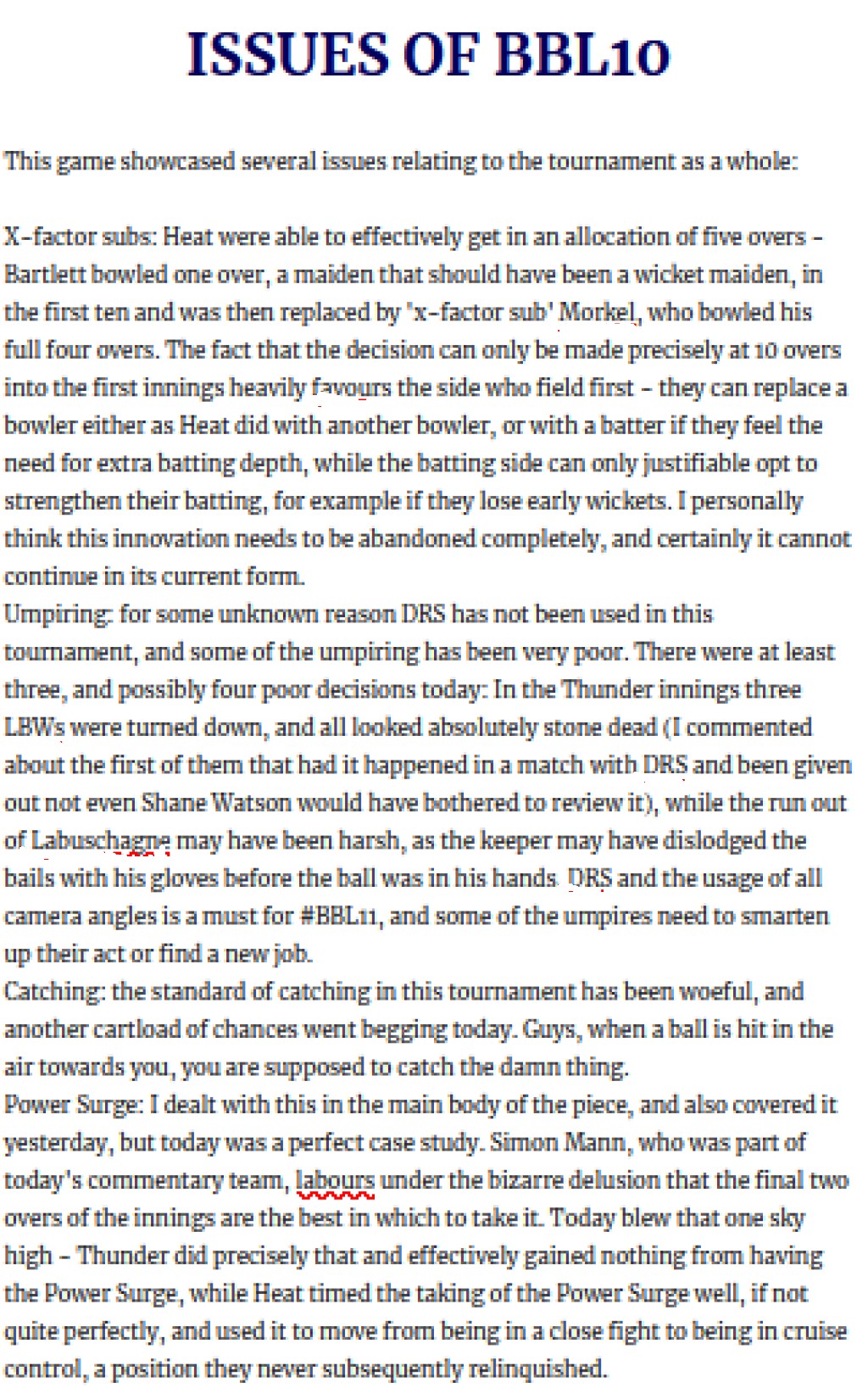
ISSUES OF BBL10

This game showcased several issues relating to the tournament as a whole:

  • X-factor subs: Heat were able to effectively get in an allocation of five overs – Bartlett bowled one over, a maiden that should have been a wicket maiden, in the first ten and was then replaced by ‘x-factor sub’ Morkel, who bowled his full four overs. The fact that the decision can only be made precisely at 10 overs into the first innings heavily favours the side who field first – they can replace a bowler either as Heat did with another bowler, or with a batter if they feel the need for extra batting depth, while the batting side can only justifiable opt to strengthen their batting, for example if they lose early wickets. I personally think this innovation needs to be abandoned completely, and certainly it cannot continue in its current form.
  • Umpiring: for some unknown reason DRS has not been used in this tournament, and some of the umpiring has been very poor. There were at least three, and possibly four poor decisions today: In the Thunder innings three LBWs were turned down, and all looked absolutely stone dead (I commented about the first of them that had it happened in a match with DRS and been given out not even Shane Watson would have bothered to review it), while the run out of Labuschagne may have been harsh, as the keeper may have dislodged the bails with his gloves before the ball was in his hands. DRS and the usage of all camera angles is a must for #BBL11, and some of the umpires need to smarten up their act or find a new job.
  • Catching: the standard of catching in this tournament has been woeful, and another cartload of chances went begging today. Guys, when a ball is hit in the air towards you, you are supposed to catch the damn thing.
  • Power Surge: I dealt with this in the main body of the piece, and also covered it yesterday, but today was a perfect case study. Simon Mann, who was part of today’s commentary team, labours under the bizarre delusion that the final two overs of the innings are the best in which to take it. Today blew that one sky high – Thunder did precisely that and effectively gained nothing from having the Power Surge, while Heat timed the taking of the Power Surge well, if not quite perfectly, and used it to move from being in a close fight to being in cruise control, a position they never subsequently relinquished.

PHOTOGRAPHS

My usual sign off…

Scorchers Shamed

An account of today’s BBL ‘Qualifier’ between Sixers and Scorchers, including a disgraceful incident involving AJ Tye, and thoughts about the Power Surge.

The title of this post, devoted to today’s #BBL10 qualifier is dual purpose, relating both the Scorcher’s overall performance today and to the incident that ended the match.

SIXERS SLAM SCORCHERS

Scorchers batted first and started slowly, Roy falling in the third over for a nine ball three. They finished their Power Play overs strongly, taking 25 off the last 11 balls to be 30-1 after four overs. The second phase of their innings was solid, overs 5-10 inclusive yielding 44-1, to give a halfway score of 74-2, with two well set batters, one the very dangerous Colin Munro, together at the crease. It was a situation that demanded an early use of the Power Surge to launch the second half of the innings, but Scorchers did not take the opportunity, and they paid for their voluntary surrender of the initiative lest the Surge cause a fall of wickets, as the third quarter of their innings was an unqualified disaster, yielding them 24-2 to reach the three-quarter way stage at 98-4. At that point they did take the Power Surge (leaving it any later would have been truly appalling). They made superb use of those two overs, scoring 34 off them, a gain of at least 20 on what they would have scored from those overs in ordinary play. They then kept the momentum going to finish their 20 overs with 167-6, a defensible looking total. Their top scorer was Josh Inglis, a wicketkeeper, who as Yorkshire-born Aussie may potentially follow in the footsteps of Hanson Carter, the best Aussie keeper between Jim Kelly and Bertie Oldfield, who was also born in Yorkshire.

Sixers started brightly, taking 13 off the first over of the reply, and being 43-0 at the end of the Power Play, 13 runs and one wicket to the good. They lost Philippe late in the first half of their innings, but still had a superb overs 5-10, scoring 61-1 in that period, 17 more than Scorchers had managed, in what had been a good period for them. I would have thought an early Power Surge was called for, but Sixers did not go for it. By the the end of the 15th Scorchers were 151-1 and the only question was whether James Vince, by then on 89, would reach a ton before the end. Although Daniel Hughes hit a boundary to level the scores with Vince on 98, he then avoided scoring off any of the last three balls of that over. The 18th over began with the scores level, setting the stage for…

AJ TYE’S ABJECT ASSAULT ON THE SPIRIT OF CRICKET

Tye, an experienced and successful bowler, bowled to Vince with the scores level and Vince 98 not out. He produced what was blatantly obviously a deliberate wide, a mean and petty ‘dog in the manger’ type gesture that denied Vince any chance to complete a century that would have been thoroughly merited. I have umpired a few games at a low level, and temporarily donning my umpire’s hat, I would have been tempted to tell Tye loudly that I was not going to oblige him by calling a wide and that he better bowl the next one straight. I certainly think the Scorchers should drop Tye for their next game, which will be against the winners of the match between Thunder and Heat, and the winners of that will take on Sixers in the final. I will certainly be rooting against the Scorchers when the time comes. Is my dim view of this just because the offender is an Aussie? No, and I offer as evidence to back up my own criticisms the fact that one Richard Thomas Ponting, not normally known for Aussie bashing, is on my side as well. Very little in cricket is new, given the game’s long history, and there was an incident in a long ago ODI when David Gower, called up to bowl by way of a concession of defeat, again with a batter, this time Greg Chappell, on 98, bowled a deliberate no-ball. Gower’s behaviour then was marginally less inexcusable than Tye’s today because he was a non-bowler and one can understand him not being impressed by being made to act as a sacrificial offering.

THE POWER SURGE

I have stated my thoughts on the taking of the Power Surge before, but I am going to extend on them here. Firstly, I am more and more convinced that one should have a good reason for not going early, rather than allowing caution to dictate. Scorchers paid for their failure to go when in a perfect position to do so, and it was only Sixers utter dominance that enabled them to get away with delaying their own surge. The extra point about the runs from the surge overs is that is not just a question of how many do you get from them, it also a question of how many would you have scored anyway from those overs even without the surge, and that is where leaving it late is a definite loser – you will be throwing the bat at pretty much everything in the closing stages of a T20 innings anyway, so would be scoring faster than at other stages of the innings. Scorcher’s surge was worth about +20 to them compared to two ordinary overs at that stage, because they did make it count when they finally took it. Had those two overs been, to take the extreme, the last two of the innings, then they would have been maybe +10 had they scored the same 34. However, had Scorchers gone in overs 11-12, when they had two top batters together, including the potentially devastating Munro, those same 34 runs would have had them 108-2 with eight overs to go and a total of 180 a definite goal, with more a distinct possibility. As it was, timing it when they did, even that huge surge only brought a total of 170 on to the horizon, and in the end they were just short of that. Here as a reminder is a Power Surge inforgraphic I created earlier:

PHOTOGRAPHS

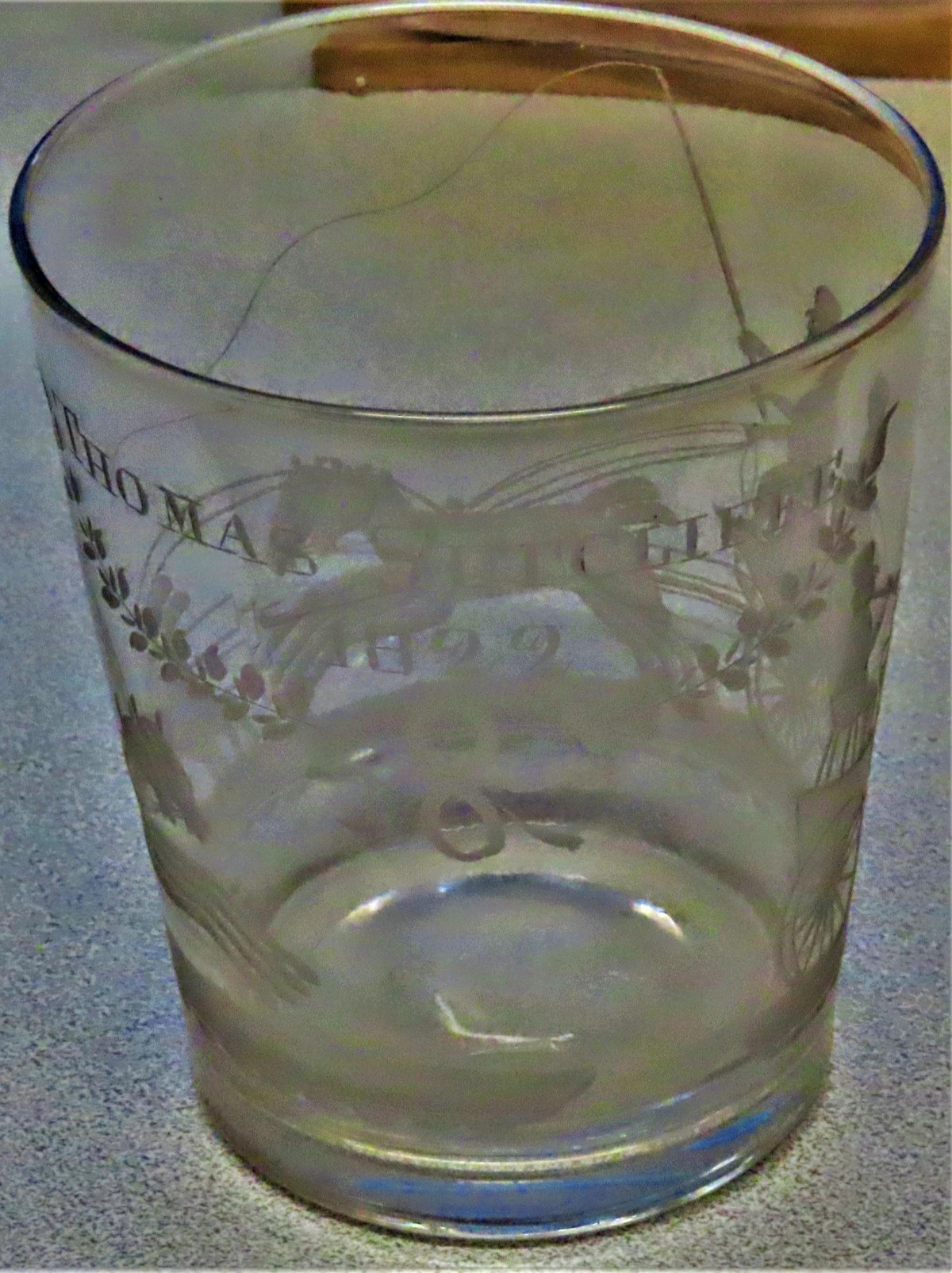
My parents are in King’s Lynn because my aunt is undergoing a medical procedure and needs to be kept company for 24 hours. They arrived yesterday, and we had a chat over my back garden fence, and I took delivery of a glass vessel which bears my name, and is now the only one of what was a pair, due to a recent accident, and it dominates today’s photo gallery…
A Game That Neither Side Deserved to Win

An account of today’s BBL10 ‘Eliminator Round’ between Strikers and Heat, some suggested changes to the format of the tournament, and an acknowledgement of Pakistan’s victory over South Africa.

Before getting into the meat of today’s post, which deals with the ‘Eliminator’ round of BBL10, between Strikers and Heat, a word of congratulation to Pakistan, who completed a convincing win over South Africa by seven wickets. South Africa lost three wickets just before the close yesterday, as 175-1 became 185-4, and today they continued in that vein, being all out for 245, a lead of 87. Although Nortje bagged a couple of early wickets Pakistan were never in serious trouble, and fell appropriately to Fawad Alam to make the winning hit. His form since his recall to the colours makes one wonder how his team overlooked him for 11 whole years (not a record – George Gunn was called up by England after a lapse of 17 years between games, while in first class cricket there is the bizarre case of William Caesar who played two games in 1920 and four more in 1946, with nothing in between).

OVERKIND QUALIFICATION
SYSTEM EXPOSED

It is rare the a pom gets an opportunity to call Aussies soft with any hint of justification, but BBL10 has provided it. A qualification system that allowed five teams out of a total of eight to make it to the knock out phase (in the Vitality Blast eight teams out of 18 do so, while in the 50 over contest it has been six teams out of 18) look questionable from the get go, and today’s match was powerful evidence for the prosecution, as Strikers took on Heat in the ‘Eliminator’.

Heat have been at their most vulnerable this season when faced with a run chase, so the Strikers were correct to choose to bat first. However, even if you make the correct call, you do then have to play decent cricket, and this was where Strikers slipped up. All seemed good when they were 18-0 after two overs, but overs three and four went for only six runs between them, giving a Power Play score of 24-0. In Overs 5-10 Strikers failed to gain any momentum, as first Carey and then Head pottered about, barely managing to achieve a scoring rate of one run per two balls (Carey 13 off 22, Head 12 off 21). At the half way stage Strikers were 53-1, way below par, and they immediately claimed the Power Surge, also using the ‘x-factor sub’ rule to bring Wells in for Worrall in an effort to jazz up their batting. One wicket fell in the Surge, but Strikers also scored 16 off those two overs, and they seemed to be maintaining the momentum, although bizarrely Renshaw came in ahead of ‘x-factor’ man Wells, when they were 94-3 after 15, having scored 41 in the third quarter of their innings. A big finish was needed, and did not materialize. In the end Strikers finished with 130-7 from their 20 overs, with only Weatherald, Salt, and at the death Wes Agar having shown anything like sufficient intent.

Heat made an even worse start than Strikers had, not scoring especially quickly and losing the big wickets of Lynn and Labuschagne early. A third wicket went down in the fourth over, and Heat’s Power Play had yielded 24-3. In overs 5-10 Heat scored 44 without losing a wicket, being 68-3 at halfway, 15 runs ahead but two wickets behind Strikers at the same point. They declined to take the Power Surge, holding back, and in the 14th over Denly was out for 41 to make it 92-4. At the end of the 15th Heat were 98-4, needing 33 of five overs, and the 16th was economical as well. Then however Travis Head blundered, giving himself a second over when he could have had Siddle and Agar bowl through. It revived the Heat, as they were 110-4 at the end of it, and that point they finally did claim the Power Surge. They got eight off the first over with it, reducing the ask to 13 runs off two overs, and then Agar, who had had a fine tournament with the ball, cracked under pressure, the winning runs being accrued off five balls of his over. Jimmy Peirson finished unbeaten on 47, a fine knock, which earned him the Player of the Match award.

Strikers made a huge mess of their own innings, with as I have said, Carey and Head especially culpable. Heat were barely any more impressive, getting their tactics badly wrong and being saved by Head’s inexplicable decision to give himself a second over. Heat should have claimed the surge when Denly and Peirson were together and they could have had two set batters use it. Also, their selection of Heazlett backfired – the left hander was picked to counter Strikers’ spinners Briggs and O’Connor both of whom turn the ball away from the right hander’s bat and was out before he got to face either.

Tomorrow sees Scorchers and Sixers do battle, with the winner going straight into the final, while the loser whill face the winner of Sunday’s game between Heat (their reward for winning this one) and Thunder. I would guess that if they followed today’s action Thunder will be licking their lips at the prospect of Sunday’s game.

This was a game that neither side deserved to win, and that had the qualification system been sensible would not have been taking place – 4th and 5th out of eight have no business making it to the knock out stages of a tournament, and it looked every inch a contest between two moderate sides neither of whom really know how to win.

ORGANIZATIONAL CHANGES

I have already indicated what I think the qualification system should be: three teams qualify, group winners into the final, second vs third for the right to join them, with 2nd having home advantage.

I also feel the tournament would benefit from being more compact. A lot of the time there is only one game per day, with a few days featuring two games. With 14 rounds of group games I would play four fixtures per day, thereby having all eight sides in action, with a day off between rounds, meaning that the group phase would last 27 days in total, and then the two knockout matches would take place on successive days after two days off, making the whole length of the tournament 31 days – and it being an Aussie tournament I would make game day 1 Boxing Day, and the final to take place on Australia Day.

PHOTOGRAPHS

My usual sign off…