Batting Order = Alphabetical Order

A variation on my all-time XI theme and a large photo gallery.

This is a variation on my all-time XI theme. Today I pick an XI starting with my first choice opener and moving down the order in strict alphabetical fashion, each player with a surname starting exactly one letter ahead of the person immediately above them in the order. Each player will be introduced with an outline of their role. There will also be a brief honourable mentions section.

  1. *WG Grace (England, right handed opening batter, right arm bowler of various styles through his career, captain). A natural choice for this role, as the first great superstar of cricket. He was captain my of all time Gs XI and you can read more about him in that post.
  2. JB Hobbs (England, right handed opening batter, brilliant cover fielder, occasional medium pacer). The Master, the all time leading scorer of first class runs and first class hundreds. He was in my Hs XI.
  3. Yashavsi Jaiswal (India, left handed top order batter). The only player in this XI not to have featured in my cricketing journey through the alphabet, he has come to the fore in no uncertain terms since then, and has a chance of breaking an all time Indian record for runs in a series in the fifth and final test match of the current series. As it is, only one cricketer has ever had more test runs to their name after eight appearances at that level, a certain Donald George Bradman. The Js are very strong in batting, but even if I did not feel able to fit him in there I would indulge in a quibble cook and drop Martin Young from the Ys so that he could open for that XI.
  4. Virat Kohli (India, right handed batter). The Indian maestro has missed this series for personal reasons, but his record is enough to guarantee selection. He occupies this same slot in my Ks XI.
  5. Brian Lara (West Indies, left handed batter). Lower in the order than he would usually be, but I reckon he could handle this slot. He featured in my Ls XI.
  6. Keith Miller (Australia, right handed batter, right arm fast bowler). One of the greatest of all all rounders, in the same slot he had in my Ms XI.
  7. +Paul Nixon (Leicestershire, wicket keeper, left handed batter). The only non-test cricketer in the XI, but his outstanding service for an unfashionable county over the course of many years deserves recognition, and he occupies the same slot as the one I gave him for the Ns.
  8. Chris Old (England, right arm fast medium bowler, left handed batter). A little higher in the batting order than one might like, but he did have his moments with the bat. He was in the Os XI.
  9. Peter Pollock (South Africa, right arm fast bowler, right handed batter). A fearsome fast bowler whose test career was shortened by his country being banished from international cricket. He had this same slot in my Ps XI.
  10. Abdul Qadir (Pakistan, leg spinner, right handed batter). The art of leg spin bowling almost died out in the 1980s as teams became more and more inclined to rely on pace and seam, with maybe a finger spinner or two being used to tie up an end. There was however one leggie of undisputed top class in that decade who kept the torch burning, this man, the star of my Qs XI.
  11. Wilfred Rhodes (England, left arm orthodox spinner, right handed batter). I have remarked before, notably in my Rs XI, where he is one place higher than in this one on Rhodes’ extraordinary five-phase career, which started and finished with him in the side as a specialist left arm spinner. He was number 11 at The Oval in 1902 when he and Hirst saw England to a one-wicket win, and at the SCG in 1903 when he scored 40*, helping RE Foster (287, at the time an all comers record, and still a debut record) add 130 for the last wicket.

This side has a powerful top five, a great all rounder, a quality keeper/batter and four excellent and well varied bowlers. I do not anticipate P Pollock, Old, Miller, Rhodes and Qadir having any great difficulty in taking 20 wickets, especially with the skipper in reserve.

I will deal with these in batting order:

Grace was the chosen opener, but I acknowledge that Gavaskar, Gambhir, Gayle and Greenidge would all have their advocates.

I also regarded ‘The Master’ as sacrosanct, though George Headley (West Indies), Len Hutton (England) and possibly Matthew Hayden (Australia) could all make cases for inclusion.

The number three pick was controversial, with two Sri Lankans, Jayasuriya and Jayawardene (whose regular slot this was) firmly in the mix, and a couple of tough and competitive antipodeans, Andrew Jones (NZ) and Dean Jones (Aus) also worthy of mention. However, my feeling is that Jaiswal is not just a flash in the pan.

I would have annoyed over 1 billion of the game’s most avid fans had I named anyone else at number four, though there was also a case for Jacques Kallis.

Lara’s major challenger was another West Indian, but I don’t think even ‘big Hubert’ would think himself hard done by, especially given that with Grace in the side he was never getting the captaincy.

Of the two main challengers for Miller’s slot one, Mushtaq Mohammad could not be accommodated given that the self set rules of this exercise virtually mandated the selection of Qadir. The other, Mulvantrai ‘Vinoo’ Mankad certainly could, but I decided in Miller’s favour (Mankad, a left arm spinner with the ball, could be got in by dropping Rhodes and bringing in one of Kagiso Rabada, Tom Richardson or Andy Roberts, though the last named would be out of position at no11).

Nixon had no serious challenger, and neither did Old.

Although there are two other notable fast bowlers with surnames beginning with P both (Mike Procter and Shaun Pollock) would have been absurdly out of place at number nine, and I was not prepared to bend the rules to that extent.

Qadir had no challenger.

Had I opted for only one front line spinner then Rhodes as described above could have been replaced, but it seemed appropriate given these two colossi bestrode the cricketing scene for 65 years between them (Grace’s FC debut happened in 1865, Rhodes retired in 1930) for an order that began with Grace to end with Rhodes.

My usual sign off…

A Match of Many Twists and Turns

An account of the second half of a thoroughly absorbing test match between India and England at Ranchi, and a photo gallery.

This post deals with the second half of an extraordinary test match between India and England, the fourth of the series currently taking place between the two teams. I covered the first two days here, so the body of this post picks up the action on day three (yesterday).

Play resumed with India 219-7, 134 adrift. England’s first task was to take the last three Indian wickets as quickly as possible. Unfortunately they were baulked in contrasting styles by wicket keeper Dhruv Jurel who played a superb innings and left arm wrist spinner Kuldeep Yadav who resisted stoutly, comfortably completing a ‘Den-tury’ – 100 balls survived in an innings (look up the career of Joe Denly for the origin of this term). When Yadav was finally dislodged for a 131 ball 28 debutant Akash Deep continued the resistance, surviving a further 29 balls. Mohammed Siraj really is a genuine number 11, and it was in the Jurel who was last out, bowled by Tom Hartley for a splendid and spirited 90 off 149 balls. India has thus reached 307, a deficit of a mere 46. Shoaib Bashir recorded figures of 5-119 from 44 overs, becoming the fourth England bowler to take their maiden first class five-for in a test match. Christopher Heseltine (Hampshire, right arm fast) did so in 1896 in South Africa, in a series whose claim to test match status is decidedly dubious – visiting South African teams were not given test matches in England until 1907, while the other two members of this club are both part of the current England set up, and both principally batters – Joe Root who took 5-8 at Ahmedabad last time England were in India and Will Jacks who took a six-for in Pakistan.

Things still look good for England with an advantage of 46 and India having to bat last, but their second innings soon started going pear shaped. Crawley and Bairstow threatened a revival, and at 110-3 England looked comfortable. However Crawley fell for a fine 60, and then Stokes suffered his second failure of the match, and for the second time in the match England went into an interval, tea in this case, having just lost their skipper, and five down for not a huge amount. Soon after the interval a loose stroke spelt the end of Bairstow and it was 120-6. Hartley failed again with the bat, and Robinson was unable to repeat his first innings efforts. Foakes resisted gamely and did his best to shepherd the tail, but eventually he attempted to play one from Ashwin through midwicket and got a leading edge straight back to the bowler. Anderson lasted three balls, the last of which he nicked to the keeper, and England were all out for 145, leaving India 192 to get.

Stokes now opted to give the new ball to Root and Hartley. There was merit in the idea of giving a spinner the new ball, especially given that Robinson had been decidedly underwhelming with the ball, but James Anderson should have bowled at one end for the mini-session India faced at the end of this third day – this would have given England a measure of control, whereas in the event India were 40-0 off eight overs by the close, needing 152 more for victory.

India advanced their score to 84 before a splendid catch by Anderson off Root accounted for Yashavsi Jaiswal, leaving the new India opener needing to tally 120 or more in the fifth match of the series to break a record that has stood to Sunil Gavaskar’s credit since 1970 for the most runs in a series by an Indian opener.

15 runs later Foakes achieved a double dismissal of Rohit Sharma – it was initially recorded as stumped, but replays showed that there had been an edge, and it now appears as caught Foakes bowled Hartley 55. One run later Rajat Patidar was on his way back for a five ball duck, courtesy of a good catch by Pope off Bashir, and I suspect that unless he intends to watch the match Patidar will not be in Dharamsala for the final match of the series. Ravindra Jadeja never looked comfortable, and with 120 on the board, and himself on 4 off 32 balls he hit a full toss from Bashir straight to Bairstow to end a tortured stay at the crease. The very next ball Sarfaraz Khan was snapped up Pope to make it 120-5, and Bashir had three wickets and was on a hat trick. At that point Jurel joined Gill, and these two players steered India home. Gill completed a 50, while Jurel was unbeaten on 39, and appropriately enough the winning runs came from his bat – he was deservedly named as Player of the Match, having kept very well in tricky conditions and scored 129 in the match for once out. India have an unassailable 3-1 lead in the series, but England have had moments in all four matches when things looked like going their way, and given the loss of Leach, the inexperience of the remaining spinners and the fact that no visiting side have laid a glove on India in the last decade this is very far from a humiliation. Bashir and Hartley, especially the former, look very promising for the future. Robinson, who finished the match off the field nursing a back problem, must be in jeopardy – when the force is with him he is a very good bowler indeed, but in this match he was consistently 10kph below his best pace, and given his previous injuries and fitness issues I think England have to say that enough is enough. Matthew Potts of Durham, Josh Tongue of Worcestershire and Gus Atkinson of Surrey are all fine bowlers, Tom Lawes of Surrey may be on the radar, and there are probably other younger seamers who could do a job for England as well. James Anderson’s bowling and fielding leads one to wonder whether he has a portrait hidden away somewhere that is ageing in his place!

This match was a thoroughly absorbing contest which commanded attention right to the end. Though it does scant justice to the events of the last four days a full scorecard can be viewed here.

I end with my usual sign off…

Brilliant Bumrah Blitzes England

An account of day two of India v England at Vizag, dominated, as the day’s play itself was by the brilliance of Jasprit Bumrah. Also my customary photo gallery.

Today was day two of the second test match of the five match series between India and England. This match is taking place at Vizag. I covered day one here.

Although it was a mere prologue to the main event of the day the end of the Indian innings was not devoid of significance. England appeared to have done reasonably well to keep India below 400, with the tenth wicket going at 396. Yashavsi Jaiswal who had dominated day one resumed on 179 not out. He completed his double century, but facing the risk of being stranded got out for 209, meaning that the highest score by an Indian opener against England remains the 221 that Sunil Gavaskar scored at the Oval in 1979. Anderson claimed his second and third wickets of the innings, and kept his economy rate below two an over, while young spinners (their combined age is less than that of Mr Anderson) Rehan Ahmed and Shoaib Bashir also finished the innings with three wicket hauls.

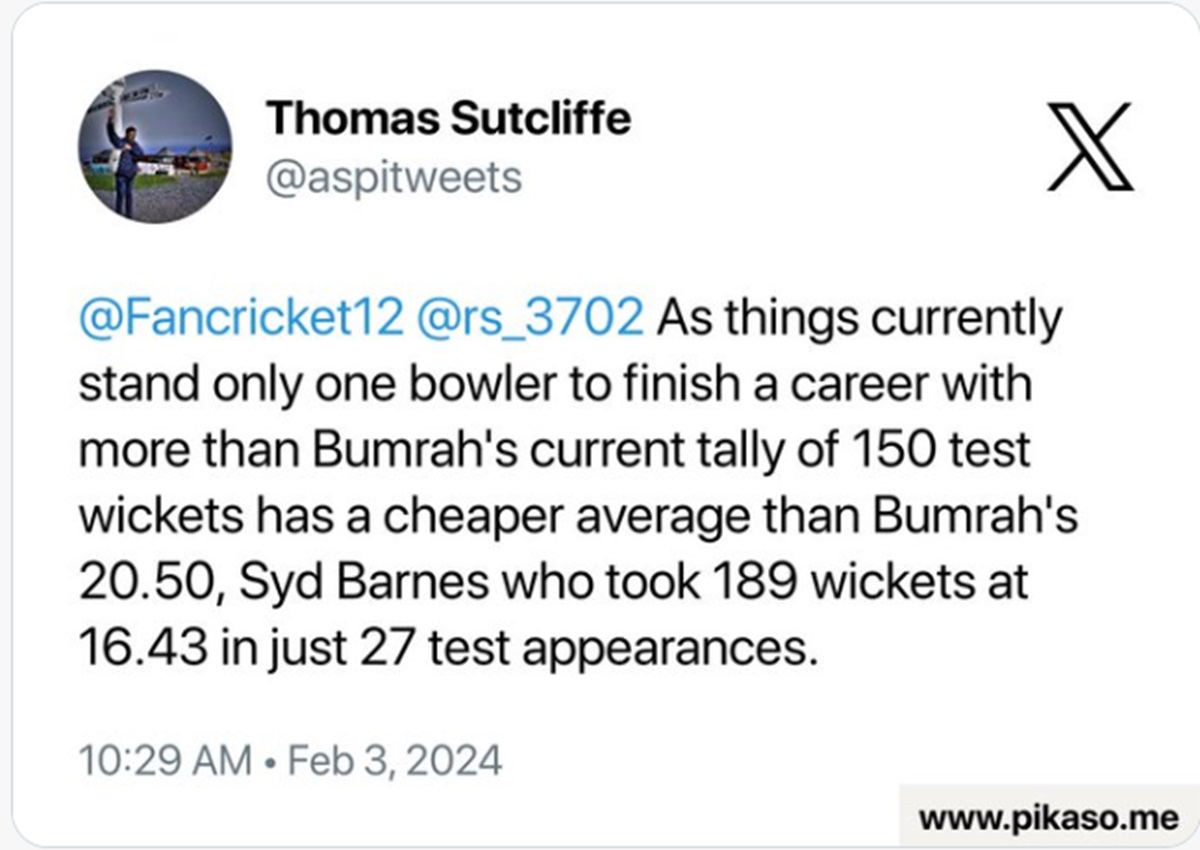
England began brightly, with Zak Crawley playing well. Mukesh Kumar did not at any stage resemble a genuine test match new ball bowler. Axar Patel, R Ashwin and left arm wrist spinner Kuldeep Yadav all took turns at the bowling crease. At high water mark England were 114-1, but then Crawley fell to catch by Iyer of Axar Patel. Bumrah was then called back into the attack to deal with Joe Root. Nine runs later Bumrah found the edge of Root’s bat, Gill took the catch and it was 123-3. Then Pope, who was just beginning to look settled after a typically nervous start had two of his stumps uprooted by an absolutely unplayable ball from Bumrah to make it 136-4. Bairstow and Stokes resisted for a time, but the unstoppable Bumrah found one to take the edge of Bairstow’s bat for another catch to Gill to make it 159-5. Kuldeep Yadav got Foakes with a good ball and Ahmed courtesy of a loose stroke which gave Gill his third catch of the innings and England were 182-7. Tom Hartley now joined Ben Stokes, and Stokes threatened to wrest the initiative back for England. However, with Stokes on the verge of a half century a superb delivery from Bumrah rattled his stumps to make it 229-8. That was Bumrah’s 150th test wicket, at an average of 20.50 a piece, a fact the significance of which I noted in the tweet reproduced in screenshot form below (follow the link highlighted in blue to note the exact time at which I posted it):

The day got better yet for Bumrah, as he induced Hartley to give Gill a fourth catch of the innings, which brought the debutant Shoaib Bashir in to join Anderson, given a one place promotion from his usual slot presumably on grounds of experience for the last wicket stand. Bumrah finished the innings by pinning Anderson LBW. England had just crept past 250, but a final score of 253 all out gave India a first innings advantage of 143. Bumrah had taken 6-45 from 15.5 overs on a pitch not offering much assistance, a truly great display of test match fast bowling, from one of the great masters of that art. This gives him an overall tally of 152 test wickets at 20.29 each, with Barnes ahead of him on 189 wickets at 16.43, and Alan Davidson the great Australian left armer having taken 186 at 20.53, with West Indians Ambrose, Garner and Marshall all also having finished with over 150 wickets at less than 21 a piece. Barnes and Bumrah were both in my all time Bs XI. I make one change to that XI in retrospect, Benaud being moved from being in the XI to fronting the TV commentary and Bishan Bedi taking his place giving an XI off: C Bannerman, SG Barnes, *DG Bradman, KF Barrington, AR Border, IT Botham, +Wasim Bari, W Bates, SF Barnes, BS Bedi, JJ Bumrah. I first noticed Bumrah when not long discharged from Addenbrooke’s after emergency cancer treatment, when he destroyed Australia in Australia (see here).

There was time for five overs of the Indian second innings, in the course of which they scored 28-0, meaning that they start day three with a lead of 171 and all their second innings wickets intact. Cricket is a game which regularly makes fools of those who make over-dogmatic statements about match situations, and this is never truer than when Stokes’ England are involved in the action, but it is at any rate not contentious to state that India are in a very strong position, especially given the tendency of Vizag pitches to break up as the match progresses (average innings scores there show a very straightforward pattern of declining from first to fourth innings of the match).

My usual sign off…

All Time XIs – Golden Oldies

In view of today’s happenings in Vizag I offer an XI of players whose skills and appetite for the game remained undimmed into their 40s. I also have my usual photo gallery for you.

The second test match of the five match series between India and England began at 4:00 this morning UK time. The pitch at Vizag is a batters paradise, which is why I reckon it is honours even at the end of day one. India are 336-6, with Yashavsi Jaiswal having batted all through the day for 179*. England actually bowled three overs more than the statutory minimum of 90, which is almost as rare as seeing a woodpecker in the environs of King’s Lynn, which also happened today:

Close up of a Green Woodpecker seen while walking along the Gaywood River path this morning.

England’s two young spinners, Rehan Ahmed and debutant Shoaib Bashir (born in Nottinghamshire and Surrey respectively for those who care about such things) each picked up two wickets, and each took a catch of the other’s bowling. Bashir became the 713th player capped by England Men, and one of his team mates in this match is the 613th player capped by England Men, one James Michael Anderson, who is the inspiration for today’s XI, comprising players who had great test match moments when past 40 years of age. Anderson had a fine day on a pitch offering him precious little, being parsimony personified, with 1-30 from 17 overs, meaning that he has now taken at least one test wicket in each of 22 successive calendar years.

  1. Jack Hobbs (England, right handed opening batter). Almost half of his test runs were scored after he had turned 40, and at Melbourne in 1929, at the age of 46, he became test cricket’s oldest ever centurion with an innings of 142.
  2. Warren Bardsley (Australia, left handed opening batter). At Lord’s in 1926, almost 17 years after he had become the first to score twin centuries in a test match, Bardsley, then 43 years old, carried his bat through Australia’s first innings, scoring 193 not out.
  3. Patsy Hendren (England, right handed batter). Like Hobbs a tall scoring batter to the very end of his long career – over 1,000 of his test runs came after turning 40.
  4. Tom Graveney (England, right handed batter). Another in the select ‘1,000 test runs after the age of 40’ club.
  5. *Misbah-ul-Haq (Pakistan, right handed batter, captain). Someone whose prime test years were after he had turned 40.
  6. Basil D’Oliveira (England, right handed batter, right arm medium pacer). Based on his test record a batter who bowled rather than a genuine all rounder, though that might very well have been different had he been able to play for his native land starting in his mid 20s rather than for another country starting officially in his mid 30s.
  7. +Bob Taylor (England, wicket keeper, right handed batter). The only candidate for this slot.
  8. Clarrie Grimmett (Australia, leg spinner, right handed batter). His career did not begin in earnest until his mid 30s, and his test career only ended when at 46 years of age he was left out of the squad for the 1938 Ashes in England. By then he had taken 216 wickets in 37 tests.
  9. Sydney Barnes (England, right arm fast medium bowler, right handed batter). His last series, played at the age of 41, saw him claim 49 wickets in four matches before an argument of terms and conditions saw him miss the fifth and final match of the series. Those 49 wickets were just over a quarter of his career tally of 189, taken in just 27 matches.
  10. James Anderson (England, right arm fast medium bowler, left handed batter). Incredible longevity at the top for a 21st century cricketer, and his performance today suggests that the skills are very much still there. He has been known to bowl left arm spinners in the nets, though as far as I am aware has not yet deployed this method in a match. The oldest ever test cricketer, Wilfred Rhodes, who played his last match at the age of 52 years 165 days bowled left arm spin.
  11. Bert Ironmonger (Australia, left arm orthodox spinner, left handed batter). He made his debut at the age of 46, played 14 tests over the course of five years, and took 74 wickets at 17.97 in those matches. Thus in spite of being the ultimate in one-dimensional players – a clumsy fielder, and possessor of a test batting average of 2.62, he was nailed on for selection in this XI.

This side features a strong top six, a keeper whose batting was better than it is often given credit for being, and four great bowlers. Going by D’Oliveira’s actual record rather than dealing in ‘what might have been’ it is very much six batters, a keeper and four bowlers, rather than five batters, an all rounder, a keeper and four bowlers. However, the two most dominant men’s test cricket forces of my life time, the West Indies under Lloyd and Richards, and their successors at the top of the test tree, the Australians under Mark Taylor and Steve Waugh, both relied on six batters, a keeper and four bowlers, so it clearly can work provided that the personnel involved are good enough at their jobs, and I believe that this team ticks that box.

Among the batters to merit serious consideration were Bobby Simpson of Australia, Eric Rowan of South Africa and Herby Taylor of South Africa. The only other keeper to do well at the very highest level when past 4o was Bert Strudwick of England, and he was a genuine tailender with the bat, which would have made things very dicey indeed batting wise. Freddie Brown, who captained England in Australia at the age of 40 and had a respectable series would have had the number six slot had I been desperate to tick the all rounder box, but I felt in view the people at 8-11 that D’Oliveira, the batter who bowled, was a better fit for the XI.. Few genuine quicks have kept their pace into their 40s, and although his presence at number eight would have strengthened the batting I did not feel that Gubby Allen (England), one of that select company, was good enough to dislodge any of my chosen bowlers.

My usual sign off…