All Time XIs – Through The Alphabet VII

Today’s all time XI cricket post continues the alphabetic progression theme. Lots of Photographs as well.

INTRODUCTION

Today’s all time XIs cricket post is our seventh alphabetic progression. We finished yesterday with a B, so today we start with a C.

JW HEARNE’S XI

  1. Chetan Chauhan – right handed opening batter. He was overshadowed by his regular opening partner for India, Sunil Gavaskar, but his record was not a bad one.
  2. +Tillekaratne Dilshan – right handed opening batter, wicket keeper. One of the most innovative of all iternational batters. I admit that he was not a regular wicket keeper, and that the combination of keeping and opening the batting is a tough one, but he did keep on occasion, and I think he could do both jobs.
  3. Bill Edrich – right handed batter, right arm fast medium bowler. A regular number three and occasional opener. In the last ever ‘timeless’ test match (the 99th such ever played, and it was the events of that game that pretty much killed the notion of timeless tests stone dead – after ten days play it ended in a draw because England had to get back to Cape Town to catch their boat home) Edrich who had endured a nightmare start to his test career produced 219 in the second England innings, as they got to 654-5 chasing 696 to win.
  4. Neil Fairbrother – left handed batter. He holds the record for the highest first class score at a London ground – 366 for Lancashire v Surrey at The Oval, in a monstrosity of a match in which Surrey made 707 and Lancashire 863. He failed to establish himself at test level, partly because the powers that be typecast him as a one-day specialist, where he did have an excellent record.
  5. David Gower – left handed batter. 8,231 runs at 44.25 in test cricket, and it would have been more but for the narrow-minded, intolerant attitude of then captain Graham Gooch, which brought the curtain down on his career when he still had plenty to offer. Gower, unlike Gooch, resisted the bait dangled by apartheid South Africa, and did not sign up for either of the two England rebel tours of the 1980s. He scored 58 in his first test innings, making his maiden century against New Zealand later that summer, and scoring a crucial maiden Ashes hundred at Perth on the 1978-9 tour. His 123 at Adelaide on the 1990-1 tour, one of two centuries he made in that series (the only England player to do so), was rated by Don Bradman as among the top five innings he ever saw played in Australia. That tour also saw an epic sense of humour failure by Gooch and manager Mickie Stewart over an incident in which Gower and John Morris of Derbyshire buzzed the upcountry ground at which England were playing in tiger moth planes.
  6. *Jack Hearne – right handed batter, leg spinner. In first class cricket over the course of a long career he averaged 40 with the bat and 24 with the ball, although he did most of his bowling before World War 1, playing largely as a batter thereafter. He was not actually related to the original Jack Hearne, a medium pacer who claimed 3,061 first class wickets (the fourth most ever), but they did both play for Middlesex, and their careers overlapped. I have named as captain, following my belief that all other factors being equal a slow bowling all rounder should be best equipped for the job (exhibit A among actual captains in favour of this theory the late legendary Richie Benaud, exhibit B Ray Illingworth – and as an effective captain who because of the mores of his time never officially had the job I give you exhibit C, Wilfred Rhodes – as witness his comment about Percy Chapman’s England captaincy “Aye ‘ee wor a good ‘un – he allus did what me and Jack telt him”).
  7. Doug Insole – right handed batter. He normally batted a little higher than this, but his attacking approach, often further highlighted by the fact that he was batting in partnership with one TE Bailey, makes him well suited to batting in this position, and I is not the easiest of letters to deal with. After his playing days were done he became a selector, and as chairman of selectors once dropped a well known Yorkshire opener on disciplinary grounds immediately after said worthy had scored 246 not out – an incident with which TMS listeners no longer have to fear being regaled while listening to commentaries.
  8. Ravindra Jadeja – left arm orthodox spinner, left handed lower middle order batter. Test averages of 35 with the bat and 24 with the ball make for a mighty useful no8, and he is also one of the best fielders currently playing the game. For those who produce ‘ah, but he is not so good away from home’ I suggest you check out the away records of James Anderson and Stuart Broad and then come back to me.
  9. Bart King – right arm fast bowler, useful lower order batter. In 65 first class matches he took 415 wickets at 15.66 each while also averaging 20 with the bat. In the last of his four visits to England with the Philadelphians he claimed 87 wickets in 11 first class appearances to top that season’s bowling averages. He was the pioneer of swing bowling – it was a commonplace in that era before World War 1 for bowlers to rub the new ball in the dirt to remove the shine, and many sides reckoned that to give the opponents a varied challenge it was best to open the bowling with a fast and a slow bowler. Kent, champions four times in the last eight pre world war one seasons, regularly gace the new ball to left arm spinner Blythe alongside right arm fast bowler Arthur Fielder, while Lancashire a decade earlier had used a similar pairing of Briggs and Mold. It was King who taught the cricket world how to use the shine of a new ball as an extra weapon in the bowler’s armoury, and it is now very rare for a slow bowler of any type to get the new ball, although Muralitharan sometimes took it for Sri Lanka.
  10. Jim Laker – off spinner. Probably the best of all classical off spinners, most famous for his destruction of the 1956 Australians (58 of the first 100 wickets he took that season in first class matches wore baggy greens, 46 of them being claimed in the five test matches). On the 1958-9 tour of Australia, although the hosts regained the urn, they were, much to their chagrin, obliged to treat Laker with a degree of respect, and in the four test matches for which he was fit and available he claimed 15 wickets at an economical average. Among English off spinners only Fred Titmus four years later, John Emburey and Geoff Miller against an ill-equipped and badly captained rabble in 1978-9 and John Emburey again in 1986-7 also against a less than full strength side have fared better down under.
  11. Ted McDonald – right arm fast bowler. One half of the first great fast bowling duo seen at test level, along with Jack Gregory (Tom Richardson and Bill Lockwood, pioneer of the slower ball, had opened together for Surrey). After the Ashes series of 1920-1 and 1921, in which Australia won eight straight tests before England drew the last two of the home series he accepted a Lancashire league contract, and went on to playfor the county for some years, combining with Cecil Parkin and Richard Tyldesley to form a bowling unit that saw Lancashire dominate the second half of the 1920s.

This team has a solid batting line up, a competent keeper and a fine array of bowlers. McDonald and King look a splendid new ball pair, Edrich is available if a third pace option is needed, and in Laker, Jadeja and Hearne there is a wonderfully varied trio of spinners.

SYDNEY SMITH’S XI

  1. Mike Norman – right handed opening batter. A consistent county pro rather than a real star.
  2. Alan Ormrod – right handed opening batter. Played for Worcestershire for many years, before finishing his career at Lancashire. He was part of the Worcestershire side involved in the ‘ten minute game’, when Somerset skipper Brian Rose declared after one over, deliberately losing the limited overs match in order to protect his side’s wicket taking rate. The powers that be took a dim view of this, and Somerset were booted out of the competition anyway. Declarations were late banned from limited overs cricket, a move I consider unduly hamfisted, especially now that net run rate is used to split ties. Why shouldn’t a side who are 300-2 after 40 overs and facing possible weather interruptions say to their opponents “OK, we reckon we can defend in this over the full fifty if we have to do, over to you to have a bat”?
  3. Graeme Pollock – left handed batter. He averaged 60.97 in test cricket before his country were forced into international isolation by the fallout from the D’Oliveira case (in fact South Africa were lucky to have lasted as longs as they did in that first incarnation as a test playing nation – various moments could have seen them given the boot well before they were.
  4. +Stanley Quin – right handed batter/ wicket keeper. He played for Victoria in the 1930s, averaging 33 in first class cricket, including a double century, and given how difficult a letter Q is I think this is a pretty good solution. His 24 first class appearances brought him 35 catches and 24 stumpings.
  5. Vernon Ransford – left handed batter. He averaged 37.84 in test cricket – at a time when Victor Trumper, universally regarded as an all-time great, averaged 39.04 at that level, sufficient indication of his class as a performer.
  6. *Sydney Smith – left handed batter, left arm orthodox spinner. He was Northamptonshire’s first ever overseas signing, coming over from the West Indies in 1909, twenty years before they took their test bow, and doing the double in his first season of county cricket. He finished his career averaging 31 with the bat and 18 with the ball. Making a standard ‘covered pitches inflation’ adjustment of 50% up for each average that equates to averaging 46 with the bat and 27 with the ball today.
  7. George Thompson – right handed batter, right arm fast medium bowler. The man, along with Bill East, who was most responsible for Northants’ elevation to first class rank in 1905, and the first Northamptonshire cricketer to play for his country – and he did not fare badly at that level either, more especially given that by the time the chance arrived he was already past 30.
  8. Rana Naved Ul-Hasan – right arm fast medium bowler, right handed lower middle order batter. He first appeared on scoresheets as Naved Ul-Hasan, before indicating a preference for Rana Naved, and U is not an easy letter to fill. He played for Sussex for some years, and had a lot in common with an earlier Sussex stalwart, Maurice Tate, both being fast medium bowlers who loved to give the ball a good clout with the bat.
  9. Vince Van der Bijl right arm fast medium. Took his first class wickets at 16.54 each. A combination of the political situation in South Africa and his unwillingness to completely cast adrift from his native land cost him a test career. He was a popular overseas star for Middlesex. On one occasion when the county lost a Sunday League (an aeon or so ago counties played 40 overs per side matches on Sundays, accumulating points towards a league title) match by eight runs and when they got back to the dressing room Van der Bijl opened the post -mortem by saying “sorry folks, those two half volleys I bowled early in my spell cost us”, thereby preventing any recriminations from developing.
  10. Jack Walsh – left arm wrist spinner. Australian born, but moved to England and enjoyed a long career with Leicestershire – one of a number of Aussie spinners of that era to decide that the grass was greener elsewhere.
  11. Xara Jetly – off spinner. The trickiest letter of the lot, but the teenage Kiwi may yet go on to establish herself as a top player – it is certainly a name I will have half an eye one for the future. The women play almost exclusively limited overs cricket, which reduces the potential for really big wicket hauls, but there is a 3-35 among her recent sets of figures.

This team may be a little short of really top drawer batters (only Pollock and Ransford qualify for that description), but it does have great depth – everyone down to no8 has the capacity to play a match winning innings. The bowling, with a pace trio of Rana Naved Ul-Hasan, Vince Van der Bijl and George Thompson backed by tweakers Xara Jetly, Jack Walsh and Sydney Smith looks really good.

THE CONTEST

This should be a cracker. JW Hearne’s XI are stronger in batting, but not quite as strong in bowling. I suspect that Sydney Smith’s XI would need Graeme Pollock to ‘come to the party’ to win, but he usually managed that, so I cannot predict a winner.

PHOTOGRAPHY

Finally, it is time for my usual sign off…

IMG_1148 (2)IMG_1149 (2)IMG_1151 (2)IMG_1152 (2)IMG_1154 (2)IMG_1155 (2)IMG_1159 (2)IMG_1160 (2)IMG_1161 (2)IMG_1162 (2)IMG_1166 (2)IMG_1167 (2)IMG_1168 (2)IMG_1171 (2)IMG_1171 (3)IMG_1172 (2)IMG_1172 (3)IMG_1173 (2)IMG_1176 (2)IMG_1178 (2)IMG_1179 (2)IMG_1183 (2)IMG_1184 (2)IMG_1185 (2)IMG_1186 (2)IMG_1188 (2)IMG_1189 (2)IMG_1190 (2)IMG_1192 (2)IMG_1192 (3)IMG_1193 (2)IMG_1194 (2)IMG_1195 (2)IMG_1195 (3)IMG_1198 (2)IMG_1199 (2)IMG_1201 (2)IMG_1202 (2)IMG_1203 (2)IMG_1205 (2)

TTA VII
The teams in tabulated form.


All Time XIs – Through the Alphabet VI

Our sixth ‘alphabetic progression’ post in this ‘all time XI’ cricket series, a solution to yesterday’s teaser and plenty of photographs.

INTRODUCTION

In today’s all time XIs cricket post we continue with our alphabetic progression. Yesterday we ended on an F, so today we start from G.

BILL O’REILLY XI

  1. Gordon Greenidge – right handed opening batter. He was a crucial part of the West Indies success in the 1980s. In the 1984 series in England the West Indies were twice in deep trouble, and both times were hauled out of it by Greenidge. At Old Trafford he saved the day with an innings of 223 in 10 hours at the crease, and the Windies emerged victorious. At Lord’s the Windies were set 342 to win in just under a full day (and Gower, the England captain, was criticized for not declaring earlier, and for allowing his batters to accept on offer of the light when they should, four fast bowlers notwithstanding, have stayed out there. The West Indies won by nine wickets, with Greenidge blazing his way to 214 not out, while Larry Gomes (92 not out) played the supporting role to perfection. In the MCC Bicentennary match he made a century, notable for the setting of a fielder specifically to cut down the number of runs the reverse sweep was bringing him. A long county career with Hampshire helped him to score more first class hundreds (90) than any other West Indian bar Viv Richards.
  2. Desmond Haynes – right handed opening batter. He was Greenidge;s regular opening partner for Barbados and the West Indies. Barbados, a coral island similar in size to the Isle of Wight has produced over 70 test match cricketers – an all time batting order with these two opening, the three Ws at 3,4 and 5, Sobers at six, a keeper and four bowlers, two of them Marshall and Garner is shaping up mightily impressively. The Isle of Wight for comparison has produced a few cricketers who reached the dizzy heights of the Hampshire 2nd XI. Haynes and Greenidge put on over 6,000 runs together in first wicket stands at test level, although their average opening stand is not quite as eye-popping as the 87 of Jack Hobbs and Herbert Sutcliffe.
  3. Shreyas Iyer – right handed batter. The young Indian, noted for his aggressive approach, has yet to play test cricket, but hes an averages 52 in first class cricket and has made a remarkable start to his ODI career. I can envisage him being devastating after Greenidge and Haynes have given the innings their usual strong start (and similarly when the time comes coming in after the Sharma/ Agarwal opening partnership has been broken).
  4. Mahela Jayawardene – right handed batter. He holds the record for the highest test score by a right handed batter, 374 vs South Africa, when he and gthe left handed Kumar Sangakkara put on 624 together for the third wicket, starting from 14-2. Three higher individual test scores have been recorded, Lara’s 400 not out and 375, which both came in high scoring draws, whereas Jayawardene’s set his side up for an innings victory, and Matthew Hayden’s 380, scored against a hapless Zimbabwe team at Perth. Following the list on down, Sobers’ 365 not out was made against a Pakistan side who fielded only two front line bowlers, Hutton’s 364 at The Oval set his side up for a crushing victory, Jayasuriya’s 340 came in a monstrosity of a game at Colombo (over 100 runs per wicket through the five days), Hanif Mohammad’s 337 secured a draw for his side, Hammond’s 336 not out and Bradman’s 334 both came in drawn games- not that many of the super-huge scores have actually helped their team to win.
  5. Rohan Kanhai – right handed batter. His record at first class and test level is highly impressive, and I have the word of CLR James, that he was an absolute genius with a bat in his hand.
  6. Geoffrey Legge – right handed batter. He played for Kent and England. He managed only one century for his country, but it was a big one – 196.
  7. +Billy Murdoch – right handed batter, wicket keeper. Fred ‘the demon’ Spofforth missed the first ever test match because he believed that only Billy Murdoch could keep to his bowling (he came in to the side when the second match was arranged, apparently convinced that the chosen keeper, Blackham, was good enough after all), so although it was not where he usually played in test cricket he did have pedigree as a wicket keeper. His batting deeds included 153 not out in the first test on English soil at The Oval, the first ever test double century at the same ground four years later, 286 for Australia in a tour match and a first class triple century, at a time when only WG Grace (twice) and Walter Read of Surrey had previously achieved the feat.He played county cricket for Sussex and was part of WG Grace’s ultimately ill-fated London County venture.
  8. Dion Nash – right arm fast medium bowler. An effective swing bowler for New Zealand in the 1990s, and by no means valueless as a lower order batter.
  9. Bill O’Reilly – leg spinner. Nicknamed ‘tiger’ for his on field ferocity (he was later to be fairly ferocious with a pen in his hand as well), he bowled faster than most of his type (one action shot of him was erroneously labelled ‘Bill O’Reilly, Australia fast bowler, and seeing it one can understand how the mistake happened).Donald Bradman rated him the best bowler he ever saw or faced, although as O’Reilly himself acknowledged Bradman was the one opposition batter who generally had his measure. World War II basically ended his career at the top level, although he played a one-off test against New Zealand, taking a hatful of cheap wickets but also learning the hard way that his knees were finally knackered.
  10. Jamie Porter – right arm fast bowler. Has done good things for his county Essex, but has not yet been given the opportunity to perform at a higher level. I hope he does get the chance to prove himself at the highest level. He has 329 first class wickets at 24.31.
  11. Hamidullah Qadri – off spinner. He currently pays 35 per wicket in his fledgling first class career, and needs to reduce that figure, but he is still very young, and he did enjoy some success in the last U19 world cup. Given that I already had a legspinner (more on this later), the alternative was Imran Qayyum, a left arm orthodox spinner, but he pays 43 per wicket, which is simply too expensive to hold out serious hopes of him making the grade.

This side has a stellar batting line up but is a trifle light on bowling options. Nonetheless I would expect it to give a good account of itself.

HONOURABLE MENTIONS

Strong cases could be made for the selection of Gavaskar or Gooch as my opening batter whose name begins with G, and a respectable one for Chris Gayle, while Jack Hobbs and Matthew Hayden could both have been picked as the opener whose name begins with H, with Tom Hayward also a possibility. However, Greenidge and Haynes functioned superbly well as a pair, and I have opted for them because of that detail. Abdul Qadir deserves credit for keeping the embers of the torch of leg spin bowling aglow in the 1980s, to be fanned in full blazing flame by Shane Warne in the 1990s, but with Bill O’Reilly in the side I did not especially want a second leg spinner, so I went with the unknown quantity of Hamidullah Qadri.

ANDREW STRAUSS’ XI

  1. Jack Robertson – right handed opening batter. A test average of 46 is testament to his class. In the great 1947 season when Denis Compton and Bill Edrich rewrote the record books Robertson hit 12 first class centuries, very often teeing the innings up for the other two.
  2. *Andrew Strauss – left handed opening batter, captain. The man who captained England to no one in the world at test cricket, and who averaged over 40 with the bat, both as captain and in the ranks gets the nod here.
  3. Johnny Tyldesley – right handed batter. In the first decade of the twentieth century only two professionals were selected in England teams purely for their batting, this man and David Denton of Yorkshire.
  4. Inzamam Ul-Haq – right handed batter. He announced his arrival at the top level with an innings of 60 off 37 balls in the 1992 World Cup (back then, performances like that were not commonplace).
  5. James Vince – right handed batter. Has a good record for Hampshire, and has done fairly well in limited overs matches for England. His test career has featured far too many well compiled 20s and 30s and no really major innings (83 at Brisbane is his highest).
  6. +Clyde Walcott – right handed batter, wicket keeper. Selecting him as wicket keeper, enables me to pick a strong bowling line up.
  7. Xenophon Balaskas – leg spinner, right handed batter. This is about the right position for him, and X is a difficult letter.
  8. Bruce Yardley – off spinner. He was effective for Australia in the late 1970s and early 1980s, once being te match winner against the West Indies at a time when defeats for them were a great rarity.
  9. Dawlat Zadran – right arm fast medium bowler. Has done some good things for Afghanistan and may yet get better still. Certainly worth his place.
  10. James Anderson – right arm fast medium bowler. Zadran could only benefit from sharing the new ball with an experienced partner, and they don’t come much more experienced in that regard than the man who has taken more test wickets than any other pace bowler, and the most by any Eng;land bowler (and officially he is still counting).
  11. Jasprit Bumrah – right arm fast bowler. The list of visiting quick bowlers to really rattle the Aussies in their own backyard is not a long one, although the West Indies in the great years under Lloyd and Richards had a few. The list of Indian bowlers of serious pace is also not a long one – Amar Singh in the 1930s, and Javagal Srinath in the 1990s are the only two before the present era who I can think of. If one were to use the two lists to create a Venn diagram, there would be one name in the overlap between the two circles: Jasprit Bumrah, whose sheer speed in the 2018-9 series for the Border-Gavaskar trophy was more responsible than anything else for India’s triumph.

This team has an excellent top six, Xenophon Balaskas at seven can be considered an all-rounder, Yardley may provide some assistance to the top order, and then there are three pace bowlers. With Anderson to guide and encourage them the two younger bowlers, Bumrah and Zadran should fare well. If there is real turn Xenophon Balaskas and Yardley should be capable of exploiting it. This looks a fine side.

HONOURABLE MENTIONS

Bobby Simpson would have his advocates for the opening slot I gave to Strauss. I thought about picking Radha Yadav, the left arm spinner, for the no eight slot but decided that gave me too long a tail (Anderson at 10 is definitely in the ‘rabbit’ category with the bat, while Bumrah is a ‘ferret’ – someone who comes after the raqbbits).

THE CONTEST

Bill O’Reilly XI have a very deep batting line up packed with class, but they are short of bowling guns. Andrew Strauss’ XI have less in the way of batting riches, although their top order is strong on any reckoning, but they do have what looks a strong and balanced bowling unit. My reckoning, based on the evidence from cricket’s history is that it is the bowlers who settle matches, and so my reckoning is that Andrew Strauss’ XI start as firm favourites.

SOLUTION TO YESTERDAY’S TEASER

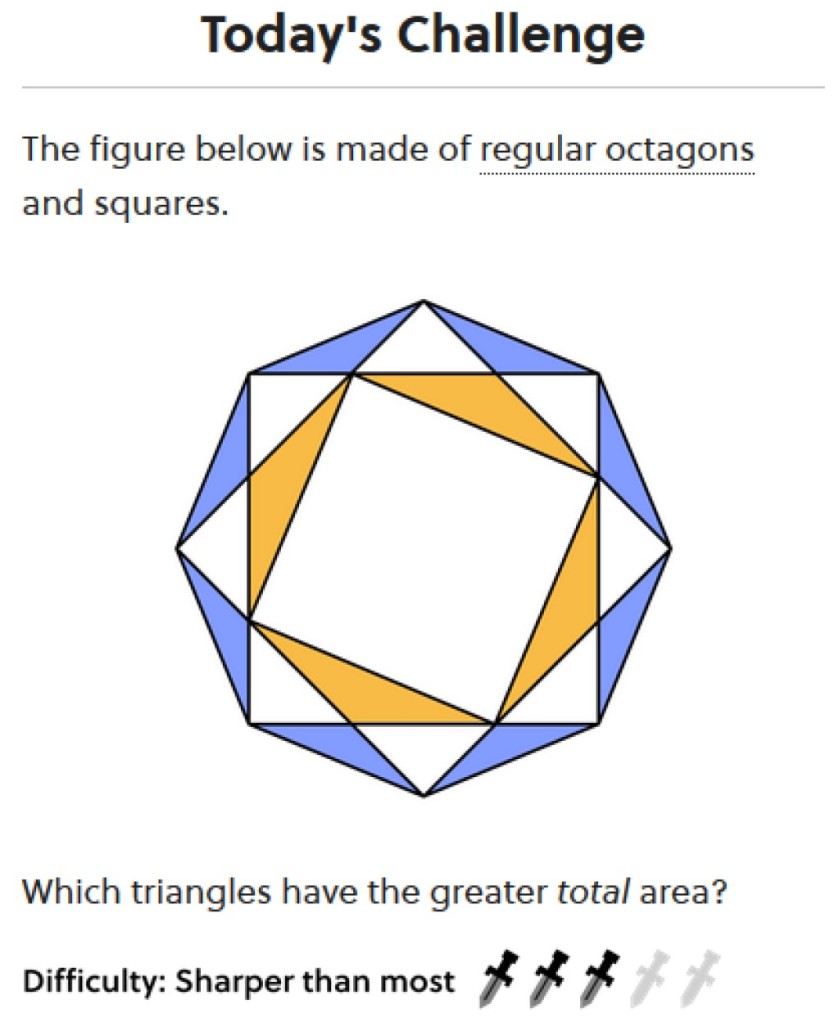
Yesterday I set this teaser, from brilliant.org:

Octagons

Here is Chew-Seong Cheong’s excellent published solution:

Oct Sol

As an habitue of brilliant.org I recognized a trick when I saw it and realized that the trick answer given the wording of the question was that the areas were equal and therefore went for that as my answer.

PHOTOGRAPHS

I have introduced today’s teams, assessed the contest and presented the solution to yesterday’s teaser. The only thing left to for this post to be complete is my usual sign off…

IMG_1114 (2)IMG_1115 (2)IMG_1116 (2)IMG_1117 (2)IMG_1118 (2)IMG_1118 (3)IMG_1119 (2)IMG_1119 (3)IMG_1120 (2)IMG_1120 (3)IMG_1121 (2)IMG_1121 (3)IMG_1122 (2)IMG_1123 (2)IMG_1124 (2)IMG_1124 (3)IMG_1125 (2)IMG_1126 (2)IMG_1126 (3)IMG_1127 (2)IMG_1127 (3)IMG_1128 (2)IMG_1129 (2)IMG_1129 (3)IMG_1130 (2)IMG_1133 (2)IMG_1133 (3)IMG_1139 (2)IMG_1140 (2)IMG_1141 (2)IMG_1142 (2)IMG_1143 (2)IMG_1144 (2)IMG_1145 (2)IMG_1146 (2)IMG_1146 (3)IMG_1147 (2)

TTA VI
The teams in tabulated form.

All Time XIs – Through The Alphabet V

Today’s ‘all time XI’ cricket post continues the alphabetic progression theme. Also features a mathematical teaser and lots of photographs.

INTRODUCTION

Welcome to today’s all time XI cricket post. We continue the alphabetic progression theme. Yesterday’s second XI ended with a J, so we start with an opening batter whose name begins with K.

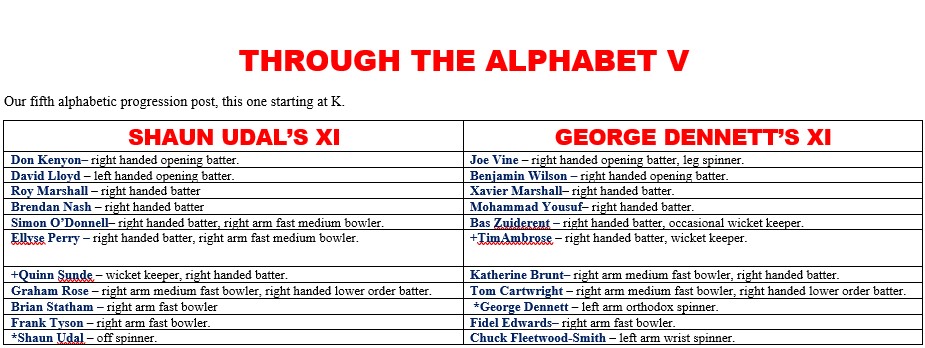
SHAUN UDAL’S XI

  1. Don Kenyon – right handed opening batter. A consistent and reliable opener for Worcestershire over a number of years.
  2. David Lloyd – left handed opening batter, occasional left arm orthodox spinner. After a distinguished career for Lancashire and nine appearances in test matches he went to become a highly entertaining commentator and writer, and a good coach.
  3. Roy Marshall – right handed batter. He usually opened, mainly for Hampshire. Regular openers often fare well at number three – Mark Butcher and Michael Vaughan are two who did so for England.
  4. Brendan Nash – right handed batter. Australian born, but played for the West Indies.
  5. Simon O’Donnell – right handed batter, right arm fast medium bowler. Toured England in 1985 as a promising young all rounder, but did not quite make the grade at test level (he was a casualty of a rebuilding effort that paid dramatic fruit starting in 1989 with an Ashes win in England and going on to become a dominant international force). He finished his first class career with a first class batting average of 39 and a bowling average of 37.
  6. Ellyse Perry – right handed batter, right arm fast medium.
  7. +Quinn Sunde – wicket keeper, right handed batter. Finding Qs to fit the bill calls for some flexibility. He is only just 19 and has not yet played first class cricket, but has played for NZ U-19.
  8. Graham Rose – right arm medium fast bowler, useful lower order batter. A Somerset stalwart, who did not do quite enough to attract the attention of the England selectors. I saw him in  action in 1996 at Swansea, and he took four cheap wickets in a Glamorgan total of 310 in the first innings. Somerset took a small lead, with Lathwell playing fluently early in their innings and Hayhurst and Bowler providing grittier efforts, while Steve Watkin had a very similar analysis to Rose’s. Somerset’s advantage was insufficient – Robert Croft spun them to defeat on the final day. His averages are just the right way round, and hos bowling average is just less than 30.
  9. Brian Statham – right arm fast bowler. 252 test wickets at 24 each, mainly from the wrong end – for Lancashire when he had the choice of ends he took his wickets at just 16 a piece. Like his successor as Lancashire and England new ball bowler, James Anderson, he batted left handed, occasionally playing very useful innings – in one of the 1954-5 Ashes matches he was involved in a crucial partnership in England’s first innings – the last wicket stand between him and Johnny Wardle account for 43 of a total of 154, and England won that game by 38 runs. Also, at a time when quite a few of his colleagues had to be ‘hidden’ in the field he was excellent in that department as well.
  10. Frank Tyson – right arm fast bowler. The other half of that 1954-5 Ashes winning new ball pairing. His was a brief but spectacular career – he had other strings to his bow, which meant that he did not have worry about prolonging his career, and by the end of the 1950s he was finished as a professional.
  11. *Shaun Udal – off spinner, captain. A long career, mainly for Hampshire, before moving to Middlesex for his last few years. He did get to play for England but did not fare very well at the highest level.

This team has a decent top four, one good and one great all rounder, a wicket keeper and a bowling foursome that looks pretty good. It is deficient in the spin department – the only back up available for Udal’s off spin is Lloyd’s part time left arm spin.

GEORGE DENNETT’S XI

  1. Joe Vine – right handed batter, leg spinner. The role he played for Sussex for many years, and briefly for England. Sussex in that period were a magnificent batting side, but somewhat light on bowlers, so they never seriously threatened in the county championship – there is a vast mass of evidence to support the contention that if you are going to a little short in either of these departments it is better to be light in batting – good bowlers do not need absolutely huge totals to defend, whereas unless you get lucky with opposition declarations you cannot win games without taking 20 wickets. This is why, when I started this series with a look at the 18 first class counties and restricted myself to one overseas player per county that overseas choice was nearly always a bowler, occasionally an all rounder and almost never a pure batter.
  2. Benjamin Wilson – right handed opening batter. He was Wilfred Rhodes’ most regular Yorkshire opening partner in the years immediately before World War 1. He was sometimes criticized for taking an overly defensive approach to his innings (I have an idea that there was a more recent Yorkshire opener who also got that kind of criticism!).
  3. Xavier Marshall – right handed batter. A man who has played for two international sides – the West Indies where he was born and the USA. X, like Q, calls for a wee bit of flexibility.
  4. Mohammad Yousuf – right handed batter. After a slightly suspect top three we come to someone who averaged over 50 in his test career. He finished under something of a cloud (and I saw every ball of that shocking match in Sydney which he basically handed to Australia after Pakistan had taken a first innings lead of 200). First, with Hussey and tail ender Siddle resuming overnight and Australia only 74 to the good he failed to set attacking fields, and his tactics allowed Australia to reach lunch with no further loss. Then, with Pakistan needing 176, when it should have been under 100, he surrendered his own wicket to an appalling stroke, leaving his side 54-4 and with no experienced front line batters left.
  5. Bas Zuiderent – right handed batter. England’s performance in the 1996 World Cup was one of their most disgraceful ever in any tournament, on-field incompetence being matched by bad behaviour off it (skipper Atherton, who should have been nowhere near a limited overs side in any case,  called one reporter who was having difficulty phrasing a question in what was after all not his first language a buffoon, and there were other cringeworthy stories as well). England reached the quarter finals only because they had been put in a group with two non-test playing nations, Holland and the United Arab Emirates, the only two teams they beat in that competition (justice was done in the quarter-final when they were marmalised by Sri Lanka). The Holland win was decidedly unconving, with Zuiderent, then only 18, and Van Noortwijk plundering a century stand together – it was only Van Noortwijk’s dismissal to a boundary catch that finally put England in control. Zuiderent’s share of the spoils was a merry 54. He did not go on to great things after that start, but his innings that day, which garnered more plaudits than Hick’s century for England had, gets him his place as a middle order batter beginning with Z.
  6. +Tim Ambrose – right handed batter, wicket keeper. He made a century on test debut, but never fully established himself. For Sussex and then Warwickshire he was a consistent run getter in the middle of the order and a superb wicket keeper.
  7. Katherine Brunt – right arm medium fast bowler, right handed batter. She began as a pure bowler, but although not doing so as effectively as Ellyse Perry who also began down the order she has developed her batting to a level that allows her to be described as an all rounder.
  8. Tom Cartwright – right arm medium fast bowler, useful lower order batter. The obverse of Brunt in terms of career development – he started as mainly a batter, and actually scored a first class double century playing as such, before dropping down the order because his bowling was more valuable to the side than his batting. He started with Warwickshire and moved to Somerset. He became so metronomically accurate that it is claimed that at the end of a season at Taunton there would be a worn patch two feet long and six inches wide at one end, where he had been lading the ball time after time through the season. He played a walk-on role (more accurately walk-off) in the D’Oliveira affair – he was initially selected in the 1968-9 tour party to South Africa, while D’Oliveira to general consternation was left out. Cartwright then withdrew citing injury, but as he later admitted, actually because he did not wish to go to South Africa. His replacement was D’Oliveira, mainly a batter, and Balthazar Johannes Vorster, then South African president, proceeded to state that D’Oliveira would not be accepted (attempts had earlier been made to bribe D’Oliveira, as documented by Peter Oborne in his book “Basil D’Oliveira”), and the tour was promptly cancelled. England and South Africa next went head to head in 1994, and a visit by Bradman to South Africa in which he had a face to face meeting with Vorster, and the latter, erroneously feeling safe, gave vent to some unvarnished racism led to the final isolation of apartheid South Africa.
  9. *George Dennett – left arm orthodox spinner. When cricinfo tweeted yesterday asking for people’s suggestions for the best player never to have played test cricket this man was mine. 2,151 wickets at 19.82 each in first class cricket, mainly for Gloucestershire, and never an England call up. This is because when he was in his pomp first Wilfred Rhodes and then Colin Blythe (2,503 first class wickets at 16) were ahead of him in the pecking order of left arm spinners, and Frank Woolley, worth his place as a batter anyway, also bowled left arm orthodox spin. Similarly, when I named my Gloucestershire all-time XI (second post in this series), Charlie Parker, third leading wicket taker in first class history got the left arm spinner’s position, with the off-spin of Tom Goddard (no 5 on the all time first class wicket taking list with 2,979) in support. The mores of his time prevented it from even being a consideration then, but I have named him as captain of this team, a job I think he would have done well.
  10. Fidel Edwards – right arm fast bowler. A genuinely fast bowler for the West Indies, at a time when they as a side were struggling. His tendency to waywardness is partially addressed by the fact that the support pace bowlers, Cartwright and Brunt are both noted for accuracy.
  11. Chuck Fleetwood-Smith – left arm wrist spinner. He was the reason for Denis Compton choosing this most difficult type of bowling when he decided to add a second string to his bow. He was often expensive, but always capable of bowling the wicket taking ball.

This team has a respectable top order, a quality keeper who can bat well in the middle od the order, and five players selected principally for their bowling, although two of them could definitely make significant contributions with the bat. There is not a front line off spinner, but Dennett, Fleetwood-Smith and Vine are a fine and varied trio of spinners, while the presence of Brunt and Cartwright should enable Edwards ton be used in short bursts.

THE CONTEST

Shaun Udal’s XI are somewhat stronger in batting (if only because they bat deeper)  than George Dennett’s XI, but their bowling attack is not as well balanced. I would expect George Dennett’s XI to prevail, and would be absolutely certain that they would do so on a turner, as Udal backed by Lloyd’s part time stuff hardly compares with Dennettt, Fleetwood-Smith and Vine.

A MATHEMATICAL TEASER

This problem came up on brilliant.org today:

Octagons

The original question has multiple choice answers, but I am not offering that. I will offer you a gentle hint – there are three possible answers to this question. In tomorrow’s post I will include an official solution and an explanation of my own ‘method’.

PHOTOGRAPHS

My usual sign off…

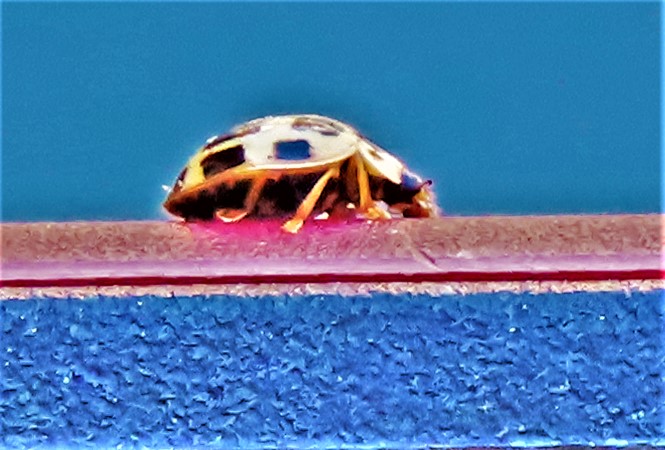
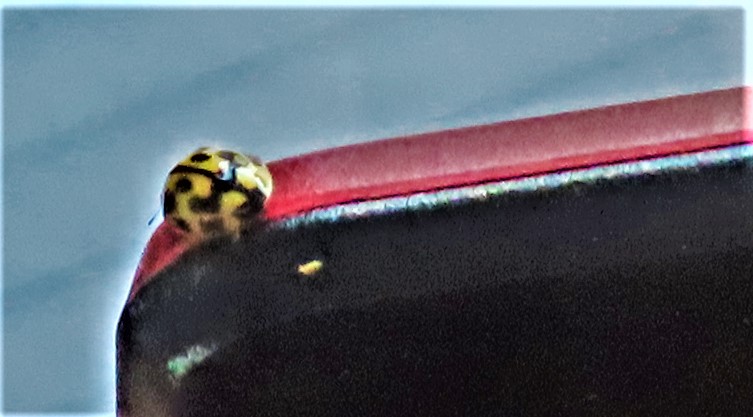
IMG_1039 (2)IMG_1040 (2)IMG_1042 (2)IMG_1048 (2)IMG_1050 (2)IMG_1051 (2)IMG_1052 (2)IMG_1053 (2)IMG_1055 (2)IMG_1059 (2)IMG_1061 (2)IMG_1062 (2)IMG_1062 (3)IMG_1065 (2)IMG_1066 (2)IMG_1067 (2)IMG_1068 (2)IMG_1069 (2)IMG_1072 (2)IMG_1073 (2)IMG_1074 (2)IMG_1077 (2)IMG_1078 (2)IMG_1080 (2)IMG_1081 (2)IMG_1082 (2)IMG_1083 (2)IMG_1087 (2)IMG_1088 (2)IMG_1090 (2)IMG_1091 (2)IMG_1093 (2)IMG_1094 (2)IMG_1096 (2)IMG_1097 (2)IMG_1098 (2)IMG_1100 (2)IMG_1101 (2)IMG_1103 (2)IMG_1104 (2)IMG_1105 (2)IMG_1106 (2)IMG_1107 (2)IMG_1109 (2)IMG_1111 (2)IMG_1113 (2)

TTA V
The teams in tabulated form

All Time XIs – Through The Alphabet IV

Our all time XIs resume the alphabetic progression seen on Friday, Saturday and Sunday. Lots of photographs.

INTRODUCTION

For today’s all time XI cricket post we revert to the alphabetic progression that I started on Friday and continued on Saturday and Sunday. No 11 in Sunday’s second XI began with an N, so today’s first XI starts with an opener who begins with O.

HEDLEY VERITY’S XI

  1. Javed Omar – right handed opening batter. His test record looks modest, but he had very little support at the top of the Bangladesh order (his most frequent opening partner, Hannan Sarkar, was once out to the first delivery of each of three successive test matches).
  2. Alviro Petersen – right handed opening batter. A so-so record in test cricket for South Africas, but a regular big scorer in the county championship. His overall FC average is just above 40 runs an innings, good enough to suggest a player of quality.
  3. Willie Quaife – right handed batter, occasional leg spinner. A fine and consistent upper order batter for Warwickshire for a very long period, signing off with a hundred in his last match, at the age of 56 years and 4 months, the oldest scorer of first class hundred there has ever been (WG Grace notched his 126th and last on his 56th birthday, going on to 166 in that innings). There were question marks about the legality of his bowling action, and the most famous occasion on which his bowling featured prominently did not end well for Warwickshire – when Hampshire made their astonishing recovery at Edgbaston in 1922 after being rolled for 15 in the first innings he bowled 49 overs, being then 50 years of age, as Hampshire reached 521 at the second attempt. Warwickshire, exhausted from their efforts in the field and dispirited by Hampshire’s Houdini act then collapsed to 158 all out in their own second innings, the match ending in a Hampshire victory by 155 runs at 4:20PM on third and final scheduled day.
  4. Viv Richards – right handed batter, occasional off spinner. Had he been able to play all five tests of the 1976 ‘grovel’ series against England Don Bradman’s 974 runs in the 1930 Ashes series would almost certainly have been overtaken. Richards missed the third match of that series through injury, scoring 829 in the other four games. In the final match of the 1985-6 home series v England, with quick runs the order of the day as the Windies pushed for a second successive blackwash of their opponents, Richards smashed a century off 56 balls, at the time the fewest ever to reach that mark in a test match (still third on that list).
  5. Kumar Sangakkara – left handed batter, occasional wicket keeper. Only one left handed batter has scored more test career runs than him, Alastair Cook. The biggest partnership for any wicket in first class cricket is the 624 that he and Mahela Jayawardene put on against South Africa.
  6. +Sarah Taylor – right handed batter, wicket keeper. One of the most accomplished keepers the game has ever seen and a fine stroke making batter as well. Mental health issues cut short her career, but she did plenty enough in the time she did play to justify her selection.
  7. George Ulyett – right arm fast bowler, right handed batter. An attacking all rounder for Yorkshire and England in the late 19th century. He had a test best score of 149, and test best innings bowling figures of 7-36. In the test match at The Oval in 1882, the second ever on English soil after 1880, he top scored with 26 in the England first innings, and was third out in the second, with the score at 51, and only another 34 needed to win. Grace fell two runs later, having become only the second player in the game to record a 30+ innings, and the middle and lower order froze in the face of Fred ‘the demon’ Spofforth’s unbridled hostility. In the end Peate’s wild heave against Harry Boyle might contact only with fresh air, and the stumps were rattled, leaving England beaten by seven runs. He also had a famous fielding moment in the course of his England career, when he took a catch of a shot that Bonnor, the legendary Aussie hitter had absolutely middled.
  8. *Hedley Verity – left arm orthodox spinner, useful lower order batter. 1,956 first class wickets in less than a full decade at that level, at 14.90 each. 144 test wickets at 24 – when contending with a combination of doped pitches and Bradman’s batting. I have awarded him the captaincy that the mores of his time withheld from him, because I believe he would have been excellent at the job.
  9. Bill Whitty – left arm fast medium bowler. He had an excellent record in the years just prior to World War 1 breaking out. In terms of bowling averages only two Aussie left armers of pace have subsequently had records to compare with his (65 wickets at 21.12 from 14 test appearances), Alan Davidson (186 wickets at 20.53) and Bill Johnston who will be meeting later.
  10. Xara Jetly – off spinner. The young Kiwi is very much a prospect rather than an established player, but her last set of bowling figures recorded on cricinfo were 3-35, and I expect the hear more of her in due course (she is only 18, and has appeared a handful of time for Wellington Women).
  11. Waqar Younis – right arm fast bowler. Has all the ingredients – extra pace, rikght handed as opposed to left, etc, to make an excellent new ball partner for Bill Whitty. His first big moments were in the 1992 test series in England, when the home batters simply could not handle him. He subsequently played county cricket for first Surrey, and then Glamorgan, spearheading the bowling for the latter when they won the championship in 1997. Once in an ODI against England he took the first seven wickets to fall, the first time that had ever been done.

This team has a fine top five, albeit there is a question mark over Javed Omar, a great wicket keeping all rounder at six, the perfect type of all rounder to be coming at seven, and four well varied bowlers. Waqar Younis and Bill Whitty as mentioned should combine well with the new ball, Ulyett wuld be an excellent third seamer, and Verity’s class as a left arm spinner as unchallengable. His ‘spin twin’, Xara Jetly is admittedly an unknown quantity, but bowling in tandem with Verity could only help her. Quaife’s leg spin is more than adequate for a sixth bowler.

DON BRADMAN’S XI

  1. Hazratullah Zazai – left handed opening batter. Whatever he does he will do at a rapid rate.
  2. Azhar Ali – right handed opening batter. Averages 42 in test cricket, and had some very fine innings for Somerset as their overseas player. He and Zazai don’t need to score bucket loads opening for this team, just enough to set the stage for…
  3. Don Bradman – right handed batter. The greatest batter there has ever been, and number three was his preferred slot.
  4. Denis Compton – right handed batter, occasional left arm wrist spinner. A man who averaged 50 in test cricket, including scores of 145 and 184 against the 1948 invincibles. His record would have been even more amazing but for a long term knee injury.
  5. Basil D’Oliveira – right handed batter, right arm medium pacer. Had he been able to make his debut for his native land when in his mid 20s, instead of for his adopted land ten years later he would probably have had a record to put him among the all time greats. As it was, he averaged 40 in test cricket, starting at age 35 and ending at age 41. He also played probably the most important innings ever, the 158 at The Oval in 1968 that underlined his claim to a place in the tour party to South Africa that winter, and that triggered the events that led to the sporting isolation of apartheid South Africa.
  6. Grant Elliott – right handed batter, right arm medium paced bowler. Another cricketer born in South Africa  who sought pastures new, albeit for different reasons. He has played for New Zealand, mainly in limited overs cricket.
  7. +Bruce French – wicket keeper, right handed batter. He was in his prime when the England selection approach was at its most inconsistent – the second half of the 1980s, which saw the England gauntlets spread around Paul Downton, him, Jack Richards and Jack Russell (and probably others I have forgotten).
  8. Joel Garner – right arm fast bowler. His ODI economy rate was just 3.09 runs per over, he also had a magnificent test record, and as a youngster possessed one of the most powerful throwing arms ever seen on a cricket field. He was broad and solid in proportion to his 6’8″ height, which helped to spare him from the kind of stress related injuries that plagued beanpoles such as Bruce Reid. The immense height from which he brought the ball down (approx 10 feet given the length of his arms and the fact that he had a high action) made things extremely tricky for opposing batters, especially at his native Barbados where his arm was coming from above the height of the sight screen.
  9. Bill Hitch – right arm fast below. Over 1,000 first class wickets at 21 a piece, but he was never an England regular such was the bowling strength available in his day. Playing for Surrey meant that a lot of his bowling was done at The Oval, not a ground that tops many bowler’s lists of favourites.
  10. Jack Iverson – right arm wrist spinner. A one place promotion from his usual spot for ‘wrong grip Jake’. I have used the designation right arm wrist spinner because although he bowled with a leg spinner’s action (augmented by flicking the ball with his middle finger) his principal delivery was the off break, which confused opposition batters no end. He was only once collared in first class cricket, when Keith Miller and Arthur Morris realized that getting well down the pitch was the way to play him. He played one test series, and was instrumental in Asutralia winning it, capturing 21 cheap wickets.
  11. Bill Johnston – left arm medium fast bowler, left arm orthodox spinner. Three times in the post World War Two era he was Australia’s leading wicket taker in a series. It was not unknown when conditions warranted it for Johnston to switch straight from spinning the old ball to swinging the new. His 40 test match appearances yielded 160 wickets at 23.91.

This team has an adequate looking opening pair, the incomparable Bradman at three, Compton at four, two fine players at five and six who can fill in as support bowlers, an excellent keeper and a marvellous line up of bowlers. Garner, Hitch and Johnston look an excellent pace trio, while Iverson’s spin would pose a stern test, and if a second spinner is needed Johnston can bowl in his slower style.

AN HONOURABLE MENTION

Some would argue that I should have picked Sobers ahead of Sangakkara, but with virtually all of Sobers’ bowling skills covered by specialists in the persons of Verity and Whitty I felt that Sangakkara’s batting style was more suited to the team’s needs than that of Sobers. It is a very close call.

THE CONTEST

This is a close call – the advantage the Bradman gives his own XI is to an extent negated by the presence of Verity, the one bowler he acknowledged facing as an equal in the opposition. Also, bearing in mind 1932-3, if Younis were to strike early with the new ball I would be tempted to set a 7-2 legside field for him and see how Bradman stands up to a barrage – possibly deploying Ulyett from the other end, also with a packed legside field as well. I would just about favour Verity’s XI to emerge victorious, and if the match was being played on an uncovered pitch I would make them distinct favourites, because they are better equipped to take advantage of a rain affected surface than Bradman’s XI, and Bradman himself rarely succeeded with the bat on such surfaces.

PHOTOGRAPHS

We end with my usual sign off:

IMG_0960 (2)IMG_0961 (2)IMG_0963 (2)IMG_0964 (2)IMG_0965 (2)IMG_0966 (2)IMG_0967 (2)IMG_0968 (2)IMG_0969 (2)IMG_0973 (2)IMG_0974 (2)IMG_0975 (2)IMG_0976 (2)IMG_0978 (2)IMG_0979 (2)IMG_0983 (2)IMG_0984 (2)IMG_0985 (2)IMG_0987 (2)IMG_0990 (2)IMG_0991 (2)IMG_0992 (2)IMG_0993 (2)IMG_0995 (2)IMG_1001 (2)IMG_1002 (2)IMG_1003 (2)IMG_1006 (2)IMG_1007 (2)IMG_1008 (2)IMG_1011 (2)IMG_1012 (2)IMG_1014 (2)IMG_1015 (2)

IMG_1018 (2)
Caterpillar on anettle 1
IMG_1019 (2)
Caterpillar on a nettle 2
IMG_1019 (3)
Caterpillar no nettle 3
IMG_1020 (2)
The aerial view of the indivdual nettle plant selected by this caterpillar.

IMG_1024 (2)IMG_1025 (2)IMG_1026 (2)IMG_1027 (2)IMG_1028 (2)IMG_1029 (2)IMG_1032 (2)IMG_1035 (2)IMG_1037 (2)

TTA IV
The teams in tabuilated form.

All Time XIs -Other Sport Namesakes

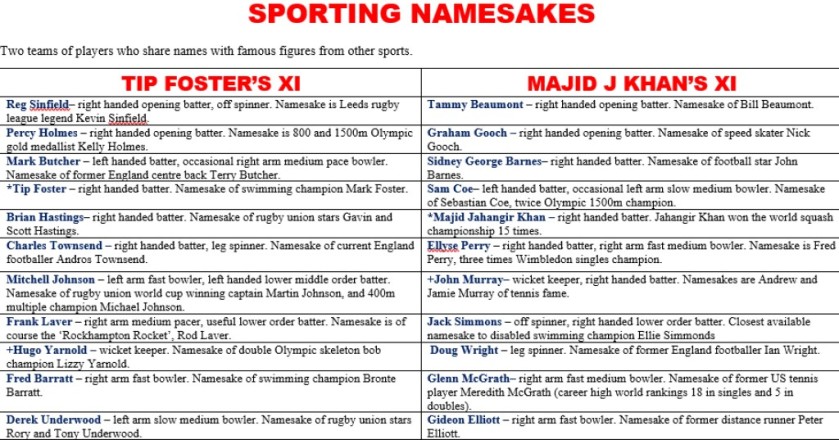
Two teams of players who share names with leading competitors in other sports.

INTRODUCTION

Today I am taking a break from the alphabetic progression I started in this all time XI series on Friday. Previously on Mondays I have looked at an international set up, but I lack options there by now, so I have come with something else. Two teams of players who have namesakes from other sports do battle today.

TIP FOSTER’S XI

  1. Reg Sinfield – right handed opening batter, off spinner. One of three front line spinners Gloucestershire had in the 1930s, alongside Tom Goddard and Charlie Parker, and a consistent batter at the top of the order. He played briefly for England as well. His namesake from elsewhere in the sporting world is Leeds rugby league legend Kevin Sinfield, who was man of the match in the Grand Final in his last game before retiring.
  2. Percy Holmes – right handed opening batter. One half of the most productive opening pair in first class history along with Herbert Sutcliffe. These two had an extra link – they were born exactly seven years apart, with Holmes the older. At the time of his retirement Holmes had five of the ten highest individual innings for Yorkshire to his credit. His namesake from elsewhere in sport is Dame Kelly Holmes, double gold medallist (800 and 1,500m) at the Athens Olympics in 2004.
  3. Mark Butcher – left handed batter, occasional right arm medium pace bowler. His greatest moment came at Headingley in 2001 when he scored a scintillating 173 not out to carry England to an unlikely seeming victory over Australia. His namesake is former England football central defender Terry Butcher.
  4. *Tip Foster – right handed batter, captain. He did captain England in the course of his fairly brief test career, which he launched with an innings of 287 v Australia at Sydney. He is a particularly appropriate person to be captaining this side because he is alone in captaining senior England teams at both cricket and football. For his namesake we dive into the world of swimming, specifically former champion over 50m butterfly and freestyle Mark Foster.
  5. Brian Hastings – right handed batter. He once shared a stand of 223 with Bevan Congdon, who was an archetypally New Zealand type of cricketer, later exemplified by such as Jeremy Coney and Chris Harris – the gritty middle order batter who could keep things tight with the ball at a pace that barely even justified the description medium. As a Kiwi he would have no objection to sharing his spotlight with folk from the rugby world, and his sporting namesakes are the great Scottish rugby playing brothers Gavin and Scott Hastings.
  6. Charles Townsend – right handed batter, leg spinner. He was the second ever to achieve the season double of 2,000 runs and 100 wickets in first class games, after his fellow Gloucvestershire player WG Grace (the third to do so was another Gloucestershire cricketer, Gilbert Jessop). His father Frank also played for Gloucestershire, and his son David was picked for England while still at university but never did anything significant in the game. Andros Townsend is a current England football player.
  7. Mitchell Johnson – left arm fast bowler, left handed lower middle order batter. He has two top drawer sporting namesakes: rugby world cup winning captain Martin Johnson and multiple 400m champion runner Michael Johnson.
  8. Frank Laver – right arm medium pace bowler, useful right handed lower order batter. He discovered a way to bowl a vicious late swinger at cricket while practicing baseball pitching. He used it to achieve a then record test innings analysis for an Australian bowler of 8-31. His namesake is of course the ‘Rockhampton Rocket’, Rod Laver, who twice won the calendar year tennis grand slam (1962 and 1969, the latter being the first year professionals were allowed to compete in the grand slam events, and for that reason the first time Laver had been involved since 1962 – had he played right through the 1960s at the grand slams he may well have set an untouchable record).
  9. +Hugo Yarnold – wicket keeper, right handed lower order batter. It was he who got my thoughts turned towards this post, when I used him to fill a ‘Y’ slot in one of my alphabetic progressions. His sporting namesake is twice skeleton bob gold medallist (2014 and 2018) Lizzy Yarnold.
  10. Fred Barratt – right arm fast bowler. Played for Nottinghamshire in the 1920s and early 1930s, capturing over 1,000 first class wickets at 22 each. As a youngster, before his cricketing talent was identified, he worked down the mines, like another rather better known Nottinghamshire right arm quick of that era. England’ strength at that time restricted his test opportunities. His namesake is Australian former swimming champion Bronte Barratt.
  11. Derek Underwood – left arm slow medium bowler. His record for England would have been even more remarkable had he not signed up for both Packer and the first South African rebel tour, the latter decision effectively ending his international career. As it was he finished with 297 test wickets, still an England record for any bowler of less than medium pace. His sporting namesakes are a pair of England rugby playing brothers, Rory and Tony Underwood, the former of whom scored 49 tries for his country.

Given the selection criteria this looks a solid and well balanced side, with a strong top six including two all rounders, some decent support batting down to number nine. The bowling with Johnson, Laver and Barratt to bowl various types of pace, Underwood’s craft and guile at slow medium and the spinners Townsend and Sinfield also looks impressive. This team should give a decent account of itself.

MAJID J KHAN’S XI

  1. Tammy Beaumont – right handed opening batter. Has a fine record at the top of the order since being given the job for England Women in 2015. Her sporting namesake is of course Bill Beaumont. I never saw him in action on the field, but am just old enough to remember him as a team captain on Question of Sport.
  2. Graham Gooch – right handed opening batter. His combined tally of First Class and List A runs is over 65,000, the most in the history of the game across multi-formats of top level cricket (Graeme Hick is number two on that list, having lasted long enough to play all three formats professionally, while Hobbs’ 61,237 first class runs in the days of single format top level cricket put him third). His sporting namesake is British former speed skater Nicky Gooch, who has gone from own fairly successful career to be a fine coach, his charges including multiple European champion Elise Christie.
  3. Sidney George Barnes – right handed batter. Often an opener, he also played well at no 3. He averaged 63 in his truncated test career (disrupted by World War II and terminated early by his rows with authority figures). His namesake is the Liverpool football legend John Barnes.
  4. Sam Coe – left handed batter, left arm slow medium bowler. The first batter eevr to be dismissed by a deliberately bowled googly, with 98 to his name at the time. He amassed over 17,000 first class runs in his career. He owes his place here to Sebastian Coe, twice 1,500m Olympic champion (1980 and 1984) and currently head honcho of world athletics.
  5. *Majid Jahangir Khan – right handed batter, captain. One of three cousins (Javed Burki and Imran Khan are the others – their mothers are sisters) to have captained Pakistan. A stroke making batter who in the early days of ODIs when such were still great rarities scored a century off 88 balls, in what was the first ODI to feature three such individual scores (two for Pakistan who emerged victorious). He also played county cricket for Glamorgan, once producing an innings of 147 for them that included 13 sixes, at the time the joint record for a first class innings in England, shared with another overseas star, Gordon Greenidge of Hampshire. I gave his full name here to justify his inclusion in this side, which comes courtesy of six time world squash champion Jahangir Khan.
  6. Ellyse Perry – right handed batter, right arm fast medium bowler. A regular new ball bowler who is also one of her country’s finest batters. Her range of accomplishments includes a double century in a test match (she averages 78 with the bat in that format) and a seven-for in an ODI. In the last edition of the Women’s Big Bash League she scored over 750 runs, taking her team to the final. She gets the all rounder slot in this team courtesy of three time Wimbledon champion Fred Perry.
  7. +John Murray – wicket keeper, right handed batter. One of only two wicket keepers ever to achieve the season double of 1,000 runs and 100 dismissals in first class matches (the other, Les Ames of Kent, achieved the feat three times in all). In career terms only Bob Taylor made more first class dismissals. His sporting namesakes are the tennis playing Murray brothers, Andrew (twice Wimbledon singles champion) and Jamie (multiple doubles champion).
  8. Jack Simmons – off spinner, useful lower order batter. Played for Lancashire for many years, was the first to captain Tasmania to Sheffield Shield success, and his taste in food caused his local chippy to name a particular combo the ‘Simmons Special’ in his honour. I have slightly cheated here because no cricketer named Simmonds with the d in has a record I can use for this purpose, and once I had decided to do this post I wanted to include a mention of multiple disabled swimming champion Ellie Simmonds.
  9. Doug Wright – leg spinner. More first class hat tricks than any other bowler – seven in total in his career. He had a long run up for a spinner, and could prevent opposition batters from automatically getting on the front foot by the simple expedient of sending down a bouncer. His namesake is former Arsenal and England footballer Ian Wright.
  10. Glenn McGrath – right arm fast medium bowler. A promotion for the Aussie metronome from his usual position. He was only once involved in a losing Ashes series in the course of his long career, and was absent injured from both the games Australia lost in that series. He took 563 test wickets in all, a record for a bowler of pace until Jimmy Anderson beat in 2018. He gets his place as one this team’s new ball bowlers courtesy of US tennis player Meredith McGrath. She was good enough to reach number 18 in the world in singles and number five in the world in doubles. I saw her playing her first Wimbledon, when she came through the qualifiers and then reached the last 16 of the main event. The following season she won the Wimbledon warm up event at Eastbourne.
  11. Gideon Elliott – right arm fast medium bowler. A brief but spectacular career which included innings figures of 9-2. Exhibit A against the contention that a higher batting average than bowling average makes an all rounder – he averaged 7.91 with the bat in first class crickets, and his 48 wickets cost 4.87 each. His namesake comes from the world of track and field athletics – former distance runner Peter Elliott, who ran for GB at the 1988 Seoul Olympics.

This team has a solid top six, including a great all rounder, a wicket keeper who can bat and four excellent and varied bowlers. Elliott, McGrath and Perry provide an excellent trio of seam options, and Wright and Simmons provide a contrasting pair of spin options. Sam Coe is a fair sixth bowler as well.

HONOURABLE MENTION

Albert Trott the Australian born Middlesex slow bowling all rounder is a namesake of British cyclist Laura Trott (now Kenney), but I could not fit him into either side. Other possibilities will doubtless occur to readers of this post.

THE CONTEST

These are two good, well balanced sides to compete for what in keeping with the multi-sport theme I have decided to call the ‘Jess Ennis’ trophy in honour of a great all round athlete. Probably the issue would be settled by which version of Mitchell Johnson showed up – the 2010-11 version would see the opponents win, while the 2013-4 version would very likely win it for his side.

PHOTOGRAPHS

It is time for my usual sign off:

IMG_0916 (2)IMG_0917 (2)IMG_0918 (2)IMG_0919 (2)IMG_0920 (2)

IMG_0921 (2)
I am starting to walk a bit further afield – these pics were taken while out and about yesterday evening.

IMG_0922 (2)IMG_0922 (3)IMG_0923 (2)IMG_0924 (2)IMG_0925 (2)IMG_0925 (3)IMG_0926 (2)IMG_0928 (2)IMG_0929 (2)IMG_0930 (2)IMG_0931 (2)IMG_0932 (2)IMG_0933 (2)IMG_0934 (2)

IMG_0935 (2)
A butterfly heading towards Lynn Sport Park (Lynn Sport is still closed, so numbers are not too great in that area).

IMG_0936 (2)IMG_0937 (2)IMG_0938 (2)IMG_0940 (2)IMG_0944 (2)IMG_0945 (2)IMG_0946 (2)IMG_0947 (2)

IMG_0947 (3)
Heading back owards home.

IMG_0950 (2)IMG_0951 (2)IMG_0952 (2)IMG_0953 (2)IMG_0954 (2)IMG_0955 (2)IMG_0957 (2)IMG_0958 (2)IMG_0959 (2)

Other Sports
The teams in tabulated form.

All Time XIs – Through The Alphabet III

Continuing the alphabetic progression of the last two days.

INTRODUCTION

Today’s all time XIs cricket post continues the alphabetic progression established over Friday and yesterday, so out first XI begins with an S.

GRAEME SMITH’S XI

  1. *Graeme Smith – left handed opening batter, captain. Scored large numbers of runs for South Africa. Appointed captain at a very young age he did that job very well as well.
  2. Glenn Turner – right handed opening batter. The only New Zealander to score 100 first class hundreds. In reversal of the more frequent pattern of development he started out as an absolute barnacle and developed an impressive range of strokes as he matured and grew in confidence – his 100th first class hundred as reached in the morning session of the first day of that game. This opening pair should blunt the opposing attack nicely for…
  3. Polly Umrigar – right handed batter, off spinner. India’s leading test run scorer prior to Gavaskar.
  4. Bryan Valentine – right handed batter. A great stylist for Kent and England.
  5. Everton Weekes – right handed batter. One of the greatest of all time to strengthen the middle order.
  6. Jerome Xaba – right handed batter, right arm medium pacer. X is a very difficult letter in this context, hence my inclusion of a player who has yet to feature in first class cricket.
  7. +Hugo Yarnold – wicket keeper, right handed batter. Holds the all-time record for stumpings in a first class innings, with six (six successive batters no less, only David East of Essex who caught eight in a row beats that sequence). In total he made almost 700 dismissals in his 287 first class matches. I accept that he is a trifle high in the order.
  8. Dawlat Zadran – right arm fast medium bowler.
  9. Curtly Ambrose – right arm fast bowler.
  10. Sydney Barnes – right arm fast medium bowler.
  11. Bhagwath Chandrasekhar – leg spinner. Our only front line spinner, and one member of this team whose position in the batting order will not cause any controversy.

This team is weaker in batting than is usual with my selections – Weekes is likely to need to remember how to count to six in the latter part of the innings.

CB FRY’S XI

  1. Ian Davis – right handed opening batter for Australia in the second half of the 1970s, known to his team mates as ‘wiz’ after a TV character of the time, ‘the wizard of ID’.
  2. John Edrich – left handed opening batter. A scorer of over 100 first class hundreds, and with a fine record at test level. He is one of five Surrey batters to have reached 100 first class hundreds (Hayward, Hobbs, Sandham and Ramprakash are the others).
  3. *CB Fry – right handed batter, captain. The English Leonardo, with an astonishing range of accomplishments to his credit. 
  4. Syd Gregory – right handed batter, brilliant fielder. A record eight tours of England, the first in 1890 and the last in 1912, the first test double century in Australia (Billy Murdoch scored 211 at The Oval in 1884), 201 at the SCG in 1894.
  5. Graeme Hick – right handed batter, occasional off spinner. His international record makes disappointing reading when compared to his stellar first class record, but there are two bog mitigating factors: his promotion to international cricket was rushed through, pitching him in to the fray against a very formidable West Indian fast bowling line up, and he was then dropped for the Sri Lanka game at tbe end of that season, and subsequently, when he was producing consistently at the top level for the first and only time of his career Ray Illingworth became supremo of English cricket (good idea, utterly wrong choice of person), and publicly described Hick as being ‘soft’, and Hick found himself back to being in and out of the side, as the Illingworth era was marked not so much by selectorial policy as a selectorial merry-go-round. Hick was merely the most prominent of a number of cricketers, along with Devon Malcolm, to be victims of the combination of crassness and insensitivity that marked the Illingworth era.
  6. Jack Iddon – right handed batter, left arm orthodox spinner. Just five England caps, because he was in prime during the tail end of Rhodes’ career and with Roy Kilner also well to the fore, but his first class record, coinciding with his county, Lancashire, enjoying their most successful ever period was 504 matches, 22,681 runs at 36.76 and 551 wickets at 26.90. He was also a decent fielder – once when Hammond commenced a day’s play by hitting the great Ted McDonald for five successive boundaries it was only a great stop by Iddon that prevented ball number six of that opening over going the same way.
  7. Gilbert Jessop – right handed batter, right arm fast bowler, brilliant fielder. The ultimate x-factor player to be coming at seven.
  8. +Jim Kelly – wicket keeper, right handed batter. He succeeded the great Jack Blackham as Australia’s wicket keeper and held the post for some 15 years.
  9. Geoff Lawson – right arm fast bowler. Had an excellent record in the 1980s, including being well capable of making irritating lower order runs, most notably his 74 at Lord’s in 1989 in support of Steve Waugh who was on his way to a second straight 150 (and was undefeated in both those innings).
  10. Muttiah Muralitharan – off spinner. 800 test wickets in 133 appearances at the highest level.
  11. Sarfraz Nawaz – right arm fast medium bowler. The highlight of his distinguished career was a spell of 7-1 in 33 deliveries that turned seeming defeat against Australia into victory – 305-3 became 310 all out.

This team has solid batting, and a bowling attack of Lawson, Nawaz, Muralitharan, Jessop and Iddon is hardly shabby, though not as stellar as some I have part together in this series.

THE CONTEST

CB Fry’s XI have greater depth in batting, while Graeme Smith’s XI are heavily reliant on their top five to score lots of runs. Graeme Smith’s XI has a stellar bowling unit, especially Ambrose, Barnes and Chandrasekhar. I see this as a close contest, with the odds possibly favouring CB Fry’s XI.

PHOTOGRAPHS

My usual sign off…

IMG_0908 (2)IMG_0910 (2)IMG_0911 (2)IMG_0912 (2)IMG_0912 (3)IMG_0913 (2)IMG_0913 (3)

TAII
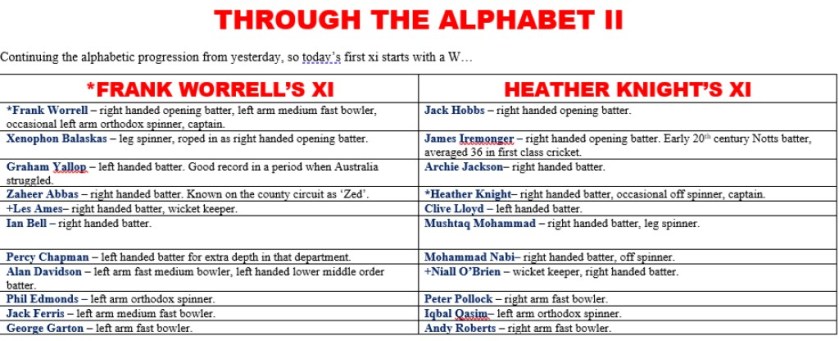
The teams in tabulated form.

All Time XIs – Through The Alphabet II

Picking up where I left off yesterday, with my first team starting with a ‘w’.

INTRODUCTIONS

For today’s all time XI cricket post I am picking up where I left off yesterday, continuing the alphabetic progression, so our first XI begins with a player whose surname begins with W.

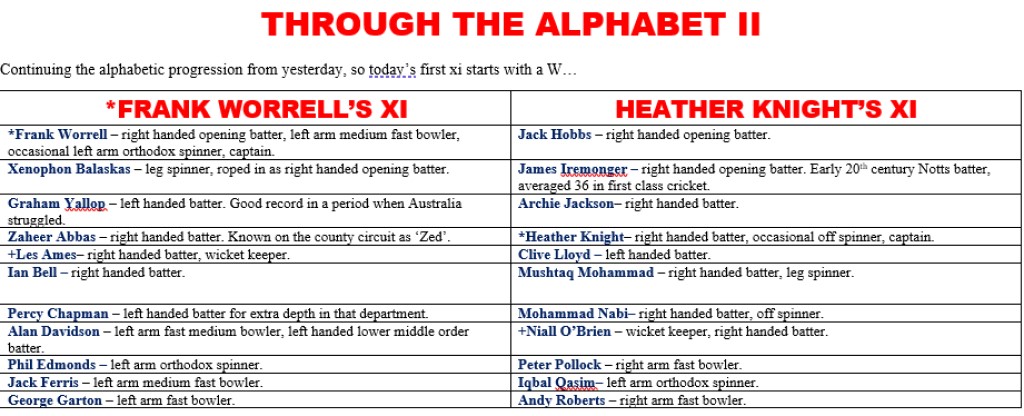
FRANK WORRELL’S XI

  1. *Frank Worrell – right handed batter, left arm medium fast bowler, occasional left arm orthodox spinner, captain.
  2. Xenophon Balaskas – leg spinner, drafted in here as ersatz opener as well. X is a very difficult letter, but I will attempt to find alternatives for the leg spinning all rounder in future posts of this type. He did average 28.68 with the bat in first class cricket.
  3. Graham Yallop – left handed batter. He batted at no 3 in the 1978-9 Ashes and was the only player on either side to score two centuries in the series – it was only as captain that he was not up to the task.
  4. Zaheer Abbas – right handed batter. Known on the county circuit as ‘Zed’, Z is another difficult letter.
  5. +Leslie Ames – right handed batter, wicket keeper.
  6. Ian Bell – right handed batter. Given the opening situation I felt an extra specialist batter was warranted, so Ian Botham missed out.
  7. Percy Chapman – left handed batter. Extra batting depth needed.
  8. Alan Davidson – left arm fast medium bowler, left handed batter.
  9. Phil Edmonds – left arm spinner, right handed lower order batter.
  10. Jack Ferris – left arm medium fast bowler.
  11. George Gartonleft arm fast bowler. The Sussex youngster has had some good moments in his fledgling career.

This team has an adequate line up, albeit with an ersatz opener, and a fine collection of bowlers.

HEATHER KNIGHT’S XI

  1. Jack Hobbs – right handed opening batter.
  2. James Iremonger – right handed opening batter. Played for Notts at the start of the 20th century, opened the innings in his first full season, and finished his long career with a batting average of 36. When his playing days were done he became a coach, still with Notts, and among the youngsters he ushered into first team cricket were Harold Larwood and Bill Voce.
  3. Archie Jackson – right handed batter. A regular opener, batting at no 3 here.
  4. *Heather Knight – right handed batter, occasional off spinner, captain. She has batted at no3, but no4 is nowadays her regular slot. World cup winning captain, given that role in this side.
  5. Clive Lloyd – left handed batter. My second world cup winning captain, in this team he will be vice captain to Heather Knight.
  6. Mushtaq Mohammad – right handed batter, leg spinner. The first of two all rounders in this side.
  7. Mohammad Nabi – right handed batter, off spinner. Part of the first ever Afghanistan team, and still in the ranks when they attained test status. His role in the astonishing rise of his country as a cricketing force means that he has played against a wider range of sides than any other player in the game’s history.
  8. +Niall O’Brien – wicket keeper, right handed batter.
  9. Peter Pollock – right arm fast bowler.
  10. Iqbal Qasim – left arm orthodox spinner. Q is a  difficult letter, but he is worth is his place, and no9 is the right place in the order for him.
  11. Andy Roberts – right arm fast bowler. No11 is very low in the order for him, but the pace bowling department needs strengthening. He was the leader of original fearsome foursome of fast bowlers deployed by Clive Lloyd.

This side has a good batting line up, and an excellent variety of bowlers. Admittedly the only seam back up to the two big guns, Roberts and Pollock is Jack Hobbs, but it is still a good side.

THE CONTEST

Both of these teams look pretty good, and both have excellent captains. I think the presence of Roberts and Pollock just about gives Heather Knight’s XI the edge, but it has all the makings of a fine contest. 

LINK AND PHOTOGRAPHS

Just before my usual sign off, physics-astronomy.com have an excellent article about some new x-ray pictures of the sky. The image below, taken from the article, is formatted as a link.

X-Ray sky

Now for my pictures…

IMG_0900 (2)IMG_0900 (3)IMG_0901 (2)IMG_0901 (3)IMG_0902 (2)IMG_0903 (2)IMG_0904 (2)IMG_0904IMG_0905 (2)IMG_0906 (2)IMG_0906IMG_0907

TAII
The teams in tabulated form.

All Time XIs – Through The Alphabet

Today’s all time XI cricket post follows a strict alphabetical progression.

INTRODUCTION

Welcome to another variation on the all-time XI cricket theme. Today each featured player has a surname beginning with a different letter of the alphabet, and each letter is used strictly in sequence, meaning that the second XI ends with a player whose surname begins with V.

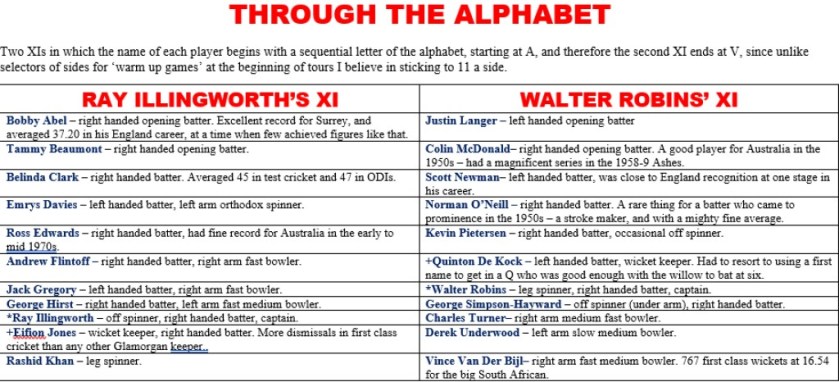
RAY ILLINGWORTH’S XI

  1. Bobby Abel – right handed opening batter. 744 test runs at 37.20, an excellent record for his period, over 30,000 first class runs.
  2. Tammy Beaumont – right handed opening batter. Has fared magnificently as an opener since being given the role for England in 2015.
  3. Belinda Clark – right handed batter. In the 1990s she had the same kind of reputation as a batter that her compatriot Meg Lanning does today. She averaged 45 in test cricket and 47 in ODIs, the latter figure including the first ODI double ton by anyone.
  4. Emrys Davies – left handed batter, left arm orthodox spinner. He was usually to be found in this sort of place in the batting order, and played some fine innings from no4.
  5. Ross Edwards – right handed batter. One of the better Aussie batters of the first half of the 1970s (he retired somewhat prematurely at the end of the 1975 series played after the inaugural men’s world cup). In the first match of that series at Edgbaston he was horrifically out of form but ground out a half century in four hours and ten minutes, while others scored quicker (notably Rod Marsh with the top score of 61) at the other end. Rick McCosker and Ian Chappell had also scored 50s, and Thommo down near the extras scored a test best 49 to boost the score to 359. England were then bowled out twice, with skipper Denness, who had won the toss an put Australia in, managing three and eight in his last two test innings. In the second test of that series Australia slumped to 81-7 in response to England’s first innings 315 (Greig 96, Knott 69, Steele 50) and it was that man Edwards, helped by DK Lillee, who dug Australia out of this king sized hole. Edwards made 99, Lillee a test best 73 not out, and in the end England led by just 47, and were unable to force victory.
  6. Andrew Flintoff – right handed batter, right arm fast bowler. He took a while to establish himself at the top level before enjoying a couple of magnificent years, and occasionally reviving old memories thereafter.
  7. Jack Gregory – left handed batter, right arm fast bowler. Injuries took their toll late in his career, but his record confirms his status as a genuine all rounder.
  8. George Hirstright handed batter, left arm fast medium bowler. His England record does not look that great, but his play for Yorkshire, over the course of three decades, places him firmly among the greatest of all time.
  9. *Raymond Illingworth – off spinner, right handed batter. In 1970-1, with Australia holding the Ashes, and having done so since winning them in 1958-9, Illingworth captained England to a 2-0 series victory to regain the urn, the first to do so in Australia since Jardine 38 years previously, and only the sixth in all after Bligh in 1882-3, Stoddart in 1894-5, Warner in 1903-4 and Douglas in 1911-2 as well as Jardine. Subsequent to that tour England’s only successes down under have been when Brearley defended the urn in 1978-9, Gatting in 1986-7 defending the urn won back by Gower in 1985 and Strauss in 2010-11, defending the 2009 spoils. He was a quality player in his day as well.
  10. +Eifion Jones – wicket keeper, right handed batter. He made more dismissals than any other Glamorgan keeper, 933 of them (840 caught, 93 stumped) in 405 matches.
  11. Rashid Khan – leg spinner, right handed lower order batter. Although it is his bowling that has got him in (after four tests he has 23 wickets at 21.08 at that level – a more than promising start – while eight first class matches in total have yielded him 58 wickets at 17.44, and he is not quite 22 years old.

This team has a solid top five, three fine all rounders, a keeper, and two spinners who can both bat. It has no tail to speak of (even Rashid Khan averages 23 in FC cricket), and Gregory and Hirst will make a fine new ball pairing, with Flintoff as back up, while Khan, Illingworth and Davies provide fine spinning options (especially the first two). This team will take a lot of beating.

HONOURABLE MENTIONS

First of all, bear in mind my decision to pick players in positions they actually occupied. That means that Abel is virtually indisputable, although Mayank Agarwal will change that if he continues as he has started. Jack Brown of England, Bill Brown of Australia and Sidney George Barnes of Australia were all good options for the letter B, and I could accept any of them. Ian Chappell might have had the no 3 slot. I felt no 4 was a position too high for Basil D’Oliveira, and felt that Davies’ bowling gave him an edge of Joe Darling. No 5 was too low in the order for Bill Edrich (he either opened or batted no 3) or his cousin John (a specialist opener), while none of the other cricketing Edriches had a good enough record. George Emmett of Gloucestershire might have his advocates, although five was lower than he usually batted. Freddie Flintoff had no rivals. Jack Gregory’s slot might have gone to Tony Greig, but I felt that that the Aussie gave me three genuine pace bowlers. Hirst’s place might have gone to Schofield Haigh but I felt that his left arm bowling and superior batting clinched it in his favour. Illingworth’s two main rivals were Jack Iverson and Bert Ironmonger, but both were genuine no11s, so would have been two places too high, and in Ironmonger’s case I already had a left arm spinner in Davies. Some might think that Geraint Jones should have had the keeper’s slot, but his allegedly superior batting (I am not wholly convinced it actually was) does not make up for the fact that he was definitely a tad clumsy behind the stumps. Rashid Khan’s place could have gone to his compatriot the left arm wrist spinner Zahir Khan, while if I had wanted an extra pace bowling option Indian left armer Zaheer Khan could have been selected.

WALTER ROBINS’ XI

  1. Justin Langer – left handed opening batter, averaged 45 in test cricket, with a best of 250 against England at the MCG.
  2. Colin McDonald – right handed opening batter. The 1950s was a slow and low scoring decade, which makes McDonald’s test average of 39, batting at the top of the order particularly impressive. His best series was the 1958-9 Ashes when the he was the most successful batter on either side.
  3. Scott Newman – left handed batter. When he first started it seemed that an England career beckoned, but he never quite kicked on, finishing with a first class average of 38.
  4. Norman O’Neill – right handed batter. A fine stroke making batter for Australia. He averaged 45.55 in test cricket, making his debut in  the 1958-9 Ashes series.
  5. Kevin Pietersen – right handed batter, occasional off spinner.
  6. +Quinton De Kock – left handed batter, wicket keeper. I could not come up with a cricketer whose surname began with Q who could play as high as no six, so I allowed myself to pick someone whose first name began with Q.
  7. *Walter Robins – leg spinner, right handed batter, captain. A highly successful captain of Middlesex, well regarded by most of those who played under him. He averaged 26.39 with the bat and 23.30 with the ball, scoring 13,884 first class runs and capturing 969 wickets in his 379 games at that level.
  8. George Simpson-Hayward – off spinner (under arm). 23 wickets at 18 in his five test matches, 503 first class wickets at 21.
  9. Charles Turner – right arm medium fast bowler. One of the great bowlers of the early period of test history – took his 100th wicket in his 17th test match. Link two in an Australian chain through test history – Jack Blackham who kept wicket in the first 17 test matches ever played was a team mate of his, he gave Bill O’Reilly (3) some useful advice, who in turn gave Richie Benaud (4) some useful advice, and in his turn he passed on some advice to Shane Warne (5) – it only remains to provide a verifiable link from Warne to a current Aussie player to complete the chain.
  10. Derek Underwood – left arm slow medium bowler. 297 test wickets for the Kent maestro. Economical on pitches that did not help him and a destroyer on any surface that did help him.
  11. Vince Van Der Bijl – right arm fast medium bowler. The big South African took 767 wickets at 16.54 in first class cricket (his country were isolated due to apartheid, and he chose not to go down the route of qualifying to play for another country, so he played no official international cricket). Philippe-Henri Ednonds who played alongside Van Der Bijl for Middlesex said in “100 Greatest Bowlers” that Van Der Bijl would likely have had a test record in similar lines to Brian Statham’s had he played at that level.

This side has a powerful top five, an explosive batter/ keeper at six and a well balanced bowling attack. Turner and Van Der Bijl look every inch a quality new ball pair, while Underwood, Simpson-Hayward and Robins offer a fine variety of slower options.

HONOURABLE MENTIONS

No other L challenges Langer for the no1 slot. N was also a fairly barren letter, as was O. I did consider selecting Ellyse Perry in place of Kevin Pietersen, while no5 is too low for Graeme Pollock, who batted either at no3 or no4. I covered Q in that entry. I think Robins’ all round skills and captaincy make him a must pick – no 7 is definitely at least a position too high for Andy Roberts the . great fast bowler. Similarly, I felt no 8 was too high in the order for Fred Spofforth, so went for the highly individual skills of Simpson-Hayward. Jeff Thomson’s hell fire pace was an alternative to Turner. Underwood had no rival for the letter U. I could have gone for Chaminda Vaas in place of Van Der Bijl, but considered that the South African’s amazing first class record had to be acknowledged. Including Hedley Verity would have left me with only Turner as a recognized new ball bowler.

THE CONTEST

Robins’ XI has the stronger top batting, but more of a tail. Illingworth’s XI are better equipped in bowling, and they bat deeper, although their top batting is the weaker of the two sides. It is a tough call, but I think that Illingworth’s XI just about has the edge.

SOLUTION TO YESTERDAY’S TEASER

Marathon

We are told that the runners in first and fourth told the truth and those in second and third lied. C’s statement has to be true, because it being a lie would put C in fourth and that is disallowed by the conditions. Since it is a true statement and C did not finish fourth there is only one place for C to finish, which is first, the other place who told the truth. A’s statement is thus proven true, so A came fourth. B thus lied and therefore finished second, making D the other liar and the third place finisher. Thus C was first and A was fourth, making them three places apart. The cause of the aggro when this problem appeared on brilliant is that two runners finished in between A and C and some therefore believed the answer to be two, but the number of places separating A and C is 4-1 = 3. Brilliant caved to the moaners, giving those who had selected two but explained their reasoning for doing so in the comments credit, and they added an explanatory note to the problem itself. However, having reasoned the problem out as I have explained above and then selected two is actually equivalent to arguing that 4-1 = 2, so I think they should have held firm on that one.

LINK AND PHOTOGRAPHS

Holly Gillibrand, a young Scottish environmental activist has an article titled “Cry for the Wild” in the Oban Times. Below is a screenshot of the first few paragraphs:

HG

Time for my usual sign off:

IMG_0880 (2)IMG_0881 (2)IMG_0881 (3)IMG_0882 (2)IMG_0882 (3)IMG_0885 (2)IMG_0885 (3)IMG_0888 (2)IMG_0888 (3)IMG_0889 (2)IMG_0889 (3)IMG_0890 (2)IMG_0890 (3)IMG_0891 (2)IMG_0891 (3)IMG_0892 (2)IMG_0892 (3)IMG_0894 (2)IMG_0894 (3)IMG_0895 (2)IMG_0896 (2)IMG_0897 (2)IMG_0898 (2)IMG_0898 (3)IMG_0899 (2)IMG_0899 (3)IMG_0899 (4)

Through the Alphabet
The teams in tabulated form.

All Time XIs – Mark/Steve vs Alec/Eric

A nod to cricket’s most famous pairs of twins as an XI of Mark/Steves takes on an XI of Alec/Erics. Plus a mathematical teaser.

INTRODUCTION

Today’s all time XI cricket post honours cricket’s two most famous pairs of twins by pitting an XI whose names all feature Mark or Steve, or a variation thereof against an XI whose names all contain either Eric or Alec (or variations thereof).

THE MARK/STEVE XI

  1. Mark Taylor – left handed opening batter. He announced his presence at the highest level by scoring 839 runs in the 1989 Ashes, the most in a series by any Aussie not named Bradman.
  2. Stephen Moore – right handed opening batter. The Johannesburg born Worcestershire man was a little unlucky to miss out on international recognition in the course of his long career. He finished with a first class average of 36.
  3. *Stephen Fleming – left handed batter, captain. Over 7,000 test runs at an average of just over 40 for the Kiwi. The only small question mark is that his conversion rate of 50s into 100s was very poor. I have named as captain in acknowledgement of his skilled handling of a New Zealand outfit that contained few stars.
  4. Steve Smith – right handed batter, occasional leg spinner. One of the best batters ever seen, for all the unorthodoxies and unattractiveness of his method.
  5. Steve Waugh – right handed batter, occasional medium pacer. Averaged over 50 in test cricket. He like Taylor really hit the headlines in the 1989 Ashes – he made two unbeaten 150+ scores in the first two matches, and at one stage, immediately before his second dismissal of the series his average for that series stood at 418. His most remarkable performance came later, in a match at Old Trafford in which 21 of the 22 players failed to make a major score between them and he chiselled out twin centuries.
  6. Mark Waugh – right handed batter, occasional off spinner. Very different from his twin brother, but also had a marvellous record at the highest level.
  7. +Steven Davies – wicket keeper, left handed batter. At one time he seemed nailed on for a long and distinguished England career, but it did not eventuate. He is a better red ball player than white ball, but the England selectors picked him only in white ball games, and thereby failed to see the best of him.
  8. Greville Stevens – leg spinner, right handed batter. The only player in either team to have been slipped in by use of the surname. It was the only way I could give this side a front line spinning option, and Stevens had a significantly better bowling record than the other option, Vic Marks, with the added benefit that as a leg spinner he combines somewhat better with the next best spin option in the side, Mark Waugh, than Marks. Stevens played before limited overs cricket at the highest level was a thing, so the comparable parts of their records are: Marks six tests, batting average 27.66, bowling average 44.00, 342 first class games, batting average 30.29, bowling average 33.28 and Stevens 10 tests, batting average 15.47, bowling average 32.40, 243 first class games, batting average 29.56, bowling average 26.84. Stephens took 684 first class wickets at a rate 2.80 per game, Marks 859 at 2.52 per game, so on wickets per game Stevens was marginally more effective as well.
  9. Mark Wood – right arm fast bowler. The first of two genuinely fast bowlers to feature in this XI, a current England regular.
  10. Mark Davies – right arm medium fast bowler. He was plagued by injuries, otherwise he would have been an England regular. The 109 first class games he played when not crocked brought him 315 wickets at 22.42 each.
  11. Steve Harmison – right arm fast bowler. A third successive Durham quick, one who was ranked number one the world in 2004, and also played a starring role in the 2005 Ashes.

This team has a good top six, a keeper who can bat and four fine bowlers. There is a shortage of spin options, but overall it looks a useful side.

NEAR MISSES

Glamorgan fast medium man Steve Watkin and Middlesex quick Steve Finn were close to selection for bowling spots, while two other notable wicket keeping Steves were messrs Rhodes and Marsh (for all that he played test cricket Steve Rixon was not a notable wicket keeper). Mark Butcher was close to a batting slot, but the team was strong in that area. Mark Adair of Ireland may in due course claim his place as an all rounder but he is not there yet. Finally, although he was not close to selection, some might think that Mark Lawson of Yorkshire could have solved the spin bowling issue – the trouble with that being that he paid over 40 runs a piece for his first class wickets.

THE ALEC/ERIC XI

  1. Eric Rowan – right handed opening batter. A fine test record, including what was at the time the highest individual score by a South African, 236, a mark which stood until Graeme Pollock scored his 274 v Australia.
  2. Alec Stewart – right handed opening batter. He averaged 45 for England in this specific role, and the combination of him and the combative Rowan looks like a strong start to the innings.
  3. Alec Bowell – right handed batter. A stalwart for Hampshire in the 1920s, regularly batting in this position.
  4. *Alex Blackwell – right handed batter, captain. A fine batter and captain of the Australian women’s team a few years ago, and not inappropriately for this post, one half of a pair of cricketing twins.
  5. Alexander Webbe – right handed batter, occasional right arm fast bowler. A stylish batter of the 1870s.
  6. Eric Bedser – right handed batter, right arm off spinner.
  7. Alec Kennedy – right arm fast medium, right handed batter. The seventh leading first class wicket taker of all time (2,874 of them), and good enough with the willow to have done the double (1,000 first class runs and 100 wickets in a first class season) eight times in his long career.
  8. Alec Bedser – right arm fast medium bowler, useful lower order batter.
  9. +Eric Petrie – wicket keeper. A superb keeper, though a rather limited batter, the Kiwi gets in here because I need Stewart’s batting unencumbered by keeping duties.
  10. Alex Hartley – left arm orthodox spinner. Part of England women’s 2017 World Cup winning squad.
  11. Eric Hollies – leg spinner. Has the biggest negative balance between runs scored in first class cricket and wickets taken (-650 – 1,673 runs, 2,323 wickets) in history. He was the bowler in the most famous commentary moment of them all: “…Bradman bowled Hollies nought…”, which left the Don with 6,996 runs at 99.94 in test cricket.

This team has a decent top six, with Eric Bedser just about rating as an all rounder, a great keeper, and four excellent and well varied front line bowlers. It lacks genuine pace, but Bedser and Kennedy would be a fine new ball pairing, while the spin trio of Hollies, Hartley and Eric Bedser have the great merit as a combination that each does something different (LS, SLA, OS).

THE CONTEST

The Mark/Steve combination definitely looks the stronger, although a discreet hint to the groundsman to prepare a ‘bunsen’ would help to make it more of a contest!

A MATHEMATICAL CHALLENGE

This problem, set today on brilliant.org, has generated a large amount of controversy there due to the interpretation made by some of one part of the question. Click on tghe screenshot below to see it in it’s original setting:

Marathon

On brilliant there is a statement of clarification as a sop to all of those who reasoned it out correctly but then misinterpreted the final part of the question, and there are multiple choice answers available. I think making it multi-choice makes it too easy, and I want to see if any of my readers make the mistake quite a number of solvers on brilliant apparently did – explanation tomorrow.

PHOTOGRAPHS

Just  a few photographs today = the weather took an unpleasant turn yesterday afternoon and is only now showing signs of becoming pleasant again.

IMG_0871 (2)IMG_0872 (2)IMG_0873 (2)IMG_0874 (2)IMG_0875 (2)IMG_0876 (2)

MS v AE
The gteams in tabulated form.

All Time XIs – The Family Game

Today’s all time cricket post looks at cricketing families – an XI of siblings takes on an intergenerational XI. Please note the requirement that at least two members of each selected family feature in the team.

INTRODUCTION

For today’s all time XI cricket post we are looking at cricketing families. A team made up of groups of siblings do battle against an intergenerational XI. There are a number of famous cricketing families I could not include – I set myself a rule of including at least two members of each chosen family – not just select one and name their cricketing relations.

THE SIBLINGS XI

  1. *WG Grace – right handed opening batter, right arm bowler of varying types through his career, captain. The way to get round 11 being an odd number when selecting a team of siblings is to pick one group of three siblings, and fortunately there is a darned good such grouping readily available. His test batting average was only 32.29, but he made his debut at the age 32 and played on at that level until he was almost 51 – had the first test in England been in 1870 rather than 1880 his record would have been considerably better. He won eight of his 13 tests as captain, and all 13 of those matches were against the oldest enemy.
  2. EM Grace – right handed opening batter, lob bowler, fearless close fielder. Seven years WG’s senior, that inaugural test in England was his only one, and he shared an opening stand of 91 with his brother in the first innings thereof. England would probably have fared better in the 1882 match that inaugurated the Ashes had he been present in place of AN Hornby. Before WG’s rise overshadowed everyone else EM had been regarded as a phenomenon.
  3. Andrew Flower – left handed batter, occasional wicket keeper. He averaged over 50 in test cricket (see my ‘Minor Nations’ post from Monday), and makes a good selection for the critical number three slot, especially since other considerations prevented the use of the only other sibling to have been a really good test no 3, ‘Chappelli’.
  4. Mark Waugh – right handed batter, occasional off spinner, ace slip fielder. The first of two pairs of twins to make their appearances in this XI. He announced his presence at the highest level (selected in place of his brother!) with a scintillating 138 against England and went to establish a superb record.
  5. Steve Waugh – right handed batter, occasional medium pace bowler. He was first picked in 1985 at the age of 20 as a ‘bowling all rounder’, but it is his batting that gets him in – he averaged over 50 at the highest level, and that after taking 27 matches to reach his first century (177 not out at Headingley, as Australia, put in by England skipper Gower cashed in on an ‘attack’ comprising four medium pacers to the tune of 601-7 declared). He would be vice captain of this side.
  6. Grant Flower – right handed batter, occasional left arm orthodox spinner. Andrew’s younger brother, averaged just over 40 in test cricket.
  7. Eric Bedser – right handed batter, off spinner. His averages are just the wrong way round – 24.00 with the bat, 24.95 with the ball (833 first class wickets in total), and he is the first of three members of the XI not to have played test cricket.
  8. GF Grace – right handed batter, right arm medium pace bowler. In his case his sudden death from a freak illness prevented him from having a better record – he was 29 years old and just two weeks previously had played in the inaugural test in England, and had there been such a thing in 1880 his catch to dismiss George Bonnor would have been a shoo-in for the ‘Champagne Moment’. He averaged 25 with the bat and 20 with the ball, and the former figure puts him on a par with Richard Daft, rated no2 to WG Grace in the 1870s, GF’s decade.
  9. Alec Bedser – right arm fast medium bowler, useful lower order batter. Eric’s identical twin brother – and they used to wear identical clothes as well apparently. Because they considered playing for separate counties unthinkable they tossed a coin for who would stick to medium pace, and who would work on batting and off spin, and Alec won. There is a story that once in a benefit match Eric finished an over that Alec had started, and no one noticed the substitution, which suggests that Eric remained quite useful as a medium pacer.
  10. +Thomas Mycroft – wicket keeper, right handed batter. The most obscure of my choices, but he did average almost three dismissals a game in his brief first class career, and his presence enables me to give some much needed punch to the bowling by selecting his brother…
  11. William Mycroft – left arm fast bowler. 138 first class matches, 863 wickets at 12.09 each, and hopefully a suitable new ball partner for Alec Bedser.

This team is strong in batting, and the three Graces plus Eric Bedser should between them be able to provide sufficient bowling back up to the new ball pairing of Mycroft and Eric Bedser.

OTHER POSSIBILITIES

I might have opted for a new ball pairing of half brothers, Fidel Edwards and Pedro Collins, with Alec Bedser coming on first change, but that could only have been done by giving Andrew Flower the gauntlets and dropping the Mycrofts, and I prefer my no3 not also have to keep wicket. Although both captained England neither Arthur nor Harold Gilligan had a record to merit inclusion, and I certainly could not accommodate both. The Pitheys of South Africa were good rather than great. John and Hugh Trumble and Richie and John Benaud were two pairings that each had one weak link and so could not be accommodated. Johnny and Ernest Tyldesley were also in the mix, but would you drop either the Flowers or the Waughs for them? Richard and Dayle Hadlee could also have been picked to share the new ball, using the same method as for Edwards and Collins.

INTERGENERATIONAL XI

  1. Ron Headley – left handed opening batter. The Headleys provide three members of this side. He opened for Worcestershire for many years, although his two matches for the West Indies were not a great success.
  2. Vic Richardson – right handed batter. He was not an absolutely regular opener, but he did do the job at test level. We shall meet one of his grandsons at no4 in this order.
  3. George Headley – right handed batter. Averaged 60.83 in test cricket, and no3 was his regular position. The first of the family to play top level cricket.
  4. *Greg Chappell – right handed batter, occasional right arm medium pace (started as a leg spinner), excellent slip fielder, captain. Averaged over 50 in test cricket, one of three grandsons of Vic Richardson who all played test cricket.
  5. James H Parks – right handed batter, right arm bowler. The only player ever to have scored 3,000 runs and taken 100 wickets in the same first class season.
  6. +James M Parks – right handed batter, wicket keeper. Son of James H Parks, a fine batter/ keeper for Sussex, and had today;s attitudes to selecting keepers existed in the 1960s he would have played many more times for England in that role than he did.
  7. Maurice Tate – right arm fast medium bowler, right handed lower middle order batter. One of the greatest of all bowlers of cutters, and the first bowler to be able to use the sea fret at Hove to facilitate movement in the air.
  8. James Lillywhite jnr – left hand batter, left arm orthodox spinner. England’s first test captain; 1,210 wickets at 15.12 in first class cricket. Nephew of…
  9. William Lillywhite – right arm fast roundarm bowler. Known as the ‘nonpareil’ such was his superiority to other bowlers of his era.
  10. Dean Headley – right arm fast medium bowler. The third of the Headley family trio, he played for England and would have had more success had he not been plagued by injuries.
  11. Fred Tate – off spinner, good close fielder. His one test appearance, coming late in his long career, was undistinguished, but 1,331 first class wickets at 21.55 confirms that he is not just here to get his son into the side.

This side has a solid batting line up, and the bowling looks adequate, albeit that Fred Tate is the only front line spin option.

OTHER CRICKETING FAMILIES

Sussex have a grand tradition of cricketing families, as the above team shows – and I did not include the two members of the ruling family of Nawanagar, ‘Ranji’ and ‘Duleep’. The Tremletts produced three generations of first class cricketers, but accommodating all three would have been a challenge. Chris Broad would have been preferable to Ron Headley as opening batter, and Stuart preferable to Dean as a bowler, but if I had made that call I would have had to drop George Headley, and likewise dropping Vic Richardson would have necessitated dropping Greg Chappell. The Cowdreys are the only cricketing family to have produced four successive generations of first class cricketers, but of them all only Colin was truly top class. I would have liked to include the D’Oliveiras but to do so I would have to have found room for either Damian or Brett, so Basil missed out. Charles Townsend, the Gloucestershire leg spinning all rounder would have been useful, but I would have to had to find a place for either his father Frank or his son David, neither of whom were genuinely top class. I could have selected Jonny Bairstow as a batter and David as a keeper in place of the Parkses, but considered JH’s bowling to be a valuable asset. Perhaps the biggest miss caused by my criteria of demanding at least two members of each family feature was Denis Compton, but that would have necessitated finding space for his grandson Nick. The Gunns of Nottinghamshire also missed out. Billy Quaife would have been a solid opener, but I would have had to accommodate his son Bernard, less good, as well. The Quaife’s once faced up as opening batters to Billy and Robert Bestwick, likewise related, but again Robert Bestwick would not have been worth his place. Len Hutton would have strengthened the batting, but accommodating his son Richard would have been a challenge, while the same applies even more strongly to Herbert and Billy Sutcliffe. The great-grandfather/ great-grandson pairing of William Cooper and Paul Sheahan obviously appealed, but neither were really of the highest class. Richard Hadlee missed out because there was no way to accommodate his father Walter. Vinoo Mankad was another in this mix, but again his son Ashok was not good enough to warrant a place. Had I been willing to forego Greg Chappell I could have had an adhesive opening pair of Hanif and Shoaib Mohammad.

THE CONTEST

The contest for the ‘Cowdrey-Tremlett trophy’ (honouring two of the great cricket dynasties) would be a good one, with a splendid contest within a contest between Alec Bedser and Maurice Tate at the heart of it. I think the better balance of the intergenerational side just gives them the edge.

PHOTOGRAPHS

Time for my usual sign off:

IMG_0822 (2)IMG_0823 (2)IMG_0824 (2)IMG_0825 (2)IMG_0827 (2)IMG_0828 (2)IMG_0829 (2)IMG_0830 (2)IMG_0831 (2)IMG_0832 (2)IMG_0833 (2)IMG_0834 (2)IMG_0835 (2)IMG_0836 (2)IMG_0838 (2)IMG_0839 (2)IMG_0840 (2)IMG_0841 (2)

IMG_0843 (2)
Butterflies will soon be in evidence…
IMG_0843 (3)
…a caterpillar dozing on a leaf

IMG_0844 (2)IMG_0844 (3)

IMG_0846 (2)
Two caterpillars visible in this shot…
IMG_0846 (3)
…this one and…
IMG_0846 (4)
….this one.

IMG_0847 (2)

IMG_0848 (2)
A flower that lures…
IMG_0848 (3)
…bugs like this one…
IMG_0849 (2)
…to their dome – besides the one I was focussing on, which crawled in but was not going to be getting out any time soon you can two other bug bodies in there.
IMG_0850 (2)
This bee has a large load of pollen.

IMG_0852 (2)

IMG_0853 (2)
A flick of a dark coloured tail caught my attention, but it was merely an adventurous young cat…
IMG_0854 (2)
…returning the the path shortly afterwards.

IMG_0855 (2)IMG_0856 (2)IMG_0857 (2)IMG_0858 (2)IMG_0859 (2)IMG_0860 (2)IMG_0863 (2)IMG_0863 (3)IMG_0864 (2)IMG_0864 (3)IMG_0865 (2)IMG_0865 (3)

Family Game
The teams in tabulated form.