All Time XIs – The London Transport Clash

An all time XI cricket post with a public transport theme – my thanks to insidecroydon.com for providing the inspiration.

INTRODUCTION

Today’s all time XIs cricket post features players whose names link to London stations, and then leads on to something I came across yesterday and wanted to expand on today. Incidentally, three of the names featured here were suggested by a twitter correspondent in response to a previous post in this series, and none of my own station connections from that earlier post have been reused today.

HEATHER KNIGHT’S XI

  1. Chris Broad – left handed opening batter. Various London stations have Broad in their name – Ealing, Fulham and Tooting Broadway to name three, while there used to be two termini at what is now Liverpool Street, the other one being Broad Street.
  2. Victor Trumper – right handed opening batter. His given name forms the first six letters of Victoria, a massive transport hub. With all due respect to Mr Marks there are not many cricketers of distinction who have had the given name Victor.
  3. Robin Smith – right handed batter. He gets in here via Hammersmith, terminus of the Hammersmith & City line, and now linked by a subway (it used to be a horrible surface level road crossing when I first did it) to the District and Piccadilly line station of the same name (the original western terminus of the Piccadilly), which of course contains his surname.
  4. Clem Hill – left handed batter. There are several stations in London that have hill in their name. Tower Hill (District and Circle), Hillingdon (Piccadilly and Metropolitan), Harrow-on-the-Hill (Metropolitan), Sudbury Hill (Piccadilly) and others.
  5. David Gower – left handed batter. When the Metropolitan Railway as it was then called opened for business in 1863 the station that is now Euston Square was named Gower Street after the major thoroughfare of that name.
  6. *Heather Knight – right handed batter, off spinner, captain. The presence of Knightsbridge (Piccadilly line) enables me to give this side an excellent (indeed world cup winning) skipper.
  7. +Tom New – wicket keeper, left handed batter. He averaged just over 30 with the bat in his Leicestershire career. New Cross and New Cross Gate, now part of the London Overground network, but once termini of London Underground’s East London line, get him in (New Barnet and New Southgate in north London would also do the trick, as would Newbury Park on the Central line).
  8. Sydney Barnes – right arm fast medium bowler. Barnes and Barnes Bridge are suburban railway stations through which trains heading towards Richmond and Windsor head.
  9. Shane Bond – right arm fast bowler. As the twitter correspondent mentioned in the introduction pointed out the presence of Bond Street (Central, Jubilee and in due course Elizabeth lines) creates an opportunity to include this brilliant but injury prone Kiwi quick.
  10. Kate Cross – right arm fast medium bowler. King’s Cross and Charing Cross, as well as DLR station Crossharbour provide the links that get her into this team.
  11. Phil Tufnell – left arm orthodox spinner. Tufnell Park on the Northern line is his link station (the second of my twitter correspondent’s three suggestions).

This team has a fine batting line up, and what looks like an adequate set of bowlers, although relying on Knight’s off spin as pretty much sole back up to the front four is a little chancy.

WG GRACE’S XI

  1. Gordon Greenidge – right handed opening batter. There is a London Overground station called Gordon Hill, which I used to fill one opening berth in this team.
  2. Harold Gimblett – right handed opening batter. Harold Wood is a station on what is currently a TFL Rail route, and will ultimately part of the route of the Elizabeth line when that is finally completed.
  3. Dennis Brookes – right handed batter. The Northamptonshire stalwart gets the nod thanks to District line station Stamford Brook (Piccadilly trains run fast from Hammersmith to Acton Town, passing Ravenscourt Park and Turnham Green as well as this station).
  4. Clive Lloyd – left handed batter. There is a Tramlink station called Lloyd Park, which enables me to include this scorer of 7,515 runs and also scorer of the first ever century in a world cup final.
  5. *William Gilbert Grace – right handed batter, right arm bowler of various types through his career. My only usage of now closed station in this exercise. When the first deep level tube line, the City & South London Railway opened in 1890 (the origin of the Northern line), its northern terminus was King William Street. This terminus was abandoned when the line was extended in 1900, so only served as a station for 10 years.
  6. Learie Constantine – right handed batter, right arm fast bowler. Thanks to his civil rights work Constantine became Baron Constantine of Nelson and Maraval, and there is a station served by the District and Piccadilly lines called Barons Court, which gets him in (neither the seventh Baron Hawke, nor the third Baron Tennyson have records that would justify using this link, although both did play for England).
  7. +Arthur Bush – wicket keeper, left handed batter. There is a Tramlink station called Bush Hill Park, and a section of what is now railway but was once jointly served by railways and the Bakerloo line features a station called Bushey, while one of the potential names for the station between Hampstead and Golder’s Green that was excavated at platform level but never opened was Bull and Bush after a famous pub in the area.
  8. Chris Old – right arm fast medium, useful left handed lower order batter. ‘Chilly’ as he was nicknamed (from C.Old – discredit allegedly due to Bob Willis for that one) was a fine player in his day, though injury prone – note that I have cunningly spread the risk by placing him and Shane Bond in opposite teams. He is the third of my twitter correspondent’s picks, from Old Street on the Bank branch of the Northern line.
  9. Arnold Warren – right arm fast bowler. The Derbyshire man, who took five wickets on his only England appearance, in 1909, gets in courtesy of Warren Street on the Northern (Charing Cross branch) and Victoria lines, which is literally round the corner from Euston Square (Circle, Hammersmith & City, Metropolitan).
  10. James Bridges – right arm fast medium bowler. He took his wickets at 25.8 each, often bowling in tandem with Robertson-Glasgow, subsequently to find fame as great writer about the game, and the only Somerset player of the time to regularly bat below Bridges. London Bridge (Northern Bank branch, Jubilee), Putney Bridge (District) and Redbridge (Central) are three stations with bridge in their name.
  11. Amanda-Jade Wellington – leg spinner. My spin option comes courtesy of a piece of lateral thinking. She is a namesake of Wellington who won the battle of Waterloo, and London’s busiest station is also called Waterloo.

This team has a strong top six, a keeper, and four good bowlers. There is only one specialist spinner, but I think that can be coped with.

THE CONTEST

Both these teams are somewhat stronger in batting than bowling. I think that Heather Knight’s XI just have the edge because they have Syd Barnes, possibly the finest bowler there has ever been, and that in itself is enough for one to think they are more likely to take 20 wickets.

TRAMLINK AND PHOTOGRAPHS

Yesterday my attention was drawn to something on insidecroydon.com about Tramlink, and the role it could and should be playing in London Transport. They have drawn on the work of one Anthony Norris-Watson who has produced maps in the style of the legendary Harry Beck to show what might have been had every proposed scheme materialized. Some years ago in a post on my London Transport themed website I speculated about effectively combining the DLR, Tramlink and the Waterloo and City as an integrated network, and several of the Tramlink suggestions featured in the insidecroydon.com piece dovetail very well with that, while one branch that never materialized would have run through Streatham to Brixton, connecting to the Victoria line (as a former Streatham resident I particularly see the virtues of that one). I have used Tramlink and enjoyed it, and am also familiar with tram networks in Sheffield, Adelaide and Melbourne, all of which serve their purpose well, so why not give Tramlink a more central role in the transport infrastructure of the capital? It is certainly food for thought, and I may well revisit it in more detail later. For the moment please read the insidecroydon.com post – one of the maps from that post is below, formatted as a link and serving a segue to my usual sign off:

Tramlink

IMG_0777 (2)IMG_0778 (2)IMG_0779 (2)IMG_0780 (2)IMG_0781 (2)IMG_0782 (2)IMG_0783 (2)IMG_0784 (2)IMG_0785 (2)IMG_0786 (2)IMG_0788 (2)IMG_0788 (3)IMG_0789 (2)IMG_0790 (2)IMG_0791 (2)IMG_0792 (2)IMG_0793 (2)IMG_0794 (2)IMG_0795 (2)IMG_0796 (2)IMG_0797 (2)IMG_0798 (2)IMG_0799 (2)IMG_0800 (2)IMG_0801 (2)IMG_0802 (2)IMG_0803 (2)IMG_0805 (2)IMG_0806 (2)IMG_0808 (2)IMG_0810 (2)IMG_0811 (2)

IMG_0812 (2)
My most up to date London Connections map.

IMG_0813 (2)IMG_0814 (2)IMG_0815 (2)IMG_0816 (2)IMG_0817 (2)IMG_0818 (2)IMG_0819 (2)IMG_0820 (2)IMG_0821 (2)

LTC
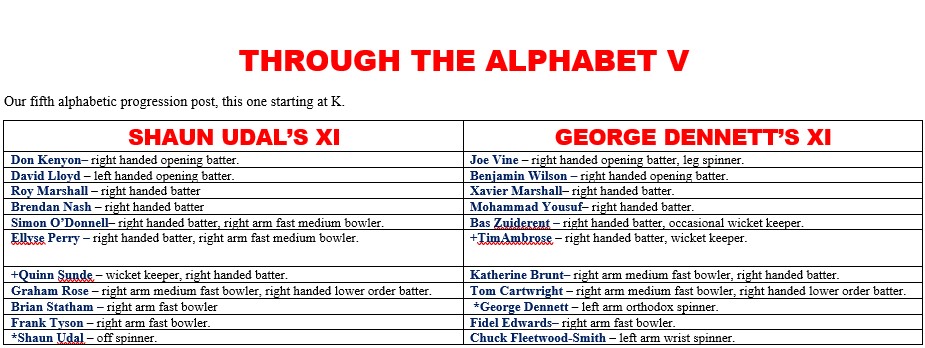
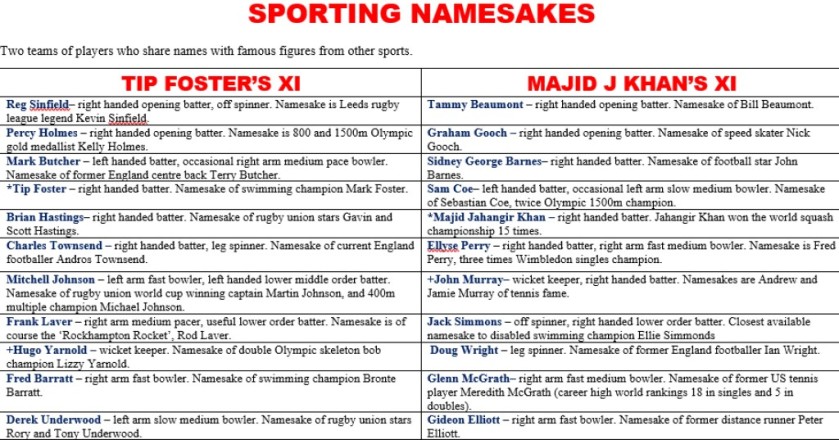
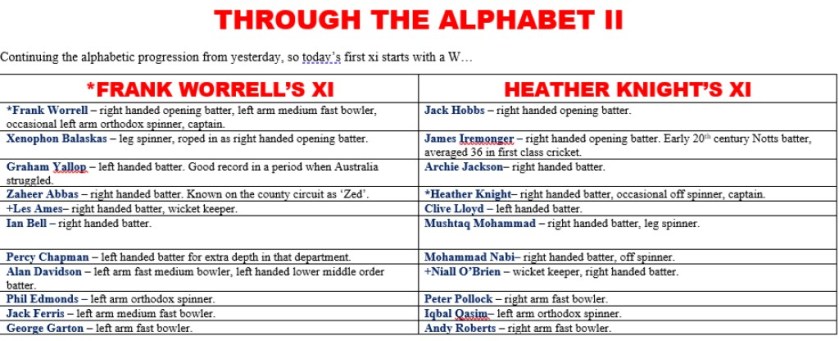
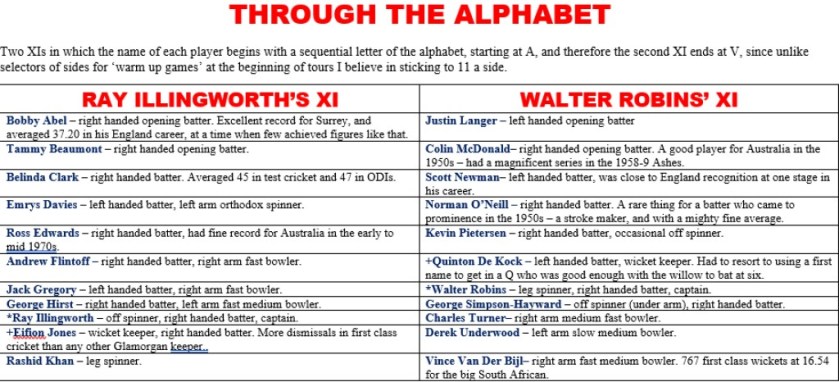
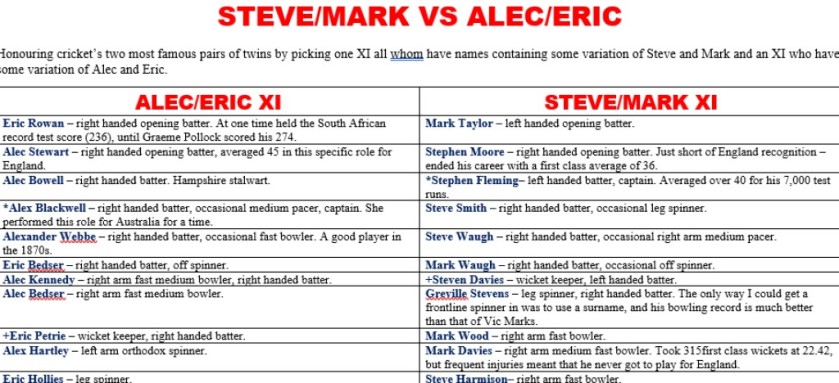
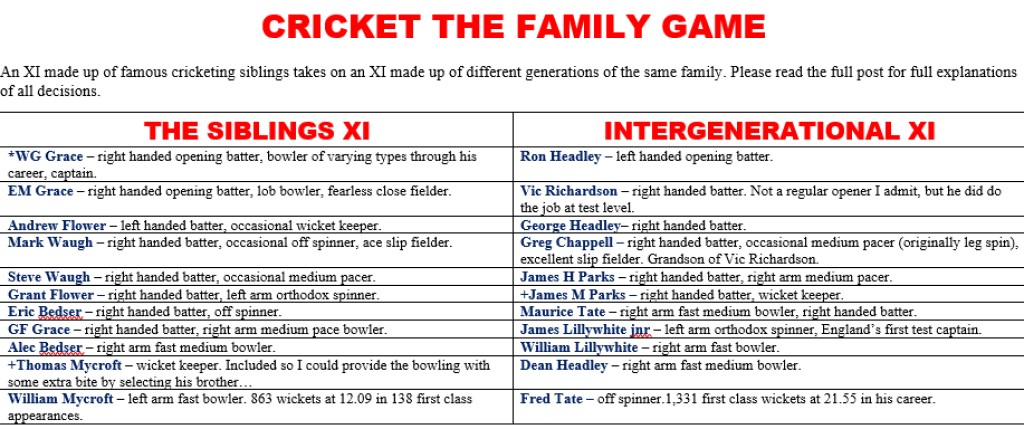
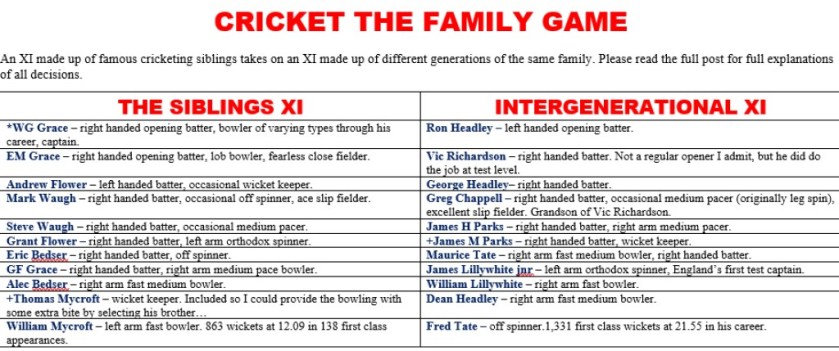
The teams in tabulated form.

All Time XIs – The Minor Nations

Today is ‘international Monday’ in my all time XI cricket series, and I honour some of the finest cricketers to hail from countries who do not dine at cricket’s top table.

INTRODUCTION

Today is Monday, and our ‘all time XI’ series of cricket posts usually covers an international set up on that day. Today varies the theme by acknowledging various countries who have produced the odd fine player but never a top ranking team. Some of the countries from whom I have selected players have or have had test match status, others aspire to such. I have included one player who actually did play for a major nation over a century before the land of his birth gained test status. The two XIs I have selected are named after their captains.

SHAKIB AL HASAN’S XI

  1. Freddie Fane – right handed opening batter. He played for and captained England in the early part of the 20th century, his international highlight being an innings of 143 against South Africa during the 1905-6 series. He was born in Ireland and is proof that that country has been producing talented cricketers for a long time. He is part of the select group of people to have read their own obituary – his cousin Francis Luther Fane – same initials, middle name and surname, had died, and somebody dug out the wrong obituary. Other members of this club include Mark Twain (“reports of my death have been greatly exaggerated.”)
  2. Tamim Iqbal – left handed opening batter. A man who currently averages 38.64 at test level, probably the classiest batter that Bangladesh have yet produced. Bangladesh’s elevation to test rank came too soon for them, and their record shows this only too clearly. They may eventually become a force to be reckoned with.
  3. *Shakib Al Hasan – left handed batter, left arm orthodox spinner, captain. I have awarded him the no3 slot from where he had such a marvellous 2019 World Cup. He is currently serving a suspension for failing to report an unathorised approach from a bookmaker, but there is no suggestion that he has actually been involved in any sort of fixing, he appears to have accepted his punishment with good grace, and he had done enough before his fall from grace to earn his place.
  4. Andrew Flower – right handed batter, occasional wicket keeper. The only Zimbabwean to ever be ranked world no 1 batter, he averaged over 50 in test cricket. He subsequently had a very successful career as coach, including guiding England to the world no 1 test ranking, a position they achieved in 2011.
  5. Steve Tikolo – left handed batter, occasional off spinner. His country, Kenya, have never had test status, but they rank fairly high in ODI cricket. Tikolo’s first class average of 48 is far in excess of his record in short form cricket, and suggests someone with the class and the temperament to succeed at the highest level.
  6. Alec O’Riordan right handed batter, left arm fast medium bowler. His first class record looks modest, but his mere 25 appearances at that level were spread across 15 years. He was the first, and for many years, the only person to have both scored 2,000 runs and taken 200 wickets for Ireland. His finest hour came at Sion Mills in 1969, when he combined with his skipper Doug Goodwin to dismiss the West Indies for 25 (and 13 of those runs came for the last wicket!) Ireland overhauled this total for the loss of one wicket, declared later in the day and took a few more West Indies wickets, Goodwin finishing with match figures of 7-7. It was scheduled to be a one innings per side match, so the result appears in the book as Ireland beat West Indies by nine wickets – everything that happened after Ireland had reached 26 was merely to give the crowd their money’s worth.
  7. +Mushfiqur Rahim – wicket keeper, right handed batter. He averages 36.77 in test cricket and is excellent behind the stumps. If a world XI of current test players was being picked he would be in the mix for the gloves – BJ Watling of New Zealand also has a good claim, and were he the incumbent Ben Foakes of England would be there as well.
  8. Mehidy Hasan – off spinner, right handed batter. Another Bangladeshi, and provenly capable of match winning performances – just ask England.
  9. Bart King – right arm fast bowler, right handed batter. The greatest cricketer ever produced by the US. His 415 first class wickets came at 15.66 each, and he also averaged 20 with the bat. He was one of the pioneers of swing bowling. At one time, thanks to the efforts of King and his fellow Philadelphians the US was not all that far from test match status. WG Grace toured North America in 1872-3 and was favourably impressed, though he expected bigger things from the Canadians than from the US.
  10. Rashid Khan – leg spinner, useful lower order batter. He has already experienced some success in the test arena (23 wickets at 21 each in four matches) although most of the cricket he plays is short form – I would applaud any county who had the courage to offer him a contract as their official overseas player for a whole season. He is the finest talent to emerge from Afghanistan to date, although as we shall see not the only one.
  11. Mashrafe Bin Mortaza – right arm fast medium bowler. He went on a little too long at the top, but in his prime he was decidedly sharp, and remains the best pace bowler to have come from Bangladesh.

This team has a solid batting line up, two genuine all rounders, a top keeper who can bat and lots of variety in the bowling: Right arm pace from King and Mortaza, left arm pace from O’Riordan, leg spin from Rashid Khan, off spin from Mehidy Hasan and left arm orthodox spin from Shakib Al Hasan.

MURRAY GOODWIN’S XI

  1. Jeremy Bray – left handed opening batter. He was of that generation who put Ireland firmly on the cricketing map but for whom test cricket came just too late. Am average of 52 in first class cricket suggests that he would have fared well at test level.
  2. Hazratullah Zazai – left handed opening batter. A first class average of 38, yet to get his chance in the test arena. His aggressive approach should complement the more old school approach of Bray nicely.
  3. Dave Houghton – right handed batter. One of Zimbabwe’s best, he once scored 266 in a test match, and averaged 43 in that form of the game.
  4. Mominul Haque – left handed batter. One of the few Bangladeshis to average over 40 in test cricket.
  5. *Murray Goodwin – right handed batter, captain. He played for Zimbabwe, once scoring a century against England in a test match. He retired early from international cricket, and proceeded to churn out bucketloads of runs for Sussex, including a county record 335 not out which secured them their first county championship (a feat they repeated twice in the following three seasons).
  6. Manjural Islam Rana – left handed batter, left arm orthodox spinner. He died in a road accident at the age of 23, but even at that young age he was averaging 36.26 with the bat and 25.97 with the ball in first class cricket – figures that suggest that had he survive Bangladesh may have had two Shakib Al Hasan type cricketers available to them.
  7. +Niall O’Brien – wicket keeper, right handed batter. Ireland’s elevation to test status came too late for him, but a first class batting average of 35.51 and 540 dismissals in 176 matches are some testament to his skill.
  8. Heath Streak – right arm fast medium bowler, useful lower order batter. Zimbabwe’s finest test bowler, with 216 wickets at 28 each at that level. He played county cricket for Warwickshire, once combining a half century with a 13 wicket match haul.
  9. Dawlat Zadranright arm fast medium bowler. So far the only pace bowler of indisputable class to have come out of Afghanistan.
  10. Sandeep Lamichhane – leg spinner. Almost all his cricket has been played over limited overs, but his record in both List A and T20 is outstanding, and I would love to see him gain first class experience – I would applaud any county who signed him as their official overseas player. Nepal are not currently in the running for test status, and it takes a lot more than one player to make a case. Bangladesh and Ireland have both suffered from mistimed promotions – in Ireland’s case the promotion was confirmed just as the generation who had really earned it were bowing out, while Bangladesh’s came without sufficient scrutiny of their domestic structure. On overseas players I would add that is unlikely that a top player from really top ranking nation will be available for a whole season as they will have other commitments, and I would prefer a calculated gamble on a youngster who may well improve such as Rashid Khan, Sandeep Lamichhane or indeed the chap I will be mentioning next to the signing of someone who is established as not quite being top drawer. I would also say that an overseas player should not be signed just to tick that particular box – one should be certain they are bringing something to the squad that is not already available.
  11. Zahir Khan – left arm wrist spinner. We end with another Afghan (not be confused with Zaheer Khan, the Indian former left arm quick bowler), and another who has had little exposure to long form cricket and is still well and truly young enough to learn. Afghanistan’s promotion to test status appears to have been managed very well, and they recorded a victory in their second game at that level, the earliest time of such an achievement since 1877, when Australia won the first ever test match and England the second. Although they were winless in the 2019 World Cup they had their moments along the way, and I shall not be unduly surprised if in years to come we see an Afghanistan side that is truly a force to be reckoned with.

This side has a solid top six including a genuine all rounder, a keeper who can bat and four varied bowlers. There is no front line off spin option, but there are three very distinctive and different styles of spin represented. Heath Streak and Dawlat Zadran should make a good new ball pairing.

LINK AND PHOTOGRAPHS

Richard Murphy of Tax Research UK has produced a brilliant diagram comparing outdated beliefs about money with modern understandings of the same. I urge you to view the full post in its original setting by clicking on the screenshot below.

OB v NU

Now it is time for my usual sign off…

IMG_0738 (2)IMG_0739 (2)IMG_0740 (2)IMG_0741 (2)IMG_0743 (2)IMG_0744 (2)IMG_0745 (2)IMG_0746 (2)IMG_0747 (2)IMG_0748 (2)

IMG_0760 (2)
I ventured out for a walk today, taking good care to go nowhere that might be crowded, and got some good pics along the way.

IMG_0761 (2)

IMG_0762 (2)
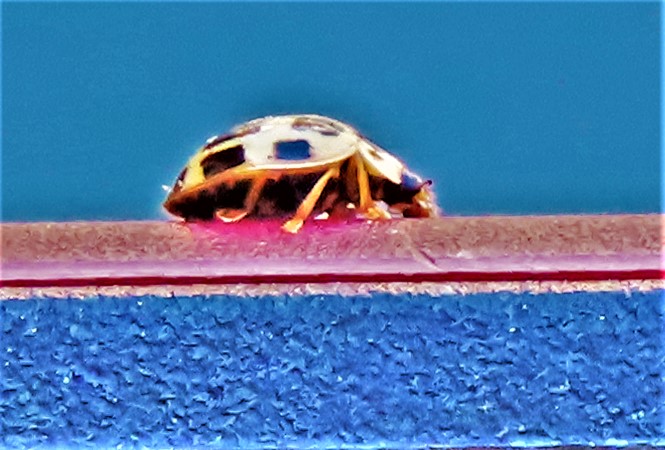
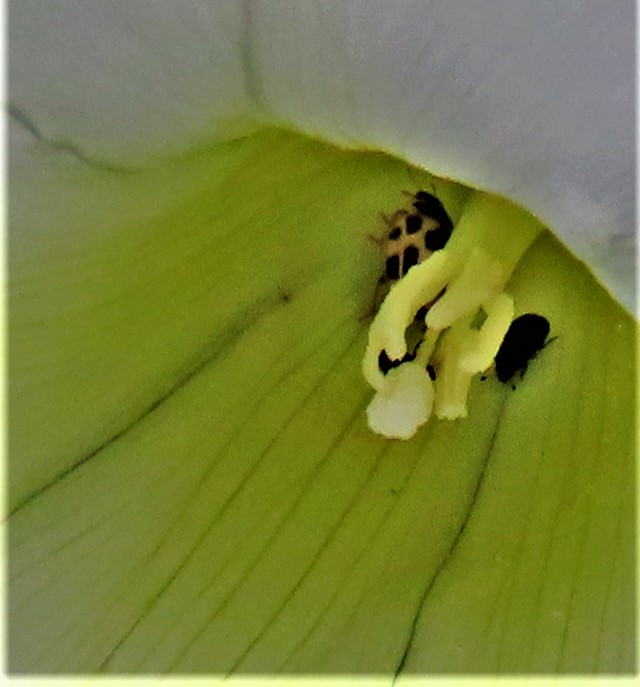
A ladybird and…
IMG_0762 (3)
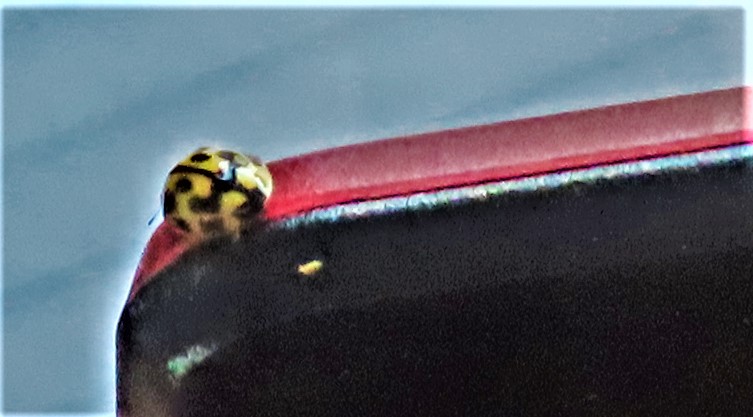
…what I believe to a species of shieldbug

IMG_0763 (2)

IMG_0764 (2)
The lavender is in full bloom outside my bungalow, which means lots of bees..

IMG_0766 (2)IMG_0767 (2)IMG_0768 (2)

IMG_0768 (3)
…and other pollinators – this one from the wings and eyes is a tyoe of fly that has evolved to resemble a wasp.
IMG_0769 (2)
Back home, and the weather which had started cloudy cleared (I started today in trousers and jumper, and the clearing of the weather has seen that change into shorts and t-shirt).

IMG_0770 (2)IMG_0771 (2)IMG_0772 (2)IMG_0773 (2)IMG_0773 (3)IMG_0775 (2)

Minor Nations
The teams in tabulated form.

All Time XIs – Globetrotting and Beyond

Today’s all time XI cricket post pits a team of players with names linked to exploration against a team of players who found love while on their travels.

INTRODUCTION

Welcome to today’s all time XI cricket post. Today we have a team of players whose names offer links to people who have played a major role in explorations and a team of players who found love while on their travels.

THE EXPLORATION XI

  1. Marcus Trescothick – left handed opening batter, occasional medium pacer. Averaged 43 in test cricket, and over the course of a lonh and illustrious Somerset career did everything short of win the county championship for them. I have allowed an element of flexibility here – his exploring counterpart is Marco Polo, who documented his experiences of global travel in a book “The Travels of Marco Polo”.
  2. Alastair Cook – left handed opening batter. Scorer of almost 12,500 test runs. In 2010-11 he scored 766 runs in the Ashes series down under, representing the most successfull visit to Australia by anyone named Cook since the days of Captain James Cook and the Endeavour.
  3. Percy Perrin – right handed batter. Scorer of 66 first class centuries. His full name was Percival Albert Perrin, and that connects to Percival Lowell, an enthusiast for space exploration.
  4. Bryan Valentine – right handed batter. A stylish player for Kent for some years, never quite establishing himself at England level. Valentine is also a forename, and in some countries the specifically female version Valentina is used. The first woman in space was Valentina Tereshkova.
  5. *Warwick Armstrong – right handed batter, leg spinner, captain. One of Australia’s finest ever all rounders. He first toured England with Joe Darling’s 1902 squad, and on the 1905 tour he scored over 2,000 runs and rook over 100 wickets in first class matches, also touring in 1909, missing the 1912 tour due to a dispute with the newly established Australian Board of Control (later the Australian Cricket Board and now Cricket Australia), but making a final visit as captain in 1921, by when he was 41 years old, weighed almost 22 stone and was still playing superbly. Gideon Haigh in his book on Armstrong “Big Ship” demonstrates that in those last two years (1920 and 1921) Armstrong scored more runs than Steve Waugh in a comparable period and did more bowling than Shane Warne. His exploration namesake is of course Neil Armstrong, the first person to set foot on a celestial body other than planet Earth.
  6. Alonzo Drake – left handed batter, left arm orthodox spinner. My second all rounder, a man who was denied international status only by the outbreak of World War 1. His doppelganger for this purpose is of course Francis Drake who organized an expedition that circumnavigated the globe when that was a very difficult thing to do, although he himself did not quite complete the journey.
  7. +Hanson Carter – wicket keeper, right handed batter. Australia’s first choice keeper between Jim Kelly and Bert Oldfield. In the second test of the 1907-8 Ashes at Melbourne he guided Australia to 397 in their second dig, setting England 282 for victory. When England lost their eighth second innings wicket at 208 it looked like his batting efforts had helped set Australia up for victory, but Syd Barnes chiselled out an unbeaten 38, batting first with England keeper Joe Humphries and then Arthur Fielder, Gerry Hazlitt panicked when a calm throw the the keeper would have secured test cricket’s first tie and England sneaked it by one wicket. His analogue is another H Carter, Howard, discoverer of the tomb of Tutankhamun.
  8. Xenophon Constantine Balaskas – leg spinner, right handed batter. One could argue given the ‘Anabasis’ that the original Xenophon counts for this purpose, but I am actually using the Russian equivalent of his middle name, which gives us rocketry pioneer Konstantin Tsiolkovsky who played an important role in us taking our explorations beyond our own planet.
  9. Don Shepherd – off spinner, taker of more first class wickets than anyone else who never played test cricket. His name is pronounced the same way as Shepard, as in Alan Shepard, the first USian in space.
  10. Bull’ Alexander – right arm fast bowler. He was one of those Australia might have selected in the 1932-3 Ashes had they opted to meet fire with fire instead of aiming for the moral high ground (Laurie Nash, Jack Scott and Eddie Gilbert were also mentioned in this context). As well as his fast bowling he gets in here as a nod to the great German explorer Alexander Von Humboldt.
  11. Stanley Christopherson – right arm fast bowler. An early England one cap wonder, he took his first class wickets at 21 a piece, though his career was massively shortened by an injury sustained in 1886. His analogue is explorer Henry Morton Stanley.

This is a well balanced team, with everyone down to Balaskas at eight capable of contributing with the bat, and a bowling attack that offers both pace and spin.

12TH MAN & HONOURABLE MENTION

I could have opted for Learie Constantine in place of Xenophon Constantine Balaskas for my link to Konstantin Tsiolkovsky, but preferred the spinner. However, as well as being a fast bowling all rounder Learie Constantine was an outstanding fielder, so rather than just giving him an honourable mention I name him as 12th man (though unfortunately there will be no Ponting in the opposition to provide fireworks in the event of a direct hit run out!). Alf Valentine, the West Indian left arm spinner who took the first eight wickets to fall in the first test innings in which he bowled would be argued by some to have a prior claim over Bryan Valentine, but I needed to strengthen the batting, and not even Alf Valentine’s most devoted fan could claim he would have helped with that.

TRAVELLING ROMANCE XI

  1. Andrew Strauss – left handed opening batter. Born in South Africa, played for an captained England, and married an Australian.
  2. Archie MacLaren – right handed opening batter. He had a tremendous time with the bat on the 1897-8 tour of Australia, and it was also in Australia that he met the woman who became Mrs MacLaren.
  3. Wally Hammond – right handed batter, right arm medium fast bowler. He married his first wife for money, and that marriage did not work out well. The second Mrs Hammond was a South African beauty queen whose birth name was Sybil Ness-Harvey. The surprise given what is known of how Hammond conducted his personal life is that there were only the two Mrs Hammonds.
  4. *Ivo Bligh – right handed batter, captain. After England’s dramatic loss at The Oval in 1882 and the subsequent mock obituary of English Cricket in The Sporting Times, Bligh assembled a team to travel to Australia and win back what he called ‘The Ashes of English Cricket.” While on this tour, which had a successul playing outcome, Bligh stayed at Rupertswood, a luxurious house owned by Victoria’s wealthiest family. Florence Rose Morphy, a young woman of Irish ancestry, was employed there as governess/ music tutor. She was one of a group of ladies who presented Bligh with the famous urn that England and Australia have fought over ever since (no one has ever established what the ashes actually are – there are conflicting claims). Ms Morphy evidently made a huge impression on Bligh because they ultimately married. The one time governess/ music tutor ended her life as Dowager Countess of Darnley. Although his playing record was not great his historical significance means that he has to be captain of this side.
  5. Percy Chapman – left handed batter. The fifth successive batter in our order to have captained England, and he won his first eight matches as test captain (The Oval 1926, a 3-0 triumph in the West Indies first ever test series in 1928 and the first four matches of the 1928-9 Ashes). He married the sister of New Zealand batter Tom Lowry.
  6. Gilbert Jessop – right handed batter, right arm fast bowler. Jessop was travelling to Australia for the 1901-2 Ashes when an allegedly errant throw by him during a deck game hit the handbag of a female passenger. There are those familiar with Jessop’s fielding who reckon that the throw must have been intentional. Whether it was intentional or not it worked well for Jessop, since he and the young woman, named Millicent, got talking, and ultimately they married.
  7. +David Murray – wicket keeper, right handed batter. A West Indian keeper who married an Australian woman, a story mentioned by Rodney Marsh in “Inside Edge” while explaining why he was not going to play in South Africa at that time (then Aussie PM Malcolm Fraser had threatened Murray that if he went he would not be allowed back into Australia).
  8. John  Emburey – off spinner. He married an Australian – he missed a first class game on the 1986-7 Ashes tour in order to spend more time with her and her family in Melbourne.
  9. Gladstone Small – right arm fast medium bowler. Noted for his apparent lack of a neck (actually he was born missing one of the vertebrae in his neck, which means that it looks like his head is resting on his chest), the Barbadian born England bowler married an Australian.
  10. Frederick Spofforth – right arm fast bowler (developed variations later in his career). Australia’s first great bowler, he married an English woman (her father ran a tea trading company which passed in due time to Spofforth, who left an estate worth £164,000 – about £7,000,000 in today’s money).
  11. Glenn McGrath – right arm fast medium bowler. The first Mrs McGrath, in whose memory the McGrath Foundation was established) was an English woman.

This is a respectable team, although the bowling lacks spin options, with only Emburey in that department. Only the top three are unquestionably of test standard with the bat, but a side with Emburey at no8 cannot be said to be hopelessly weak in that department.

THE CONTEST

This is a good contest, though I think the ‘Exploration XI’ have the edge – and if the surface offers any turn they will definitely be favourites, with Shepherd, Drake, Balaskas and Armstrong to exploit such a surface while the ‘Travelling Romance XI’ have only Emburey as a counter of their own.

PHOTOGRAPHS

Having introduced today’s contest and presented the two teams it remains only for me to apply my usual sign off…

IMG_0718 (2)IMG_0719 (2)

IMG_0720 (2)
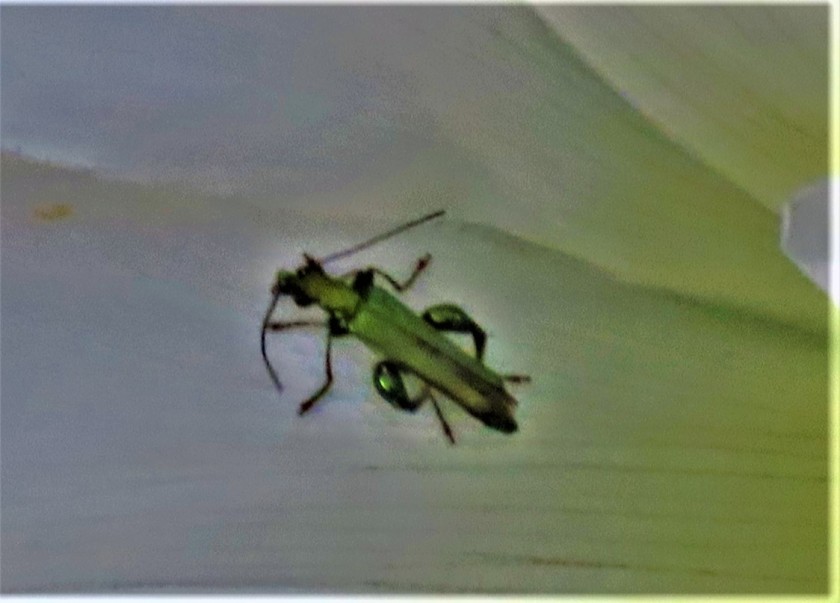
This was a good tweet by the cricketmen, but it was mainly the bug that interested me in photographic terms…

IMG_0720 (3)IMG_0721 (2)IMG_0722 (2)

IMG_0723 (2)
….various close ups

IMG_0724 (2)IMG_0725 (2)IMG_0726 (2)IMG_0727 (2)IMG_0728 (2)IMG_0731 (2)IMG_0732 (2)IMG_0733 (2)IMG_0734 (2)IMG_0736 (2)IMG_0737 (2)

Globetrotting
The teams in tabulated form.

All Time XIs – STEM Challenge

Today’s all time XI cricket post features two teams assembled to fight out a STEM challenge.

INTRODUCTION

Welcome to the latest installment in my all time XI cricket series. Today the focus is on cricketers whose names link to STEM subjects.

MATHEMATICAL XI

  1. Alec Stewart – right handed opening batter. As I have previously mentioned he averaged 45 for England in this specific role. Undoubtedly his greatest moment as opener came at Barbados in 1994. England had just lost the Trinidad test match, collapsing to 46 all out in pursuit of a target of 194, and nobody had beaten the West Indies at Barbados since 1935. Stewart responded to the challenge with 143 and 118, and England duly won the match.His analogue is Ian Stewart, author of a number of excellent books about mathematics.
  2. Bobby Abel – right handed opening batter. The first ever to carry his bat through an England innings, and holds the record for carrying his bat through the largest first class innings (Surrey 811 all out v Somerset, Abel 357 not out). His alter ego for this purpose is Norwegian mathematician Niels Henrik Abel.
  3. Carole Hodges – right handed batter, off spinner. A fine all rounder whose regular batting position this was. Her alter ego is Andrew Hodges, author of a book titled ‘One to Nine’.
  4. Stan McCabe – right handed batter, right arm medium fast bowler. An Aussie legend of the 1930s, author of three of the greatest test innings ever played – 187 at Sydney in the first match of the 1932-3 Ashes, 189 not out vs South Africa facing a target of over 400, and playing so brilliantly that the SA captain appealed against the light, and 232 not out at Trent Bridge in 1938, when Bradman called his team out on to the balcony on the grounds that they would probably never see anything like this again. George McCabe did some work on the mathematics of lottery wins.
  5. Harry Graham – right handed batter. A century on test debut at Lords, a feat no repeated at that ground until John Hampshire in 1969. His alter ego is Ronald Graham, he worked out Graham’s number, which is so huge that it could never be written out in full. More about this number and its significance here.
  6. *George Frederick Grace – the youngest Grace of WG’s generation, he was one of the leading all rounders of the 1870s. A freak illness killed him at the age of 29. I have given him his full name to set the stage for the explanation of an admittedly tenuous piece of linking. His middle name of Frederick is the English version of Friedrich and his surname begins with a G, which is just enough, given who I am linking to to give a nod to Carl Friedrich Gauss, one of the greatest of all mathematicians. Gauss showed his brilliance as a child, when his teacher set the class to add up all the numbers from 1 to 100. The teacher was expecting a long break while the students worked on this task, but Gauss realized that the problem could be viewed as 50 pairs of numbers which summed to 101, in otherwords 50 x 101 = 5,050, and was finished very quickly. Later in his life Gauss correctly calculated the orbit of Ceres and told astronomers where they needed to look with their telescopes to see it again.
  7. +Mark Wallace – wicket keeper, left handed batter. A very fine player for Glamorgan who never quite managed to attract the attention of the England selectors. His alter ego is David Foster Wallace, author of a biography of Georg  Cantor.
  8. Graham Napier – right arm medium pace bowler, right handed batter. He was better at limited overs cricket than long form, but he did once hit 17 sixes in a first class innings against Surrey. His analogue is John Napier, pioneer of logarithms.
  9. Jack Newman – right arm fast medium bowler, useful lower order batter. He abd Alec Kennedy carried the Hampshire bowling load together for many years. He is in here as analogue to James Newman who edited a book called ‘World of Mathematics‘.
  10. Srinivas Venkataraghavan – off spinner. One of the great Indian spin quartet of the 1970s, and later a fine umpire. His analogue is Srinivasa Ramanujan, a great Indian mathematician of the early 20th century.
  11. Sophie Ecclestone – left arm orthodox spinner. The women these days play very little test cricket, but she has had considerable success in the shorter forms, especially given how young she still is. She is here because she shares a first name with Sophie Germain, a great French mathematician who has a class of prime numbers named in her honour. A Sophie Germain prime is a prime number which when you double it and add one gives another prime. There are Sophie Germain prime sequences, where each number obtained by this process is a prime – one well known example goes 89, 179, 359, 719 and 1439 – 2,879 is not itself a Sophie Germain prime because 5759 is equal to 443 x 13.

This team has a good top five, an all rounder at six, a keeper who can bat, and four varied bowlers. There is a lack of genuine pace, but otherwise the bowling looks respectable.

 AN HONOURABLE MENTION

I could also have got the Sophie Germain reference in by picking New Zealand pace bowling all rounder Sophie Devine. I reckoned that selecting the spinner made for a more balanced team.

THE SCIENCES XI

  1. Alan Jones – right handed opening batter, more first class runs than anyone else who never played test cricket. His analogue is evolutionary biologist Steve Jones.
  2. Mike Norman – right handed opening batter. Had a long career with first Northamptonshire and then Leciestershire. He owes his place here to David Norman, author of several paleontology books. He has a subversive streak, and carried out a thought experiment in evolution based on the dinosaurs not going extinct, arriving at the conclusion that one particular lineage of dinosaurs might have arrived at a large brained biped 40 million years ago.
  3. Kepler Wessels – left handed batter. The only player to have scored over 1,000 runs for each of two different countries. His scientific namesake is the one and only Johannes Kepler.
  4. Arthur Ridley – right handed batter, occasional fast bowler. He shared the largest partnership of the 1878 match between MCC and Australia, 22 with AN Monkey Hornby. At 27-2 in the MCC first innings Frederick Robert Spofforth was called up for a bowl, and took 6-4, causing the last eight wickets to crash for six runs. In the second innings after Australia had eked out a lead of eight Spofforth and Boyle opened, Spofforth taking 4-16 and Boyle 6-3, as MCC crashed for 19, making 18 wickets for 25 runs. He has two namesakes from the world of biology, Matthew and Mark Ridley.
  5. *Jack Mason – right handed batter, right arm fast medium bowler., captain. A fine record which would have been greater still had he not retired to concentrate on his career as a solicitor at the age of 28. Stephen Mason is the author of “A History of Science.”
  6. +John Hubble – right handed batter, wicket keeper. Kept for Kent between Frederick Huish and Les Ames. His namesake is the legendary Edwin Powell Hubble.
  7. Alonzo Drake – left handed batter, left arm orthodox spinner. A remarkable career, ended by World War 1 – in the last two months of his professional career he collected 85 wickets in first class matches and played some crucial innings. His namesake is Frank Drake, creator the Drake Equation, which may ultimately enable the calculation of the likelihood of extraterrestrial civilisations (at the moment the error bars on many of the terms are simply too large for it to of any real value).
  8. Jack Gregory – right arm fast bowler, left handed batter. In first class cricket he averaged 36 with the bat and 20.99 with the ball, while in test cricket he paid 30 per wicket. He formed one half of test cricket’s first great fast bowling partnership, with Ted McDonald. Skipper Warwick Armstrong deployed them with such ruthlessness that Australia won eight straight matches in 1920 and 1921, before a combination of Phil Mead’s batting and some inclement English weather allowed the last two matches of that series to be drawn.His namesake is Andrew Gregory, author of “Eureka! the birth of science”, a title inspired by the great Archimedes of Syracuse.
  9. Harry Boyle – right arm medium pace bowler. Yes, the self same Boyle who combined with Spofforth to dismiss MCC for 19 on that famous day in 1878. His namesake is Robert Boyle, famous for Boyle’s law.
  10. Ken Higgs – right arm fast medium bowler. A successful bowler for first Lancashire and then Leciestershire, including playing for England at one point  He gets in here as namFesake to Peter Higgs, of Higgs boson fame (incidentally the word boson for that class of particles derives from Indian scientist Satyendra Bose).
  11. Bhagwath Chandrasekhar – leg spinner. Among bowlers who never played county championship cricket only Clarrie Grimmett, also a leg spinner, took more first class wickets. His namesake is Subrahmanyan Chandrasekhar, after whom the Chandrasekhar limit (the most mass a white dwarf can have before gravity causes to collapse an form a neutron star) is named.

This side has a respectable top order, genuine all rounders in Hubble, Drake and Gregory and three varied bowlers. Higgs, Gregory, Boyle, Chandrasekhar and Drake looks a good and well balanced bowling unit.

AN HONOURABLE MENTION

Folk whose vision is particular strong in the green and gold regions of the spectrum will be aware of Jim Higgs, a fine leg spinner of the 1970s, and a candidate for Peter Higgs’ namesake. I felt that with one leg spinner and absolutely blown in the glass no 11 already inked in for selection that fast medium bowler Ken was a better pick in terms of balance.

THE CONTEST

This should be a good contest – the general science XI has a slightly better balance to it, and in Jack Gregory the only serious pace available to either side, but the mathematical team is definitely stronger in batting. Also, the fact that Hodges (especially) and McCabe among the the mathematical team’s top batters are genuine bowling options partially makes up for their lack of pace, and at least with Venkataraghavan, Ecclestone and Hodges bowling varieties of spin it is not all going to be workaday medium pace.

LINK AND PHOTOGRAPHS

I have introduced my two teams for today’s STEM contest, but before I sign off, Richard Murphy of Tax Research UK has being running a ‘mythbuster‘ series of posts on his blog, and his latest such takes on the ‘National Debt‘. Now we have reached time for my usual sign off…

IMG_0698 (2)IMG_0699 (2)IMG_0700 (2)IMG_0701 (2)IMG_0702 (2)IMG_0704 (2)IMG_0705 (2)IMG_0706 (2)IMG_0707 (2)IMG_0709 (2)IMG_0711 (2)IMG_0712 (2)IMG_0713 (2)

STEM
The teams in tabulated form.

All Time XIs – Mixed Chirality

Today’s ‘all time’ XI circket themed posts focusses on players who batted and bowled with different hands. Also contains a couple of links and some photographs.

INTRODUCTION

Welcome to today’s variation on an all-time XI cricket theme. As hinted at yesterday, today we look at players who bat and bowl with different hands.

THAT WORD CHIRALITY

I have borrowed this from the realm of chemistry. Here is an official definition – screenshot below:

Chirality

BATTED LEFT AND BOWLED RIGHT XI

  1. Matthew Hayden – left handed opening batter, very occasional right arm medium pace bowler. He averaged 50 with the bat in test cricket with the bat. He did bowl at that level as well, but never picked up a wicket.
  2. Alastair Cook – left handed opening batter, very occasional off spinner. Bizarrely has one of the most economical wicket taking averages of all in test cricket – his one visit to the bowling crease in his long career yielded him figures of 1-7, an average of 7.00. He scored nearly 12,500 runs at 45 as a batter, including a 50 and a century on debut against India, and the same double in his last match against the same opponents 12 years later.
  3. Brian Lara – left handed batter, very occasional leg spinner. Holds world record individual scores at both test and first class level.
  4. Graeme Pollock – left handed batter, very occasional leg spinner. Averaged 60.97 in his test career, before his country’s isolation brought the curtain down on it.
  5. Shivnarine Chanderpaul – left handed batter, occasional leg spinner. Possessor of one of the most unusual of all batting stances – and opponents have been given plentiful opportunities to study it at length. 
  6. *Ben Stokes – left handed batter, right arm fast bowler. The ultimate big occasion player. I have named as captain of this team, a role he is due to assume later this year on a temporary basis, while Joe Root is with his wife for the birth of their child.
  7. +Adam Gilchrist – left handed batter, wicket keeper, very occasional off spinner. He bowled two overs in all senior first team cricket across the formats, and they were classed as off spin.
  8. Richard Hadlee – right arm fast bowler, left handed lower middle order batter. Quite simply his country’s G.O.A.T.
  9. Bill O’Reilly – leg spinner, left handed lower order batter. One of the greatest of all bowlers, rated by Bradman as the best he ever saw or faced. His batting highlight was an unbeaten 30 in the third test of the 1930 Ashes, which prevented Australia from having to follow on, after his narrow failure to do the same at Lord’s had led to them suffering an innings defeat. Avoiding the follow on meant that Australia saved that match, and after a draw in the 4th match they won at The Oval to regain the Ashes.
  10. Curtly Ambrose – right arm fast bowler, left handed tail end batter. One of the greatest of all fast bowlers, taking his wickets at under 21 a piece in test cricket, the most economical rate of anyone to have taken 400 or more.
  11. James Anderson – right arm fast medium bowler, left handed tail end batter. England’s all time leading test wicket taker, currently on 584 and officially still counting.

This team has an excellent top five, the ultimate x factor all rounder, a keeper batter, and four excellent bowlers. There is only one genuine spin option, O’Reilly, but overall the bowling is pretty impressive.

THREE NEAR MISSES

Stuart Broad, right arm fast medium bowler and left handed lower order batter, came close, but I do not think one could seriously pick him ahead of Ambrose. Stan Nichols and Jack Gregory were both attacking left handed batters who regularly bowled right arm fast with the new ball, but they hardly challenge Stokes and Hadlee.

BATTED RIGHT AND BOWLED LEFT XI

  1. Wilfred Rhodes – right handed opening batter, left arm orthodox spinner. 39,807 first class runs, 4,187 first class wickets. In one of the many phases of his extraordinary career he was effectively a specialist batter, opening for England with Jack Hobbs, and being number two in the batting averages as well.
  2. Vinoo Mankad – right handed opening batter, left arm orthodox spinner. He once scored 184 and 72 either side of a five wicket haul. He amassed four double centuries in his test career, including what was then the Indian record of 231, when he and Pankaj Roy put on 413 for the first wicket.
  3. *Frank Worrell – right handed batter, left arm medium fast bowler, occasional left arm orthodox spinner, captain. Averaged 49.48 in test cricket, was the first black captain of the West Indies.
  4. Denis Compton – right handed batter, left arm wrist spinner. Averaged 50 in his test career, and fared respectably with his wrist spin, which he developed after a tour to Australia in which he noticed how many Aussies were good at more than one department. He chose left arm wrist spin because he was impressed by Chuck Fleetwood-Smith, a specialist bowler in that style.
  5. Charlie Macartney – right handed batter, left arm orthodox spinner. Averaged 41.78 with the bat, including three successive centuries in the 1926 Ashes. Also had a ten wicket match haul with his left arm spin.
  6. +Sarah Taylor – wicket keeper, right handed batter. I could not find a high class keeper who batted right handed and was an occasional left arm bowler, so I went for one who batted right handed and never bowled a ball in senior first team cricket (and who happens to be one of the two best English keepers I have ever seen in action).
  7. George Hirst – right handed batter, left arm fast medium bowler. One of the greatest of all all rounders. When he and Rhodes, known as the ‘Kirkheaton twins’ because they both hailed from that village, were in the prime there was a famous joke quiz question “who is the world’s best all rounder?” The only definitive answer to which was “he comes from Kirkheaton, bats right handed and bowls left, and beyond that we cannot go.” Hirst was always inclined to award Rhodes the palm, while Rhodes, cagier (he was after all the original author of the definitive Yorkshire phrase “we doan’t play it for foon, tha knows”), always refused to be drawn.
  8. Frank Foster – right handed batter, left arm fast medium bowler. He and Sydney Barnes (32 and 34 wickets respectively) were the bowling force behind arguably England’s greatest ever series performance in Australia, the 4-1 win in 1911-2 against a definitively full strength Aussie side, which held the Ashes going into that series. Foster was also a very fine batter, the first Warwickshire player to score a treble century, and captain of their first ever championship winning side.
  9. Hedley Verity – left arm orthodox spinner, right handed lower order batter. 1,956 first class wickets at 14.90, 144 of them at 24 in test cricket. Although definitely not a genuine all rounder he did have some useful batting performances to his credit, including stepping in as emergency opener for England and seeing through a dangerous period. He never managed the season double of 1,000 runs and 100 wickets, tallying just over 800 in his best batting season.
  10. Derek Underwood – left arm slow medium bowler, right handed tail end batter. A very economical bowler, rarely collared even on the flattest of pitches and a destroyer on a rain affected pitch (and also the match winner on the only documented fusarium affected pitch in test history, at Headingley in 1972). He did eventually register a first class ton, near the end of his long career, but there was never any serious chance of him being considered an all rounder.
  11. William Mycroft – left arm fast bowler, right handed tail end batter. He flourished just before test cricket was a thing, but 138 first class matches brought him 863 wickets at 12.09 each. 791 runs at 5.34 over the same period makes him not so much a rabbit in that department as a ferret (the one who comes after the rabbits).

This team has a respectable opening pair, an excellent 3,4 and 5, a superb keeper batter, two of the greatest of all all rounders, and three excellent specialist bowler. It commands the full range of left arm bowling from outright pace (Mycroft) through fast medium (Hirst and Foster), medium fast (Worrell), slow medium (Underwood) and spin (Verity, Rhodes, Mankad and Macartney bowling the orthodox variety, Compton wrist spin).

A NEAR MISS

Chuck Fleetwood-Smith, a left arm wrist spinner, came very close to selection, but I felt that with Compton in the side, Underwood’s slow-medium craft and guile offered me an extra variation.

THE CONTEST

The contest would be a good one. I think that the bowling options possessed by the batted right, bowled left brigade just give them the edge, but it is a very close call.

SPORTING AMBIDEXTERITY

The first Dr Grace, WG’s father, was a moderate cricketer, but noted for one peculiarity – although he insisted on batting right handed, he bowled and threw with his left. There are stories of Hanif Mohammad bowling with both hands at club level, and even snagging a wicket left handed. Neil Harvey, a great left handed batter, was right handed for everything other than cricket. I have yet to locate a cricketer who actually had bowling styles with each arm at first class level, but ambidexterity is positively encouraged these days, so it is probably just a matter of time. In other sports golfer Phil Mickelson plays left handed while being right handed everywhere other than the golf course. Snooker legend ‘Rocket’ Ronnie O’Sullivan regularly plays left handed shots in championship matches, and has apparently made entirely left handed century breaks in less exalted settings. Moving back to cricket, the sideways on stance used by almost all batters means that a right handed batter sees the ball mainly with their left eye, while a left handed batter sees it mainly with their right eye (this is why the Nawab of Pataudi junior, aka Mansur Ali Khan, could return to top level cricket after losing his right eye in an accident but Colin Milburn, another attacking right handed batter, could not do so after losing his left.

LINKS AND PHOTOGRAPHS

The statue of slave trader Robert Milligan has recently been removed from its plinth in West India dock in response to public pressure. Now there is a petition for its place to be taken by a memorial honouring writer and abolitionist Olaudah Equiano, which you can sign and share here.
Equiano

APF News Agency have produced this splendid infographic about Britain and the slave trade:

BST

Now it is time for my usual sign off…

IMG_0673 (2)IMG_0674 (2)IMG_0675 (2)IMG_0677 (2)IMG_0678 (2)IMG_0680 (2)IMG_0681 (2)IMG_0682 (2)IMG_0683 (2)IMG_0684 (2)IMG_0685 (2)IMG_0686 (2)IMG_0687 (2)IMG_0688 (2)IMG_0689 (2)IMG_0690 (2)IMG_0691 (2)IMG_0692 (2)IMG_0693 (2)IMG_0694 (2)IMG_0695 (2)IMG_0696 (2)

IMG_0697 (2)
Radioactive clocks, from Dawkins’ “The Greatest Show on Earth”.
Mixed Chirality
The teams in tabulated form.


All Time XIs – Left Hand v Right Hand

Today’s ‘all time XI’ cricket post sees a team of left handers take on a team of right handers.

INTRODUCTION

Welcome to today’s ‘all time XI‘ cricket themed post. Today we have a team who did everything right handed against a team who did everything left handed, and a guessing game – based on some of my explanations can you work out what tomorrow’s post will be?*

THE LEFT HANDED XI

  1. Arthur Morris – left handed opening batter, very occasional left arm wrist spin. Rated by Bradman as the best left handed opener he ever saw. Morris the bowler was in action when Compton hit the four that won the 1953 Ashes.
  2. Sanath Jayasuriya – left handed opening batter, left arm orthodox spinner.
  3. Frank Woolley – left handed batter, left arm orthodox spinner.
  4. Martin Donnelly – left handed batter, very occasional left arm orthodox spinner. He averaged 52.90 in his very brief test career, including 206 v England at Lord’s in 1949.
  5. *Allan Border – left handed batter, occasional left arm orthodox spinner, captain. The guy who if the first three wickets fall quickly will dig the team out of the hole, while also being capable of playing very aggressively if circumstances warrant. 
  6. Garry Sobers – left handed batter, left arm bowler of every type known to cricket. The most complete all rounder ever to play the game. His 254 for Rest of the World v Australia in the series that replaced the 1971-2 Australia v South Africa series was rated by Bradman as the best innings he ever saw played in Australia.
  7. +Steven Davies – wicket keeper, left handed batter. Once seen as England material he did not quite kick on. He has never bowled a ball of any kind in senior first team cricket.
  8. Wasim Akram – left arm fast bowler, left handed lower middle order batter. An ideal number eight, who meets all the qualification criteria for this XI.
  9. Mitchell Johnson – left arm fast bowler, useful left handed lower order batter. A cricketing version of the ‘little girl with the curl’ – when he was good he was very good indeed, when he was bad (e.g Brisbane, Melbourne and Sydney in the 2010-11 Ashes) he was awful. Having listened to a number of them I consider his good times to be good enough to warrant his inclusion.
  10. Johnny Wardle – left arm orthodox spinner, left arm wrist spinner, left handed lower order batter. 102 test wickets at 20.39, in spite of often missing out to make way for Tony Lock, and his career ending early due to a fall out with authority.
  11. Fred Morley – left arm fast bowler, left handed genuine number 11 batter. Took his first class wickets at 13 a piece, and his four test appearances netted him 16 wickets at 18.50 (he died at the age of 33, in 1884, hence the brevity of his test career).

This team has an excellent batting line up, and with Wasim Akram, Mitchell Johnson and Fred Morley to bowl fast and Sobers as fourth seamer, plus Wardle, Woolley, Sobers and Jayasuriya as front line spin options the bowling is none too shabby either.

NOT QUALIFIED

Among the specialist batters who did not qualify were Graeme Pollock, Brian Lara, Shivnarine Chanderpaul and Alastair Cook who all bowled their few deliveries with their right hands. Adam Gilchrist, keeper and left handed batter, bowled only a few balls in his career, but he did so with his right hand, officially described as ‘off spin’. Two of the greatest of left arm orthodox spinners batted right handed, Wilfred Rhodes and Hedley Verity, while the crafty left arm slow medium of Derek Underwood was paired with rather less crafty right handed batting. Left arm fast bowler William Mycroft, who took his first class wickets even more cheaply than Morley, and was a similarly genuine no11, did his batting right handed, and so did not qualify. This little list contains a clue to tomorrow’s post.

RIGHT HANDED XI

  1. Jack Hobbs – right handed opening batter, occasional right arm medium pace bowler.
  2. Herbert Sutcliffe – right handed opening batter, very occasional right arm medium pacer.
  3. *Donald Bradman – right handed batter, occasional leg spinner, captain. The greatest batter of them all, to build on the foundation laid by the greatest of all opening pairs.
  4. George Headley – right handed batter, occasional leg spinner. Averaged 60.83 in test cricket, converting 10 of his 15 50+ scores at that level into hundreds.
  5. Walter Hammond – right handed batter, right arm medium fast bowler, ace fielder. Averaged 58.45 in test cricket, topping 200 seven times at that level, including twice hitting two in succession – 251 at Sydney and then 200 not out at Melbourne in 1928-9 and 227 and 336 not out in New Zealand on the way home from the 1932-3 Ashes.
  6. WG Grace – right handed batter, right arm bowler of varying styles through his career.
  7. +Les Ames – right handed batter, wicket keeper, very occasional leg spinner. Statistically the greatest of all wicket keeping all rounders, and ticks all the qualifying boxes for this team.
  8. Malcolm Marshall – right arm fast bowler, useful right handed lower order batter.
  9. Shane Warne – leg spinner, useful right handed lower batter.
  10. Sydney Barnes – right arm fast medium bowler, right handed lower order batter. 189 wickets in just 27 test matches, 77 of them in 13 games down under.
  11. Muttiah Muralitharan – off spinner, right handed tail end batter. 800 wickets in 133 test matches – an average of six per game.

This team contains a super strong top six, a great wicket keeping all rounder and four all time great bowlers. Hammond is not the worst as a fifth bowler, particularly behind that foursome, while Grace is also a genuine all rounder, and even Hobbs might take wickets with his medium pace. Because there have historically been many more pure right handers than pure left handers, people turning out not to be qualified is less of an issue for this team.

THE CONTEST

The Right Handed XI is stronger in batting, but not quite so formidably armed in the bowling department, although still mighty strong. Overall I would expect the right handers to win, but certainly would not entirely rule out the left handers.

LINKS AND PHOTOGRAPHS

I have introduced my two teams for today’s contest, set you a guessing game re tomorrow, and now just before signing off I have a couple of superb twitter threads to share:

My usual sign off…

IMG_0662 (2)IMG_0664 (2)IMG_0665 (2)IMG_0666 (2)IMG_0667 (2)IMG_0668 (2)IMG_0669 (2)IMG_0670 (2)IMG_0671 (2)IMG_0672 (2)

LH v RH
The teams in tabulated form.

All Time XIs – The Literary Clash

Today’s all time XI cricket themed post uses fictional characters for its inspiration. Also featured are #NHSPayRise and #BlackLivesMatter.

INTRODUCTION

Welcome to another variation on an ‘all time XI‘ cricket theme. Today I pit two XIs whose players share names with characters from fiction against each other.

ROLY JENKINS’ XI

  1. Arthur Morris – left handed opening batter. 46 test matches yielded him 3,533 runs at 46.48, and Don Bradman rated him the best left handed opener he ever saw. King Arthur has been fictionalized by many writers, arguably beginning with Geoffrey of Monmouth. In primary school I read “Swords and Circles” by Rosemary Sutcliff, and almost equally long ago I first read “The Once and Future King” by TH White, but it is particularly Stephen Lawhead’s “Pendragon” series that I wish to flag up.
  2. Alec Stewart – right handed opening batter. I have commented on his success in this specific role before. The literary connection is to Alan Breck Stewart, who features in two of Robert Louis Stephenson’s novels.
  3. Jimmy Sinclair – right handed batter, occasional medium pacer. He registered the first test century for South Africa. His literary alter ego is Sabrina Sinclair, the female lead in Magda Josza’s “Sherlock Holmes and the Femmes Fatales”, the sequel to “The Private Diaries of Doctor Watson”.
  4. Eoin Morgan – left handed batter. England’s current One Day International captain. One of Colleen McCullough’s novels is titled “Morgan’s Run”, and the Morgan in question is Eoin’s literary alter ego for this purpose.
  5. Jamie Dalrymple – right handed batter, occasional off spinner. When he first appeared on the first class scene big things were expected of him, but he ended with a respectable rather than genuinely outstanding record. His alter ego is Carola Dunn’s series character Daisy Dalrymple.
  6. Ben Stokes – left handed batter, right arm fast bowler. He was already established as one of England’s finest before 2019, but his deeds that year moved him into the category of all time greats. His literary connection is a slightly convoluted one involving Thomas Hardy’s “Tess of the D’Urbervilles”. Unlike Tess, who is a direct descendant of the real D’Urbervilles the villain of the story, Alec D’Urberville owes his surname to his grandfather, Simon Stokes, who changed his name by deed poll and purchased a coat of arms to back it up.
  7. *Roly Jenkins – leg spinner, right handed batter. 386 first class matches brought him 10,073 runs at 22.23 and 1,309 wickets at 23.64. His problem with the bat was a failure to convert fifties to hundreds – he reached 50 on 41 occasions, but only once went on to the hundred. He has a part share in a first class record: in a match between Worcestershire and Scotland the county’s keeper Hugo Yarnold accounted for six Scotland second innings wickets in a row – all stumped! Four of those six stumpings were effected off the bowling of Jenkins. His literary namesake is Tilly Jenkins of Mandy Morton’s “No2 Feline Detective Agency” series of novels. Tilly Jenkins is one of the two detectives in said agency, along with Hetty Bagshaw.
  8. +Godfrey Evans – wicket keeper, right handed batter. He played 95 test matches, scoring 2,439 runs at 20.49, taking 173 catches and making 46 stumpings. While in his 465 first class appearances he scored 14,882 runs at 21.22, took 816 catches and made 250 stumpings. Bradman named him as England wicket keeper in “Bradman’s Best Ashes Teams”. His literary alter ego is ‘Killer’ Evans, villain in “The Adventure of the Three Garridebs”, one of the stories that appears in the collection “The Casebook of Sherlock Holmes”, the fifth and last book of Conan Doyle’s Sherlock Holmes short stories.
  9. Percy Jeeves – right arm fast medium bowler, useful lower order batter. 50 first class matches brought him 1,204 runs at 16.05 and 199 wickets at 20.03. He took 12 five wicket hauls, with a best of 7-34, and achieved one ten wicket match. He is not merely a namesake of famous fictional character, his performance for Warwickshire v Gloucetsreshire at Cheltenham, witnessed by PG Wodehouse, actually inspired the naming of Jeeves the valet.
  10. Edwin Tyler – left arm orthodox spinner. A one-cap wonder for England, against South Africa at Cape Town in 1896 – he took four wickets at 16.25 in that sole international appearance. His 185 first class appearances brought him 895 wickets at 22.09, with 77 five wicket innings hauls and 22 10 wicket matches. His best innings figures were 10-49, the first all-ten by a Somerset bowler. He gets in on a childhood memory – at primary school one of the books I read was Gene Kemp’s “The Turbulent Term of Tyke Tiler”.
  11. William Mycroft – left arm fast bowler. 138 first class appearances yielded him 863 wickets at 12.09, with 87 five wicket innings hauls and 28 10 wicket matches. His namesake is of course Mycroft Holmes, elder brother of Sherlock, who appears twice in the original Holmes stories, with a mention in a third (“The Greek Interpreter”, “The Bruce-Partington Plans”, and a walk on role in “The Final Problem”) and many times in pastiche/ new Holmes stories by other authors.

This team has a respectable batting order, and a strong bowling line up, with Mycroft and Jeeves likely to share the new ball, Stokes third seamer, Jenkins and Tyler as front line spinners and Dalrymple as sixth bowler.

PETER MAY’S XI

  1. Bobby Abel– right handed opening batter. 13 test match appearances yielded him 744 runs at 37.20, with two centuries and a best of 132 not out. In all first class cricket he scored 33,128 runs at 35.46, with 74 centuries, including the Surrey individual record 357 not out. His literary namesake is Abel Whittle who appears in Thomas Hardy’s “The Mayor of Casterbridge.”
  2. Vince Wells – right handed opening batter, occasional medium pacer. He once scored three double centuries in the same season for Leicestershire, but typically his England call up did not occur during this purple patch, but a little later in his career. He ended with 9,314 first class runs at 32.79 and 302 wickets at 26.22. He owes his place here to being a namesake of Daisy Wells, president of the Wells & Wong Detective Society from Robin Stevens’ “Murder Most Unladlylike” series.
  3. *Peter May – right handed batter, captain. In a difficult decade for batting, the 1950s, he averaged 46.77 in test cricket, captaining his country 41 times along the way. His literary namesake is John May of the Peculiar Crimes Unit, the May of Christopher Fowler’s “Bryant and May” series of novels. Another May, John’s grand-daughter April, also appears in those books.
  4. Willie Watson – left handed batter. The only person to have played in a football world cup and for England in test cricket. His most famous innings was his five and three quarter hour century at Lord’s in 1953 which helped England to a draw, the full value of which was brought home at The Oval in the final match of the series when England’s victory secured them the Ashes for the first time since surrendering them in 1934. In his 468 first class matches he scored 25,670 runs at 39.86 with a best of 257. He is of course namesake of Dr John H Watson, narrator of the original Holmes stories.
  5. Toby Colbeck – right handed batter. He played 32 first class matches between 1905 and 1913-4, in which he scored 1,368 runs at 24.87, with three centuries, and a best of 175 not out. I would not normally select someone with a record of this nature, even given the allowances that can be made for him, but I was willing to stretch a point to be able to include a namesake of Inspector Robert Colbeck, aka The Railway Detective, star of a series of novels by Edward Marston. I have given these books coverage elsewhere on this blog (here, here and here).
  6. Vic Wilson – left handed batter, brilliant close fielder. 502 first class matches brought him 21,650 runs at 31.33 and also 549 catches in the field. He was the first professional to be officially appointed as captain of Yorkshire. His literary alter ego is Daniel Wilson, one of the two stars of Jim Eldridge’s ‘Museums’ series of murder mysteries (“Murder at the Fitzwilliam Museum”, “Murder at the Ashmolean”, “Murder at the British Museum”, and one that I have yet to read, ‘Murder at the Manchester Museum’) – the other being Abigail Fenton.
  7. +Jock Cameron – wicket keeper, right handed batter. 26 test appearances brought him 1,239 runs at 30.21, with 39 catches and 12 stumpings. In all first class cricket he made 107 appearances, scoring 5,396 runs at 37.47, and took 155 catches and made 69 stumpings. He once took 30 in an over from the great Hedley Verity, an onslaught that got the bowler some ‘Yorkshire brand sympathy’ from keeper Arthur Wood “tha’s got ‘im in two minds Hedley, he doan’t know whether t’hit thee for fower or six.” His position in this line up is by way of a nod to Cassandra ‘CJ’ Cameron, hero of Matthew Reilly’s “The Great Zoo of China”, with an acknowledgement also to the journalistic couple Pete and Alison Cameron in “Ice Station” by the same author.
  8. Johnnie Clay – off spinner, useful lower order batter. He played for Glamorgan when they were promoted to first class status in 1921, and was still in the team when they won their first county championship in 1948! He played 373 first class matches, taking 1,317 wickets at 19.76 each with 105 five wicket innings hauls and 28 10 wicket matches, and scored 7,186 runs at 15.45, with two first class hundreds. His literary analogue is John Clay, villain of “The Red Headed League”, who also appears in “Sherlock Holmes and the Femmes Fatales” as partner of Sabrina Sinclair’s sister, in Hugh Ashton’s novel “The Darlington Substitution”, and also one of Ashton’s collections of short stories, presented as an autobiography.
  9. Frank Holmes Tyson – right arm fast bowler. A meteor who blazed through the cricketing skies in the 1950s, he played 17 test matches, taking 76 wickets at 18.56 and being the star of the 1954-5 Ashes, and also scoring 230 runs at 10.95. He played 244 first class matches in all, taking 767 wickets at 20.89 and scoring 4,103 runs at 17.09. I have given his full name including middle name, because of course it is that middle name of Holmes that gets him in here.
  10. Joel Garner – right arm fast bowler. A magnificent servant of Barbados, Somerset and the West Indies down the years. 58 test match appearances saw him capture 259 wickets at 20.97 and score 672 runs at 12.44. His total first class record was 214 matches, 881 wickets at 18.53 and 2,964 runs at 16.74. His literary namesake is Paul D Garner, from Toni Morrison’s “Beloved”.
  11. Shannon Gabriel – right arm fast bowler. 45 test matches have yielded him 133 wickets at 30.63, with a best of 8-62. In all first class cricket he has played 103 matches, taking 289 wickets at 29.67. His literary alter ego is Gabriel Oak, the shepherd in Thomas Hardy’s “Far From The Madding Crowd”

This team has a strong top four, Colbeck at five, Wilson a respectable six, a keeper who can really bat and four fine bowlers. There is a shortage of spin options, with only Clay available in that department, but Tyson, Garner and Gabriel look a fearsome trio of quick bowlers (I suggest Tyson and Garner with the new ball, Gabriel on when Tyson needs a breather).

THE CONTEST

Both squads have strengths and weaknesses. I think that the presence of the genuine all rounder in Ben Stokes just tips the odds in favour Roly Jenkins’ XI but I would expect it to be close.

NHS POSTER COURTESY OF 38 DEGREES

A little while back I signed up to get a free poster from 38 degrees calling for NHS workers to be given a pay rise, and it arrived in today’s post and is now on display in my front window. Regular readers of this blog will know that I have been through a very serious illness, and my experiences then have served only to underline the extent to which I value our NHS (see the posts you find following this link), and it is long past time they received a pay rise. Their efforts during this pandemic have been amazing.

IMG_0659 (2)
The window I chose, the most prominent I have.
IMG_0660 (2)
A close up of the poster.

LINK AND PHOTOGRAPHS

Maureen Fitzsimmons has produced an excellent twitter thread on what the #BlackLivesMatter protests have accomplished thus far, the beginning of which is screenshotted below – click to view full thread:

Fitzsimmons

IMG_0616 (2)IMG_0617 (2)IMG_0618 (2)IMG_0619 (2)IMG_0620 (2)IMG_0621 (2)IMG_0622 (2)IMG_0623 (2)IMG_0625 (2)IMG_0626 (2)IMG_0627 (2)IMG_0628 (2)IMG_0629 (2)IMG_0630 (2)IMG_0631 (2)IMG_0632 (2)IMG_0634 (2)IMG_0636 (2)IMG_0637 (2)IMG_0638 (2)IMG_0640 (2)IMG_0641 (2)IMG_0642 (2)IMG_0643 (2)IMG_0644 (2)IMG_0645 (2)IMG_0646 (2)IMG_0647 (2)IMG_0648 (2)IMG_0649 (2)IMG_0650 (2)IMG_0652 (2)IMG_0654 (2)IMG_0655 (2)IMG_0656 (2)IMG_0657 (2)IMG_0658 (2)

Literary Clash
The teams in tabulated form.

All Time XIs – Anti-racism XI

Today for my all-time XI cricket themed post I present a team of players whose names provide links to those who have fought against racism.

INTRODUCTION

Welcome to today’s installment in my ‘all time XI‘ cricket series. Today we have a single XI rather than a match up, and our focus is on anti-racism. I have selected an XI of players who share names with important figures who have fought against various manifestations of racism. There is one player in this XI who doubles up as a campaigner.

THE ANTI-RACISM XI

  1. Jack Brown – right handed opening batter. A great player for Yorkshire and England in his day. He is a namesake of John Brown, a legendary name among the abolitionists who fought against slavery in the US.
  2. Glenn Turner – right handed opening batter. The only Kiwi to have scored a hundred first class hundreds. His namesake for the purposes of this XI is Nat Turner, an ex-slave who was involved in an insurrection, and who wrote an autobiography in which he gave an account of this and other doings of his.
  3. *Clive Lloyd – left handed batter, captain. Scorer of 7,515 runs in 110 tests, and the man responsible for the four pronged pace attacks that took the West Indies to the top of the world game and kept them there for almost 20 years. I have got him in by linking to William Lloyd Garrison, another legend of the abolitionists.
  4. Robin Smith – right handed batter. Averaged 43 in test cricket, and it was only that low because Shane Warne gave him a horrible time in 1993. His namesake is Ruby Doris Smith, who got arrested at an anti-segregationist sit in as a teenager, and went on to become one of the leading figures on the Student Non-Violent Co-ordinating Committee, which organized such protests in the 1960s.
  5. Ashwell Prince – left handed batter, occaional off spinner. Averaged 41 in test cricket. His analogue is Mary Prince, author of a particularly graphic slave narrative, and the first woman ever to present a petition to parliament.
  6. +Jim Parks – wicket keeper, right handed batter. An England cricketer in his time, although by no means a regular. He took 1,087 first class catches and made 94 stumpings at that level. His namesake is of course Rosa Parks who refused to sit at the back of the bus, and triggered the Montgomery Bus Boycott.
  7. Franklyn Stephenson – right handed batter, right arm fast bowler. One of only two cricketers (the other being Sir Richard Hadlee) to have done the double of 1,000 runs and 100 wickets in an English first class season since the reduction of first class games to accommodate the John Player League in 1969 (anyone achieving it in a 14 game season as we have had for the last few years would achieve a feat that is in truth comparable to George Hirst’s ‘double double’ of 1906). His namesake is Paul Stephenson, an anti-racist campaigner who is being suggested as a replacement for Edward Colston on the now vacant plinth from which the statue of that slave trader was removed by #BlackLivesMatter protesters. The petition is here.
  8. Bart King – right arm fast bowler, useful lower order batter. The greatest of all USian cricketers, a pioneer of swing bowling whose 415 first class wickets cost just 15 a piece. His namesake is Martin Luther King.
  9. Palwankar Baloo – left arm orthodox spinner. Just 33 first class matches, in which he took 179 wickets at 15.21 each. He was a member of a low caste, and he was one of three members of his caste who negotiated the pact that ended Gandhi’s fast against separate electorates for members of depressed castes.
  10. Cameron Cuffy – right arm fast bowler. His career suffered because the West Indies were still very strong in fast bowling when he was in his prime. He only got an extended run at the highest level when already past his best. I admit to a small cheat here – his namesake is actually the black Chartist leader William Cuffay.
  11. Devon Malcolm – right arm fast bowler. England’s fastest bowler of the 1990s, with his career highlight that 9-57 against South Africa at The Oval. He was one of many among his generation to be adversely affected by Ray Illingworth’s tenure os supremo of English cricket (the idea was a sensible one, and had been advocated by CB Fry many years previously, but the person chosen for the role was catastrophically wrong, a mistake which destroyed a number of careers and hindered others). His namesake is Malcolm X.

This team has a good top five, a keeper batter, an allrounder and four fine bowlers. The bowling is heavy on pace and light on spin, but nevertheless this side should be able to give a good account of itself.

LINKS AND PHOTOGRAPHS

Just a few links before I bring this little post to a conclusion…

Finally, just a few pictures…

IMG_0616 (2)IMG_0617 (2)IMG_0618 (2)

AR
The players and their analogues in tabulated form.


All Time XIs – England

Today is international day in my ‘all-time XIs’ cricket series, and it is England in the spotlight. I also have a mini-section offering solidarity to #BlackLivesMatter.

INTRODUCTION

Today is a Monday, which means that it is international day in my ‘all time XIs’ cricket series. The international set up in the spotlight today is England.

ENGLAND IN MY TIME

  1. Alastair Cook – left handed opening batter. England’s all time leading scorer of test runs and test centuries.
  2. Alec Stewart – right handed opening batter. His average for England in this specific role (he played many roles in his long and distinguished career) was 45, excellent for his era. I have opted for him out of my available options because as a right hander of fundamentally attacking inclinations he complements Cook perfectly.
  3. *Michael Vaughan – right handed batter, occasional off spinner, captain. The captaincy did somewhat negatively affect his batting output, as it has done a lot of incumbents, but he was such a good captain that I am prepared to accept that.
  4. Joe Root – right handed batter, occasional off spinner. A magnificent batter, but wasted as captain, a role which is negatively affecting his output.
  5. David Gower – left handed batter. There were two choices for the left handed specialist middle order batter, Gower or Graham Thorpe, and I opted for Gower.
  6. Ben Stokes – left handed batter, right arm fast bowler. Ian Botham’s pomp occurred before I had got seriously into cricket, so I could not honestly include him in this XI, which left me two choices for the all-rounder, Flintoff or Stokes, and I regarded Stokes as the better option.
  7. +Matthew Prior – right handed batter, wicket keeper. This is a thorny one, which I shall be going into more detail on later on. Suffice to say for the present that this is not a selection I am entirely happy with.
  8. Graeme Swann – off spinner, useful lower order batter. The best spinner England have had in my lifetime (although the future in that department looks bright).
  9. Jofra Archer – right arm fast bowler. One of the most exciting talents I have ever seen.
  10. Steve Harmison – right arm fast bowler. Rated number one in the world at his absolute peak.
  11. James Anderson – right arm fast medium. England’s all time leading test wicket taker.

This team has a decent balance, although there is only one genuine spin option – until very recently England struggled in that department. The batting in strong, and Stokes’ bowling workload should be kept reasonably light with Harmison, Archer, Anderson and Swann also there.

HONOURABLE MENTIONS

I will split these into playing roles:

  • Opening batters – besides my actual choices there were three outstanding candidates for the positions, Marcus Trescothick, Andrew Strauss and Graham Gooch.
  • Nos 3-5 – the main candidates among those I did not pick were Graham Thorpe, Jonathan Trott, Ian Bell and Kevin Pietersen. I expect Ollie Pope to force his way in in the next few years.
  • The all-rounder – Flintoff was the only other serious candidate. I saw many ‘all rounders’ who were in truth not up to the job with either bat or ball.
  • The wicketkeeper – Ben Foakes should be England’s current keeper, and if he was he would have been in this team. Jack Russell was a fine keeper who was poorly treated by the selectors of his day. I also considered registering my unhappiness with the behaviour of the current England selectors over the keeping position by naming Sarah Taylor, a magnificent keeper for the England Women’s team.
  • Spinners – None of slow left armers Tufnell, Panesar, Giles or as yet Leach have a record to quite merit selection, nor does leg spinner Rashid. There are various young spinners who may feature in a few years time.
  • Fast bowlers. Mark Wood was in the mix and might have displaced Harmison. Simon Jones was another to merit consideration.

ENGLAND ALL TIME

  1. Jack Hobbs – right handed opening batter. Among the greatest ever to have played the game.
  2. Herbert Sutcliffe – right handed opening batter. Averaged 60.73 in test cricket, and 66.85 in the cauldron of The Ashes. Also formed the greatest opening partnership ever seen in test cricket with Hobbs (average stand 87).
  3. *WG Grace – right handed batter, right arm bowler of various types through his career, captain. His test average of 32.29 looks modest, but was achieved between 1880 and 1899, when batting averages were lower, and he was already 32 by the time he made his debut in the first test on English soil in 1880. His record as test captain was excellent – eight wins in 13 matches in that role, another reason for his selection. He usually opened, and I see value in having three recognized openers at the top of the order.
  4. Wally Hammond – right handed batter, occasional right arm medium fast bowler. 85 test matches, 7,249 runs at 58.45. Had he not returned to top level action after World War II, when into his forties, he would have had 6,883 test runs at 61.75.
  5. Denis Compton – right handed batter, occasional left arm wrist spinner. He averaged over 50 in test cricket in spite of losing six years of his prime to World War II.
  6. Ben Stokes – left handed batter, right arm fast bowler.
  7. Ian Botham – right handed batter, right arm fast medium bowler. For about the first five years of his career he was an authentic great, and he still had great moments after that for a few more years, although he went on long after his decline had become obvious. He completed the test career double of 1,000 runs and 100 wickets in 21 matches, 2,000 runs and 200 wickets in 42, maintaining the pace, and then slowed down, reaching the triple double in his 72nd test, while by the end of his career after another 30 matches he had over 5,000 runs, but was still short of 400 wickets.
  8. Billy Bates – off spinner, useful lower order batter. An eye injury ended his test career after just 15 matches, but 656 runs at 27.33 and 50 wickets at 16.42 were testament to his effectiveness. He was the first England bowler to take a test hat trick, in a match in which he took seven wickets in each innings and scored a 50.
  9. Fred Trueman – right arm fast bowler.
  10. Sydney Barnes – right arm fast medium bowler. 189 wickets in 27 test matches at 16.43 each. 77 of those wickets came in 13 matches in Australia.
  11. +Herbert Strudwick – wicket keeper. His career was disrupted by World War 1. 28 test matches between 1910 and 1926 saw him take 61 catches and execute 12 stumpings, while his 674 first class appearances saw him achieve 1,495 dismissals.

This team has a very strong top five, two magnificent all rounders at six and seven, a superb keeper and three excellent and varied bowlers. Although he would have share the new ball with Trueman, there is an argument for regarding Barnes, based on descriptions of his method as effectively a leg spinner, which is why I did not select a second front line spinner (Compton is also available as back up).

HONOURABLE MENTIONS

It is impossible to cover everyone who would have claims advanced on their behalf, but I shall mention some of the more obvious omissions:

  • Opening batters – I had positive reasons, based on their records, and their amazing success as an opening pair for going for Hobbs and Sutcliffe, and the only other England opener for whom I would consider breaking this pair up is Len Hutton, who was also an all-time great.
  • Nos 3-5 – Eddie Paynter (test average 59.23), Ken Barrington (58.67) and KS Duleepsinhji (58.52) had the highest averages of anyone I omitted, and Paynter in particular as a left handed batter was unfortunate. Peter May who averaged 46 batting in a difficult decade for run scoring (the 1950s) would also have his advocates. Frank Woolley, Patsy Hendren, Phil Mead and KS Rinjitsinhji all also had fine test records, while Colin Cowdrey’s longevity at the highest level was remarkable, and Ted Dexter would also have his advocates.
  • The all-rounders – Andrew Flintoff had a a few magnificent years (2004, 2005, first part of 2006) and had occasional moments either side of that golden period, but cannot displace Botham on any rational assessment. George Hirst, Trevor Bailey and Tony Greig all did good things for England over the years without having records to merit serious consideration.
  • Keepers – England have had some excellent ones, including the three contrasting Kent characters Ames, Evans and Knott, Bob Taylor and JT Murray.
  • Spinners – Jim Laker would have been the conventional selection as an off spinner, There have been a plethora of quality left arm spinners down the years: Johnny Briggs, Bobby Peel, Wilfred Rhodes, Colin Blythe, Roy Kilner, Hedley Verity, Johnny Wardle, Tony Lock and Phil Edmonds of the conventional type, plus the left arm slow-medium of Derek Underwood. Also three bowlers of that type who barely believable given their first class records have a single cap between them: George Dennett, Alonzo Drake and Charlie Parker. There have been fewer leg spinners with really good England records, but Tich Freeman, Ian Peebles and Doug Wright might all have their advocates.
  • Pace bowlers – too many of these to name. I am aware that I have not selected a left arm quick, and the best options in that department among those who got to play for England would be Fred Morley, Frank Foster or Bill Voce, while William Mycroft was at his peak just too early (he took his wickets at 12.09 each in first class cricket).

If naming another five players to make up a standard sized touring party I would choose Paynter and Woolley as reserve batters, Ames officially as reserve keeper, noting that he could also be played as a batter, and noting Woolley’s skill as an left arm orthodox spinner, Lohmann (right arm medium fast, 112 wickets at 10.75 in 18 test matches) and Underwood as my reserve bowlers.

LINKS AND PHOTOGRAPHS

This links section is to declare my solidarity with the Black Lives Matter movement, and especially to support the activists who toppled the statue of slave trader Edward Colston in Bristol.

Had Covid-19 not caused a change of plan for them, soprano Charlotte Hoather and her fiancee, pianist George Todica would have been married this weekend. Instead they settled for giving a wonderful concert from their balcony, posted by Charlotte on her blog yesterday.

Finally it is time for my usual sign off…

IMG_0581 (2)IMG_0583 (2)IMG_0584 (2)IMG_0586 (2)IMG_0587 (2)IMG_0588 (2)IMG_0589 (2)IMG_0590 (2)IMG_0591 (2)IMG_0594 (2)IMG_0595 (2)IMG_0597 (2)IMG_0598 (2)IMG_0599 (2)IMG_0602 (2)IMG_0603 (2)IMG_0604 (2)IMG_0605 (2)IMG_0606 (2)IMG_0607 (2)IMG_0608 (2)IMG_0609 (2)IMG_0611 (2)IMG_0612 (2)

IMG_0613 (2)
This picture, and the next five after it are of a little bird that I spotted for the first time yesterday and captured on camera. My bird book does not offer a conclusive answer, so I post it here to invite comment.

IMG_0613 (3)IMG_0613 (4)IMG_0613 (5)IMG_0613 (6)IMG_0613 (7)IMG_0614 (2)IMG_0615 (2)

England
The teams in tabulated form.

All Time XIs – Music and Military

Today’s ‘all time XI’ cricket post sees two topics beginning with M, music and military, as the themes for our XIs.

INTRODUCTION

Welcome to another installment of my ‘all time XI‘ cricket series. Today we have an XI of players with names that connect to music and an XI with names that connect to military matters.

THE MUSIC XI

  1. *Andrew Strauss – left handed opening batter, captain. The man who captained England to the top of the test world, and who have a very respectable test average. There have been a phalanx of composers named Strauss – Johann I, Johann II, Joseph, Richard etc. Here is a youtube video of Johann Strauss II’s “Blue Danube Waltz”:
  2. Dean Elgar – left handed opening batter, occasional left arm orthodox spinner. Has a fine record for South Africa, though just short of being genuinely top drawer. He gets in here thanks to Sir Edward Elgar. Since openers represent the overture to the innings, here is a youtube video of Elgar’s “Cockaigne Overture”:
  3. Bob Barber – left handed batter, occasional leg spinner. An attacking batter whose greatest innings was played when opening the batting for England in the 1965-6 Ashes – 185 to set up an innings victory. Samuel Barber was a USian composer, best known for his “Adagio for Strings”:
  4. Michael Clarke – right handed batter, occasional left arm orthodox spinner. Averaged 49 in his test career, in spite of a truly horrible series in the 2010-1 Ashes. Jeremiah Clarke was a composer, chiefly known for his “Trumpet Voluntary”:
  5. Walter Gilbert – right handed batter, right arm slow bowler. A cousin of WG Grace whose career ended in sad circumstances. He played a peripheral role in bringing about the first test match to be played on English soil – he and GF Grace strengthened many of the sides against whom the 1880 Aussies, who had arrived under a major cloud, played against, and were impressed by their strength, which they communicated to WG, who was eventually able to persuade the right people that a test match should be arranged. He gets is as name sake to WS Gilbert, the Gilbert of Gilbert and Sullivan.
  6. Felix Organ – right handed batter, off spinner. A very promising youngster, having already scored a century and taken a five for in the course of his fledgling career. He averages 26 with the bat and 15 the ball at the present moment, but his five-for does account for more than half of his tally of first class wickets.
  7. +Keith Piper – wicket keeper, right handed batter. Part of Dermot Reeve’s Warwickshire side that had a brilliant period in the mid 1990s. There are various musical instruments that include the name pipes, and one who plays the pipes is a piper, as in “who pays the piper, calls the tune.”
  8. Jason ‘Dizzy’ Gillespie – right arm fast bowler. The original Dizzy Gillespie was a famous jazz musician:
  9. Trent Boult – left arm fast medium bowler. Sir Adrian Boult was a famous conductor.
  10. Neil Wagner – left arm fast medium bowler. Very different to Boult in approach. He is here as analogue to Richard Wagner, a great composer. Here is a youtube video of “The Ride of The Valkyries”:
  11. Charlie Parker – left arm orthodox spinner. The third leading wicket taker in first class history, with 3,278 scalps at that level. The other Charlie Parker was a jazz musician. Here, again from youtube, is “Ornithology”:

This team has a solid top four, two all rounders, an excellent keeper and four very respectable bowler. Gillespie, Boult, Wagner and Parker backed by Gilbert and Organ, with Barber’s leg spin also available make for a decent and very balanced attack.

THE MILITARY XI

  1. *Pelham Warner – right handed opening batter, captain. He earned the nickname ‘the general’ because by the time he became captain of Middlesex he had led England on several successful campaigns, including the 1903-4 Ashes.
  2. Harry Lee – right handed opening batter. A regular opening partner of Warner at Middlesex. He was once the victim in a very quirky scorebook line, when Middlesex played Somerset – his brother Frank took the catch that dismissed him off the bowling of his other brother Jack. His analogue is General Lee.
  3. Stan McCabe – right handed batter, right arm medium fast bowler. Nicknamed ‘Napper’, which derived from Napoleon.
  4. Julius Caesar – right handed batter, occasional fast bowler. Appropriately given his name he was inclined to the aggressive approach. His playing days were before the era of test cricket, but he did tour Australia in 1863-4. His military namesake can be read about here.
  5. Paul Collingwood – right handed batter, right arm medium pace bowler. His approach to batting earned him the nickname “Brigadier Block”.
  6. Stanley Jackson – right handed batter, right arm medium fast bowler. Hero of the 1905 Ashes, when as England captain he won all five tosses, led England to victory in both the matches that reached a conclusion and topped both the batting and bowling averages. Although it is as a namesake of general ‘Stonewall’ Jackson that I have picked him he also won a DSO in the Boer War.
  7. +Phil Mustard – wicket keeper, left handed batter. Due to his surname and the game Cluedo he was nicknamed ‘Colonel’.
  8. Xenophon Constantine Balaskas – leg spinner, right handed batter. The original Xenophon served as a mercenary soldier, while the most famous Constantine became Roman Emperor after winning the battle of the Mulvian Bridge.
  9. Paul Franks – right arm fast medium bowler, useful lower order batter. Referred to as ‘the general’ because of US general Tommy Franks.
  10. Amanda-Jade Wellington – leg spinner. Yes, on this occasion we have a Napoleon – ‘Napper’ McCabe – and a Wellington on the same side!
  11. Neil Hawke – right arm medium fast bowler. Played for Australia in the 1960s, and had a decent record. His analogue is Admiral Hawke who won the naval battle of Quiberon Bay. His direct descendant, Martin Bladen seventh Baron Hawke, captained Yorkshire for many years, but his playing record did not justify inclusion.

This side has a respectable top five, an all rounder in Jackson, a keeper who could bat and four varied bowlers. There is a lack of genuine pace, and also both front line spinners are leg spinners, but the bowling attack is perfectly respectable.

THE CONTEST

I have to say that, notwithstanding managing to accommodate references to Napoleon and Wellington in the same side for that purpose, the music themed side looks the stronger and I would expect them to win the contest for the ‘John Philip Sousa Trophy’ (he was a composer of military music).

LINK AND PHOTOGRAPHS

DPAC (Disabled People Against Cuts) have produced an official response to Jonathan Reynolds’ (supposedly ‘Labour’) comments on welfare reform. Please click on the screenshot below to see it in full:

DPAC

Now we are ready for my usual sign off…

RS

IMG_0560 (2)IMG_0561 (2)IMG_0562 (2)IMG_0563 (2)IMG_0565 (2)IMG_0566 (2)IMG_0567 (2)IMG_0568 (2)IMG_0569 (2)IMG_0570 (2)IMG_0570 (3)IMG_0571 (2)IMG_0572 (2)IMG_0573 (2)IMG_0574 (2)IMG_0575 (2)IMG_0576 (2)IMG_0577 (2)IMG_0578 (2)IMG_0579 (2)IMG_0580 (2)

MM
The teams in tabulated form.