An account of today’s #INDvENG T20I cricket match and a solution to yesterday’s mathematical teaser, plus some photographs.
This post looks at an extraordinary game of cricket that has just taken place in India. I also provide a solution to the mathematical conundrum from brilliant.org that I posed yesterday and of course a few photographs.
THE PRELIMINARIES
England were unchanged, India had two changes. Ishan Kishan had a minor injury and was replaced by Suryakumar Yadav. Yuzvendra Chahal was dropped and replaced by another leg spinner, Rahul Chahar. Eoin Morgan won the toss and chose to bowl.
THE INDIAN INNINGS
Neither of India’s openers were massively convincing, and Kohli at no 4 also failed with the bat. However, Suryakumar Yadav played a quite magnificent innings, at one stage threatening to record a century, and Rishabh Pant also played very nicely. India put up 185-8 in the end, a total that looked defensible but not unassailable. Jofra Archer took four wickets, Mark Wood was also impressive, but Adil Rashid had an off day for once, and Jordan, Stokes and Curran were all unimpressive as well.
THE ENGLAND RESPONSE
Buttler failed, Malan got a bit of a start but did not go on, Roy reached 40 for the third time of the series and for the third time of the series got out with a seriously big score apparently beckoning. Bairstow and Stokes batted well together before Bairstow was out, and then it looked like Stokes and Morgan were taking England close. However, both fell to Thakur in consecutive deliveries at the start of the 18th. Curran and Jordan played decently for the rest of that over, but then Curran fell in the 19th. A four off the last ball of the 19th by Archer reduced the requirement to 23 off the final over. Thakur, who had put India in command with his bowling at the start of the 18th now lost his bearings and at one point the ask was down to ten off three balls, but then he regathered his nerve, and India emerged victorious by eight runs, setting up a final game decider on Saturday. Although the standard of play was high an both sides it is not really acceptable for 40 overs of cricket to occupy four and a quarter hours of playing time as happened today.
SOLUTION TO A TEASER
Yesterday I set you the following:
In total there are 512 small cubes in the structure. Of these 216 (6x6x6) are purely internal and therefore unpainted, eight are corner cubes and painted on three faces, which leaves 288 cubes painted on either one or two faces. The cubes painted on one face are those in the centre of each visible face, which number 36 on each face = 216 in total. This leaves 72 cubes painted on two faces, and 216 – 72 = 144. For a cube with side length n, there will eight corner pieces, (n-2) ^ 3 centre pieces that are thus unpainted, 6 ((n-2)^2) pieces that are painted on one face only and 12 (n-2) pieces that are painted on exactly two faces. Though these equations only start to work once n is greater than 2 – a 2 x 2 x 2 cube has eight blocks each of which are painted on three faces.
An account of India v England yesterday, some stuff about the environment, a mathematical teaser and a bumper crop of photos.
Yesterday the third of five T20Is between India and England took place in Ahmedabad. The first part of this post gives an account of proceedings in that match, and then I have a couple of bonus features as well as my usual sign off.
THE PRELIMINARIES
For England Mark Wood was fit again and came back into the side in place of Tom Curran, and that was the only change. For India Rohit Sharma returned to the ranks and Suryakumar Yadav who had not even batted on his debut was benched to make way for him. England won the toss, and with the series 1-1 and both matches won by chasing sides, chose to bowl first, the correct decision (although if he wins the toss tomorrow he should gamble and bat first as there as World T20 Cup coming up in India and England will probably need to win at least one match batting first to lift that trophy).
THE INDIAN INNINGS
England bowled magnificently in the Power Play overs, restricting India to 24-3 from the first six overs of their innings. After 15 overs India were 87-5, but they then had what would prove to be their only good period of the match, plundering 69 off the final five overs of their innings to post 156-6 from their 20 overs. Half of this total came off the bat of Virat Kohli. Mark Wood, at his best, had 3-31 from his four overs, and 16 of those runs were hit off the third, fourth and fifth balls of his final over. Every other bowler contributed to a fine team effort, with Rashid being wicketless but bowling his full four overs for 26 runs.
THE ENGLAND RESPONSE
Roy fell cheaply after successive good scores in the first two matches, but Buttler underlined his status as England’s finest white ball batter, looking in complete command right from the start of his innings. Malan got a start, but on this occasion did not turn it into anything big, though he still managed to contribute to a fifty partnership. Bairstow, a superb white ball batter, joined Buttler, and these two players were still together when the match was won in the 18th of 20 overs, Buttler 83 not out off 54 and Bairstow 40 not out off 26 balls. None of the Indian bowlers looked terribly threatening, and Yuzvendra Chahal, their chosen leg spinner, looked leagues below Adil Rashid. Washington Sundar is an economical off spinner, but what India desperately needed and could not get were wickets. A total of 180 might have been defendable by keeping things as tight as possible, but 156 was never. likely to be defended unless India got wickets, and a lot of them. Buttler, who had also done well with the gloves, was the only conceivable candidate for Player of the Match.
THE REMAINING FIXTURES
Although some people either through mischief or through idiocy were questioning Malan’s place in the England side based on two comparative failures the truth is that there are only two changes at present that would make any real sense, and I would be disinclined to make either while the series remains live: Moeen Ali to replace either Sam Curran or Chris Jordan, giving an extra spin option, and/or Liam Livingstone to replace Stokes as no5 batter and sixth bowling option (he can spin the ball both ways, although he is not a regular bowler).
For India things are more complicated – their top order batting has struggled in this series, with fatally poor starts in the first and third matches and an indifferent one in the second, and the bowling attack as currently constituted is simply not good enough. He did not fare too badly this time, but for me if he is going to be worth his place Hardik Pandya needs to be batting in the top half of the order and being India’s sixth bowler, not their fifth. I do not see how Chahal can retain his place – he is leaking runs consistently and rarely threatens to take wickets. The obvious struggling batter is KL Rahul, with one run in his last four innings (note to Malan bashers – that IS the sort of form on which you can talk about dropping a highly ranked batter.
ENVIRONMENT THOUGHTS
The Green Party candidate in the London Mayoral election, Sian Berry (please, Londoners, do the right things this time and elect her) has proposed the creation of a ‘habitat crime unit’ which would tackle habitat and ecological crimes in the capital. I think this is an excellent idea. You can read full details of it by clicking here.
The London Parklet campaign today tweeted out a superb graphic created by Emma Paxton on redesigning cities to be greener. You can see the tweet by clicking here, and I present a screenshot of the graphic below:
A MATHEMATICAL TEASER
I have not presented one of these for a while, but I enjoyed solving this one this morning:
This was originally set as a multiple choice question, but I am not giving readers that luxury, although you can see it in it’s original setting by clicking here. Solution in my next post.
PHOTOGRAPHS
Now it is time for my usual sign off, including my first blue tit of 2021…
A look at two successful run chases from yesterday.
Yesterday was the fifth and final day of the second Afghanistan v Zimbabwe test match and also the day of the second T20I between India and England. This post looks at both games.
AFGHANISTAN V ZIMBABWE
Going into the final day Zimbabwe had a small lead but only three second innings wickets standing. For a time the overnight pair of Sean Williams and Donald Tiripano kept the resistance going, with Williams reaching 150. Tiripano fell only five runs short of becoming only the second ever batter named Donald to rack up a test century. The resistance did not quite end there, with Zimbabwe finally being all out for 365, an advantage of 107. Afghanistan were never in serious trouble in the chase, though the loss of three wickets as the target approached reduced the margin from nine to six wickets.
While acknowledging Zimbabwe’s great fight back I am personally pleased that Afghanistan won and thereby levelled the series. They had very comfortably the better of the game overall, and also if they had lost the follow on (see my previous post)would have become obsolete in the minds of a lot of captains. The truth is that Zimbabwe’s great fightback has no bearing on the decision to enforce the follow on, and I wonder how many were questioning it when Zimbabwe were 142-7, still 116 short of making Afghanistan bat a second time. If any Afghanistan decision was questionable it was the decision to declare the first innings at 545-4 rather than pushing on past 600.
The other notable feature of this match was the workload shouldered by leg spinner Rashid Khan – 99 overs in the match, in which he captured 11 wickets (he now has 34 test wickets in five matches at that level, including two hauls of 10 in a match), three more than Zimbabwe as a whole managed across both Afghanistan innings. This was the most since Muralitharan sent down 116 overs of off spin at The Oval in 1998, taking 16 wickets in the process. The overall test record was set by Hedley Verity, at 774 balls across the two innings of the last timeless test (eight ball overs in that match), while in first class cricket CS Nayudu tops the list having once bowled 917 balls in the course of a match. Another notable workload was the 124 overs bowled in the Adelaide test in the 1928-9 Ashes by JC ‘Farmer’ White (13 wickets, and England won albeit only just). The single innings record was set by Sonny Ramadhin at Edgbaston in 1957, when he wheeled down 98 overs in England’s second innings. Tom Veivers bowled 95.2 overs in England’s innings at Old Trafford in 1964 (A 656-8 declared, Simpson 311, E 611 all out, Barrington 256, A 4-0).
A full scorecard for the match can be viewed here.
INDIA V ENGLAND
Mark Wood had a niggle and was replaced by Tom Curran, a decision that many questioned at the time. India won the toss and put England in. No one really sparked for England, though Roy managed 46, and there were several scores in the 20s. It was only poor fielding by India that enabled England to reach 164-6 from their 20. When Sam Curran opened the defence with a wicket maiden things looked interesting. However, Kohli and Ishan Kishan, making his debut, soon put India well on top. No English bowler was really impressive, and the fielding was sloppy, lowlighted by bad dropped catches on the part of Buttler and Stokes. By the time Kishan fell for a magnificent 56 off 32 balls the game was effectively up for England. There was still time for Pant to score a rapid 26, while Kohli anchored the chase. The skipper finished things with a six, taking him to 73 not out. Shreyas Iyer was 8 not out, following his 50 in the previous match. Tom Curran bowled two overs for 26 and never looked like causing anyone any problems. Although Kohli had the highest score of the day Kishan was quite correctly named Player of the Match for his game changing innings. For India Rohit Sharma is now available again and will presumably displace KL Rahul who has had a horrible time of late, while they might also look at ways to give themselves a sixth genuine bowling option – although it did not affect them this time, Hardik Pandya as fifth bowler seems a trifle hair raising. For England Wood will return in place of Tom Curran if fit, if not either Reece Topley or if England want an extra spin option Moeen Ali could come in. The other possible move is Liam Livingstone, mainly a batter but also capable of spinning the ball both ways, to come for Stokes. A full scorecard can be viewed here.
A look at a subject that has been brought back into the news by events in the current Afghanistan v Zimbabwe test match: the follow on and whether or not to enforce it.
In this post I look at the question of whether or not to enforce the follow on. This is prompted by match that is still just in progress between Afghanistan and Zimbabwe, in which Zimbabwe have just avoided an innings defeat after Afghanistan chose to enforce the follow on.
A POTTED HISTORY OF THE FOLLOW ON
The follow on is a method by which a team batting second who finish their first innings a certain margin behind their opponents can be made to bat again straight away. At first at was compulsory, though the exact margins varied. In the early days of test cricket the required advantage was 80 runs, and on one occasion a first innings score of 172 was enough for England to beat Australia by an innings. That was increased to 100, then 120, and then 150. In the 1890s there were instances of fielding sides deliberately giving away runs so that they would not have to enforce the follow on and that led eventually to it becoming a choice as to whether it would be enforced or not.
THE FOLLOW ON IN ACTION
At Sydney in 1894 when it was still compulsory to enforce the follow on England came back from a 261 run first innings deficit to win by 10 runs. However, two players who made useful contributions for England in their second innings 437, Ford (48) and Briggs (42) benefitted from dreadful dropped catches, and George Giffen made the mistake of not attempting to push the scoring rate along on the fifth evening of a timeless match. Overnight rain coupled with a strong Sydney sun then turned the pitch into a minefield on which left arm spinners Peel (6-67) and Briggs were basically unplayable.
At Headingley in 1981, by when it long been a choice of whether to enforce the follow on or not Australia were again victims of an astonishing come back by England. Richie Benaud, former Aussie skipper turned commentator, fully endorsed Kim Hughes’ decision to send England back in, and there would not have been many doubters when England were 41-4 and later 135-7, still 92 adrift, in that second innings. Even with Botham, Dilley and Old all making significant contributions England only had 130 to defend in the final innings, and when Australia were 56-1 just before lunch on the final day there still would not have been many questioning Hughes’ decision. At that point Bob Willis was given the ball at the Kirkstall Lane End for a last ditch spell to revive his test career. Trevor Chappell could only fend a bouncer into the hands of keeper Bob Taylor, Kim Hughes fell to fine slip catch by Botham and right on the stroke of lunch Yallop was caught by Gatting at forward short leg to make it 58-4. This little clatter to end the morning session was crucial as it gave the Australians a lunch interval to contemplate the fact that for the first time in the match defeat was a real possibility. When Border, Dyson, Marsh and Lawson all fell rapidly after lunch Australia were 75-8 and definitely second favourites. Lillee and Bright smacked 35 in four overs in a final twist to the tale, but then Lillee mistimed a drive and fell to a running, diving catch by Gatting, and a perfect middle stump yorker from Willis accounted for Bright to give England victory by 18 runs.
The third occasion that a test match was lost by a side who enforced the follow on was at Kolkata in 2001, and on that occasion the three heroes were VVS Laxman (281 not out), Rahul Dravid (180) and Harbhajan Singh who bowled Australia out in their second innings. That remains the sum total of test matches lost by a team enforcing the follow on.
One test match has been lost by a team declining to enforce – Australia vs South Africa, when Australia were rolled for 99 in their second innings and SA chased the target down. Frank Woolley in “King of Games” cites an example at first class level, a game he was involved in. Warwickshire, captained by Frank Foster, declined to send Kent in again and Kent’s two left arm spinners, Blythe and Woolley himself each took 5-8 as Warwickshire were bowled out for 16. Kent chased the target down without over much difficulty. Other occasions when sides have come unstuck in the third as opposed to fourth innings of matches include Derbyshire v Essex 1904 when Essex managed just 97 in the third innings, precisely 500 fewer than they had achieved in the first and Derbyshire won by nine wickets, and Lancashire against Warwickshire in 1982, when a sea fret at Southport enabled Les MacFarlane to record a career best 6-59 with his swingers as Warwickshire followed a first innings 523-4 declared (Humpage 254, Kallicharran 230 not out) with 111 all out, and Lancashire won by ten wickets.
TWO RECENT EXAMPLES
In the first match of the recent India v England series England had the opportunity to enforce the follow-on (current margin required is 200, enforcement is voluntary) after India had responded to their 578 with a modest 334. Joe Root chose not to so, and for me he was right, as the pitch was showing signs of deterioration and there was enough time left in the game to build a big lead and bowl India out a second time. The opportunity nearly arose for India in the second game, and again it would have been folly for them to enforce it in the circumstances.
We now come to Afghanistan v Zimbabwe, which series is taking place in the United Arab Emirates (for reasons that should be obvious Afghanistan cannot stage home matches at present). Going into the current match Zimbabwe are one up in the series having won the opener. Afghanistan posted 545-4 declared in their first innings, Hashmatullah Shahidi becoming the first Afghan to score a test double century (200 not out), and Asghar Afghan scoring 164. Zimbabwe were bowled out for 287 in their first innings. With the game already deep into the third of five scheduled days and needing a win Afghanistan enforced the follow on. When Zimbabwe were 142-7, still 116 adrift few would have been questioning that call, but Sean Williams and Donald Tiripano have shown impressive fight, adding 124 so far and getting Zimbabwe to the close of day four on 266-7, an advantage of eight. If Zimbabwe can conjure up another 120 against bowler’s who have had a night’s rest they might make things interesting. However, this does not reflect on the decision to enforce the follow on, which I consider every bit as correct as Root’s decision not to do so against India in Chennai. It would be a poor batting performance to collapse in the face of a target of 130, and if any decision the Afghans have made would be open to question it would be the first innings declaration rather than pushing on past 600.
TO ENFORCE OR NOT TO ENFORCE? THAT IS THE Q
The answer is: it depends on the circumstances. If there is lots of time left in the game and the pitch seems likely to misbehave later then it can make sense not to enforce. Also, if it is the final match of a series and a draw will be sufficient then there is a case for not enforcing as it is slightly less unlikely that you will lose outright if you don’t enforce (though defeat with that kind of lead is rare anyway). If however you are a match down and it is already quite late in the game (the Afghanistan situation) then failing to enforce would be an act of arrant folly. Overall I would say that one should be inclined to enforce, and that there should be a strong reason, as there was in Chennai, for doing otherwise.
PHOTOGRAPHS
Not inappropriately for a post in which a team who could be considered the wrens of the test cricket world have featured so prominently today’s usual sign off is headed by the first wren I have seen in 2021…
A brief account of England’s impressive victory in the first T20I at Ahmedabad and some photographs.
The T20I series between Indian and England got underway at Ahmedabad, where all five fixtures will be played, at 1:30 UK time this afternoon. This post tells the story of that match.
A GREAT TEAM BOWLING PERFORMANCE
England won the toss and put India in. Somewhat surprisingly they omitted Moeen Ali, relying on one spinner (Adil Rashid), with Archer, Wood, Jordan, Curran and Stokes their other bowling options. India were on the back foot right from the start, with Adil Rashid going for only two runs in the opening over, Jofra Archer opening from the other end with a wicket maiden and then Rashid claiming the prize scalp of Kohli in his second over. In the end, as every England bowler produced the goods only Shreyas Iyer, whose selection for the game was not universally popular among Indian fans, with a splendid 67 off 47 balls contributed anything of note. Axar Patel scored seven off the final three balls of the innings, but the final total was only 124-7, which did not look defensible. Archer had 3-23 from his four overs.
ROY’S REVENGE
At the IPL auction a few weeks ago Jason Roy went unsold, which may well have been in his mind, along with rumblings about a possible recall for Alex Hales who has been in stellar form of late (leading run scorer in BBL10) as he and Jos Buttler walked out to open England’s reply. Buttler scored 27 off 24 balls, slow by his standards, but valuable in the context of the match. Roy played magnificently, before being pinned LBW for 49, at which point it was 89-2, and England were so far ahead of the run rate that even a major collapse would probably not have derailed them. As it was Bairstow, in at no 4, scored an unbeaten 26 off 17, while Malan, the world no1 rated T20I batter, was also unbeaten from his regular slot at no3, with 24 off 20. England had eight wickets and 27 balls to spare when Malan hit the winning six. Deservedly, given that he was the best of the bunch, and it was the bowlers who put England in complete control of the match Archer’s 4-1-23-3 has earned him Player of the Match.
LOOKING AHEAD
This is match one of a five match series, but England have been hugely impressive and must surely now be favourites to justify their world no1 ranking in this format by winning the series. I expect India to come out fighting in the next game, but England look just too strong for them. With a World T20 coming up in this part of the world England look like putting down a serious marker for that event.
A post put together for England ace Tammy Beaumont’s 30th birthday.
Today is England Women’s cricketer Tammy Beaumont’s 30th birthday. I celebrate the day by drawing your attention to some of my previous writings about one of my favourite current cricketers.
A RADICAL SOLUTION TO ENGLAND’S OPENING WOES
This blog’s first mention of Tammy Beaumont was in August 2018 when Cook was nearing retirement and Keaton Jennings was proving not to be up to the task. I had noted that Beaumont had been scoring well for some time in international cricket, and that other than Rory Burns no one was making a really convincing case for themselves. I still think England would have been well advised to try out my suggestion. The post can be viewed here, with the featured image from it reproduced below:
THE OPENING POST OF THE 100 CRICKETERS SERIES
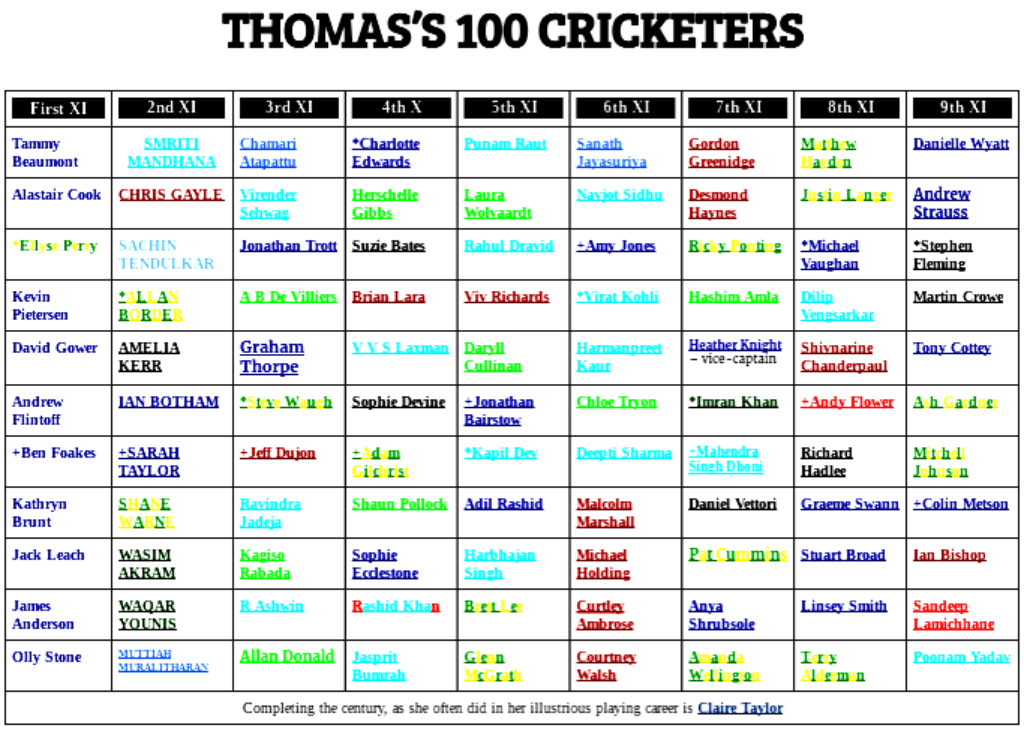
When I produced my ‘100 Cricketers’ series in 2019, I started with a post dedicated to Tammy Beaumont (the series also concluded with a standalone post dedicated to a female cricketer, Claire Taylor). This post can be viewed here. An overview of the entire series with links to all posts can be seen by visiting this page. I reproduce the complete list of those involved below.
TAMMY BEAUMONT IN ALL TIME XIS
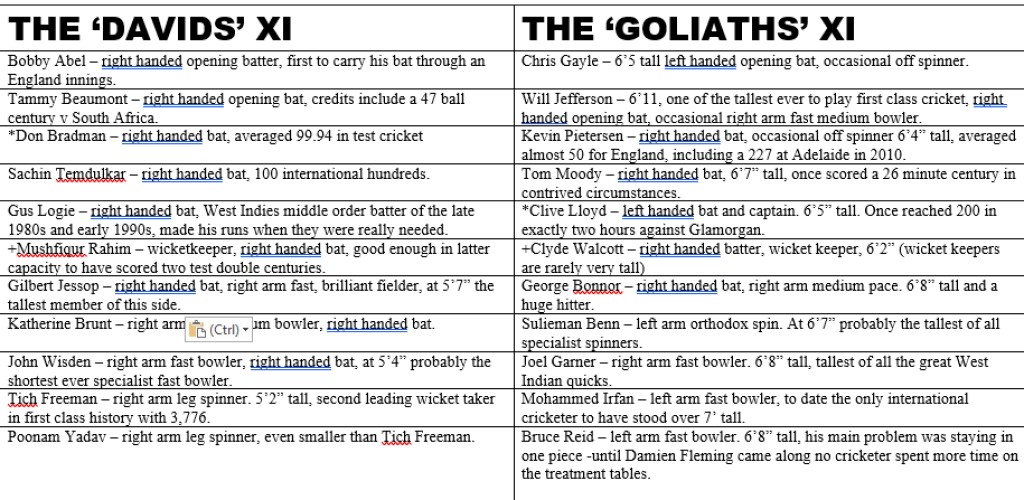
During the first lockdown I produced a series of All Time XI themed posts which you can view by clicking here. The first of these to feature Tammy Beaumont was a contest in which an XI of Goliaths took on an XI of Davids. It can be seen here, with the feature image reproduced below.
Today has seen confirmation that the final of the World Test Championship will take place at The Ageas Bowl, and this is my response to that news.
Today saw confirmation that the first final of the World Test Championship, between India and New Zealand will take place at the Ageas Bowl, near Southampton. The match is scheduled for 18-22 June. The question had been whether it could be staged at Lord’s or not.
THE PROS AND CONS
From a purely cricketing point of view the Ageas Bowl is a superior venue to Lord’s – it will produce a good pitch on which cricketer’s of all types will be able to get into the game, whereas it would only take one overcast day at Lord’s for the match to settled in favour of whoever was bowling at the time, and spinners would find little assistance at any stage of proceedings.
Of course, from a historical and emotional point of view Lord’s, the home of cricket, would have been far superior to the Ageas Bowl.
However, heretical as it will seem to many devoted cricket followers, I would never have had Lord’s in the equation, for all its history and status as a ground – had I been going for a London venue, for which I can see the logic, I would have preferred The Oval, a ground with a grand history in it’s own right, and far more likely to provide a really good match than Lord’s.
As it is, I expect a cracking game between these two sides.
WHY THE AGEAS BOWL?
The Ageas Bowl is one of two grounds in England, the other being Old Trafford, to have hotel built into it, meaning that if the health situation warrants it can easily be turned into a bio-secure bubble, as it was last summer. For all the Prime Minister’s optimism regarding the health situation and his so called ‘road map out of lockdown’, Chris Whitty has been sounding a much more cautious note, and I for one trust him more than I do Johnson. So it seems do the cricketing powers that be who came to this decision.
GETTING THERE
To put it mildly my expectation is that ordinary spectators will not have to worry about getting there in any case, although it is possible that they will be allowed. The Ageas bowl has a reputation for not being accessible, and there is some justice in that. I did a bit of research based on a hypothetical journey from my home in North Lynn to the Ageas bowl and it went as follows:
Use of google maps revealed that the nearest train station to the ground is Southampton Airport Parkway.
If one can be at that station by 9:27AM there is a bus that runs to the ground and would arrive at 9:45AM. Otherwise, one either has a seriously long walk (over an hour, and not terribly pleasant either by the look of it), or one has to fork out for a taxi on top of other expenses (this is a station serving an airport, so taxis will be available, but doubtless at a premium price).
To arrive at Southampton Airport Parkway at 9:27 I would have to be on the 5:39 train out of Lynn, which means leaving my bungalow by 5:15 at the latest, I would then have to change at King’s Cross to the Victoria line, board a mainline train at Victoria and change at Clapham Junction to the train that calls at Southampton Airport Parkway. If and only if all of these connections worked as they are supposed to I would arrive at Southampton Airport Parkway at 9:13, giving me 14 minutes to be aboard the bus. With four stages at which things could go wrong this hypothetical journey would be a colossal (and doubtless expensive) gamble.
NB it is notoriously difficult to get from Southampton town centre itself to the ground, so at least to that extent my methodology, anchoring to Southampton Airport Parkway, is sound.
HOW THE MATCH SHOULD BE APPROACHED
This is a one-off match, with no ‘rest of the series’ or ‘league table position’ to be thought about, so both sides should look askance at the very idea of a draw and should be eager to force a definite result. I would personally favour allowing extra days, or even making this officially the 100th timeless test ever to be played, and the first such since WWII, in order that we do have a definite winner. In the Centenary Test Match of 1977 Mike Brearley ordered his side to keep going for an unlikely final innings target of 463, even though a defeat was the likely outcome of so doing, and stuck to that intent even going into the final session with 110 needed and only five wickets standing. England ultimately lost by 45 runs, the same result and margin as the inaugural test match 100 years earlier, but Brearley was right to scorn the draw in a one-off match. Brearley talks about the match in “The Art of Captaincy”, while Greg Chappell (Aussie skipper in the match in question) covers it in some detail in “The 100th Summer”.
A look at the Natural History Museum and possible alternatives to a straight to/from South Kensington, plus a related twitter thread. Note that the ideas around the museum are strictly for thinking about for the future.
To start a brief warning: the main attraction at the heart of this post is closed at the time of writing and even if things go according to Johnson’s ‘road map out of lockdown’ it will be some while before it reopens and before travelling for leisure is again safe. By all means note the things I write about here down for future reference but please do not attempt to put plans into practice just yet.
This post was inspired by a thread posted on twitter by the Natural History Museum earlier today, which I shall be saying more about later.
POSSIBLE ADDITIONS TO AN NHM VISIT
The Natural History Museum is served along with a number of other attractions by South Kensington Station (Circle, District and Piccadilly lines, subject of two station posts on my other site – here and here) and you can choose whether to use the underground passage that links the station to the museums or walk at surface level, where you will see some fine wrought ironwork.
Once you have enjoyed the museum, the logical next step is to visit Hyde Park, and there are stations all around that park that you could use as the station from which to begin your journey home. You could also head into London’s West End, where after Marble Arch you could choose Bond Street, Oxford Circus, Piccadilly Circus by walking along Regent Street, or go a little north to Baker Street, home to the Sherlock Holmes Museum and Madame Tussaud’s. Also you could extend your walk in a westerly direction, aiming for Notting Hill Gate. For those interested in a longer walk you could continue beyond Baker Street and take in Regent’s Park. Here are a few map pictures of various kinds to conclude this section:
THE TWITTER THREAD
The Natural History Museum today put out a superb 13 tweet thread about a very recent meteorite strike (a tiny meteorite which did no serious damage – it’s journey through the earth’s atmosphere lit up the skies on the night of February 28) and about that object’s journey, a story four billion years or so in the making and yet 13 tweets in the telling. A screenshot of the start of the thread is below, and you can read it in full by clicking here.
For more about these sorts of objects I recommend the book “Comet”, by Carl Sagan and Ann Druyan:
PHOTOGRAPHS
A very brief usual sign off – I have been unable to get out today since I am waiting for someone to examine an issue with my drains – they should have been and gone by now…
An international women’s day special, selecting an XI of the finest contemporary female cricketers, with a couple of extra features.
Today is International Women’s Day, and as a cricket fanatic I am commemorating it by selecting an XI comprising the finest talents from contemporary women’s cricket.
THE XI IN BATTING ORDER
Laura Wolvaardt – right handed opening batter. The 21 year old South African already has over 2,000 ODI runs at an average of 46. She forms one half of an opening partnership that blends youth and experience and could confidently be expected to function superbly. A career best 149 and one other hundred indicate that she can go big.
Tammy Beaumont – right handed opening batter. Just a few days short of her 30th birthday, the experienced England opener is in the form of her life at the moment, reflected by her status as the no1 ODI batter in women’s cricket. She averages a run per innings less than Wolvaardt, but has played rather more. Seven centuries in ODIs confirm her ability to go on and get big runs.
Smriti Mandhana – left handed top order batter. She normally opens for India, but should also go well at number three. An ODI average of 42, including four centuries at that level indicates a player of high class, and she is also one of the most aesthetically pleasing of all international batters, especially when driving through the covers.
Amelia Kerr – right handed batter, leg spinner. At the age of 20 she has a personal highlights reel at international level that includes a double century and a five wicket haul. In the one victory New Zealand recorded over England in their recent series she starred with 72 and four wickets.
Ellyse Perry – right handed batter, right arm fast medium bowler. The 30 year old Aussie is the most complete all rounder in the game. Her eight test appearances have yielded her a batting average of 78 and a bowling average of 18, in 112 ODIs she averages 52 with the bat and 24 with the ball, while in 120 T20Is she averages 28 with the bat and 19 with the ball. She has also found time to feature in the later stages of a football world cup along the way – she is an all rounder in more than one sense!
+Amy Jones – right handed batter, keeper. Her batting is improving, and her keeping at its best can be reminiscent of great predecessor in the role, Sarah Taylor.
Deepti Sharma – left handed batter, off spinner. She averages 38 with the bat and 27 with the ball in ODIs.
Katherine Brunt – right arm fast medium bowler, right handed lower order batter. She regularly bats seven for England, having massively improved that area of her game over the years, but it is her bowling that makes her worth her place.
Sophie Ecclestone – left arm orthodox spinner, right handed lower order batter. 106 international wickets at less than 20 each and she is still only 21. For more detail on her please visit Inside Edge Cricket’s post on her produced specially for today as this post is, by clicking here.
Poonam Yadav – leg spinner, right handed lower order batter. A complete contrast to her predecessor in the order, who is very tall, the leggie is the smallest member of the XI, and bowls very slow, high tossed spinners. She has many remarkable spells to her credit, perhaps the most outstanding being against Australia in a world T20 cup match, when the latter were seemingly cruising to victory when she was brought on and nailed on for defeat by the time she had bowled her four overs.
Shabnim Ismail – right arm fast medium, left handed lower order batter. The veteran South African is bowling as well now as she ever as and will be an excellent new ball partner for Brunt. She had a superb tournament in the most recent running of the Women’s Big Bash League.
This team comprises a stellar top five, two of whom are genuine all rounders, a splendid keeper/batter at six, a genuine all rounder at seven, a top quality bowling all rounder at eight and three superb specialist bowlers. Brunt and Ismail with the new ball, Perry as third seamer if needed and spin quartet of Ecclestone, Yadav, Sharma and Kerr provides a bowling attack that should be comfortably able to meet all eventualities. Below is the team in infographic form:
LINK AND PHOTOGRAPHS
Just the one link before my usual sign off, a tweet which fits the international women’s day theme – it is a list of rape prevention tips, which rather than being the usual victim-blaming c**p such things usually are actually addresses those who need to be told – the men. It was posted by Theresa Drennan, and can be viewed it’s original niche by clicking here.
A look at England’s tests in 2021 and forward to the future. Also a very important petition and a related post on Tax Research UK and some deserved mentions of successes by Women’s cricket teams.
This post looks back at the six test matches England have played in India and Sri Lanka and forward to the future.
THE STORY IN BRIEF
England won both matches in Sri Lanka against a side with a very unthreatening bowling attack, although there were warning signs in the form of Embuldeniya, a left arm orthodox spinner who caused England such problems as they experienced on that tour. In India England started with a victory in the first match, but then lost three in a row as their problems against spin on turning pitches were cruelly exposed. English cricket officialdom has a phobia of turning tracks, as shown by the punishment recently inflicted on Somerset. This combined with the fact that a large proportion of English first class cricket is confined to the margins of the season means that there are not many really good spinners in the game and that in consequence the batters rarely face much if any spin. Anyone shown Axar Patel’s figures in this series and not told who had recorded them would be forgiven for thinking it was Hedley Verity or Derek Underwood operating on rain affected pitches. There were other causes of problems besides this…
ROTATION POLICY AND POOR SELECTIONS
Some element of rotation was going to be necessary due to the circumstances in which these test matches were being played, but I think England took things too far in that regard, and the side became unsettled as a result. In particular the handling of the Moeen Ali/ Dom Bess situation was shocking. England had planned to play Moeen Ali for both Sri Lankan matches and the first two matches in India before resting him prior to the limited overs element of the Indian tour. Had that plan been operable it might have made sense, though Moeen Ali’s test record is unconvincing to put mildly. As it was he caught Covid and by the time he had recovered and quarantined himself for the required period the only match he would be available for was the second of the Indian series. Bess had not bowled especially well but had been picking up wickets, and the logical thing to do in the changed circumstances was send Moeen home earlier than intended and play Bess straight through or promote one of Parkinson or Virdi from the reserves. Moeen Ali was rushed into the XI for that one match, and on brute figures had a decent game, capturing eight wickets and scoring 49 runs. The problem was that most of the good things he did came after he had virtually bowled England out of contention by conceding 94 runs from his first 20 overs on a pitch that was offering assistance to spinners from the start of the game. In selecting Moeen Ali England had directed some harsh words in Bess’ direction (doubtless some even harsher ones in private than the ones we heard about), and then after the game they tried to persuade Moeen Ali to stay on, abandoning his plans to visit his family in England, and allowed this to become public knowledge. Then, still reluctant to promote Parkinson or Virdi, and unwilling to risk Bess, they went into the third match of the series with three specialist quicks plus Stokes and only Leach as a front line spinner. Inexplicably Chris Woakes was also entirely ignored, though with the party the entire time, and he was sent home after the third test. England then had a massive knee jerk reaction to the humiliating defeat they suffered in that third match and brought Bess back, and also brought Lawrence in to strengthen the batting, going into the game with three specialist bowlers plus Stokes. Lawrence had a fine match, showing fight in both innings to amass 46 and 50, but apart from Stokes (55 in the first innings, four wickets), and Anderson, who was his usual self and therefore always formidable, and with a nod to the ever reliable Leach who toiled hard with the ball, basically no one else did. Bairstow, a flawed selection, as I pointed out in December when rumours of a test recall for him first surfaced, needed a bit of luck to make 28 in the first innings and gave his wicket away first ball in the second to one of the softest dismissals in test history. The other problem besides basic disruption and his own inadequate performances with the selection of Bairstow was that he pretty much replaced Burns, which forced Crawley up to open, when the latter has done his best test work from no3.
One or other of Parkinson or Virdi, with a preference for the former, since as a leg spinner he brings something new to the team, should have been promoted from the reserves to partner Leach, rather than the obviously untrusted Bess being recalled. The treatment of Olly Stone, who bowled well in the second match on a surface that did not suit him in the slightest and was thereafter resolutely ignored is also hard to fathom.
LOOKING TO THE FUTURE
In terms of the batting two things have happened this tour that are of any significance: Lawrence has surely moved ahead of Pope, who seems to have regressed from the good start he made to his test career, in the pecking order, and Bairstow must finally have blown one opportunity too many for even this England management to recall him to the test ranks, though he remains an integral part of the white ball set up. Leach is now established as first choice spinner, and given the unlikeliness of any English test pitch warranting the selection of two specialist spinners (I would put such a pitch being prepared in England rather below a meteorite strike in the betting stakes), and the fact that the next tour is Australia where English off spinners have not fared well (see here for some detail on the spin options in England’s successful Ashes tour parties) I am looking at Leach as sole spinner for the home summer, and Leach and Parkinson as spinners for Australia (unless England go the radical route of inviting Sophie Ecclestone to plat alongside the men). Virdi may well merit an England call up as well, but probably not for Australia. Bess needs to have at least one seriously good season for his new county, Yorkshire, before his credentials can even be considered again, so should not be a factor in England terms before the 2022 home season at the earliest.
Unless someone has a string of superb performances at the top of a county order to start the season I do not see much point introducing another newcomer to the batting order – chronically ill equipped though they were to handle India’s spinners these batters are by and large the best available to England at present. I might consider Buttler as a specialist batter, but he has been so indulged by the England management in recent times that I refuse to officially nominate him for one of my teams. In view of the fact that Anderson and Broad need to be rotated to some degree, and that I prefer not to have four out and out tailenders in the team my XI for the first test of the home season if nothing significant changes mean time would thus be something like: Sibley, Burns, Crawley, *Root, Stokes, Lawrence, +Foakes, Woakes, Stone, Leach, Anderson. Archer or Wood if fit and firing could replace Stone, though I would like to see the latter given a proper chance, and similarly Broad may play instead of Anderson if conditions seem likely to favour him. Woakes in England is a formidable all round cricketer, and as indicated earlier in this piece he may well have proved useful at times in India had he been given the chance.
Among those who may force their way into contention in the not too distant future are Tom Abell and Tom Lammonby of Somerset, Sam Hain of Warwickshire, Liam Livingstone of Lancashire and Haseeb Hameed of Nottinghamshire. Ben Coad may claim a bowling slot (he pays about 20 per wicket in FC cricket, but England have plenty of pace bowling options). Jordan Cox is an outside chance if he can prove the double century he scored against Sussex last season was not just a one off. Lewis Goldsworthy, a left arm orthodox spin bowling all rounder, may make some sort of mark for Somerset with Leach on England duty. He has yet to play first class cricket but impressed at the Under 19 World Cup last year and has a decent record in the handful of T20s he has played for Somerset. It is also possible that Liam Patterson-White (bowling average 21.00 from five FC games) and Dan Moriarty (17 wickets at just under 21 each from two first class games) will prove that their currently impressive bowling averages are not freaks.
LINKS AND PHOTOGRAPHS
My first link is to a petition calling on the government to award NHS nurses a 12.5% pay rise. To sign this you have to be a UK citizen or resident. If you are please do so. A screenshot is below:
My second link is related to the above, being to a blog post by Richard Murphy of Tax Research UK that started life as a twitter thread, in which he takes Johnson to task for his derisory 1% offer. The start of what is a longish piece is shown below:
Finally congratulations to the England Women’s team who completed a clean sweep of the T20Is in New Zealand to go with their earlier triumph in the ODI series. Katherine Brunt was Player of the Match, while Tammy Beaumont, as in the ODI leg of the tour, was named Player of the Series. Also, South Africa Women won the first ODI of their series in India, with Laura Wolvaardt making a fine 80. Now it is time for my usual sign off…










































































































































 aspiblog