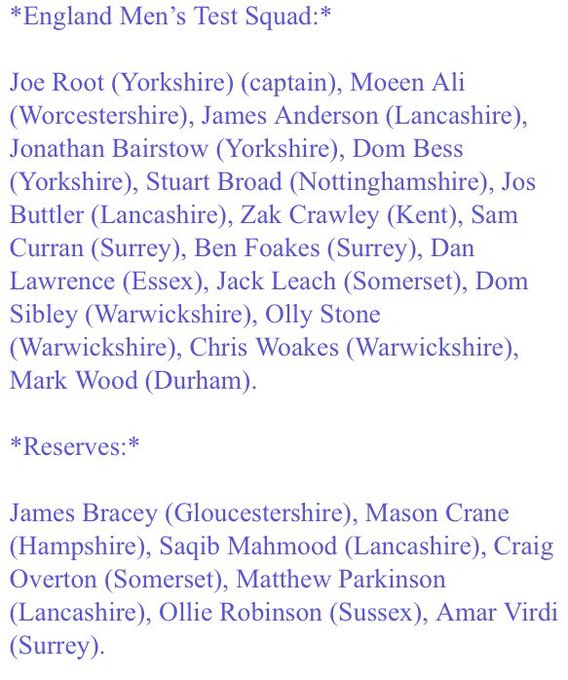
Rory Burns is missing because his wife is about to give birth, and Stokes among those being rested. No issues with those two omissions. However, Jonathan Bairstow should be nowhere near selection for an England test squad, likewise Moeen Ali, who was never actually that great, and has not done anything in red ball cricket for some time. As I indicated in my previous post making my own picks I would also have left out the veterans Broad and Anderson as neither have great records in Sri Lanka and this tour should have been used to experiment. I would also have left out Dom Bess. James Bracey should be in the main squad, not listed as a reserve, ditto Matthew Parkinson and Amar Virdi.
On the plus side, Stone and Wood are both in the main squad, as is Daniel Lawrence. I am also glad to see that Ben Foakes is there, although whether he actually gets selected remains to be seen.
Three of the official reserves, Craig Overton, Ollie Robinson and Mason Crane should not have been picked, Overton and Robinson because their bowling methods are unsuited to Sri Lankan conditions, Crane because he is a proven failure at the highest level, and England needing to be looking forward not back.
This England party has been picked with eyes fixed firmly on the past. From the players listed in the main squad and the reserves I would pick as my starting XI for a match in Sri Lanka: Dom Sibley, Zak Crawley, James Bracey, *Joe Root, Daniel Lawrence, Chris Woakes, +Ben Foakes, Sam Curran, Mark Wood, Jack Leach and Matthew Parkinson. This combo is a little light on batting with Woakes and Foakes at six and seven, but absent Stokes it is the only way to accommodate a back up seam option while still playing two genuine front line spinners, and Sri Lanka tends to be a place where games are fairly high scoring, so I err on the side of having more bowling options, as that is where the principal difficulty is likely to be.
SPIN OPTIONS FOR ENGLAND
I have indicated that I would start with Leach and Parkinson, with Virdi as a back up spinner. Lewis Goldsworthy, an all rounder who bowls left arm spin, may well be worth a pick in the not too distant future, if he can build on his good showing for England U19s. Liam Patterson-White has made a promising start to his career at county level. Finally, there is the radical option I have touched on previously: give Sophie Ecclestone a chance to play alongside the men. The spin bowling cupboard is not massively well stocked at present, although a few youngsters besides those I have named have made appearances at county level, but even in its current state it does represent a reason for bringing back average performers (Moeen Ali at test level) or worse still proven expensive failures (Mason Crane).
OVERALL THOUGHTS
Overall, while acknowledging that they faced difficulties due to various players not being available, I have to say that the selection of this touring party represents a clear failure on the part of the selectors. I award them 3 out of 10.
I don my selector’s hat to name my suggested tour party for the test tour of Sri Lanka in January. Also, as usual there are some photographs.
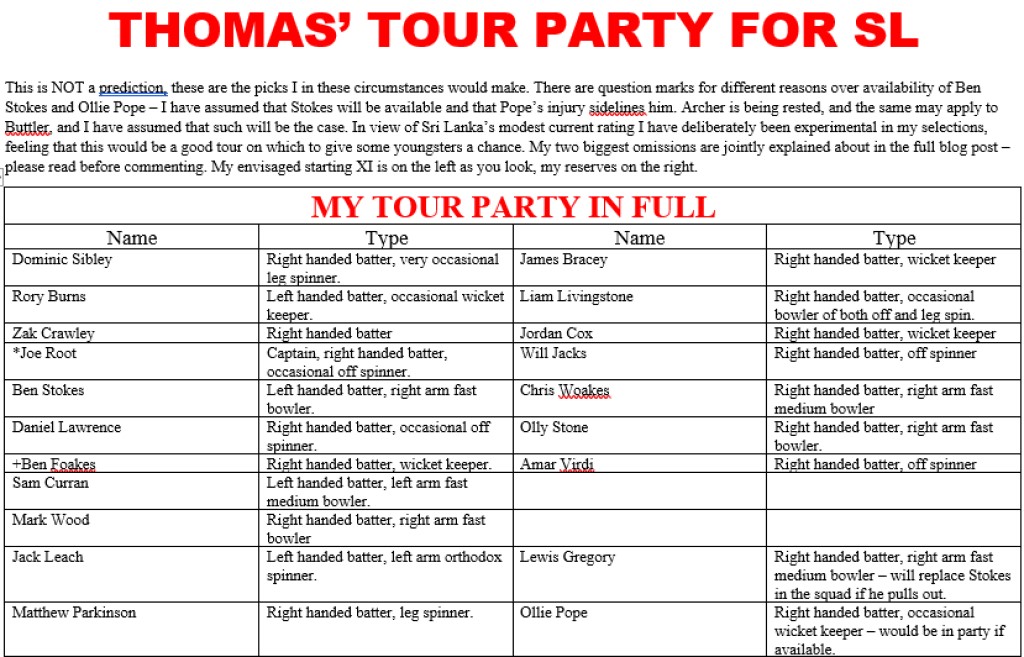
The dates for the England’s two test matches in Sri Lanka have been confirmed. The first test will take place from 14-18 January and the second from 22-26 January. In this post I name the tour party I would pick given the circumstances. This is not, repeat not, an attempt at prediction. Jofra Archer is confirmed as an absentee, and Jos Buttler is possibly also going to be rested, and I have made this my assumption. Ollie Pope is a doubt due to injury, and Stokes may choose to miss the tour for personal reasons. Here I have assumed that Pope is not available but that Stokes is, though I also explain who I would select as Stokes’ replacement and why. I have two supplementary sections after going through my chosen squad, one explaining the biggest of the unexplained omissions and a controversial footnote.
MY ENVISAGED STARTING XI
My thinking here is informed by several factors: Sri Lanka are currently not one of the strongest of international outfits which means that this could well be a good first tour for youngsters, classic English fast medium bowlers do not tend to fare all that well in Sri Lanka, and the spin options are somewhat limited for England. The scene set, here we go:
Dominic Sibley – right handed opening batter, very occasional leg spinner. There are question marks over his ability to handle spinners, and he could well have difficulty against Sri Lanka’s best current bowler, Dananjaya (bowling average 24.33) but his overall record since his elevation means that he warrants selection. I do not expect him to increase his meagre tally of four first class wickets on this tour.
Rory Burns – left handed batter, occasional wicket keeper. He is also happier against seam than spin, but like Sibley deserves his continued presence in the side.
Zak Crawley – right handed batter. The youngster has been a revelation since his elevation to international level, with his monumental 267 vs Pakistan an obvious highlight.
*Joe Root – captain, right handed batter, occasional off spinner. The skipper has been somewhat short of runs lately, but England will need his experience.
Ben Stokes – left handed batter, right arm fast bowler. The one member of this England squad one cannot even attempt to find a like for like replacement for. If he does pull out it will be a crippling blow for England even considering the less than stellar opposition.
Daniel Lawrence – right handed batter, occasional off spinner. He deserves his chance at the highest level, is known to play spin well, and his bowling is by no means negligible (I would certainly have him ahead of Root in the bowling pecking order). For more on my thinking here see my earlier post arguing against a test recall for Jonny Bairstow.
+Ben Foakes – right handed batter, wicket keeper. Since the retirement from top level cricket of Sarah Taylor his status as England’s finest contemporary keeper has been unchallenged, he had a splendid tour of Sri Lanka last time England were here, and he should be given another opportunity.
Sam Curran – left handed batter, left arm fast medium bowler. His left handedness increases the variety available to the bowling attack and he is also a more than useful lower/ middle order batter.
Mark Wood – right handed batter, right arm fast bowler. Archer is not available for this tour, and I want at least one bowler of serious pace in the side.
Jack Leach – left handed batter, left arm orthodox spinner. I think two genuine spinners are needed on Sri Lankan pitches, Bess has struggled of late, failing to build on his good tour of South Africa, and England are not massively spoilt for choice in this department.
Matthew Parkinson – right handed batter, leg spinner. Deserves a chance to establish himself at the highest level.
We now turn our attention to the reserves. This is a very short tour, but Covid-19 necessitates having plenty of cover available, so I name seven designated reserves, and mention a couple of others.
Liam Livingstone – right handed batter, occasional bowler of both off spin and leg spin. Primarily selected on the basis of his batting, but his bowling may well get some use as well.
James Bracey – right handed batter, wicket keeper. He is more batter than keeper, but he is good enough at the latter role to be designated official reserve keeper as cover for Foakes while also covering a batting slot.
Jordan Cox – right handed batter, occasional wicket keeper. A hugely promising youngster, having scored a double century for Kent against Sussex while still in his teens. I admit that in making this call I am influenced by the success that his county colleague Crawley has enjoyed since his own elevation.
Will Jacks – right handed batter, off spinner. He probably has more bowling pedigree than Moeen Ali did when he was first selected to bowl spin for England, although he is undoubtedly more batter than bowler. He is as close to an all rounder who bowls spin as England have at the moment.
Chris Woakes – right handed batter, right arm fast medium bowler. He is much better in England than he is overseas, but his all round skills would enable him to cover any vacancy save in the wicket keeping department without massively weakening the side.
Olly Stone – right handed batter, right arm fast bowler. Cover for Wood, and might replace Curran to give the attack extra pace, although that would give England a decidedly long tail.
Amar Virdi – right handed batter, off spinner. Specialist spin cover, chosen instead of Bess.
Ollie Pope – right handed batter, occasional keeper. Obviously he makes the trip if fit, in which case Lawrence reverts to being a reserve, he is the first of two conditional names here, the other being…
Lewis Gregory – right handed batter, right arm fast medium. Should he pull out Stokes cannot be replaced, and in view of the frequency of high scoring games in this part of the world I feel that bowling depth is more needed than batting depth, so the man who would take Stokes’ place in the event of him pulling out is someone who is more bowler than batter.
1100 TEST WICKETS OVERLOOKED?
I have mentioned elsewhere that Sri Lanka is not a happy hunting ground for fast medium bowlers, and that applies in spades to Stuart Broad, whose record there is quite frankly dreadful. James Anderson has a less bad record in Sri Lanka than Stuart Broad, but it is hardly one to shout about. I therefore feel that England can be best served by not selecting the two veterans, and instead giving younger bowlers a chance to flourish against one the less strong test match outfits. In the future England are due to tour India and Australia, and one would rather not have players making their first test match tour to either of those countries. Also, neither Leach nor Parkinson, my two envisaged spinners, are up to much with the bat, and while I do not subscribe to selecting bowlers based on their batting it has to be said that an 8,9,10, 11 of Broad, Leach, Anderson, Parkinson as it would presumably be looks very fragile.
A CONTROVERSIAL FINISH
I have noted that England are not hugely well equipped in the spin bowling department, and I think that recalling either Adil Rashid or Moeen Ali to the test squad would be a retrograde step, especially in view of the fact that this is a tour where youngsters should be getting a chance. One potential solution is someone who has a phenomenal record at both domestic and international level, just not in men’s cricket: Sophie Ecclestone. I have not named her in my envisaged tour party, but I could see her doing the job.
PHOTOGRAPHS
Time for my usual sign off – to see a photo at full size please click on it:
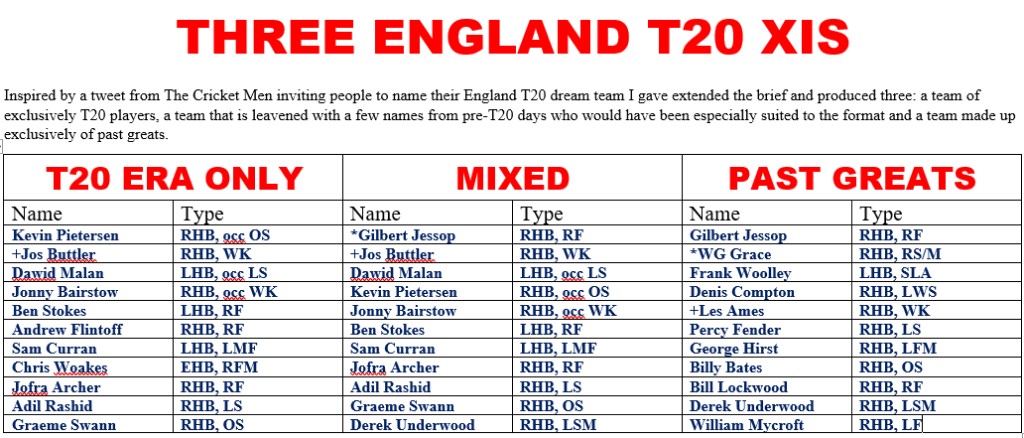
Three all-time England T20XIs selected with differing criteria in response to a twitter challenge from The Cricket Men, some photographs and a video.
This post is a response to a challenge thrown out on twitter yesterday by The Cricket Men. I have extended their brief, and rather than one XI will be naming three: one made up exclusively of T20 players, one which features two past greats who methods I believe would have been especially suited to T20, and one which is made up entirely of past greats.
CONVENTIONAL T20 XI
Kevin Pietersen – right handed batter, occasional off spinner. An explosive batter, just right for opening a T20 innings.
+Jos Buttler – right handed batter, wicket keeper. Possibly the finest limited overs batter England have ever had, and a shoo-in for this XI.
Dawid Malan – left handed batter, occasional left arm spinner. Officially the highest rated T20I batter ever, with 915 points following his amazing series against South Africa.
Jonny Bairstow – right handed batter, occasional wicket keeper. One of the most devastating of short form batters around. His 86 not out in the first match of the series against South Africa first kept England in the contest and then led them to victory.
Ben Stokes – left handed batter, right arm fast bowler. Explosive with the bat, and a golden arm with the ball, though probably seventh bowler in this combination.
Andrew Flintoff – right handed batter, right arm fast bowler. A must for this XI.
Sam Curran – left handed batter, left arm medium fast bowler. His stocks went through the roof in this year’s IPL, and his performances against South Africa confirmed his advancement.
Chris Woakes – right handed batter, right arm fast medium bowler. A big hitting batter and a crafty operator with the ball.
Adil Rashid – right handed batter, leg spinner. He is superb in this form of the game, economical with the ball even when he is not picking up wickets.
*Graeme Swann – right handed batter, off spinner. I preferred him to Moeen Ali for the second spinner’s role because he was a much better bowler, although not as good in his secondary role.
Jofra Archer – right handed batter, right arm fast bowler. With all due respect to Messrs Flintoff and Stokes, likely sixth and seventh bowlers in this combination, we need some genuine pace at our disposal, and for me Archer is the man to provide it
PAST GREATS INTO THE MIX
My second XI involves the addition of two blasts from the past who I consider would have been particularly effective in this format:
*Gilbert Jessop – right handed batter, right arm fast bowler. Jessop was the fastest scoring top line batter the game has ever seen, and bear in mind that for most of his career a ball had to go right out of the ground as opposed to just over the ropes to count six. He was also a highly skilled quick bowler who once bowled unchanged through a first class innings conceding just three runs (v Northants in 1907, in a total of 12 all out – George Dennett 8-9, Jessop 2-3). Finally, he was what is now termed a ‘gun’ fielder to the extent that most reckonings of his contribution in this department have him effectively coming to the crease already 30 not out. I have also named him as captain, a job he did for Gloucestershire for some years.
Jos Buttler
Dawid Malan
Kevin Pietersen
Jonny Bairstow
Ben Stokes
Sam Curran
Adil Rashid
Graeme Swann
Jofra Archer
Derek Underwood – right handed batter, left arm slow medium bowler. He was famously miserly at the bowling crease, and his style of bowling, with taking the pace of the ball so often being desirable at T20, would seem well suited to this format.
BLASTS FROM THE PAST
My final selection comprises entirely players from the past:
Gilbert Jessop
*WG Grace – right handed batter, right arm bowler of varying types, excellent close catcher, captain. With his range of skills and forceful personality he just has to feature.
Frank Woolley – left handed batter, left arm orthodox spinner, brilliant fielder. His attacking brilliance with the bat makes him well suited to the no3 slot in this team and he would also be full value in the field.
Denis Compton – right handed batter, left arm wrist spinner. Capable of scoring all round the wicket.
+Les Ames – right handed batter, wicket keeper. In the 1930s the Walter Lawrence trophy, awarded to the scorer of the fastest first class hundred of the English season, was launched. In two of it’s first three seasons it went to Les Ames, the only recognized keeper ever to score 100 first class hundreds. He holds the record for career first class stumpings – 418 of them in total.
Percy Fender – right handed batter, leg spinner. The scorer of the fastest competitive first class century (35 minutes vs Northants, there have been a few instances of players getting to the mark quicker against bowlers deliberately feeding them runs to bring about a declaration), a brilliant fielder, and a regular wicket taker. Also, although no one could usurp the mighty WG for the captaincy, I acknowledge his skills in this area by naming him vice captain of the XI.
George Hirst – right handed batter, left arm fast medium bowler. One of the greatest all rounders ever to play the game, and his attacking approach would be well suited to short form cricket. Like Jessop he was what we now call a ‘gun’ fielder, in his case usually patrolling mid off.
Billy Bates – right handed batter, off spinner. He had a remarkable record, including a 55 and two seven-fors in the same test match, at Melbourne in 1883. Playing for the Players against the Gentlemen in 1881 he had a spell of 17 overs for eight runs (so much for those carefree, all-attacking amateurs!), so he could certainly keep it tight.
Bill Lockwood – right handed batter, right arm fast bowler. Variation of pace was mentioned in the context of certain earlier bowlers, notably Alfred Shaw and the Australia FR Spofforth, but the first bowler about whom the phrase ‘slower ball’ was regularly used was this man, and his version appears to have been the deadliest to see the light of day until Franklyn Stephenson came on the scene almost a century later. Given the role the slower balls play in the armoury of T20 bowlers I suggest that one of the great early masters of the craft has to be included.
Derek Underwood
William Mycroft – right handed batter, left arm fast bowler. His extraordinary record (863 wickets in 138 first matches at 12.09 apiece), the fact that he could move the ball as well as propel it at great pace and his the fact that he bowled left handed all militate in his favour.
BRIEF ANALYSES OF THE XIS
My pure T20 squad has good batting depth, with everyone in it having some degree of skill with the bat, and seven genuine bowling options. It is well equipped to handle every challenge and would give a good account of itself.
The second squad has even greater bowling depth, and although it features one genuine tailender in Underwood the bowling depth is awesome.
My final offering, the blasts from the past combination, is simply awesome, with recognized batting talent all the way down to Lockwood at no9, and so much depth and variety in the bowling that Compton, by no means poor in that department, would probably be 10th choice bowler on most surfaces.
A FEW OF THE MISSING
These names all relate to the blasts from the past. Alfred Shaw, the man who bowled more first class overs than he conceded runs, was one I would have loved to include, while two fast medium bowlers who hit the ball miles when they batted, Jim Smith of Middlesex and Arthur Wellard of Somerset also commanded attention but could not quite get in. Cecil Parkin of Lancashire, with his penchant for bowling six different types of delivery per over, would have been good in T20, and I nearly selected him ahead of Bates. The great SF Barnes would have been formidable at any form of the game but I think he would have found being limited to four overs per innings insupportable, so he missed out. Some of you will doubtless have your own ideas, and I hope you will post them in the comments.
PHOTOGRAPHS
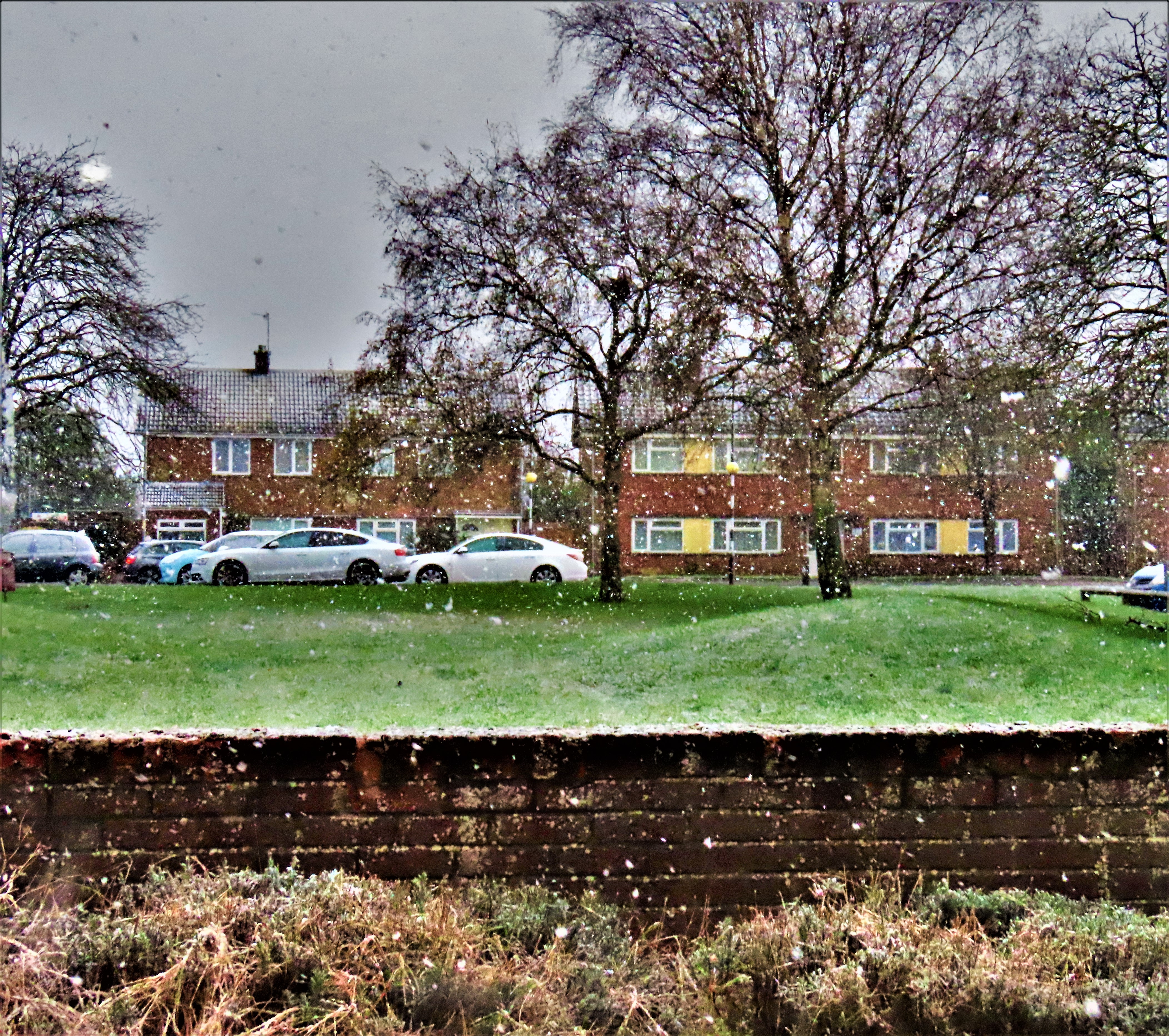
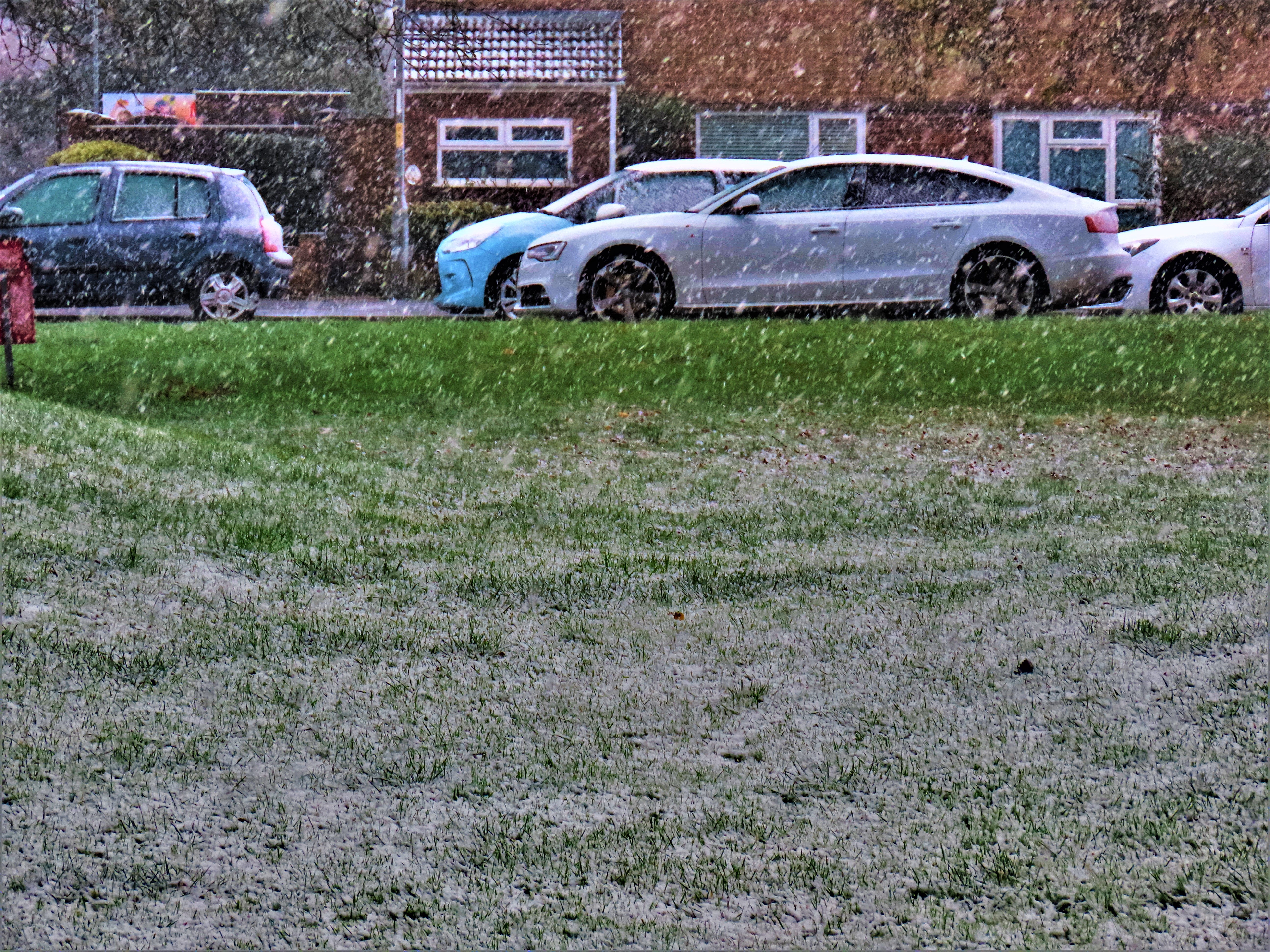
A very contrasting set of photographs, featuring yesterday’s snow and today’s far more benign weather.
To finish, here is a video of the snow falling yesterday (a rare happening in King’s Lynn):
A look back at the recently concluded T20I series between South Africa and England, a petition, a link and some photographs.
The T20I series between England and South Africa ended last night, and what an ending it was! This post looks back at that series.
MATCH 1: BEURAN HENDRICKS’ HORROR SHOW
South Africa bossed this match for most of its duration, but in the 17th over of the innings Beuran Hendricks lost his bearings completely and in so doing lost South Africa the match. England had needed 51 off the last 24 balls to win, but by the time Hendricks had reached the end of his over, taking nine deliveries instead of the regulation six to do so, that had become 23 of 18, and England were suddenly in full control, and duly completed their victory with four balls and five wickets to spare.
MATCH 2: NGIDI’S PYRRHIC VICTORY OVER MALAN
Once again England were behind for large parts of this match, and with three overs to go in the chase they needed 28, which looked a tough proposition on a slow pitch. Ngidi;s final over was the 18th over of the chase, and although he dismissed Malan with the fifth ball of it the previous four had been dispatched for 14. The dismissal was immediately followed by a wide and then two off the extra delivery necessitated by the infraction, which reduced the target to 11 off 12 balls. South Africa opted for Nortje rather than Rabada to bowl the 19th, and by the end of it England needed just three to win, and gamely though he tried not even Rabada could prevent that.
MATCH 3: THE MALAN MASTERCLASS
South Africa won the toss and batted. After 10 overs they were 66-3, by the end of the 15th this had improved to 107-3, and then Rassie van der Dussen and Faf du Plessis went crazy in the last five overs, plundering no fewer than 84 further runs to finish on 191-3, a daunting looking total.
Roy made 16 before holing out, which brought Dawid Malan, the world no1 ranked T20I batter, in to join Buttler. Malan hit 10 off his first two balls, and simply kept on going. Buttler supported him well, and by the end of the 10th over England were 85-1, needing 107 in the remaining 10 to complete a 3-0 sweep. By the end of the 15th, such was the onslaught they now launched, this target had been reduced to 29 in the final five overs, and in the 18th over Malan hit his fifth six to move to 94 and put England within six of the target. The next delivery was a wide, and then Malan hit a four to level the scores. Off the fourth legal delivery of the over Malan took the match and series winning single, finishing unbeaten on 99 off 47 balls. This victory took England to the top of T20I rankings, and Malan’s innings saw him become the first T20I batter to have a rating of over 900 points – 915 to be exact. In his 19th T20I it was tenth score of 50 or more, and his average in the form of the game now stands at 53. Before this match began, for all his ranking, there were those still questioning whether Malan was worth his place in the team. He provided the most emphatic of affirmative answers to that one, and I trust we will hear no more of such nonsense.
The first two matches of this series were closely fought, with the result in doubt until quite close to the end, but this was every bit as much of a shellacking as a margin of nine wickets with 14 balls to spare suggests. Less than eight hours after this game finished Australia set out to make at a 3-0 sweep of an ODI series against India, and failed to deliver, going down by 13 runs, the hitherto dominant Steve Smith (rapid centuries in both the first two matches) contributing just seven.
A PETITION, A LINK AND PHOTOGRAPHS
Jenny Jones of the Green Party, a former deputy mayor of London and now in the House of Lords, drew my attention to this change.org petition calling on current London mayor Sadiq Khan to take control of arterial roads in the borough of Kensington & Chelsea. It is quite clear from the information contained in the petition that RBKC are failing miserably to do the job. A screenshot of the petition can be seen below:
Richard Murphy of Tax Research UK has put up a post titled MMT: a primer, which I heartily recommend you to read. If you want to explore the subject in greater detail, as I hope, then as well as Richard’s blog I recommend that you get hold of a copy of Stephanie Kelton’s “The Deficit Myth”.
The case against the proposed recall to the England test squad of Jonny Bairstow.
Apparently England are considering recalling Bairstow to the test squad due to an injury to Ollie Pope. In this post I set out the reasons why they should not be doing so.
TRIED AND UNTRUSTED
Bairstow was dropped from the test squad because he was consistently failing to deliver in that format. His brilliance in limited overs cricket is unquestionable, but the case of Jason Roy should serve as a warning. Roy had a fantastic 2019 World Cup, and was drafted into the test squad off the back of it. Save for one good innings against Ireland at Lord’s he never looked like making the grade as a test batter. Not only that, the knock that his confidence took through his failures in test cricket has impacted on his international white ball form to the extent that his place in the squad is now in jeopardy.
DANIEL LAWRENCE AND JAMES BRACEY
On any rational assessment Daniel Lawrence and James Bracey should be ahead of Bairstow in the queue for a test place. Both have fine recent first class records, both made runs in intra-squad games in the preparation for the Covid-hit 2020 home international season. I would probably opt for Lawrence of the two, but fully acknowledge the case for Bracey. Lawrence and Bracey are both very much players for the future, and the upcoming series in Sri Lanka would give them a chance to stake a long term claim, whereas Bairstow would be a very regressive selection.
COUNTY CHAMPIONSHIP
The proving ground for long format players is supposed to the county championship, and even in the abbreviated 2020 season, where Essex and Somerset played six matches each and everyone else five more than one youngster accepted opportunities that came their way. The inclusion of Bairstow in a test squad would smack of ‘closed shop’ practices and look suspiciously like a slap in the face not just for the players I have actually named above, but for the County Championship. Jordan Cox of Kent had an amazing season, especially for someone who was still in his teens at the time (he has just turned 20), and has every right to expect a test call to come sooner rather than later, and like Lawrence and Bracey he would be more deserving of such than Jonny Bairstow.
The other alternative route the selectors could go down given his recent success with the bat is to promote Buttler to no 6 and give the wicket keeper’s role to Foakes. This too would be superior to the non-solution of a recall for Bairstow, especially if given the nature of Sri Lankan pitches they plan to elevate Matthew Parkinson, the young leg spinner.
Accounts of three very different cricket matches, an important link and some photographs.
From the beginning of the first of these matches to the end of the third a grand total of 31 and a quarter hours elapsed. Before I get in my detailed coverage of each game I have one other thing to do…
SHARE YOUR BLOG
The wonderful Phoebe MD has once again offered people a chance to share their blogs with a wider audience. Please visit the post here, post a link to a post or posts from your own blog, and check out the links others have posted.
GAME 1: AUSTRALIA V INDIA
This one was a 50 overs per side runfest notable also for the spectacularly slow over rate – from the start of coverage on the radio to the final delivery over nine hours elapsed. Australia batted first, and Aaron Finch and Steve Smith each ran up centuries, while Glen Maxwell produced a spectacular cameo at the end. This left Australia with 374 to defend, as only Mohammad Shami among India’s bowlers managed to exercise any kind of control over the scoring rate.
India began the chase brightly, helped by some early waywardness on the part of Mitchell Starc, but then Josh Hazlewood took three wickets in very rapid succession, and although they continued to score at a decent rate India never really got back into the contest. Leg spinner Adam Zampa picked up four wickets as India got desperate.
Australia ended up with a comfortable victory and India looked to be lacking depth in both batting and bowling – they had only five regular bowlers at their disposal, and the fifth wicket pair were faced with the double challenge of maintaining a rapid run rate and staying together until quite deep into the innings due to a lack of batting to come.
The umpires were far too lax on time wasting, allowing Steve Smith a ridiculous number of changes of batting gloves to give just one example. I understand that some disciplinary action has been taken, but the problem will only be properly addressed if a)the umpires are absolutely rock hard on time wasting, being prepared to do things like telling Steve Smith that no he cannot have a 27th new pair of batting gloves for the innings, he must make do with his current pair, and b)failure to bowl ones allocation of overs in the allotted time is punished by a fine of runs – I suggest ten per unbowled over or twice the batting side’s scoring rate, whichever is the greater (this latter being to ensure that the measure is actually punitive).
GAME 2: SOUTH AFRICA VERSUS ENGLAND
This was a 20 overs per side match. England had to decide which of the four batters they had who habitually bat in the top three in limited overs cricket would go down the order, and they opted to place Bairstow at number four, going with a top three of Buttler, Roy and Malan (the current no1 T20 batter in the world). They also opted for only one genuine spin option, Rashid, with Moeen Ali missing out. England gave themselves two major bowling variations besides Rashid’s leg spin: the left arm of Sam Curran and the extra pace of Jofra Archer, which latter proved a doubtful asset on a slow surface. For South Africa Nortje was injured, while George Linde, a left arm spinner, was given a debut.
Morgan won the toss and chose to field first. England began very well, and after three overs SA were 12-1. The next three overs went for 45 however, so that at the end of the powerplay South Africa were 57-1 and headed for a big total. Rashid was respectably economical, but unthreatening, finishing with 0-27 from his four overs and never really looking like taking a wicket. Sam Curran was the best England bowler, taking 3-28 from his four overs. Unfortunately Tom Curran blotted the family copybook by racking up the wrong kind of half century – 55 being belted from his four overs. A final total of 179-6 was good but less substantial than it had looked like being at times.
South Africa commenced in the field by reinventing the cricketing wheel, starting with the left arm spinner Linde in partnership with Rabada, a combination of left arm slow and right arm fast that was popular a century and more ago (Kent won four county championships using Colin Blythe and Arthur Fielder, just such a combination, and Lancashire at the same period habitually used Briggs and Mold, another combination in the same mould). The bold move (especially bold given that the spinner Linde was on debut) paid an immediate dividend when Linde got Roy with the second ball of the innings. Buttler and Malan also fell cheaply, and at that stage England were well behind the rate, a situation that was still the case when Linde finished his bowling stint with 2-20 from four overs, a truly remarkable effort by the debutant. When he then caught Ben Stokes England looked in trouble. After 16 overs England had got to 129-4 with Bairstow going well, answering every question about his ability to handle batting at no4. The 17th over of the chase was the fourth and last of Beuran Hendricks’ (left arm fast medium) allocation, and he proceeded to lose his team the match. The over contained nine deliveries in total, and between the wides, one of which raced away to advance the score by five and several juicy legal offerings no fewer than 28 accrued to England, reducing a daunting looking 51 off 24 balls to a stroll in the park 23 off 18 balls. This also saw Hendricks join Tom Curran in the ‘wrong sort of half century’ club, leaving him with 0-56 from his four overs. Bairstow, appropriately given his innings, ended proceedings by hitting the second ball of the final over for six to take England to 183-5. It was also appropriate if England were to win that the other England star of the day, Sam Curran, was there at the death.
George Linde deserved better for his magnificent debut effort than to finish on the losing side, and he has my sympathy. I also feel sorry for South African skipper Quinton De Kock who made a bold move at the start of the England innings, and should have seen it bring victory. I can see no case for Hendricks playing any further part in the series. I would also look closely at the involvement of Jason Roy whose recent international form has been very poor.
Other than Hendricks the other let down of the day was the Talk Sport 2 commentary team, who failed to do justice to an excellent game.
GAME THREE – MELBOURNE STARS V SYDNEY THUNDER
This was the final of the Womens’ Big Bash League, which tournament has been very enjoyable. It also duplicated Australia’s oldest internal rivalry, the one that led to the creation of Canberra, since neither of the two biggest cities would countenance the other being named capital.
Melbourne Stars won the toss and batted first, but that win of the toss was the only thing that went right for them. Shabnim Ismail, the South African who is probably the quickest bowler in the women’s game at present, bowled one of the greatest spells in T20 history, by any bowler, either male or female. She bowled her four overs straight through at the start of the innings, finished with 2-12 and would not have been flattered by a five-for. She put Melbourne Stars firmly on the back foot, a position from which they never extricated themselves. They eventually limped to 86-9 from their 20 overs, Sammy-Jo Johnson just improving on Ismail’s figures by taking 2-11 from her four overs. Lauren Smith, an off spinner, went for 18 from two overs, but England captain Heather Knight filled in the remaining two overs, taking 1-9. The top scorer was another England star, Katherine Brunt who finished with 22 not out, just topping Annabel Sutherland’s 20.
This total of course was never remotely defensible, and Sydney Thunder won by seven wickets, with 6.2 overs to spare. There were useful contributions from Tammy Beaumont (another England star), Rachel Trenaman, Heather Knight (26 not out, the highest individual score of the day), and skipper Rachel Haynes.
Quite rightly Shabnim Ismail’s magnificent bowling earned her the player of the match award.
Responding to an entertaining challenge thrown down by cric blog to name a test XI and 12th man featuring one current player from each of the 12 test playing nations. Also features some photographs.
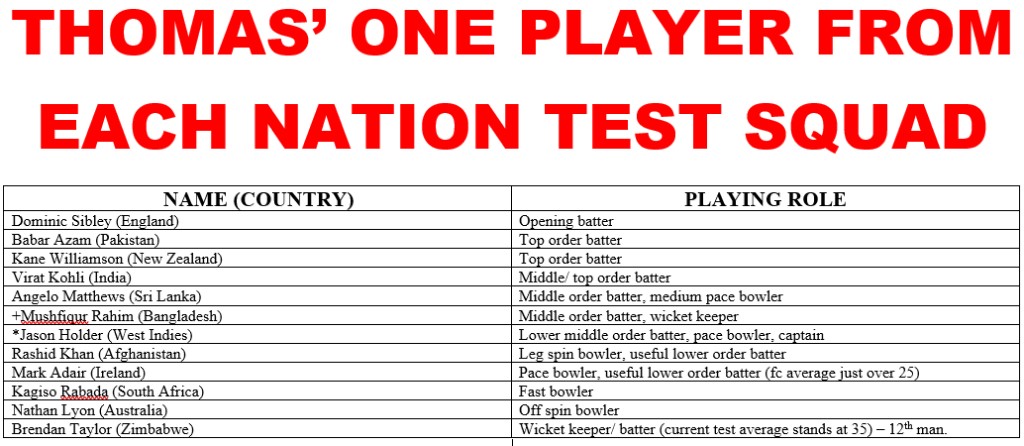
This post was inspired by a challenge tweeted by @cric_blog:
🇦🇫 🇦🇺 🇧🇩 🏴 🇮🇳 🇮🇪 🇳🇿 🇵🇰 🇿🇦 🇱🇰 🇧🇧 🇿🇼
Make a Test XI (and 12th man) picking one current player from each of the 12 Test nations. Go!#Cricket
I responded on twitter, but there is a limit to how much detail one can go into there, so I am now putting up a blog post to provide a fuller explanation of my thoughts (I thank CricBlog for setting a tough but fun challenge and inspiring me to create a blog post – a combination of an English late autumn/ winter and lock down is not exactly ideal for providing inspiration!).
SELECTION ISSUES
The 12 test playing nations are: Australia, Afghanistan, Bangladesh, England, India, Ireland, New Zealand, Pakistan, South Africa, Sri Lanka, West Indies and Zimbabwe. Some of these nations have many current greats to choose from, others have very few players to merit consideration. I also wished as far as possible to pick players in appropriate places in the batting order and to have a properly balanced side.
THE SQUAD FROM 1-12
Dominic Sibley (England) – an opening batter who knows how to bat for a long time. He has impressed considerably since his selection for England, which was earned the old fashioned way by scoring shedloads for his county.
Babar Azam (Pakistan) – he often bats no3 in long form cricket, but he can also open, his class is unquestionable, and his attacking inclinations make him a suitable partner for the solid Sibley.
Kane Williamson (New Zealand) – one of the finest long form batters the game has ever seen, and certainly in the top handful of contemporary batters whatever the format.
Virat Kohli (India) – Another all time great.
Angelo Matthews (Sri Lanka) – Averages 45 with the bat and is also a potential sixth bowler with his medium pace. Sri Lanka are not especially strong at the moment, limiting one’s options in terms of selecting a team of this nature.
+Mushfiqur Rahim (Bangladesh) – A fine wicket keeper and worth his place as a middle order batter as well, the little Bangladeshi can be counted as one of two genuine all rounders in the XI.
*Jason Holder (West Indies) – lower middle order batter, quick bowler and captain. He has a test double century to his name and has also taken some major wicket hauls, including a six-for to start the first test series of the 2020 English season. Although the West Indies ended up losing that series I was overall impressed by Holder’s captaincy and had little hesitation over giving him that role in this team. As an aside, England owe the Windies big time for this summer and should have reciprocal tours of that part of the world high on their priority list.
Rashid Khan (Afghanistan) – an outstanding leg spinner and a useful lower order batter, he was the easiest selection of all for this squad, so far above his compatriots does he stand.
Mark Adair (Ireland) – pace bowler, useful lower order batter (he averages over 25 in first class cricket). He was impressive with the ball at Lord’s in 2019, his only test to date.
Kagiso Rabada (South Africa) – pace bowler. The quickest bowler in the squad, and the best of the three pace bowlers I have named.
Nathan Lyon (Australia) – the best current off spinner (only Murali among off spinners I have seen in action ranks as an unquestionably better bowler – sorry Swanny), and a suitable ‘spin twin’ for Rashid Khan.
Brendon Taylor (Zimbabwe) – Zimbabwe has few stand out names at present, but as a 12th man a wicket keeper who is also a good enough willow wielder to average 35 in test cricket is a pretty decent option.
THE TEAM ANALYSED
This team has a well matched opening pair, an outstanding no 3 and 4, a no 5 who has a very respectable record, an excellent keeper/batter, and Holder filling the all rounders slot at seven. The bowling line up, with Rabada taking the new ball alongside Holder or Adair, a third high class pacer and two outstanding and contrasting spinners in Rashid Khan and Nathan Lyon is also formidable. I would fully expect this team to give a good account of itself in any conditions. For more about my ideas on selection policies and team balance you can look at my ‘All Time XIs‘ series and/or at my ‘100 cricketers‘ series.
EXTENDING THE CHALLENGE
Please feel free to use the comments to indicate your own selections, sticking to the brief of one player per test playing nation. Those who fancy a really serious challenge are invited to pick a XII on similar lines to go up against mine (without thinking too hard I can identify nos 4, 5, 6 (or 4, 5, 7 or 4,6, 7) and 11 of such a combination and would be interested to see if these names feature).
PHOTOGRAPHS
I finish this post with some photographs (to view an image at full size please click on it):
A look at the end of the test match summer, and at the state of the Bob Willis Trophy.
INTRODUCTION
From Friday through Tuesday at those times the weather permitted England and Pakistan did battle at the Ageas bowl in the last test match of this strangest of all summers, and from Saturday through Tuesday the fourth round of the Bob Willis Trophy took place, again with considerable interference from the weather. I look back at the test match and forward to the final round of BWT fixtures.
YOUTH AND EXPERIENCE TO THE FORE
England amassed 583-8 declared in their first innings, a performance underpinned by Zak Crawley who scored 267, his first test century. The only higher scores for a maiden test ton have been Brian Lara’s 277 at Sydney, Tip Foster (287 in his first ever test innings at Sydney), Bobby Simpson’s 311 at Old Trafford and Garry Sobers’ 365 not out at Sabina Park. Among England batters only Compton (278 v Pakistan), Foster (287 v Australia), Cook (294 v India), John Edrich (310 not out v New Zealand), Andy Sandham (325 v West Indies), Graham Gooch (333 v India), Walter Hammond (336 not out v New Zealand) and Len Hutton (364 v Australia) have ever scored more in a single innings. Only Hutton has ever scored more at a younger age than Crawley, who is just 22 years old. Thereafter, in the cricket that the weather permitted the spotlight was focussed on 38 year old James Anderson, as he first took a five-for (and had three catches missed) in Pakistan’s first innings, to which skipper Azhar Ali contributed a splendid 141 not out. This put Anderson on 598 test wickets, and England enforced the follow on as they had to. By the end of day 4, as the weather played havoc with the match Pakistan were 100-2 in their second innings, with one of the wickets to Anderson moving him on to 599, and yet another catch having gone begging off his bowling. There was heavy overnight rain, and it continued to rain for most of the morning, finally stopping just after 11AM. The sodden ground then had to dry out before play could commence, but eventually, at 4:15PM, with a possible 42 overs (27 mandatory and a further 15 if a result seemed possible) to be bowled. Anderson did not break through in his first spell, and as England hurried through overs to get to the second new ball Joe Root took a wicket with his part time off spin and Dom Sibley bowled one of the filthiest overs ever seen in a test match with his even more part time leg spin. The new ball was taken, and in his third over with it James Anderson induced a nick from Azhar Ali and the ball was pouched by a waiting slip fielder, bringing him to 600 test wickets. No one who bowled above medium pace had previously reached this landmark, and of the three spinners who had got there only one, Muttiah Muralitharan had done so in fewer balls bowled. Shortly after this a well struck four brought up a remarkable statistical landmark highlighted by Andy Zaltzman on Test Match Special: 1,000,000 runs in test matches involving England. A little later the last 15 overs were called, and after one ball thereof the teams decided to accept a draw as the pitch was doing precious little, and they were all eager to get away from the biosecure bubble and back to loved ones.
At the moment there is no way of knowing when England will next be in test match action, but James Anderson has every intention of still being in action when they do, and since he is still regularly clocking 85mph even at the age of 38 (while it is not unusual for veteran bowlers to be very successful due to the smarts they have acquired from years of experience it is unusual for a bowler of that age not to have slowed down – Walsh was barely exceeding 80mph when he toured England in 2000, likewise Shaun Pollock and Glenn McGrath in their veteran years) and is statistically bowling better than he ever has I for one am not counting him out.
I would like to thank both the West Indies who visited for three test matches immediately before Pakistan came over and Pakistan for braving the uncertainties created by this pandemic and coming to play, ensuring we had some cricket. I also tender a second huge thank you to the West Indies because their women are coming over to play against our women after India and South Africa cried off. I hope that England will reciprocate as soon as possible.
ADVANTAGE SOMERSET IN THE BWT
The format of the Bob Willis Trophy, tailored to fit special circumstances, is that the 18 first class counties have been grouped into three regional conferences, meaning that five rounds of matches will be played, and then the two best group winners will fight out a five day final at Lord’s. After four rounds of matches Somerset lead the central group with 76 points, Derbyshire the north group with 71 points and Essex the south group with 70 points. Although bonus points (of which as readers of this blog will be aware I am not a huge fan) complicate the issue somewhat, basically any win in their final match will qualify Somerset, since it is next door to impossible to win a match without taking full bowling bonus points, which on its own would put Somerset on 95, meaning that Derbyshire could equal them with a maximum point win and Essex could finish on 94 with a maximum win. Somerset crushed Gloucestershire and the most recent round, dismissing them for 76 and 70. Surrey’s nightmare season went from bad to worse as they were beaten by Kent in spite of the restored Ben Foakes contributing a century and a fifty. A major role for Kent was played by Darren Stevens, an all rounder who bowls medium pace, and who remains a force to be reckoned with at county level even at the age of 44. Limited overs cricket will be the order of the day for most of the rest of this season, which will extend into October because of the hugely delayed start. The T20 blast competition gets underway tomorrow afternoon, with commentaries on all matches accessible via www.bbc.co.uk/cricket.
A look at the extraordinary events that are unfolding at the Ageas bowl as Zak Crawley establishes himself at the highest level.
INTRODUCTION
It is now all but a 100% certainty that England will win the series against Pakistan, and what follows explains why.
DAY 1
Yesterday after messrs Curran, Foakes and Robinson were allowed to leave the bubble at the Ageas Bowl to play for their counties in the Bob Willis Trophy, leaving an England side of Burns, Sibley, Crawley, *Root, Pope, +Buttler, Woakes, Bess, Archer, Broad and Anderson (Dan Lawrence and Ben Stokes had already been released in both cases for family reasons) Joe Root won the toss and chose to bat. The morning session went England’s way as they reached Lunch on 91-2. The loss of Root for 29 and Pope for 0 in quick succession made it 127-4, and seemingly turning in Pakistan’s favour. However, Zak Crawley was playing a magnificent innings, and Buttler continued his good recent form with the bat (pity he has been so bad with the gloves). By the tea interval it was 183-4 with Crawley on the verge of a maiden test century and England were starting to look good. The evening session was brilliant for England and horrible for Pakistan. Late in the day the runs were coming very fast as the Pakistan bowling got decidedly ragged. The day ended with England 332-4, Crawley 171 not out and Buttler within sight of a century of his own.
DAY 2
There have been two disruptions for rain, but in the cricket that has been played England have fared well, with the Pakistan bowling not looking remotely threatening. The score is now 380-4, and the stand between Crawley and Buttler is an all time England fifth wicket record against anyone, and Crawley is seven runs away from becoming the youngest England player to score a test double century since David Gower against India at Edgbaston in 1979. This is Crawley’s first test century and among those who have gone big on their first venture into three figures at this level are Bill Edrich (219 at Durban in 1939), Tip Foster (287 in his first test innings at Sydney in 1903), Bobby Simpson for Australia against England at Old Trafford (311) and at the top of this particular tree Garfield St Aubrun Sobers, 365 not out for West Indies v Pakistan at Sabina Park. Crawley has just brought up the double century with a four to third man, and England are now 391-4. Crawley was picked on potential, with not a lot in the way of major first class batting achievements behind him, and had passed 50 on three previous occasions in his fledgling test career, but this innings has surely settled the number three position for some considerable time to come – it has been a supreme performance, with no definite chances given. The record score for England against Pakistan is 278 by Denis Compton at Trent Bridge in 1954, which is definitely within Crawley’s compass from here. No3 has caused England many problems since I first started following cricket, with only Michael Vaughan and Jonathan Trott really succeeding there before the emergence of Crawley who has looked like a natural at no3.
THE REST OF THE MATCH
The weather forecast is pretty good for the rest of this match, and it is very hard to see any way of England losing from here, especially given that a draw will give them the series, which means they can shut up shop if trouble threatens. The 400 has just come up, and I reckon the way things are going that Crawley and Buttler should have at least half an eye on the all-time test record with wicket stand by anyone – the 405 that Sidney George Barnes and Donald Bradman put on together against England at Sydney in 1946. For the real pessimists the highest ever first innings to lose a test match is 586 by Australia at Sydney in 1894, when England replied with 325 and then in the follow on 437 and Australia got caught on a sticky in the final innings and were all out for 166, with Bobby Peel taking six cheap wickets. My own reckoning is that with England putting up a total like this after being 127-4 Pakistan will be demoralized and that England will win comfortably. Crawley has just had a little bit of good fortune, with an attempted catch becoming a six, and his score is now 222, moving him one run ahead of his mentor Rob Key’s highest test score. Only two England batters have had a higher maiden century, Hammond with 251 at Sydney in 1928 and Tip Foster’s 287 also at Sydney in 1903. The 300 stand has just come up for the fifth wicket.
Cricket and how to deal withe time being lost to the weather.
INTRODUCTION
The match at the Ageas bowl between England and Pakistan has been hammered by a combination of bad weather and excessive caution on the part of the umpires, and not a single one out of nine Bob Willis Trophy matches has escaped unscathed either. This post looks at the various matches and looks at reducing the toll poor weather takes of cricket.
THE TEST MATCH
The situation at the Ageas bowl is that the equivalent of over two whole days have been lost to the weather, and the teams are currently in their hotel sheltering from what is apparently quite heavy rain. In the play that has been possible Pakistan have amassed 236 in their first innings, with Mohammad Rizwan playing a fine innings, and Stuart Broad continuing his excellent summer with the ball. England in response are 7-1, with Burns out for a duck, and a little lucky to have lasted as long as he did, since his second ball was edged just short of the slip fielder before his fourth was caught in that region. Probably the only chance of a positive result in that game is if the teams broker a deal whereby England declare, Pakistan forfeit their second innings and England have a go at a target of 230, while Pakistan try to take 10 wickets.
THE BOB WILLIS TROPHY
Leeds has seen 79 overs in a day and a half, and Yorkshire are 288-4 against Derbyshire.
Birmingham has seen more play than most places, and Warwickshire were dismissed for 121 in the first innings, while Somerset are 134-5 off 45.2 overs in response.
At Hove there have been 61 overs of play and Sussex are 155-6 against Essex.
At Northampton Worcestershire made 219 in their first innings and Northamptonshire are 60-3 in response.
At Trent Bridge there have been 71.2 overs and Nottinghamshire are 268-2 against Lancashire.
The St Lawrence Ground at Canterbury has seen 46 overs so far, and Middlesex are 94-4 against Kent.
At the Arundel Castle Ground which Hampshire are using as a home venue since the Ageas Bowl is required for other purposes they have already given up on play for today, which means that two days have seen exactly 40 overs, off which Surrey have reached 130-8.
In the game I am currently listening to at Sophia Gardens, Cardiff, Glamorgan are 68-4 off 40 overs against Gloucestershire.
Finally, at Grace Road there have been 72.2 overs thus far and Glamorgan are 224-4.
REDUCING LOSSES TO THE WEATHER
Firstly, abolish stoppages for the light altogether – play all matches using pink balls, so that the floodlights can be allowed to take complete control if necessary. Rain is harder to deal with, but I have an idea to float. It should be possible to construct a strong, lightweight but entirely waterproof canopy which could be attached to the tops of the floodlight pylons, enabling matches to be continued even if it is raining. It is just possible that an almighty miscue could send a ball pretty much vertically upwards (there was a shot that Ian Botham played off Terry Alderman at Old Trafford in 1981 that might have done this – Mike Whitney made a gallant effort to get underneath it to take the catch but could not quite do so) and cause it to hit the canopy, but I am sure that that could be dealt with.













































































































































































































































 aspiblog