All Time XIs – Given Names Beginning With D

A look at some of the greatest cricketers to have given names beginning with D and a large photo gallery.

Today I select an all time XI of players whose given names begin with D. There will be quite a few honourable mentions.

  1. David Warner (Australia, left handed opening batter). Few openers with given names beginning with D make a really strong case for inclusion, and in spite of various question marks (lack of runs in spin friendly India and Sri Lanka, ditto in swing and seam friendly England and New Zealand) about him this guy has to have the number one slot in this XI.
  2. Desmond Haynes (West Indies, right handed opening batter). His test record is excellent, and he habitually opened with a more attack minded partner in Gordon Greenidge. He would be an excellent foil to Warner.
  3. *Donald Bradman (Australia, handed batter, captain). Indisputably the best test batter there has ever been, and a splendid captain into the bargain.
  4. David Gower (England, left handed batter). A stylish left hander who also had enough steel to score 8,000 test runs at an average of 44.
  5. Denis Compton (England, right handed batter, left arm wrist spinner). Lost six years to WWII, was dogged for most of his post-war career by knee troubles and still had a superb record at the highest level.
  6. Dane van Niekerk (South Africa, right handed batter, leg spinner). The most controversial selection I have yet made in this latest blogging venture. She has not had the opportunity to play a test match, but her record in ODIs is better than her record in T20Is, which suggests that longer formats suit her. She is an attacking batter and a big spinner of the ball.
  7. +Don Tallon (Australia, wicket keeper, right handed batter). One of the greatest keepers ever to play the game and a more than adequate middle order batter. My chosen captain would be the first to endorse my choice of wicket keeper, since he rated Tallon the best he ever saw in action.
  8. Daniel Vettori (New Zealand, left handed batter, left arm orthodox spinner). New Zealand has not produced vast numbers of quality spin bowlers, but he was one of them. In 1999 as a youngster he played a huge role in consigning England to the home series loss that put them at the bottom of the world test rankings.
  9. Dennis Lillee (Australia, right arm fast bowler, right handed batter). One of the greatest fast bowlers ever to play the game.
  10. Dale Steyn (South Africa, right arm fast bowler, right handed batter). Even South Africa, which has produced a wealth of quality pacers, has had precious few to match Dale Steyn.
  11. David Harris (Hambledon, right arm fast bowler, right handed batter). The game’s first unarguably great bowler, largely responsible for the fact that catches are now credited to the bowler (simply because he showed precisely how bowlers can bowl with the specific intention of generating catches in mind). He would need a law change to be able to bowl in the style that he did back then, a matter I have covered in previous blog posts. My final word on this selection refers to the latter stages of his career: he was crippled by gout, but was so important to his team that they used to bring an armchair on to the field so that he could rest his feet when not actually bowling.

This side has strong batting, and with Lillee, Steyn and Harris to bowl pace and two contrasting front line spinners in Vettori and van Niekerk plus Compton as back up it is also well served in the spin department. Add to this a great captain and an outstanding keeper and you see a side with all bases covered.

Before I go into general honourable mentions there is a particular slot to be given special treatment…

There is of course someone who regularly batted at number six for Australia with distinction and whose given name begins with D: Doug Walters. The reason for my omission of Walters is down to the balance of the side – Walters was a batter who bowled, while I wanted an all rounder, and a spin bowling all rounder for preference. Within the brief of ‘spin bowling all rounder’ the main rival to van Niekerk was David Holford of the West Indies, but he did not really measure up in either department. Dattu Phadkar of India, a middle order batter and a bowler of fast medium or off spin according to circumstances had a fine FC record, but his international record was decidedly ordinary. Deandra Dottin of the West Indies was a seam bowling all rounder, and there was a significant decline between her records at T20I and ODI cricket, which suggests that genuinely long form cricket would not suit her at all. My contention here is a simple one: of all those I could have selected for this slot Dane van Niekerk most closely meets the specific requirements of this XI.

Don Kenyon was a fine opener for Worcestershire, but a failure for England. Deep Dasgupta once scored a century for India against England as an opener, but his presence in that role said more about the nature of the pitches and of the fact that the best Indian batters of the time disliked opening than it did about his skills. His wicket keeping is a red herring in this context since he ranks several miles below Tallon in that department. Two other Aussie batters besides Walters who had to be overlooked were Dean Jones and Darren Lehmann. Dilip Vengsarkar of India had a good test record, and was among the few of his day who fared better against the West Indies than he did overall, but no way could he displace Compton. Daryl Cullinan of South Africa was another who was unlucky to miss out. Duleep Mendis of Sri Lanka did enough to earn a mention here but not enough to force his way in. Daryl Mitchell of New Zealand is a fine middle order batter. Douglas Jardine was a good player and a great captain. Denis Lindsay of South Africa had one great series with the bat against Australia, but that was not enough to displace Tallon as keeper. Derek Shackleton was a superbly reliable and consistent medium pacer, taking 100 or more FC wickets in each of 20 successive English seasons, and would get the nod for the third seamer’s slot if I were to be debarred from selecting Harris. Devon Malcolm was fast, and on his day, as when he took 9-57 against South Africa he could be unplayable, but when it wasn’t his day he could also go round the park. Doug Wright, the Kent and England leg spinner of the immediate post war era was too erratic – in between the moments of devastation, which included taking a record seven first class hat tricks he could leak runs at an alarming rate. Doug Bollinger had some good moments, but his performance at Adelaide in 2010 when he could barely raise a gallop sent my estimation of him through the floor. Dushmantha Chameera of Sri Lanka is as yet unproven, but may force his way in eventually, as may Dilshan Madushanka. David ‘Butch’ White of Hampshire had some great moments while not quite meriting selection.

My usual sign off…

Australia 1963-83

A look at the best Australian cricketers of the period 1963-83 and a photo gallery.

I continue my look through Australia’s cricket history with a look at the best men’s cricketers of 1963-83, which brings us into the era covered in this post.

THE XI IN BATTING ORDER

  1. Bill Lawry (left handed opening batter). He averaged 47 with the bat over a long test career, which ended with him being dropped from the team when the Aussie selectors decided they wanted a new captain in Ian Chappell and that they did not think Lawry should play under his successor. This resulted in a first and only test appearance for Ken Eastwood, another dour left hander of similar age to Lawry but possessed of about half his skill.
  2. Bobby Simpson (right handed opening batter, ace slip fielder, occasional leg spinner). He took until his 30th test match to reach three figures at that level. In that first three figure innings he went on to 311, batting until the third morning of a match that Australia only needed to draw to retain the Ashes. Simpson scored nine further test centuries, one of them in the Ashes (a score of 225). He and Lawry also became the first pair of openers to score double centuries in the same test innings, their opening stand against the West Indies being worth 382 on that occasion.
  3. *Ian Chappell (right handed batter, captain, occasional leg spinner). A fine test match number three and a great skipper who took Australia to the top of the cricket world before the rise of Lloyd’s West Indies with their pace battery.
  4. Greg Chappell (right handed batter, ace slip fielder, occasional medium pacer, occasional leg spinner). The best Aussie batter to play his cricket exclusively in this era. Leg spin was his first style of bowling, but he learned to bowl medium pace while playing for Somerset as an overseas player.
  5. Allan Border (left handed batter, occasional left arm orthodox spinner). Although he had another ten years of test cricket ahead of him in 1983 he had done enough by then to warrant his place, and by the time of his retirement he would be remembered as an all time great, the first ever to score 11,000 test runs.
  6. Doug Walters (right handed batter, occasional medium pacer). Averaged in the mid-40s in test cricket, though he never quite cracked batting in England. His career best was 250 against New Zealand, and he also had a match in which he scored 242 and 103. He twice scored 100 runs in a single session of play in test cricket. As a bowler at test level he was mainly used to break awkward partnerships, though he was good enough as a youngster to take a seven-for on FC debut.
  7. +Rod Marsh (wicket keeper, left handed batter). At the time of his retirement he had made more test dismissals than any other wicket keeper and had also scored two test centuries. His departure left a hole in Aussie ranks that took a few years to properly fill, the search for decent test keeper only ending with the emergence of Ian Healy.
  8. Ashley Mallett (off spinner, expert gully fielder, right handed lower order batter). Very valuable in a supporting role when Australia had some serious fast bowling talent in the 1970s.
  9. Dennis Lillee (right arm fast bowler, right handed lower order batter). 71 test appearances yielded him 355 wickets, including 164 in Ashes matches, breaking a record that Hugh Trumble had held for three-quarters of a century. Lillee’s own tally was beaten in turn by Shane Warne.
  10. Jeff Thomson (right arm fast bowler, right handed lower order batter). The fastest bowler of the era, and possibly the fastest Australia has yet produced (Shaun Tait and the 2013-14 incarnation of Mitchell Johnson are possible rivals for this one). 200 test wickets in all, in spite of injury problems disrupting his career.
  11. Rodney Hogg (right arm fast bowler, right handed lower order batter). The 41 wickets he took in his debut series in 1978-9 were at the time an Australian record for an Ashes series. Injuries subsequently spoiled his career.

This side has a powerful top six, most of whom could also contribute something with the ball, a great keeper, a good off spinner and three genuinely fast bowlers.

HONOURABLE MENTIONS

The only other opening batter from this period who might have justified breaking the Lawry/ Simpson combo at the top was Keith Stackpole, but although his attacking approach may have made him a better foil to Lawry than Simpson, Simpson had the better record.

In the middle order there were two very near misses, Kim Hughes and Graham Yallop, but good as they were neither could realistically challenge either the Chappells or Border.

The main spin bowling challengers were two leg spinners, Terry Jenner and Kerry “Skull” O’Keeffe, but bearing in mind the spin bowling capacities of my front line batters I wanted on off spinner, and the only close challenger to Mallett on that basis was Bruce Yardley.

The pace bowling department was much more difficult. My decision to go for all out pace, with Hogg accompanying Lillee and Thommo meant that three guys with solid claims all missed out: Graham McKenzie was Australia’s best seamer between the retirement of Alan Davidson and the rise of Dennis Lillee, claiming 246 test scalps. Max Walker, the regular third seamer when Lillee and Thommo shared the new ball was also a candidate. Finally, brought into the picture by the fact that he bowled left arm fast medium which would have added variation and that he would have strengthened the lower order batting there was Gary Gilmour. In the ‘what might have been’ category is Bob Massie, who claimed 16 scalps on test debut, but then had a disastrous tour of the West Indies in which an attempt to generate extra pace led to him permanently losing his ability to swing the ball.

PHOTOGRAPHS

My usual sign off…

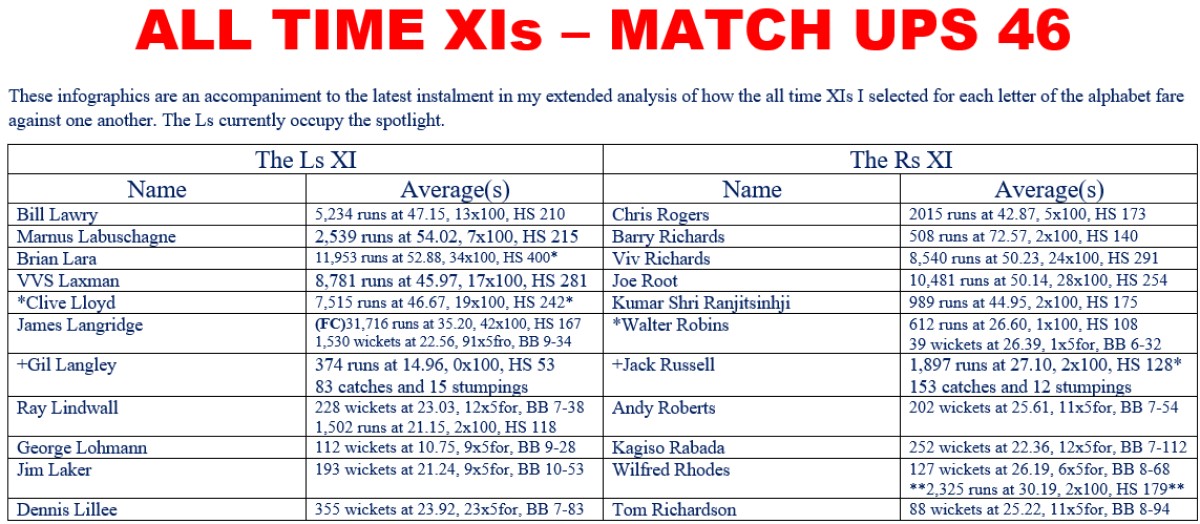
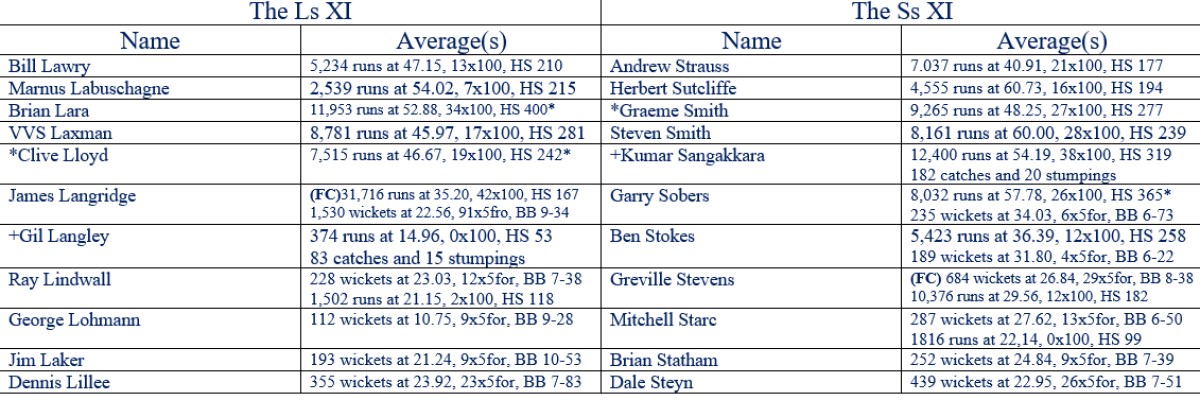
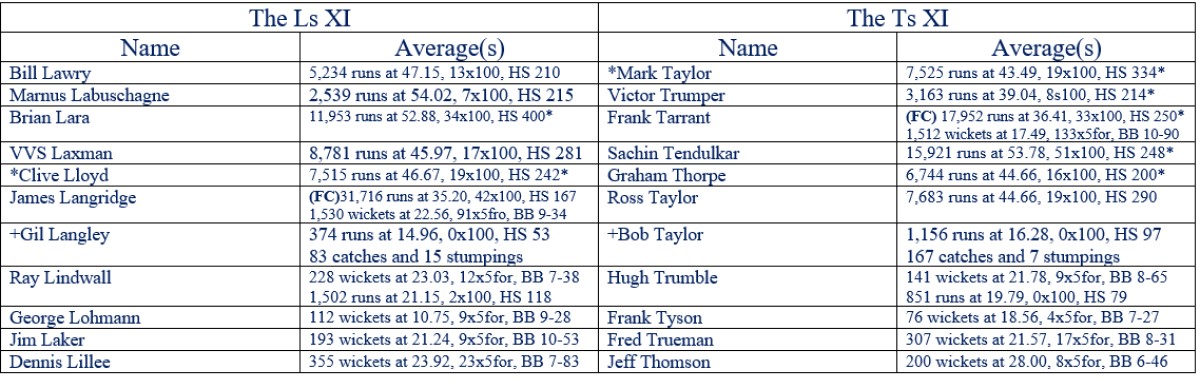
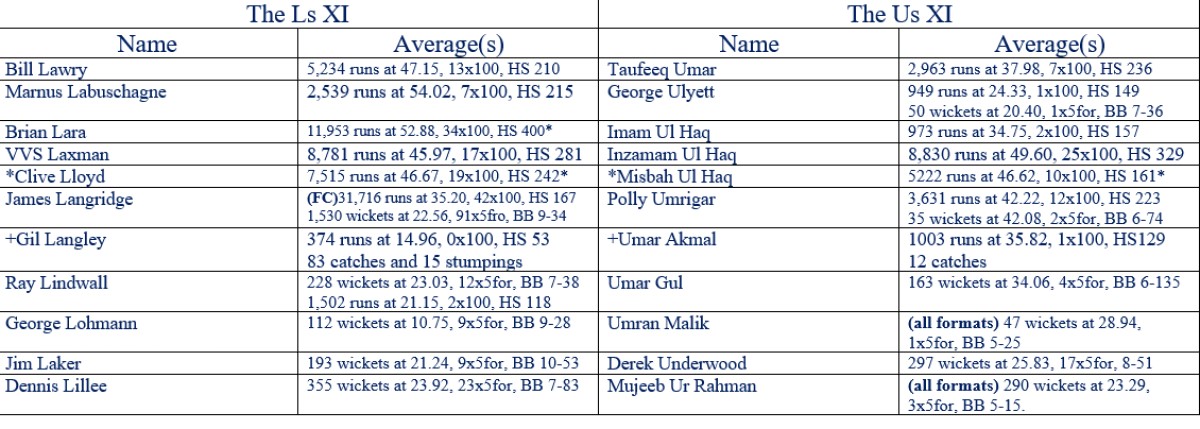
All Time XIs – Match Ups 46

Continuing my extended analysis of how the all time XIs I selected for each letter of the alphabet fare against one another.

Welcome to the latest instalment in my extended analysis of how the all time XIs I selected for each letter of the alphabet fare against one another. The Ls are in the spotlight and have so far accrued 60 of a possible 80 points.

THE Ls V THE Rs

The Rs have the better opening pair (Lawry outranks Rogers but Richards absolutely blows Labuschagne out of the water, especially given that the latter is batting out of position). Lara shades the number three slot, but Root handsomely wins the number four slot. The number five slot looks a big win for Lloyd, but appearances are a bit deceptive – Ranji played on much more difficult batting surfaces than Lloyd. Langridge comfortably wins the battle of the spin bowling all rounders over Robins, but Russell totally bosses the keeping match up. The Ls win the pace/ seam element of this match up, Lohmann being the deciding factor there. They also win the spin bowling element – Laker outranking Robins by more than Rhodes outranks Langridge in the battle of the left armers. I think the Ls bowling settles this one in their favour and I make it a comfortable win: Ls 4, Rs 1.

THE Ls V THE Ss

The Ss have the better opening pair – Lawry outranks Strauss, but by far less than Sutcliffe outranks Labuschagne. Lara wins the battle of the number threes, but Smith comfortably outranks Laxman and Sangakkara outranks Lloyd, though the Ls do have the better keeper. Sobers massively outbats Langridge, but Langridge was the finer left arm orthodox spinner, and similarly Laker’s off spin is more valuable than Sobers’ left arm wrist spin. Stokes is the bonus the Ss get for having Sangakkara as keeper. The Ss win the pace/seam bowling – Starc’s left arm gives them extra variation among the three front liners, and Stokes and Sobers in his quicker incarnations lend them extra depth as well. The Ls win the spin bowling. I think the Ss have got this but not by a huge margin: Ls 2, Ss 3

THE Ls V THE Ts

I give the Ts the better opening pair – Trumper was a regular opener and he scored his runs on uncovered, often treacherous pitches, which I think comfortably makes up both the discrepancy between his and Labuschagne’s averages and for Lawry’s advantage over Taylor. Lara comfortably wins the batting match up at number three, but Tarrant outranks Langridge as a bowler. Tendulkar bosses the number four slot, and while Lloyd had a somewhat better test average than Thorpe, the Englishman had a lot less support from the rest of the order than the West Indian. Ross Taylor outbats James Langridge at six. The Ts comfortably win the battle of the keepers. The pace bowling is hard to call – the Ts are quicker, but the Ls are probably better. Trumble and Laker are about equal, so with Tarrant outpointing Langridge as a bowler the Ts win the spin bowling department. I think the Ts superior batting and spin bowling wins it for them, but it is close: Ls 2, Ts 3.

THE Ls V THE Us

The Ls boss the batting – only Inzamam Ul-Haq, Umrigar and Umar Akmal win their match ups in that department. The Ls win the keeping contest hands down, and massively outrank the Us in pace/ seam bowling as well. Underwood outranks Langridge, and at the moment, though subject to change as more evidence comes in from Ur Rahman, Laker massively outranks Ur Rahman as an off spinner. It is hard to see the Us claiming anything from this contest: Ls 5, Us 0.

THE Ls V THE Vs

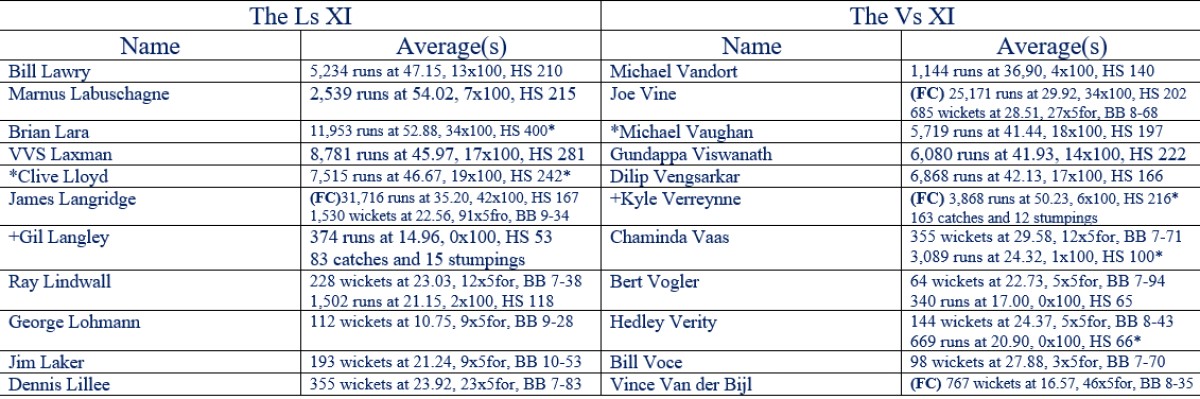
The Ls have a significant advantage with the bat, with only Verreynne and Vaas winning their match ups in that department for the Vs. Langley outranks Verreynne as keeper. The pace/seam bowling contest is close – the Vs have two left armers in Vaas and Voce, the former of whom would fare better as part of this attack than he did IRL to counter the Ls superior overall figures. Verity hugely outranks Langridge – he was the reason the latter only go the test call up quite late in his career, though Laker just outranks Vogler, giving the Vs the advantage in spin bowling. I think the Ls being ahead in batting and at least level on seam/ pace bowling is enough for a comfortable win for them, but I will grant the Vs spinners (particularly Verity) one big day out: Ls 4, Vs 1.

THE Ls PROGRESS REPORT

The Ls have scored 17 out of 25 today, moving them up to 77 out of 105, 73.33% overall.

PHOTOGRAPHS

All Time XIs – The Letter L

A couple of pieces of news and a continuation of my exploration of the All Time XIs theme with a team whose surnames all begin with L.

Before I get to the main meat of this blog post – another variation on the all time XIs theme I have a couple of pieces of news to share.

HERITAGE OPEN DAY

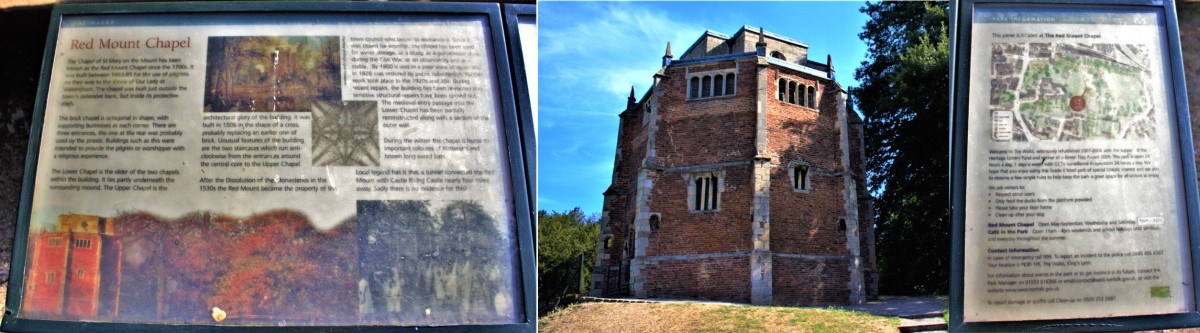
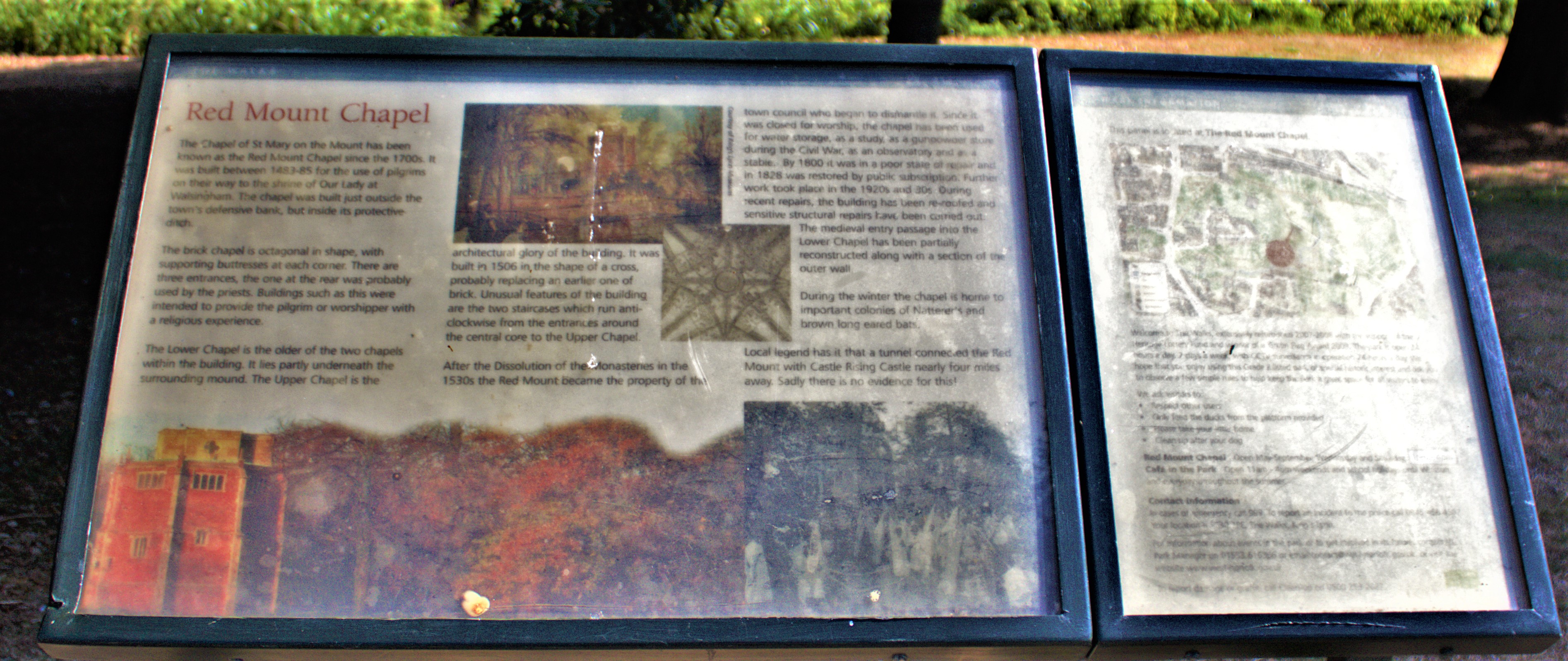
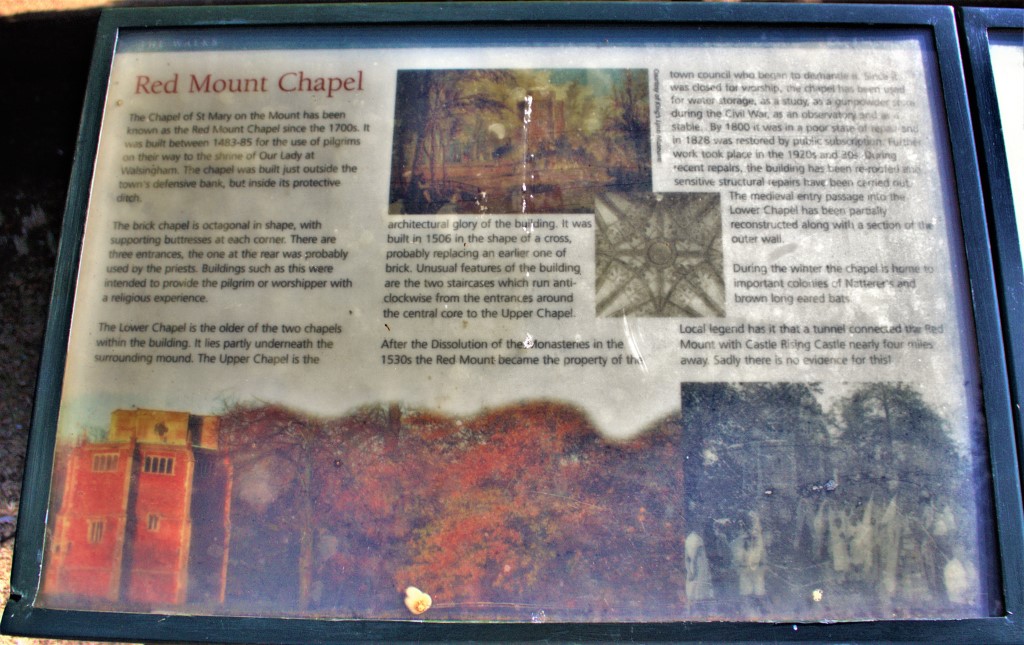
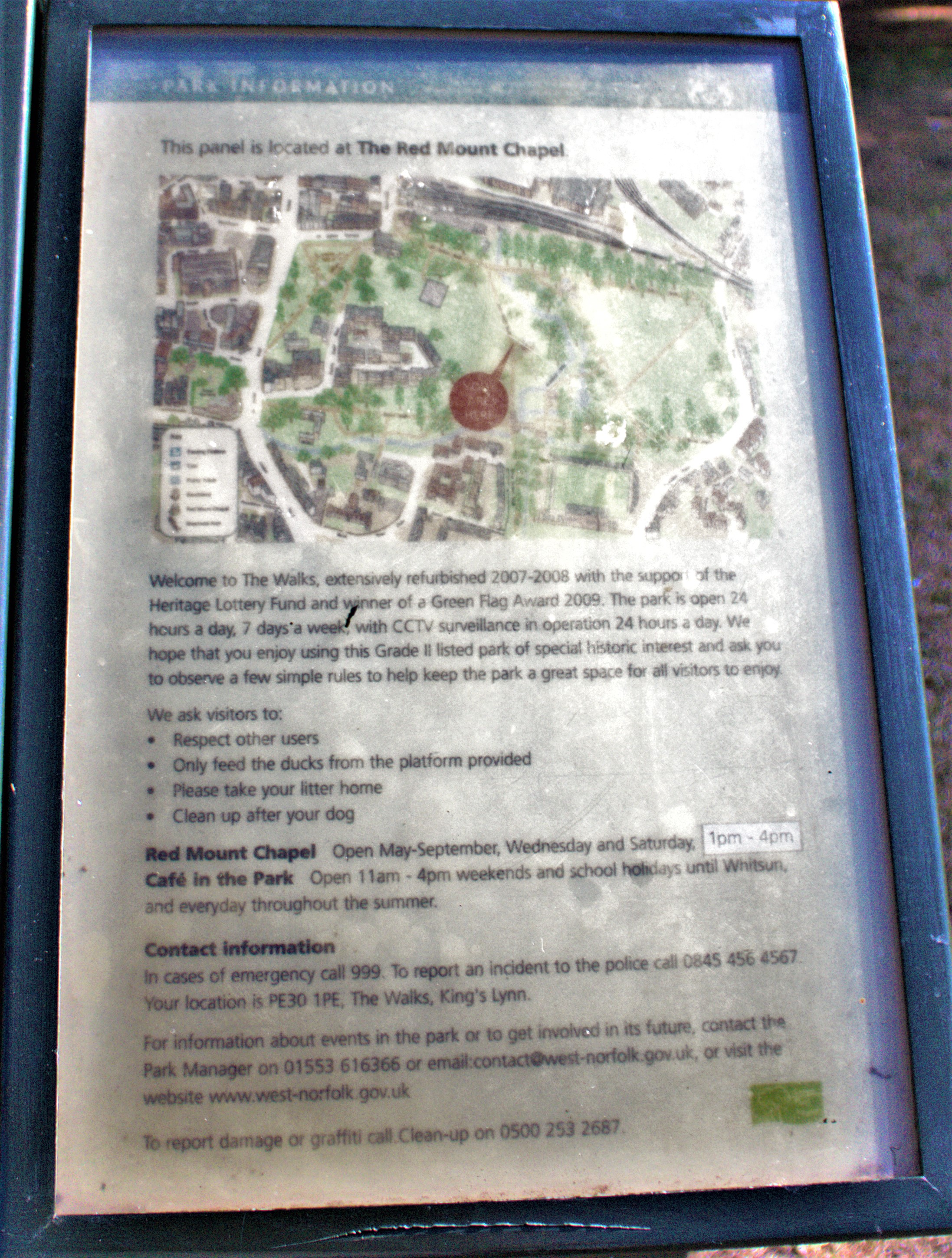
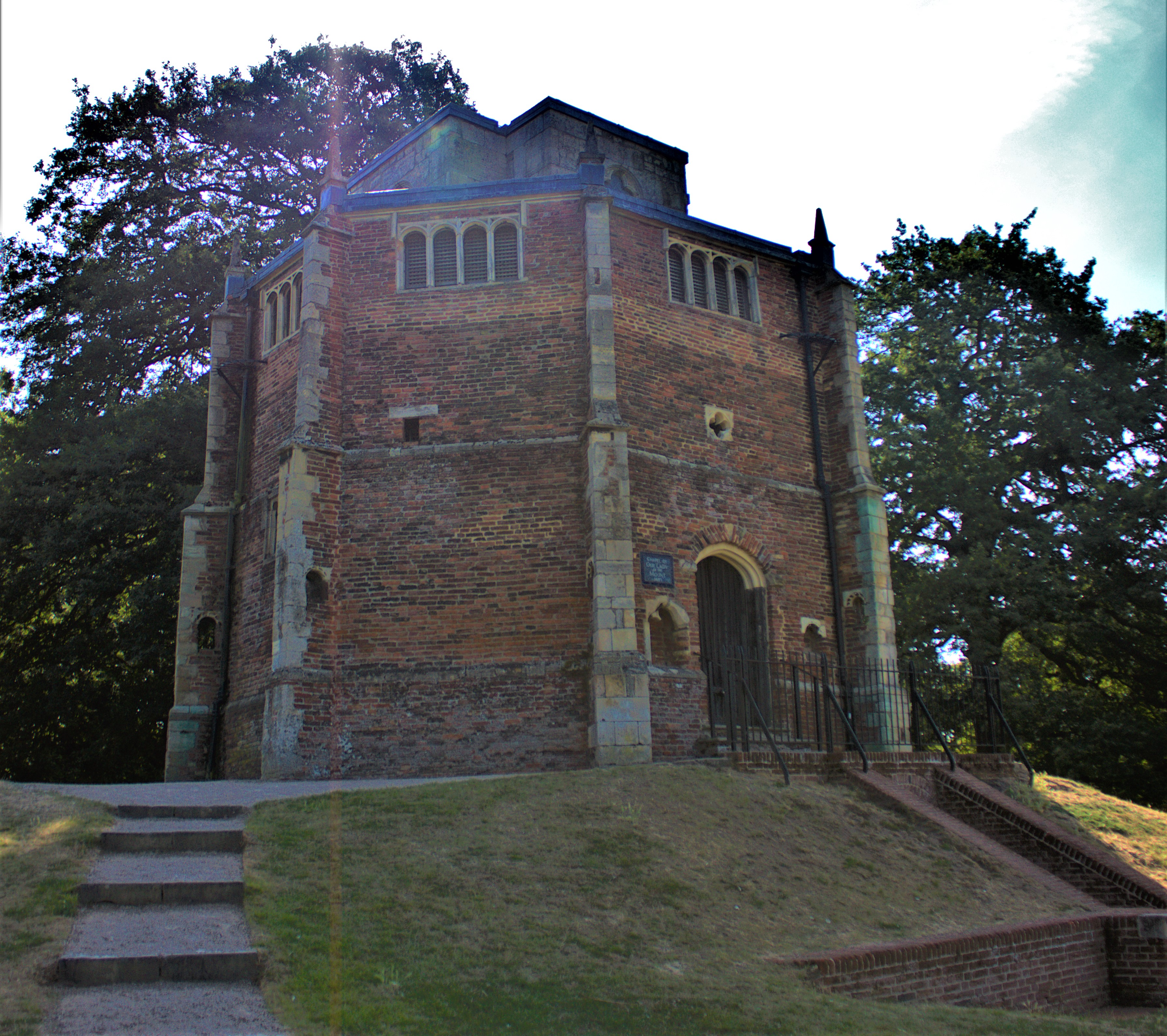
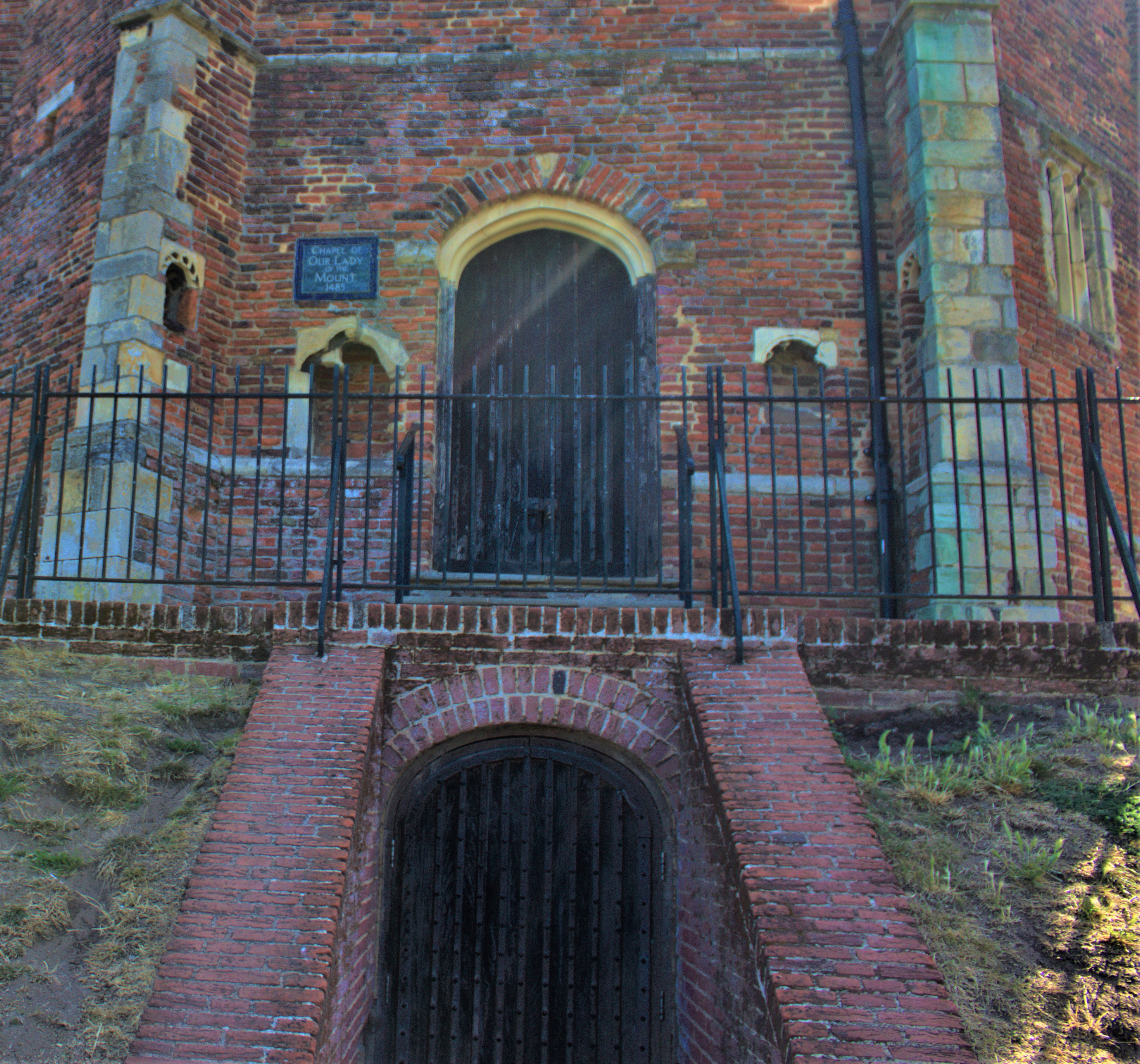
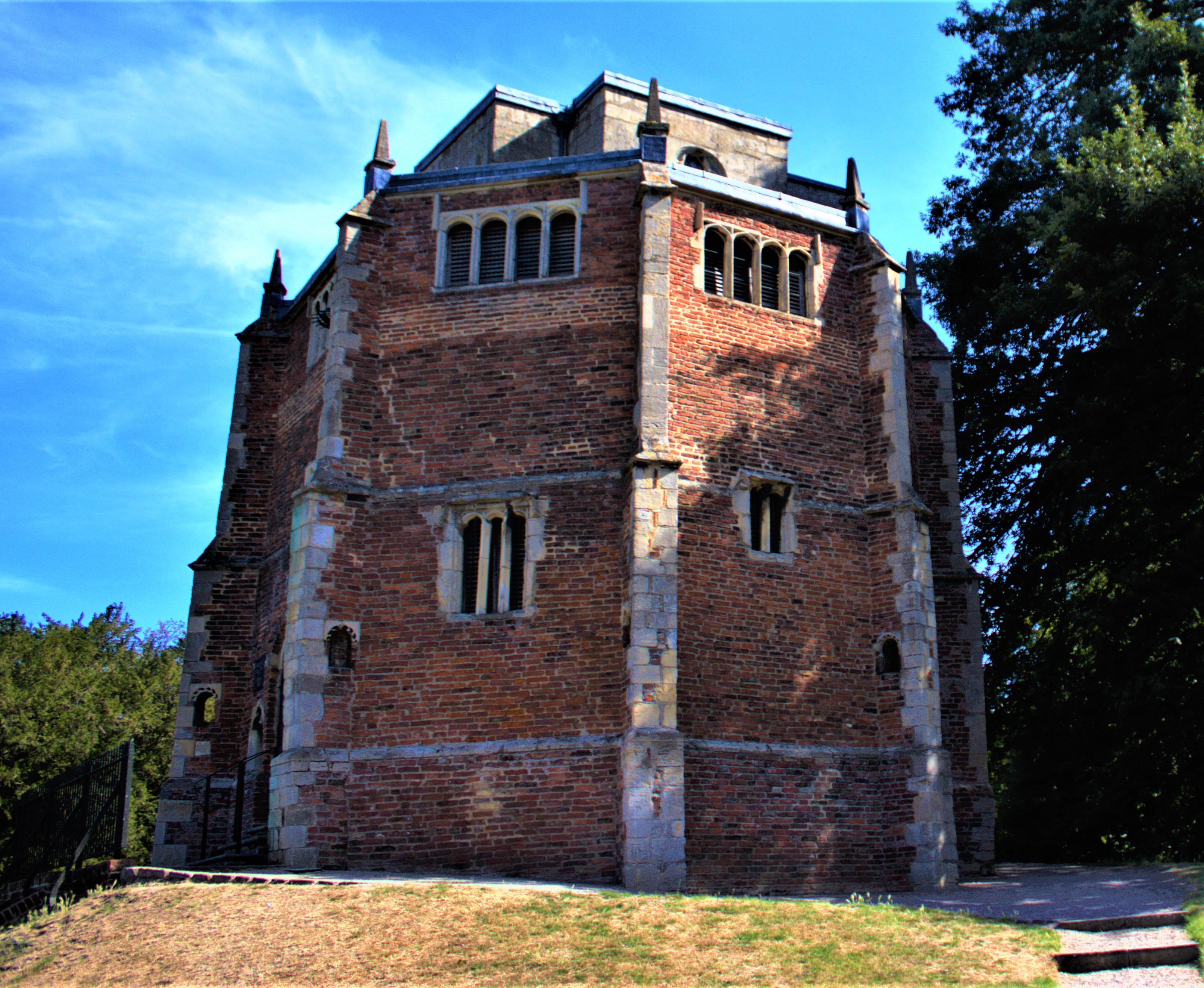
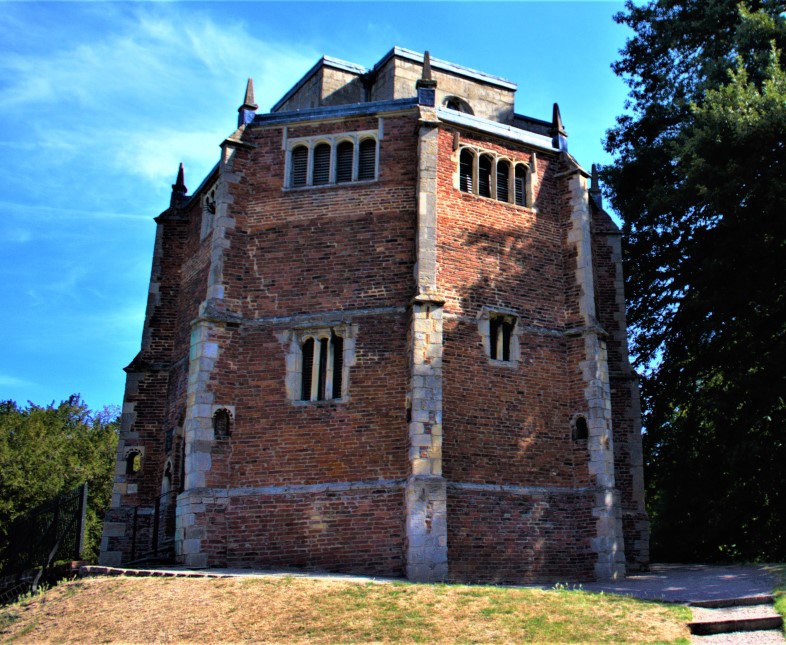
Yesterday I got the news of my stewarding commitment for Heritage Open Day (Sunday 11th September), and I regard it as a plum posting: the Red Mount Chapel, between 10AM and noon. I have visited this remarkable place a number of times, including during last year’s Heritage Open Day.

PRESS COVERAGE OF WNAG

Your Local Paper have produced an article about the Beer Festival at Stewart House raising funds for the West Norfolk Autism Group.

Now we move on to the main meat of the post, a look at the greatest cricketers to have surnames beginning with the letter L.

THE XI IN BATTING ORDER

  1. Bill Lawry (Australia). A dour left handed opener, his test record speaks for itself.
  2. Marnus Labuschagne (Glamorgan, Australia). One of the best contemporary test match batters in the world. He generally bats at three, but I am moving up one place to open due to the number high quality batters I have to accommodate and the fact that there are not many regular openers of quality who had surnames beginning with L.
  3. Brian Lara (Warwickshire, West Indies). The only person to twice hold the world record individual score in test cricket and one of only two (Bradman being the other) to simultaneously hold the world FC and test record individual scores.
  4. VVS Laxman (India). A monumental 281 vs Australia in 2001 helped set up only the third instance of a team coming back from being made to follow on to win a test match. He was part of a massively strong middle order, playing alongside Tendulkar, Dravid and Ganguly in their prime.
  5. *Clive Lloyd (Lancashire, West Indies). A shoo-in for the captaincy of this side, as one of the two greatest West Indian skippers ever (Frank Worrell being the other). 110 test matches yielded him 7,515 runs, and he quite often only had to bat once because of the immense strength of his West Indies side.
  6. James Langridge (Sussex, England). A left arm spin bowling all rounder, his international opportunities were limited by him being a contemporary of Hedley Verity who had first dibs on the left arm spinner’s spot. Nonetheless his test averages were the right way round, while in the course of his long first class career he averaged 35 with the bat and 21 with the ball.
  7. +Gil Langley (Australia). One of the many great wicket keepers produced by Australia over the years. He was the first keeper to make as many as nine dismissals in a single test match, a feat later equalled by Rodney Marsh and bettered by Jack Russell.
  8. Ray Lindwall (Australia). One of the greatest of all fast bowlers and a handy enough lower order batter to have scored two test centuries.
  9. George Lohmann (Surrey, England). The cheapest wicket taking average of anyone to have claimed 100+ test wickets – 110 at 10.75 each, also by far the quickest strike rate of any taker of 100+ wickets at that level – one every 34 balls.
  10. Jim Laker (Surrey, Essex, England). For my money the greatest off spinner ever to play the game. 193 wickets in 46 test matches, at 21 a piece. His absolute peak was the 1956 Ashes when he took 46 wickets at 9.60 a piece in the series, including a test AND FC record match analysis of 19-90 at Old Trafford. In the tour match for Surrey v Australia he took 10-88 in the first innings of the match, bowling 46 overs on that occasion. His most shattering single piece of bowling came at Bradford in 1950 when playing for England against The Rest he took 8-2 (one of the singles being a gift to Eric Bedser) as The Rest collapsed to 27 all out.
  11. Dennis Lillee (Northamptonshire, Australia). A former holder of the record for most career test wickets – 355 in 71 test matches. He was at least two great bowlers – a fire and brimstone quick in his younger days, and a superbly accurate fast-medium bowler late in his career.

This team has a strong top five, albeit one of them batting out of position, a great all rounder, a great keeper and four great and well varied bowlers. Two genuine quicks in Lindwall and Lillee, a very crafty medium pacer in Lohmann, Laker’s off spin and Langridge’s left arm spin represents a strong and superbly balanced bowling attack.

HONOURABLE MENTIONS

I considered two specialist openers in addition to Lawry. John Langridge, brother of James, scored 76 first class hundreds and tallied over 34,000 FC runs but never gained an England cap. The other possibility, as a rebuke to Cricket South Africa for their treatment of her, was Lizelle Lee, hounded into international retirement by her board. However, although I recognize that there is an element of a gamble in playing a regular number three as an opener I would challenge any who insist on selecting one of these openers to say who out of Lara, Laxman and Lloyd you will drop to accommodate Labuschagne in his preferred number three slot.

Another fine middle order batter who had to miss out was the little West Indian battler Gus Logie.

The choice of James Langridge as all rounder meant that two high quality left arm spinners missed out: Tony Lock and Jack Leach. Left arm wrist spinner Jake Lintott may well merit consideration for this XI in a few years time, but he has played very little long form cricket as yet.

The best quick bowlers to miss out were Bill Lockwood and Harold Larwood. Lockwood was one of the pioneers of the slower ball, but as fine a cricketer as he was he could not dislodge Lindwall. Harold Larwood had one great test series (the 1932-3 Ashes when he claimed 33 wickets), but otherwise a fairly ordinary international career, and could hardly therefore be seen as a challenger to the consistent excellence of Lindwall and Lillee. Brett Lee was quick but somewhat erratic, reflected in his slightly high test bowling average. Geoff Lawson had a patchy career and was not worth serious consideration.

PHOTOGRAPHS

Our look at the letter L is at an end and it remains only to produce my usual sign off…

New Materials For Cricket Bats

My take on a story that has come out today about bamboo being considered as a possible alternative material for the making of cricket bats (willow is the traditional choice).

This post is prompted by a story that bamboo, more sustainable than the traditional willow, is being considered as a possible material for making cricket bats.

A CONTROVERSY AND A PIECE OF LEGAL PEDANTRY

The laws of cricket currently state in the section codifying what is acceptable in a bat that “the bat shall be made of wood”. Officially bamboo is a grass and not wood, so strictly technically a change to the laws of cricket would be required to permit the construction of bamboo bats.

The reason for this requirement being codified into law dates back to the post-Packer concord series of 1979-80 when Australia, with the World Series Cricket players restored to the fold, played three test matches against each of England and the West Indies. In one of the Australia v England matches Dennis Lillee, one of the greatest bowlers in the history of the game and a competent lower order batter came to wicket bearing an aluminium bat, having come to a financial arrangement with the manufacturer. Mike Brearley, the England skipper, was less than impressed, quickly noting two things: firstly that every time the bat made contact with the ball it made an ugly clanging sound and secondly and more importantly that the impacts of this new type of bat on the ball were damaging to said item. There was an on-field spat, and Lillee, instructed to revert to a wooden bat, hurled the aluminium implement away in disgust.

To prevent the aluminium bat from making further appearances an addition was made to the laws of cricket, and the overly restrictive formula that ‘the bat shall be made of wood’ came into being.

ON ALTERNATIVE
BAT MATERIALS

Although it is technically grass and not wood (this distinction is to my mind a piece of legal pedantry in the David Allen Green class) I do not see a lot of difference between a wooden bat and a bamboo one in terms of either the effect its impact has on the ball or the distances the ball can be hit with it (I would object to a cork bat on the latter grounds – the natural springiness of cork would surely cause a bat made of that material to send a ball much greater distances) and this to me is the key. I would say that new materials for bats would need rigorous testing to ensure that they do not damage the ball, that the noise of the impact of bat on ball is not positively unpleasant, and that they do not radically alter the game by having a massive effect on the distances that balls can be struck. Rather than worry overmuch about the type of material from which the bat is constructed its effect on the game should be the key criteria. If it can be demonstrated that a bamboo bat will work not too differently to the traditional willow I would have no objection to such being used.

Possibly the keenest statisticians (are you reading this James McCaghrey?) will come to produce tables comparing scoring by batters with wooden implements and with bamboo to analyse whether the different material is having any great effect.

PHOTOGRAPHY

My usual sign off…