All Time XIs – Match Ups 46

Continuing my extended analysis of how the all time XIs I selected for each letter of the alphabet fare against one another.

Welcome to the latest instalment in my extended analysis of how the all time XIs I selected for each letter of the alphabet fare against one another. The Ls are in the spotlight and have so far accrued 60 of a possible 80 points.

THE Ls V THE Rs
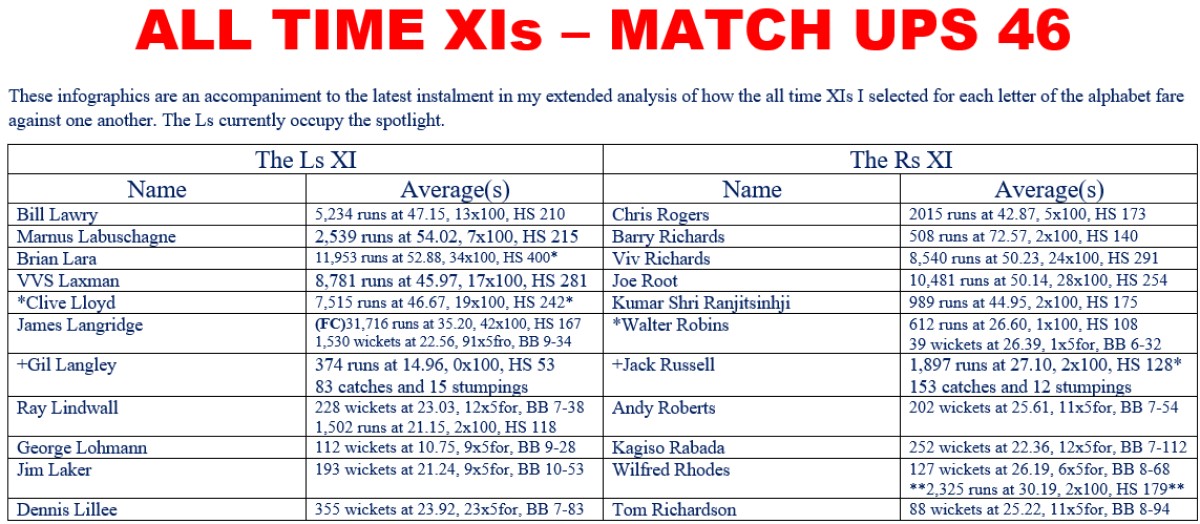
The Rs have the better opening pair (Lawry outranks Rogers but Richards absolutely blows Labuschagne out of the water, especially given that the latter is batting out of position). Lara shades the number three slot, but Root handsomely wins the number four slot. The number five slot looks a big win for Lloyd, but appearances are a bit deceptive – Ranji played on much more difficult batting surfaces than Lloyd. Langridge comfortably wins the battle of the spin bowling all rounders over Robins, but Russell totally bosses the keeping match up. The Ls win the pace/ seam element of this match up, Lohmann being the deciding factor there. They also win the spin bowling element – Laker outranking Robins by more than Rhodes outranks Langridge in the battle of the left armers. I think the Ls bowling settles this one in their favour and I make it a comfortable win: Ls 4, Rs 1.

THE Ls V THE Ss
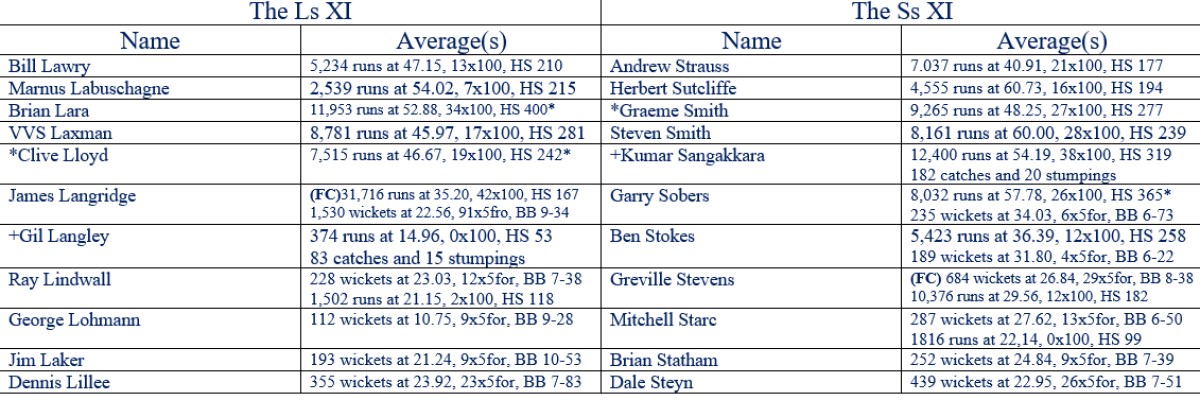
The Ss have the better opening pair – Lawry outranks Strauss, but by far less than Sutcliffe outranks Labuschagne. Lara wins the battle of the number threes, but Smith comfortably outranks Laxman and Sangakkara outranks Lloyd, though the Ls do have the better keeper. Sobers massively outbats Langridge, but Langridge was the finer left arm orthodox spinner, and similarly Laker’s off spin is more valuable than Sobers’ left arm wrist spin. Stokes is the bonus the Ss get for having Sangakkara as keeper. The Ss win the pace/seam bowling – Starc’s left arm gives them extra variation among the three front liners, and Stokes and Sobers in his quicker incarnations lend them extra depth as well. The Ls win the spin bowling. I think the Ss have got this but not by a huge margin: Ls 2, Ss 3

THE Ls V THE Ts
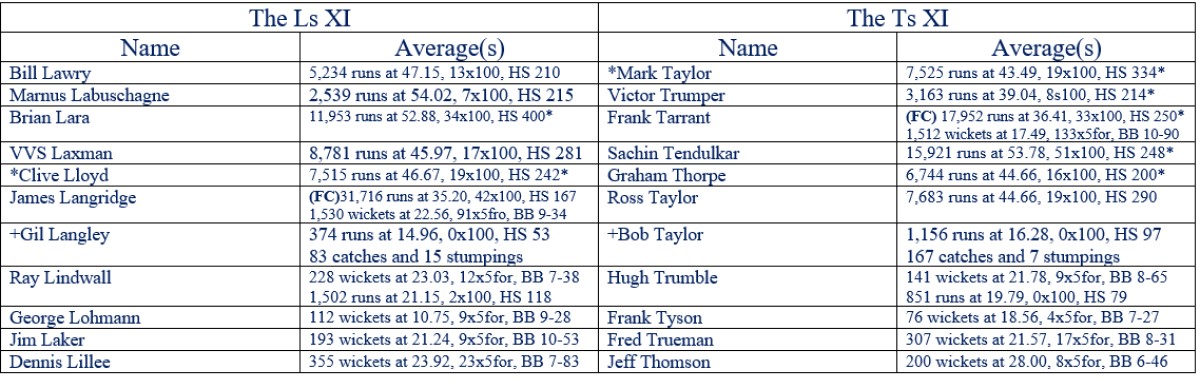
I give the Ts the better opening pair – Trumper was a regular opener and he scored his runs on uncovered, often treacherous pitches, which I think comfortably makes up both the discrepancy between his and Labuschagne’s averages and for Lawry’s advantage over Taylor. Lara comfortably wins the batting match up at number three, but Tarrant outranks Langridge as a bowler. Tendulkar bosses the number four slot, and while Lloyd had a somewhat better test average than Thorpe, the Englishman had a lot less support from the rest of the order than the West Indian. Ross Taylor outbats James Langridge at six. The Ts comfortably win the battle of the keepers. The pace bowling is hard to call – the Ts are quicker, but the Ls are probably better. Trumble and Laker are about equal, so with Tarrant outpointing Langridge as a bowler the Ts win the spin bowling department. I think the Ts superior batting and spin bowling wins it for them, but it is close: Ls 2, Ts 3.

THE Ls V THE Us
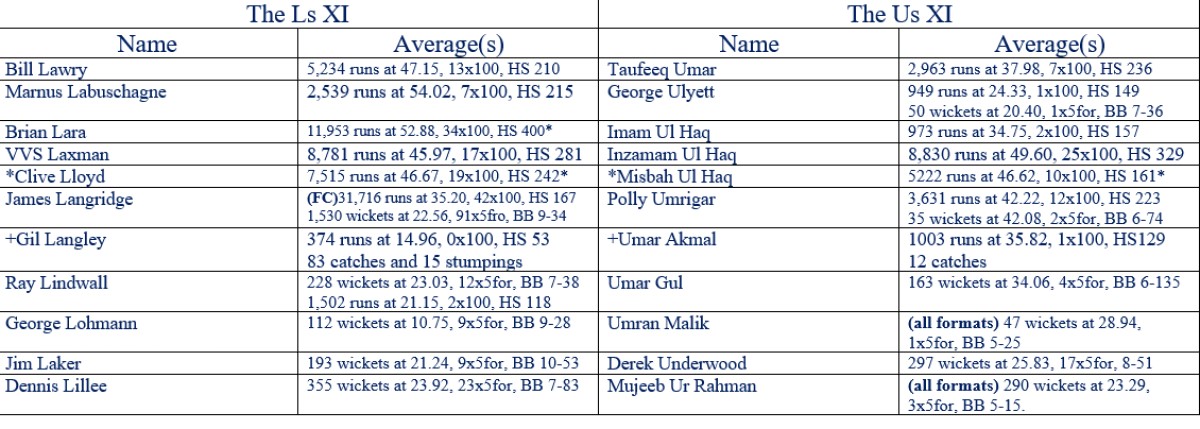
The Ls boss the batting – only Inzamam Ul-Haq, Umrigar and Umar Akmal win their match ups in that department. The Ls win the keeping contest hands down, and massively outrank the Us in pace/ seam bowling as well. Underwood outranks Langridge, and at the moment, though subject to change as more evidence comes in from Ur Rahman, Laker massively outranks Ur Rahman as an off spinner. It is hard to see the Us claiming anything from this contest: Ls 5, Us 0.

THE Ls V THE Vs
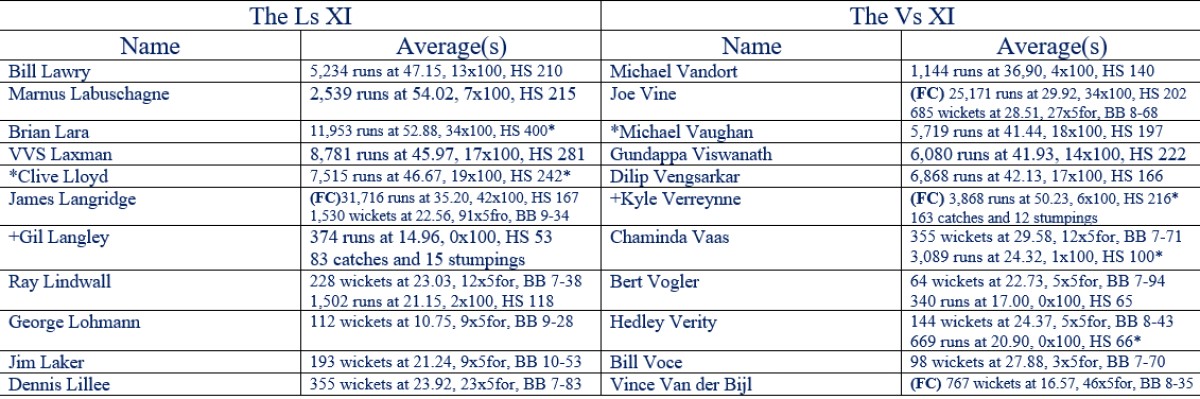
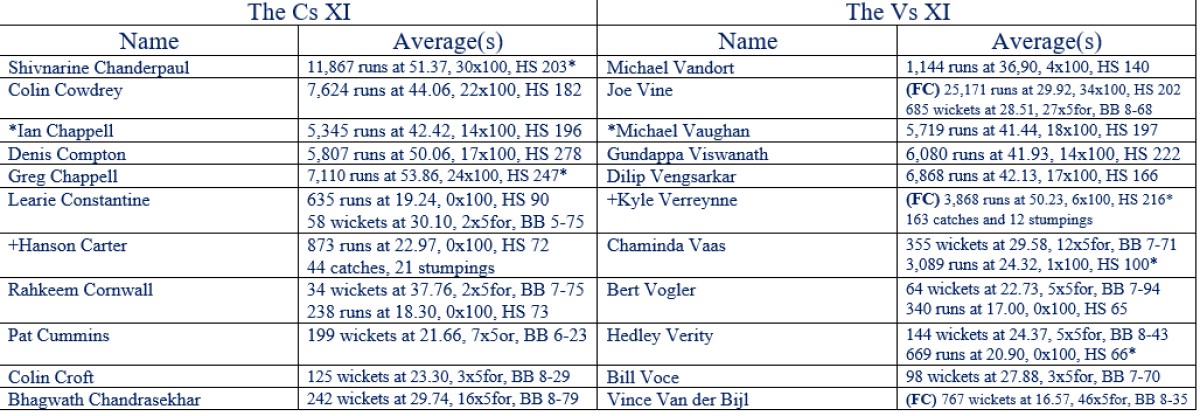
The Ls have a significant advantage with the bat, with only Verreynne and Vaas winning their match ups in that department for the Vs. Langley outranks Verreynne as keeper. The pace/seam bowling contest is close – the Vs have two left armers in Vaas and Voce, the former of whom would fare better as part of this attack than he did IRL to counter the Ls superior overall figures. Verity hugely outranks Langridge – he was the reason the latter only go the test call up quite late in his career, though Laker just outranks Vogler, giving the Vs the advantage in spin bowling. I think the Ls being ahead in batting and at least level on seam/ pace bowling is enough for a comfortable win for them, but I will grant the Vs spinners (particularly Verity) one big day out: Ls 4, Vs 1.

THE Ls PROGRESS REPORT

The Ls have scored 17 out of 25 today, moving them up to 77 out of 105, 73.33% overall.

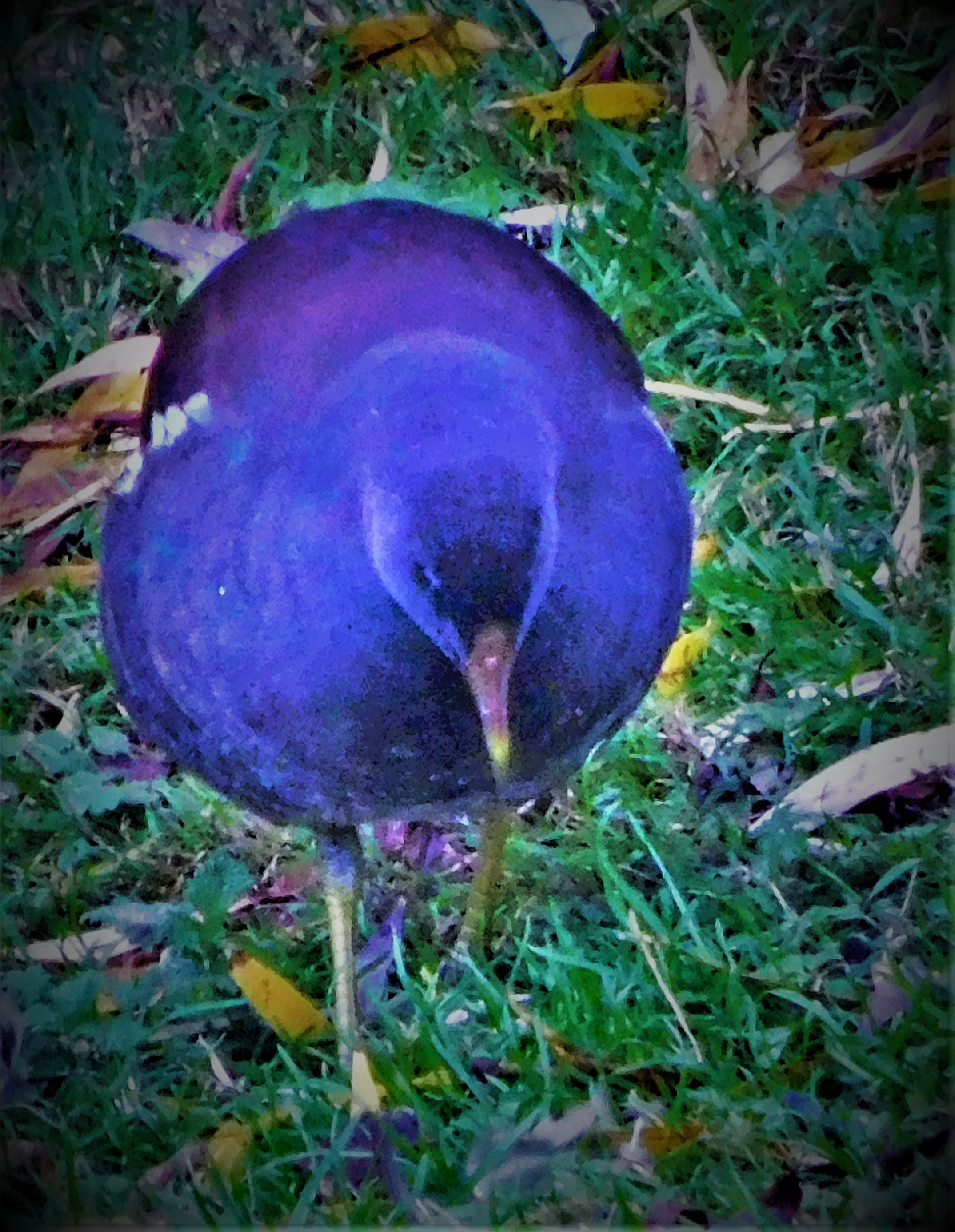
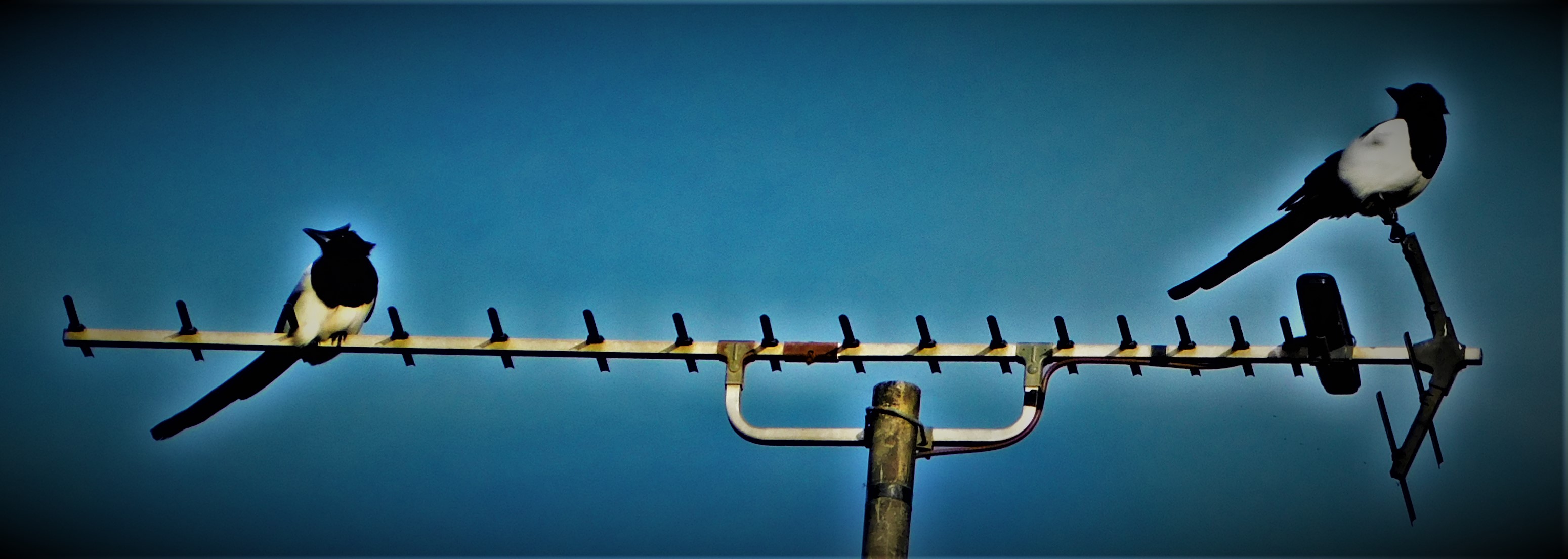
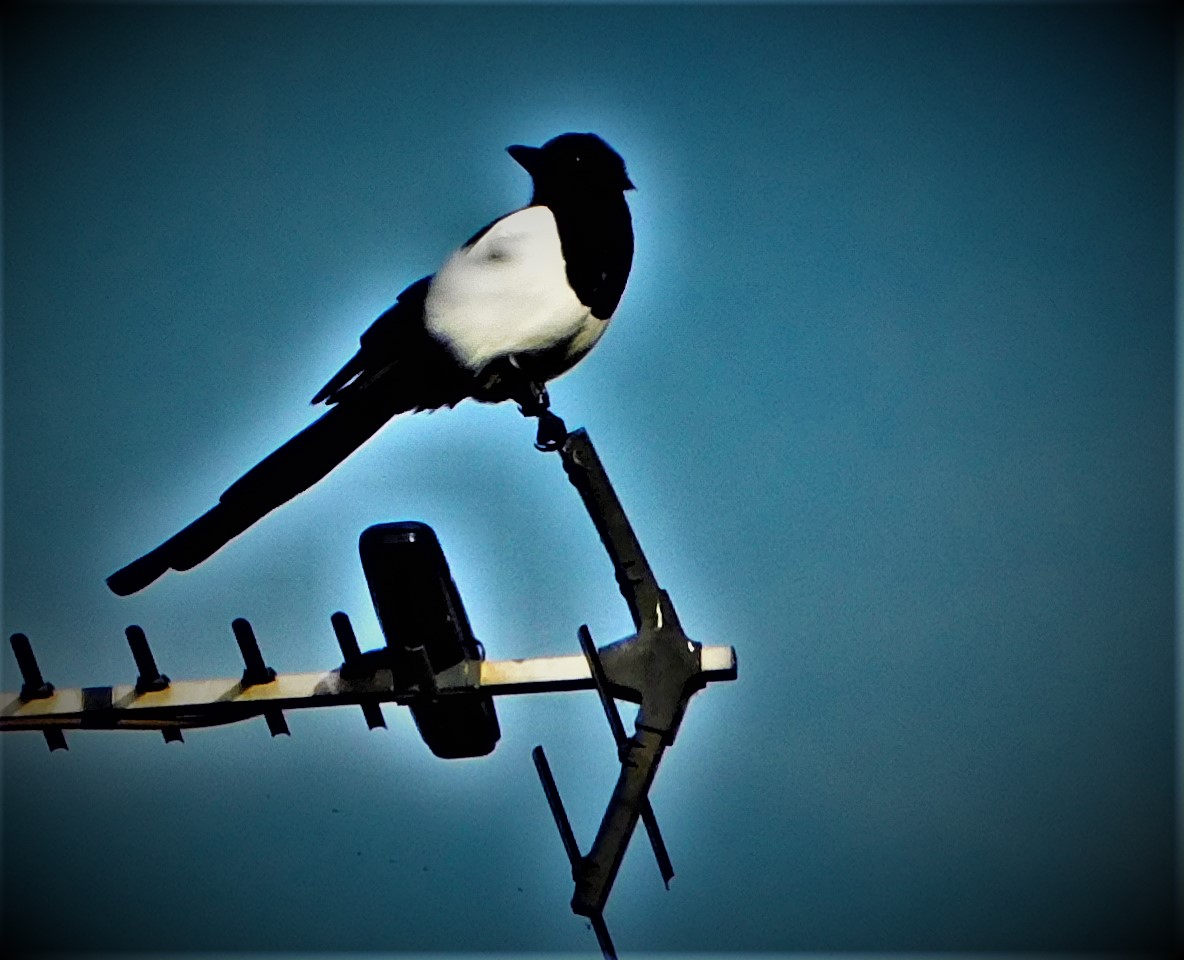
PHOTOGRAPHS

All Time XIs – Match Ups 44

Continuing my extended analysis of how the all time XIs I selected for each letter of the alphabet fare against one another, with the Ks last day in the spotlight.

Welcome to the latest instalment in my extended analysis of how the all time XIs I picked for each letter of the alphabet fare against one another. Today is the Ks last day in the spotlight, and they have 68 of a possible 100 points so far.

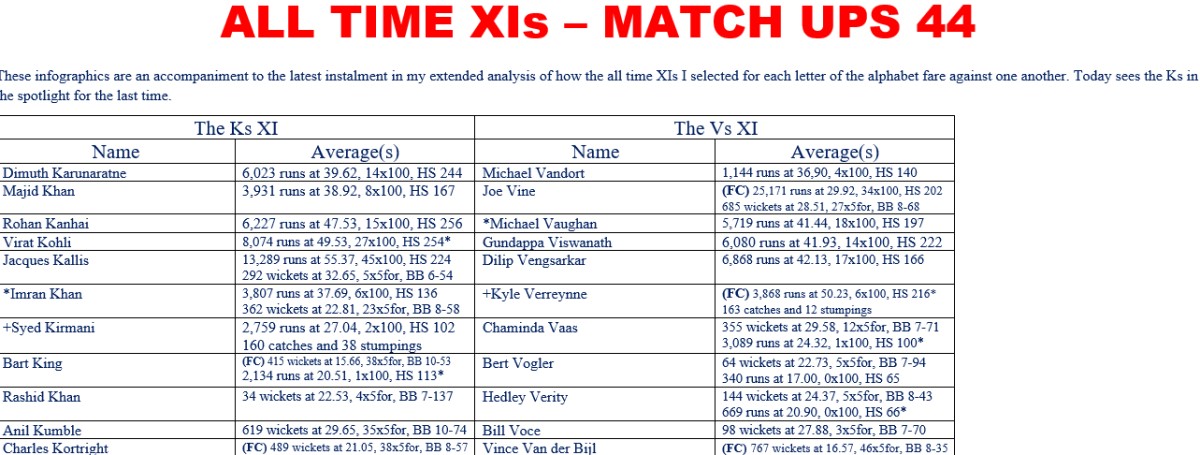
THE Ks V THE Vs

The Ks boss the batting, they have the better keeper, the better captain and the better pace bowling unit. Only Hedley Verity saves the Vs from a complete wipeout in all departments, but not even his presence alters the scoreline: Ks 5, Vs 0.

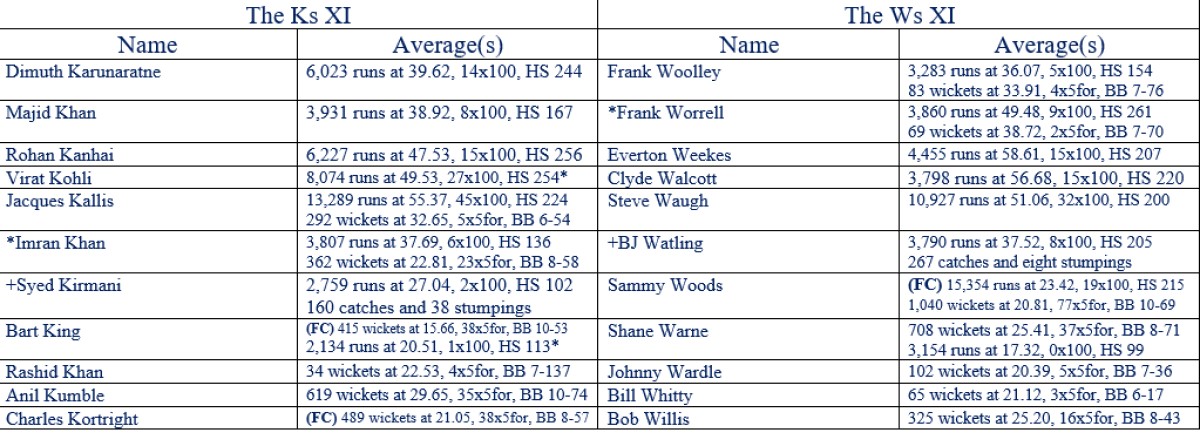
THE Ks V THE Ws

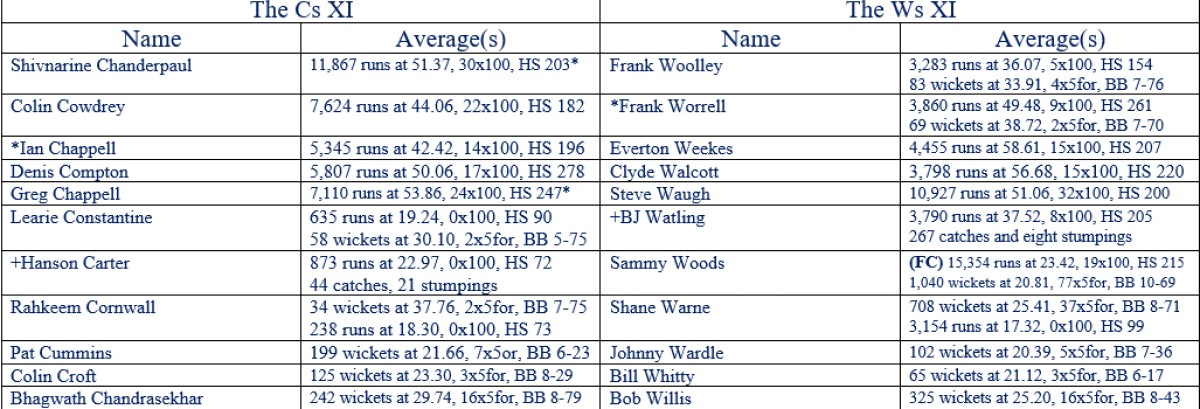
The Ws have the better the opening pair and also comfortably win the number three and four slots. Kallis beats S Waugh at number five. I Khan and Watling are equals with the bat, Worrell and I Khan is a clash of captaincy titans, Woods ranks higher with the bat than Kirmani and is on similar plane to I Khan with the ball. The Ws have the better spin combination, and Whitty’s left arm gives them the edge in new ball bowling as well. I would say Woolley is a better sixth bowler than Kallis as well. I think the Ws winning this, though it would be a hell of a contest: Ks 2, Ws 3.

THE Ks V THE Xs

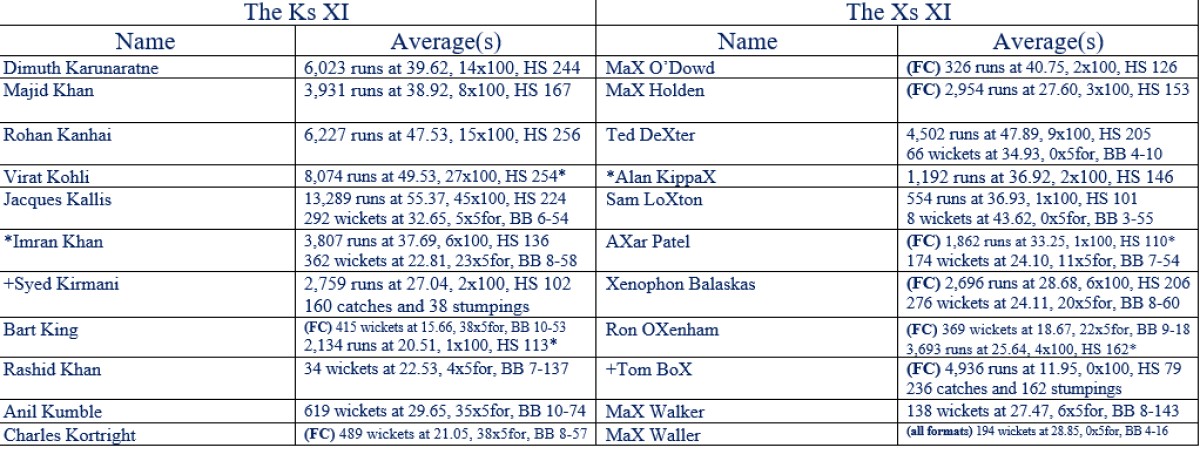
Apart from DeXter having a small advantage over Kanhai in the number three slot and BoX being the better keeper, and probably pretty close with the bat (Pilch, the best bat of BoX’s era averaged under 20) the Xs are thoroughly outclassed in all departments: Ks 5, Xs 0.

THE Ks V THE Ys

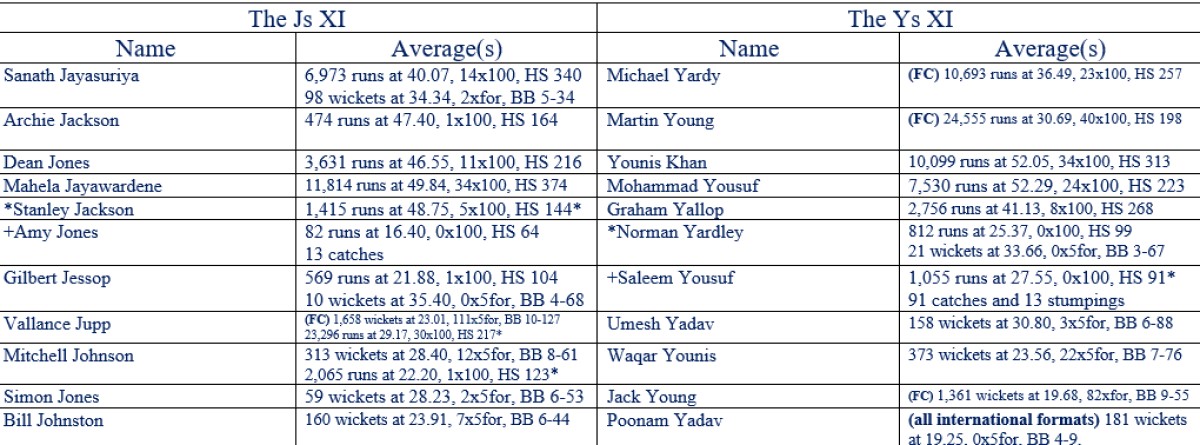
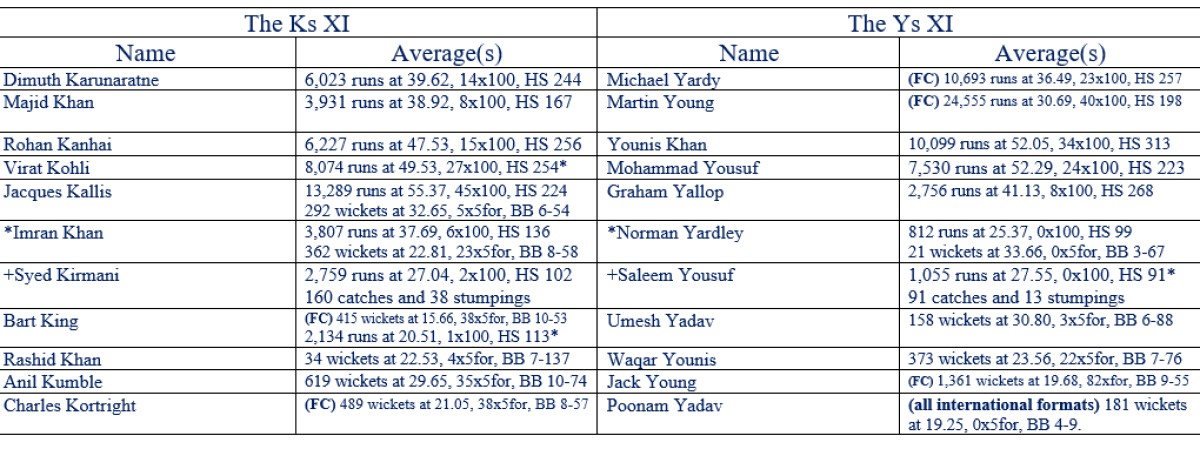
Only in the number three and four slots do the Ys have a definitive advantage over the Ks. The Ks have an overwhelming superiority in pace bowling, though the better balance of the Ys spin pairing just gives them that department their inferiority everywhere else means that the scoreline in unaffected: Ks 5, Ys 0.

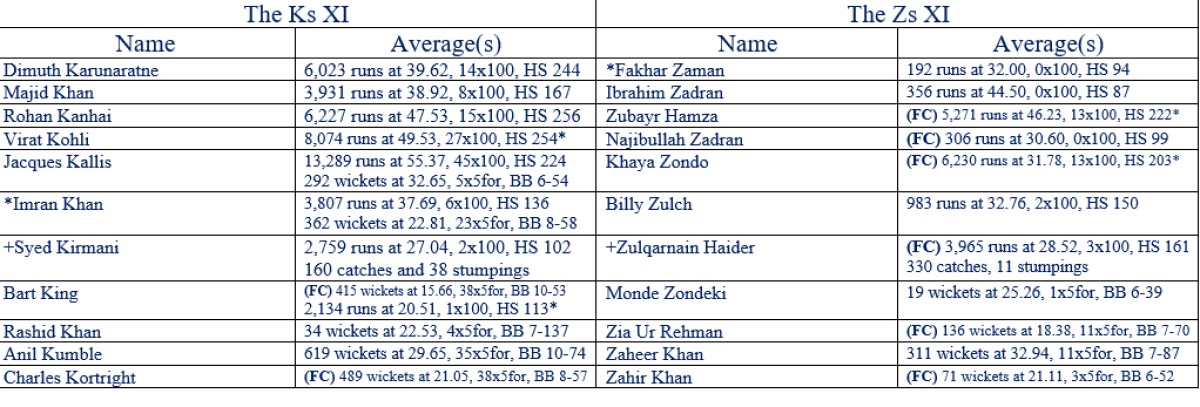
THE Ks V THE Zs

The Ks dominate this outright, with the Zs not even matching them anywhere: Ks 5, Zs 0.

THE Ks FINAL SCORE

The Ks have scored 22 of a possible 25 points today, meaning that they finish with 90 out of 125 points, 72% overall.

PHOTOGRAPHS

All Time XIs – Match Ups 41

Continuing my in depth analysis of how my all time XIs fare against one another, with some comments about Ireland’s great win over England in the T20 World Cup and a photo gallery.

Welcome to the latest installment in my extended analysis of how my all time XIs fare against one another. Today sees the Js occupy the spotlight for the final time, with 50 points out of 100 currently on the board. Before getting into the main meat meat of this post I congratulate Ireland wholeheartedly on their defeat of England. The rain, which washed the second match (Afghanistan vs New Zealand) out completely did play a walk on role – officially Ireland won by 5 runs on the DLS method. However, England deserve no sympathy and will receive none from me – they were behind the asking rate the entire way through the chase, even after Ireland failed to capitalize on being 92-1 after 10 overs, slipping to 157 all out in 19.4. Dawid Malan (35 off 37) and Harry Brook (17 off 18) were chiefly responsible for putting England in a hole they couldn’t dig their way out of – their scoring, with rain an obvious threat, was absurdly slow. England had a very deep batting order, but the approach of Malan and Brook meant that by the time the rain came the biggest hitter in the side, Livingstone, who would have been on a high having taking 3-17 with the ball, faced only two balls. Ireland skipper Balbirnie was named player of the match for his 62, but crucial early momentum was also provided by Ireland number three and keeper Lorcan Tucker.

THE Js V THE Vs

The Js are stronger in batting and have the better keeper, both sides have similar strength in front line pace bowling, though the Js have Jessop as an extra option. The Vs are stronger in spin bowling, with Verity, Vogler and Vine all front line options, while the Js have Jupp, Johnston in his slower style and the part timer Jayasuriya. I think the Js have got this one, but not by a huge margin: Js 3, Vs 2.

THE Js V THE Ws

The Js have the better opening pair though not by much, the Ws dominate in positions 3-6 batting wise, though the Js have the better keeper. Warne, Wardle and Woolley are a better spin combo than the Js have (Wardle’s ability to bowl wrist spin means that the Ws effectively have off spin covered even without having a designated off spinner). There is little to choose between the front line pace trios, though Jessop outranks Worrell as a support seamer. The Ws have a clear advantage but not enough to put them in whitewash territory: Js 1, Ws 4

THE Js V THE Xs

The Js are ahead on batting (only DeXter wins his match up among the Xs top eight), massively ahead in pace bowling, a little behind in spin bowling and BoX is one of the few keepers in this series to definitely at least match A Jones in that department. I don’t think the Xs spinners will help them enough to make any difference to the result: Js 5, Xs 0.

THE Js V THE Ys

The Js have the better opening pair by some way, the Ys the better nos 3 and 4. Jackson outranks Yallop at five and probably outranks fellow Yorkie Yardley as a skipper. The Js are way ahead in pace bowling and about even in spin bowling. This is a comfortable but not whitewash win for the Js: Js 4, Ys 1.

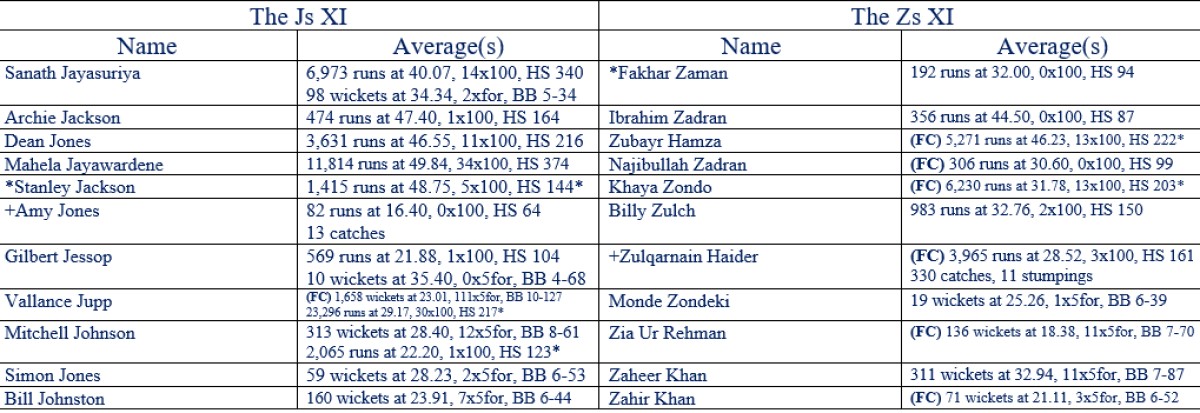
THE Js V THE Zs

The Js have the better batting by some way, the better skipper, the better keeper, a far stronger pace attack and a spin attack that probably matches that of the Zs if it doesn’t better it. There can be only one scoreline: Js 5, Zs 0.

THE Js FINAL SCORE

The Js have scored 18 out of 25 today, giving them a final tally of 68 out of 125, 54.4%.

PHOTOGRAPHS
My usual sign off…

All Time XIs – Match Ups 37

Continuing my extended analysis of how the all time XIs I selected for each letter of the alphabet fare against one another, plus a rather different picture gallery from usual.

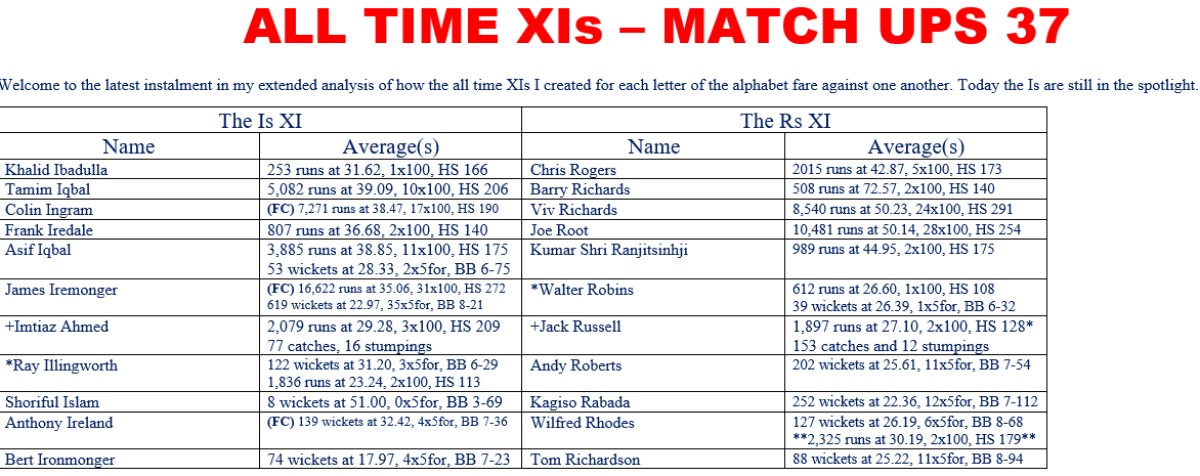
Welcome to the latest instalment in my extended analysis of how the all time XIs I created for each letter of the alphabet fare against one another. Today the Is occupy the spotlight and they start with a mere 10 out of a possible 80 points so far. The Super 12s stage of the men’s World T20 started today. The first game saw New Zealand thump hosts Australia by 89 runs (a monster margin in aT20), while in the second England won by five wickets over Afghanistan, with 11 balls to spare – a rather disappointing chase after a magnificent effort in the field restricted Afghanistan to 112 all out, headlined by Sam Curran taking 5-10.

THE Is V THE Rs

The Rs dominate the top batting positions – only Asif Iqbal at number five comes close to his opposite number, and ‘Ranji’ played on more difficult batting surfaces than Iqbal. The Is do have small batting advantages at six and seven, though Russell is the better keeper and Robins was a better skipper than Illingworth. The Rs powerful pace bowling unit absolutely obliterates such competition as the Is can offer in that department. The spin department is close – Illingworth outranks Robins, but as against that Rhodes, one of the all time legends of the game definitely outranks Ironmonger. There is simply no way the Is can put a dent in the Rs: Is 0, Rs 5.

THE Is V THE Ss

The Ss powerful batting line up absolutely dominates, arguably winning all 11 slots in that department. Imtiaz outranks Sangakkara as a keeper, the Ss utterly dominate in pace bowling, though the Is to win the spin bowling that can make no difference to the final result: Is 0, Ss 5.

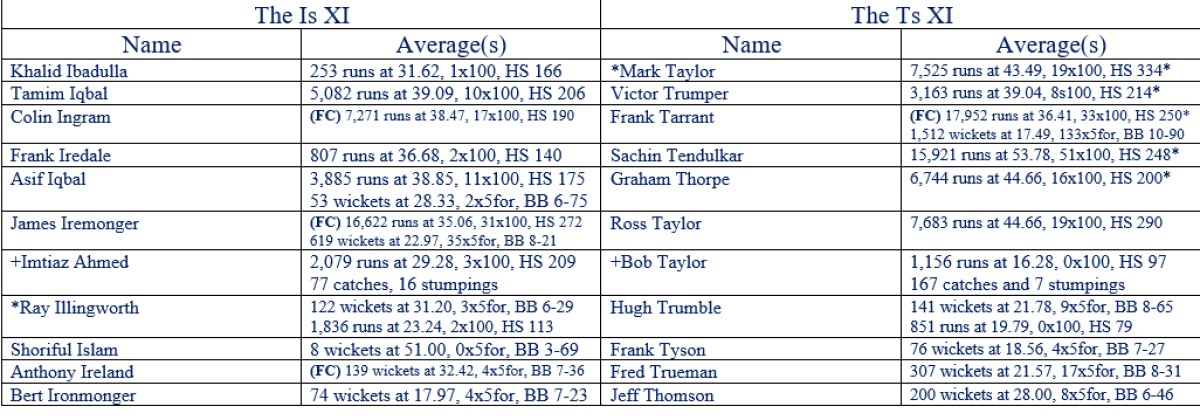
THE Is V THE Ts

The Ts are way ahead on batting – only Imtiaz Ahmed and Illingworth at seven and eight can be said to win their match ups in this department. They also have by far the better keeper, and as usual dominate the pace bowling. Trumble and Tarrant are a decent match for Illingworth and Ironmonger spin wise. There is once again only one possible score: Is 0, Ts 5.

THE Is V THE Us

The opening pairs are closely matched – Ulyett’s runs, made in the very early days of test cricket would equate to only just less than Tamim Iqbal’s average today. The Us win the number four and five slots and the batting elements of no six and seven, though Imtiaz Ahmed wins the keeping laurels, and Iremonger offers more bowling than Umrigar, though not quite so much as Ulyett. The Us have the better new ball pairing, and Underwood outranks Ironmonger, though Ur Rahman hasn’t yet done enough to outrank Illingworth, though he probably will in the end. Neither of these sides are great with the bat, but the Us outgun the Is with the ball: Is 1, Us 4.

THE Is V THE Vs

The opening pairs are closely matched, the Vs own positions three through six, Imtiaz Ahmed outbats Vaas, but Vaas outbowls Iremonger as third seamer. Voce and Van der Bijl are by far the better new ball pairing, Verity outranks Ironmonger, and I would personally rate Vogler ahead of Illingworth, meaning that the Vs utterly dominate the bowling in all departments. Since they are also clearly ahead on batting, and captaincy and keeping skills are about even there can be only one scoreline: Is o, Vs 5.

THE Is PROGRESS REPORT

The Is managed one point of a possible 25 today and are now on 11 out of 105, 9.55% overall.

PICTURE GALLERY

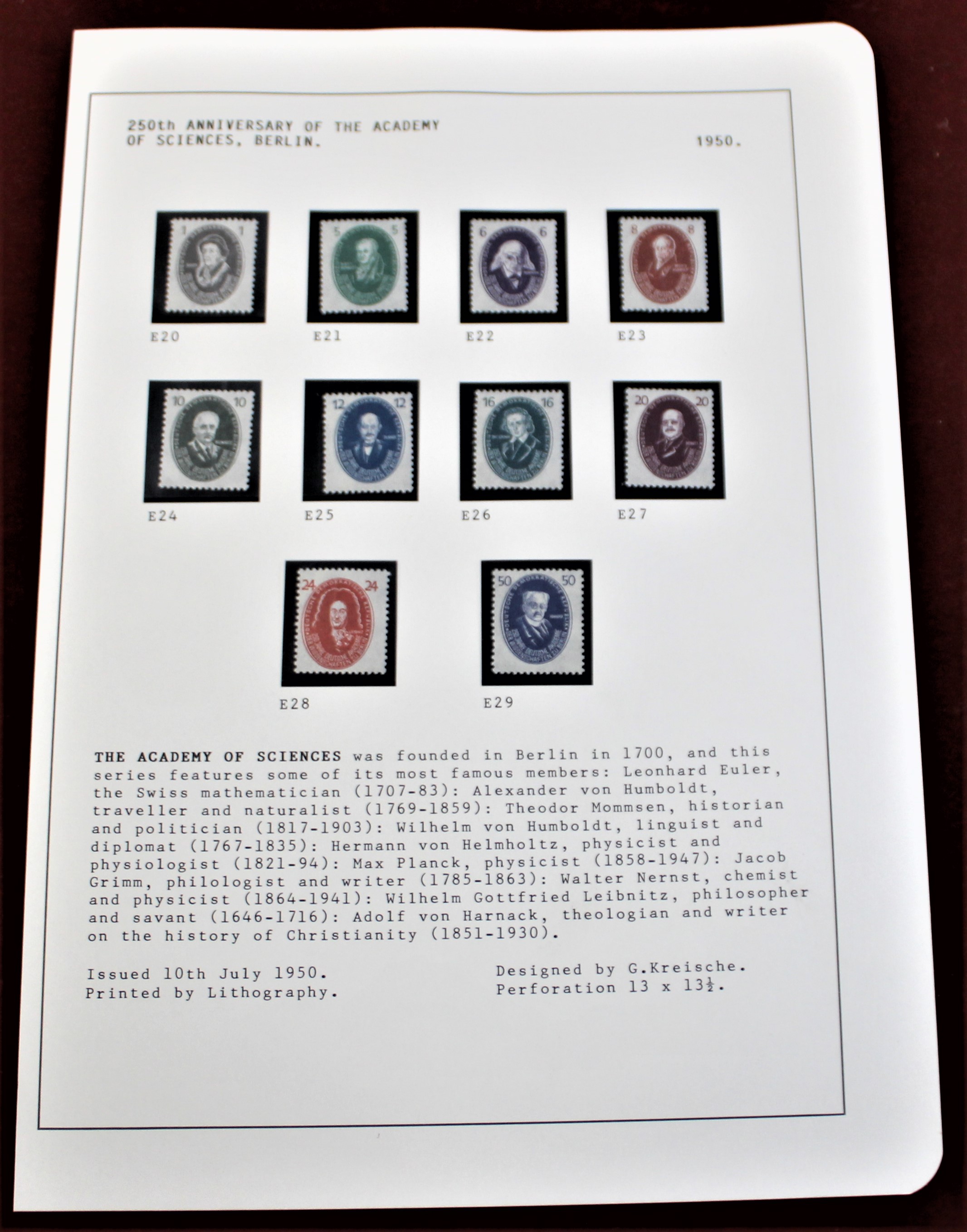
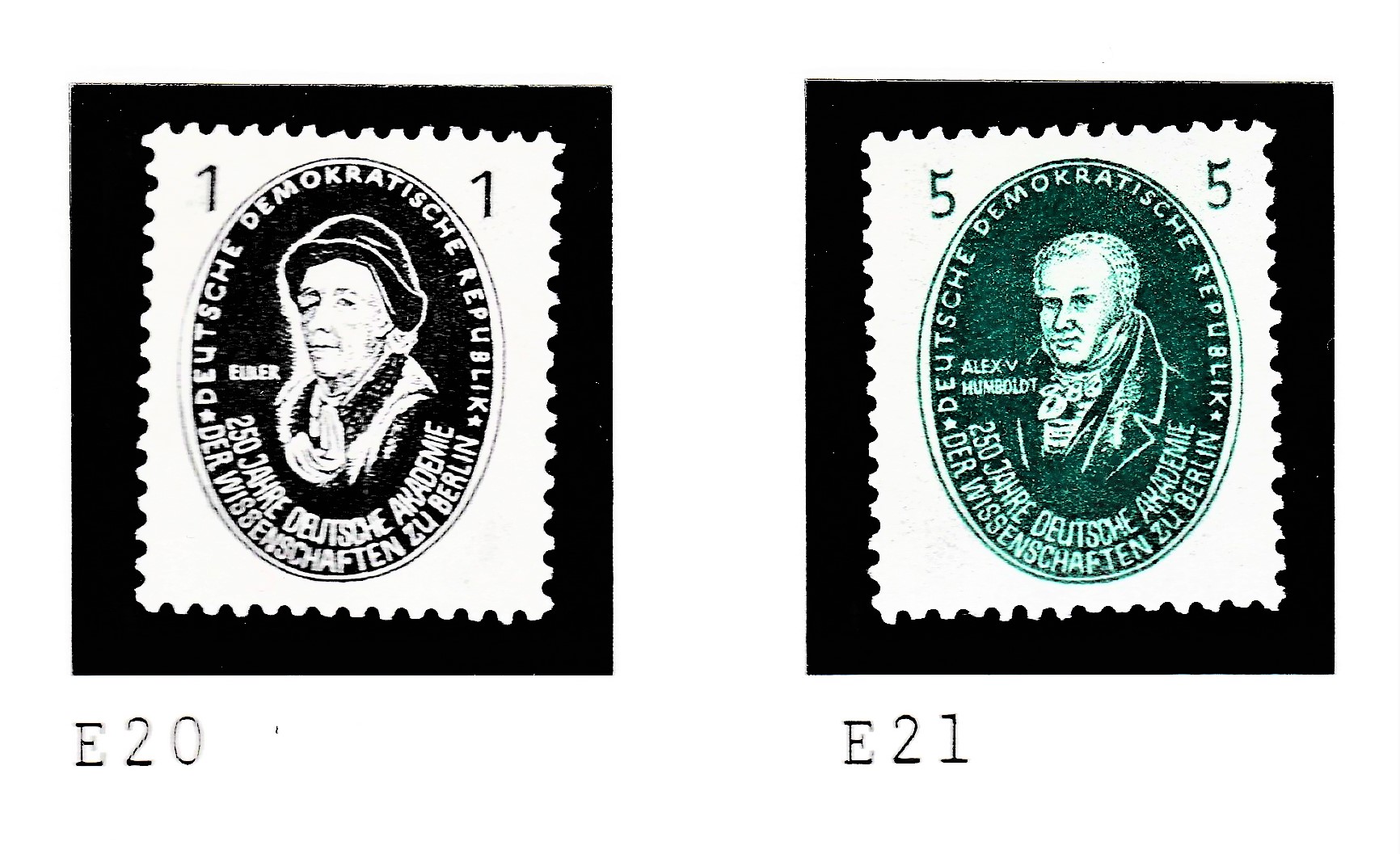
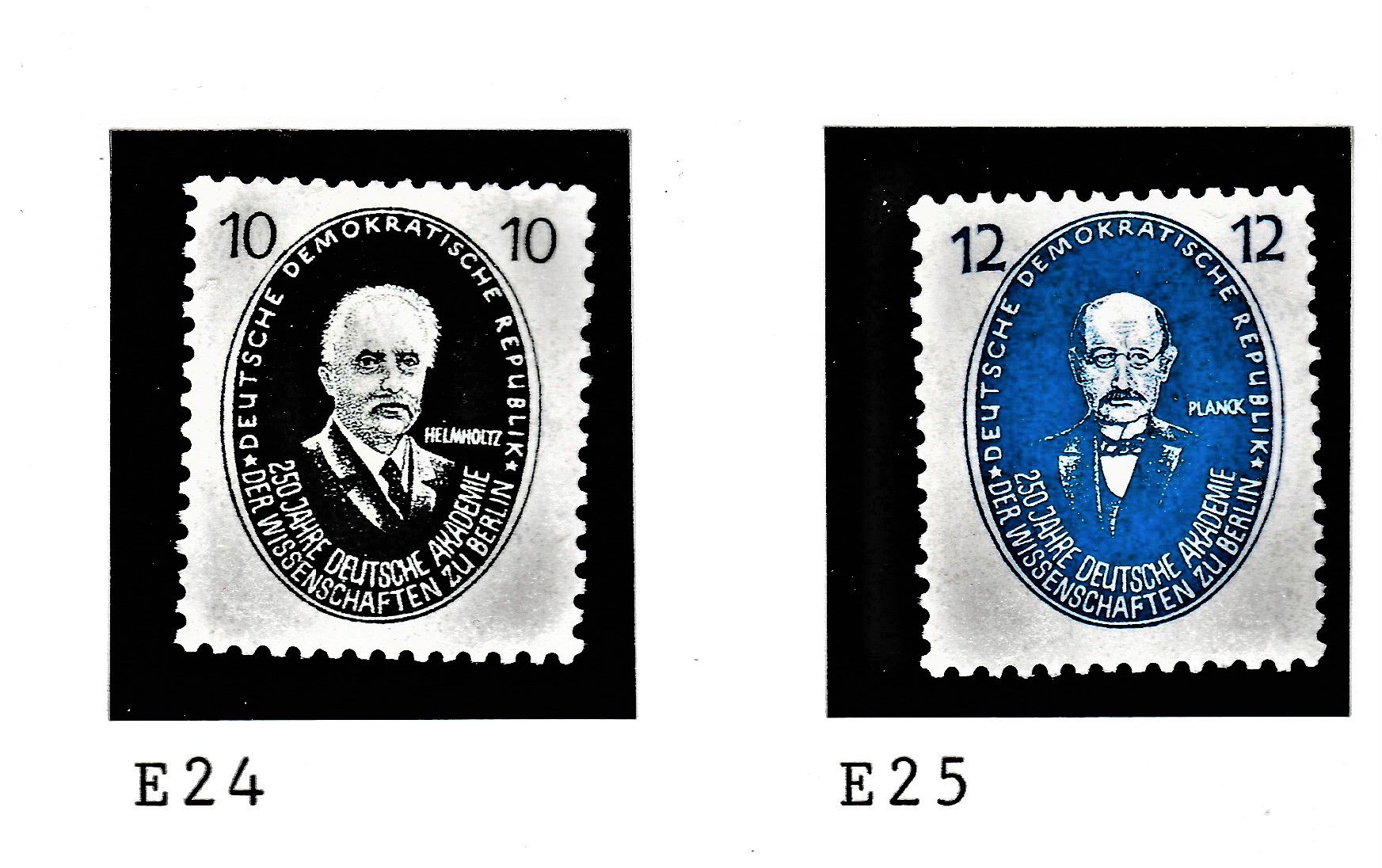
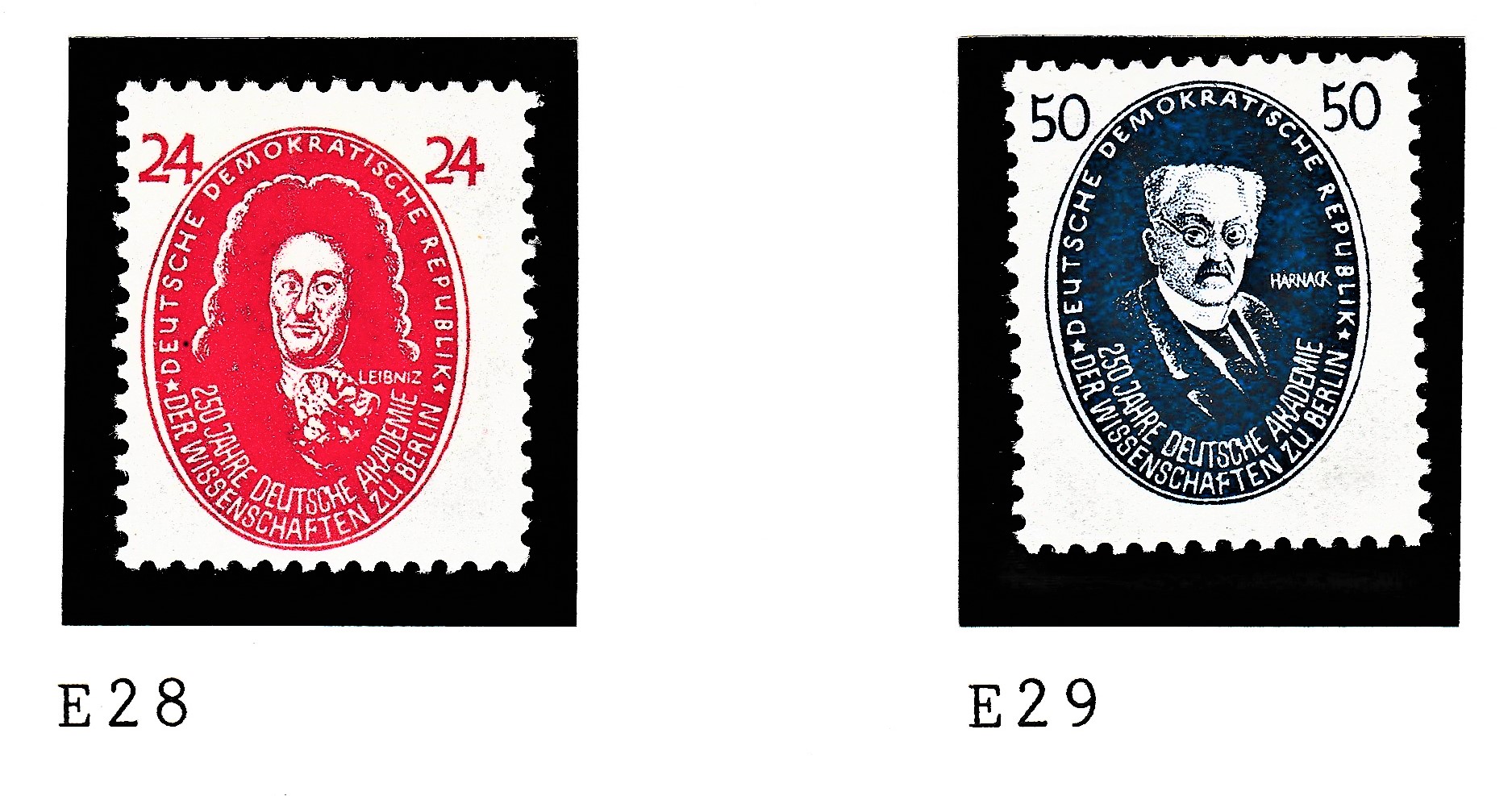
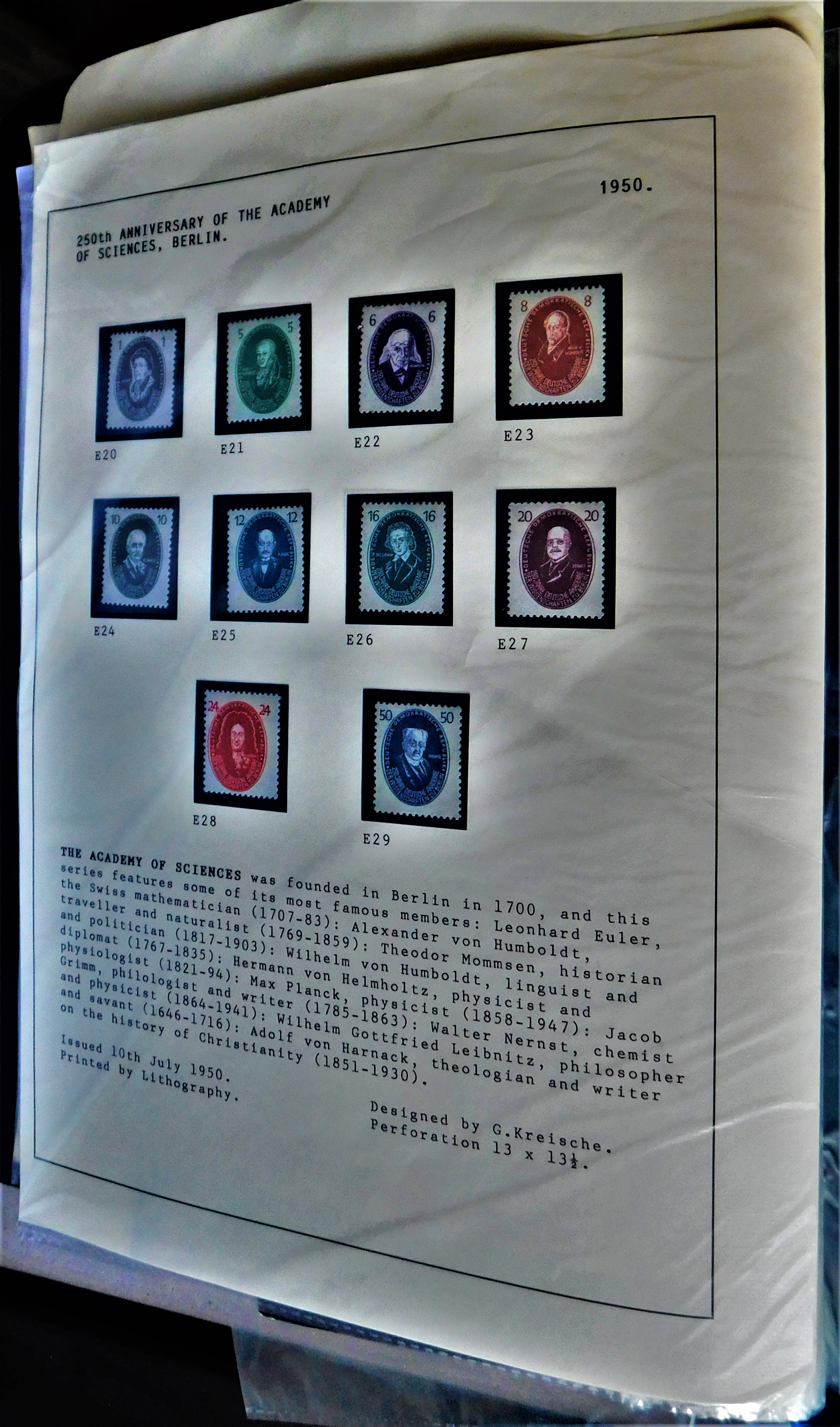
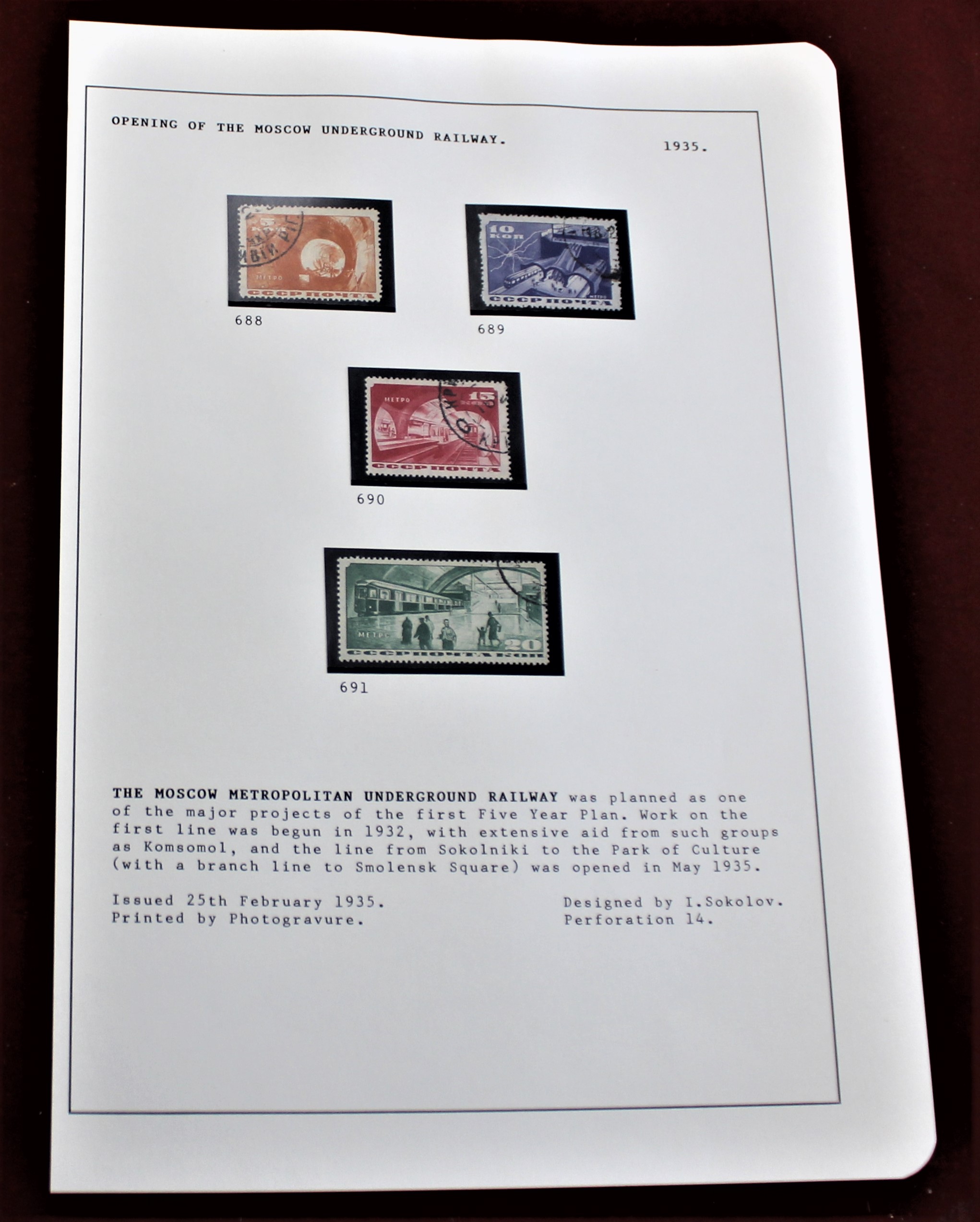
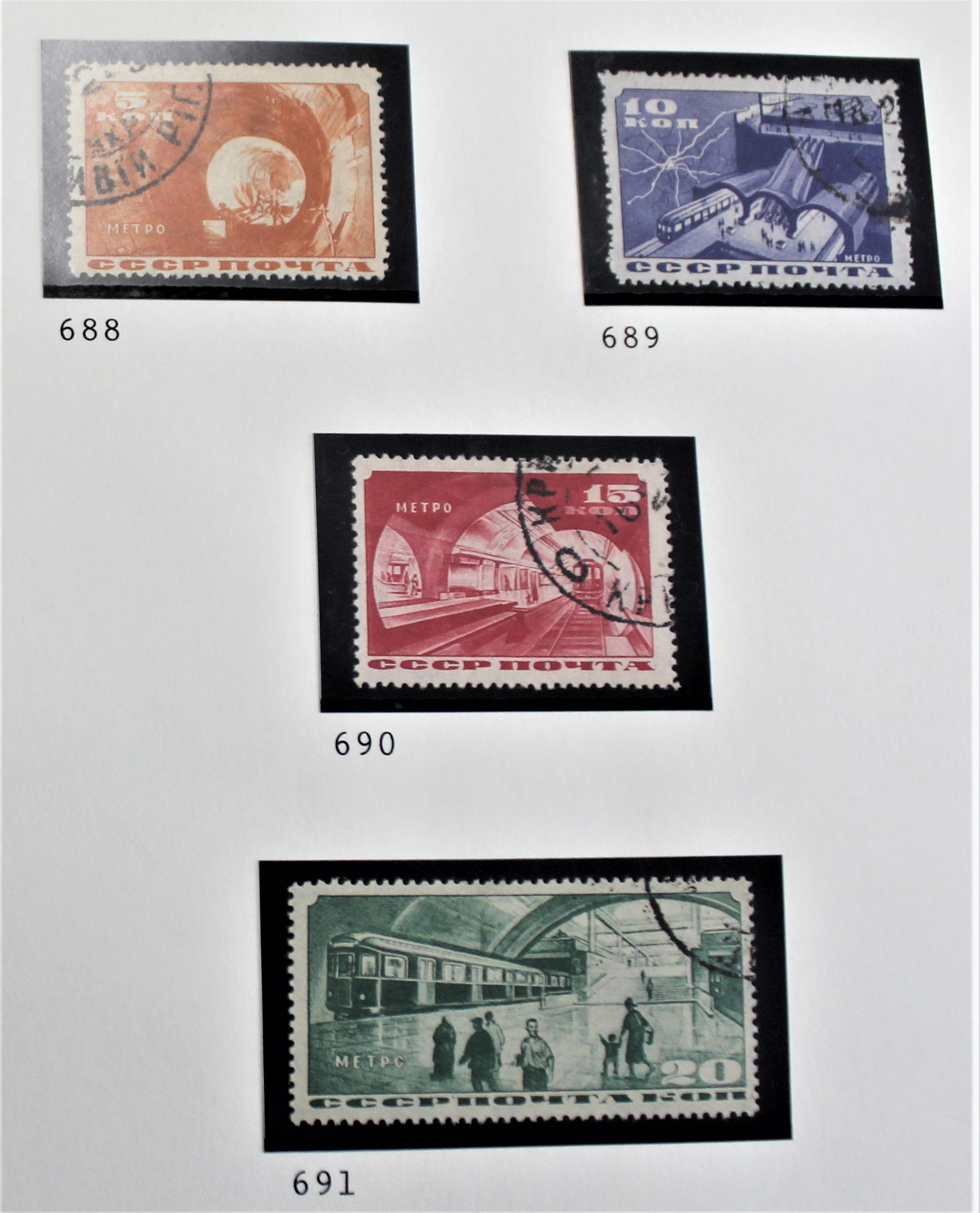
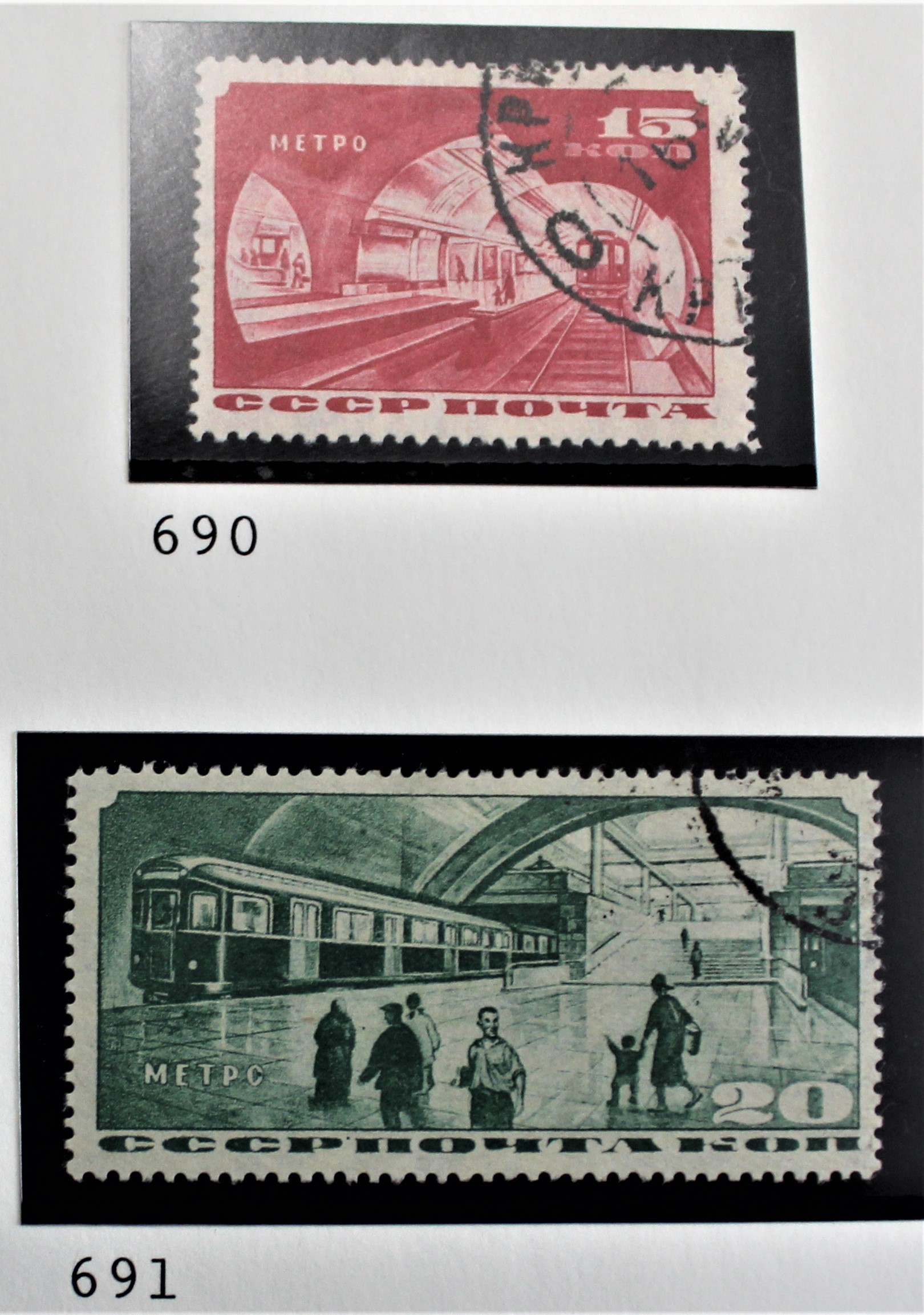
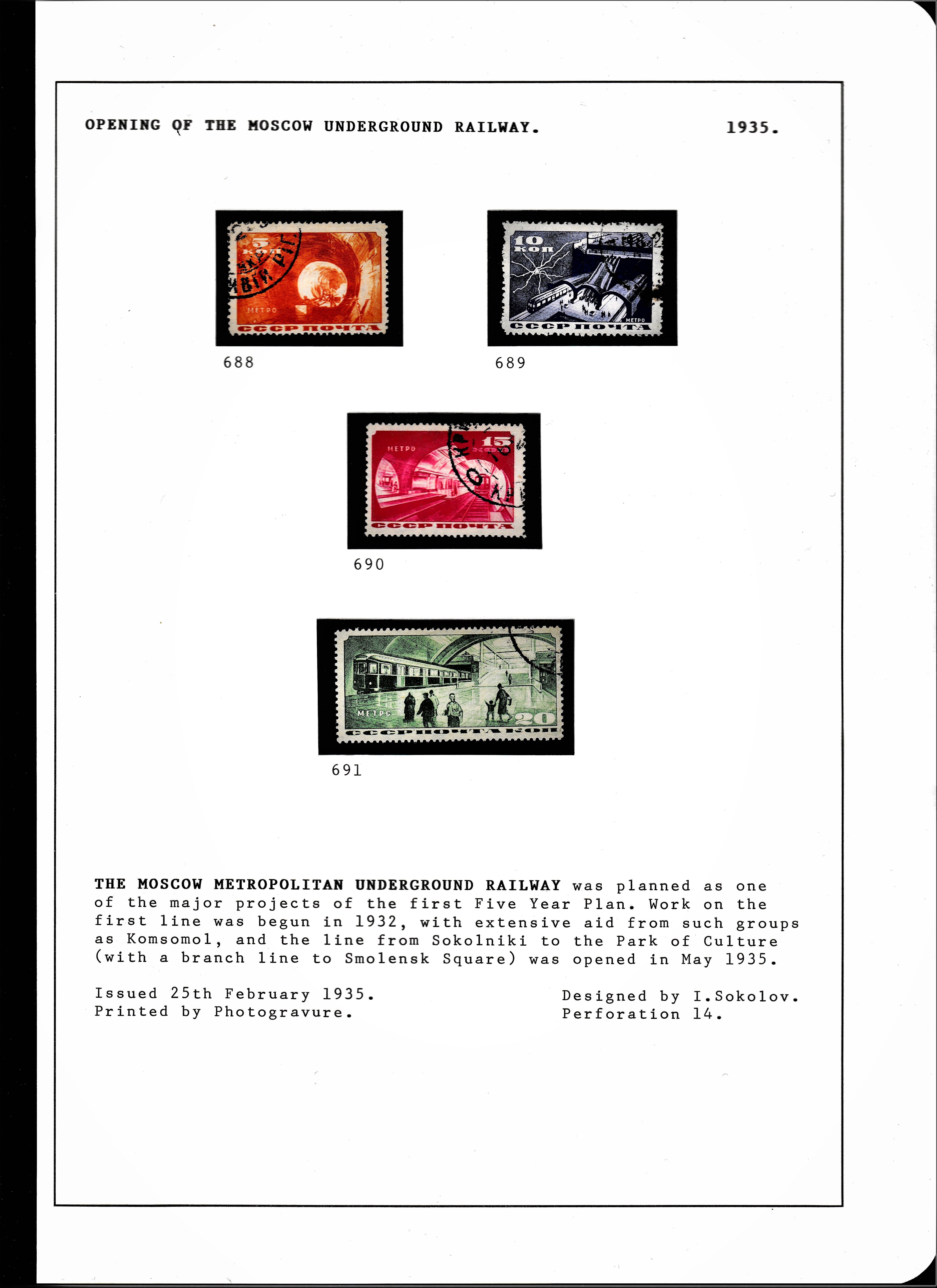
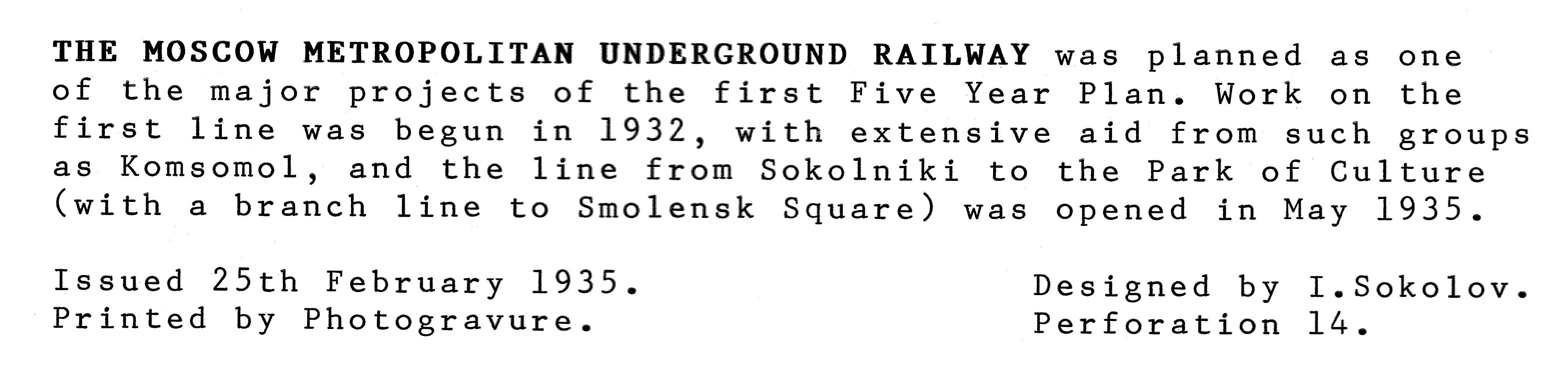
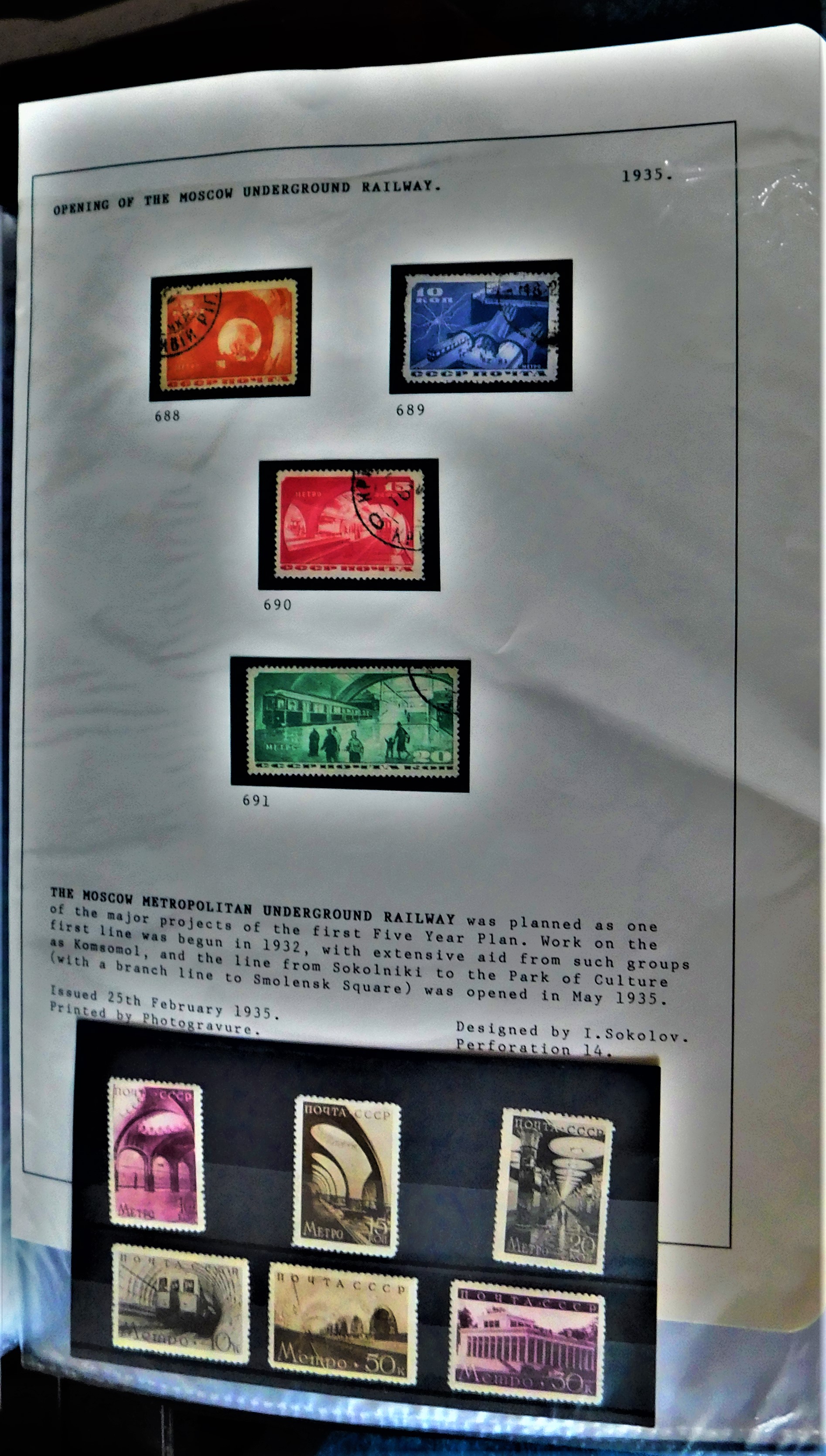
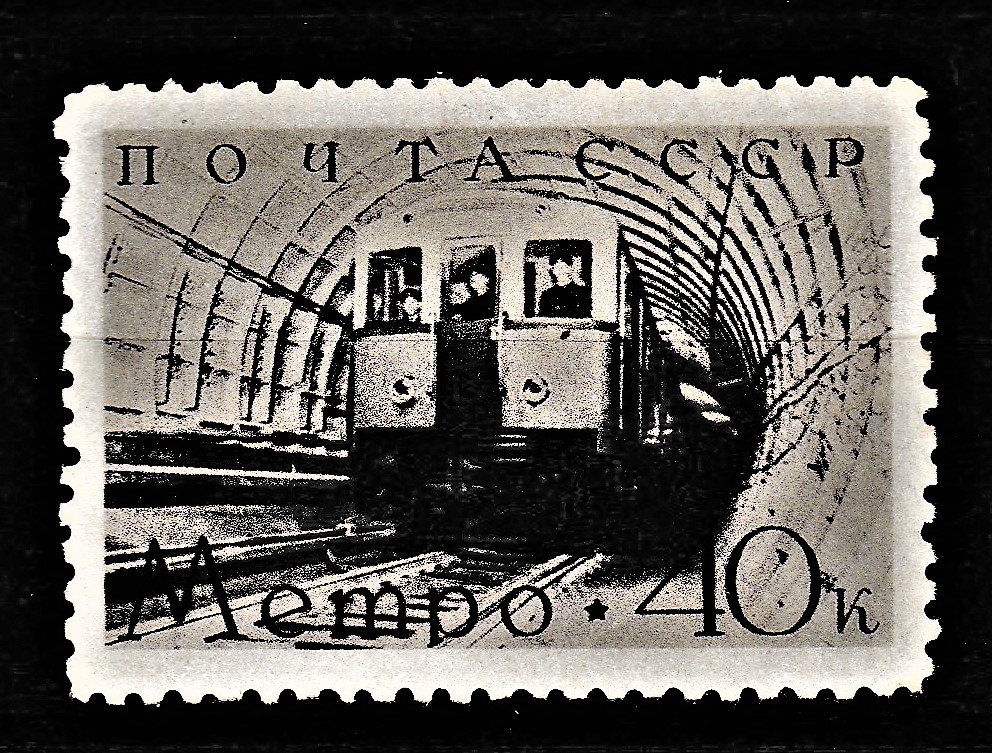
Today’s picture gallery is something different from usual, and necessitates a disclaimer notice. In James and Sons’ October sale I got two lots very cheaply, a set of stamps celebrating the opening of the Moscow Metro and a set of Stamps marking the 250th anniversary of The Academy of Sciences. Both these sets of stamps, and the set of Moscow Metro I already owned were issued by regimes that I must stress I regard as absolutely appalling. Stalinist Russia was one of the nastiest of all dictatorships, and the laughably misnamed German Democratic Republic was also appalling. I purchased these stamps for their subject matter and in spite of my hatred for the regimes that produced them. For each of the two new lots I show the official auction images and some that I have produced now that the items are in my possession.

We start with the Scientists:

Now the Moscow Metro stuff…

All Time XIs – Match Ups 23

Continuing my extended analysis of how the all time XIs I selected for each letter of the alphabet fare against one another.

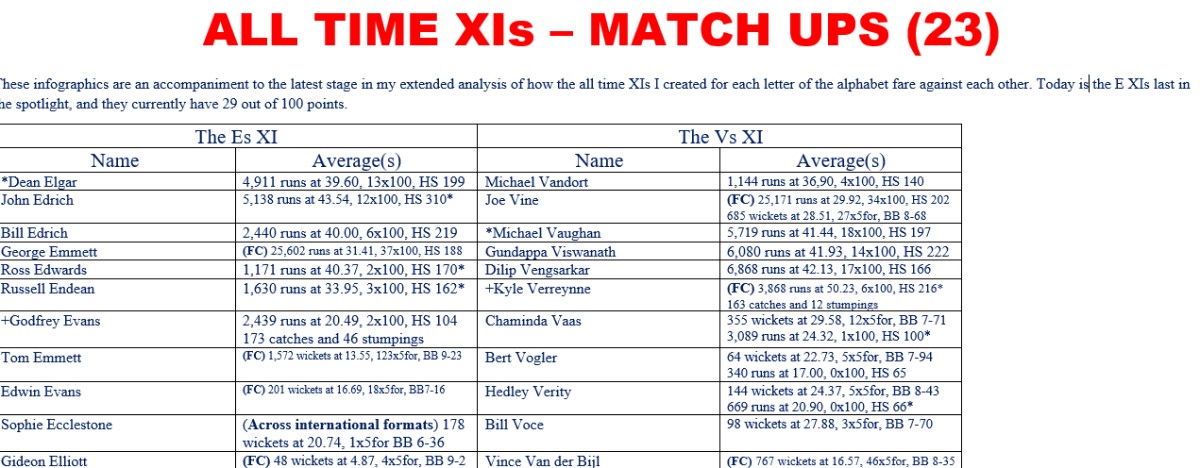
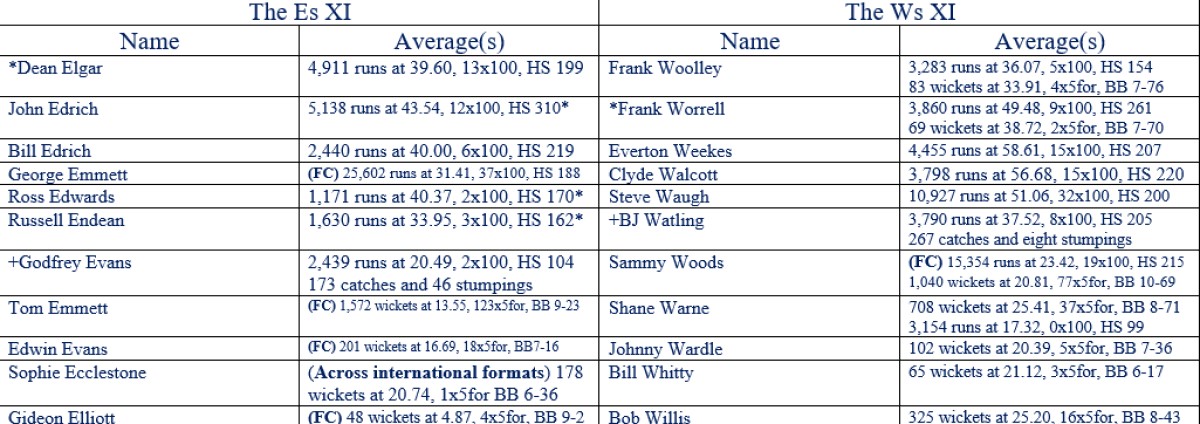
Welcome to the latest instalment in my extended analysis of how the all time XIs I selected for each letter of the alphabet fare against one another. Today the Es complete their match ups, coming into the day on 29 points out of 100.

THE Es V THE Vs

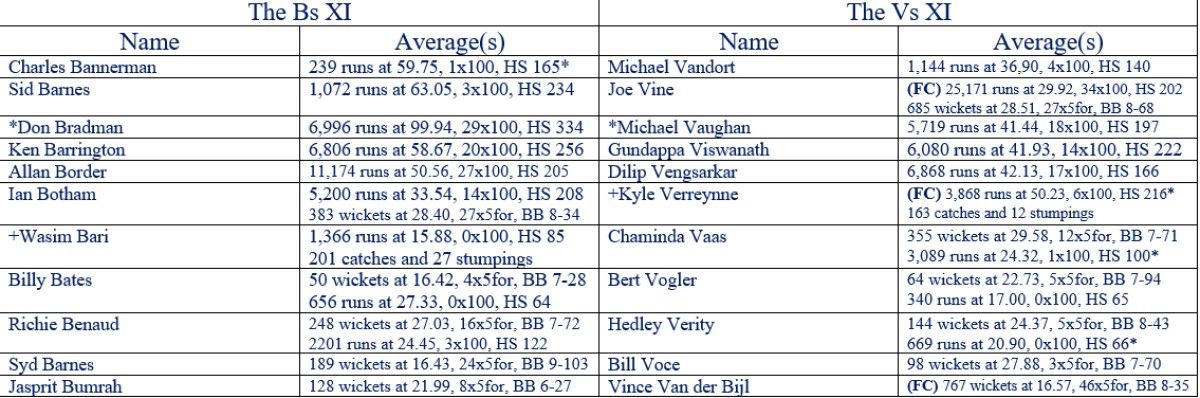
The Es have the better opening pair, the Vs have the better numbers 3,4 and 5. Verreynne is a much better batter than Endean was, but G Evans was miles ahead when it come to keeping. Vaas was a somewhat better batter than G Evans was, and his bowling as third seamer in a strong attack rather than his usual IRL role of opening bowler in a moderate one is likely to be even more valuable than his figures suggest. Voce and Van der Bijl have to be considered at least a match for T Emmett and Elliott as an opening pair, and the Es only back up seam option is Bill Edrich. The Vs are also clear winners in spin bowling, with Verity among the few left arm slow to medium paced bowlers to definitively outrank Ecclestone, and Vogler definitely ahead of E Evans (Vogler bowled largely on properly prepared pitches, whereas the Aussie benefitted from some very rough surfaces in the 1870s). The Es may benefit from the better starts their openers are likely to give them, but not enough to make a difference to the outcome: Es 0, Vs 5.

THE Es V THE Ws

Worrell is further clear of Edrich than Elgar is clear of Woolley with the bat, and additionally he massively outranks Elgar as a skipper. Weekes, Walcott and Waugh comfortably win the nos 3,4 and 5 slots, Watling at six outbats Endean, though G Evans was a better keeper. Woods at seven was a better batter than G Evans, and provides the Ws with an extra bowling option. Whitty and Willis probably outrank T Emmett and Elliott as a new ball combination, and while Ecclestone v Wardle is a close contest, shaded by the Yorkie on the grounds that he bowled both finger and wrist spin, Warne massively outranks E Evans. The Ws are massively clear in all departments: Es 0, Ws 5.

THE Es V THE Xs

The Xs are ahead in the number three and four slots but well behind elsewhere. Es 4, Xs 1.

THE Es V THE Ys

The Es have the better opening partnership, the Ys win the 3,4 and 5 slots. Endean was a better batter than Yardley, but the latter offers a bowling option and would outrank Elgar as a skipper. S Yousuf was a better batter than G Evans but a less good keeper. The Es have the better new ball pair, though the Ys have the better spin attack. I think the Es just have this one and score it Es 3, Ys 2.

THE Es V THE Zs

The Es dominate in batting, dominate in pace bowling, have the better spin attack and have the better keeper. This is clear cut – Es 5, Zs 0.

THE Es FINAL SCORE

The Es have scored 12 points out of 25 in this set of match ups, to finish with 41 out of 125, 32.8%.

PHOTOGRAPHS
Today’s photo gallery is the last from my recent trip north, featuring the pictures I took from Newcastle onwards on the return journey.

H

All Time XIs – Match Ups (14)

Continuing my extended analysis of how the all time XIs I created for each letter of the alphabet fare against one another. Also has a king sized photo gallery.

Welcome to the next stage in my extended analysis of how my all time XIs for each letter of the alphabet fare against each other. The Cs still occupy the hot seat, and they start today with 23 of a possible 90 points to their credit.

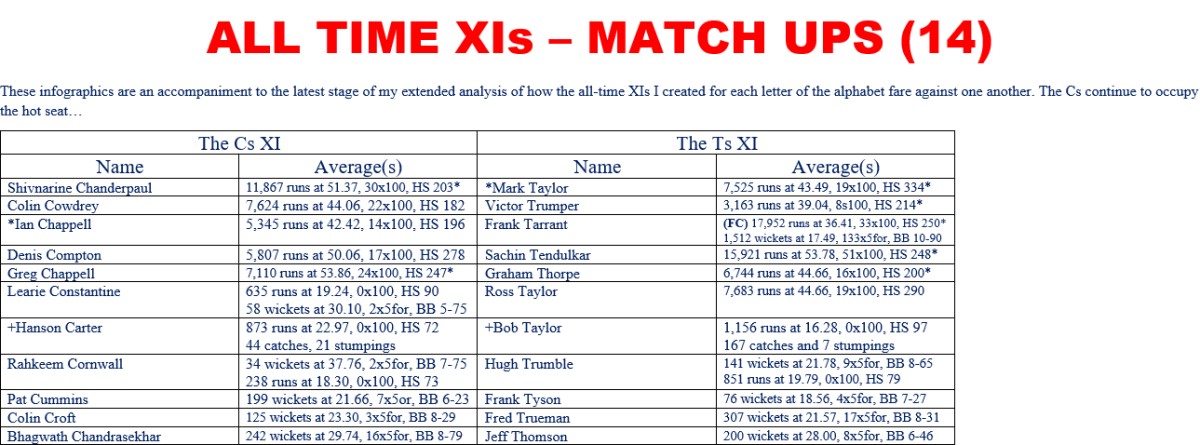
THE Cs V THE Ts

The Cs in theory have the stronger opening pair but a) both the Ts openers were regulars at that job, unlike the Cs, and b) Victor Trumper played in an era when run scoring was less than it is now. Therefore I say that the Ts win here. Frank Tarrant at three is outdone by Chappelli for the Cs, although he would average more with the bat had he played in Chappell’s era rather than considerably earlier, so this contest is not is clear in Chappelli’s favour as it looks. Tendulkar beats Compton, but Thorpe loses to G Chappell. As against that Ross Taylor is much better with the bat than Constantine. Carter beats Bob Taylor with the bat, but the Ts man was the finer keeper. Tyson and Trueman outrank even Cummins and Croft as a new ball pair, and Thomson is far superior to Constantine as third seamer. Trumble is clear of Cornwall, and Tarrant the bowler rates little if any behind Chandrasekhar. I make the Ts winners in all departments, save for Carter being better with the bat than his rival keeper, and accordingly score this Cs 0, Ts 5.

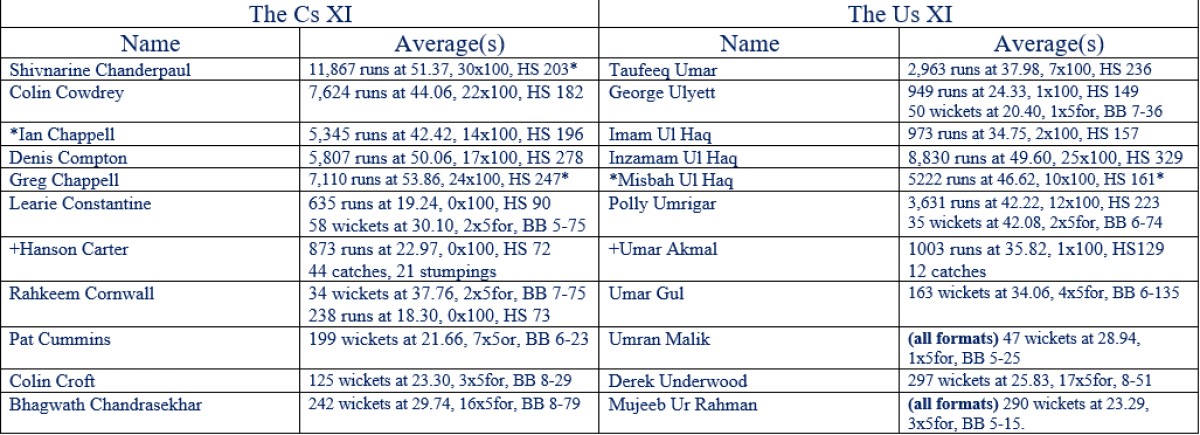
THE Cs V THE Us

The Cs win the top five batting slots, with only Inzamam Ul-Haq and Misbah Ul-Haq winning their match ups. Umrigar at six is better with the bat than Constantine, while Ulyett makes up for being outbatted by comfortably outbowling Constantine. Umar Akmal was a finer batter than Carter but a fraction of the keeper that the Aussie was. Umar Gul and Umran Malik are comfortably out pointed by Cummins and Croft, although Umran Malik would be the fastest of the four. Ur Rahman is a better off spinner than Cornwall by some way, and Underwood outranks Chandrasekhar as a bowler. Chappelli outranks Misbah Ul-Haq as a captain. The Cs win on batting, captaincy, keeping and new ball bowling, the Us have the better third seamer, more batting from their keeper and boss the spin bowling department. Overall the Cs are obviously clear, but allowing for one serious turner out of five I score this one Cs 4, Us 1.

THE Cs V THE Vs

The Cs win on opening pairs even allowing for Vine averaging more these days than he did in his actual playing days. Chappelli just edges Vaughan on batting, and also beats the Yorkie on captaincy, by a slightly wider margin. Compton beats Viswanath and G Chappell beats Vengsarkar. Verreynne handsomely beats Carter on batting but is well behind him as a keeper. Vaas was less of a batter than Constantine, but wins the bowling side of their match up more convincingly than the figures suggest – as third seamer in a strong attack he would perform even better than he actually did as opening bowler in a weak one. The Cs win the battle of the new ball pairs – Van der Bijl probably was the best of the four bowlers involved in this match up, but Voce undoubtedly ranks fourth, some way adrift of third. Vogler and Chandrasekhar are close as bowlers, while Verity blows Cornwall out of the water. The Cs have a noticeable advantage in batting, but the Vs are well clear in bowling, especially given that they have a sixth front line option in Vine. I think the Vs bowling guns settle this one, but it is far from one sided: Cs 2, Vs 3.

THE Cs V THE Ws

The Cs have theoretically the better opening pair, but Worrell and Woolley were more suited to opening than Chanderpaul and Cowdrey. Weekes is massively clear of Chappelli with the bat, and Worrell probably just wins the captaincy side of that match up. Walcott beats Compton, while G Chappell is just ahead of Waugh. Watling massively outbats Carter, but the Aussie was the finer keeper. Woods outranks Constantine in both departments. Cummins and Croft outrank Willis and Whitty as a new ball combo, although Whitty’s left arm reduces the margin between these combos. Woods’ advantage over Constantine, and the presence of Worrell as a fourth seam option gives the Ws a clear win in this department. Warne is clear of Chandrasekhar, and Wardle knocks the spots of Cornwall, and the Ws also have Woolley’s left arm orthodox spin as a third option in that department. There is no set of circumstances that enables the Cs to come out on top, so: Cs 0, Ws 5.

THE Cs V THE Xs

The Cs dominate the top batting, although Dexter wins his match up against Chappelli. As against that, Chappelli was a much better skipper than Kippax. Axar Patel beats Constantine in both departments. The Xs are well down in the pace bowling department, but have lots of depth in the spin bowling department. Box was a legendary keeper, and bearing in mind that the best batter of his era, Fuller Pilch, averaged less than 20, he is not outgunned by Carter in that department either. The Cs win this one, but not in a whitewash: Cs 4, Xs 1.

THE Cs PROGRESS REPORT

The Cs accrued 10 points out of 25 today, meaning that they now have 33 points out of 115, 28.69%.

PHOTOGRAPHS
I have a huge photo gallery to share today. To view a photo at full size just click on it

All Time XIs – Match Ups (9)

Continuing my extended analysis of how my all time XIs for each letter of the alphabet fare against one another.

I continue my series of posts analysing how my all time XIs for each letter of the alphabet fare against one another. The Bs XI are still in the hot seat, and they come into this series of match ups on 55 points out of 80.

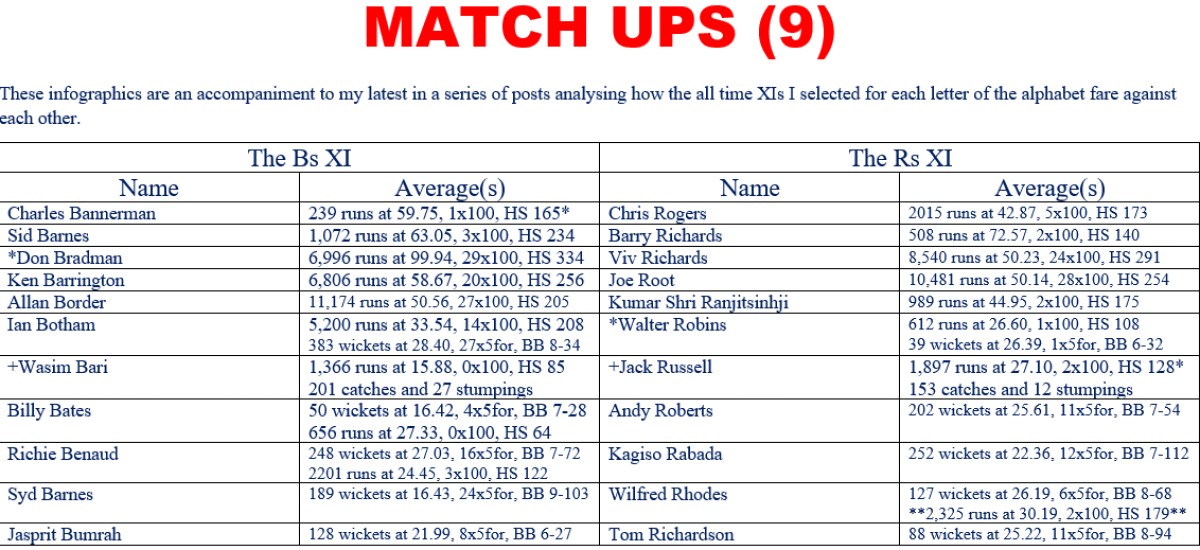
THE Bs V THE Rs

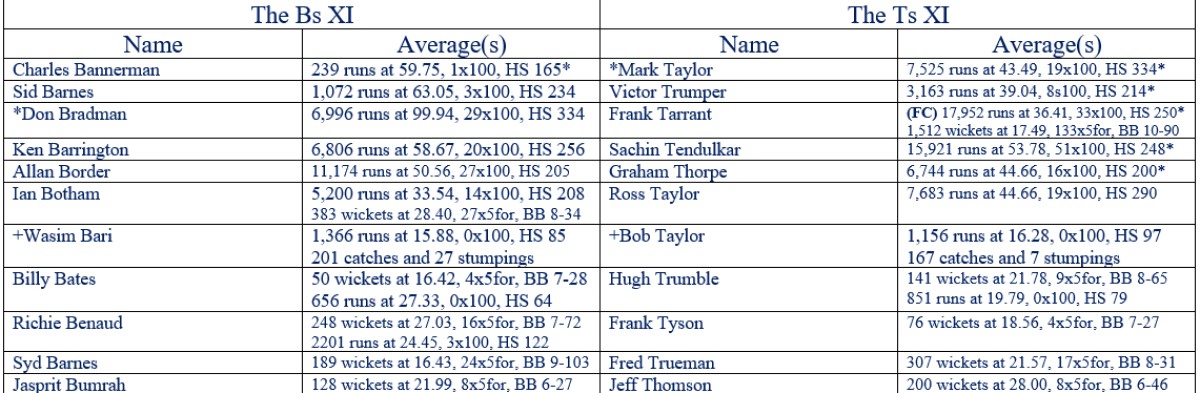
The Bs are massively ahead on batting. They also have the better new ball pairing, but whoever out of Roberts or Richardson ends up first change is a better third pacer than Botham. Benaud outdoes Robins, but Rhodes is a match for Bates. Though the Rs do have an advantage in bowling it is a small one and does not make up for the gulf in batting. Bs 3.5, Rs 1.5.

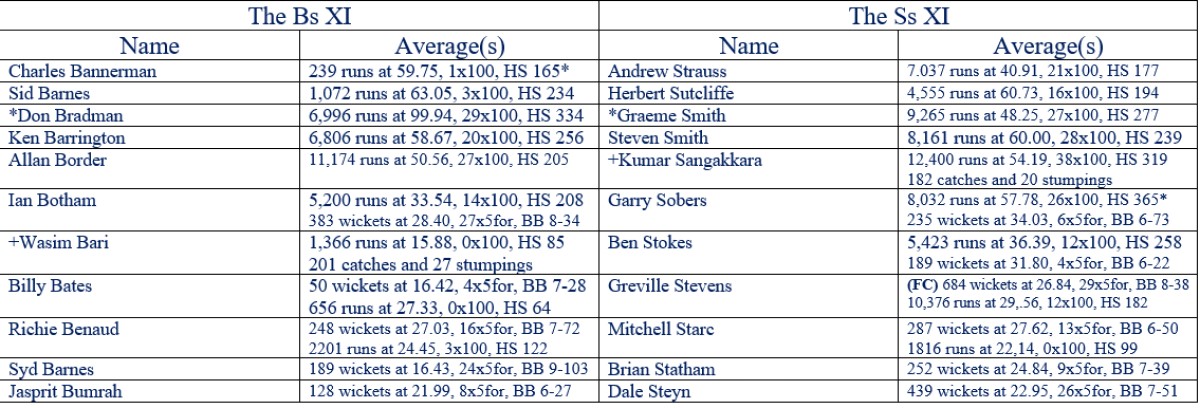
THE Bs V THE Ss

The Ss are only definitively behind the Bs in one batting slot – the number three position. Sangakkara as keeper and Sobers’ constellation of talents mean that other than number three the only position for which batting skill is noted that the Bs win is at number nine, where Benaud outdoes Starc. Though Barnes and Bumrah are the best new ball combination available to either side Starc far outdoes Botham as a bowler, and his left handedness gives his side an extra variation. Stokes and Sobers in his quicker guise are decidedly useful back up seamers as well, while Sobers in his slower guises and Stevens will be a good spinning combination, albeit not the equal of Benaud and Bates. The Ss XI have a clear but not utterly overwhelming advantage: Bs 1.5, Ss 3.5.

THE Bs V THE Ts

The Bs have an advantage in batting, but the Ts have the fastest pace combo of any letter, with Tyson and Trueman matching Barnes and Bumrah for potency with the new ball and Thomson a better third pacer than Botham. Frank Tarrant and Hugh Trumble are certainly at least as potent as Benaud and Bates – Bates may have an advantage over Trumble, but Tarrant has the edge on Benaud. I think the Ts just about have the bowling guns to negate the Bs advantage with the bat. Bs 2, Ts 3.

THE Bs V THE Us

The Bs boss the top batting, with only Inzamam Ul-Haq and Misbah Ul-Haq within ten runs an innings of their opposite numbers in the first five positions. Umrigar outbats Botham, but is much less of a bowler. Similar Umar Akmal outbats Bari, but is nowhere near him as a keeper. Umar Gul has an ordinary bowling record, Umran Malik has earthshaking potential but little actual experience, leaving Ulyett the pick of their fast bowlers. Underwood rates ahead of Benaud as a bowler, and Ur Rahman looks about even with Bates, though again, as with Umran Malik, he lacks experience. The presence of Ulyett and Umrigar does mean that the Us have six bowling options to the Bs five, but I don’t think that can save them, although they might just have a field day if Underwood and Ur Rahman with Umrigar as back up get to work on a raging bunsen. Bs 4 Us 1.

THE Bs V THE Vs

The Bs have their usual huge advantage with the bat, but the Vs are stronger in bowling. While Barnes and Bumrah have to be considered to outrank Voce and Van der Bijl as a new ball pair, Vaas is ahead of Botham as third seamer, and probably by more than the figures show – he would almost certainly fare better as third seamer in a strong attack than he did as opening bowler in a moderate one. Vogler beats Benaud as a leg spinner, while Verity and Bates look on a par, although Verity’s test figures were achieved in a decade of doped pitches and Bradman’s batting. Verity’s advantage over Bates is clear if you compare their FC figures. I do not think that the Vs can make up for their deficit in the batting department, but I would expect a good contest: Bs 3, Vs 2.

THE Bs PROGRESS

The Bs scored 14 out of 25 points in today’s match ups, moving them on to 69 of a possible 105 points, 65.72% overall. The As by comparison were on 54 points at this stage of their match ups.

PHOTOGRAPHS

My usual sign off…

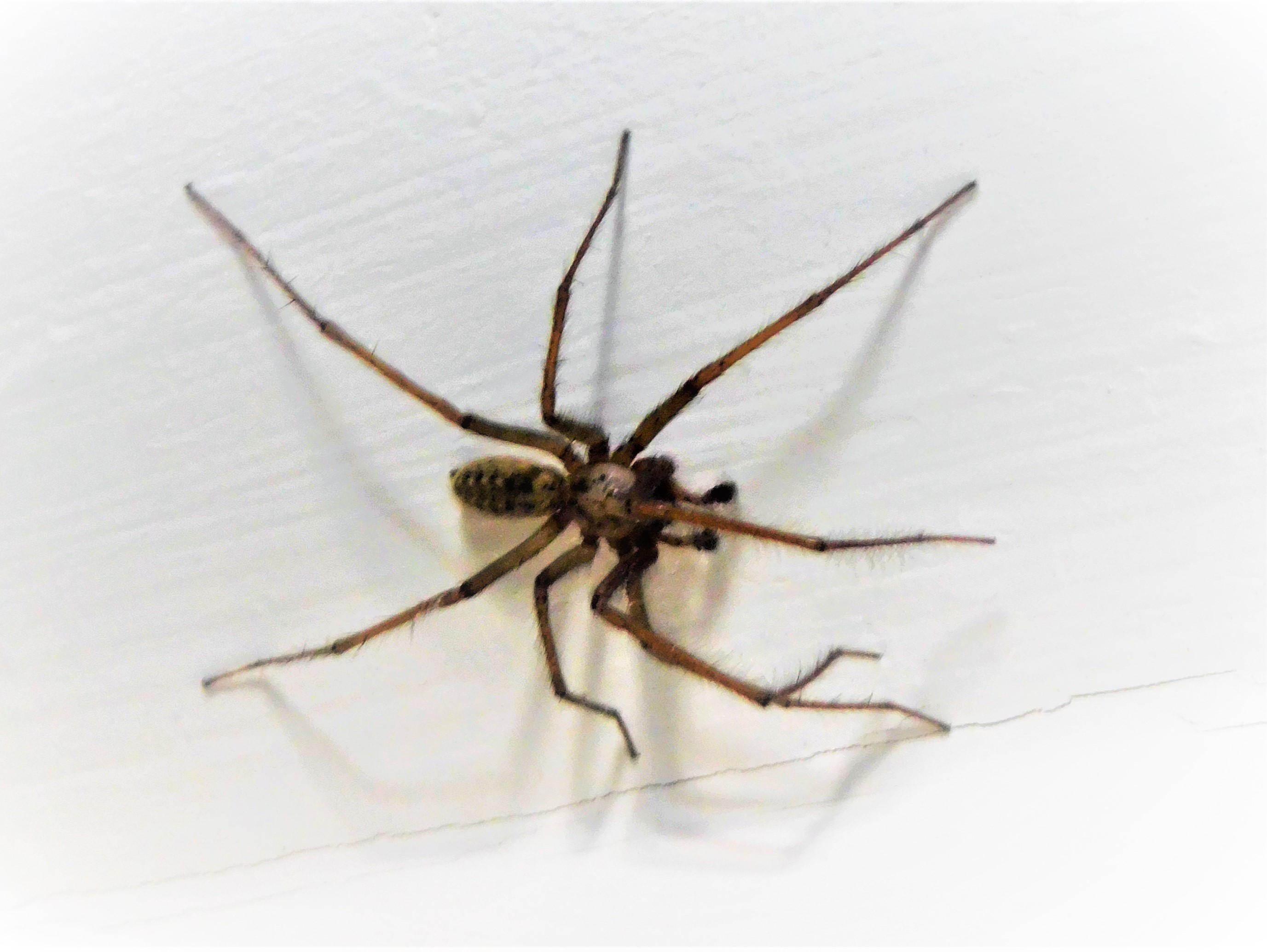
I have separated some of my photographs off from the rest because I know that some of my readers are arachnophobic. If you are among them skip the last few photos…

All Time XIs – Match Ups (5)

Continuing my analysis of how my all time XIs for each letter of the alphabet match up against one another.

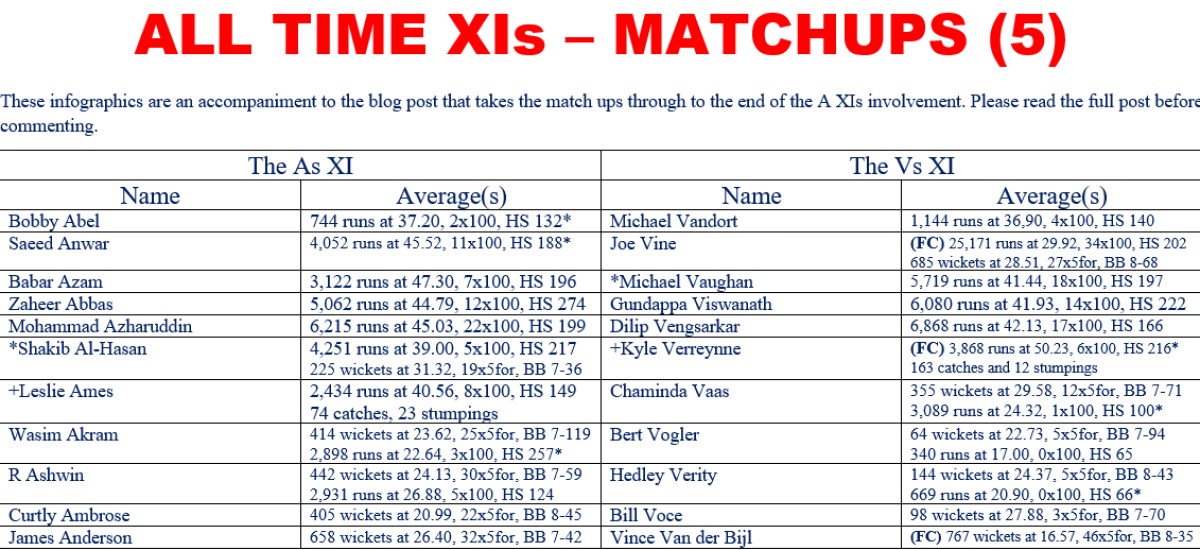
This is the fifth post in my series analysing how the XIs I picked for each letter of the alphabet fare against each other. This will conclude the As involvement. At the start of this post the As have 51 out of a possible 100 points.

THE As V THE Vs

The As are stronger in batting and in seam bowling, though less though than the averages make the latter look – Vaas would fare better as third seamer in a strong attack than he did as opening bowler in a moderate one. The Vs are comfortably ahead in spin bowling. The As are definitely getting the better of this, but not by a huge margin. I score this one as As 3, Vs 2.

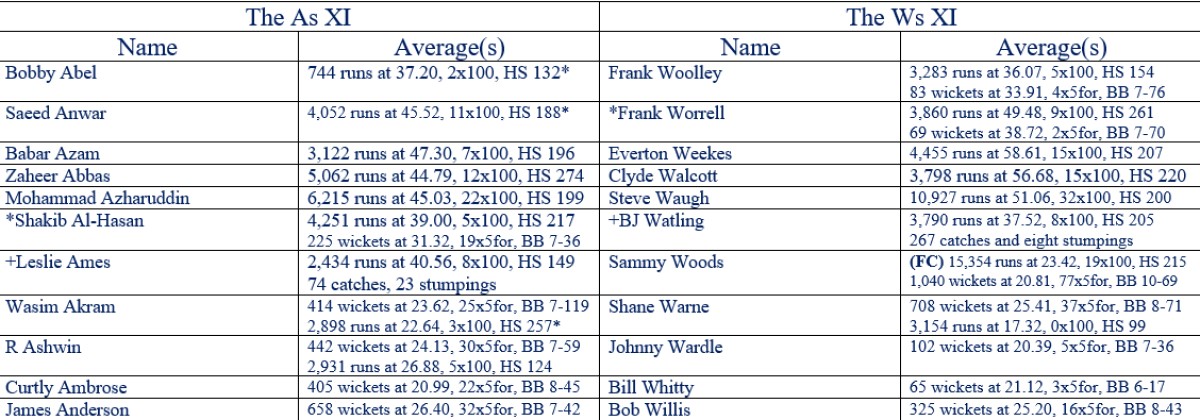
THE As V THE Ws

The Ws are comfortably ahead in batting, behind but not massively so in seam bowling and ahead in the spin bowling department. The extra bowling options provided by Woolley and Worrell count in their favour, and Worrell is clearly the better of the two skippers. I award the Ws a clear advantage here and score this one: As 1 Ws 4.

THE As V THE Xs

The As have a massive advantage in this one. For me this one is As 5 Xs 0.

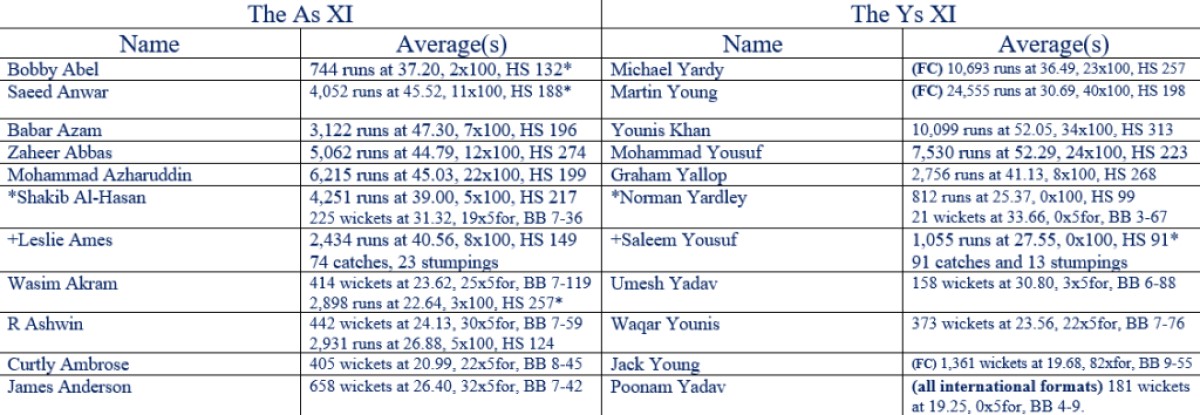
THE As V THE Ys

Even allowing for the presence of Younis Khan and Mohammad Yousuf the As have an advantage in batting. They also boss the seam bowling department. The Ys have the advantage in spin bowling, but not enough to compensate. As 4, Ys 1.

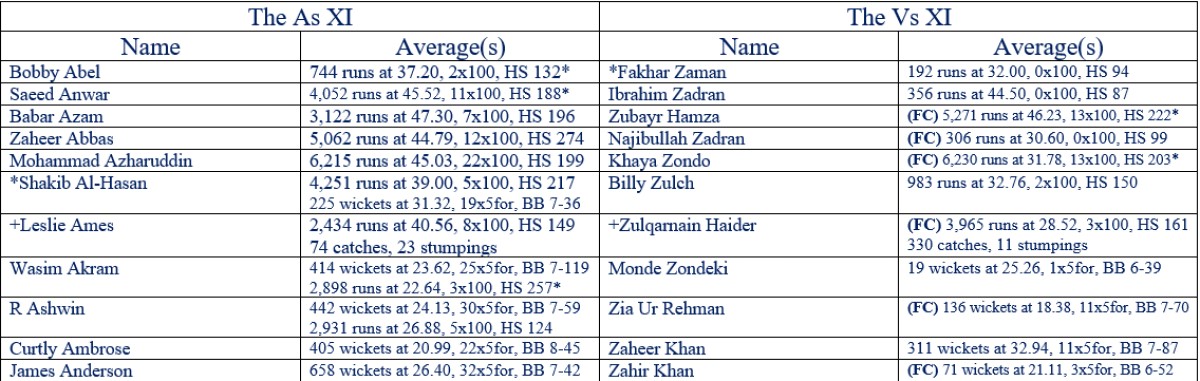
THE As V THE Zs

The As boss the batting and have a massive advantage in seam bowling. Spin bowling may be in favour of the Zs, but even if it is it cannot alter the outcome: As 5 Zs 0.

THE AS OVERALL

A strong final section for the As, seeing them take 18 of a possible 25 points to finish on 69 out of 125 points, 55.2%. The As fare respectably in the comparison and will be a lot closer to the top than the bottom.

PHOTOGRAPHS

My usual sign off…

All Time XIs – The Letter V

Continuing my exploration of the all time XIs theme with a look at players whose surnames begin with V.

I continue my exploration of the all time XIs theme with a look at players whose surnames begin with the letter V. There were many challenges with the selection of this side, which I will elucidate through the post.

THE XI IN BATTING ORDER

  1. Michael Vandort (Sri Lanka). A left handed opening batter, his test record was respectable rather than outstanding.
  2. Joe Vine (Sussex, England). A right handed opening batter and a leg spinner. His job for much of his career was to bat defensively for long periods – Sussex sides of his time were well equipped with stroke makers, but no so much with folk capable of playing the anchor role. An innings of 202 in five hours late his career showed that he could play more expansively when the situation allowed. His batting and bowling averages are the right way round.
  3. *Michael Vaughan (Yorkshire, England). A right handed batter, occasional off spinner, and an excellent captain, a role I have given him in this side.
  4. Gundappa Viswanath (India). A right handed batter possessed of consdierable grit and determination. He averaged over 40 in test cricket.
  5. Dilip Vengsarkar (India). A right handed batter who averaged 42 in test cricket. He scored tough runs as well – he averaged a run more per innings against the West Indies, utterly dominant in his era, than he did in overall test cricket. At Headingley in 1986 when no one else on either side could score even one 50 he produced innings of 61 and 102.
  6. +Kyle Verreynne (South Africa). A right handed batter and a fine wicket keeper. He is still establishing himself at test level, but he averages over 50 in FC cricket, and his keeping skills are abundantly clear.
  7. Chaminda Vaas (Sri Lanka). A quality left arm fast medium bowler who never benefitted from having adequate seam support, and a useful left handed lower order batter. I freely admit that he is one place higher than would be ideal, but none of the bowlers I have named could accurately be described as mugs with the bat.
  8. Bert Vogler (South Africa). A leg spinner, part of the great ‘googly quartet’ that South Africa fielded in the years 1907-10. His test wickets cost 22 a piece and came at well over four per match. In first class cricket his averages were the right way round – 20 per innings with the bat and 18 runs per wicket with the ball.
  9. Hedley Verity (Yorkshire, England). One of the greatest of all left arm orthodox spinners. 144 test wickets at 24 a piece in a decade that featured doped pitches and Bradman’s batting is a fine record, and he also averaged 20 with the bat in test cricket. At first class level he was an absolute destroyer, claiming is wickets at 14.90 a piece, which enabled him to have batting and bowling averages the right way round.
  10. Bill Voce (Nottinghamshire, England). A high quality left arm fast medium bowler, and a useful lower order batter. He was part of the 1932-3 England side that won 4-1 down under, and was the best bowler in the side four years later in a 2-3 defeat.
  11. Vintcent Van Der Bijl (South Africa). The only member of this XI not to play test cricket, due to apartheid, but regarded as a great bowler by all who met him. The deeds at test level of the likes of Garner, Ambrose and McGrath are testament to how effective exceptionally tall bowlers can be at that level. He took his FC wickets at 16.57 a piece, though he doesn’t quite join the list of players in this side with their averages the right way round since he only averaged 16.20 with the bat.

This side contains an opening pair likely to build a good platform for the engine room of Vaughan, Viswanath and Vengsarkar to cash in on, a keeper who is also a genuinely high class batter, and a strong and varied bowling unit. Van der Bijl and Voce with the new ball will pose a challenge for anyone, and I suspect that Vaas as third seamer in a strong attack rather than opening bowler in an ordinary one would be even better than he actually was in the circumstances he faced, while Verity and Vogler are on reckoning a quality pair of contrasting spinners. My selection here absent a genuine all rounder (Vine, though a respectable bowler definitely does not merit the title all rounder) is an extreme example of my preference for strong bowling resources even if it means slightly limited batting. I refer sceptical readers to the deeds of Yorkshire in the 1930s and Surrey in the 1950s for examples of champion sides who were such precisely because of their bowling strength.

HONOURABLE MENTIONS

I start this section with a subsection devoted to a single player…

ADAM VOGES

Ignoring current players, a couple of whom are in the mix, this man has the highest batting average among those to have played 20 or more test matches, so why does he miss out? Quite simply because he cashed in on some pop-gun attacks, and in the only Ashes series he was part of, he like his team came a cropper. Thus, at the risk of enraging worshippers of the baggy green, I declined to select him.

OPENING BATTERS

Pieter Van Der Bijl (father of Vintcent) did well in his five test matches, including coming within a few runs of notching twin tons in the last ever timeless test match, at Durban in 1939. Murali Vijay had a respectable record for India. In short form cricket, especially T20, Elyse Villani of Australia’s women’s team would have a strong case, but there is a notable falling off in her record even between T20 and OD cricket.

MIDDLE ORDER BATTERS

Hanuma Vihari has a magnificent record in Indian domestic cricket, but has never delivered at international level, and his best position is number three, reserved in this XI for skipper Vaughan. Martin Van Jaarsveld had a solid record in domestic cricket but his test record was modest, whereas Vaughan,Viswanath and Vengsarkar were all proven at the highest level. Mike Veletta had a decent record in Australian domestic cricket, but a test batting average of less than 20 tells its own story about him at international level. Lou Vincent of New Zealand was no more than a goodish middle order batter, reflected by averaging in the mid thirties. Bryan Valentine of Kent had an excellent record in the few test matches he got to play, and I regretted not being able to include him. Dane Van Niekerk of South Africa Women is excellent at T20, good at OD cricket, but has hardly played any long form cricket.

WICKET KEEPERS

Other than Verreynne two candidates entered my thoughts. Sadanand Viswanath was one of the most talented keepers India ever produced, but that talent was largely unfulfilled, especially at international level. He has 25 years experience as an umpire however, so there is a role for him. Ricardo Vasconcelos started sensationally at Northamptonshire, but has fallen back in recent years, with his FC batting average standing at 34.

BOWLERS

The two bowlers I most regret not being able to accommodate were both left arm spinners, and unsurprisingly could not challenge the claims of Hedley Verity. Alf Valentine, the second of ‘those two little pals of mine’, took the first eight wickets to fall in the first test innings in which he ever bowled, but his overall record was not as good as Verity’s. Daniel Vettori of New Zealand may well be the second best spinner ever to have been born in the land of the long white cloud behind Clarrie Grimmett, who played his test cricket for Australia, but he comes some way short of challenging Verity.

PHOTOGRAPHS

Our cricketing journey through the letter V is at an end and all that remains is the usual sign off…

All Time XIs – Through The Alphabet IV

Our all time XIs resume the alphabetic progression seen on Friday, Saturday and Sunday. Lots of photographs.

INTRODUCTION

For today’s all time XI cricket post we revert to the alphabetic progression that I started on Friday and continued on Saturday and Sunday. No 11 in Sunday’s second XI began with an N, so today’s first XI starts with an opener who begins with O.

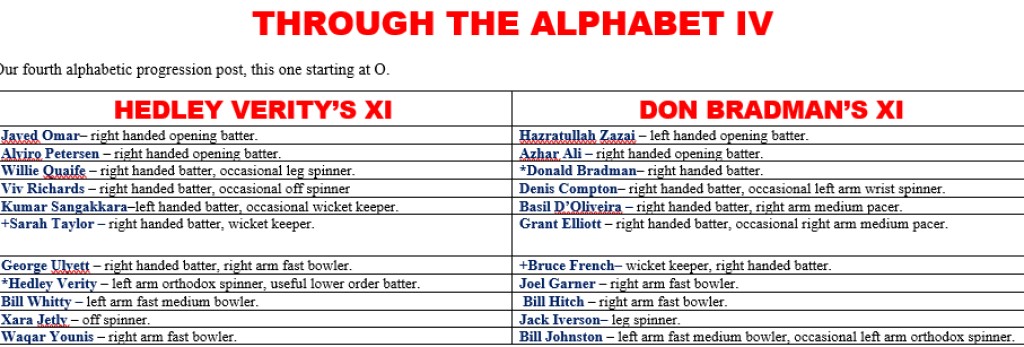
HEDLEY VERITY’S XI

  1. Javed Omar – right handed opening batter. His test record looks modest, but he had very little support at the top of the Bangladesh order (his most frequent opening partner, Hannan Sarkar, was once out to the first delivery of each of three successive test matches).
  2. Alviro Petersen – right handed opening batter. A so-so record in test cricket for South Africas, but a regular big scorer in the county championship. His overall FC average is just above 40 runs an innings, good enough to suggest a player of quality.
  3. Willie Quaife – right handed batter, occasional leg spinner. A fine and consistent upper order batter for Warwickshire for a very long period, signing off with a hundred in his last match, at the age of 56 years and 4 months, the oldest scorer of first class hundred there has ever been (WG Grace notched his 126th and last on his 56th birthday, going on to 166 in that innings). There were question marks about the legality of his bowling action, and the most famous occasion on which his bowling featured prominently did not end well for Warwickshire – when Hampshire made their astonishing recovery at Edgbaston in 1922 after being rolled for 15 in the first innings he bowled 49 overs, being then 50 years of age, as Hampshire reached 521 at the second attempt. Warwickshire, exhausted from their efforts in the field and dispirited by Hampshire’s Houdini act then collapsed to 158 all out in their own second innings, the match ending in a Hampshire victory by 155 runs at 4:20PM on third and final scheduled day.
  4. Viv Richards – right handed batter, occasional off spinner. Had he been able to play all five tests of the 1976 ‘grovel’ series against England Don Bradman’s 974 runs in the 1930 Ashes series would almost certainly have been overtaken. Richards missed the third match of that series through injury, scoring 829 in the other four games. In the final match of the 1985-6 home series v England, with quick runs the order of the day as the Windies pushed for a second successive blackwash of their opponents, Richards smashed a century off 56 balls, at the time the fewest ever to reach that mark in a test match (still third on that list).
  5. Kumar Sangakkara – left handed batter, occasional wicket keeper. Only one left handed batter has scored more test career runs than him, Alastair Cook. The biggest partnership for any wicket in first class cricket is the 624 that he and Mahela Jayawardene put on against South Africa.
  6. +Sarah Taylor – right handed batter, wicket keeper. One of the most accomplished keepers the game has ever seen and a fine stroke making batter as well. Mental health issues cut short her career, but she did plenty enough in the time she did play to justify her selection.
  7. George Ulyett – right arm fast bowler, right handed batter. An attacking all rounder for Yorkshire and England in the late 19th century. He had a test best score of 149, and test best innings bowling figures of 7-36. In the test match at The Oval in 1882, the second ever on English soil after 1880, he top scored with 26 in the England first innings, and was third out in the second, with the score at 51, and only another 34 needed to win. Grace fell two runs later, having become only the second player in the game to record a 30+ innings, and the middle and lower order froze in the face of Fred ‘the demon’ Spofforth’s unbridled hostility. In the end Peate’s wild heave against Harry Boyle might contact only with fresh air, and the stumps were rattled, leaving England beaten by seven runs. He also had a famous fielding moment in the course of his England career, when he took a catch of a shot that Bonnor, the legendary Aussie hitter had absolutely middled.
  8. *Hedley Verity – left arm orthodox spinner, useful lower order batter. 1,956 first class wickets in less than a full decade at that level, at 14.90 each. 144 test wickets at 24 – when contending with a combination of doped pitches and Bradman’s batting. I have awarded him the captaincy that the mores of his time withheld from him, because I believe he would have been excellent at the job.
  9. Bill Whitty – left arm fast medium bowler. He had an excellent record in the years just prior to World War 1 breaking out. In terms of bowling averages only two Aussie left armers of pace have subsequently had records to compare with his (65 wickets at 21.12 from 14 test appearances), Alan Davidson (186 wickets at 20.53) and Bill Johnston who will be meeting later.
  10. Xara Jetly – off spinner. The young Kiwi is very much a prospect rather than an established player, but her last set of bowling figures recorded on cricinfo were 3-35, and I expect the hear more of her in due course (she is only 18, and has appeared a handful of time for Wellington Women).
  11. Waqar Younis – right arm fast bowler. Has all the ingredients – extra pace, rikght handed as opposed to left, etc, to make an excellent new ball partner for Bill Whitty. His first big moments were in the 1992 test series in England, when the home batters simply could not handle him. He subsequently played county cricket for first Surrey, and then Glamorgan, spearheading the bowling for the latter when they won the championship in 1997. Once in an ODI against England he took the first seven wickets to fall, the first time that had ever been done.

This team has a fine top five, albeit there is a question mark over Javed Omar, a great wicket keeping all rounder at six, the perfect type of all rounder to be coming at seven, and four well varied bowlers. Waqar Younis and Bill Whitty as mentioned should combine well with the new ball, Ulyett wuld be an excellent third seamer, and Verity’s class as a left arm spinner as unchallengable. His ‘spin twin’, Xara Jetly is admittedly an unknown quantity, but bowling in tandem with Verity could only help her. Quaife’s leg spin is more than adequate for a sixth bowler.

DON BRADMAN’S XI

  1. Hazratullah Zazai – left handed opening batter. Whatever he does he will do at a rapid rate.
  2. Azhar Ali – right handed opening batter. Averages 42 in test cricket, and had some very fine innings for Somerset as their overseas player. He and Zazai don’t need to score bucket loads opening for this team, just enough to set the stage for…
  3. Don Bradman – right handed batter. The greatest batter there has ever been, and number three was his preferred slot.
  4. Denis Compton – right handed batter, occasional left arm wrist spinner. A man who averaged 50 in test cricket, including scores of 145 and 184 against the 1948 invincibles. His record would have been even more amazing but for a long term knee injury.
  5. Basil D’Oliveira – right handed batter, right arm medium pacer. Had he been able to make his debut for his native land when in his mid 20s, instead of for his adopted land ten years later he would probably have had a record to put him among the all time greats. As it was, he averaged 40 in test cricket, starting at age 35 and ending at age 41. He also played probably the most important innings ever, the 158 at The Oval in 1968 that underlined his claim to a place in the tour party to South Africa that winter, and that triggered the events that led to the sporting isolation of apartheid South Africa.
  6. Grant Elliott – right handed batter, right arm medium paced bowler. Another cricketer born in South Africa  who sought pastures new, albeit for different reasons. He has played for New Zealand, mainly in limited overs cricket.
  7. +Bruce French – wicket keeper, right handed batter. He was in his prime when the England selection approach was at its most inconsistent – the second half of the 1980s, which saw the England gauntlets spread around Paul Downton, him, Jack Richards and Jack Russell (and probably others I have forgotten).
  8. Joel Garner – right arm fast bowler. His ODI economy rate was just 3.09 runs per over, he also had a magnificent test record, and as a youngster possessed one of the most powerful throwing arms ever seen on a cricket field. He was broad and solid in proportion to his 6’8″ height, which helped to spare him from the kind of stress related injuries that plagued beanpoles such as Bruce Reid. The immense height from which he brought the ball down (approx 10 feet given the length of his arms and the fact that he had a high action) made things extremely tricky for opposing batters, especially at his native Barbados where his arm was coming from above the height of the sight screen.
  9. Bill Hitch – right arm fast below. Over 1,000 first class wickets at 21 a piece, but he was never an England regular such was the bowling strength available in his day. Playing for Surrey meant that a lot of his bowling was done at The Oval, not a ground that tops many bowler’s lists of favourites.
  10. Jack Iverson – right arm wrist spinner. A one place promotion from his usual spot for ‘wrong grip Jake’. I have used the designation right arm wrist spinner because although he bowled with a leg spinner’s action (augmented by flicking the ball with his middle finger) his principal delivery was the off break, which confused opposition batters no end. He was only once collared in first class cricket, when Keith Miller and Arthur Morris realized that getting well down the pitch was the way to play him. He played one test series, and was instrumental in Asutralia winning it, capturing 21 cheap wickets.
  11. Bill Johnston – left arm medium fast bowler, left arm orthodox spinner. Three times in the post World War Two era he was Australia’s leading wicket taker in a series. It was not unknown when conditions warranted it for Johnston to switch straight from spinning the old ball to swinging the new. His 40 test match appearances yielded 160 wickets at 23.91.

This team has an adequate looking opening pair, the incomparable Bradman at three, Compton at four, two fine players at five and six who can fill in as support bowlers, an excellent keeper and a marvellous line up of bowlers. Garner, Hitch and Johnston look an excellent pace trio, while Iverson’s spin would pose a stern test, and if a second spinner is needed Johnston can bowl in his slower style.

AN HONOURABLE MENTION

Some would argue that I should have picked Sobers ahead of Sangakkara, but with virtually all of Sobers’ bowling skills covered by specialists in the persons of Verity and Whitty I felt that Sangakkara’s batting style was more suited to the team’s needs than that of Sobers. It is a very close call.

THE CONTEST

This is a close call – the advantage the Bradman gives his own XI is to an extent negated by the presence of Verity, the one bowler he acknowledged facing as an equal in the opposition. Also, bearing in mind 1932-3, if Younis were to strike early with the new ball I would be tempted to set a 7-2 legside field for him and see how Bradman stands up to a barrage – possibly deploying Ulyett from the other end, also with a packed legside field as well. I would just about favour Verity’s XI to emerge victorious, and if the match was being played on an uncovered pitch I would make them distinct favourites, because they are better equipped to take advantage of a rain affected surface than Bradman’s XI, and Bradman himself rarely succeeded with the bat on such surfaces.

PHOTOGRAPHS

We end with my usual sign off:

IMG_0960 (2)IMG_0961 (2)IMG_0963 (2)IMG_0964 (2)IMG_0965 (2)IMG_0966 (2)IMG_0967 (2)IMG_0968 (2)IMG_0969 (2)IMG_0973 (2)IMG_0974 (2)IMG_0975 (2)IMG_0976 (2)IMG_0978 (2)IMG_0979 (2)IMG_0983 (2)IMG_0984 (2)IMG_0985 (2)IMG_0987 (2)IMG_0990 (2)IMG_0991 (2)IMG_0992 (2)IMG_0993 (2)IMG_0995 (2)IMG_1001 (2)IMG_1002 (2)IMG_1003 (2)IMG_1006 (2)IMG_1007 (2)IMG_1008 (2)IMG_1011 (2)IMG_1012 (2)IMG_1014 (2)IMG_1015 (2)

IMG_1018 (2)
Caterpillar on anettle 1

IMG_1019 (2)
Caterpillar on a nettle 2

IMG_1019 (3)
Caterpillar no nettle 3

IMG_1020 (2)
The aerial view of the indivdual nettle plant selected by this caterpillar.

IMG_1024 (2)IMG_1025 (2)IMG_1026 (2)IMG_1027 (2)IMG_1028 (2)IMG_1029 (2)IMG_1032 (2)IMG_1035 (2)IMG_1037 (2)

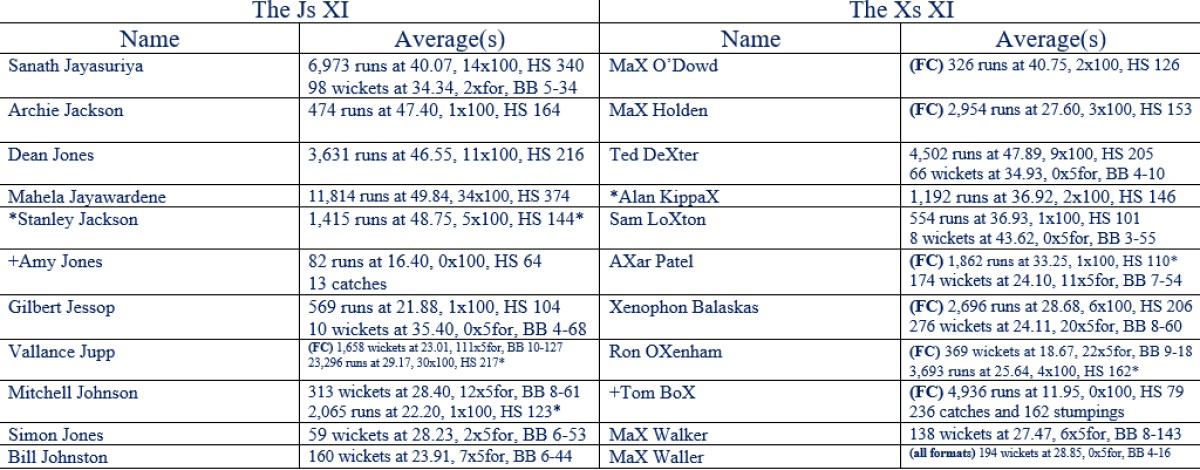
TTA IV
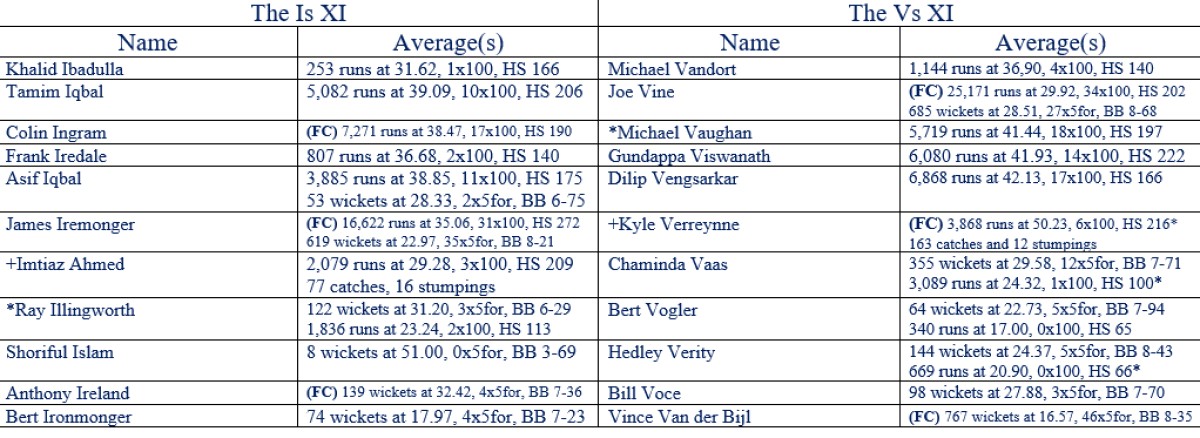
The teams in tabuilated form.