India Men Flop in Melbourne

A look back at today’s T20I between Australia and India men’s teams at Melbourne and a large photo gallery.

There is no women’s world cup cricket on at the moment – yesterday saw the second semi-final of which I was unable to catch a single ball due to being at work. It must have been a classic game, with India chasing down 339 with nine balls to spare. This morning UK time there was a T20I between the Australia and India men’s teams and this post looks back at that match.

India were in trouble early, crashing to 32-4, and never really recovered. India also showed a chronic lack of game awareness and tactical nous. The only Indian batter to play with real fluency was Abhishek Sharma, who produced a gem of an innings, but also only had the strike for one-third of the deliveries bowled during his innings (37 balls faced out of 111 bowled). As an indication of how much this cost India he scored 68 off those 37 balls, while the rest of the batters managed 57 from the other 74. The innings lasted one ball after his dismissal – Bumrah wanted a run off the ball in question, Varun Chakravarthy failed to respond, and that kind of mix-up leads to only one result, which duly happened here – J Bumrah run out 0 (1). Thus India had a beggarly 125 to defend, which was never going to be enough on a pitch that offered bounce but could not be described as difficult to bat on.

Although Bumrah took two late wickets to lend the match a veneer of closeness, reducing that side of the margin to a mere four wickets the truth of the scale of the home side’s win is better illustrated by the fact that they took a mere 13.2 overs to chase down the runs, thus doing the job with exactly one-third of their innings to spare. Being English I have to note that if the test pitches in a little while offer a bit of bounce then England, with the phalanx of express bowlers they have named in their party, will be delighted.

This is a large gallery, and reflective of weather that cannot quite seem to make its mind up. Today, though mainly cloudy and with odd spots of rain has been almost absurdly warm for the end of October in England – the outside temperature is still officially 15 Celsius (59 Fahrenheit) at 5PM…

Role Reversal in Guwahati

A look back at the world cup semi-final between England and South Africa at Guwahati today, and especially at an astonishing display from Laura Wolvaardt. Also lots of photos.

Today saw the first semi-final of the 2025 women’s cricket world cup, between England and South Africa. These two sides played their first match of the tournament at this same venue, and on that occasion South Africa were bowled out for 69 and England won by 10 wickets. In South Africa’s last group match, after a superb middle phase of the competition they fell victim to Alana King’s amazing one-woman show and were again all out for under 100. Thus England probably thought they had little to fear.

Laura Wolvaardt and Tazmin Brits led off with a century stand, but then England took three wickets in next to no time. Marizanne Kapp then provided fine support for Wolvaardt, scoring 42 from 33 balls before being caught by Charlie Dean off Sophie Ecclestone, who was looking something close to her best with the ball after sustaining a shoulder injury last time out. Many have suggested that Sinalo Jafta, the Proteas keeper, is too high in their order at number six, and 1 off four balls before Lauren Bell bowled her did nothing to alter that impression. Ms Jafta has now played 46 ODIs, with an average of 12.59 and a best score of 29, not the stuff of which top six batters are made. With the first ball of the 41st over Ecclestone claimed her fourth scalp of the day, her 16th of the tournament, making her leading wicket taker thereof, and her 37th world cup wicket in all, by bowling Annerie Dercksen for 1 to make it 202-6…

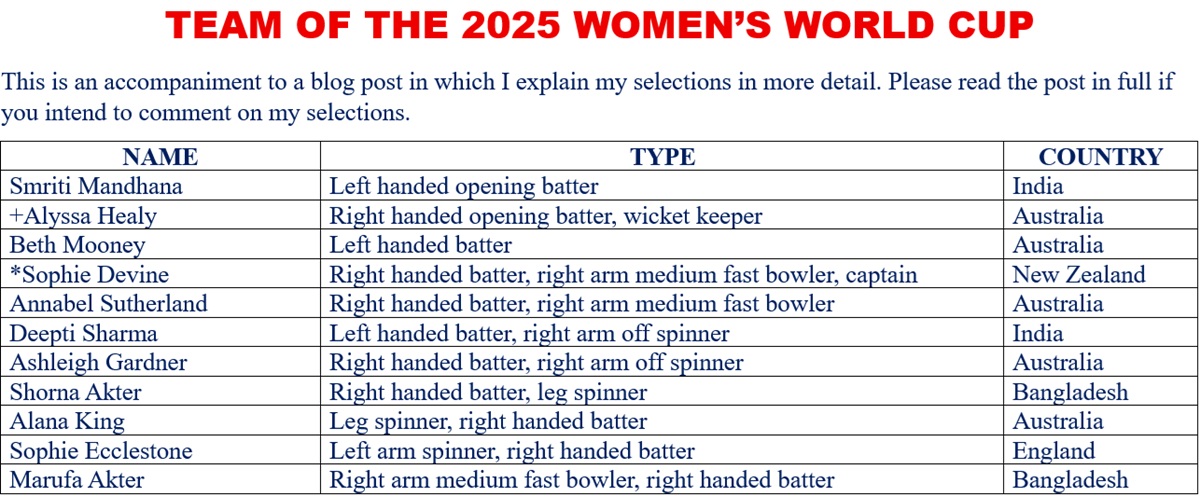
…Laura Wolvaardt had survived all the carnage, and reached three figures off 115 balls. Now, starting from that 202-6 after 40.1 overs, and with Chloe Tryon her main remaining supporter she turned a high class ton into the sort of innings that settles matches and possibly even tournaments. Wolvaardt’s acceleration in the final phase of the innings was so dramatic that her third 50 took a mere 21 balls, including four sixes when she had none in her first 100 runs. In the end a catch by Capsey off Bell got her for a magnificent 169 off 143 balls, including 20 fours and five sixes, with 62 off her last 69 runs being in boundaries – eight fours and five sixes in that period. The innings catapulted her to the top of the scoring charts for the tournament, moved her past 5,000 ODI runs in all and moved her ODI batting average north of 50. Her dismissal made it 291-7 after 48 overs. Chloe Tryon and Nadine de Klerk completed a remarkable last 10 overs for the Proteas by scoring 28 off the last two overs between them for a final total of 319-7, 117 of them in the last ten overs. Off the 40 overs not bowled by Ecclestone (10-1-44-4) South Africa scored 275-3. This innings has caused a backdated change to my team of the tournament – on Monday I had Alyssa Healy as Smriti Mandhana’s opening partner and Wolvaardt as reserve opener, but after today I have changed my mind, Wolvaardt opens with Mandhana and Healy is reserve opener and keeper, with Beth Mooney taking the gloves: S Mandhana, L Wolvaardt, +B Mooney, S Devine, A Sutherland, D Sharma, A Gardner, Shorna Akter, A King, S Ecclestone, Marufa Akter, with the reserves now N Sciver-Brunt, A Healy, L Smith and K Gaud.

The England innings began in spectacular fashion, of the wrong sort for them, with the top three of Amy Jones, Tammy Beaumont and Heather Knight all departing for ducks, with the only run accrued in the seven balls of mayhem in which this happened being a wide. After that beginning it was miracles required territory, and although Sciver-Brunt batted very well and Alice Capsey scored her maiden ODI 50 England never looked like getting on terms. When Linsey Smith was last out, caught by Luus off de Klerk for 27, England were all out for 194, beaten by 125 runs, a remarkable turnaround from that opening group fixture at this same venue. Full scorecard here.

My usual sign off…

Women’s World Cup 2025 Team of the Tournament

I pick my team of the 2025 Women’s World Cup. Also two photo galleries.

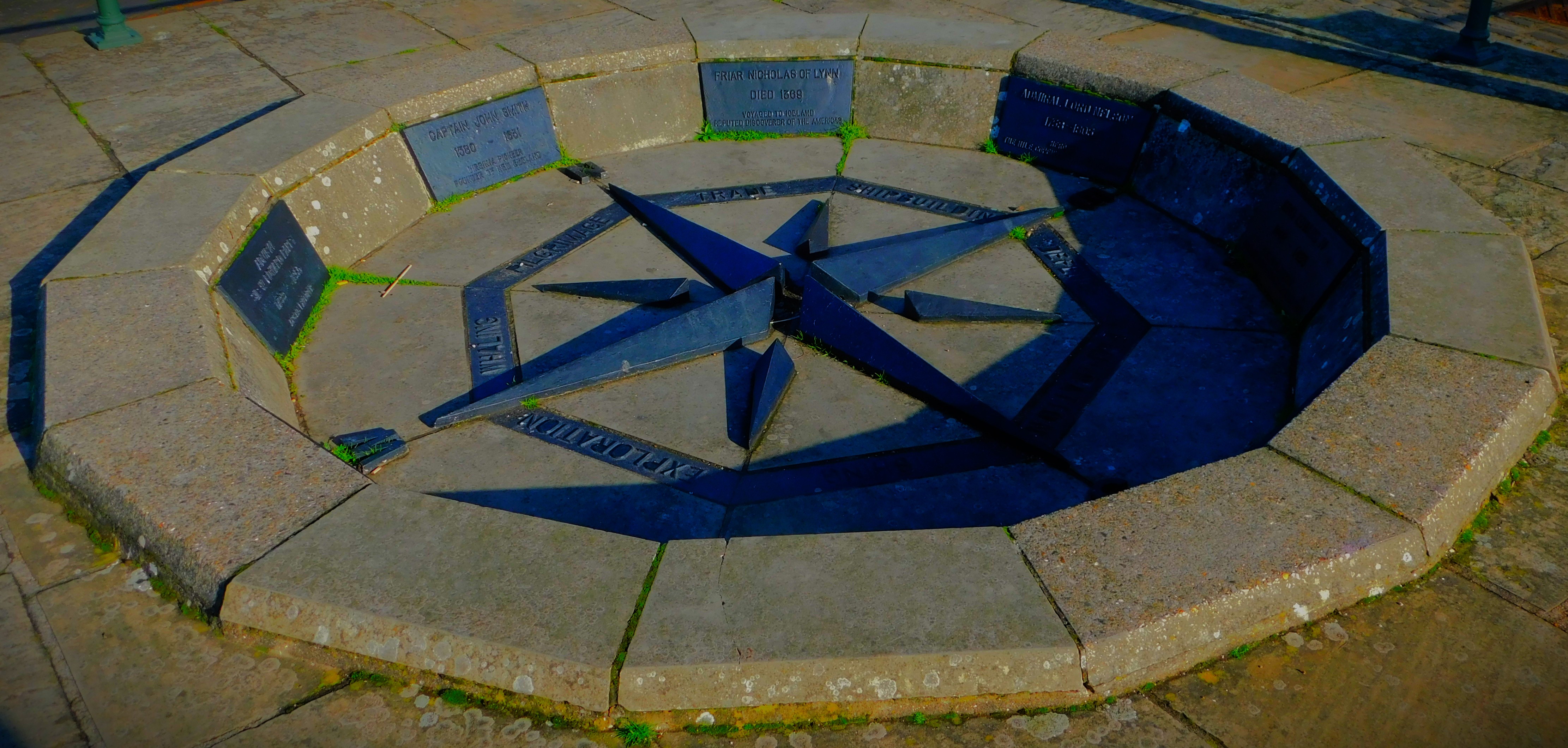
There is no cricket today – the group games are done and the semi-finals happen on Wednesday and Thursday respectively. Therefore, as the first of two posts I am doing today (the third to last image you will see in this one provides a hint as to the subject matter of the second post) I shall be naming my team of the tournament.

I am picking chiefly based on what has happened at this tournament, and as usual I am considering overall balance as well as player quality. Also, although I could probably have safely done the lazy thing and just named Australia en bloc I have not done so.

  1. Smriti Mandhana (India, left handed opening batter). The stylish left hander has had an excellent tournament, including a magnificent century against new Zealand that helped India to seal their spot in the semi-finals.
  2. +Alyssa Healy (Australia, right handed opening batter, wicket keeper). Before injuring her calf she had been in superb form, twice making run chases, one large and one not so large, look absurdly easy by scoring commanding and rapid centuries at the top of the order.
  3. Beth Mooney (Australia, left handed batter). Australia were deep in trouble against Pakistan, and it was Mooney, helped first by some defiance from Kim Garth and then a sparky 50 from Alana King, who dug them out of it with a century.
  4. *Sophie Devine (New Zealand, right handed batter, right arm medium pacer, captain). Although bowing out of ODI cricket in a blaze of glory has not happened for the Kiwi legend it is not any fault of hers, she has personally had a very good tournament.
  5. Annabel Sutherland (Australia, right handed batter, right arm medium fast bowler). The leading wicket taker of the tournament, and although she has done less with the bat a 98 not out when her side had been reduced to 68-4 chasing 245 against England was a crucial effort in that department.
  6. Deepti Sharma (India, left handed batter, right arm off spinner). She has had a superb tournament, being second on the wicket taking list and having scored some useful runs.
  7. Ashleigh Gardner (Australia, right handed batter, off spinner). Two centuries (one from number six, one from number seven), both made with her team initially in a bit of trouble, and has bowled well.
  8. Shorna Akter (Bangladesh, leg spinner, right handed batter). Two cheap three-fors with the ball and a maiden ODI 50 with the bat. I have placed her lower in the order than she has been batting for Bangladesh because they are a weak batting side and my view, that 50 notwithstanding, is that at the moment she is actually a bowling all rounder, rather than the batting all rounder that her position in the Bangladesh order suggests.
  9. Alana King (Australia, leg spinner, right handed batter). Even if she had done nothing else all tournament, which is far from the case, her destruction of South Africa when she rewrote the record books with her figures of 7-2-18-7 would have earned her a place in this XI.
  10. Sophie Ecclestone (England, left arm orthodox spinner, right handed batter). The fact that she is England’s joint leading wicket taker, with 12 scalps, in spite of missing one match due to illness and bowling only four balls in another due to a shoulder injury speaks for itself.
  11. Marufa Akter (Bangladesh, right arm medium fast bowler, right handed batter). Has shown herself to be an extremely skilful operator in conditions in which most teams, including her own Bangladesh, have gone in spin heavy.

This side has great batting depth and a wealth of bowling options – only the top three in the order won’t be used as bowlers, and everyone down to Ecclestone, scheduled to bat at ten (who might be promoted and sent in to swing for hills if it was close to the end of the innings) could offer something with the bat.

My first reserve, on the grounds that she can replace anyone other than one of the openers without weakening the XI is England’s Natalie Sciver-Brunt, right handed batter, right arm medium pacer and shrewd captain. I also want a reserve opening batter, and my choice there is Laura Wolvaardt of South Africa, a right hander. My third choice of reserve is Linsey Smith of England, left arm spinner and brilliant fielder. Her ability to take the new ball, which she has shone doing this tournament counts in her favour. To round out the squad I name a reserve seamer, Indian right arm medium fast bowler Kranti Gaud, who with the one exception of taking a pounding at Australia hands has had a very fine tournament.

The only rival to Mandhana for the left handed opener’s slot was Phoebe Litchfield, but she has not been quite as good as the Indian at this tournament. As well as Wolvaardt who I actually named as a reserve, the other South African opener Tazmin Brits deserves a mention. Marizanne Kapp has shown no signs of fading powers at this tournament, but I could not name her ahead of either Sutherland or Devine.

My usual sign off…

A One Woman Show at Indore

A look back at today’s Women’s World Cup Match between Australia and South Africa, and in particular its defining performance, an incredible display of leg spin bowling by Alana King. Also a photo gallery.

This post is devoted to today’s match at the Women’s Cricket World Cup, between Australia and South Africa to decide who would finish top of the league stage, setting up a semi-final against fourth placed India, while the losers would face England in the other semi-final. Yesterday, which should have been Sri Lanka versus Pakistan, saw only 4.2 overs of play before the rain finally and decisively settled things, underlining yet again the folly of using Colombo as a venue in that city’s wettest month and the further folly of making all matches there day-nighters when the rain is generally at its worst in late afternoon/ early evening.

The heading for this section is simply the figures in standard Overs-Maidens-Runs-Wickets form recorded by Alana King for the nearest thing to an absolutely perfect display of leg spin bowling that you could ever hope to see.

King came on to bowl with South Africa looking a bit rocky at 43-2 after 11 overs, and by the time she rattled Nadine de Klerk’s stumps with the last ball of 24th over (her seven overs being numbers 12, 14, 16, 18, 20, 22 and 24 of the innings) the Proteas had subsided to a miserable 97 all out. The one wicket not to go to King in this period, that of Ayabonga Khaka was arguably the leggie’s by proxy as well – in the previous over bowled by King there had been five dots and then a single off the sixth ball as de Klerk, who was batting competently, demonstrated her opinion of Khaka’s chances against King. Khaka was on strike to the fourth ball of the following over, bowled by Ash Gardner, and was comprehensively bowled by the off spinner. King took four of her wickets before conceding a run, and her final figures of 7-18 were an all time record for a World Cup match and an all time ODI record for an Australian woman, relegating Ellyse Perry’s 7-22 to second place and current bowling coach Shelley Nitshke’s 7-24 to third.

After what had happened in South Africa’s innings there was very little chance of an upset. South Africa did take two early wickets, but a 75 run stand between Georgia Voll and Beth Mooney did most of the work for them, and some good blows by Annabel Sutherland after the stand was broken did the rest. Sutherland hit each of her first two balls to the boundary, and after one dot ball she then got her fourth ball away for the two runs Australia still needed. The margin was seven wickets, and Australia had taken only 16.5 overs to knock off the runs. There was of course only one candidate for Player of the Match.

South Africa have overall been very convincing in this phase of the tournament, but in both their first and last matches they came a cropper against quality spin – in their first match England’s spinners shared the wickets as the Proteas slumped to 69 all out, while in this one Alana King almost single-handedly destroyed them. They now have to face England in the semi-final. In view of what has happened today England must be looking at ways to include leg spinner Sarah Glenn. One possibility if they feel like going all in on ‘spin to win’ would be to rest Lauren Bell for the semi-final and rely purely on Natalie Sciver-Brunt’s medium pace for any seam they might need.

My usual sign off…
The Annabel and Ashleigh Show

An account of today’s match at the cricket world cup between the Australia and England women’s teams and two photo galleries.

Today’s match at the women’s cricket world cup saw a revisit to international sport’s oldest continuously maintained rivalry, that between Australia and England. This post looks back at the match.

Both sides were already qualified for the semi-finals but:

  1. This match could easily be a dress rehearsal for bigger match later in the tournament.
  2. Whoever emerged victorious from the encounter would temporarily displace South Africa from top spot in the table and
  3. No game between this particular pair of opponents can ever be described as meaningless.

Australia were missing Alyssa Healy with a calf strain, and her place at the top of the order went to Georgia Voll, while Beth Mooney took over the wicket keeping gauntlets and Tahlia McGrath assumed the captaincy (Mooney and McGrath are absolute regulars in the XI, so Voll for Healy was only the change in personnel). England were unchanged from the side that just prevailed over India at this same venue last time out. Australia won the toss and chose to put England in to bat.

England started fast, with Tammy Beaumont in particular playing impressively. However Australia soon adapted to the conditions, realizing that pace off was the way to go. Annabel Sutherland, the fastest of Australia’s bowlers was expensive early on, but once she worked the surface out and focussed on slower balls she bowled very well, and emerged with 3-60 from her 10 overs, her 13th, 14th and 15th wickets of the tournament, putting her two clear of Deepti Sharma at the top of the wicket takers list. Ashleigh Gardner fared well with her off spin as well, claiming 2-39 for the innings. Beaumont’s 78, which fizzled out after a blazing start, was the only innings of real substance for England, though a spirited partnership between Capsey and Dean, numbers seven and eight in the order, somewhat revived England in the closing stages. England ended their innings on 244-9.

With a modest total on the board England needed a good start, and they got it. Lauren Bell bowled Phoebe Litchfield with the third ball of the inning, Linsey Smith accounted for the other opener Voll in the fourth over and for Ellyse Perry in the sixth over at which point the score was 24-3. When Nat Sciver-Brunt took a catch off Ecclestone to dismiss Mooney for 20 it was 68-4, and Ashleigh Gardner was joining Annabel Sutherland. Their partnership turned the game, slowly at first, and then very rapidly. By the closing stages the only questions where whether both batters would reach three figures, and if so who would get there first. Gardner did reach three figures, off the 70th ball of her innings, and in the end Sutherland just missed out, though Gardner had tried to create the opportunity for her team mate to get there. In the end after the 41st over had start with a two and a single that took Sutherland to 98 not out but left her off strike, Gardner, who had blocked the last three balls of the 40th over to give Sutherland a shot at the landmark, straight drove the third ball of the 41st over for the winning runs, ending with 104 not out from 73 balls, including 16 fours, while Sutherland’s 98 not out took 123 balls and included nine fours and a six. Their stand was worth an unbroken 180 from 24.4 overs. England had their moments during the match, but against this Australian combination having one’s moments from time to time is simply not good enough. Sutherland’s 3-60 and 98 not out earned her Player of the Match, by a short head from Gardner (2-39 and 104 not out).

My usual sign off…
England Women Book Semi-Final Slot

A look back at yesterday’s thriller at the women’s cricket world cup between India and England, with links to the scorecard and to a post by Hypocaust about the the numbers, plus a photo gallery.

Yesterday’s match at the women’s cricket world cup saw England facing hosts India at Indore. This post looks back at a remarkable match.

Lauren Bell and Sophie Ecclestone were recovered from the sickness that kept them out of England’s previous match, so England were back at full strength. India had opted to bolster their bowling. Natalie Sciver-Brunt won the toss and decided, to some surprise, that England would bat first.

Amy Jones and Tammy Beaumont gave England a solid start, and then the rest of the England innings was dominated by a command performance from former skipper Heather Knight. Knight, well supported by current skipper Sciver-Brunt who helped the third wicket to put on 115 at better than a run a ball, took a mere 86 balls to reach her third career ODI hundred and first against India. After Sciver-Brunt was out we saw a familiar scene as Sophia Dunkley, Emma Lamb and Alice Capsey all fell cheaply – the England numbers 5,6 and 7 have a combined aggregate of 111 runs between them for the tournament so far, and then a second familiar scene as Charlie Dean ensured that the good early phase of the innings was entirely wasted by scoring a rapid undefeated 19 to boost the final total to 288, not massive on a good pitch but surely defensible.

For much this innings it looked like the hosts were heading to a comfortable win. In particular when the two left handers, Smriti Mandhana and all rounder Deepti Sharma were both going well England looked beaten for all money. Then Mandhana had a rush of blood to the head against Linsey Smith and holed out to Alice Capsey for 88 off 94 balls to make it 234-4 in the 42nd over and open up a possible way back in to things for England. Richa Ghosh never got going and managed a mere 8, caught by former skipper Knight off the bowling of current incumbent Sciver-Brunt to make it 256-5 in the 46th over. It was in the following over that England got the breakthrough that put them ahead on points for the first time in a long while, when Deepti Sharma, who had batted very well for her 50, got over aggressive against Ecclestone, who by her own lofty standards had had a poor time with the ball, and was caught by Dunkley to make it 265-6. With two overs to go India needed 23, and England were definitely favourites. The first ball of the 49th over, bowled by Lauren Bell, went for four, but the tall seamer came back well in the rest of the over, and India needed 14 off the final over, with Linsey Smith, England’s most economical bowler on the day, to bowl it. Smith bowled a superb over, and by the time the fifth ball had gone for a mere two runs India needed eight to tie off the last ball of the match, meaning that in effect Smith only had to bowl a legal delivery for England to get the win that would secure their semi-final berth. She did so, and it was hit for four irrelevant runs, meaning that England had won by four runs and became the third side to book a semi-final slot. India meanwhile are now in serious jeopardy of suffering the fate of the England men in 1999 – being ejected early from their own party. Even with that final irrelevant four Linsey Smith’s figures were 10-0-40-1, absolutely crucial to England’s success, though unsurprisingly Knight was named Player of the Match for her century. Scorecard here, and a for the numbers people here is Hypocaust’s post.

My usual sign off…

Cricket Meets Baldrick

Some thoughts on the use of Colombo as an adjunct venue at the Women’s World Cup, which is mainly happening in India. Also a photo gallery,

This edition of the women’s ODI world cup was supposed to be entirely hosted in India. However the Indian government has a policy of denying admission to the country for Pakistanis, and they refused to make an exception for the Pakistan Women’s cricket team. That forced the finding of venues outside India, and Sri Lanka was chosen. This post looks at happenings there, especially with reference to the last two days.

While Sri Lanka, just off the southern tip of India, can indeed be considered close to the host country there is one problem with Sri Lanka at this time of year that downgraded the plan from sensible to Baldrickian – it is Sri Lanka’s rainy season. Further, although Dambulla is much drier at this time of year Colombo was chosen because it has better infrastructure. Finally, although the rain generally hits in mid to late afternoon and only sometimes lets up thereafter, all the matches have been scheduled to be day-night matches because that is what the TV people want. Thus the Colombo matches have been a combination of ‘no result’ (four times) and reduced overs contests (four times).

Yesterday actually did provide a result. Sri Lanka, batting first, had reached 46-2 from 12 overs when the rain hit, and by the time a resumption was possible the contest was reduced to 20 overs per side. Sri Lanka did hit 66 more off the eight overs they had left to bat, and because they had only lost two wickets the DLS formula worked somewhat in their favour, giving South Africa an adjusted target of 133. However, those who are familiar with 20 overs a side matches will be aware that even 133 is rarely a difficult target, and Laura Wolvaardt and Tazmin Brits, with a half century a piece, made it look a ridiculously easy one, coasting home with their opening stand unbroken and 5.1 overs to spare. Wolvaardt who had also pouched two catches in the field and captained the side well was named Player of the Match.

Today it was Pakistan who got the booby prize of batting first in a game in which rain would make its presence felt. They were 52-3 when rain intervened for the first time, 92-5 from 25 overs when the rain made its second and final intervention. My own feeling is that any side batting first in Colombo at this tournament would be well advised to approach their innings as though playing a T20 – if the rain holds off enough to allow a match to be completed it is not likely to be much more than 20 overs a side in any case, and I would prefer a big total adjusted down for over expenditure of resources to a small one adjusted up for having conserved resources early on. Pakistan are pretty much out of the tournament anyway, and have looked the worst of the eight sides to qualify (barring against England – see here for more). New Zealand still have hopes, although there is one less semi-final slot open after today than there was starting the day, with the points being shared here meaning that South Africa have joined Australia in booking their slot.

My usual sign off…

England’s Undeserved Point

A look back at the England Women’s cricket team’s luckiest ever day, escaping with a point from a match in which they were utterly outplayed, and a lot of photographs.

Today’s match in the women’s cricket world cup saw England facing Pakistan in Colombo (this tournament is officially being held in India, but the Indian government refuse to allow Pakistanis, even Pakistani international cricketers, into their country, so Pakistan are based in Colombo). Such action as there was took place in three stanzas. The photos in this post will come in three parts, in natural breaks in the format of the post.

Pakistan won the toss and put England in to bat. England had two changes, both caused by illness. Em Arlott replaced Lauren Bell while leg spinner Sarah Glenn was in for the world’s number one ranked ODI bowler Sophie Ecclestone.

Pakistan bowled beautifully, albeit with quite a few bad balls thrown in. England scored rapidly, but lost wickets even more rapidly. Both openers went cheaply, and so too did Heather Knight and Natalie Sciver-Brunt. At 39-4 England were in deep trouble, and it would get deeper. Emma Lamb, an opener in domestic cricket, has barely been able to buy a run since England crowbarred her into their middle order, and she failed again today. Sophia Dunkley tried to play left arm spinner Sadia Iqbal off the back foot and was LBW for 11 to make it 57-6. Charlie Dean dug in with typical determination, but with the score having inched up to 78 Alice Capsey was LBW – she reviewed it in desperation, but it was pretty much plumb. One more run came before with the completion of the 25th over rain forced the players from the field. England at this juncture were 79-7, and unlike Australia who had had a similar score line against Pakistan but had escaped there was no frontline batter left to play the Mooney role in any turnaround.

When play was finally able to resume the match had been reduced to a 31 over per side match, meaning that England had six overs left to bat. Those six overs were England’s best period of play by far. They scored 54-2 from those six overs, giving them a final total of 133-9 from 31 overs. Quite rightly in view of the calamitous early part of their innings and the fact that only having six overs to bat had definitely worked in their favour this target was adjusted downwards. Pakistan would resume after a 10 minute innings break needing 113 to win. Charlie Dean with 33 from number eight in the order was the only English batter to even get as far as 20. Sarah Glenn with 18 from number nine was joint second top scorer alongside Knight.

Pakistan’s openers, Muneeba Ali and Omaima Sohail, started well. Not only were England not taking wickets as they needed to, they were not really threatening to do so. However with Pakistan 34-0 from 6.4 overs and in cruise control the rain returned and this time it did not let up, and the match was abandoned. That meant one of the most undeserved points you will ever see for England, official confirmation of Pakistan’s elimination, and a bad taste in the mouth of any genuine cricket fan who was following proceedings. I am English, but my sense of justice prevails here. The only emotions the England players should be feeling about today are shame and embarrassment – there have been few teams in any sport I would suggest who have been this humiliated and still emerged with a share of the spoils.

England do not stand quite alone in escaping with a share of the spoils after being thoroughly humiliated – few events in the history of a sport as old as cricket are truly unique. In the 1992 men’s world cup Pakistan were bowled out for 74 in a group match against England, and then it rained and the points were shared. Pakistan pulled their socks up after that shocking performance against England and went on to win the tournament.

In 1907 Northamptonshire probably suffered the worst humiliation of any side to escape with a share of the spoils in professional cricket. They were playing Gloucestershire in Gloucestershire in a heavily rain affected match. Gloucestershire totalled 60 and 88, with Gilbert Jessop managing 22 and 24, a performance at least as valuable as twin tons on a good batting pitch, while Northamptonshire were all out for 12 in their first innings (George Dennett 8-9, that man Jessop 2-3) and 40-7 in their second innings (Dennett 7-12 including a hat trick) when the rain made its final intervention.

India in Jeopardy

A look back at today’s women’s world cup clash between India and Australia and a photo gallery.

Today’s match in women’s cricket world cup saw India facing off against Australia. This post looks back at a match that has left India in danger of an early exit from their own tournament.

The pitch for today’s match at Visakhapatnam was the best for batting at the world cup so far, and India started superbly through openers Smriti Mandhana and Pratika Rawal. However neither managed a really imposing score – Mandhana scored 80 and Rawal 75. India would have been pleased with a score of 330 but may also have felt that it should have been even better. Annabel Sutherland, surely the best all rounder in the world right now (Natalie Sciver-Brunt is not currently capable of bowling a full allocation of 10 overs, so has to be ruled out of contention at present) took 5-40 from 9.5 overs while her colleagues were taking a thrashing.

A blazing performance from Alyssa Healy ensured that Australia were never out of contention in the chase. There was still some work to be done when she was out for 142 with the score at 265. When Sophie Molineux was out the score was 303-7, with Perry, who had retired hurt earlier, the senior surviving batter. Kim Garth rose to the occasion, and it was she who put Australia ahead of the rate in the closing stages, though it was Perry, hitting the last ball of the 49th over for a straight six, who actually settled the issue in Australia’s favour. This was the largest successful chase in the history of women’s ODIs. India, having lost to South Africa in their previous outing are now in considerable danger of an early exit from the tournament they are hosting. Another loss would almost certainly seal their fate, and even a washout might be enough to end their participation.

My usual sign off…

England Win in Colombo

A brief look back at happenings at the Women’s cricket world cup on Thursday and yesterday, and account of today’s match in Colombo and two photo galleries.

Although today’s match dominates this post I make mention of a couple of others as well.

Tuesday and Wednesday both saw threats of upsets, but in each case the big side came good in the end. On Thursday we finally saw an upset. For most of the chase it looked like India were in charge, but then Nadine de Klerk, batting at number eight, came to the party. An astounding display from the spin bowling all rounder saw four sixes in the space of 2.5 overs (the first two balls of the 47th over, the third and fifth of the 49th). That last six, de Klerk’s fifth in all, took South Africa to victory with seven balls to spare. In total de Klerk scored 84 not out from 54 balls. Remarkably the innings that seemed to have given India enough to defend, Richa Ghosh’s 94, was also scored from number eight, though I cannot comment on that innings other than the bare detail since I was at work while it was being played.

Yesterday I missed the New Zealand innings (see my previous post) but got to hear most of the Bangladesh reply. This match was a familiar tale for Bangladesh and Pakistan at this tournament – a respectable bowling performance but the batters were simply not up to the task. Chasing 225 Bangladesh were at one point 33-6, and although they fought back somewhat from that nadir the final margin was over 100 runs in the Kiwis favour.

The start was slightly delayed by a wet outfield, but both sides stuck to their spin heavy selection plans. Sri Lanka won the toss and chose to bowl, which did not worry Natalie Sciver-Brunt and England in the slightest since they would have batted first in any case.

Tammy Beaumont and Amy Jones began brightly before a combination of an over-optimistic call by Beaumont and a hesitation on the part of Jones cost the latter her wicket. Sri Lanka fared well once they had broken this partnership, but they made a crucial error when a catch offered by Sciver-Brunt, then on 3, went to ground. While no one else made a major contribution the England skipper batted through, cautiously at first, and finally blazingly aggressively in the closing stages of the innings. Her 117 off 117 balls with nine fours and two sixes was the highest individual score of the tournament so far and got England to 253-9, which looked enough.

With 18 runs on the board Sri Lanka lost Chamari Athapaththu to a calf issue – she left the field on a stretcher, but after treatment it was confirmed that she would be able to resume her innings. Vishmi Gunaratne was bowled by Charlie Dean for 10 (9) to make it 37-1, but then for a time Sri Lanka prospered. It was Sophie Ecclestone who changed all that. A high water mark of 95-1 degenerated to 103-4 in the space of 2.2 overs, with the tall left armer dismissing Hasini Perera with the aid of a catch by Alice Capsey, Harshitha Samarawickrama to a fine running catch by Lauren Bell and Kavisha Dilhari clean bowled. There was the merest hint of a revival after that, but 13 runs later Ecclestone effectively terminated Sri Lanka’s interest in proceedings by clean bowling the restored Athapaththu with a beauty for her fourth wicket of the innings (at this stage she had 4-5). In the process of spinning this web from which Sri Lanka could not extricate themselves Ecclestone reached 30 wickets in ODI world cup matches, in just her 12th such game, five matches fewer than the previous quickest to that mark. Sri Lanka resisted with sufficient determination that their last wicket fell with only 4.2 overs of their allocation left, but the margin of 89 runs tells a truer story of this one-sided match. Sciver-Brunt picked up a couple of wickets in this phase to go with her century, and was the last player to touch the ball in the match, holding the catch off Linsey Smith that dismissed Udeshika Prabodhani.

My usual sign off…