England Triumph in Multan

An account of days four and five in Multan is England created history by winning by an innings margin after conceding over 500 in the first innings. Also a photo gallery.

In my previous post I told the story of the first three days of the opening test of the Pakistan v England series in Multan. I now tell the story of days four and five (please bear in mind day four was a work day for me and therefore I did not to get follow all of it).

England started day four on 492-3. They utterly dominated the morning session, Root and Brook batting like a pair of titans. Had England scripted the session they would hardly have dared to make as good for themselves as it actually was. Not only did the Yorkies remain together throughout the session, they plundered 166 runs from 29 overs in the course of it. Both were well past 200 by the lunch interval, only the second time England had ever had two double centuries in a single test innings after Chennai in 1984 when Graeme Fowler and Mike Gatting did likewise. The partnership was worth an unbroken 409 at this point, already England’s second best ever for any wicket against all comers, also the highest ever England partnership between two players from the same county, relegating Hutton/ Leyland (Yorkshire, 382 for the second wicket v Australia at The Oval in 1938) into second place in this particular league table, with Denis Compton/ Bill Edrich (Middlesex, 370 v South Africa for the third wicket in 1947) and Ken Barrington/ John Edrich (Surrey, 369 for the second wicket v New Zealand in 1965).

After lunch the pair continued the assault, taking the total past 700 while they were still together. Both passed 250 along the way, Root first, closely followed by Brook who in spite of having given his partner an 80-odd run head start was threatening to overhaul him. Finally, Pakistan gained a measure of relief, when Salman Agha trapped Root LBW for a new test best of 262 to make it 703-4, ending the stand at 454, England’s record for any wicket in all test cricket, the all time fourth wicket record for all test cricket, and the fourth biggest partnership in test history, beaten only by Martin Crowe/ Andrew Jones 467 for the third wicket v Sri Lanka, Jayasuriya/ Mahanama 576 for the second wicket v India and Jayawardene/ Sangakkara 624 for the third wicket v South Africa, which means that this was also the biggest ever partnership in a test match not involving Sri Lanka.

Brook kept going, ticking off a few more milestones. At 270 he claimed possession of the highest test score by any member of this XI, a four taking past Crawley’s 267 also against Pakistan. Then came Cook’s 294, the highest score for England in the 21st century, then the triple century. It was at this point that I headed off to catch the bus to work, having made all my preparations and decided that I would take my leave either when Brook was out or when he reached 300, whichever came first, so I missed the last period of England’s charge towards a declaration. Later checks revealed that the declaration had finally come at 823-7, with Brook’s innings ending on 317, the second highest ever score for an England batter abroad behind Hammond’s 336* v new Zealand in 1933, and that Saim Ayub, pressed into service due Abrar Ahmed being ill (ill enough to hospitalized) had become a record breaking sixth Pakistan bowler to concede 100 or more in the innings. The previous was five, although in the first such instance of that happening, when Australia scored 758-8 declared v West Indies back in the 1950s, a sixth bowler, Sobers, avoided joining them by the narrowest possible margin, going for 99.

Pakistan thus began their second innings 267 runs adrift. It would appear to be in the early stages of their second innings that their hopes of escaping with a draw were killed. Abdullah Shafique was bowled by the first ball of the innings, and Pakistan somehow lost six wickets in the space of 24.2 overs, for 82 runs. The seventh wicket pair stopped the collapse to the extent of taking Pakistan to the close of day four on 156-6.

Day five started with Pakistan needing 111 to avoid the innings defeat, with three wickets standing (it was confirmed that Abrar Ahmed was still ill in hospital and would not bat, though as a regular number 11 he was unlikely candidate for becoming a latter-day Eddie Paynter, rising from his hospital bed in his country’s hour of need and becoming the batting hero, as the Lancashire left hander did in the fourth test of the 1932-3 Ashes). Salman Agha and Aamer Jamal took their partnership past the 100 mark, but at 191 Jack Leach pinned Agha LBW for 63. Shaheen Shah Afridi resisted for a time, but after an over in which Brydon Carse gave him a tough time he drilled one back at Leach who took a superb return catch to make it 214-8. Naseem Shah got off the mark with a six, but missed another huge heave at the next ball and was stumped by Smith to end proceedings with Pakistan 47 short of avoiding the innings defeat. Leach’s polishing off of the tail gave him innings figures of 4-30, the stuff of miracles on this pitch, and match figures of 7-190. To put those figures in their true perspective, it means he took his wickets in this match at 27.14 each, while outside of his efforts the total score was 1,409-19, an average of 74.16 per wicket. Pakistan’s 556 is the highest first innings total by any side to lose a test match by an innings. There have been two higher scores in the first innings of a match by a side who ended up beaten: Bangladesh 595-8 declared v New Zealand quite recently, and Australia’s 586 at Sydney in 1894, when overnight rain at the end of the fifth day of a timeless match saw Australia caught on a vicious sticky and spun to defeat by Bobby Peel and Johnny Briggs, 113-2 becoming 166 all out and a loss by ten runs. Pakistan under Shan Masood have now lost six successive matches. The second match of this series starts, also in Multan, on Tuesday.

My usual sign off…

County Championship Race Going to the Wire

A look back at the top of the table County Championship clash between Somerset and Surrey at Taunton, and a huge photo gallery.

A round of county championship fixtures took place this week, starting on Monday and ending on Thursday. Days two and four were thus work days for me, limiting what I actually got to hear about at the time. The big tie of the round was between second place Somerset and leaders Surrey. In county championship fixtures there are 16 points for a win, eight points for a draw and no points for a loss, with each side able to earn up to eight bonus points. These points, awarded in the first 110 overs of each team’s first innings are slightly lopsidedly awarded, five for batting and three for bowling. The bowling points are awarded for taking three, six and then nine wickets, the batting points for reaching scores of 250, 300, 350, 400 and 450. This post now looks back at the Taunton summit meeting with these extra details in mind.

When Surrey arrived in Taunton they were 24 points clear of Somerset, meaning that a win would effectively close the deal on their third successive title, a draw would still leave them firm favourites and a defeat would open the race right up, though unless Somerset took a maximum of 24 points (16+8 as described in the introduction) and Surrey 0 the visitors would still be at the top of the table. Somerset batted first, and their first innings was precisely contained within the first day, their last wicket falling on the stroke of time with their score at 317. Tom Banton made a superb 132 and there were useful supporting contributions from Tom Abell, Archie Vaughan (son of Michael, and there will be much more about him later in this piece) and James Rew. Shakib Al Hasan, at Surrey on the most temporary of temporary contracts, claimed four wickets and Daniel Worrall three. This, since the innings was done inside 110 overs, meant that Somerset took two batting points and Surrey a full haul of three bowling points.

When I was able to join the coverage on day two it looked like Somerset were headed for a big first innings advantage – Surrey were almost 100 adrift and had only three wickets standing. However at this point Tom Curran, playing his first first class match in almost two years (he is a white ball specialist, and has played plenty of high level limited overs cricket in that period) proceeded to swing things back towards Surrey, ending with a score of 86 off 75 balls, and getting Surrey to 321. Archie Vaughan had 6-102 with his off spin, and veteran left arm spinner Jack Leach had 4-105, having wheeled through 48.2 overs. Although Surrey had faced over 110 overs in total they had passed 300 before the end of the 110th, and Somerset had got them nine down by the end of the 110th, so with the game now a one innings shoot out each side had claimed a total of five bonus points. This meant that there were now three possible final points scenarios at the end of the match: Surrey lead by 40 if they win, Surrey lead by 24 in the event of a draw and Surrey lead by eight if Somerset win.

Tom Banton was injured and not expected to bat for Somerset in their second innings. Surrey worked their way through the Somerset second innings. At 153-9 it looked like they had a decent chance, but then to general surprise (and not a little criticism on social media) the injured Banton hobbled out to the middle to join Craig Overton. By the end of a truncated day this pair had extended the Somerset score to 194. I was to find out that they had added a further 30 on the final morning before Banton was out for 46, leaving Overton unbeaten on 49. Jack Leach and Archie Vaughan set to work on getting through Surrey for a second time. When I checked in on the score at Fakenham library it looked like time was Somerset’s enemy – Surrey were three wickets down at that point, with Sibley and Foakes batting together, and only two hours or thereabouts left. By the time I got home Surrey were nine down and desperately trying to bat out time for the draw. With the final ball of the 78th over, and almost certainly time only for one more over after it had the wicket not fallen, Leach got one on to Worrall’s pads and the umpire raised the finger to confirm that it was LBW. County Championship games are not generally televised, and this one wasn’t, so even if it might have saved him Worrall had no recourse to DRS and Somerset could start celebrating as soon as that finger went up. Surrey were all out for 109, giving Somerset victory by 111 runs. Jack Leach had 5-37 for that final innings, and young Archie Vaughan had the other five, for only one run more, giving him 11-140 in the match as well as that first innings 44. This was a classic match, and even as someone who grew up in south London, a short trip along the Northern line from The Oval, I say without hesitation that the final result was a good one not just for Somerset, but for the County Championship, which is now a genuine contest at the top, and indeed for the game of cricket. Full scorecard here.

My usual sign off…

England’s Clean Sweep in Pakistan

A look back at the events of the third Pakistan v England test, which ended in the early hours of yesterday morning UK time.

At just about 5:40AM UK time yesterday Ben Duckett smashed a four to take England from 166-2 to 170-2 in the final innings of the test series in Pakistan, and in so doing created a piece of cricket history – no visiting side had ever won a clean sweep in a three+ match series in Pakistan until that moment. This post looks back at the events of the third match of the series (I covered the first two matches extensively already) and then at the key moments of this extraordinary series.

THIRD TEST: DAY ONE

Rehan Ahmed was given a debut for England, and Ben Foakes was recalled to the XI, Will Jacks and James Anderson being rested. For Pakistan Nauman Ali played in place Zahid Mahmood. Babar Azam won the toss and decided to bat, which looked like good news for Pakistan. Pakistan scored 304, with various players making useful runs but no one getting a massive score, and by the close England had lost Crawley. Nevertheless, England would have considered getting Pakistan all out on day one a good day’s work.

DAY TWO

England looked to be struggling at 145-5, when Ben Foakes joined Harry Brook, but a big stand between these two and some useful contributions from the rest of the order saw England to 354, a first innings advantage of 50. Pakistan were 21-0 by the close.

DAY THREE

This was the day the fate of the match was settled. Pakistan were 54-3 at one point, all three wickets to Leach to give him seven in the match. Then Babar Azam and Saud Shakeel shared a century stand. The key turning point came when Babar Azam smashed a slow long hop from Rehan Ahmed straight to Pope at midwicket. From then on the Pakistan middle and lower order imploded, a combination of poor shots from them and good work from England seeing a high water mark of 164-3 turn into 216 all out. Rehan Ahmed had 5-48 and Joe Root nabbed a wicket with his occasional off spin. Rehan Ahmed’s debut match figures of 7-137 were the best such by an England leg spinner since Charles ‘Father’ Marriott took 11-96 v West Indies at The Oval in 1933. Marriott, then 37 and a part time cricketer (he worked as a schoolmaster and turned out for Kent in the summer holidays) never played for England again, Ahmed should do so on many occasions. Leach’s seven wickets with his left arm spin were enough to make him the leading test wicket taker of 2022.

England needed 167 to win and there were 17 overs to be bowled that evening. Traditional test thinking would suggest a cautious approach and looking to get through without losing any wickets, but Crawley and Duckett set off at a merry pace. When Crawley was out Stokes made a typical Stokes move – the events of Pakistan’s second innings suggested that this was Rehan Ahmed’s day, so Stokes sent him in at number three. This divided opinion among those following the match – some, like me, thought it was superb, others grumbled about it being disrespectful to Pakistan. It had limited success, Ahmed making a rapid 10, but I think it was right nevertheless. In 1986 when John Bracewell scored his maiden test hundred against England, NZ skipper Jeremy Coney tossed him the ball that evening although it was earlier in the England innings than he would usually have deployed his off spinner, and was rewarded with a wicket – it was Bracewell’s day. Stokes then went in himself for the remainder of the evening. Stokes and Duckett played well together and England closed on 112-2, 55 short of victory. I thought, as I said in my post on Monday that this was far preferable to 40-0.

DAY FOUR

Stokes and Duckett never looked like doing anything other than knocking the runs off and the main focus of interest soon became whether Ben Stokes could hit his 108th career test match six, thereby breaking the record held by England head coach Brendon McCullum. The answer to that was no, and with McCullum’s native New Zealand being England’s next opponents the two are tied on 107 sixes in test cricket. England won by eight wickets, with among those not to bat in the innings being Root (thin series but still England’s finest), Brook (soon to collect both the Player of the Match and Player of the Series awards) and Pope. This time last year a rabble of an England test team were being obliterated in Australia, and if you had told me that 12 months on an England test side would be winning 3-0 away from home without Root scoring many runs I would have laughed outright.

PLAYER RATINGS

These my England player ratings in batting order:

Zak Crawley 4 – failed in the first innings, made a half decent score in the second.

Ben Duckett 8 – a comparative failure first up (26), but 82* in the final innings rounded out an excellent comeback series for him.

Ollie Pope 6.5 – a 50 in the only innings in which he batted, and although he was gifted it by a terrible shot from the batter his catch to dismiss Babar Azam and start the implosion of the Pakistan second innings was a good one.

Joe Root 5 – a duck in the only innings in which he batted, but three wickets for him across the two Pakistan innings count for something.

Harry Brook 9 – a superb century which pulled England out of some strife in the first innings. He had a superb series and should be part of the England test side for many years to come.

Ben Stokes 8.5 – a fairly quiet match for Stokes the player (26 and 35* with the bat, eight overs for 20 with the ball) though that second innings carried England to victory, but a fantastic match for Stokes the captain.

Ben Foakes 7.5 – a good and much needed 50 in the only innings in which he was needed to bat, and impeccable as ever behind the stumps.

Rehan Ahmed 8.5 – had a great time with the ball, and an entertaining one as “night hawk” in the final innings. His success bodes well for England’s future.

Ollie Robinson 6 – a useful contribution with the bat in England’s first innings, and didn’t do a lot wrong with the ball, though this was never a surface to suit him and his light workload reflects that fact.

Mark Wood 7 – an entertaining cameo with the bat, and on a surface that offered nothing to a fast bowler he gave it everything he had every time he was asked to bowl.

Jack Leach 7 – England’s work horse in this match – 57 overs across the two innings yielded him combined figures of 7-212 and his scalps included Abdullah Shafique (who had made a splendid start to his test career until this match) in both innings and Shan Masood and Azhar Ali (giving the latter a Bradman-like end to his career – bowled for a duck by an English spinner who batted at number 11) in the second – four of his seven scalps thus coming from the top three in the Pakistan order.

SERIES KEY MOMENTS

  1. Day one – England score 500 in 75 overs. This set a template for attacking cricket, and indicated that England weren’t about to just settle for an all round boosting of batting averages on a flat pitch.
  2. Day four – THAT declaration – Stokes sets Pakistan 343 in four sessions, albeit knowing that the light will be truncating the first and fourth of those sessions.
  3. Day five – England keep pressing, and claim the final wicket with maybe 1.3 overs left before the light closed proceedings.
  4. Second test day one – England attack on a turner. Many criticized England’s approach in the first innings of this match, but they managed 281 from 51.4 overs, and my own belief is that they would have made many fewer runs had they been obsessed with batting time. England went on to win, as a fourth innings target of over 350 proved too much for Pakistan.
  5. Third test day one – England bowl Pakistan out in less than a day after the latter have chosen to bat.
  6. Day two – England bounce back from 145-5 to claim a first innings lead of 50.
  7. Day three – Rehan Ahmed takes five wickets as Pakistan slump from 164-3 to 216 all out, England knock off two thirds of their victory target in the 17 overs they have to face that evening.
  8. Day four – Stokes and Duckett carry England to an eight wicket victory, Duckett making the winning hit, which means that England whose total tally of test match wins in Pakistan prior to this series totalled two had secured a 3-0 win in this series.

PHOTOGRAPHS

These pictures are split – I left the camera I took them with at work on Thursday, which was the peak of the freeze and retrieved it yesterday. To further increase the variation there are some night time pictures there…

England on the Threshold of History

A look at how it is that England stand on the threshold of a historic clean sweep of the test series in Pakistan, plus some photographs.

This post will be a fairly brief one, setting the scene for a more detailed one on Wednesday. The main subject is the match that is nearing its end in Karachi. No visiting men’s team has ever won every match of a three+ match test series in Pakistan, and as things stand England, already 2-0 up in the series are 55 runs away from victory with eight wickets standing (and three of those waiting to bat are Root, Pope and Brook, the latter two of whom have had outstanding series) in the final game. This match has featured three things until Stokes was appointed skipper have been in very short supply for the England men’s test team in recent years, and I tackle each in turn.

A WIN ORIENTED MINDSET

England have all too often approached test matches from a perspective of ‘must not lose’. Under Stokes that has very much become the correct ‘must win’ attitude. The first match of the current series, when Stokes boldly offered Pakistan a target of 342 in four sessions (albeit knowing that due to limited daylight both the first and fourth of said sessions would be of reduced length) exemplified this, as did the way England started their chase of 167 for victory in Karachi – rather than ‘make sure we don’t lose any wickets’ Stokes and England opted to see if they could win it before the end of the third day.

PUBLICLY BACKING PLAYERS

There have been two outstanding on-field examples of this in the current match: Harry Brook caused Stokes to be run out, and Stokes as he left the crease made a point of telling Brook not to worry about it. Brook duly scored a superb century. Today Rehan Ahmed took 5-48, a splendid performance (more on this and him in Wednesday’s post), especially for an 18 year old debutant, and when Crawley was first out Stokes decided that was Ahmed’s day and sent him in at number three to play the ‘night hawk’ role – an attacking version of the ‘night watch’ role. Ahmed only scored 10, but he hit two boundaries and helped maintain England’s momentum. Stokes himself went in at number four, but the light closed in. Nevertheless, so much of the task has already been accomplished that even if Pakistan start tomorrow sensationally it is hard to see England even getting nervous, never mind succumbing to those nerves – doing what England did is far preferable to a more conventional 40-0, and almost 130 still needed.

SPIN BOWLING

English pitches these days do not often favour spinners with the result that England have struggled in that department in recent times. Jack Leach took his 100th test wicket during this series, and in the period in which I have been an active cricket fan (mid 1980s to present) only one England spinner has taken over 100 test wickets at a better average than Leach – Graeme Swann (Derek Underwood played some of his career during my lifetime, but benefitted from uncovered pitches for much of his career – on a rain affected pitch, or at the other extreme, a dustbowl, he was truly ‘Deadly’, but on ordinary surfaces he was merely very accurate, and I don’t think he would take his wickets at much if anything below 30 each these days). In this match Leach and debutant Rehan Ahmed each claimed seven wickets, and even Joe Root had some success with the ball. This is important – many of those talking about England’s approach under Stokes are understandably dazzled by the incredible batting, but to win a match you generally need to take 20 wickets, and one reason England are poised for ninth win in ten test matches is that they have taken all ten of their opponents wickets in each of the last 19 innings in which they have bowled.

PHOTOGRAPHS

Before my regular photos I have two others that have appeared in previous posts to share for a special reason: Karachi is regarded as something of a fortress for Pakistan, and England are 55 runs away from taking it by storm, so which of the two photographs below do you think is more apt for the circumstances:

Please comment with your answer.

Now for my usual sign off…

Multan Mayhem

A look at the first two days of the second Pakistan v England test, which is taking place in Multan.

Greetings from the frozen wastes of Norfolk. It is currently four degrees outside with a significant wind chill, and that represents the least bad it has been in the last 48 hours. The second test of the Pakistan v England series is currently taking place in Multan, and may even finish tomorrow, while I would bet money against there being a day five.

THE PRELIMINARIES

England decided to persist with Pope as keeper and number three even though Foakes was available. Mark Wood came into the side to strengthen the bowling. For Pakistan there was a debut for leg spinner Abrar Ahmed and a recall for Faheem Ashraf. Ben Stokes won the toss and chose to bat first. This was soon seen to be a correct call as there was already evidence of turn on day one.

DAY ONE

Ben Duckett made a fluent 63 and Ollie Pope 60, and there were some other useful contributions down the order. The story of the innings however was the debutant Abrar Ahmed, who took the first seven wickets to fall with his leg spin. This puts him second on the all time list to Alf Valentine who took the first eight wickets to fall in his debut match. The other leg spinner, Zahid Mahmood broke the sequence, and in the end claimed the last three wickets. England were all out for 281 from 51.4 overs, and some were condemning the team’s new, much more aggressive approach. However my own reckoning was that England of a year or so ago would not have batted much if any longer on this pitch and would have scored many fewer runs. Also of course, first innings efforts should really be assessed only after both teams have batted – and that would apply with a vengeance this time round.

Pakistan batted well in the remaining overs of day one, reaching 107-2. Babar Azam was especially impressive, while James Anderson, the man who just keeps on bowlin’, claimed the first wicket to fall to seam bowling in the match and Jack Leach extended the tally of wickets taking by bespectacled spinners to eight. With Pakistan looking well placed the would be writers of ‘bazball obituaries’ were having themselves a field day in spite of England’s record since Stokes assumed the captaincy full time being won seven, lost one.

DAY TWO

Pakistan seemed to start day two as they had finished day one, scoring well, but then Babar Azam fell for 75 to make is 145-3. Mohammad Rizwan took his place in the middle and the game tilted on its axis. It took Rizwan 25 balls to get off the mark, and even with two fours he managed in total 10 off 43 balls, and Pakistan went into a tailspin. Leach picked up his second, third and fourth wickets of the innings,, Root bagged two in an over with his part time off spin and Wood took two wickets along the way. It was only a lusty last wicket stand between Faheem Ashraf and Abrar Ahmed that got Pakistan past 200. They were all out 202, and England had a 79 run lead on first innings, precisely the same advantage they enjoyed in Rawalpindi, but one that looked a lot more significant on this surface.

England lost two early wickets, Crawley running himself out and Jacks promoted to number three in order that Pope could have more of a rest from his keeping. Root also failed by his own high standards, but Duckett played superbly once again, scoring 79. His dismissal, bowled by one from Abrar Ahmed that shot through low, was an ominous sign for Pakistan – they had needed him out, but they did not need to see a ball doing that with England already over 220 runs to the good. Pope was run out cheaply to make it 155-5, but skipper Stokes stayed with Brook until the light brought an early end to proceedings. By then England were 202-5, 281 runs ahead, with Brook 74* and Stokes 16*. Abrar Ahmed had taken his tally of wickets on debut to 10, but the two run outs meant that he could not equal the record performance by a debutant (16 wickets, achieved twice, by Bob Massie of Australia in 1972 and Narendra Hirwani of India in 1989). The alacrity with which Pakistan headed for the pavilion when the umpires decided the light was no longer good enough was telling as to their state of mind just two days into this match. The events of this second day’s play, rather like the events post Stokes’ declaration at Rawalpindi, left the naysayers looking more than a little foolish. It is dollars to doughnuts that at some point tomorrow or Monday the series score will be 2-0 to England.

PHOTOGRAPHS

Just before the photographs, I shared an old post in a twitter discussion this morning and it was well received. Now for my usual sign off…

A Test Match For The Ages

An account of the closing stages of a classic test match and some photographs.

This post looks at the extraordinary events that unfolded in Rawalpindi this morning UK time.

AN EXTRAORDINARY FINISH

At the tea interval Pakistan were 257-5 chasing the target of 343 that Ben Stokes had dangled before them precisely a day earlier. Thus this match went into the final session with all results possible (the draw being in the equation due to the fact the fading light would force a halt at approximately 4:45PM local time) rather than the players heading out for an hour of meaningless cricket before the umpires were officially allowed to confirm the draw as would have happened had any current international skipper other than Stokes been in charge of the visiting side on such a flat pitch. Many, especially those who had objected to the Stokes declaration reckoned that the Pakistan victory was the most likely outcome, but that neglected both the time limit imposed by fading light and the fact that the pair in occupation, Azhar Ali and Agha Salman, were their team’s last recognized batters – Pakistan had four genuine tail enders in their team. Agha Salman was the first to fall post tea, and then crucially Azhar Ali was seventh out, leaving the tail enders needing to cobble 83 together to win or else to survive until the light halted play. Anderson removed numbers 9 and 10 in the same over to claim his third and fourth scalps of the innings, drawing level with Ollie Robinson who also had four wickets. Zahid Mahmood joined Naseem Shah, and they held out determinedly for some time.

Eventually the third ball of the the 97th over of the innings, bowled by Jack Leach, pinned Naseem Shah plumb in front. He sent it upstairs, but it was never really in doubt. By my reckoning the wicket fell with nine balls remaining before the light forced an abandonment. Pakistan were all out for 268, and England had won by 74 runs. I hope those who criticized the declaration are enjoying their portions of humble pie – England needed the time they gave themselves to take those 10 wickets. The last visiting side to play a test match in Rawalpindi, Australia in March, had their full first choice bowling attack and managed to take precisely four wickets in the entire match, so for a weakened England to claim all 20 of the opposition wickets was outstanding.

Ollie Robinson was named Player of the Match for his bowling efforts (I would have given it to Stokes for his captaincy, which transformed what have been an Old Trafford 1964 style snoozefest into a test match for the ages – I rank it second among those I have witnessed live behind Edgbaston 2005, but absent that it was right to honour Robinson for his great bowling effort on a lifeless pitch). I stand by every word of my criticisms of this pitch in earlier posts – it was Ben Stokes who engineered a compelling test match out of nothing on a surface that was ridiculously loaded in favour of the batters. England faced only just over half as many overs as Pakistan in the course of the match, winning it because they quite literally scored twice as fast as Pakistan. This match set many records: Highest match aggregate for test match with a definite result, highest match aggregate for a time limited test match (the first and second highest scoring test matches were both supposed to be timeless but were abandoned as draws when the visitors had to travel home, hence this match gaining these two records. Pakistan’s 847 is the most runs ever scored by a side losing a test match, and their 579 is the highest first innings score by a home side to lose a time limited test match (Australia lost after scoring 586 first up at the SCG in 1894, when overnight rain after the fifth day’s play in a timeless match turned the uncovered pitch into a vicious sticky dog and a hung over Bobby Peel claimed six cheap wickets with his left arm spin on the sixth morning, to give England victory by 10 runs). A final note from this remarkable match: James Anderson conceded just 2.35 runs per over, while the average economy rate of every other bowler in the match was 5.09 per over. A full scorecard can be viewed here, and I have included a video of the winning wicket below:

PHOTOGRAPHS

My usual sign off…

England 3 New Zealand 0: A Retrospective

A look back at the England v New Zealand test series.

Having finally concluded my series about my Scottish holiday I now look back at the series between England and New Zealand that concluded yesterday.

MATCH ONE: A NEW ERA DAWNS

The length of England’s injury list in the fast bowling department and well justified concerns about the top order batting made what already seemed a tough ask appear even tougher. However, Matt Potts of Durham, given his call up to fill one of the vacant slots in the pace bowling department had a superb debut, Broad and Anderson both bowled well on their return to the side, and England won impressively.

MATCH TWO: A DRAMATIC TURNAROUND

Prospects didn’t seem too rosy when England put New Zealand in on a flat pitch and the visitors racked up 550 in the first innings. However, England responded in kind, with Ollie Pope, whose presence at number three, where he had never previously batted in FC cricket, was a cause of some disquiet making a big hundred, Joe Root confirming his status as the greatest England batter of the 21st century with 176 and various other players producing runs. NZ managed to set England 299 to win, having looked in trouble at one stage of their second innings. When Root departed early and England were three down still needing well over 200 for the win the prognosis looked grim. Jonny Bairstow, enjoying a remarkable revival to his career in red ball cricket, played a remarkable innings, with Ben Stokes providing his principal support. Bairstow scored the second fastest test century by an England batter ever, beaten only by Gilbert Jessop’s 1902 effort against Australia, also in a fourth innings run chase. The Yorkshireman was 136* when England completed a five wicket win, with keeper Foakes undefeated at the other end in support.

MATCH 3: 55-6 AND THEN…

James Anderson was unable to play this match, meaning that Devonian born Surrey fast bowler and lower middle order batter Jamie Overton got a first test cap. New Zealand tallied 329 in the first innings, Leach the left armspinner answering some increasingly vociferous critics with 5-100. When Jamie Overton walked out to bat the score was 55-6 and NZ were probably contemplating enforcing the follow on. They were to end up in deficit on first innings. Overton on debut was 89* by the end of the second day, and the seventh wicket stand between him and Bairstow was worth 209, England being 264-6. On day three Overton agonisingly failed to complete a debut century, falling on 97. Bairstow went on to 162, the lower order providing some support, and England, all out for 360, led by 31 on first innings. NZ mustered 326 second time round, with Mitchell and Blundell sharing yet another long partnership in the middle order. Leach, remarkably, achieved a second five wicket haul, 5-66 this time, on a pitch that has seldom been kind to spinners in recent times. England thus need 296 to win. Lees was out early on this occasion, Crawley made a very fortuitous 25 before a chance offered to the slip/ gully region (a mode of dismissal he suffers unacceptably often), but Joe Root and Ollie Pope saw England to 183-2 by the end of day four, 113 more needed and eight wickets standing. Pope did not last long on the final morning, but his departure merely signalled more Bairstow fireworks. Bairstow was a little too brilliant on this occasion, depriving his fellow tyke Root of what would have been that worthy’s 28th test century. England won by seven wickets and taken the series 3-0. Leach was named Player of the Match for his bowling effort, while Root just pipped Bairstow to the Player of the Series award.

POSITIVES AND NEGATIVES

The new mindset that Brendon ‘Baz’ McCullum has instilled in his charges has been a huge positive. The comeback from the depths of 55-6 in reply to 329 in the third match illustrated the spirit in the camp. Pope finally seems to be reproducing his first class form in the test arena, Bairstow has been a revelation, reigniting a test career that looked done not so long ago. Potts and J Overton have both shown great promise early in their test careers, with Potts in particular seeming destined for great career. Leach has ended any discussion about who England’s no1 test spinner is with his bowling at Headingley (with a tour to Pakistan coming at the end of the summer the question of back up spinners will need looking at, and I have several ideas there which I will explore more fully nearer the time). Although temporarily indisposed (lower back pains which turned out to be an early symptom of Covid) Foakes remains first choice keeper. Lees has played a couple of decent knocks at the top this series, and Pope is looking good at three (and in any case that experiment needs rather more time than one three match series before it can be judged). A new opener is needed to replace Crawley. After 24 test matches Crawley averages 26.68 overall, and much less than that as on opener – in the course of this series Crawley’s average as an opener dipped below that of Mike Brearley, and of course for a lot of Brearley’s career his batting was not the main reason for him having a place in the side. While I can understand that it would have been difficult to call up a replacement opener for the one-off match against India that starts on Friday I am absolutely certain that there should be a new name up top (for me one of Chris Dent or Ben Compton) by the time the series against South Africa gets underway.

Overall this series has been hugely positive for England, and although India are likely to prove tougher opposition England are better placed than one could have imagined when they left the West Indies a few months ago with a record showing one victory in their last 17 test matches.

PHOTOGRAPHS

As always I conclude this post by sharing some of my photos…

Thoughts On New England Squad

My thoughts on the England squad for the first two tests against New Zealand, announced today.

The England squad for the first two tests against New Zealand was announced today – the first major announcement since the appointment of Brendon McCullum as new head coach of the test side. Also announced today was the appointment of Matthew Mott as new head coach of the England men’s white ball side. Mr Mott has experience of rendering a powerful side close to invincible having come to this job from being head coach of the Aussie Women’s side, who became during his tenure arguably the most dominant international cricket side there has ever been. The rest of this post looks at the new test squad and my thoughts about it.

THE SQUAD

The screenshot below, from the secret pear (Worcestershire are known as The Pears) twitter account shows the squad:

THE BATTERS AND KEEPER

Zak Crawley and Alex Lees will open. Lees is a sound call, having demonstrated in the West Indies that he can bat for decent periods of time. Crawley is a quite abysmal selection, with a test average of 28.60, which drops to 22.16 if you take his one freak performance against Pakistan out of the equation, and is 18.60 since he scored that 267. He averages 30.5 for Kent, and is averaging less than 20 for them this season. Among the openers to have shown form this season, which Crawley has not, are Burns, Sibley, Tom Haines, Chris Dent and Crawley’s own Kent team mate Ben Compton. Any of these five would definitely have been a better pick than Crawley.

Ollie Pope is scheduled to bat at three, which is one place higher than he has ever batted for Surrey. Pope is a fine batter who may yet start reproducing his county form at test level, but seeking turn him into a number three is a) foolish and b) downright insulting to Bohannon, Bracey and Abell (Bohannon has an FC average 47.5, while the other two have scored runs this season though can’t match his record) all of whom are regular number threes England might have turned to.

Joe Root will bat in the number four slot where he has been so brilliant down the years, the first likely pick that I unequivocally agree with.

Jonathan Bairstow is likely to bat at five in spite of the fact that a) he has a poor record there at test level and b)he is not currently playing long form cricket having followed the money to India, and c)he has not exactly had a sparkling IPL either. Harry Brook has earned his place in the squad with an avalanche of runs for Yorkshire (over 750 this season and we are still in mid-May, and I would prefer to see him picked ahead of Bairstow but suspect Bairstow will get the nod.

Number six will be the new skipper, Ben Stokes. Number six is a sensible slot for an all rounder, but whether Stokes can cope with being skipper and being fast bowling all rounder remains to be seen. Nonetheless this one is indisputable for the present.

Number seven and the gloves will almost certainly both go to Ben Foakes who has had a fine early season for Surrey and deserves an extended run in the England side. For those who are hellbent on getting Bairstow in one way to do so would to put Foakes at five, where he bats for Surrey and Bairstow at seven, where he has done well for England in the past.

THE BOWLERS

The pace/swing/seam department is severely injury hit (ironically the oldsters, Anderson and Broad are both fully fit). I am pleased that Matty Potts who has been bowling like a demon for Durham has been included and slightly disappointed that Parkinson of Lancashire has not, but Jack Leach, chosen to fill the spinners slot (and only one will play on an English pitch) is in excellent form and I don’t grudge him his place. I expect that the perceived need to deepen the batting will see an England 8,9,10,11 of C Overton, Broad, Leach, Anderson, but I would like to see Potts make his debut in place of C Overton in that line up. If you are getting the impression that I am a good deal less bothered by the bowling than I am by the batting give yourself 10/10 – I am not unhappy with the chosen bowlers whereas I consider that the batting choices leave a lot to be desired.

XIs – THEIRS AND MINE

I end the business part of this post with two XIs – the one I think will be named and the one I would name from the selected squad.

Their likely XI: Crawley, Lees, Pope, Root, Bairstow, *Stokes, +Foakes, C Overton, Broad, Leach, Anderson.

The XI I would name from this squad (though like the Irishman being asked for directions “I wouldn’t start from here”): Crawley, Lees, Pope, Root, Brook, *Stokes, +Foakes, Potts, Broad, Leach, Anderson.

Overall I award the selectors 6/10 for their efforts – Crawley’s retention on its own is worth three marks off, while Bairstow cannot be regarded as an ideal test selection, and while circumstances allow for leniency regarding the seam/ swing/ pace selections I also cannot approve the continuing refusal to pick Parkinson. Also as I have said I regard the attempt to turn Pope into a number three as foolish, and between them these misgivings amount to another mark off in addition to the hit for retaining Crawley.

PHOTOGRAPHS

My usual sign off…

A Draw in Antigua

A look back at the West Indies v England test match in Antigua.

The first test match in three match series between the West Indies and England ended in a draw yesterday. This post looks back at the match.

THE PRELIMINARIES

England made a cautious selection, opting for both Woakes and Overton, leaving out Saqib Mahmood. The West Indies meanwhile went for Holder at number six and four specialist bowlers as well. Joe Root won the toss and chose to bat first.

ENGLAND FIRST INNINGS

England made a disastrous start, slumping to 48-4. A fightback spearheaded by Bairstow and featuring good contributions from Stokes, Foakes and Woakes saw England end the first day 268-6 and possible back on track. On the second morning England battled on to 311 and it looked very much game on.

WEST INDIES FIRST INNINGS

West Indies did not score at all quickly, but they batted a very long time on a surface which had little life. Wood, the only bowler England had who was capable of bowling genuinely fast, left the field injured fairly early in the innings. Leach bowled well but without luck, keeping things tight but not taking wickets. Stokes, supposedly having his workload managed, was made to bowl 28 overs in the innings. Eventually the West Indies were all out for 375, Nkrumah Bonner scoring a very slow century to anchor the innings.

ENGLAND SECOND INNINGS

Zak Crawley delivered with the bat for once, and Root moved into second place on the England century makers list and became the leading scorer of centuries as England captain (24 in his career, still nine short of Alastair Cook’s tally and 13 as skipper). With Wood injured a measure of caution was necessary when it came to the declaration, and Root declared leaving WI a target of 286 in 70 overs.

WEST INDIES SECOND INNINGS

It was soon obvious that West Indies were not going to attempt the target, but when they lost their fourth wicket with quite a bit of time remaining England had genuine hope. Root made a point about his team’s mindset by staying out there until West Indies had six wickets left with only five balls to go – only then did he accept the draw. There was some adverse comment about this, but he did the right thing, not giving up on the chance of victory until he absolutely had to.

PHOTOGRAPHS

Time for my usual sign off…

Ashes Ahoy

A preview of Ashes 2021-22, with official coverage starting at 11PM UK time.

Official coverage of the 2021-22 Ashes series gets underway at 11PM tonight UK time, on five live sports extra for radio fans like me and on BT Sports for TV fans. The preliminaries have been turbulent for both sides, though at least England’s woes have largely been weather related (no on-field preparation time due to ridiculous amounts of rain), whereas for the second time in a few years an Australian test skipper has stepped down mired in scandal.

ENGLAND

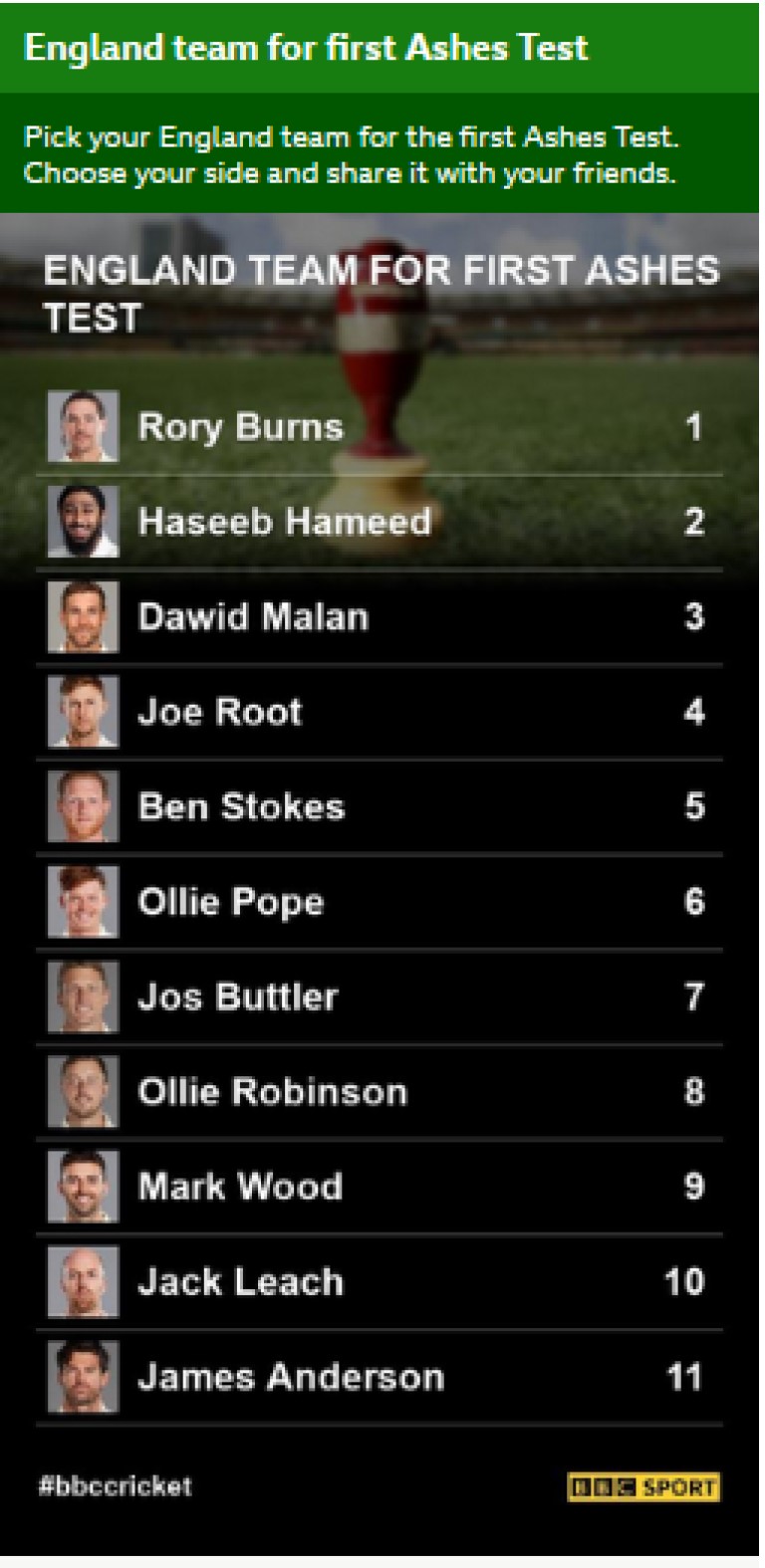
England welcome Ben Stokes back into the fold after a layoff for mental health reasons. Sensibly Pope, a massive talent and one seemingly well suited to Aussie pitches has been preferred for the number six slot to the perennially underachieving at test level Jonathan Bairstow (a magnificent ODI opener and a fine T20I number four, the two international roles he should now make his sole focus). The basic question left is between Woakes (for extra batting depth and arguably bowling variety), Broad (for maximum bowling firepower) and Leach (there is some talk of going without the spinner, but with Stokes back there is no excuse – three front line pacers plus Stokes as back up is plenty in that department). My own final 11 would be: Burns, Hameed, Malan, *Root, Stokes, Pope, +Buttler, Robinson, Wood, Broad, Leach but I would not unduly quarrel with Woakes being picked ahead of Broad.

AUSTRALIA

Cynics would say that the loss of Tim Paine probably leaves Australia better equipped both batting and keeping wise than they were with him in post (Alex Carey makes his test debut as keeper-batter). Pat Cummins, who was Paine’s vice captain takes over the captaincy for this series (it is not common for a specialist fast bowler to be given this role – the last for England was Bob Willis who held the reins from 1982 to early 1984, and the only one ever to perform the role for Australia was Ray Lindwall in the 1950s – he stepped in on the field due to an injury). Mysteriously, Steve Smith, who could surely never be trusted with the captaincy again, has been appointed vice captain. Australia have a tried and not very trusted at no5 in Travis Head, a newbie at no six in Cameron Green and a debutant keeper in Carey. They have an experienced pace trio of Cummins, Hazlewood and the express paced but sometimes erratic Starc, and the second best test off spinner currently playing the game (sorry Nathan Lyon, Ashwin is definitely ahead of you). Their batting has three proven stars in Warner, Labuschagne and Smith.

PROSPECTS

While neither could be described as top class both of England’s openers, Burns and Hameed, have demonstrated an ability to bat time in test matches, and they provably gel well as a pair – three test century opening stands together already. Malan at number three is frankly a backward looking selection, but he may perform well. Obviously the skipper, batting in his regular number four slot, will be crucial to England’s chances, and at least the Burns/Hameed combo should insure that he is not too often coming in with the ball still new and shiny. It is a huge relief to have Stokes back in action, and a good series for him could well swing things England’s way. This is the series for Pope, who enjoys the type of pitches that Australia usually provides, to establish himself beyond question in England’s middle order, and I am expecting big things from him. Buttler has a respectable test batting record, and though he is not the equal of Foakes as a keeper I can understand why England have opted for him. The bowling, even with Anderson rested due to a minor calf issue, looks impressive. Robinson has been a revelation since his elevation to the test match ranks, Wood is quick and performs well away from home, Leach pays less than 30 per wicket and takes only just short of four wickets per game in his career to date and could well be crucial in this series, Broad has previously had success at the Gabba, and Woakes if picked will probably perform well.

Australia are in some turmoil, with four of their top seven genuinely questionable, though their bowling unit is its usual formidable self. Also Cummins is new to captaincy and there are at least two major ways a bowling captain can err – they can bowl themselves into the ground in an effort to lead by example, and they can go the other way and not give themselves enough overs. Also captaincy can have an adverse effect on form – Ian Botham took 7-48 in his last bowling innings before becoming England captain and 6-95 in his first after resigning the role, but never managed a five-for as captain.

A further factor in the equation is that due to their quarantine policy Perth (where England have only ever won one match, under Brearley in 1978) is off the roster, and if the weather forecasts are correct the opener at the Gabba is highly likely to be drawn.

Thus, even though it is half a century since an England team regained The Ashes down under (three retentions in that period, in 1978-9, 1986-7 and 2010-11), I really believe that England have a genuine chance. Australia will start as favourites and rightly so, but if England get everything right the upset is a definite possibility.

PHOTOGRAPHS

My usual sign off…