A Match of Many Twists and Turns

An account of the second half of a thoroughly absorbing test match between India and England at Ranchi, and a photo gallery.

This post deals with the second half of an extraordinary test match between India and England, the fourth of the series currently taking place between the two teams. I covered the first two days here, so the body of this post picks up the action on day three (yesterday).

Play resumed with India 219-7, 134 adrift. England’s first task was to take the last three Indian wickets as quickly as possible. Unfortunately they were baulked in contrasting styles by wicket keeper Dhruv Jurel who played a superb innings and left arm wrist spinner Kuldeep Yadav who resisted stoutly, comfortably completing a ‘Den-tury’ – 100 balls survived in an innings (look up the career of Joe Denly for the origin of this term). When Yadav was finally dislodged for a 131 ball 28 debutant Akash Deep continued the resistance, surviving a further 29 balls. Mohammed Siraj really is a genuine number 11, and it was in the Jurel who was last out, bowled by Tom Hartley for a splendid and spirited 90 off 149 balls. India has thus reached 307, a deficit of a mere 46. Shoaib Bashir recorded figures of 5-119 from 44 overs, becoming the fourth England bowler to take their maiden first class five-for in a test match. Christopher Heseltine (Hampshire, right arm fast) did so in 1896 in South Africa, in a series whose claim to test match status is decidedly dubious – visiting South African teams were not given test matches in England until 1907, while the other two members of this club are both part of the current England set up, and both principally batters – Joe Root who took 5-8 at Ahmedabad last time England were in India and Will Jacks who took a six-for in Pakistan.

Things still look good for England with an advantage of 46 and India having to bat last, but their second innings soon started going pear shaped. Crawley and Bairstow threatened a revival, and at 110-3 England looked comfortable. However Crawley fell for a fine 60, and then Stokes suffered his second failure of the match, and for the second time in the match England went into an interval, tea in this case, having just lost their skipper, and five down for not a huge amount. Soon after the interval a loose stroke spelt the end of Bairstow and it was 120-6. Hartley failed again with the bat, and Robinson was unable to repeat his first innings efforts. Foakes resisted gamely and did his best to shepherd the tail, but eventually he attempted to play one from Ashwin through midwicket and got a leading edge straight back to the bowler. Anderson lasted three balls, the last of which he nicked to the keeper, and England were all out for 145, leaving India 192 to get.

Stokes now opted to give the new ball to Root and Hartley. There was merit in the idea of giving a spinner the new ball, especially given that Robinson had been decidedly underwhelming with the ball, but James Anderson should have bowled at one end for the mini-session India faced at the end of this third day – this would have given England a measure of control, whereas in the event India were 40-0 off eight overs by the close, needing 152 more for victory.

India advanced their score to 84 before a splendid catch by Anderson off Root accounted for Yashavsi Jaiswal, leaving the new India opener needing to tally 120 or more in the fifth match of the series to break a record that has stood to Sunil Gavaskar’s credit since 1970 for the most runs in a series by an Indian opener.

15 runs later Foakes achieved a double dismissal of Rohit Sharma – it was initially recorded as stumped, but replays showed that there had been an edge, and it now appears as caught Foakes bowled Hartley 55. One run later Rajat Patidar was on his way back for a five ball duck, courtesy of a good catch by Pope off Bashir, and I suspect that unless he intends to watch the match Patidar will not be in Dharamsala for the final match of the series. Ravindra Jadeja never looked comfortable, and with 120 on the board, and himself on 4 off 32 balls he hit a full toss from Bashir straight to Bairstow to end a tortured stay at the crease. The very next ball Sarfaraz Khan was snapped up Pope to make it 120-5, and Bashir had three wickets and was on a hat trick. At that point Jurel joined Gill, and these two players steered India home. Gill completed a 50, while Jurel was unbeaten on 39, and appropriately enough the winning runs came from his bat – he was deservedly named as Player of the Match, having kept very well in tricky conditions and scored 129 in the match for once out. India have an unassailable 3-1 lead in the series, but England have had moments in all four matches when things looked like going their way, and given the loss of Leach, the inexperience of the remaining spinners and the fact that no visiting side have laid a glove on India in the last decade this is very far from a humiliation. Bashir and Hartley, especially the former, look very promising for the future. Robinson, who finished the match off the field nursing a back problem, must be in jeopardy – when the force is with him he is a very good bowler indeed, but in this match he was consistently 10kph below his best pace, and given his previous injuries and fitness issues I think England have to say that enough is enough. Matthew Potts of Durham, Josh Tongue of Worcestershire and Gus Atkinson of Surrey are all fine bowlers, Tom Lawes of Surrey may be on the radar, and there are probably other younger seamers who could do a job for England as well. James Anderson’s bowling and fielding leads one to wonder whether he has a portrait hidden away somewhere that is ageing in his place!

This match was a thoroughly absorbing contest which commanded attention right to the end. Though it does scant justice to the events of the last four days a full scorecard can be viewed here.

I end with my usual sign off…

England Going Well In Ranchi

A look back at the first two days of the fourth test match of the India v England series and a substantial photo gallery.

The fourth match of the five match test series between India and England got underway in Ranchi at 4AM Friday morning UK time. This post looks at the action from the first two days of play.

India had gone one up in the series following a thumping victory in the third match of the series (I was unable due to my internet situation to follow that match). England were forced to make one change to their line up, Rehan Ahmed having flown home for personal reasons. This meant a recall for Shoaib Bashir. Mark Wood was rested, with Ollie Robinson taking his place in the XI, and the England selectors failed to take the opportunity to drop Bairstow who has a had a horrible series, meaning that Dan Lawrence is still yet to feature. India made only one change, resting Jasprit Bumrah in the name of workload management, and handing a debut cap to Akash Deep in his place. I would have thought it would be better to keep him in the side for this match, aiming to settle the series early and then rest him. England won the toss, and chose to bat (choosing to bowl first on that surface and with Ranchi’s history would have made Nasser Hussain’s Brisbane 2002 howler of a decision look positively Solomonic).

England reached 47 without undue difficulty, at which point Zak Crawley got himself out. Shortly after this it was 57-3, with Pope gone for a duck and Duckett also back in the pavilion. Bairstow scored rapidly but never suggested permanence, and sure enough, just before lunch he essayed one outrageous stroke too many and was on his way back to the pavilion. The interval came early when Stokes got a horrible ball from Jadeja, which shot through virtually at ground level, and hit the bottom of his pad so obviously plumb in front that the England skipper was setting off for the pavilion before the umpire’s finger was fully raised. Thus England were looking decidedly shaky with score 112-5.

However, Joe Root and Ben Foakes batted through the afternoon session together, and England took tea feeling somewhat happier at 198-5.

Post tea England continued to prosper. Foakes after initially being very slow hammered two sixes and a four in quick succession to move to 47, but then he holed out to end a partnership that had over doubled England’s score. When Hartley fell it was 245-7, and things were still very much in the balance, but Ollie Robinson batted sensibly, while Root continued on imperturbably to reach a superb century, his 31st in all test cricket, a record 10th against India and also a record third against India in India. England reached 300 just before the close, and by the end of the day were far the happier side, finishing on 302-7.

England continued their revival, with Ollie Robinson completing an invaluable maiden test fifty, and Root finally ending on 122 not out, with England all out for 353. James Anderson soon had test wicket number 697, that of Rohit Sharma to a catch by Foakes. Jaiswal batted beautifully, but Gill became Shoaib Bashir’s first victim for 38, and Patidar and Jadeja were both out cheaply. At 161 Jaiswal’s innings came to an end for 73, bowled by the impressive Bashir. Jaiswal had become only the second ever Indian opener to score over 600 runs in a series, though he has a bit to do to overhaul Gavaskar’s 774 against the West Indies in 1970. Sarfaraz Khan, hugely talented (he averages 70 in first class cricket) but also inexperienced, struggled, and at 171 a fine catch by Root off Hartley ended his innings with his score on 14. Ashwin, who had done little to distinguish himself in this match either with the ball or in the field, mustered a single before Hartley trapped him LBW. Kuldeep Yadav provided one of India’s few bright spots of the day by batting through to the close in the company of Dhruv Jurel who ended the day 30* in a score of 219-7. India need this pair to continue their good work tomorrow – if England end with a big first innings lead the match will be as good as settled. Shoaib Bashir produced an exemplary spell of bowling, 32-4-84-4, keeping it tight and taking wickets. Anderson was Anderson, Hartley had his moments but also bowled quite a few loose balls, and Ollie Robinson was accurate, but lacking in pace (he was not even hitting 80mph). Ben Stokes did some bowling warm ups in the innings break, but did not put himself on, while with Bashir bowling so well Root was not called on save for one over near the end of the day. At the moment a 2-2 scoreline going to Dharamsala for the final match seems likely. England deserve great credit for the character they have shown to come back from the humiliation of the previous match and their decidedly unimpressive start to this match. I would say that after the first session on day one was indisputably India’s session England have had the better of all other five we have had so far, notwithstanding the late defiance of Jurel and Yadav.

My usual sign off…

India Level the Series

A look back at the last two days of the second test match of the five match series between India and England and some thoughts about the composition of the England XI. Also a photo gallery.

After many twists and turns India won the second test of the five match India v England series at Vizag when Jasprit Bumrah clean bowled Tom Hartley for 36, making England 292 all out, and India victors by 106 runs. This post looks back at the last couple of days.

India started day three of a possible five 28-0 in their second innings, 171 runs ahead with all their wickets intact. Shubman Gill enjoyed a charmed life, surviving one LBW due to an edge that was as much news to him as it was to the rest of us and another on umpire’s call when not quite enough of the ball was deemed to be hitting the top of middle stump. He made the most of this, going on to a century which was instrumental in India getting to 255, a score that meant England would need the highest total of the match batting last to win. Their target of 399 was also over 100 more than any visiting side had ever scored in a fourth innings in India, though four previous tests elsewhere have been won after higher run chases, and in the 99th and last ‘timeless test’ at Durban in 1939 England scored 654-5 before weather and the arrangements for their journey home led to the match being abandoned as a draw with England 42 runs short of the target. However England under Stokes have produced so many surprises that no one was consigning them to defeat just yet.

England lost Duckett just before the close of day three, and Rehan Ahmed was sent in at number three (Pope is a nervous starter, so it makes sense to protect him from having to do so twice over, and Ahmed is good enough with the bat that the possibility of a major innings from him could not be entirely discounted). England closed on 67-1, needing 332 more to win.

The fourth morning (this morning) started with news that James Anderson had said England were in a very good position and that Shubman Gill had assessed India 70-30 favourites, an assessment that in itself spoke volumes for the approach of this England team compared to the last one to visit India in 2021, and the extent to which they have ripped up conventional test standards.

Ahmed was the second to fall, contributing 23 before he did so. Pope exactly matched this score, and his dismissal brough Root to the crease. Root played a frenetic, almost frantic, innings, wildly at variance with the methods that have brought him over 11,000 test runs at an average of 50, and was out for 16 off 10 balls. Crawley, who had batted impressively, then fell to a controversial LBW, which was sent upstairs. At the point the ball hit Crawley’s pad two stumps were exposed and part of the third was visible, which raised questions over whether the impact was truly in line with the stumps. However, the technology ruled that it was out, and England were 194-5. With the score still at 194 Bairstow was pinned by a beauty from Bumrah, LBW for 26. Stokes and Foakes played well for a while, until Foakes edged one behind the wicket but on the floor, Stokes judged that a run was on and was beaten by Shreyas Iyer’s direct hit throw to make it 220-7, this being Iyer’s most significant contribution to the match. Foakes and Tom Hartley then crafted a solid partnership for the eighth wicket, which ended when Foakes gave Bumrah a return catch. That was 275-8. Two landmarks were possible at this stage, Ashwin’s 500th test wicket and a 10-wicket match haul for Bumrah. However Bashir edged one from Mukesh Kumar through to keeper Bharat to make it 281-9 (this was Kumar’s only wicket of what was in truth a wretched match for him) and rule out Bumrah’s 10 wicket match haul. Bumrah then produced a superb delivery to get through Tom Hartley’s defences and end the match. That gave him nine wickets in the match (6-45 and 3-46), and 155 career test wickets at 20.19. Bumrah was named Player of the Match, his marvellous bowling being deemed even more crucial to India’s success than Jaiswal’s double century. I agree with this assessment, though I would have been inclined to give a shared award to both players. England though comfortably beaten in the end were in no way disgraced, though there were too many 20s and 30s in that fourth innings effort, and only Crawley’s 73 as a score of real substance. I think that the ‘three spinners and one seamer’ approach England have taken thus far needs changing – with Leach injured the remaining spinners are all very inexperienced and none are capable at the moment of providing control. I believe that England’s 8,9,10,11 for the third match of this series should read: R Ahmed, T Hartley, OE Robinson, JM Anderson, and if England want to increase the back up spin options available to them in the XI they can drop Bairstow, who has not been impressive this series, and select Dan Lawrence in his place, giving them two part time spin options (Root being the other).

Brilliant Bumrah Blitzes England

An account of day two of India v England at Vizag, dominated, as the day’s play itself was by the brilliance of Jasprit Bumrah. Also my customary photo gallery.

Today was day two of the second test match of the five match series between India and England. This match is taking place at Vizag. I covered day one here.

Although it was a mere prologue to the main event of the day the end of the Indian innings was not devoid of significance. England appeared to have done reasonably well to keep India below 400, with the tenth wicket going at 396. Yashavsi Jaiswal who had dominated day one resumed on 179 not out. He completed his double century, but facing the risk of being stranded got out for 209, meaning that the highest score by an Indian opener against England remains the 221 that Sunil Gavaskar scored at the Oval in 1979. Anderson claimed his second and third wickets of the innings, and kept his economy rate below two an over, while young spinners (their combined age is less than that of Mr Anderson) Rehan Ahmed and Shoaib Bashir also finished the innings with three wicket hauls.

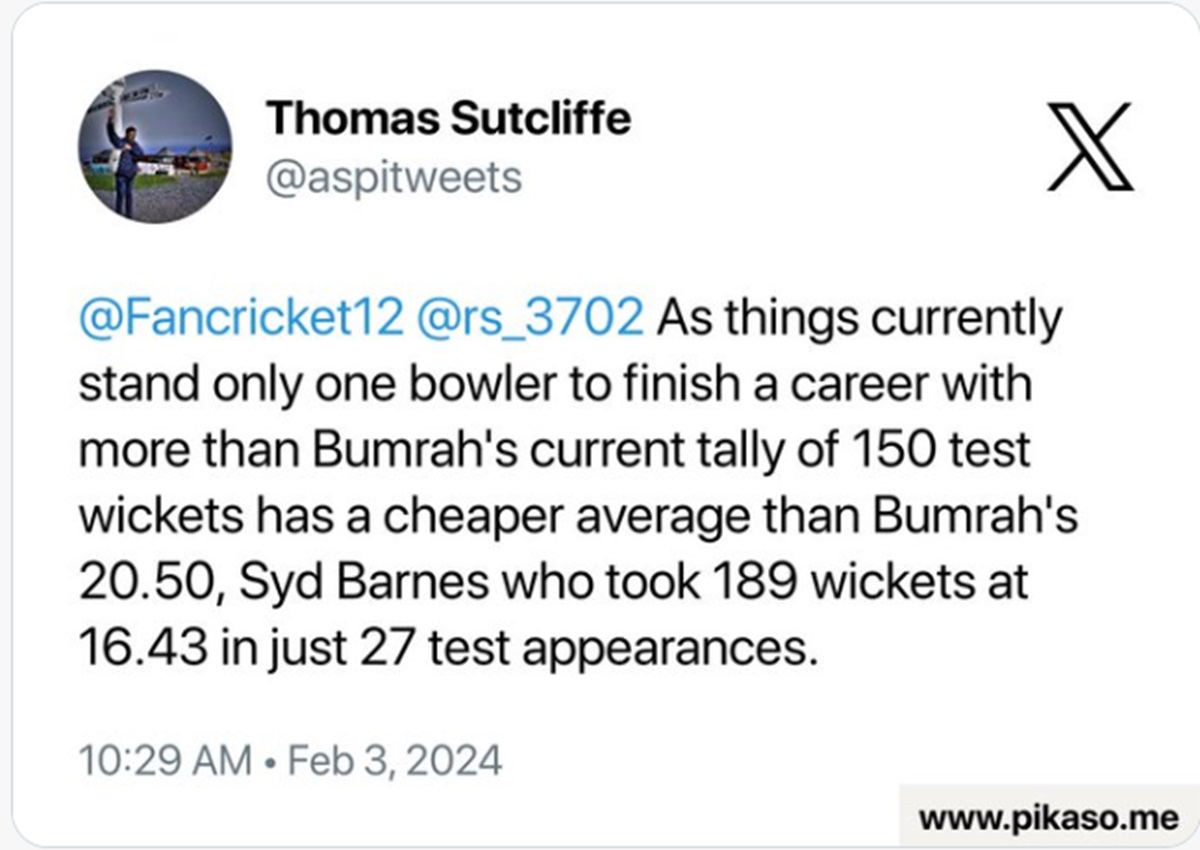
England began brightly, with Zak Crawley playing well. Mukesh Kumar did not at any stage resemble a genuine test match new ball bowler. Axar Patel, R Ashwin and left arm wrist spinner Kuldeep Yadav all took turns at the bowling crease. At high water mark England were 114-1, but then Crawley fell to catch by Iyer of Axar Patel. Bumrah was then called back into the attack to deal with Joe Root. Nine runs later Bumrah found the edge of Root’s bat, Gill took the catch and it was 123-3. Then Pope, who was just beginning to look settled after a typically nervous start had two of his stumps uprooted by an absolutely unplayable ball from Bumrah to make it 136-4. Bairstow and Stokes resisted for a time, but the unstoppable Bumrah found one to take the edge of Bairstow’s bat for another catch to Gill to make it 159-5. Kuldeep Yadav got Foakes with a good ball and Ahmed courtesy of a loose stroke which gave Gill his third catch of the innings and England were 182-7. Tom Hartley now joined Ben Stokes, and Stokes threatened to wrest the initiative back for England. However, with Stokes on the verge of a half century a superb delivery from Bumrah rattled his stumps to make it 229-8. That was Bumrah’s 150th test wicket, at an average of 20.50 a piece, a fact the significance of which I noted in the tweet reproduced in screenshot form below (follow the link highlighted in blue to note the exact time at which I posted it):

The day got better yet for Bumrah, as he induced Hartley to give Gill a fourth catch of the innings, which brought the debutant Shoaib Bashir in to join Anderson, given a one place promotion from his usual slot presumably on grounds of experience for the last wicket stand. Bumrah finished the innings by pinning Anderson LBW. England had just crept past 250, but a final score of 253 all out gave India a first innings advantage of 143. Bumrah had taken 6-45 from 15.5 overs on a pitch not offering much assistance, a truly great display of test match fast bowling, from one of the great masters of that art. This gives him an overall tally of 152 test wickets at 20.29 each, with Barnes ahead of him on 189 wickets at 16.43, and Alan Davidson the great Australian left armer having taken 186 at 20.53, with West Indians Ambrose, Garner and Marshall all also having finished with over 150 wickets at less than 21 a piece. Barnes and Bumrah were both in my all time Bs XI. I make one change to that XI in retrospect, Benaud being moved from being in the XI to fronting the TV commentary and Bishan Bedi taking his place giving an XI off: C Bannerman, SG Barnes, *DG Bradman, KF Barrington, AR Border, IT Botham, +Wasim Bari, W Bates, SF Barnes, BS Bedi, JJ Bumrah. I first noticed Bumrah when not long discharged from Addenbrooke’s after emergency cancer treatment, when he destroyed Australia in Australia (see here).

There was time for five overs of the Indian second innings, in the course of which they scored 28-0, meaning that they start day three with a lead of 171 and all their second innings wickets intact. Cricket is a game which regularly makes fools of those who make over-dogmatic statements about match situations, and this is never truer than when Stokes’ England are involved in the action, but it is at any rate not contentious to state that India are in a very strong position, especially given the tendency of Vizag pitches to break up as the match progresses (average innings scores there show a very straightforward pattern of declining from first to fourth innings of the match).

My usual sign off…

All Time XIs – Golden Oldies

In view of today’s happenings in Vizag I offer an XI of players whose skills and appetite for the game remained undimmed into their 40s. I also have my usual photo gallery for you.

The second test match of the five match series between India and England began at 4:00 this morning UK time. The pitch at Vizag is a batters paradise, which is why I reckon it is honours even at the end of day one. India are 336-6, with Yashavsi Jaiswal having batted all through the day for 179*. England actually bowled three overs more than the statutory minimum of 90, which is almost as rare as seeing a woodpecker in the environs of King’s Lynn, which also happened today:

Close up of a Green Woodpecker seen while walking along the Gaywood River path this morning.

England’s two young spinners, Rehan Ahmed and debutant Shoaib Bashir (born in Nottinghamshire and Surrey respectively for those who care about such things) each picked up two wickets, and each took a catch of the other’s bowling. Bashir became the 713th player capped by England Men, and one of his team mates in this match is the 613th player capped by England Men, one James Michael Anderson, who is the inspiration for today’s XI, comprising players who had great test match moments when past 40 years of age. Anderson had a fine day on a pitch offering him precious little, being parsimony personified, with 1-30 from 17 overs, meaning that he has now taken at least one test wicket in each of 22 successive calendar years.

  1. Jack Hobbs (England, right handed opening batter). Almost half of his test runs were scored after he had turned 40, and at Melbourne in 1929, at the age of 46, he became test cricket’s oldest ever centurion with an innings of 142.
  2. Warren Bardsley (Australia, left handed opening batter). At Lord’s in 1926, almost 17 years after he had become the first to score twin centuries in a test match, Bardsley, then 43 years old, carried his bat through Australia’s first innings, scoring 193 not out.
  3. Patsy Hendren (England, right handed batter). Like Hobbs a tall scoring batter to the very end of his long career – over 1,000 of his test runs came after turning 40.
  4. Tom Graveney (England, right handed batter). Another in the select ‘1,000 test runs after the age of 40’ club.
  5. *Misbah-ul-Haq (Pakistan, right handed batter, captain). Someone whose prime test years were after he had turned 40.
  6. Basil D’Oliveira (England, right handed batter, right arm medium pacer). Based on his test record a batter who bowled rather than a genuine all rounder, though that might very well have been different had he been able to play for his native land starting in his mid 20s rather than for another country starting officially in his mid 30s.
  7. +Bob Taylor (England, wicket keeper, right handed batter). The only candidate for this slot.
  8. Clarrie Grimmett (Australia, leg spinner, right handed batter). His career did not begin in earnest until his mid 30s, and his test career only ended when at 46 years of age he was left out of the squad for the 1938 Ashes in England. By then he had taken 216 wickets in 37 tests.
  9. Sydney Barnes (England, right arm fast medium bowler, right handed batter). His last series, played at the age of 41, saw him claim 49 wickets in four matches before an argument of terms and conditions saw him miss the fifth and final match of the series. Those 49 wickets were just over a quarter of his career tally of 189, taken in just 27 matches.
  10. James Anderson (England, right arm fast medium bowler, left handed batter). Incredible longevity at the top for a 21st century cricketer, and his performance today suggests that the skills are very much still there. He has been known to bowl left arm spinners in the nets, though as far as I am aware has not yet deployed this method in a match. The oldest ever test cricketer, Wilfred Rhodes, who played his last match at the age of 52 years 165 days bowled left arm spin.
  11. Bert Ironmonger (Australia, left arm orthodox spinner, left handed batter). He made his debut at the age of 46, played 14 tests over the course of five years, and took 74 wickets at 17.97 in those matches. Thus in spite of being the ultimate in one-dimensional players – a clumsy fielder, and possessor of a test batting average of 2.62, he was nailed on for selection in this XI.

This side features a strong top six, a keeper whose batting was better than it is often given credit for being, and four great bowlers. Going by D’Oliveira’s actual record rather than dealing in ‘what might have been’ it is very much six batters, a keeper and four bowlers, rather than five batters, an all rounder, a keeper and four bowlers. However, the two most dominant men’s test cricket forces of my life time, the West Indies under Lloyd and Richards, and their successors at the top of the test tree, the Australians under Mark Taylor and Steve Waugh, both relied on six batters, a keeper and four bowlers, so it clearly can work provided that the personnel involved are good enough at their jobs, and I believe that this team ticks that box.

Among the batters to merit serious consideration were Bobby Simpson of Australia, Eric Rowan of South Africa and Herby Taylor of South Africa. The only other keeper to do well at the very highest level when past 4o was Bert Strudwick of England, and he was a genuine tailender with the bat, which would have made things very dicey indeed batting wise. Freddie Brown, who captained England in Australia at the age of 40 and had a respectable series would have had the number six slot had I been desperate to tick the all rounder box, but I felt in view the people at 8-11 that D’Oliveira, the batter who bowled, was a better fit for the XI.. Few genuine quicks have kept their pace into their 40s, and although his presence at number eight would have strengthened the batting I did not feel that Gubby Allen (England), one of that select company, was good enough to dislodge any of my chosen bowlers.

My usual sign off…

Declarations

A look at declarations in the light of recent events in Brisbane, and a large photo gallery.

Declarations have been in the cricket news again lately after one by Australian captain Pat Cummins didn’t work out for him. In this post I look at that declaration and some stories from cricket history involving declarations or their equivalent.

West Indies had fought back from a poor start to record a first innings score of 311, Australia then had an even worse start to their first innings, being 24-4 at one point. They also fought back hard, and reached 289-9, at which point Cummins declared, opting to look for early wickets under the lights. While declaring when still in deficit is unusual there were justifications for taking this approach. Australia were unbeaten in day/night tests, largely because they as a whole, and Mitchell Starc in particular bowl so well under the lights, so it was natural for Cummins to want to play a potential trump card. Unfortunately for Cummins Australia managed only one wicket in the mini-session under the lights that he engineered for them, and West Indies ended up winning the match by eight runs.

Declarations were only allowed in the late 19th century, and two matches from the tail end of the period in which declarations were not permitted help to illustrate why.

When Surrey played Nottinghamshire in 1889 they were going well in their second innings – so well in fact that they were in danger of not having enough time left to dismiss Nottinghamshire a second time. Surrey captain John Shuter instructed his side to get themselves out quickly, and they did so. Surrey then bowled Nottinghamshire out cheaply. In 1893 England were playing Australia in a rain affected match, and England were batting with a small lead at the end of day’s play. England captain WG Grace inspected the pitch the following morning and getting back to the pavilion he told his team mates “I need you to get out quickly – we need to be bowling by 12:30 at the latest”. Grace was not the sort of skipper anyone would dare ignore, and England duly lost their remaining wickets in 20 minutes of play. Australia then collapsed on a pitch that was every bit as spiteful as WG had reckoned it would be and England won the match.

England were 2-0 up in an away Ashes series after two matches, and all seemed to going well when they got Australia out for 200 in the first innings of the third match. Then the rain came, turning the pitch into a vicious sticky. England limped to 76-9 before skipper Allen declared to get Australia back in again while the pitch was still misbehaving. Bradman countered by sending tailenders O’Reilly and Fleetwood-Smith in to play and miss until the close, and when O’Reilly was out before the close he sent in another tail ender, Frank Ward. All of this meant that by the time Bradman, normally number three, joined Fingleton, a regular opener, the score was 97-5, and the pitch was easing. Bradman and Fingleton put on 346 together for the sixth wicket, Bradman going on to record score for anyone batting at number seven in a test match of 270, and England were beaten by a massive margin.

The England squad for the 1950-1 Ashes arrived in Australia not expected to do much, with both batting and bowling looking questionable and the skipper Freddie Brown known to have been the third choice for that role. In the first match at Brisbane they rose magnificently to the occasion in the first innings and dismissed the Australians for 228 on a plumb pitch. Unfortunately for them it then rained, with the usual effect on uncovered pitches. At 68-7 Brown declared to get Australia in while the pitch was at its worst. Australia were 32-7, and in danger of being all out for a new all time test low, beating the 36 they had been rolled for at Edgbaston in 1902, when Hassett declared to get England back in that night. England held back Hutton for the following day, but unfortunately they did not make a great fist of surviving that evening being 30-6 by the close. The worst of many poor dismissals among those six was that of Arthur McIntyre, reserve keeper but playing that match as a batter, who was run out coming back for a fourth run. Hutton played a superb innings the following day, but England came up short.

Surrey were going a third successive title near the end of the 1954 season when they played Worcestershire. Worcestershire were all out for 27 batting first. With Surrey 92-3 Stuart Surridge decided he wanted another go at Worcestershire that evening and declared. Laker and Lock each claimed a wicket by the end of day one, and on the second morning Worcestershire were all out for 40, and won by an innings and 25 runs, which ensured that they would retain the championship.

A few months before England toured Pakistan in late 2022 Australia had visited, and when they played at Rawalpindi they had a full bowling attack, rated among the best in the world, and took precisely four Pakistan wickets in the match. Thus, England were already well in credit by tea on day four, having dismissed Pakistan in their first innings and built an advantage of 347. At that point Ben Stokes opted to declare, a declaration that many rushed to condemn. I had not been expecting the move, but did not rush to judgement on it. Having been following the match the whole way through I knew that both evening sessions would be abbreviated due to lack of daylight, so it was not quite as generous in practice as it was in theory. England secured the victory with time for probably nine more balls, and at most 15, before the light closed in on the final day (the final wicket went to the third ball of an over, and there were nine minutes left before the time at which the light had been judged unplayable the previous day).

New on my blog:

England Go 1-0 Up In India

An account of an amazing finish in Hyderabad and a mention of another in Brisbane.

This morning saw two superb test match finishes. I was following the India v England match on Talk Sport2, while over on Five Live Sports Extra TMS were covering Australia v West Indies. A West Indies side who lacked most of their best known names and had been written off in brutal terms in the run up to the series, and who were 0-1 down in a two match series (this latter is an abomination that should never occur) managed to overcome Australia, winning by a slender eight runs. The body of this post is devoted the action I was listening to, in Hyderabad.

England resumed 126 runs ahead of India with four second innings wickets standing (see here for an account of days 1-3). Rehan Ahmed and Tom Hartley both provided good support to Ollie Pope, while the Surrey man headed towards a double hundred. At 173 he established a new record for a visiting number three batter in a second innings in India, beating the 172 scored by Ken Barrington at Kanpur in 1961. At 177 he passed Alastair Cook’s record for the highest second innings score in India by any English batter. The loss of Hartley and Wood in quick succession, which brought a limping Leach to the crease (the left arm spinner has a knee injury, though he managed to both bat and bowl today) derailed Pope’s advance on the 200 mark, and in the new circumstances he essayed a somewhat desperate reverse sweep and was out for 196. Given the circumstances (India, pitch showing signs of misbehaviour – the ball that got Rehan Ahmed went through very low indeed, England under the gun for much of his innings) this was as good a test knock as has been played by an English batter in my lifetime. England had reached 420, setting India 231 to win the match. Lunch was taken at the end of the England innings. Few Indian bowlers had cause to enquire to closely as to their figures, but the shining exception was Jasprit Bumrah, who somehow conjured up figures of 4-41. Bumrah now has 146 test wickets at 20.85, which means that of bowlers who have finished with more wickets than him precisely two, Sydney Francis Barnes of England, 189 at 16.43 each and Alan Keith Davidson of Australia with 186 at 20.53 each have better averages than the Indian pace ace.

Rohit Sharma began well for India, while Tom Hartley, perhaps heartened by having batted so well, was a different bowler from the guy who took only just more than 20 overs to concede 100 in the first innings. Hartley got Jaiswal, who had given him a lot of stick in the first innings, and also got Shubman Gill cheaply. Gill has talent to burn, but the hard facts are that after a decent number of tests he now averages below 30 at that level, which is not the stuff of which number threes are made. At 63 Hartley made his most important intervention to date, pinning Sharma LBW for 39 (the Indian skipper sent it upstairs, but it couldn’t have been much plumber than it actually was). Axar Patel was promoted to number five in the hope that the presence of a left hander would disrupt Hartley. He batted reasonably until with 17 to his name he pushed one straight back to Hartley and it was 95-4. At 107 KL Rahul fell LBW to Leach. At 119 came a double blow which virtually settled the issue, Jadeja being run out by Stokes’ direct hit throw and then Shreyas Iyer being caught by Root off Leach. That left India needing 112, with keeper Bharat, off spinning all rounder Ashwin and the two rank tail enders Bumrah and Siraj to score them. Bharat and Ashwin threatened for a while, scoring 57 together before Hartley got one through Bharat;s defences for his fifth wicket of the innings. One run later a smart stumping by Foakes off Hartley sent Ashwin on his way, leaving the two specialist bowlers to attempt to score 54 more for victory. Virtually every ball, especially those faced by Siraj, looked capable of yielding the final wicket, but the end was prolonged deep into the extra eight overs, claimed by England to finish things today, as fortune favoured the batters for a time. Eventually Siraj charged down the pitch against Hartley and missed his shot giving Foakes the easiest of stumping chances, which the keeper made look every bit as easy as it was. India were all out for 202 giving England victory by 28 runs. Hartley, so awful in the first innings, had redeemed himself with 7-62 second time round. Pope, who had taken a couple of catches early in the Indian innings to go with his magnificent 196 was deservedly named Player of the Match. Without his innings there would have been nothing for England to defend. India had cause to rue the cavalier way in which they batted in the first innings – they could and should have scored well over 500 against the England bowling of that innings, and that would have prevented any chance of them facing a target in the face of which they could collapse.

Here are links to full scorecards of this match and AUS v WI.

My usual sign off…

Game on in Hyderabad

A look at the action in the first three days of the test match between India and England in Hyderabad and a photo gallery.

India and England are currently locked in battle at Hyderabad, and after three days of play there is just a chance of decent finish. This post looks at the action so far.

There were huge question marks over England’s selections. James Anderson was overlooked and three front line spinners were named – Rehan Ahmed, Jack Leach and Tom Hartley. Ahmed is 19 years old and hugely promising, Leach is England’s best current front line spinner (alas, not the highest of bars), while Hartley was quite frankly a joke of a selection – Lancashire’s decision to sign Nathan Lyon as overseas player for the upcoming season tells you what they think of him as a red ball cricketer. With Brook having withdrawn from the series for personal reasons even England could find no excuse for not playing Ben Foakes, so at least the gauntlets were in good hands.

England won the toss and batted. 70 from Ben Stokes got them to 246, which didn’t look too bad. However India got off to an absolute flier in reply, helped by Tom Hartley bowling some utter rubbish – he was at that point going at seven an over on a turner. Only the experienced Leach, with 1-24 from nine overs was anywhere near test standard with the ball, and India were 119-1 overnight.

India moved into seemingly complete control, even though their batting was far from flawless – virtually every wicket they lost was down to bat batting rather than good bowling, three players reached 80, and two of those three got themselves out in the 80s, while the third, Jadeja, was unbeaten at the close. The day ended with Axar Patel scoring 14 off the last three balls, bowled by Hartley, who in spite of being donated two test wickets never looked remotely like the real deal. India were 421-7 and ahead by 175.

I missed the first session due to not understanding the workings of my phone’s alarm system – it has different settings for week days and weekends. England took the last three Indian wickets quickly, restricting the deficit to 190. The most damning stat of the innings for England was that with three front line spinners selected Joe Root, very much a batter who bowls, had taken 4-79`. By lunch England were 89-1, with Crawley gone, but Duckett and Pope, who had been very jumpy in the first innings, both going well.

The afternoon session belonged to India, with four wickets going down, but Foakes staunched the flow of wickets and settled into a partnership with Pope. In the evening session Pope and Foakes continued to prosper, their partnership reaching 112, before a freak delivery from Axar Patel, which shot along the deck, accounted for Foakes. Pope had by then completed a century, and Rehan Ahmed proved to be a good partner as well. By the close England were 316-6, with Pope 148* and looking every inch a test match number three. England thus lead by 126. Given the paucity of their bowling, even with the pitch showing signs of genuine mischief they probably need to double their current advantage to really worry India, but the situation is not completely hopeless, as it seemed to be at the end of day two.

My usual sign off…

History in Mumbai

A look back at the events that have unfolded in Mumbai over the last few days, a historic win for India Women in a test match over Australia women. Also a photo gallery.

Four days ago a test match between the Indian and Australian Women’s teams got underway in the city of Mumbai. I was only able to follow developments through cricinfo and some of my twitter and mastodon followers, so this post will be a bit sketchy, but you will see why I could not ignore it. India Women had never beaten Australia Women in a test match going into the game, but they had just won a test against England Women in Mumbai…

The first hint that not all was going to the way of Australia came in the first innings of the match, when they managed only 219, with Pooja Vastrakar taking four wickets, Sneh Rana three and Deepti Sharma two. Vastrakar’s effort was especially significant – both because day one often sets the tone and because seamers should do well early in matches.

India started impressively with the bat, with Smriti Mandhana, Richa Ghosh and Jemimah Rodrigues all making runs, and looked set for a massive lead when they passed 250 with only three wickets down. They then suffered a mid-innings collapse and at273-7 it looked like an opportunity to bury the match had been squandered. However, for the all their positions at numbers eight and nine in the order both Deepti Sharma and Pooja Vastrakar are competent batters, with Sharma being a genuine all rounder in any format save T20, where her relatively slow scoring rate counts against her. This pair reasserted India’s dominance, batting all the way through the final session of the second day and taking India’s lead past 150. India ultimately topped 400, finishing with 406 for a lead of 187. Sharma had the top score of the match with 78, and Vastrakar had set a new record for an Indian number nine in a test match with 47.

Australia, as one would expect of such a strong and determined side fought hard in their second innings, but never really threatened to take the initiative away from India. Perry, McGrath, Healy and Sutherland all provided stiff resistance, but by the close of third day Australia were five down and only 46 to the the good. Had their lower order been able to conjure another 100 on the final day Indian nerves might have been jangling, but in the end they only managed a further 28, to give themselves just 74 to defend. Sneh Rana claimed four wickets with her off spin, and two other spinners, skipper Harmanpreet Kaur and Rajeshwari Gayakwad claimed two scalps a piece, while Vastrakar added another wicket to four first innings scalps. Tahlia McGrath had battled her way to 73.

Shafali Verma was out cheaply to make it 4-1, but Richa Ghosh offered Smriti Mandhana good support, and by the time she was out only a further 20 were needed for victory. Rodrigues joined Mandhana and this pair were still together when India completed an impressive win, Mnadhana 38*, Rodrigues 12*. Sneh Rana’s seven wicket match haul earned her the Player of the Match award, though both Vastrakar (five wickets across the two innings and a vital 47) and Sharma (the highest individual score of the match and two wickets) must have been close, especially the former. All credit to India for winning this one – Australia were unbeaten in the format since 2014 going into this match. A full scorecard can be seen here.

Time for my usual sign off…

A Pulsating End to The #MAshes

A look at the conclusion to an amazing Ashes summer, a mention of a hugely successful auction and a large photo gallery.

The men’s Ashes of 2023 ended on Monday. The first part of this post looks at that final day’s play.

After the close of play on day three of this match Stuart Broad told the world that it would be his last as a competitive cricketer. On the fourth morning he struck the last delivery he received in test cricket for six, on the fifth evening he took a wicket with his last ball as a test cricketer, giving England victory by 49 runs and a 2-2 drawn series, a result which leaves The #MAshes in Australian hands but also means that the visitors will now go longer without an away series win than any other side in the history of The Ashes – it will be 26 years since their last by the time 2027 comes round, beating the 24 years between successful England trips down under in 1986-7 and 2010-11.

Australia had looked decently placed going into the final day – 135-0, needing 249 runs more to win the match. However, both openers went quickly that final morning (Warner just before I got back from delivering Green Party leaflets in South Wootton, Khawaja just after I had tuned in). Australia were still genuinely in the hunt until Woakes, deservedly Player of the Match, England Player of the Series and winner of the Compton-Miller medal, accounted for Steve Smith, which left Carey plus the bowlers to score over 100 between them. Starc and Cummins both fell fairly cheaply, while Murphy for the second time in the match showed himself rather better than a standard number 10, but when Broad got him the writing really was on the wall. Carey was last to go, also to Broad. Moeen Ali’s test career also ended on Monday, and he took a couple of crucial wickets.

The eventual 2-2 series result was just about fair, though Australia were somewhat flattered by it – the rain ruined game at Old Trafford was going meltingly in England’s favour, and you could probably replay the first two matches of the series a thousand times over and not have Australia emerge 2-0 up.

A week ago today James and Sons had the second auction of a double header. Tuesday had featured stamps and postal history, and was a success by any normal reckoning. However, the Wednesday sale, a massive collection of banknotes, was probably the greatest success James and Sons have had in the decade since I started working there. Not only did pretty much every lot find a buyer, on most occasions they went for way more than we had dared to hope. Lot 695, expected to fetch 10-12 went for £75…

Lot 741, estimated at 25-30 went for £140…

Lot 877 was the star of the show, expected to go for 30-40 and instead soaring away for £380…

I used this lot to provide the picture for a press release I sent out yesterday.

Lot 894, expected to fetch 25-30 actually went for £180…

Any image can be viewed at full size by clicking on it.

I continue to seek and find things to photograph while out walking…