A look at Australia’s best test cricketers of 1877-1914 and a large photo gallery.
Having just finished a brief look at England men’s test cricket through the ages I now turn England’s oldest adversaries in international cricket, Australia. I start with the best players of 1877-1914 inclusive.
THE XI IN BATTING ORDER
Warren Bardsley (left handed opening batter). Until Don Bradman came along and blew all such records out of the water he had scored more FC centuries than any other Australian batter and more than half of those centuries were scored on tours of England (compare and contrast a left hander of much more recent vintage in David Warner). At the Oval in 1909 he became the first ever to score a century in each innings of a test match.
Victor Trumper (right handed opening batter). One of cricket’s immortals. In the wet summer of 1902 he scored 2,570 FC runs for the tour including 11 centuries. In the Old Trafford test of that series, where an Australian win by three runs ensured that they kept the Ashes he reached a century before lunch on day one.
*Billy Murdoch (right handed batter, captain). In 1880 at The Oval he won a sovereign from WG Grace by scoring 153* in Australia’s second innings to top the bearded Doctor’s 152 on the opening day of the match. Four years later at the same ground he scored test cricket’s first ever double century, 211.
Clem Hill (left handed batter). Until Hobbs overhauled his tally he held the record for test career runs. He amassed eight test tons in total, including the only century of the only test ever played at Bramall Lane, Sheffield in 1902. He also had a unique sequence of near misses in the 1901-2 series, making 99, 98 and 97 in successive knocks.
Charlie Macartney (right handed batter, left arm orthodox spinner). He had only just begun his rise to the top before WWI, but did enough, including taking his one and only match haul of ten wickets, to claim his spot in the XI.
George Giffen (right handed batter, off spinner). Australia’s first great all rounder. In the 1894-5 Ashes he scored 475 runs and claimed 34 wickets.
+Jack Blackham (wicket keeper, right handed batter). The ‘Prince of Wicket Keepers’, and enough of a batter to have been the first keeper to score two fifties in the same test match. He played in each of the first 17 test matches ever contested, before missing one due a dispute over pay, and then returning and playing on until the 1894-5 Ashes.
Hugh Trumble (off spinner, right handed batter). Good enough in his secondary department to have done the season’s double on the 1899 tour of England and to have been Australia’s highest individual scorer at The Oval in 1902. He took 141 test wickets all against England, including doing the hat trick twice in his career. His 141 wickets against England remained a record for almost eight decades after his retirement, until Dennis Lillee overtook him at Headingley in 1981.
Fred ‘Demon’ Spofforth (right arm medium-fast). A master of changes of pace, he took the first ever test hat trick, and it was his bowling that won the 1882 match at The Oval that led to the creation of the Ashes.
Charlie ‘Terror’ Turner (right arm medium fast). He succeeded Spofforth as leader of Australia’s attack, and reached the milestone of 100 test wickets in just 17 matches.
Ernest Jones (right arm fast). Australia’s first authentic test match quick bowler. He once sent a ball through WG Grace’s beard. Like the later Harold Larwood of England he was a miner before establishing himself as a cricketer.
This side has a powerful top five, an all rounder at six, a keeper who could bat and four formidable front bowlers. The bowling is also very powerful, though it lacks either a left arm seam option or a leg spin option.
HONOURABLE MENTIONS
Charles Bannerman missed out on an opening slot partly because of being right handed – Trumper had to be picked and I felt that left handed Warren Bardsley was a better foil for him than Bannerman. Two other specialist batters who could not be accommodated were Joe Darling and Syd Gregory, the latter playing more test matches than anyone else whose entire career happened before WWI.
I could have got around the leg spin problem by naming Warwick Armstrong as the all rounder, but I felt that Giffen’s case was unanswerable. Monty Noble was the other candidate for the all rounder’s role and would have been a natural for the captaincy had I gone for him. Frank Tarrant never played test cricket, otherwise he would have been a shoo-in (England toyed with the idea of picking him based on his years at Middlesex but felt that such a move would cause problems with the Aussies, who don’t appear to have ever considered picking him).
There were two other keepers of the era of something approaching comparable stature to Blackham, Jim Kelly and Hanson Carter.
The nearest any left arm bowler who actually played for Australia came to claiming a place were Jack Ferris, Turner’s regular new ball partner, and Jack Saunders, but neither quite did enough.
Frank Laver and Albert ‘Tibby’ Cotter were right arm seam/ pace bowlers who came close.
Australia only had one specialist leg spinner of note before WWI, Herbert Hordern, and his career was brief.
PHOTOGRAPHS
My usual sign off…
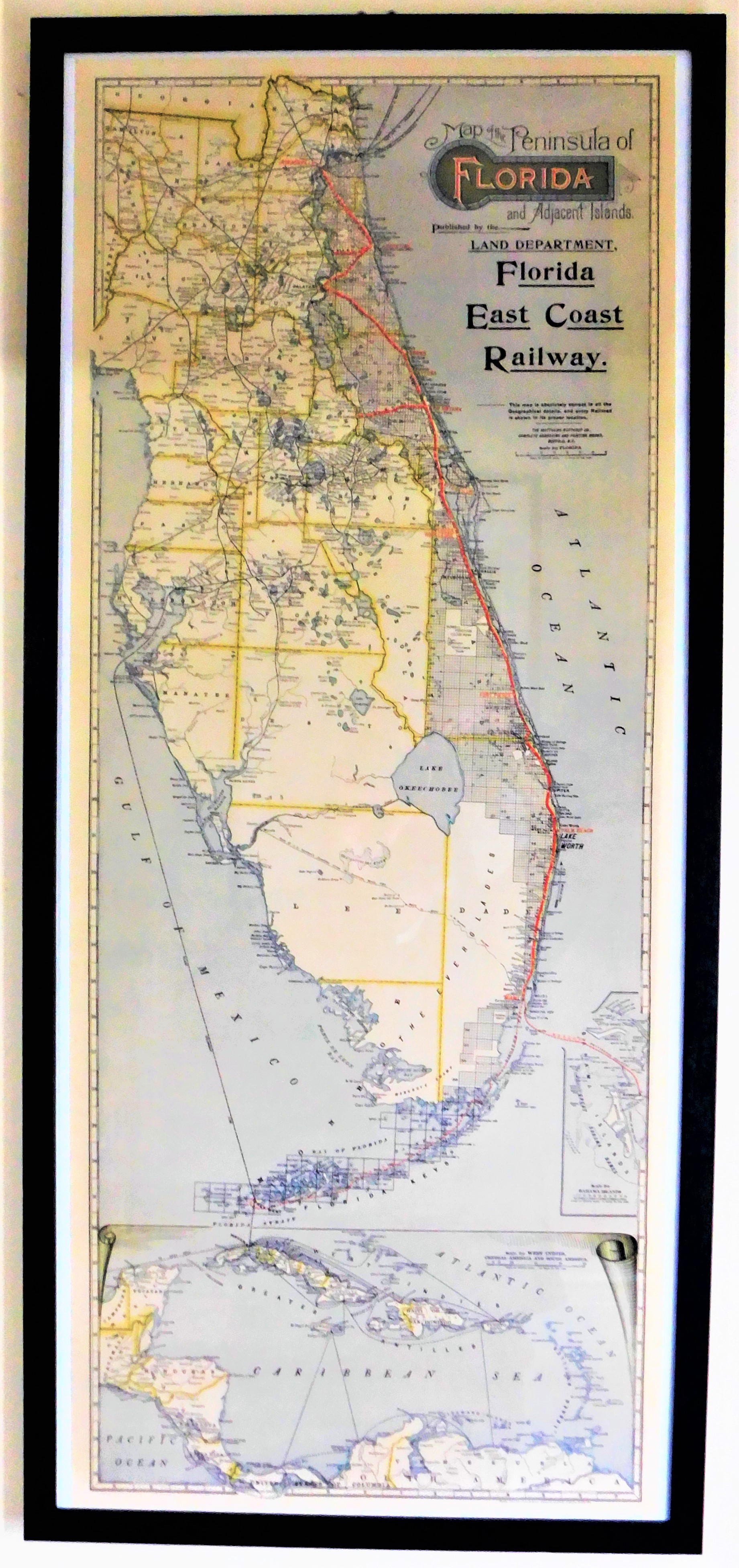
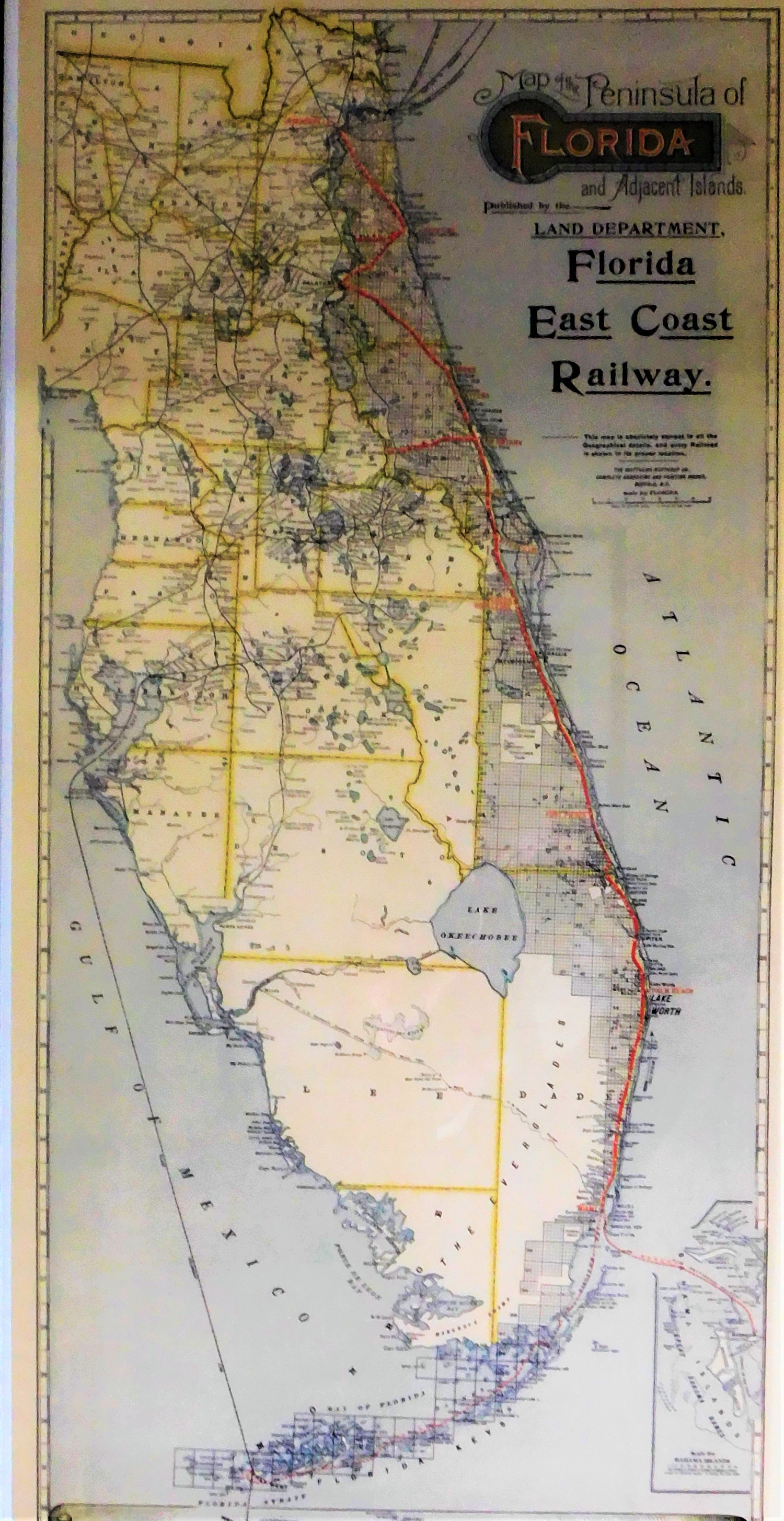
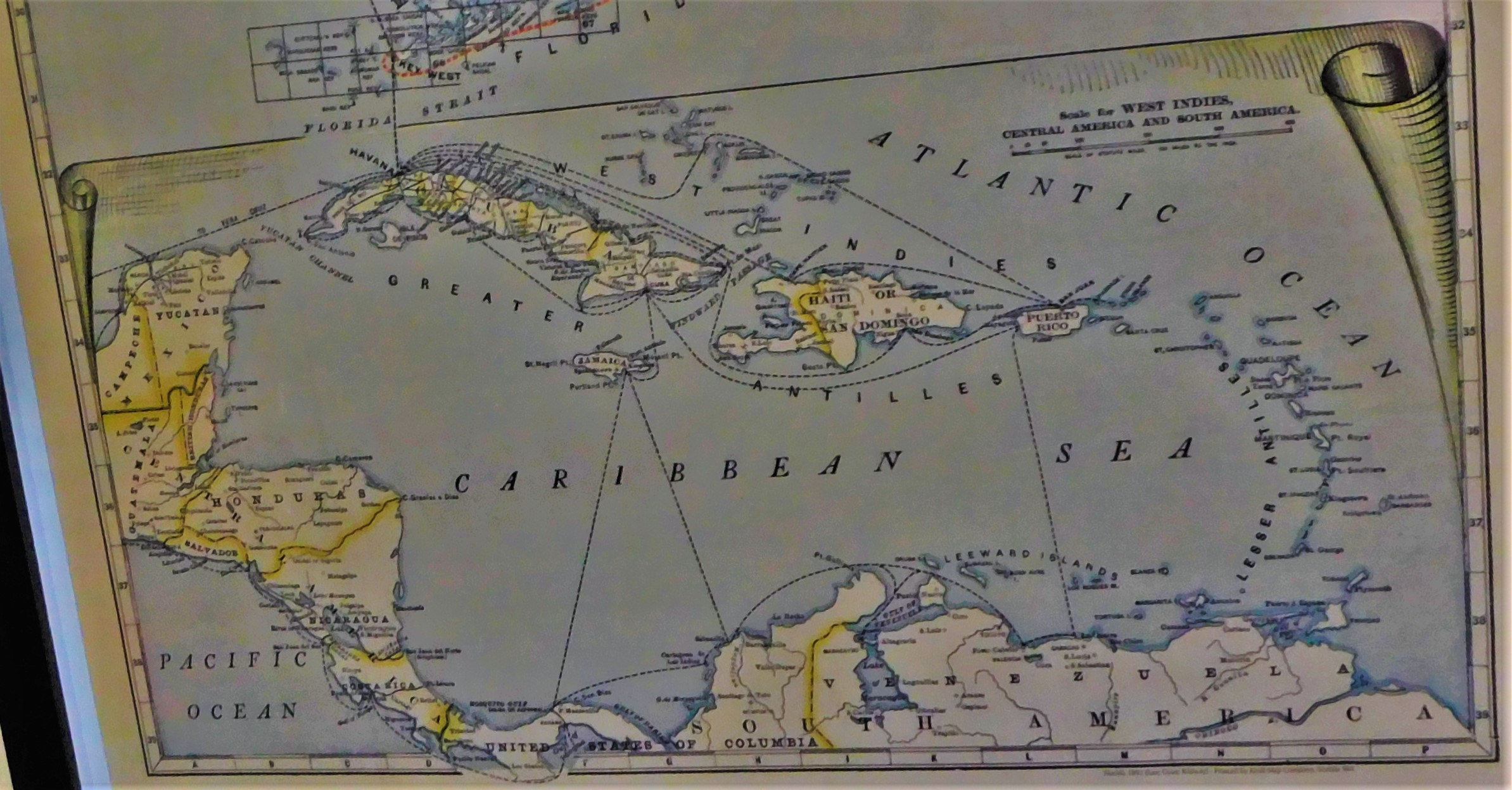
The five images, starting with this one are of a present from my parents who have recently been in Florida. It hangs just inside my front door, on the left side.
An XI of southpaws for World Left Handers Day. Plus of course some photographs.
Today is World Left Handers Day, so I put together an XI of players who did everything cricket wise left handed. This means a lot of famous names are missing because they performed one discipline right handed. My chosen wicket keeper bowled six deliveries in a professional career that spans 470 matches across formats to date, and I have been unable to establish for sure which hand he bowled them with.
THE XI IN BATTING ORDER
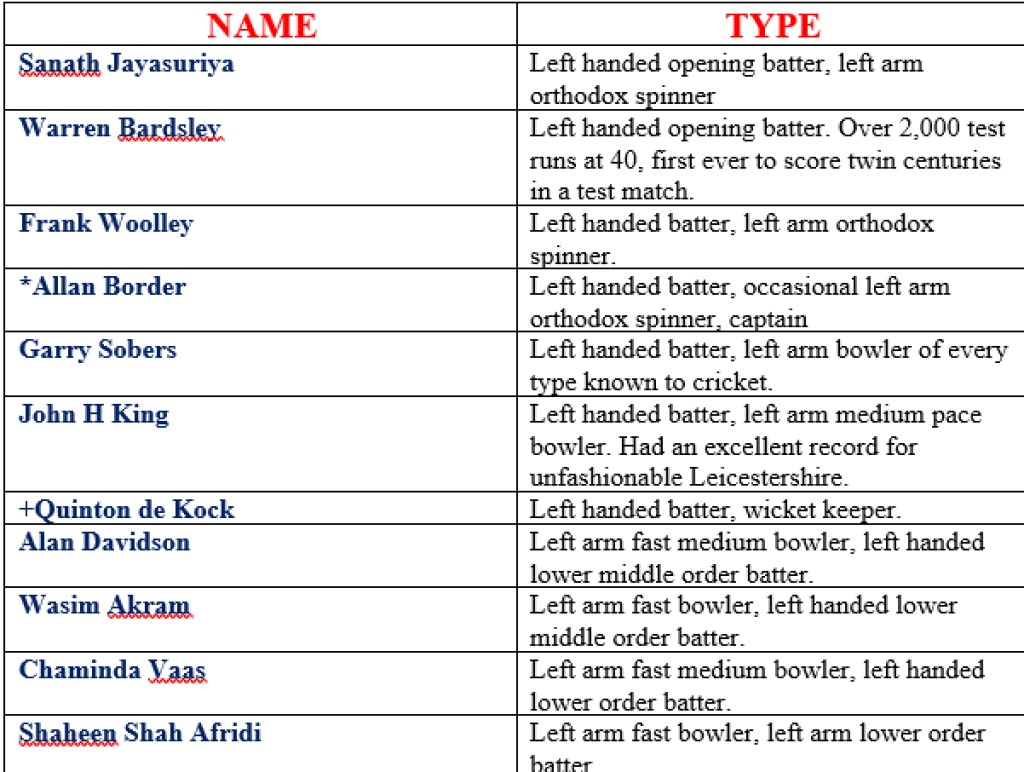
Sanath Jayasuriya: left handed opening batter, left arm orthodox spinner. In 1996 he was the MVP at the World Cup. Two years later at The Oval he scored 213 in Sri Lanka’s first innings, the highest individual score of the match.
Warren Bardsley: left handed opening batter. The gritty Aussie scored over 2,000 test runs at an average above 40. He was the first to score twin centuries in a test match, at The Oval in 1909. In first class cricket he tallied 17,000 runs at 49 including 53 centuries. He scored 29 of those 53 centuries in England, proving that he was definitely not a ‘home track bully’.
Frank Woolley: left handed batting, left arm orthodox spinner. The only person to have achieved the career treble of 10,000 runs, 1,000 wickets and 1,000 catches in first class cricket.
*Allan Border: left handed batter, occasional left arm orthodox spinner, captain. Another gritty Aussie, he was the first to the milestone of 11,000 test runs, having been the second after SM Gavaskar to reach 10,000. The first and greatest of four long serving Aussie captains with magnificent winning records to appear in my lifetime – he passed the baton to Mark Taylor, who was succeeded by Steve Waugh and then Ricky Ponting, who oversaw a regression back towards the mean in his last years in the job.
Garry Sobers: left handed batter, left arm bowler of every type known to cricket. Fortunately the most complete cricketer ever to have played the game did everything cricket wise left handed, and is therefore a shoo-in for this team.
John H King: left handed batter, left arm medium pace bowler. A stalwart all rounder for Leicestershire he suffered from ‘unfashionable county syndrome’ to the extent that in spite of a highly impressive record at FC level he was a one cap wonder for England.
+Quinton de Kock: left handed batter, wicket keeper. He has a magnificent record in all formats of the game.
Alan Davidson: left arm fast medium bowler (also occasional orthodox spin), left handed lower middle order batter. 186 test wickets at 20.53 secure his place in this side.
Wasim Akram: left arm fast bowler, left handed lower middle order batter. Fast tracked into his national side when then captain Imran Khan saw him bowling in the nets and liked what he saw he established himself as one of the greatest of left arm pace bowlers and a more than useful batter.
Chaminda Vaas: left arm fast medium bowler, left handed lower order batter. The Sri Lankan never had pace bowling support of the same class at the other end (indeed for most of his career the only other bowler of unquestioned top class in the side was the off spinner, Muralitharan) but still established a fine test record.
Shaheen Shah Afridi: left arm fast bowler, left arm lower order batter. The young Pakistani has already established a remarkable record in his brief career to date, and I expect many more highlights before his time at the top is done.
Below is a condensed version of the above in graphic form:
EVALUATION OF RESOURCES
The side has a strong and deep batting order – Wasim Akram at nine would satisfy even England’s selectors as to depth, while Jayasuriya, Bardsley, Woolley, Border, Sobers and de Kock are all bona fide greats, and King, the all rounder, would probably have averaged 40 had he played on today’s pitches, though he would also have paid more for his wickets. The bowling resources are awesome, with Afridi, Akram, Davidson, Sobers and King to provide pace/ swing/ seam bowling, and Woolley, Jayasuriya and Sobers able to provide top quality spin. Sobers is the only wrist spin option, but there are very few left arm wrist spinners with commanding records. The depth of spin available means that Border, with a 10 wicket haul in a test match to his credit, would almost certainly never get a bowl. This southpaw squad would take a lot of beating.
PHOTOGRAPHS
My usual sign off…
A comma butterfly. The ragged looking wings are the result of evolution, not injury.
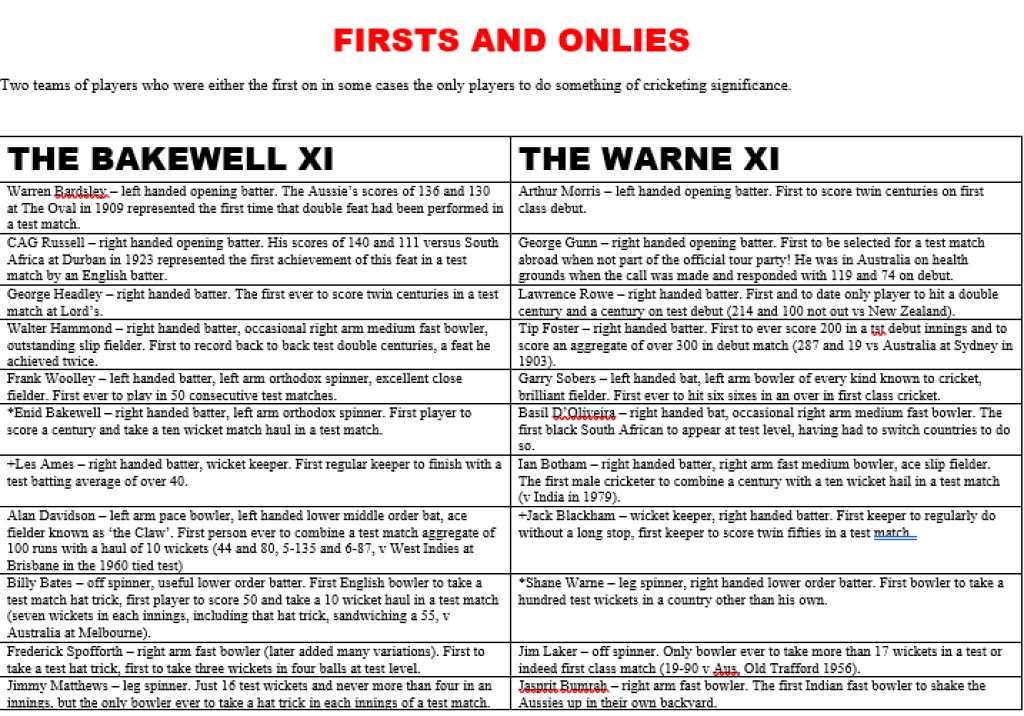
Today’s variation on an all time XI theme looks at firsts and a few onlies, plus a couple of bonus cricket links and a measure of mathematics, and of course photographs.
INTRODUCTION
Welcome to another variation on the all-time XI theme. Today we look at people who were the first to achieve certain landmarks, generally though not exclusively related to test cricket. Our two teams are named in honour of their designated captains and as usual due consideration has been given to the balance of each side.
THE BAKEWELL XI
Warren Bardsley – left handed opening batter. He entered the test record books at The Oval in 1909, when he scored 136 and 130, the first time the double feat had been performed in a test match. Ironically, having hit two in one match, in a reverse of the usual bus situation, he would then wait ages for his next Ashes ton, which finally came almost 17 years later, at Lord’s in 1926 when he scored 193 not out in all out total of 389. England on that latter occasion batted the game to a stalemate, as each of their top five passed 50, and they amassed 475-3. The 1909 game at The Oval also ended in draw, which was enough for Australia to keep The Ashes. Bardsley was Australia’s leading scorer of first class centuries at the end of his career, at which time a young chap named Bradman was just beginning to make his presence felt in the batting record books that by the time he had finished would bear his seemingly indelible stamp.
CAG Russell – right handed opening batter. Charles Albert George ‘Jack’ Russell, who I introduced by his initials was no relation of the later wicket keeper Robert Charles ‘Jack’ Russell who has featured elsewhere in this series, though the first ‘Jack’ Russell was the son of a county wicket keeper. At Durban in 1923he scored 140 and 111, the first Englishman to achieve the double feat and test level, and the only person to date to have done so in their final appearance at that level! He was a casualty of the emergence of Herbert Sutcliffe, who made his test debut the following home season, had a record breaking Ashes tour in 1924-5 (see yesterday’s post) and never looked back. Russell’s test career lasted 10 matches, in which he played 18 innings, two of them not outs and scored 910 runs for an average of 56.87, or 50.56 if you discount the not outs. He passed fifty a total of seven times in those innings and converted five of the seven into hundreds.
George Headley – right handed batter. The great West Indian, referred to by some as ‘the black Bradman’ (though in the Caribbean folk preferred to talk of ‘the white Headley’) was the first ever to score twin centuries in a test match at Lord’s, the home of cricket. He also holds the record for the highest individual score in the 4th innings of a test match, 223 at Kingston in 1930.
Walter Hammond– right handed batter, occasional right arm medium fast, ace slip catcher. He was the first to score back to back test match double centuries, 251 at Sydney and 200 not out at Melbourne in the second and third matches of the 1928-9 Ashes, and was also the second to do so, when on the way home from the 1932-3 Ashes he scored 227 and 336 not out in New Zealand. He was also the first non-wicket keeper to take 100 catches at test level.
Frank Woolley – left handed batter, left arm orthodox spinner, excellent close catcher. He was the first to play in as many as 50 successive test matches. A combination of the infrequency of tests in his day and World War I meant that the great sequence began in 1909 and did not end until 1928, when he was passed over for the 1928-9 Ashes in favour of Phil Mead.
*Enid Bakewell – right handed batter, left arm orthodox spinner. She was the first player to score a century and record a ten wicket match haul in the same test match. Between 1968 and 1979 she played 12 test matches, scoring 1078 runs at 59.88 and taking 50 wickets at 16.62. I have awarded her the captaincy, and with it her name in the title of the XI.
+Leslie Ames – wicket keeper, right handed batter. He was the first regular wicket keeper to play at least 20 test matches and finish with a batting average of over 40. He scored 120 at Lord’s in 1934, matching left hander Maurice Leyland’s century and helping England to a total of 440, after which a combination of rain juicing up the pitch and the left arm spin of Hedley Verity (15-104 in the match) saw England to their only win in an Ashes match at headquarters in the entire 20th century.
Alan Davidson – left arm pace bowler, left handed lower order batter, brilliant fielder (known as ‘the Claw’ for his ability to grasp catches that tested credulity). At the Gabba in 1960 Davidson became the first cricketer in test history to combine a match aggregate of 100 runs (44 and 80) and 10 wickets (5-135 and 6-87). His endeavours in that game were not quite in vain, but nor did they bring the desired result for his team – the match, for the first time in 83 years of test cricket, finished in an exact tie – WI 453 and 284, Aus 505 and 232. Two direct hit run outs from Joe Solomon, the first to account for Davidson when he seemed to be winning the match for Australia, and the second to bring about the tie were key, and Conrad Hunte produced a tremendous long throw to run out Meckiff when that worthy was going for a third that would have settled the issue in Australia’s favour. Davidson has the lowest average of bowlers to have played post war, taken at least 150 test wickets and finished their careers, his 186 wickets at the highest level costing 20.53 each.
Billy Bates – off spinner, useful lower middle order bat. At Melbourne in 1882-3, en route to helping Ivo Bligh achieve his goal of bringing back ‘The Ashes of English Cricket’, following the 1882 Oval test match and subsequent mock obituary in The Sporting Times, Bates took seven wickets in each innings, while also scoring 55 for England. His bowling performance included the first hat trick by an English bowler in test cricket, the first hat trick by someone who scored 50 in the same test and the first test combination of ten wickets and a fifty. His career was ended early when he lost the use of an eye after being injured at net practice. His 15 tests yielded 656 runs at 27.33 and 50 wickets at 16.42. He was the first of a remarkable sporting dynasty – his son WE Bates played for Yorkshire and Glamorgan, while grandson Ted Bates was involved with Southampton Football Club in various capacities for upwards of six decades.
Frederick Spofforth – right arm fast bowler (later added variations). Spofforth was the first bowler to take a test match hat trick, the first bowler to take three wickets in four balls at test level and the bowler responsible for the victory that created The Ashes.
Jimmy Matthews– leg spinner. How does a bowler who took a mere 16 test wickets, and never more than four in a test innings get into a team like this? Simple, six of those wickets, his only ones of the match in question, and all captured without the assistance of fielders, came in the form of the only ever incidence of a bowler taking a hat trick in each innings of a test match. His great moment came in the Triangular Tournament of 1912, for Australia against South Africa, at Old Trafford. His victims were Beaumont, Pegler and Ward in the first innings, and Taylor, Schwarz and Ward in the second, giving Ward his place in the record books as the scorer a king pair and hat trick victim in each innings. Ward by the way was a wicket keeper, and he did actually score two test fifties in his career. The modes of dismissal were bowled, LBW, LBW in the first innings and bowled, caught and bowled, caught and bowled in the second.
This team has an excellent top five, two of whom could contribute as bowlers, a great all rounder at six, a splendid keeper batter at seven and four varied bowlers of whom three definitely deserve to be described as great. The bowling has Davidson and Spofforth to take the new ball, Hammond as third seamer if needed, Bakewell, Bates and Matthews to bowl three different varieties of spin and Woolley as seventh bowler – 20 wickets won’t be a problem for this combo.
THE WARNE XI
Arthur Morris – left handed opening batter. The first ever to score twin centuries on first class debut. Against Gloucestershire in 1948 he accepted responsibility for ensuring that off spinner Tom Goddard did not get an England call up, and proceeded to belt 290 in five hours, leaving Goddard nursing a very sick looking bowling analysis, and well and truly out of test contention. I have written about elsewhere.
George Gunn – right handed opening batter. The Accidental Test Tourist – he was in Australia on health grounds when he got the emergency call up to join England’s ranks during the 1907-8 Ashes, the first time an English tour party had adopted such an approach. He responded by scoring 119 and 74.
Lawrence Rowe– right handed batter. The first to score a double century and a century on test debut, 214 and 100 not out vs New Zealand. He subsequently took a triple century off England as well, but eye problems truncated his career.
Tip Foster – the first to score a double century on test debut, the only person to captain England at cricket and football. I have covered him elsewhere.
Garry Sobers – left handed batter, every kind of left arm bowler known to cricket, brilliant fielder. The first to hit six sixes in an over in first class cricket. I have written about him elsewhere.
Basil D’Oliveira – right handed bat, right arm medium fast bowler. The first non-white South African to play test cricket. As mentioned in my South Africapost he had to move countries to be able to achieve this, and was lucky to find backers to help him do so. The 158 he scored against Australia at The Oval immediately before the selectors of that winter’s tour party to South Africa sat down to deliberate took his test record to 972 runs at 48.60, an average bettered only by Barrington among those then playing for England. The subsequent ramifications of his non-selection and then selection as replacement for someone picked as a bowler shook the sporting world, and ultimately led to South Africa being isolated from world cricket for over 20 years.
Ian Botham – right handed batter, right arm fast medium bowler, ace slipper. Ian Botham was the first male test cricketer to score a hundred and take a ten wicket match haul, against India in 1979. He was also the first to combine a century with a five wicket innings haul on more than two occasions (v New Zealand at Christchurch, 103, 30, 5 first innings wickets, three second innings wickets, v Pakistan at Lord’s, 108 and 8-34, the first century and eight-for combo at that level, v India in 1979 – 114, 6-58, 7-48, v Australia at Headingley 6-95, 50, 149 not out, one second innings wicket and v New Zealand on the 1983-4 tour, 138 and 5-59, before New Zealand were inspired by Martin Crowe’s maiden test hundred to save the game with a fighting second innings display), and the first to the career triple double at test level (3,000 runs and 300 wickets, achieved in his 72nd match).
+Jack Blackham – wicket keeper, right handed batter. The first keeper to regularly do without a long stop, and the first keeper to score twin fifties in a test match.
*Shane Warne – leg spinner, right handed lower order bat. First bowler to take 100 test wickets in a country other than his own – he reached the mark for matches in England in 2005. He is the leading wicket taker in Anglo-Australian tests and second to Muralitharan in the all-time list. He is the designated captain of this XI.
Jim Laker – off spinner. Only one bowler in first class history has taken more than 17 wickets in a first class match, and he did in an Ashes test. James Charles Laker took 19-90 (9-37, followed by 10-53) at Old Trafford in 1956 to retain the Ashes for England. In a tour match for Surrey against Australia on a good Oval pitch he took 10-88 from 46 overs in the first innings of the match, settling for 2-42 at the second attempt, when his spinning partner Tony Lock took 7-49, Surrey becoming the first county to beat the Aussies since 1912. England made 459 in the first innings of the Manchester match, Peter Richardson and David Sheppard (then bishop of Woolwich, later bishop of Liverpool) making centuries, Sheppard’s 113 being the highest individual innings of the series. Australia then sank for 84, before determined resistance by Colin McDonald (89 in 337 minutes, highest Aussie score of the series) saw them to 205 second time round. Four front line spinners operated in this match, and three of them (Ian Johnson, Richie Benaud and Tony Lock) had combined match figures of 7-380 (an average of 54.43 per wicket). In 1950 Laker had taken 8-2 for England v The Rest at Bradford as The Rest limped to 27 all out. In 1954 he was involved in one cricket’s most remarkable fixtures, when Surrey sealed their third straight County Championship (a sequence they would extend to seven under first Surridge, five of them, and then Peter May, two more). Worcestershire were rolled for 25 in their first innings, and Surrey had reached 92-3 when Surridge decided that he fancied another go at Worcestershire that evening and declared! Not bothering with conventional new ball bowling he threw the cherry straight to his spin twins, who each produced an unplayable ball before the close. The following morning Worcetsreshire were blown away for 40, to lose by an innings and 27 runs. Laker, not required in the first innings rout of Worcestershire, took a hat trick in the second. That aggregate of 157 runs for 23 wickets remains the lowest ever for a completed County Championship game, and the victory that Surridge conjured out of nothing was as mentioned enough to secure that year’s title for Surrey.
Jasprit Bumrah – right arm fast bowler. The first Indian fast bowler to rattle Australia in their own backyard. His 6-33 in Australia’s first innings at the MCG in 2018 effectively settled the destination of the Border-Gavaskar Trophy. Neither of the two great quicks of the 1930s, Amar Singh and Mahomed Nissar ever got to pit their wits against Australia, and basically between them and Bumrah India never had a really fast bowler of top quality.
This team has a splendid top four, three all rounders of differing types, a top of the range keeper and three fine specialist bowlers. Bumrah would share the new ball with either Botham or Sobers, with the other third seamer, while the spin options are provided by Warne, Laker and Sobers, and there is medium pace back up if required available from D’Oliveira.
THE CONTEST
These are two strong and formidably well balanced sides. Obviously, with all due respect to the only person ever to bag a hat trick in each innings of a test match the Warne XI have an advantage in the leg spin department. However, Bates vs Laker is a good match up, while Sobers’ talents are counterbalanced by those of Davidson, Bakewell and Woolley. The Warne XI have an edge in the pace bowling department, but not much of one. There is also no doubt in my mind that the Bakewell XI have greater strength and depth in batting. I reckon this one goes down to the wire and I cannot even attempt to call a winner.
A COUPLE OF CRICKET LINKS
The pinchhitter has produced an excellent post today, looking back 17 years ago to the highest successful run chase in test history, when the West Indies chased down 418 in Antigua.
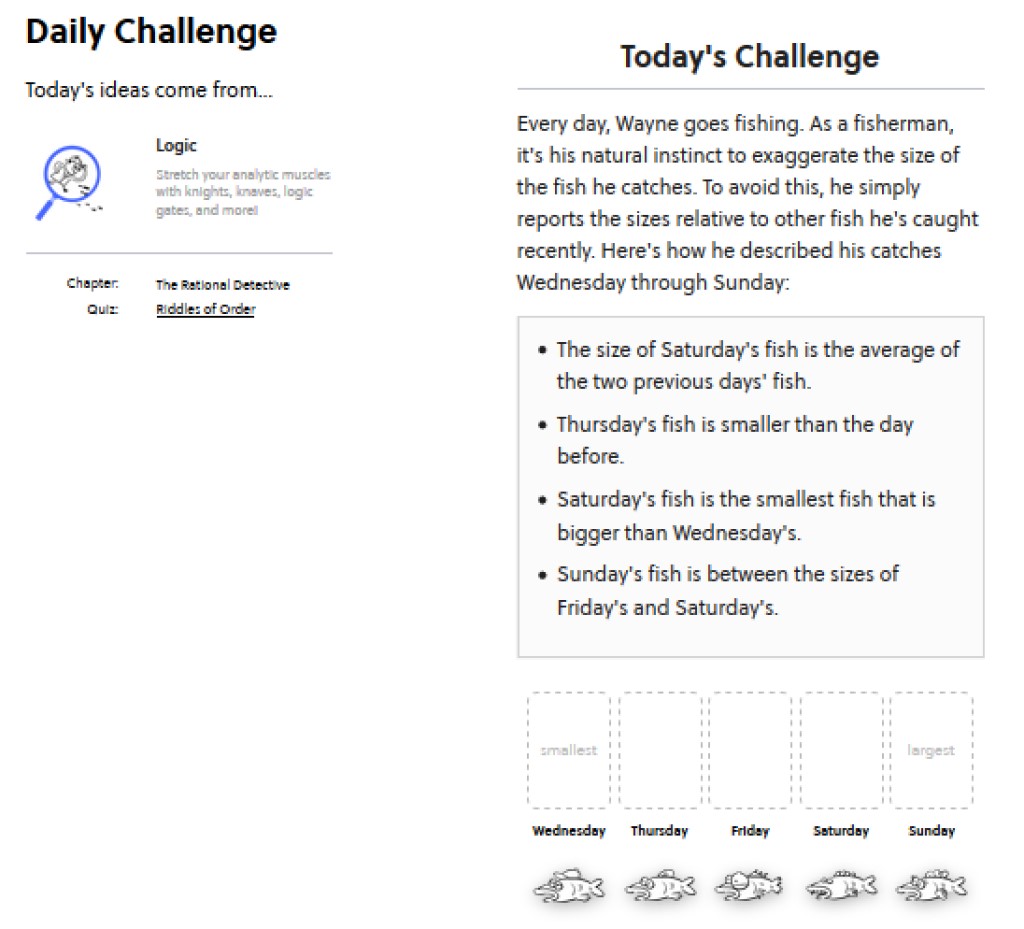
Your task is to use the above information to identify the smallest fish – and if you enjoy the task establish a complete ranking order of the five fish.
PHOTOGRAPHS
Today’s teams have put in their appearance, I have served up a couple of bonus cricket links and a mathematical teaser, so I now hand over to you for your comments with my usual sign off…
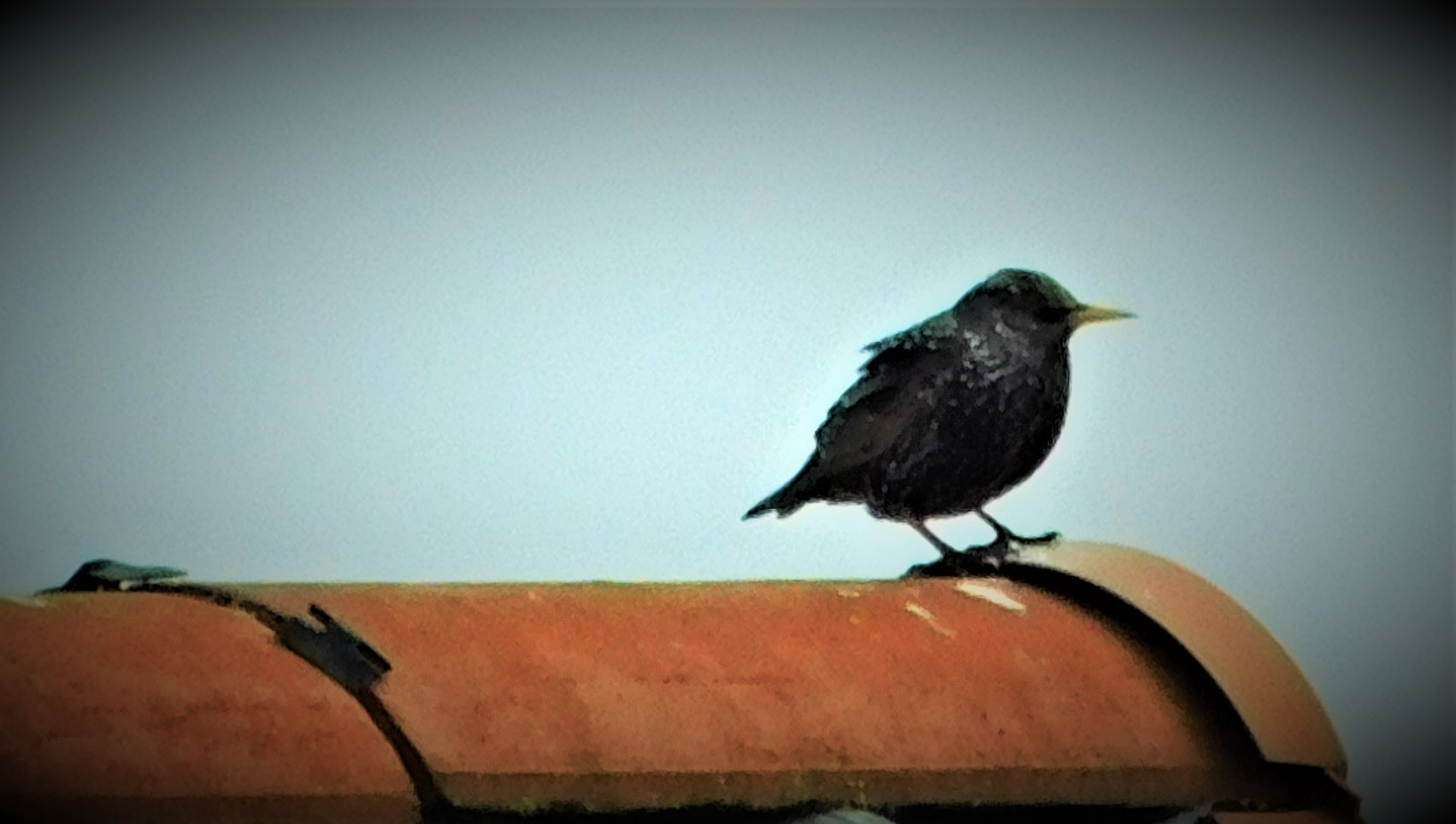
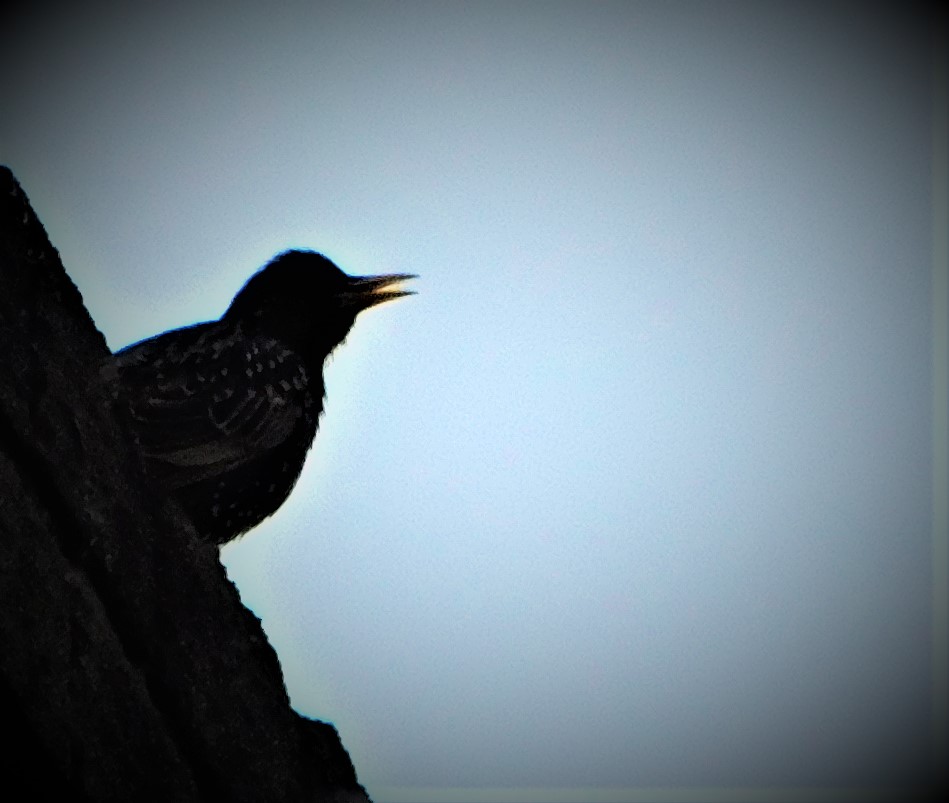
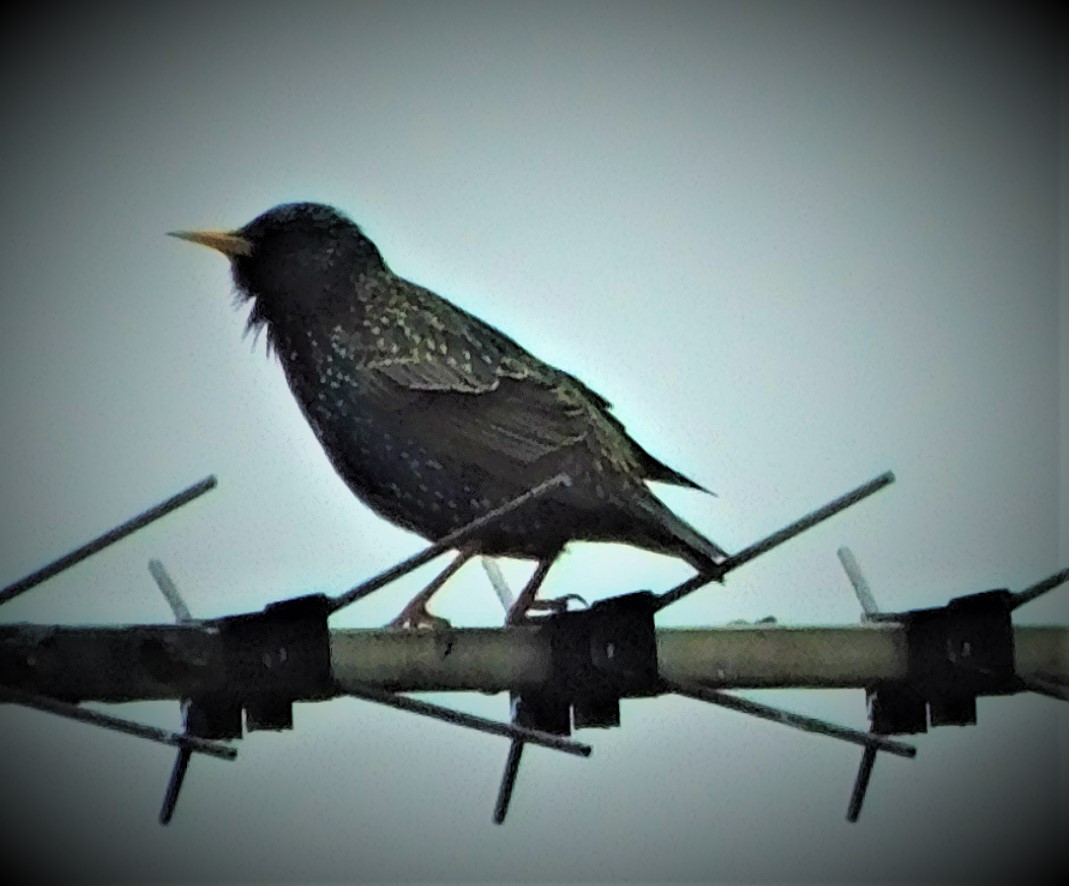
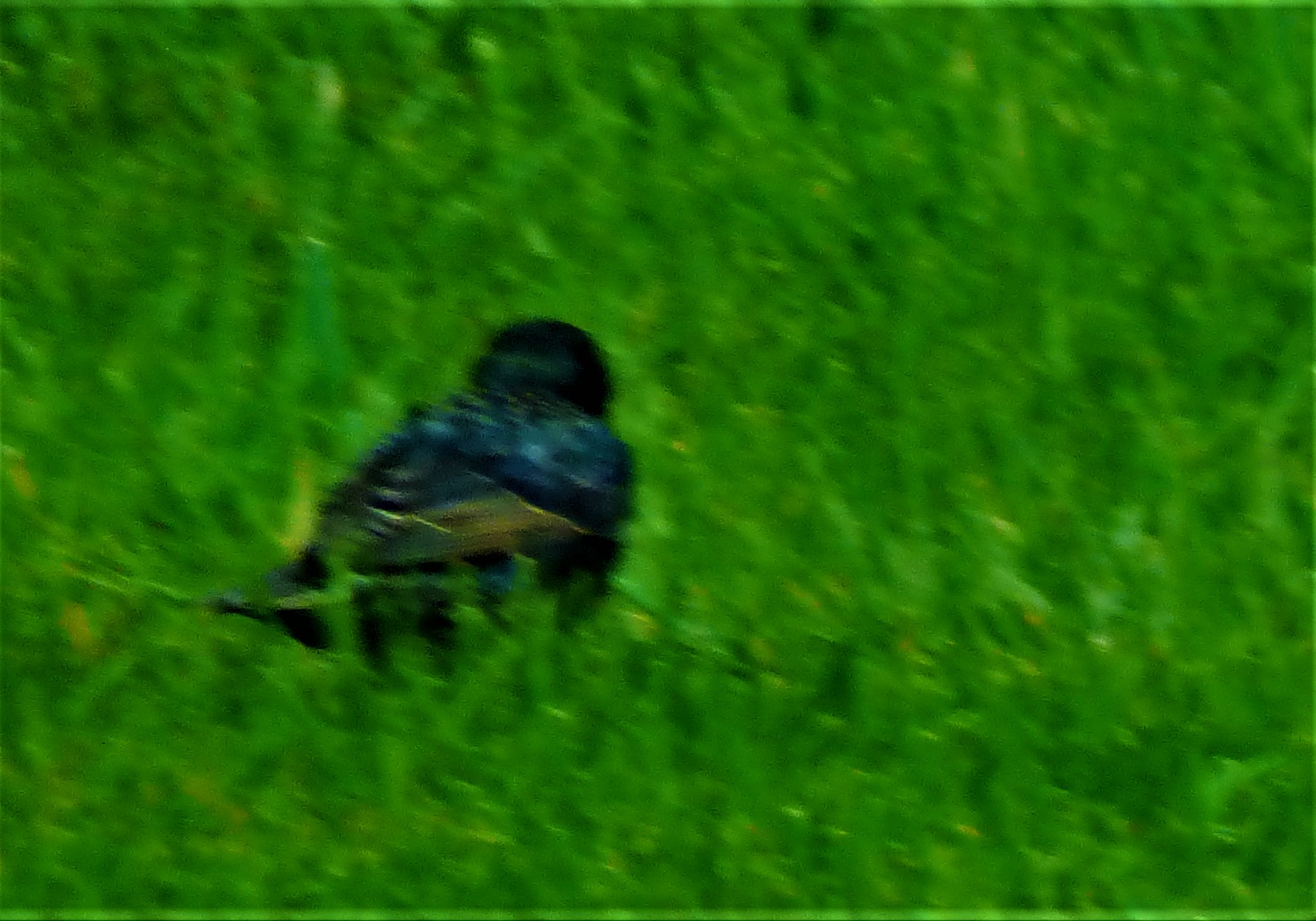
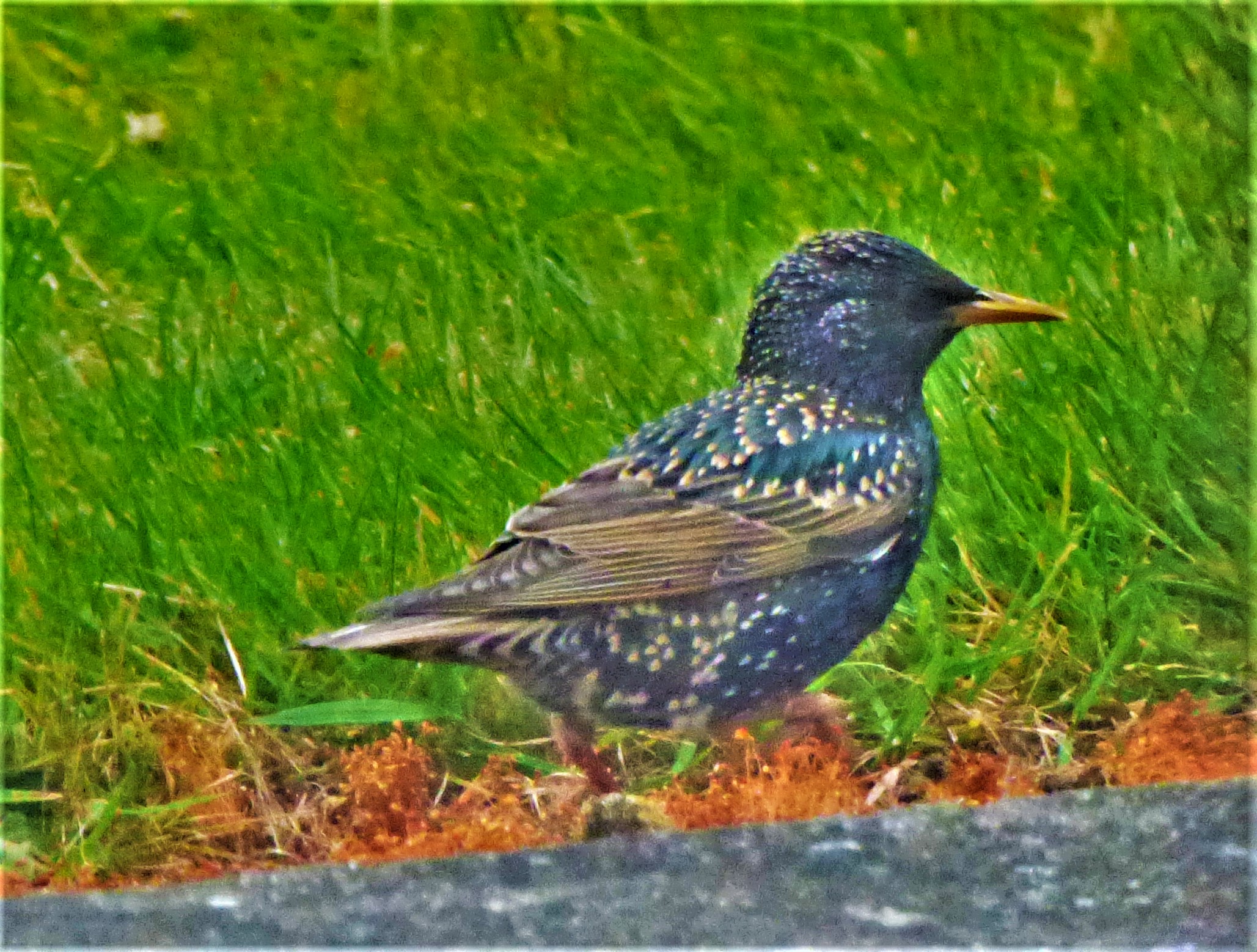
The first of two particularly satsifying starling pics























































 aspiblog