All Time XIs – ODI Special

In the absence of live cricket to write about I have created a clash between a team of players from before ODI cricket was a thing and a team of ODI players to do battle with one another. Also a photo gallery.

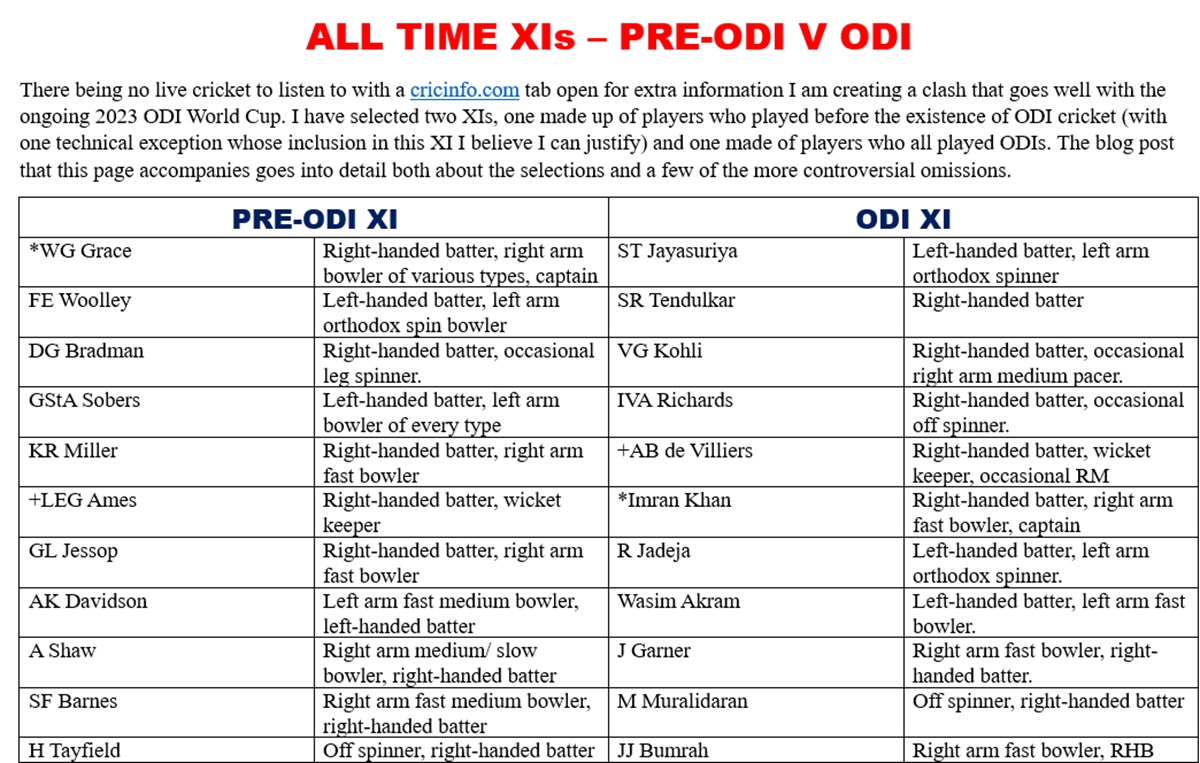
There is no live cricket today, so with the ODI World Cup 2023 approaching its final phase I have decided to produce a contest between two XIs – one of players whose careers took place before ODI cricket existed (with one very minor exception explained when we come to him) and one of ODI players. The following playing conditions would apply to what would be a five match ODI series: only one new ball per innings – using two as happens currently deprives us of old ball skills such as reverse swing because a ball that is only in use for 25 overs doesn’t get old, two minute time limit between a wicket falling and the new batter being ready to face (I am not expecting any ‘Timed Out’ dismissals but I am making sure that situation is covered anyway) and my own playing condition regarding overs not bowled within the time limit: The batting side to be awarded 10 runs or twice the current scoring rate, whichever is the greater, for each unbowled over, counting incomplete overs as ‘unbowled’ for this purpose.

  1. *WG Grace (right handed batter, right arm bowler of various types through his career, good close catcher, captain). His commitment to attacking cricket is without question, his captaincy record is superb, and he was the dominant cricketer of his era.
  2. Frank Woolley (left handed batter, left arm orthodox spin bowler, excellent close catcher). A fast scorer, a fine bowler and an excellent close fielder. Only one cricketer ever achieved the first class career treble of 10,000 runs, 1,000 wickets and 1,000 catches – Woolley.
  3. Don Bradman (right handed batter, occasional leg spinner, excellent outfielder). The most prolific batter the game has ever known and capable of scoring seriously fast as well.
  4. Garry Sobers (left handed batter, left arm bowler of every type known to cricket, excellent fielder). Before the pedants fly in, yes he did play a solitary ODI near the end of his career, in which he scored a duck. That is not enough to class him as an ODI player in my book, and I refuse to not pick the most complete player the game has ever known, so I include him in this XI.
  5. Keith Miller (right handed batter, right arm fast bowler). One of the greatest all rounders ever to play the game, and both his attacking approach to batting and his willingness to experiment with the ball would be well suited to ODI cricket.
  6. +Les Ames (right handed batter, wicket keeper). Twice winner of the Lawrence trophy for scoring the fastest first class hundred of the season, and maker of over 1,000 wicket keeping dismissals in his career.
  7. Gilbert Jessop (right handed batter, right arm fast bowler, gun fielder). The most consistently fast scoring batter the game has ever known, a more than useful bowler and a brilliant fielder. I have listed him at seven in this order but I would expect Grace to display some flexibility in this matter – if wicket number 1,2,3 or 4 falls with say 10 overs to go I expect Jessop to come in.
  8. Alan Davidson (left arm fast medium bowler, left handed batter, brilliant fielder). Among bowlers to play exclusively post WWII, to have ended their careers and to take 150 or more test wickets the one with the most economical bowling average is Davidson, with 186 test scalps at 20.53 each. He also had moments with the bat even at the highest level, averaging 24 in test cricket with an HS of 80 and his fielding earned him the nickname ‘the claw’.
  9. Alfred Shaw (right arm medium/ slow bowler, right handed batter). The man who bowled more FC overs than he conceded runs at that level, and took just over 2,000 FC wickets at 12 a piece just has to be in this XI.
  10. Sydney Francis Barnes (Right arm fast medium bowler, right handed batter). He would grumble about only being allowed 10 overs, but I would fully expect him to make superb use of those overs – he was probably the most skilful bowler ever to pick up a cricket ball.
  11. Hugh Tayfield (off spinner, right handed batter). The leading test wicket taker for South Africa in their first period as a test nation, and by some way at that. He was also notoriously miserly with the ball, once sending down 137 successive dot balls including 16 successive eight ball maidens.

This side has seven top line batters and a capable number eight in Davidson. However the true jewel in this side’s crown is the bowling, with that front four of Davidson, Barnes, Shaw and Tayfield backed by all rounders Miller, Jessop, Sobers, Grace and Woolley. The only recognized bowling type not covered is leg spin, and Syd Barnes’ signature weapon largely fills that gap. Also there are few if any ‘passengers’ in the field in this XI, and a number of genuinely outstanding fielders. This is a side that would take a lot of beating.

New Zealander Bert Sutcliffe would be well suited to the left handed opener’s gig, but he does not have Woolley’s advantage of also offering a bowling option. Mulvantrai Himmatlal ‘Vinoo’ Mankad was another possibility, but I rated his batting not explosive enough. Mushtaq Mohammad could have been selected in place of Keith Miller had I been really desperate for leg spin representation. Among the bowlers I regretted not being able to include were Bill O’Reilly, Clarrie Grimmett, Hedley Verity, Johnny Wardle and Wilfred Rhodes (his approach to batting rules him out of an upper order slot in this format IMO). Billy Bates instead of Hugh Tayfield would strengthen the batting, but I think the South African was the finer bowler.

Various white South Africans around the time ODIs were first getting going had limited opportunities to showcase their talents, and while several could make cases for inclusion I have opted not to pick any – I could not count them as ODI players since they never got to play those, and it would have been against the spirit of the exercise to pick them in the above line up. I will repeat something I have previously stated about this issue: these individuals deserve some sympathy, but not as much as the non-white South Africans who were entirely deprived of the chance to showcase their talents, going all the way back to Krom Hendricks in the 1890s.

  1. Sanath Jayasuriya (left handed batter, left arm orthodox spinner). He gets this gig for his stellar role in Sri Lanka’s only World Cup win back in 1996.
  2. Sachin Tendulkar (right handed batter). His record tally of ODI centuries has just been equalled, but his claim to this slot is in my view unarguable.
  3. Virat Kohli (right handed batter, occasional right arm medium pacer). Currently the co-holder of the record for ODI centuries.
  4. Viv Richards (right handed batter, occasional off spinner). The first truly great ODI batter.
  5. +AB de Villiers (right handed batter, wicket keeper, occasional medium pacer). The man known to fans as ‘Mr 360’ because he could score literally anywhere in the whole 360 degree arc.
  6. *Imran Khan (right handed batter, right arm fast bowler, captain). One of the greatest all rounders ever to play the game, and his leadership in the ‘cornered tigers’ world cup of 1992 removes any doubt about who has that role in this side.
  7. Ravindra Jadeja (left handed batter, left arm orthodox spinner, gun fielder). One of the finest all rounders of the modern era.
  8. Wasim Akram (left arm fast bowler, left handed batter). A great bowler and a handy lower order batter.
  9. Joel Garner (right arm fast bowler, right handed batter). His immense height meant that he posed problems in 3D geometry for opposition batters, and very few could surmount them.
  10. Muthiah Muralidaran (off spinner, right handed batter). One of the stars of that 1996 world cup win – the Sri Lankan seamers Vaas and Wickremasinghe often bowled only their opening spells, the remainder of the overs being bowled by spinners, and this man invariably bowled his full ten overs, generally with fine figures.
  11. Jasprit Bumrah (right arm fast bowler, right handed batter). One of the reasons India have won all nine of their group games at the current tournament has been the excellence of their bowling, and this man is the spearhead of that attack.

This side is well equipped batting wise, and has a stellar bowling line up, with Jayasuriya likely to be seventh bowler. There is no leg spin – to accommodate either of the two best ODI leg spinners I have seen in action I would have to drop Jadeja and promote Akram to number seven.

Some would have ignored Jayasuriya’s bowling and selected Adam Gilchrist to open the batting and keep wicket. Some Indian fans would want Dhoni to be both keeper and captain, but I disagree, and they already have four players in my chosen XI. A live alternative for the number seven slot, though it would remove a spin option would be one of two South African bowling all rounders: right arm seamer Shaun Pollock or left arm seamer Marco Jansen. Some would pick McGrath ahead of Garner as the tall mean right arm pacer and in test cricket I would agree, but in ODIs I rate the West Indian just ahead of the Australian. Feel free to volunteer further suggestions in the comments, but remember to consider how your choices would affect the balance of the sides.

My usual sign off…

Group Stage of ODI Cricket World Cup Done

A brief account of the last group match at the 2023 Cricket World Cup, a look at the final group standings, and what the rest of the tournament may hold. Also a link to an important petition. Finally, a photo gallery.

The last group match of the 2023 ODI Cricket world cup took place today between India and the Netherlands. The former had already won the group and were looking to make it a perfect nine wins out of nine at the group stage, while the latter knew that a win would qualify them for the 2025 Champions Trophy. Both teams were unchanged, and India won the toss and elected to bat.

India had an innings in three parts. They made a blazing start, making 500 look a distinct possibility, then they slowed down in the middle, but in the closing stages of their innings Shreyas Iyer and KL Rahul were imperious, and although the record breaking innings tally did not materialize, India managed 410-4, with all of their top five topping the half century mark. Iyer and Rahul reached centuries, off 82 and 64 balls respectively, while Logan van Beek had a century of a different and less welcome kind – 10-0-107-0.

The Netherlands showed fight, as they had all tournament, but never looked like threatening the Indian total. As it became obvious that India were in no danger whatsoever, some part time bowlers put in appearances for them – Shubman Gill, Virat Kohli, Suryakumar Yadav and Rohit Sharma all taking turns. Kohli picked up a wicket, and Sharma, bringing himself on as ninth bowler for the 48th over of the innings took the final wicket, that of Nidamanuru for 54. Since Sharma conceded only seven runs, six of them to the shot that completed Nidamanuru’s 50 and took the Netherlands to 250 he now has the best bowling average at this world cup – 7.00 per wicket. Among the more serious bowlers Jasprit Bumrah had 9-1-33-2, and Siraj, Kuldeep Yadav and Jadeja also picked up two wickets a piece.

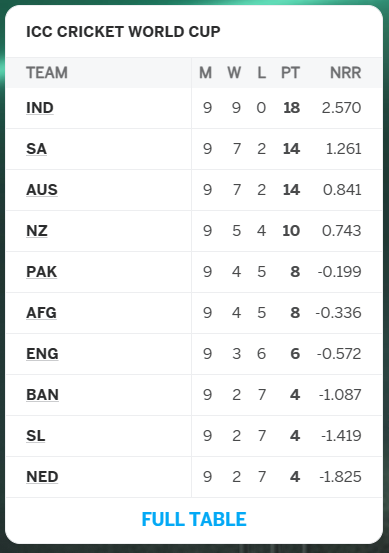
The final table reads as follows:

Thus India will play New Zealand in semi-final one on Wednesday and South Africa will play Australia in semi-final two on Thursday. Pakistan, Afghanistan, England and Bangladesh are all qualified for the 2025 Champions Trophy and Sri Lanka and the Netherlands leave with nothing. Afghanistan did superbly well to threaten to qualify for the semi-finals, while without a doubt the team with the most cause to be embarrassed about/ ashamed of their performance at this tournament is England, winners four years ago, falling at the first hurdle this time round. My initial expectation was that teams with a won six, lost three or better ratio would qualify automatically and that teams with a won five, lost four ratio would be split be net run rate. In the end, a combination of dominance by the top three and the fallibilities near the end of the tournament of both Afghanistan and Pakistan meant that only one side had 5:4 record and it was enough for them to qualify without relying on net RR. India look heavy favourites right now, but in 1996 (two groups of six, rather than one of 10) South Africa won every group game and looked a superb unit going into the quarter finals, where they were knocked out. That is by way of a reminder that there are four teams still in this competition, and that whichever of them wins two successive knock out matches will take the trophy. While I will congratulate India with all sincerity should they go on to win, and might even genuinely mean a few words of praise if Australia do the same, my own hope as someone whose inclination is to support the underdog is that one or other of the two ‘Cinderella’ sides, New Zealand or South Africa end up winning the title.

First, a link to an important petition, against a planned road development that would literally undermine Stonehenge. Please click here to read, sign and share this petition.

Now it is time for my usual sign off…

England Exit but take Pakistan with them

A look back at today’s world cup matches, especially England v Pakistan, , analysis of the group standings with one group match to go, a mention of a couple of upcoming auctions being held by my employer and my usual sign off.

Today saw two group matches at the 2023 ODI World Cup, Australia v Bangladesh and England v Pakistan. Most of this post is dedicated to the second of these fixtures. In the early game Bangladesh posted just over 300, and Australia chased them down very comfortably, Mitchell Marsh setting a new record for an Australian number three in ODIs by scoring 177 not out.

England were already eliminated, while Pakistan had a very outside chance of staying in the tournament. The least vanishingly unlikely scenario to allow this to happen would have seen Pakistan bat first, score a huge total and bowl England out cheaply. Going this way round would still have left Pakistan needing to win by 287 runs to go ahead of New Zealand on net RR. As it happened Buttler won the toss and decided to bat. This meant that the first landmark for England to reach was 169, at which point Pakistan would be in the position of needing at least one no-ball from England even if they hit everything for six if they were to overhaul New Zealand on net RR.

In the event England batted the best they had all tournament, and it was soon very obvious that any scenario involving Pakistan overhauling New Zealand was not so much vanishingly as Daniel Dennett’s usage of Vanishingly unlikely (in the book “Darwin’s Dangerous Idea”). Various players contributed for England, and all Pakistan’s bowlers took a fair amount of stick. In the end England posted 337 from their 50 overs.

Pakistan never looked at the races, and there were times when it looked like their net RR was going to take such a battering that they dipped below Afghanistan into sixth place. The magic number to avoid that was 187, and they reached that figure with eight wickets already gone, losing a ninth shortly afterwards. The last pair of Mohammad Wasim and Haris Rauf then managed to connect with some meaty blows, but long before they were even close to worrying England one such shot went higher than it did long and Stokes managed to get himself underneath it. Pakistan were all out for 244, beaten by 93 runs. Two England bowlers reached career landmarks along the way – David Willey whose retirement is already confirmed reached 100 ODI wickets with the second of his three scalps, and Adil Rashid claimed his 200th ODI wicket. Willey was given the Player of the Match award, making the decision not to award him a new central contract look even sillier than it already did (while the timing of the central contract details being made public, right in the middle of a tournament, verged on the criminally insane). England are in seventh place, and unless the miracle of the tournament happens tomorrow and the Netherlands somehow beat India by a really big margin in the last group match seventh is where they will finish. However, two of their three wins came after their eliminations was already confirmed, and those two late consolation victories should not be allowed to overshadow just how dire a tournament this was for the team who “didn’t come here to defend anything”.

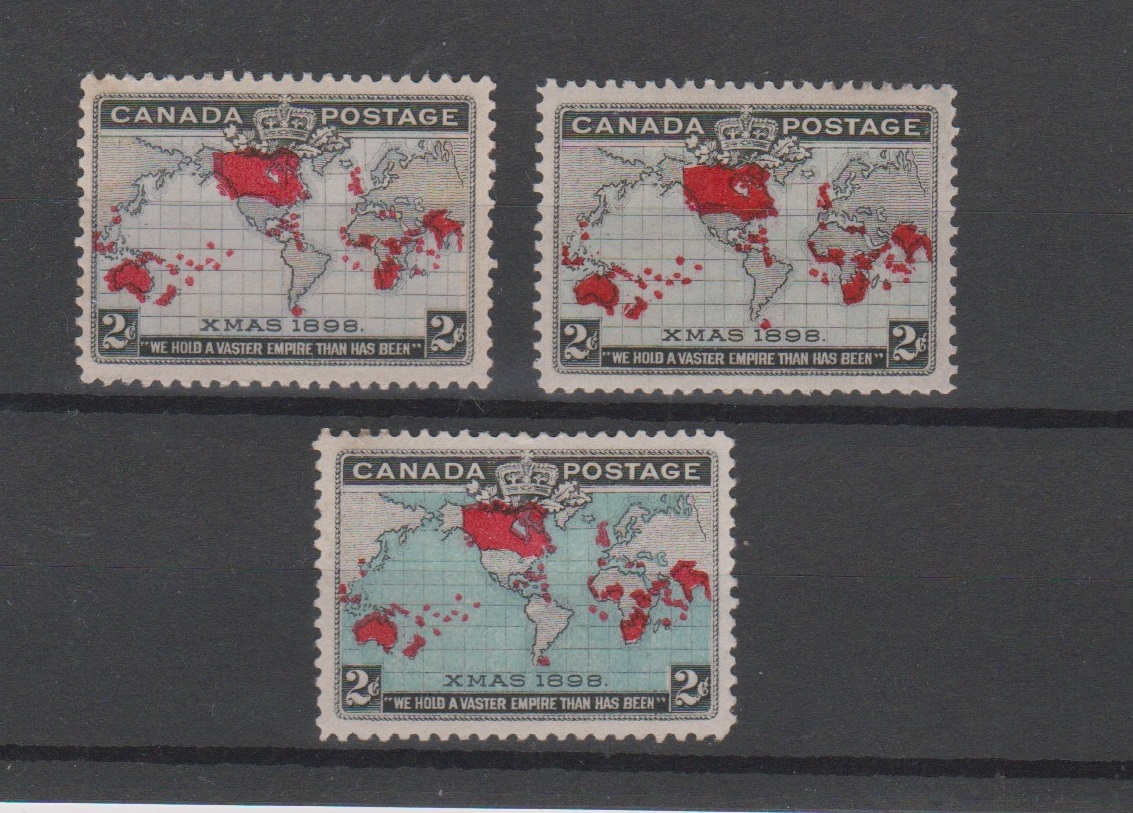
James and Sons’ November auctions (on Tuesday 21st and Wednesday 22nd) are now ready to view online.

Tuesday’s auction features stamps and postal history, and contains 500 lots. Lot 105 (below) is one of them:

There are two ways to view a catalogue listing and/or sign up to bid online:

Saleroom Easyliveauction

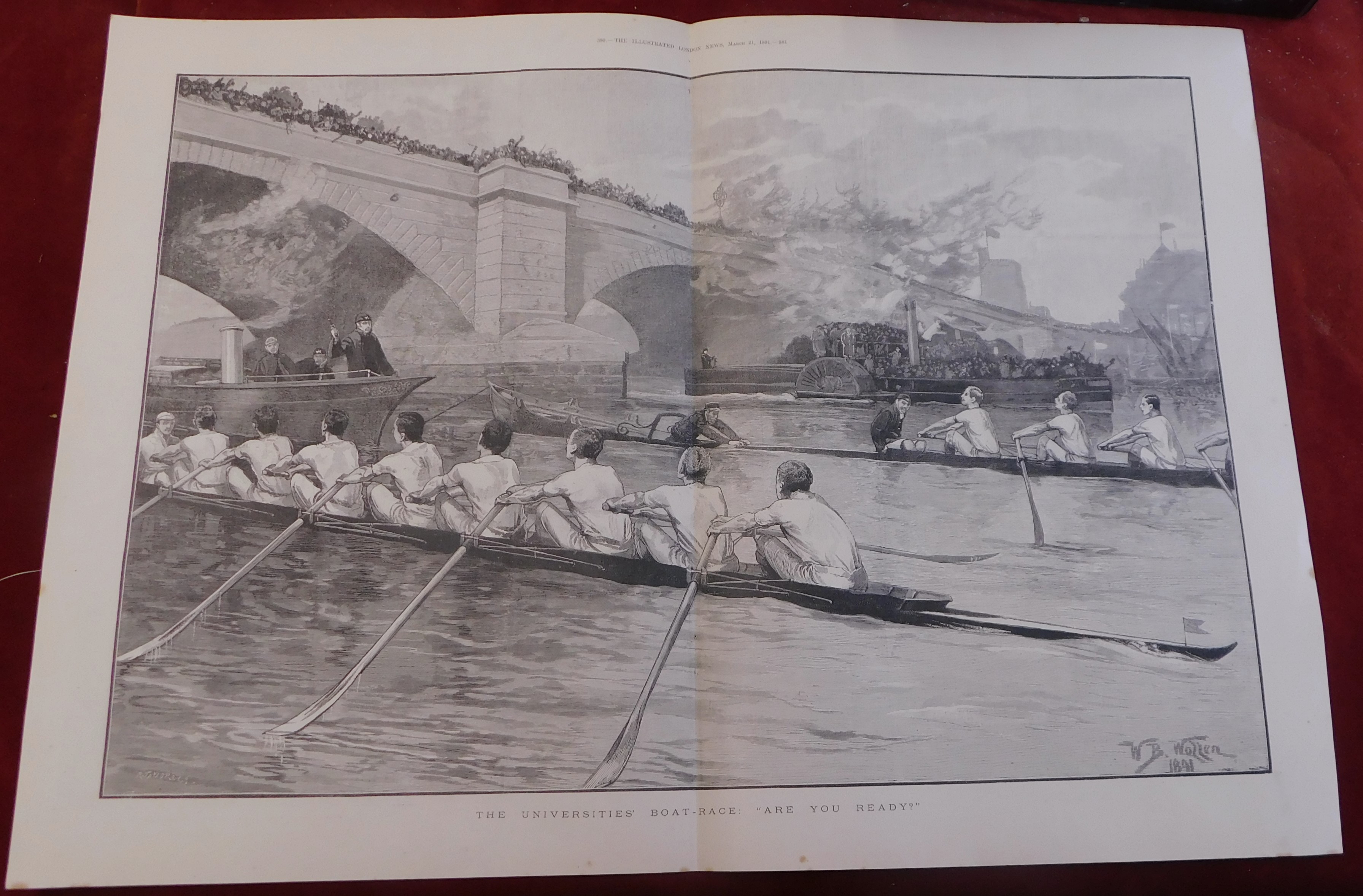
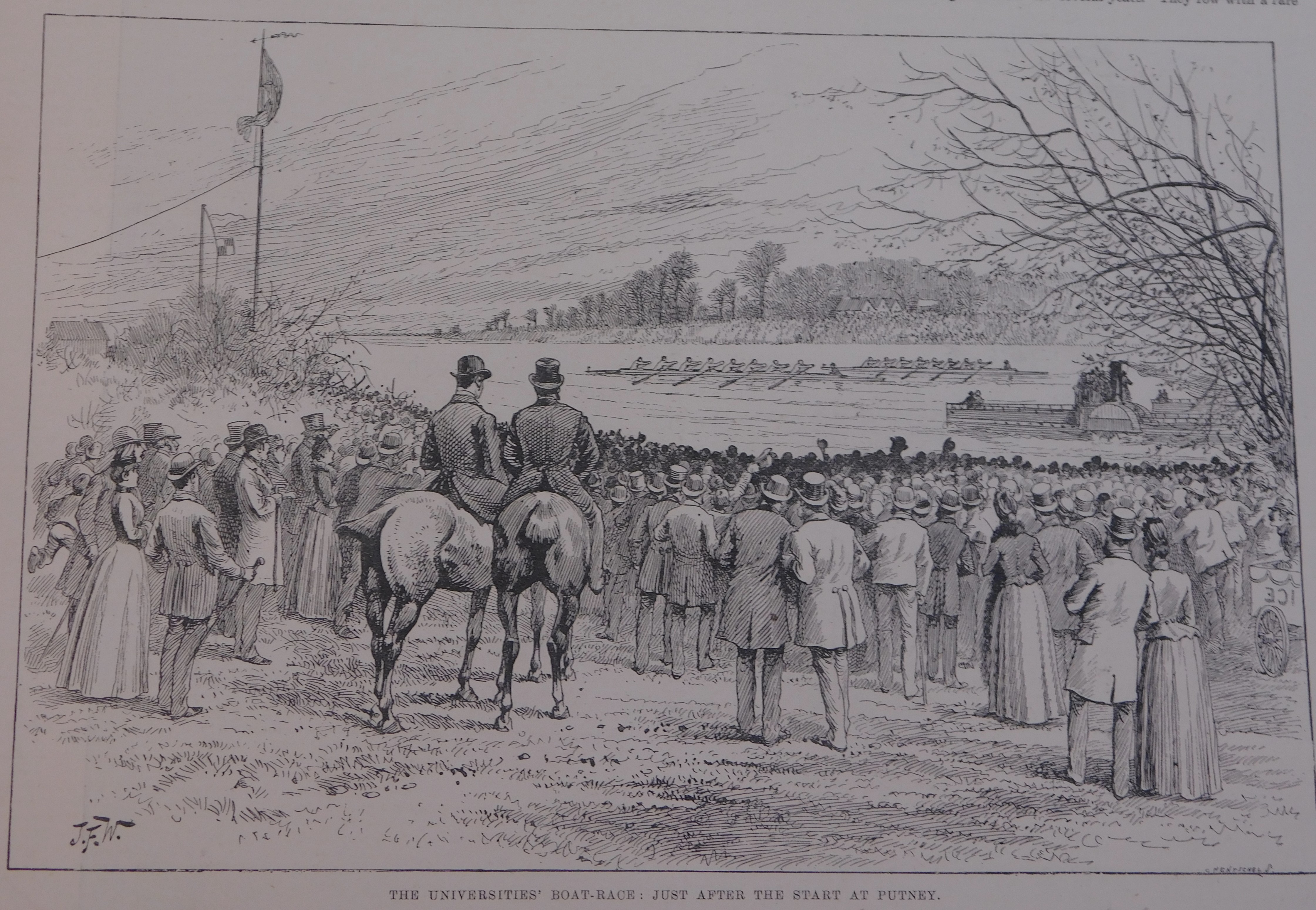
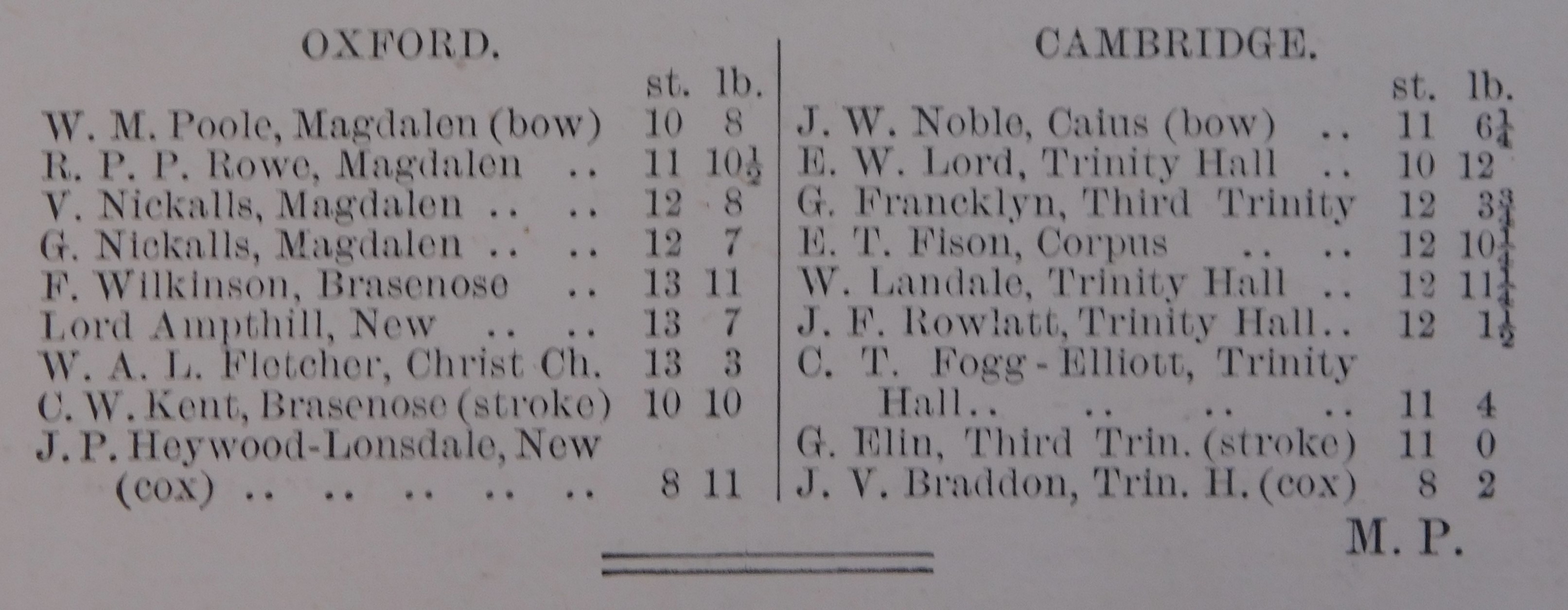
The second day’s sale features advertising and ephemera. The main feature image is the centrepiece of lot 702, a poster sized picture of the 1891 Boat Race crews in action:

Full catalogue listing online, starting from lot 501

Saleroom Easyliveauction

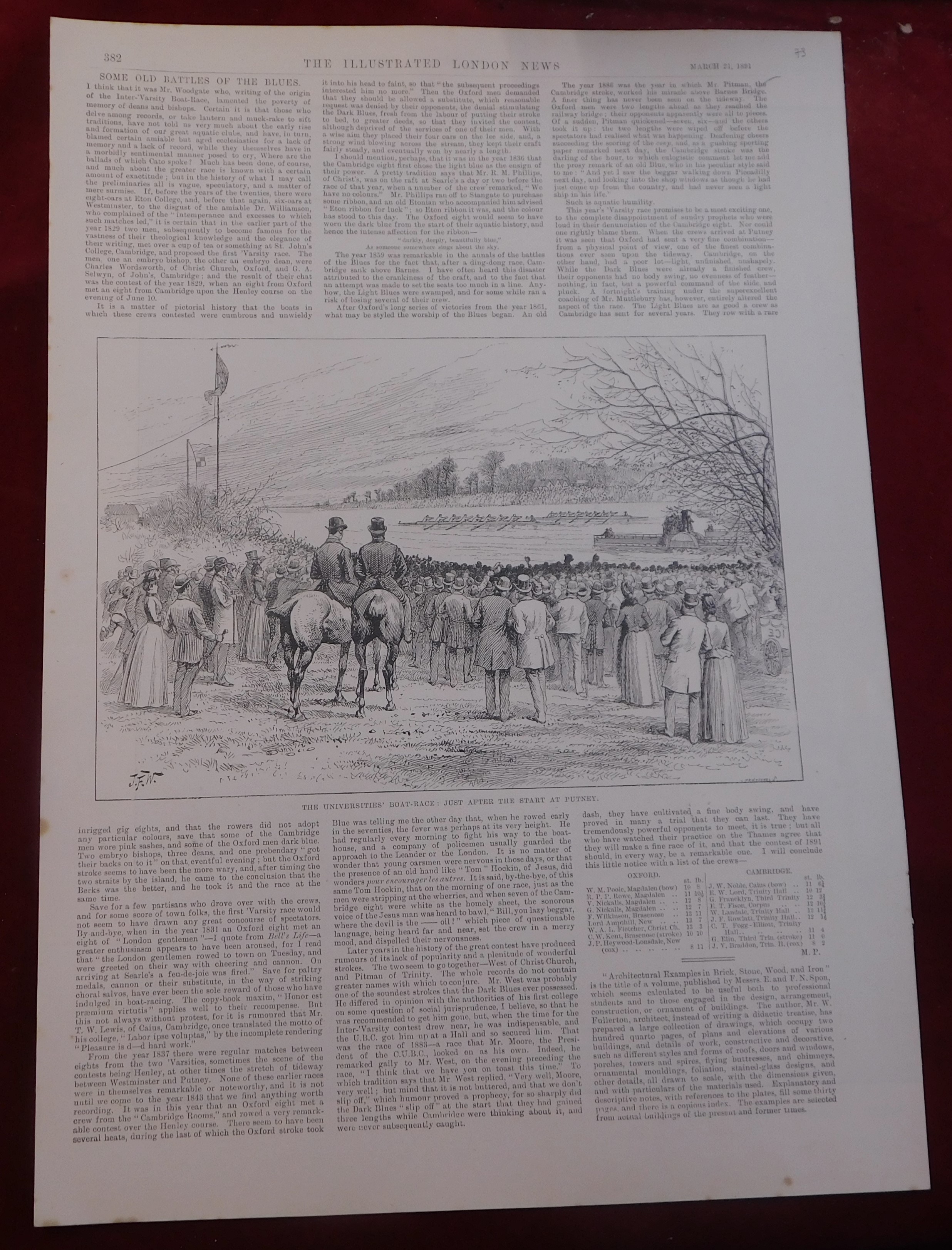
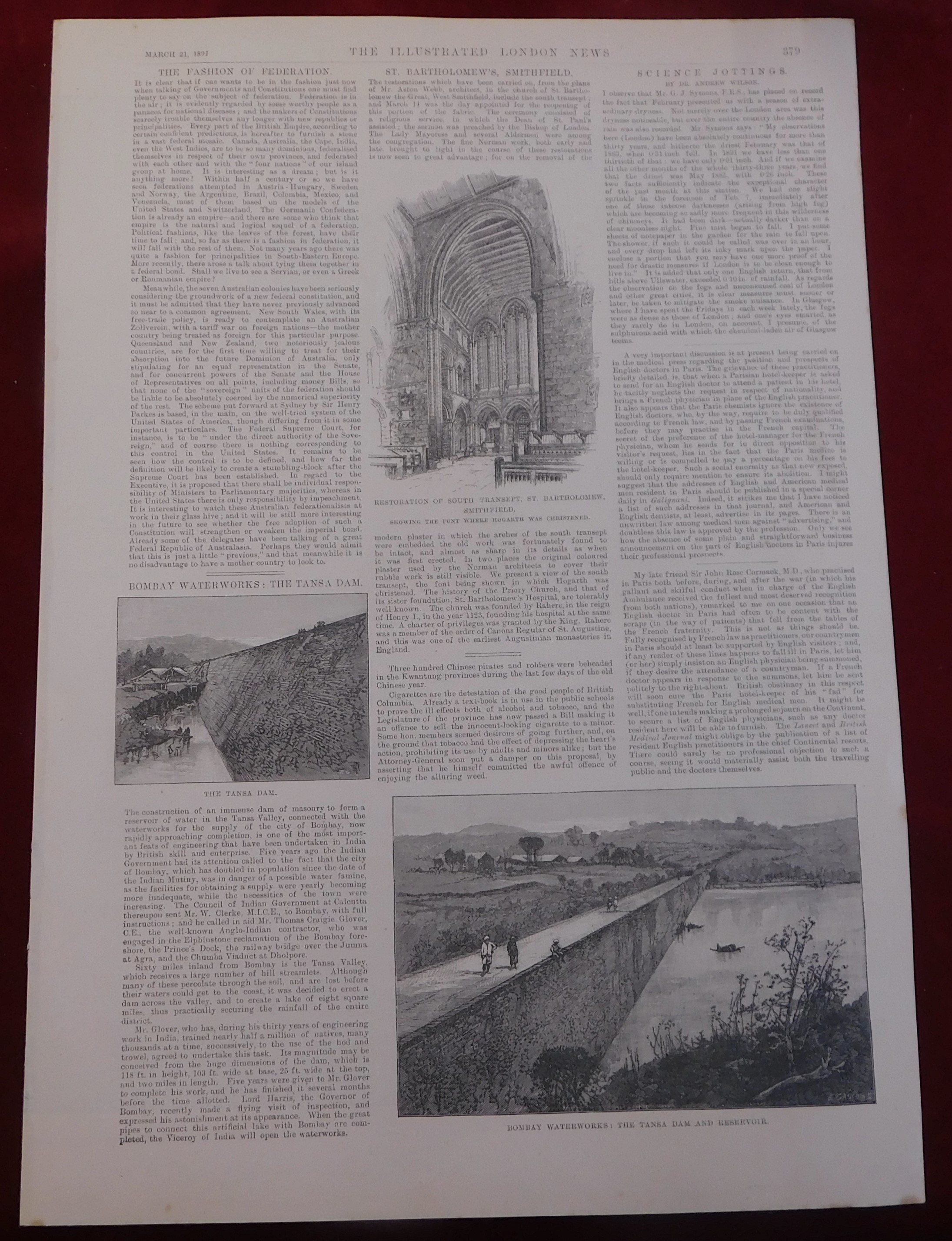
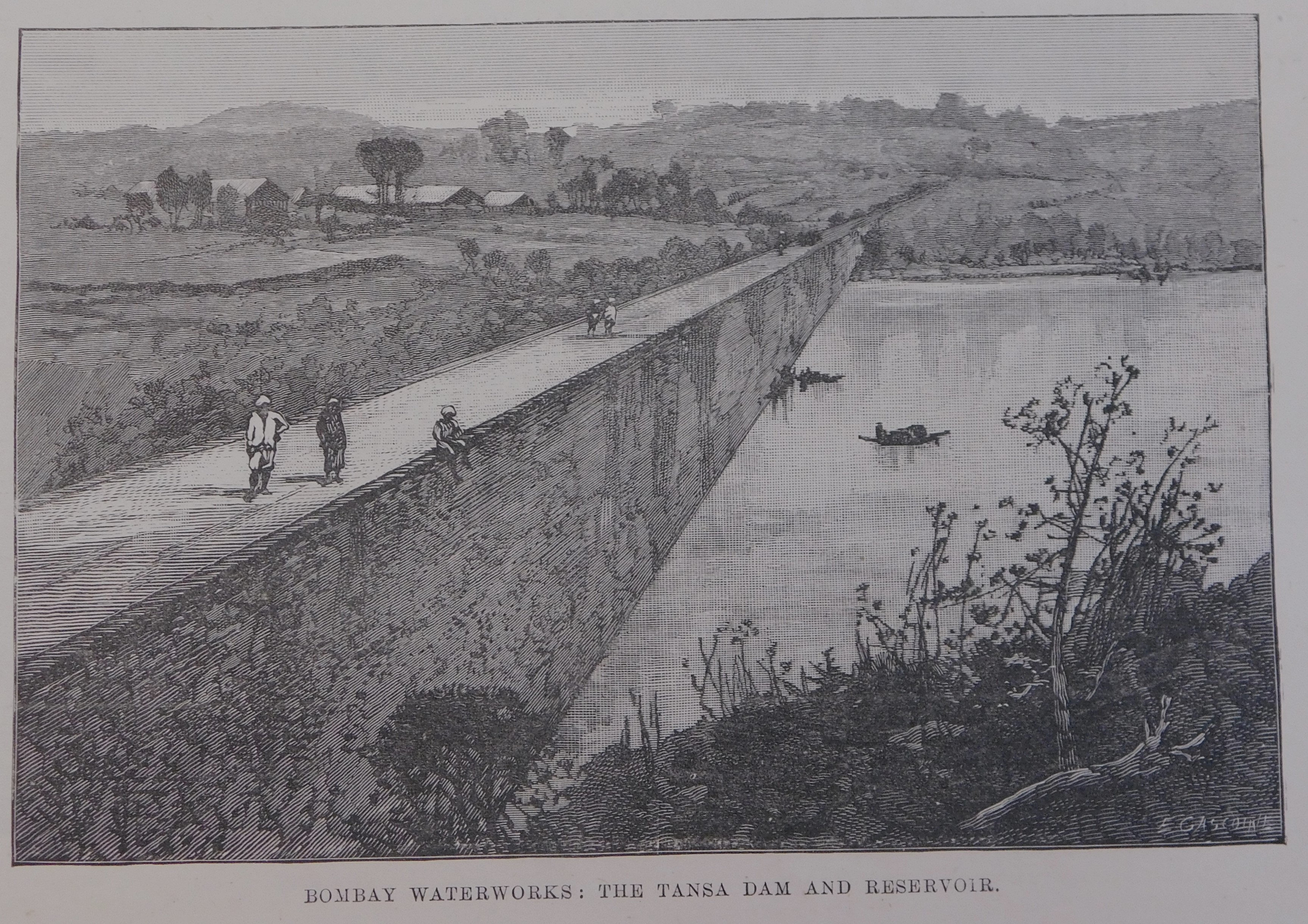
As a lead in to the final section I have a few more ephemera images, including the rest of the gallery for lot 702…

It is getting to the time of year when really good things to photograph become harder to come by, but I do have my usual sign off…

Afghanistan Out

A look at developments in the cricket world cup, with a special focus on today’s match between Afghanistan and South Africa – a valedictory on Mohammad Nabi and an acknowledgement of a new star in cricket’s firmament, Azmatullah Omarzai. Also a prize winning photograph and one of my regular galleries.

The 2023 ODI Cricket World Cup is approaching its conclusion, with the final round of group fixtures being played. I did not witness a single ball of either Tuesday’s or Thursday’s games because of work commitments, and England’s performance on Wednesday while impressive in isolation merely applied an unwarranted late gloss to what has been an appalling tournament for them. Today’s match was between Afghanistan and South Africa. South Africa are already qualified for the semi-finals, where their opponents will be Australia. Afghanistan had the slenderest of chances of taking the fourth slot going into today (slenderer by far than the threads holding the mythical sword above Damocles).

To overhaul current fourth placers New Zealand on net RR Afghanistan needed a record breaking win – they would have to bat first, and would need win by at least 438 runs. They won the toss and chose to bat (no one in their right minds puts this South Africa side into bat even if it is not absolutely mandated by the group situation, do they Jos?). Unfortunately, this was not a pitch for heavy scoring, and it was soon apparent that Afghanistan were not going to score enough to give themselves any chance of qualifying. In the end the main question as their innings headed to towards the end of the scheduled 50 overs was as to whether Azmatullah Omarzai, of whom more later, would manage to complete a century. When he found himself facing the bowling, on 97 not out with three balls to come it looked on, but it was not to be. He failed to score off any of the three deliveries, and the number 11 was run out of the final ball of the innings. Afghanistan had scored 244 from 50 overs, with Gerald Coetzee, a fiery and talented young fast bowler, taking 4-44, and Keshav Maharaj achieving a notably economical analysis with 2-25 from his full 10 overs of left arm spin.

There were times in the innings when it looked like Afghanistan might be signing off with a victory – South Africa never got right away from them. Rashid Khan had 2-37 from 10 overs of leg spin, the veteran Mohammad Nabi topped him with 2-35 from 10 overs of off spin in what may well be the last world cup innings in which he features as a player. Nabi has an extraordinary playing history, having been part of the Afghanistan men’s side for their entire history as a cricketing nation, and having played his part in victories over no fewer than 43 different opposing countries. The least impressive of Afghanistan’s four front line spinners was Mujeeb Ur Rahman, with 1-51 from his 10 overs. He seems to feel an obligation to showcase his variations by bowling six different types of delivery per over, a strategy that in T20s can work very well, but in longer formats he would be better served by bowling his stock ball four or five times in an over and slipping in the variations every so often as a surprise. Andile Phehlukwayo eventually finished things in the 48th over when he hit left arm seamer Naveen-ul-Haq for 6,4,6 in successive balls to get his side over the line. Afghanistan are thus sixth in the group, which is the lowest they can finish. Tomorrow sees Pakistan in action against England. If Pakistan can conjure a win by 287 or more runs they will pip New Zealand to the final qualifying slot, while if they suffer a heavy defeat in going for the huge win they need they might drop below Afghanistan in the standings. The scorecard of today’s match is available here.

The young Afghan all rounder (RHB, RMF) has had an excellent tournament, and I regretted that he missed out on his century today, though of course that particular tally only has significance because we use base 10. I am sufficiently convinced by what he has done this tournament that although I usually base my judgements for such things on long form cricket I am prepared to change my all time Os XI – he displaces Irish seam bowling all rounder of yesteryear Alec O’Riordan from the number six slot in that XI. He has been one of the finds of this tournament as an individual, just as teams wise his team have been THE find of the tournament.

The results of the West Norfolk Autism Group autumn photography competition are in, and I won a £10 Amazon gift voucher for this picture:

When I took this picture on October 10th this autumnal leaf on which you can see both a snail with a very dark shell and much lighter coloured slug was still attached to it’s branch, though clearly almost ready to fall. I got a second picture out of this shot, focussing more closely on the snail.

Now for my usual sign off – some photographs from the last few days (to view any of these at a larger size just click on them)…

A Historic Day at the World Cup

A look back at today’s world cup match between Bangladesh and Sri Lanka, which featured a classic century from Charith Asalanka, 90 from Najmul Hossain Shanto, a Player of the Match all round performance from Shakib Al-Hasan and a moment of cricket history – the first ‘Timed Out’ dismissal in any international match. Also a photo gallery.

Today’s match at the 2023 ODI World Cup was between Sri Lanka and Bangladesh. A win for Bangladesh would mean that England stood alone as the sole team with as few as two points, while a win for Sri Lanka would effectively book their place in the 2025 Champions Trophy.

Bangladesh won the toss and decided to bowl first. Sri Lanka’s fourth wicket fell at 135. Angelo Mathews came in at that point. One minute and 54 seconds after the fall of the fourth wicket Mathews put his helmet on and tried to tighten the strap, which promptly broke. Mathews then had a bit of a laugh and called for a replacement helmet. Shakib Al-Hasan, mindful of the laws of the game and the playing conditions in force for this tournament, appealed, and the umpires had no choice but to give Matthews ‘Timed Out’ for not being ready to face the ball within two minutes of the wicket falling. Mathews eventually left the crease, and as he crossed the boundary he petulantly flung down his bat and helmet.

The Laws of Cricket require that the new batter be ready to face within three minutes of the fall of a wicket, while this tournament has a playing condition in place tightening that to two minutes. The Sri Lankan numbers 3,4 and 5 had all been ready within about 100 seconds of the fall of the wicket. Mathews was testing the limits even before his helmet strap broke while he tried to tighten it. The umpires apparently checked twice with Shakib Al-Hasan as to whether he wished to withdraw the appeal, and he quite rightly refused to do so – Matthews was out fair and square.

It was the first time anyone had been given ‘Timed Out’ in any international fixture, though there are six official incidents from first class matches and from before ‘Timed Out’ was officially introduced there is the case of Harold Heygate for Sussex v Hampshire, who originally did not intend to bat since he was suffering from rheumatism, but at the crisis decided to attempt to go in, took too long to reach the middle and was denied his innings. A detailed analysis of the Mathews dismissal can be found here. For more on bizarre dismissals, here is a link to a post I created during the first Covid lockdown.

The rest of the Sri Lankan innings after Mathews’ zero ball duck was dominated by Charith Asalanka. The talented left hander scored a splendid 108, which enabled his side to reach 279 from 49.3 overs by the time their tenth wicket fell. Shakib Al-Hasan had 2-57 from his 10 overs of left arm spin, as well as playing his role in the historic Mathews wicket.

I missed a chunk of the Bangladesh innings due to having to visit my surgery. Bangladesh were firmly in control by the time I got home, and did not seriously look like losing at any stage, though they lost a few late wickets. Najmul Hossain Shanto scored 90 off 101 balls, and Shakib Al-Hasan 82 off 65 balls. Bangladesh won by three wickets with 8.5 overs to spare, a result which moved them above Sri Lanka in the table, and left England even more firmly nailed to the foot of the table than they already were. The Sri Lankan players refused to shake hands with their Bangladeshi counterparts at the end of the match. Shakib Al-Hasan’s all round contribution earned him the Player of the Match award.

My usual sign off…

India Looking Dominant at ODI World Cup

A look back at the weekend’s action in the 2023 ODI World Cup – a somewhat fortunate two points for Pakistan, two rather more well earned points for Australia and an utterly dominant display by hosts India in today’s table topping clash with South Africa. Also a large photo gallery.

Since I last posed there have been three matches at the ODI Cricket World Cup: New Zealand v Pakistan, Australia v England and India v South Africa. This post looks at these matches and at the state of play in the tournament.

Pakistan won the toss and elected to bowl first, a type of decision that has a terrible track record at this tournament. That did not look like changing when New Zealand were batting – at the end of the 29th over I tweeted that a total of 400 was on for the Kiwis, and 21 overs later when their innings had run its course they were 401-6. A combination of an amazing innings from Fakhar Zaman, solid support from Babar Azam and good reading of the Duckworth-Lewis-Stern situation by Pakistan saved them from a poor decision at the toss. With rain threatening Pakistan started to seriously increase their scoring rate from the end of the 15th over onward, and by the time of the first intervention, in the 21st over they were 10 runs ahead of where they needed to be according to DLS. When the second and final interruption came midway through the 26th over they had increased their advantage to 20, and emerged with the two points when the rest of the match was rained out. It was well judged by Pakistan to get themselves significantly ahead of where DLS said they needed to be – there have been some famous mishaps involving DLS calculations, such as Mark Boucher studiously blocking a ball with the rain already falling in the belief that his side were already ahead on DLS, when they actually needed a single off that ball to get ahead. At the same time I feel that the Kiwis were hard done by – I don’t think that had the match been allowed by the weather to go the distance that Pakistan would have pulled off this chase would have been over 50 runs more than the biggest successful full distance chase of the tournament so far.

At 8AM UK time yesterday Jos Buttler won the toss at this match, and moments later uttered what has become something of doom laden phrase at this tournament “we’re going to bowl”.

This was not actually by any means one of England’s worst efforts of the tournament, though that is more a reflection of how bad they have been than of how good they were on the day. However, even with the bowlers showing up and restricting Australia to 286 from their 50 overs, it was never terribly close, and the final margin of 33 runs flattered England rather than Australia.

India were playing a world cup match at Eden Gardens, Kolkata for the first time since 1996 (that game was a disgrace for India in two ways, first they were totally outplayed by Sri Lanka, and second it was called off early and awarded to Sri Lanka because with India over 100 adrift with just two wickets left the “fans” rioted rather than suffer the closing stages of a defeat). Today’s match was billed as a clash of the titans, featuring as it did the two best teams of the tournament to date. India won the toss and chose to bat first, virtually a mandatory decision when facing South Africa (just ask Jos Buttler and Tom Latham, both of whom made the wrong decision in this situation)…

Rohit Sharma played some beautiful strokes early on, while Shubman Gill hit four fours and a six on his way to 23, but also allowed 18 dot balls to be bowled to him. India scored 91 off the first 10 overs and a huge total looked on. However, South Africa looked to have fought back quite well when India finished on 326-5 from their 50 overs. Virat Kohli equalled Sachin Tenulkar’s career tally of 49 ODI hundreds, while Suryakumar Yadav and Ravindra Jadeja provided some late hitting.

South Africa started their reply badly and it never got any better. Ravindra Jadeja followed his batting cameo by claiming five wickets with his left arm spin, while everyone else also bowled well. South Africa scraped up a beggarly 83 in 27.1 overs, going down by 243 runs, the biggest margin of defeat South Africa have ever suffered in any ODI (some of the sides from South Africa’s first incarnation as a test nation between 1889 and 1971 took some absolute thumpings). India had batted well, but it was the bowling that was really notable in this performance. Usually batting sides try to find a bowler or bowlers they can target and see if they can force the bowling side into using minor bowlers, but when an attack features three top class pacers and two top class spinners all of whom are in good form this is rather difficult to do.

India are now looking extremely likely to win the tournament – their performance against South Africa today was simply awesome, and was the second successive time they had bowled an opposition team out for under 100 while defending, a detail which might make Sri Lanka feel a little less ashamed of their own capitulation a few days ago. South Africa are qualified for the semi-finals and are likely to hang on to second place, meaning that they are most likely to face Australia in the semi-finals. The fourth semi-final slot is up for grabs between Afghanistan, New Zealand and Pakistan (listed in alphabetical order for the avoidance of prejudice). Bangladesh, England, Netherlands and Sri Lanka are battling for the minor places, with 7th and 8th in the group gaining qualification for the 2025 Champions Trophy. Personally I reckon that England deserve to finish the tournament precisely where they currently are: stone last. That would force them to make the necessary wholesale changes.

My usual sign off…

Afghanistan in the Hunt for Semi-final Slot

A look at today’s world cup match between Afghanistan and the Netherlands, and the affect that the result has on the battle for semi-final qualification. Also a very large photo gallery.

Today’s world cup match saw Afghanistan facing the Netherlands. This post looks back at that match and at the fight for a semi-final slot. I did not catch a single ball of yesterday’s game in which India obliterated Sri Lanka (another “we’ll have a bowl” disaster at this world cup – India put in to bat tallied 357 from their 50 overs and Sri Lanka sank to 55 all out in response).

Afghanistan opted to go with four front line spinners, relying on Fazalhaq Farooqi and Azmatullah Omarzai to bowl such seam as was required. The Netherlands won the toss and chose to bat first, clearly the correct decision on a turner. However, winning the toss and making the right decision are the first two steps of a three-step process, with the third step, playing good cricket, by far the most important…

The Netherlands started very well, but the dismissal of O’Dowd, run out for a rapid 42, put the skids under them. That dismissal made it 73-2, and Colin Ackermann and Sybrand Engelbrecht put on 19 together before Ackermann became the second run out victim of the innings. Scott Edwards was then given Run Out first ball to make it 92-4. This was unlucky for Afghanistan keeper Ikram Alikhil, who pulled off a superb piece of work behind the stumps and deserved by credited with a stumping, but apparently Edwards had made contact with the ball, which meant that officially it had to be called a run out. Five runs later Bas de Leede played a wild shot at Mohammad Nabi and succeeded only in edging to Ikram Alikhil to make it 97-5. Saqib Zulfiqar offered Engelbrecht some support, but after scoring a very slow 3 he edged one from Noor Ahmad into the safe gloves of Alikhil and it was 113-6. Logan van Beek stayed while a further 21 runs accrued, of which his share was 2, before he was stumped by Alikhil. Roelof van der Merwe helped the Netherlands past the 150 mark, but shortly thereafter caused the run out of the determined Engelbrecht for 58 (86), and it was 152-8. Roelof van der Merwe and Aryan Dutt devoted themselves almost solely to seeing out overs at this point. The first really aggressive shot by either, from van der Merwe resulted in a lobbed catch to Ibrahim Zadran off Noor Ahmad to make it 169-9. Dutt and Paul van Meekeren cobbled together another 10 for the last wicket before Mohammad Nabi trapped van Meekeren LBW. The Dutch number 11 reviewed it, but it was plumb and the Netherlands were all out for 179 in 46.3 overs. 38.3 of those overs had been bowled by spinners, an all time record for a men’s world cup match. Ikram Alikhil had had a hand in six of the wickets, the three officially credited to him, and three of the four run outs (one was a direct hit throw from Azmatullah Omarzai), and with the four run outs and one official stumping this was the first ever men’s world cup innings in which as many as five batters had been out through being out of their crease at the wrong time. The Netherlands had lost their last nine wickets for 106 runs, and their last eight for 87.

Can be summed up with one word: clinical. Although both openers were out cheaply Rahmat Shah and Hashmatullah Shahidi had a fine partnership for the third wicket, and then Azmatullah Omarzai joined Shahidi in the stand that saw Afghanistan over the winning line with 18.3 overs to spare. Rahmat Shah scored 52 (54), Omarzai 31* (28) and Shahidi 56* (64), a thoroughly professional display from the numbers three, four and five for Afghanistan. This puts Afghanistan firmly in the mix for a semi-final slot. If they can beat either Australia or South Africa, their last two opponents, that will probably be enough for them. New Zealand look the most vulnerable of those currently in qualifying slots – they have lost three in a row, while India and South Africa are both guaranteed to qualify, and Australia could only be dragged into the dogfight for the fourth slot if they somehow lose against bottom of the table England tomorrow.

Just before I terminate this post, two posts ago I included in my gallery two street names which each connected to two cricketers. The connections are as follows: Wyatt Street – current England T20I women’s opener Danni Wyatt and former England men’s captain Bob Wyatt, and Archdale Street – England women’s first ever captain, Betty Archdale, and former long serving Somerset wicket keeper the reverend Archdale Palmer Wickham.

Now for my usual sign off…

Fourth Semi-Final Slot up for Grabs

A look back at the match between New Zealand and South Africa in the 2023 ODI Cricket World Cup, and a brief look at the ramifications of the result for the tournament as a whole. Also a very large photo gallery.

Today’s match at the 2023 ODI Cricket World Cup saw New Zealand face South Africa. This post looks back at the match and at the ramifications of today’s result.

New Zealand skipper Tom Latham won the toss, which was probably the last thing that went right for his side on the day. South Africa had batted first four times this tournament and never scored below 300 on any of those occasions, New Zealand are not a stellar chasing side. Yet, for some reason unknown to anyone other than himself Latham decided to put South Africa in to bat.

When Temba Bavuma was out fairly early, with just 38 runs on the board things weren’t looking all that bad for New Zealand. However, the second wicket stand between Quinton de Kock and Rassie van der Dussen illustrated precisely why putting the Proteas in is a poor idea. They got themselves in, and gradually increased the tempo as the danger of a sudden crash of wickets faded. After 35 overs the score was 194-1, and while some were criticising the SA second wicket pair for not having upped the rate enough by then, I tweeted at that point that they were well placed, and that a total of significantly above 300 looked more likely than not and that 350 couldn’t be ruled out. Quinton de Kock completed his fourth century of this world cup, joint second most for a single edition ever behind the five Rohit Sharma scored in 2019, and in the process became the first South African to score 500 runs in a single edition of the tournament, putting the all comers record, Sachin Tendulkar’s 673, in severe danger of being broken. Rassie van der Dussen opened out after a sedate start and moved his own rate to better than a run a ball, as he too completed a century. It was de Kock who was second out, ending a stand of exactly 200. David Miller came in at number four, and when van der Dussen was third out with only 17 balls left in the innings Heinrich Klaasen joined the fray. Miller was out to the second last ball of the innings for 53 (30) to make it 351-4, and Aiden Markram came out to face one ball, which he despatched for six giving South Africa a final score of 357-4. 163 of those came in the last 15 overs and 119 in the last ten as South Africa once again demonstrated their ability to butcher opposition attacks in the closing stages of an innings. They were helped by a hamstring injury to Matt Henry, but the heaviest blow to Kiwi hopes had happened at the toss with that awful decision by Latham.

My tweet at the 35 over mark (a reply to Lawrence Bailey):

https://x.com/aspitweets/status/1719672685507105159?s=20

New Zealand faced a daunting task, and it only got more daunting as the innings progressed. Wickets fell with remorseless regularity, run scoring was difficult at all times, and there was little prospect at any stage of a successful chase. New Zealand lost their ninth wicket at 133, still 224 runs adrift, and the injured Matt Henry came in to bat in a desperate effort to mitigate the hammering their net RR was taking. Some good blows from Glenn Phillips reduced the margin to below 200, but with the score at 170 he took one chance too many and offered up a straightforward catch, which ended the match with a margin of 184 runs. Keshav Maharaj claimed four wickets with his left arm spin, Marco Jansen three with his left arm pace, Gerald Coetzee two and Kagiso Rabada one, leaving Lungi Ngidi wicketless. Rassie van der Dussen was named Player of the Match for his 133. A full scorecard can be viewed here.

This is New Zealand’s third straight defeat, and opens the way for Afghanistan or Pakistan to displace them from the semi-finals. Afghanistan have played a game fewer than either New Zealand or Pakistan, and their next match is against the Netherlands, which they would regard as a major opportunity. Their other two group games are against South Africa and Australia, with the former requiring that they bat first and then bowl well in defence of whatever they manage to post, and the latter almost certainly against a side who will have guaranteed qualification by then and therefore probably easier than if they met them earlier in the tournament. Pakistan still have New Zealand to play, a huge game in the context of developments in the tournament so far, and their other remaining game is a more or less guaranteed two points against the demoralized, disorganized rabble masquerading as “England”.

My usual sign off…