All Time XIs – Great Test Matches I Did Not Get To Witness

11 of the greatest test matches that I know about only at second hand – I may have watched highlights of them, read about them or both of the foregoing, but I did not witness them live.

This is a follow up to my earlier post about great test matches I did get to witness. These are matches I have read about and/or witnessed highlights of but did not get to follow live at the time. The matches are listed ibn chronological rather than ranking order, and to set the tone there is match not of test status as an hors d’oeuvre.

MCC V AUSTRALIA, LORD’S 1878 – A WARNING SHOT

The Australians had had a rough start to their tour of England in what was a very wet summer. When they arrived at Lord’s to take on the MCC few gave them much of a chance. MCC were fielding a very respectable side, with the mighty WG Grace to the fore. MCC batted first, and Frank Allan, a graceful left armer dubbed ‘bowler of the century’ in the run up to the tour shared the new ball with Harry Boyle, a medium pacer of exceptional accuracy. WG Grace hit the first ball of the match for four, but was out to the second. Another wicket fell one run later, but then Albert ‘Monkey’ Hornby and Arthur Ridley shared what turn out to be the largest partnership of the match. The moment that tilted this game towards being a historic one was when Frederick Robert Spofforth was called upon to bowl in place of Allan. Spofforth destroyed the MCC middle and lower order with sheer pace, a high water mark of 27-2 becoming 33 all out. Spofforth had taken 6-4 for the innings. The Nottinghamshire pair of Alfred Shaw (right arm slow/ medium) and Fred Morley (left arm fast) took the new ball for MCC. Australia fared little better than the home side, limping to 41 all out, with Shaw following the general pattern of his career by bowling considerably more overs than he conceded runs. For the second MCC innings Spofforth was given the new ball alongside Boyle, and MCC were rolled for a paltry 19, Boyle taking 6-3 and Spofforth 4-16. Charles Bannerman fell early in the fourth innings, but Billy Midwinter and Tom Horan saw Australia to a nine wicket win. The match was over on the same day it started, the thick end of a century before games with that intention would become a regular thing in top level cricket, and the aggregate of 105 runs remains the smallest ever for an FC match with a definite result. This tour did not feature any test matches, but the next visit by Australia in 1880 did, England winning a hastily organized match in September of that year by five wickets.

ENGLAND V AUSTRALIA, THE OVAL 1882: ASHES BORN

Unlike its predecessor in 1880 this match was planned when the tour itinerary was created. Albert ‘Monkey’ Hornby captained England, a mistake, espeically given that Spofforth, the leading Australian bowler, had a hex on him (if they weren’t yet prepared to appoint WG Grace who would have been the best choice then Lord Harris would have done). Rather than Hornby, EM Grace should have been the other opener for England (as he was in 1880, when he and WG put on 91 together in the first innings). However, all seemed rosy when Australia were dispatched for 63 in their first innings, and England responded with 101, Yorkshireman George Ulyett top scoring with 26. Hugh Massie now played a crucial innings for Australia, scoring 55 of the first 66 runs in their second innings and propelling them into credit with only one wicket down. Once he was out there was little more to the Australian innings, though Murdoch batted through such of it as there was to finish on 29* in a score of 122. The single most significant moment of the innings was the dismissal of Sammy Jones, who left his crease to pat down the pitch with the ball not officially dead. Grace, fielding at point, ran him out, a move which provoked Spofforth to absolute fury. While England were preparing to chase 85 to win Spofforth was telling his team mates “this thing can be done”. Grace and Hornby put on 15 for the first wicket, but then Hornby and Richard Barlow, also of Lancashire, were both out at that score. Grace and Ulyett shared a fine partnership, but Ulyett was dislodged with the score at 51, and two runs later, Grace, only the second player in the game to record a score of above 30, was dislodged for 32, making it 53-4. It was at this juncture that things turned against England. Lyttelton and Lucas, paralysed by nerves, could barely score, and skipper Hornby started panicking and messed with his batting order. When Lyttelton was dismissed to make it 66-5 the panic really set in, Hornby holding CT Studd, scorer of two centuries against the Aussies that season, back in the order until the eighth wicket fell. Billy Barnes was dismissed shortly after Studd’s arrival to make it 75-9, and Peate had three balls to survive from Harry Boyle before the end of the over. He scored two off the first of these, but a wild swing at the second met fresh air, while the ball clattered against his stumps. England 77 all out, and beaten by seven runs. Studd, with his two centuries against the Aussies earlier that season, was 0* (0), not the least ridiculous feature of this ridiculous match.

AUSTRALIA V ENGLAND, SCG 1894: 586 BATTING FIRST…

England were captained by Andrew Stoddart, Australia had entrusted veteran wicket keeper Blackham (who had played the first test match of all in 1877) with the captaincy. Blackham won the toss and batted. Tom Richardson the great Surrey fast bowler claimed three early wickets, but the then George Giffen and Frank Iredale joined forces. Their stand, apparently helped by some clumsy keeping on the part of Leslie Gay, yielded 171 runs, and then after Iredale’s dismissal Syd Gregory joined the fray, adding a further 139 with Giffen before the latter fell for 161 just before the end of day one. Australia closed on 346-5. On day two Syd Gregory completed a double century, only the second ever achieved in test cricket, and with Blackham scoring a test best 74 Australia reached 586.

England were all out for 325 in their first innings, Albert Ward top scoring with 75. They were made to follow on, and when the sixth wicket went down at 296, with the lead still only 35 Australia still looked well place. However, Francis Ford and Johnny Briggs put on 89 together for the seventh wicket, and even the tail made contributions. England mustered 437 in this second innings, setting Australia 177 to win. Jack Lyons began breezily, hitting 25 in 15 minutes at the crease, but after he and Harry Trott were both out, Giffen opted to play safe, making sure he was still there for the following morning (tests in Australia were played to a finish in those days). Australia close on 113-2, needing just 64 the following morning, Darling 44*, Giffen 30*. Overnight it rained (pitches were uncovered in those days, and overnight rain, followed by strong Australian sun the following morning created what was known as a ‘sticky dog’), though England’s trump card in such circumstances, left arm spinner Bobby Peel, did not hear the rain following, as he had given the match up for lost and drowned his sorrows in emphatic fashion. The Australians certainly did realize that it had rained. Peel and fellow left arm spinner Johnny Briggs gradually tightened the screw on Australia, and the ninth wicket went down with Australia still 15 short. Blackham was last man in, nursing a cracked thumb, and the other remaining batter, Charlie McLeod did his best to protect the injured keeper, ultimately Blackham prodded a catch back to Peel and England had won by 10 runs, with Peel having innings figures of 6-67.

OLD TRAFFORD 1902 – ENGLAND V AUSTRALIA

A spat between chairman of selectors (Lord Hawke, Yorkshire) and captain (Archie MacLaren, Lancashire) led to an odd looking England side. MacLaren wanted Schofield Haigh, but Hawke would not release him. MacLaren in a fit of pique at this left another Yorkshireman, George Hirst, out on the morning of the match, handing a debut to 35 year old Fred Tate of Sussex.

Australia batted first, and by lunch they were 173-1 with Victor Trumper having reached three figures, the first ever to do so on the first morning of a test match. Post lunch England did better, but a rapid partnership between middle order left handers Clem Hill and Joe Darling (73 in 45 minutes) helped Australia to reach 299. England began poorly, but a big stand between FS Jackson and Len Braund, plus some further lower order support for Jackson (128) got England to 262. Australia in their second innings were 10-3 and should have been 16-4, but MacLaren had high-handedly refused to move Lionel Palairet, a fellow amateur, from square leg to the right hander to square leg to the left hander, sending Fred Tate (who fielded close to the bat for Sussex) out there instead. Tate dropped a chance offered by Darling, and the partnership added 46 further runs. Thereafter it was a procession and Australia mustered just 86 second time round, setting England 124 to win. At 92-3 England appeared to be cruising home, but then a collapse set in. When keeper Dick Lilley was brilliantly caught by Clem Hill, who ran 30 yards round the boundary and threw himself full length to make the catch, it was 116-9 and Fred Tate joined Wilfred Rhodes. Tate snicked a boundary off Jack Saunders to open his account, but then Saunders’ next ball kept fiendishly low and bowled the unfortunate Tate to give Australia victory by three runs.

THE OVAL 1902ENGLAND V AUSTRALIA: A REVERSAL

George Hirst and Gilbert Jessop returned for England after missing the match described above. Australia batted first and tallied 324, Hugh Trumble top scoring with64* and Monty Noble making 52. Trumble then turned to his more publicized ability, bowling unchanged through the England first innings, taking 8-65. England avoided the follow on only thanks to Hirst who scored 43 out of the last 54 runs of the innings. Australia at the second time of asking were all out for 121, setting England 263, which looked a massive total in those circumstances. It was looking even further distant by the time Saunders (four wickets) and Trumble (one) had reduced England to 48-5. At this point Gilbert Jessop joined FS Jackson and the match began to turn. Jackson fell for 49 with the score at 157, and George Hirst joined Jessop. This pair added 30 together in just eight minutes, Jessop completing three figures in 75 minutes and off his 76th ball, both still England records, though the latter has seemed under constant threat lately. Jessop fell for 104, making it 187-7, and still 76 needed from the last three wickets. However, Bill Lockwood stayed with Hirst while 27 of those were scored, and keeper Dick Lilley helped add a further 34, meaning that when fellow Yorkshireman Rhodes joined Hirst in the middle 15 were needed with one wicket standing. England inched their way towards the target, and finally Rhodes hit the winning single off Trumble. Trumble had scored 71 undefeated runs with the bat and captured 12 wickets, Hirst had 101 runs for once out and a first innings five-for but this is always called “Jessop’s Match”. Lionel Palairet gained two England caps – the Old Trafford and Oval tests of 1902.

MCG 1907 – AUSTRALIA V ENGLAND – NEARLY A TIE

This was a match which swing back and forth but seemed settled in Australia’s favour when England were 209-8 in the final innings, needing 73 more to win. Joe Humphries was ninth out, with 39 still needed for the win, to an LBW which added fuel to the flames of a controversy – England had had several rough LBWs in that match, George Gunn being furious about the two given against him. Arthur Fielder, a fast bowler, but as he was to show both here and a little later for Kent when sharing a last wicket stand of 235 with Woolley no mug with the bat, joined Barnes in the middle. The last wicket pair chipped away at the target and eventually levelled the scores. Barnes then went for a winning run that Fielder was unsure about. Had the fielder, Gerry Hazlitt, kept his head and lobbed to the keeper test cricket would have seen its first ever tied match. As it was, Hazlitt panicked and shied wildly at the stumps, missing and allowing the completion of the winning run.

MCG 1928 – AUSTRALIA A ENGLAND – ASHES HELD

England had comfortably won the first two matches of the series, but although Hammond had already entered the record books by becoming the first to score two consecutive test double hundreds, with 200 in the first England innings, it looked long odds against a third win in a row when England set off in pursuit of a victory target of 332 on a pitch that had become so spiteful that opening batter Jack Hobbs reckoned it would be all over by the tea interval. As it turned out Hobbs and Herbert Sutcliffe, the other opener, were still both in residence by said interval, and midway through the evening, with the great pair still together Hobbs made a vital intervention, sending a message to the dressing room that if either opener fell that evening Jardine should be promoted to number three as his defence was more reliable than Hammond’s. Hobbs was the one to go, for 49 out of an opening stand of 105, and Jardine duly survived the remainder of the evening and England returned the following morning still only one down. Jardine contributed a crucial 33, Herbert Sutcliffe went on to 135, and although England had a bit of a stutter late on, George Geary, who had claimed the final wicket of the 1926 Ashes, smashed a four through mid-on to seal a three wicket win and with it retention of The Ashes.

OLD TRAFFORD 1956 – ENGLAND V AUSTRALIA

Good pitch which one side handled badly or spinners paradise made to order? England batting first ran up 459 in rapid time. Although Australia’s two recognized spinners, leg spinner Benaud and off spinner Ian Johnson claimed six scalps between them, they also leaked 274 runs while doing so.

Jim Laker, England’s off spinner, took the first two Aussie wickets, before Lock claimed the third, which opened the floodgates for Laker, who polished off the Aussie first innings with a spell of 7-8, giving him 9-37 in total. Regular rain interruptions and a fine defensive effort by Aussie opener Colin McDonald took the game into the final day. Eventually, with the second ball of his 52nd over, Laker trapped Maddocks LBW and Australia were all out for 205, beaten by an innings and 170 runs. Laker had all ten Aussie second innings wickets for 53, still the cheapest all ten in test cricket, and 19-90 in the match. The three other front line spinners had combined match figures of 7-380, an average of 54.29 per wicket, and earlier in the season, in the first innings of the match on a good Oval pitch Laker had recorded figures 10-88 from 46 overs against the Australians for Surrey. In all 58 of Laker’s first 100 Fc wickets of 1956 were Aussies, 46 in the Ashes series and 12 for Surrey in that tour match.

BRISBANE 1960 – AUSTRALIA V WEST INDIES

52 years after Gerry Hazlitt had failed to make the most of an opportunity to secure test cricket’s first tie Joe Solomon showed how to keep his head under pressure, executing two direct hit run outs in less than 15 minutes, first to dismiss Davidson (80), thereby giving his side a chance to save themselves, and then to seal the tie. Alan Davidson bestrode this match like a colossus, taking 5-135 in West Indies first innings 453, then scoring 44 of Australia’s reply of 505, then taking 6-87 as West Indies managed 284 second time round and finally scoring that 80 which so nearly won the match for Australia.

HEADINGLEY 1981 – ENGLAND V AUSTRALIA

This is proper script rejection stuff – not only did England record only the second ever victory by a side made to follow on, but one of the players who was key to achieving that result was not originally selected for the game and the other had been asked (albeit at most semi-seriously) if he wanted to play, having just stood down as captain (moments before he would have been sacked from that role). Australia scored 401-9 declared batting first, which was far more than they should have scored on that surface. John Dyson scored a very slow century, Kim Hughes made 89 and Graham Yallop 58, while Botham, recently resigned from the captaincy, claimed 6-95, his first five wicket haul since before taking up the reins of captaincy. England were 87-5 when Botham went in for his first innings, and a rapid 50 from him was the only highlight of their 174 all out. In the second innings they plummeted to 41-4 before Boycott and Willey added 64 for the fifth wicket. At 133 Boycott was pinned LBW, and two runs later keeper Bob Taylor departed. That brought Graham Dilley in to join Botham, and in 80 minutes the eighth wicket pair added 117, Dilley recording a maiden test 50, and Botham being well past his second 50 of the match. Chris Old helped the ninth wicket to raise a further 67, Botham racing past the 100 mark (87 balls to get there). Willis stayed long enough for a further 37 to accrue. England had totalled 356, a lead of 129, and Botham had scored 149*. The final morning was just underway. Approaching the lunch interval Australia were 56-1 and seemingly cruising towards their target of 130, when Bob Willis was put on to bowl at the Kirkstall Lane end. The first victim of one of the greatest spells of fast bowling in test history was Trevor Chappell, who in truth resembled a test match number three in name only, fending a bouncer through to Bob Taylor. Then came back to back wickets right on the stroke of lunch, Hughes well caught by Botham in the slips and Yallop superbly taken at short leg by Gatting. At lunch Australia were 58-4, and suddenly realizing that match wasn’t over just yet, while England went into lunch on a high. Old got one through Border’s defences early in the afternoon and it was 65-5. Dyson, who had one boundary off Willis post lunch took an a short ball from him and succeeded only in gloving it to the keeper to make it 68-6. Rod Marsh, the Aussie keeper, who had made a light-hearted bet on England when Ladbrokes were offering 500-1, took on another short ball from Willis, and Dilley at deep fine leg judged the catch superbly, being less than a foot inside the boundary when he completed it. That was 74-7, and one run later Lawson fell to mkae it 75-8. There was one final twist, as Lillee, who like Marsh had placed a bet on England at 500-1, helped Bright add 35 for the ninth wicket in four overs. Lillee then mistimed a drive at Willis and Gatting just managed to complete the catch, having to run in and dive forward to do so. Alderman came in at number 11, and was reprieved twice in one Botham over as Old at third slip put down catches. Willis summoned up enough energy for one final over, and with the first ball thereof he ripped a perfect yorker through Bright’s defences and Australia were all out for 111m giving England victory by 18 runs.

CHENNAI 1986: INDIA V AUSTRALIA – A TIE

Australia in the early to mid 1980s were a struggling outfit, but in this particular match they did a lot right, though not quite enough to win it. Dean Jones, in part due a vicious taunt from skipper Border, batted himself into a hospital bed, scoring 210 in eight hours at the crease on the first two days of the match, after which he had to put on a saline drip. Towards the end of the fifth day it looked like India were odds to complete their chase of 348, but Greg Matthews refused to give up, and eventually, with the scores level he trapped Maninder Singh LBW to secure test cricket’s second ever tie.

KOLKATA 2001: INDIA V AUSTRALIA – A VERY VERY SPECIAL TEST MATCH

Australia in the late 1990s and early 2000s were well nigh invincible, and the first two innings of this match did not suggest anything other than business as usual for Steve Waugh and his men, as they forced India to follow on. VVS Laxman and Rahul Dravid then produced a historic partnership, with Laxman going to a then Indian individual record test score of 281 and Dravid making 180. India declared their second innings at 657-7, setting Australia 384 to win. Australia, unsurprisingly dispirited, collapsed to 212 all out and defeat by 171 runs, the third (and to date) last test defeat suffered by a side enforcing the follow on. Australia have rarely chosen to enforce the follow on since then, preferring to build stupendous leads and then look to dismiss their opponents a second time. Myself I would still need a good reason to suggest not enforcing.

PHOTOGRAPHS

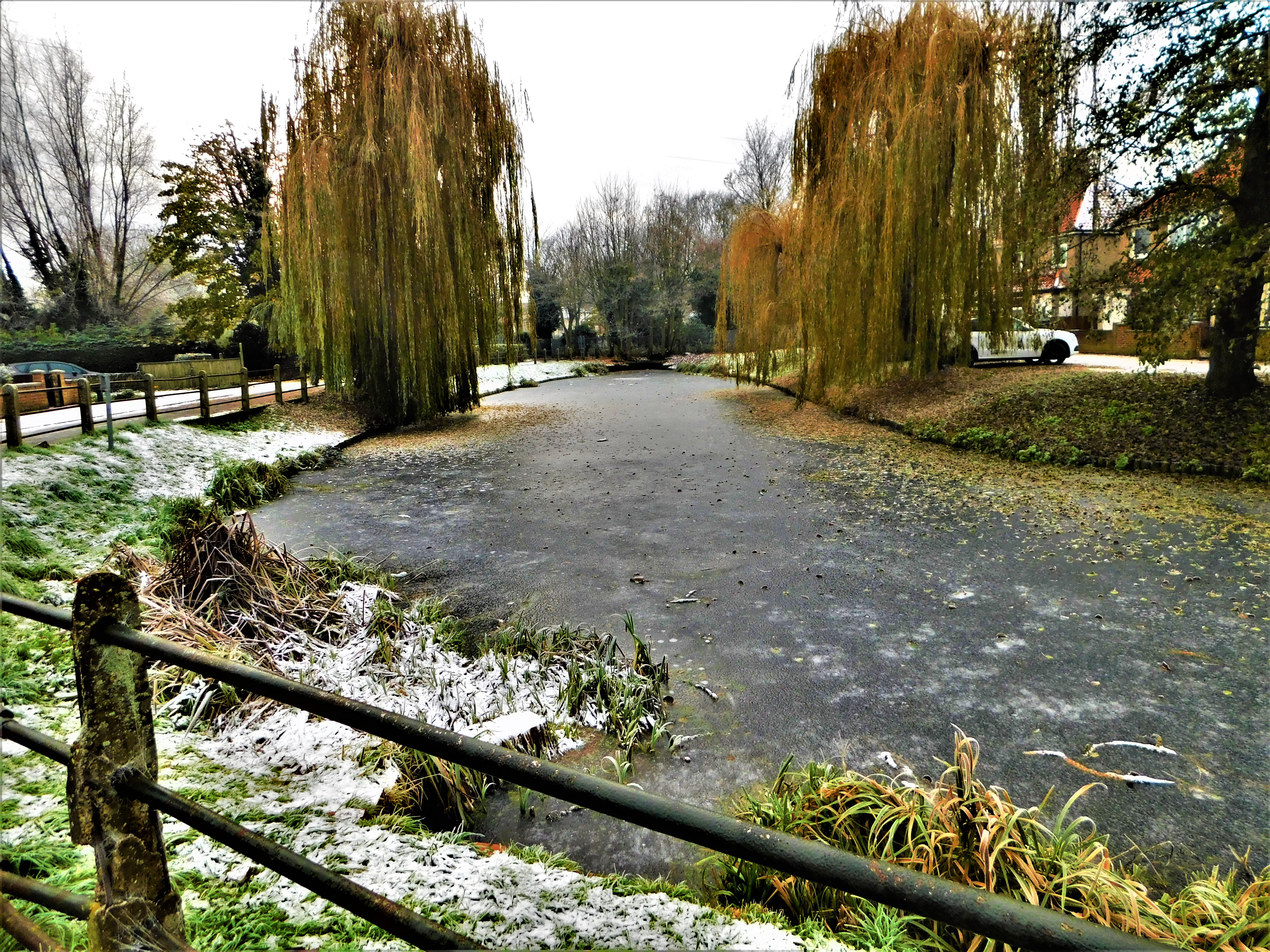
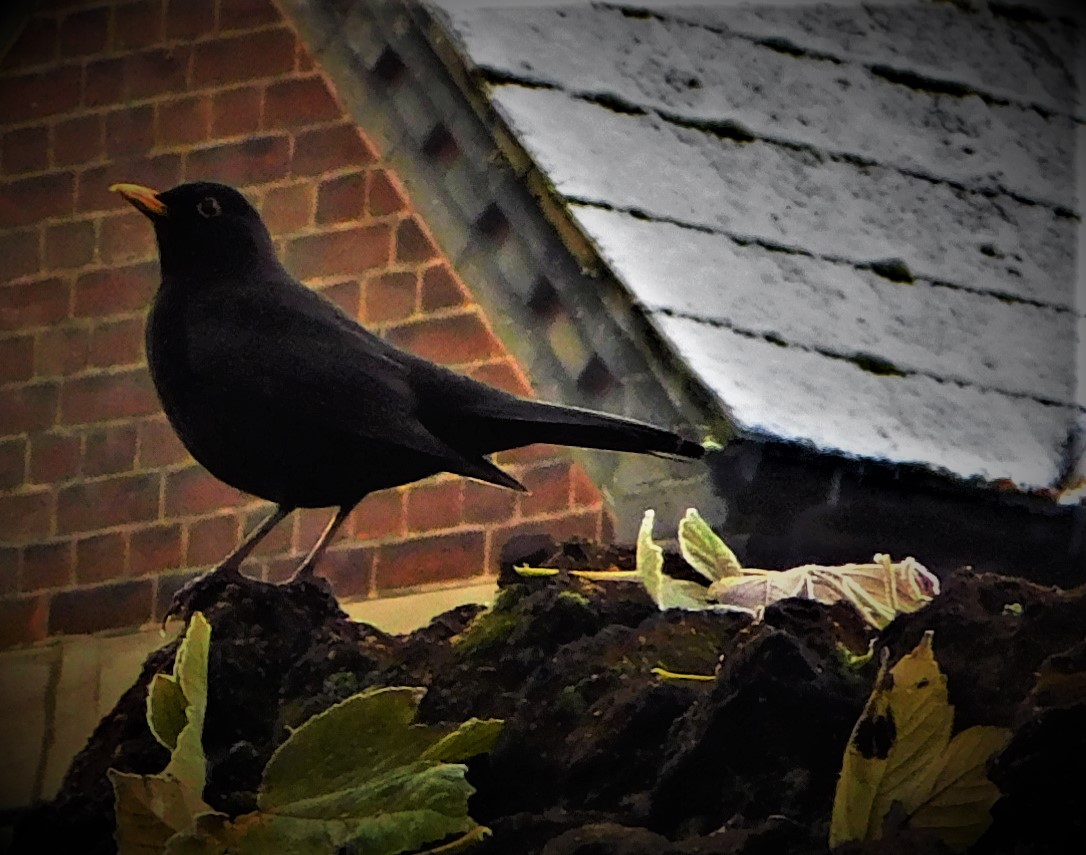
Time for my usual sign off (the gallery is smaller than usual – there is not as much to see in foul weather)…


England Seal Series Win At Multan

A look at England’s win in Multan, sealed earlier today.

This post looks at events in Multan and sets them in context. I have already covered the first two days play here, so this post takes up the story on day three.

DAY THREE

England extended their lead of 281 to 354, Brook completing a century to continue the highly impressive start he has made in test cricket. The last five wickets fell in a bit of a heap, but England had a substantial total to defend by then.

With Imam-ul-Haq initially unable to bat Mohammad Rizwan opened with Abdullah Shafique. These two both fell cheaply, and Babar Azam was also out with Pakistan massively adrift, but at that point Imam-ul-Haq joined Saud Shakeel, and they had a good partnership. Just before the end of the day Leach got Imam-ul-Haque for 60, and by the close Pakistan were 198-5, still needing 157 to win.

DAY FOUR

Saud Shakeel and Mohammad Nawaz got Pakistan to within 70 of the target, but Wood got both in a fiery spell just before the lunch interval, albeit the Shakeel dismissal was a rough one. Agha Salman and Abrar Ahmed resisted for a time immediately after the interval, but Anderson got Abrar Ahmed, and moments later Zahid Mahmood became Wood’s fourth victim. That left the last pair needing 36 runs to win, and they managed nine of them before number 11, Mohammad Ali edged Robinson to Pope to end that match. England were home by 26 runs. Many, including me, would have given debutant Abrar Ahmed the Player of the Match award for his 11 wickets and entertaining batting in both innings, and had been forced to name an England player for the honour I would have gone with Ben Duckett who played two superb innings, but landmark obsession carried the day, and Brook got it for his second innings hundred.

CONTEXT AND LOOKING AHEAD

This win was England’s eighth in nine test matches since Ben Stokes was appointed full time skipper. It also meant that in the space of a week they had doubled their all time tally of wins in Pakistan from two (in 1962 and 2000) to four. Pakistan are the fourth team England have won against (out of four they have played tests against) under Stokes – they came here off the back of home series wins over New Zealand and South Africa and a win in a one-off home test against India. England’s last win in Pakistan before this visit came at Karachi in 2000, and the third and final match of this series is in Karachi.

Jack Leach took his 100th test wicket during this match, and only one England spinner in my time following the game has taken that many wickets at a better average than him, Graeme Swann.

I would personally like to see Rehan Ahmed make his debut in the third test match, possibly in place of Will Jacks – with the series already won England can definitely allow themselves a look at Ahmed.

PHOTOGRAPHS

As this little gallery makes abundantly clear, Norfolk remains literally frozen…

Multan Mayhem

A look at the first two days of the second Pakistan v England test, which is taking place in Multan.

Greetings from the frozen wastes of Norfolk. It is currently four degrees outside with a significant wind chill, and that represents the least bad it has been in the last 48 hours. The second test of the Pakistan v England series is currently taking place in Multan, and may even finish tomorrow, while I would bet money against there being a day five.

THE PRELIMINARIES

England decided to persist with Pope as keeper and number three even though Foakes was available. Mark Wood came into the side to strengthen the bowling. For Pakistan there was a debut for leg spinner Abrar Ahmed and a recall for Faheem Ashraf. Ben Stokes won the toss and chose to bat first. This was soon seen to be a correct call as there was already evidence of turn on day one.

DAY ONE

Ben Duckett made a fluent 63 and Ollie Pope 60, and there were some other useful contributions down the order. The story of the innings however was the debutant Abrar Ahmed, who took the first seven wickets to fall with his leg spin. This puts him second on the all time list to Alf Valentine who took the first eight wickets to fall in his debut match. The other leg spinner, Zahid Mahmood broke the sequence, and in the end claimed the last three wickets. England were all out for 281 from 51.4 overs, and some were condemning the team’s new, much more aggressive approach. However my own reckoning was that England of a year or so ago would not have batted much if any longer on this pitch and would have scored many fewer runs. Also of course, first innings efforts should really be assessed only after both teams have batted – and that would apply with a vengeance this time round.

Pakistan batted well in the remaining overs of day one, reaching 107-2. Babar Azam was especially impressive, while James Anderson, the man who just keeps on bowlin’, claimed the first wicket to fall to seam bowling in the match and Jack Leach extended the tally of wickets taking by bespectacled spinners to eight. With Pakistan looking well placed the would be writers of ‘bazball obituaries’ were having themselves a field day in spite of England’s record since Stokes assumed the captaincy full time being won seven, lost one.

DAY TWO

Pakistan seemed to start day two as they had finished day one, scoring well, but then Babar Azam fell for 75 to make is 145-3. Mohammad Rizwan took his place in the middle and the game tilted on its axis. It took Rizwan 25 balls to get off the mark, and even with two fours he managed in total 10 off 43 balls, and Pakistan went into a tailspin. Leach picked up his second, third and fourth wickets of the innings,, Root bagged two in an over with his part time off spin and Wood took two wickets along the way. It was only a lusty last wicket stand between Faheem Ashraf and Abrar Ahmed that got Pakistan past 200. They were all out 202, and England had a 79 run lead on first innings, precisely the same advantage they enjoyed in Rawalpindi, but one that looked a lot more significant on this surface.

England lost two early wickets, Crawley running himself out and Jacks promoted to number three in order that Pope could have more of a rest from his keeping. Root also failed by his own high standards, but Duckett played superbly once again, scoring 79. His dismissal, bowled by one from Abrar Ahmed that shot through low, was an ominous sign for Pakistan – they had needed him out, but they did not need to see a ball doing that with England already over 220 runs to the good. Pope was run out cheaply to make it 155-5, but skipper Stokes stayed with Brook until the light brought an early end to proceedings. By then England were 202-5, 281 runs ahead, with Brook 74* and Stokes 16*. Abrar Ahmed had taken his tally of wickets on debut to 10, but the two run outs meant that he could not equal the record performance by a debutant (16 wickets, achieved twice, by Bob Massie of Australia in 1972 and Narendra Hirwani of India in 1989). The alacrity with which Pakistan headed for the pavilion when the umpires decided the light was no longer good enough was telling as to their state of mind just two days into this match. The events of this second day’s play, rather like the events post Stokes’ declaration at Rawalpindi, left the naysayers looking more than a little foolish. It is dollars to doughnuts that at some point tomorrow or Monday the series score will be 2-0 to England.

PHOTOGRAPHS

Just before the photographs, I shared an old post in a twitter discussion this morning and it was well received. Now for my usual sign off…
All Time XIs – The Greatest Test Matches I Have Witnessed

An all time XI of the best test matches I have ever witnessed, with one that should have been a classic but ended up not being one.

Usually my all time XI posts are about selecting teams, but this one is a variation – I have selected what I consider to be the 11 greatest test matches I have personally witnessed. I start with the ‘twelfthy’ equivalent – a game that should have been a classic but was spoiled by cowardice on the part of one of the captains.

TWELFTHY – AUS V WI, ADELAIDE 2009

After four days this match was superbly poised, with the West Indies ahead by just over 320, Chris Gayle having made a superb second innings century to keep them in contention. When WI were all out Australia were left with 81 overs to score 330 on pitch that was still pretty flat and against a bowling attack that was pretty moderate – the only detectable threats were Kemar Roach, then lightning quick, and the possibility of turn for Sulieman Benn. However this match did not get the finish it merited as Aussie skipper Ricky Ponting made a cowardly decision not to make any attempt to score the runs as a result of which the game finished up as a draw.

11: BRISBANE 2021 – AUS V I

India had an injury hit squad, and had started the tour in disastrous fashion, being bowled for 36 in their second innings at Adelaide to lose from what had been a position of strength. They had fought back splendidly winning one and drawing one of the other two games, so the two sides assembled at Brisbane with the series poised at 1-1. India were faced with chase of just over 300 on the final day, and they went for it. Cheteshwar Pujara played a valuable early knock, meaning that the Aussies already had plenty of overs in their legs by the time the middle order got in. Pant and Sundar each played superb innings, and India got home by four wickets to win the series 2-1.

10: LORD’S 2000 – ENG V WI

Things did not look good when England were all out for 133 in reply to WI’s first innings score of 267. However, Gough and Caddick ripped through the WI second innings, skittling them for 54. England needed 188 to win, with the fourth innings of the match starting on the same day that the first innings had ended. England batted better second time round, but even so they only had two wickets in hand when they finally reached the target.

9: HEADINGLEY 2001 – E V A

England achieved what was at the time their largest successful chase on English soil, largely thanks to Mark Butcher who conjured a match winning 173 not out from nowhere.

8: HEADINGLEY 1991 -E V WI

England took a small first innings lead, but it nearly went to waste, as Ambrose commenced ripping through the England second innings. One of the front line batters survived the onslaught: Graham Gooch. England managed to rally to reach 252 all out, of which Gooch’s share was 154 not out. West Indies, needing the largest total of the match to win it never looked remotely like getting there.

7: THE OVAL 2005 – E V A

Australia had won eight consecutive Ashes series going into this one, and the series had already produced several classic matches. England were coming into this match off the back of a win at Trent Bridge that put them one up with one to play, meaning that a draw was enough for them, but Australia needed a win. England made 373 batting first, Strauss leading the way with a century. Hayden and Langer both made centuries for Australia, and when Australia somewhat illogically accepted an offer of the light which ended day three they were less than a hundred short of England’s total with nine wickets standing. England fought back on day four, actually claiming a small first innings lead, largely thanks to Flintoff. The weather terminated the day’s play early, and England knew that they would need to bat for most of day five to eliminate the Australian victory from the equation. England were five down at lunch time, and Kevin Pietersen had had a lucky escape when Warne at slip failed to hold a catch off him. Collingwood, selected in place of the injured Jones held out for a while, and then Ashley Giles offered Pietersen valuable support. By the time Pietersen was out for the second most important 158 ever scored by a South African born batter at The Oval England knew that they were safe. Giles completed a fine 50, and when England were all out Australia needed 342 off 18 overs, a chase that even they could not have taken on. As it happened the weather intervened very early in the Australian second innings, and terminated the match.

6: THE OVAL 2009, E V A

Another Ashes finale, this time with the series score level, and Australia having won 5-0 in 2006-7. England had won at Lord’s earlier in the series but came into this game having taken an absolute pounding at Headingley. Jonathan Trott had been called into the side to make his debut, and Andrew Flintoff was playing his final test match. England made a good but not great first innings score (332). Australia were 72-0 in reply at one point, before Stuart Broad and Graeme Swann got busy, bowling them out for 160. Jonathan Trott scored a century in the second innings of his debut test, helping England to an advantage of over 500. Australia fought hard, but were almost 200 short when the final wicket fell.

5: MCG 2010 – ENG v AUS

This was the fourth match of this Ashes series, and the series score was 1-1 going into, England having won comfortably at Adelaide and Australia having won easily at Perth to level the scores, with the series opener at Brisbane having been drawn. Many felt that England would be unable to pick themselves up from the Perth hammering, which made the events of the opening day all the more astounding. Australia slumped to 98 all out in the first innings, only just making it into the afternoon session of day one. By the close England were 157-0. England were eventually all out on third day for over 500, and Australia could not avoid the innings defeat, although they fared better with the bat second time round than they had in the first innings. That secured the Ashes for England, and another innings win at Sydney gave the series a scoreline which fairly reflected England’s dominance.

4: HEADINGLEY 2019 – E V A

I wrote in detail about this one at the time (see here). An epic last wicket stand between Ben Stokes and Jack Leach took England to victory after they had been rolled for 67 in their first innings. Australia messed up their use of DRS, burning their last review on one that was never going to be overturned when a few runs were still needed. This meant that a few minutes later when a decision that they would have been right to review occurred they could do nothing about it.

3: TRENT BRIDGE 2005 – ENGLAND V AUSTRALIA

The series was 1-1 going into this match, Australia having escaped with a draw in the previous game at Old Trafford, and made the mistake of publicly celebrating their escape, something that England used as a boost. A big stand between Flintoff and Geraint Jones got England out of a bit of a hole in the first innings, and they ended up with a total of 477. Australia were all out 218, with Simon Jones taking 6-53, the best test figures ever achieved by a Welsh bowler. Australia followed on, and managed to set England 129 to win. At 116-7 things were looking dicey for England, but Ashley Giles and Matthew Hoggard saw them over the line.

2: RAWALPINDI 2022 – P V E

The match that inspired this post. I have written about it in some detail already (here, here and here). Suffice to say that conjuring a result out of that surface was borderline miraculous and took some very bold captaincy from Stokes and hyper aggressive batting from England.

1: EDGBASTON 2005 – E V A

England had been thrashed at Lord’s to start the series. On the morning of this match Glenn McGrath crocked himself by treading on a cricket ball, but Ponting arrogantly decided not to alter his plan to put England in if he won the toss, even having lost his chief enforcer and having an absolutely guaranteed source of fourth innings wickets. England scored 407 on the opening day, led by 99 on first innings and were then saved by Flintoff from total disaster in their second innings. However, Australia needed a gettable looking 282 to win. At the end of the penultimate day Australia were 175-8, Harmison having brought the day to a close by bowling Clarke with a slower ball. When Warne was ninth out over 60 were still needed, but Lee and Kasprowicz (McGrath’s replacement) gradually whittled down the deficit. Finally, with just three runs needed for victory a ball from Harmison took Kasprovicz’s glove and went through to Geraint Jones. umpire Bowden raised his finger, and the series was well and truly alive at 1-1. The nature of the rest of the series can be gauged from the fact that two of the three remaining matches featured earlier in this XI.

PHOTOGRAPHS

My usual sign off…

A Test Match For The Ages

An account of the closing stages of a classic test match and some photographs.

This post looks at the extraordinary events that unfolded in Rawalpindi this morning UK time.

AN EXTRAORDINARY FINISH

At the tea interval Pakistan were 257-5 chasing the target of 343 that Ben Stokes had dangled before them precisely a day earlier. Thus this match went into the final session with all results possible (the draw being in the equation due to the fact the fading light would force a halt at approximately 4:45PM local time) rather than the players heading out for an hour of meaningless cricket before the umpires were officially allowed to confirm the draw as would have happened had any current international skipper other than Stokes been in charge of the visiting side on such a flat pitch. Many, especially those who had objected to the Stokes declaration reckoned that the Pakistan victory was the most likely outcome, but that neglected both the time limit imposed by fading light and the fact that the pair in occupation, Azhar Ali and Agha Salman, were their team’s last recognized batters – Pakistan had four genuine tail enders in their team. Agha Salman was the first to fall post tea, and then crucially Azhar Ali was seventh out, leaving the tail enders needing to cobble 83 together to win or else to survive until the light halted play. Anderson removed numbers 9 and 10 in the same over to claim his third and fourth scalps of the innings, drawing level with Ollie Robinson who also had four wickets. Zahid Mahmood joined Naseem Shah, and they held out determinedly for some time.

Eventually the third ball of the the 97th over of the innings, bowled by Jack Leach, pinned Naseem Shah plumb in front. He sent it upstairs, but it was never really in doubt. By my reckoning the wicket fell with nine balls remaining before the light forced an abandonment. Pakistan were all out for 268, and England had won by 74 runs. I hope those who criticized the declaration are enjoying their portions of humble pie – England needed the time they gave themselves to take those 10 wickets. The last visiting side to play a test match in Rawalpindi, Australia in March, had their full first choice bowling attack and managed to take precisely four wickets in the entire match, so for a weakened England to claim all 20 of the opposition wickets was outstanding.

Ollie Robinson was named Player of the Match for his bowling efforts (I would have given it to Stokes for his captaincy, which transformed what have been an Old Trafford 1964 style snoozefest into a test match for the ages – I rank it second among those I have witnessed live behind Edgbaston 2005, but absent that it was right to honour Robinson for his great bowling effort on a lifeless pitch). I stand by every word of my criticisms of this pitch in earlier posts – it was Ben Stokes who engineered a compelling test match out of nothing on a surface that was ridiculously loaded in favour of the batters. England faced only just over half as many overs as Pakistan in the course of the match, winning it because they quite literally scored twice as fast as Pakistan. This match set many records: Highest match aggregate for test match with a definite result, highest match aggregate for a time limited test match (the first and second highest scoring test matches were both supposed to be timeless but were abandoned as draws when the visitors had to travel home, hence this match gaining these two records. Pakistan’s 847 is the most runs ever scored by a side losing a test match, and their 579 is the highest first innings score by a home side to lose a time limited test match (Australia lost after scoring 586 first up at the SCG in 1894, when overnight rain after the fifth day’s play in a timeless match turned the uncovered pitch into a vicious sticky dog and a hung over Bobby Peel claimed six cheap wickets with his left arm spin on the sixth morning, to give England victory by 10 runs). A final note from this remarkable match: James Anderson conceded just 2.35 runs per over, while the average economy rate of every other bowler in the match was 5.09 per over. A full scorecard can be viewed here, and I have included a video of the winning wicket below:

PHOTOGRAPHS

My usual sign off…

Stokes Sets Up Superb Finish

An account of the extraordinary fourth day’s play between Pakistan and England in Rawalpindi, including an endorsement of Stokes and England’s approach.

Today was day four of Pakistan v England in Rawalpindi, and a remarkable day it was too. In this post I look at the events of the day and ahead to tomorrow and the future of international crickets oldest and greatest format, test cricket.

THE END OF THE PAKISTAN FIRST INNINGS

Pakistan boosted their total from an overnight 499-7 to 579 all out. All three wickets fell to Will Jacks, giving him 6-161 on test debut, his first ever five wicket innings haul in first class cricket. Agha Salman managed a 50.

THE ENGLAND SECOND INNINGS

England went about the business of extending their first innings lead of 78 with considerable spirit and gusto. At lunch they were 46-2, with Duckett and Pope gone. Crawley made exactly 50 before he was third out, and then came a gorgeous partnership between Root and Brook. Root at one point switched to batting left handed (his younger brother Billy, now at Glamorgan after spells with Yorkshire and Nottinghamshire, is actually a left handed batter). Root was fourth out, having scored 73, which was just enough to put his test average at 50.00. Stokes fell cheaply, but Jacks hit 24 off 13 balls, and then the injured Livingstone joined Brook, who was on for breaking the record for the fastest ever test ton by an English batter. That was not to be, as when Brook had reached 87 off 64 balls Naseem Shah clean bowled him to make at 264-7, a lead of 342. The umpires called tea, and as it transpired Ben Stokes decided that with only the crocked Livingstone and three specialist bowlers left it was time to declare. This move basically took the draw off the table.

PAKISTAN’S SECOND INNINGS

Pakistan set off in pursuit of the target of 343 with some brio, but Ollie Robinson induced Abdullah Shafique to pull a ball into deep square leg’s hands, and later in the same over the new batter, Azhar Ali, was injured and returned to the pavilion. Ben Stokes had rival skipper Babar Azam caught behind, but Imam-ul-Haq and Shakeel Saud lasted until fading light brought the usual early close to proceedings. Pakistan were 80-2 at that point, and therefore will need 263 with 7+ wickets standing (even if Azhar Ali can resume his innings at some point tomorrow he will not be fully effective when carrying an injury). Thus a game which in other circumstances would have been the drabbest of high scoring draws enters day five with three results possible and the draw (barring rain) not one of them. I would say the England win is most likely of the three, the Pakistan win a not too distant second and the tie, which would only be the third such result in test history cannot be entirely ruled out – in many ways this extraordinary match deserves such an outlandish final outcome.

STOKES’ DECLARATION & TEST CRICKET’S FUTURE

There were many criticisms of Stokes’ declaration on twitter, but none from me. Stokes has said many times that he has no time for draws, echoing the legendary Somerset fast bowling all rounder and skipper of yore, Sammy Woods, who once said “draws…they are for bathing in”, and this was a case of him putting that philosophy into practice. Although it represents a major gamble it was a logical move on two grounds:

  1. With Livingstone injured and having only specialist bowlers for company England were probably not going to score that many more runs anyway, and why gift Pakistan with the morale boost of three cheap wickets post tea?
  2. England’s best route to victory lies paradoxically in keeping Pakistan interested – if the set target was entirely nominal Pakistan would shut up shop and a couple of their number would boost their batting averages courtesy of some red ink.

By taking such a hardline stance and effectively eliminating the draw from consideration Stokes has done test cricket a great service. Many of cricket’s most successful skippers have been so precisely because of a willingness to take risks in pursuit of victory. Stuart Surridge, captain of Surrey for five seasons in the 1950s and winner of the county championship in all five of those seasons, was noted for making declarations that no other skipper would have dared to, and getting away with it very frequently. He once set Somerset, with a batting line up led by the aggressive Harold Gimblett 297 in 315 minutes, and even with Gimblett scoring a rapid century Surrey won with half an hour to spare. On another occasion Surrey had bowled Worcestershire out for 27, and were 92-3 in reply when Surridge declared as he wanted a second bowl at Worcestershire that evening. Laker and Lock took the new ball, and each had nabbed a wicket by the close, and the following morning Worcestershire were all out for 40, losing by an innings and 25 runs. This remarkable victory sealed that year’s championship for Surrey.

Ben Stokes this match has demonstrated how a captain who is fully committed to taking an enterprising and aggressive approach can generate results even on surfaces that are practically tailored to prevent such. Whatever happens tomorrow, in spite of it being played on a surface which is IMO unfit for test cricket due to being ridiculously loaded in favour of the batters this match will go down as a classic test match, fit to stand alongside the great Ashes battles of 2005 and that is down to England and Stokes’ commitment to go all out for victory even if doing so means risking defeat. This match has confounded many people’s expectations of how test cricket is/ should be approached, and that is all to the good as far as I am concerned. Whatever the final result I unreservedly applaud Ben Stokes and his England team for their approach to the game.

PHOTOGRAPHS

My usual sign off…

Rawalpindi Runfest

A look at goings on in Rawalpindi where Pakistan are playing England in a test match that has already seen seven centuries and the first test wickets by a bowler with first two initials WG since 1890.

The Pakistan vs England test series, the first between these two teams to take place in Pakistan in 17 years (for most of that time Pakistan were restricted to playing “home” series at neutral venues such as the United Arab Emirates because of security concerns) got underway on Thursday morning (earlyish Pakistan time, very early – though “ridiculous o’clock” rather than “ludicrous o’clock” as would be the case for a series in Australia). This post looks at the first three days action.

ENGLAND MANAGE TO NAME A TEAM

There had been fears that the start of this match would be delayed due to illness in the England camp, but although they had to make some last minute changes England were able to come up with 11 fit players. In batting order the final XI was Crawley, Duckett, +Pope, Root, Brook, *Stokes, Livingstone, Jacks, Robinson, Leach, Anderson. Foakes being unavailable meant Pope keeping wicket, and the team looked colossally strong in batting but limited in bowling (while some of the bowlers concerned are excellent practitioners of their art an attack with three specialists – Anderson, Leach and Robinson, and back up options Stokes, Jacks and Livingston is no one’s definition of a stellar bowling unit, with Stokes the nearest thing to a properly fast bowler in the ranks). There was less drama around the Pakistan selections, though their bowling attack was a very inexperienced one. Fortunately for England Stokes won the toss and chose to bat first (IMO a decision to field first would have raised legitimate questions about whether Stokes had been doing deals with dodgy bookies so terrible would it have been).

DAY ONE: THE RUNS FLOW

A barely believable opening day saw England post a new record for the opening day of a test match of 506-4, and that with fading light in the evening restricting play to 79 overs. The previous record of 494 by Australia versus South Africa had stood since 1910. Crawley, Duckett, Pope and Brook all registered centuries on this amazing opening day, and all went at over a run a ball. In amongst the carnage Joe Root just for once failed with the bat. Pakistan bowled poorly, and England’s batters took no prisoners – every loose ball was remorselessly punished.

DAY TWO: PAKISTAN FIGHT BACK

It is not often that a team who score 657 batting first could be disappointed with their efforts, but England were in that position. On one of the flattest pitches ever seen and against an experienced attack they lost their last six wickets in less than a full session, though their blistering scoring rate made up for the lack of time that they batted for. The innings lasted exactly 101 overs, with Brook scoring England’s quickest ever test 150 (at 80 balls his 100 was third on the England list behind Gilbert Jessop and Jonathan Bairstow, while Crawley had taken 86 balls, the same number as Botham at Old in 1981). Zahid Mahmood had the remarkable figures of 33-1-235-4!

By the time fading light forced a second successive early closure of a day’s play Abdullah Shafique and Imam-ul-Haq, Pakistan’s openers, were still together and the score was 181-0.

DAY THREE – LATE WICKETS SPARE ENGLAND’S BLUSHES

Abdullah Shafique and Imam-ul-Haq each completed tons for Pakistan, making this the first test match in which all four openers had scored first innings centuries. Babar Azam also reached three figures, and at 413-3 Pakistan looked well capable of taking a first innings lead. The breaking of Pakistan’s open stand featured a bit of cricket history – debutant Will Jacks became the first person with first two initials WG to claim a test scalp since the original “WG” dismissed Aussie wicket keeper Jack Blackham at Lord’s in 1890. This also meant that it took approximately 19 and a half years less as a test cricketer to claim a scalp on Pakistan soil than Anderson, whose own first scalp in that country came later in the day.

Late in the day England got things to happen, and by the time the light forced a third straight early finish to a day’s play Pakistan were 499-7, still 158 in arrears. Jacks has three of the wickets (remarkable given that at the start of the 2022 English season he had a grand total of three first class wickets), Leach two and Anderson and Robinson one a piece. England will be looking to polish of Pakistan’s tail early tomorrow, and score quick enough in their second innings to have a bowl at Pakistan before the close of tomorrow. Pakistan will be looking to thwart England for as long as possible – for them a draw will now be the summit of their ambitions for this match, while England retain some hope of winning. Incidentally with seven centuries already racked up it is worth noting that the record for any test match is eight and the FC record is nine, in an absurd game between Bombay and Maharashtra in the late 1940s which the former won by 354 runs – Bombay 651-9d and 714-8d, Maharashtra 407 and 604.

Although this game is not utterly dead yet, that is more by accident than by design, and a pitch on which bowlers are as helpless as they have been these three days is a poor one for test cricket. My own feeling is that a draw remains the likeliest outcome, with the Pakistan win and the tie the two rank outsiders and an England win maybe 25%.

PHOTOGRAPHS

Today’s photographs are all work photographs. The auctions in which these items feature can be viewed here and here.

Now on to the second sale (takes place on Dec 14th):

England in Pakistan

A quick look at England’s selections for the first test in Pakistan, due to start early tomorrow morning UK time.

Yesterday I concluded my alphabetical all time XIs project. Tomorrow morning should be seeing the start of England’s first test series in Pakistan in a good many years, and England have named their XI. However an illness is sweeping the England camp and they are in negotiations to delay the start of the match. Before I look at the rights and (mostly) wrongs of this England XI I will say as an English person that England should get no special treatment – if they are not out in the middle and ready to play at the appointed hour the game should be awarded to Pakistan as per the laws of cricket.

THE ENGLAND XI

This is the XI England have named:

Overall I cannot say that I am impressed by this selection. Crawley has no business being in a test side and clearly only retains his place because his father is a golfing buddy of one of the top people in English cricket. Duckett to replace Lees is a reasonable call, though I consider Lees less in need of being replaced than Crawley. Pope, Root, Brook, Stokes and Foakes are all pretty automatic, with Bairstow injured. It is numbers eight to 11 that especially concern me: Livingstone is mainly a batter, with bowling very much his second string, and plays little red ball cricket these days, Robinson has had injury problems and while few could argue with Leach and even fewer with Anderson, the bowling looks to be lacking in both depth and variety, with the seam/ pace element limited to the new ball pair and Stokes, and Leach the only front line spin option, with Root and Livingstone by way of support. Pakistan pitches are usually flat and I cannot see this bowling “attack” taking 20 wickets on a flat track. Frankly this XI has all the appearance of one that has been selected to not lose, rather than selected to win, with extreme emphasis on batting depth and a skeleton bowling unit. Potts should be in there to support Robinson and Anderson, and if a batter who bowls spin is a must, then Brooks should miss out, with Stokes and Foakes each moving up one place and one of Rehan Ahmed or Will Jacks debuting at number seven (NOT Livingstone).

PHOTOGRAPHS

My usual sign off….

All Time XIs – The Grand Finale

Bringing the curtain down on an immense series that has taken us through the alphabet, 200+ years of cricket history and every inhabited continent in the world. The XIs are presented in reverse ranking order, with links back to the selectorial posts.

This post concludes our cricketing journey through the alphabet, a couple of centuries of history and every inhabited continent, with a listing of each XI in reverse ranking order from 26th up to first. I have appended extra comments along the way where my thinking may have changed, or where cricketing developments caught up with me during the course of this series, which has been running since late July. Each XI is also accompanied by a link to the relevant selectorial post.

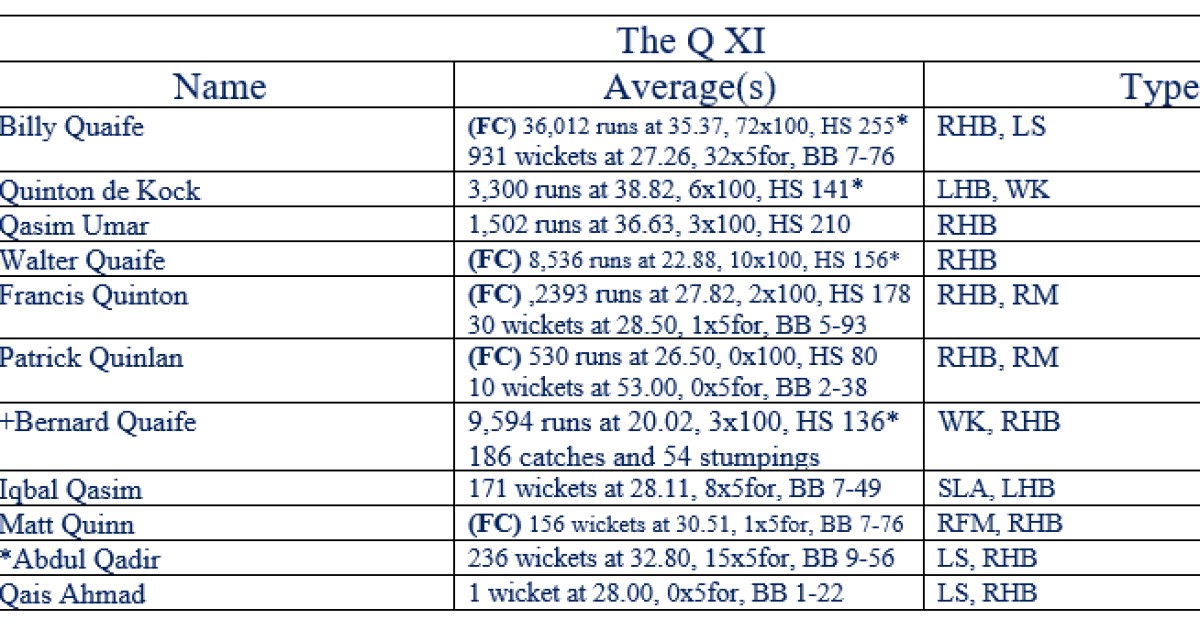
26TH: THE Qs

The challenge for this letter was actually finding 11 players to constitute an XI, and not surprisingly the final result was decidedly ill assorted. They managed just 7 of a possible 125 points.

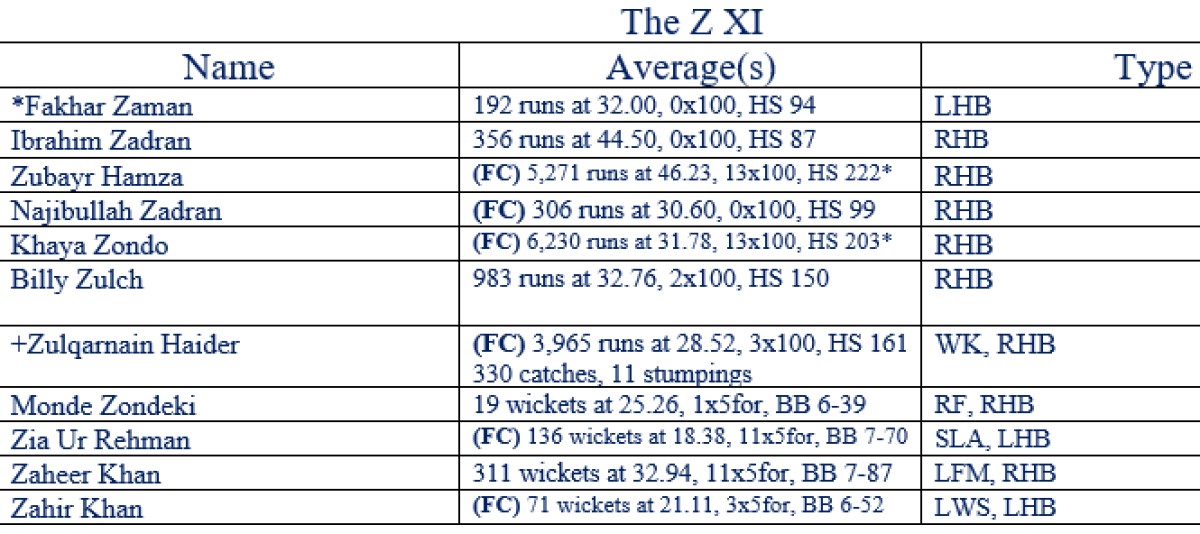
25TH: THE Zs

Click here for more information.

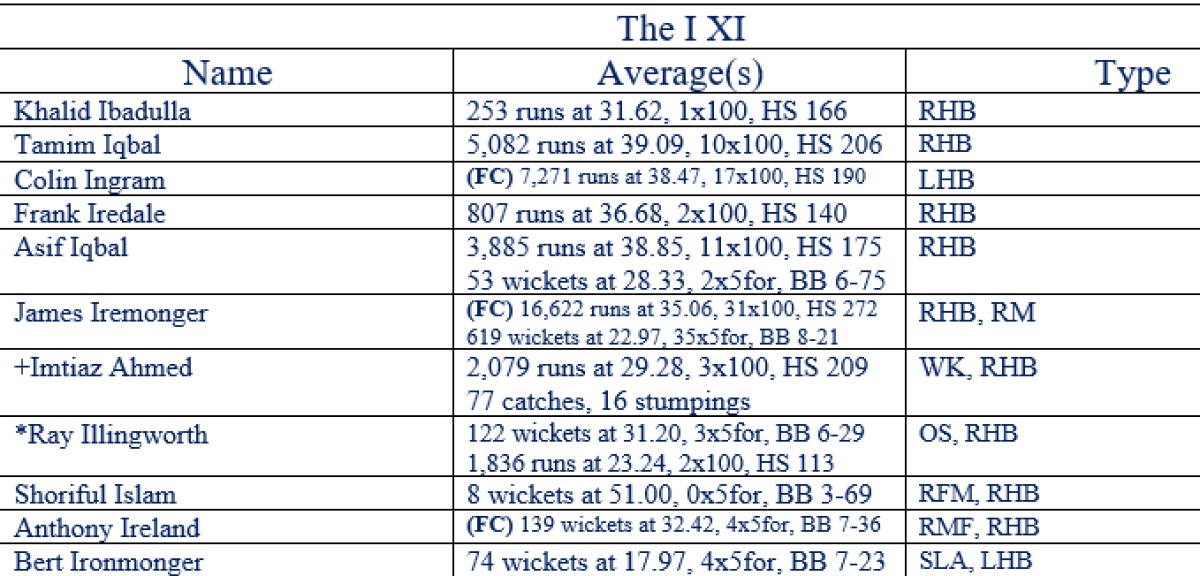
24TH: THE Is

While this XI has no great strength anywhere its biggest weakness was in the seam/ pace bowling department.

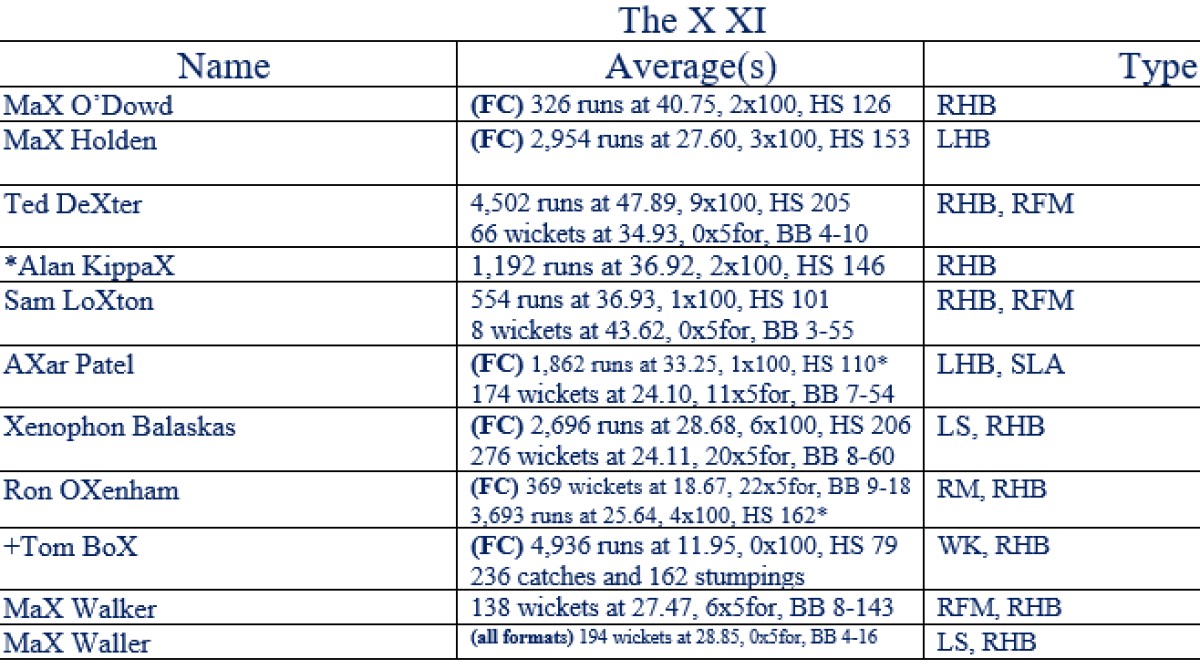
23RD: THE Xs

This was an XI which required a lot of chicanery to pull together. Between the creation of this XI and latter stages of the match ups a women’s tournament took place in New Zealand, and one development there was the arrival in the big time of off spinner Xara Jetly, who were I selecting this XI now would replace MaX Waller, who adds very little to the XI.

22ND: THE Us

Click here for more information.

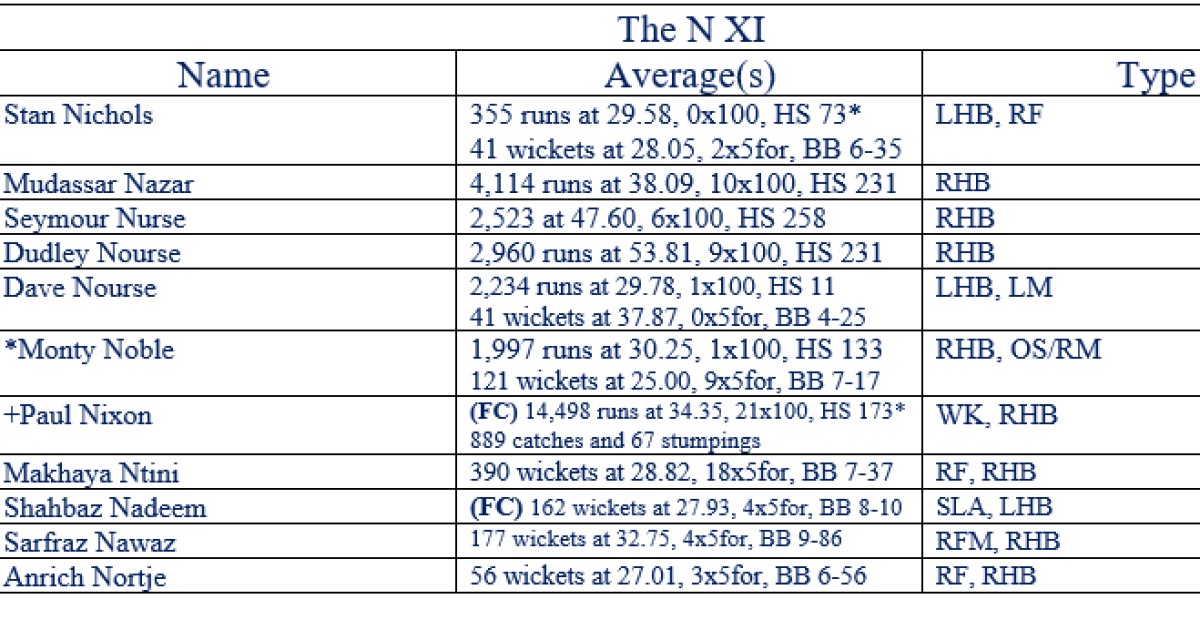
21ST: THE Ns

Click here for more information.

20TH: THE Ys

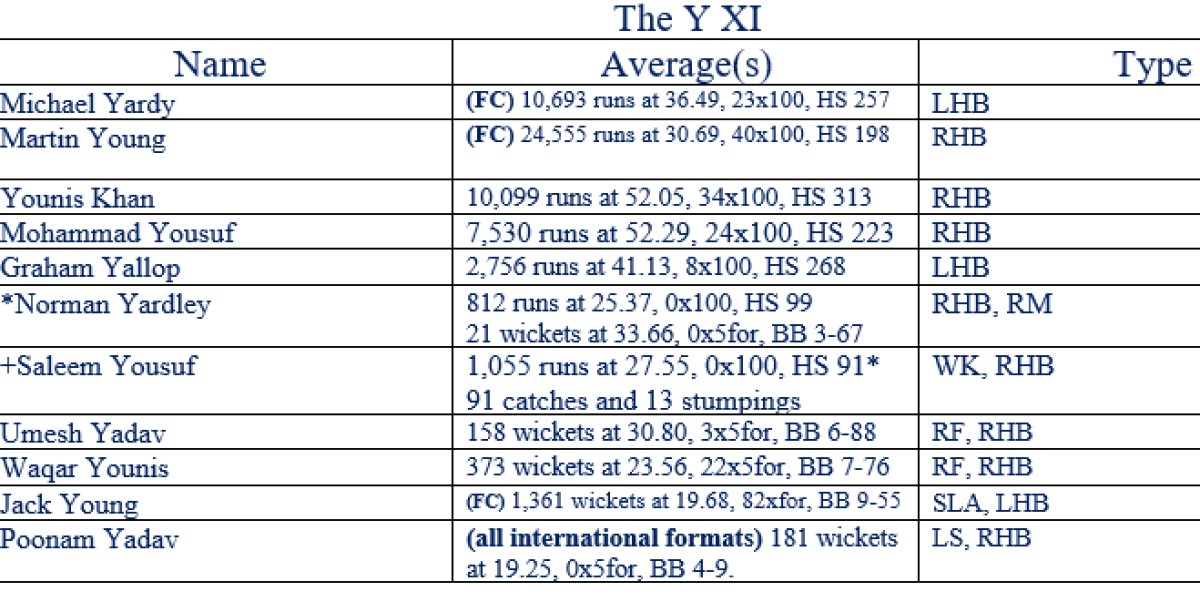
The strong middle order, good spin pairing and one high class fast bowler saved this side from complete disaster.

19TH – THE Cs

Click here for more information.

18TH: THE Es

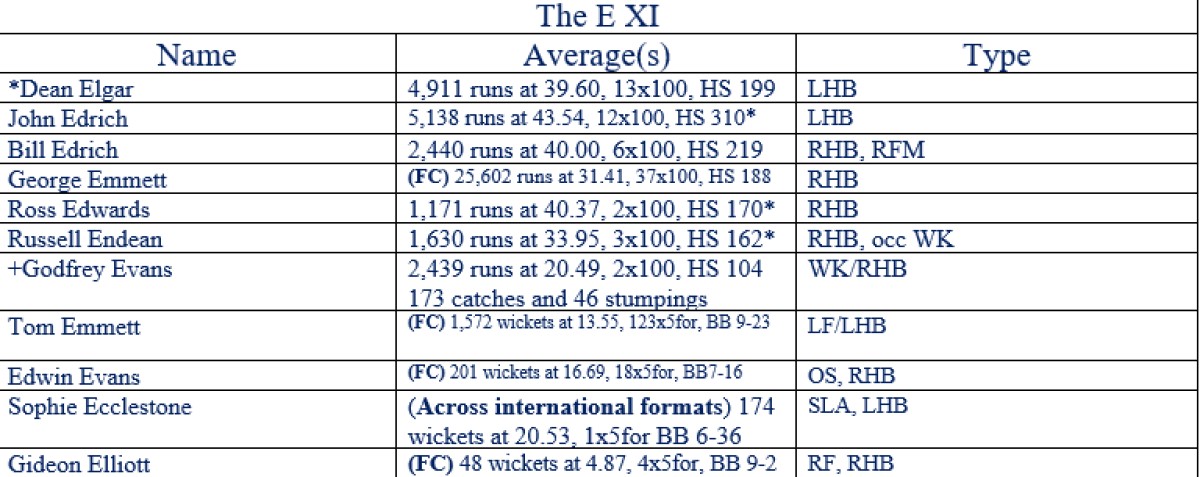
A good spin pairing, two pacers with remarkable records and a world class keeper, but not enough batting for comfort and Bill Edrich the best available back up bowler. More here.

17TH: THE Os

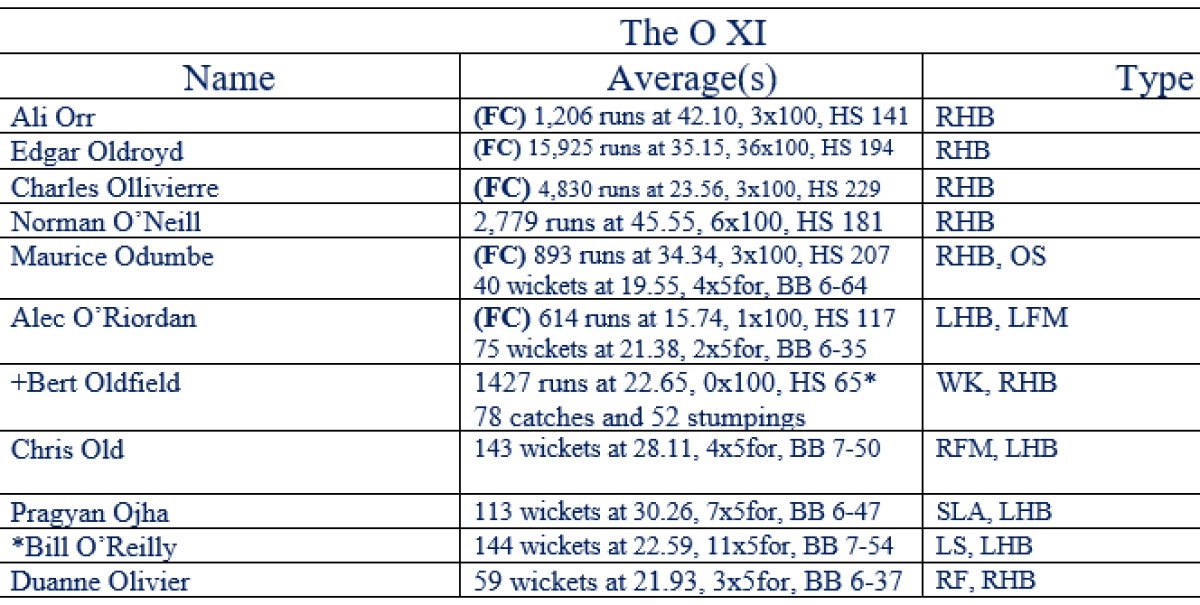
The same score as the Es, but the Os get the higher spot as they won the match up between the two sides.

16TH: THE Ds

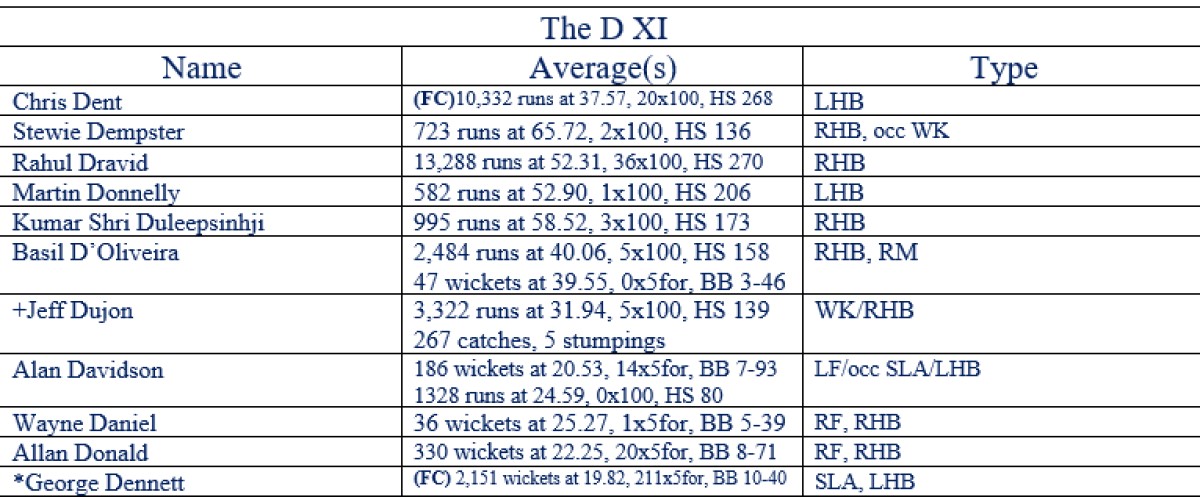
Good batting, good pace/ seam bowling, good keeper but the Ds fall down on spin bowling and captaincy.

15TH: THE Js

The Js.

14TH: THE Vs

The Vs superb bowling unit did not quite propel them into the top half of the table, as they lost a split tie (both XIs scoring 69 out 125) to…

13TH: THE As

Solid batting, a top keeper and a superbly balanced bowling unit was just enough to get the As into the top half of the table, since they won their match up with the Vs.

12TH: THE Hs

Stellar batting, a great keeper and a sound captain, but not quite enough bowling to get them to the very top. Neil Harvey might replace Hussey in some people’s estimation, and I would probably have served this letter better had I steeled myself to pick an all rounder (probably George Hirst, with his bowling stock in trade being left arm pace) rather than Hendren, but dropping the scorer of the second most FC centuries ever would have been a huge call.

11TH: THE Ps

The Ps, just missing out on the top ten.

10TH – THE Rs

This exemplifies the advantage of having Rhodes available – you can pick him for any one of several roles depending on your needs. Here, Rhodes the specialist spinner was required and therefore I selected him in that capacity, the one in which he both started and finished his career. The Rs.

9TH – THE Bs

In retrospect, given that Barnes could be said to attend to the leg spinners angle of attack with his ‘Barnes ball’, as explicated by Ian Peebles, himself an England leggie, it might have made this team even better to have selected Palwankar Baloo, Bishan Singh Bedi or left arm spinning all rounder Enid Bakewell in place of Benaud (who could instead be put in charge of the commentary team) to increase the variety available in the bowling department. Nevertheless, the Bs are a fine combination, and it says more about the top eight than it does about them that they ended up ninth.

8TH: THE Gs

If the Gs can be said to have a defect it is that none of their bowlers are left armed.

7TH: THE Ts

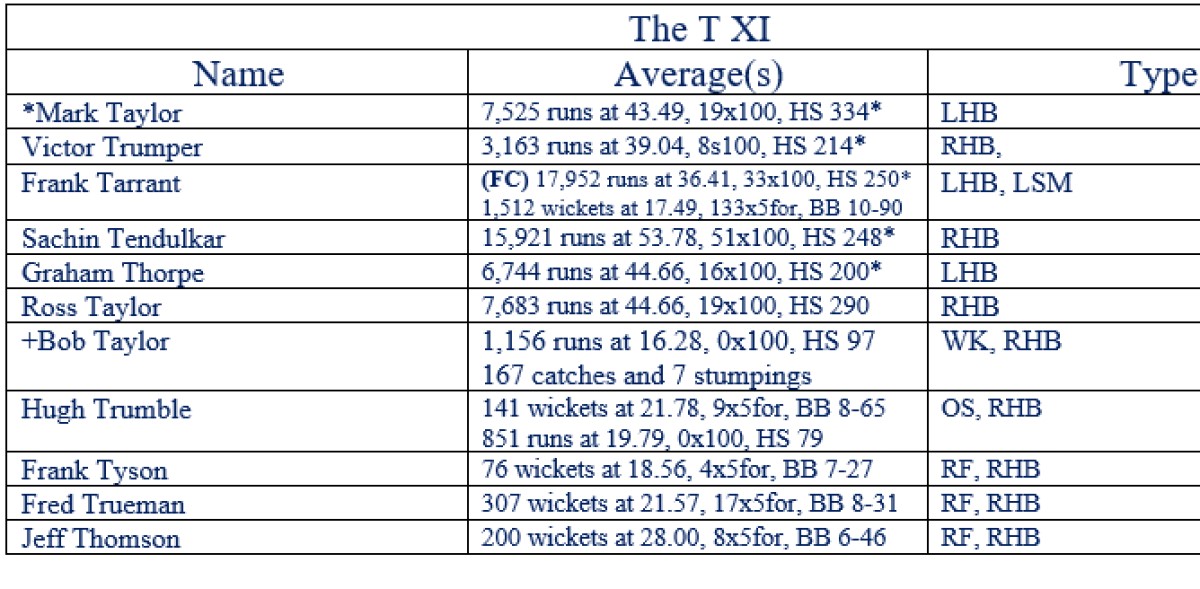
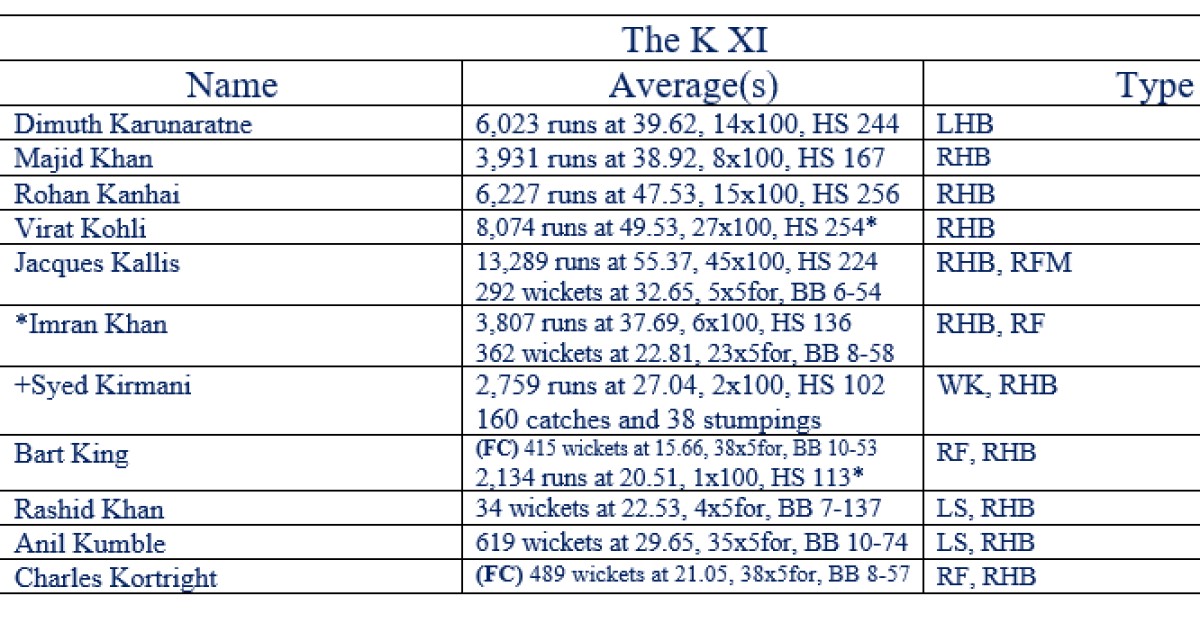
The Ts amassed the same number of points (90 out of 125) as the Ks and the Fs, but my tie-splitting procedure ranked them third out of three. Their batting was weakened slightly by the necessity of ensuring that there were relief bowling options available for three specialist quicks who demanded inclusion, a problem resolvable only by turning to the all round talents of Frank Tarrant.

6TH: THE Ks

Click here for more information.

5TH: THE Fs

For more information click here.

4TH: THE Ls

Strong and well balanced, but the Ls just missed out on a medal.

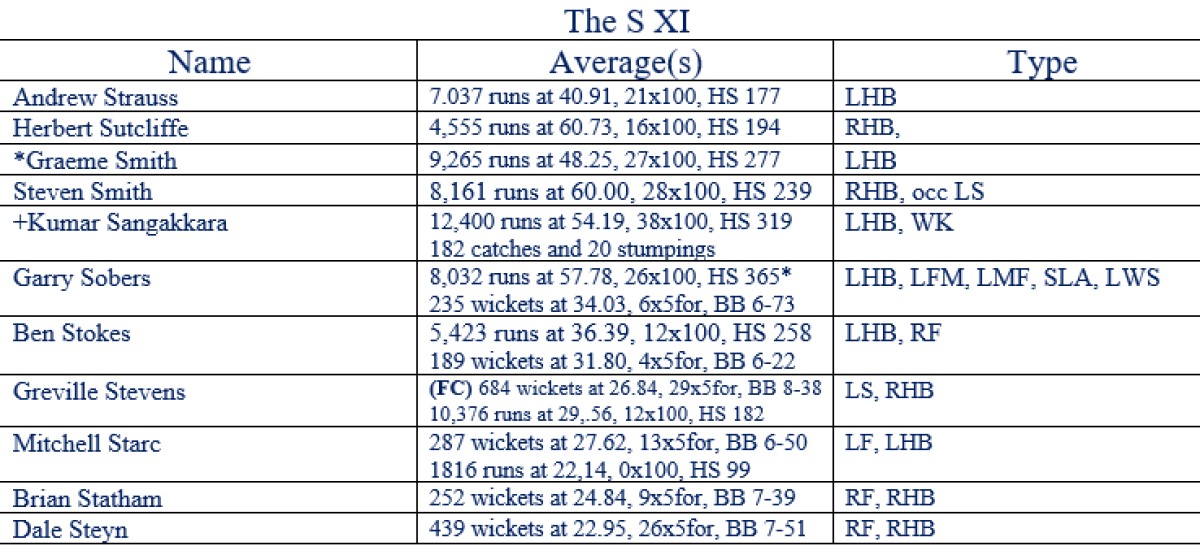
3RD: THE Ss

The Ss are a stellar combination, although Sangakkara would not be considered a top flight keeper and the spin options are limited.

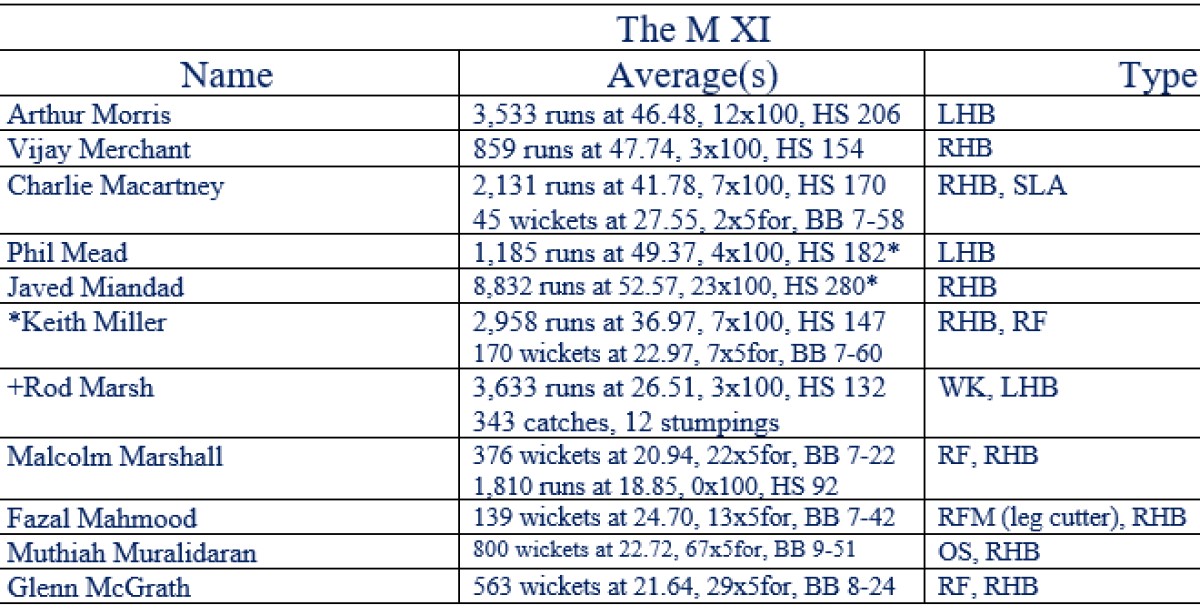
2ND: THE Ms

A powerful batting line up and a superbly balanced bowling line up, with Mahmood’s leg cutter meaning that a specialist leg spinner is unlikely to be missed.

FIRST: THE Ws

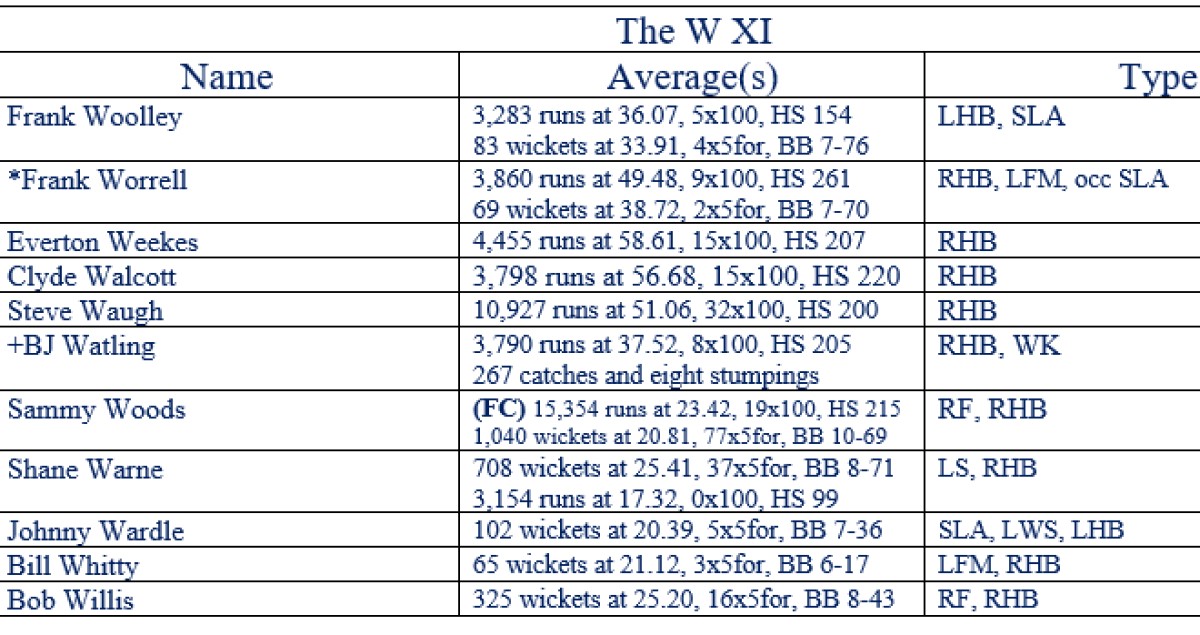
A strong batting line up, a wonderfully balanced bowling attack (Wardle’s ability to bowl left arm wrist spin covers the lack of an off spinner), a quality keeper and one of the greatest of all captains. The Ws are worthy champions.

This has been a fun exercise, though challenging in parts (both weak letters where actually completing an XI takes effort and strong letters where in some cases a second or third XI would beat most of the rest of the alphabet, which require extended acknowledgements of players one has overlooked).

PHOTOGRAPHS

Not one of my largest photo galleries, but I hope you enjoy it…

All Time XIs – Match Ups 65

The final post in the extended analysis phase of this long series. The series will conclude with a grand finale post presenting the XIs in reverse ranking order.

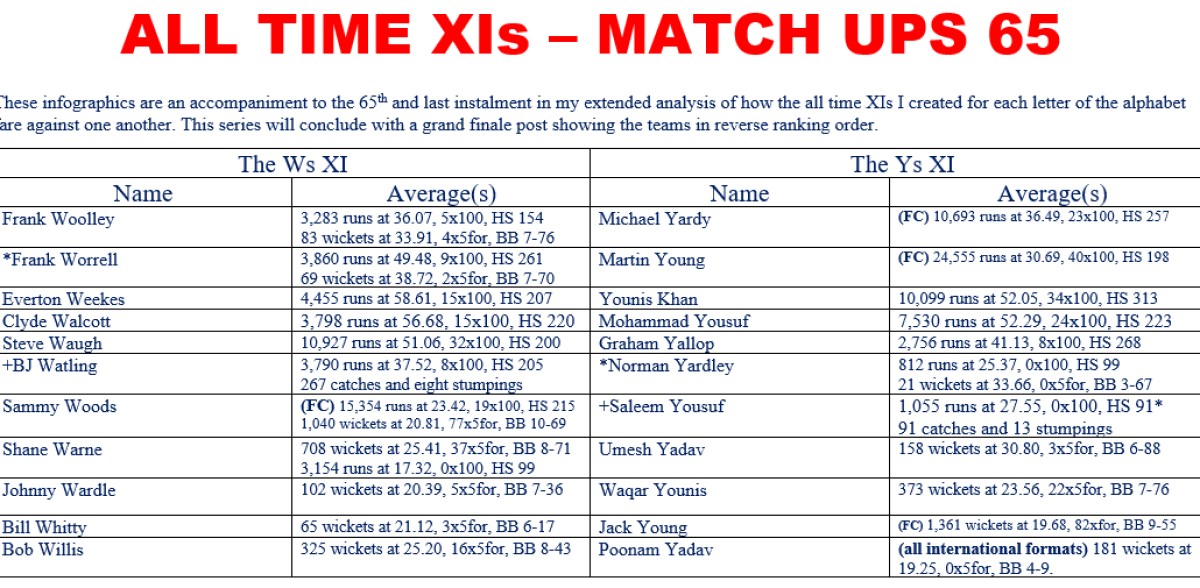
Welcome to the final post in the analysis stage of this series. There may be delays to me completing these posts – I have a minor injury to my right wrist, and although the brace the hospital have provided me with to support said wrist is doing wonders in terms of enabling me to do things with my right hand, I am still somewhat incommoded and probably therefore will not complete things with my usual speed. This post starts with the Ws in the spotlight, with 97 points out of 115 accumulated so far.

THE Ws V THE Ys

The Ws dominate this contest. The only match up the Ys win is in the fast bowling department where W Younis beats Willis – but Whitty beats U Yadav by a greater margin, and Woods blows Yardley out of the water. Thus the only conceivable scoreline is Ws 5, Ys 0.

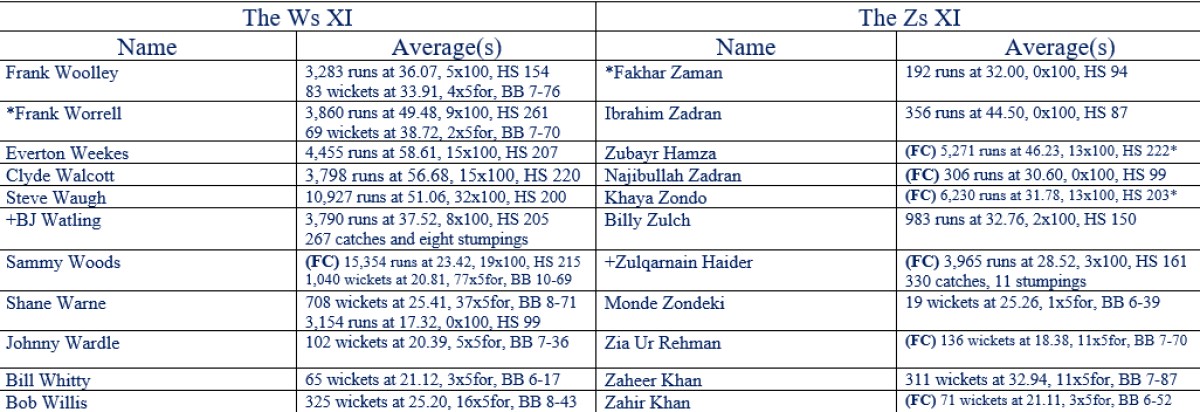
THE Ws V THE Zs

Total dominance from the Ws here: Ws 5, Zs 0.

THE Ws FINAL SCORE

The Ws have amassed 107 of a possible 125 points, 85.6% overall.

THE Xs V THE Ys

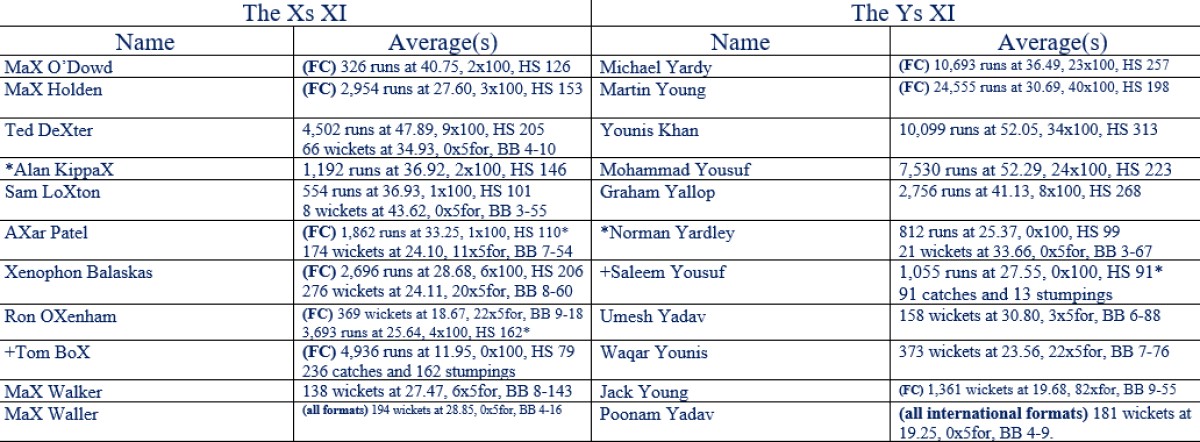
Before going into this match up, a brief note about the Xs. Had I seen developments in NZ domestic cricket in 2022-23 before I selected the Xs MaX Waller would have missed out, and Xara Jetly, a young off spinner would be in, with MaX Walker relegated one place from number 10 to number 11. The Xs have 13.5 out of 115 points coming in to today.

The Ys have much stronger batting, better pace bowling, the better skipper, and the two best spinners on either side. The Xs have the better keeper. This is clear cut: Xs 0, Ys 5.

THE Xs V THE Zs

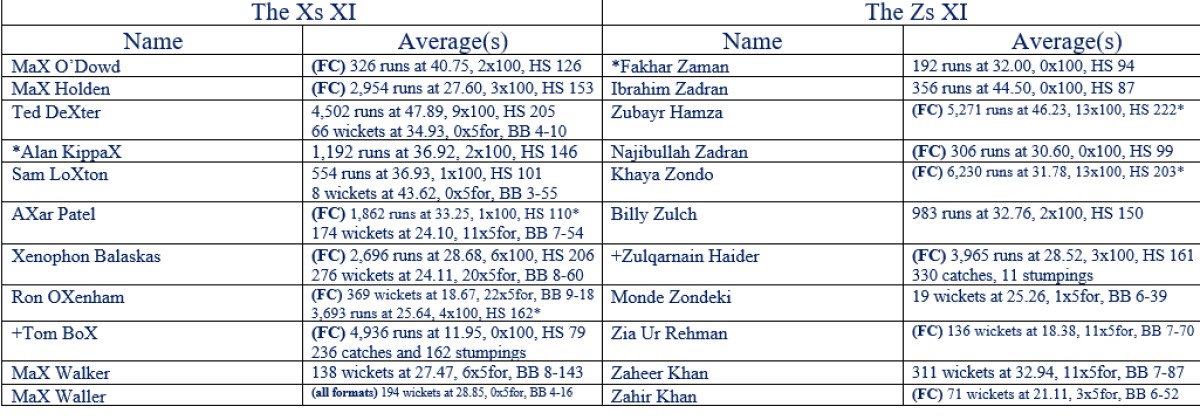
The Zs have the better opening pair, the Xs win the batting match ups 3-9 inclusive, and AXar Patel, Xenophon Balaskas, Ron OXenham, Ted DeXter and Sam LoXton are all genuine bowling options, while BoX was a much finer keeper than Zulqarnain Haider. MaX Walker ranks first among seam/ pace bowlers on either side, and the Xs, with OXenham, Dexter and Loxton as back up options in this department also have the greater depth. The spin bowling is hard to call, but even if the Zs win, it only reduces the margin of their defeat. I score this one Xs 4, Zs 1.

THE Xs FINAL SCORE

The Xs have scored 4 points today, finishing on 17.5 out of 125, 14% overall.

THE Ys V THE Zs

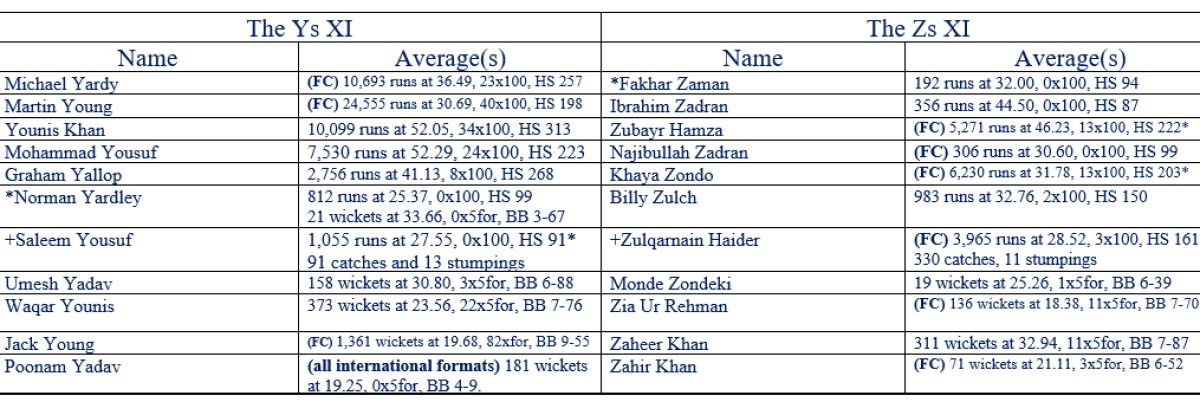
The Ys have 33 out of 120 so far and the Zs 10.5 out of 120. This suggests a one-sided contest, and that impressions is not awry. The Zs have the better opening pair, the Ys win at nos 3-6, though only Yardley offers a bowling option. S Yousuf outranks Zulqarnain Haider in both departments. The fast bowling is close, with Zaheer Khan’s left arm making up for his slightly high average, but the Ys definitely win the spin bowling department. The Ys also have the better captain. I score this one: Ys 5, Zs 0.

THE Ys AND Zs FINAL SCORES

The Ys finish with 38 out of 125, 30.4% overall, the Zs with 10.5 out of 125, 8.4% overall.

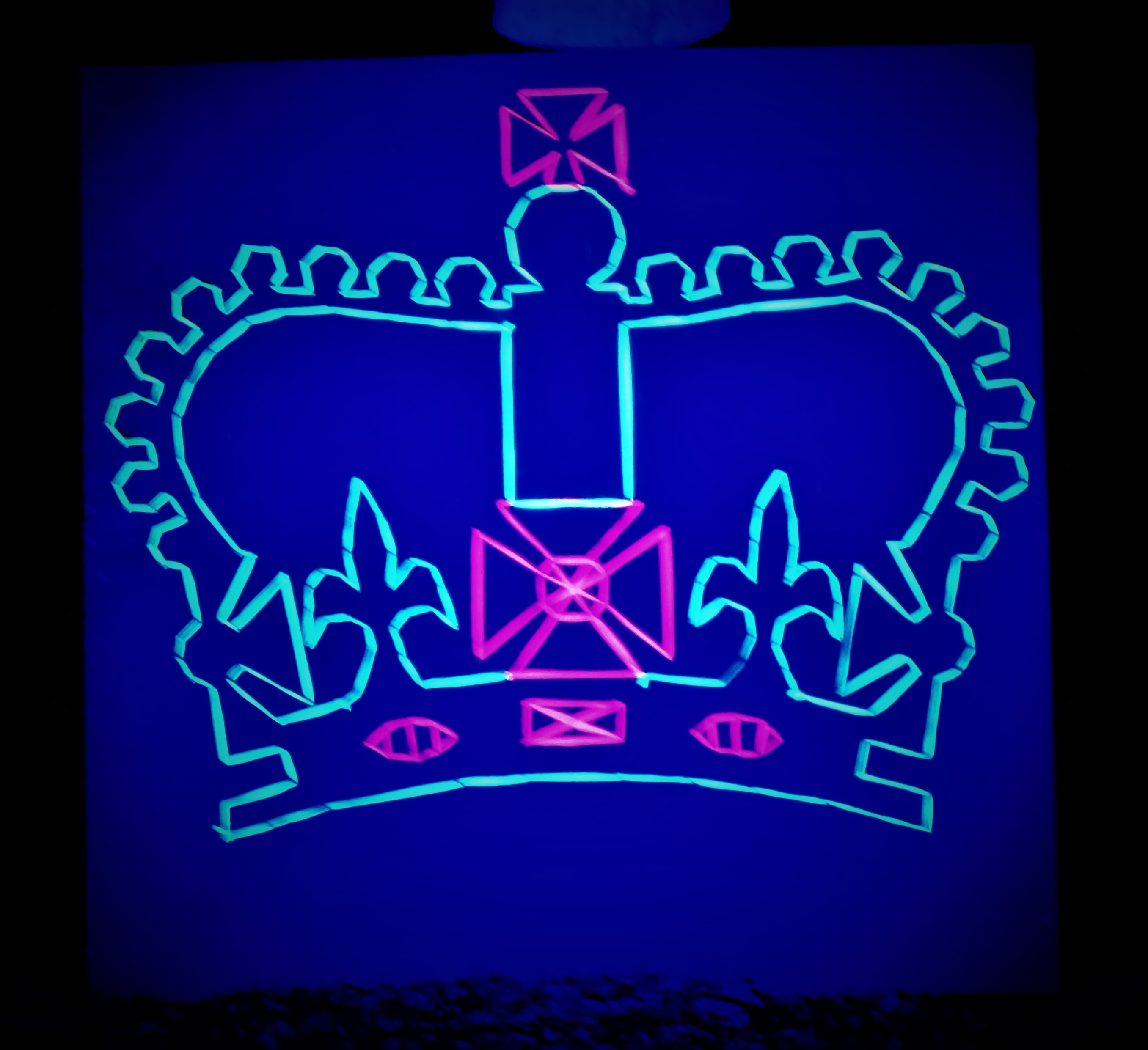
A SPECIAL PHOTO GALLERY

On Saturday night I attended Luminate at Sandringham. For those so inclined (not me) there are fairground rides before the start/ after the finish of the main event, which is walk through wooded areas of the estate, with light features all the way around. I took a lots of pictures while on my way round…