An injury to Zak Crawley forces a rejig of England’s batting line up, and in the face of continuing hype for a Moeen Ali recall I once again point out the flaws with that idea.
With the first India v England test match due to get underway in Chennai in 33 hours time news has come through of an injury to Zak Crawley. Better news is that Ollie Pope is definitely fit, while the ridiculous news is that Moeen Ali is till being hyped for a test comeback.
REJIGGING THE ENGLAND BATTING ORDER
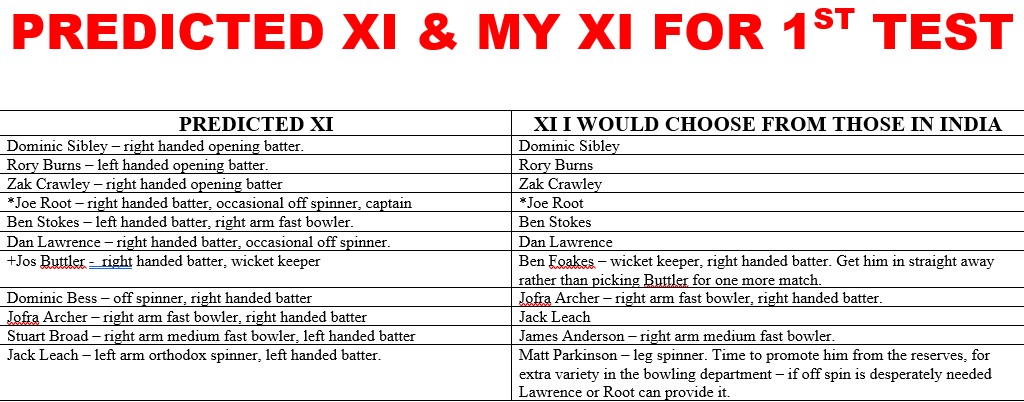
With Pope returning and Crawley injured, Dan Lawrence who made a decent start to his international career in Sri Lanka will come into the side. For me he goes in at number three, while Pope makes his return at no6. Thus, the team I expect to see is now: Sibley, Burns, Lawrence, *Root, Stokes, Pope, +Buttler, Bess, Archer, Broad, Leach and the team I would personally pick from those in India is: the same top six, and then +Foakes, Archer, Leach, Anderson, Parkinson. I explained in yesterday’s post why I favour the elevation of Parkinson, but I will not be especially annoyed if Bess retains his place, and I would accept a dogged insistence on strict rotation policy for the veterans. I will be furious if Moeen gets selected. Such a move would be doubly flawed: his record shows him to not be worth a place with either bat or ball, and it is a retrograde step bringing back an oldster.
TWO SPINNERS NEEDED
There is more than a possibility that India will have three front line spinners in their ranks, with the most likely trio being R Ashwin (off spin), Kuldeep Yadav (left arm wrist spin) and Axar Patel (left arm orthodox spin), although Washington Sundar (off spin) is also in the reckoning. Thus, for England to go with only one front line spinner plus Moeen as back up would be foolish, especially given that Root or Lawrence could bowl off spin if such was definitely warranted. The presence of two part time off spinners among the batters is a further reason for favouring the Parkinson/ Leach combo, maximizing the variation available to England. Without Parkinson playing the nearest England have to a leg spin option is Sibley, with a princely tally of four first class wickets to his name.
If England are up for a real gamble, and want to suggest a potential career development path to Bess, they could select all three spinners (Bess alongside Leach and Parkinson) and have Bess come in at number seven – he has shown some skill with the bat and I suspect a move up the order, maybe not so dramatically as the legendary Wilfred Rhodes, is in his future. Moeen Ali does not have enough to offer as a bowler, and very much belongs to the past. At no seven, as third spinner, where I am suggesting Bess he would be less of a disaster, but if he is at no8 in a team aiming for a more conventional balance England will be in trouble – you can only win a test match if you can take 20 wickets. It is time for my ‘spinners’ infographic to get yet another run out:
I look at England’s options ahead of the series in India which gets underway on Friday, with a particular focus on spin.
Before I get into the main meat of this post, a note on the coverage of this series: radio commentary is in the hands of talksport2, which means a less good commentary team than if TMS had the rights, while TMS will be running what they call a ‘cricket social’, which does not work anything like as well as commentary, and for TV fans the big news is that UK broadcasting rights have gone to Channel Four, the first time since 2005 that a terrestrial broadcaster has had such rights in this country. Radio coverage (the way I will be following the action) begins at 3:45AM on Friday our time, with the first ball scheduled to bowled at 4:00AM.
INS AND OUTS
Rory Burns is back from paternity leave, Ben Stokes and Jofra Archer are both available after missing the Sri Lanka tour, and the spin situation remains in flux. Burns will open with Sibley, with Crawley reverting to the number three slot from which he hit 267 against Pakistan not so long ago. Root will be at four. England seem to be being absolutely rigid in their rotation policy re Anderson and Broad, so his heroics in the second match in Galle notwithstanding Anderson is likely to be on the sidelines for this match. The most likely top six given continuing uncertainty over Pope’s shoulder, although he is with the tour party, would seem to be: Sibley, Burns, Crawley, Root, Stokes, Lawrence. Foakes is finally going to get another chance with the gloves, although probably not until match 2, with Buttler available this time, and that leaves the bowling to sort out. England will probably select two spinners given that the pitch at Chepauk Stadium, Chennai will take spin late in the game, which almost certainly means that Archer will be paired with Broad to take the new ball, though I would personally retain Anderson rather than be quite so dogmatic about the rotation policy with the veterans. This leaves the spinners to sort out.
ENGLAND’S SPINNING WOES
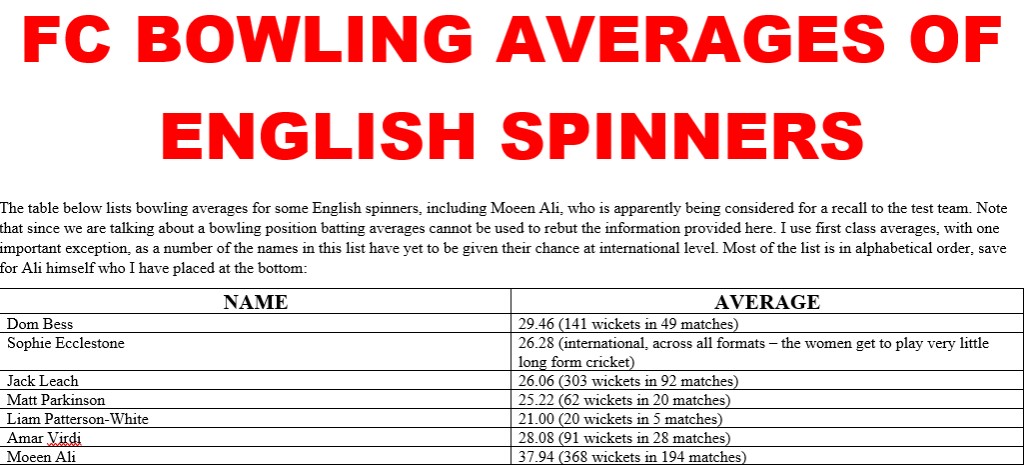
Current incumbents Jack Leach and Dominic Bess each had their good moments in Sri Lanka but each also looked innocuous at times, and Bess in particular struggled to keep things tight enough when nothing was happening as he bowled too many loose balls. Amar Virdi and Matt Parkinson are in India, officially as reserves, and also in India is Moeen Ali, a man in his middle thirties whose record (60 test matches, batting average 29, bowling average 37) is that of someone who is not up to the task in either department. There have been rumblings about a test recall for him, including an article published on the usually sensible Full Toss blog making what was supposed to be the case for his recall. Whatever the right answer to England’s spinning woes is it is not selecting an ageing mediocrity such as Moeen Ali. I expect that the selectors will persevere with Leach and Bess, but myself, for all that it makes the England lower order look a bit shaky I would be inclined to promote Parkinson (leg spin, FC average 25.22) from the reserves to partner Leach, with off spin if it is deemed necessary being bowled by either Lawrence or Root (skipper, please not the order in which I have listed these two options!). In the longer haul, rather than looking backwards to Moeen Ali, England need to look forwards, and in addition to Parkinson I suggest that Virdi, Liam Patterson-White and Daniel Moriarty as being worthy of attention, with Simon Harmer, now eligible for England, being considered as a stop gap solution so long as he accepts coaching younger spinners as part of his England duties. I might also consider whether Sophie Ecclestone’s left arm spin could prove as effective among the men as it has in the women’s game. Looking to the future, left arm spinning all rounder Lewis Goldsworthy will be worth keeping an eye on. Finally, England might not struggle so much to find spinners if counties who produced turning pitches did not find themselves the subject of sanctions from the ECB.
TWO ENGLAND XIS
I offer in infographic form two XIs for the match starting on Friday, the one I think we will actually see, and the one I would pick from those available:
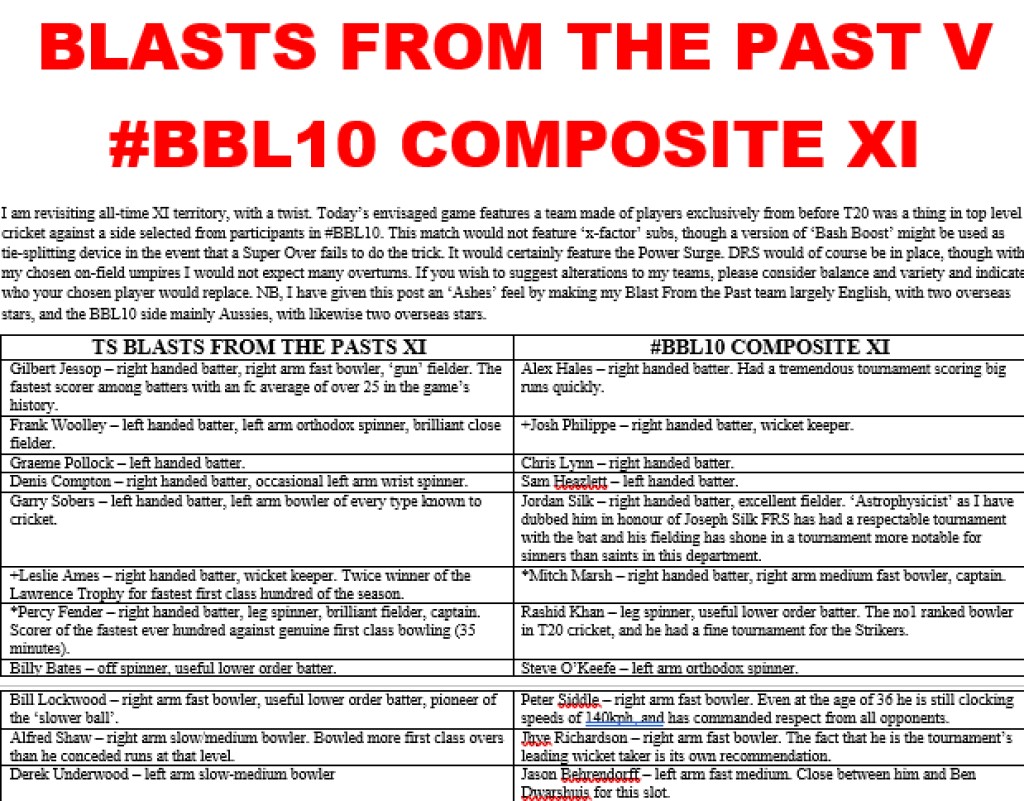
A variation on my All Time XI theme pits a ‘Blast from the Past’ XI against a #BBL10 Composite XI. Also, on the 40th anniversary of the Chappell incident I look at under arm bowling.
Today we revisit all-time XI territory with a bit of a twist, and then I have a bonus section prompted by today being the 40th anniversary of Trevor Chappell’s most (in)famous moment on the cricket field.
THE GROUND RULES
I have given this post a hint of an ‘Ashes’ flavour – my Blast From The Past XI is mainly English, though this being put in a T20 setting I have allowed myself two overseas players, while similarly my BBL10 Composite XI is mainly Australian with two overseas players permitted. It is two XIs, with the ‘x-factor sub’ idea given the treatment it deserves – in the bin. A variant on the ‘Bash Boost’ could be used as a tie-splitting procedure if a Super Over doesn’t do the job, while the Power Surge would remain. Naturally, DRS would be in use for this contest, though with my chosen on-field umpires, of whom more later, Claire Polosak as TV Replay umpire probably wouldn’t be overturning many deicisons. If you think I have had mistakes with either XI please feel free to make alternative suggestions, but remember that balance and variety are important, and tell me who should be dropped to make way for the people you want.
THOMAS SUTCLIFFE’S BLASTS FROM THE PAST XI
All members of this team played before T20 was a thing in top level cricket, and only three even played what is now called List A cricket.
Gilbert Jessop – right handed batter, right arm fast bowler, ‘gun’ fielder. The fastest scoring batter with a first class average of over 25 that the game has ever seen, a useful fast bowler and an electrifying fielder, the ‘Croucher’ is a must for this side.
Frank Woolley – left handed batter, left arm orthodox spinner, excellent close catcher. All-out attack was his natural tendency with the bat anyway, his all round record was astonishing – 58,969 runs at 40 an innings, over 2,000 wickets at 19 a piece and 1,018 catches in first class cricket, the latter a record for any outfielder.
Graeme Pollock – left handed batter. One of my overseas players, and one of the three members of this side to have played List A cricket – he actually held the record in that format with an innings of 222, which stood until Ally Brown hit 268 for Surrey v Glamorgan at The Oval, with the pitch for that game being way off centre, giving a very short boundary on one side.
Denis Compton – right handed batter, occasional left arm wrist spinner.
Garry Sobers – left handed batter, left arm bowler of pretty much every type known to cricket. The first person ever to hit six sixes in an over in first class cricket, and without a doubt the most complete player the game has yet seen. My second overseas player, and one of the three members of this side to have played List A. He averaged 38 with the bat and 21 with the ball in list A, though his only ODI innings was a duck (he did bowl respectably in that game).
+Leslie Ames – right handed batter, wicket keeper. Twice a winner of the Lawrence Trophy for the fastest first class hundred of the season, the only keeper ever to score 100 first class hundreds, all-time record holder for first class stumpings – 418 in total in his career.
*Percy Fender – right handed batter, leg spinner, brilliant fielder, captain. He scored the fastest century ever scored off authentic first class bowling, in 35 minutes versus Northamptonshire.
Billy Bates – off spinner, useful lower order batter. Took England’s first ever hat trick, part of a performance in which took seven wickets in each innings and scored 55 with the bat.
Bill Lockwood – right arm fast bowler, useful lower order batter. One of the first fast bowlers to develop a slower ball as part of his armoury, and he caused as many problems with it as any player prior to Franklyn Stephenson.
Alfred Shaw – right arm slow to medium bowler. Bowled more overs in his first class career than he conceded runs, took his wickets at 12 a piece, and once said “length and successful variation of pace are the secrets of good bowling”, a philosophy which would stand him in good stead for T20s.
Derek Underwood – left arm slow-medium bowler. The third member of this side to have played List A cricket. His economy rate in ODIs was 3.44.
This team has massive batting depth, with only Shaw and Underwood unlikely to contribute in that department. Only Pollock and Ames of the XI are completely unrecognized as bowlers, with Sobers’ three styles meaning that there are in total 10 front line options plus Compton’s left arm wrist spin.
#BBL10 COMPOSITE XI
This XI have been selected on their performances during the tournament and with an eye to balance and variety. Note also that I have only allowed myself two non-Aussies.
Alex Hales – right handed opening batter. He has had a quite magnificent tournament, and in many people’s eyes should be back in the mix for England’s T20 team.
+Josh Philippe – right handed batter, wicket keeper. Excellent with both bat and gloves this tournament.
Chris Lynn – right handed batter. Usually an opener, I put him at three here, with his four fifty plus scores in the tournament indicating that he is far from finished just yet.
Sam Heazlett – left handed batter. His ‘Sambulance rescue‘ innings of 74 not out off 49 when his team were in big trouble against Thunder yesterday sealed his place in this XI.
Jordan Silk – right handed batter, excellent fielder. There were many possibilities for this slot, but ‘Astrophysicist’ (in honour of Joseph Silk FRS) gets the nod because in a tournament where there have been rather more sinners than saints in the field he has shone in that department.
*Mitch Marsh – right handed batter, right arm medium fast bowler, captain. A T20 side really needs six front line bowling options at minimum so that you have cover if one misfires, and Marsh’s batting is unequivocally good enough to be no six, usually considered mainly a batter’s position.
Rashid Khan – leg spinner, useful lower order batter. The Afghan, rated the no1 T20 bowler in the world, did superbly for the Strikers before his country’s needs took over and he left the tournament.
Steve O’Keefe – left arm orthodox spinner. He has bowled very economically this tournament.
Peter Siddle – right arm fast bowler. The veteran impressed for the Strikers, still being able to hit the 140kph mark, and generally being very accurate.
Jhye Richardson – right arm fast bowler. The leading wicket taker in this tournament.
Jason Behrendorff – left arm fast medium. Close between him and Ben Dwarshuis for this slot.
This side has good batting strength, and a strong and varied bowling attack, and should be able to give a good account of itself.
MY ON-FIELD UMPIRES
In keeping with this post I choose one umpire who is in the ‘blast from the past’ category and one from the modern era to officiate on the field. I am opting for Frank Chester, who stood in 48 test matches, a record at the time and for many years afterwards as my ‘blast from the past umpire’. One story about Chester to sum up his skill in this role: there was an occasion when he was officiating and a ball went through to the keeper with an audible click en route, the fielding side went up in a huge appeal for caught behind and were shocked when Chester gave it not out, while the umpire, unflustered, walked up to the stumps at the batter’s end, looked at the off stump and nodded to himself – he had identified the faint red mark that confirmed that he was right, and that the click has been the ball brushing the stump not quite hard enough to dislodge a bail. The other on-field umpire for this contest, from the modern era, is Aleem Dar.
THE CHAPPELL INCIDENT AND UNDER ARM BOWLING
It was 40 years ago today that with New Zealand needing six off the last ball to tie the match and no11 Brian McKechnie on strike Greg Chappell ordered his brother Trevor to roll that last ball along the ground. This disgraceful incident led to under arm bowling being ruled illegal, an overreaction in my opinion. Since that time a law change has seen balls that bounce multiple times called no balls, so the Chappell situation can be handled simply by adding a note that a ball that rolls along the deck is considered to have bounced an infinite number of times and is therefore a no-ball. This would keep the way open for a latter-day Jephson or Simpson-Hayward, or indeed a would-be reviver of the art of David Harris to emerge, while preventing dishonourable tactics such as those used by the Chappell brothers 40 years ago (if you would have it so Greg can be considered the chief culprit, but Trevor cannot be held blameless, since he could have challenged his brother and said that he would not adopt those tactics but would bowl the best yorker he could summon up).
An account of today’s BBL10 ‘Knockout’ between Thunder and Heat and a few comments about issues relating the tournament that were in the spotlight today.
This post is devoted to today’s #BBL10 ‘Knockout’ game between Thunder who finished third in the group and Heat, who finished fourth and then beat Strikers in the ‘Eliminator’.
THUNDER’S POOR TACTICS
Thunder got away to a slow start, only managing 22-1 in their four overs of Power Play. The seventh and eighth overs of their innings were both big ones, yielding 13 and 14 respectively. Khawaja fell in the ninth to make it 62-2. At the end of the tenth Thunder were 68-2, and in need of a big second half to their innings. The second half started slow, and the dismissal of Ferguson made it 74-3 at the start of the 12th. It was 78-3 at the end of 12th, and then 11 came off the 13th over to make it 89-3. At this point the Power Surge should certainly have been claimed in a bid to maintain the momentum, but Thunder did not do so, and a wicket fell in the 15th, with the Power Surge still unclaimed. At the three-quarter way stage Thunder were 107-4, and overs 11-15 had yield 39-2, respectable, but not enough after the slow beginning. Thunder still refused to claim the Power Surge, and by the 18th they were 134-6, and now had to use the Surge for their last two overs. They had a nightmare start to this final phase, losing wickets off the first two balls. The rest of it went OK and they finished with 158-8, nine runs less than the Scorchers had spectacularly failed to defend at the same ground yesterday. The Power Surge overs had yielded 24-2, but they would probably have managed that many from overs 19 and 20 even without them being the Surge overs, so basically because they were scared to take the Power Surge early they did not benefit from it at all.
A SLOW START FOR HEAT
Heat lost two wickets, including the man with the best twitter ‘meme team’ in the business backing him, Joe Denly. 10 off the fourth over saw them end the Power Play at 25-2, three runs ahead but one wicket behind Thunder. Overs 5-10 were slow going as well for the Heat, and that the half way stage they were 56-2, needing 103 off their last 10 overs for the win. They were building towards a good moment to take the Power Surge when Labuschagne was run out for 30 to make it 70-3 after 12 overs, 89 needed off eight overs to win. Sam Heazlett who had come in at the fall of the second wicket and was already going well was joined by Jimmy Peirson, setting the stage for…
THE ‘SAMBULANCE RESCUE’
After 14 overs Heazlett reached 50, having taken 37 balls to get there, with Peirson going nicely as well, and the score was 96-3, 63 needed off six. The 15th over went for 15, taking the score to 111-3, four runs and 1 wicket ahead of Thunder at the same stage, and now Heat managed something that had proved beyond Thunder: taking the Power Surge at a sensible time (I would have gone an over earlier, if not two, but at least they did take it with Heazlett and Peirson both still there). Heat took 26 off their two Power Surge overs without losing a wicket (only two runs more than Thunder, but two fewer wickets lost, and crucially a net gain of approximately ten runs compared to two non-surge overs at the same stage of the innings), and with three overs to go they were 137-3, needing 22 off 18 and now heavy favourites. Ten more runs of the 18th reduced the ask to 12 off 12 balls, and the match was practically unloseable. The 19th over nearly finished it, but the final ball of it, with scores level, was a dot, leaving Heazlett on strike for the start of the 20th, to complete the ‘Sambulance rescue’. The first ball of the 20th was put away for four by Heazlett – no deliberate wides this time! Heazlett had scored 74 not out of 49 balls, and his supporting act Peirson had 43 not out off 24 balls. Their match turning and ultimately match winning stand had produced 92 runs in 7.1 overs. Heat face Scorchers on Thursday, with the winners to take on Sixers in Saturday’s final, and given yesterday’s events I will be rooting for the Heat, who if only for their better handling of the Power Surge thoroughly deserved their win.
ISSUES OF BBL10
This game showcased several issues relating to the tournament as a whole:
X-factor subs: Heat were able to effectively get in an allocation of five overs – Bartlett bowled one over, a maiden that should have been a wicket maiden, in the first ten and was then replaced by ‘x-factor sub’ Morkel, who bowled his full four overs. The fact that the decision can only be made precisely at 10 overs into the first innings heavily favours the side who field first – they can replace a bowler either as Heat did with another bowler, or with a batter if they feel the need for extra batting depth, while the batting side can only justifiable opt to strengthen their batting, for example if they lose early wickets. I personally think this innovation needs to be abandoned completely, and certainly it cannot continue in its current form.
Umpiring: for some unknown reason DRS has not been used in this tournament, and some of the umpiring has been very poor. There were at least three, and possibly four poor decisions today: In the Thunder innings three LBWs were turned down, and all looked absolutely stone dead (I commented about the first of them that had it happened in a match with DRS and been given out not even Shane Watson would have bothered to review it), while the run out of Labuschagne may have been harsh, as the keeper may have dislodged the bails with his gloves before the ball was in his hands. DRS and the usage of all camera angles is a must for #BBL11, and some of the umpires need to smarten up their act or find a new job.
Catching: the standard of catching in this tournament has been woeful, and another cartload of chances went begging today. Guys, when a ball is hit in the air towards you, you are supposed to catch the damn thing.
Power Surge: I dealt with this in the main body of the piece, and also covered it yesterday, but today was a perfect case study. Simon Mann, who was part of today’s commentary team, labours under the bizarre delusion that the final two overs of the innings are the best in which to take it. Today blew that one sky high – Thunder did precisely that and effectively gained nothing from having the Power Surge, while Heat timed the taking of the Power Surge well, if not quite perfectly, and used it to move from being in a close fight to being in cruise control, a position they never subsequently relinquished.
An account of today’s BBL ‘Qualifier’ between Sixers and Scorchers, including a disgraceful incident involving AJ Tye, and thoughts about the Power Surge.
The title of this post, devoted to today’s #BBL10 qualifier is dual purpose, relating both the Scorcher’s overall performance today and to the incident that ended the match.
SIXERS SLAM SCORCHERS
Scorchers batted first and started slowly, Roy falling in the third over for a nine ball three. They finished their Power Play overs strongly, taking 25 off the last 11 balls to be 30-1 after four overs. The second phase of their innings was solid, overs 5-10 inclusive yielding 44-1, to give a halfway score of 74-2, with two well set batters, one the very dangerous Colin Munro, together at the crease. It was a situation that demanded an early use of the Power Surge to launch the second half of the innings, but Scorchers did not take the opportunity, and they paid for their voluntary surrender of the initiative lest the Surge cause a fall of wickets, as the third quarter of their innings was an unqualified disaster, yielding them 24-2 to reach the three-quarter way stage at 98-4. At that point they did take the Power Surge (leaving it any later would have been truly appalling). They made superb use of those two overs, scoring 34 off them, a gain of at least 20 on what they would have scored from those overs in ordinary play. They then kept the momentum going to finish their 20 overs with 167-6, a defensible looking total. Their top scorer was Josh Inglis, a wicketkeeper, who as Yorkshire-born Aussie may potentially follow in the footsteps of Hanson Carter, the best Aussie keeper between Jim Kelly and Bertie Oldfield, who was also born in Yorkshire.
Sixers started brightly, taking 13 off the first over of the reply, and being 43-0 at the end of the Power Play, 13 runs and one wicket to the good. They lost Philippe late in the first half of their innings, but still had a superb overs 5-10, scoring 61-1 in that period, 17 more than Scorchers had managed, in what had been a good period for them. I would have thought an early Power Surge was called for, but Sixers did not go for it. By the the end of the 15th Scorchers were 151-1 and the only question was whether James Vince, by then on 89, would reach a ton before the end. Although Daniel Hughes hit a boundary to level the scores with Vince on 98, he then avoided scoring off any of the last three balls of that over. The 18th over began with the scores level, setting the stage for…
AJ TYE’S ABJECT ASSAULT ON THE SPIRIT OF CRICKET
Tye, an experienced and successful bowler, bowled to Vince with the scores level and Vince 98 not out. He produced what was blatantly obviously a deliberate wide, a mean and petty ‘dog in the manger’ type gesture that denied Vince any chance to complete a century that would have been thoroughly merited. I have umpired a few games at a low level, and temporarily donning my umpire’s hat, I would have been tempted to tell Tye loudly that I was not going to oblige him by calling a wide and that he better bowl the next one straight. I certainly think the Scorchers should drop Tye for their next game, which will be against the winners of the match between Thunder and Heat, and the winners of that will take on Sixers in the final. I will certainly be rooting against the Scorchers when the time comes. Is my dim view of this just because the offender is an Aussie? No, and I offer as evidence to back up my own criticisms the fact that one Richard Thomas Ponting, not normally known for Aussie bashing, is on my side as well. Very little in cricket is new, given the game’s long history, and there was an incident in a long ago ODI when David Gower, called up to bowl by way of a concession of defeat, again with a batter, this time Greg Chappell, on 98, bowled a deliberate no-ball. Gower’s behaviour then was marginally less inexcusable than Tye’s today because he was a non-bowler and one can understand him not being impressed by being made to act as a sacrificial offering.
THE POWER SURGE
I have stated my thoughts on the taking of the Power Surge before, but I am going to extend on them here. Firstly, I am more and more convinced that one should have a good reason for not going early, rather than allowing caution to dictate. Scorchers paid for their failure to go when in a perfect position to do so, and it was only Sixers utter dominance that enabled them to get away with delaying their own surge. The extra point about the runs from the surge overs is that is not just a question of how many do you get from them, it also a question of how many would you have scored anyway from those overs even without the surge, and that is where leaving it late is a definite loser – you will be throwing the bat at pretty much everything in the closing stages of a T20 innings anyway, so would be scoring faster than at other stages of the innings. Scorcher’s surge was worth about +20 to them compared to two ordinary overs at that stage, because they did make it count when they finally took it. Had those two overs been, to take the extreme, the last two of the innings, then they would have been maybe +10 had they scored the same 34. However, had Scorchers gone in overs 11-12, when they had two top batters together, including the potentially devastating Munro, those same 34 runs would have had them 108-2 with eight overs to go and a total of 180 a definite goal, with more a distinct possibility. As it was, timing it when they did, even that huge surge only brought a total of 170 on to the horizon, and in the end they were just short of that. Here as a reminder is a Power Surge inforgraphic I created earlier:
PHOTOGRAPHS
My parents are in King’s Lynn because my aunt is undergoing a medical procedure and needs to be kept company for 24 hours. They arrived yesterday, and we had a chat over my back garden fence, and I took delivery of a glass vessel which bears my name, and is now the only one of what was a pair, due to a recent accident, and it dominates today’s photo gallery…
An account of today’s BBL10 ‘Eliminator Round’ between Strikers and Heat, some suggested changes to the format of the tournament, and an acknowledgement of Pakistan’s victory over South Africa.
Before getting into the meat of today’s post, which deals with the ‘Eliminator’ round of BBL10, between Strikers and Heat, a word of congratulation to Pakistan, who completed a convincing win over South Africa by seven wickets. South Africa lost three wickets just before the close yesterday, as 175-1 became 185-4, and today they continued in that vein, being all out for 245, a lead of 87. Although Nortje bagged a couple of early wickets Pakistan were never in serious trouble, and fell appropriately to Fawad Alam to make the winning hit. His form since his recall to the colours makes one wonder how his team overlooked him for 11 whole years (not a record – George Gunn was called up by England after a lapse of 17 years between games, while in first class cricket there is the bizarre case of William Caesar who played two games in 1920 and four more in 1946, with nothing in between).
OVERKIND QUALIFICATION SYSTEM EXPOSED
It is rare the a pom gets an opportunity to call Aussies soft with any hint of justification, but BBL10 has provided it. A qualification system that allowed five teams out of a total of eight to make it to the knock out phase (in the Vitality Blast eight teams out of 18 do so, while in the 50 over contest it has been six teams out of 18) look questionable from the get go, and today’s match was powerful evidence for the prosecution, as Strikers took on Heat in the ‘Eliminator’.
Heat have been at their most vulnerable this season when faced with a run chase, so the Strikers were correct to choose to bat first. However, even if you make the correct call, you do then have to play decent cricket, and this was where Strikers slipped up. All seemed good when they were 18-0 after two overs, but overs three and four went for only six runs between them, giving a Power Play score of 24-0. In Overs 5-10 Strikers failed to gain any momentum, as first Carey and then Head pottered about, barely managing to achieve a scoring rate of one run per two balls (Carey 13 off 22, Head 12 off 21). At the half way stage Strikers were 53-1, way below par, and they immediately claimed the Power Surge, also using the ‘x-factor sub’ rule to bring Wells in for Worrall in an effort to jazz up their batting. One wicket fell in the Surge, but Strikers also scored 16 off those two overs, and they seemed to be maintaining the momentum, although bizarrely Renshaw came in ahead of ‘x-factor’ man Wells, when they were 94-3 after 15, having scored 41 in the third quarter of their innings. A big finish was needed, and did not materialize. In the end Strikers finished with 130-7 from their 20 overs, with only Weatherald, Salt, and at the death Wes Agar having shown anything like sufficient intent.
Heat made an even worse start than Strikers had, not scoring especially quickly and losing the big wickets of Lynn and Labuschagne early. A third wicket went down in the fourth over, and Heat’s Power Play had yielded 24-3. In overs 5-10 Heat scored 44 without losing a wicket, being 68-3 at halfway, 15 runs ahead but two wickets behind Strikers at the same point. They declined to take the Power Surge, holding back, and in the 14th over Denly was out for 41 to make it 92-4. At the end of the 15th Heat were 98-4, needing 33 of five overs, and the 16th was economical as well. Then however Travis Head blundered, giving himself a second over when he could have had Siddle and Agar bowl through. It revived the Heat, as they were 110-4 at the end of it, and that point they finally did claim the Power Surge. They got eight off the first over with it, reducing the ask to 13 runs off two overs, and then Agar, who had had a fine tournament with the ball, cracked under pressure, the winning runs being accrued off five balls of his over. Jimmy Peirson finished unbeaten on 47, a fine knock, which earned him the Player of the Match award.
Strikers made a huge mess of their own innings, with as I have said, Carey and Head especially culpable. Heat were barely any more impressive, getting their tactics badly wrong and being saved by Head’s inexplicable decision to give himself a second over. Heat should have claimed the surge when Denly and Peirson were together and they could have had two set batters use it. Also, their selection of Heazlett backfired – the left hander was picked to counter Strikers’ spinners Briggs and O’Connor both of whom turn the ball away from the right hander’s bat and was out before he got to face either.
Tomorrow sees Scorchers and Sixers do battle, with the winner going straight into the final, while the loser whill face the winner of Sunday’s game between Heat (their reward for winning this one) and Thunder. I would guess that if they followed today’s action Thunder will be licking their lips at the prospect of Sunday’s game.
This was a game that neither side deserved to win, and that had the qualification system been sensible would not have been taking place – 4th and 5th out of eight have no business making it to the knock out stages of a tournament, and it looked every inch a contest between two moderate sides neither of whom really know how to win.
ORGANIZATIONAL CHANGES
I have already indicated what I think the qualification system should be: three teams qualify, group winners into the final, second vs third for the right to join them, with 2nd having home advantage.
I also feel the tournament would benefit from being more compact. A lot of the time there is only one game per day, with a few days featuring two games. With 14 rounds of group games I would play four fixtures per day, thereby having all eight sides in action, with a day off between rounds, meaning that the group phase would last 27 days in total, and then the two knockout matches would take place on successive days after two days off, making the whole length of the tournament 31 days – and it being an Aussie tournament I would make game day 1 Boxing Day, and the final to take place on Australia Day.
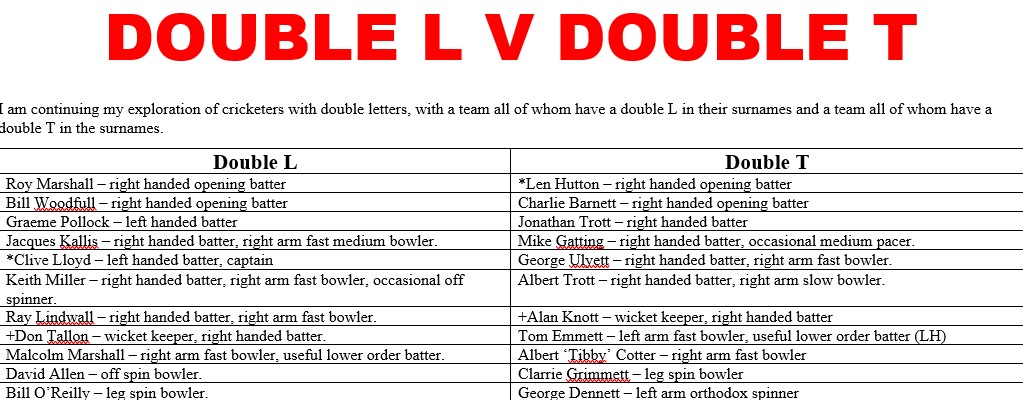
An ‘all time XI’ post that continues the double letter theme from a couple of days ago. A team of players whose surnames contain a double L are pitted against a team of players whose name contains a double T.
After my recent post about cricketers with double letters in their names I am exploring the theme further with a team of players all of whom have a double L in their surnames taking on a team of players all of whom have a double T in their surnames.
TEAM DOUBLE L
Roy Marshall – right handed opening batter. He was part of the 1950 West Indies team that toured England, and there were those who reckoned that in terms of pure talent he was the equal of any of the three Ws. However, his main distinction was a brilliant overseas player for Hampshire, including playing a key role in their first ever County Championship.
Bill Woodfull – right handed opening batter. He averaged 65 in first class cricket, 46 in test cricket. He once went two whole years without being out ‘bowled’ at all. Although both were right handers he represents a good contrast to Marshall as he was a blocker, while Marshall preferred a more flamboyant approach.
Graeme Pollock – left handed batter. A test average of 60.97, including a highest score of 274.
Jacques Kallis – right handed batter, right arm fast medium bowler. A man who averaged over 50 with the bat and in the low 30s with the ball. Just as Woodfull was a blocker to accompany Marshall the hitter, so Kallis’ approach is much more staid than was that of Pollock.
*Clive Lloyd – left hander batter, captain. 7,515 test runs for the Guyanese giant. He scored the joint second fastest first class double hundred ever, reaching that mark in precisely 120 minutes v Glamorgan, thereby equalling Gilbert Jessop who reached 200 in the same length of time for Gloucestershire v Sussex. He made a century in the final of the first ever men’s cricket world cup (the women had taken their bow in this format two years previously).
Keith Miller – right handed batter, right arm fast bowler, occasional off spinner. Australia’s greatest ever all rounder, and one the two individuals in whose honour the Compton-Miller medal was named. He once took a seven-for in his secondary bowling style, on a Brisbane pitch (uncovered in those days) that had been turned into a mud heap by heavy overnight rain.
Ray Lindwall – right arm fast bowler, right handed batter. He scored two test centuries with his batting, while has bowling record was outstanding.
+Don Tallon – wicket keeper, right handed batter. Rated by many of those who saw him (including Bradman) as the greatest of all keepers, and a capable batter.
Malcolm Marshall – right arm fast bowler, useful lower order batter. An all-time great of fast bowling.
David Allen – off spinner. The Gloucestershire bowler took his first class wickets (over 1,200 of them) at 23.64, and was unlucky that his prime years coincided with those of Titmus and Illingworth, which limited his test exposure. I opted for him over Illingworth because he was a slower bowler than Illingworth, contrasting nicely with my other front line spinner who was notably quick for a bowler of his type…
Bill O’Reilly – leg spinner. He bowled his leg breaks at a briskish medium pace and had a well concealed googly in his armoury. Although the pair famously did not get on Bradman rated O’Reilly high enough to include him in his all time World XI, covered in detail by Roland Perry in “Bradman’s Best”.
This team has a stellar top five, a legendary all rounder at six, a great bowling all rounder at seven, an all-time great keeper who could also bat at eight and three quality bowlers to round out the order. Only David Allen, included for reasons of balance (apologies Mr D K Lillee, four fast bowlers plus Kallis with only O’Reilly as a spin option just doesn’t look right). could be considered other than great. Another fast bowler who could not be accommodated on similar grounds was big Bob Willis. Phil Tufnell might have had the second spinner’s berth, but his successes were too sporadic to make him eligible as far as I am concerned.
TEAM DOUBLE T
*Len Hutton – right handed opening batter, captain. Take a look at his outstanding record and then consider that he missed six years of his prime due to World War II, from which he also emerged with one arm shorter than the other following an accident.
Charlie Barnett – right handed opening batter. Again combining a blocker and a hitter for our opening pair. In the Trent Bridge test of 1938 he was 98 not out by lunch on the first day, opening with Hutton. There is a story that a spectator once arrived a few minutes late a Bristol and saw that one over had gone and the score was 20-1 – Barnett had hit five fours and then been dismissed by the sixth ball!
Jonathan Trott – right handed batter. From 2010 to 2012 he was a superb no3, including scoring two centuries in an Ashes series in Australia, the first to help save the first match at the Gabba and the second to bury Australia at the MCG after the hosts were dismissed for 98 on the opening day.
Mike Gatting – right handed batter, occasional medium pacer. A combination of a very slow start at international level and the fact that he played on for too long at the end makes his test record look ordinary, but for the second half of the 1980s he was superb at that level.
George Ulyett – right handed batter, right arm fast bowler. A test best score of 149, and he also had a seven-for at that level.
Albert Trott – right handed batter, right arm slow bowler. He made a sensational start to his test career, taking 8-43 in one innings of his debut match and also scoring 110 undefeated runs in his own two batting innings (38* and 72*). He also featured prominently in his second test match, but was surprisingly overlooked for the 1896 tour of England captained by his brother Harry. He travelled over anyway, signed for Middlesex, and was a few years the best all rounder in the game. Even after his star had faded he had occasional spectacular moments, such as the devastating spell in his benefit match where in a short space of time he took four wickets in four balls and followed up with another hat trick to finish things, unfortunately to the detriment of his financial well being. He played three times for England against South Africa, and his test record from five matches played shows a batting average of 38 and a bowling average of 15 (26 wickets, including two five fors, but no ten wicket match).
+Alan Knott – wicket keeper, right handed batter. One of the greatest of all glovemen and he tended to score his runs when they were most needed.
Tom Emmett – left arm fast bowler, left handed batter. At a time when such were much scarcer than today he was good enough with the bat to score a first class hundred, and his averages at that level are the right way round – 14.84 with the bat and 13.55 with the ball. Test cricket came too late for him (he was already 35 when he played in the first ever test match, the first of seven such appearances).
Albert ‘Tibby’ Cotter – right arm fast bowler. Had a fine record for Australia in the first decade of the 20th century.
Clarrie Grimmett – leg spinner. 216 test wickets in 37 matches at that level, and more first class wickets (1,424) than anyone else who never played in the County Championship.
George Dennett – left arm orthodox spinner. 2,151 first class wickets at 19.82 and never played for his country. Against Northamptonshire in 1907 he had match figures of 15-21, only to see rain save his opponents in the end. Gloucesterhsire scored 60 all out in the first innings, Northants then crumbled for just 12, Dennett 8-9, Jessop 2-3, Gloucestershire then made 88 at the second attempt, and set 137 to win Northants were 40-7, Dennett 7-12, when the rain made its final decisive intervention.
This side has depth in batting, with everyone down to Emmett at eight capable of making a significant contribution, a superb bowling attack with Emmett, Cotter and Ulyett to bowl fast, and Grimmett and Dennett two great spinners.
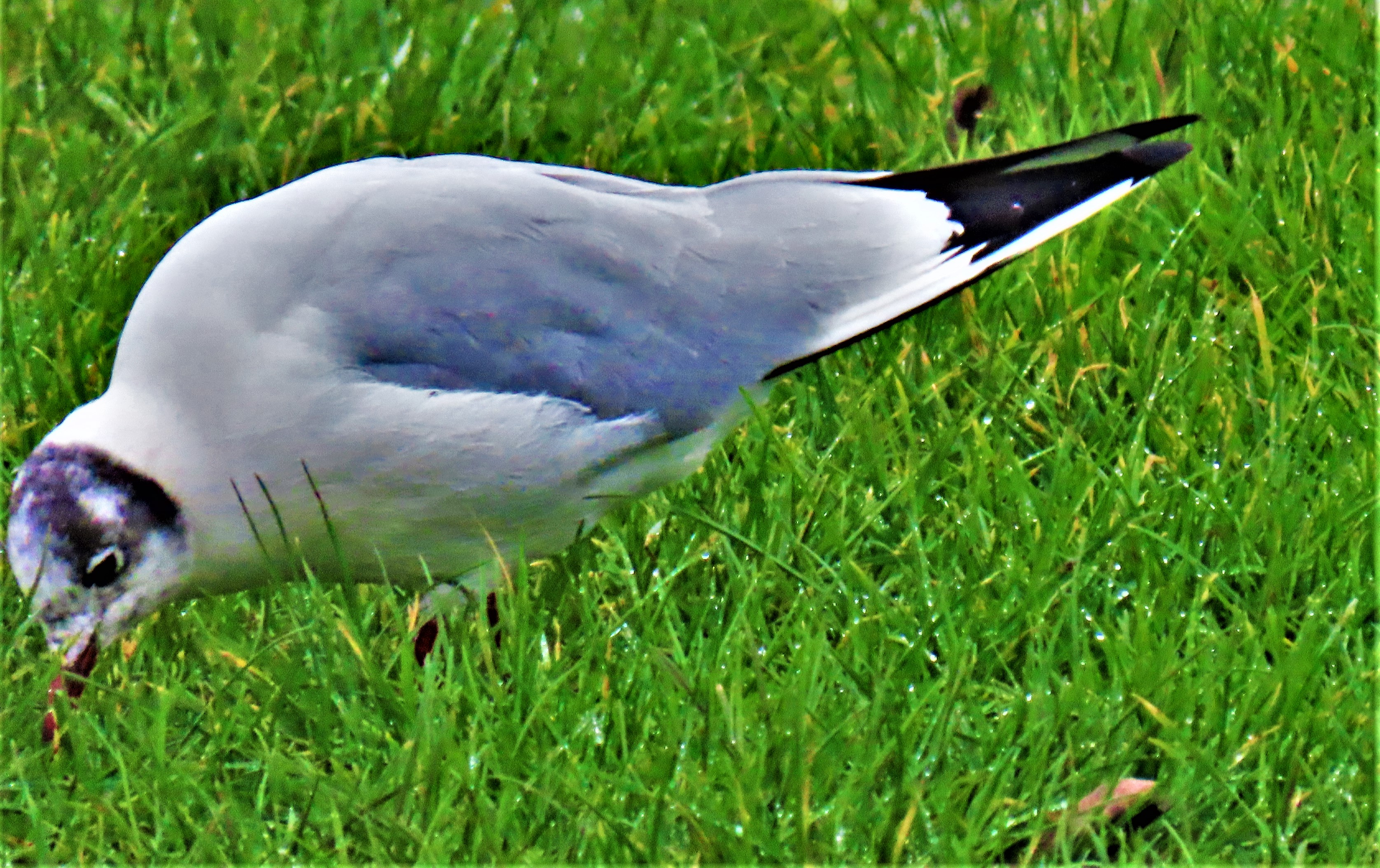
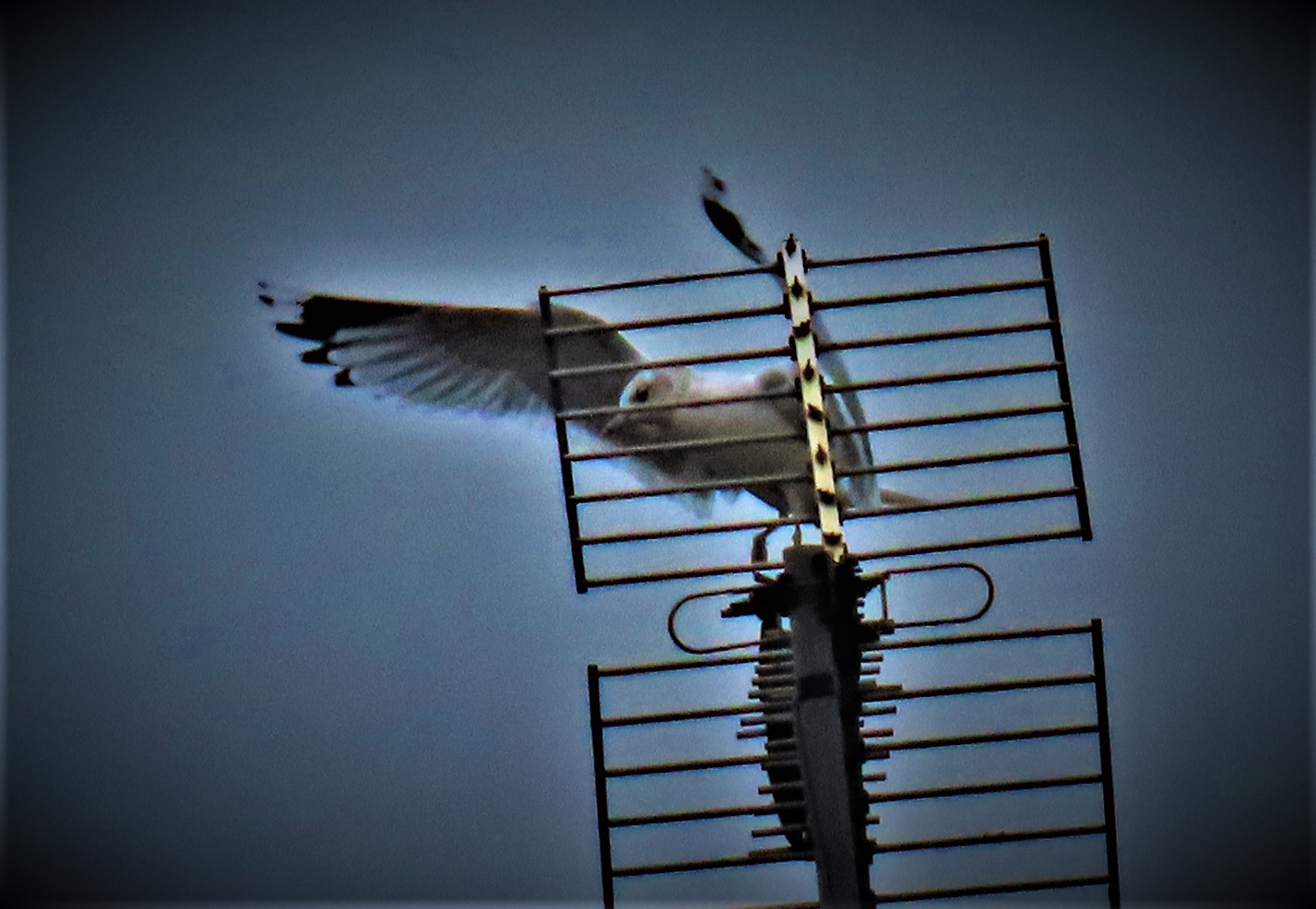
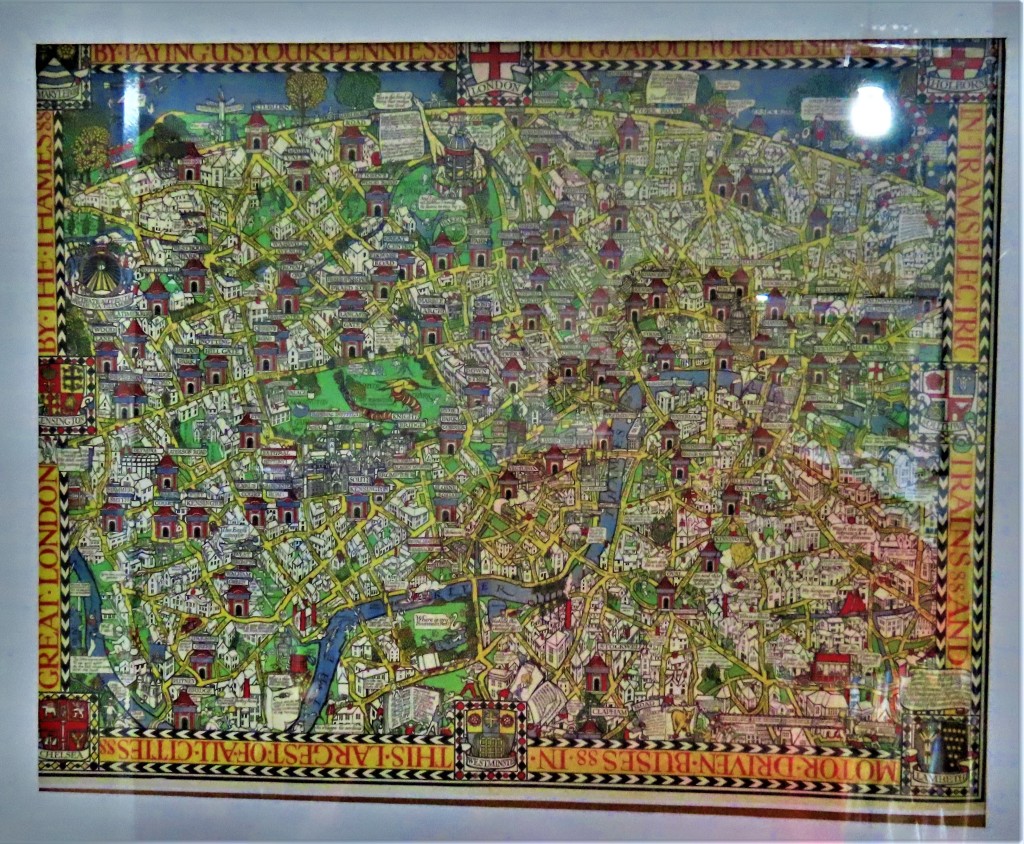
PHOTOGRAPHS
I have a fine collection of photos for you, including swans demonstrating synchronized diving:
Looking at the resumption of test cricket in Pakistan and at the question of England spinners, as news arrives of a potential test recall for Moeen Ali.
This post contains two parts, a look at current goings on in Pakistan and a look at England spinners ahead of the upcoming tour of India. The feature infographic provides a brief version of why I less than impressed by news of a possible test recall for Moeen Ali, and I will cover it more fully in the second part of this post. All player details come from cricinfo.com.
SOUTH AFRICA IN TROUBLE
The first test match to be played in Pakistan for some considerable time is under way. South Africa, the visitors, batted first, and did not make a particularly good fist of it. No one in their top six scored less than 13, but only Dean Elgar with 58 managed to get beyond 23. It took a late 35 from George Linde to get South Africa to 220. Five of the top six (where most of the runs should come from) getting into double figures but not even reaching 25 suggests carelessness, and reports I have read of the wickets confirm that more of them were given than were taken.
Pakistan looked to faring even worse when South Africa reduced them to 33-4 by the close of the first day. However, Fawad Alam dug in, and found some good support from the middle and lower order. Alam ground out a determined century, with no8 Faheem Ashraf (fairly new to test cricket, but averaging 31 with the bat and 27 with the ball in first cricket) scoring 64. By the time stumps were drawn at the end of day two, Pakistan were 308-8, a lead of 88. I don’t think it will happen, but personally just for the psychological impact of telling the opposition “you had us 33-4 and now we reckon we have enough of an advantage to win” I would recommend an overnight declaration. It was not all bad for South Africa today however – their women recorded an impressive win in an ODI against Pakistan, Laura Wolvaardt scoring 58 – perhaps the men should give her a bell, as their top order could do with a bit of stiffening.
ENGLAND SPINNERS
Leaving aside Simon Harmer, now technically eligible for England but apparently not in the selector’s minds, England have a number of spinning options they could look at, and Moeen Ali, touted for a test recall in some quarters, is not in my opinion one of them. He pays 36.59 per wicket in test cricket, a marginal improvement on his first class bowling average of 37.94. His batting, which his supporters turn to next demands two retorts: firstly picking people for bowling slots based on what they can do with the bat is flawed, unless they have very similar bowling stats to someone with much less batting skill, and secondly at test level it does not pass muster anyway – while his first class batting average is a respectable 36.72, his test batting average is 28.97, at the good end of ‘bowler who bats’ territory but definitely nowhere close to all-rounder status. In other words England are thinking of recalling someone whose bowling is in the ordinary range of ‘batters who bowl’ (Hammond, who averaged 58.45 with the bat at test level took his wickets at 37.80 for example) and whose batting is at the good end of the range for ‘bowlers who bat’.
Dom Bess, one of the current incumbents, pays 29.46 for his first class wickets, and just over 30 each for his test victims. Sophie Ecclestone, a very successful bowler for England Women, averages 26.28 across the three international formats (the women play so little long form cricket that one has to look across the spectrum) – and yes, I would certainly rate her a better option for a spinner’s berth than Ali. Jack Leach pays 26.06 a time for his first class victims, and averages just over 30 per victim in test cricket. Matt Parkinson, yet to be given his chance at test level pays 25.22 per victim at first class level. Liam Patterson-White has played just five first class matches to date, but has 20 wickets in them at 21.00 a piece. Amar Virdi has paid 28.08 each for his 91 first class wickets. Finally, if you absolutely insist on someone with all round qualities, Lewis Goldsworthy had an excellent under 19 world cup, though he has yet to play first class cricket (it would not be entirely unprecedented for someone to make their first class debut in a test match). Moeen Ali sits firmly in the category of proven failures at the highest level, and any of the players I have listed would be better selections than him – all are young enough to improve, whereas he is not. My personal vote would go to Parkinson, the leg spinner, to support Jack Leach, with Bess coming in if the pitch looks it warrants three spinners (Bess takes wickets when the ball turns, but when there is no assistance for him he leaks too many runs for comfort due to his tendency to bowl the odd loose ball). Whatever the right answer is, it is most definitely not an ageing player who cannot be deemed worthy of a place with either bat or ball.
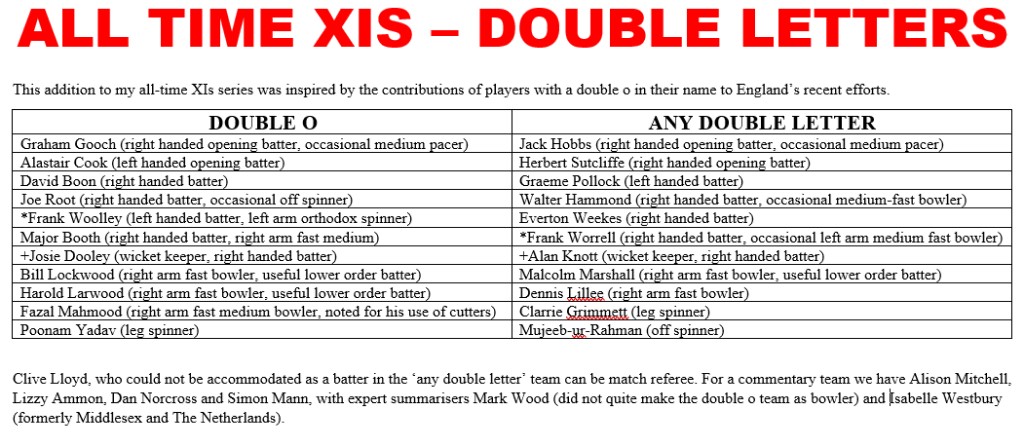
An addition to my ‘All Time XIs’ series, this time taking double letters as its theme.
The role of players with a double o in their names for England in recent times got me thinking about a team of players who all featured that combo, and I then started thinking about other names with double letters in, resulting in a new post for my All Time XIs series.
THE DOUBLE O XI
Graham Gooch – right handed opening batter, occasional medium pacer. Scorer of 8,900 test runs, and player of the best test innings I have ever personally witnessed – 154 not out in an innings tally of 252 vs West Indies at Headingley in 1991, with Ambrose running riot on a pig of a pitch.
Alastair Cook – left handed opening batter, scorer of more test runs than any other left hander – 12,475 of them in all.
David Boon – right handed batter, started as an opener, but moved down to no3 to enable the formation of the right-left Marsh-Taylor combination and enjoyed tremendous success in that latter position.
Joe Root – right handed batter, occasional off spinner. Arguably England’s finest batter of the 21st century, Cook’s achievements notwithstanding.
*Frank Woolley – left handed batter, left arm orthodox spinner. The only player to have the treble of 10,000 first class runs, 1,000 first class wickets and 1,000 first class catches, and indeed the only person to have taken 1,000 catches as other than a wicket keeper. In first class cricket he averaged 40 with the bat and 19 with the ball, and his bowling won at least one test match for England. I am sufficiently impressed by his tactical thoughts, as expressed in “King of Games” to name him as captain even though as a professional of that era he never had the job.
Major Booth – right handed batter, right arm fast medium bowler. Major was his given name (he was named in honour of a respected Salvation Army figure), not a rank. He would certainly have played many times for England but for the first World War (he lost his life during the battle of the Somme). In the late stages of the 1914 season he and Alonzo Drake, another cut off in his prime by the outbreak of war, bowled unchanged together through four successive first class innings.
+Josephine Dooley – wicket keeper, right handed batter. One of the successes of the most recent edition of the Women’s Big Bash League.
Bill Lockwood – right arm fast bowler, useful lower order batter. He was one of the first fast bowlers to develop a really effective slower ball.
Harold Larwood – right arm fast bowler, useful lower order batter. The list of visiting fast bowlers to have blitzed the Aussies in their own backyard is a short one, and the Notts express features prominently on it.
Fazal Mahmood – right arm fast medium bowler. Pakistan’s first authentically great bowler, he took 12 wickets in their first ever test victory at The Oval in 1954. He was known as a master of bowling cutters, often wreaking havoc on the matting pitches which were standard in his homeland at the time.
Poonam Yadav – leg spinner. The tiny Indian causes huge problems with her craftily flighted slow leg breaks. The greatest demonstration of her ability to change the course of a match came in the most recent World T20 when Australia seemed to be coasting as she began her spell and were obviously beaten by the time she had finished.
This team contains a strong top five, an all rounder at six in Booth, a keeper who can bat at seven and four great bowlers with plenty of variation. Woolley is an excellent second spin option with his left armers, and Gooch and Root might also contribute with the ball.
THE ANY DOUBLE LETTER XI
Jack Hobbs – Right handed opening batter, occasional medium pacer. The Master, scorer of 197 first class centuries in total, 12 of them in Ashes tests. He achieved all that in spite of losing four years of his cricketing prime to World War 1.
Herbert Sutcliffe – right handed opening batter. First class average 52.02, test average 60.73, Ashes average 66.85. When the going got tough, he got going. He formed the most successful opening pairing in test history with Hobbs, their average opening stand being 87.81.
Graeme Pollock – left handed batter. The South African averaged 60.97 before his country’s international isolation ended his test career. I opted for his left handed stroke play in preference to having a third right handed opener in Hutton occupy this slot.
Walter Hammond – right handed batter, occasional medium-fast bowler. 7,249 runs in 85 test matches at 58.45, and that average only ended up below 60 because he returned to test action after World War Two, when into his forties.
Everton Weekes – right handed batter. He had a similar average to Hammond in test cricket.
*Frank Worrell – right handed batter, occasional left arm medium-fast bowler, captain. He averaged 49.48 in test cricket, and was one the most successful captains ever, taking the West Indies from also rans which they had been for their entire history to that point to being champions by the time he finished.
+Alan Knott – wicket keeper, right handed batter. One of the game of cricket’s most noted eccentrics, and also one of the greatest keepers ever to don the gauntlets. He also averaged 32.75 with the bat, and tended to score big runs when the team most needed them.
Malcolm Marshall – right arm fast bowler, useful lower order batter. Arguably the greatest fast bowler of the golden age of West Indies fast bowling.
Dennis Lillee – right arm fast bowler. The Aussie was for some years test cricket’s all time leading wicket taker, and his 164 Ashes wickets is a tally surpassed in the history of those contests only by Shane Warne who finished just short of 200.
Clarrie Grimmett – leg spinner. The New Zealand born Aussie who having moved country to better his cricketing prospects had to then cross two state boundaries before establishing himself in first class cricket at the third time, and did not make his test debut until the age of 33 still became the first bowler ever to take 200 test wickets, capturing 216 from 37 test appearances – nearly six per game at the highest level. His Aussie team mate Bill O’Reilly, who was second choice for this spot, was adamant that Grimmett, then 46, should have been selected for the 1938 tour of England.
Mujeeb-ur-Rahman – off spinner. A bit of a gamble on this one – left armer George Dennett with 2,151 first class wickets at less than 20 a piece could easily have been named for this spot, but the young Afghan off spinner has impressed most times he has had the ball in his hand of late.
This team features a very strong top six, one of the all time great keepers, and four great bowlers. I consider that Hammond and Worrell between them make up for the lack of a genuine all rounder. There are too many honourable mentions to name, but before moving on to the next section I would just like to say that if you have someone who you think I have missed please indicate which of my selections should be dropped to make way for them.
OFF THE FIELD
Clive Lloyd, a near miss for a batting place in the ‘any double letter’ team can be match referee, a role he also filled with distinction. In the commentary box we can have Alison Mitchell, Lizzy Ammon, Dan Norcross and Simon Mann, with expert summarisers Mark Wood (not too far off a bowling spot in the double o XI) and Isabelle Westbury (Middlesex and Holland).
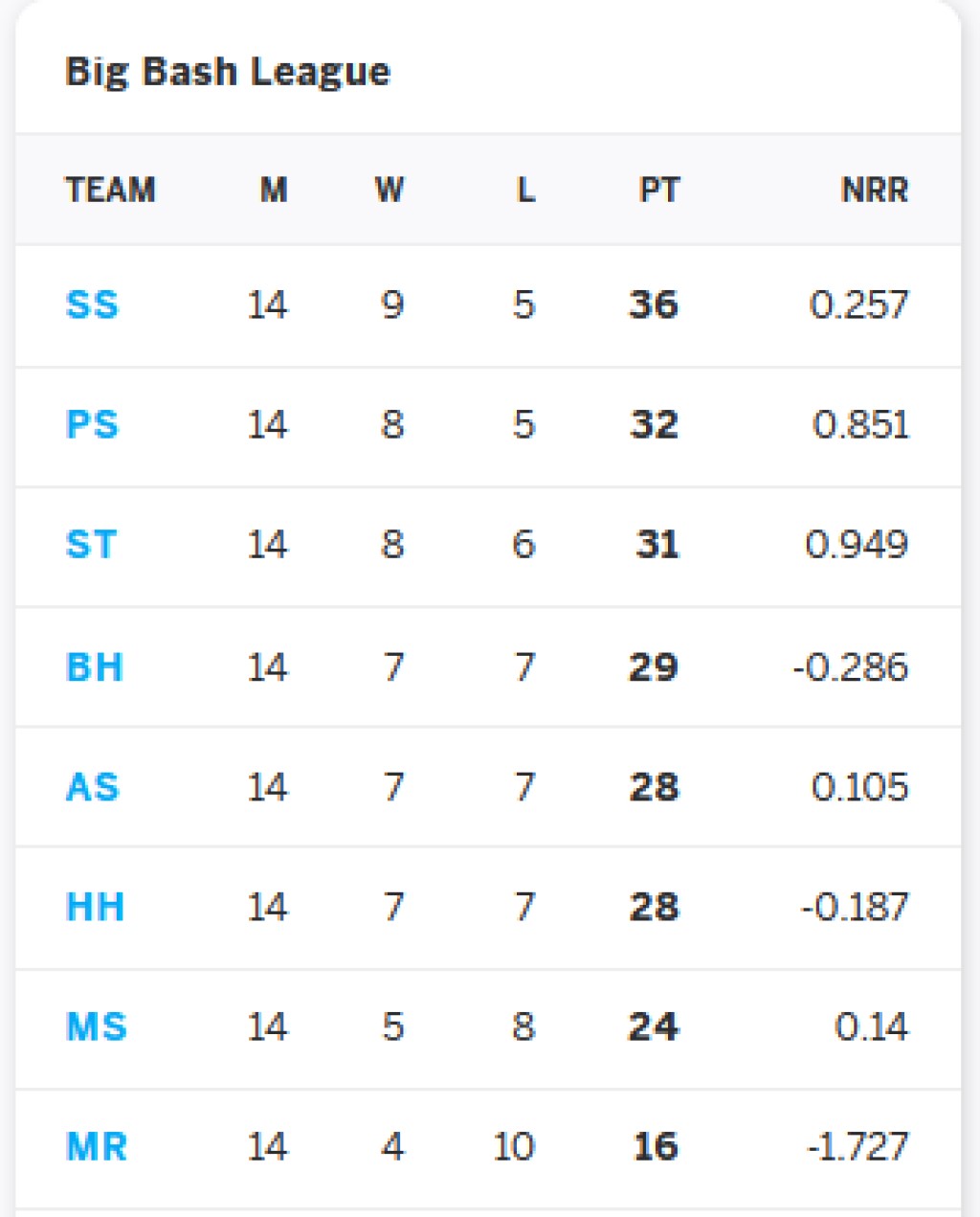
A look at the 56th and last group game of #BBL10, an analysis of the qualification system, a look at the innovations in this year’s BBL and some photographs.
The graphic which heads this post is the final group table of BBL10, screenshotted from cricinfo.com. In this post I look back at the 56th and final group game, analyse the qualifying system in place for this tournament and offer final views on the three innovations. I would like to say at this point, in case the rest of this post gives a wrong impression, that I have enjoyed the tournament, and my criticisms are offered in a constructive spirit.
STARS STUFF UP SEES THEM CRASH OUT OF BBL10
With Heat beating Scorchers to secure a qualifying place and Renegades final act of the tournament being to eliminate the Hurricanes the 56th and last group game, commentary of which was broadcast on five live sports extra presented a stark situation to the two combatants: Stars needed the full four points (three for the win and one for the Bash Boost) to qualify (with a sensible qualifying system they would already have been gone – more on this later). Sixers meanwhile needed the Bash Boost point at minimum to win the group, and a victory of any sort to do so outright rather than on net run rate.
With Stars needing all the points they had to get big runs in the first ten overs of their innings, but they failed to pick up this message. Nick Larkin, a known slow starter, was sent in at number three, and in this case provided the expected slow start and then failed to go on (11 off 16 balls). Then, at the end of the tenth, setting the Bash Boost target, Nic Maddinson came back for a second on the penultimate ball rather than leaving the big hitting Maxwell on strike. Two more accrued of the last ball of the tenth, leaving Stars on 72-3, and a modest target for the Sixers to claim the all-important first point of the game, which would ensure no Melbourne participation in the final stages (Renegades’ win had not altered their final position – last).
Overs 11-15, which included the Power Surge being taken for overs 14 and 15 were the best part of Stars’ day, as they scored 52-1 in that period to reach 125-4 at the three-quarter mark. They lost a little momentum in the closing stages, but three sixes in the final over boosted them to 177-6, a respectable total, though not very relevant as their poor handling of the first ten had likely cost them any chance of qualifying.
Faced with the situation they were in Stars should have front loaded their batting with all their biggest hitters, realising that their 20 over score would only be truly relevant if they went big in the first ten. Nick Larkin as a known slow starter should probably not have been picked for this match at all.
Sixers lost a couple of early wickets, but by the end of their four over power play were 43-2, 11 runs ahead of Stars at the same stage. They also outscored Stars in the second phase of the innings, albeit only by two runs, being 85-3 at the halfway point, and having already won the war, securing their own status as group winners and the elimination of the Stars, although a Pyrrhic victory in the final battle remained on for the Stars.
Overs 10-15 did not go especially well for the Sixers, who reached the three-quarter way stage at 126-5, 1 run ahead, but one wicket behind the Stars. They picked things up in the final quarter however, and in the end a boundary struck by Dan Christian of the penultimate ball of the match ensured that Stars would not even have a Pyrrhic victory to finish. Sixers deservedly topped the group, and I for one have no sympathy for the Stars, who made a complete mull of their approach to this game, and who in the words of Anne Robinson “Leave with NOTHING.”
A FLAWED QUALIFICATION SYSTEM
Although it lent a few of the final group games an interest they might not otherwise have had, a qualification system that allows five teams out of eight to progress to the knockout stages has to be considered flawed. Firstly, in order to reward each qualifying team according to their placement the knockout phase is byzantine in the extreme. Secondly, it means that average teams are being rewarded – the teams in the 4th and 5th qualifying spots each recorded seven wins and seven losses, which does not deserve to be enough to progress. Tournaments that are organized on part league part cup lines should reward only teams who are exceptionally successful in the league phase – and losing as many games as you win is not exceptionally successful on any definition. My own preferred method for an eight team tournament would be as follows: three teams qualify for the final stages, the group winners going straight through to the final, while the second and third place teams play off for the right to join them, with the second placed team having home advantage by way of reward for doing better than the third placed team. This would make the tournament more compact by reducing the number of knockout matches, although they also need to have more days on which multiple matches are played in the group stages, and would ensure that only teams who are clearly better than the rest get to play in the knockout matches.
THE THREE INNOVATIONS
BBL10 featured three innovations this year: the Power Surge, reducing the opening Power Play from six overs to four, with a two over Power Surge to be claimed by the batting team at any point after 10 overs, the Bash Boost point, awarded to the team with the better score at the halfway stage, and the ‘x-factor’ sub where specifically at the halfway stage of the first innings each team may swap out one player for one of their designated ‘x-factor’ subs. I am a huge fan of the Power Surge, though a number of teams have misused it, being wary of going early and ending up without front line batters to cash in on it, and would like to see it adopted in other T20 competitions. The Bash Boost point has overall been a success, although a combination of the importance it assumed today, and Stars’ flawed approach caused it to spoil this particular game somewhat, and again albeit under a different name, it might well be worth other T20 competitions adopting it. The ‘x-factor’ sub rule belongs in the circular file, and has in my view contributed nothing to the tournament. If you need to alter the balance of your side after the start of the game, the one valid reason for using such a sub, you should have got it right first time.















































































































































































































 aspiblog