A look at developments so far in the women’s Ashes and a substantial photo gallery.
Yesterday morning the Women’s Ashes got underway with day one of a five day test match (this move being not before time – see here). This post looks at the action so far.
THE PRELIMINARIES
The warm up matches (England v Australia A and England A v Australia) both went better for England than Australia. England’s chosen XI included an international debutant in Lauren Filer and a test debutant in Danni Wyatt. Filer was part of seam/ pace trio alongside veteran Kate Cross and the tall swing bowler Lauren Bell, while the front line spinner was inevitably Sophie Ecclestone. In addition to these Natalie Sciver-Brunt’s medium pace, Sophia Dunkley’s leg spin and Heather Knight’s off spin were also available as back up options. Australia’s side included Ellyse Perry, adding to her many entries in the record books by taking part in a tenth Women’s Ashes series. They opted for two front line spinner, Ashleigh Gardner and Alana King. They also had such strength in the batting department that Annabel Sutherland, a regular number three in Australian domestic cricket and coming off the back of a century in her warm up game was at number eight (she is a seam bowling all rounder, and has a better record at the age of 21 than Perry did when she was that age. Australia won the toss and chose to bat.
DAY ONE
Yesterday was a work day for me, so I missed a lot of the action, but tuned in just in time to catch Sophie Ecclestone’s second wicket. Two balls later Aussie skipper Alyssa Healy was out for duck and it was 226-5. That was as good as it got for England, and by the end of the day Australia were 328-7, with Sutherland going well.
DAY TWO
The second morning definitely belonged to Australia. Bell claimed the wicket of Alana King, but Kim Garth has providing staunch support for the brilliant Sutherland since then. Australia have just reached 450, with Sutherland now on 121. Ecclestone has been by far the best of the England bowlers, and now has figures of 44-9-115-3, with the rest of the attack going at closer to five an over than four – rather a contrast to the men’s test, when England’s supposed front line spinner was the one getting smacked around while the seamers were significantly more economical (on a side note, the England men’s selectors seem to have realized that persisting with Ali is not on – Rehan Ahmed has just been added to their squad). Although Australia are in a very strong position England are themselves a powerful batting side, with an opener, Beaumont, coming off a double century in her warm up match and a few others in good form. As I type this Garth has just been given LBW to Ecclestone, though she has reviewed it, it has been confirmed as out and Australia are 457-9, Ecclestone has 4-120 in her 45th over of the innings. Darcie Brown, the sole member of this Aussie XI with no batting pedigree has joined Sutherland at the crease.
PHOTOGRAPHS
The first four pictures in today’s gallery were taken a few days earlier than any of the others, which all date from the last couple of days. To view a photo at full size just click on it.
A look at the amazing test match the ended at 7:20PM yesterday and a substantial photo gallery.
This post looks back at a test match that had everything. From the moment Zak Crawley creamed the first ball of the match for four through to 7:20PM yesterday when Pat Cummins struck a four to third man to settle things the fortunes of war swayed hither and thither. I will be producing a detailed set of player ratings and a look at who England might pick to deal with obvious problems revealed in this match.
THE CLOSING STAGES
I was at work yesterday, but a rain delay at Edgbaston meant that I got to witness the closing stages of the match by way of Test Match Special and cricinfo. On a last day pitch definitely favouring spinners supposed front line spinner Moeen Ali had the indignity of being outbowled by part timer Joe Root. Stokes, injured knee and all, bowled with great determination. Broad and Robinson were both excellent, though Anderson did little. Stokes declined to take the new ball when it first became available, and when Root got Carey to make it 227-8, 54 still needed, it looked like the move had paid off. However Stokes persisted with the old ball, and Cummins and Lyon gradually settled in. Finally, with the deficit halved England took the new ball, but although Broad and Robinson bowled well they simply could not break through. In truth I had been rooting for what would have been only test cricket’s third ever tie, because each side had at least one player who did not deserve a loss – Khawaja for Australia and Root for England being the standouts. A tie clearly outranks a draw, as it is a result in keeping with the Stokes ethos. However, I have no complaints about the end result, and certainly none whatsoever about the final stages of the match.
ENGLAND’S MAIN PROBLEMS
I am going to start this post by stating firmly one thing that did not cause England to lose: Stokes’ declaration on the first evening has been the subject of much comment, a good deal of it hostile. The truth is the problems lay elsewhere than that decision:
‘samey’ main bowlers: as splendid as they all are at what they do Anderson, Broad and Robinson are too similar as bowlers for England to accommodate all three of them in the XI.
Wrong choice of main spinner: it should not have surprised anyone that an ageing player who has not played red ball for a couple of years struggled with the extra workload entailed in bowling in the long form of the game, nor that someone coming into the match with a bowling average against Australia of 65 did not pose very much of a threat.
Wrong choice of wicket keeper: for my money Bairstow’s three definite missed chances (two catches and one stumping), plus the potential chance he didn’t go for, leaving the ball to pass between him and Root for four more than neutralized his contribution with the bat. Last summer Bairstow played as a specialist batter, with Foakes behind the stumps, and if Bairstow has a role in the side it is as a batter, not a keeper/batter.
Players getting in and getting themselves out. : in the second England innings three players got to 40, and not one of them went on to 50. At least one of those three should have gone on to a genuinely major innings.
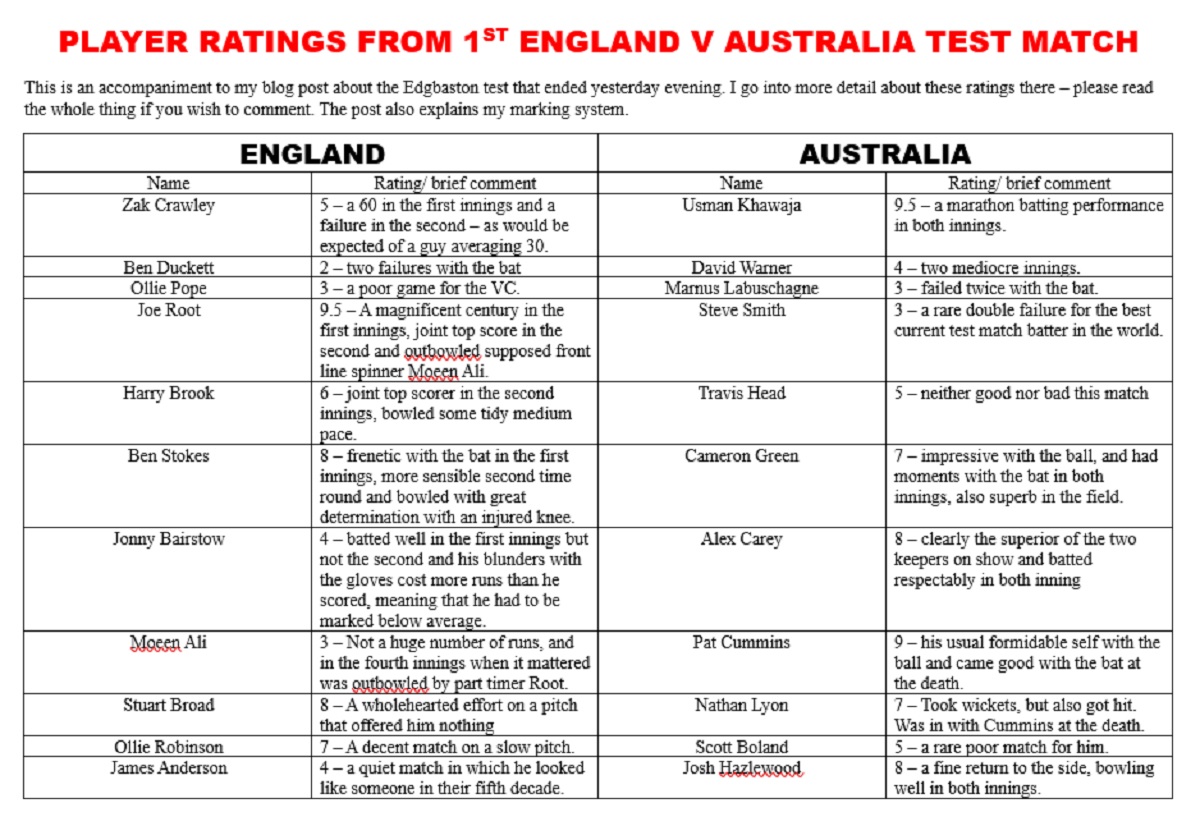
PLAYER RATINGS
I will be going through each team in official batting order, using a scale of 0 (did nothing of value at all) through to 10 (perfection). Please note that when using such scales I use the whole scale – no courtesy marks just for turning up.
ENGLAND
Zak Crawley: 5. A dead average performance from someone who is in truth a dead average player – 61 in the first innings and a failure in the second is nothing special for an opener.
Ben Duckett: 2. Two failures with the bat this time, but he surely has credit in the bank from Pakistan and New Zealand to retain his slot.
Ollie Pope: 3. A promising start in the first innings, and his dismissal was somewhat unfortunate, but a skittish performance in the second in which he never looked like getting settled. Not one of the vice-captain’s finest outings.
Joe Root: 9.5. A glorious hundred in the first innings, joint top scorer in the second and out-bowled the ‘front line spinner’. Although this was a performance that underlined his status as one of the greatest cricketers his country has ever produced I dock him half a point for getting out on 46 in the second innings.
Harry Brook: 6. He was joint top scorer in the second innings, and bowled some tidy medium pace along the way.
Ben Stokes: 8. An overly frenetic batting performance in the first innings, but a much better effort second time round, and a determined bowling performance in spite of having knee trouble.
Jonny Bairstow: 4. The most controversial mark I am giving, but as I stated earlier in this piece I reckon that the chances he either missed or simply didn’t go for cost more runs (remember as well as the extra runs scored by the reprieved batters you have to factor in extra runs scored at the opposite end in the same period) than he contributed with the bat, and his second innings demonstrated another point about Bairstow the keeper/batter – he rarely scores well after a keeping performance. Since I have have him in net debit for the match I have to give him a below average score to reflect what was overall a below average performance, and on a scale of 0-10, 5 is average.
Moeen Ali: 3. Did not do a lot with the bat, and had a poor game with the ball, to the extent that on a final day pitch which was helping spinners he had the indignity of being out-bowled by part time Joe Root.
Stuart Broad: 8. A wholehearted bowling effort on a pitch that offered him absolutely nothing.
Ollie Robinson: 7. A solid bowling effort in unfavourable conditions, and some lower order runs in the second innings. His reaction to dismissing Khawaja in the first Australian innings attracted a lot of condemnation, but frankly given the way their bowlers have been known to treat opposition batters Aussies are the last to have any right to complain about this kind of thing
James Anderson: 4. Did little in the match, and I for one would not be terribly surprised if he missed Lord’s.
AUSTRALIA
Usman Khawaja: 9.5. A marathon effort with the bat in both innings. The only blot on his copybook is that he did not quite see the job through in the final innings.
David Warner: 4. Not absolute failure, but two moderate scores.
Marnus Labuschagne: 3. Failed twice with the bat.
Steve Smith: 3. The best current test batter in the world suffered a rare double failure in that department.
Travis Head: 5. Could not duplicate his brilliance against India in the WTC final, but not an outright poor performance.
Cameron Green: 7. Impressive with the bat, albeit assisted by Bairstow in the first innings, respectable with the ball, and fielded superbly.
Alex Carey: 8. Clearly the superior of the two keepers on show, and batted well, albeit with two assists from his opposite number in the first innings.
Pat Cummins: 9. His usual formidable self with the ball and batted well in both innings, getting Australia over the line in the second.
Nathan Lyon: 7. He took wickets in both innings, but also took some punishment. He was batting with Cummins when the winning runs were scored.
Scott Boland: 5. A poor match with the ball, but given how close it was his 20 as nightwatch in the fourth innings redeemed him somewhat.
Josh Hazlewood: 8. Bowled well on his return to the side from injury.
Foakes has to return to the side as keeper. I would personally achieve this by dropping Crawley, and having someone else open the innings. Ali cannot be retained, and I would say genuine possibilities are: Rehan Ahmed, Liam Dawson, Dan Moriarty (not a Surrey regular alas, but always bowls well when given the opportunity, as an FC bowling average of 27 suggests), Jack Carson, or the ultra-radical option of asking Sophie Ecclestone if she is up for playing alongside the men. Also, I would rest Anderson and bring in Wood to give the seam attack a point of difference. Chris Woakes has a splendid record at Lord’s, and playing him at number eight and relying on Root for spin is another option.
PHOTOGRAPHS
This has been a long post, but for those of you who made it to the finish this is my usual sign off…
A look at developments in The Ashes so far and a photo gallery.
While I have been blogging about my holiday in the Lake District (I have a page with links to all the posts in this series) plenty has been happening in the world of cricket. England and Australia both had good build ups to the first match of the Men’s Ashes, although England lost leading spinner Jack Leach to an injury. This post looks at the developments since the series got underway on Friday.
THE PRELIMINARIES
England’s final XI, announced two whole days before the match started, contained several bones of contention. Foakes was dropped, as England decided that the best way to accommodate the returning Bairstow was to give him the wicket keeping gloves. When it came to finding a replacement for Leach as spinner they made the shockingly retrograde decision to recall Moeen Ali, now on a WHITE BALL ONLY contract with Warwickshire. Finally, perennial top order failure Zak Crawley retained his slot. The final XI thus read Z Crawley, B Duckett, O Pope, J Root, H Brook, *B Stokes, +J Bairstow, M Ali, S Broad, O Robinson, J Anderson. Australia’s only question mark was which two of Josh Hazlewood, Scott Boland and Mitchell Starc would play. In the event they opted, rightly IMO, for Hazlewood and Boland, benching Starc. England won the toss, and as they were virtually obliged to opted to bat first.
DAY ONE
Ben Duckett and Ollie Pope were both out fairly cheaply, but Crawley for once played well, scoring 61. However the feature of the innings was a glorious century by Joe Root, underlining his status as an all time great. Bairstow made 80, and Stokes surprised many by declaring at the end of the 78th over with the score reading 393-8. This set a new record – the earliest point in terms of balls bowled at which the opening innings of a test match has been declared. England didn’t manage an early breakthrough that evening, and many were slating Stokes for declaring. I was not among them, because unlike these critics I remember Rawalpindi, when Stokes was proved right about an aggressive declaration.
DAY TWO
This was a frustrating day. Bairstow more than undid his good work with the bat with some poor keeping – he reprieved Travis Head and Alex Carey, both pretty costly, and Australia reached the close at 311-5, 82 behind.
DAY THREE
The very first ball of the day should have seen England break through but Bairstow muffed another easy chance. There was another edge that failed to go to hand not much later, but I am not cruel enough to describe that one as a chance – it hit Bairstow’s boot before touching the ground, but it would have been miraculous to make a catch of it. However, in spite of these frustrations England did eventually take a first innings lead, bowling Australia out for 386. They made a good start, but then Cummins and Boland had a purple patch, and when the rain made its final intervention of the day England were 28-2, 35 runs ahead.
DAY FOUR SO FAR
Pope was third out with the score at 77, though Root was again batting splendidly. He was now joined by Harry Brook. They put on a rapid 50 stand before Root fell for 46 to make it 129-4. Brook exactly matched Root’s score before he too was out. Stokes and Bairstow are still together. Scott Boland had a naughty moment when he claimed a catch that would have meant the end of Stokes, but it went upstairs and replays showed that Stokes had hit the ball straight into the ground, a fact of which Boland must have been aware. As things stand England are 196-5, 203 runs ahead, and the match is intriguingly poised.
PHOTOGRAPHS
My usual sign off…
As I was preparing this post for publication Bairstow fell LBW to Lyon to make it 196-6, and new batter Ali has got off the mark with a single. Yes Bairstow has contributed 100 runs in the match (80 and 20), but his bad wicket keeping means he is no better than even for the match, and maybe even in debit – certainly any more errors behind the stumps that cost anything will put him in debit.
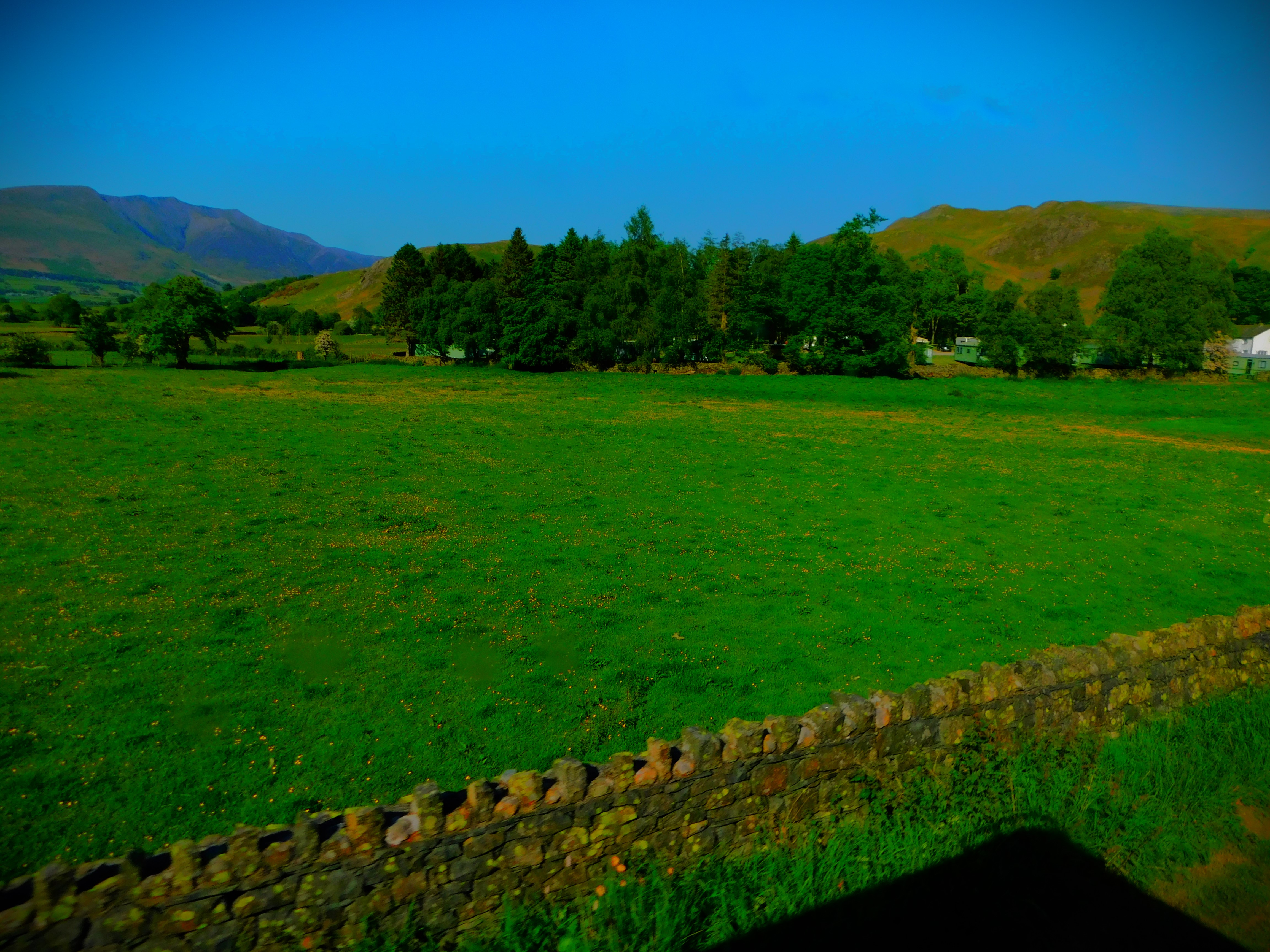
Continuing my series about my holiday in the Lake District with a post about our visit to Keswick.
Welcome to the latest instalment in my series about my holiday in the Lake District. Today deals with the last activity of the Tuesday – after concluding our explorations of Grasmere we went on to Keswick before returning to Ambleside.
ABOUT KESWICK
Keswick looks down on Derwentwater (although this area is called the Lake District very few of the bodies of water in question actually have lake in their title – they are either -mere, -water or water (Coniston Water and Brothers Water to name two of the latter). Those of you who think the Derwent part of Derwentwater looks familiar are probably right – you almost certainly had pencils which had Derwent stamped on their sides, and they were made here – there are graphite deposits in the area. Keswick has its place in Rebecca Tope’s Lake District series – main character Simmy Brown’s other half, who becomes her second husband during the course of the series, is an auctioneer and his auction house is in Keswick.
EXPLORING KESWICK
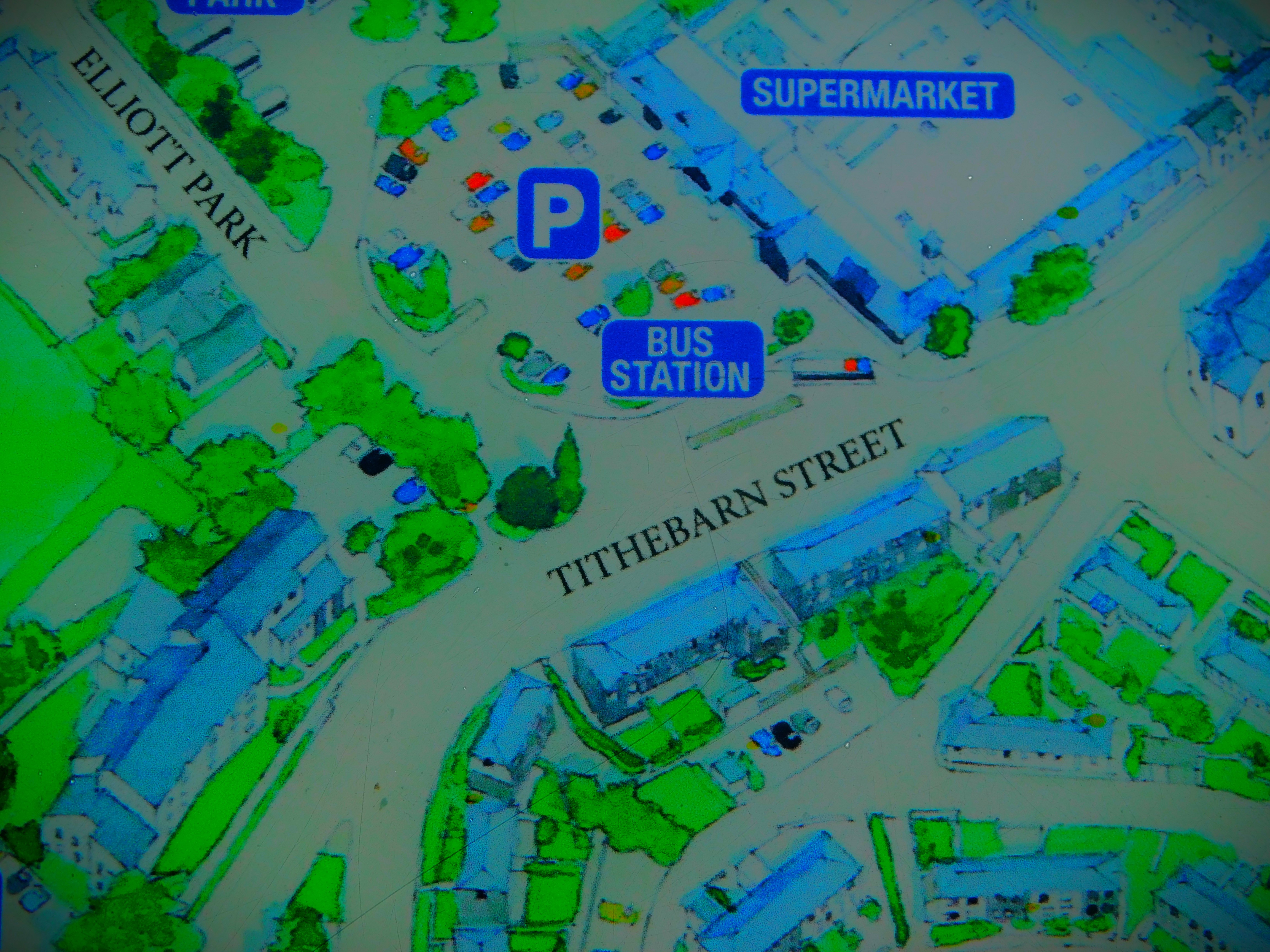
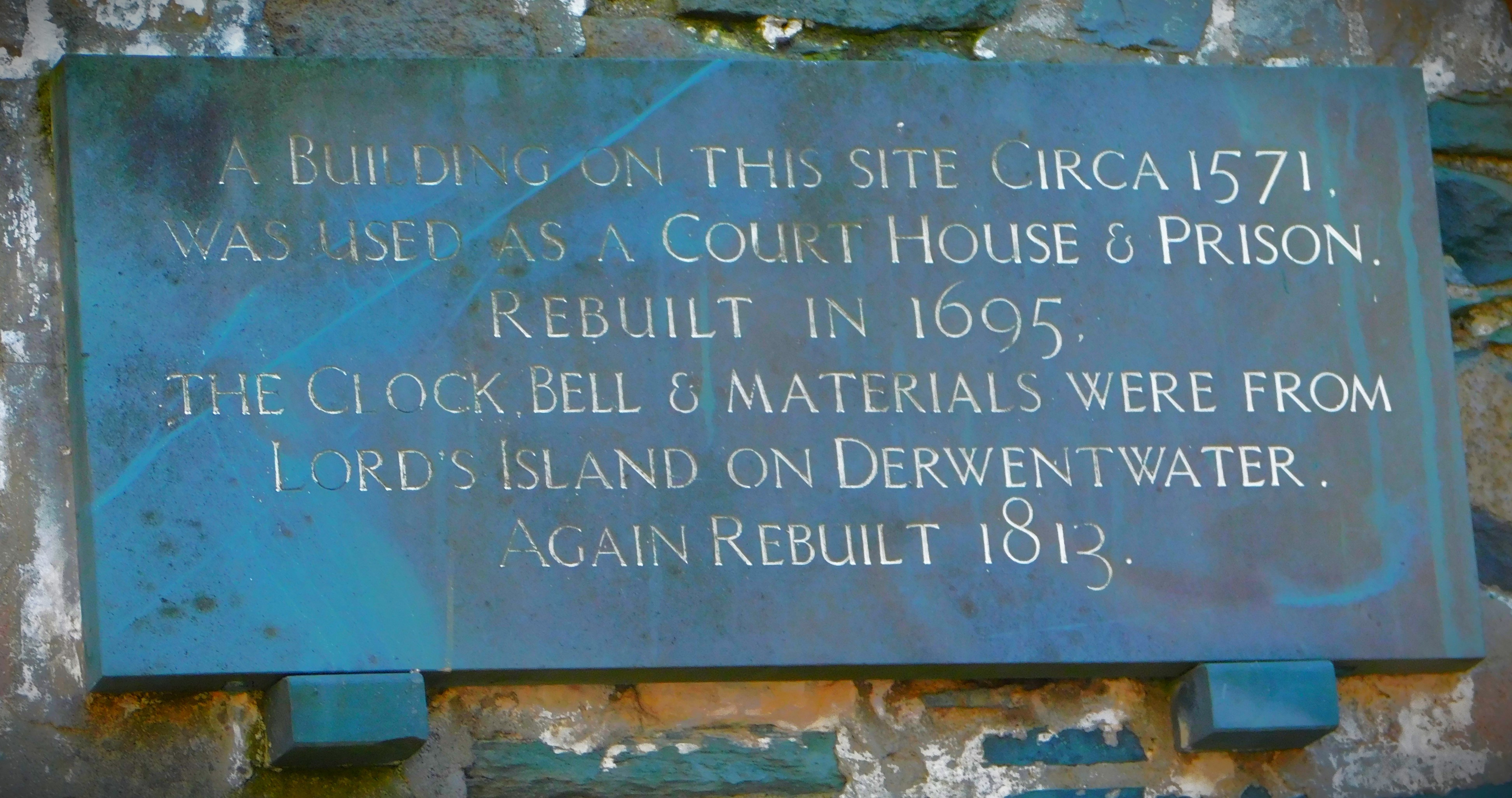
Grasmere to Keswick is a short and scenic bus ride, and I enjoyed it. Keswick has an old meeting hall, a pencil museum which we didn’t visit and a general museum which we looked at but opted not to visit given the price. It is also home to a splendid park in which we spent some time. A bus journey back to Ambleside, alighting at Ambleside bus station at my initial suggestion – I had figured it was close as the bus was going to get us and I was right – it is a much shorter walk than from the garden centre which would have been the next stop.
PHOTOGRAPHS
My usual sign off…
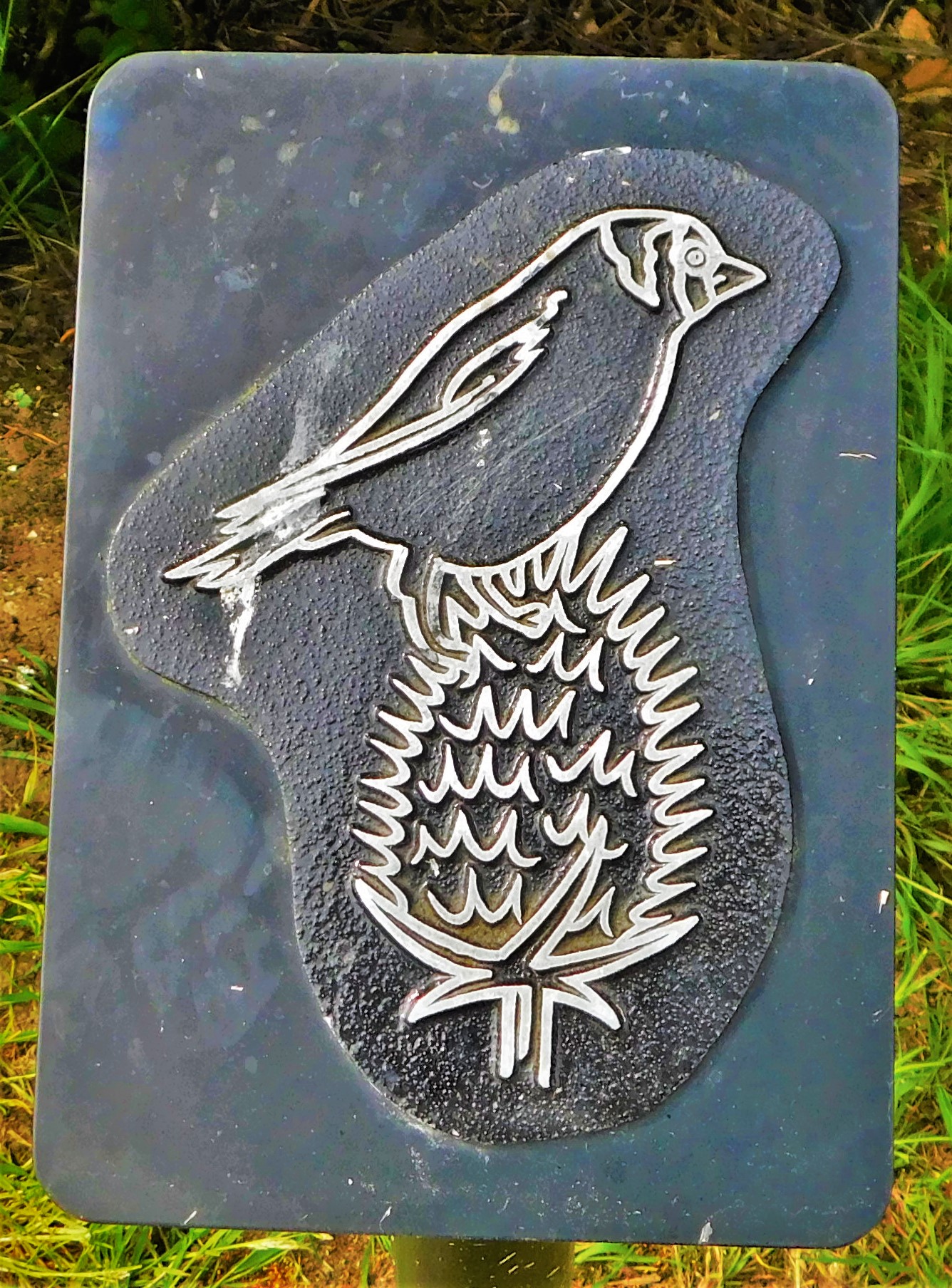
A rather scenic cricket ground.The significance of this sign is the top line (see also the next picture) – Ellie Threlkeld is England Women’s second choice wicket keeper at present, and this sign provides a clue to the origins of that surname.
This post looks at the number 48 for reasons which will become apparent.
THE NUMBER 48
48 has the most factors of any number under 50, nine other than itself (24, 16, 12, 8, 6, 4, 3, 2, 1). It is therefore an ‘abundant number’ – abundant numbers are those whose factors add up to more than the number itself, while deficient numbers have factors that add up to less than the number itself, and perfect numbers have factors that add up to exactly that number. In the case of 48 its factors add up to 76, giving it an abundance of 1.583.
48 squared is 2,304, and 2*3!*4+0 = 48, while 48 cubed is 110,592, and ((11+0)*5)-(9-2) = 48.
48 IN CRICKET
As a cricket fan I look at occurrences of the number 48 in the game. In 1907 Colin Blythe, Kent’s left arm spinner of the era, conceded just 48 runs while claiming 17 Northamptonshire wickets in one single day’s play. This is the cheapest ever match haul of 17 wickets, and the joint most ever taken in a day in first class cricket.
In the 1925 first class season Nottinghamshire skipper Arthur Carr hit 48 sixes. The following season he would captain England in the first four matches of the Ashes series, before Percy Chapman was brought in as skipper for the last match of the series.
In 1896, WG Grace scored 301 against Sussex at the age of 48, still the oldest ever first class triple centurion.
In the ‘Jubilee Match’ early in 1980 Ian Botham claimed 7-48 in India’s second innings, noteworthy as he had already taken 6-58 and scored 114*, the first man to combine a century and a ten wicket match haul at test level, although a few months earlier Enid Bakewell had achieved the same feat for England Women against West Indies Women.
At Edgbaston in 1981 against Australia England captain Mike Brearley managed the highest individual score of the match with 48 in England’s first innings. This was the first completed test match since 1935 to not feature an individual half century. Australia had the better of most of it, but then collapsed from 87-3 to 121 all out in the final innings to lose by 29 runs.
Why I have I produced a post the text part of which focuses on the number 48? Because today is my 48th birthday.
PHOTOGRAPH
I have decided to select a single image with which to end this post…
A look at a resistance act by Glamorgan that has rewritten the first class record books and a substantial photo gallery.
As the 2023 County Championship heads towards a break for the Vitality Blast (which kicked off yesterday, overlapping with this round of matches), the match between Sussex and Glamorgan is heading towards a draw, but today’s action has seen several Glamorgan records go and one all time first class record. The Glamorgan innings is still ongoing at the moment.
THE MORNING SESSION
Kiran Carlson was sixth out, having reached a career best 192, and when Chris Cooke also fell in the morning session it looked like Sussex would have a gettable target. However, Michael Neser and Timm van der Gugten saw Glamorgan through to lunch with no further loss.
THE AFTERNOON SESSION
It has been since lunch that the assault on the record books has been happening, spearheaded by Neser, supported first by Van der Gugten, then by James Harris and now by number 11 Jamie McIlroy. As I write this Neser has completed his maiden Glamorgan century and brought Glamorgan’s score past 700. The first class record came when Glamorgan reached 675, 552 more than the first innings score, relegating Barbados (175 and 726-7), Middlesex (83 and 634) and Pakistan (106 and 657-8) to joint second in this category with a 551 differential, though Pakistan still hold the test record, theirs having happened against West Indies. Glamorgan have beaten their previous record against Sussex, though their overall record, against Leicestershire last season is probably out of their reach at 795. There are some mitigating factors for Sussex – Ollie Robinson has an ankle problem and has not been on the field during this innings, and regular skipper Pujara has a stiff neck and is likewise off the field, Tom Alsop leading the side in his absence. Nonetheless, Glamorgan’s response to facing a deficit of 358 on first innings has been utterly extraordinary. Sussex will be recording a fifth successive draw after coach Farbrace had said they would always go for a win.
A look at the victories recorded by Surrey and Somerset today and a splendid photo gallery.
The county championship is heading towards its break for the Vitality Blast, and all though today is only day three of four a lot of matches have reached their conclusions. This post looks at two that I followed on the radio.
KENT’S HORROR MORNING
Kent went into day three at The Oval trailing by three runs with six second innings wickets standing. Both overnight batters fell quickly, both to Tom Lawes who claimed his third and fourth wickets of the innings. Kent were still in arrears at that point. Lawes completed a maiden first class five-wicket haul with the seventh wicket of the innings. Sean Abbott claimed the eighth wicket of the innings, and Jordan Clark snapped up the last two. Kent had mustered a paltry 141, leaving Surrey needing 58 to win. Burns and Sibley saw Surrey home by ten wickets, just before the scheduled lunch interval. Surrey look wellnigh unstoppable – they were not by any means at their best this match and they still won it by 10 wickets.
SOMERSET END WINLESS RUN
Somerset came to Lord’s having not won any of their last six matches. Midway through day three of their encounter with Middlesex they had ended that unhappy sequence in some style, routing their opponents by an innings and 13 runs. Craig Overton claimed five second innings wickets, while the rout was completed by Jack Leach. Middlesex now look absolute certainties to be relegated back to division two. I am now following the action between Sussex and Glamorgan. Sussex had an enormous first innings lead (over 350), but Glamorgan are back in credit with only three wickets down, Labuschagne and Carlson in a partnership that is closing on the 3o0 mark. Carlson has had a curious season – this is his third century of it and all of his other innings have been under 20.
A look at the events in Surrey v Kent, particularly the transformation wrought by the Surrey lower order, plus a huge photo gallery.
In this last round of championship fixtures before a break for the Vitality Blast T20 tournament Surrey are playing neighbours Kent, and day two is entering its closing stages. Surrey are about where they would want to be, but not in the way they would have expected.
REGULAR WICKETS AND THEN…
Kent had been restricted to 278 in the first innings, and when Surrey reached the 100 with only one wicket gone things seemed to be going well for them, but then Kent had their best period of the game, and by the time Surrey reached 200 they were six wickets down. With a seventh wicket falling not very long after the 200 was reached Kent may have expected a significant advantage, especially with number eight Sean Abbott being Surrey’s senior remaining batter. However, Surrey moved close to parity in a stand between Abbott and Tom Lawes, and then surged clear as Abbott and Gus Atkinson cut loose. Abbott was ninth out for 78, and then with last man Daniel Worrall at the other end, Atkinson blasted three sixes in the space of a single over to complete a 42 ball half century. Surrey had tallied 362 for a first innings lead of 84. Kent are currently 20-0 in their second innings, but Crawley has already enjoyed one moment of good fortune – a massive lash out drive at the second ball of the innings met fresh air – had there been a fraction of contact then, as has happened so often in Crawley’s career the slips would have been in business. The other opener, Ben Compton, has just gone as I type this, caught by Pope after Will Jacks missed it but fortunately sent it upwards, enabling Pope to atone for the mistake. Surrey thus lead by 64 with Kent having nine second innings wickets standing.
A look at the best players from before the official inauguration of the county championship, some comments on the selection of England test squad for the one off match against Ireland and a large photo gallery.
Today I create an XI of the best players most or all of whose careers took place before there was a county championship. Incidentally, there is a page from which all my posts about Saturday’s excursion to Pensthorpe can be accessed. Before I get into the main business of today’s post there is a brief section about…
ENGLAND TEST SELECTORS BLUNDER BIG TIME
The squad for the first test match of the home season, against Ireland is now out, and there are three areas of concern, two selections and an omission. Zak Crawley, a proven failure at test level, retains his slot at the top of the order. Far worse, Ben Foakes has been dropped to make way for the return to test action of Jonathan Bairstow. There may be a case for picking Bairstow, though in a test career which stretches back to 2012 he has blown hot and cold, and more often cold than hot, but there is not even the shadow of a case for dropping Foakes, the best current keeper by far, and someone who has been scoring big runs for Surrey in the championship this season, including a century at better than a run a ball when Surrey were looking for a declaration. Many people have posed this as being a challenge about how to accommodate Bairstow, and I have two options, listed in order of preference:
Opt for what C Auguste Dupin would call “the sagacious and comprehensive expedient of making no attempt to accommodate Bairstow”. England are coming off a very successful winter without Bairstow, and Bairstow’s overall test record is that of a mediocre middle order batter, certainly not sufficient to warrant discarding Foakes.
Have Bairstow open the innings as he does in white ball cricket and drop the proven failure Crawley (I would prefer to see a proper opener such as Ben Compton or Ali Orr picked in Crawley’s case, but at least Bairstow would probably be an improvement were he coming in in place of Crawley).
It is now time to get back to the main meat of the post…
THE XI IN BATTING ORDER
*WG Grace (right handed opening batter, right arm bowler of various types through his career, captain). Had a quarter of a century of first class experience by the time of the first official county championship, so even though he played his last first class game as late as 1908 he qualifies.
Arthur Shrewsbury (right handed opening batter). The man WG rated as the second best batter around (himself obviously no1), and since he played 15 years of FC before the inauguration of the Championship and 12 afterwards he just qualifies.
James Aylward (left handed batter). In 1777, just eight years after John Minshull had scored the first recorded century in any form of cricket, he hit the Hambledon record score of 167, which remained an all comers record for 43 years.
William ‘Silver Billy’ Beldham (right handed batter). In an era when centuries of any kind were rare he hit three in matches of indisputably first class status.
Fuller Pilch (right handed batter). Acknowledged as the best batter of the 1830s and 1840s, a period when scoring was very low.
Alfred Mynn (right handed batter, right arm fast bowler). “The Lion of Kent”, an absolute man mountain, and a great all rounder. He was quick enough that on one occasion someone fielding at long stop (directly behind the keeper) to his bowling once had to be hospitalized after being hit in the chest by several of his deliveries.
Vyell Walker (right handed batter, right arm slow underarm bowler). One of only two cricketers to have scored a century and taken an all-10 in the same first class fixture (the other, WG, is also in this XI). As an underarm bowler any turn he got would have been the equivalent of an overarm bowler bowling leg spin, which makes him a good slow bowling partner for the next guy in the order…
Billy Bates (right handed batter, off spinner). A massively impressive career record, probably equating in the modern era to averaging 32 with the bat and 25 the ball (actual averages were 21 and 17). He was even better in his brief test career, averaging 27 with bat and 16 with the ball, which probably equates to 41 and 24 in the modern era.
+Tom Box (wicket keeper, right handed batter). He appeared in every fixture that Sussex played for an unbroken 24 year period, and although his batting average looks very low to modern eyes it is about 60% of that of Fuller Pilch, rated the best batter of the era.
William Lillywhite (right arm fast roundarm bowler, right handed lower order batter). Rated the best bowler of his era (he was referred to as ‘the Nonpareil’, one half of my envisaged new ball pairing.
William Mycroft (left arm fast bowler, right handed tail end batter). 800 first class wickets at 12 a piece.
This side has a powerful batting line up, with everyone down to Bates at number eight definitely capable of playing a match winning innings. The bowling, with Mycroft, Lillywhite and Mynn to bowl pace, and Bates and Walker two contrasting types of slow bowler, plus of course the redoubtable WG is magnificent, having both depth and variety.
HONOURABLE MENTIONS
The two chief rivals to Shrewsbury for the position of Grace’s opening partner were John Small of Hambledon and EM Grace. Lambert, scorer of twin centuries in a match in 1817, a feat which stood alone for half a century until WG Grace emulated it might have had a middle order slot. George Osbaldeston was a fine fast bowling all rounder, but not I reckon the equal of Mynn. Had I been going to pick an overseas player it would have been Dr ME Pavri (India), who visited England in the 1890s and achieved remarkable things as a pace bowling all rounder (once in his native land he decided in advance that team mates weren’t needed, took on an XI on his unaided own, and beat them). Among the great bowlers who missed out were David Harris (Hambledon), the Notts duo of Alfred Shaw and Fred Morley, James Broadbridge and John Wisden both of Sussex and two Yorkshire speedsters, Tom Emmett (left arm) and George Freeman (right arm). Sam Redgate, John Jackson and George Tarrant would all also have their advocates.
An all time XI of cricketers who achieved on a massively consistent basis in the county championship.
This is a sort of follow up to the post I have just published – I pick a team of players who were consistently great in the county championship over very long periods, with one single exception – a kind of wild card pick I allowed myself, which I will tackle more fully when I come to him. This is an all-English XI.
THE XI IN BATTING ORDER
Jack Hobbs (right handed opening batter, outstanding cover fielder, occasional medium pacer). The scorer of more first class runs and more first class hundreds than anyone else in history.
Herbert Sutcliffe (right handed opening batter). Although he was even better at test level than at county level he still has a case to be regarded as the greatest of all county championship batters, as I argued in the previous post.
Walter Hammond (right handed batter, ace slip fielder, right arm medium fast bowler). The third leading scorer of first class hundreds, and one of seven players to have scored over 50,000 runs in first class cricket.
Phil Mead (left handed batter). The fourth leading scorer of first class runs and first class hundreds.
Patsy Hendren (right handed batter, outstanding fielder). The second leading scorer of first class hundreds, the third leading scorer of first class runs.
George Hirst (right handed batter, left arm fast medium bowler, outstanding fielder). Rated by his skipper Lord Hawke as the finest of all county cricketers, he achieved the season’s double of 1,000 runs and 100 wickets on 14 occasions, including the only ever ‘double double’ of 2,000 runs and 200 wickets. 10 of those 14 doubles were achieved in successive seasons, the greatest display of all round consistency in the history of cricket.
Vallance Jupp (right handed batter, off spinner). He achieved the double eight times in succession in the 1920s, second only Hirst’s great sequence mentioned above.
+Bob Taylor (wicket keeper, right handed batter). More dismissals than any other keeper in first class history.
Frank Tyson (right arm fast bowler, right handed lower order batter). The wildcard pick, probably the fastest bowler England has ever produced, and a few brief years he did brilliantly, including blitzing the Aussies in their own backyard in 1954-5.
*Wilfred Rhodes (left arm orthodox spinner, right handed lower order batter). Rhodes had an amazing career comprising at least five distinct phases – specialist bowler, all rounder, specialist batter, all rounder, specialist bowler – but it his bowling that this side needs, and it as the taker of more first class wickets than anyone else that I have selected him. I have also named him as captain, reckoning that he would be an outstanding skipper had he had the chance. He once said of an England skipper “aye ‘ee wor a good un – he allus did what me and Jack (Hobbs) telt him”.
Derek Shackleton (right arm medium fast bowler, right handed lower order batter). Only one bowler managed to take 100 or more first class wickets in each of 20 successive seasons, and it was him. Rhodes achieved the feat 23 times in all in his astonishing career.
This side has a super powerful top five, two outstanding all rounders at six and seven, a great keeper who was a better bat than he was often given credit for being and a well varied trio of great bowlers to round out the order. A bowling attack that has Tyson, Shackleton and Hirst to bowl seam, Rhodes and Jupp to bowl spin and Hammond as sixth bowler is more than amply equipped to claim 20 wickets.
HONOURABLE MENTIONS
This section has multiple subsections, starting with:
WG GRACE – AN EXPLANATION
This post is about cricketers who were in their prime when the championship was on an organized footing, and as mentioned in the previous post WG was past his prime by 1890.
SPECIAL MENTION: FRANK WOOLLEY
Frank Woolley had a truly outstanding record, and I would not argue against selecting him. It was a coin toss between him and Mead and I went for Mead.
ACKNOWLEDGEMENT: SIR LEONARD HUTTON
A very great batter, but I felt the Hobbs/ Sutcliffe combo, the greatest opening pair in history, had to be kept together.
ANTI-ACKNOWLEDGEMENT: GEOFFREY BOYCOTT
While his record with the bat was outstanding, it was too often not accompanied by success for his team, and for that reason he had to be disqualified.
TICH FREEMAN
The second leading wicket taker in first class history, the only bowler to take three first class all-tens, the only bowler to take 300 first class wickets in a season. However, while he habitually destroyed the ‘rest’ there was a notable falling off in his record even against the strongest counties – he paid over twice as much for his Surrey and Lancashire wickets as he did for his Northamptonshire and Somerset ones.
OTHERS
Had I been going to pick a specialist captain I would have gone with Stuart Surridge, who captained Surrey for five seasons and won five county championships, but I felt I could not accommodate a specialist skipper in this XI. Had I not decided to allow myself the wildcard pick of Frank Tyson I would have had two choices for a fast bowler who had a very long and consistent career: Tom Richardson or Fred Trueman. Maurice Tate might be considered unlucky to miss out, and everyone will have their favourites who they feel I have neglected.

















































































































































































































































































































































































































































































































































































 aspiblog