
All Time XIs – Given Names Begin With F

An all time XI of players whose given names begin with F and a photo gallery.

Today’s post sees an all time XI of players whose given names begin with F make their appearance. There will be plenty of honourable mentions as well.

  1. Frank Woolley (England, left handed batter, left arm orthodox spin bowler). The only player ever to complete the career triple of 10,000 runs, 1,000 wickets and 1,000 catches in first class matches.
  2. *Frank Worrell (West Indies, right handed batter, left arm medium fast bowler, captain). One of the finest captains in the game’s history and a test batting average of 49 as well.
  3. Frank Tarrant (Middlesex, left handed batter, left arm slow medium bowler). A habitual opener for Middlesex, and a very fine bowler as well.
  4. Fawad Alam (Pakistan, left handed batter). Someone who when he gets in takes a lot of getting out – five of the seven 50+ scores he amassed at test level were centuries, a Bradmanesque conversion rate.
  5. Francois ‘Faf’ du Plessis (South Africa, right handed batter). Just over 4,000 test runs at an average of 40.
  6. +Farokh Engineer (India, wicket keeper, right handed batter). An attacking batter and an excellent keeper. He once scored 94 runs in a morning session of a test match.
  7. Frank Foster (England, left arm fast medium bowler, right handed batter). Though I have listed his bowling first among his attributes he was a genuine all rounder, good enough with the willow to be Warwickshire’s first ever triple century maker. Even at test level his averages are the right way round – 23.57 with the bat and 20.57 with the ball.
  8. Fred Titmus (England, off spinner, right handed batter). A fine off spinner and plenty good enough with the willow to come in at number eight.
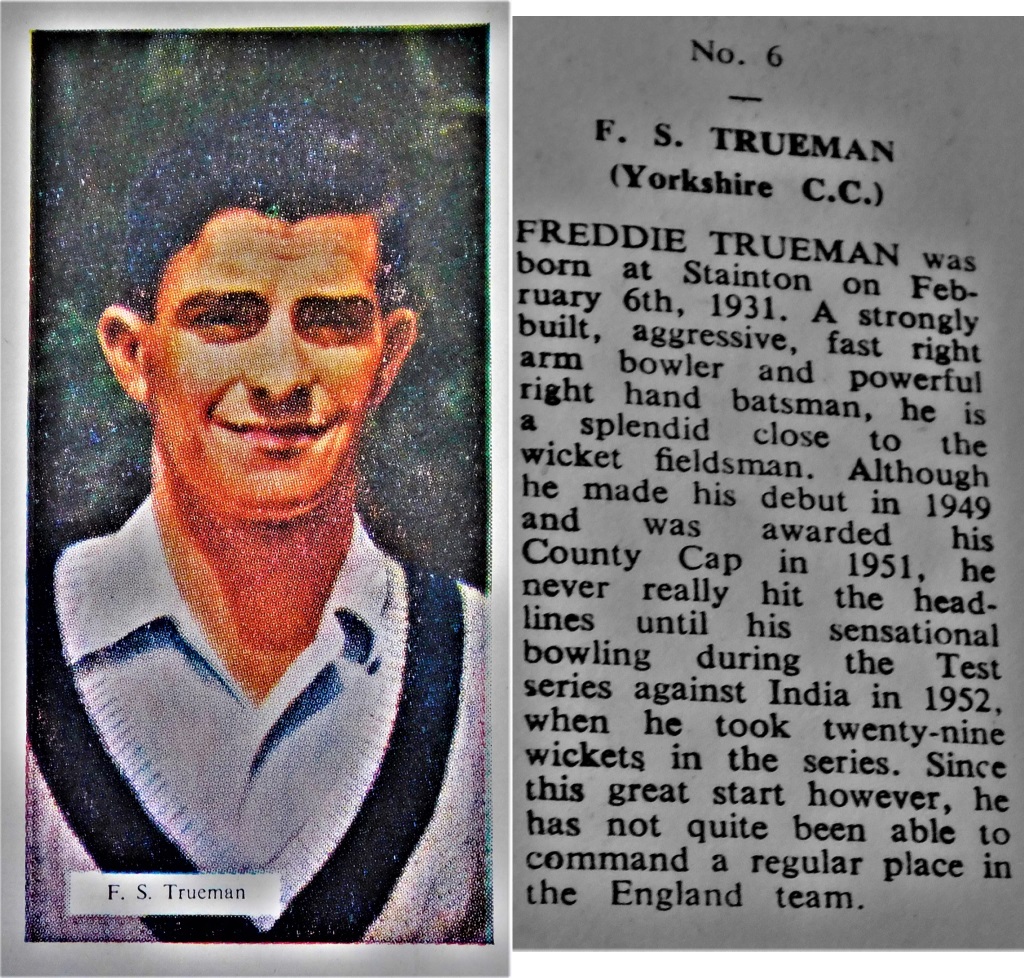
  9. Fred Trueman (England, right arm fast bowler, right handed batter). The first ever to capture 300 test wickets. His 307 test scalps came in 67 matches, and at an average of 21.57 each. He was not entirely without merit as a batter either, amassing three first class centuries over the years.
  10. Frederick Spofforth (Australia, right arm fast medium bowler, right handed batter). In 1878 pace alone sufficed for him to destroy a strong MCC batting line up at Lords (MCC 33 and 19 all out in their two innings, Spofforth 10-20 in the match). Four years later at The Oval he helped to inaugurate The Ashes by taking 14 wickets in the match with a mixture of pace and guile as England lost a low scoring match by seven runs. WG Grace, whose 32 in the final innings was one of only two 30+ individual scores in the whole match was fourth out with a mere 32 further runs needed, but a combination of English nerves and the sheer relentlessness of “the Demon” proved sufficient to put this beyond them.
  11. Fazal Mahmood (Pakistan, right arm fast medium bowler, right handed batter). Pakistan’s first great test match bowler, star of their win at The Oval in 1954. His great weapon was the leg cutter, which led to comparisons with England’s Alec Bedser, who deployed the same weapon to great effect.

This side has decent batting strength, with a strong top five, Engineer and Foster both definitely counting as all rounders, and Titmus a capable number eight. It also boasts a stellar bowling line up, with Spofforth, Trueman, Fazal Mahmood and Foster a fine pace/seam/swing/cut quartet, Titmus and Woolley to provide orthodox spin and Tarrant’s slow medium also available as an extra variation. Fazal Mahmood, given his expert usage of the leg cutter, can also be said to attend to the leg spinner’s angle of attack.

Had I been picking with limited overs cricket in mind Fakhar Zaman would have been one of the first names on the team sheet. In long form cricket he would be a more dubious asset and therefore I have omitted him. Faoud Bacchus of the West Indies was a possible for a batting slot, but although he did score a test match 250 that was his only three figure score at that level. Francis Ford had a decent first class batting record by late 19th century standards, but at test level he was an unequivocal failure, with a best score at that level of a mere 48. Fred Grace was among the leading batters of the 1870s, but his death at the age of 29 after one England appearance meant that there is no way of assessing his test capabilities. Frank Chester seemed destined for the top before a war time injury ended his playing career. He would certainly by one of the umpires, having stood in a then record 48 tests in the course of his second cricket career, and his colleague would be Frank Lee. Freddie Calthorpe was a decent county all rounder, but save for having the embarrassment of leaving what was supposed to be a ‘timeless test’ with a draw in a match his side had bossed (he deemed a first innings advantage of 563 insufficient to enforce the follow on, and a combination of two days of rain and the timing of England’s boat home punished him for his timidity) he did little of note at international level. Another Freddie, Brown of Surrey and Northants, was similarly not quite good enough as a player, though he handled himself better as a captain than did Calthorpe. There are cartloads of seam/ pace bowlers who were in the mix: Frank Farrands, a fine fast bowler of the 1870s, Frank Laver, one of the first great swing bowlers, Fanie de Villiers (good record for South Africa in the 1990s, but loses points for provoking Devon Malcolm into producing that 9-57 at The Oval in 1994) and current Afghanistan bowler Fazalhaq Farooqi who would be a strong candidate for a limited overs side being the most obvious. Feroze Khushi, a talented young middle order batter for Essex, is not there yet, but there are promising signs, and he may force his way in in due course.

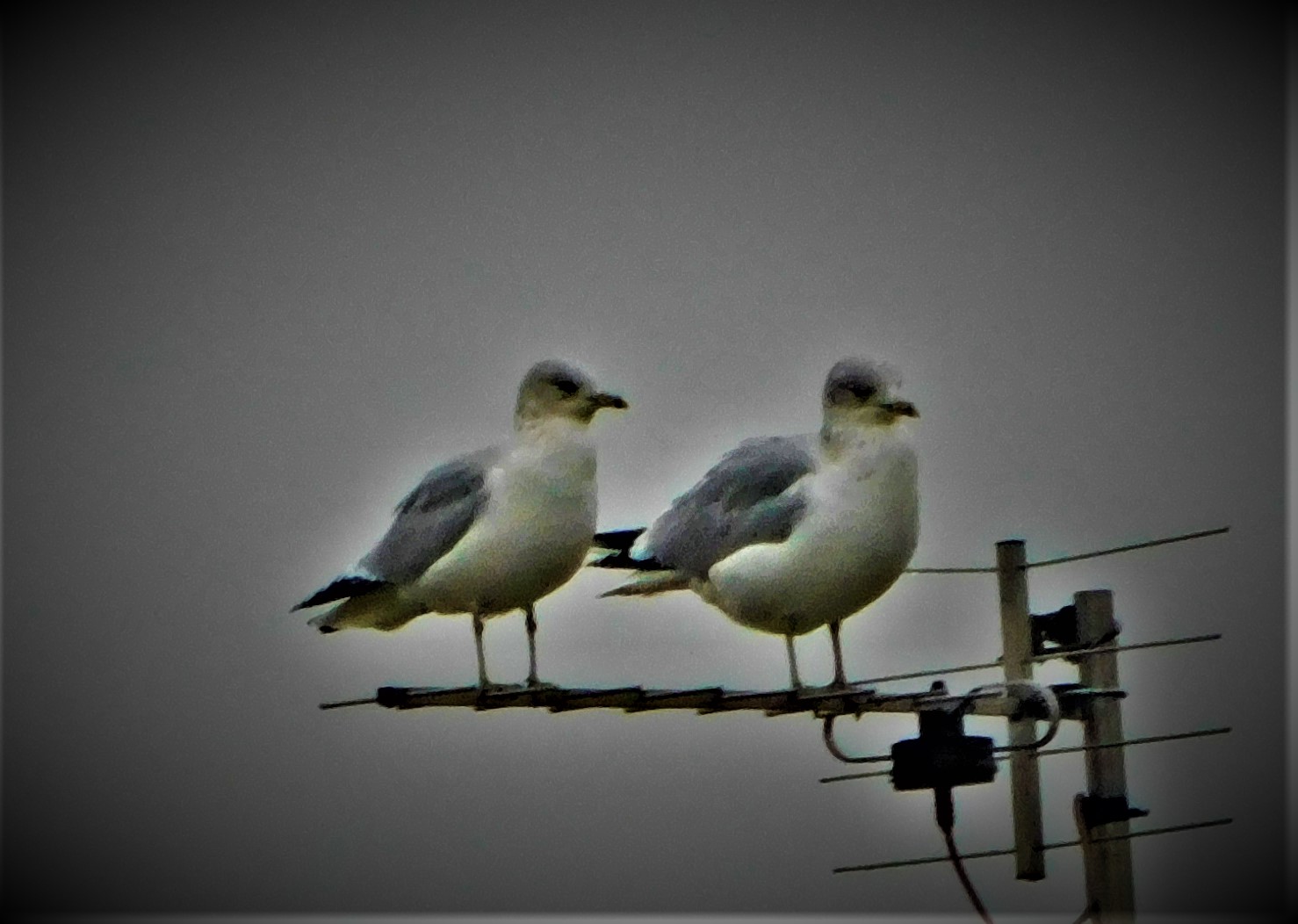
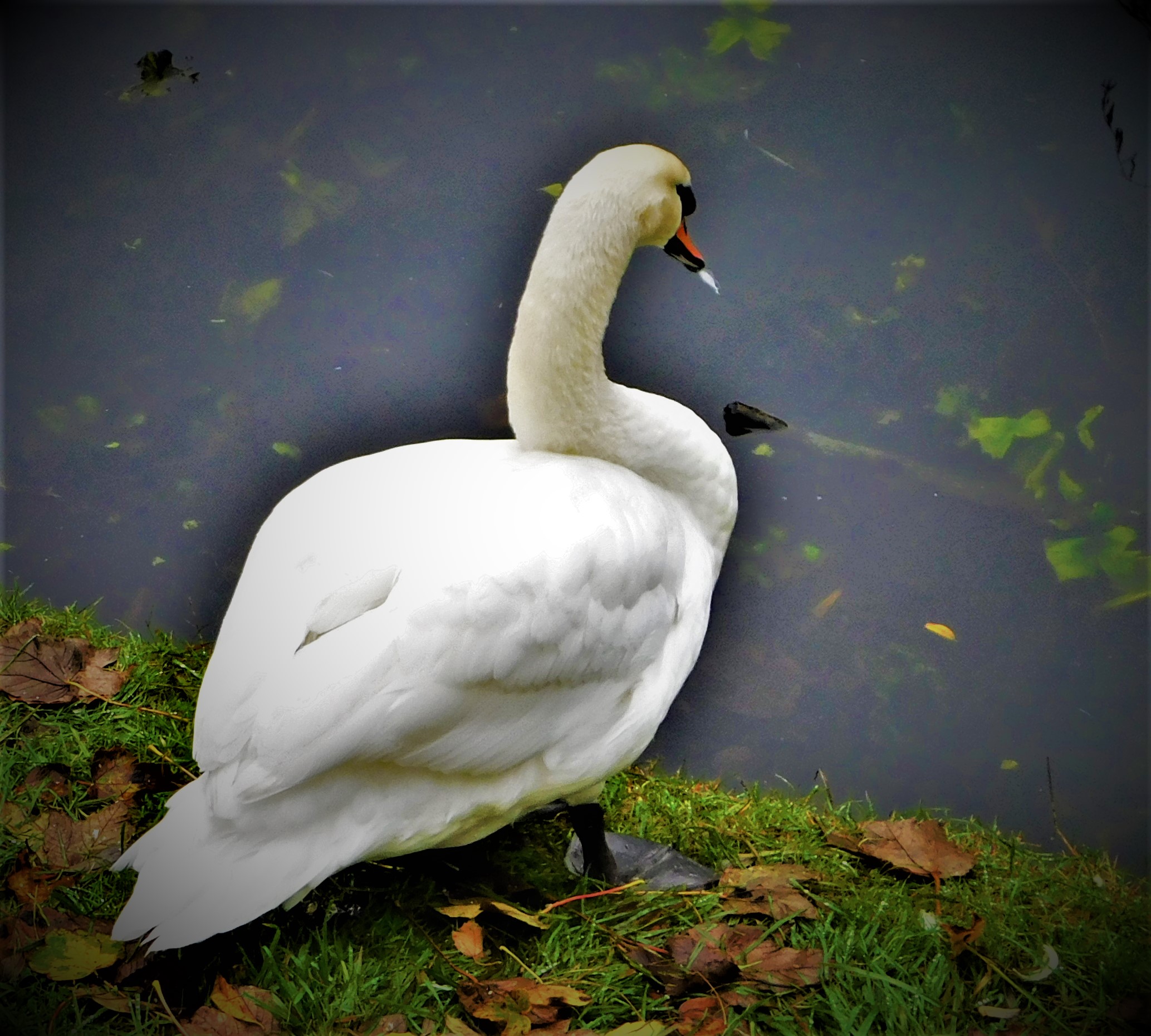
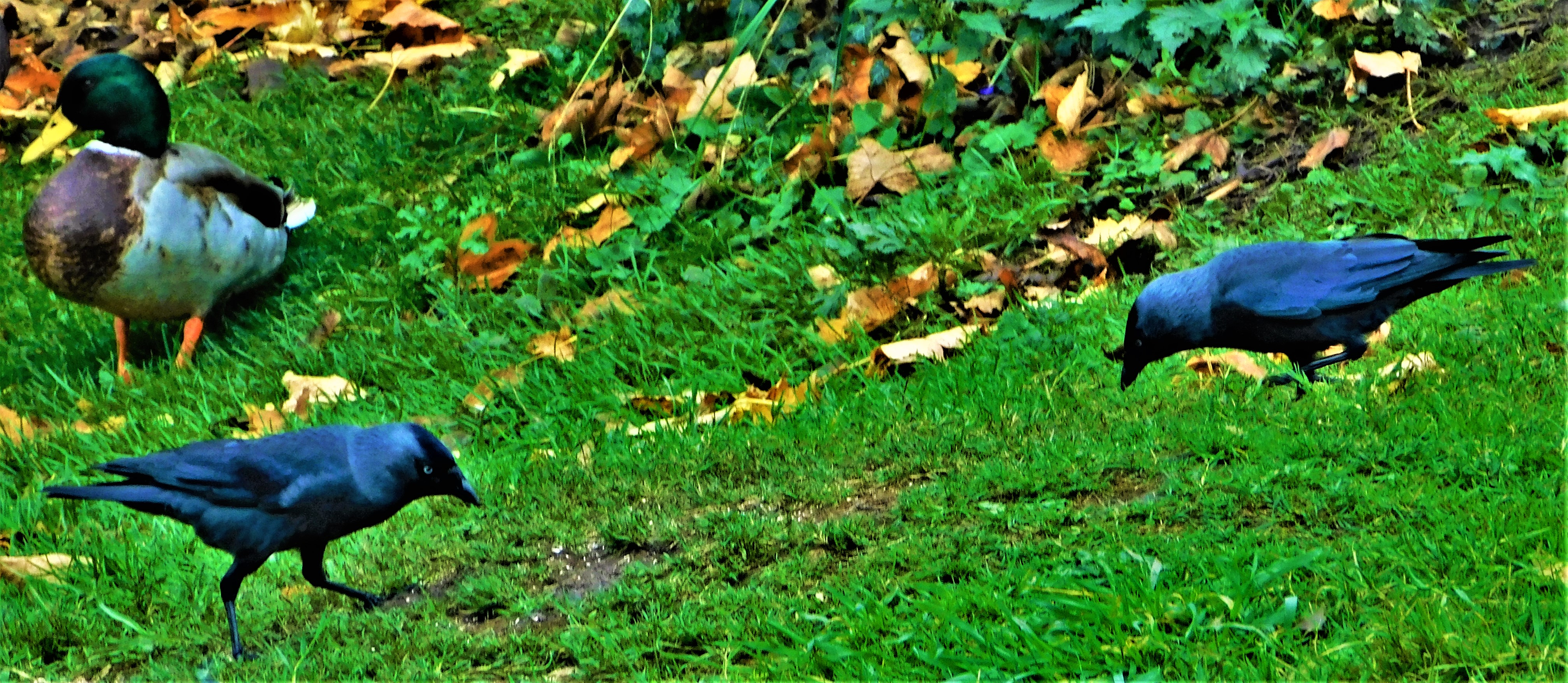
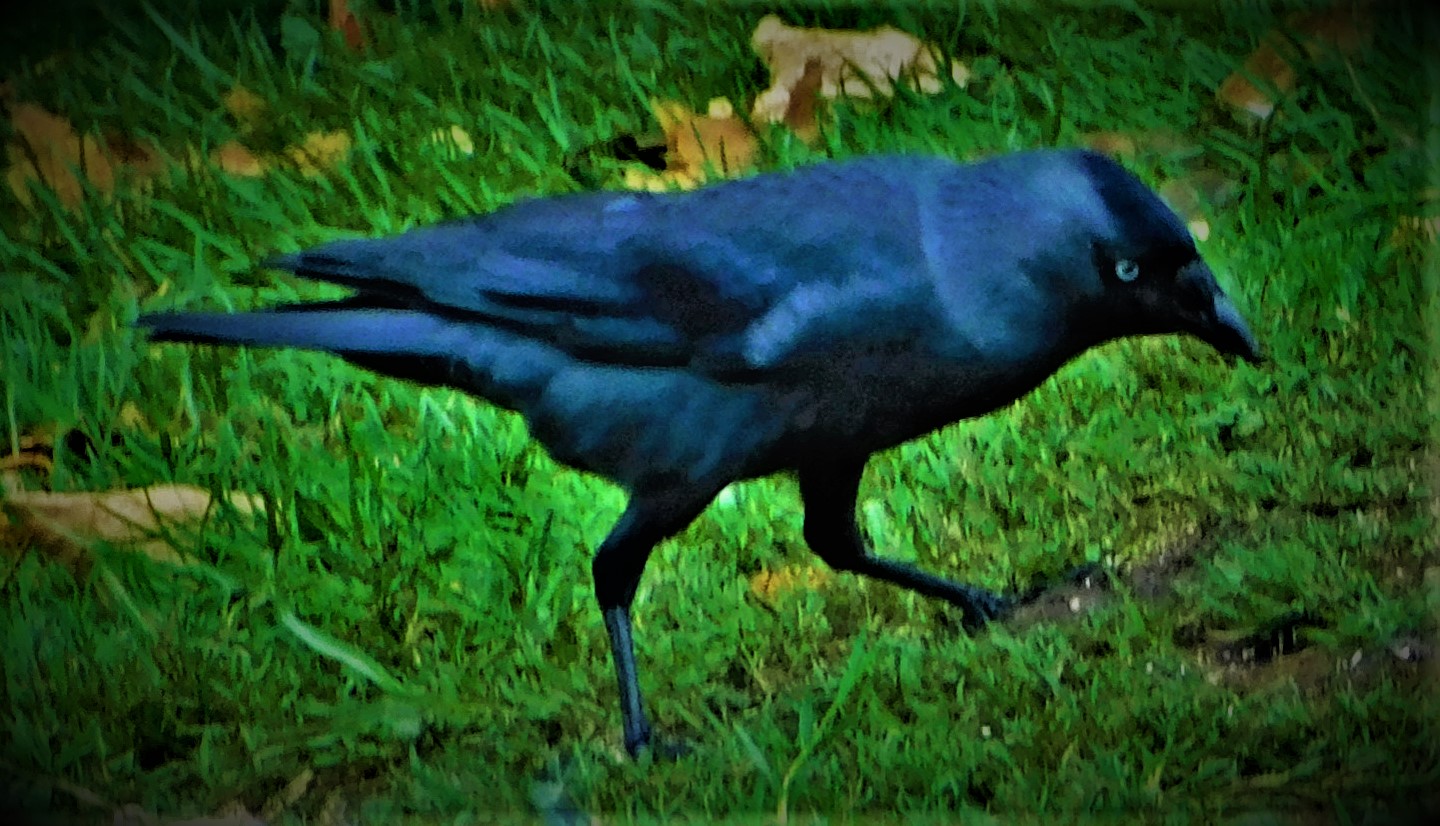
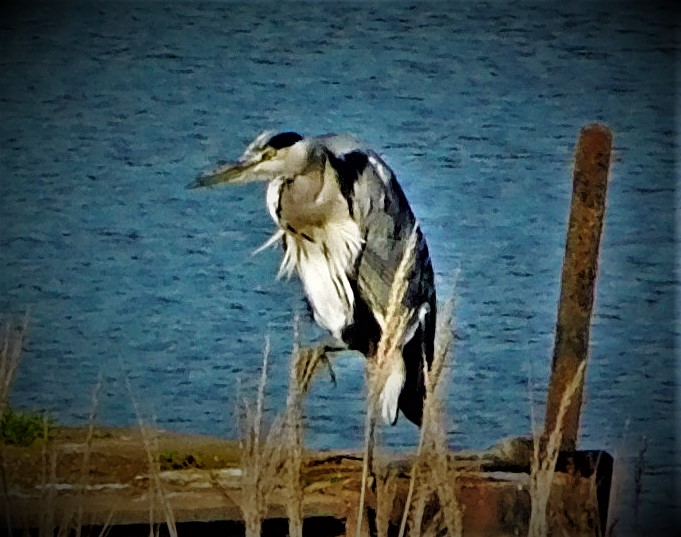
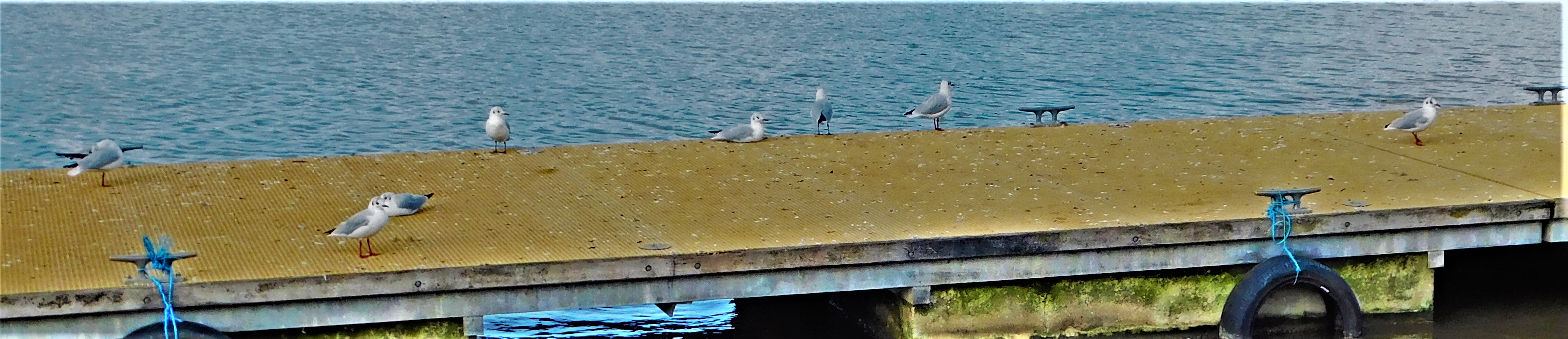
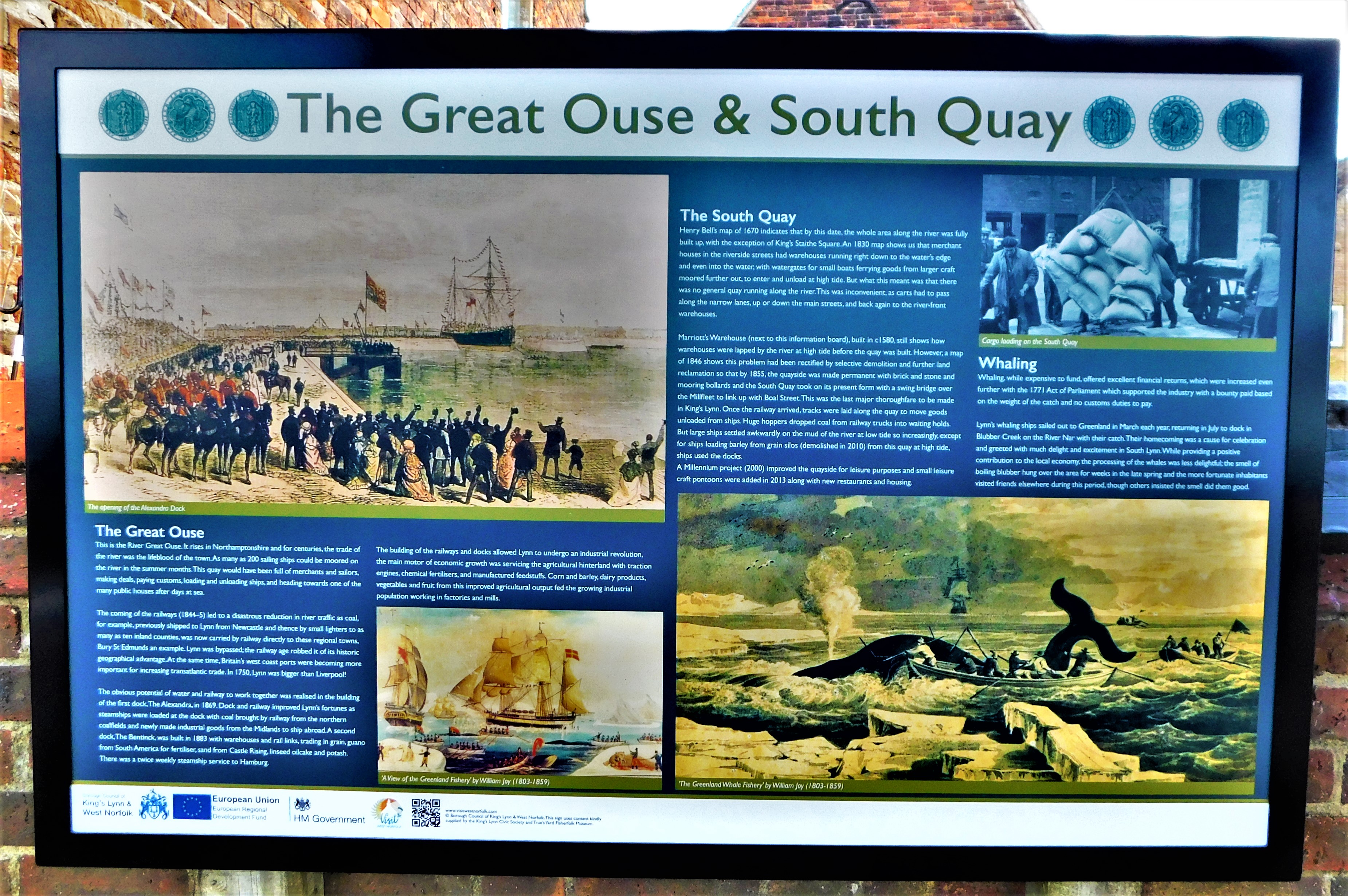
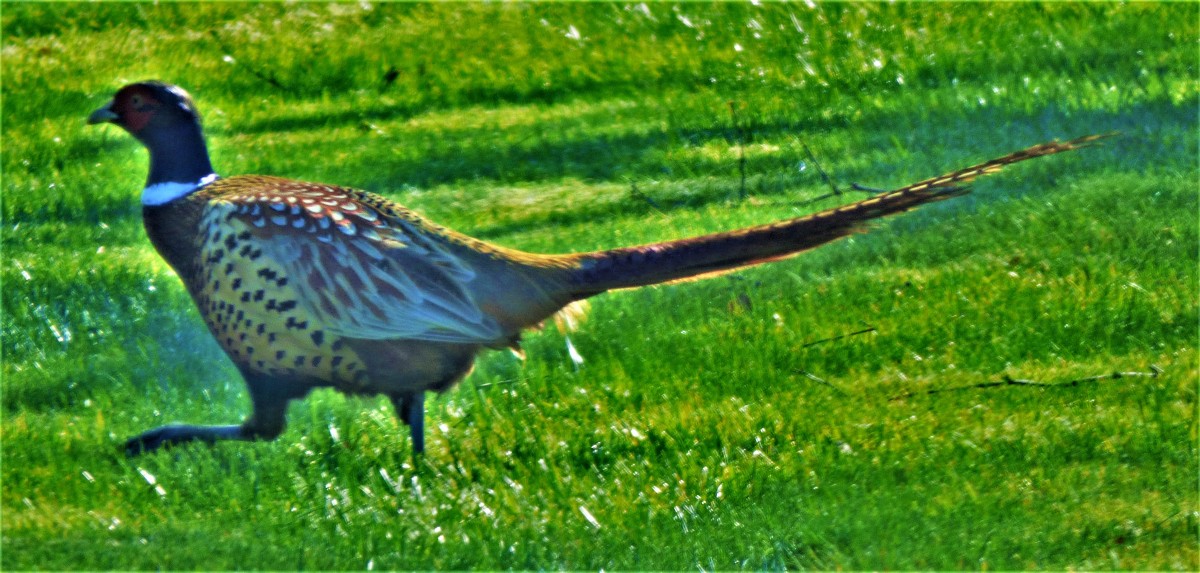
It has not been an ideal day for photography. to put it mildly, but I do have enough for my usual sign off…

England XIs: WWII – 1962

A look at the best England men’s cricketers of the immediate post war era and a large photo gallery.

I continue my look at the England men’s cricket team through the ages with a look at the immediate postwar era. I have chosen 1962 as the endpoint because the 1963 season was notable on two grounds: it was the first season in which players were not divided between amateurs and professionals (or “Gentlemen” and “Players”) and it also saw the first staging of the first professional limited overs tournament, the Gillette Cup, and from these beginnings limited overs cricket, and subsequently very limited overs cricket in the form of T20 would come to play an ever increasing role in professional cricket.

THE XI IN BATTING ORDER

  1. *Leonard Hutton (right handed opening batter, captain). In 1938 at Trent Bridge Walter Hammond became the first officially appointed England captain to have played cricket as a professional. In the very first England XI he led out on to the field was the man who would become the first to be appointed official England captain while still playing as a professional, Leonard Hutton. Hutton was comfortably England’s best batter of the immediate postwar years (the only remotely credible challenger, Denis Compton, actually wrote in one of hs books that Hutton was the greater batter of the two). What makes Hutton’s performances between 1946 and 1955, which stand among the greatest of anyone in the game’s history in any case, even more extraordinary is that as well as having lost six years of cricketing development to the war he had suffered a training accident which left him with one arm shorter than the other.
  2. Cyril Washbrook (right handed opening batter). The best of Hutton’s various opening partners. In 1956 after Hutton had retired, Washbrook, then a 41 year old selector, was chosen for the third test of the series against Australia and scored a crucial 98, paving the way for further successful recalls for David Sheppard (4th test, century from number three) then Bishop of Woolwich and Compton (5th test, having had his right kneecap surgically removed and fought his way back to fitness, 94).
  3. Colin Cowdrey (right handed batter, ace slip fielder, occasional leg spinner). The first cricketer to earn 100 test caps and by the end of his career scorer of 22 test centuries, at the time a joint England record with Hammond.
  4. Denis Compton (right handed batter, occasional left arm wrist spinner). Even with a long term knee injury, ultimately necessitating the removal of the kneecap he achieved some outstanding performances for England, including a century in each innings at Adelaide in the 1946-7 Ashes, four centuries against the visiting South Africans in 1947, two against Bradman’s 1948 Invincibles and a 278 against Pakistan at Trent Bridge in 1954.
  5. Peter May (right handed batter). In test cricket’s slowest scoring decade this naturally aggressive batter averaged 46.77, including a 285 not out that effectively terminated Sonny Ramadhin as an effective bowling force (Ramadhin ended up toiling through 98 overs in that innings, as West Indies, having led by 288 on first innings ended up clinging on for a draw with seven wickets down in their second innings).
  6. Trevor Bailey (right handed batter, right arm fast medium bowler). A genuine all rounder.
  7. +Godfrey Evans (wicket keeper, right handed batter). One of the greatest keepers of all time and a good enough batter to have scored two test centuries.
  8. Jim Laker (off spinner, right handed lower order batter). 193 wickets at 21 a piece in 46 test appearances. In 1956 he claimed 46 wickets in the Ashes series at 9.6 a piece, including the best match haul in first class history, 19-90 at Old Trafford (9-37 in the first innings, 10-53 second time round).
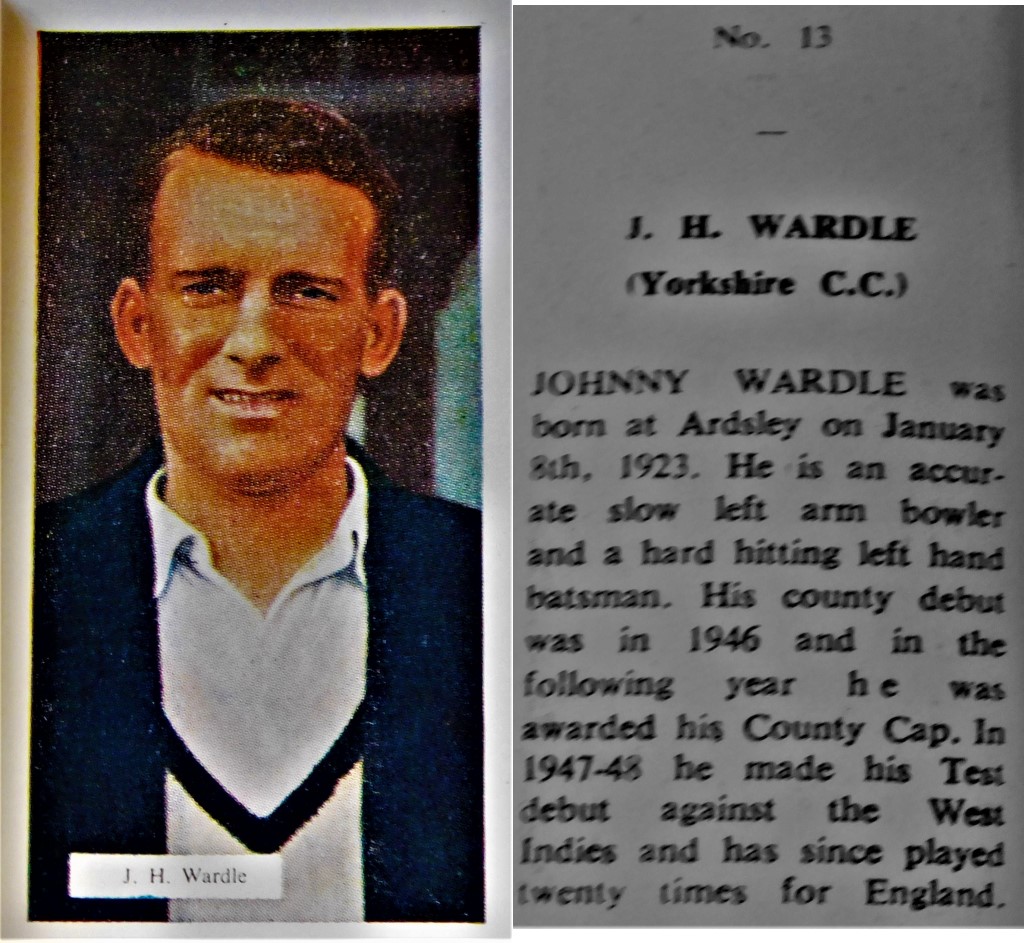
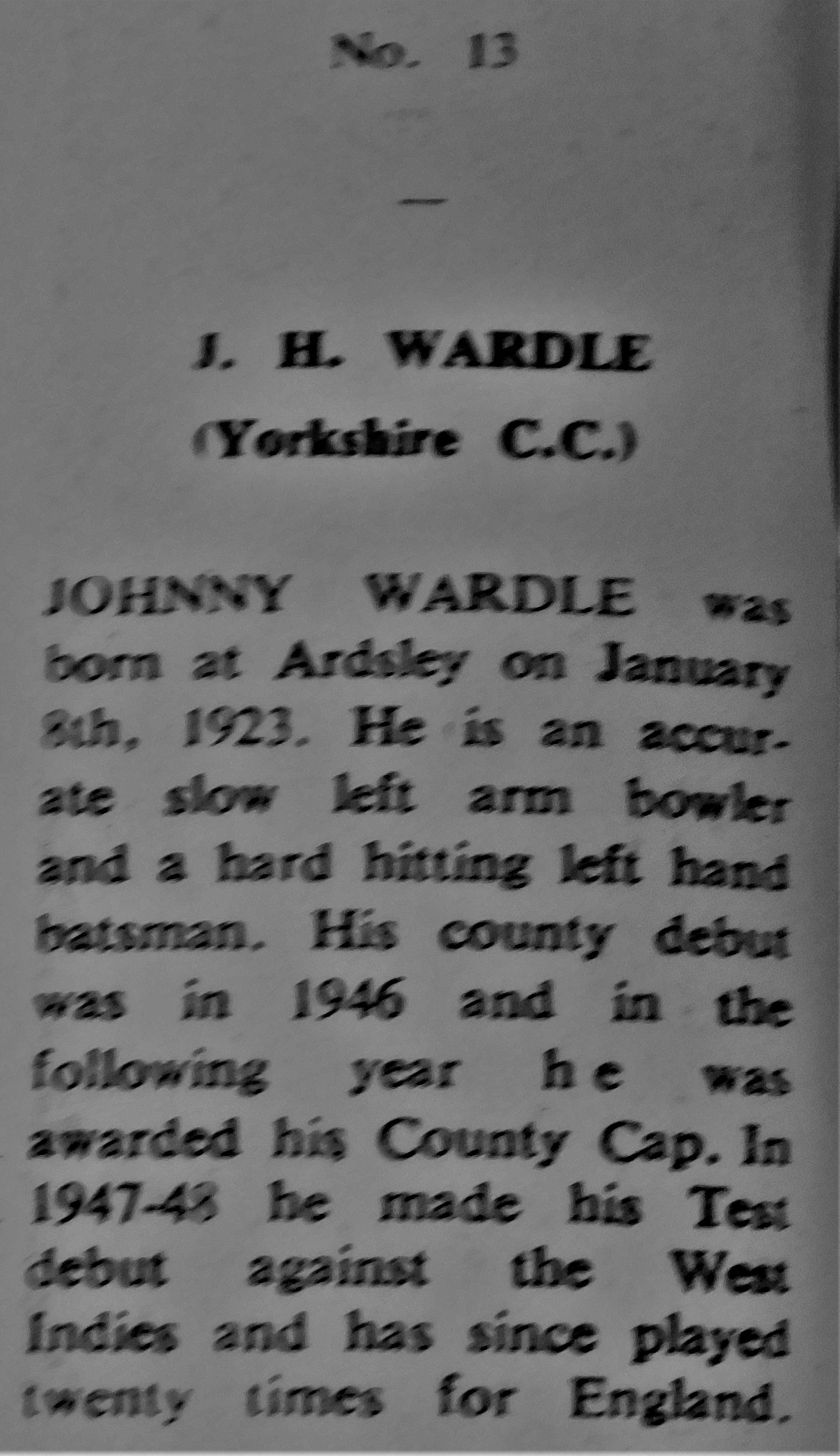
  9. Johnny Wardle (left arm orthodox spinner, left arm wrist spinner, left handed lower order batter). 102 test wickets at 20.39. He was often passed over in favour of Tony Lock, and his career came to a premature end after he expressed forceful opinions about Yorkshire’s choice of captain in 1958. His robust late order hitting was also of value to England more than once.
  10. Fred Trueman (right arm fast bowler, right handed lower order batter). The first bowler of any type to claim as many as 300 test scalps, 307 in 67 matches.
  11. Brian Statham (right arm fast bowler, right handed lower order batter). 252 test scalps at 24 a piece, most of them bowling from the less favourable end as either Trueman or Frank Tyson (in the 1954-5 Ashes) had first choice of which end to bowl from.

This XI has a powerful top five, a genuine all rounder at six, a legendary keeper, two of the greatest spinners of all time and two great fast bowlers who were moreover a regular combination at test level.

HONOURABLE MENTIONS

I start this section with two name checks as the players concerned deserve more than a standard honourable mention:

BILL EDRICH

A fine right handed batter and a useful right arm fast medium bowler. However I could only accommodate him in one of two ways: play him as an opener in place of Washbrook, or class him as an all rounder and give him Bailey’s slot, and neither of those seemed right to me.

ALEC BEDSER

For the first few years after the war he carried England’s bowling almost single handed, and at the time of his retirement he was test cricket’s leading wicket taker with 236 scalps. However I wanted two spinners, and considered the claims of the fast bowlers Trueman and Statham to be unanswerable, so I could not accommodate him.

OTHER HONOURABLE MENTIONS

Although Ken Barrington and Ted Dexter both played for England during this period I considered them to belong more properly to the next. No other keeper of this period was close to Evans with the gloves, though the more determined members of the “look at the batting first” school of thought might opt for James M Parks (his father James H Parks, a batting all rounder, also played for Sussex and England), a quality batter, but several classes below Evans with the gloves.

The brilliant but meteoric Frank Tyson might have had a fast bowling slot. Tony Lock’s bowling action for most of his England career was to put politely of dubious legality, and he could bowl only finger spin, whereas Wardle could also bowl wrist spin. Leg spinner Doug Wright could be devastating on his day (he claimed a record seven first class hat tricks), but when things weren’t going his way he was often very expensive. I end this section with one of cricket’s ultimate ‘might have beens’: Maurice Tremlett of Somerset (father of Tim, grandfather of Chris) who had a dream first class debut, claiming eight wickets in the match and then playing a splendid cameo innings to see his side over the line by one wicket against the team who would be that season’s champions, Middlesex. Unfortunately he fell victim to well meaning coaches who tried to turn a fast-medium who liked to give the ball a wallop into a genuine fast bowler and succeeded in destroying his confidence and interest in bowling, and within a few years he was playing for Somerset as an exciting middle order batter who was occasionally used as a partnership breaker with the ball.

PHOTOGRAPHS

My usual sign off…

All Time XIs – Match Ups 62

Continuing my extended analysis of how my all time XIs fare against one another. Today sees the end of the Ts.

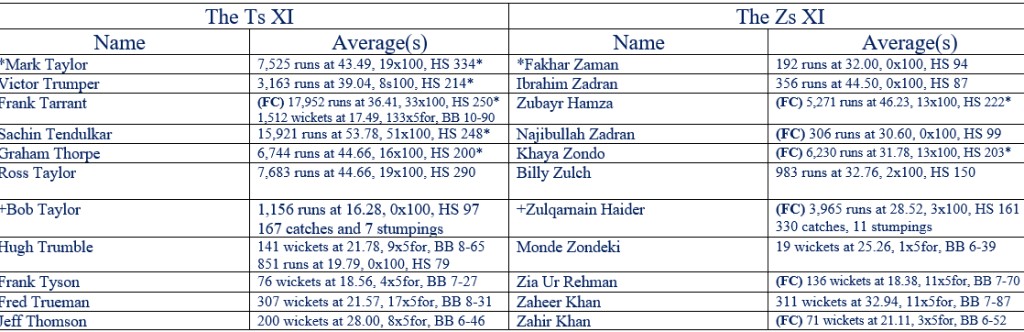
Welcome to the latest instalment in my extended analysis of how my the all time XIs I selected for each letter of the alphabet fare against one another. Today we see the Ts last five match ups, with them having 72.5 out of 100 points so far.

THE Ts V THE Vs

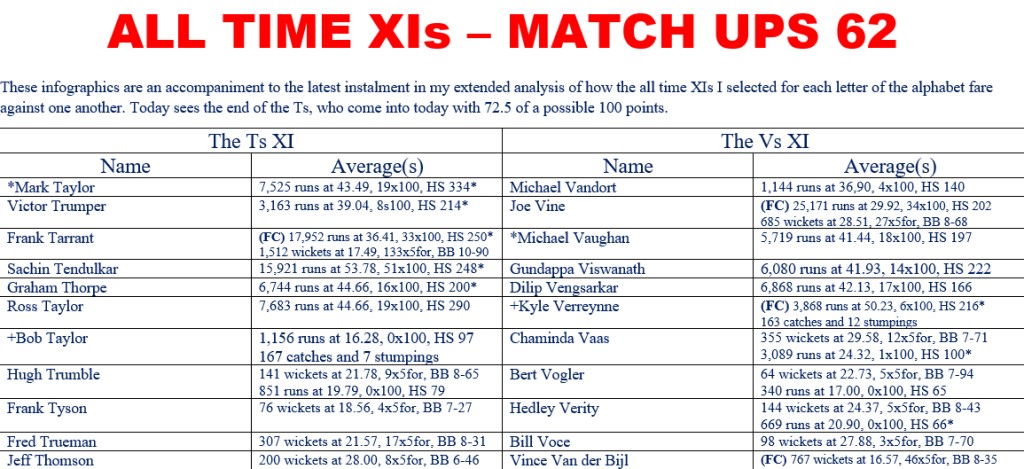
The Ts win the batting match ups at 1,2,4,5,6 and 8, with Vaughan winning at no 3 for the Vs, though unlike Tarrant he does not offer a bowling option. Vaas at seven and Verity at nine also win batting match ups for the Vs, while Bob Taylor is clearly the superior keeper. I award the Vs the pace/ seam bowling honours on two grounds: 1) the Ts pacers are all right handers, reducing the variation in their attack, and 2) Vaas would fare better as third seamer in a powerful attack than he actually did as opening bowler in a moderate one. The spin pairings are closely matched – Verity beats Tarrant (in FC cricket, which is where a comparison is available Verity was 2.5 runs per wicket cheaper than Tarrant and bowled in less favourable conditions), while Trumble beats Vogler. The Ts are stronger in batting, the Vs are stronger in bowling. The Ts have the better keeper. I think the Ts good batting is enough to save them from defeat, but I am not prepared to award them victory: Ts 2.5, Vs 2.5.

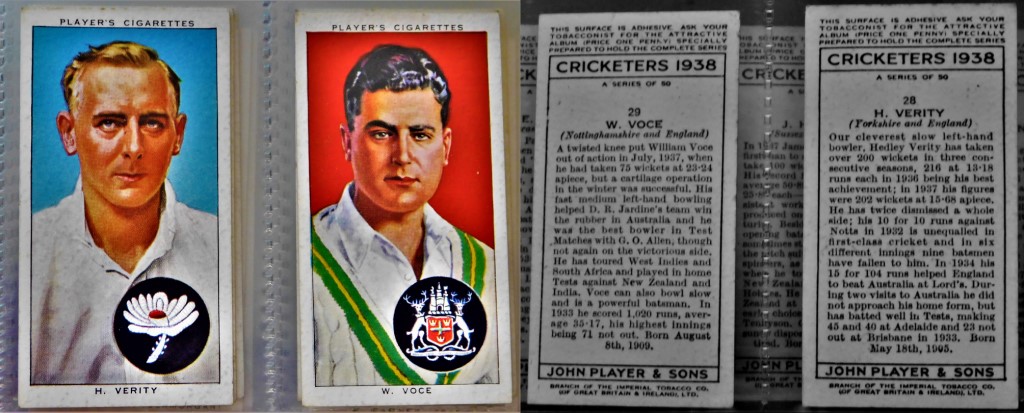
Two of the Vs brightest stars, Verity and Voce.

THE Ts V THE Ws

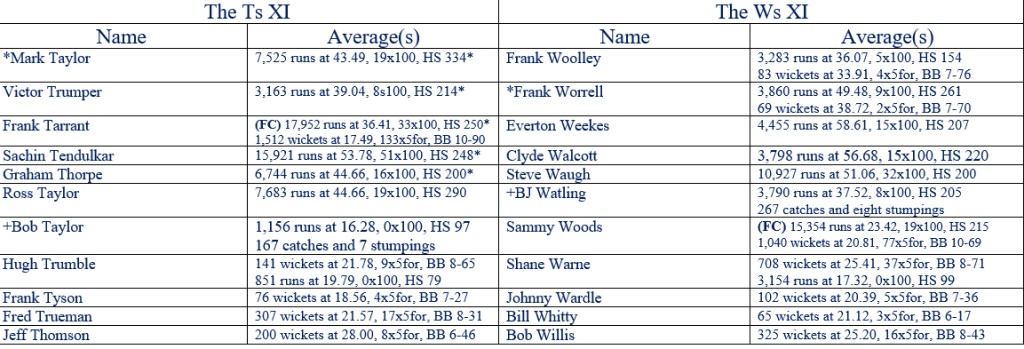
The Ws dominate the batting – apart from Mark Taylor up top, the only other winners of batting match ups are Ross Taylor at six and Hugh Trumble at eight. The Ts have the better keeper. The fast bowling is close, Whitty’s left handedness possibly the decisive factor in giving that department to the Ws. The Ws steamroller the spin bowling department, Wardle outranking Tarrant and Warne outranking Trumble. The Ws also have the better captain – as good as Mark Taylor was in that role, Worrell’s achievement in unifying the West Indies and turning them for the first time in their history to into a combination that could and did win anywhere and against anyone puts him a cut above even Taylor as a skipper. As good as the Ts are there is no areas save wicket keeping in which they are even close to the Ws, so I have to score this Ts 0, Ws 5.

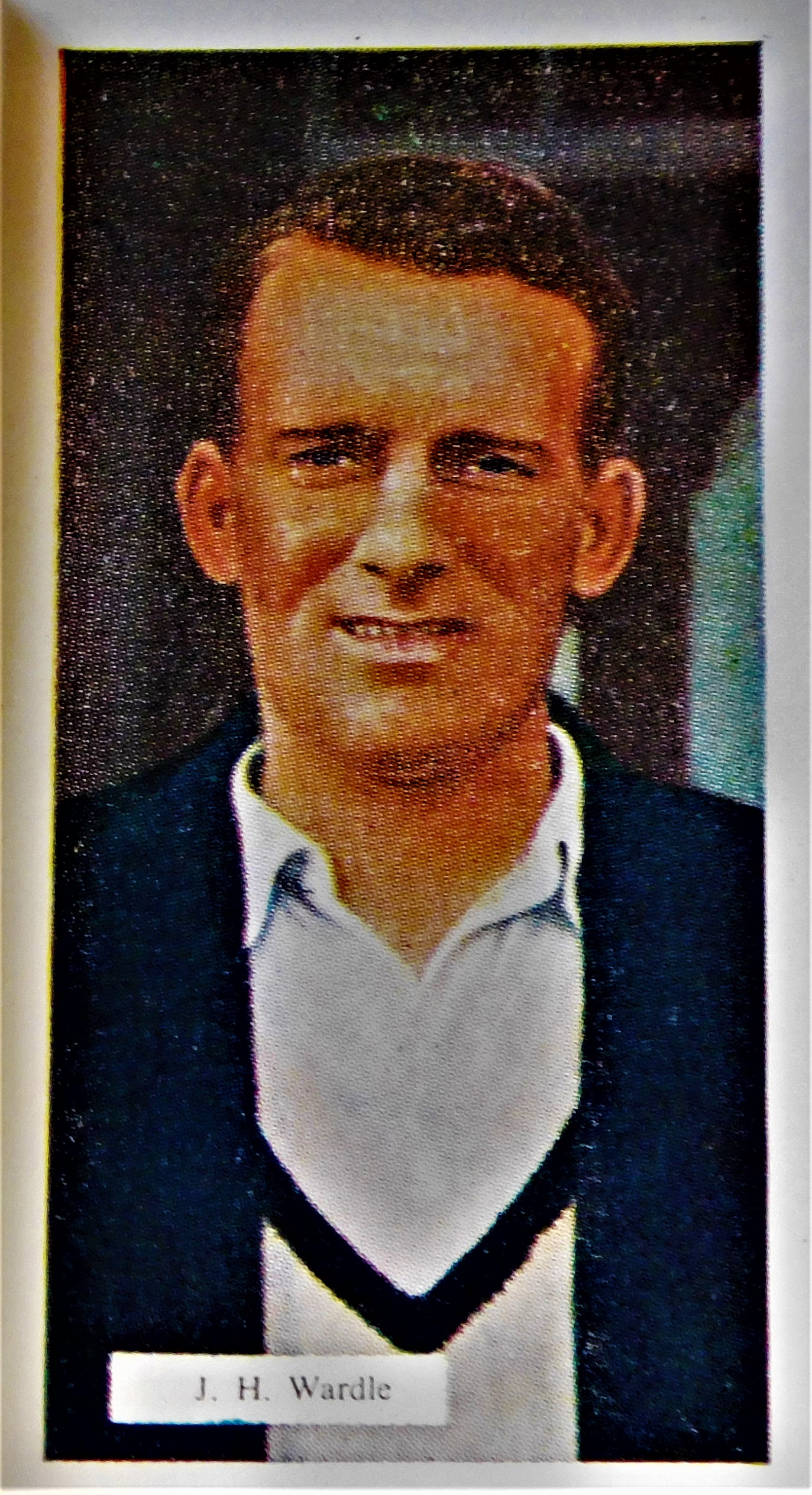
Johnny Wardle, left arm trickster for the Ws

THE Ts V THE Xs

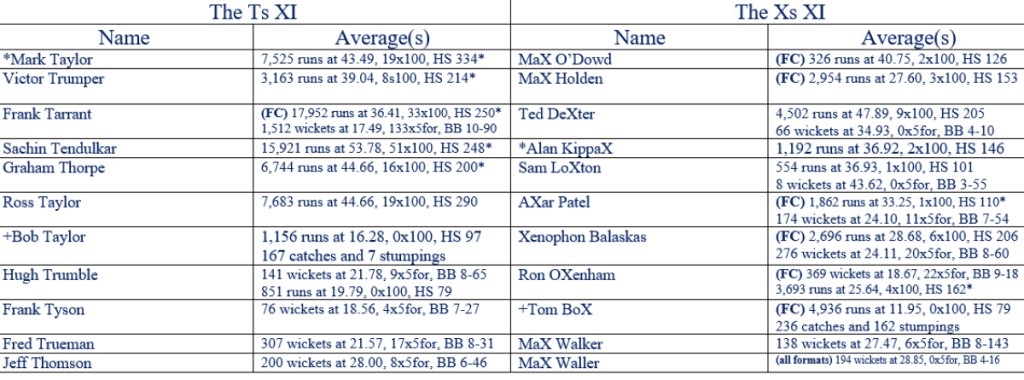
Total dominance with the bat for the Ts – not until Xenophon Balaskas at seven, Ron Oxenham at eight and Tom Box at nine do the Xs win any batting match ups. Box is one of the few keepers in this series to be a match for Bob Taylor. The Ts also have the better captain and dominate the pace/ seam department. Also, while the Xs have a numerical superiority in the spin department, Trumble is definitely the best spinner on either side, and Tarrant would be at least Axar Patel’s equal. Therefore there can be only one scoreline: Ts 5, Xs 0.

Captain of the Xs, Alan KippaX.

THE Ts V THE Ys

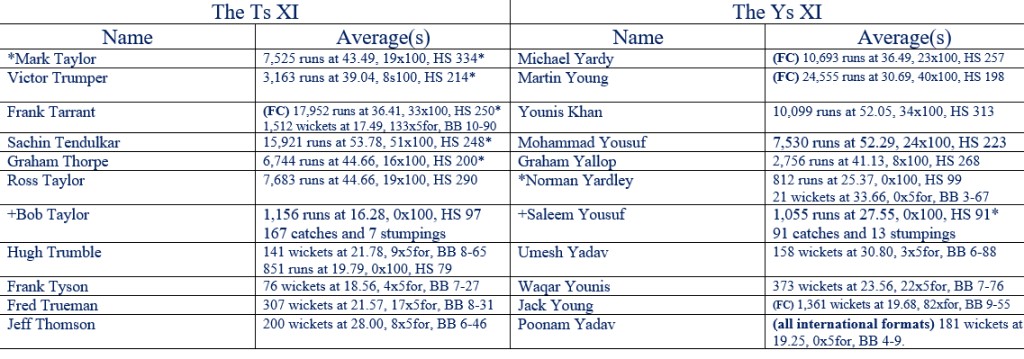
The Ts are dominant in batting – only Younis Khan at three and Saleem Yousuf at seven win batting match ups for the Ys. Bob Taylor resumes his usual position of being obviously the best keeper on either side, the Ts are utterly dominant in seam/pace bowling, and also have the better spin pairing – Tarrant definitely outranks Jack Young in that department, whereas P Yadav is not definitively clear of Trumble (though I call that match up just her way). Thus this one is Ts 5, Ys 0.

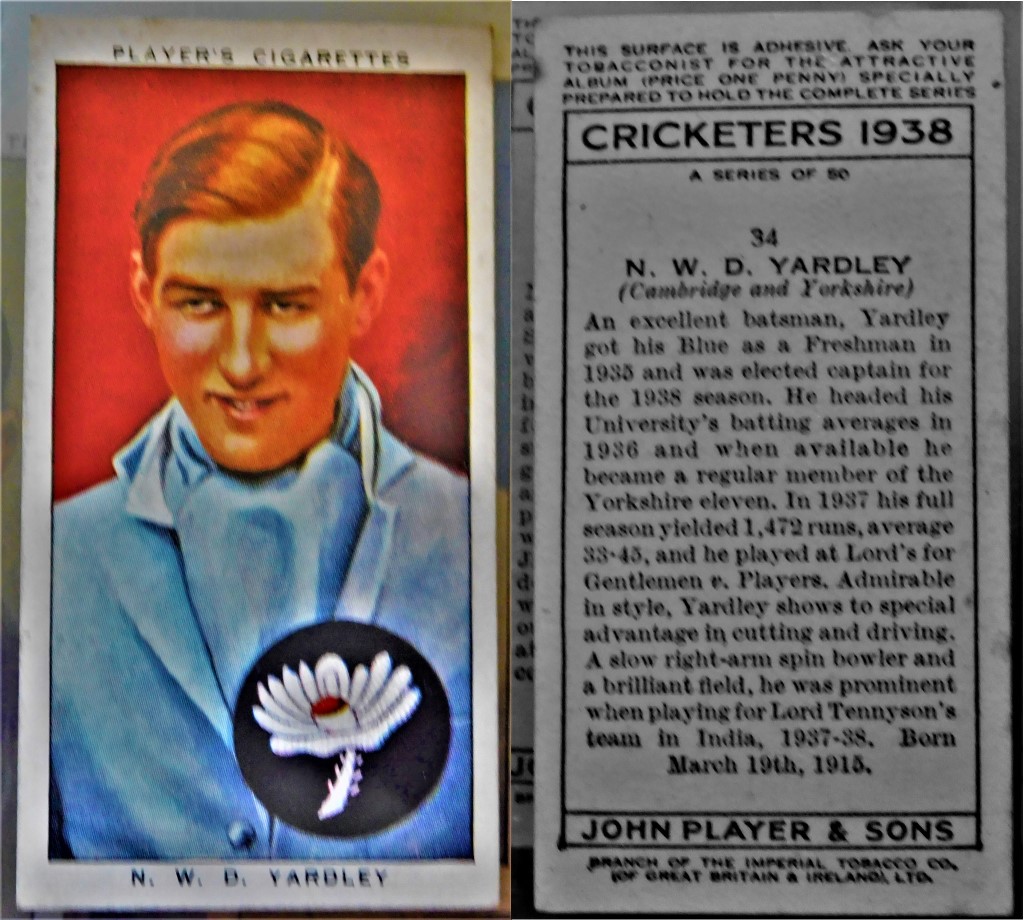
Ys skipper Norman Yardley. This was from early in his career, and by the time of the 1946-7 Ashes he was bowling medium pace and used mainly as a partnership breaker.

THE Ts V THE Zs

The Ts utterly dominate the batting – only Zulqarnain Haider at seven wins a match up for the Zs in this department, and he loses the keeping match up against Bob Taylor. The Ts also have the better captain. They utterly dominate the pace/ seam bowling department, and they are least on level terms in the spin department: Ts 5, Zs 0.

Trueman, one of three out and out fast bowlers available to the Ts. None of my cigarette cards feature any of the Zs.

THE Ts FINAL SCORE

The Ts have scored 17.5 out of 25 today, to finish on 90 out of 125, exactly 72%.

PHOTOGRAPHS

My usual sign off…

All Time XIs – Match Ups 43

Continuing my extended analysis of how the all time XIs I selected for each letter of the alphabet fare against one another.

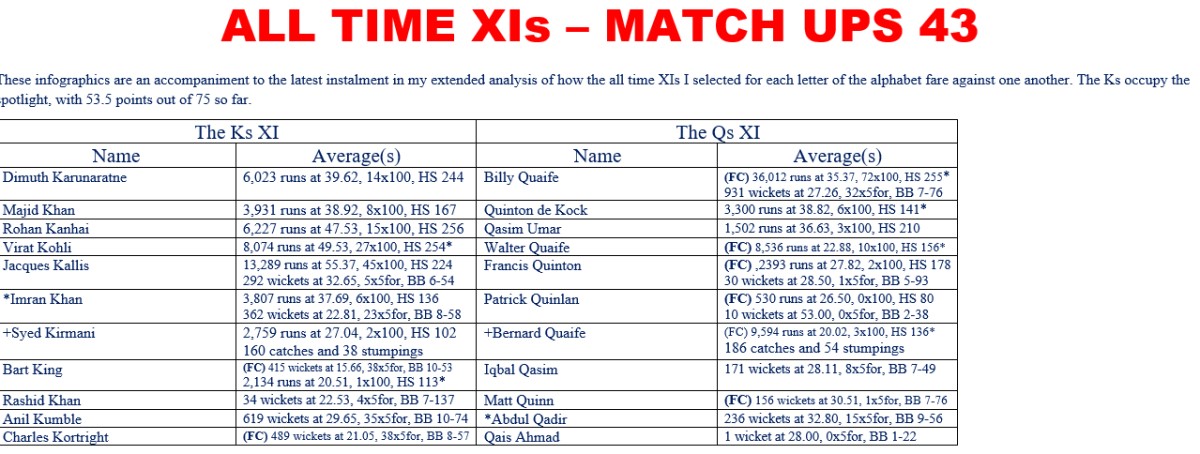
Welcome to the latest instalment in my extended analysis of how the all time XIs I selected for each letter of the alphabet fare against one another. The Ks continue to occupy the spotlight, and they come into today on 53.5 of a possible 75 points.

THE Ks V THE Qs

An easy one to start – the Ks boss all departments completely, and the Qs can do nothing to prevent the inevitable: Ks 5, Qs 0.

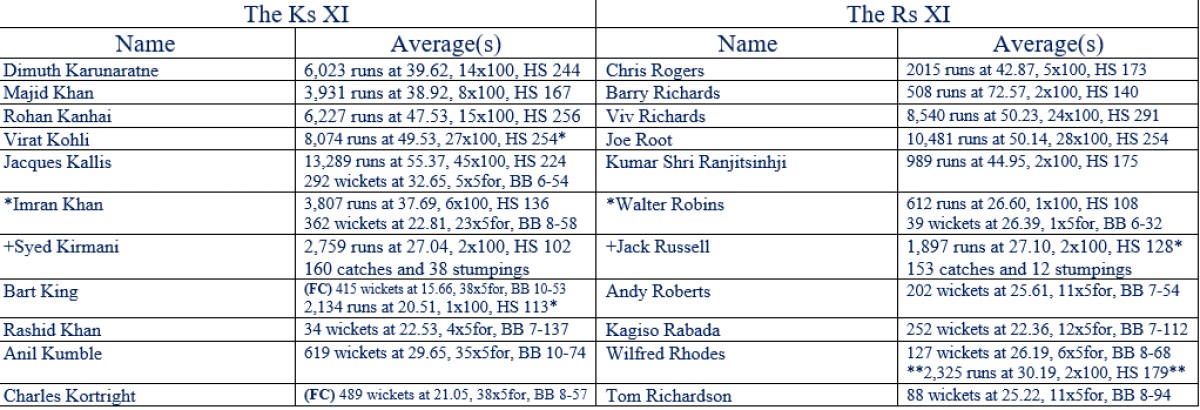
THE Ks V THE Rs

The Rs win the first four batting match ups (sorry India fans, Root has more runs, more centuries and a higher average than Kohli), though Kallis outranks Ranji and offers a bowling option. The Ks have the better all rounder, while both sides are excellently captained. The Rs have the finer keeper. Both sides have superb pace trios, the Rs possibly just the better. The Rs also have a small edge in spin bowling, with Rhodes and Robins being better balanced than the Ks two leg spinners. The Ks have a fourth seam option in Kallis, as against which the Rs have part time off spin available from Root or either Richards. In the end the sheer power of the Rs top batting, and their more varied bowling unit leads me to give them the verdict, just: Ks 2, Rs 3.

THE Ks V THE Ss

The Ss win the first four batting slots, narrowly lose the batting match up at five. Sobers beats I Khan with the bat, though the latter outranks G Smith as a captain. Kirmani wins the keeping match up, but Sangakkara as keeper gives the Ss a bonus pick – Stokes has no match up in the Ks ranks. Both sides have ace fast bowling trios, though the Ss have a small edge there in the form of Starc’s left arm. The Ss not only have Stokes as fourth seamer (he outranks Kallis the bowler), they also have the quicker version of Sobers as a fifth seam option, and a second left armed one. The Ks do have better spinners, but the Ss with Stevens leg spin, and Sobers in his slower guises cover every spin angle (left arm wrist spin is quite similar in angle to off spin). I think the Ss have this one quite comfortably, but the Ks would avoid a whitewash: Ks 1 Ss 4.

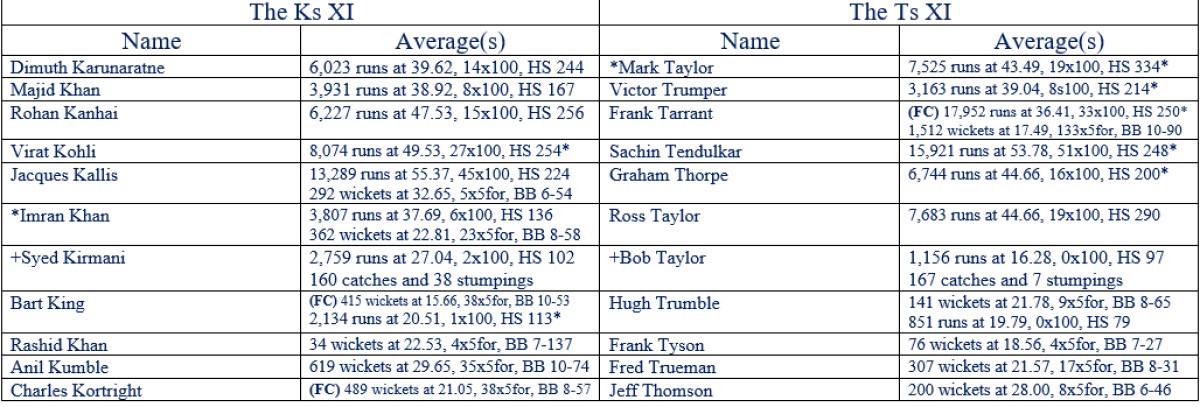
THE Ks V THE Ts

The Ts have the better opening pair, and by more than the figures suggest – Trumper played on some rough pitches and would undoubtedly average a lot more on 21st century surfaces. The Ks win the number three slot batting wise. Tendulkar wins the number four slot, Kallis the number five. Ross Taylor outbats I Khan but does not offer a bowling option. I Khan outranks Mark Taylor as a skipper. Bob Taylor wins the keeping match up. Trumble was a better spinner than either of the Ks two, and Frank Tarrant also ranks very high. The Ts pace trio is the fastest in this series, and they outrank the Ks for quality as well. The Ks of course have the Kallis factor on their side, but I do not think that is enough for them to win outright: Ks 2.5, Ts 2.5.

THE Ks V THE Us

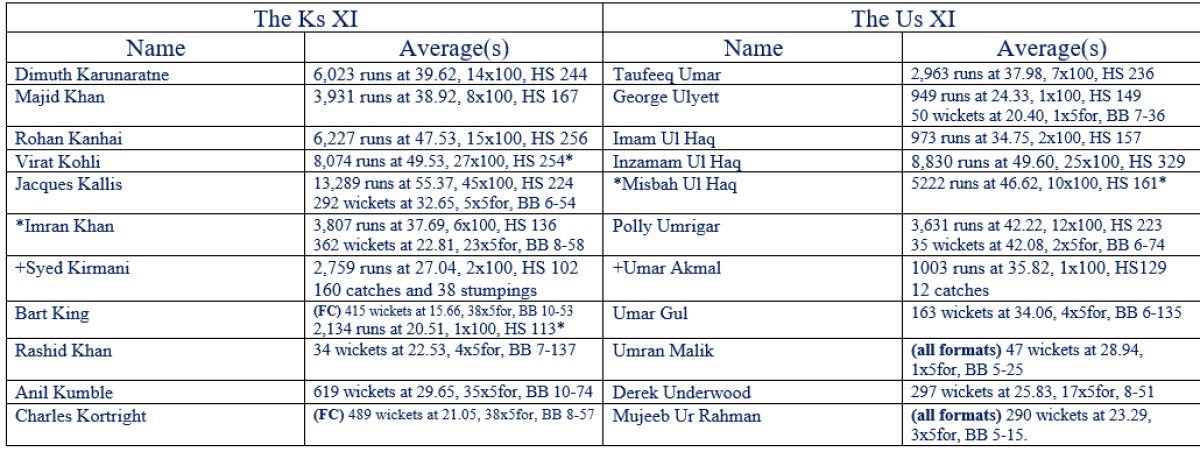
The Ks win in all departments. It is just conceivable that Underwood and Ur Rahman would prove better than Kumble and R Khan on a turner, so I will score this as Ks 4, Us 1.

THE Ks PROGRESS

The Ks have scored 14.5 out of 25 today, putting them on 68 out of 100, 68% overall.

PHOTOGRAPHS

My usual sign off…

All Time XIs – Match Ups 22

Continuing my extended analysis of how the all time XIs I selected for each letter of the alphabet fare against one another.

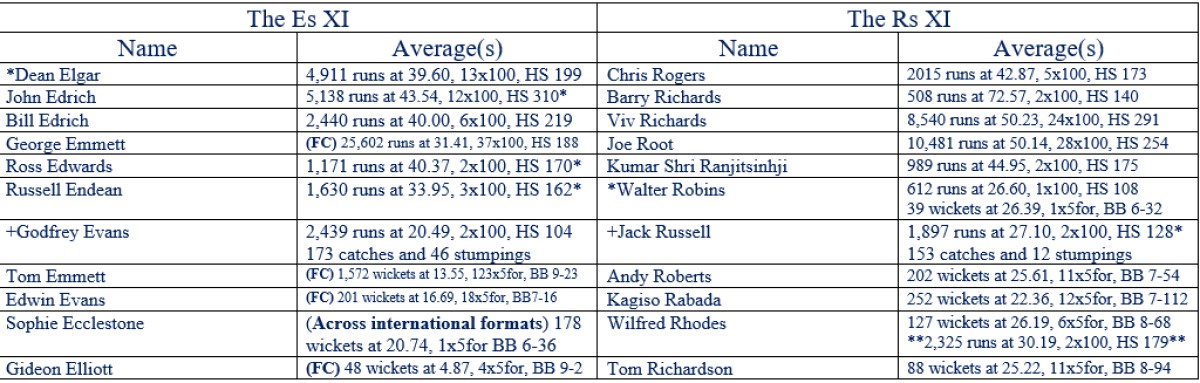
Welcome to the latest instalment in my extended analysis of how the all time XIs I selected for each letter of the alphabet fare against one another. The Es XI continue to occupy the spotlight, and they start today on 21 of a possible 75 points.

THE Es V THE Qs

The Es dominate the batting, and are also massively superior in pace bowling, having a proper new ball pairing in the form of T Emmett and Elliott, whereas the Qs only front line seamer is a bad third in the seam bowling rankings across the sides. The Qs have a numerical advantage in the slow bowling department, but Ecclestone is probably the best individual slow bowler on either side. I do not think that even on a turning pitch the Qs can close the gulf between them and the Es and accordingly score this one Es 5, Qs 0.

THE Es V THE Rs

The Rs win the first five batting match ups, and while Endean ranks ahead of Robins as a batter, Robins’ all round skills partly compensate for that, and he also comfortably outranks the fairly pedestrian Elgar as a captain. Russell’s batting advantage of over 6.5 per innings over G Evans undoubtedly more than makes up for any slight superiority Evans may have had as a keeper. The Rs are comfortably clear in bowling as well – they have three front line pacers to the Es two, and magnificent though she is Ecclestone cannot be ranked ahead of Rhodes in the pantheon of left arm spinners. I score this one Es 0, Rs 5.

THE Es V THE Ss

The Ss dominate in all departments save wicket keeping – G Evans was undoubtedly a finer keeper than Sangakkara. Es 0, Ss 5.

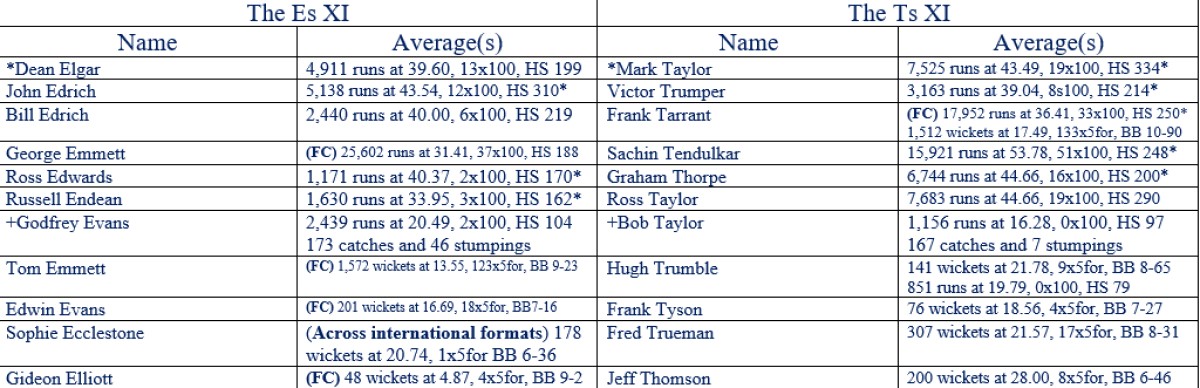
THE Es V THE Ts

I give the Ts the verdict on opening pairs – Taylor’s marginal disadvantage v J Edrich is compensated for by his greater tally of runs, while Trumper made his runs on much more difficult pitches than Elgar. Additionally I would rate Taylor a better skipper than Elgar. While Tarrant loses the batting element of his match up against Bill Edrich, he offers an extra bowling option. The Ts have an overwhelming advantage in the number 4,5 and 6 positions. Bob Taylor ranks below Evans with the bat, similarly as a keeper. The Ts have far the stronger pace attack, and while Ecclestone just outranks Tarrant as a bowler Trumble has a significant advantage over E Evans. The Ts are well ahead and I score this Es 0, Ts 5.

THE Es V THE Us

The Es win the first three batting slots, the Us win the the next three. Umar Akmal outranks G Evans with the bat but is miles behind him as a keeper. The Es comfortably outrank the Us in the new ball contest, though Ulyett’s presence as a third pace option reduces the gap in this department. Ecclestone against Underwood is a mighty contest, though Ecclestone offers more with the bat. Given that he has done his bowling on 21st century pitches, which offer less to slow bowlers than the 19th century surfaces that E Evans exploited I put Ur Rahman ahead in this match up. Overall the Es should have enough, but it is close: Es 3, Us 2.

THE Es PROGRESS REPORT

The Es have scored 8 of a possible 25 points today, moving them to 29 out of 100 – 29%.

PHOTOGRAPHY

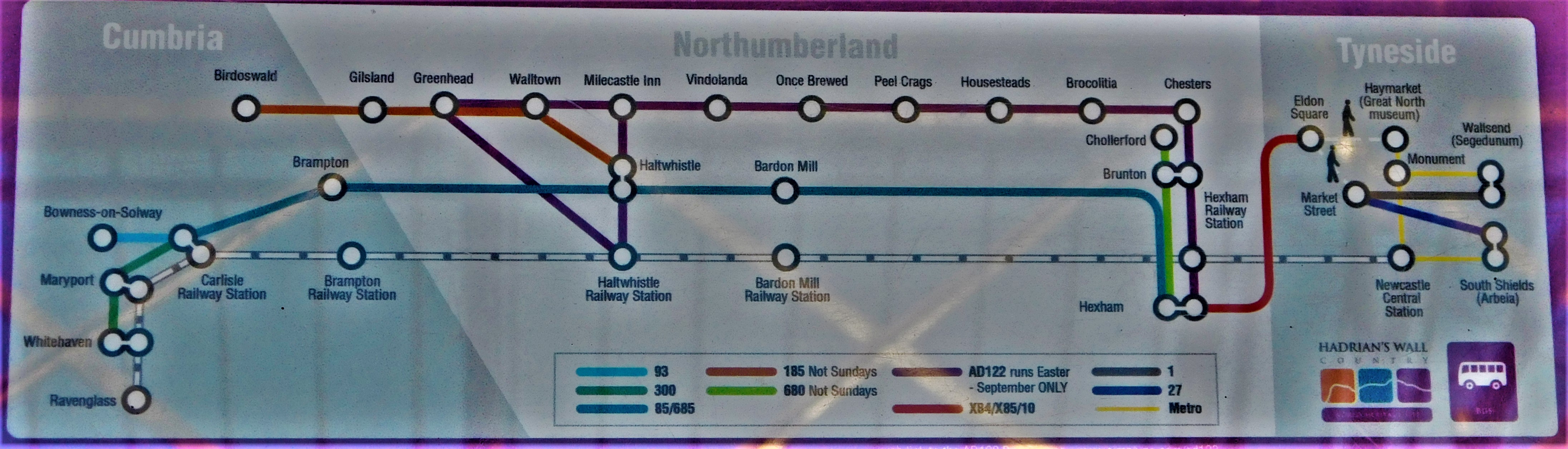
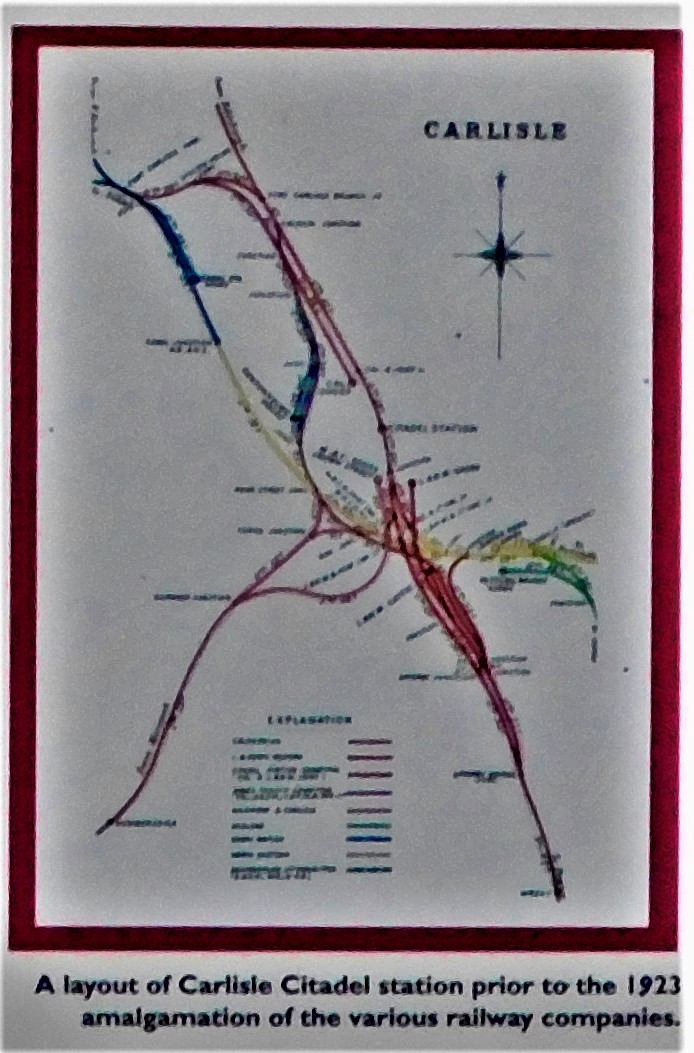
Today’s photo gallery comes from the first part of my return journey from Cumbria. I agreed to be dropped at Penrith station and buy a single from Penrith to Carlisle to get back on track with my return journey. I had a bit of a wait at Carlisle for a train to Newcastle, and as you will see the station there has various points of interest. This gallery takes us to my arrival at Newcastle, where I had a much longer wait as I opted to travel on the train on which I had a reserved seat rather than trying my luck on an earlier service.

All Time XIs – Match Ups (18)

Continuing my extended analysis of how the all time XIs I selected for each letter of the alphabet fare against one another. Also a huge photo gallery.

Welcome to the next series of match ups in my extended analysis of how the all-time XIs I selected for each letter of the alphabet fare against one another. The Ds continue to occupy the spotlight. They come into today with 38 of a possible 80 points.

THE Ds V THE Rs

The Rs have the better opening combo, the Ds win the number three slot, though no 4 has to go the Rs purely on sample size, while nephew ‘Duleep’ beast uncle ‘Ranji’ in the number five slot. D’Oliveira out bats Robins, but Robins’ bowling is more likely to of value than D’Oliveira’s, and additionally the Rs have the better captain. Dujon was the better batter than Russell, the Russell definitely the finer keeper. Roberts, Rabada and Richardson are possibly just short of Davidson, Donald and Daniel as a pace trio, but as against that Rhodes clearly outpoints Dennett (Rhodes the bowler was one of the two, along with Blythe, who was chiefly responsible for Dennett not gaining any test caps). It is very close on batting, but the Rs have a clear advantage in bowling – their attack is better balanced, and they win the spin department by a bigger margin than they lose the pace department. I score this Ds 1.5, Rs 3.5.

THE Ds V THE Ss

The Ss win the batting comfortably, with only Dravid of the Ds top eight definitely outpointing his opposite number . Starc, Steyn and Statham are fractionally behind Davidson, Donald and Daniel as a pace trio, but the Ss back up options, Stokes and Sobers in his quicker incarnations are both ahead of D’Oliveira. Dennett outpoints Sobers the left arm orthodox spinner, but Sobers the left arm wrist spinner and Stevens are both unmatched by anyone from the Ds line up. The Ss thus have a much more powerful batting line up, a marginally inferior pace trio, more spin options and much better back up seam/ pace options. I score this one as Ds 0, Ss 5.

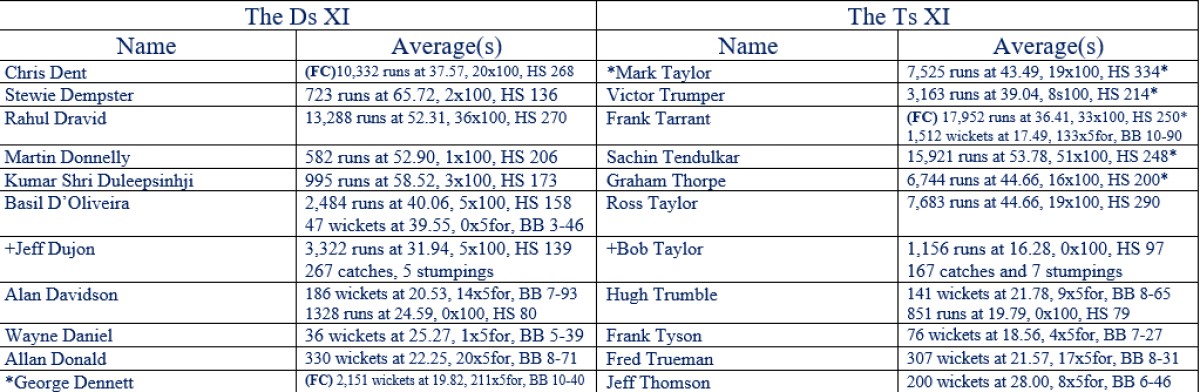
THE Ds V THE Ts

The Ts have the better opening pair, the Ds win the number slot comfortably, the Ts win the number four slot, Thorpe’s inferiority vis a vis Duleepsinhji is lessened by the vastly increased sample size on which his figures are based, and Ross Taylor outbats D’Oliveira, while Tarrant is far ahead of D’Oliveira as a bowler. Dujon beats Bob Taylor with the bat, but Taylor was the finer keeper. Tyson, Trueman and Thomson are at least a match for Davidson, Donald and Daniel, and Trumble outranks Dennett as a spinner. Mark Taylor outranks Dennett as a skipper as well. The Ts are well clear in this contest and I score it Ds 0.5, Ts 4.5.

THE Ds V THE Us

The Ds absolutely boss the batting side of this, have the better keeper, are totally dominant in pace bowling, though outmatched in spin bowling and having the inferior skipper. I score this one Ds 4, Us 1.

THE Ds V THE Vs

The Ds have the better batting, the better keeper and are ahead in the pace bowling department, though by less than the figures make it look – Vaas would fare better as third seamer in a strong attack than he actually did as opening bowler in a moderate one. As against that Verity is clear of Dennett, and Vogler and Vine have no equivalents in the Ds line up, and the Vs have the finer skipper. I score this one Ds 3, Vs 2.

THE Ds PROGRESS REPORT

The Ds have scored nine of a possible 25 points today, meaning that they now have a total of 47 points from a possible 105, 44.76%.

PHOTOGRAPHS

My usual sign off…

All Time XIs – Match Ups (14)

Continuing my extended analysis of how the all time XIs I created for each letter of the alphabet fare against one another. Also has a king sized photo gallery.

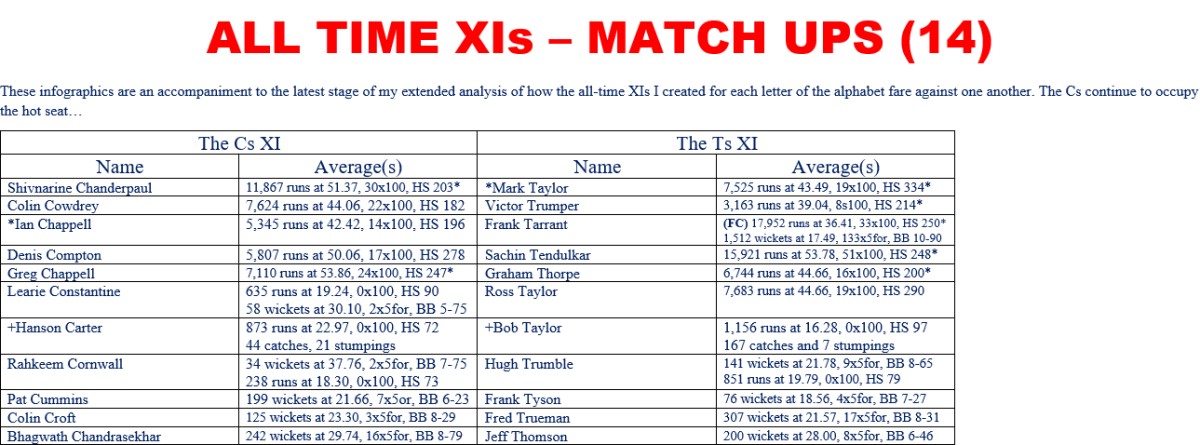
Welcome to the next stage in my extended analysis of how my all time XIs for each letter of the alphabet fare against each other. The Cs still occupy the hot seat, and they start today with 23 of a possible 90 points to their credit.

THE Cs V THE Ts

The Cs in theory have the stronger opening pair but a) both the Ts openers were regulars at that job, unlike the Cs, and b) Victor Trumper played in an era when run scoring was less than it is now. Therefore I say that the Ts win here. Frank Tarrant at three is outdone by Chappelli for the Cs, although he would average more with the bat had he played in Chappell’s era rather than considerably earlier, so this contest is not is clear in Chappelli’s favour as it looks. Tendulkar beats Compton, but Thorpe loses to G Chappell. As against that Ross Taylor is much better with the bat than Constantine. Carter beats Bob Taylor with the bat, but the Ts man was the finer keeper. Tyson and Trueman outrank even Cummins and Croft as a new ball pair, and Thomson is far superior to Constantine as third seamer. Trumble is clear of Cornwall, and Tarrant the bowler rates little if any behind Chandrasekhar. I make the Ts winners in all departments, save for Carter being better with the bat than his rival keeper, and accordingly score this Cs 0, Ts 5.

THE Cs V THE Us

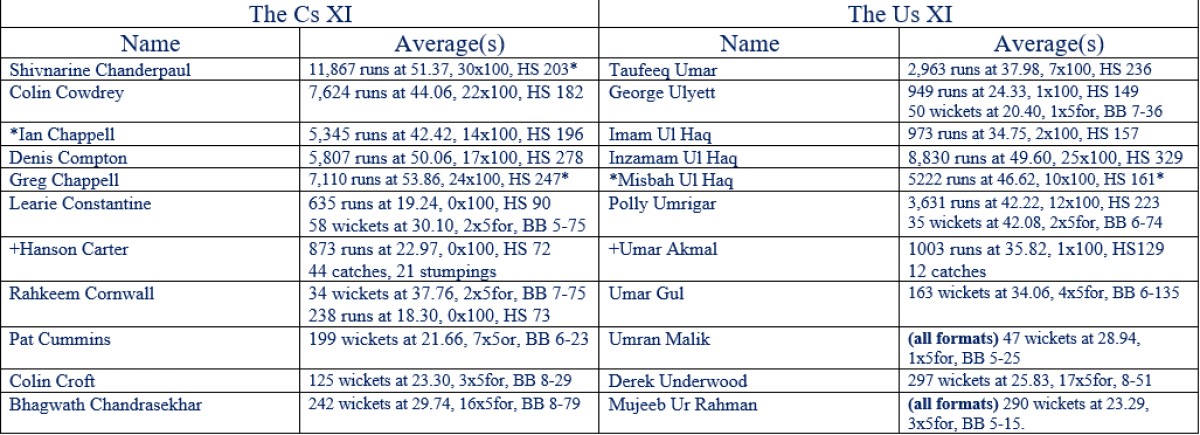
The Cs win the top five batting slots, with only Inzamam Ul-Haq and Misbah Ul-Haq winning their match ups. Umrigar at six is better with the bat than Constantine, while Ulyett makes up for being outbatted by comfortably outbowling Constantine. Umar Akmal was a finer batter than Carter but a fraction of the keeper that the Aussie was. Umar Gul and Umran Malik are comfortably out pointed by Cummins and Croft, although Umran Malik would be the fastest of the four. Ur Rahman is a better off spinner than Cornwall by some way, and Underwood outranks Chandrasekhar as a bowler. Chappelli outranks Misbah Ul-Haq as a captain. The Cs win on batting, captaincy, keeping and new ball bowling, the Us have the better third seamer, more batting from their keeper and boss the spin bowling department. Overall the Cs are obviously clear, but allowing for one serious turner out of five I score this one Cs 4, Us 1.

THE Cs V THE Vs

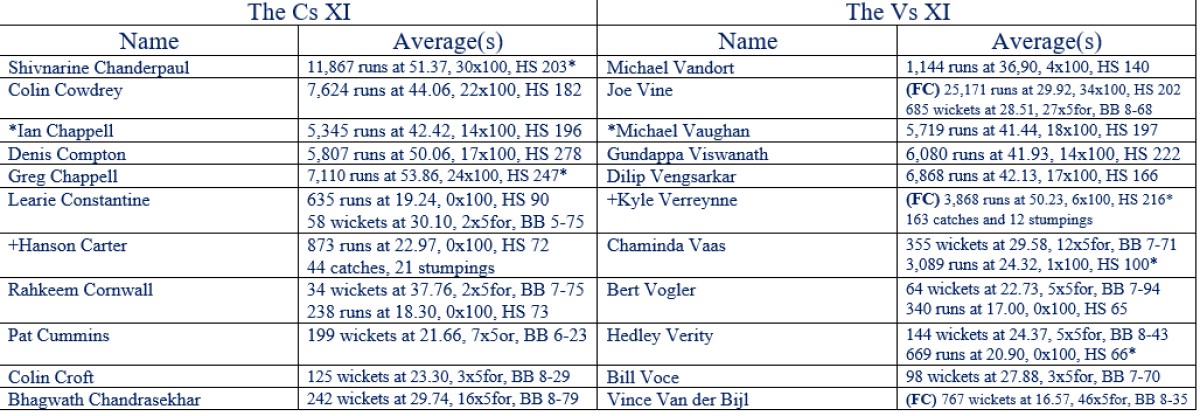
The Cs win on opening pairs even allowing for Vine averaging more these days than he did in his actual playing days. Chappelli just edges Vaughan on batting, and also beats the Yorkie on captaincy, by a slightly wider margin. Compton beats Viswanath and G Chappell beats Vengsarkar. Verreynne handsomely beats Carter on batting but is well behind him as a keeper. Vaas was less of a batter than Constantine, but wins the bowling side of their match up more convincingly than the figures suggest – as third seamer in a strong attack he would perform even better than he actually did as opening bowler in a weak one. The Cs win the battle of the new ball pairs – Van der Bijl probably was the best of the four bowlers involved in this match up, but Voce undoubtedly ranks fourth, some way adrift of third. Vogler and Chandrasekhar are close as bowlers, while Verity blows Cornwall out of the water. The Cs have a noticeable advantage in batting, but the Vs are well clear in bowling, especially given that they have a sixth front line option in Vine. I think the Vs bowling guns settle this one, but it is far from one sided: Cs 2, Vs 3.

THE Cs V THE Ws

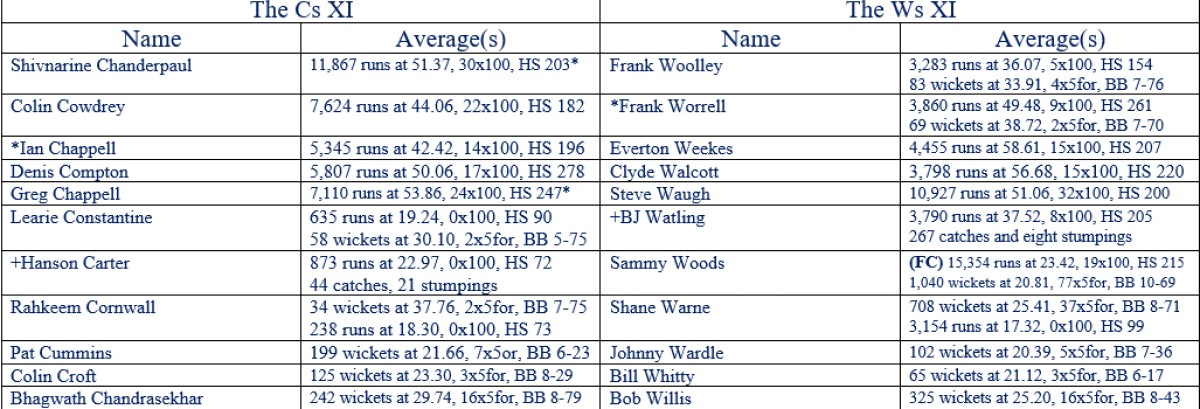
The Cs have theoretically the better opening pair, but Worrell and Woolley were more suited to opening than Chanderpaul and Cowdrey. Weekes is massively clear of Chappelli with the bat, and Worrell probably just wins the captaincy side of that match up. Walcott beats Compton, while G Chappell is just ahead of Waugh. Watling massively outbats Carter, but the Aussie was the finer keeper. Woods outranks Constantine in both departments. Cummins and Croft outrank Willis and Whitty as a new ball combo, although Whitty’s left arm reduces the margin between these combos. Woods’ advantage over Constantine, and the presence of Worrell as a fourth seam option gives the Ws a clear win in this department. Warne is clear of Chandrasekhar, and Wardle knocks the spots of Cornwall, and the Ws also have Woolley’s left arm orthodox spin as a third option in that department. There is no set of circumstances that enables the Cs to come out on top, so: Cs 0, Ws 5.

THE Cs V THE Xs

The Cs dominate the top batting, although Dexter wins his match up against Chappelli. As against that, Chappelli was a much better skipper than Kippax. Axar Patel beats Constantine in both departments. The Xs are well down in the pace bowling department, but have lots of depth in the spin bowling department. Box was a legendary keeper, and bearing in mind that the best batter of his era, Fuller Pilch, averaged less than 20, he is not outgunned by Carter in that department either. The Cs win this one, but not in a whitewash: Cs 4, Xs 1.

THE Cs PROGRESS REPORT

The Cs accrued 10 points out of 25 today, meaning that they now have 33 points out of 115, 28.69%.

PHOTOGRAPHS

I have a huge photo gallery to share today. To view a photo at full size just click on it

All Time XIs – Yorkshire

Continuing my all-time XIs series with Yorkshire.

INTRODUCTION

This is the fourth all-time XI post I have done (Surrey, Gloucestershire and Worcestershire were the first three). I have an ancestral connection to Yorkshire, and I lived in Barnsley for six years. As you would expect of the county that has by far the most outright championships (32 at the present time), there is a positive embarrassment of riches to choose from.

YORKSHIRE ALL TIME XI

  1. Herbert Sutcliffe – a big occasion player, as witnessed by the progression of his averages (overall FC 52.02, overall test 60.73, Ashes 66.85), he also overlapped for a few years at first class level and rather longer at club level (both were raised in Pudsey) with the person I have chosen as the other opener. He could claim that both World Wars affected his career since the first prevented his entry into first class cricket until he was 24, and the second led to his retirement from the game (and his 1939 performances were not those of a man preparing to lay aside his bat for the last time, though resuming after a six season layoff when past the age of 50 was obviously not going to happen). He tallied over 50,000 first class runs in total with 149 centuries.
  2. Leonard Hutton – a man who averaged 56.7 in test cricket and was also hugely productive in first class cricket, in spite of missing six of what would have been prime development years to World War II, from which he emerged with one arm shorter than the other due a training accident. In 1953 as captain he regained the Ashes which had been in Australian hands since Woodfull’s 1934 triumph, and eighteen months later he led England to victory down under.
  3. David Denton – in the first decade of the 20th century only one Yorkshire cricketer gained England selection purely on the strength of batting skill, and that person was David Denton. He was known as ‘lucky’ Denton because he seemed to benefit from plenty of dropped chances but there are two counters to that, firstly there is Napoleon’s “give me a lucky general rather than a good one”, and secondly people noticed him benefitting from dropped chances for the very simple reason that he made it count when such occurred.
  4. Maurice Leyland – a left handed bat and a bowler of ‘chinamen’, he scored heavily for both Yorkshire and England.
  5. Joe Root – the current England test captain, and a bat of proven world class, though his off spin would not see much use in this team, and you will note that I have not named as captain of this team.
  6. George Hirst – rated by his long time county captain Lord Hawke as the greatest of all county cricketers, he batted right handed and bowled left-arm pace. He achieved the season double of 1,000 runs and 100 wickets in first class matches 14 times, 10 of them in successive seasons. In each of 1904 and 1905 he had over 2,000 runs and 100 wickets, and in 1906 uniquely he had over 2,000 runs and 200 wickets. He was also noted for his fielding at mid-off.
  7. *Wilfred Rhodes – the other of the ‘Kirkheaton twins’, a right handed bat and slow left arm bowler with over 4,000 first class wickets and almost 40,000 first class runs in his career, the longest ever test career in time terms (31 and a half years between his first and last appearances) his astonishing career linked the era of Grace with that of Bradman. I have named as captain because although being a humble professional he never officially had the job I believe he would have been excellent at it- when asked about Percy Chapman as England captain Rhodes said “‘ee wor a good ‘un – he allus did what me an’ Jack telt him”.
  8. Tom Emmett – a left arm pace bowler who took his wickets very economically and was a good enough wielder of the willow to have a first class hundred at a time when they were not easy to come by. He accounted for W G Grace 36 times (as well as Gloucs v Yorks, there were fixtures such as North v South, Gentlemen vs Players etc, so top cricketers came up against one another frequently) and was highly rated by ‘The Doctor’.
  9. Fred Trueman – “T’finest bloody fast bowler that ever drew breath” at least in his own oft stated opinion, and it was close enough to true for the exaggeration to be pardonable. He was the first to take 300 test wickets, and in a 20 year first class career he bowled an average of 800 overs per year. He could also handle a bat and was a good fielder.
  10. Schofield Haigh – a right arm quick medium/ off cutter bowler and lower order bat who sometimes made useful contributions. He often bowled devastatingly in tandem with Hirst and/or Rhodes.
  11. +David Hunter – the only non-international in the XI, he made 1,200 dismissals as Yorkshire wicket keeper, and with the depth of the batting in this side I felt it right to go for the best wicket keeper irrespective of batting ability.

There are a stack of players who could have merited inclusion but for the limit of 11. Among the openers Louis Hall, Jack Brown and Percy Holmes (partner of Herbert Sutcliffe in 74 century opening stands, 69 of them for Yorkshire) could all have been considered, while Brian Close would have his advocates in the middle order, as would various others. Off spinning all rounders Ted Wainwright and Billy Bates could have had a place, and there are a number of slow left armers who could have been given the nod – any of Ted Peate, Bobby Peel, Hedley Verity, Johnny Wardle or Alonzo Drake. Among the faster bowlers for whom no space could be found were George Freeman, Emmett’s regular opening partner for a few years, who took his first-class wickets at less than 10 a piece, George Macaulay, Emmott Robinson, Darren Gough and Chris Silverwood, all of whom might have their advocates. Similarly I could have given the gloves to Arthur Dolphin, Arthur Wood (“always wor a good man for a crisis” when coming in at 770-6 at the Oval in 1938), Jimmy Binks, David Bairstow or Jonny Bairstow. One big name who I refuse to call unlucky to miss out is Geoffrey Boycott – I pick teams to win, not to draw, and Yorkshire’s record in the two seasons in which Boycs averaged over 100 is testimony to the problems his approach created in that regard. Undoubtedly he has the best career record of anyone I have neglected to pick for one of these teams, but too often his runs were not made in a winning cause. I try to balance my sides as well as possible, and in the one I chose I have five top of the range batters, two of the greatest all-rounders to ever play the game, three great and contrasting bowlers and a super gloveman. The bowling options include two different types of left arm pace (Emmett and Hirst), right arm pace (Trueman), right arm medium fast (Haigh), left arm spin (Rhodes), left arm wrist spin (Leyland) and at a push off spin in the person of Root and right arm  leg spin courtesy of Hutton. Also, if I am going to err in selecting a side it will be in the direction of stronger bowling rather than stronger batting – you will note that both two actual overseas players I have picked in previous posts and the potential one that I mentioned in the Surrey post are all bowlers. There are examples of teams with less than stellar batting but excellent bowling being big winners – Yorkshire in several of their most outstanding periods, Surrey in the 1950s and a few others, but there are few examples of the converse. Sussex in the the first decade of the 20th century had a powerful batting line up, with Fry and Ranjitsinhji among the all time greats and Joe Vine are top drawer opening partner for Fry plus a few other useful contributors, but they never came close to being champions because they did not have the bowling to press home the advantage that batting should have given them.

PHOTOGRAPHS

P1310397 (2)P1310398 (2)P1310399 (2)P1310400 (2)P1310401 (2)

P1310402 (2)
The cars in the background are parked, not travelling anywhere.

P1310403 (2)P1310404 (2)P1310405 (2)P1310406 (2)