Two Wins For England Cricket Teams

A look back at victories by the England men’s and women’s cricket teams, a mention of an upcoming auction and a photo gallery.

Last night saw the third T20I in a five match series between the England and New Zealand teams, while this morning, though it should have been just less than halfway through the match saw the last knockings of the first of three test matches between the England and West Indies men’s teams. This post looks at both games.

The test match at Lord’s was the last appearance at that level of the legendary James Anderson, who made his test debut as long ago as 2003. England have decided to look to the future, and gave Anderson this match so that he could bow out in front of a home crowd. It also saw the arrival on the test scene of Gus Atkinson, the Surrey fast bowler. In terms of the result it was the new comer who had the bigger say (and how!)

In my previous post I mentioned Atkinson’s first innings brilliance (7-45) and the fact that England were going well in response. While I was at work yesterday England continued to progress with the bat – Crawley, Pope, Root, Brook and the other debutant, Jamie Smith, selected as keeper although he is not Surrey’s first choice in that role all made 50s, though none managed to reach 80. Smith’s 70 on debut included a significant increase in scoring pace when he was left with the tail. The West Indies second innings got underway yesterday evening, and the skids were soon under it in no uncertain terms. Stokes took two early wickets, Anderson one and Atkinson one. Late in the day two further scalps fell, a second to Anderson and a second to Atkinson giving the debutant nine for the match to that point. West Indies were 79-6 when that wicket rang down the curtain on day two (although an extra half hour can be claimed if a result is possible that usually only enters the equation if seven or more wickets are down). It also ensured that James Anderson would finish behind Warne in the all time test wicket takers list. Atkinson and Anderson resumed bowling this morning, and it was Anderson who had the first success with a beauty that took the edge of Josh da Silva’s bat and went through to Smith. Thereafter however it was the Atkinson show. First Alzarri Joseph took on a short ball and succeeded only in giving Duckett catching practice, then Atkinson bowled Shamar Joseph to make it 103-9. At that point Atkinson had match figures of 11-86, and if he could take the final wicket and concede 15 or fewer runs in the process he would set a new record for an England debutant, beating the 12-102 taking by Fred ‘Nutty’ Martin way back in 1890 (Jack Ferris took 13 in his first match for England, but he had previously played for Australia, and it would have been news to him that he was playing that match for England since it was on a privately organized tour of South Africa and was only granted test status some years later). A combination of luck and some decent batting by Gudakesh Motie robbed him of that, but when Jayden Seales, the number 11, was caught by Duckett, fielding at long leg, Atkinson had his second five-for of the match, and final figures of 12-106 (7-45, 5-61), the second best ever for England, and a number of wickets beaten by only two test debutants in history, Narendra Hirwani (India, 16-136) and Bob Massie (Australia 16-137). Anderson’s final bowling effort was 3-32 from 16 overs, meaning that he ended with 704 test wickets overall. England’s winning margin was an innings and 114 runs – WI 121, ENG 371, WI 136. Atkinson was, as I said in a tweet shortly after the final wicket fell, the ONLY candidate for Player of the Match and was duly confirmed as such. A scorecard of this match can be seen here.

In theory the question for England is now which of Potts or Pennington comes in for Anderson (Sam Cook is currently injured, so his call up must wait). However, I would boldly select both, leaving out Woakes who contributed little at his favourite ground.

England won the toss and chose to field. The New Zealand innings was dominated by two players named Sophie. Sophie Devine scored 58 not out off 42 balls to give New Zealand 141 to defend, and the main reason that total wasn’t higher was Sophie Ecclestone, who finished with 4-0-25-4. The first of those four wickets, that of Suzie Bates, kept an astonishing run going – it made it 33 consecutive international bowling innings in which the left armer had claimed at least one wicket. Later in that same opening over she snared Amelia Kerr, and in the later stages of the innings she clean bowled each of Isabella Gaze and Leigh Kasperek. Although England only had four balls to spare when they scored the winning run, they had six wickets standing. The batting star was Alice Capsey whose 67* (60) undergirded the chase. It was Capsey who was named player of the match ahead of Ecclestone. Scorecard here.

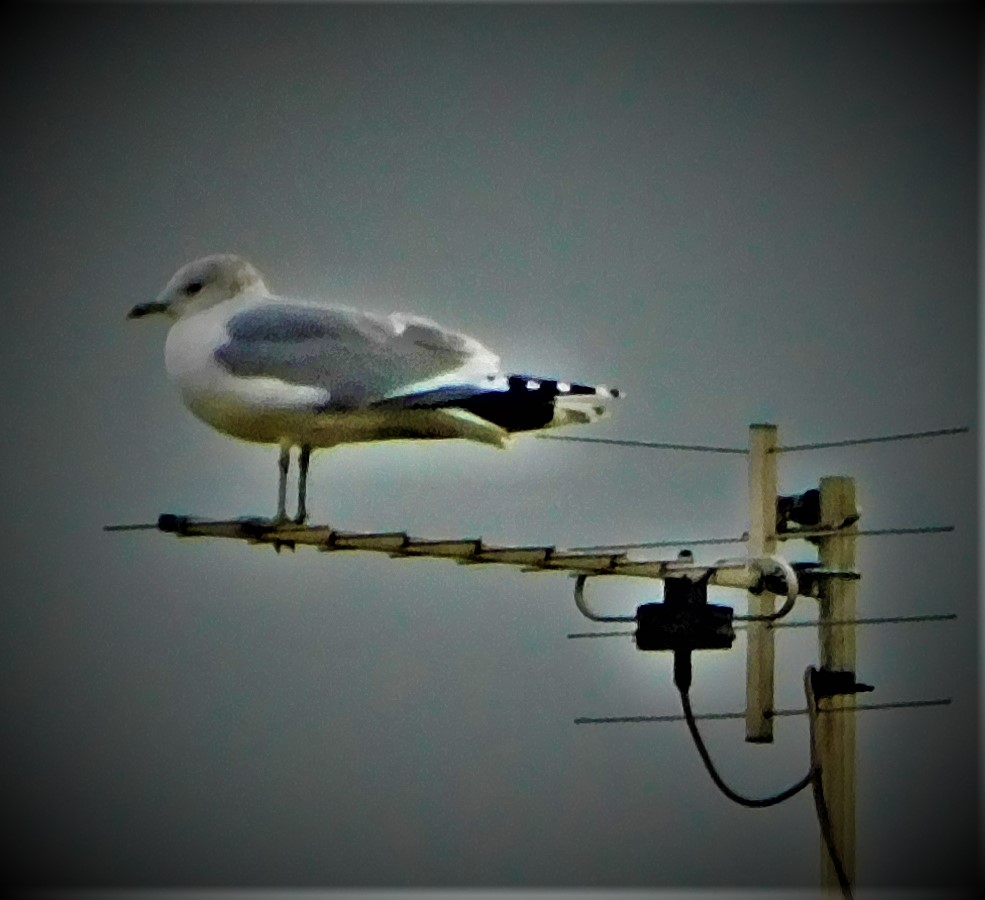
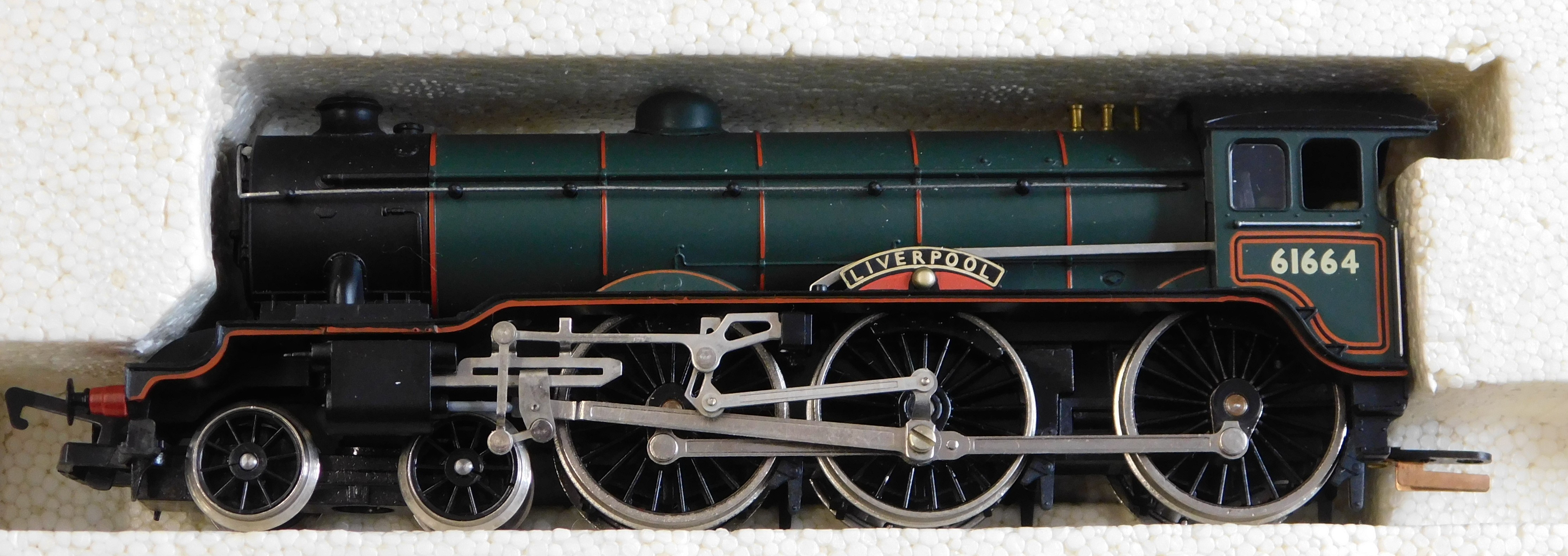
Before I get to my usual sign off, I sent out a bulk email about the upcoming railway models auction at work yesterday. I will not include the full thing here, but you can view a full catalogue and/or sign up to bid here or here. The image I used to accompany the email is below.
Now for the main gallery…


All Time XIs – Golden Oldies

In view of today’s happenings in Vizag I offer an XI of players whose skills and appetite for the game remained undimmed into their 40s. I also have my usual photo gallery for you.

The second test match of the five match series between India and England began at 4:00 this morning UK time. The pitch at Vizag is a batters paradise, which is why I reckon it is honours even at the end of day one. India are 336-6, with Yashavsi Jaiswal having batted all through the day for 179*. England actually bowled three overs more than the statutory minimum of 90, which is almost as rare as seeing a woodpecker in the environs of King’s Lynn, which also happened today:

Close up of a Green Woodpecker seen while walking along the Gaywood River path this morning.

England’s two young spinners, Rehan Ahmed and debutant Shoaib Bashir (born in Nottinghamshire and Surrey respectively for those who care about such things) each picked up two wickets, and each took a catch of the other’s bowling. Bashir became the 713th player capped by England Men, and one of his team mates in this match is the 613th player capped by England Men, one James Michael Anderson, who is the inspiration for today’s XI, comprising players who had great test match moments when past 40 years of age. Anderson had a fine day on a pitch offering him precious little, being parsimony personified, with 1-30 from 17 overs, meaning that he has now taken at least one test wicket in each of 22 successive calendar years.

  1. Jack Hobbs (England, right handed opening batter). Almost half of his test runs were scored after he had turned 40, and at Melbourne in 1929, at the age of 46, he became test cricket’s oldest ever centurion with an innings of 142.
  2. Warren Bardsley (Australia, left handed opening batter). At Lord’s in 1926, almost 17 years after he had become the first to score twin centuries in a test match, Bardsley, then 43 years old, carried his bat through Australia’s first innings, scoring 193 not out.
  3. Patsy Hendren (England, right handed batter). Like Hobbs a tall scoring batter to the very end of his long career – over 1,000 of his test runs came after turning 40.
  4. Tom Graveney (England, right handed batter). Another in the select ‘1,000 test runs after the age of 40’ club.
  5. *Misbah-ul-Haq (Pakistan, right handed batter, captain). Someone whose prime test years were after he had turned 40.
  6. Basil D’Oliveira (England, right handed batter, right arm medium pacer). Based on his test record a batter who bowled rather than a genuine all rounder, though that might very well have been different had he been able to play for his native land starting in his mid 20s rather than for another country starting officially in his mid 30s.
  7. +Bob Taylor (England, wicket keeper, right handed batter). The only candidate for this slot.
  8. Clarrie Grimmett (Australia, leg spinner, right handed batter). His career did not begin in earnest until his mid 30s, and his test career only ended when at 46 years of age he was left out of the squad for the 1938 Ashes in England. By then he had taken 216 wickets in 37 tests.
  9. Sydney Barnes (England, right arm fast medium bowler, right handed batter). His last series, played at the age of 41, saw him claim 49 wickets in four matches before an argument of terms and conditions saw him miss the fifth and final match of the series. Those 49 wickets were just over a quarter of his career tally of 189, taken in just 27 matches.
  10. James Anderson (England, right arm fast medium bowler, left handed batter). Incredible longevity at the top for a 21st century cricketer, and his performance today suggests that the skills are very much still there. He has been known to bowl left arm spinners in the nets, though as far as I am aware has not yet deployed this method in a match. The oldest ever test cricketer, Wilfred Rhodes, who played his last match at the age of 52 years 165 days bowled left arm spin.
  11. Bert Ironmonger (Australia, left arm orthodox spinner, left handed batter). He made his debut at the age of 46, played 14 tests over the course of five years, and took 74 wickets at 17.97 in those matches. Thus in spite of being the ultimate in one-dimensional players – a clumsy fielder, and possessor of a test batting average of 2.62, he was nailed on for selection in this XI.

This side features a strong top six, a keeper whose batting was better than it is often given credit for being, and four great bowlers. Going by D’Oliveira’s actual record rather than dealing in ‘what might have been’ it is very much six batters, a keeper and four bowlers, rather than five batters, an all rounder, a keeper and four bowlers. However, the two most dominant men’s test cricket forces of my life time, the West Indies under Lloyd and Richards, and their successors at the top of the test tree, the Australians under Mark Taylor and Steve Waugh, both relied on six batters, a keeper and four bowlers, so it clearly can work provided that the personnel involved are good enough at their jobs, and I believe that this team ticks that box.

Among the batters to merit serious consideration were Bobby Simpson of Australia, Eric Rowan of South Africa and Herby Taylor of South Africa. The only other keeper to do well at the very highest level when past 4o was Bert Strudwick of England, and he was a genuine tailender with the bat, which would have made things very dicey indeed batting wise. Freddie Brown, who captained England in Australia at the age of 40 and had a respectable series would have had the number six slot had I been desperate to tick the all rounder box, but I felt in view the people at 8-11 that D’Oliveira, the batter who bowled, was a better fit for the XI.. Few genuine quicks have kept their pace into their 40s, and although his presence at number eight would have strengthened the batting I did not feel that Gubby Allen (England), one of that select company, was good enough to dislodge any of my chosen bowlers.

My usual sign off…

All Time XIs – The Jameses

An all time XI of players who all have James as one of their given names and a large photo gallery.

Today’s post honours two cricketers who are very different stages of their careers and happen to have the first name James. Both of course are in the starting XI.

  1. James Burke (Australia, right handed opening batter). Usually known by the diminutive Jim, he was a dour opener with a respectable test record and a good first class one. I have not mentioned his off spin, as a) I don’t see it getting much use in this XI and b) to quote a spectator at one of his matches “bowl him one for a change Burkie – you’ll surprise him”.
  2. James Aylward (Hambledon, left handed batter). Anyone good enough to have scored 167 in a big match on the kind of pitches that existed in 1777, as he did, must have been an excellent batter, and I am pleased to honour him here.
  3. James Langridge (Sussex, England, left handed batter, left arm orthodox spinner). He was often called on to act as sheet anchor for Sussex, which is why I feel confident using him to fill what would otherwise be a tough slot. Even at test level his averages were the right way round, while at FC level he averaged 35 with the bat and 21 with the ball.
  4. *James Hildreth (Somerset, right handed batter, occasional right arm medium pacer). Very unlucky never to have to have played test cricket, he was one of the most prolific middle order batters of his era. I have also named him as captain of this side.
  5. James H Parks (Sussex, England, right handed batter, right arm slow medium bowler). The only player ever to score 3,000 FC runs and take 100 FC wickets in the same season.
  6. James Rew (Somerset, left handed batter, occasional wicket keeper). At the age of 19 he already has six first class hundreds with an HS of 221, with an average of 52.80 at that level. Elevation to the test ranks looks assured. He is the first of the two guys to inspire this post.
  7. +James Foster (Essex, England, wicket keeper, right handed batter). One of the finest wicket keepers ever to play the game, and enough of a batter to score 13,000 FC runs at an average of 37.
  8. Cedric Ivan James ‘big Jim’ Smith (Middlesex, England, right arm fast bowler, right handed very aggressive lower order batter). Took his FC wickets at 19 a piece. Among his many absurdly fast innings is the quickest 50 ever scored against genuine (as opposed to declaration) bowling – he reached the landmark in 11 minutes on that occasion!
  9. James Charles Laker (Surrey, Essex, England, off spinner, right handed lower order batter). Possibly the greatest of all conventional off spinners (Murali is in a category of his own), and good enough with the bat to have amassed two first class hundreds.
  10. James Bridges (Somerset, right arm fast medium bowler, right handed lower order batter). A fine new ball bowler for Somerset, and has the distinction of coming closer to having an FC century than anyone else who failed to score one – his HS at that level being 99 not out.
  11. James Anderson (Lancashire, England). He turned 41 yesterday, and he is guaranteed to remain England’s all time leading test wicket taker for some time to come, as his closest rival Stuart Broad has announced that the current test match will be his last. Anderson has not yet retired, and although he is unlikely feature much if at all in India this winter, he may be eyeing Sri Lanka at his him ground of Old Trafford next year as a potential sign off match.

This side has a solid batting line up, with most of the bowlers capable of weighing in as well, and a great bowling attack – Anderson, Smith, Bridges, Laker and Langridge, with James H Parks as sixth bowling option.

James Pattinson (Australia) is the biggest miss by far, but I wasn’t prepared to drop any of my chosen specialist seamers to make way for him. James M Parks, son of James H, was a good middle order batter and some might have picked him ahead of his father. James Hallows of Lancashire would have given me a left arm pace option, but he was more batter than bowler, and his record in that department does not stack up. James Morton Sims of Middlesex was the best leg spinner to qualify for consideration, but I preferred three seamers and two spinners to really stacking the spin options. James Seymour of Kent was a good county pro in his day. Finally, James Lillywhite junior who could not be accommodated in this side deserves a mention for his historical significance – he captained England in the first two test matches ever played, and also helped to arrange a number of the early tours.

On this day last year I published my all time XI of players whose surnames begin with J. Now it is time for my usual sign off…

All Time XIs – England ‘Bazball’

A quirky all time XI – an England XI picked to play in the style of the current one.

It is ‘all time XI’ time again. The brief for this one is to pick an all-attacking all time England XI which is as perfectly balance as I can make it. This is a team that would score its runs quickly and have no problem taking 20 wickets in a test match. Also, no two successive batters in the envisaged order bat with the same hand.

THE XI IN BATTING ORDER

  1. Ben Duckett (left handed opening batter, occasional wicket keeper). He has been doing splendidly since his recall under Stokes’ captaincy.
  2. *WG Grace (right handed opening batter, right arm bowler of various styles, captain). The only conceivable choice as right handed opener for this XI, someone who was always looking to score runs.
  3. Frank Woolley (left handed batter, left arm orthodox spinner). A stroke making batter, a fine bowler and the only non-keeper to have taken over 1,000 first class catches.
  4. Denis Compton (right handed batter, occasional left arm wrist spinner). A natural born entertainer if ever there was one, holder of the fastest ever first class triple century (got to that mark in 181 minutes in a tour match at Benoni, South Africa).
  5. David Gower (left handed batter). Ideally suited to a side of this nature.
  6. +Les Ames (right handed batter, wicket keeper). Averaged 40 with the bat at test level, scored over 100 FC hundreds, twice won the Lawrence trophy for the fastest first class hundred of the season. Over 1,100 first class dismissals including an all time record 418 stumpings.
  7. Ben Stokes (left handed batter, right arm fast medium bowler, vice captain and talisman). Had to be included in this side, and a nod had to be given to his leadership, hence the award of the vice captaincy.
  8. Billy Bates (off spinner, right handed batter). A great all rounder whose career was ended prematurely by the loss of an eye in a freak accident. His test career was brief, but his first class career averages of 21.57 with the bat and 17.13 with the ball – both figures would be higher today (probably 32 with the bat and 25 with the ball) – illustrate his credentials.
  9. Tom Emmett (left arm fast bowler, left handed batter). A great fast bowler and a good enough batter to have scored a first class hundred at a time when that was not particularly easy to do.
  10. Syd Barnes (right arm fast medium bowler, right handed batter). 189 test wickets at 16.43 a piece in just 27 test matches.
  11. James Anderson (right arm fast medium bowler, left handed batter). England’s all time leading test wicket taker, and though his position in this batting order is unarguable, he would probably get off the mark with a reverse sweep.

This side has great batting depth, and with Stokes, Woolley, Grace and at a push Compton all capable of backing up the front four there is a wealth of bowling as well. This side would win a lot of matches, lose a few and probably not draw any unless epic quantities of rain fell.

HONOURABLE MENTIONS

I will go through these in batting order. Bob Barber was a contender for the left handed opener’s slot I gave to Duckett, but his top level career was much briefer. Had I not wanted Grace as captain Charlie Barnett and Colin Milburn would both have merited attention for the right handed openers slot. Woolley’s role as second spinner meant that the number three slot was nailed down. I might have named several at number four: Hammond, Dexter, May, Cowdrey, Pietersen and Root were all in the mix. Gower at number five had few challengers – the two left handed middle order players with really substantial test records, Phil Mead and Graham Thorpe were both more sedate in approach, while Percy Chapman, undoubtedly aggressive in nature, was never really worth his England place as a player. Ames at six and with the gloves had few challengers – Jonny Bairstow is not good enough with the gloves for the dual role, though I might have considered Matt Prior. Stokes really had to get the number seven slot. I regretted not being to accommodate Gilbert Jessop, though he can be designated fielding sub. There were two challengers for the number eight slot: Graeme Swann and Greville Stevens (with Woolley inked in I wanted a second spinner who was not an SLA). With Barnes indispensable I had no way to accommodate Trueman.

PHOTOGRAPHS

A couple of links before my usual sign off:

  1. A Guardian article about a site that is due to be used as the marker for the dawn of the anthropocene.
  2. An excellent twitter thread by Richard Murphy.

Multan Mayhem

A look at the first two days of the second Pakistan v England test, which is taking place in Multan.

Greetings from the frozen wastes of Norfolk. It is currently four degrees outside with a significant wind chill, and that represents the least bad it has been in the last 48 hours. The second test of the Pakistan v England series is currently taking place in Multan, and may even finish tomorrow, while I would bet money against there being a day five.

THE PRELIMINARIES

England decided to persist with Pope as keeper and number three even though Foakes was available. Mark Wood came into the side to strengthen the bowling. For Pakistan there was a debut for leg spinner Abrar Ahmed and a recall for Faheem Ashraf. Ben Stokes won the toss and chose to bat first. This was soon seen to be a correct call as there was already evidence of turn on day one.

DAY ONE

Ben Duckett made a fluent 63 and Ollie Pope 60, and there were some other useful contributions down the order. The story of the innings however was the debutant Abrar Ahmed, who took the first seven wickets to fall with his leg spin. This puts him second on the all time list to Alf Valentine who took the first eight wickets to fall in his debut match. The other leg spinner, Zahid Mahmood broke the sequence, and in the end claimed the last three wickets. England were all out for 281 from 51.4 overs, and some were condemning the team’s new, much more aggressive approach. However my own reckoning was that England of a year or so ago would not have batted much if any longer on this pitch and would have scored many fewer runs. Also of course, first innings efforts should really be assessed only after both teams have batted – and that would apply with a vengeance this time round.

Pakistan batted well in the remaining overs of day one, reaching 107-2. Babar Azam was especially impressive, while James Anderson, the man who just keeps on bowlin’, claimed the first wicket to fall to seam bowling in the match and Jack Leach extended the tally of wickets taking by bespectacled spinners to eight. With Pakistan looking well placed the would be writers of ‘bazball obituaries’ were having themselves a field day in spite of England’s record since Stokes assumed the captaincy full time being won seven, lost one.

DAY TWO

Pakistan seemed to start day two as they had finished day one, scoring well, but then Babar Azam fell for 75 to make is 145-3. Mohammad Rizwan took his place in the middle and the game tilted on its axis. It took Rizwan 25 balls to get off the mark, and even with two fours he managed in total 10 off 43 balls, and Pakistan went into a tailspin. Leach picked up his second, third and fourth wickets of the innings,, Root bagged two in an over with his part time off spin and Wood took two wickets along the way. It was only a lusty last wicket stand between Faheem Ashraf and Abrar Ahmed that got Pakistan past 200. They were all out 202, and England had a 79 run lead on first innings, precisely the same advantage they enjoyed in Rawalpindi, but one that looked a lot more significant on this surface.

England lost two early wickets, Crawley running himself out and Jacks promoted to number three in order that Pope could have more of a rest from his keeping. Root also failed by his own high standards, but Duckett played superbly once again, scoring 79. His dismissal, bowled by one from Abrar Ahmed that shot through low, was an ominous sign for Pakistan – they had needed him out, but they did not need to see a ball doing that with England already over 220 runs to the good. Pope was run out cheaply to make it 155-5, but skipper Stokes stayed with Brook until the light brought an early end to proceedings. By then England were 202-5, 281 runs ahead, with Brook 74* and Stokes 16*. Abrar Ahmed had taken his tally of wickets on debut to 10, but the two run outs meant that he could not equal the record performance by a debutant (16 wickets, achieved twice, by Bob Massie of Australia in 1972 and Narendra Hirwani of India in 1989). The alacrity with which Pakistan headed for the pavilion when the umpires decided the light was no longer good enough was telling as to their state of mind just two days into this match. The events of this second day’s play, rather like the events post Stokes’ declaration at Rawalpindi, left the naysayers looking more than a little foolish. It is dollars to doughnuts that at some point tomorrow or Monday the series score will be 2-0 to England.

PHOTOGRAPHS

Just before the photographs, I shared an old post in a twitter discussion this morning and it was well received. Now for my usual sign off…

A Test Match For The Ages

An account of the closing stages of a classic test match and some photographs.

This post looks at the extraordinary events that unfolded in Rawalpindi this morning UK time.

AN EXTRAORDINARY FINISH

At the tea interval Pakistan were 257-5 chasing the target of 343 that Ben Stokes had dangled before them precisely a day earlier. Thus this match went into the final session with all results possible (the draw being in the equation due to the fact the fading light would force a halt at approximately 4:45PM local time) rather than the players heading out for an hour of meaningless cricket before the umpires were officially allowed to confirm the draw as would have happened had any current international skipper other than Stokes been in charge of the visiting side on such a flat pitch. Many, especially those who had objected to the Stokes declaration reckoned that the Pakistan victory was the most likely outcome, but that neglected both the time limit imposed by fading light and the fact that the pair in occupation, Azhar Ali and Agha Salman, were their team’s last recognized batters – Pakistan had four genuine tail enders in their team. Agha Salman was the first to fall post tea, and then crucially Azhar Ali was seventh out, leaving the tail enders needing to cobble 83 together to win or else to survive until the light halted play. Anderson removed numbers 9 and 10 in the same over to claim his third and fourth scalps of the innings, drawing level with Ollie Robinson who also had four wickets. Zahid Mahmood joined Naseem Shah, and they held out determinedly for some time.

Eventually the third ball of the the 97th over of the innings, bowled by Jack Leach, pinned Naseem Shah plumb in front. He sent it upstairs, but it was never really in doubt. By my reckoning the wicket fell with nine balls remaining before the light forced an abandonment. Pakistan were all out for 268, and England had won by 74 runs. I hope those who criticized the declaration are enjoying their portions of humble pie – England needed the time they gave themselves to take those 10 wickets. The last visiting side to play a test match in Rawalpindi, Australia in March, had their full first choice bowling attack and managed to take precisely four wickets in the entire match, so for a weakened England to claim all 20 of the opposition wickets was outstanding.

Ollie Robinson was named Player of the Match for his bowling efforts (I would have given it to Stokes for his captaincy, which transformed what have been an Old Trafford 1964 style snoozefest into a test match for the ages – I rank it second among those I have witnessed live behind Edgbaston 2005, but absent that it was right to honour Robinson for his great bowling effort on a lifeless pitch). I stand by every word of my criticisms of this pitch in earlier posts – it was Ben Stokes who engineered a compelling test match out of nothing on a surface that was ridiculously loaded in favour of the batters. England faced only just over half as many overs as Pakistan in the course of the match, winning it because they quite literally scored twice as fast as Pakistan. This match set many records: Highest match aggregate for test match with a definite result, highest match aggregate for a time limited test match (the first and second highest scoring test matches were both supposed to be timeless but were abandoned as draws when the visitors had to travel home, hence this match gaining these two records. Pakistan’s 847 is the most runs ever scored by a side losing a test match, and their 579 is the highest first innings score by a home side to lose a time limited test match (Australia lost after scoring 586 first up at the SCG in 1894, when overnight rain after the fifth day’s play in a timeless match turned the uncovered pitch into a vicious sticky dog and a hung over Bobby Peel claimed six cheap wickets with his left arm spin on the sixth morning, to give England victory by 10 runs). A final note from this remarkable match: James Anderson conceded just 2.35 runs per over, while the average economy rate of every other bowler in the match was 5.09 per over. A full scorecard can be viewed here, and I have included a video of the winning wicket below:

PHOTOGRAPHS

My usual sign off…

All Time XIs – Match Ups (3)

Continuing my analysis of my all-time XIs match up against each other. Today we look at the As against the Ls, Ms, Ns, Os and Ps.

Welcome to the continuation of my look at how my all time XIs for each letter of the alphabet match up against each other. Going into this post we have been through ten of the A XI’s match ups, and they are so far on 27 of a possible 50 points.

THE As V THE Ls

Among the top five batters the Ls have a clear advantage, even allowing for the fact that Labuschagne is out of position – only Laxman and Lloyd are not significantly clear of their opposite numbers. At number six we have a clash of left arm spinning all rounders. Shakib Al Hasan is ahead on the batting front, but there is very little doubt that Langridge was the finer bowler. While Langley was a better keeper than Ames he was a fraction of the batter that Ames was. Lindwall is outpointed by Akram, but Lohmann and Lillee are worthy adversaries for Ambrose and Anderson. Laker wins the battle of the off spinners on the bowling front, though he was a lot less of a batter than Ashwin.

Boiling it all down, The Ls have an advantage of the batting front, although their batting power is very top heavy, have the better keeper and are at least the equal of the As on the bowling front, and for my money definitely superior. There would probably be one occasion in a series when the As batting depth would count in their favour over the Ls top heavy power in that department, so I score it As 1 Ls 4.

THE As V THE Ms

Among the top five only Babar Azam for the As has a better batting average than his opposite number. Miller comes out slightly below Al Hasan on the batting front, way ahead on the bowling front. I suspect he was also the finer captain. Ames has an advantage on the batting front among the keepers, but Marsh was one of the greatest keepers ever to play the game. Marshall, McGrath and Mahmood a certainly a capable match for Akram, Ambrose and Anderson. Murali comfortably wins the battle of the off spinners on the bowling front, though Ashwin’s batting partly compensates for this. Additionally the Ms have a sixth bowling option, Charlie Macartney, who did win his country a match with the ball in hand. Miller once switched to off breaks on a Brisbane ‘sticky dog’, and took seven wickets, so even producing a raging bunsen for the benefit of Ashwin and Al Hasan might not be enough for the As. I find it hard to see any situation in which the As come out on top in this clash and accordingly score it As 0 Ms 5.

THE As V THE Ns

The As boss the opening combo. Nurse and Dudley Nourse outpoint Azam and Abbas, in one case by a minor margin in the other substantially. Azharuddin has a significant advantage over Dave Nourse. Al Hasan beats Noble with the bat, but the Aussie wins hands down with the ball and as a captain. Ames wins the battle of the keepers with the bat, and there is no huge difference in gkovework. Ntini, Nawaz and Nortje are comfortably outpointed by Akram, Ambrose and Anderson, and Nadeem is nowhere close to Ashwin in either department. The Ns do have an extra pace option in Nichols, but even that is not enough – The As have an overwhelming advantage in bowling and I expect that to tell in their favour: As 4, Ns 1.

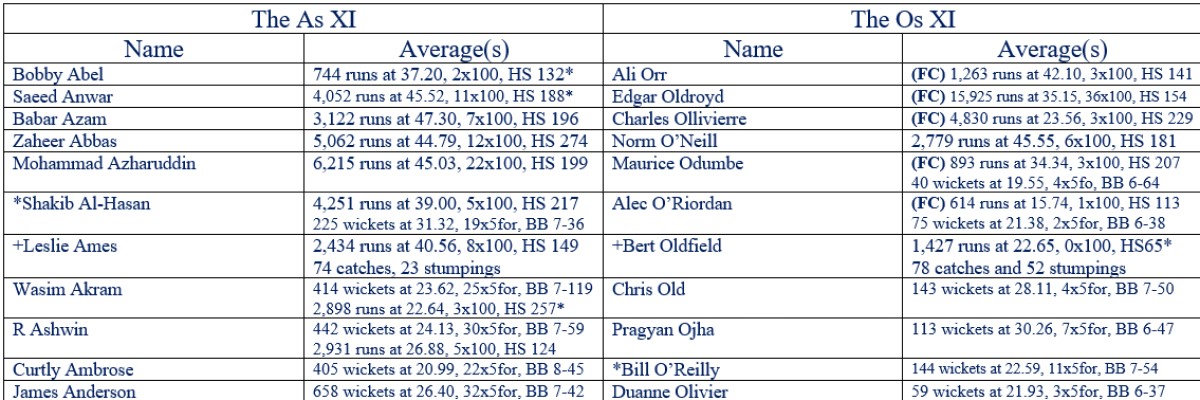
THE As V THE Os

The As dominate this in all departments. The only member of the Os team the As would want in their own ranks is Bill O’Reilly. There can only be one scoreline here: As 5, Os 0

THE As V THE Ps

The opening pairs are closely matched here, the Ps dominate slots 3-5. Procter is massively ahead of Al Hasan as an all rounder – while the Bangladeshi has a better batting record, the Saffa is far ahead with the ball. Pant has a better batting average than Ames and is at least his equal with the gloves. Shaun Pollock is almost an exact match to Akram in terms of bowling figures and almost ten runs an innings better with the bat. Peter Pollock is beaten only by Ambrose among the As quick bowlers. Parker, a victim of selectorial malice in his playing days (a one cap wonder at test level in spite of that huge tally of FC wickets), is the best spinner on either side in this match, though Prasanna is outmatched by Ashwin. The Ps are stronger in batting, and Procter, S Pollock, P Pollock, Parker and Prasanna is not a definitely inferior bowling unit to Ambrose, Anderson, Akram, Ashwin and Al Hasan. I expect the Ps to win, and slightly more comfortably than a bare 3-2. Final score As 1.5, Ps 3.5.

As PROGRESS SO FAR

This has been a tough set of match ups for the As XI, and even with one 5-0 in their favour they score just 11.5 of a possible 25 points in this segment of the alphabet, putting them on 38.5 out of 75, a score of 51.33%, down from the 54% they were on going into this post.

PHOTOGRAPHS

My usual sign off…

All Time XIs – Match Ups (2)

Continuing my analysis of how I see the all time XIs I created for each letter of the alphabet faring against on another.

Yesterday I started the long process of analyzing how my teams for each letter of the alphabet measure up against each other. In that post I have covered the As XI against Bs, Cs, Ds, Es and Fs. At that stage the As rated at 13.5 out of 25. We pick up where we left off.

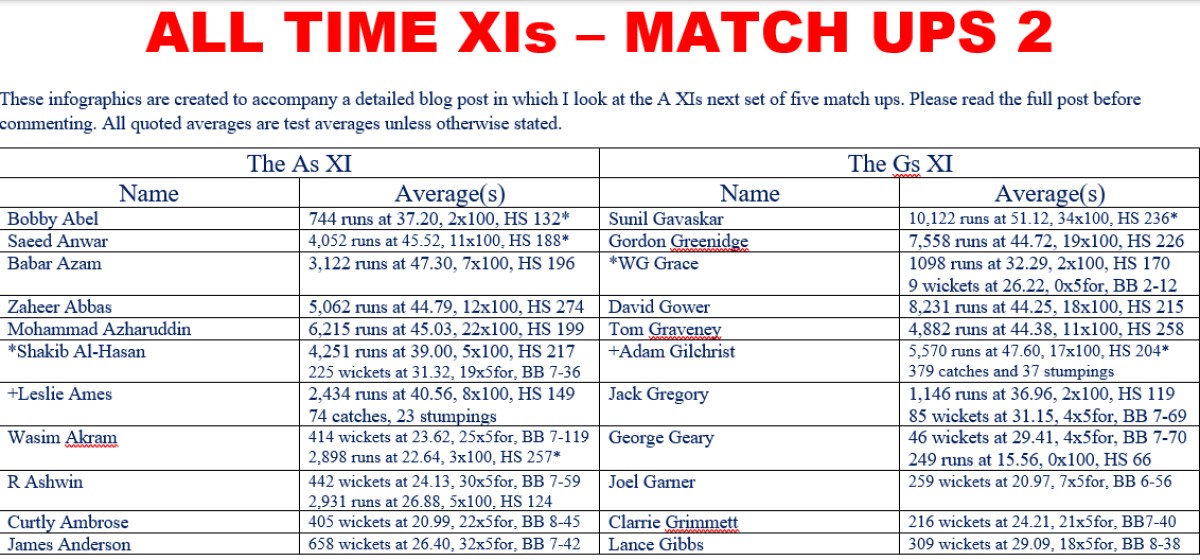
THE As V THE Gs

The Gs have substantial advantages batting wise in positions 1 and 6, a theoretical disadvantage in position 3 and are otherwise about even down to number seven. WG Grace’s test batting average of 32.29 has to be looked at a) with regard to the fact that he was 32 when his career at that level began and almost 51 when it ended and b) with regard to the fact that he played on some pretty ropey pitches. I would thus say that he should be regarded as at minimum Babar Azam’s equal in that department. In bowling the Gs have a very clear advantage, with their sixth best bowler by average, Gregory, marginally better than the As fifth best, Shakib Al Hasan. I also have to say that I reckon that WG has to be considered a better skipper than Shakib Al Hasan. I would score this one as Gs 4, As 1.

THE As V THE Hs

The question here is whether the Hs can make their massive batting advantage tell, when their bowling is weaker than the As. With Hammond prospective third seamer for them, they probably need a turner, when their spinners Harmer and Herath are probably a stronger pair than Ashwin and Al Hasan – Ashwin may be better than Harmer, though it is far from conclusive, but Herath is unquestionably superior to Al Hasan as a bowler. For all the greatness of Hadlee and Holding, they are outnumbered by Akram. Ambrose and Anderson, and the first named of the trio is left handed to add a point of variation. I think that anywhere other than India or Sri Lanka the As would be able to make their pace bowling advantage count, and I score this one As 3, Hs 2.

THE As V THE Is

The As have a huge advantage in batting and in seam bowling, additionally, Ashwin’s clear superiority as an off spinner over Illingworth counter balances Ironmonger’s advantage over Al Hasan as a bowler. Finally, the tail end of the Is is very weak batting wise – Anderson would bat above any of Islam, Ireland or Ironmonger. This is a colossal mismatch in favour of team A, and I accordingly score it As 5 Is 0.

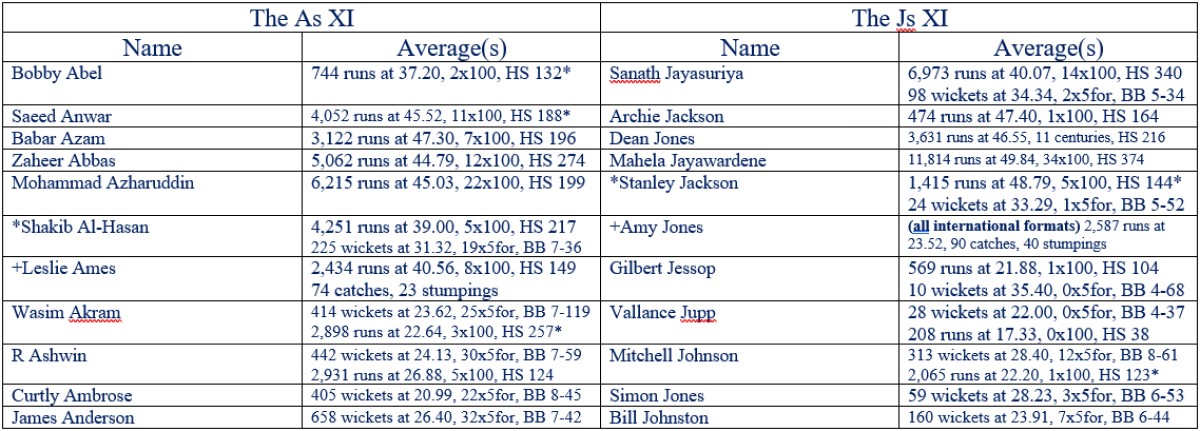
THE As V THE Js

Down to number five the Js win every batting match up. They also have an ‘X factor’ player in Jessop, a great captain in Stanley Jackson. In bowling the Js have greater depth, but the As have more frontline strength. I consider the As to have a definite advantage overall, courtesy of their stellar bowling line up, but not enough to score it at 4-1. Final verdict: As 3.5, Js 1.5.

THE As V THE Ks

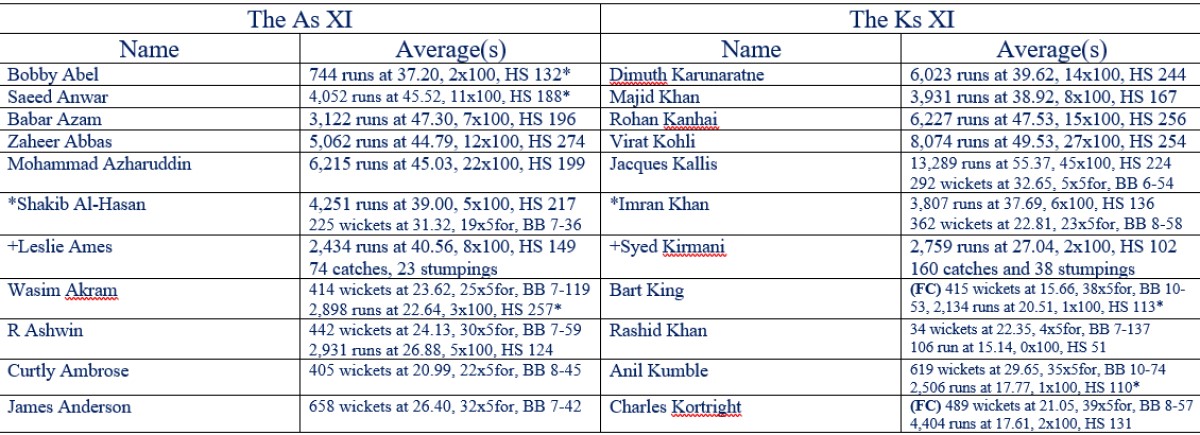
Positions 1-3 are fairly even between these two teams, but the Ks boss positions four and five, and while Shakib Al Hasan has a slightly better batting average than his rival skipper, Imran Khan’s bowling average blows Al Hasan’s out of the water. Ames has a better batting record than Kirmani, but the Indian was probably the finer keeper. Charles Kortright, Bart King and Imran Khan are a faster trio than Akram, Ambrose and Anderson, though don’t include a left armer in their number. The contrasting pair of leg spinners, Kumble and Rashid Khan probably give the Ks the edge in the spin department, and they also have the luxury of having Kallis available as sixth bowler. Finally, whereas the As who two genuine tail enders in Ambrose and Anderson, the Ks bat literally all the way down, with the no11 having two first class hundreds. I award the Ks a substantial advantage, my final score being As 1, Ks 4.

As STATS UPDATED

In the end, with two heavy defeats, one overwhelming win and two respectable wins in these five matches the As score another 13.5 points, now having 27 out of a possible 50 and still being on 54%.

PHOTOGRAPHS

My usual sign off…

All Time XIs – The Letter A

Assembling an XI all of whose surnames begin with A. Also some photographs.

I am revisiting the theme of All Time XIs. This time I am focussing on teams that can be composed with players whose surnames all begin with the same letter. I begin at the beginning with the letter A.

THE XI IN BATTING ORDER

  1. Bobby Abel – Surrey and England. The diminutive opener scored 74 first class centuries with a best of 357* v Somerset at Taunton. He was the first England batter to carry his bat through a completed test innings, scoring 132* on that occasion. He was also a fine fielder.
  2. Saeed Anwar – Pakistan. A superb left handed stroke maker, an excellent counterpart to Abel at the top of the order.
  3. Babar Azam – Pakistan. One of the best all format batters in the world at the moment.
  4. Zaheer Abbas – Gloucestershire and Pakistan. The only Asian to have scored 100+ FC hundreds, a roll of honour that includes scores of 274 and 240 vs England in test matches and eight instances of a century in each innings of an FC match, including four where one of the centuries was a double.
  5. Mohammad Azharruddin – India. A wristy middle order batter who did enough before his career ended in scandalous circumstances (match fixing and other dealings with dodgy bookies) to earn his place in this XI. He announced himself with centuries in each of his first three test matches, and at his peak dominated attacks all around the world.
  6. *Shakib Al-Hasan – Bangladesh. Has an amazing all round record and has achieved it without ever having what could be described as a stellar supporting cast around him
  7. +Leslie Ames – Kent and England. The only recognized keeper to have scored 100FC hundreds. Also holds the record for career stumpings in FC cricket (418). Won the Lawrence Trophy for the fastest hundred of the season twice in its first three seasons. Three of the four instances of the ‘wicket keepers double’ – 1,000 runs and 100 dismissals in FC cricket in a single season – were achieved by him.
  8. Wasim Akram – Lancashire and Pakistan. Among left arm fast bowlers who bat only Alan Davidson of Australia, who played many fewer matches, boasts a test record to rival him.
  9. R Ashwin – India. The best off spinner of the current era, and a handy lower order batter. It is a fair bet that England’s exhilarating run chase at Edgbaston would have been harder work had India picked him rather than Thakur for the number eight slot in their team.
  10. Curtly Ambrose – Northamptonshire and West Indies. The list of bowlers with over 400 test wickets at under 21 a piece currently stands at one: Curtly Elconn Lynwall Ambrose. He rocked the WACA in Perth in 1998 by claiming seven Australian wickets for one run in a spell of 33 balls. Australia having reached 100 only one wicket down were all out for 118. At Trinidad in 1994 England need 194 in the last innings to win, with an awkward hour and a bit to survive in murky light on the penultimate day as their first task. By the end of that short session England were 40-8, and although bad batting played its part, so to did an immaculate spell of bowling by Ambrose.
  11. James Anderson – Lancashire and England. More test wickets than any other pace bowler, and nor is there any obvious sign of his powers waning as his 40th birthday approaches.

This XI has a heavy scoring top five, a genuine all rounder at six, an all time great keeper batter at seven and a quite awesome quartet of bowlers, two of whom can certainly also bat. While the bowling attack is missing a leg spin option it is by any standards both powerful and varied, with left arm pace (Akram), two of the greatest right arm fast mediums of all time, who are different in methods to boot (Ambrose, relying on his immense height and unrelenting accuracy, and Anderson with his mastery of swing and seam). This trio is backed up by a pair of contrasting spinners (Ashwin, off spin, and Al-Hasan, left arm orthodox spin). The biggest decision is likely to which of Anderson or Ambrose gets to share the new ball with Akram.

HONOURABLE MENTIONS

Mike Atherton was close to claiming an opening slot and Dennis Amiss even closer, but I feel credit should be given to Abel for the fact that most of his runs were scored in the 19th century when pitches were often treacherous, and in the case of Amiss also feel that his decision to join a rebel tour of apartheid South Africa counts against him. Two top order batters who could bowl seam up both entered my thoughts: Mohinder Amarnath and Tom Abell. Russel Arnold of Sri Lanka came close. Among the quicks I could not accommodate were Kyle Abbott (Hampshire and South Africa) and Mohammad Abbas (Hampshire and Pakistan). Sri Lankan strokemaker Charith Asalanka may merit a place in few years time. Tommy Andrews, an Aussie middle order batter and ace close fielder of yesteryear was another who could not force his way into the middle order. West Indian left hander Keith Arthurton needed a bit more substance to go with his style to claim a place. Finally, although anyone capable of scoring 167 on the kind of pitches that existed in 1777 as James Aylward of Hambledon did must have been a very fine player, but I felt that there was just too little evidence to justify such a selection.

PHOTOGRAPHS

My usual sign off…

England’s Record Run Chase

An account of England’s victory over India which they completed earlier today, and some of my recent photographs.

This post looks back at the match just concluded between England and India, officially the fifth of the 2021 series.

A LONG DELAYED FINALE

India won the the fourth test of the 2021 series comfortably, and then in the run up to the fifth test there was a Covid scare in the Indian camp. By the letter of the law the match should have been forfeited since England were able to play and India were refusing to put a team out, but because the BCCI pulls the ICCs strings a compromise was arranged, whereby the match would be played in 2022 instead. England after a miserable winter in Australia and then the West Indies had started 2022 in a blaze of glory, recording three successive spectacular victories over World Test Champions New Zealand (who won’t get to defend their title in consequence of this). India made some curious selecorial decisions (Pujara as makeshift opener when Mayank Agarwal was available, Thakur preferred to Ashwin, Vihari at three and Shreyas Iyer in the middle order all definitely questionable and the persistence with an aging, chronically out of form Kohli didn’t look right either), England had two obvious question marks, Crawley at the top of the order and the decision to drop Jamie Overton for the returning Anderson (Anderson’s return had to happen, but I would have had Broad make way for him).

INDIA IN CHARGE FOR THREE DAYS…

India had the better of all of the first three days, with only a century by Jonny Bairstow restricting England’s deficit on first innings to 132. India were then 126-3 in their second innings by the end of day three, leading by 258. James Anderson had underlined his enduring class in the Indian first innings by taking 5-60 while everyone else was was being thrashed. Rishabh Pant played a great innings for India, and was the centrepiece of their total of 416. At the end of day three (just under four playing sessions ago) you would have got generous odds on an England win, though probably not quite the 500-1 famously offered at Headingley in 1981.

…AND THEN

In the first part of day four India failed to make the most of their advantage, rather frittering away their last seven wickets for the addition of a further 120. Pujara scored a gritty 66, Pant a more flamboyant 57, but overall India would have been disappointed with a total of 245 all out, and would have been aware that they had not completely killed the game when they might have done. Ben Stokes claimed four wickets for England.

Just for once England did not lose their first wicket ridiculously early. Crawley and Lees both batted well, but just before tea Crawley was out for 46, leaving one that bowled him. This meant that Pope had to begin his innings twice over, either side of the interval. He managed the first, but not the second. Then Root made a horrible misjudgement which caused Lees to be run out. That was 109-3, 269 more still needed for victory, and Bairstow joined Root. Not only were this pair still together at the close, they had done a lot to break the back of the chase, taking England to 259-3, 119 short of victory with the final day to come. The final morning began with India surely needing to break the stand quickly, and probably needing to have both players out within the first half hour to keep their hopes alive. India showed themselves mentally already beaten when they set fields that effectively said “help yourselves to singles but please don’t bash us”. Root and Bairstow accepted the singles but did not comply with the second part of India’s implied request – anything loose (and India provided a fair quantity of this) was ruthlessly punished. After just an hour and a half of the fifth day, including two ball replacements (a huge number of balls have needed to be replaced in this season’s tests) the job was completed, with a single off the fourth ball of the 77th over of the innings. England won by seven wickets, Root 142*, Bairstow 114*. Root’s hundred was his 28th in test cricket, obliterating the so-called ‘curse of 27’, a piece of nonsense that had arisen due to Steven Smith and Virat Kohli both being stuck on 27 test tons for some considerable time. The truth is that a total of 20 players have scored as many as 27 test centuries, and 16, including Root, have gone on to at least 28, while only four (Allan Border, Graeme Smith, Steven Smith, Virat Kohli) failing to do so. It was also Root’s fifth test hundred of 2022, to follow the six he scored in 2021. Bairstow’s century was his fourth in five test innings, his sixth of 2022 and his second of this match. The Root/ Bairstow stand of 269* was the fourth biggest ever in a fourth innings behind 301 by Arthur Morris and Don Bradman at Headingley in 1948 (Aus won by seven wickets), 287* by Gordon Greenidge and Larry Gomes at Lord’s in 1984 (WI won by nine wickets) and 280 by Bill Edrich and Paul Gibb at Durban in 1939 (a preposterous draw, with England 654-5 chasing 696 for victory when play had to be abandoned). This was also the fourth successive time England had chased 275 or over to win a test match, and England’s record successful run chase, beating the 362-9 at Headingley in 2019.

Bairstow was named Player of the Match for his twin tons, and Root Player of the Series for his 737 runs across the five matches. Virat Kohli’s only noteworthy contributions to this match were sledging Bairstow when that worthy was struggling in the first innings, since which moment Bairstow scored a further 207 runs for once out and a disgraceful display of aggression at the fall of an English wicket yesterday which involved charging straight across the pitch and earned him a ticking off from the umpires and may yet have further repercussions in the form of a fine or even a ban.

For England, as well as the two batting guns Root and Bairstow, Anderson maintained his high standing, Potts looked the real deal, Leach came back well from a hammering in the first innings (1-28 from 12 overs in the second). Broad, two second innings scalps not withstanding, looks to be a fading force at test level. Lees and Pope both deserve extended runs in the side (Pope has just been assigned a new role at number three and has done quite well there, and Lees has shown a lot of promise). Zak Crawley’s second innings 46 should not be enough to save him from the axe, and I fully expect Lees to have a new opening partner against South Africa in six weeks time. India’s carelessness with the bat on the fourth morning probably cost them 100 runs, but the way this England handle fourth innings run chases even that might not have been enough. A full scorecard of the match can be viewed here.

PHOTOGRAPHS

My usual sign off…